Also in 2025 Practice Test B English, question 28.
Passage At Dusk
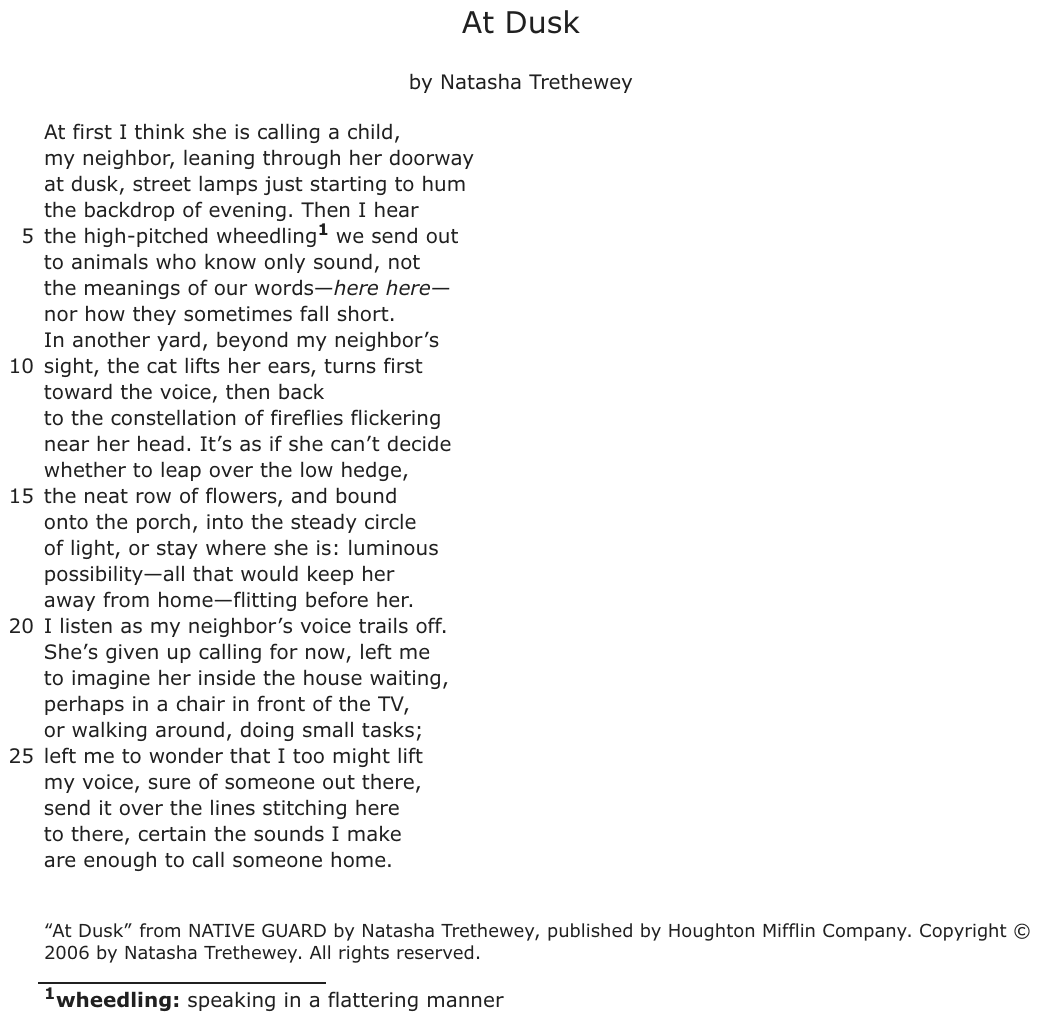
At Dusk
by Natasha Trethewey
At first I think she is calling a child,
my neighbor, leaning through her doorway
at dusk, street lamps just starting to hum
the backdrop of evening. Then I hear
the high-pitched wheedling1 we send out
to animals who know only sound, not
the meanings of our words—here here—
nor how they sometimes fall short.
In another yard, beyond my neighbor’s
sight, the cat lifts her ears, turns first
toward the voice, then back
to the constellation of fireflies flickering
near her head. It’s as if she can’t decide
whether to leap over the low hedge,
the neat row of flowers, and bound
onto the porch, into the steady circle
of light, or stay where she is: luminous
possibility—all that would keep her
away from home—flitting before her.
I listen as my neighbor’s voice trails off.
She’s given up calling for now, left me
to imagine her inside the house waiting,
perhaps in a chair in front of the TV,
or walking around, doing small tasks;
left me to wonder that I too might lift
my voice, sure of someone out there,
send it over the lines stitching here
to there, certain the sounds I make
are enough to call someone home.
“At Dusk” from NATIVE GUARD by Natasha Trethewey, published by Houghton Mifflin Company. Copyright © 2006 by Natasha Trethewey. All rights reserved.
1wheedling: speaking in a flattering manner
Question
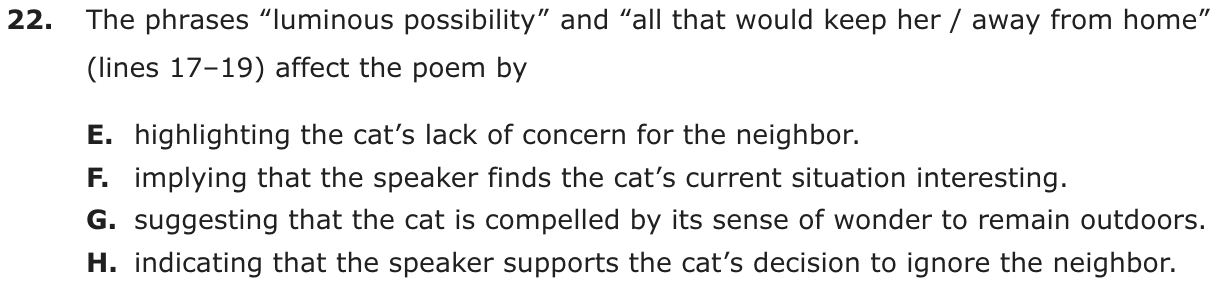
The phrases “luminous possibility” and “all that would keep her / away from home” (lines 17–19) affect the poem by
- Ahighlighting the cat’s lack of concern for the neighbor.
- Bimplying that the speaker finds the cat’s current situation interesting.
- Csuggesting that the cat is compelled by its sense of wonder to remain outdoors.
- Dindicating that the speaker supports the cat’s decision to ignore the neighbor.
Show the answer
Correct answer: C
The question asks how the phrases “luminous possibility” and “all that would keep her / away from home” (lines 17–19) affect the poem.
A. Incorrect. In lines 20–21, the neighbor’s voice “trails off,” and the speaker states that “she’s given up calling for now,” which could be interpreted as a lack of concern. However, these lines describe the neighbor rather than the cat. The phrases from lines 17–19 are used to explain that what keeps the cat from returning home is the allure of “luminous possibility.” The use of the phrase “all that would keep her” suggests that the cat would likely return home to the security of “the steady circle / of light” (lines 16–17) if not for the possibilities offered by the night, implying that the cat usually prefers to be at home with the neighbor. The phrases do not highlight a lack of concern for the neighbor on the part of the cat.
B. Incorrect. While the phrase “luminous possibility” does convey a high degree of interest, it is used to describe why being outside at night appeals to the cat. It does not describe the speaker’s interest in the cat. The speaker observes the cat as it tries to decide between returning home and staying out and then concludes that it is only “luminous / possibility . . . that would keep [the cat] / away from home.”
C. CORRECT. The phrases are used to explain that the cat, though tempted to return home, is also tempted or compelled by “luminous possibility” to remain outdoors. The phrases convey a sense of wonder about what the night may offer, and it is the powerful effect of this sense of wonder (“all that would keep her / away from home”) that ultimately tempts the cat to remain outdoors rather than return to the comforts of home.
D. Incorrect. Lines 17–19 present the speaker’s observations about the cat as it tries to decide whether to stay where it is or return home. The speaker explains that it is only “luminous possibility” that can convince the cat to stay rather than return to the comforts of home. While the speaker then imagines the neighbor indoors, there is no indication that the speaker supports the cat’s decision. The speaker merely notes that the neighbor stops calling to the cat “for now” (line 21), and then the speaker reflects on the possible results of calling someone home.
Question analysis
This reading question asks how the phrases luminous possibility and all that would keep her away from home, which describe what surrounds a cat in a nearby yard, affect the poem At Dusk. Students must interpret abstract, figurative wording and work out whose feelings it conveys: the cat's, the neighbor's or the speaker's.
- Grade level
- Grade 8 reading and task
- Compared with grade 7
- At grade 7 Explaining how word choice affects a poem is grade 7 work. These phrases are abstract and broken across lines, which adds some challenge, but the lines around them are concrete, so the task stays within typical grade 7 demand.
- Estimated difficulty
- Moderate: several steps, or a close reading with one strong distractor.
- Thinking it demands
- Depth of knowledge 2, skills and concepts · mainly analyze
- What makes it hard
- Figurative or literary language moderate
- Reading between the lines minor
- Complex sentences minor
- Evidence
- Answered from one paragraph or stanza
- Reading level
- Passage: 236 words (a poem; reading level not measured); question and choices: about grade 8, 63 words.
- Students, last 30 days
- Not enough answers yet to show (it takes 10).
Why it is hard, traps and wrong answers (shows the answer)
Why it is hard
The phrases belong to the speaker but describe what tempts the cat, and the choices exploit that by offering the speaker's interest or approval, or the cat's indifference to its owner. The words “all that would keep her / away from home” imply that home still pulls at the cat, so only an attraction strong enough to hold her outside fits. Students who first settle whose experience the phrases describe can rule out most choices at once.
Figurative or literary language moderate Understanding the question
“Luminous possibility” is abstract, an unnamed promise glowing in the dusk, and students must see it as what draws the cat, the counterweight to “the steady circle / of light” at home. (Graesser, Singer & Trabasso, 1994; Kintsch, 1998)
Reading between the lines minor Working it out
The phrases are the speaker's words about the cat, so students must work out that they convey the cat's pull, not the speaker's opinion or the neighbor's feelings. (Graesser, Singer & Trabasso, 1994; Kintsch, 1998)
Complex sentences minor Understanding the question
The phrases are broken across lines 17–19 and set off by dashes, so “flitting before her” is separated from “possibility” by the inserted “all that would keep her / away from home.” (Abedi & Lord, 2001; Freedle & Kostin, 1993; Messick, 1989)
Strategy: Decide first who or what the phrases describe, then keep only choices about that same subject and check that the phrases themselves show what each one claims.
Traps
- Wrong tone or attitude: Misjudges the tone, attitude or point of view, such as reading admiration as criticism, or taking a character's or subject's feelings for the author's.
- Reads too much in: A reasonable-sounding conclusion that goes further than the text allows.
The wrong answers, classified
A Reads too much in (Graesser, Singer & Trabasso, 1994)
Reads the cat's staying out as indifference to its owner, though “all that would keep her / away from home” implies home would win without the night's attractions.
B Wrong tone or attitude (Graesser, Singer & Trabasso, 1994)
Notices that “luminous possibility” is the speaker's lyrical phrase and takes it as the speaker's own interest, when it describes the wonder drawing the cat.
D Reads too much in (Graesser, Singer & Trabasso, 1994)
Assumes that describing the night so warmly means the speaker approves of the cat ignoring the neighbor, an opinion the poem never states.
Working it out, step by step
Figure out what the question asks
You need to know what two phrases do in the poem. First decide who they describe. Here they describe the cat and what pulls at her.
Find the phrases in lines 17–19
The cat could go home, “or stay where she is: luminous / possibility—all that would keep her / away from home—flitting before her.”
Work out what the words mean
“Luminous” means glowing with light. “Possibility” means what might happen. “Flitting” means darting quickly about, like the fireflies near her head. So the glowing night is full of exciting chances. It is everything that “would keep her / away from home.” That sense of wonder is what holds the cat outside.
Check each choice
- A is wrong. “All that would keep her / away from home” means home pulls at her too. She isn’t uncaring.
- B is wrong. The phrases describe what draws the cat, not how the speaker feels.
- C is right. The night’s glow and wonder tempt the cat to stay out. “Compelled” means strongly pulled.
- D is wrong. The speaker never says the cat is right to stay out.
Watch out: B is tempting because “luminous possibility” is the speaker’s own beautiful wording. But the speaker uses it to show what the cat sees.
Choose the answer
The phrases show a wonder strong enough to hold the cat outdoors. So the answer is C.
Why this answer and not the closest wrong one
B is the closest wrong answer. The speaker does choose these glowing words. But they describe the night that is “flitting before her,” the cat. They explain what keeps her “away from home.” C fits, because the phrases show the cat drawn by wonder to stay outside.
More questions like this
The original DOE question
The passage “At Dusk” as printed (page 48)