Also in 2025 Practice Test B English, question 27.
Passage At Dusk
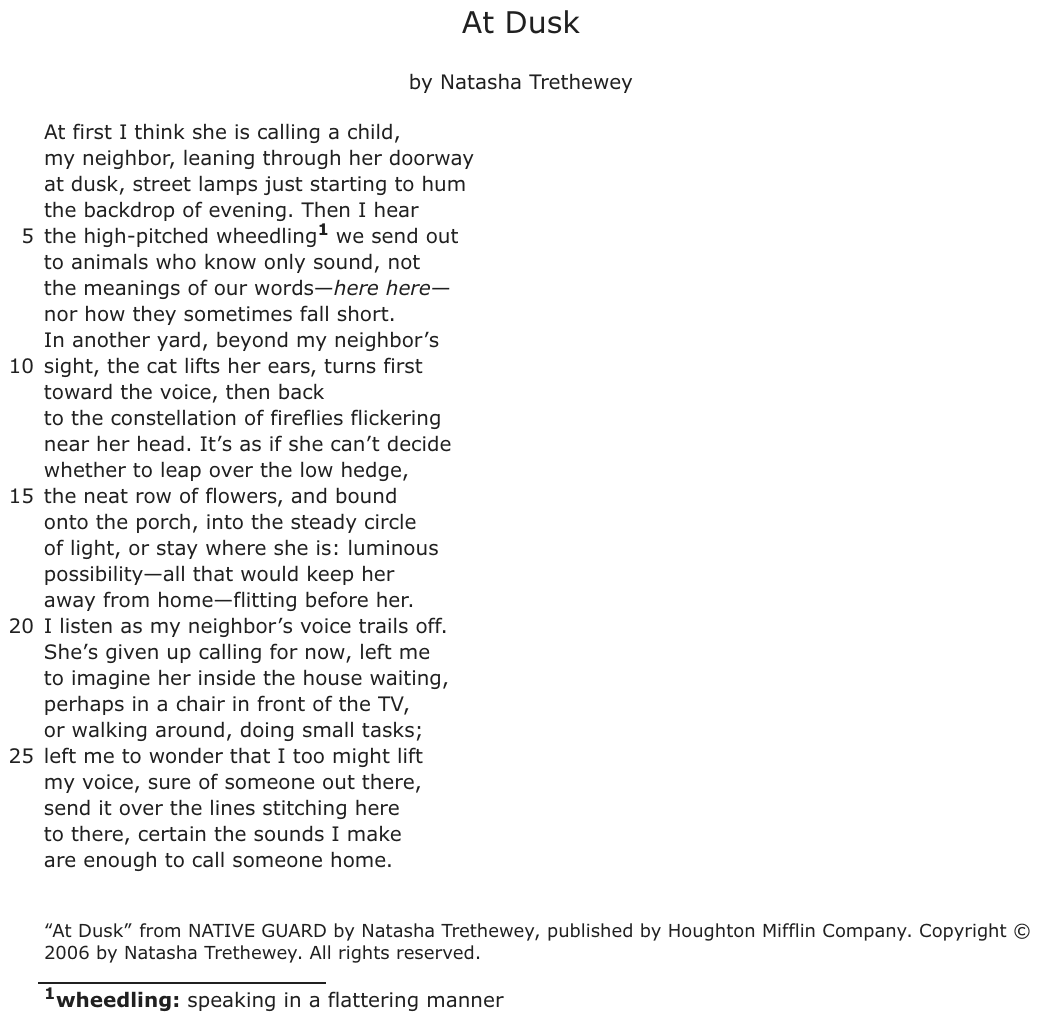
At Dusk
by Natasha Trethewey
At first I think she is calling a child,
my neighbor, leaning through her doorway
at dusk, street lamps just starting to hum
the backdrop of evening. Then I hear
the high-pitched wheedling1 we send out
to animals who know only sound, not
the meanings of our words—here here—
nor how they sometimes fall short.
In another yard, beyond my neighbor’s
sight, the cat lifts her ears, turns first
toward the voice, then back
to the constellation of fireflies flickering
near her head. It’s as if she can’t decide
whether to leap over the low hedge,
the neat row of flowers, and bound
onto the porch, into the steady circle
of light, or stay where she is: luminous
possibility—all that would keep her
away from home—flitting before her.
I listen as my neighbor’s voice trails off.
She’s given up calling for now, left me
to imagine her inside the house waiting,
perhaps in a chair in front of the TV,
or walking around, doing small tasks;
left me to wonder that I too might lift
my voice, sure of someone out there,
send it over the lines stitching here
to there, certain the sounds I make
are enough to call someone home.
“At Dusk” from NATIVE GUARD by Natasha Trethewey, published by Houghton Mifflin Company. Copyright © 2006 by Natasha Trethewey. All rights reserved.
1wheedling: speaking in a flattering manner
Question
The details in lines 10–17 about the cat convey a central idea of the poem by
- Ashowing that returning home after experiencing independence is challenging.
- Bsuggesting that caring for others means allowing them to grow and to roam freely.
- Cimplying that expecting to feel at home in the natural world leads to disappointment.
- Demphasizing the conflicting desires to return to the familiar and to explore the unknown.
Show the answer
Correct answer: D
The question asks how the details in lines 10–17 convey a central idea of the poem.
A. Incorrect. In lines 10–17, the speaker says that the cat’s actions—she “turns first / toward the voice, then back”—make the cat seem “as if she can’t decide” whether to return home or to explore “the constellation of fireflies flickering / near her head.” However, while the cat is indecisive, it is not the experience of independence that causes this conflict for the cat but rather the “luminous / possibility . . . flitting before her” (lines 17–19).
B. Incorrect. The neighbor’s calling of the cat indicates that she does allow it to roam outside regularly. However, the details in these lines focus not on whether allowing the cat to roam is an expression of caring but on the cat’s reaction to the neighbor’s calls, “as if she can’t decide” (line 13) whether to return home “into the steady circle / of light” (lines 16–17) or stay and enjoy the “luminous / possibility” (lines 17–18) that the night offers. Furthermore, the neighbor’s “wheedling” (line 5) and the timing of her call, “at dusk” (line 3), introduce the possibility that encouraging others to come home expresses more caring than allowing them to roam freely.
C. Incorrect. Lines 10–17 describe the reactions of the cat, who is exploring the natural world, including a “constellation of fireflies flickering / near her head,” when the neighbor calls to her. The poet describes the cat’s conflict by saying that “It’s as if she can’t decide” whether to stay outdoors or return “into the steady circle / of light” at home with the neighbor. However, the cat’s indecision demonstrates that, rather than being a disappointment, the natural world is as appealing as home.
D. CORRECT. Lines 10–11 describe how the cat “turns first / toward the voice, then back,” indicating that the cat is experiencing a conflict. To the speaker, the cat seems “as if she can’t decide” (line 13) between exploring “the constellation of fireflies” (line 12) outdoors and returning to the familiar “steady circle / of light” (lines 16–17) indoors. This central idea that someone might experience a conflict between exploring and returning to the familiar is suggested again in lines 28–29 when the speaker wonders whether “the sounds I make / are enough to call someone home.”
Question analysis
This reading question asks how the lines describing a cat in another yard, as the neighbor calls from her doorway, convey a central idea of Natasha Trethewey's poem At Dusk. Students must turn a concrete picture of an animal's behavior into a general idea and check each proposed lesson against what the cat actually does in these lines.
- Grade level
- Grade 7 reading and task
- Compared with grade 7
- At grade 7 Showing how specific lines convey a central idea is grade 7 work. The cat's behavior is concrete and easy to picture, so the step from image to idea is a typical grade 7 poetry task.
- Estimated difficulty
- Moderate: several steps, or a close reading with one strong distractor.
- Thinking it demands
- Depth of knowledge 2, skills and concepts · mainly understand
- What makes it hard
- Figurative or literary language moderate
- Reading between the lines minor
- Evidence
- Answered from one paragraph or stanza
- Reading level
- Passage: 236 words (a poem; reading level not measured); question and choices: about grade 9, 66 words.
- Corrected from the DOE handbook
- A grammar slip in the explanation was corrected.
- Students, last 30 days
- Not enough answers yet to show (it takes 10).
Why it is hard, traps and wrong answers (shows the answer)
Why it is hard
The lines show a cat turning toward the voice and back to the fireflies, then hesitating between the porch light and the night, so the idea is a pull in two directions. The most tempting wrong answer also describes trouble going home but explains it by time spent away, a cause these lines never give. Other choices bring in lessons about caring for pets or about nature letting us down, which the bright images of the night contradict.
Figurative or literary language moderate Understanding the question
The two pulls are images, “the constellation of fireflies flickering” for the unknown and “the steady circle / of light” on the porch for the familiar, and both must be read that way. (Graesser, Singer & Trabasso, 1994; Kintsch, 1998)
Reading between the lines minor Working it out
Students must turn one cat's hesitation in a yard into an idea about people, a step these lines leave to the reader until the speaker's own wish at the end of the poem. (Graesser, Singer & Trabasso, 1994; Kintsch, 1998)
Strategy: Describe in plain words what the cat does in lines 10–17 and why, then choose the general idea that matches that behavior without adding causes the lines never give.
Traps
- Half right: One half of a two-part choice is right and the other is not.
- Outside knowledge: A choice is plausible in the real world but not supported by this text.
- Twists what the text says: Uses the text's topic and ideas but changes what it says: who did it, how much, when, or why.
The wrong answers, classified
A Half right (King et al., 2004; Thissen, Steinberg & Fitzpatrick, 1989)
Rightly sees that going home is hard for the cat but blames a taste of independence, when the lines show her drawn by the fireflies now, not changed by time away.
B Outside knowledge (King et al., 2004; Recht & Leslie, 1988)
Brings in a familiar belief that caring means letting loved ones roam, but lines 10–17 describe the cat's choice, not how the neighbor shows care.
C Twists what the text says (King et al., 2004)
Turns the poem's picture of nature upside down: the fireflies and the “luminous / possibility” make the outdoors appealing, not a source of disappointment.
What was corrected from the DOE handbook, and why
- Explanation: In rejecting choice A, the handbook reads “the cat’s actions—she “turns first / toward the voice, then back”—makes the cat seem.” It now reads “make,” to agree with “actions.”
Working it out, step by step
Figure out what the question asks
Lines 10–17 are about the cat. A central idea is a main message of the poem. You need the idea that these details about the cat show.
Read what the cat does
The cat “lifts her ears, turns first / toward the voice, then back / to the constellation of fireflies flickering / near her head” (lines 10–13). Then the speaker says, “It’s as if she can’t decide” (line 13). She could leap “onto the porch, into the steady circle / of light” (lines 16–17). Or she could “stay where she is” (line 17).
Work out what it means
The porch light is home. It is familiar, something the cat knows well. The fireflies are like a “constellation,” a group of stars. They stand for the unknown night and its wonders. The cat is pulled both ways. Part of her wants home. Part of her wants to stay out and explore.
Check each choice
- A is wrong. Going home is hard for the cat. But the reason is the fireflies near her now. The lines never say she got used to being free.
- B is wrong. These lines are about the cat’s choice. They say nothing about caring for her or letting her roam.
- C is wrong. Nature is not disappointing here. The fireflies make the outdoors glow.
- D is right. The cat is torn between the familiar porch and the unknown night.
Watch out: A sounds close, because the cat really does have trouble going home. But A adds a cause the poem never gives.
Choose the answer
The cat turns toward home and then back to the fireflies. So the answer is D.
Why this answer and not the closest wrong one
A is the closest wrong answer. It is right that going home is hard for the cat. But A blames a taste of freedom from time spent away. The poem says nothing about that. It shows two pulls at once: the voice and light of home, and the fireflies close by. D names both desires.
More questions like this
The original DOE question

The passage “At Dusk” as printed (page 48)