Passage 5 Reasons Physical Books Might Be Better Than E-Books
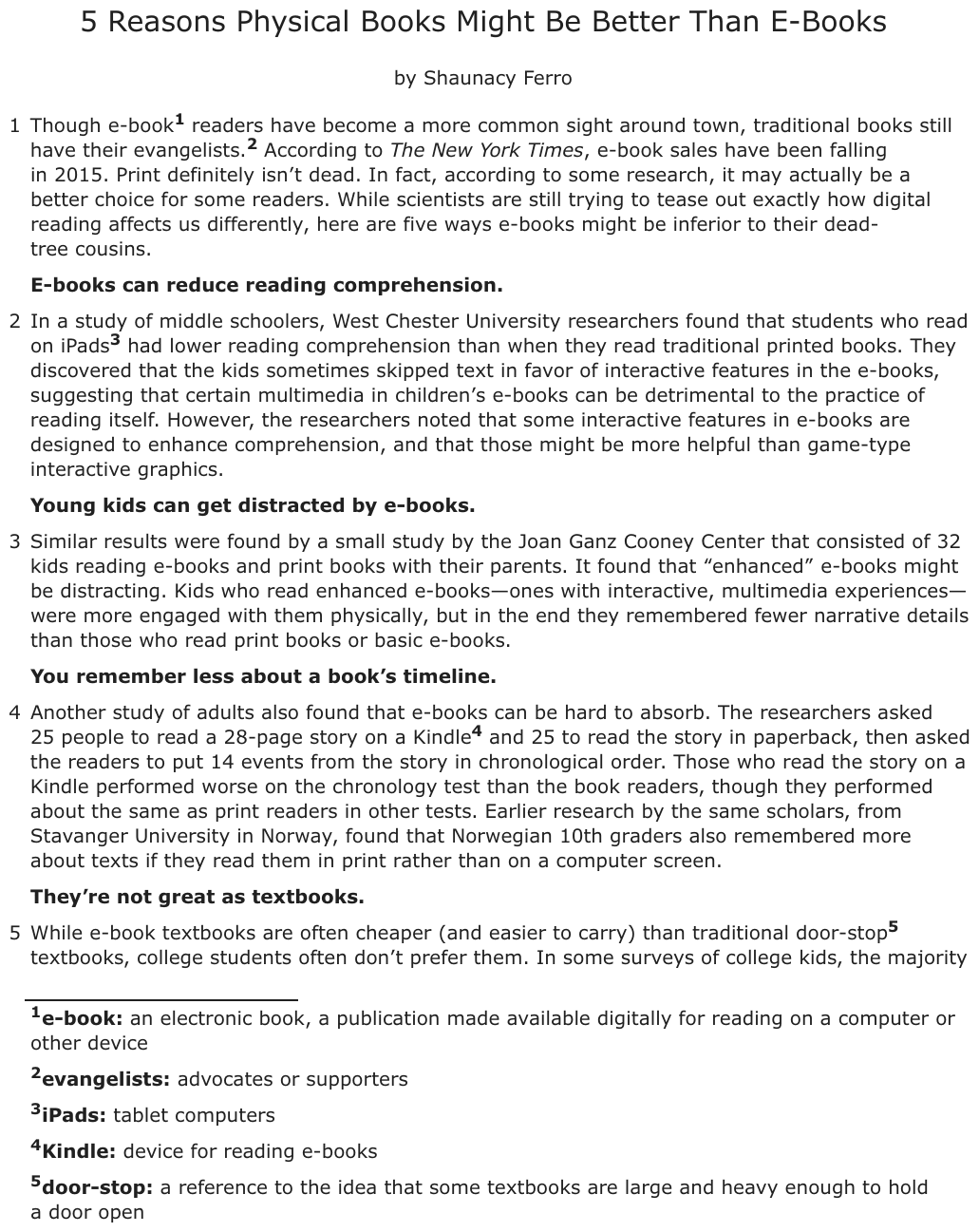
5 Reasons Physical Books Might Be Better Than E-Books
by Shaunacy Ferro
Though e-book1 readers have become a more common sight around town, traditional books still have their evangelists.2 According to The New York Times, e-book sales have been falling in 2015. Print definitely isn’t dead. In fact, according to some research, it may actually be a better choice for some readers. While scientists are still trying to tease out exactly how digital reading affects us differently, here are five ways e-books might be inferior to their dead-tree cousins.
E-books can reduce reading comprehension.
In a study of middle schoolers, West Chester University researchers found that students who read on iPads3 had lower reading comprehension than when they read traditional printed books. They discovered that the kids sometimes skipped text in favor of interactive features in the e-books, suggesting that certain multimedia in children’s e-books can be detrimental to the practice of reading itself. However, the researchers noted that some interactive features in e-books are designed to enhance comprehension, and that those might be more helpful than game-type interactive graphics.
Young kids can get distracted by e-books.
Similar results were found by a small study by the Joan Ganz Cooney Center that consisted of 32 kids reading e-books and print books with their parents. It found that “enhanced” e-books might be distracting. Kids who read enhanced e-books—ones with interactive, multimedia experiences—were more engaged with them physically, but in the end they remembered fewer narrative details than those who read print books or basic e-books.
You remember less about a book’s timeline.
Another study of adults also found that e-books can be hard to absorb. The researchers asked 25 people to read a 28-page story on a Kindle4 and 25 to read the story in paperback, then asked the readers to put 14 events from the story in chronological order. Those who read the story on a Kindle performed worse on the chronology test than the book readers, though they performed about the same as print readers in other tests. Earlier research by the same scholars, from Stavanger University in Norway, found that Norwegian 10th graders also remembered more about texts if they read them in print rather than on a computer screen.
They’re not great as textbooks.
While e-book textbooks are often cheaper (and easier to carry) than traditional door-stop5 textbooks, college students often don’t prefer them. In some surveys of college kids, the majority of students have reported preferring print books. However, a 2012 study from the UK’s National Literacy Trust of kids ages 8 to 16 found that more than 50 percent of children reported preferring screen reading.
They’re tiring.
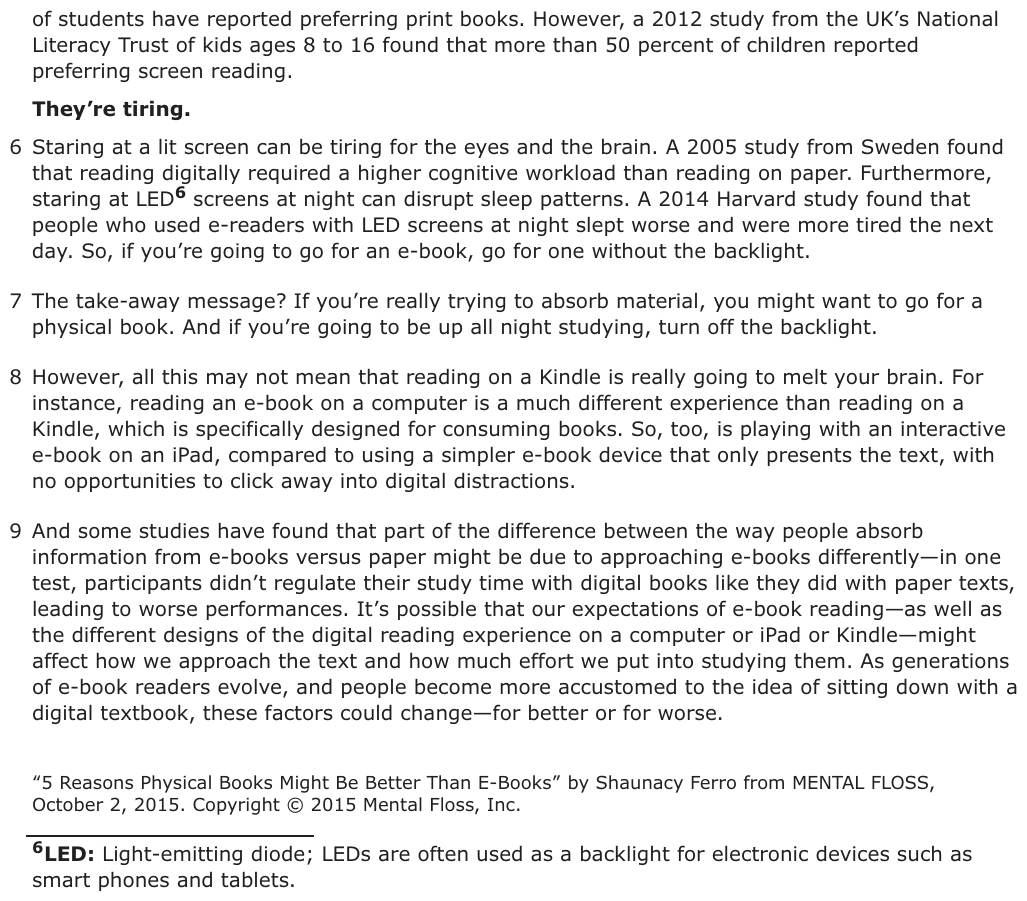
Staring at a lit screen can be tiring for the eyes and the brain. A 2005 study from Sweden found that reading digitally required a higher cognitive workload than reading on paper. Furthermore, staring at LED6 screens at night can disrupt sleep patterns. A 2014 Harvard study found that people who used e-readers with LED screens at night slept worse and were more tired the next day. So, if you’re going to go for an e-book, go for one without the backlight.
The take-away message? If you’re really trying to absorb material, you might want to go for a physical book. And if you’re going to be up all night studying, turn off the backlight.
However, all this may not mean that reading on a Kindle is really going to melt your brain. For instance, reading an e-book on a computer is a much different experience than reading on a Kindle, which is specifically designed for consuming books. So, too, is playing with an interactive e-book on an iPad, compared to using a simpler e-book device that only presents the text, with no opportunities to click away into digital distractions.
And some studies have found that part of the difference between the way people absorb information from e-books versus paper might be due to approaching e-books differently—in one test, participants didn’t regulate their study time with digital books like they did with paper texts, leading to worse performances. It’s possible that our expectations of e-book reading—as well as the different designs of the digital reading experience on a computer or iPad or Kindle—might affect how we approach the text and how much effort we put into studying them. As generations of e-book readers evolve, and people become more accustomed to the idea of sitting down with a digital textbook, these factors could change—for better or for worse.
“5 Reasons Physical Books Might Be Better Than E-Books” by Shaunacy Ferro from MENTAL FLOSS, October 2, 2015. Copyright © 2015 Mental Floss, Inc.
1e-book: an electronic book, a publication made available digitally for reading on a computer or other device
2evangelists: advocates or supporters
3iPads: tablet computers
4Kindle: device for reading e-books
5door-stop: a reference to the idea that some textbooks are large and heavy enough to hold a door open
6LED: Light-emitting diode; LEDs are often used as a backlight for electronic devices such as smart phones and tablets.
Question
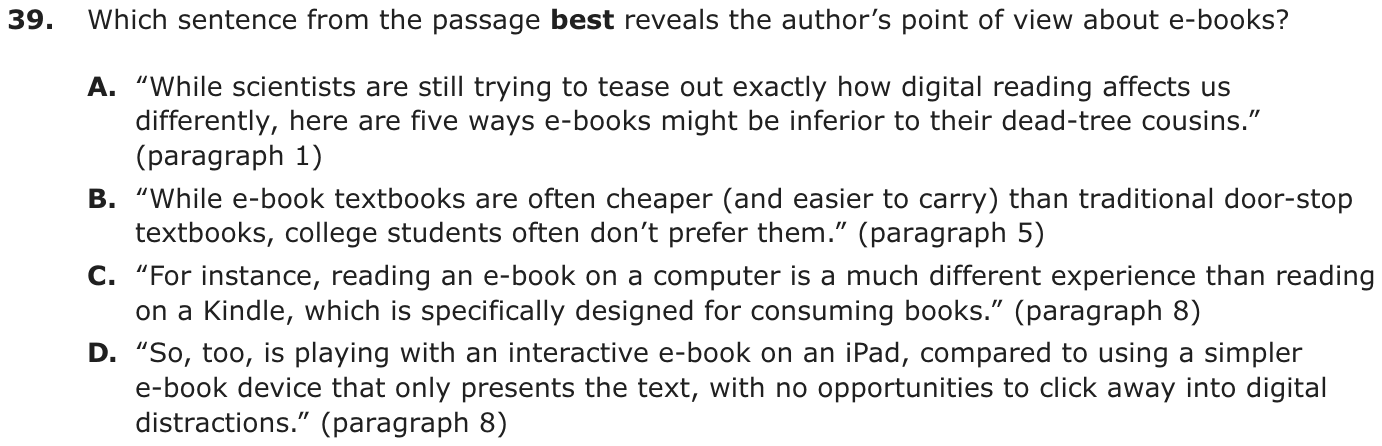
Which sentence from the passage best reveals the author’s point of view about e-books?
- A“While scientists are still trying to tease out exactly how digital reading affects us differently, here are five ways e-books might be inferior to their dead-tree cousins.” (paragraph 1)
- B“While e-book textbooks are often cheaper (and easier to carry) than traditional door-stop textbooks, college students often don’t prefer them.” (paragraph 5)
- C“For instance, reading an e-book on a computer is a much different experience than reading on a Kindle, which is specifically designed for consuming books.” (paragraph 8)
- D“So, too, is playing with an interactive e-book on an iPad, compared to using a simpler e-book device that only presents the text, with no opportunities to click away into digital distractions.” (paragraph 8)
Show the answer
Correct answer: A
The question asks which sentence from the passage best reveals the author’s point of view about e-books.
A. CORRECT. The sentence from paragraph 1 best reveals the author’s point of view because it introduces the author’s argument that “e-books might be inferior,” which is illustrated throughout the text.
B. Incorrect. The sentence from paragraph 5 provides a small detail about college students preferring traditional books over e-books despite the fact that e-books may seem ideal by being “cheaper (and easier to carry).” This statement supports one point made in the text but not the author’s broader point of view about e-books in general.
C. Incorrect. In the second sentence from paragraph 8, the author discusses answers to why “all this may not mean that reading on a Kindle is really going to melt your brain” and compares reading on a Kindle with reading on a computer to explain how they are different. The sentence focuses on the experiences with using two types of e-book devices rather than on the author’s broader opinion about e-books.
D. Incorrect. In the last sentence from paragraph 8, the author uses the previous comparison between reading on a Kindle and reading on a computer to illustrate the differences between “playing with an interactive e-book on an iPad” and using “a simpler e-book device that only presents the text” and limits distractions. However, similar to the sentence in Option C, this sentence focuses on the experiences of using two types of e-book devices rather than on the author’s broader point of view about e-books.
Question analysis
This point-of-view question asks which sentence best reveals the author's own view of e-books in a magazine article weighing them against printed books. Students must separate a sentence that states the author's position from sentences that support or qualify it, and the article's later hedging about e-books can blur the picture.
- Grade level
- Grade 7 reading and task
- Compared with grade 7
- At grade 7 Identifying an author's point of view in an informational article is standard grade 7 work. The quotations are labeled by paragraph and the article's stance stays consistent, so the demand matches a typical grade 7 point-of-view item.
- Estimated difficulty
- Straightforward: two steps or one careful reading.
- Thinking it demands
- Depth of knowledge 2, skills and concepts · mainly analyze
- What makes it hard
- How, not what minor
- Complex sentences minor
- Evidence
- Answered from the whole text
- Reading level
- Passage: about grade 10, 829 words; question and choices: about grade 14, 122 words.
- Students, last 30 days
- Not enough answers yet to show (it takes 10).
Why it is hard, traps and wrong answers (shows the answer)
Why it is hard
The article announces its stance in the first paragraph, so the question rewards recognizing the sentence where the author sets up the whole list of reasons. The pull comes from a sentence about college students passing up cheaper e-book textbooks, which agrees with the author but reports one finding. The two sentences from paragraph 8 compare devices, and their mention of “digital distractions” can sound like a verdict without being one.
How, not what minor Working it out
Point of view must be told apart from reported fact: three sentences describe students' habits or devices, and only one carries the author's verdict, “might be inferior”. (Anderson & Krathwohl, 2001)
Complex sentences minor Understanding the question
The right sentence holds its point behind a long “While scientists are still trying to tease out” clause, and paragraph 8's “So, too, is playing with” sentence borrows its meaning from the one before. (Abedi & Lord, 2001; Freedle & Kostin, 1993; Messick, 1989)
Strategy: First decide in a few words what the author thinks about e-books overall, then find the sentence that states that view rather than one piece of support for it.
Traps
- Too narrow: A single detail offered as the central idea or a summary, or a summary that keeps minor details and leaves out an essential part.
- True but not the answer: A choice says something accurate about the text that does not answer this question.
The wrong answers, classified
B Too narrow (King et al., 2004)
Takes the finding that college students pass up cheaper e-book textbooks, one supporting detail for one of the five reasons, as the author's overall view of e-books.
C True but not the answer (King et al., 2004; Embretson & Wetzel, 1987)
Picks paragraph 8's contrast between reading on a computer and on a Kindle, an accurate comparison of two devices that passes no judgment on e-books as such.
D True but not the answer (King et al., 2004; Embretson & Wetzel, 1987)
Hears criticism in “digital distractions”, but the sentence explains how an interactive iPad e-book differs from a text-only device, part of the article's hedge, not its verdict.
Working it out, step by step
Know what point of view means
An author’s point of view is what the author thinks about a topic. You need the sentence that shows how the author sees e-books overall. One small fact, or a comparison of two devices, isn’t enough.
Sum up the author’s view
The title says physical books “Might Be Better Than E-Books.” The article then gives five reasons, one under each bold heading. So the author thinks e-books may be worse than print for some kinds of reading.
Find where the author says it
Choice A comes from paragraph 1. It ends, “here are five ways e-books might be inferior to their dead-tree cousins.” Inferior means worse. “Dead-tree cousins” is a joke name for paper books, since paper is made from trees. This sentence states the author’s view and sets up the whole list.
Check each choice
- A fits: it states the author’s overall view that e-books “might be inferior.”
- B is wrong because it reports one finding about college students, which supports just one reason.
- C is wrong because it compares a computer and a Kindle without judging e-books.
- D is wrong because it explains how an iPad e-book differs from a simpler device, not what the author thinks.
Watch out: B agrees with the author, so it seems right. But it is one small piece of support, not the view itself.
Choose the answer
Choice A is where the author announces the opinion behind the whole article. So the answer is A.
Why this answer and not the closest wrong one
B comes closest, because it fits the author’s view. But it reports what college students prefer, one detail in one section. A is where the author states the opinion the whole article supports: e-books “might be inferior” to print.
More questions like this
The original DOE question
The passage “5 Reasons Physical Books Might Be Better Than E-Books” as printed (pages 58–59)