Also in 2025 Practice Test B English, question 31.
Passage At Dusk
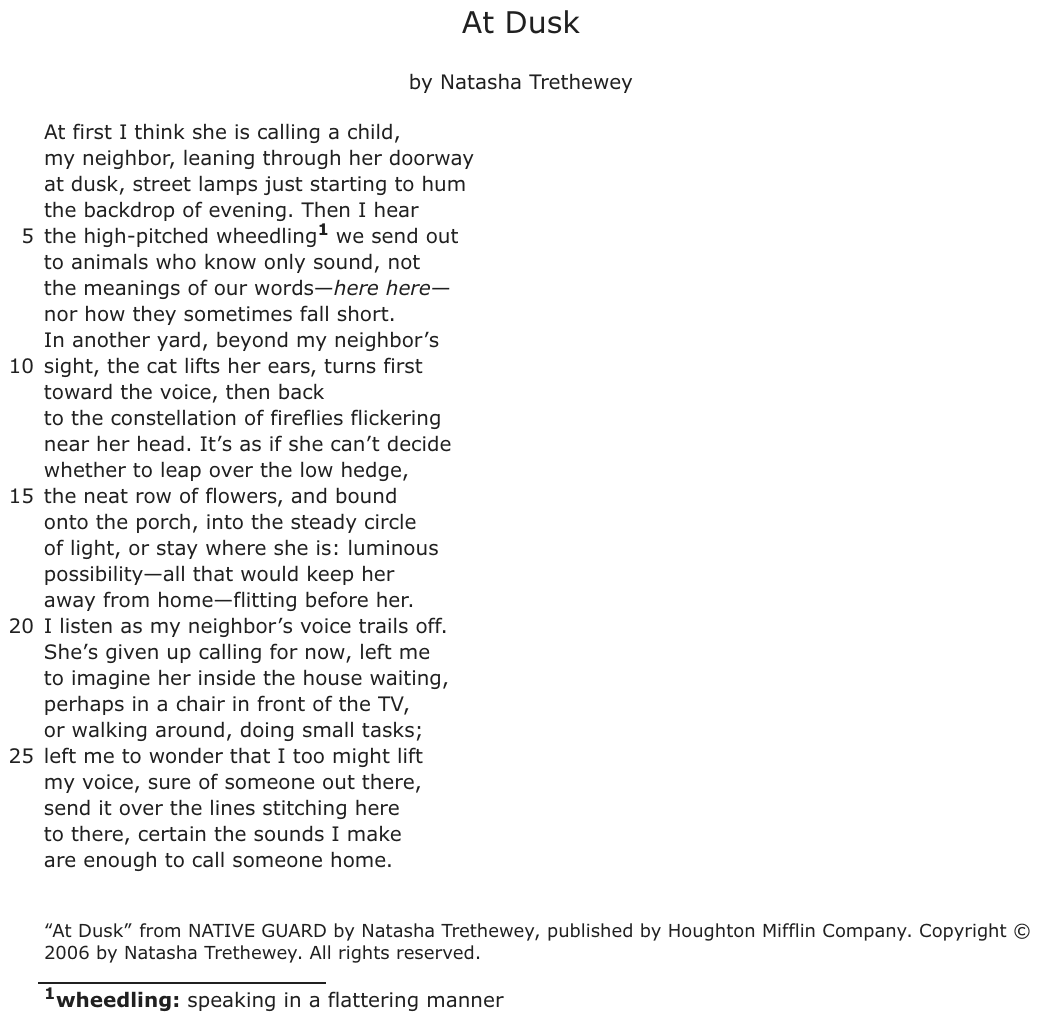
At Dusk
by Natasha Trethewey
At first I think she is calling a child,
my neighbor, leaning through her doorway
at dusk, street lamps just starting to hum
the backdrop of evening. Then I hear
the high-pitched wheedling1 we send out
to animals who know only sound, not
the meanings of our words—here here—
nor how they sometimes fall short.
In another yard, beyond my neighbor’s
sight, the cat lifts her ears, turns first
toward the voice, then back
to the constellation of fireflies flickering
near her head. It’s as if she can’t decide
whether to leap over the low hedge,
the neat row of flowers, and bound
onto the porch, into the steady circle
of light, or stay where she is: luminous
possibility—all that would keep her
away from home—flitting before her.
I listen as my neighbor’s voice trails off.
She’s given up calling for now, left me
to imagine her inside the house waiting,
perhaps in a chair in front of the TV,
or walking around, doing small tasks;
left me to wonder that I too might lift
my voice, sure of someone out there,
send it over the lines stitching here
to there, certain the sounds I make
are enough to call someone home.
“At Dusk” from NATIVE GUARD by Natasha Trethewey, published by Houghton Mifflin Company. Copyright © 2006 by Natasha Trethewey. All rights reserved.
1wheedling: speaking in a flattering manner
Question
The poet develops a theme about making connections with others mainly through the
- Aexploration of the desires of the speaker and the neighbor.
- Bspeaker’s observations of the sights and sounds in the neighborhood.
- Cspeculations the speaker makes about what the neighbor does inside her house.
- Dspeaker’s explanation of the cat’s thoughts and actions.
Show the answer
Correct answer: A
The question asks for an explanation of how the poet develops a theme about making connections with others.
A. CORRECT. The speaker first describes the neighbor calling the cat in a “high-pitched wheedling” (line 5) voice before giving up and returning indoors. The neighbor’s desire to have the cat return home prompts the speaker to wonder whether the speaker could call out and be “certain the sounds . . . / are enough to call someone home” (lines 28–29). These final lines most develop the theme of connection by conveying a desire to be able to prompt someone’s return.
B. Incorrect. Line 1, in which the speaker at first thinks the sound in the neighborhood is the neighbor “calling a child,” might be assumed to introduce a theme of making connections with others. However, other descriptions of the sights and sounds of the neighborhood, including the time of day—“at dusk, street lamps just starting to hum / the backdrop of evening” (lines 3–4) and “constellation of fireflies flickering” (line 12) near the cat—have no relationship to a theme of connection.
C. Incorrect. In lines 22–24, the speaker imagines the neighbor’s activities inside her house: “perhaps in a chair in front of the TV, / or walking around, doing small tasks.” Although the speaker does imagine the neighbor is doing these things to pass time while “waiting” (line 22) for the cat, the neighbor’s actions—and even the speaker’s imagining—are carried out alone, so they do not develop a theme of connection.
D. Incorrect. Lines 10–19 present the speaker’s observations of the cat, which “turns first / toward the voice, then back” when the neighbor calls, then appears “as if she can’t decide” whether to return to the neighbor or stay outside. Although the cat’s indecision about whether to heed the neighbor’s call might seem to develop a theme about making connections, lines 10–19 focus more on the relative appeal of the cat’s two options—returning to “the steady circle / of light” at home or pursuing the “luminous / possibility . . . flitting before her”—than on any connection between the cat and its owner or between the speaker and the neighbor.
Question analysis
This reading question asks which element of Natasha Trethewey's poem At Dusk mainly develops its theme about making connections with others. All four choices describe something that really happens in the poem, from neighborhood sights to a cat's hesitation, so students must weigh how much each part contributes to that theme.
- Grade level
- Grade 8 reading and task
- Compared with grade 7
- Above grade 7 Analyzing how a theme develops is grade 7 work, but here the student must rank four genuine features of the poem by how much each builds the theme, a comparison that asks more than typical grade 7 work.
- Estimated difficulty
- Hard: combines ideas, needs a plan, and has more than one tempting wrong answer.
- Thinking it demands
- Depth of knowledge 3, strategic thinking · mainly analyze
- What makes it hard
- Every choice must be checked moderate
- Evidence in several places moderate
- The right answer is reworded minor
- Evidence
- Answered from the whole text
- Reading level
- Passage: 236 words (a poem; reading level not measured); question and choices: about grade 8, 53 words.
- Students, last 30 days
- Not enough answers yet to show (it takes 10).
Why it is hard, traps and wrong answers (shows the answer)
Why it is hard
The question asks what mainly carries the theme, and every choice is a real part of the poem, so ruling choices out means ranking them, not spotting errors. The cat takes up the most lines and is the one being called home, which makes it the strongest lure, though its lines are about her choice between two places. What builds the theme is the neighbor's wish to bring the cat home, echoed by the speaker's wish to call someone home.
Every choice must be checked moderate Choosing the answer
All four choices name something that really fills the poem, so each must be weighed by how much it builds the theme of connection, not by whether it is there. (Embretson & Wetzel, 1987)
Evidence in several places moderate Working it out
The theme is built from the two ends of the poem: the neighbor calling and then waiting in lines 1–8 and 20–22, and the speaker's wish in lines 25–29 to send a voice out. (Kirsch & Mosenthal, 1990; Gorin & Embretson, 2006)
The right answer is reworded minor Choosing the answer
The right choice speaks of “desires,” a word the poem never uses, while the wrong ones echo its sounds, the neighbor's house and the cat. (Freedle & Kostin, 1993; Kirsch & Mosenthal, 1990)
Strategy: For each choice, find the lines it refers to and ask how directly they bear on making connections with others; keep the choice whose lines do so most fully.
Traps
- Wrong part of the text: A choice is true of another paragraph, stanza or speaker than the one asked about.
- Too narrow: A single detail offered as the central idea or a summary, or a summary that keeps minor details and leaves out an essential part.
- True but not the answer: A choice says something accurate about the text that does not answer this question.
The wrong answers, classified
B True but not the answer (King et al., 2004; Embretson & Wetzel, 1987)
Picks the poem's sights and sounds, the humming street lamps and the fireflies, which set the scene at dusk but are not where the poem says anything about reaching others.
C Too narrow (King et al., 2004)
Chooses the speaker picturing the neighbor in front of the TV, a real moment of imagining another life, but three lines of solitary tasks cannot carry the theme alone.
D Wrong part of the text (Kirsch & Mosenthal, 1990)
Notices how many lines follow the cat, the one being called home, but they weigh the porch light against the night, not one person reaching toward another.
Working it out, step by step
Figure out what the question asks
A theme is a big message about life. This poem has a theme about making connections, or reaching out to others. You need the part of the poem that mainly builds that theme.
Look at what the neighbor wants
The neighbor wants her cat to come home. She calls out at dusk with a “high-pitched wheedling” (line 5). Wheedling means sweet-talking. When she stops, the speaker pictures her “inside the house waiting” (line 22). Her wish is to reach the cat and bring her back.
Look at what the speaker wants
Her calling “left me to wonder that I too might lift / my voice” (lines 25–26). The speaker hopes the sounds “are enough to call someone home” (line 29). So the speaker wants to reach someone too. Both people wish to call someone back to them. That shared wish builds the theme of connection.
Check each choice
- A is right. The desires, or wishes, of the neighbor and the speaker carry the theme.
- B is wrong. The humming street lamps and the fireflies set the scene. They don’t show anyone reaching out.
- C is wrong. The guesses about the neighbor inside fill only three lines, and they show her alone.
- D is wrong. The cat lines weigh home against the night. They don’t show one person reaching another.
Watch out: D is tempting because the cat fills many lines. But they are about her choice, not about a connection.
Choose the answer
The poem builds its theme through what the neighbor and the speaker both want. So the answer is A.
Why this answer and not the closest wrong one
D is the closest wrong answer, since the cat takes up lines 10–19. But those lines weigh the porch light against the glowing night. The theme of connection comes from two wishes. The neighbor wants to call the cat home. The speaker wants to “call someone home” too. A names those desires.
More questions like this
The original DOE question

The passage “At Dusk” as printed (page 48)