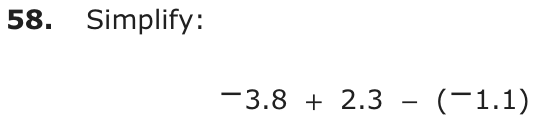
Question
Simplify:
Grid-in question: work out the answer and enter it as a number.
Show the answer
Correct answer: -0.4
Subtracting a negative number is the same as adding a positive number. Rewrite the expression to simplify:
Question analysis
This grid-in asks students to simplify a short expression that mixes negative and positive decimals and ends by subtracting a negative number. It tests adding and subtracting rational numbers in order. The double negative, and keeping track of the sign of the final result, are where errors creep in.
- Grade level
- Grade 7 content, by NYS standard
- Compared with grade 7
- At grade 7 Adding and subtracting negative decimals is core grade 7 content, and this is a routine three-term version. It matches a typical classroom exercise; the only extra demand is gridding a signed decimal correctly.
- Estimated difficulty
- Straightforward: two steps or one careful reading.
- Thinking it demands
- Depth of knowledge 1, recall and reproduction · mainly apply
- What makes it hard
- Error-prone arithmetic moderate
- An answer in an unexpected form minor
- Solution
- 2 steps
- Reading level
- Question and choices: about grade 16+, 2 words.
- Students, last 30 days
- Not enough answers yet to show (it takes 10).
Why it is hard, traps and wrong answers (shows the answer)
Why it is hard
This is a three-term expression with small decimals, so the method is never in doubt; the points are lost on signs. The double negative at the end is the classic place to slip; the other is the result itself, which sits just below zero and is easy to grid without its minus sign. Grouping the positive terms first, 2.3 + 1.1, and comparing that sum with 3.8 settles both the size and the sign.
Error-prone arithmetic moderate Working it out
The last term, − (−1.1), has to turn into + 1.1, and the total then crosses zero, since 2.3 + 1.1 = 3.4 falls just short of the 3.8 below zero. (Brown & Burton, 1978; Junker & Sijtsma, 2001)
An answer in an unexpected form minor Choosing the answer
As a grid-in it shows no choices, so a double negative read as a single one, or a result gridded without its minus sign, gets no warning from the page. (Enright, Morley & Sheehan, 2002)
Strategy: Rewrite subtracting −1.1 as adding 1.1, combine the two positive decimals first, then compare their total with 3.8 to decide the sign and size.
Traps
- Negatives and direction: Arithmetic with negative numbers, the order of a subtraction, or direction on a number line. (Moving a term across the equals sign without changing its sign is a faulty procedure.)
The wrong answers, classified
-2.6 Negatives and direction (Brown & Burton, 1978)
Treats subtracting −1.1 as subtracting 1.1, so it works out −3.8 + 2.3 − 1.1 = −1.5 − 1.1 and moves further below zero.
0.4 Negatives and direction (Brown & Burton, 1978)
Rewrites the double negative correctly and finds the gap 3.8 − 3.4 = 0.4, but drops the minus sign that the larger negative term gives the result.
Worked solution, step by step
Formulas used
- Subtracting a negative number
- a is any number, and b is a positive number, so −b is negative. Taking away a negative number is the same as adding the positive number. Think of money: if someone takes away a debt of b dollars, you are b dollars better off.
- Adding a negative and a positive
- a and b are positive numbers, and a is the larger one. A negative and a positive partly cancel out. So find the difference of their sizes, a − b. The result keeps the sign of the number farther from zero, which here is the negative one.
Sort out the expression
You need to simplify . Simplify means work it out to one number. Two of the numbers are negative: −3.8 and −1.1. One is positive: 2.3. The tricky part is at the end. It says minus negative 1.1. The answer can be negative, so keep track of every sign.
Change minus a negative to plus
Taking away a negative is the same as adding a positive. Use the rule with b = 1.1.
Now only one negative number is left. Watch out: do not just subtract 1.1. That gives , which is wrong.
Add the two positive numbers
Group the positive numbers first. This makes the rest of the work short.
Now the problem is . One number is negative and one is positive.
Combine the negative and the positive
They partly cancel. Use the rule with a = 3.8 and b = 3.4.
The negative number, 3.8, is farther from zero than 3.4 is. So the result is negative. Watch out: keep the minus sign. Dropping it gives 0.4, which is wrong. So you would grid -0.4, with the minus sign in its own column.
Check your answer
Use a number line. Start at −3.8. Adding 2.3 moves you right, to −1.5. Subtracting −1.1 also moves you right, by 1.1, to −0.4. You end just to the left of zero. So a small negative answer makes sense.
More questions like this
The original DOE question