Question
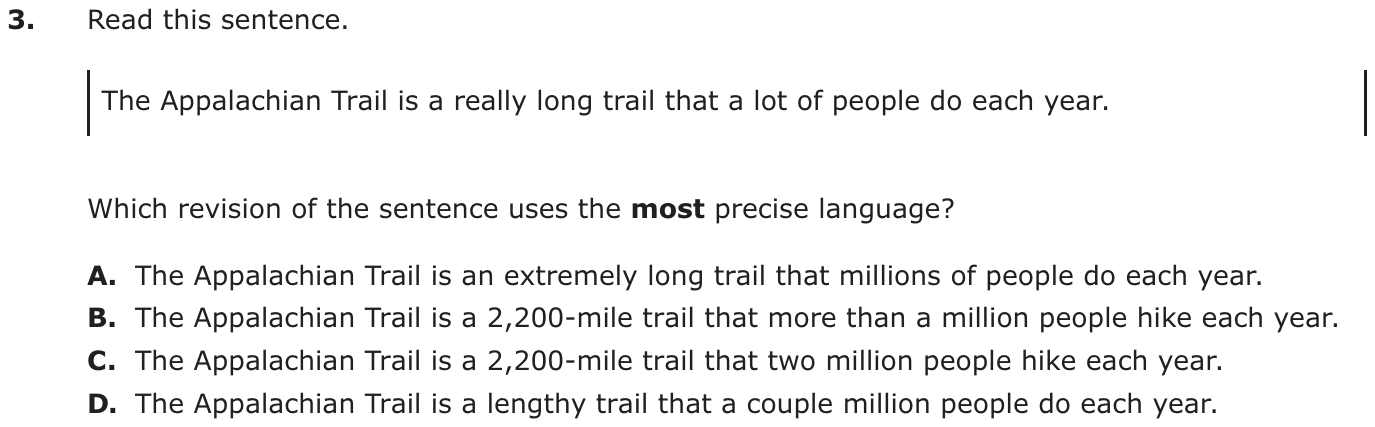
Read this sentence.
The Appalachian Trail is a really long trail that a lot of people do each year.
Which revision of the sentence uses the most precise language?
- AThe Appalachian Trail is an extremely long trail that millions of people do each year.
- BThe Appalachian Trail is a 2,200-mile trail that more than a million people hike each year.
- CThe Appalachian Trail is a 2,200-mile trail that two million people hike each year.
- DThe Appalachian Trail is a lengthy trail that a couple million people do each year.
Show the answer
Correct answer: C
The question asks for the revision of the sentence that uses the most precise language.
A. Incorrect. The word “extremely” does not specify the precise length of the trail (2,200 miles); “millions” is less precise than the specific number of people who hike the trail each year (two million); and the verb “do” imprecisely describes the purpose of visiting the trail (hiking).
B. Incorrect. While the revision specifies the precise length of the trail and the verb “hike” precisely describes the purpose of visiting the trail, “more than a million” is less precise than the specific number of people who hike the trail each year (two million).
C. CORRECT. The length of the trail (2,200 miles), the specific number of people who hike the trail each year (two million), and the action of the visitors (hiking) are clear and precise in this revision of the sentence.
D. Incorrect. The word “lengthy” is less precise than specifying the actual length of the trail (2,200 miles); “a couple million” is less precise than the specific number of people who hike the trail each year (two million); and the verb “do” imprecisely describes the purpose of visiting the trail (hiking).
Question analysis
This precise-language question gives a casual sentence saying the Appalachian Trail is “a really long trail that a lot of people do each year” and asks which revision is most precise. Several revisions swap in more specific words or numbers, so students must check every part of each sentence, not just the first improvement they notice.
- NYS standards
- 7L3a precise and concise language
- Grade level
- Grade 6 reading and task
- Compared with grade 7
- Below grade 7 Choosing precise wording is grade 7 language work, but this item is one short sentence in everyday words. Typical grade 7 revision sets the same choice inside a paragraph, with more wording to weigh.
- Estimated difficulty
- Straightforward: two steps or one careful reading.
- Thinking it demands
- Depth of knowledge 1, recall and reproduction · mainly evaluate
- What makes it hard
- A very close wrong answer moderate
- Every choice must be checked minor
- Evidence
- Answered from one sentence or line
- Reading level
- Question and choices: about grade 6, 89 words.
- Students, last 30 days
- Not enough answers yet to show (it takes 10).
Why it is hard, traps and wrong answers (shows the answer)
Why it is hard
The question is quick once each revision is tested on three points: how long the trail is, how many people hike it, and what they do there. The near miss catches students who stop checking once they see the mileage and the verb “hike,” though its count of hikers is still a range. Words such as “extremely” and “lengthy” are the other snare, since they sound sharper without saying any more.
A very close wrong answer moderate Choosing the answer
The right revision and the one with “more than a million” share the 2,200-mile length and the verb “hike,” and differ only in the hiker count: an exact two million or an open-ended floor. (Embretson & Wetzel, 1987; Gorin & Embretson, 2006; Ascalon et al., 2007)
Every choice must be checked minor Choosing the answer
Each revision repairs a different part of “a really long trail that a lot of people do,” so all four have to be checked for the length, the count and the verb. (Embretson & Wetzel, 1987)
Strategy: Check each revision on three points: how long the trail is, how many people visit, and what they do there. Keep only a version that is exact on all three.
Traps
- Wordy, vague or informal: A revision is grammatical but wordy, imprecise or too casual for the passage.
The wrong answers, classified
A Wordy, vague or informal (Connors & Lunsford, 1988)
Treats “extremely long” and “millions” as upgrades, though neither gives a length or a count, and the vague verb “do” is still there.
B Wordy, vague or informal (Connors & Lunsford, 1988)
Sees the exact length and the verb “hike” and stops checking, missing that “more than a million” is looser than a specific number of hikers.
D Wordy, vague or informal (Connors & Lunsford, 1988)
Takes the fancier “lengthy” and the casual “a couple million” for sharper wording, though neither is exact and “do” still does not say what visitors do.
Working it out, step by step
Figure out what the question asks
You need the revision with the most precise language. Precise means exact. A precise word tells the reader exactly what or how much. For example, a lot of homework is vague, but three pages of math homework is precise. The sentence has three vague parts: “a really long trail,” “a lot of people,” and the verb “do.”
Make a three-part test
The most precise revision must fix all three parts.
- How long is the trail? Look for an exact length.
- How many people go? Look for an exact number.
- What do they do there? Do is vague. People hike a trail.
A choice that fixes only one or two parts is not the most precise.
Check each choice
- C gives “a 2,200-mile trail,” “two million people,” and “hike.” It passes all three tests.
- B gives the length and “hike.” But “more than a million” is not exact. It could mean 1.1 million or 5 million.
- A says “extremely long” and “millions.” Neither is exact, and it keeps “do.”
- D says “lengthy” and “a couple million.” These sound fancier but say no more. It also keeps “do.”
Pick the answer
Watch out: B is very close. It has the length and the right verb, so many students stop there. But its count of people is still loose. Only C is exact on all three parts. So the answer is C.
Why this answer and not the closest wrong one
B is the closest wrong answer. It matches C on the length, 2,200 miles, and on the verb “hike.” The only difference is the number of hikers. “More than a million” sets a low limit but gives no exact count. “Two million” tells the reader exactly how many, so C is more precise.
More questions like this
The original DOE question