Also in 2025 Practice Test B English, question 25.
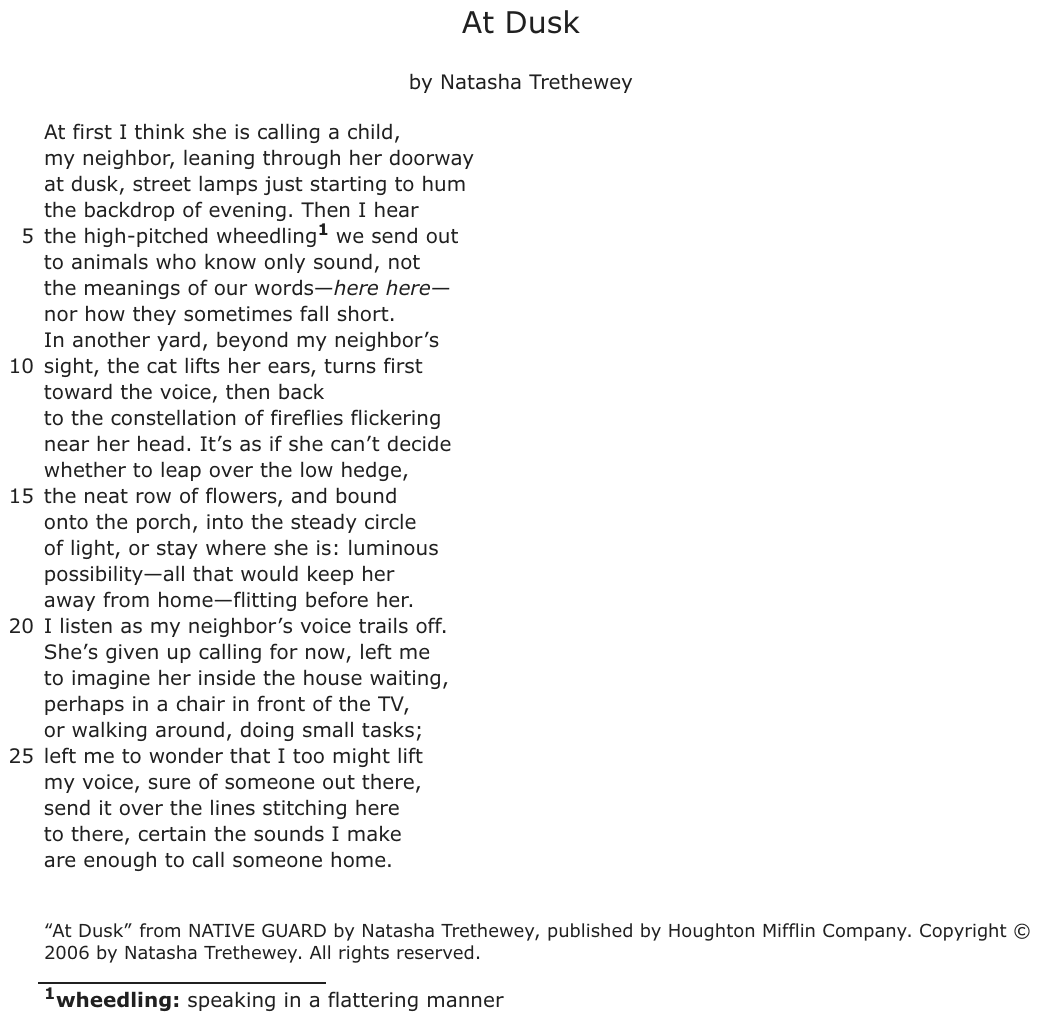
Passage At Dusk
At Dusk
by Natasha Trethewey
At first I think she is calling a child,
my neighbor, leaning through her doorway
at dusk, street lamps just starting to hum
the backdrop of evening. Then I hear
the high-pitched wheedling1 we send out
to animals who know only sound, not
the meanings of our words—here here—
nor how they sometimes fall short.
In another yard, beyond my neighbor’s
sight, the cat lifts her ears, turns first
toward the voice, then back
to the constellation of fireflies flickering
near her head. It’s as if she can’t decide
whether to leap over the low hedge,
the neat row of flowers, and bound
onto the porch, into the steady circle
of light, or stay where she is: luminous
possibility—all that would keep her
away from home—flitting before her.
I listen as my neighbor’s voice trails off.
She’s given up calling for now, left me
to imagine her inside the house waiting,
perhaps in a chair in front of the TV,
or walking around, doing small tasks;
left me to wonder that I too might lift
my voice, sure of someone out there,
send it over the lines stitching here
to there, certain the sounds I make
are enough to call someone home.
“At Dusk” from NATIVE GUARD by Natasha Trethewey, published by Houghton Mifflin Company. Copyright © 2006 by Natasha Trethewey. All rights reserved.
1wheedling: speaking in a flattering manner
Question
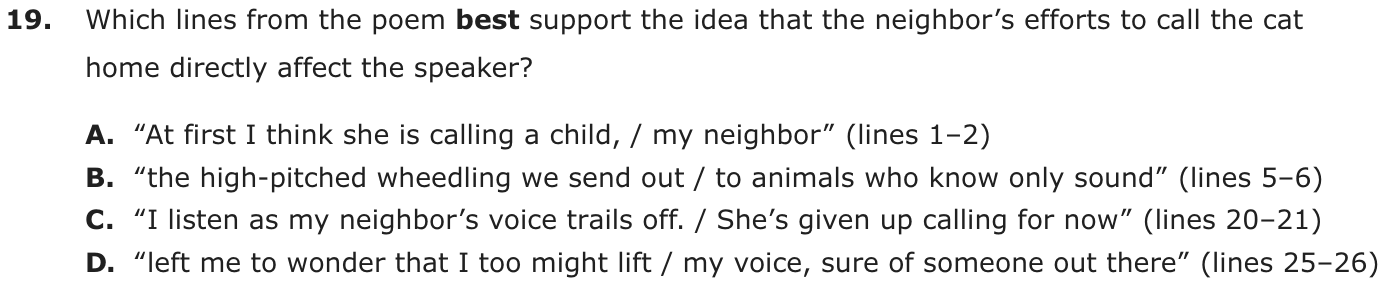
Which lines from the poem best support the idea that the neighbor’s efforts to call the cat home directly affect the speaker?
- A“At first I think she is calling a child, / my neighbor” (lines 1–2)
- B“the high-pitched wheedling we send out / to animals who know only sound” (lines 5–6)
- C“I listen as my neighbor’s voice trails off. / She’s given up calling for now” (lines 20–21)
- D“left me to wonder that I too might lift / my voice, sure of someone out there” (lines 25–26)
Show the answer
Correct answer: D
The question asks for the best textual support for the idea that the neighbor’s actions in calling the cat directly affect the speaker of the poem.
A. Incorrect. Lines 1–2 show that the speaker has noticed the neighbor’s calling and guessed the reason for it. The speaker at first believes that the neighbor is “calling a child,” but then the speaker notices a sound associated with the time of day—the “street lamps just starting to hum / the backdrop of evening” (lines 3–4). However, the poem does not describe any direct effects on the speaker’s own opinions or behavior caused by these aspects of the surroundings.
B. Incorrect. The “high-pitched wheedling” sound the speaker mentions in line 5 might be assumed to have an annoying effect. However, the poem includes no indication that the sound has any direct effect on the speaker or that the speaker has any personal reaction to the sound. Instead, in lines 6–7, the speaker concentrates on explaining the reason people make the sound: to communicate with “animals who know only sound, not / the meanings of our words.”
C. Incorrect. In lines 20–21, the speaker actively listens “as my neighbor’s voice trails off,” which could be interpreted as an effect of the neighbor’s call. However, the speaker’s listening soon comes to an end because the neighbor has “given up calling for now,” and the poem does not describe any direct effects on the speaker’s own opinions or behavior caused by listening. Therefore, lines 20–21 do not best support the idea that the neighbor’s actions directly affect the speaker of the poem.
D. CORRECT. In lines 25–26, after observing the neighbor calling the cat, the speaker begins to reflect on the speaker’s own behavior and motivations, wondering if, like the neighbor, the speaker “might lift” the speaker’s voice to call someone who is surely “out there.” The speaker’s description of being left “to wonder” indicates that the speaker’s thoughts are a direct effect of observing the neighbor’s efforts to call the cat.
Question analysis
This reading question asks which lines from Natasha Trethewey's poem At Dusk best support the idea that a neighbor's efforts to call her cat home directly affect the speaker. Every option quotes lines connected to the calling, so students must tell lines that merely describe the scene from lines that show its effect on the person watching.
- NYS standards
- 7R1 textual evidence and inferences
- Grade level
- Grade 7 reading and task
- Compared with grade 7
- At grade 7 Choosing lines that support an idea is grade 7 evidence work. The quotations are short and the poem's language is plain, but each must be checked against a specific claim, a typical grade 7 task.
- Estimated difficulty
- Moderate: several steps, or a close reading with one strong distractor.
- Thinking it demands
- Depth of knowledge 2, skills and concepts · mainly evaluate
- What makes it hard
- Reading between the lines moderate
- Every choice must be checked moderate
- Evidence
- Answered from one sentence or line
- Reading level
- Passage: 236 words (a poem; reading level not measured); question and choices: about grade 5, 79 words.
- Students, last 30 days
- Not enough answers yet to show (it takes 10).
Why it is hard, traps and wrong answers (shows the answer)
Why it is hard
Every quotation shows the speaker noticing the call in some way, so the question is how strong a connection “directly affect” requires. The listening lines are the trap: they stop one line short of “left me,” where the effect begins. Students who ask what the calling makes the speaker think or want find the lines in which the speaker imagines calling out too.
Reading between the lines moderate Working it out
Students must decide what counts as an effect on the speaker: hearing and listening are reactions, but only lines 25–26 show the calling changing what the speaker thinks or wants. (Graesser, Singer & Trabasso, 1994; Kintsch, 1998)
Every choice must be checked moderate Choosing the answer
All four quotations involve the speaker and the calling, from “I think” to “we send out” to “I listen,” so each has to be tested for an effect, not just a connection. (Embretson & Wetzel, 1987)
Strategy: For each quotation, ask what the speaker does, thinks or feels because of the calling; lines that only report a sound or an event show no effect.
Traps
- Supports only part of the claim: In a question about evidence: a line that backs one half of the claim but not the other, or a related point rather than the claim itself.
- True but not the answer: A choice says something accurate about the text that does not answer this question.
The wrong answers, classified
A Supports only part of the claim (King et al., 2004; Thissen, Steinberg & Fitzpatrick, 1989)
Takes the speaker's first guess, that a child is being called, as an effect, but the lines only record how the speaker interpreted the sound, not any change it caused.
B True but not the answer (King et al., 2004; Embretson & Wetzel, 1987)
Chooses the lines on the “high-pitched wheedling,” which explain how people call animals in general and show no personal reaction from the speaker.
C Supports only part of the claim (King et al., 2004; Thissen, Steinberg & Fitzpatrick, 1989)
Treats “I listen” as the effect, but these lines report the voice fading and the neighbor stopping, and the speaker's response begins only with “left me” after them.
Working it out, step by step
Figure out what the question asks
You need the lines that best show the neighbor’s calling has a direct effect on the speaker. The speaker is the “I” who tells the poem. An effect here is a change in what the speaker thinks, feels or does.
Find where the effect begins
In line 20 the neighbor’s voice “trails off.” She has given up calling, and that “left me” with new thoughts. First it “left me / to imagine her inside the house waiting” (lines 21–22). Then it “left me to wonder that I too might lift / my voice, sure of someone out there” (lines 25–26).
Work out what the lines mean
“I too” means the speaker now thinks of doing what the neighbor did. The speaker imagines calling out to someone, the way the neighbor called the cat. Watching her call has changed the speaker’s own thoughts and wishes. That is a direct effect.
Check each choice
- A is wrong. Lines 1–2 show only the speaker’s first guess about the sound. Nothing changes for the speaker.
- B is wrong. Lines 5–6 explain how people in general call animals. They show no reaction from the speaker.
- C is wrong. Lines 20–21 show the speaker listening as the calling stops. The effect starts after them, with “left me.”
- D is right. The speaker wonders about lifting “my voice” too.
Watch out: C is tempting because “I listen” is a reaction. But hearing a sound is not the same as being changed by it.
Choose the answer
Lines 25–26 show the calling making the speaker want to call out too. So the answer is D.
Why this answer and not the closest wrong one
C is the closest wrong answer. In it the speaker does listen to the neighbor. But the lines only report her voice fading and the calling ending. The speaker’s own response begins with “left me to wonder,” in line 25. There the speaker thinks of calling someone too. That is the direct effect.
More questions like this
The original DOE question
The passage “At Dusk” as printed (page 48)