Passage The Free College Debate
The Free College Debate
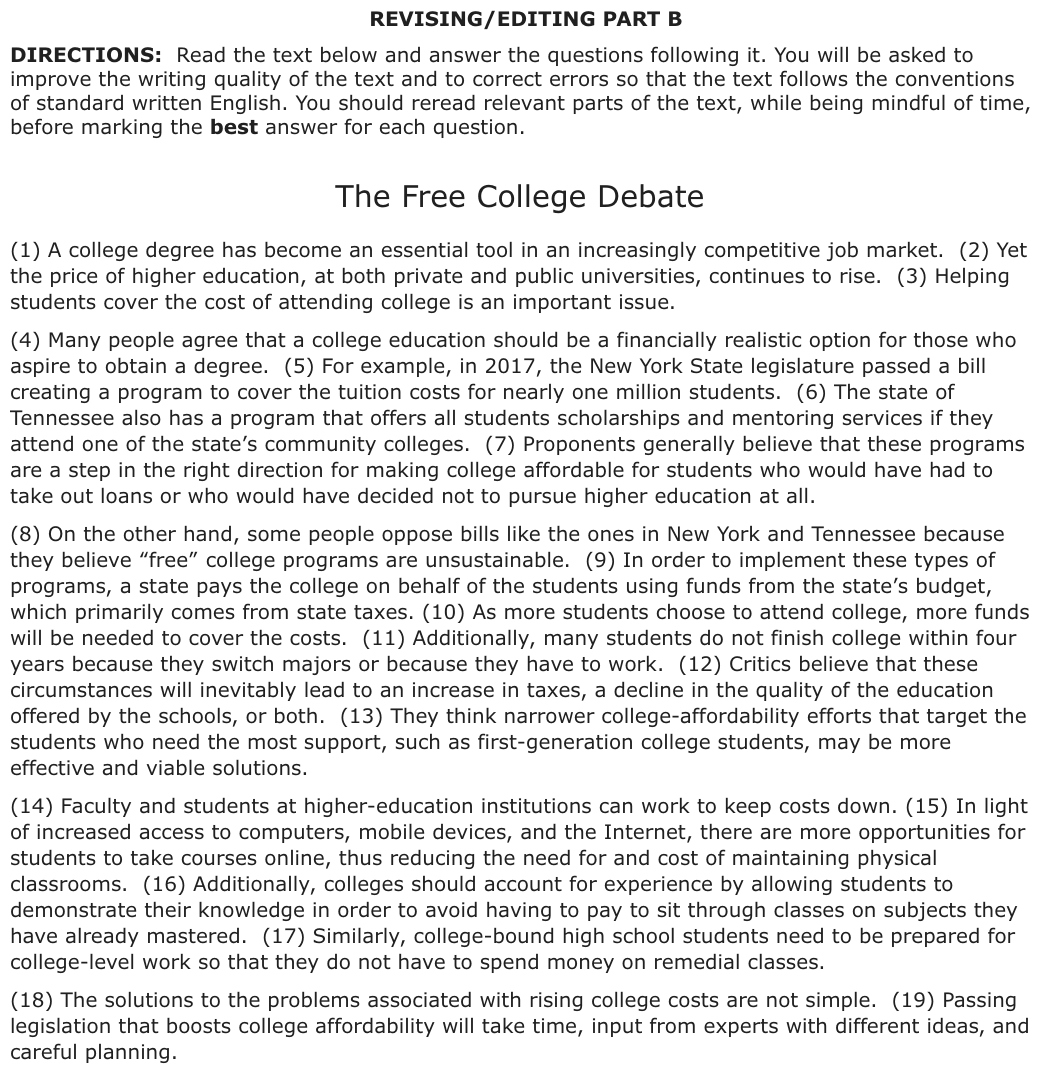
(1) A college degree has become an essential tool in an increasingly competitive job market. (2) Yet the price of higher education, at both private and public universities, continues to rise. (3) Helping students cover the cost of attending college is an important issue.
(4) Many people agree that a college education should be a financially realistic option for those who aspire to obtain a degree. (5) For example, in 2017, the New York State legislature passed a bill creating a program to cover the tuition costs for nearly one million students. (6) The state of Tennessee also has a program that offers all students scholarships and mentoring services if they attend one of the state’s community colleges. (7) Proponents generally believe that these programs are a step in the right direction for making college affordable for students who would have had to take out loans or who would have decided not to pursue higher education at all.
(8) On the other hand, some people oppose bills like the ones in New York and Tennessee because they believe “free” college programs are unsustainable. (9) In order to implement these types of programs, a state pays the college on behalf of the students using funds from the state’s budget, which primarily comes from state taxes. (10) As more students choose to attend college, more funds will be needed to cover the costs. (11) Additionally, many students do not finish college within four years because they switch majors or because they have to work. (12) Critics believe that these circumstances will inevitably lead to an increase in taxes, a decline in the quality of the education offered by the schools, or both. (13) They think narrower college-affordability efforts that target the students who need the most support, such as first-generation college students, may be more effective and viable solutions.
(14) Faculty and students at higher-education institutions can work to keep costs down. (15) In light of increased access to computers, mobile devices, and the Internet, there are more opportunities for students to take courses online, thus reducing the need for and cost of maintaining physical classrooms. (16) Additionally, colleges should account for experience by allowing students to demonstrate their knowledge in order to avoid having to pay to sit through classes on subjects they have already mastered. (17) Similarly, college-bound high school students need to be prepared for college-level work so that they do not have to spend money on remedial classes.
(18) The solutions to the problems associated with rising college costs are not simple. (19) Passing legislation that boosts college affordability will take time, input from experts with different ideas, and careful planning.
Question
Read this sentence.
Some note that several states have made their community or state colleges low-cost or free for students with limited resources.
Where should the sentence be added to best support the ideas in the second paragraph (sentences 4–7)?
- Aat the beginning of the paragraph (before sentence 4)
- Bbetween sentences 4 and 5
- Cbetween sentences 5 and 6
- Dbetween sentences 6 and 7
Show the answer
Correct answer: B
The question asks where the sentence should be added to best support the ideas in the second paragraph (sentences 4–7).
A. Incorrect. Sentence 4 introduces the main idea of the second paragraph (making college “a financially realistic option for those who aspire to obtain a degree”) and should not be preceded by the added sentence, which focuses more narrowly on the specific ways that some states are implementing that idea.
B. CORRECT. The added sentence provides a proposed solution to the issue stated in sentence 4, that “a college education should be a financially realistic option.” Sentence 5 is an example of the programs discussed in the added sentence.
C. Incorrect. Sentences 5 and 6 offer examples of state governments providing “low-cost or free” tuition. The added sentence introduces this idea in the second paragraph and should come before these specific examples are provided as evidence.
D. Incorrect. Sentence 6 provides an example of the state government of Tennessee providing “low-cost or free” tuition, and sentence 7 further explains the opinion of those in favor of such programs (“a step in the right direction for making college affordable”). However, the ideas in sentences 6 and 7 follow from and support the idea in the added sentence. Therefore, the added sentence should be placed before sentences 6 and 7, which help elaborate its idea.
Question analysis
This revising question gives a sentence noting that several states have made public colleges low-cost or free and asks where it best fits in the paragraph about making college financially realistic. Students must follow how the paragraph moves between general claims and specific examples, since the sentence reads smoothly in more than one place.
- NYS standards
- 7W2a introducing and organizing a topic
- Grade level
- Grade 7 reading and task
- Compared with grade 7
- At grade 7 Placing a sentence so ideas follow logically is grade 7 writing work. The paragraph is only four sentences long and the four positions sit side by side, so this matches a typical grade 7 revision task.
- Estimated difficulty
- Moderate: several steps, or a close reading with one strong distractor.
- Thinking it demands
- Depth of knowledge 2, skills and concepts · mainly analyze
- What makes it hard
- How sentences fit together moderate
- Every choice must be checked moderate
- Evidence
- Answered from one paragraph or stanza
- Reading level
- Passage: about grade 12, 427 words; question and choices: about grade 6, 56 words.
- Students, last 30 days
- Not enough answers yet to show (it takes 10).
Why it is hard, traps and wrong answers (shows the answer)
Why it is hard
This is a general-before-specific question disguised by smooth reading: the added sentence fits grammatically anywhere in the paragraph. What decides it is that New York and Tennessee are examples of states making college low-cost or free, so the claim belongs before them and after sentence 4's broader belief. Students who place it as a summary before “these programs” have noticed a real link but put the claim after its own evidence.
How sentences fit together moderate Working it out
Sentence 5 opens “For example” and sentence 6 says Tennessee “also” has a program, so the claim about several states must come right before the New York example it introduces. (Halliday & Hasan, 1976)
Every choice must be checked moderate Choosing the answer
The new sentence reads smoothly in all four spots, even after the examples, where sentence 7's “these programs” seems to point back to it, so each position has to be tried in context. (Embretson & Wetzel, 1987)
Strategy: Decide whether the new sentence is a general statement or a specific example, then read the paragraph with it in each position and check that every example follows what it illustrates.
Traps
- Sentence in the wrong place: Puts a sentence where it breaks the order of ideas or separates it from what it refers to.
The wrong answers, classified
A Sentence in the wrong place (Halliday & Hasan, 1976)
Rightly treats the new sentence as general, then makes it the opener, ahead of sentence 4, the broader belief that college should be financially realistic.
C Sentence in the wrong place (Halliday & Hasan, 1976)
Drops the claim about several states between the New York and Tennessee examples, splitting the pair and leaving the first example without the statement it illustrates.
D Sentence in the wrong place (Halliday & Hasan, 1976)
Sees that sentence 7's “these programs” could refer back to the new sentence, but placed there it only restates what the New York and Tennessee examples have shown.
Working it out, step by step
Figure out what the question asks
You need the best place for a new sentence in paragraph 2. First ask: is it a general idea or a specific example? A general idea usually comes before the examples that show it.
Look at the new sentence
The new sentence says “several states have made their community or state colleges low-cost or free.” It does not name any state. So it is a general claim. A claim is a statement that something is true.
Look at sentences 4 to 7
- Sentence 4 is the paragraph’s main idea. College should be “a financially realistic option,” or something people can afford.
- Sentence 5 starts “For example” and names New York.
- Sentence 6 says Tennessee “also has a program.”
- Sentence 7 tells what supporters think of “these programs.”
New York and Tennessee are two of the “several states.” So the new sentence belongs right before them.
Check each choice
- A is wrong. Sentence 4 is the broader main idea, so it should stay first.
- B is right. The claim comes after the main idea. Then “For example” leads into New York.
- C is wrong. It splits New York and Tennessee, two examples that belong together.
- D is wrong. It puts the claim after both of the examples that show it.
Watch out: D is tempting, since “these programs” in sentence 7 could point back to it. But there the claim would just repeat what the examples already showed.
Choose the answer
The order should be main idea, then claim, then examples. So the answer is B, between sentences 4 and 5.
Why this answer and not the closest wrong one
D is the closest wrong answer, because the sentence reads smoothly there too. But a general claim should come before the examples that prove it. In B, the reader first hears about “several states.” Then “For example” brings in New York, and Tennessee follows.
More questions like this
The original DOE question
The passage “The Free College Debate” as printed (page 38)