Question
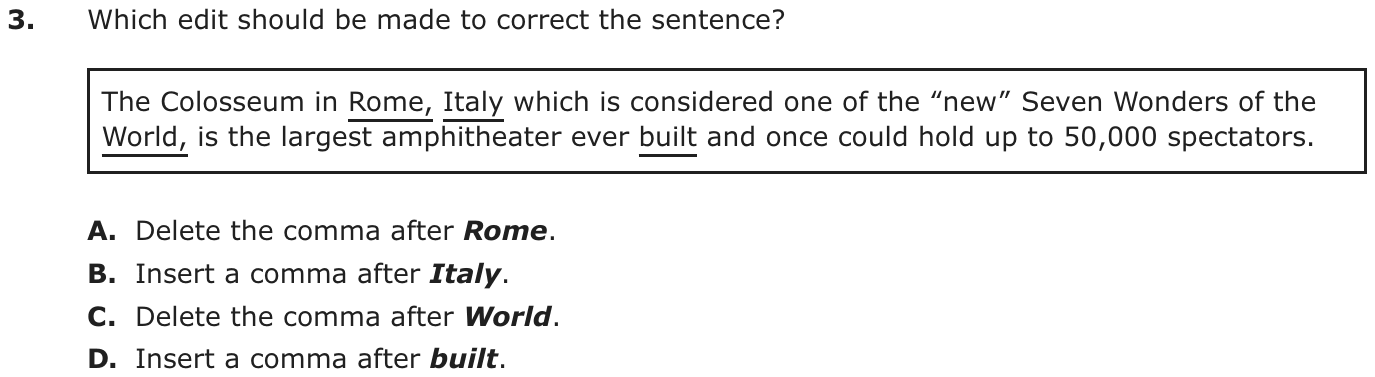
Which edit should be made to correct the sentence?
The Colosseum in Rome, Italy which is considered one of the “new” Seven Wonders of the World, is the largest amphitheater ever built and once could hold up to 50,000 spectators.
- ADelete the comma after Rome.
- BInsert a comma after Italy.
- CDelete the comma after World.
- DInsert a comma after built.
Show the answer
Correct answer: B
The question asks for the correction needed for an error in the sentence.
A. Incorrect. When a place name has more than one element, a comma is used to separate the elements for clarity.
B. CORRECT. The sentence needs a comma to set off the clause “which is considered one of the ‘new’ Seven Wonders of the World,” because the clause is not essential to the meaning of the sentence (nonrestrictive clause). This option is correct because it places a comma where it is needed, after “Italy,” to set off the nonrestrictive clause that follows.
C. Incorrect. This edit would remove the comma at the end of the nonrestrictive clause, which should be set off by commas at the beginning and the end.
D. Incorrect. A comma after “built” would separate the predicate “and once could hold up to 50,000 spectators” from the subject of the main clause. The predicates “is the largest amphitheater ever built” and “once could hold up to 50,000 spectators” both relate to the same subject (“The Colosseum in Rome, Italy”), so a comma should not be used to separate the second predicate from that subject.
Question analysis
This editing question gives one long sentence about the Colosseum in Rome and asks which comma edit corrects it. Students must know how commas work with a city and its country, with a descriptive clause beginning with which, and with two verbs that share one subject, because every choice adds or removes a comma.
- NYS standards
- 7L2 capitalization, punctuation, and spelling
- Grade level
- Grade 6 reading and task
- Compared with grade 7
- Below grade 7 Comma rules for place names and for extra information set off in a sentence are taught by grade 6. Here they are tested in one sentence with four marked spots, lighter than typical grade 7 editing of a whole paragraph.
- Estimated difficulty
- Straightforward: two steps or one careful reading.
- Thinking it demands
- Depth of knowledge 1, recall and reproduction · mainly apply
- What makes it hard
- A rule that doesn't sound wrong moderate
- Complex sentences minor
- Evidence
- Answered from one sentence or line
- Reading level
- Question and choices: about grade 6, 59 words.
- Students, last 30 days
- Not enough answers yet to show (it takes 10).
Why it is hard, traps and wrong answers (shows the answer)
Why it is hard
The which-clause has a closing comma after “World” but no opening one, and the sentence still sounds natural, so many students see the lone comma as the mistake instead of noticing its missing partner. Bracketing the extra description first, from “which” to “World,” exposes the gap quickly. The remaining choices fall to two rules students usually know: city and country are separated, and a second verb sharing the subject takes no comma.
A rule that doesn't sound wrong moderate Working it out
“Rome, Italy which is considered” reads smoothly aloud, yet the comma after “Italy” is needed twice over: to close the city-and-country pair and to open the nonessential which-clause. (Connors & Lunsford, 1988)
Complex sentences minor Understanding the question
Thirty-one words hold a two-part place name, a which-clause wedged between subject and verb, and two verbs, “is” and “once could hold,” sharing one subject, so each comma must be judged against that frame. (Abedi & Lord, 2001; Freedle & Kostin, 1993; Messick, 1989)
Strategy: Strip the sentence down to its main subject and verb, then check every marked spot against that core: what is the comma, or the missing comma, doing there?
Traps
- Punctuation: A comma, semicolon, colon, dash or apostrophe used where it does not belong, or missing where it does.
The wrong answers, classified
A Punctuation (Connors & Lunsford, 1988)
Treats “Rome, Italy” as a single name that should not be broken, not knowing that a comma always separates a city from the country that follows it.
C Punctuation (Connors & Lunsford, 1988)
Applies the sound rule against a comma between a subject and its verb to the comma before “is,” missing that it closes the which-clause and must stay.
D Punctuation (Connors & Lunsford, 1988)
Adds a pause before “and once could hold” because the sentence is long, though that second verb shares the subject, the Colosseum, and takes no comma.
Working it out, step by step
Figure out what the question asks
This is a punctuation question. Punctuation means marks like commas and periods. Four spots are underlined, at “Rome,” “Italy,” “World” and “built.” One edit fixes the sentence. Two comma rules decide it.
Learn the rule for extra information
Some groups of words just add an extra fact. If you take them out, the sentence still works. This is called a nonessential clause. A clause is a group of words with its own verb. A nonessential clause needs a comma before it and a comma after it, like a pair of brackets.
Example: Our school, which is very old, has a new gym. Without the middle part: Our school has a new gym.
Find the extra part
The extra part here starts at “which is considered” and ends at “of the World.” It adds a fun fact. Take it out and the sentence still works: The Colosseum in Rome, Italy, is the largest amphitheater ever built.
The comma after “World” closes the extra part. But nothing opens it. A comma is missing after “Italy.”
Learn the rule for places
A comma goes between a city and its country, as in “Rome, Italy.” If the sentence keeps going, put a comma after the country too. Example: She flew from Lima, Peru, to Miami.
So the comma after “Italy” is needed for two reasons. One comma does both jobs.
Check each choice
- A is wrong. The comma after “Rome” splits the city from the country. It must stay.
- B is right. It adds the missing comma that opens the extra part.
- C is wrong. The comma after “World” closes the extra part. Without it, neither end would be marked.
- D is wrong. The Colosseum “is the largest amphitheater” and “once could hold” many people. These are two verbs with one subject. No comma goes before the second verb. Example: Max swam fast and won a medal.
Watch out: C is tempting. A comma between a subject (who or what the sentence is about) and its verb is usually wrong. Here it is fine, because it is the second comma of a pair.
Choose the answer
With a comma after “Italy,” the extra part has a comma at each end. So the answer is B: insert a comma after Italy.
Why this answer and not the closest wrong one
C is the closest wrong answer. It treats the comma before “is” as the mistake. But that comma ends the extra part about the Seven Wonders. Delete it and nothing marks either end. B adds the missing opening comma, so both ends are marked.
More questions like this
The original DOE question