Passage The Free College Debate
The Free College Debate
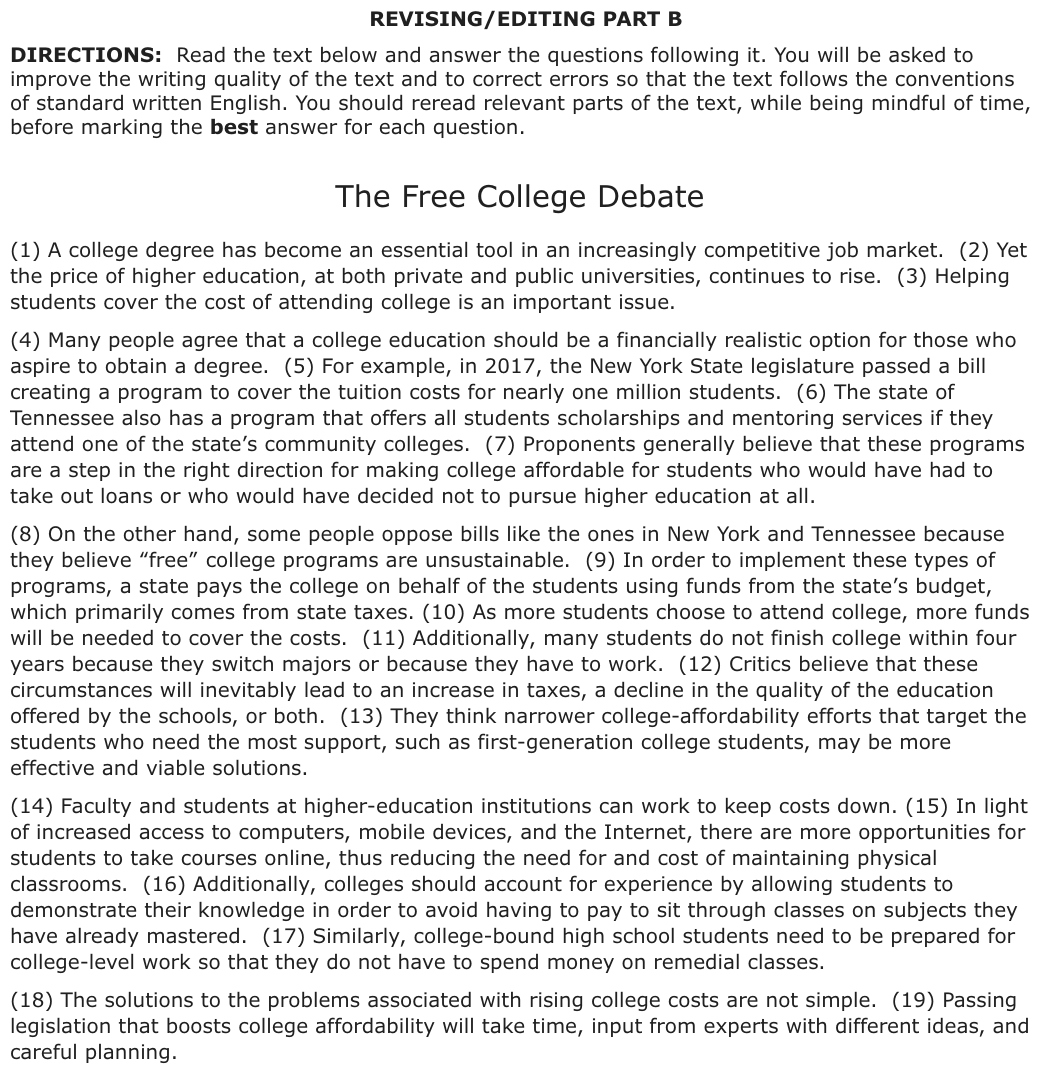
(1) A college degree has become an essential tool in an increasingly competitive job market. (2) Yet the price of higher education, at both private and public universities, continues to rise. (3) Helping students cover the cost of attending college is an important issue.
(4) Many people agree that a college education should be a financially realistic option for those who aspire to obtain a degree. (5) For example, in 2017, the New York State legislature passed a bill creating a program to cover the tuition costs for nearly one million students. (6) The state of Tennessee also has a program that offers all students scholarships and mentoring services if they attend one of the state’s community colleges. (7) Proponents generally believe that these programs are a step in the right direction for making college affordable for students who would have had to take out loans or who would have decided not to pursue higher education at all.
(8) On the other hand, some people oppose bills like the ones in New York and Tennessee because they believe “free” college programs are unsustainable. (9) In order to implement these types of programs, a state pays the college on behalf of the students using funds from the state’s budget, which primarily comes from state taxes. (10) As more students choose to attend college, more funds will be needed to cover the costs. (11) Additionally, many students do not finish college within four years because they switch majors or because they have to work. (12) Critics believe that these circumstances will inevitably lead to an increase in taxes, a decline in the quality of the education offered by the schools, or both. (13) They think narrower college-affordability efforts that target the students who need the most support, such as first-generation college students, may be more effective and viable solutions.
(14) Faculty and students at higher-education institutions can work to keep costs down. (15) In light of increased access to computers, mobile devices, and the Internet, there are more opportunities for students to take courses online, thus reducing the need for and cost of maintaining physical classrooms. (16) Additionally, colleges should account for experience by allowing students to demonstrate their knowledge in order to avoid having to pay to sit through classes on subjects they have already mastered. (17) Similarly, college-bound high school students need to be prepared for college-level work so that they do not have to spend money on remedial classes.
(18) The solutions to the problems associated with rising college costs are not simple. (19) Passing legislation that boosts college affordability will take time, input from experts with different ideas, and careful planning.
Question
Which concluding sentence should be added after sentence 19 to support the topic of the passage?
- AThe increasing use of technology in college classrooms and the financial support from tuition scholarship programs will make colleges more affordable for many students.
- BStatewide tuition scholarship programs will make college more affordable for many students, but these programs may lead to new problems.
- CUntil the problems associated with the rising cost of college are solved, many students will pursue other options after graduating high school.
- DWhen the issue of college affordability is resolved, students will be able to make decisions about pursuing higher education without cost being the deciding factor.
Show the answer
Correct answer: D
The question asks which concluding sentence should be added after sentence 19 to support the topic of the passage.
A. Incorrect. Although sentence 15 cites “increased access to computers, mobile devices, and the Internet” and states that “there are more opportunities for students to take courses online, thus reducing the need for and cost of maintaining physical classrooms,” the primary topic discussed throughout the passage is that making college affordable is a complex issue on which people hold differing opinions, and sentences 18 and 19 stress that the solutions “are not simple” and “will take time.” The option instead states that technology and scholarship programs will make colleges more affordable. Therefore, the sentence should not be added after sentence 19, because it does not support the topic.
B. Incorrect. Sentence 5 presents the example of the New York State legislature, which “passed a bill creating a program to cover the tuition costs for nearly one million students.” Sentence 12 states that critics of this type of program believe that certain circumstances “will inevitably lead to an increase in taxes” or other issues such as low-quality education. However, the option covers only the statewide programs and their critics (sentences 4–13). It leaves out the ways faculty and students can keep costs down (sentences 14–17) and the closing point that solutions will take time and careful planning (sentences 18 and 19). Therefore, the sentence should not be added after sentence 19, because it does not support the topic.
C. Incorrect. Although sentence 7 states that scholarship programs are helpful “for students who would have had to take out loans or who would have decided not to pursue higher education at all,” the passage does not state that many students will stop pursuing higher education until the affordability issues are solved. In fact, sentence 14 states that there are ways faculty and students can “work to keep costs down.” Therefore, the sentence should not be added after sentence 19, because it does not support the topic.
D. CORRECT. The sentence in this option should be added after sentence 19 to support the topic because it acknowledges that the issue of college affordability discussed throughout the passage is not “resolved” but that when it is, students will be able to make decisions about attending college without concerns about cost. Sentence 18 states that “the solutions to the problems associated with rising college costs are not simple,” and sentence 19 adds that “passing legislation that boosts college affordability will take time,” ideas, and planning.
Question analysis
This revising question asks which concluding sentence should be added after the final sentence of a passage about the debate over making college affordable. Students must keep the whole passage in view and pick the ending that follows from its last paragraph, because several choices repeat real details or offer predictions that sound reasonable.
- NYS standards
- 7W2e concluding informative writing
- Grade level
- Grade 7 reading and task
- Compared with grade 7
- At grade 7 Choosing a conclusion that follows from a passage's central idea is standard grade 7 writing work. The passage is five formal paragraphs that present two sides and then practical steps, which the student must hold together, a typical grade 7 challenge.
- Estimated difficulty
- Moderate: several steps, or a close reading with one strong distractor.
- Thinking it demands
- Depth of knowledge 2, skills and concepts · mainly evaluate
- What makes it hard
- Evidence in several places moderate
- How sentences fit together minor
- Evidence
- Answered from the whole text
- Reading level
- Passage: about grade 12, 427 words; question and choices: about grade 13, 106 words.
- Corrected from the DOE handbook
- The explanation misstated the topic of the passage; that sentence was corrected.
- An inaccurate statement about the passage in the explanation was corrected.
- Students, last 30 days
- Not enough answers yet to show (it takes 10).
Why it is hard, traps and wrong answers (shows the answer)
Why it is hard
The strongest wrong ending is a fair summary of the passage's middle, the state programs and their critics, so it feels like a conclusion. It falls short because it drops the campus steps and the closing point that solutions are slow and complicated. Other endings echo the final paragraph's words or bundle two solutions into a promise, and students who keep the passage's caution in mind reject those quickly.
Evidence in several places moderate Working it out
Judging an ending means holding the whole passage: the debate over state programs in sentences 4–13, the campus cost-cutting in 14–17, and the warning in 18–19 that solutions take time. (Kirsch & Mosenthal, 1990; Gorin & Embretson, 2006)
How sentences fit together minor Working it out
The new sentence follows “will take time,” so an ending that looks ahead to when the problem “is resolved” continues the thought, while a confident promise of affordability contradicts it. (Halliday & Hasan, 1976)
Strategy: State the passage's topic and its final point in your own words, then test each ending: does it follow from both, or does it bring in a claim the passage never supports?
Traps
- Too narrow: A single detail offered as the central idea or a summary, or a summary that keeps minor details and leaves out an essential part.
- Too broad or too strong: A choice overstates, generalizes, or uses absolute words the text does not support.
- Off the point: Adds or keeps something that does not support the paragraph's or the passage's focus, or an introduction or conclusion that misses the main point.
The wrong answers, classified
A Too broad or too strong (King et al., 2004)
Bundles paragraph 4's online courses with the state scholarships and promises they “will make colleges more affordable,” a certainty the passage rejects just before by calling solutions “not simple.”
B Too narrow (King et al., 2004)
Sums up paragraphs 2 and 3 fairly, programs that help and the problems critics foresee, but leaves out the campus cost-cutting and the closing point about time and planning.
C Off the point (Halliday & Hasan, 1976)
Borrows “the problems associated with” rising costs from sentence 18 and adds a prediction about students choosing other paths, which the passage never makes.
What was corrected from the DOE handbook, and why
- Explanation: In rejecting choice A, the handbook says the topic of the passage is that “state and federal governments, not faculty and students, must resolve the issue of college affordability.” The passage never mentions the federal government, and sentences 14–17 are about what faculty and students can do. The topic, as question 5's answer puts it, is that making college affordable is a complex issue with differing opinions about how to approach it. The explanation now says so, and that choice A instead states that technology and scholarships will make college more affordable.
- Explanation: In rejecting choice B, the handbook says “the idea that these types of programs may lead to new problems is not thoroughly discussed in the passage.” Sentences 8–13 discuss exactly that: critics expect higher taxes or lower-quality education. Choice B falls short because it covers only the statewide programs and their critics, leaving out sentences 14–17 (what faculty and students can do) and the closing point that solutions take time and planning. The explanation now says that. The answer, D, is unchanged.
Working it out, step by step
Figure out what the question asks
You need a last sentence for the passage. A good conclusion fits the topic of the whole passage. It should also follow from sentence 19, the sentence right before it.
Recall the topic and the ending
The passage shows that making college affordable is a complex issue. People have different opinions about how to do it. Sentence 18 says the solutions “are not simple.” Sentence 19 says new laws “will take time, input from experts with different ideas, and careful planning.” So the passage ends by saying the problem is not solved yet.
Find the sentence that follows
D begins “When the issue of college affordability is resolved.” Resolved means solved. That fits right after “will take time.” It looks ahead to a day when the problem is fixed. Then cost won’t decide whether a student goes to college.
Check each choice
- A is wrong. It promises that technology and scholarships “will make colleges more affordable.” But the passage just said solutions are not simple.
- B is wrong. It sums up only the state programs and their critics. It leaves out the cost-cutting ideas and the point about time and planning.
- C is wrong. The passage never says students will choose other paths after high school.
- D is right. It fits the topic and follows sentence 19.
Watch out: B is a fair summary of paragraphs 2 and 3. That makes it feel like a conclusion. But it covers only part of the passage.
Choose the answer
D keeps the passage’s careful tone and looks ahead to a time when cost no longer decides. So the answer is D.
Why this answer and not the closest wrong one
B is the closest wrong answer. The passage really does discuss state programs and the problems critics expect. But B leaves out paragraph 4, on cutting costs, and the closing point that solutions take time. D follows “will take time” by looking ahead to when the issue “is resolved.”
More questions like this
The original DOE question
The passage “The Free College Debate” as printed (page 38)