Question
Read this sentence.
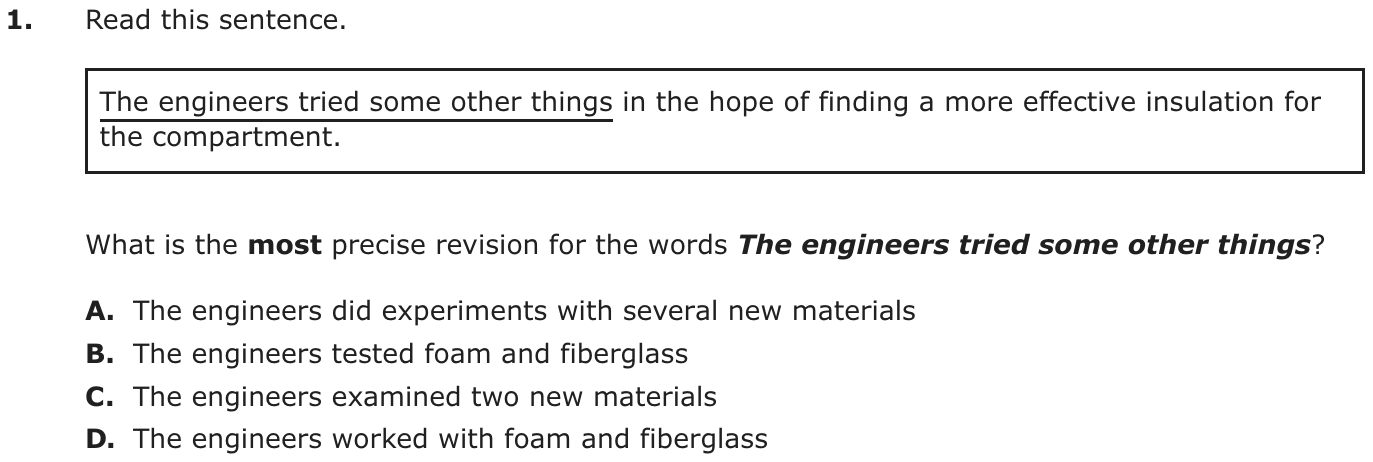
The engineers tried some other things in the hope of finding a more effective insulation for the compartment.
What is the most precise revision for the words The engineers tried some other things?
- AThe engineers did experiments with several new materials
- BThe engineers tested foam and fiberglass
- CThe engineers examined two new materials
- DThe engineers worked with foam and fiberglass
Show the answer
Correct answer: B
The question asks for the most precise revision for the words “The engineers tried some other things.”
A. Incorrect. This revision uses the word “materials” rather than precisely identifying what the engineers used.
B. CORRECT. This option revises the words to be more precise by using the specific words “tested” for the verb and “foam and fiberglass” for the materials.
C. Incorrect. This revision uses the word “examined” rather than a word indicating a process of experimental trial and error. The sentence also uses the word “materials” rather than precisely identifying what the engineers used.
D. Incorrect. This revision identifies the materials, but the imprecise verb “worked with” does not specify what the engineers were doing.
Question analysis
This revising question gives one sentence about engineers looking for better insulation for a compartment and asks which rewrite of its vague opening words is the most precise. The tricky part is that some choices sharpen one half of the phrase while leaving the other half as loose as the original.
- NYS standards
- 7L3a precise and concise language
- Grade level
- Grade 7 reading and task
- Compared with grade 7
- Below grade 7 Choosing precise wording is a grade 7 language standard, but this item is a single sentence about an engineering test with everyday words. Typical grade 7 revision asks for the same judgment across a paragraph or a full draft.
- Estimated difficulty
- Straightforward: two steps or one careful reading.
- Thinking it demands
- Depth of knowledge 1, recall and reproduction · mainly evaluate
- What makes it hard
- A very close wrong answer moderate
- Every choice must be checked minor
- Evidence
- Answered from one sentence or line
- Reading level
- Question and choices: about grade 7, 63 words.
- Students, last 30 days
- Not enough answers yet to show (it takes 10).
Why it is hard, traps and wrong answers (shows the answer)
Why it is hard
Precision here has two halves: a verb that names the actual activity and an object that names the actual materials. Most students who miss it stop at the first concrete detail they see, the named materials or the count of two, and never test the verb. Only one rewrite names both an exact action and the exact materials; each of the others leaves one half, or both, nearly as loose as the original.
A very close wrong answer moderate Choosing the answer
The rewrite with “worked with foam and fiberglass” matches the right one word for word except the verb, so only asking whether “worked with” says what the engineers did separates them. (Embretson & Wetzel, 1987; Gorin & Embretson, 2006; Ascalon et al., 2007)
Every choice must be checked minor Choosing the answer
The vague words have two parts, the action “tried” and the object “some other things,” and each rewrite sharpens a different part, so every one must be tested for both. (Embretson & Wetzel, 1987)
Strategy: Split the underlined words into the action and the things acted on, then ask of each revision whether a reader would know exactly what the engineers did and with what.
Traps
- Half right: One half of a two-part choice is right and the other is not.
- Wordy, vague or informal: A revision is grammatical but wordy, imprecise or too casual for the passage.
The wrong answers, classified
A Wordy, vague or informal (Connors & Lunsford, 1988)
Takes “did experiments with” as an exact verb, but the wordier phrase still ends in “several new materials,” which leaves the reader guessing what was tried.
C Wordy, vague or informal (Connors & Lunsford, 1988)
Treats the count “two” as precise detail, though the materials stay unnamed and “examined” suggests looking them over rather than trying them as insulation.
D Half right (King et al., 2004; Thissen, Steinberg & Fitzpatrick, 1989)
Sees that naming foam and fiberglass makes the object exact and stops there, missing that “worked with” is as vague as the original “tried.”
Working it out, step by step
Figure out what the question asks
This question is about precise language. Precise means exact and clear. The words “The engineers tried some other things” are vague. You can’t tell what the engineers did. You also can’t tell what they used. You need the rewrite that tells both.
Learn what makes words precise
Precise writing names the exact action and the exact thing. Vague: She did stuff with food. Precise: She baked bread.
The underlined words have two vague parts. The verb (the action word) is “tried.” The things are “some other things.” A good rewrite must fix both parts.
Think about what the sentence needs
The engineers want “a more effective insulation.” Insulation is material that keeps heat or cold from getting through. To find the best one, they would try out real materials and see how well each works. So the best verb says they tested. The best object names the materials.
Check each choice
- A is wrong. “Did experiments with” is wordy, and “several new materials” still doesn’t say which ones.
- B is right. “Tested” names the exact action. “Foam and fiberglass” names the exact materials.
- C is wrong. “Two new materials” gives a number but no names. “Examined” means looked over, not tried out.
- D is wrong. It names foam and fiberglass. But “worked with” is as vague as “tried.”
Watch out: D is tempting because it names the materials. Always check the verb too.
Choose the answer
Only B fixes both vague parts. The reader learns what the engineers did and what they used. So the answer is B: The engineers tested foam and fiberglass.
Why this answer and not the closest wrong one
D is the closest wrong answer. It matches B word for word except for the verb. “Worked with” could mean cut, built or studied. “Tested” tells you the engineers tried each material to see how well it insulates. That is what the sentence is about, so B is more precise.
More questions like this
The original DOE question