Passage Find Time to Volunteer
Find Time to Volunteer
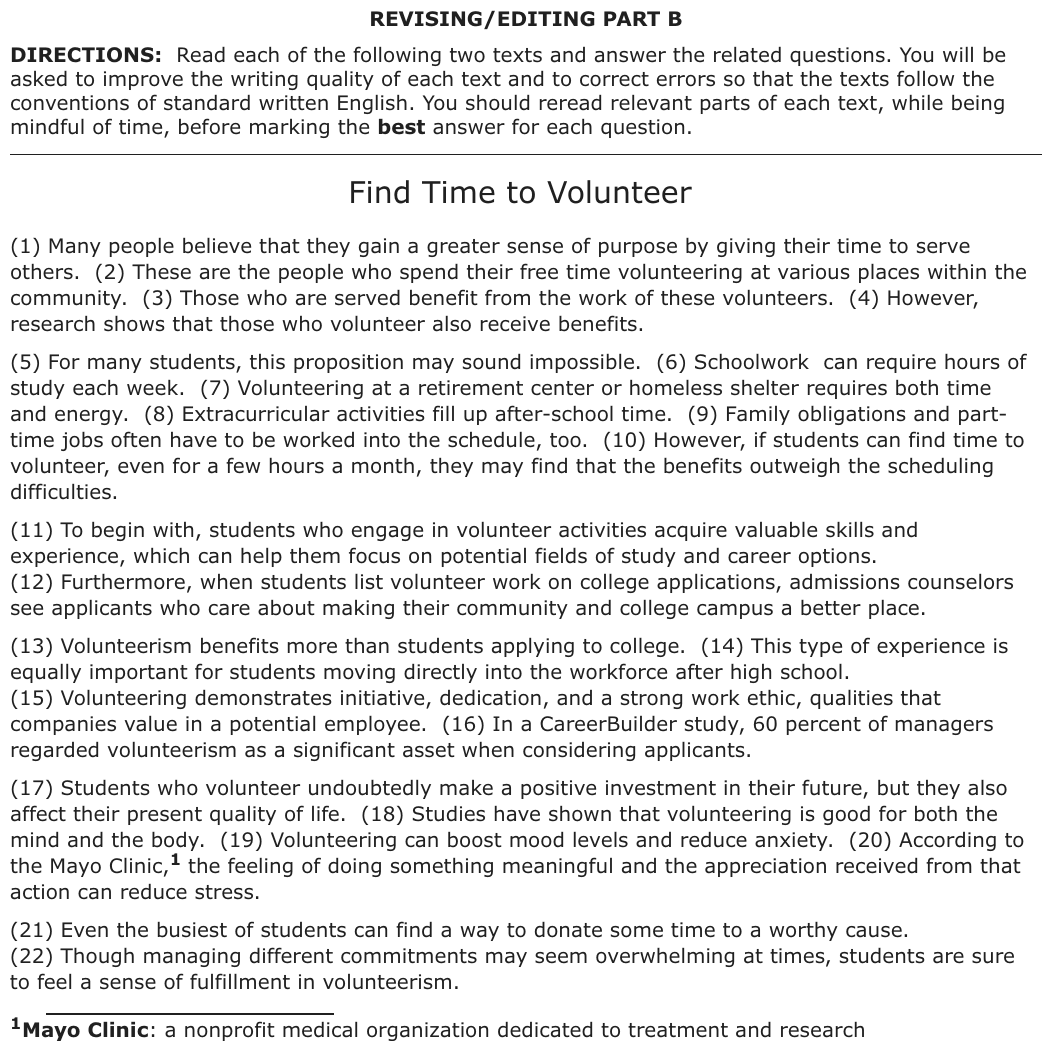
(1) Many people believe that they gain a greater sense of purpose by giving their time to serve others. (2) These are the people who spend their free time volunteering at various places within the community. (3) Those who are served benefit from the work of these volunteers. (4) However, research shows that those who volunteer also receive benefits.
(5) For many students, this proposition may sound impossible. (6) Schoolwork can require hours of study each week. (7) Volunteering at a retirement center or homeless shelter requires both time and energy. (8) Extracurricular activities fill up after-school time. (9) Family obligations and part-time jobs often have to be worked into the schedule, too. (10) However, if students can find time to volunteer, even for a few hours a month, they may find that the benefits outweigh the scheduling difficulties.
(11) To begin with, students who engage in volunteer activities acquire valuable skills and experience, which can help them focus on potential fields of study and career options. (12) Furthermore, when students list volunteer work on college applications, admissions counselors see applicants who care about making their community and college campus a better place.
(13) Volunteerism benefits more than students applying to college. (14) This type of experience is equally important for students moving directly into the workforce after high school. (15) Volunteering demonstrates initiative, dedication, and a strong work ethic, qualities that companies value in a potential employee. (16) In a CareerBuilder study, 60 percent of managers regarded volunteerism as a significant asset when considering applicants.
(17) Students who volunteer undoubtedly make a positive investment in their future, but they also affect their present quality of life. (18) Studies have shown that volunteering is good for both the mind and the body. (19) Volunteering can boost mood levels and reduce anxiety. (20) According to the Mayo Clinic,1 the feeling of doing something meaningful and the appreciation received from that action can reduce stress.
(21) Even the busiest of students can find a way to donate some time to a worthy cause. (22) Though managing different commitments may seem overwhelming at times, students are sure to feel a sense of fulfillment in volunteerism.
1Mayo Clinic: a nonprofit medical organization dedicated to treatment and research
Question
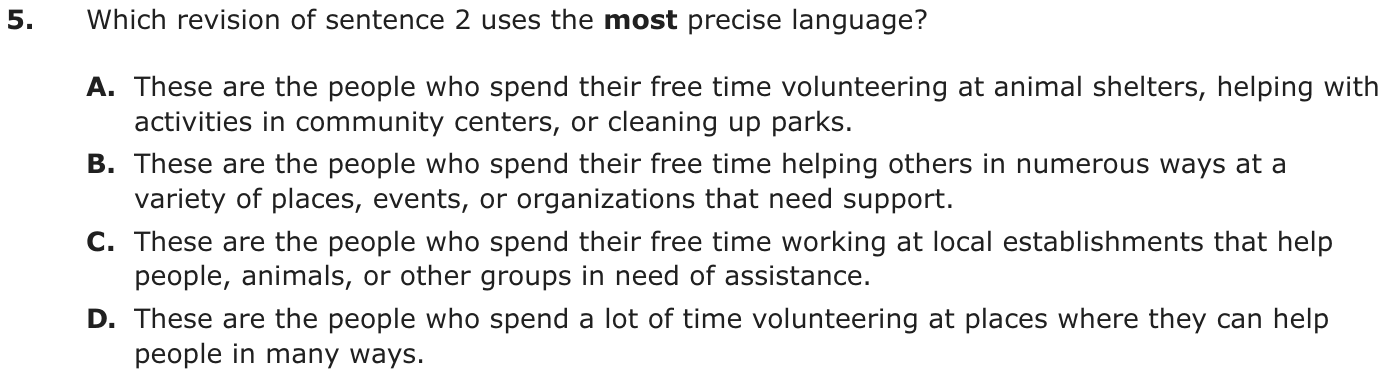
Which revision of sentence 2 uses the most precise language?
- AThese are the people who spend their free time volunteering at animal shelters, helping with activities in community centers, or cleaning up parks.
- BThese are the people who spend their free time helping others in numerous ways at a variety of places, events, or organizations that need support.
- CThese are the people who spend their free time working at local establishments that help people, animals, or other groups in need of assistance.
- DThese are the people who spend a lot of time volunteering at places where they can help people in many ways.
Show the answer
Correct answer: A
The question asks which revision of sentence 2 uses the most precise language.
A. CORRECT. In sentence 2, the author states that people who volunteer in their free time do so “at various places.” The revision to sentence 2 provides the most precise language because it references three specific places (animal shelters, community centers, and parks) where people often volunteer.
B. Incorrect. Although this sentence mentions “a variety of places, events, or organizations” at which people volunteer, the revision does not use the most precise language, because it does not list specific places, events, or organizations.
C. Incorrect. Although this sentence mentions “local establishments that help people, animals, or other groups,” the revision does not use the most precise language, because it does not name the specific types of establishments at which people can volunteer.
D. Incorrect. Although this sentence mentions “places where [volunteers] can help people in many ways,” the revision does not use the most precise language, because it does not provide specific examples of where people can volunteer.
Question analysis
This revising question uses a persuasive essay urging high school students to find time to volunteer. It asks which rewrite of the second sentence, about the people who spend free time volunteering at various places, uses the most precise language. The trap is that longer, list-like wording can look more specific than it really is.
- Grade level
- Grade 6 reading and task
- Compared with grade 7
- Below grade 7 Grade 7 writers learn to replace vague wording with precise language. Here that skill is applied to one sentence of a plain persuasive essay, with no grammar to fix, which makes it lighter than typical grade 7 revision work.
- Estimated difficulty
- Routine: one familiar step, little to misread.
- Thinking it demands
- Depth of knowledge 1, recall and reproduction · mainly evaluate
- What makes it hard
- Evidence
- Answered from one sentence or line
- Reading level
- Passage: about grade 11, 354 words; question and choices: about grade 10, 102 words.
- Students, last 30 days
- Not enough answers yet to show (it takes 10).
Why it is hard, traps and wrong answers (shows the answer)
Why it is hard
Sentence 2’s vague phrase is “various places,” and only one revision replaces it with places a reader can picture: animal shelters, community centers and parks. The wrong revisions grow longer or list the kinds of people helped, which can pass for precision on a quick read. Asking whether a revision names a real place settles it.
Every choice must be checked minor Choosing the answer
Every revision is longer than sentence 2 and sounds more detailed, so each has to be checked for whether it names actual places or only adds general words such as “organizations” and “establishments.” (Embretson & Wetzel, 1987)
Strategy: Find the vague phrase in sentence 2, then ask of each revision whether it tells the reader something more definite or simply uses more words to say the same thing.
Traps
- Wordy, vague or informal: A revision is grammatical but wordy, imprecise or too casual for the passage.
The wrong answers, classified
B Wordy, vague or informal (Connors & Lunsford, 1988)
Mistakes a longer string of general categories, “places, events, or organizations,” for precision, though none is named and the sentence only grows wordier.
C Wordy, vague or informal (Connors & Lunsford, 1988)
Is drawn by the three-part list of people, animals and other groups, but “local establishments” still leaves the actual places unnamed.
D Wordy, vague or informal (Connors & Lunsford, 1988)
Accepts “a lot of time” and “many ways,” which keep the original’s vagueness and even drop the point that volunteers give their free time.
Working it out, step by step
Figure out what the question asks
You need to rewrite sentence 2 with more precise language. Precise means exact. Precise words help the reader picture something real. Sentence 2 says: “These are the people who spend their free time volunteering at various places within the community.” Look for the part that is vague.
Find the vague phrase
The vague phrase is “at various places.” Various means different kinds. But the sentence never says which places. You can’t picture them. A better sentence would name real places. Example: I help out at different spots is vague. I help out at the library and the food bank is precise.
Check each choice
- A names three real places: “animal shelters,” “community centers,” and “parks.” You can picture each one.
- B says “a variety of places, events, or organizations.” That is a longer list of general words. It still names nothing real.
- C says “local establishments.” An establishment is a business or group. It still doesn’t say which ones.
- D says “a lot of time” and “many ways.” Those words are vague too. D even drops the idea of free time.
Pick the answer
Watch out: C has a list, “people, animals, or other groups,” so it looks detailed. But that list tells who gets help, not where volunteers go. Only one choice names the places. So the answer is A.
Why this answer and not the closest wrong one
C is the closest wrong answer. Its list of people, animals and other groups sounds specific. But “local establishments” could be any place at all. A replaces “various places” with three places a reader can picture: animal shelters, community centers and parks. That makes A the most precise.
More questions like this
The original DOE question
The passage “Find Time to Volunteer” as printed (page 163)