Passage Find Time to Volunteer
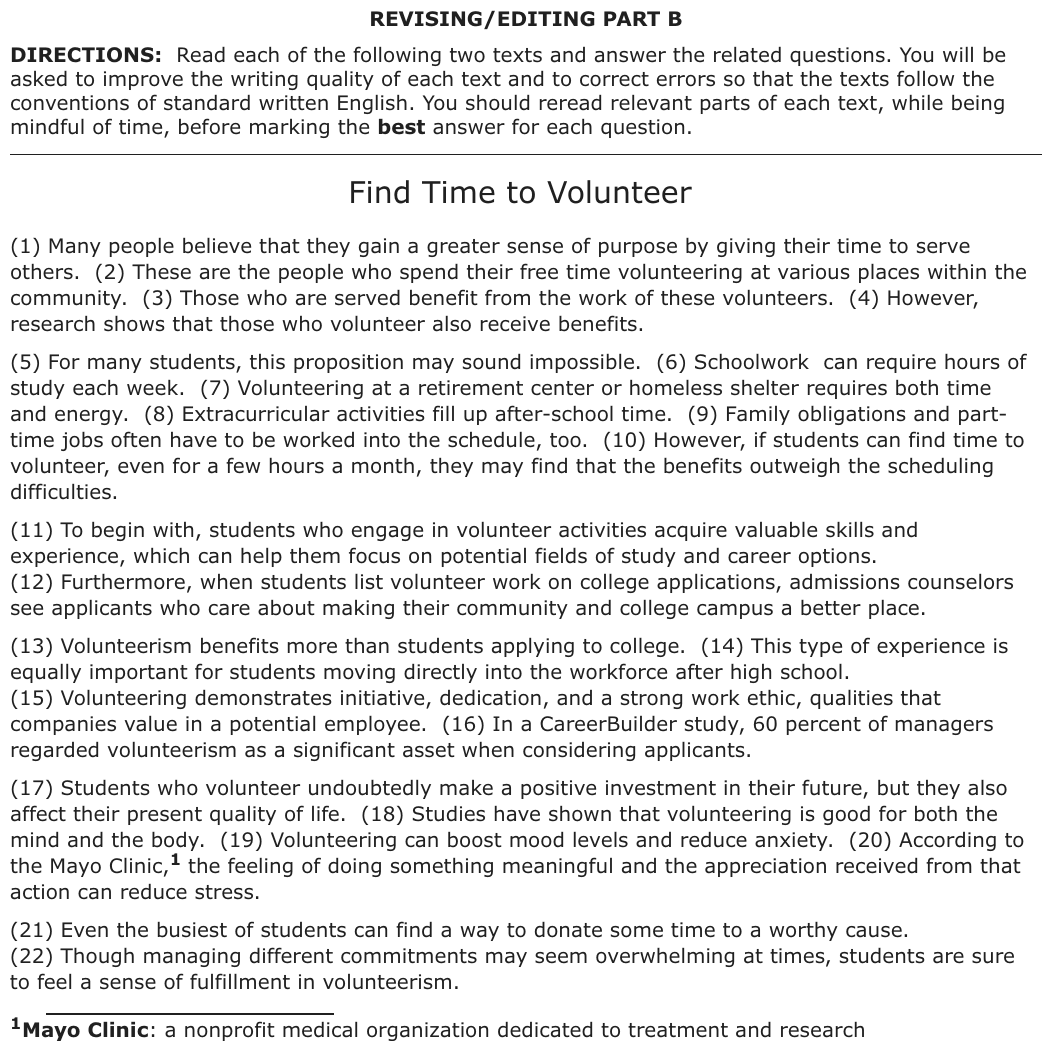
Find Time to Volunteer
(1) Many people believe that they gain a greater sense of purpose by giving their time to serve others. (2) These are the people who spend their free time volunteering at various places within the community. (3) Those who are served benefit from the work of these volunteers. (4) However, research shows that those who volunteer also receive benefits.
(5) For many students, this proposition may sound impossible. (6) Schoolwork can require hours of study each week. (7) Volunteering at a retirement center or homeless shelter requires both time and energy. (8) Extracurricular activities fill up after-school time. (9) Family obligations and part-time jobs often have to be worked into the schedule, too. (10) However, if students can find time to volunteer, even for a few hours a month, they may find that the benefits outweigh the scheduling difficulties.
(11) To begin with, students who engage in volunteer activities acquire valuable skills and experience, which can help them focus on potential fields of study and career options. (12) Furthermore, when students list volunteer work on college applications, admissions counselors see applicants who care about making their community and college campus a better place.
(13) Volunteerism benefits more than students applying to college. (14) This type of experience is equally important for students moving directly into the workforce after high school. (15) Volunteering demonstrates initiative, dedication, and a strong work ethic, qualities that companies value in a potential employee. (16) In a CareerBuilder study, 60 percent of managers regarded volunteerism as a significant asset when considering applicants.
(17) Students who volunteer undoubtedly make a positive investment in their future, but they also affect their present quality of life. (18) Studies have shown that volunteering is good for both the mind and the body. (19) Volunteering can boost mood levels and reduce anxiety. (20) According to the Mayo Clinic,1 the feeling of doing something meaningful and the appreciation received from that action can reduce stress.
(21) Even the busiest of students can find a way to donate some time to a worthy cause. (22) Though managing different commitments may seem overwhelming at times, students are sure to feel a sense of fulfillment in volunteerism.
1Mayo Clinic: a nonprofit medical organization dedicated to treatment and research
Question
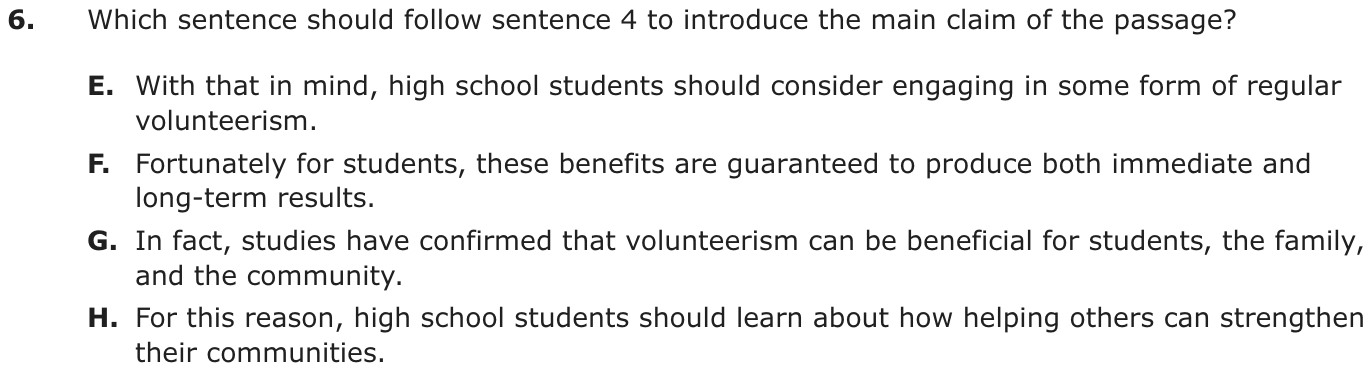
Which sentence should follow sentence 4 to introduce the main claim of the passage?
- AWith that in mind, high school students should consider engaging in some form of regular volunteerism.
- BFortunately for students, these benefits are guaranteed to produce both immediate and long-term results.
- CIn fact, studies have confirmed that volunteerism can be beneficial for students, the family, and the community.
- DFor this reason, high school students should learn about how helping others can strengthen their communities.
Show the answer
Correct answer: A
The question asks which sentence should follow sentence 4 to introduce the main claim of the passage.
A. CORRECT. Sentence 4 states that “research shows that those who volunteer also receive benefits.” The sentence in the option logically follows the ideas in sentence 4 and provides the best thesis statement for the passage because it introduces the main claim that high school students should consider the benefits of volunteerism.
B. Incorrect. While the sentence refers to the “benefits” mentioned in sentence 4, it erroneously asserts that “immediate and long-term results” are “guaranteed.” In addition, the sentence does not introduce the main claim of the passage that volunteering is beneficial for high school students.
C. Incorrect. Although the sentence states that “volunteerism can be beneficial for students,” it introduces the idea that “the family, and the community” benefit as well, which is not part of the main argument. Therefore, this sentence should not follow sentence 4 to introduce the main claim of the passage.
D. Incorrect. Although the sentence introduces the claim that “high school students should learn about” volunteering, it focuses on the idea that volunteering strengthens the community, which is not the main claim. This sentence does not accurately introduce the claim that volunteering is beneficial for high school students and thus should not follow sentence 4.
Question analysis
This introduction question asks which sentence should come right after sentence 4 of the volunteering essay to state its main claim. Students must work out what the whole essay argues and match it to an opening line, while the choices mention benefits, studies and communities in ways that sound like a thesis.
- NYS standards
- 7W1a introducing claims and counterclaims
- Grade level
- Grade 7 reading and task
- Compared with grade 7
- At grade 7 Stating a precise claim is a core grade 7 argument skill. Students must sense the essay’s claim from all six paragraphs and test four openers that each sound like a thesis, typical of careful grade 7 revision.
- Estimated difficulty
- Moderate: several steps, or a close reading with one strong distractor.
- Thinking it demands
- Depth of knowledge 2, skills and concepts · mainly evaluate
- What makes it hard
- Evidence in several places moderate
- A very close wrong answer moderate
- How sentences fit together minor
- Evidence
- Answered from the whole text
- Reading level
- Passage: about grade 11, 354 words; question and choices: about grade 10, 76 words.
- Students, last 30 days
- Not enough answers yet to show (it takes 10).
Why it is hard, traps and wrong answers (shows the answer)
Why it is hard
Three of the four sentences sound like a thesis, and two contain “high school students should,” so tone decides nothing. Students go wrong when they choose a sentence that only repeats the research point of sentence 4, or one that urges a different action. The question rewards stating the essay’s claim first, that students should volunteer because it pays off for them, and then finding the sentence that says exactly that.
Evidence in several places moderate Working it out
The essay never states its claim in one sentence; it has to be pieced together from the benefits for college, work and health in paragraphs 3 to 5 and sentence 21’s “Even the busiest of students can find a way.” (Kirsch & Mosenthal, 1990; Gorin & Embretson, 2006)
A very close wrong answer moderate Choosing the answer
The right sentence and the one about strengthening communities both open with a linking phrase and “high school students should”; they part only on what students should do, volunteer or learn about communities. (Embretson & Wetzel, 1987; Gorin & Embretson, 2006; Ascalon et al., 2007)
How sentences fit together minor Working it out
The new sentence follows sentence 4’s “those who volunteer also receive benefits,” so it must turn that research point into what students should do about it. (Halliday & Hasan, 1976)
Strategy: Skim the body paragraphs and state in a few words what the essay wants its readers to believe. Then choose the sentence that says exactly that and follows naturally from sentence 4.
Traps
- Off the point: Adds or keeps something that does not support the paragraph's or the passage's focus, or an introduction or conclusion that misses the main point.
- Too broad or too strong: A choice overstates, generalizes, or uses absolute words the text does not support.
The wrong answers, classified
B Too broad or too strong (King et al., 2004)
Follows the word “benefits” from sentence 4 but overstates them as “guaranteed” and never says what students should do, so no claim is introduced.
C Off the point (Halliday & Hasan, 1976)
Likes the research-sounding “studies have confirmed,” but it restates sentence 4 as a fact rather than a claim and widens the benefits to families and the community.
D Off the point (Halliday & Hasan, 1976)
Sees the thesis-like “high school students should,” but it asks students to learn about strengthening communities, a point the essay never develops, instead of urging them to volunteer.
Working it out, step by step
Figure out what the question asks
You need a sentence to go right after sentence 4. It must introduce the main claim. A claim is the main point a writer wants you to believe or act on. In an essay like this, it is often a should statement. Example: Students should get more sleep. So first figure out what the whole essay argues.
Find the essay’s main claim
The essay keeps urging students to make time to help. Sentence 10 says “if students can find time to volunteer, even for a few hours a month, they may find that the benefits outweigh the scheduling difficulties.” Paragraphs 3 to 5 give benefits for college, jobs and health. Sentence 21 says “Even the busiest of students can find a way to donate some time to a worthy cause.” So the claim is: high school students should volunteer, because it helps them.
Use the clue in sentence 5
The new sentence will sit just before sentence 5. Sentence 5 says “For many students, this proposition may sound impossible.” A proposition is a suggestion. So the sentence before it must suggest something students could do. That points to a sentence telling students to volunteer.
Check each choice
- A says students “should consider engaging in some form of regular volunteerism.” That is the essay’s claim. “With that in mind” links it to the benefits in sentence 4.
- B says the benefits are “guaranteed.” That overstates them, and it never tells students to do anything.
- C just repeats that studies found benefits. It also adds families, which the essay never discusses.
- D tells students to “learn about” helping communities. The essay never argues for that.
Pick the answer
Watch out: D also says “high school students should,” so it sounds like a claim. But it asks them to learn, not to volunteer. Only one choice states what the essay argues. So the answer is A.
Why this answer and not the closest wrong one
D is the closest wrong answer, because it also tells high school students what they should do. But the essay never asks students to study how helping makes communities stronger. It argues that volunteering pays off for the students themselves. A says exactly that, and it sets up “this proposition” in sentence 5.
More questions like this
The original DOE question
The passage “Find Time to Volunteer” as printed (page 163)