Question
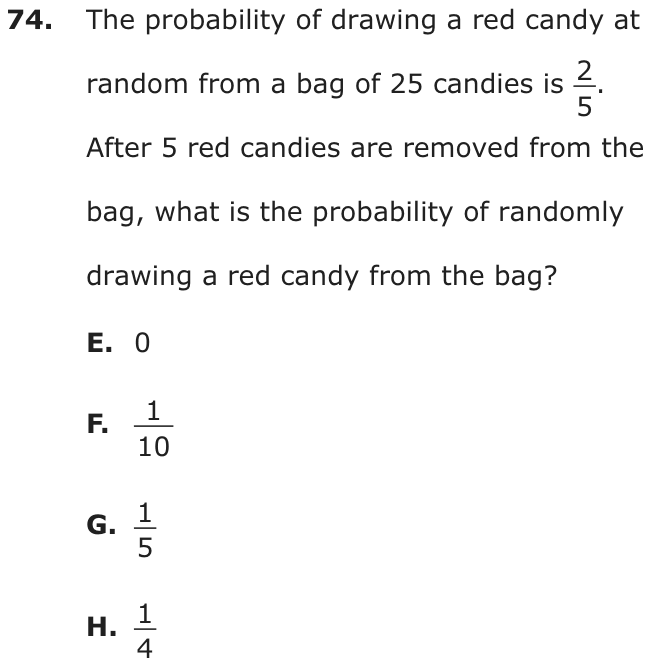
The probability of drawing a red candy at random from a bag of 25 candies is . After 5 red candies are removed from the bag, what is the probability of randomly drawing a red candy from the bag?
- A0
- B
- C
- D
Show the answer
Correct answer: D
Start with a proportion to determine the total number of red candies in the bag:
There are currently 10 red candies out of 25 candies in the bag. After 5 red candies are removed, there would be 5 red candies left in the bag and 20 total candies.
The probability of randomly drawing a red candy would then be .
Question analysis
A probability question about a bag of 25 candies in which the chance of drawing red is 2/5; then 5 red candies are taken out. Students find the new probability of drawing a red candy. They must work out how many red candies there were, then rebuild the fraction from the counts left in the bag.
- Grade level
- Grade 6 content, by NYS standard
- Compared with grade 7
- At grade 7 Simple probability as a fraction of outcomes is grade 6 and 7 content. This adds a step back from the probability to a count and an update after removal, which is typical grade 7 multi-step work.
- Estimated difficulty
- Moderate: several steps, or a close reading with one strong distractor.
- Thinking it demands
- Depth of knowledge 2, skills and concepts · mainly apply
- What makes it hard
- Turning words into math moderate
- Many steps minor
- Solution
- 3 steps
- Reading level
- Question and choices: about grade 7, 40 words.
- Students, last 30 days
- Not enough answers yet to show (it takes 10).
Why it is hard, traps and wrong answers (shows the answer)
Why it is hard
The question gives a probability, not a count, so the first job is to rebuild the bag: 10 red candies among 25. Removing candies changes two numbers at once, and the strongest wrong choice comes from updating the red count while leaving the total at 25. A student who writes both new counts before forming the fraction avoids it.
Turning words into math moderate Understanding the question
The probability 2/5 has to be turned into a count, 10 red of 25, and "after 5 red candies are removed" lowers both the red count and the bag's total. (Hegarty, Mayer & Monk, 1995; Koedinger & Nathan, 2004)
Many steps minor Working it out
Three steps follow in order: 2/5 of 25 = 10, then 5 red among 20 candies left, then 5/20 reduced to lowest terms. (Daniel & Embretson, 2010; Enright, Morley & Sheehan, 2002)
Strategy: Use 2/5 of 25 to find the number of red candies, subtract 5 from both the red count and the total, and write the new fraction in lowest terms.
Traps
- Misreads the question: Misses or misreads a condition or a word in the question: "at least", "each", "remaining", "not".
The wrong answers, classified
A An arithmetic slip (Junker & Sijtsma, 2001)
Takes 2/5 of 25 as 25 ÷ 5 = 5, forgetting to multiply by 2, so removing 5 red candies seems to leave none.
B Little reason to choose it (Haladyna & Downing, 1993; Rodriguez, 2005)
No working gives 1/10, which would need 2 red candies among the 20 left; it mostly draws students who are guessing.
C Misreads the question (Hegarty, Mayer & Monk, 1995)
Subtracts the 5 removed candies from the 10 red ones but keeps 25 as the total, finding 5/25 = 1/5, though the bag now holds 20.
Worked solution, step by step
Formulas used
- Probability
- P is the probability, the chance of drawing a red candy. Red candies is how many red ones are in the bag. All candies is how many candies are in the bag in all. Each candy is equally likely, so the chance is the fraction of the bag that is red.
Sort out the question
The bag has 25 candies. The chance of drawing red is . Then 5 red candies are taken out. You need the new chance of drawing red. Taking out candies changes both the red count and the total.
Find the number of red candies
A chance of means 2 out of every 5 candies are red. Call the red count r.
There are 10 red candies. Watch out: do not stop at . You must also multiply by 2. Thinking there are 5 red candies leads to 0, choice A.
Take out the 5 red candies
Now 5 of the 20 candies are red. Watch out: the total goes down too. Keeping 25 gives , choice C.
Find the new probability
To simplify, divide the top and bottom by 5. So the answer is D, .
Check your answer
At first, is 40% of the bag. Taking out only red candies should lower the chance. is 25%, which is lower but not zero. That makes sense, because 5 red candies are still in the bag.
More questions like this
The original DOE question