Also in 2026 Practice Test D English, question 33.
Passage Excerpt from The Highest Tide
Excerpt from The Highest Tide
by Jim Lynch
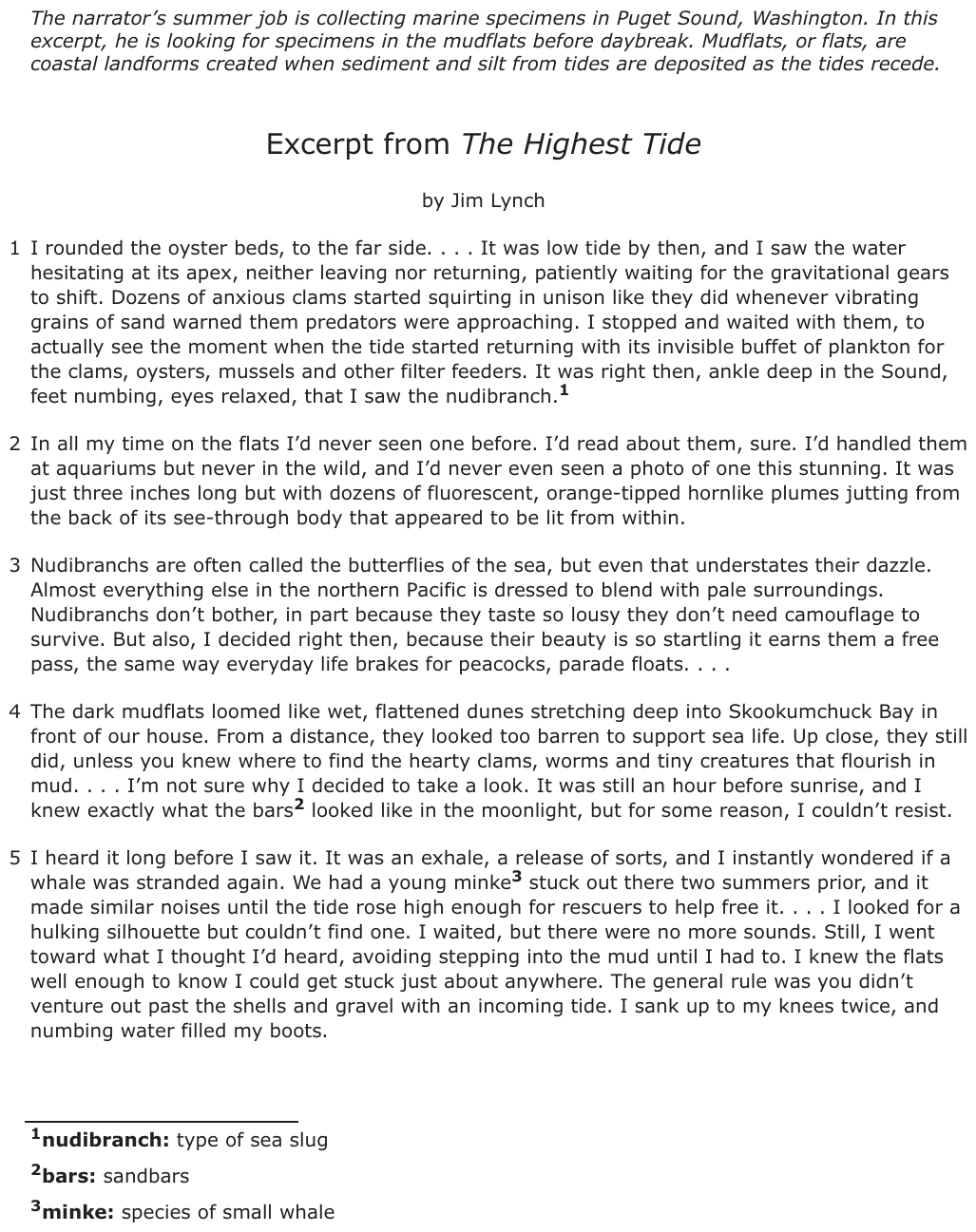
The narrator’s summer job is collecting marine specimens in Puget Sound, Washington. In this excerpt, he is looking for specimens in the mudflats before daybreak. Mudflats, or flats, are coastal landforms created when sediment and silt from tides are deposited as the tides recede.
I rounded the oyster beds, to the far side. . . . It was low tide by then, and I saw the water hesitating at its apex, neither leaving nor returning, patiently waiting for the gravitational gears to shift. Dozens of anxious clams started squirting in unison like they did whenever vibrating grains of sand warned them predators were approaching. I stopped and waited with them, to actually see the moment when the tide started returning with its invisible buffet of plankton for the clams, oysters, mussels and other filter feeders. It was right then, ankle deep in the Sound, feet numbing, eyes relaxed, that I saw the nudibranch.1
In all my time on the flats I’d never seen one before. I’d read about them, sure. I’d handled them at aquariums but never in the wild, and I’d never even seen a photo of one this stunning. It was just three inches long but with dozens of fluorescent, orange-tipped hornlike plumes jutting from the back of its see-through body that appeared to be lit from within.
Nudibranchs are often called the butterflies of the sea, but even that understates their dazzle. Almost everything else in the northern Pacific is dressed to blend with pale surroundings. Nudibranchs don’t bother, in part because they taste so lousy they don’t need camouflage to survive. But also, I decided right then, because their beauty is so startling it earns them a free pass, the same way everyday life brakes for peacocks, parade floats. . . .
The dark mudflats loomed like wet, flattened dunes stretching deep into Skookumchuck Bay in front of our house. From a distance, they looked too barren to support sea life. Up close, they still did, unless you knew where to find the hearty clams, worms and tiny creatures that flourish in mud. . . . I’m not sure why I decided to take a look. It was still an hour before sunrise, and I knew exactly what the bars2 looked like in the moonlight, but for some reason, I couldn’t resist.
I heard it long before I saw it. It was an exhale, a release of sorts, and I instantly wondered if a whale was stranded again. We had a young minke3 stuck out there two summers prior, and it made similar noises until the tide rose high enough for rescuers to help free it. . . . I looked for a hulking silhouette but couldn’t find one. I waited, but there were no more sounds. Still, I went toward what I thought I’d heard, avoiding stepping into the mud until I had to. I knew the flats well enough to know I could get stuck just about anywhere. The general rule was you didn’t venture out past the shells and gravel with an incoming tide. I sank up to my knees twice, and numbing water filled my boots.
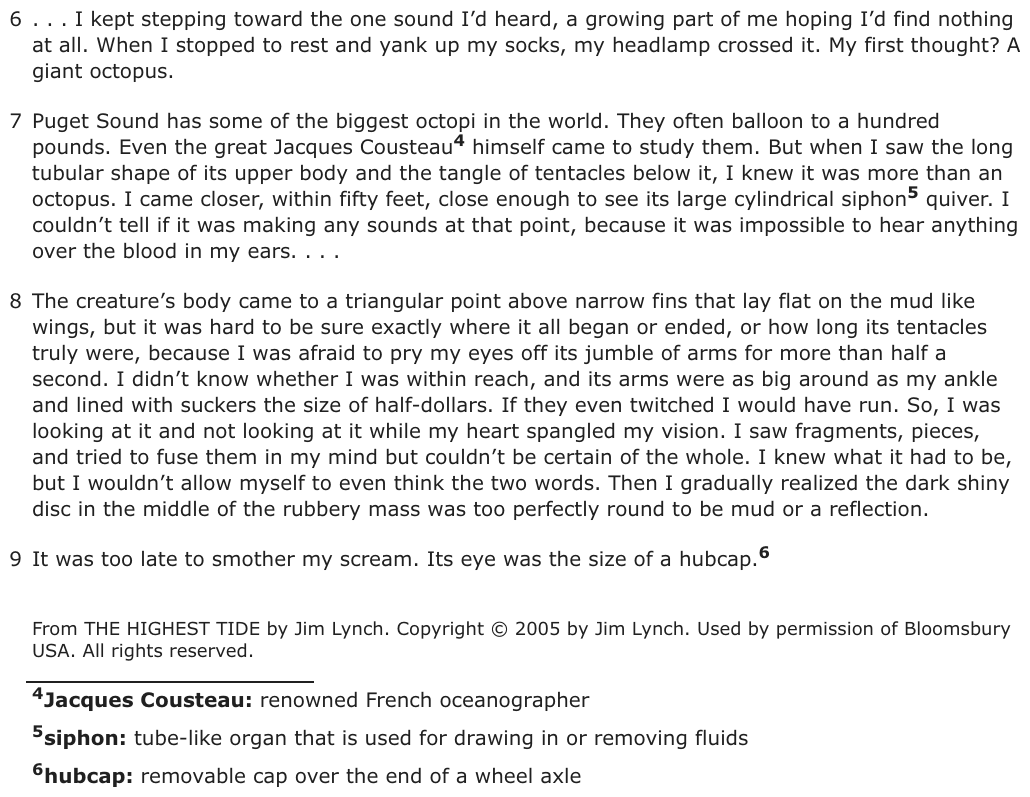
. . . I kept stepping toward the one sound I’d heard, a growing part of me hoping I’d find nothing at all. When I stopped to rest and yank up my socks, my headlamp crossed it. My first thought? A giant octopus.
Puget Sound has some of the biggest octopi in the world. They often balloon to a hundred pounds. Even the great Jacques Cousteau4 himself came to study them. But when I saw the long tubular shape of its upper body and the tangle of tentacles below it, I knew it was more than an octopus. I came closer, within fifty feet, close enough to see its large cylindrical siphon5 quiver. I couldn’t tell if it was making any sounds at that point, because it was impossible to hear anything over the blood in my ears. . . .
The creature’s body came to a triangular point above narrow fins that lay flat on the mud like wings, but it was hard to be sure exactly where it all began or ended, or how long its tentacles truly were, because I was afraid to pry my eyes off its jumble of arms for more than half a second. I didn’t know whether I was within reach, and its arms were as big around as my ankle and lined with suckers the size of half-dollars. If they even twitched I would have run. So, I was looking at it and not looking at it while my heart spangled my vision. I saw fragments, pieces, and tried to fuse them in my mind but couldn’t be certain of the whole. I knew what it had to be, but I wouldn’t allow myself to even think the two words. Then I gradually realized the dark shiny disc in the middle of the rubbery mass was too perfectly round to be mud or a reflection.
It was too late to smother my scream. Its eye was the size of a hubcap.6
From THE HIGHEST TIDE by Jim Lynch. Copyright © 2005 by Jim Lynch. Used by permission of Bloomsbury USA. All rights reserved.
1nudibranch: type of sea slug
2bars: sandbars
3minke: species of small whale
4Jacques Cousteau: renowned French oceanographer
5siphon: tube-like organ that is used for drawing in or removing fluids
6hubcap: removable cap over the end of a wheel axle
Question
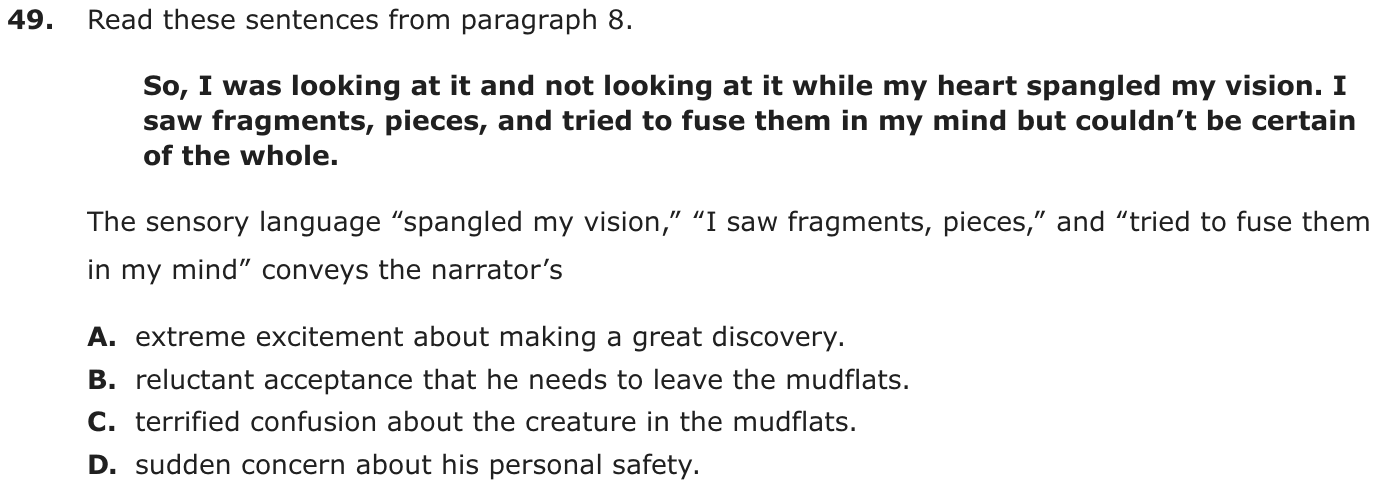
Read these sentences from paragraph 8.
So, I was looking at it and not looking at it while my heart spangled my vision. I saw fragments, pieces, and tried to fuse them in my mind but couldn’t be certain of the whole.
The sensory language “spangled my vision,” “I saw fragments, pieces,” and “tried to fuse them in my mind” conveys the narrator’s
- Aextreme excitement about making a great discovery.
- Breluctant acceptance that he needs to leave the mudflats.
- Cterrified confusion about the creature in the mudflats.
- Dsudden concern about his personal safety.
Show the answer
Correct answer: C
The question asks what the sensory language in the sentences from paragraph 8 conveys about the narrator.
A. Incorrect. While the narrator does not leave the mudflats and is curious about what has been found, the main emotions described in paragraph 8 are fear and confusion as the narrator tries to comprehend the size of the animal.
B. Incorrect. The language focuses on the narrator’s inability to organize what he sees into useful thoughts and conclusions, and while the narrator feels fear in paragraph 8—“I was afraid” and “I would have run”—the narrator refuses to leave the mudflats out of curiosity.
C. CORRECT. The phrase “spangled my vision” illustrates that the narrator cannot fully recognize what has appeared on the mudflats. The sight is so amazing, the narrator is trying to “fuse” together “fragments” and “pieces” because seeing the creature has created so much emotion in the narrator that he feels confused.
D. Incorrect. While the narrator is feeling some fear, as expressed in paragraph 8, the phrases actually indicate that the narrator’s amazement causes him to struggle to take in the view of the creature before him.
Question analysis
This question about sensory language asks what three phrases, including “spangled my vision,” convey about the narrator as he stares at a huge creature in the mud in an excerpt from The Highest Tide. Students must interpret unusual imagery and choose among emotions that all seem possible at such a startling moment.
- Grade level
- Grade 8 reading and task
- Compared with grade 7
- Above grade 7 Interpreting sensory language for a character's state of mind is grade 7 work, but spangled is an unusual verb, and the paragraph partly supports several of the emotions offered, so the choice must be matched precisely to the quoted phrases.
- Estimated difficulty
- Hard: combines ideas, needs a plan, and has more than one tempting wrong answer.
- Thinking it demands
- Depth of knowledge 2, skills and concepts · mainly analyze
- What makes it hard
- Figurative or literary language major
- A very close wrong answer moderate
- Hard words minor
- Evidence
- Answered from one paragraph or stanza
- Reading level
- Passage: about grade 6, 902 words; question and choices: about grade 7, 92 words.
- Students, last 30 days
- Not enough answers yet to show (it takes 10).
Why it is hard, traps and wrong answers (shows the answer)
Why it is hard
The quoted phrases are about perception, not feeling: the narrator sees fragments and cannot assemble them, while his heart pounds hard enough to blur his sight. The fear is clear from the surrounding sentences, where he is afraid to look away and ready to run, and that context makes the choice about personal safety very tempting. The answer must cover both the terror and the confusion, and the word “spangled” can mislead readers into hearing excitement.
Figurative or literary language major Understanding the question
The phrases describe seeing in pieces, “looking at it and not looking at it”, a heart that “spangled” his vision, “fragments” he cannot “fuse”, and the emotion has to be read from that broken sight. (Graesser, Singer & Trabasso, 1994; Kintsch, 1998)
A very close wrong answer moderate Choosing the answer
The right choice and the one about concern for his safety both name fear; they part on what the quoted phrases show, a mind unable to piece the creature together or a worry about its reach. (Embretson & Wetzel, 1987; Gorin & Embretson, 2006; Ascalon et al., 2007)
Hard words minor Understanding the question
“Spangled”, to scatter with glittering spots, is a rare word, and its sparkle can suggest delight, which opens a reading of excitement to students who miss the fear around it. (Perfetti, 2007; Freedle & Kostin, 1993)
Strategy: Ask what the three quoted phrases together say about how the narrator is seeing and thinking at this moment, then choose the emotion that accounts for all three, not just one.
Traps
- True but not the answer: A choice says something accurate about the text that does not answer this question.
- Wrong tone or attitude: Misjudges the tone, attitude or point of view, such as reading admiration as criticism, or taking a character's or subject's feelings for the author's.
The wrong answers, classified
A Wrong tone or attitude (Graesser, Singer & Trabasso, 1994)
Reads the pounding heart and glittering vision as the thrill of a great find, missing that he is afraid to take his eyes off the creature and cannot make sense of it.
B Twists what the text says (King et al., 2004)
Turns “If they even twitched I would have run”, a possibility, into an accepted need to leave, though the narrator stays and the phrases describe how he sees.
D True but not the answer (King et al., 2004; Embretson & Wetzel, 1987)
Matches the fear in paragraph 8, where he wonders whether he is within reach, but the quoted phrases describe broken seeing and puzzling, and his fear has been building, not sudden.
Working it out, step by step
Know what the question asks
Sensory language describes what a character sees, hears or feels. This asks what feeling the three quoted phrases show. Your answer must explain all three phrases, not just one.
Explain the hard words
To spangle means to cover with glittering spots. His heart pounds so hard that his sight seems to sparkle and blur. Fragments are small broken pieces. To fuse means to join together.
Put the phrases together
He sees only “fragments, pieces.” He tries “to fuse them in my mind” but “couldn’t be certain of the whole.” So he is confused, unable to tell what the creature really is. The sentences around them show he is also terrified. He is “afraid to pry my eyes off” its arms, and his heart is racing.
Check each choice
- C fits: “terrified confusion” covers both his fear and his broken, puzzled seeing.
- A is wrong because “spangled” may sound happy, but he is frightened, not thrilled.
- B is wrong because he never decides to leave, and he would run only if the arms moved.
- D is wrong because the phrases show confused seeing, and his fear has been growing since paragraph 6.
Watch out: D is close, since he is afraid. But it leaves out the confusion the phrases show.
Choose the answer
The phrases show a frightened narrator who cannot piece together what he sees. So the answer is C.
Why this answer and not the closest wrong one
D comes closest, because the narrator truly fears for his safety. But the quoted phrases are about how he sees: in pieces he can’t join. That is confusion. C names both the fear and the confusion, so it fits all three phrases.
More questions like this
The original DOE question
The passage “Excerpt from The Highest Tide” as printed (pages 64–65)