2025
This test has the first 120 of the 228 questions that match.
Question 1 of 120
2026 Practice Test A English, question 4Passage Snowy Mountains
Snowy Mountains
by John Gould Fletcher
Higher and still more high,
Palaces made for cloud,
Above the dingy city-roofs
Blue-white like angels with broad wings,
Pillars of the sky at rest
The mountains from the great plateau
Uprise.
But the world heeds them not;
They have been here now for too long a time.
The world makes war on them,
Tunnels their granite cliffs,
Splits down their shining sides,
Plasters their cliffs with soap-advertisements,
Destroys the lonely fragments of their peace.
Vaster and still more vast,
Peak after peak, pile after pile,
Wilderness still untamed,
To which the future is as was the past,
Barrier spread by Gods,
Sunning their shining foreheads,
Barrier broken down by those who do not need
The joy of time-resisting storm-worn stone,
The mountains swing along
The south horizon of the sky;
Welcoming with wide floors of blue-green ice
The mists that dance and drive before the sun.
“Snowy Mountains” by John Gould Fletcher—Public Domain
Question
In which two ways does the poet develop the speaker’s point of view in the second stanza (lines 8–14)?
Select the two correct answers.
Choose every answer that is correct, then check. The DOE has not published how answers with several parts are scored; this site counts one right only when every part is right.
- Aby describing the mountains’ awe-inspiring size and strength
- Bby comparing the various methods humans use to control nature
- Cby criticizing the careless actions of humans that harm the natural environment
- Dby demonstrating how the mountains and the people are able to benefit from each other
- Eby depicting the unfortunate plight of the mountains with vivid details
Show the answer
Correct answer: C and E
The question asks for the two ways in which the poet develops the speaker’s point of view in the second stanza (lines 8–14).
A. Incorrect. The speaker’s descriptions of the mountains’ awe-inspiring size and strength mainly occur in the first and third stanzas, while in the second stanza, the speaker focuses on humanity and its negative effect on the mountains.
B. Incorrect. The wording of the second stanza—“makes war” (line 10), “Splits down their shining sides” (line 12), and “Destroys the lonely fragments” (line 14)—communicates the speaker’s position that people’s main impact on the mountains is destructive, but the stanza does not compare the various methods people use to control nature.
C. CORRECT. In the second stanza, the speaker criticizes the careless and destructive actions of society or “the world” (lines 8 and 10) that harm the natural environment. Humans are described as both heedless of the mountains (“heeds them not”) and harmfully warlike (“makes war on them”). The speaker cites the harm done to the mountains when people “[tunnel] their granite cliffs” (line 11) and “[split] down their shining sides” (line 12), thus “[destroying] the lonely fragments of their peace” (line 14).
D. Incorrect. In the second stanza, the speaker does not describe a mutually beneficial relationship between the mountains and the people. Although people clearly derive benefits from the mountains by plastering “their cliffs with soap-advertisements” (line 13), the stanza does not demonstrate that the mountains receive any benefit from the harmful actions of the people.
E. CORRECT. In the second stanza, the speaker depicts the unfortunate plight of the mountains with vivid details. Lines 11–14 feature expressive wording that sharply illustrates the mountains’ misfortune: “Tunnels their granite cliffs, / Splits down their shining sides, / Plasters their cliffs with soap-advertisements.”
Question analysis
This select-two question on John Gould Fletcher’s poem “Snowy Mountains” asks in which two ways the poet develops the speaker’s point of view in the second stanza, lines 8–14. It reworks a one-answer handbook question, now with five choices. Each choice has to be judged on its own, and a choice that fits the poem as a whole is not enough.
- Grade level
- Grade 6 reading and task
- Compared with grade 7
- At grade 7 Typical grade 7 point-of-view questions ask for one answer about a longer text. This stanza is only seven short lines with one steady attitude, but students must find two right choices out of five and judge each one separately.
- Estimated difficulty
- Moderate: several steps, or a close reading with one strong distractor.
- Thinking it demands
- Depth of knowledge 2, skills and concepts · mainly analyze
- What makes it hard
- How, not what moderate
- Every choice must be checked moderate
- Hard words minor
- Evidence
- Answered from one paragraph or stanza
- Reading level
- Passage: 161 words (a poem; reading level not measured); question and choices: about grade 8, 79 words.
- Students, last 30 days
- Not enough answers yet to show (it takes 10).
Why it is hard, traps and wrong answers (shows the answer)
Why it is hard
Most students sense the anger at “the world” in lines 8–14 and find the criticism of people quickly. The point is lost on the second pick, because the other right choice names a technique, vivid details of the mountains’ suffering, and can look like plain description. The choice about comparing methods tempts students who see a list of human actions, and the awe of the first and third stanzas pulls those who drift outside the stanza, while both picks must be right to score.
How, not what moderate Working it out
The stem asks how the viewpoint is built, and both right choices are methods: a judgment of “the world” that “makes war,” and the vivid verbs “Tunnels,” “Splits” and “Plasters” in lines 11–13. (Anderson & Krathwohl, 2001)
Every choice must be checked moderate Choosing the answer
All five choices must be tested and both picks must be right, so finding the criticism of people is only half the work; the second right choice is about imagery, not message. (Embretson & Wetzel, 1987)
Hard words minor Understanding the question
One right choice turns on “plight,” a hard situation; a student who does not know the word cannot see that it names the damage done to the mountains in lines 11–14. (Perfetti, 2007; Freedle & Kostin, 1993)
Strategy: Restate in your own words what lines 8–14 say and how they say it, then test each of the five choices on its own and keep only the two that fit this stanza rather than the whole poem.
Traps
- Twists what the text says: Uses the text's topic and ideas but changes what it says: who did it, how much, when, or why.
- Wrong part of the text: A choice is true of another paragraph, stanza or speaker than the one asked about.
The wrong answers, classified
A Wrong part of the text (Kirsch & Mosenthal, 1990)
Brings in the awe of the first and third stanzas, “Higher and still more high” and “Vaster and still more vast,” though in lines 8–14 the cliffs appear only as things being damaged.
B Twists what the text says (King et al., 2004)
Sees that lines 11–13 list several human acts, tunneling, splitting and plastering, but the stanza never weighs one against another; all are blows in one war, not methods of control.
D Wrong tone or attitude (Graesser, Singer & Trabasso, 1994)
Treats the soap advertisements as people getting some use from the cliffs and imagines an exchange, missing the hostility of “The world makes war on them” and “Destroys.”
E Wrong purpose or structure (Anderson & Krathwohl, 2001)
Left out by students who see the vivid verbs as mere description of damage rather than the way the speaker builds sympathy, or who do not know that “plight” means a bad situation.
Working it out, step by step
Figure out what the question asks
This asks about point of view: how the speaker, the voice talking in the poem, feels about the subject. It also asks how the poet shows that feeling. Stay inside the second stanza, lines 8 to 14. You must pick two answers, so test all five choices one at a time.
Read the second stanza closely
Line 8 says “But the world heeds them not.” To heed something is to pay attention to it. Here “the world” means people in general. Line 10 says “The world makes war on them.” Lines 11 to 13 list what people do: “Tunnels their granite cliffs, / Splits down their shining sides, / Plasters their cliffs with soap-advertisements.” Line 14 ends with “Destroys the lonely fragments of their peace.”
Name how the speaker feels
The speaker is on the mountains’ side. People ignore the mountains, yet they keep attacking them. The speaker blames people for this harm. Pointing out what someone does wrong is called criticizing. The speaker also makes you feel sorry for the mountains. Strong action words like “Tunnels,” “Splits” and “Plasters” paint a sharp picture of the damage. Sharp word pictures like these are called vivid details.
Check each of the five choices
- A does not fit. The mountains’ great size fills the first and third stanzas, as in “Higher and still more high.” In lines 8 to 14 they are only being hurt.
- B does not fit. The stanza lists several things people do, but it never compares them. They are all part of one “war.”
- C fits. The speaker criticizes people for careless acts that damage nature.
- D does not fit. The mountains get nothing good from people. The stanza shows only harm.
- E fits. A plight is a bad or sad situation. The vivid verbs in lines 11 to 13 show the mountains’ plight.
Watch out: B is tempting because the stanza names several acts. But a list is not a comparison.
Choose both answers
The speaker’s view comes through two things: blame for people, and a vivid picture of the mountains’ suffering. Select both choices on the screen. You need both to get the point. So the answers are C and E.
Why this answer and not the closest wrong one
E is the right answer that is easiest to miss, because it can look like plain description. But those vivid details are how the speaker makes you feel for the mountains. B is the closest wrong choice. The stanza does list several human acts, yet it never weighs one against another. Each act is just one more blow.
More questions like this
The original DOE question
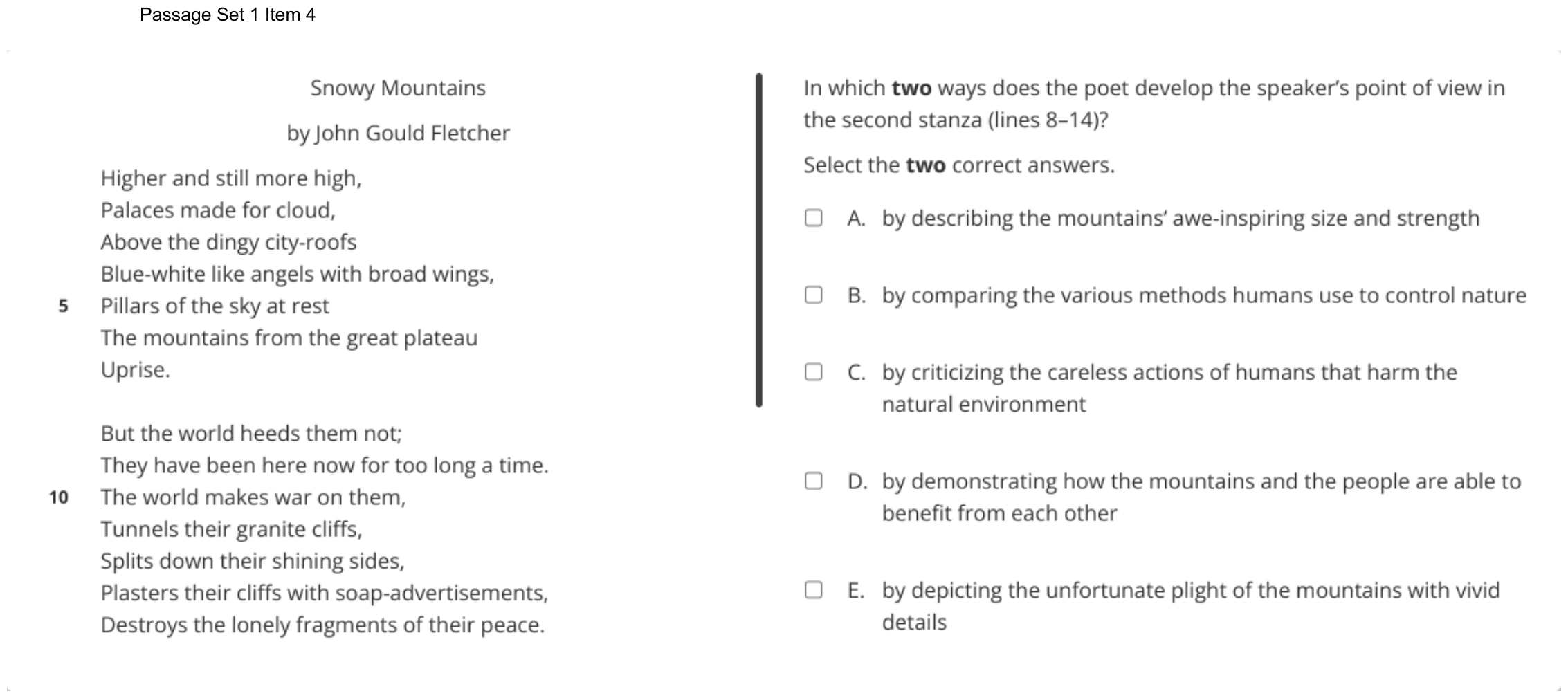
The passage “Snowy Mountains” as printed (page 142)
Question 2 of 120
2026 Practice Test A English, question 7Uses the passage above: “Snowy Mountains”.
Question
Which quotations from the poem support the theme that nature’s unspoiled beauty is splendid, and which quotations support the theme that human creations detract from natural wonder?
Move each answer to the correct box.
Choose one answer in each row, then check. The DOE has not published how answers with several parts are scored; this site counts one right only when every part is right.
| Nature’s Unspoiled Beauty is Splendid | Human Creations Detract from Natural Wonder | |
|---|---|---|
| “Above the dingy city-roofs / Blue-white like angels with broad wings,” (lines 3–4) | ||
| “Pillars of the sky at rest / The mountains from the great plateau / Uprise.” (lines 5–7) | ||
| “Tunnels their granite cliffs, / Splits down their shining sides,” (lines 11–12) | ||
| “Wilderness still untamed, / To which the future is as was the past,” (lines 17–18) | ||
| “The south horizon of the sky; / Welcoming with wide floors of blue-green ice” (lines 24–25) |
Show the answer
Correct answer: “Above the dingy city-roofs / Blue-white like angels with broad wings,” (lines 3–4): Human Creations Detract from Natural Wonder; “Pillars of the sky at rest / The mountains from the great plateau / Uprise.” (lines 5–7): Nature’s Unspoiled Beauty is Splendid; “Tunnels their granite cliffs, / Splits down their shining sides,” (lines 11–12): Human Creations Detract from Natural Wonder; “Wilderness still untamed, / To which the future is as was the past,” (lines 17–18): Nature’s Unspoiled Beauty is Splendid; “The south horizon of the sky; / Welcoming with wide floors of blue-green ice” (lines 24–25): Nature’s Unspoiled Beauty is Splendid
The question identifies two themes and asks which quotations from the poem support each theme. Each quotation should be moved to one of the two boxes: “Nature’s Unspoiled Beauty is Splendid” or “Human Creations Detract from Natural Wonder.”
“Above the dingy city-roofs / Blue-white like angels with broad wings,” (lines 3–4)
This quotation supports the theme that human creations detract from natural wonder. The lines describe the city-roofs as “dingy,” suggesting that they mar the lovely background of the blue-white mountains, which are compared to angels, a simile that vividly conveys the wonder of nature. The description in the lines primarily serves to create a contrast between the city’s unsightly appearance and the beauty of the mountains, thereby providing support for the theme that human creations (i.e. the city) detract from natural wonder.
“Pillars of the sky at rest / The mountains from the great plateau / Uprise.” (lines 5–7)
This quotation supports the theme that nature’s unspoiled beauty is splendid. By describing the mountains as “pillars of the sky” that “uprise” dramatically from a large plateau, the lines primarily convey a sense of the mountains’ dramatic and impressive size. The description suggests that the mountains are holding up the sky, a powerful image of an unspoiled, natural landscape.
“Tunnels their granite cliffs, / Splits down their shining sides,” (lines 11–12)
The quotation supports the theme that human creations detract from natural wonder. The words “tunnels” and “splits” emphasize that human intervention in nature is destructive, breaking apart the “shining sides” of the mountain. These lines suggest that human creations—such as building a tunnel through a mountain—detract from natural wonder, diminishing its beauty and serenity.
“Wilderness still untamed, / To which the future is as was the past,” (lines 17–18)
The quotation supports the theme that nature’s unspoiled beauty is splendid by indicating that the natural mountainous landscape is both splendid and unspoiled (“wilderness still untamed”). The phrase “to which the future is as was the past” suggests that nature in its unspoiled state is timeless or eternal, further supporting the theme.
“The south horizon of the sky; / Welcoming with wide floors of blue-green ice” (lines 24–25)
The quotation supports the theme that nature’s unspoiled beauty is splendid. The reference to the “wide floors of blue-green ice” emphasizes that the landscape is beautiful, and the description in the lines conveys the grandiose splendor of nature, conveying an image of the “south horizon of the sky” majestically “welcoming” one’s eye, inviting appreciation of its unspoiled beauty.
Question analysis
This sorting question on the poem “Snowy Mountains” gives two themes, the splendor of unspoiled nature and the way human creations detract from natural wonder, and asks students to place five quotations under them. The quotations come from all three stanzas. Students make five separate judgments, and a line’s most vivid image is not always the best guide to where it belongs.
- Grade level
- Grade 7 reading and task
- Compared with grade 7
- At grade 7 Matching quotations to a stated theme is routine grade 7 evidence work, and both themes are given. The added demand is volume: five separate judgments on lines from all three stanzas of old-fashioned verse, each of which must land in the right box.
- Estimated difficulty
- Moderate: several steps, or a close reading with one strong distractor.
- Thinking it demands
- Depth of knowledge 2, skills and concepts · mainly analyze
- What makes it hard
- Much to keep track of moderate
- Reading between the lines moderate
- Figurative or literary language minor
- Evidence
- Answered from several paragraphs or stanzas
- Reading level
- Passage: 161 words (a poem; reading level not measured); question and choices: about grade 9, 34 words.
- Students, last 30 days
- Not enough answers yet to show (it takes 10).
Why it is hard, traps and wrong answers (shows the answer)
Why it is hard
Most tiles sort quickly once a student asks whether people appear in the lines. The first tile is the hard one: its angel simile is pure splendor, yet the “dingy city-roofs” beneath it set the city against the peaks, and only that contrast fits the second theme. The tunneling lines hide their human actor outside the tile. With five placements that must all be right, one hasty tile loses the question.
Much to keep track of moderate Working it out
Five tiles from all three stanzas go into two boxes and every placement must be right, so a student holds both themes in mind while judging each quotation on its own. (Sweller, 1988; Carpenter, Just & Shell, 1990)
Reading between the lines moderate Working it out
Two tiles name no person: in lines 3–4 the human presence is only the “dingy city-roofs,” and in lines 11–12 the subject, “The world,” sits back in line 10, outside the tile. (Graesser, Singer & Trabasso, 1994; Kintsch, 1998)
Figurative or literary language minor Understanding the question
The splendor is carried by images rather than statements, the mountains as “angels,” “Pillars of the sky” and “wide floors of blue-green ice,” which students must read as praise of untouched nature. (Graesser, Singer & Trabasso, 1994; Kintsch, 1998)
Strategy: Read each quotation to the end and ask whether it shows something people have made or done; then sort it by what the lines as a whole are about, not by one word.
Traps
- Supports only part of the claim: In a question about evidence: a line that backs one half of the claim but not the other, or a related point rather than the claim itself.
- Taking figurative language literally: A choice reads a figure of speech or image at face value.
- Word match: Repeats striking words or phrases from the text, so it looks supported, but its meaning does not fit the question.
The wrong answers, classified
1:A Supports only part of the claim (King et al., 2004; Thissen, Steinberg & Fitzpatrick, 1989)
Files the lines under splendor for the angel simile, which shows beauty but not beauty unspoiled; the “dingy city-roofs” put a human creation right beneath it.
2:B Taking figurative language literally (Graesser, Singer & Trabasso, 1994)
Takes “Pillars” as something people build, a human structure, when the metaphor makes the mountains themselves the columns that hold up the sky.
3:A Word match (Freedle & Kostin, 1993)
Is drawn by “granite cliffs” and “shining sides,” words of admiration, and misses that “Tunnels” and “Splits” are what “The world” of line 10 does to the mountains.
4:B Reads too much in (Graesser, Singer & Trabasso, 1994)
Reads “still untamed” as a sign that people are trying to tame the land, though the lines praise a wilderness that people have not changed and that time leaves as it was.
5:B Wrong part of the text (Kirsch & Mosenthal, 1990)
Remembers that the last stanza blames those who broke down the “Barrier” in lines 21–22 and carries that charge to lines 24–25, which only picture ice and sky.
Working it out, step by step
Figure out what the question asks
This is a sorting question. You get two themes. A theme is a big idea a poem keeps coming back to. The first theme says nature that people have not spoiled is splendid, which means grand and beautiful. The second says things people make detract from nature, which means they take away from its wonder. For each quotation, ask: does it show something people made or did?
Sort the lines about the city
Lines 3 and 4 say “Above the dingy city-roofs / Blue-white like angels with broad wings.” The angel picture is beautiful. But right under the mountains are “dingy city-roofs.” Dingy means dirty and dull. City roofs are something people built. The lines set the dirty city against the shining mountains. So this quotation shows a human creation taking away from nature’s wonder.
Sort the lines about the pillars
Lines 5 to 7 say “Pillars of the sky at rest / The mountains from the great plateau / Uprise.” Pillars are tall posts that hold something up. A plateau is a high, flat stretch of land. The mountains rise up like giant posts holding up the sky. No people appear here. This quotation shows how splendid untouched nature is.
Sort the lines about tunnels
Lines 11 and 12 say “Tunnels their granite cliffs, / Splits down their shining sides.” These lines do not say who does this. Look back at line 10: “The world makes war on them.” So “the world,” meaning people, cuts tunnels and splits the mountains. The cliffs shine, but people are breaking them. This quotation shows human creations hurting nature.
Sort the last two quotations
Lines 17 and 18 say “Wilderness still untamed, / To which the future is as was the past.” Untamed means not controlled or changed by people. The second line means the mountains will stay as they always were. Lines 24 and 25 say “The south horizon of the sky; / Welcoming with wide floors of blue-green ice.” That is a picture of sky and ice, with no people in it. Both praise unspoiled nature.
Place each quotation in its box
- Lines 3–4 (the city roofs): Human Creations Detract from Natural Wonder
- Lines 5–7 (the pillars): Nature’s Unspoiled Beauty is Splendid
- Lines 11–12 (the tunnels): Human Creations Detract from Natural Wonder
- Lines 17–18 (the wilderness): Nature’s Unspoiled Beauty is Splendid
- Lines 24–25 (the ice): Nature’s Unspoiled Beauty is Splendid
Drag each tile into its box. All five must be right to get the point.
Why this answer and not the closest wrong one
Lines 3 and 4 are the hardest tile. The angel image alone would fit the first box. But that box is about beauty that is unspoiled. These lines put the dingy city right under the shining peaks. The dirty roofs spoil the view, so the tile belongs in the second box.
More questions like this
The original DOE question
Question 3 of 120
2026 Practice Test A English, question 29Passage Excerpt from “The Spirit of the Herd”
Excerpt from “The Spirit of the Herd”
by Dallas Lore Sharp
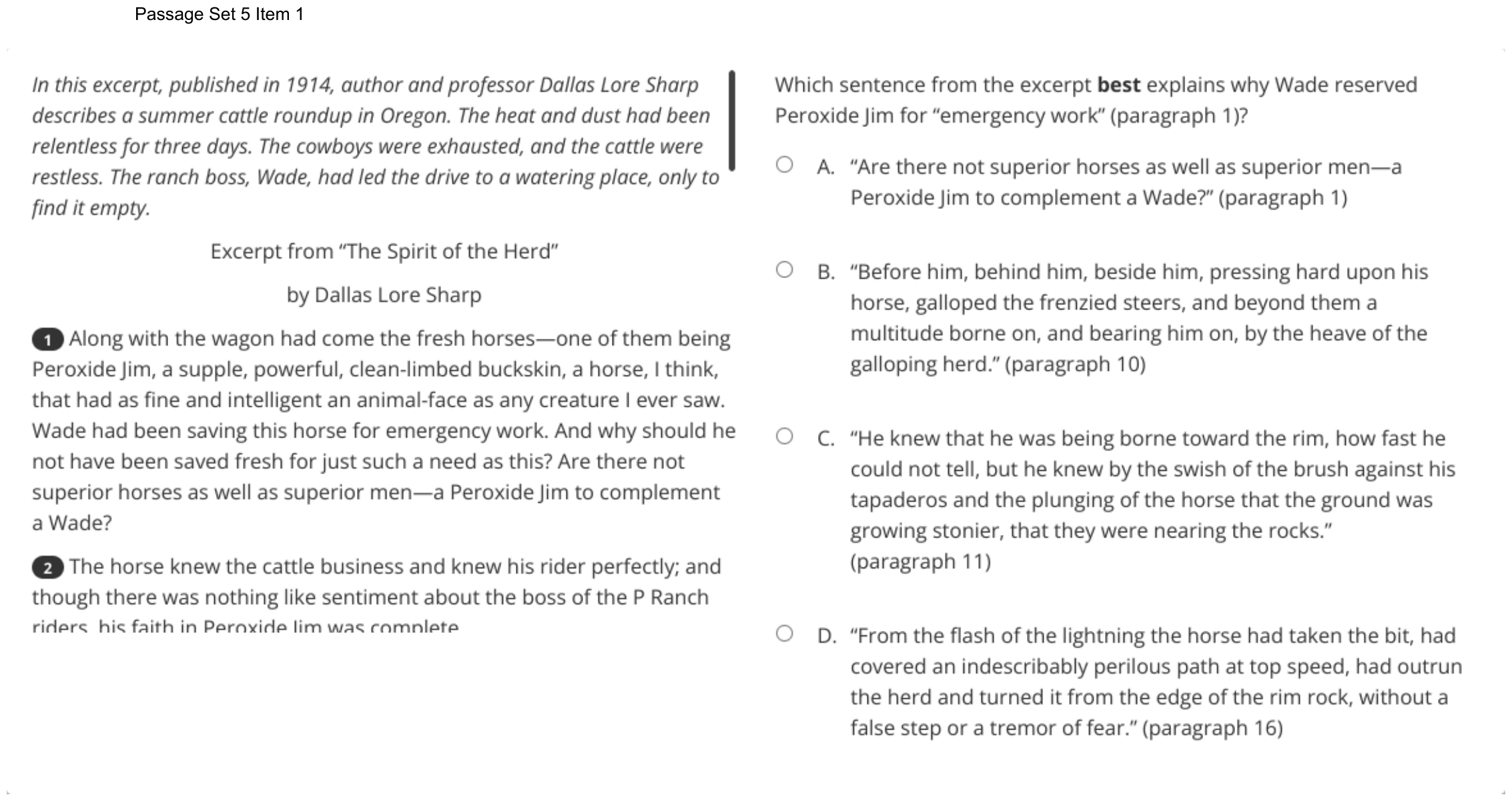
In this excerpt, published in 1914, author and professor Dallas Lore Sharp describes a summer cattle roundup in Oregon. The heat and dust had been relentless for three days. The cowboys were exhausted, and the cattle were restless. The ranch boss, Wade, had led the drive to a watering place, only to find it empty.
Along with the wagon had come the fresh horses—one of them being Peroxide Jim, a supple, powerful, clean-limbed buckskin, a horse, I think, that had as fine and intelligent an animal-face as any creature I ever saw. Wade had been saving this horse for emergency work. And why should he not have been saved fresh for just such a need as this? Are there not superior horses as well as superior men—a Peroxide Jim to complement a Wade?
The horse knew the cattle business and knew his rider perfectly; and though there was nothing like sentiment about the boss of the P Ranch riders, his faith in Peroxide Jim was complete. . . .
The desert, where the herd was camped, was one of the highest of a series of tablelands, or benches; it lay as level as a floor, rimmed by sheer rock, from which there was a drop to the bench of sage below. The herd when overtaken by the dusk had been headed for a pass descending to the next lower bench, but was now halted within a mile of the rim rock on the east, where there was a perpendicular fall of about three hundred feet. . . .
In the taut silence of the stirless desert night, with the tension of the herd at the snapping-point, any quick, unwonted sight or sound would stampede them. The sneezing of a horse, the flare of a match, would be enough to send the whole four thousand headlong—blind, frenzied, trampling—till spent and scattered over the plain.
And so, as he rode, Wade began to sing. The rider ahead of him took up the air and passed it on until, above the stepping stir of the hoofs rose the faint voices of the men, and all the herd was bound about by the slow plaintive measures of some old song. It was not to soothe their savage breasts that the riders sang to the cattle, but rather to preempt the dreaded silence, to relieve the tension, and so to prevent the shock of any sudden startling noise.
So they sang and rode and the night wore on to one o’clock, when Wade, coming up on the rim-rock side, felt a cool breeze fan his face, and caught a breath of fresh, moist wind with the taste of water in it.
He checked his horse instantly, listening as the wind swept past him over the cattle. But they must already have smelled it, for they had ceased their milling, the whole herd standing motionless, the indistinct forms close to him in the dark showing their bald faces lifted to drink the sweet wet breath that came over the rim. Then they started on again, but faster, and with a rumbling now from their hoarse throats that tightened Wade’s grip on the reins.
The sound seemed to come out of the earth, a low, rumbling mumble, as dark as the night and as wide as the plain, a thick, inarticulate bellow that stood every rider stiff in his stirrups. . . .
Then the breeze caught the dust and carried it back from the gray-coated, ghostly shapes, and Wade saw that the animals were still moving in a circle. He must keep them going. He touched his horse to ride on with them, when across the black sky flashed a vivid streak of lightning.
There was a snort from the steers, a quick clap of horns and hoofs from far within the herd, a tremor of the plain, a roar, a surging mass—and Wade was riding the flank of a wild stampede. Before him, behind him, beside him, pressing hard upon his horse, galloped the frenzied steers, and beyond them a multitude borne on, and bearing him on, by the heave of the galloping herd.
Wade was riding for his life. He knew it. His horse knew it. He was riding to turn the herd, too, back from the rim, as the horse also knew. The cattle were after water—water-mad—ready to go over the precipice to get it, carrying horse and rider with them. Wade was the only rider between the herd and the rim. It was black as death. He could see nothing in the sage, could scarcely discern the pounding, panting shadows at his side. He knew that he was being borne toward the rim, how fast he could not tell, but he knew by the swish of the brush against his tapaderos and the plunging of the horse that the ground was growing stonier, that they were nearing the rocks.
To outrun the herd was his only chance for life. If he could come up with the leaders he might not only escape, but even stand a chance of heading them off upon the plain and saving the herd. There were cattle still ahead of him; how many, what part of them all, he could not make out in the dark. But the horse knew. The reins hung on his straight neck, where his rider had dropped them, as, yelling and firing over the wild herd, he had given this horse the race to win, to lose.
They were riding the rim. Close on their left bore down the flank of the herd, and on their right, under their very feet, was a precipice, so close that they felt its blackness—its three hundred feet of fall! . . .
. . . Then Wade found himself racing neck and neck with a big white steer, which the horse, with marvelous instinct, seemed to pick out from a bunch, and to cling to, forcing him gradually ahead, till, cutting him free from the bunch entirely, he bore him off into the swishing sage.
The steers coming on close behind followed their leader, and in, after them, swung others. The tide was turning from the rim. More and more were veering, and within a short time the whole herd, bearing off from the cliffs, was pounding over the open plains.
Whose race was it? It was Peroxide Jim’s, according to Wade, for not by word or by touch of hand or knee had the horse been directed in the run. From the flash of the lightning the horse had taken the bit, had covered an indescribably perilous path at top speed, had outrun the herd and turned it from the edge of the rim rock, without a false step or a tremor of fear.
From “The Spirit of the Herd” by Dallas Lore Sharp—Public Domain
tablelands: plateaus, flat areas of land sharply elevated from the surrounding area
tapaderos: leather covers for stirrups
Question
Which sentence from the excerpt best explains why Wade reserved Peroxide Jim for “emergency work” (paragraph 1)?
- A“Are there not superior horses as well as superior men—a Peroxide Jim to complement a Wade?” (paragraph 1)
- B“Before him, behind him, beside him, pressing hard upon his horse, galloped the frenzied steers, and beyond them a multitude borne on, and bearing him on, by the heave of the galloping herd.” (paragraph 10)
- C“He knew that he was being borne toward the rim, how fast he could not tell, but he knew by the swish of the brush against his tapaderos and the plunging of the horse that the ground was growing stonier, that they were nearing the rocks.” (paragraph 11)
- D“From the flash of the lightning the horse had taken the bit, had covered an indescribably perilous path at top speed, had outrun the herd and turned it from the edge of the rim rock, without a false step or a tremor of fear.” (paragraph 16)
Show the answer
Correct answer: D
The question asks which sentence from the excerpt best explains why Wade reserved Peroxide Jim for “emergency work” (paragraph 1).
A. Incorrect. While the sentence from paragraph 1 refers to Peroxide Jim as being a superior horse, it does not tell why he would be useful in an emergency. The mention of Peroxide Jim’s superiority does not describe the attributes that would make him an appealing choice for use in an emergency.
B. Incorrect. The sentence from paragraph 10 does not describe the actions of Peroxide Jim. The sentence describes what Wade and the horse were experiencing, but it does not include any reference to how Peroxide Jim was responding to the situation.
C. Incorrect. The sentence from paragraph 11 describes Wade’s experiences and does not focus on the actions of Peroxide Jim. It reveals Wade’s awareness of the danger he was in, but the only reference to Peroxide Jim in this sentence is the description of the horse having to work harder to run on the stonier ground as they neared the edge: from “the plunging of the horse,” Wade knew “that the ground was growing stonier, that they were nearing the rocks.” This quotation does not show that Peroxide Jim was the right horse to use for emergency work because it does not indicate, at this point in the text, that he was responding in a way that saved the herd or Wade.
D. CORRECT. The sentence from paragraph 16 describes Peroxide Jim’s high level of skill and ability to perform in a life-and-death situation. Not only did Peroxide Jim recognize the emergency immediately (“From the flash of the lightning the horse had taken the bit”), but the horse also proved to have the physical capability (“had covered an indescribably perilous path at top speed, had outrun the herd and turned it from the edge of the rim rock”) and the mental toughness (“without a false step or a tremor of fear”) required to respond appropriately to the dangerous situation.
Question analysis
This evidence question on Dallas Lore Sharp’s “The Spirit of the Herd,” a 1914 account of a night stampede on an Oregon cattle drive, asks which sentence best explains why the ranch boss Wade kept his horse Peroxide Jim for “emergency work.” The four quoted sentences come from different parts of the excerpt and are long, so the choice takes careful reading.
- Grade level
- Grade 8 reading and task
- Compared with grade 7
- At grade 7 Finding the sentence that best explains a detail is regular grade 7 evidence work. The four quotations, though, are long sentences from across a dense excerpt written in 1914, so the reading load is heavier than usual.
- Estimated difficulty
- Moderate: several steps, or a close reading with one strong distractor.
- Thinking it demands
- Depth of knowledge 2, skills and concepts · mainly evaluate
- What makes it hard
- Evidence in several places moderate
- A lot to read minor
- Reading between the lines minor
- Evidence
- Answered from the whole text
- Reading level
- Passage: about grade 8, 1160 words; question and choices: about grade 13, 160 words.
- Students, last 30 days
- Not enough answers yet to show (it takes 10).
Why it is hard, traps and wrong answers (shows the answer)
Why it is hard
The question links the start of the excerpt to its end, and the nearest quotation is the most tempting: the narrator’s rhetorical question about “superior horses” sits beside the phrase and seems to explain it. It praises the horse without showing what he can do. The two stampede sentences show the emergency itself, so the point goes to students who look for the horse acting on his own and find it in the final paragraph.
Evidence in several places moderate Working it out
The phrase “emergency work” is in paragraph 1, but the proof of the horse’s worth comes only at the very end, in paragraph 16, after the stampede has been turned. (Kirsch & Mosenthal, 1990; Gorin & Embretson, 2006)
A lot to read minor Understanding the question
Three of the quotations run 33 to 46 words, and two of them describe the stampede in vivid detail without saying what the horse does, so sorting them takes time. (Kintsch, 1998; Gorin & Embretson, 2006; Freedle & Kostin, 1993)
Reading between the lines minor Working it out
Students must decide what an emergency horse needs, speed, nerve and judgment without a rider’s guidance, before the last sentence reads as an answer to paragraph 1. (Graesser, Singer & Trabasso, 1994; Kintsch, 1998)
Strategy: Decide what a horse saved for emergencies would need to be able to do, then pick the quotation that gives the clearest proof that Peroxide Jim can do it.
Traps
- Supports only part of the claim: In a question about evidence: a line that backs one half of the claim but not the other, or a related point rather than the claim itself.
- True but not the answer: A choice says something accurate about the text that does not answer this question.
The wrong answers, classified
A Supports only part of the claim (King et al., 2004; Thissen, Steinberg & Fitzpatrick, 1989)
Stays beside the phrase in paragraph 1 and accepts the claim that Peroxide Jim is “superior,” which praises him but gives no sign of what makes him useful in a crisis.
B True but not the answer (King et al., 2004; Embretson & Wetzel, 1987)
Picks the most vivid picture of the stampede, which shows the emergency itself but says nothing about how Peroxide Jim handles it.
C Supports only part of the claim (King et al., 2004; Thissen, Steinberg & Fitzpatrick, 1989)
Notices “the plunging of the horse” at a tense moment, but the sentence is about Wade sensing the rocks ahead, not about the horse meeting the danger.
Working it out, step by step
Figure out what the question asks
This asks for evidence. In paragraph 1, Wade was saving Peroxide Jim for “emergency work.” Which sentence best explains why? You need a sentence that shows what this horse can do when something goes wrong.
Decide what to look for
An emergency is a sudden, dangerous event. A horse saved for one should be fast, steady and smart. It should act quickly when things go wrong. So look for the sentence that shows the horse himself doing that.
Read the last sentence of the excerpt
Paragraph 16 says “From the flash of the lightning the horse had taken the bit, had covered an indescribably perilous path at top speed, had outrun the herd and turned it from the edge of the rim rock, without a false step or a tremor of fear.”
Put the sentence in plain words
The bit is the metal bar in a horse’s mouth that the reins attach to. A horse that “had taken the bit” runs on its own. Perilous means dangerous. A tremor is a small shake. So the moment the stampede began, the horse took charge. He raced along a dangerous path, got ahead of the herd and turned it from the cliff. He never stumbled or showed fear.
Check each choice
- A does not fit. It calls him “superior,” but it shows no skill.
- B does not fit. It shows the stampede, but not how the horse handles it.
- C does not fit. It is about Wade sensing the rocks ahead.
- D fits. It shows the horse saving the herd in a real emergency.
Watch out: A sits right next to “emergency work” in paragraph 1, so it seems to explain it. But praise is not proof.
Choose the answer
The last sentence shows exactly why the horse was worth saving for emergencies. So the answer is D.
Why this answer and not the closest wrong one
A is the closest wrong choice. It sits beside the words “emergency work” and praises the horse. But calling a horse “superior” does not say what it can do. D shows the horse in action: fast, sure-footed and fearless in a real emergency. That explains why Wade saved him.
More questions like this
The original DOE question
The passage “Excerpt from “The Spirit of the Herd”” as printed (page 41)
Question 4 of 120
2026 Practice Test A English, question 30Uses the passage above: “Excerpt from “The Spirit of the Herd””.
Question
Paragraphs 1–2 contribute to the development of the central idea of the excerpt by
- Arevealing the respect Wade had for his horse.
- Bemphasizing Wade’s high expectations of his horse and himself.
- Cindicating that Wade and his horse understood the cattle business.
- Ddemonstrating Wade’s ability to gauge a horse’s competence.
Show the answer
Correct answer: A
The question asks how paragraphs 1–2 contribute to the development of the central idea of the excerpt.
A. CORRECT. The description of Peroxide Jim in paragraph 1 indicates that the horse was a fine animal (“Along with the wagon had come the fresh horses—one of them being Peroxide Jim, a supple, powerful, clean-limbed buckskin, a horse, I think, that had as fine and intelligent an animal-face as any creature I ever saw” [paragraph 1]). The statement in paragraph 2 that Wade’s “faith in Peroxide Jim was complete” supports the central idea of the excerpt that Wade believed in Peroxide Jim’s abilities even before the horse turned the herd and saved the cattle.
B. Incorrect. Paragraphs 1–2 do not emphasize Wade’s high expectations for himself, nor are these expectations a central idea of the excerpt. The narrator expresses a high opinion of Wade’s abilities in his comparison of Peroxide Jim and Wade, referring to the horse as a “complement” (paragraph 1) for Wade; however, Wade showed complete trust in the horse’s ability to save the herd without his help, as evidenced by Wade dropping the reins to allow the horse to control the situation (paragraph 12).
C. Incorrect. The paragraphs refer to Peroxide Jim’s ability to handle cattle; in fact, paragraph 2 says that “the horse knew the cattle business.” It can be inferred that Wade had this knowledge as well, but this idea is not the focus of paragraphs 1–2 and is not the central idea of the excerpt.
D. Incorrect. Wade’s ability to judge a horse’s competence is not a central idea of the excerpt. The event described in the text is proof that Wade knew how to judge a horse’s ability: Wade trusted Peroxide Jim, and Peroxide Jim did not let him down. The option puts the focus on Wade and one of his strengths, when the central idea and focus of the excerpt is Peroxide Jim’s abilities and strengths, not Wade’s.
Question analysis
This central-idea question asks how the first two paragraphs of “The Spirit of the Herd,” which introduce the buckskin horse Peroxide Jim and the ranch boss Wade, contribute to the excerpt’s central idea. Students connect these opening details to the story of the stampede that follows. The narrator’s old-fashioned rhetorical questions can make the paragraphs’ point hard to pin down.
- Grade level
- Grade 8 reading and task
- Compared with grade 7
- At grade 7 Explaining how opening paragraphs build a central idea is typical grade 7 work. The two paragraphs are short, but the narrator’s rhetorical questions and old-fashioned phrasing must be decoded, and the central idea must come from the rest of the excerpt.
- Estimated difficulty
- Moderate: several steps, or a close reading with one strong distractor.
- Thinking it demands
- Depth of knowledge 2, skills and concepts · mainly analyze
- What makes it hard
- Reading between the lines moderate
- How, not what moderate
- Complex sentences minor
- Evidence
- Answered from several paragraphs or stanzas
- Reading level
- Passage: about grade 8, 1160 words; question and choices: about grade 9, 48 words.
- Students, last 30 days
- Not enough answers yet to show (it takes 10).
Why it is hard, traps and wrong answers (shows the answer)
Why it is hard
The opening paragraphs talk about both Wade and his horse, so every choice can find a foothold in them. The question turns on the excerpt as a whole, which ends by giving the race to Peroxide Jim, and only Wade’s regard for the horse points toward that ending. Students lose the point by picking a skill of Wade’s own, which his trust only implies, or by repeating “knew the cattle business,” a line said of the horse alone.
Reading between the lines moderate Working it out
Respect is never named; it must be read from Wade “saving this horse for emergency work” and from his “faith in Peroxide Jim” being “complete” in paragraph 2. (Graesser, Singer & Trabasso, 1994; Kintsch, 1998)
How, not what moderate Working it out
The question asks how two opening paragraphs serve the excerpt’s central idea, so students must know where the story ends, with the race credited to the horse, before judging them. (Anderson & Krathwohl, 2001)
Complex sentences minor Understanding the question
Paragraph 1 makes its point through two old-fashioned rhetorical questions, beginning “And why should he not” and “Are there not superior horses,” whose answers students must supply. (Abedi & Lord, 2001; Freedle & Kostin, 1993; Messick, 1989)
Strategy: Restate paragraphs 1 and 2 in plain words, decide what the excerpt as a whole is mainly about, and pick the option that links the two.
Traps
- Half right: One half of a two-part choice is right and the other is not.
- Word match: Repeats striking words or phrases from the text, so it looks supported, but its meaning does not fit the question.
- Reads too much in: A reasonable-sounding conclusion that goes further than the text allows.
The wrong answers, classified
B Half right (King et al., 2004; Thissen, Steinberg & Fitzpatrick, 1989)
Takes “superior horses as well as superior men” as Wade’s demands on both, but the paragraphs show only his trust in the horse, never his expectations of himself.
C Word match (Freedle & Kostin, 1993)
Repeats “knew the cattle business,” which paragraph 2 says of the horse alone, and treats that background detail as the point the excerpt builds toward.
D Reads too much in (Graesser, Singer & Trabasso, 1994)
Credits Wade with a talent for judging horses, which his trust implies, but the paragraphs show faith in one horse, and the excerpt’s focus is that horse’s deeds.
Working it out, step by step
Figure out what the question asks
This asks how paragraphs 1 and 2 help build the central idea. The central idea is the most important idea of the whole excerpt. So first find the central idea. Then see how the opening leads to it.
Find the central idea
The excerpt ends in paragraph 16: “Whose race was it? It was Peroxide Jim’s, according to Wade.” The horse saved the herd on his own, and Wade gives him the credit. The central idea is that Peroxide Jim is a remarkable horse who earns Wade’s trust.
Read paragraphs 1 and 2
Paragraph 1 says “Wade had been saving this horse for emergency work.” Paragraph 2 says “though there was nothing like sentiment about the boss of the P Ranch riders, his faith in Peroxide Jim was complete.”
Work out what they show
Sentiment means soft, tender feelings. Wade was a tough boss, not a soft one. Faith means trust. Even so, he trusted this horse completely. Saving the horse for the hardest jobs shows the same respect. The rest of the excerpt proves that respect was deserved.
Check each choice
- A fits. The paragraphs show how much Wade respected his horse.
- B does not fit. They never say what Wade expects of himself.
- C does not fit. “The horse knew the cattle business” is said about the horse, and it is only background.
- D does not fit. His trust may hint that he judges horses well. But the paragraphs show faith in one horse, and the excerpt is about what that horse does.
Choose the answer
The opening shows Wade’s respect, and the ending shows the horse deserved it. So the answer is A.
Why this answer and not the closest wrong one
D is the closest wrong choice. Wade’s trust does hint that he knows good horses. But paragraphs 1 and 2 show his faith in one horse, not a skill at judging horses. The excerpt is about that horse. Wade’s respect points straight to the end, where he gives the race to Peroxide Jim. That is A.
More questions like this
The original DOE question
Question 5 of 120
2026 Practice Test A English, question 31Uses the passage above: “Excerpt from “The Spirit of the Herd””.
Question
How does paragraph 3 convey the effect of the setting on the cattle drive?
- AIt shows how the growing darkness created challenges for the riders in getting the herd to move.
- BIt describes how the changing elevation contributed to the dangerousness of the environment.
- CIt describes how the desert created an uncomfortable feeling of isolation for the riders and the cattle.
- DIt shows how the steep terrain made it difficult for the cattle to keep moving forward.
Show the answer
Correct answer: B
The question asks how paragraph 3 conveys the effect of the setting on the cattle drive.
A. Incorrect. The riders were not trying to move the herd through the darkness. Instead, the reference to the growing darkness (“overtaken by the dusk”) indicates that the riders had halted the animals for the night because moving the herd across the desert in the darkness would have been much too dangerous because of the sheer drop-off at the edge of the tableland. The riders needed the daylight to navigate the herd safely through the “pass descending to the next lower bench.”
B. CORRECT. Paragraph 3 describes the land where the herd was as being “as level as a floor” but “rimmed by sheer rock, from which there was a drop to the bench of sage below.” The drop was “a perpendicular fall of about three hundred feet”—any animal or person could fall over that edge. It was the change in height, from flat tableland to sheer drop-off, that made the terrain so dangerous.
C. Incorrect. The use of the word “desert” in the first sentence of the paragraph does not highlight the isolation of the setting or indicate that the riders and the herd were uncomfortable being alone. Instead, the word merely establishes the setting where the action occurred: “it lay as level as a floor, rimmed by sheer rock, from which there was a drop to the bench of sage below.”
D. Incorrect. The excerpt does not indicate that the steep terrain made it difficult for the herd to move forward. The herd was not expected to navigate the steep terrain. Instead, the steep terrain presented a danger to the herd that must be avoided. The riders intended to move the herd safely through passes that descended gradually to lower elevations.
Question analysis
This setting question on “The Spirit of the Herd” asks how paragraph 3, which describes the high desert where the herd has stopped for the night, conveys the setting’s effect on the cattle drive. Students must understand unusual landform words, one explained in a footnote, and work out what the land means for the herd. Several choices name a real feature of the scene.
- Grade level
- Grade 8 reading and task
- Compared with grade 7
- Above grade 7 Grade 7 students analyze how setting affects a story, usually from plainly worded description. This paragraph relies on terms such as tablelands, benches and rim rock, and never names the effect, so students must work it out from the description.
- Estimated difficulty
- Hard: combines ideas, needs a plan, and has more than one tempting wrong answer.
- Thinking it demands
- Depth of knowledge 2, skills and concepts · mainly analyze
- What makes it hard
- A very close wrong answer moderate
- Hard words moderate
- Reading between the lines minor
- Evidence
- Answered from one paragraph or stanza
- Reading level
- Passage: about grade 8, 1160 words; question and choices: about grade 9, 76 words.
- Students, last 30 days
- Not enough answers yet to show (it takes 10).
Why it is hard, traps and wrong answers (shows the answer)
Why it is hard
Paragraph 3 reads like a surveyor’s report, flat land ending in a sheer drop, with no word of fear. Students must turn its landforms into a picture and see that a herd camped a mile from a three-hundred-foot fall is in danger. The strongest wrong answer gets the cliff right but makes it a barrier to the drive, and others seize on the dusk or on the loneliness a desert suggests.
A very close wrong answer moderate Choosing the answer
The choice about steep terrain blocking the herd and the right one both rest on the drop at the rim; they differ only in its effect, a hazard to avoid or an obstacle to movement. (Embretson & Wetzel, 1987; Gorin & Embretson, 2006; Ascalon et al., 2007)
Hard words moderate Understanding the question
The paragraph’s landforms, “tablelands, or benches,” “rim rock,” a “pass descending to the next lower bench” and a “perpendicular fall,” must be pictured before the danger is clear. (Perfetti, 2007; Freedle & Kostin, 1993)
Reading between the lines minor Working it out
The paragraph never calls the drop dangerous; students must infer it from “sheer rock” and “about three hundred feet,” a danger that becomes real only when the herd stampedes toward the rim. (Graesser, Singer & Trabasso, 1994; Kintsch, 1998)
Strategy: Make a quick sketch of the land paragraph 3 describes and mark where the herd is halted, then ask what that setting means for the drive and test each choice against it.
Traps
- Twists what the text says: Uses the text's topic and ideas but changes what it says: who did it, how much, when, or why.
- Outside knowledge: A choice is plausible in the real world but not supported by this text.
The wrong answers, classified
A Twists what the text says (King et al., 2004)
Turns “overtaken by the dusk” into a struggle to get the herd moving, though the herd was halted for the night and the paragraph stresses the drop, not darkness.
C Outside knowledge (King et al., 2004; Recht & Leslie, 1988)
Assumes a desert must feel lonely, a common association, though the paragraph uses “desert” only to place the herd on a level plain and says nothing of isolation.
D Twists what the text says (King et al., 2004)
Rightly notices the sheer drop but makes it an obstacle to forward movement, when the herd was headed for a pass and the cliff was a hazard to avoid.
Working it out, step by step
Figure out what the question asks
This asks about setting, the place and time of a story. How does the land in paragraph 3 affect the cattle drive? A cattle drive is a trip where riders move a large herd of cattle across the land.
Read paragraph 3
The herd is camped on high, flat land “rimmed by sheer rock, from which there was a drop to the bench of sage below.” The herd “was now halted within a mile of the rim rock on the east, where there was a perpendicular fall of about three hundred feet.”
Picture the land
The note says tablelands are “flat areas of land sharply elevated from the surrounding area.” A bench is another name for one. Picture giant steps. The herd is on a high step. Its edge is sheer rock, a straight drop. Perpendicular means straight up and down. So the herd has stopped within a mile of a cliff about 300 feet high.
Work out the effect
Elevation is how high the land is. Here the elevation changes suddenly, from flat ground to a steep cliff. A scared herd could run right over the edge. That makes the place dangerous. Later, this danger comes true when the stampede races toward the rim.
Check each choice
- A does not fit. The herd was halted for the night. The riders were not trying to move it.
- B fits. The sudden drop makes the place dangerous.
- C does not fit. The paragraph says nothing about feeling lonely.
- D does not fit. The herd was headed for a pass, an easier way down. The cliff was a danger to avoid.
Choose the answer
The change in height, from flat land to a sheer drop, makes the setting dangerous. So the answer is B.
Why this answer and not the closest wrong one
D is the closest wrong choice, because it also points to the steep drop. But the herd was not trying to climb down the cliff. It was headed for a pass and had stopped for the night. The drop matters because the herd could fall over it. That danger is what B describes.
More questions like this
The original DOE question
Question 6 of 120
2026 Practice Test A English, question 32Uses the passage above: “Excerpt from “The Spirit of the Herd””.
Question
Read this sentence from paragraph 13.
Close on their left bore down the flank of the herd, and on their right, under their very feet, was a precipice, so close that they felt its blackness—its three hundred feet of fall!
The phrase “bore down the flank of the herd” conveys that Wade
- Astruggled to see the front of the herd.
- Bhad to ride quickly to keep up with the herd.
- Cwas forced to ride between the edge of the cliff and the herd.
- Dknew that the drop of the cliff would frighten the herd.
Show the answer
Correct answer: C
The question asks what the phrase “bore down the flank of the herd” (paragraph 13) conveys about Wade.
A. Incorrect. While Wade struggled to see the front of the herd, the words “bore down the flank of the herd” (paragraph 13) are meant to convey the intensity of the situation Wade was in, not the way the herd is blocking his vision.
B. Incorrect. The sentence from paragraph 13 states that the herd was “close on their left” and includes the phrase “bore down.” Both of these phrases indicate that Wade was trapped between the stampeding herd and the steep cliff. Wade and Peroxide Jim were struggling to reach the very front of the herd to turn it away from the edge.
C. CORRECT. The phrase “bore down the flank of the herd” from paragraph 13 conveys the overwhelming strength of the herd. The herd was forcing Wade toward the cliff. The wording in the quotation emphasizes the immediate danger of the situation and conveys the idea that Wade and Peroxide Jim were almost forced over the edge of the precipice by the stampeding herd.
D. Incorrect. The phrase “bore down the flank of the herd” (paragraph 13) does not indicate anything about the fear felt by the herd. The phrase is about Wade’s position between the edge of the stampeding herd and the drop-off. Wade was aware of the danger the herd was in if he and Peroxide Jim could not turn the cattle from the edge.
Question analysis
This vocabulary-in-context question quotes a sentence from paragraph 13 of “The Spirit of the Herd,” at the height of the stampede, and asks what the phrase “bore down the flank of the herd” conveys about Wade. Students need the meaning of “bore down” and “flank” as they are used here. Some choices describe real moments of the stampede, so students must stick to what this phrase shows.
- Grade level
- Grade 7 reading and task
- Compared with grade 7
- At grade 7 Working out a phrase’s meaning from its sentence is routine grade 7 work. The words “bore down” and “flank” are less common, but the full sentence is quoted with the question, so the task stays within one sentence.
- Estimated difficulty
- Straightforward: two steps or one careful reading.
- Thinking it demands
- Depth of knowledge 2, skills and concepts · mainly understand
- What makes it hard
- Complex sentences moderate
- Hard words minor
- Evidence
- Answered from one sentence or line
- Reading level
- Passage: about grade 8, 1160 words; question and choices: about grade 3, 94 words.
- Students, last 30 days
- Not enough answers yet to show (it takes 10).
Why it is hard, traps and wrong answers (shows the answer)
Why it is hard
Once the sentence is untangled, the herd pressing in on the left and the cliff on the right, the answer is a picture of Wade squeezed between them. The trouble is the word order and the phrase itself: students who read “bore down” as speed think about keeping pace, and those who recall the darkness of the paragraph before pick a detail this sentence never mentions.
Complex sentences moderate Understanding the question
The sentence is inverted: “the flank of the herd” is the subject of “bore down,” placed after its verb, so a quick reader may think Wade bore down along the herd instead. (Abedi & Lord, 2001; Freedle & Kostin, 1993; Messick, 1989)
Hard words minor Understanding the question
Both “flank,” the side of the herd, and “bore down,” pressed in hard, are uncommon in this sense, and the stem asks about exactly those words. (Perfetti, 2007; Freedle & Kostin, 1993)
Strategy: Read the whole quoted sentence rather than the phrase alone, picture the scene it describes, and pick what this sentence itself shows about Wade.
Traps
- Dictionary meaning, not meaning here: A common meaning of the word that does not fit its use in this text.
- Wrong part of the text: A choice is true of another paragraph, stanza or speaker than the one asked about.
- Reads too much in: A reasonable-sounding conclusion that goes further than the text allows.
The wrong answers, classified
A Wrong part of the text (Kirsch & Mosenthal, 1990)
Recalls from paragraph 12 that Wade could not tell how many cattle were ahead of him, which is true there, but this sentence says nothing about what he could see.
B Dictionary meaning, not meaning here (Perfetti, 2007)
Takes “bore down” in its sense of rushing forward and gives the speed to Wade, when in this sentence it is the herd’s flank pressing in on his left.
D Reads too much in (Graesser, Singer & Trabasso, 1994)
Assumes the cliff would scare the cattle, but they are “water-mad” and ready to go over the edge, and the phrase describes Wade’s position, not their fear.
Working it out, step by step
Figure out what the question asks
This asks what the phrase “bore down the flank of the herd” shows about Wade. To answer, read the whole sentence, not just the phrase.
Learn the hard words
A flank is the side of an animal or of a group. To bear down, here “bore down,” means to press in hard on something. A precipice is a cliff, a very steep drop.
Untangle the sentence
The sentence puts its words in an unusual order. In everyday order it would say: The flank of the herd bore down close on their left. So the side of the herd pushed in on Wade and his horse from the left. On the right, “under their very feet, was a precipice.”
Picture where Wade is
Wade is squeezed. Thousands of running cattle press in on one side. A 300-foot drop sits on the other side. He has no room to move away from either one. He is forced to ride in the narrow space between the herd and the cliff edge.
Check each choice
- A does not fit. Paragraph 12 says he could not tell how many cattle were ahead, but this sentence is about the sides.
- B does not fit. Here the herd does the bearing down, not Wade.
- C fits. He rides between the herd and the cliff.
- D does not fit. The cattle were “water-mad,” ready to go over the edge. Nothing says the cliff scared them.
Choose the answer
The phrase shows the herd pushing Wade toward the edge. So the answer is C.
Why this answer and not the closest wrong one
B is the closest wrong choice, because “bore down” can mean rushing forward fast. But in this sentence the herd does the bearing down, not Wade. The herd presses in from the left while the cliff waits on the right. That squeeze is what C describes.
More questions like this
The original DOE question
Question 7 of 120
2026 Practice Test A English, question 33Uses the passage above: “Excerpt from “The Spirit of the Herd””.
Question
Read these sentences from the excerpt.
He was riding to turn the herd, too, back from the rim, as the horse also knew. (paragraph 11)
It was Peroxide Jim’s, according to Wade, for not by word or by touch of hand or knee had the horse been directed in the run. (paragraph 16)
How do these sentences develop a central idea in the excerpt?
- AThey suggest that Wade would have been unable to save the herd without Peroxide Jim.
- BThey imply that Wade spent many hours training Peroxide Jim to herd cattle.
- CThey show that Peroxide Jim was able to understand a situation and take action.
- DThey indicate that Peroxide Jim was unafraid of the dangers presented by the stampede and the cliff.
Show the answer
Correct answer: C
The question asks how the sentences from paragraph 11 and paragraph 16 develop a central idea in the excerpt.
A. Incorrect. While Peroxide Jim’s presence was critical to saving the herd, the details in paragraph 11 and paragraph 16 do not focus on this idea. The primary idea is that the horse was so intelligent and aware that he acted on his own.
B. Incorrect. The excerpt does not tell who trained Peroxide Jim. It can be inferred that Peroxide Jim had been well trained and was knowledgeable of working cattle; however, there is no indication that Wade was the person who trained Peroxide Jim, only that Wade knew of Peroxide Jim’s abilities, respected the skilled horse, and was “saving this horse for emergency work” (paragraph 1). Because the reader cannot infer from the excerpt that Wade was the trainer, this idea cannot be considered central to the excerpt.
C. CORRECT. Wade recognized that Peroxide Jim knew to turn the herd without any instruction from him. Throughout the excerpt, Wade exhibited confidence in his horse, Peroxide Jim. For example, the narrator says that Wade’s “faith in Peroxide Jim was complete” in paragraph 2. After Wade let go of the reins (paragraph 12), the horse took over, doing exactly what needed to be done to save Wade, the herd, and himself: “a big white steer, which the horse, with marvelous instinct, seemed to pick out from a bunch, and to cling to, forcing him gradually ahead, till, cutting him free from the bunch entirely, he bore him off into the swishing sage” (paragraph 14).
D. Incorrect. The sentence from paragraph 11 and the sentence from paragraph 16 show that Peroxide Jim acted skillfully and with the knowledge that the ride was dangerous (“Wade was riding for his life. He knew it. His horse knew it” [paragraph 11]). Neither sentence indicates whether Peroxide Jim was afraid. The excerpt does say, later in paragraph 16, that the horse turned the herd “without a false step or a tremor of fear,” but these two sentences focus on his awareness of the danger and his ability to act on his own, not on his lack of fear.
Question analysis
This question quotes two sentences from “The Spirit of the Herd,” one from the middle of the stampede and one from its end, and asks how together they develop a central idea of the excerpt. Students must see what the two sentences share and connect it to the story as a whole. Each choice sounds reasonable for this story, which makes the exact wording of the two sentences decisive.
- Grade level
- Grade 8 reading and task
- Compared with grade 7
- Above grade 7 Grade 7 central-idea questions usually ask about one paragraph or the whole text. Here students must find what two sentences five paragraphs apart have in common and link it to the excerpt’s central idea, among choices that all sound believable.
- Estimated difficulty
- Hard: combines ideas, needs a plan, and has more than one tempting wrong answer.
- Thinking it demands
- Depth of knowledge 3, strategic thinking · mainly analyze
- What makes it hard
- Reading between the lines moderate
- Complex sentences moderate
- Evidence in several places moderate
- Evidence
- Answered from several paragraphs or stanzas
- Reading level
- Passage: about grade 8, 1160 words; question and choices: about grade 6, 121 words.
- Corrected from the DOE handbook
- An inaccurate statement in the explanation was corrected.
- Students, last 30 days
- Not enough answers yet to show (it takes 10).
Why it is hard, traps and wrong answers (shows the answer)
Why it is hard
Each choice says something a reader could believe about this story, so the exact content of the two quoted sentences decides it. What they share is knowledge and independence: the horse knew the goal and ran the race undirected. Fearlessness is stated in the very next sentence of paragraph 16, which makes it easy to credit to these two, and the claim that Wade could not have managed alone sounds like a fair summary of the ending.
Reading between the lines moderate Working it out
Neither sentence says the horse understood; that has to be read from “as the horse also knew” and from the race being his because he was not directed “by word or by touch.” (Graesser, Singer & Trabasso, 1994; Kintsch, 1998)
Complex sentences moderate Understanding the question
The second sentence is an inverted negative passive, “not by word or by touch of hand or knee had the horse been directed,” and the first tucks its point into a trailing clause. (Abedi & Lord, 2001; Freedle & Kostin, 1993; Messick, 1989)
Evidence in several places moderate Working it out
The two sentences sit five paragraphs apart, and the detail that tempts students most, “without a false step or a tremor of fear,” follows the second one in paragraph 16. (Kirsch & Mosenthal, 1990; Gorin & Embretson, 2006)
Strategy: Note what the two quoted sentences have in common, then pick the option that states that shared point, making sure it comes from these sentences and not from elsewhere in the excerpt.
Traps
- Wrong part of the text: A choice is true of another paragraph, stanza or speaker than the one asked about.
- Reads too much in: A reasonable-sounding conclusion that goes further than the text allows.
- Outside knowledge: A choice is plausible in the real world but not supported by this text.
The wrong answers, classified
A Reads too much in (Graesser, Singer & Trabasso, 1994)
Goes a step past the sentences: the horse clearly mattered, but they stress what he knew and did on his own, not that Wade would have failed without him.
B Outside knowledge (King et al., 2004; Recht & Leslie, 1988)
Assumes a rider trains his own horse, a common idea, but the excerpt never says who trained Peroxide Jim, and these sentences stress what he did undirected.
D Wrong part of the text (Kirsch & Mosenthal, 1990)
Draws on “without a false step or a tremor of fear,” which comes after the quoted sentence in paragraph 16; the two sentences show his understanding, not his courage.
What was corrected from the DOE handbook, and why
- Explanation: The handbook’s explanation of Option D says “There is no indication that Peroxide Jim was not afraid; in fact, it is likely the awareness of the danger and the fear associated with that knowledge contributed to the horse’s motivation to turn the herd.” Paragraph 16 says the opposite: the horse turned the herd “without a false step or a tremor of fear” (the handbook’s explanation of question 29 cites these words as his mental toughness). The site now says that neither of the two quoted sentences indicates whether Peroxide Jim was afraid, which is still why Option D is wrong: they focus on his awareness of the danger and his ability to act on his own.
Working it out, step by step
Figure out what the question asks
This asks what two quoted sentences have in common and how they build a central idea, the main idea of the excerpt. Focus on what these two sentences say, not on other parts of the story.
Read the first sentence
Paragraph 11 says “He was riding to turn the herd, too, back from the rim, as the horse also knew.” To turn the herd is to make it change direction. The words “as the horse also knew” mean the horse understood the goal too.
Read the second sentence
Paragraph 16 says the race was the horse’s, “for not by word or by touch of hand or knee had the horse been directed in the run.” Directed means told where to go. Riders guide a horse with their voice, their hands on the reins and their knees. Wade did none of that. The horse ran the race on his own.
Put the two together
Both sentences show the same thing. The horse understood what was happening. Then he acted on his own, with no one telling him what to do. This builds the central idea that Peroxide Jim is a smart horse who saves the herd by himself.
Check each choice
- A does not fit. The sentences do not say whether Wade could have done it alone. They focus on what the horse knew and did.
- B does not fit. The excerpt never says who trained the horse.
- C fits. The horse understood the situation and took action.
- D does not fit. The horse was fearless, but neither quoted sentence says so.
Choose the answer
The two sentences show a horse that understood the danger and acted on his own. So the answer is C.
Why this answer and not the closest wrong one
D is the closest wrong choice, because the horse really was fearless. But that comes from a later sentence in paragraph 16: “without a false step or a tremor of fear.” The two quoted sentences say nothing about fear. They show that the horse knew the goal and acted with no one guiding him. That is C.
More questions like this
The original DOE question
Question 8 of 120
2026 Practice Test A English, question 34Uses the passage above: “Excerpt from “The Spirit of the Herd””.
Question
How do the details in paragraphs 14–16 help convey a central idea of the excerpt?
- AThey highlight Peroxide Jim’s natural ability to control the herd.
- BThey emphasize the danger of the situation from which Peroxide Jim rescued the herd.
- CThey show that Peroxide Jim’s physical strength allowed him to force the herd to turn.
- DThey indicate that Peroxide Jim anticipated the herd’s stampede before the men did.
Show the answer
Correct answer: A
The question asks how the details in paragraphs 14–16 help convey a central idea of the excerpt.
A. CORRECT. Paragraphs 14–16 describe how Peroxide Jim’s “marvelous instinct” headed off the herd and drove it away from the cliff. Wade acknowledged that without his instruction, Peroxide Jim knew to find the leader of the herd, cut him off from the rest of the herd, and then lead him to safety, confident that the remainder of the herd would follow. Paragraph 16 confirms this: “Whose race was it? It was Peroxide Jim’s, according to Wade, for not by word or by touch of hand or knee had the horse been directed in the run.” This reinforces a central idea of the excerpt regarding the horse’s amazing intellect and ability.
B. Incorrect. Although paragraphs 14–16 mention the “rim,” the “cliffs,” and the “indescribably perilous path,” these details are not the focus of the paragraphs. They are descriptions of the setting where Peroxide Jim’s able and effective actions saved the stampeding herd, and it is these actions that are the central idea being conveyed.
C. Incorrect. Although Peroxide Jim is called “powerful” in paragraph 1, his physical strength is neither a central idea of the excerpt nor the focus of paragraphs 14–16. His success at turning the herd was attributed to his intellect and instinct, not his physical strength.
D. Incorrect. The excerpt does not suggest that Peroxide Jim anticipated the herd’s stampede before the men did. In fact, the excerpt indicates that Wade led the men in singing to cover sudden noises that might cause the herd to stampede, indicating that Wade was alert to that possibility. Paragraph 7 also indicates that Wade anticipated the stampede, as he “checked his horse instantly” and “tightened [his] grip on the reins” as soon as he smelled water on the wind and heard the low rumbling of the herd that preceded the lightning strike. The narrator notes Wade’s actions well before the horse’s actions. Paragraphs 14–16 describe how Peroxide Jim acted after the stampede began.
Question analysis
This central-idea question asks how the details in the last three paragraphs of “The Spirit of the Herd,” where the stampede is finally turned away from the cliff, help convey a central idea. Students must decide what those details mainly show about Peroxide Jim. Several choices touch on something real in the story, so the paragraphs’ main emphasis decides it.
- Grade level
- Grade 7 reading and task
- Compared with grade 7
- At grade 7 Linking a passage’s final paragraphs to its central idea is a familiar grade 7 task. Paragraphs 14–16 are short and vivid, but several choices mention something those paragraphs touch on, so students must judge what the details mainly emphasize.
- Estimated difficulty
- Moderate: several steps, or a close reading with one strong distractor.
- Thinking it demands
- Depth of knowledge 2, skills and concepts · mainly analyze
- What makes it hard
- How, not what moderate
- The right answer is reworded minor
- Complex sentences minor
- Evidence
- Answered from several paragraphs or stanzas
- Reading level
- Passage: about grade 8, 1160 words; question and choices: about grade 8, 66 words.
- Corrected from the DOE handbook
- Details in the explanation that are not in the excerpt were corrected.
- Students, last 30 days
- Not enough answers yet to show (it takes 10).
Why it is hard, traps and wrong answers (shows the answer)
Why it is hard
The three paragraphs mix danger with skill, so a choice about danger can quote them and still miss what they emphasize. The detail that carries the central idea is that no word or touch directed the horse: he picked out the lead steer himself and the herd followed. Students who remember that Peroxide Jim was called “powerful” credit his strength, and a few reverse the order of events, putting his reaction before Wade’s.
How, not what moderate Working it out
The question asks what the details in paragraphs 14–16 do, so students must see that the rim and the “perilous path” are background and the horse’s choices are the point. (Anderson & Krathwohl, 2001)
The right answer is reworded minor Choosing the answer
The right choice calls the horse’s skill a “natural ability,” a plain paraphrase of “marvelous instinct,” while a wrong choice repeats the danger words the paragraphs use. (Freedle & Kostin, 1993; Kirsch & Mosenthal, 1990)
Complex sentences minor Understanding the question
Paragraph 14 tells how the horse turns the herd in one 50-word sentence full of commas, “which the horse, with marvelous instinct, seemed to pick out from a bunch, and to cling to.” (Abedi & Lord, 2001; Freedle & Kostin, 1993; Messick, 1989)
Strategy: Note what paragraphs 14–16 mostly focus on, then test each choice by asking whether it names that focus or only a detail mentioned along the way.
Traps
- True but not the answer: A choice says something accurate about the text that does not answer this question.
- Twists what the text says: Uses the text's topic and ideas but changes what it says: who did it, how much, when, or why.
- Reversed relationship: Cause and effect, or the order of events, turned around.
The wrong answers, classified
B True but not the answer (King et al., 2004; Embretson & Wetzel, 1987)
Notices the “rim,” the “cliffs” and the “indescribably perilous path,” but these details set the scene; the paragraphs dwell on how the horse turned the herd.
C Twists what the text says (King et al., 2004)
Gets right that the horse turned the herd, perhaps recalling “powerful” from paragraph 1, but the paragraphs credit his “marvelous instinct,” not his strength.
D Reversed relationship (King et al., 2004)
Puts the horse’s reaction before the men’s, but Wade sensed trouble in paragraph 7 when the wind changed, and the horse took the bit only at the lightning.
What was corrected from the DOE handbook, and why
- Explanation: The handbook’s explanation of Option D says Wade reacted “as soon as he smelled the rain and heard the low rumble of thunder that preceded the lightning strike.” The excerpt has no rain and no thunder. In paragraph 6 Wade catches “a breath of fresh, moist wind with the taste of water in it,” and in paragraph 7 the rumbling comes “from their hoarse throats,” the cattle’s; that rumbling is what “tightened Wade’s grip on the reins.” The site now says “as soon as he smelled water on the wind and heard the low rumbling of the herd that preceded the lightning strike.”
Working it out, step by step
Figure out what the question asks
This asks how the details in paragraphs 14 to 16 help show a central idea, a main idea of the excerpt. What do these last three paragraphs mostly focus on?
Read paragraphs 14 to 16
In paragraph 14, the horse, “with marvelous instinct, seemed to pick out from a bunch” a big white steer. Paragraph 15 says “The steers coming on close behind followed their leader.” Paragraph 16 says the race was the horse’s, “for not by word or by touch of hand or knee had the horse been directed in the run.”
Work out what the details show
An instinct is a natural sense of what to do, without being taught or told. A steer is one of the cattle. The horse picked out one big steer and pushed it off into the sage, away from the cliff. The rest followed it as their leader. No one guided the horse. So the horse controlled the whole herd using his own natural skill.
Check each choice
- A fits. The details show the horse’s natural ability to control the herd.
- B does not fit. The “rim” and the “cliffs” set the scene. The focus is how the horse turned the herd.
- C does not fit. The horse does not overpower the herd. He picks the leader, and the others follow.
- D does not fit. In paragraph 7, Wade sensed trouble first. The cattle’s rumbling “tightened Wade’s grip on the reins.” The horse took charge only “From the flash of the lightning.”
Choose the answer
The last three paragraphs show the horse’s natural skill at turning the herd. So the answer is A.
Why this answer and not the closest wrong one
B is the closest wrong choice, because the paragraphs do mention the rim and a “perilous,” or dangerous, path. But the danger is the background. The paragraphs mostly show what the horse did: he chose the lead steer and turned the herd with no one guiding him. That natural skill is A.
More questions like this
The original DOE question
Question 9 of 120
2026 Practice Test A English, question 35Uses the passage above: “Excerpt from “The Spirit of the Herd””.
Question
Which sentence from the excerpt best reveals the mood on the drive before the lightning struck?
- A“The herd when overtaken by the dusk had been headed for a pass descending to the next lower bench, but was now halted within a mile of the rim rock on the east, where there was a perpendicular fall of about three hundred feet.” (paragraph 3)
- B“It was not to soothe their savage breasts that the riders sang to the cattle, but rather to preempt the dreaded silence, to relieve the tension, and so to prevent the shock of any sudden startling noise.” (paragraph 5)
- C“He checked his horse instantly, listening as the wind swept past him over the cattle.” (paragraph 7)
- D“Then the breeze caught the dust and carried it back from the gray-coated, ghostly shapes, and Wade saw that the animals were still moving in a circle.” (paragraph 9)
Show the answer
Correct answer: B
The question asks which sentence from the excerpt best reveals the mood on the drive before the lightning struck.
A. Incorrect. The sentence from paragraph 3 describes the setting but does not contain words that create a strong mood. In fact, this sentence shows that while there were dangerous surroundings, the riders and the herd were “now halted.”
B. CORRECT. The sentence from paragraph 5 describes the riders singing “to preempt the dreaded silence, to relieve the tension” and to prevent “shock” from any sudden noise. These words provide a strong sense of the tense, heavy mood in which a terrible event such as a stampede could quickly happen.
C. Incorrect. In the sentence from paragraph 7, Wade has become aware of a change in the weather (“caught a breath of fresh, moist wind with the taste of water” [paragraph 6]) and is seeking to verify it. Even though a rainstorm was one concern the riders had, the words describing Wade’s immediate reaction to his discovery do not best convey the mood of dread and foreboding that the men and horses feel just before the lightning strike.
D. Incorrect. While the words “ghostly” and “still moving in a circle” in the sentence from paragraph 9 create a strange and mysterious image, the mood before the lightning struck was not one of mystery or suspense. Instead, these descriptive words are used to indicate Wade’s faint ability to see the herd moving in the dark.
Question analysis
This mood question on “The Spirit of the Herd” asks which sentence best reveals the mood on the cattle drive before the lightning struck and set off the stampede. Students compare four long quotations from paragraphs 3, 5, 7 and 9. All four describe the night leading up to it, so students must weigh which one’s wording does the most to set a mood.
- Grade level
- Grade 7 reading and task
- Compared with grade 7
- At grade 7 Picking the sentence that best reveals a mood is ordinary grade 7 work on word choice. The four quotations are long, come from four different paragraphs and are written in 1914 English, so the main demand is reading them closely.
- Estimated difficulty
- Straightforward: two steps or one careful reading.
- Thinking it demands
- Depth of knowledge 2, skills and concepts · mainly evaluate
- What makes it hard
- Hard words minor
- A lot to read minor
- Evidence
- Answered from several paragraphs or stanzas
- Reading level
- Passage: about grade 8, 1160 words; question and choices: about grade 11, 143 words.
- Students, last 30 days
- Not enough answers yet to show (it takes 10).
Why it is hard, traps and wrong answers (shows the answer)
Why it is hard
Only one quotation names a feeling outright, and once students notice “dreaded silence” and “tension,” the question is easy. The losses come from mood-sounding words elsewhere: the “ghostly shapes” of paragraph 9 suggest an eerie mystery, and Wade’s sudden stop in paragraph 7 suggests alarm. Neither captures the strained waiting that hangs over the whole drive.
Hard words minor Understanding the question
The right sentence is the hardest to read: “preempt” and the old saying about soothing “savage breasts” surround the plain mood words “dreaded” and “tension.” (Perfetti, 2007; Freedle & Kostin, 1993)
A lot to read minor Understanding the question
The quotations from paragraphs 3 and 5 run 44 and 37 words, and all four describe the night before the stampede, so each must be read for words that carry feeling. (Kintsch, 1998; Gorin & Embretson, 2006; Freedle & Kostin, 1993)
Strategy: Underline the words in each quotation that carry feeling, then pick the one whose wording most directly captures the mood of the drive before the lightning.
Traps
- Supports only part of the claim: In a question about evidence: a line that backs one half of the claim but not the other, or a related point rather than the claim itself.
- Wrong tone or attitude: Misjudges the tone, attitude or point of view, such as reading admiration as criticism, or taking a character's or subject's feelings for the author's.
The wrong answers, classified
A Supports only part of the claim (King et al., 2004; Thissen, Steinberg & Fitzpatrick, 1989)
Senses danger in the “perpendicular fall of about three hundred feet,” but the sentence states facts about the land and contains no word of feeling.
C Supports only part of the claim (King et al., 2004; Thissen, Steinberg & Fitzpatrick, 1989)
Sees alertness in Wade checking his horse “instantly,” but the sentence reports one quick reaction to the wind, not the feeling that hangs over the drive.
D Wrong tone or attitude (Graesser, Singer & Trabasso, 1994)
Is drawn to “ghostly shapes,” a phrase with a mood of its own, but it describes how dimly Wade saw the cattle through the dust, not the riders’ tension.
Working it out, step by step
Figure out what the question asks
This asks about mood, the feeling a piece of writing gives you. Which sentence best shows the feeling on the drive before the lightning struck? Look for words that name or carry a feeling.
Read the sentence from paragraph 5
Paragraph 5 says “It was not to soothe their savage breasts that the riders sang to the cattle, but rather to preempt the dreaded silence, to relieve the tension, and so to prevent the shock of any sudden startling noise.”
Work out what it means
“Soothe their savage breasts” is an old saying about calming wild feelings with music. To preempt something is to act early to stop it. So the singing was not meant as soothing music. The riders sang to fill a silence they dreaded, or feared, and to ease the tension. They also wanted to keep any sudden noise from scaring the herd. The mood is tense and nervous.
Check each choice
- A does not fit. It tells where the herd stopped and how far the drop was. It gives facts, not feelings.
- B fits. Words like “dreaded” and “tension” name the feeling.
- C does not fit. Wade stops to listen. That is one quick action, not the mood of the night.
- D does not fit. “Ghostly shapes” sounds spooky, but it describes cattle seen dimly through dust.
Choose the answer
Only one sentence names the tense feeling of the night. So the answer is B.
Why this answer and not the closest wrong one
D is the closest wrong choice, because “ghostly” sounds eerie. But that word only describes how the cattle looked in the dark and the dust. B names the feeling outright: a “dreaded silence” and “tension.” That is the mood on the drive before the lightning struck.
More questions like this
The original DOE question
Question 10 of 120
2026 Practice Test A English, question 36Passage Massachusetts: Lowell National Historical Park
Massachusetts: Lowell National Historical Park
During the first half of the 19th century, Lowell, Massachusetts, quickly transformed itself from a farm town to a bustling industrial city. In time, Lowell became a model of industry, gaining global recognition for its state-of-the-art technology, innovative canal and dam system, mill architecture, boardinghouses, churches, and ethnic neighborhoods. Young Yankee women, immigrant families, and European tourists all flocked to Lowell to find work at one of the many textile mills, or visit the industrious city that was becoming a popular tourist destination. As one Scottish traveler observed during his visit to America, “Niagara and Lowell are the two objects I will longest remember in my American journey, the one the glory of American scenery, the other of American industry.” Today, Lowell National Historical Park welcomes visitors to enjoy the sights of Lowell and learn about the history of one of America’s most significant industrial cities.
The Boston merchants who founded Lowell in 1821 and named it after Francis Cabot Lowell chose to locate the town along Massachusetts’s Merrimack River to take advantage of the kinetic energy offered by the Pawtucket waterfalls. Over six miles of canals powered the waterwheels of Lowell’s mills, whose massive five- and six-story brick buildings dominated the city’s landscape. . . . The most recognized of these buildings are the Lowell Manufacturing Company chartered in 1821, the Suffolk or Wannalancit Mill completed around the 1880s, the Boott Mill Company established in 1835, and the Boott Mill Boardinghouse that opened in 1838. By the 1850s, 40 textile mills employing over 10,000 workers stretched for about a mile along the river. . . .
The city’s female workforce was significant in the history of Lowell. From the early to mid-1800s, women left the constricted lifestyle of small rural towns and rural areas for independent industrial city life. Most were young single Yankee girls, who were tired of the limited opportunities offered by their domestic work. Women found that Lowell’s mills offered monthly wages for their services and provided them room and board. Although these women gained economic independence in Lowell, the mill boardinghouse keepers constantly supervised their social activities, for which they hardly had any time, considering their daily 12- to 14-hour work schedules. At the end of the day, the factory bell signaled the “mill girls” to return to their boardinghouses. They were expected to adhere to the strict code of conduct respecting curfew and attending church.
Yankee “mill girls” continued to dominate the Lowell workforce until the 1840s, when the city began to find it difficult to compete with the growing industrial development in other New England communities. As profits fell, the mill industry cut wages. These wage cuts, deteriorating working conditions, and long workdays led the “mill girls” to protest and organize strikes. When their demands went unheard, the women left Lowell, and immigrant groups replaced them in the workforce. Despite the low wages and unhealthy work conditions, immigrants were eager to find work.
The immigrants replacing the Yankee “mill girls” during the 1840s were predominantly Irish Catholics, who traveled to America during the Great Potato Famine. Although Lowell received an influx of Irish families during this time, the Irish were a part of the city’s history from its birth, and before the “mill girls” arrived, they built Lowell’s historic canals, mills, and boardinghouses. Initially, Lowell’s Protestant community was slow to welcome Irish immigrants, but the hostility between Yankee Protestants and Irish Catholics eventually disappeared. Irish immigrants dominated the industrial scene until the Civil War, when other immigrant groups began to work in the city mills.
Like the Irish, the French-Canadians, Greeks, Poles, Portuguese, Russian Jews, and Armenians who came to work in Lowell’s mills faced long work hours, low wages, and poor living conditions in the city’s crowded tenements. By the time Lowell’s industry declined, the city had become an ethnic melting pot, where each group claimed its own distinct neighborhood, like the Irish immigrants’ “New Dublin” or “Acre,” and the French-Canadians’ “Little Canada.” The city officially began to close down its mills in the 1920s and ’30s after Lowell’s outdated mills could no longer compete against the state-of-the-art cotton mills in other communities and working conditions continued to decline as Lowell’s companies stopped reinvesting in their mills. . . . Despite a brief resurgence during World War II, the city shut down its last surviving mill by the mid-1950s.
From “Massachusetts: Lowell National Historical Park”—Public Domain/National Park Service
Yankee: native to New England
Niagara: a town in northwestern New York State well known as the location of Niagara Falls, a series of waterfalls on the Canadian border
domestic work: household duties like cooking and cleaning
Question
Read this sentence from paragraph 1.
As one Scottish traveler observed during his visit to America, “Niagara and Lowell are the two objects I will longest remember in my American journey, the one the glory of American scenery, the other of American industry.”
The author most likely includes the quotation from the Scottish traveler in order to
- Asuggest that people around the world saw the direct contribution of nature and industry to the United States.
- Bcompare the natural and industrial attractions in the United States at that time.
- Cconvey the idea that the United States offered both natural and industrial attractions.
- Dimply that the natural resources in the United States contributed to the development of industry.
Show the answer
Correct answer: C
The question asks why the author most likely includes the quotation from the Scottish traveler in paragraph 1 of the passage.
A. Incorrect. While it is likely that people outside the United States recognized that both the natural landscape and the bustling industry were significant, the quotation from the Scottish traveler is meant to convey the variety of the types of attractions in the U.S., not to make a general statement about their contribution.
B. Incorrect. The Scottish traveler mentions both “American scenery” and “American industry” in the quotation, but the intent is to highlight that they are each points of interest. The quotation does not provide a comparison of the two attractions.
C. CORRECT. The quotation emphasizes the idea that the United States offers different attractions. The Scottish traveler highlights the two places in the United States that he will most remember: first, the beautiful natural formation of Niagara Falls (“ ‘the glory of American scenery’ ”) and second, the industrial city of Lowell (“ ‘the glory . . . of American industry’ ”).
D. Incorrect. The Scottish traveler mentions both “American scenery” and “American industry” in the quotation but does not imply that the natural resources contributed to the development of industry.
Question analysis
This reading question asks why the author of a National Park Service article about Lowell, Massachusetts, quotes a Scottish traveler who named Niagara and Lowell as the sights he would remember longest from his American journey. Students must work out the job a quotation does in an opening paragraph, and the traveler's compressed, old-fashioned wording has to be untangled first.
- NYS standards
- 7R5 structure and genre features
- Grade level
- Grade 7 reading and task
- Compared with grade 7
- At grade 7 Grade 7 readers regularly explain why an author includes a quotation. This one adds a sentence in older English built on a compressed “the one…, the other…” pattern, but it is a single sentence in a plainly organized opening paragraph, so the demand stays typical.
- Estimated difficulty
- Moderate: several steps, or a close reading with one strong distractor.
- Thinking it demands
- Depth of knowledge 2, skills and concepts · mainly analyze
- What makes it hard
- A very close wrong answer moderate
- How, not what moderate
- Complex sentences minor
- Evidence
- Answered from one sentence or line
- Reading level
- Passage: about grade 15, 764 words; question and choices: about grade 11, 115 words.
- Students, last 30 days
- Not enough answers yet to show (it takes 10).
Why it is hard, traps and wrong answers (shows the answer)
Why it is hard
Most of the work is translating the traveler's compressed remark into plain words: Niagara stands for American scenery, Lowell for American industry, and both are high points of his trip. Students who see the two placed side by side often take the pairing for a comparison, while others read more into it, a worldwide verdict or a link between waterfalls and mills. The question rewards stating only what the remark does in the paragraph, which is to set Lowell beside Niagara as a sight worth the journey.
A very close wrong answer moderate Choosing the answer
The comparison choice names the same pair as the key, Niagara's scenery and Lowell's industry; it differs only in the verb, “compare” instead of conveying that the country offered both kinds of attraction. (Embretson & Wetzel, 1987; Gorin & Embretson, 2006; Ascalon et al., 2007)
How, not what moderate Working it out
The stem asks why the author placed the traveler's remark in paragraph 1, so its job, backing the sentence before it about tourists visiting the industrious city, matters more than its content. (Anderson & Krathwohl, 2001)
Complex sentences minor Understanding the question
The 37-word sentence ends in the compressed, old-fashioned “the one the glory of American scenery, the other of American industry,” where the verb and the second “glory” are left out. (Abedi & Lord, 2001; Freedle & Kostin, 1993; Messick, 1989)
Strategy: Put the traveler's remark into plain modern words, reread the sentence before it about who came to Lowell, and pick the purpose that fits both without reading more into the remark than it says.
Traps
- Wrong purpose or structure: Names a purpose, structure or effect that the part does not serve, or describes what a part says when the question asks what it does.
- Reads too much in: A reasonable-sounding conclusion that goes further than the text allows.
- Too broad or too strong: A choice overstates, generalizes, or uses absolute words the text does not support.
The wrong answers, classified
A Too broad or too strong (King et al., 2004)
Stretches one Scottish visitor's memory into what “people around the world” saw, perhaps from the paragraph's “global recognition,” and adds a “direct contribution” that the remark never claims.
B Wrong purpose or structure (Anderson & Krathwohl, 2001)
Takes the remark's side-by-side pattern, “the one … the other,” for a comparison, though the traveler weighs neither against the other and simply names each as a highlight.
D Reads too much in (Graesser, Singer & Trabasso, 1994)
Connects Niagara's waterfalls to the Pawtucket falls that powered Lowell's mills in paragraph 2, a link between nature and industry that the traveler's remark never draws.
Working it out, step by step
Figure out what the question asks
This question asks about the author’s purpose. You need to say why the author put the Scottish traveler’s words into paragraph 1. Don’t just restate what he says. Ask what job his words do in the paragraph.
Find the quotation and its neighbor
The traveler’s words are in paragraph 1: “Niagara and Lowell are the two objects I will longest remember in my American journey.” He ends with “the one the glory of American scenery, the other of American industry.” Now look at the sentence just before it. It says European tourists came to “visit the industrious city that was becoming a popular tourist destination.”
Put his words in plain English
The old-fashioned ending leaves words out. “The one” means the first place he named, Niagara. “The other” means the second place, Lowell. Glory means the finest thing, the pride. Industry means factories and the work done in them. So he is saying: Niagara Falls is the best of America’s natural beauty, and Lowell is the best of its industry. Both are the sights he will remember longest.
Check each choice
- A is wrong. One visitor is not “people around the world.” He also never says nature or industry made a “direct contribution” to the country.
- B is wrong. He names the two places side by side, but he never weighs one against the other.
- C is right. He names a natural wonder and an industrial wonder as the two highlights of his trip. So America offered both kinds of attraction.
- D is wrong. He never says nature helped industry grow. The waterfalls that powered the mills come up in paragraph 2, not in his words.
Watch out: “The one” and “the other” set the two places side by side. That can feel like a comparison, which leads to B. But he praises both. He does not compare them.
Choose the answer
The author uses the quotation to show that America had two kinds of sights worth the trip: natural ones like Niagara and industrial ones like Lowell. So the answer is C.
Why this answer and not the closest wrong one
B is the closest wrong answer. It names the same pair, nature and industry. But to compare is to show how two things are alike or different. The traveler doesn’t do that. He simply names Niagara and Lowell as two highlights. C says just that: the country offered both kinds of attraction.
More questions like this
The original DOE question
The passage “Massachusetts: Lowell National Historical Park” as printed (page 50)
Question 11 of 120
2026 Practice Test A English, question 37Uses the passage above: “Massachusetts: Lowell National Historical Park”.
Question
A central idea that Lowell was “one of America’s most significant industrial cities” (paragraph 1) is conveyed in the passage primarily through a description of the
- Acanals, mills, and boardinghouses that were built by immigrants.
- Bmill girls and immigrants who comprised Lowell’s workforce.
- Cdevelopment of the mills and the workforce established to support them.
- Dcultural diversity of the people who lived in the area.
Show the answer
Correct answer: C
The question asks which description conveys the central idea that Lowell was “one of America’s most significant industrial cities” (paragraph 1).
A. Incorrect. While the passage does state that the city’s canals, mills, and boardinghouses were built by early immigrants from Ireland, these details do not contribute to the development of the overall idea that Lowell was a significant industrial city.
B. Incorrect. The details about the women and immigrants who worked in the mills are important to the passage, but these details alone do not show that Lowell was a significant industrial city.
C. CORRECT. The details throughout the passage about the development of the mills and the people who worked in them convey the significance of Lowell in early American industry. Paragraph 2 shares details about the businesses that started in the 1800s and contributed to the development of industry in the region (“The most recognized of these buildings are the Lowell Manufacturing Company chartered in 1821, the Suffolk or Wannalancit Mill completed around the 1880s, the Boott Mill Company established in 1835, and the Boott Mill Boardinghouse that opened in 1838”). Then paragraphs 3–6 provide specific details about the people who worked in the mills at different points in time.
D. Incorrect. Although the passage references Lowell’s culturally diverse community (“Young Yankee women, immigrant families, and European tourists all flocked to Lowell to find work at one of the many textile mills” [paragraph 1]), these groups alone are not what marked Lowell as a significant industrial city.
Question analysis
This central idea question asks which kind of description in an article about the Massachusetts mill city of Lowell does most to show that it was one of America's most significant industrial cities. Students need a map of all six paragraphs, because every choice names something the passage really describes, and the question turns on which description does the main work.
- Grade level
- Grade 8 reading and task
- Compared with grade 7
- Above grade 7 Grade 7 students trace how a central idea is developed, usually through a few supporting details. Here the strands to weigh run through six dense paragraphs of dates, mills and worker groups, and the stem is long and passive, so it asks more than typical.
- Estimated difficulty
- Hard: combines ideas, needs a plan, and has more than one tempting wrong answer.
- Thinking it demands
- Depth of knowledge 3, strategic thinking · mainly analyze
- What makes it hard
- A very close wrong answer major
- Evidence in several places moderate
- A lot to read minor
- Complex sentences minor
- Evidence
- Answered from the whole text
- Reading level
- Passage: about grade 15, 764 words; question and choices: about grade 10, 63 words.
- Corrected from the DOE handbook
- A grammatical error in the explanation was corrected.
- An inaccurate detail in the explanation was corrected.
- Students, last 30 days
- Not enough answers yet to show (it takes 10).
Why it is hard, traps and wrong answers (shows the answer)
Why it is hard
Every choice names something the passage really describes, so truth rules nothing out; the question turns on which description carries the claim that Lowell mattered as an industrial city. Because four of the six paragraphs follow the workers, the workforce alone looks like the passage's main thread, and students who forget paragraph 2's mills take the half for the whole. Diversity and the immigrant builders are real themes too, but neither says anything about Lowell's industrial standing.
A very close wrong answer major Choosing the answer
The workforce choice is the key with one half removed: both describe the people who worked the mills, but only the key also names the development of the mills, which paragraph 2 builds with dates and numbers. (Embretson & Wetzel, 1987; Gorin & Embretson, 2006; Ascalon et al., 2007)
Evidence in several places moderate Working it out
The industrial picture is built in two stages, the canals and mills of paragraph 2 and the successive workforces of paragraphs 3 to 6, so each choice must be measured against the whole passage. (Kirsch & Mosenthal, 1990; Gorin & Embretson, 2006)
A lot to read minor Understanding the question
Six paragraphs pack in mill names, dates from 1821 to the 1950s and a string of worker groups, from Yankee mill girls to Irish, French-Canadian and Greek immigrants. (Kintsch, 1998; Gorin & Embretson, 2006; Freedle & Kostin, 1993)
Complex sentences minor Understanding the question
The stem is a long passive sentence that quotes paragraph 1 inside it and holds the real question, “primarily through a description of the,” until its last words. (Abedi & Lord, 2001; Freedle & Kostin, 1993; Messick, 1989)
Strategy: Note in a phrase what each of the six paragraphs is about, then test each choice against the stem's claim: would that description make a reader see Lowell as a major industrial city?
Traps
- Too narrow: A single detail offered as the central idea or a summary, or a summary that keeps minor details and leaves out an essential part.
- True but not the answer: A choice says something accurate about the text that does not answer this question.
The wrong answers, classified
A Too narrow (King et al., 2004)
Seizes on paragraph 5's clause that Irish workers built the canals, mills and boardinghouses, one fact about construction rather than the account of mills and workers that shows Lowell's importance.
B Too narrow (King et al., 2004)
Sees that paragraphs 3 to 6 follow the mill girls and the immigrants who replaced them, but leaves out the mills themselves, the heart of paragraph 2's industrial picture.
D True but not the answer (King et al., 2004; Embretson & Wetzel, 1987)
Recalls paragraph 6's “ethnic melting pot” and paragraph 1's “ethnic neighborhoods,” which are real, but the city's diversity says nothing about its standing as an industrial city.
What was corrected from the DOE handbook, and why
- Explanation: The handbook’s explanation of Option B says “The details about the women and immigrants who worked in the mills is important to the passage.” The subject is “details,” so the site now says “are important.”
- Explanation: The handbook’s explanation of Option C says paragraph 2 describes “the businesses that started in the early 1800s,” but the sentence it then quotes includes “the Suffolk or Wannalancit Mill completed around the 1880s,” late in the century. The site now says “the businesses that started in the 1800s.”
Working it out, step by step
Figure out what the question asks
This is a central idea question. A central idea is a main point that the whole passage builds. The point here is that Lowell was “one of America’s most significant industrial cities.” Significant means important. You need the description that does the most to show this.
Map the six paragraphs
- Paragraph 1: Lowell grows from a farm town into a famous industrial city.
- Paragraph 2: The mills: canals, huge brick buildings, mills started across the 1800s, and by the 1850s, “40 textile mills employing over 10,000 workers.”
- Paragraphs 3 and 4: The Yankee “mill girls” who worked in the mills.
- Paragraphs 5 and 6: The Irish and other immigrants who took their place.
See how the picture is built
The passage shows Lowell’s importance in two parts. First it describes the mills: how they were built and how big they grew. Then it follows the workers who ran them, group after group. Together, the mills and the workforce show a major industrial city. Workforce means all the people who do the work. Either part alone tells only half the story.
Check each choice
- A is wrong. Paragraph 5 does say the Irish built the canals, mills and boardinghouses. But that is one fact in one sentence, not the main description.
- B is wrong. The mill girls and immigrants fill paragraphs 3 to 6. But this choice leaves out the mills themselves, the heart of paragraph 2.
- C is right. It covers both parts: how the mills grew and the workers who kept them running.
- D is wrong. Lowell did become an “ethnic melting pot.” But a mix of cultures doesn’t show that a city was an industrial leader.
Watch out: Four of the six paragraphs are about workers, so B looks like the main thread. It is only half of it.
Choose the answer
The central idea is carried by the growth of the mills plus the workforce gathered to run them. So the answer is C.
Why this answer and not the closest wrong one
B is the closest wrong answer. It matches the second half of C, the people who worked in the mills. But it drops the mills, with their six miles of canals and, by the 1850s, 40 mills. Workers alone don’t make a city an industrial giant. C keeps both halves, so it fits the whole passage.
More questions like this
The original DOE question
Question 12 of 120
2026 Practice Test A English, question 38Uses the passage above: “Massachusetts: Lowell National Historical Park”.
Question
Which sentence from paragraph 2 best supports the idea that Lowell became “a bustling industrial city” (paragraph 1) in a short period of time?
- A“The Boston merchants who founded Lowell in 1821 and named it after Francis Cabot Lowell chose to locate the town along Massachusetts’s Merrimack River to take advantage of the kinetic energy offered by the Pawtucket waterfalls.”
- B“Over six miles of canals powered the waterwheels of Lowell’s mills, whose massive five- and six-story brick buildings dominated the city’s landscape.”
- C“The most recognized of these buildings are the Lowell Manufacturing Company chartered in 1821, the Suffolk or Wannalancit Mill completed around the 1880s, the Boott Mill Company established in 1835, and the Boott Mill Boardinghouse that opened in 1838.”
- D“By the 1850s, 40 textile mills employing over 10,000 workers stretched for about a mile along the river.”
Show the answer
Correct answer: D
The question asks for the sentence in paragraph 2 that best supports the idea that Lowell became “a bustling industrial city” (paragraph 1) in a short period of time.
A. Incorrect. While the sentence provides details on when the town of Lowell was founded and the natural features of the area, it does not support the idea that the city became “a bustling industrial city” in a short period of time.
B. Incorrect. Although this sentence indicates that the mill buildings were a noticeable feature of the city and provides details on how the mills worked, it does not specifically show that Lowell had become “a bustling industrial city” in a short period of time.
C. Incorrect. While this sentence lists some recognizable mill buildings along the river and notes when their associated businesses were established, it does not support the idea that Lowell had become “a bustling industrial city” in a short period of time.
D. CORRECT. This sentence indicates that within only a few decades of the city’s founding, it experienced massive industrial growth, with “40 textile mills employing over 10,000 workers,” supporting the idea that Lowell became “a bustling industrial city” in a short period of time.
Question analysis
Here students choose which sentence from the second paragraph of an article about Lowell, Massachusetts, best supports the claim that the town became a bustling industrial city in a short period of time. All four sentences describe Lowell's founding, mills or canals, and several carry dates, so students must weigh what each one actually shows about how fast the city grew.
- NYS standards
- 7R1 textual evidence and inferences
- Grade level
- Grade 7 reading and task
- Compared with grade 7
- At grade 7 Picking the sentence that best supports a claim is standard grade 7 evidence work. The claim carries a time condition as well as a description, and all four choices come from one short paragraph, so the demand is typical of grade 7.
- Estimated difficulty
- Moderate: several steps, or a close reading with one strong distractor.
- Thinking it demands
- Depth of knowledge 2, skills and concepts · mainly evaluate
- What makes it hard
- Reading between the lines moderate
- Every choice must be checked minor
- Evidence
- Answered from one paragraph or stanza
- Reading level
- Passage: about grade 15, 764 words; question and choices: about grade 14, 131 words.
- Students, last 30 days
- Not enough answers yet to show (it takes 10).
Why it is hard, traps and wrong answers (shows the answer)
Why it is hard
The claim has two parts, a bustling industrial city and a short time to get there, and most sentences in paragraph 2 meet only one. The list of mills with their founding dates is the strongest pull, because its dates seem to answer the time half, yet they run into the 1880s and show four buildings, not a busy city. The question rewards pairing the 1850s figures with the 1821 founding.
Reading between the lines moderate Working it out
The 1850s sentence shows speed only beside the founding date in the paragraph's first sentence: getting from 1821 to 40 mills and 10,000 workers took about thirty years, a span students must work out. (Graesser, Singer & Trabasso, 1994; Kintsch, 1998)
Every choice must be checked minor Choosing the answer
All four sentences come from paragraph 2 and describe Lowell's mills or canals, and three carry dates, so each must be tested for both the scale and the speed of growth. (Embretson & Wetzel, 1987)
Strategy: Split the claim into its two parts, a busy industrial city and a short span of time, and check each sentence for evidence of both rather than accepting one that fits only half.
Traps
- Supports only part of the claim: In a question about evidence: a line that backs one half of the claim but not the other, or a related point rather than the claim itself.
- True but not the answer: A choice says something accurate about the text that does not answer this question.
The wrong answers, classified
A True but not the answer (King et al., 2004; Embretson & Wetzel, 1987)
Takes the founding year, 1821, as evidence about time, but the sentence only explains why the merchants built beside the Pawtucket falls and says nothing about how the city grew.
B Supports only part of the claim (King et al., 2004; Thissen, Steinberg & Fitzpatrick, 1989)
Sees six miles of canals and “massive five- and six-story brick buildings” as proof of a bustling city, but the sentence gives no date, so it cannot show speed.
C Supports only part of the claim (King et al., 2004; Thissen, Steinberg & Fitzpatrick, 1989)
Treats the list of charters and openings as proof of fast growth, but it names only four buildings, and the Wannalancit Mill's 1880s date stretches the list over some sixty years.
Working it out, step by step
Split the claim into two parts
This is an evidence question. You need the sentence that best supports a claim, and the claim has two parts. First, Lowell became “a bustling industrial city,” a busy factory town. Second, it happened “in a short period of time.” The best sentence must support both parts, not just one.
Find the starting date
Paragraph 2 opens with the town’s start. The Boston merchants “founded Lowell in 1821.” That gives you a starting point. Now look for a sentence that shows how big Lowell got, and by when.
Work out how long it took
The last sentence of paragraph 2 says: “By the 1850s, 40 textile mills employing over 10,000 workers stretched for about a mile along the river.” From 1821 to the 1850s is only about 30 years. In that time, Lowell went from a new town to 40 mills and over 10,000 workers. That is fast growth, and it is clearly bustling.
Check each choice
- A is wrong. It tells why the town was built by the waterfalls. It says nothing about how the city grew.
- B is wrong. Six miles of canals and “massive five- and six-story brick buildings” do sound busy. But there is no date, so it can’t show speed.
- C is wrong. It has dates, but they run from 1821 to the 1880s, about 60 years. And it names just four buildings, not a whole busy city.
- D is right. It shows a big city of mills and workers only about 30 years after Lowell began.
Watch out: C is tempting because it is full of dates. But dates alone don’t prove speed, and these are spread over decades.
Choose the answer
Only one sentence shows both a busy industrial city and a short time to get there. So the answer is D.
Why this answer and not the closest wrong one
C is the closest wrong answer, since its dates seem to answer the time part. But they stretch from 1821 to the 1880s, and they cover only four buildings. D gives the size of the whole mill city, 40 mills and over 10,000 workers, about 30 years after the founding.
More questions like this
The original DOE question
Question 13 of 120
2026 Practice Test A English, question 39Uses the passage above: “Massachusetts: Lowell National Historical Park”.
Question
Read this sentence from paragraph 3.
From the early to mid-1800s, women left the constricted lifestyle of small rural towns and rural areas for independent industrial city life.
Which statement best describes how the sentence fits into the overall structure of the passage?
- AIt provides a transition from a description of the mills to a description of the workforce in those mills.
- BIt indicates a shift in tone from positive and hopeful to negative and dissatisfied with working conditions at the mill.
- CIt summarizes a challenge that led many women to leave their hometown and seek work in urban areas.
- DIt begins a comparison of the mill workforce between the mid-1800s and the late 1800s.
Show the answer
Correct answer: A
The question asks which statement best describes how the sentence in paragraph 3 fits into the overall structure of the passage.
A. CORRECT. The sentence in paragraph 3 provides a transition from the overall description of the city and the mills to a description of the women who made up the workforce in the mills. The idea that women left domestic life in favor of working in the mills is important in the passage, and the sentence serves to connect that idea to the previous discussion about the mills.
B. Incorrect. While the mill girls’ dissatisfaction with their working conditions is addressed later in the passage (“These wage cuts, deteriorating working conditions, and long workdays led the ‘mill girls’ to protest and organize strikes” [paragraph 4]), the sentence in paragraph 3 does not indicate a shift in tone from positive to negative. The sentence provides a transition to the discussion of the women who worked in the mills.
C. Incorrect. Although the sentence in paragraph 3 mentions that women became interested in working in the mills because of the “constricted lifestyle of small rural towns,” structurally the sentence does not function as a summary because, instead of expanding on the idea of the difficulties or challenges of life in small rural towns and rural areas, the paragraph goes on to describe the advantages and disadvantages of life in the city for these women.
D. Incorrect. The sentence in paragraph 3 focuses on the choices women made to leave rural towns to work in the city in the early to mid-1800s, not the mid-1800s to the late 1800s. The sentence does not create a comparison between the workforce in the mid-1800s and that in the late 1800s.
Question analysis
A sentence from the start of paragraph 3 of the Lowell article, about women leaving the limited life of rural towns for the city, is the focus of this text-structure question. Students decide how it fits into the structure of the passage as a whole, so they must place it within the order of all six paragraphs instead of judging it by itself.
- NYS standards
- 7R5 structure and genre features
- Grade level
- Grade 8 reading and task
- Compared with grade 7
- Above grade 7 Grade 7 structure questions often ask what a paragraph does. This one asks how a single sentence serves a six-paragraph history and offers four abstract roles, so the student must hold the passage's whole plan in mind, more than typical grade 7 work.
- Estimated difficulty
- Hard: combines ideas, needs a plan, and has more than one tempting wrong answer.
- Thinking it demands
- Depth of knowledge 3, strategic thinking · mainly analyze
- What makes it hard
- How, not what moderate
- Evidence in several places moderate
- Reading between the lines minor
- Evidence
- Answered from the whole text
- Reading level
- Passage: about grade 15, 764 words; question and choices: about grade 9, 116 words.
- Students, last 30 days
- Not enough answers yet to show (it takes 10).
Why it is hard, traps and wrong answers (shows the answer)
Why it is hard
The answer depends on seeing the passage's plan, mills first and then the people who ran them, and placing this sentence at the seam. Its wording invites a content answer instead, since it really does describe a hardship that drove women to the city, and the later strikes tempt students to see a darker tone beginning here. The fit of the key is also imperfect, because the paragraph's opening sentence starts the turn, so students must choose the best description rather than an exact one.
How, not what moderate Working it out
The question asks what the sentence does in the passage, and its content, women escaping a “constricted lifestyle,” is easy to restate, which makes a summary of that content feel like an answer. (Anderson & Krathwohl, 2001)
Evidence in several places moderate Working it out
The sentence's role shows only from its neighbors: paragraph 2 ends with 40 mills and 10,000 workers, and paragraph 3 then follows the women who left rural towns to work in them. (Kirsch & Mosenthal, 1990; Gorin & Embretson, 2006)
Reading between the lines minor Working it out
Paragraph 3's first sentence, “The city's female workforce was significant,” already names the new subject, so students must see this second sentence as part of the turn rather than a fresh point. (Graesser, Singer & Trabasso, 1994; Kintsch, 1998)
Strategy: Sum up each paragraph in a few words, then look at what comes just before and just after this sentence and decide what role it plays at that point in the passage.
Traps
- Wrong purpose or structure: Names a purpose, structure or effect that the part does not serve, or describes what a part says when the question asks what it does.
- Wrong tone or attitude: Misjudges the tone, attitude or point of view, such as reading admiration as criticism, or taking a character's or subject's feelings for the author's.
The wrong answers, classified
B Wrong tone or attitude (Graesser, Singer & Trabasso, 1994)
Expects a turn toward complaint because the mill girls later strike, but this sentence is hopeful about “independent industrial city life,” and the protests wait until paragraph 4.
C Wrong purpose or structure (Anderson & Krathwohl, 2001)
Restates what the sentence says, women escaping a “constricted lifestyle,” instead of what it does, and the paragraph goes on to life in Lowell rather than rural hardship.
D Wrong purpose or structure (Anderson & Krathwohl, 2001)
Sees the dates “early to mid-1800s” and expects a then-and-later contrast, though the sentence opens the mill girls' story and the passage sets up no such comparison.
Working it out, step by step
Figure out what the question asks
This is a structure question. Structure is how a passage is put together. You need to say what job this sentence does in the whole passage. Don’t just restate what it says. Ask what comes before it and what comes after it.
Look at what comes before
Paragraph 2 is all about the mills. It ends with “40 textile mills employing over 10,000 workers.” Then paragraph 3 begins: “The city’s female workforce was significant in the history of Lowell.” Workforce means the people who do the work. The sentence in the question comes right after that: “From the early to mid-1800s, women left the constricted lifestyle of small rural towns and rural areas for independent industrial city life.”
Look at what comes after
Constricted means tight and limited. So women left small, limited farm towns to live on their own in the city. After this, the passage stays with the workers. Paragraphs 3 and 4 tell about the mill girls’ wages, rules, strikes and leaving. Paragraphs 5 and 6 tell about the immigrants who replaced them. So the passage turns here, from the mills to the people who worked in them.
Check each choice
- A is right. The sentence helps carry the reader from the mills to the workforce in those mills.
- B is wrong. The tone isn’t negative here. “Independent industrial city life” sounds hopeful. The protests and strikes don’t come until paragraph 4.
- C is wrong. It tells what the sentence says, not what it does. And the paragraph goes on to life in Lowell, not to more about hard times back home.
- D is wrong. The passage never compares workers of the mid-1800s with workers of the late 1800s.
Watch out: C sounds right because the sentence really does describe a limited life that women wanted to leave. But the question asks about its role, not its content.
Choose the answer
Paragraph 3’s first sentence names the new subject. This sentence carries it forward by telling where the workers came from. Together they move the passage from mills to people. So the answer is A.
Why this answer and not the closest wrong one
C is the closest wrong answer. It is true that women wanted to escape a “constricted lifestyle.” But C describes what the sentence says, not the job it does. The paragraph then moves on to life in Lowell. A names the job: the sentence links the story of the mills to the story of the mill workers.
More questions like this
The original DOE question
Question 14 of 120
2026 Practice Test A English, question 40Uses the passage above: “Massachusetts: Lowell National Historical Park”.
Question
Read this sentence from paragraph 5.
Although Lowell received an influx of Irish families during this time, the Irish were a part of the city’s history from its birth, and before the “mill girls” arrived, they built Lowell’s historic canals, mills, and boardinghouses.
How does this sentence contribute to the development of ideas in the passage?
- AIt implies that Lowell was founded by early Irish immigrants.
- BIt emphasizes the important role Irish immigrants played in Lowell’s history.
- CIt suggests that the new Irish immigrants were readily accepted into the community.
- DIt highlights the working relationship between the mill girls and the new Irish immigrants.
Show the answer
Correct answer: B
The question asks how the sentence in paragraph 5 contributes to the development of ideas in the passage.
A. Incorrect. The sentence from paragraph 5 does not imply that Lowell was founded by early Irish immigrants. The sentence explains how Irish immigrants had been settling in Lowell since the city was established and that they contributed to the construction of the city, which allowed it to become an industrial center several decades later.
B. CORRECT. The sentence from paragraph 5 shows that early Irish immigrants were critical to the success of Lowell as an industrial city. This information supports the development of the idea that the work of Irish immigrants and immigrants from other places is an important element in the historical significance of industry in Lowell.
C. Incorrect. The sentence from paragraph 5 does not suggest that new Irish immigrants were readily accepted into the community. Paragraph 5 states that “initially, Lowell’s Protestant community was slow to welcome Irish immigrants, but the hostility between Yankee Protestants and Irish Catholics eventually disappeared.”
D. Incorrect. The sentence from paragraph 5 does not highlight the relationship between the mill girls and the new Irish immigrants. Paragraph 4 explains how the mill girls left Lowell, and paragraph 5 states that the mill girls were replaced by “predominantly Irish Catholics, who traveled to America during the Great Potato Famine” but does not discuss a relationship between them.
Question analysis
This question quotes a sentence from paragraph 5 of the Lowell article about Irish families, who arrived in large numbers in the 1840s but had been part of the city since its birth. Students explain how the sentence contributes to the development of the passage's ideas, and because it packs several groups and periods into one line, they must keep straight who did what and when.
- Grade level
- Grade 7 reading and task
- Compared with grade 7
- At grade 7 Explaining how one sentence develops a passage's ideas is a core grade 7 skill. The sentence is long but its meaning is direct, and the text around it settles most of the choices, so the demand is typical.
- Estimated difficulty
- Straightforward: two steps or one careful reading.
- Thinking it demands
- Depth of knowledge 2, skills and concepts · mainly analyze
- What makes it hard
- Complex sentences minor
- Evidence in several places minor
- Evidence
- Answered from one paragraph or stanza
- Reading level
- Passage: about grade 15, 764 words; question and choices: about grade 10, 103 words.
- Students, last 30 days
- Not enough answers yet to show (it takes 10).
Why it is hard, traps and wrong answers (shows the answer)
Why it is hard
Once the long sentence is untangled, its point is plain: the Irish were in Lowell from the start and built its canals, mills and boardinghouses. The likeliest slip is reading “from its birth” as founding the city, which paragraph 2 credits to Boston merchants. The other wrong choices invent a welcome or a partnership that the surrounding sentences contradict or never mention, so a quick check of paragraph 5 settles them.
Complex sentences minor Understanding the question
The 37-word sentence moves through three times at once, the influx “during this time,” the city's birth and the years before the mill girls arrived, so who did what and when must be sorted out. (Abedi & Lord, 2001; Freedle & Kostin, 1993; Messick, 1989)
Evidence in several places minor Working it out
Ruling out the founding choice needs paragraph 2's “Boston merchants who founded Lowell,” and ruling out a warm welcome needs the next sentence's “slow to welcome Irish immigrants.” (Kirsch & Mosenthal, 1990; Gorin & Embretson, 2006)
Strategy: Put the quoted sentence into your own words, then check each choice against the sentences around it in paragraph 5 and against what earlier paragraphs say about the city's beginnings.
Traps
- Twists what the text says: Uses the text's topic and ideas but changes what it says: who did it, how much, when, or why.
- Reads too much in: A reasonable-sounding conclusion that goes further than the text allows.
The wrong answers, classified
A Twists what the text says (King et al., 2004)
Reads “part of the city's history from its birth” and building the canals as founding the city, though paragraph 2 says Boston merchants founded Lowell in 1821.
C Twists what the text says (King et al., 2004)
Remembers that the hostility toward Irish Catholics “eventually disappeared” and overlooks “Initially, … slow to welcome,” turning a gradual change into a ready acceptance.
D Reads too much in (Graesser, Singer & Trabasso, 1994)
Sees the Irish and the mill girls named in one sentence and assumes they worked side by side, a relationship the passage never describes; the Irish later replaced them.
Working it out, step by step
Figure out what the question asks
This structure question asks what one sentence adds to the passage’s ideas. First you need to understand the sentence. It is long and jumps between three times, so take it apart piece by piece.
Break the sentence into parts
The sentence is in paragraph 5. Here are its three parts:
- “Although Lowell received an influx of Irish families during this time”: an influx is a big wave of people arriving, and “this time” means the 1840s.
- “the Irish were a part of the city’s history from its birth”: its birth means the city’s very beginning.
- “they built Lowell’s historic canals, mills, and boardinghouses”: this happened before the mill girls came.
Say it in your own words
Put together, the sentence says: Many Irish families came in the 1840s, but the Irish had been in Lowell from the start. They built its canals, mills and boardinghouses. Without those canals and mills, there would be no industrial city. So the sentence shows how much the Irish mattered to Lowell’s story.
Check each choice
- A is wrong. Being there “from its birth” is not the same as founding the city. Paragraph 2 names the founders: “The Boston merchants who founded Lowell in 1821.”
- B is right. The Irish were there from the start and built the city’s mills and canals. That is an important role.
- C is wrong. The very next sentence says “Lowell’s Protestant community was slow to welcome Irish immigrants.” So they were not readily, or easily, accepted.
- D is wrong. The passage never says the Irish and the mill girls worked together. Later, the Irish replaced them.
Watch out: “From its birth” can sound like they started the city, which leads to A. Check paragraph 2 to see who founded Lowell.
Choose the answer
The sentence makes clear that the Irish helped build Lowell from its first days. So the answer is B.
Why this answer and not the closest wrong one
A is the closest wrong answer, because the sentence links the Irish to the city’s “birth.” But being part of a city from the start is different from founding it. Boston merchants founded Lowell. The Irish built its canals and mills. B fits, because it names that important role without stretching it.
More questions like this
The original DOE question
Question 15 of 120
2026 Practice Test A English, question 41Uses the passage above: “Massachusetts: Lowell National Historical Park”.
Question
Which sentence best summarizes the mill girls’ experience as the dominant workforce in Lowell?
- AThe mill girls were eager to leave their domestic duties and small towns behind, so they went to work in the mills of Lowell.
- BOriginally, the mill girls were satisfied to work in Lowell, but as they left their jobs at the Lowell mills, immigrants arrived to fill the empty positions.
- CYoung women left home to work in the Lowell mills, but the mill girls soon became dissatisfied with the working conditions and rigid boardinghouse rules.
- DThe mill girls embraced city life when they came to work in Lowell’s mills, but when their protests about unfavorable working conditions went unanswered, they left.
Show the answer
Correct answer: D
The question asks for the sentence that best summarizes the mill girls’ time as the dominant workforce in Lowell.
A. Incorrect. While the passage explains that mill girls were initially eager to leave the domestic duties of life in rural areas, the summary sentence does not address the details about the mill girls’ time working in the mills or the changes that led the mill girls to leave the industry.
B. Incorrect. Mill girls initially found satisfaction in the mill work and lifestyle, and when they did leave, immigrants filled the empty jobs. This summary sentence, however, does not address the details about the mill girls’ time as the primary workforce in Lowell or the circumstances that led them to leave their jobs in the mid-1800s.
C. Incorrect. Mill girls did leave home to work in the Lowell mills, and they did grow dissatisfied over time, but this summary sentence does not include details about the mill girls’ actions to improve the working conditions.
D. CORRECT. This sentence summary best captures the mill girls’ experience as outlined in paragraphs 3 and 4. The sentence concisely summarizes both the women’s initial excitement about the opportunity to live independently (“Women found that Lowell’s mills offered monthly wages for their services and provided them room and board” [paragraph 3]) and their eventual inability to secure better working conditions (“When their demands went unheard, the women left Lowell, and immigrant groups replaced them in the workforce” [paragraph 4]).
Question analysis
This summary question asks which sentence best sums up the experience of the Yankee mill girls during the years they were Lowell's main workforce. Students must pull together the account spread over paragraphs 3 and 4, and every choice is a two-part sentence that sounds accurate, so each must be checked for what it includes, what it leaves out and what it gets slightly wrong.
- Grade level
- Grade 8 reading and task
- Compared with grade 7
- Above grade 7 Summarizing part of a text is a grade 7 standard, usually tested with one clearly complete choice. Here all four summaries are long, two-part and largely accurate, so ranking them by completeness and precision asks more than typical grade 7 work.
- Estimated difficulty
- Hard: combines ideas, needs a plan, and has more than one tempting wrong answer.
- Thinking it demands
- Depth of knowledge 2, skills and concepts · mainly understand
- What makes it hard
- Every choice must be checked moderate
- A very close wrong answer moderate
- Evidence in several places minor
- Evidence
- Answered from several paragraphs or stanzas
- Reading level
- Passage: about grade 15, 764 words; question and choices: about grade 11, 116 words.
- Students, last 30 days
- Not enough answers yet to show (it takes 10).
Why it is hard, traps and wrong answers (shows the answer)
Why it is hard
This is a completeness question: every summary is built from true pieces of paragraphs 3 and 4, and the right one is the only one that runs from arrival to departure with the cause in between. Students who stop at dissatisfaction feel they have the whole arc, because the turn against working conditions is the story's middle. Writing a one-line summary first, with a beginning, a turning point and an end, makes the gaps in the others easy to see.
Every choice must be checked moderate Choosing the answer
All four summaries are two-part sentences of 24 to 27 words that sound accurate, so each has to be checked for what it leaves out: the arrival, the wage cuts and protests, or the departure. (Embretson & Wetzel, 1987)
A very close wrong answer moderate Choosing the answer
The dissatisfaction summary shares the key's shape, women coming to the mills and then turning against their working conditions; it differs only in the ending, where the key has unanswered protests and the women leaving. (Embretson & Wetzel, 1987; Gorin & Embretson, 2006; Ascalon et al., 2007)
Evidence in several places minor Working it out
The mill girls' story runs from paragraph 3, on why they came and how they lived, to paragraph 4, on wage cuts, strikes and their departure in the 1840s. (Kirsch & Mosenthal, 1990; Gorin & Embretson, 2006)
Strategy: Write your own one-sentence summary of paragraphs 3 and 4 before reading the choices, then compare each choice with it claim by claim, including its words about timing and cause.
Traps
- Too narrow: A single detail offered as the central idea or a summary, or a summary that keeps minor details and leaves out an essential part.
The wrong answers, classified
A Too narrow (King et al., 2004)
Covers only why the women came, leaving domestic work and small towns behind, and stops before their years as the workforce, the wage cuts and their leaving.
B Too narrow (King et al., 2004)
Gets the start and the replacement by immigrants right but drops the wage cuts, protests and strikes that paragraph 4 gives as the reason the women left.
C Too narrow (King et al., 2004)
Keeps the arrival and the growing discontent, adding the minor boardinghouse rules, but leaves out the protests and the women leaving, and “soon” skips the years before the 1840s wage cuts.
Working it out, step by step
Figure out what the question asks
This question asks for the best summary. A summary retells the main events in a few words. It covers the beginning, the middle and the end. Here you sum up the mill girls’ time as Lowell’s main workforce. Their story is in paragraphs 3 and 4.
Find the beginning of their story
Paragraph 3 says the women came for “independent industrial city life.” They found that the mills “offered monthly wages for their services and provided them room and board.” Room and board means a place to live and meals. So at first, they were glad to come. Their days were long, though, and the rules were strict.
Find the middle and the end
Paragraph 4 gives the turning point. In the 1840s, profits fell and the mills cut wages. “These wage cuts, deteriorating working conditions, and long workdays” led the women to protest and strike. Deteriorating means getting worse. Then comes the end: “When their demands went unheard, the women left Lowell.”
Check each choice
- A is wrong. It tells only why they came. It stops before their years at work and their leaving.
- B is wrong. It has the start and the end. But it skips the middle: the wage cuts and protests that made them leave.
- C is wrong. It has the start and the unhappy middle, but no protests and no leaving. Also, “soon” is off, since the trouble came years later, in the 1840s.
- D is right. It covers all three parts: they embraced city life, protested bad conditions, and left when no one listened. Embraced means happily welcomed.
Watch out: C feels complete because it ends with the women unhappy. But their story doesn’t end there. They protested, and then they left.
Choose the answer
Only one summary runs from the mill girls’ arrival to their leaving, with the cause in between. So the answer is D.
Why this answer and not the closest wrong one
C is the closest wrong answer. Like D, it starts with the women coming to the mills and then growing unhappy. But it stops there. It leaves out the protests and the women leaving Lowell, which is how their time as the main workforce ended. D tells the whole story.
More questions like this
The original DOE question
Question 16 of 120
2026 Practice Test A English, question 42Uses the passage above: “Massachusetts: Lowell National Historical Park”.
Question
The reason Lowell lost its status as an industrial leader is best illustrated through the
- Adescription of poor living and working conditions.
- Bexplanation for why some immigrant groups struggled to live together.
- Ccomparison with other mills that used modern methods.
- Dinformation about the mills opening temporarily during World War II.
Show the answer
Correct answer: C
The question asks for the reason that best illustrates why Lowell lost its status as an industrial leader.
A. Incorrect. While the passage discusses the “long work hours, low wages, and poor living conditions in the city’s crowded tenements” (paragraph 6) in Lowell, these details highlight the living and working conditions of immigrant groups. The author does not state that poor living and working conditions are the reason Lowell lost its status as a “model of industry.”
B. Incorrect. Paragraph 5 in the passage acknowledges that there was some tension between the different ethnic and religious groups in Lowell, but this idea is not what led to Lowell’s decline as a “model of industry.”
C. CORRECT. When Lowell was initially established, the mills in the city thrived because of their advanced manufacturing methods (“gaining global recognition for its state-of-the-art technology, innovative canal and dam system, [and] mill architecture” [paragraph 1]). However, manufacturing technology changed and improved over time, and many mill owners chose to close the mills rather than modernize them, resulting in Lowell’s loss of status as a “model of industry” (“The city officially began to close down its mills in the 1920s and ’30s after Lowell’s outdated mills could no longer compete against the state-of-the-art cotton mills in other communities” [paragraph 6]).
D. Incorrect. The details about the temporary revival of the mills during World War II do not show why Lowell is no longer considered a “model of industry.” The mills were used briefly during wartime because of an increased need for supplies, but this use of the mills was short-lived.
Question analysis
Why did Lowell lose its place as an industrial leader, a decline that ended with its last mill closing by the mid-1950s? This evidence question asks which part of the article best illustrates the reason, so students must find where the passage explains the cause and match it to a choice worded in general terms, while other late details compete for attention.
- Grade level
- Grade 7 reading and task
- Compared with grade 7
- At grade 7 Using a text to explain a cause is typical grade 7 work. The reason is stated directly near the end of the passage, but the choices name it in abstract terms, so a careful match is needed, as in ordinary grade 7 reading.
- Estimated difficulty
- Moderate: several steps, or a close reading with one strong distractor.
- Thinking it demands
- Depth of knowledge 2, skills and concepts · mainly evaluate
- What makes it hard
- The right answer is reworded moderate
- Complex sentences minor
- Evidence in several places minor
- Evidence
- Answered from one paragraph or stanza
- Reading level
- Passage: about grade 15, 764 words; question and choices: about grade 9, 50 words.
- Students, last 30 days
- Not enough answers yet to show (it takes 10).
Why it is hard, traps and wrong answers (shows the answer)
Why it is hard
The reason is stated, but in a sentence that pairs it with worsening working conditions, and conditions get far more space in the passage, from paragraph 4's wage cuts to paragraph 6's crowded tenements. Students who match the choices to familiar words land on the conditions, which the passage presents as a result of companies not reinvesting. The key has to be recognized in new wording, as a comparison with modern mills elsewhere.
The right answer is reworded moderate Choosing the answer
The key's “comparison with other mills that used modern methods” rewords “could no longer compete against the state-of-the-art cotton mills,” while wrong choices repeat the text's “poor living conditions,” “working conditions” and “World War II.” (Freedle & Kostin, 1993; Kirsch & Mosenthal, 1990)
Complex sentences minor Understanding the question
The 47-word sentence that gives the reason joins two clauses under one “after,” outdated mills that “could no longer compete” and working conditions that “continued to decline,” so both can look like causes. (Abedi & Lord, 2001; Freedle & Kostin, 1993; Messick, 1989)
Evidence in several places minor Working it out
The cause echoes earlier hints, paragraph 1's “state-of-the-art technology” and paragraph 4's trouble competing with “other New England communities,” which confirm that competition is the passage's explanation. (Kirsch & Mosenthal, 1990; Gorin & Embretson, 2006)
Strategy: Find the sentence that tells why Lowell's mills shut down, restate the cause in your own words, then choose the description that matches that cause rather than a detail that merely appears nearby.
Traps
- Supports only part of the claim: In a question about evidence: a line that backs one half of the claim but not the other, or a related point rather than the claim itself.
- True but not the answer: A choice says something accurate about the text that does not answer this question.
- Twists what the text says: Uses the text's topic and ideas but changes what it says: who did it, how much, when, or why.
The wrong answers, classified
A Supports only part of the claim (King et al., 2004; Thissen, Steinberg & Fitzpatrick, 1989)
Finds the sentence about the closings but takes its declining working conditions as the reason, though they follow from companies no longer reinvesting, the same neglect that left the mills outdated.
B Twists what the text says (King et al., 2004)
Recasts paragraph 5's hostility between Yankee Protestants and Irish Catholics, which “eventually disappeared,” as a struggle among immigrant groups, though the passage never ties it to the decline.
D True but not the answer (King et al., 2004; Embretson & Wetzel, 1987)
Picks the World War II detail because it belongs to the mills' last years, but a “brief resurgence” describes a short revival, not why Lowell fell behind.
Working it out, step by step
Figure out what the question asks
This evidence question asks why Lowell lost its place as an industrial leader. First find where the passage gives the reason. Then pick the choice that matches it, even if it uses different words.
Find the reason in paragraph 6
Look near the end of the passage, where the mills close. Paragraph 6 says the city began to close its mills “after Lowell’s outdated mills could no longer compete against the state-of-the-art cotton mills in other communities.” This is the reason the passage gives.
Put the reason in plain words
Outdated means old-fashioned. State-of-the-art means the newest and best. To compete is to keep up with rivals. So mills in other places had newer machines, and Lowell’s old mills couldn’t keep up. That is a comparison: Lowell’s mills next to more modern mills elsewhere. It is a big change, too. In paragraph 1, Lowell was famous for its own “state-of-the-art technology.”
Rule out the working conditions
Choice A is the hard one to rule out. The same sentence says working conditions got worse “as Lowell’s companies stopped reinvesting in their mills.” Reinvesting means putting money back in, for repairs and new machines. Mills that get no new money also fall out of date. So the worse conditions came along with the decline. Falling behind modern mills elsewhere is what cost Lowell its lead. The passage’s longer descriptions of poor conditions, in paragraphs 4 and 6, tell how hard life was for workers. They don’t explain why the mills closed.
Check the other choices
- B is wrong. The passage tells of tension between Yankee Protestants and Irish Catholics, which “eventually disappeared.” It never links this to the mills closing.
- C is right. It matches the reason: Lowell’s mills fell behind more modern mills.
- D is wrong. The World War II “brief resurgence” was a short comeback. It doesn’t explain why Lowell fell behind.
Watch out: A repeats words from the passage, so it feels safe. But matching the words is not the same as matching the reason.
Choose the answer
The passage says Lowell’s outdated mills could not keep up with modern mills in other places. Choice C names that comparison. So the answer is C.
Why this answer and not the closest wrong one
A is the closest wrong answer, because the closing sentence also says “working conditions continued to decline.” But the passage ties that to the companies no longer spending on their mills. A leader loses its place when others get ahead. C names that: other mills used modern methods, and Lowell’s did not.
More questions like this
The original DOE question
Question 17 of 120
2026 Practice Test A English, question 43Passage The Benefits of Indoor Plants
The Benefits of Indoor Plants
(1) In an age of endless media content, it is easy to see why people might prefer to stay inside. (2) According to a study sponsored by the Environmental Protection Agency, Americans spend an average of 87 percent of their time indoors. (3) Scientists say that this separation between people and nature puts people at risk for physical and psychological issues.
(4) During the process of photosynthesis, plants convert carbon dioxide into oxygen and remove many harmful toxins from the air. (5) Spending prolonged periods of time indoors, away from plants, deprives people of these benefits. (6) Air that is not regularly detoxified can lead to a condition known as sick building syndrome. (7) This disorder first came to light in the 1970s when many office workers in the United States began to complain of unexplained flu-like symptoms. (8) Researchers determined the cause to be volatile organic compounds, or VOCs. (9) VOCs are harmful chemicals that are emitted by everyday objects such as carpet, furniture, cleaning products, and computers. (10) The NASA Clean Air Study found a simple way to remove a significant number of VOCs within a 24-hour period: add plants to indoor spaces.
(11) Adding plants to indoor spaces has psychological benefits too. (12) Research has long linked time spent in natural environments with increased energy and feelings of contentment. (13) While being outdoors is an excellent option for improving a person’s mental health, recent research has indicated that encountering natural elements while indoors can also help. (14) To experience the maximum benefit of natural elements, experts suggest placing at least one live plant per 100 square feet of home or office space.
(15) Connecting with nature, even just by being near an indoor plant, is a significant factor in a person’s well-being. (16) Sitting in front of an electronic screen all day isn’t natural, and today’s workers need to get up and get outdoors. (17) Richard Ryan, a psychology professor at the University of Rochester, puts it this way: “Nature is something within which we flourish, so having it be more a part of our lives is critical, especially when we live and work in built environments.”
Question
Which sentence should follow sentence 3 to best introduce the topic of the passage?
- APlacing plants in homes and offices can provide a healthy bridge between nature and the indoors.
- BIt is important for people to realize that they need to spend more time near plants, whether indoors or out in nature.
- CFor their personal health and well-being, people need to spend more time outdoors or bring the outdoors in.
- DIndividuals with little connection to nature can experience illness, depression, and higher levels of stress.
Show the answer
Correct answer: A
The question asks which sentence should follow sentence 3 to best introduce the topic of the passage.
A. CORRECT. The sentence introduces the overall topic by previewing the main ideas in the passage. It introduces the connection between natural elements and well-being (“a healthy bridge”) and sets up the main argument of the passage (“Placing plants in homes and offices” can increase people’s well-being).
B. Incorrect. Although sentence 3 mentions the connection between “people and nature,” this sentence references the importance of spending time near plants while both indoors and outdoors. However, the passage focuses specifically on the benefits of having indoor plants.
C. Incorrect: Though the sentence describes a reason why indoor plants are important (“For [people’s] personal health and well-being”), the topic of the passage is related to the need for indoor plants, not the need for people to spend more time outdoors.
D. Incorrect. While the sentence refers to how time away from nature can affect health and well-being, the vague wording (“little connection to nature”) makes this sentence too broad to introduce the topic of the passage, and thus, it should not follow sentence 3.
Question analysis
This revising question works with the four-paragraph passage “The Benefits of Indoor Plants” and asks which sentence should follow sentence 3 to introduce the passage's topic. The opening paragraph ends on the health risks of time spent away from nature, and every choice continues that thought in some way, so students must judge which one prepares a reader for what the passage goes on to cover.
- NYS standards
- 7W2a introducing and organizing a topic
- Grade level
- Grade 7 reading and task
- Compared with grade 7
- At grade 7 Introducing a topic so that it previews what follows is a grade 7 writing standard, practised often in class. The passage is short and plainly worded, and the choices differ in focus rather than in grammar, typical grade 7 revision.
- Estimated difficulty
- Moderate: several steps, or a close reading with one strong distractor.
- Thinking it demands
- Depth of knowledge 2, skills and concepts · mainly evaluate
- What makes it hard
- A very close wrong answer moderate
- Evidence in several places moderate
- How sentences fit together minor
- Evidence
- Answered from the whole text
- Reading level
- Passage: about grade 12, 346 words; question and choices: about grade 9, 84 words.
- Students, last 30 days
- Not enough answers yet to show (it takes 10).
Why it is hard, traps and wrong answers (shows the answer)
Why it is hard
The first paragraph ends on a problem, and all four choices continue it plausibly, so the decision is about scope. The passage is about plants indoors, and the near miss offers outdoor time as an equal remedy, while another widens the subject to plants anywhere and a third simply restates the danger. Students who skim the topic sentences of the later paragraphs before choosing see that only an indoor solution introduces what follows.
A very close wrong answer moderate Choosing the answer
The choice ending “or bring the outdoors in” sounds like the key's “bridge between nature and the indoors,” but it adds spending more time outdoors, a remedy the passage does not develop. (Embretson & Wetzel, 1987; Gorin & Embretson, 2006; Ascalon et al., 2007)
Evidence in several places moderate Working it out
The topic only emerges from the later paragraphs: plants cleaning indoor air in sentences 4–10, their psychological benefits in 11–14, and nature brought indoors in 15–17. (Kirsch & Mosenthal, 1990; Gorin & Embretson, 2006)
How sentences fit together minor Working it out
The new sentence must follow sentence 3's warning about “separation between people and nature” and lead into sentence 4's photosynthesis, so it has to name plants as the remedy. (Halliday & Hasan, 1976)
Strategy: Skim the first sentence of each later paragraph to see what the passage actually covers, then test each choice: would it set up those paragraphs without promising something they never discuss?
Traps
- Half right: One half of a two-part choice is right and the other is not.
- Too broad or too strong: A choice overstates, generalizes, or uses absolute words the text does not support.
- Says it twice: Repeats an idea that the sentence or passage already states.
The wrong answers, classified
B Too broad or too strong (King et al., 2004)
Accepts a sentence about needing plants, but “whether indoors or out in nature” widens the subject to plants anywhere, while the passage discusses only plants inside.
C Half right (King et al., 2004; Thissen, Steinberg & Fitzpatrick, 1989)
Is drawn by “bring the outdoors in” and “health and well-being,” but the other half, spending more time outdoors, is a remedy the passage never goes on to develop.
D Says it twice (Connors & Lunsford, 1988)
Follows sentence 3 smoothly by naming illness, depression and stress, but that only restates its “physical and psychological issues” and never introduces plants, the passage's subject.
Working it out, step by step
Figure out what the question asks
This revising question asks you to add a sentence that introduces the topic. Such a sentence tells the reader what the passage will be about. For example, an essay about why dogs make good pets might start: Dogs make loyal, loving pets. The new sentence goes after sentence 3, so it must also follow from it.
Find the passage’s topic
Skim the rest of the passage. Sentences 4–10 tell how plants clean indoor air. Sentences 11–14 say plants indoors help the mind. Sentences 15–17 say even an indoor plant connects you with nature. So the topic is plants inside homes and offices. The title says it too: “The Benefits of Indoor Plants.”
Connect it to sentence 3
Sentence 3 names a problem: “this separation between people and nature puts people at risk for physical and psychological issues.” Psychological means having to do with the mind and feelings. The best next sentence should name the fix the passage talks about: bringing plants indoors.
Check each choice
- A is right. It names plants “in homes and offices” as “a healthy bridge between nature and the indoors.” A bridge connects two things, so plants bring nature inside. That sets up every later paragraph.
- B is wrong. “Whether indoors or out in nature” widens the topic to plants anywhere. The passage only discusses plants inside.
- C is wrong. It offers two fixes: more time outdoors, or bringing the outdoors in. The passage develops only the second. C never even mentions plants.
- D is wrong. It just repeats sentence 3’s problem in new words. It never brings up plants, the subject of the passage.
Look closely at choice C
Watch out: C sounds close because of “bring the outdoors in.” But the passage gives no tips for spending more time outside. Sentence 13 mentions being outdoors only on its way to the indoor point. So half of C promises something the passage never delivers.
Choose the answer
Only one choice moves from sentence 3’s problem to the passage’s answer, plants inside. So the answer is A.
Why this answer and not the closest wrong one
C is the closest wrong answer, because “bring the outdoors in” sounds like A. But C gives equal weight to spending more time outdoors, and the passage never develops that idea. A points only to plants indoors, which is exactly what the rest of the passage is about.
More questions like this
The original DOE question
The passage “The Benefits of Indoor Plants” as printed (page 60)
Question 18 of 120
2026 Practice Test A English, question 44Uses the passage above: “The Benefits of Indoor Plants”.
Question
Which transition word or phrase should be added to the beginning of sentence 5 to emphasize the relationship between sentences 4 and 5?
Move the correct answer to the box.
(5) ____ spending prolonged periods of time indoors, away from plants, deprives people of these benefits.
On the test you drag one of the tiles into the box; here, choose it.
- AAs a result,
- BPrimarily,
- CIn contrast,
- DUnfortunately,
Show the answer
Correct answer: D
The question asks for the transition word or phrase that should be added to the beginning of sentence 5.
“As a result,” is incorrect and should not be added. The transition phrase “As a result” conveys a cause-and-effect relationship that does not exist between the ideas in sentence 4 and sentence 5. Although the plants’ conversion of carbon dioxide into oxygen removes harmful toxins from the air, the process of photosynthesis (sentence 4) does not deprive people of the plants’ benefits (sentence 5).
“Primarily,” is incorrect and should not be added. Although the passage describes why people should spend time nearby or in close proximity to plants, the idea in sentence 5 shifts from the benefits described in sentence 4 to what people lose without them, rather than elaborating on sentence 4. The transition word “Primarily” incorrectly suggests that the sentences describe the same idea.
“In contrast,” is incorrect and should not be added. Although sentence 4 describes a positive idea (plants are beneficial) and sentence 5 describes a negative idea (deprivation), the transition phrase “In contrast” conveys an inaccurate relationship between the ideas in the sentences. Sentence 5 is not arguing against the beneficial effect of plants and should not begin with a transition that implies opposition.
“Unfortunately,” is correct and should be added. The relationship between the ideas in the sentences is correctly conveyed with the transition word “Unfortunately,” which signals the shift from the positive effect described in sentence 4 (plants are helpful) to the emphasis in sentence 5 that the positive effect is dependent on proximity or nearness to plants.
Question analysis
In this revising question, sentence 5 of the indoor-plants passage has a blank at its start, and on the test students move one of four word tiles into the box. They must decide how sentence 5, on what long stretches indoors cost people, relates to sentence 4, on what plants do for the air, since every tile is a common transition that sounds possible.
- NYS standards
- 7W2d transitions in informative writing
- Grade level
- Grade 7 reading and task
- Compared with grade 7
- At grade 7 Choosing a transition that shows how two sentences relate is routine grade 7 writing work. The two sentences are short and the four options familiar, but more than one sounds acceptable on a first reading, so the demand is a careful but typical one.
- Estimated difficulty
- Moderate: several steps, or a close reading with one strong distractor.
- Thinking it demands
- Depth of knowledge 2, skills and concepts · mainly evaluate
- What makes it hard
- How sentences fit together moderate
- Reading between the lines minor
- Evidence
- Answered from one paragraph or stanza
- Reading level
- Passage: about grade 12, 346 words; question and choices: about grade 7, 48 words.
- Corrected from the DOE handbook
- The explanation contradicted itself about how sentences 4 and 5 relate; one sentence was corrected.
- Students, last 30 days
- Not enough answers yet to show (it takes 10).
Why it is hard, traps and wrong answers (shows the answer)
Why it is hard
Two of the tiles name relationships that seem to fit at first: sentence 5 does follow from sentence 4, and it does turn from good news to bad. Neither is exact, because spending time indoors is not caused by photosynthesis, and missing out on a benefit does not oppose it. The answer is a word of regret rather than a logical connector, which students trained on cause and contrast words may not consider first.
How sentences fit together moderate Working it out
Sentence 5's “these benefits” points back to sentence 4's cleaner air, and the link is a downside of what was just praised, people indoors missing out, which neither cause nor opposition captures. (Halliday & Hasan, 1976)
Reading between the lines minor Working it out
The right tile signals the writer's regret rather than a logical link, so students who look only for cause, contrast or emphasis must infer that a negative turn is what the sentences need. (Graesser, Singer & Trabasso, 1994; Kintsch, 1998)
Strategy: Say in your own words what sentence 4 states and what sentence 5 adds, name the link between them before looking at the tiles, then reject any tile that claims a relationship the sentences do not have.
Traps
- Wrong transition: A connecting word or phrase that signals the wrong relationship, such as contrast where the idea continues.
The wrong answers, classified
A Wrong transition (Halliday & Hasan, 1976)
Hears sentence 5 as a consequence of sentence 4, but time spent indoors is not a result of photosynthesis; the loss comes from being away from plants.
B Wrong transition (Halliday & Hasan, 1976)
Uses “Primarily” to stress sentence 5's point, but the word ranks one idea above others and expresses no relationship to sentence 4 at all.
C Wrong transition (Halliday & Hasan, 1976)
Senses the turn from plants' benefits to people missing them and calls it a contrast, but sentence 5 does not dispute sentence 4; it depends on its “these benefits.”
What was corrected from the DOE handbook, and why
- Explanation: Rejecting “Primarily,”, the handbook's explanation says sentence 5 “is actually in opposition to the idea in sentence 4”. Rejecting “In contrast,”, the same explanation says sentence 5 “is not arguing against the beneficial effect of plants and should not begin with a transition that implies opposition”, and it explains the answer as a shift from the benefits to what people lose. The first sentence now describes that shift. The answer, “Unfortunately,”, is unchanged.
Working it out, step by step
Figure out what the question asks
You need a transition to start sentence 5. A transition is a word or phrase that shows how two ideas connect. On the test, you drag one tile into the box. To choose, first work out how sentence 5 connects to sentence 4.
Read sentences 4 and 5
Sentence 4 gives good news. Photosynthesis is how plants make food from sunlight, air and water. As they do it, plants “convert carbon dioxide into oxygen and remove many harmful toxins from the air.” Toxins are poisons. Sentence 5 says that spending long stretches indoors, away from plants, “deprives people of these benefits.” To deprive means to keep someone from having something.
Name the link between them
“These benefits” points back to sentence 4. So sentence 5 doesn’t argue with sentence 4. It agrees that plants help. Then it adds bad news: people stuck indoors miss out on that help. You need a word that turns from good news to a downside.
Learn what each tile signals
- As a result, shows cause and effect: It rained hard. As a result, the game was canceled.
- Primarily, means mainly. It ranks one thing above others.
- In contrast, shows two things that are opposites: Cats like to be alone. In contrast, dogs like company.
- Unfortunately, signals bad news: The pool is great. Unfortunately, it is closed today.
Test each tile in sentence 5
- A, As a result, is wrong. Photosynthesis doesn’t cause people to stay indoors. Sentence 4 is not the cause of sentence 5.
- B, Primarily, is wrong. It shows no link to sentence 4 at all.
- C, In contrast, is wrong. Sentence 5 doesn’t oppose sentence 4. It builds on “these benefits.”
- D, Unfortunately, is right. It turns from what plants do for us to what we lose without them.
Watch out: The ideas do go from good to bad, so “In contrast” is tempting. But missing out on a benefit is not the opposite of the benefit. That is the trap in C.
Choose the answer
With the tile in place, sentence 5 reads: Unfortunately, spending prolonged periods of time indoors, away from plants, deprives people of these benefits. Prolonged means long. So the answer is D: move the tile “Unfortunately,” into the box.
Why this answer and not the closest wrong one
“In contrast,” is the closest wrong tile, since sentence 5 does turn from good news to bad. But a contrast needs two ideas that pull against each other. Sentence 5 depends on sentence 4’s “these benefits” and says people miss them. “Unfortunately,” fits that turn exactly.
More questions like this
The original DOE question
Question 19 of 120
2026 Practice Test A English, question 45Uses the passage above: “The Benefits of Indoor Plants”.
Question
Which sentence could best follow sentence 13 to support the ideas in the third paragraph (sentences 11–14)?
- AA global study of 7,600 workers from sixteen countries revealed that employees who worked in spaces with natural elements, such as indoor plants, were more creative and productive than employees who worked in spaces without natural elements.
- BSpecifically, a study suggests that one well-known hotel is popular among guests because its owners have made a significant investment in landscaping and indoor plants known to have a relaxing effect.
- CIn fact, one recent study suggested that people who are routinely exposed to natural elements seem to increase their compassion for others, perhaps because that exposure generates compassion for the environment in which they live.
- DAccording to a study that was conducted in 2003, plants can reduce the amount of noise that people perceive in indoor spaces with hard surfaces, just as adding carpet can make a room seem quieter.
Show the answer
Correct answer: A
The question asks for the sentence that could best follow sentence 13 to support the ideas in the third paragraph (sentences 11–14).
A. CORRECT. The sentence could best follow sentence 13 because it directly supports the main idea of the third paragraph that indoor plants provide “psychological benefits” (sentence 11) by presenting the findings of a relevant research study. The details about the study provide a concrete example of the mental benefits of indoor plants: the employees in the study who worked near plants “were more creative” and accomplished more than those who worked in spaces without plants.
B. Incorrect. Although the sentence describes a study in which indoor plants were found to have a positive effect, it does not clearly support the ideas in sentences 11–14, because the sentence focuses on the popularity of the hotel rather than psychological benefits. Therefore, this sentence does not best follow sentence 13 to support the ideas in the third paragraph.
C. Incorrect. Although the sentence suggests that being “routinely exposed to natural elements” can increase the positive emotion of compassion, it could not best follow sentence 13, because the reference to “natural elements” is too vague to sufficiently support the ideas in the third paragraph. The sentence does not logically follow the idea from sentence 13, which refers specifically to “encountering natural elements while indoors.”
D. Incorrect. The sentence develops the idea that indoor plants are helpful by comparing them to carpeting and stating that they can reduce the amount of noise that people perceive. Noise cancellation, though convenient, is irrelevant to the topic of the third paragraph, which is specific to the psychological benefits of indoor plants. Therefore, this sentence does not best follow sentence 13 to support the ideas in the third paragraph.
Question analysis
This supporting-details question asks which sentence could best follow sentence 13 to back up the third paragraph (sentences 11–14) of the indoor-plants passage. All four options report a study or finding about plants or nature, so students must check each against what the paragraph is about and where sentence 13 leaves off.
- NYS standards
- 7W2b developing a topic
- Grade level
- Grade 8 reading and task
- Compared with grade 7
- Above grade 7 Grade 7 writers choose relevant evidence for a point. Here each option is a long sentence describing a plausible study, and the best fit depends on matching the paragraph's exact point, a finer judgment than typical grade 7 work.
- Estimated difficulty
- Hard: combines ideas, needs a plan, and has more than one tempting wrong answer.
- Thinking it demands
- Depth of knowledge 2, skills and concepts · mainly evaluate
- What makes it hard
- A very close wrong answer moderate
- How sentences fit together moderate
- A lot to read minor
- Evidence
- Answered from one paragraph or stanza
- Reading level
- Passage: about grade 12, 346 words; question and choices: about grade 15, 151 words.
- Students, last 30 days
- Not enough answers yet to show (it takes 10).
Why it is hard, traps and wrong answers (shows the answer)
Why it is hard
Every option cites a study about plants or nature, and two name feelings, a relaxing effect and compassion, which sound more psychological than the key's creativity and productivity. The decision rests on two conditions from the paragraph: the benefit must be psychological, and the nature must be indoors. Students who test only one condition end up with the compassion study, which is not about indoor spaces, or the hotel, whose finding is about popularity.
A very close wrong answer moderate Choosing the answer
The compassion choice and the key both report a study tying natural elements to a mental effect; the compassion study drops the indoor setting that sentence 13 specifies and turns to caring for others. (Embretson & Wetzel, 1987; Gorin & Embretson, 2006; Ascalon et al., 2007)
How sentences fit together moderate Working it out
The added sentence sits between sentence 13's research on “encountering natural elements while indoors” and sentence 14's one plant per 100 square feet, so it must give evidence about nature indoors. (Halliday & Hasan, 1976)
A lot to read minor Understanding the question
The options run 31 to 37 words, each describing a different study, so four separate findings must be read and held against the paragraph's point. (Kintsch, 1998; Gorin & Embretson, 2006; Freedle & Kostin, 1993)
Strategy: Restate sentences 11 and 13 in your own words, then ask of each option whether it gives evidence for that exact point or for a related benefit the paragraph does not discuss.
Traps
- Off the point: Adds or keeps something that does not support the paragraph's or the passage's focus, or an introduction or conclusion that misses the main point.
- Too broad or too strong: A choice overstates, generalizes, or uses absolute words the text does not support.
The wrong answers, classified
B Off the point (Halliday & Hasan, 1976)
Spots indoor plants and a “relaxing effect,” but the finding is that a hotel is popular with guests, a business result rather than evidence about people's well-being.
C Too broad or too strong (King et al., 2004)
Sees compassion as a psychological benefit, but the study covers exposure to “natural elements” in general, not the indoor encounters of sentence 13, and its benefit is caring for others.
D Off the point (Halliday & Hasan, 1976)
Accepts any benefit of indoor plants, but rooms that seem quieter are an acoustic advantage, not the psychological effects that sentence 11 names as the paragraph's subject.
Working it out, step by step
Figure out what the question asks
This revising question asks for a supporting detail. A supporting detail is a fact or example that backs up a paragraph’s point. The new sentence goes after sentence 13, in the third paragraph. So first pin down that paragraph’s exact point.
Find the paragraph’s point
Sentence 11 states it: “Adding plants to indoor spaces has psychological benefits too.” Psychological benefits are good effects on the mind and feelings. Sentence 13 adds that “encountering natural elements while indoors can also help.” Natural elements are bits of nature, like plants.
Set two tests
So the new sentence must pass two tests. First, it must show a benefit for the mind. Second, it must be about nature indoors. Think of a paragraph about how bedtime reading helps kids sleep. A study about bedtime reading would fit. A study about reading on the bus would not.
Check each choice
- A is right. Workers near “natural elements, such as indoor plants,” were “more creative and productive.” Creative means good at new ideas. Productive means getting more done. Both are benefits for the mind, and the plants are indoors.
- B is wrong. The finding is that a hotel is popular with guests. That is about business, not people’s minds.
- C is wrong. It is about being “routinely exposed to natural elements” anywhere, not indoors. Its benefit is caring for others.
- D is wrong. Making a room seem quieter is about sound, not the mind.
Watch out: C names a feeling, compassion, so it sounds like a benefit for the mind. But it drops the indoor setting that sentence 13 is about.
Choose the answer
Only one choice shows a benefit for the mind from nature indoors. So the answer is A.
Why this answer and not the closest wrong one
C is the closest wrong answer, because compassion is a feeling. But its study is about natural elements in general, not inside a building. Sentence 13 is about nature indoors, and sentence 14 tells how many plants to put in a room. A fits right between them.
More questions like this
The original DOE question
Question 20 of 120
2026 Practice Test A English, question 46Uses the passage above: “The Benefits of Indoor Plants”.
Question
Which sentence presents ideas irrelevant to the topic of the passage and should be deleted?
- Asentence 11
- Bsentence 14
- Csentence 15
- Dsentence 16
Show the answer
Correct answer: D
The question asks for the sentence that presents ideas irrelevant to the topic of the passage and should be deleted.
A. Incorrect. Sentence 11 presents one of the key reasons why plants are so important in indoor spaces: they have a positive effect on mental health. The idea that plants provide psychological benefits is relevant to the topic of the passage, and the sentence should not be deleted.
B. Incorrect. Sentence 14 is relevant to the topic because it explains how many plants a person should add to a space in order to experience “the maximum benefit of natural elements.” This idea addresses the main topic of the passage, and the sentence should not be deleted.
C. Incorrect. Although “connecting with nature” is somewhat broader than the topic of the passage, sentence 15 is relevant and belongs in the passage because it specifically refers to using indoor plants as one way to connect with nature (“even just by being near an indoor plant”). Therefore, the sentence should not be deleted.
D. CORRECT. While the topic of the passage is the harm caused by the “separation between people and nature” (sentence 3), the reference in sentence 16 to “an electronic screen” is irrelevant to the topic of the passage. The idea that “today’s workers need to get up and get outdoors” (sentence 16) is, in fact, the opposite of what the passage argues, and the sentence should be deleted.
Question analysis
Which sentence in the last two paragraphs of the indoor-plants passage presents ideas irrelevant to its topic and should be deleted? Each of the four listed sentences mentions nature, plants or well-being in some way, so students must pin down exactly what the passage argues before deciding which one does not serve it.
- NYS standards
- 7W2b developing a topic
- Grade level
- Grade 7 reading and task
- Compared with grade 7
- At grade 7 Spotting a sentence that strays from a passage's topic is regular grade 7 revision work. The passage is short and plainly worded, and its topic is named in its title, so this is a typical grade 7 demand.
- Estimated difficulty
- Straightforward: two steps or one careful reading.
- Thinking it demands
- Depth of knowledge 2, skills and concepts · mainly analyze
- What makes it hard
- How sentences fit together moderate
- Every choice must be checked minor
- Evidence
- Answered from the whole text
- Reading level
- Passage: about grade 12, 346 words; question and choices: about grade 6, 19 words.
- Students, last 30 days
- Not enough answers yet to show (it takes 10).
Why it is hard, traps and wrong answers (shows the answer)
Why it is hard
The stray sentence is camouflaged by its links to the opening: screens recall the media of sentence 1, and “isn't natural” sounds like the passage's theme. What gives it away is its advice, to leave the building, when the passage argues for bringing nature into it, along with its chatty tone. Students who cut a sentence for being general or practical have judged by style rather than by the passage's claim.
How sentences fit together moderate Working it out
Sentence 16 echoes sentence 1's “endless media content” with its “electronic screen,” so it seems connected, yet its call to “get outdoors” pulls against a passage about bringing plants inside. (Halliday & Hasan, 1976)
Every choice must be checked minor Choosing the answer
The four listed sentences span paragraphs 3 and 4, and each mentions nature, plants or well-being, so each must be read in place and tested against the passage's point. (Embretson & Wetzel, 1987)
Strategy: Say in one phrase what the whole passage argues, then read each listed sentence in place and ask whether it supports that argument or steers the reader toward a different idea.
Traps
- Fixes what isn't broken: Changes a part of the sentence that was already correct, while the real error stays; or, where the question asks which sentence has an error or should go, picks one that is correct and belongs.
The wrong answers, classified
A Fixes what isn't broken (Connors & Lunsford, 1988)
Cuts sentence 11 because it turns from air quality to the mind, though it is the topic sentence of the paragraph on psychological benefits.
B Fixes what isn't broken (Connors & Lunsford, 1988)
Sees the advice of one live plant per 100 square feet as a practical aside, though it tells readers how to get the benefit the passage describes.
C Fixes what isn't broken (Connors & Lunsford, 1988)
Thinks sentence 15's “connecting with nature” strays beyond indoor plants, missing that “even just by being near an indoor plant” ties it directly to the passage's topic.
Working it out, step by step
Figure out what the question asks
You need to find the sentence that is off topic. Every sentence in a passage should support its main point. For example, in a paragraph about why dogs make good pets, My cousin has a red bike doesn’t belong. You would cut a sentence like that.
Name the passage’s topic
The title is “The Benefits of Indoor Plants.” The passage says plants inside clean the air and help the mind. Its fix for too much time indoors is to bring nature inside, with plants in homes and offices.
Read sentence 16 in place
Sentence 16 says, “Sitting in front of an electronic screen all day isn’t natural, and today’s workers need to get up and get outdoors.” It switches to screens. It tells workers to go outside. It never mentions plants. The passage doesn’t object to going outdoors. Sentence 13 even calls it “an excellent option.” But sentence 16 steers away from the topic, plants indoors, to a different fix.
Check each choice
- A is wrong. Sentence 11 is the third paragraph’s topic sentence: plants indoors help the mind.
- B is wrong. Sentence 14 tells how many plants to use, one per 100 square feet. That helps readers get the benefit.
- C is wrong. “Connecting with nature” sounds broad. But it adds “even just by being near an indoor plant,” which ties it to the topic.
- D is right. Sentence 16 is about screens and going outside, not indoor plants.
Watch out: Sentence 15 is tempting because it starts with a big idea. Read the whole sentence before you cut it.
Choose the answer
Without sentence 16, sentence 15 leads straight into the professor’s words about nature in our lives. Nothing is lost. So the answer is D, sentence 16.
Why this answer and not the closest wrong one
Sentence 15 is the closest wrong answer, because “connecting with nature” sounds wider than the topic. But it names an indoor plant, so it supports the passage. Sentence 16 names no plant at all. It sends workers outdoors, a different idea from bringing nature inside.
More questions like this
The original DOE question
Question 21 of 120
2026 Practice Test A English, question 47Uses the passage above: “The Benefits of Indoor Plants”.
Question
Which concluding sentence should follow sentence 17 to best support the information presented in the passage?
- ABecause indoor plants absorb the carbon dioxide in our air and release the oxygen we need to breathe, they are vital to our wholeness and wellness.
- BExperts say that adding a Boston fern, a spider plant, or an aloe vera plant is a good place to start if you want to begin to incorporate nature into your home or office.
- CMore people should consider bringing natural elements inside to improve general wellness and reverse some of the negative effects of an indoor-centered society.
- DAs one study has confirmed, houseplants are a wise investment because they can remove almost 90 percent of the toxins in the air within the span of 24 hours.
Show the answer
Correct answer: C
The question asks for the concluding sentence that should follow sentence 17 to best support the information presented in the passage.
A. Incorrect. Although the sentence describes plants as “vital to our wholeness and wellness,” the detail about the absorption of carbon dioxide from the air is overly specific and does not capture the broader argument presented in the passage (that placing plants indoors “is a significant factor in a person’s well-being” [sentence 15]).
B. Incorrect. The sentence’s reference to particular types of plants suitable for indoor spaces supports the idea of incorporating nature into a home or office, but the sentence does not address the benefits people can experience for doing so and thus does not present a logical conclusion for the information in the passage.
C. CORRECT. The sentence directly presents the argument of the passage (“More people should consider bringing natural elements inside”) and supports the central ideas in the second and third paragraphs relating to the health and psychological benefits of having indoor plants.
D. Incorrect. Although the sentence notes the positive impact that houseplants can have on air quality, the sentence does not logically follow the preceding information about the overall benefits to a person’s health and well-being.
Question analysis
This conclusion question asks which sentence should follow the last line of the indoor-plants passage, a quotation from a psychology professor about nature and people who live and work in built environments. Students must choose an ending that fits the passage as a whole, not only its last paragraph, and every option sounds like a reasonable closing line when read on its own.
- NYS standards
- 7W2e concluding informative writing
- Grade level
- Grade 7 reading and task
- Compared with grade 7
- At grade 7 Choosing a concluding sentence that reflects a whole passage is standard grade 7 writing work. The passage is seventeen plain sentences, so keeping its main points in view is manageable, and the task matches typical grade 7 revision.
- Estimated difficulty
- Straightforward: two steps or one careful reading.
- Thinking it demands
- Depth of knowledge 2, skills and concepts · mainly evaluate
- What makes it hard
- Evidence in several places moderate
- The right answer is reworded minor
- Evidence
- Answered from the whole text
- Reading level
- Passage: about grade 12, 346 words; question and choices: about grade 13, 125 words.
- Students, last 30 days
- Not enough answers yet to show (it takes 10).
Why it is hard, traps and wrong answers (shows the answer)
Why it is hard
Three of the endings sound like conclusions: one praises plants as “vital,” one offers practical first steps, and one cites a striking statistic. Only one, though, restates the passage's whole argument, that people should bring nature indoors for their health. Students lose the point when an ending repeats a single fact, such as photosynthesis or toxin removal, or adds new specifics, and the question rewards weighing each ending against all four paragraphs.
Evidence in several places moderate Working it out
A fitting ending must gather the air-cleaning benefits of sentences 4–10, the psychological benefits of 11–14 and the closing case for keeping nature near, ideas that lie across three paragraphs. (Kirsch & Mosenthal, 1990; Gorin & Embretson, 2006)
The right answer is reworded minor Choosing the answer
The key speaks of “natural elements” and “an indoor-centered society,” new wording for the passage's argument, while two wrong endings repeat its carbon dioxide, oxygen and toxins. (Freedle & Kostin, 1993; Kirsch & Mosenthal, 1990)
Strategy: List what each paragraph contributes, then choose the ending that sums up the passage's message rather than repeating a single fact or adding a new one.
Traps
- Too narrow: A single detail offered as the central idea or a summary, or a summary that keeps minor details and leaves out an essential part.
- Off the point: Adds or keeps something that does not support the paragraph's or the passage's focus, or an introduction or conclusion that misses the main point.
The wrong answers, classified
A Too narrow (King et al., 2004)
Likes the conclusive “vital to our wholeness and wellness,” but the ending rests on one air-quality fact from sentence 4 and leaves out the psychological benefits.
B Off the point (Halliday & Hasan, 1976)
Likes ending on a practical first step, but naming a Boston fern, a spider plant and aloe vera adds new details and says nothing about why plants help.
D Too narrow (King et al., 2004)
Returns to the toxin-removal finding of paragraph 2 with a new figure, “almost 90 percent,” narrowing the ending to air quality and dropping the mental-health benefits.
Working it out, step by step
Figure out what the question asks
You need a concluding sentence, the last line of the passage. A good conclusion sums up the main point of the whole passage. It doesn’t add new facts. For example, an essay about recess might end: Recess helps kids’ bodies and minds, so schools should keep it.
Sum up the passage
- Sentences 1–3: People spend most of their time indoors, away from nature, and that puts their health at risk.
- Sentences 4–10: Indoor plants clean the air.
- Sentences 11–14: Indoor plants help the mind.
- Sentences 15–17: Being near nature, even one plant, matters for well-being.
So the main point is: bring nature indoors to help both body and mind.
Check each choice
- A is wrong. It rests on one fact from sentence 4, about carbon dioxide and oxygen. It leaves out the benefits for the mind.
- B is wrong. It adds new details, three kinds of plants. It doesn’t say why plants help.
- C is right. “Bringing natural elements inside” is the passage’s fix. Wellness means good health, of body and mind. “An indoor-centered society” recalls sentences 1 and 2, about people staying inside.
- D is wrong. It brings back only the toxins, with a new number, “almost 90 percent.” It drops the benefits for the mind.
Watch out: A sounds like an ending because it calls plants “vital to our wholeness and wellness.” But its reason covers only the air we breathe.
Choose the answer
Only one ending sums up the whole passage: people should bring nature inside for their health. So the answer is C.
Why this answer and not the closest wrong one
A is the closest wrong answer, because it sounds like a strong ending. But it repeats one fact, that plants turn carbon dioxide into oxygen. The passage also argues that plants help the mind. C covers the whole argument: bring nature inside to improve wellness.
More questions like this
The original DOE question
Question 22 of 120
2026 Practice Test A English, question 48Question
Which sentence of the paragraph should be revised to correct a vague pronoun?
(1) Eliza and Brianna have been singing in their school chorus since they were in fourth grade. (2) The girls always sing a duet at the school talent show, and they take turns singing the national anthem before school sporting events. (3) Outside of school, she also sings in a choir made up of young and old members of her community. (4) Both girls hope that they will be able to continue singing for many more years.
- Asentence 1
- Bsentence 2
- Csentence 3
- Dsentence 4
Show the answer
Correct answer: C
The question asks for identification of the sentence with a vague pronoun.
A. Incorrect. There is no vague pronoun in sentence 1, which correctly uses the plural pronouns “their”/“they” to refer to both Eliza and Brianna.
B. Incorrect. There is no vague pronoun in sentence 2, which uses the pronoun “they” to correctly refer to both girls again.
C. CORRECT. Sentence 3 is the only sentence where the pronoun is vague. The sentence uses the pronoun “she” near the beginning, but whether “she” refers to Eliza or Brianna is unclear.
D. Incorrect. There is no vague pronoun in sentence 4, which uses the pronoun “they” to correctly refer to “both girls.”
Question analysis
This editing question gives a short paragraph about Eliza and Brianna, two girls who have sung in their school chorus since fourth grade, and asks which sentence should be revised to fix a vague pronoun. Students must trace each pronoun back to the person or people it stands for and ask whether a reader could tell who is meant.
- NYS standards
- 7L1 grammar and usage conventions
- Grade level
- Grade 6 reading and task
- Compared with grade 7
- Below grade 7 Recognizing and fixing vague pronouns is taught in grade 6. This paragraph is four short sentences in everyday language with one rule to apply, lighter than the multi-error paragraphs typical of grade 7 editing.
- Estimated difficulty
- Routine: one familiar step, little to misread.
- Thinking it demands
- Depth of knowledge 1, recall and reproduction · mainly apply
- What makes it hard
- Evidence
- Answered from one paragraph or stanza
- Reading level
- Question and choices: about grade 5, 90 words.
- Students, last 30 days
- Not enough answers yet to show (it takes 10).
Why it is hard, traps and wrong answers (shows the answer)
Why it is hard
The paragraph is short, plainly worded and about two named girls, so the one singular pronoun stands out once students look for the person each pronoun stands for. Points are lost mainly by students unsure what “vague” means, who suspect a sentence with several pronouns or a plural “they” instead. Tracing each pronoun back to its noun settles the question in seconds.
Something you must already know minor Working it out
Students must know what makes a pronoun vague: “she” in sentence 3 could mean either Eliza or Brianna, while each plural “they” clearly means both girls. (Anderson & Krathwohl, 2001)
Strategy: Circle every pronoun, draw a line from each to the noun it replaces, and look for one where the line could go to more than one person.
Traps
- Fixes what isn't broken: Changes a part of the sentence that was already correct, while the real error stays; or, where the question asks which sentence has an error or should go, picks one that is correct and belongs.
The wrong answers, classified
A Fixes what isn't broken (Connors & Lunsford, 1988)
Sees two pronouns, “their” and “they,” in the first sentence and suspects confusion, though both are plural and plainly refer to Eliza and Brianna together.
B Fixes what isn't broken (Connors & Lunsford, 1988)
Thinks “The girls” and “they” are too general and wants the names repeated, though both point clearly back to the two girls just named.
D Fixes what isn't broken (Connors & Lunsford, 1988)
Wonders whether “they” could include the choir members of the sentence before, though “Both girls” at the start of sentence 4 fixes who “they” are.
Working it out, step by step
Learn the rule for pronouns
A pronoun is a short word that stands in for a noun, like she, he, they or it. A pronoun is vague when the reader can’t tell who it means. For example: Ana and Lily went to the park, and she fell. Who fell, Ana or Lily? You can’t tell.
Trace each pronoun to its noun
- Sentence 1: “their” and “they” mean both girls, Eliza and Brianna.
- Sentence 2: “they” means “The girls,” both of them.
- Sentence 3: “she” and “her” mean one girl. But which one?
- Sentence 4: “they” means “Both girls.”
Find the vague one
Sentence 3 says, “Outside of school, she also sings in a choir made up of young and old members of her community.” Two girls were just named. “She” could be Eliza or Brianna. The reader can’t tell who sings in the choir.
Show the fix
Replace the pronoun with a name: Outside of school, Brianna also sings in a choir made up of young and old members of her community. It could just as well be Eliza. The point is to name one girl. Now the reader knows who sings in the choir.
Check each choice
- A is wrong. “Their” and “they” are plural, meaning more than one. Both clearly mean the two girls.
- B is wrong. “They” points back to “The girls,” just named.
- C is right. “She” could mean either girl.
- D is wrong. “Both girls” at the start makes “they” clear.
Watch out: Having many pronouns doesn’t make a sentence vague. Sentence 1 has two, but each one is clear.
Choose the answer
Only sentence 3 has a pronoun that could point to two different people. So the answer is C, sentence 3.
Why this answer and not the closest wrong one
Sentence 1 is the closest wrong answer, because it has two pronouns, “their” and “they.” But both are plural, and both mean Eliza and Brianna together. In sentence 3, the singular “she” could mean either girl. So only sentence 3 needs a fix.
More questions like this
The original DOE question
Question 23 of 120
2026 Practice Test A English, question 49Question
Which pair of revisions is needed to correct the errors in the paragraph?
(1) Yalina, Michael, and Malcolm love making pancakes with their granddad on Saturday mornings. (2) Yalina’s job is to open the box and pour the pancake mix into a bowl, slowly adding water, eggs, melted butter, and blueberries. (3) Michael uses a wooden spoon to vigorously stir the mixture until it is smooth, and Malcolm helps Granddad carefully pour the batter onto a griddle one-fourth cup at a time. (4) Granddad turns each pancake when they start to bubble, while all three siblings get the table ready for a sweet delicious breakfast.
- ASentence 1: Delete the comma after Yalina, AND change their to her.
- BSentence 2: Change is to are, AND delete the comma after bowl.
- CSentence 3: Change it is to they are, AND delete the comma after smooth.
- DSentence 4: Change they start to it starts, AND insert a comma after sweet.
Show the answer
Correct answer: D
The question asks which two revisions are needed to correct the paragraph.
A. Incorrect. The comma is needed after “Yalina” to separate the first and second names in the series of three names (Yalina, Michael, and Malcolm). The possessive determiner “their” is also correct as written because it refers back to “Yalina, Michael, and Malcolm,” a plural group of people.
B. Incorrect. Changing “is” to “are” would introduce an error in subject-verb agreement into the sentence; the singular subject “Yalina’s job” requires the singular verb “is.” The comma after “bowl” is required because it separates the phrase “slowly adding water, eggs, melted butter, and blueberries,” which modifies how Yalina prepares the batter, from the remainder of the sentence.
C. Incorrect. “It is” refers to the singular noun “mixture,” so this singular pronoun and verb form is correct. The comma after “smooth” is necessary because this is a compound sentence where two independent clauses (“Michael uses a wooden spoon to vigorously stir the mixture until it is smooth” and “Malcolm helps Granddad carefully pour the batter onto a griddle one-fourth cup at a time”) are joined using a coordinating conjunction, which requires a comma.
D. CORRECT. The plural pronoun “they” refers incorrectly to a singular antecedent, “each pancake.” The pronoun should be changed to a singular one to match its antecedent. A comma is needed between two adjectives of equal importance that modify the noun “breakfast.” Because “sweet” and “delicious” could be written as “sweet and delicious,” they are of equal importance, and a comma is needed.
Question analysis
This editing question gives a four-sentence paragraph about three siblings making blueberry pancakes with their granddad and asks which pair of revisions corrects its errors. Eight words or commas are underlined, and each choice bundles a pronoun or verb change with a comma change in one sentence, so a choice is right only if both of its edits are needed.
- Grade level
- Grade 7 reading and task
- Compared with grade 7
- At grade 7 Pronoun and verb agreement and comma use are grade 6 and 7 conventions. Checking eight underlined spots across four long sentences, and accepting a pair only when both edits are needed, matches typical grade 7 editing.
- Estimated difficulty
- Moderate: several steps, or a close reading with one strong distractor.
- Thinking it demands
- Depth of knowledge 2, skills and concepts · mainly apply
- What makes it hard
- A rule that doesn't sound wrong moderate
- Every choice must be checked moderate
- Evidence
- Answered from one paragraph or stanza
- Reading level
- Question and choices: about grade 8, 149 words.
- Students, last 30 days
- Not enough answers yet to show (it takes 10).
Why it is hard, traps and wrong answers (shows the answer)
Why it is hard
The errors sit together in the paragraph's last sentence, and neither is heard easily, so students who judge by ear look for problems elsewhere. The strongest pull applies two familiar but wrong rules, no comma before “and” and a plural pronoun for a mixture of several ingredients, to a sentence that is already correct. The question rewards testing each pronoun against its noun and each comma against a rule before reading the pairs.
A rule that doesn't sound wrong moderate Working it out
Both real errors sound natural: “each pancake … when they start to bubble” passes because several pancakes are cooking, and “sweet delicious breakfast” seldom sounds as if it needs a comma between its adjectives. (Connors & Lunsford, 1988)
Every choice must be checked moderate Choosing the answer
Eight underlined spots are paired into four proposed revisions, one pair per sentence, and a pair is right only if both of its edits fix real errors, so every edit has to be tried in place. (Embretson & Wetzel, 1987)
Strategy: Before reading the choices, test each underlined spot yourself: find what each pronoun and verb refers to, and decide whether each comma is needed. Then look for the pair whose two edits both fix real errors.
Traps
- Fixes what isn't broken: Changes a part of the sentence that was already correct, while the real error stays; or, where the question asks which sentence has an error or should go, picks one that is correct and belongs.
- Agreement: A verb that does not agree with its subject, or a pronoun that does not agree with the word it stands for.
- Punctuation: A comma, semicolon, colon, dash or apostrophe used where it does not belong, or missing where it does.
The wrong answers, classified
A Fixes what isn't broken (Connors & Lunsford, 1988)
Deletes the comma after the first of three names in a series and changes “their” to “her,” though the pronoun refers to all three siblings.
B Agreement (Connors & Lunsford, 1988)
Counts two tasks, opening the box and pouring, and wants the plural “are,” though the subject is the singular “job,” and drops the comma before “slowly adding.”
C Punctuation (Connors & Lunsford, 1988)
Applies the rule that a comma never comes before “and,” though this one joins two complete clauses, and makes “it” plural for the ingredients, though it means the mixture.
Working it out, step by step
Figure out what the question asks
Eight spots are underlined. Each choice offers two changes in one sentence. A choice is right only if both of its changes fix real errors. So test each underlined spot yourself first.
Test sentence 1
Commas go between the items in a list of three or more: ham, eggs, and toast. So the comma after “Yalina” is needed. “Their” is plural, and it means all three kids, so it is correct too. Nothing needs fixing here, so A is out.
Test sentence 2
A verb must match its subject, the word the sentence is about. Here the subject is “Yalina’s job,” one job, so “is” is right. Example: My chore is easy, not My chore are easy. The comma after “bowl” is needed too. It shows that “slowly adding water” tells what Yalina does. Without it, the bowl seems to be adding the water. So B is out.
Test sentence 3
“It” means “the mixture,” one thing, so “it is” is correct. The comma after “smooth” comes before “and.” When and joins two complete sentences, put a comma before it. Example: I made the salad, and Dad grilled the fish. Here both halves are complete: Michael stirs, and Malcolm pours. So C is out.
Watch out: Some students learn that a comma never goes before and. That is not true when and joins two complete sentences. Believing it leads to C.
Fix the pronoun in sentence 4
A pronoun must match its noun in number. One thing takes it, and more than one takes they. Here the noun is “each pancake,” one at a time. So “they start” should be “it starts.” Example: Each cookie is done when it turns brown.
Watch out: Many pancakes are on the griddle, so they sounds fine. But each means you are talking about one pancake at a time.
Fix the comma in sentence 4
Two describing words of equal weight need a comma between them. Test: can you put and between them, or swap them? Sweet and delicious breakfast and delicious, sweet breakfast both work. So write sweet, delicious breakfast. Compare three small dogs. You can’t say three and small dogs, so no comma there.
Choose the answer
Both changes in sentence 4 fix real errors. Fixed, it reads: Granddad turns each pancake when it starts to bubble, while all three siblings get the table ready for a sweet, delicious breakfast. So the answer is D.
Why this answer and not the closest wrong one
C is the closest wrong answer. It relies on two wrong ideas: that a comma never comes before and, and that a mix of many ingredients needs they. But the comma joins two complete sentences, and “it” means the one mixture. Only D’s two changes both fix real errors.
More questions like this
The original DOE question
Question 24 of 120
2026 Practice Test A English, question 50Question
Which sentence in the paragraph contains an error in construction?
(1) The blobfish, a creature that certainly resembles its name, is an unusual fish whose body is mostly composed of pink, gelatinous flesh. (2) Because it has very few muscles and its density is close to that of water, the blobfish spends its life floating slightly above the ocean floor. (3) It must wait patiently for whatever edible matter might float by its mouth. (4) The blobfish’s downturned mouth, slimy skin, and pale coloring caused them to be voted the World’s Ugliest Animal in 2013.
Move the answer to the box. There is only one error in construction.
Contains an error in construction
On the test you drag one of the tiles into the box; here, choose it.
- ASentence 1
- BSentence 2
- CSentence 3
- DSentence 4
Show the answer
Correct answer: D
The question asks for identification of the one sentence in the paragraph that contains an error in construction.
Sentence 1: Construction is correct. The singular pronoun “its” matches the number of the word it refers to, the singular noun “blobfish.” Additionally, the appositive phrase “a creature that certainly resembles its name” is correctly set off by commas to provide an extra, but not essential, detail about the blobfish. The comma separating “pink” and “gelatinous” is correct because these are coordinate adjectives. There are no errors in sentence 1.
Sentence 2: Construction is correct. The singular pronouns “it” and “its” match the number of the word they refer to, the singular noun “blobfish.” Additionally, the structure of the sentence correctly shows that the clause “Because it has very few muscles and its density is close to that of water” explains why “the blobfish” spends its life floating. There are no errors in sentence 2.
Sentence 3: Construction is correct. The “it” and “its” in the sentence refer to “the blobfish” mentioned in the previous sentence. The use of singular pronouns in sentence 3 is consistent with the rest of the paragraph. There are no errors in sentence 3.
Sentence 4: Contains an error in construction. Sentence 4 erroneously uses the plural pronoun “them” to refer to the blobfish, when the singular “it” should have been used. Although sentence 4 starts by correctly referring to the blobfish in the singular (“the blobfish’s”), it erroneously switches to plural usage midway through: “caused them to be voted.” This is an error because the rest of the paragraph refers to the blobfish in the singular. The singular construction of the paragraph starts with “a creature” and “an unusual fish” in sentence 1 and continues throughout sentence 2 (“it has,” “its density,” “the blobfish,” and “its life”), sentence 3 (“It must” and “its mouth”), and the first half of sentence 4 (“the blobfish’s”). Proper construction requires sentence 4 to maintain the paragraph’s consistent use of singular references. To fix the construction error in sentence 4, the plural pronoun “them” should be changed to the singular pronoun “it” (i.e., “The blobfish’s downturned mouth, slimy skin, and pale coloring caused it to be voted the World’s Ugliest Animal in 2013.”).
Question analysis
This editing question gives a four-sentence paragraph describing the blobfish, a pink, jelly-like fish that floats just above the ocean floor, and asks which sentence contains an error in construction. On the test students move a sentence tile into a box; the kind of error is not named, so every sentence, with its commas, describing phrases and pronouns, must be checked.
- NYS standards
- 7L1 grammar and usage conventions
- Grade level
- Grade 7 reading and task
- Compared with grade 7
- At grade 7 The grammar here is taught by grade 6, but the question does not say what kind of error to look for, and the correct sentences carry commas, describing phrases and pronouns of their own, which is typical of grade 7 editing.
- Estimated difficulty
- Moderate: several steps, or a close reading with one strong distractor.
- Thinking it demands
- Depth of knowledge 2, skills and concepts · mainly analyze
- What makes it hard
- A rule that doesn't sound wrong moderate
- Every choice must be checked moderate
- Evidence
- Answered from one paragraph or stanza
- Reading level
- Question and choices: about grade 6, 112 words.
- Corrected from the DOE handbook
- Two grammar terms in the explanation were wrong; both sentences were corrected.
- Students, last 30 days
- Not enough answers yet to show (it takes 10).
Why it is hard, traps and wrong answers (shows the answer)
Why it is hard
The faulty pronoun is camouflaged by the list right before it, which makes a plural sound natural, so students who read by ear pass the last sentence and flag a correct one. The likeliest victim is sentence 2, where “it” comes before the noun it stands for, which some students wrongly believe is not allowed. The question rewards asking, for each pronoun, what noun it stands for and whether the number matches.
A rule that doesn't sound wrong moderate Working it out
“Them” in sentence 4 follows the plural list “downturned mouth, slimy skin, and pale coloring,” so it sounds right, though what was voted ugliest is the singular blobfish. (Connors & Lunsford, 1988)
Every choice must be checked moderate Choosing the answer
The stem names no kind of error, and every sentence has a pronoun or a set-off phrase that could be suspect, from the opening appositive to the “Because it has” clause, so all four must be checked. (Embretson & Wetzel, 1987)
Strategy: Check each sentence in turn: the subject and verb, what every pronoun refers to, and what each describing phrase attaches to, without trusting how smoothly the sentence sounds.
Traps
- Fixes what isn't broken: Changes a part of the sentence that was already correct, while the real error stays; or, where the question asks which sentence has an error or should go, picks one that is correct and belongs.
The wrong answers, classified
A Fixes what isn't broken (Connors & Lunsford, 1988)
Suspects the long interruption “a creature that certainly resembles its name” or the comma in “pink, gelatinous,” though both are correct and the sentence is complete.
B Fixes what isn't broken (Connors & Lunsford, 1988)
Believes a pronoun cannot come before its noun, so flags “Because it has very few muscles,” though “it” correctly looks ahead to “the blobfish” in the main clause.
C Fixes what isn't broken (Connors & Lunsford, 1988)
Assumes “It” must point to the nearest noun, “the ocean floor,” and calls it unclear, though only the blobfish could wait for food to float by.
What was corrected from the DOE handbook, and why
- Explanation: The handbook's explanation of sentence 1 calls “a creature that certainly resembles its name” a clause; it is an appositive phrase, a noun phrase that renames “the blobfish”, and now says so. Its explanation of sentence 2 says the “Because…” clause “modifies the words ‘the blobfish’”; an introductory “because” clause tells why something happens, so it modifies the verb, and the sentence now says it explains why the blobfish spends its life floating. The answer, sentence 4, is unchanged.
Working it out, step by step
Figure out what the question asks
You need the one sentence with an error in construction, a mistake in how the sentence is built. The question doesn’t say what kind of error. So check each sentence’s commas, phrases and pronouns. A pronoun is a word like it or them that stands in for a noun.
Check sentence 1
“A creature that certainly resembles its name” is an extra phrase that renames the blobfish. Commas around an extra phrase are correct: Max, my brother, plays drums. In “pink, gelatinous,” a comma sits between two describing words of equal weight. Gelatinous means jelly-like. You could say pink and gelatinous, so the comma is right.
Check sentences 2 and 3
Sentence 2 starts, “Because it has very few muscles.” This part tells why the blobfish floats. Here “it” comes before “the blobfish.” That is allowed when the noun follows soon after: Because she was tired, Maya went to bed. In sentence 3, “It” can only mean the blobfish. Only the fish could wait for food to float by its mouth. Both sentences are correct.
Watch out: Some students think a pronoun can never come before its noun. That makes sentence 2 look wrong, which leads to B.
Find the error in sentence 4
Sentence 4 says the fish’s features “caused them to be voted the World’s Ugliest Animal in 2013.” What was voted the ugliest animal? The blobfish, one animal. A pronoun must match its noun in number. So it should be it, not them. The rest of the paragraph calls the blobfish it every time.
Watch out: The list just before, “downturned mouth, slimy skin, and pale coloring,” is plural. That makes them sound right. But a mouth, skin and coloring can’t be voted an animal.
Show the fix
Fixed, the sentence reads: The blobfish’s downturned mouth, slimy skin, and pale coloring caused it to be voted the World’s Ugliest Animal in 2013. Now the pronoun matches the one blobfish.
Choose the answer
Sentences 1, 2 and 3 are built correctly. Only sentence 4 has a pronoun that doesn’t match its noun. So the answer is D: move the tile “Sentence 4” into the box labeled “Contains an error in construction.”
Why this answer and not the closest wrong one
Sentence 2 is the closest wrong answer, because “it” comes before the word “blobfish.” That is allowed, since the noun follows right away. In sentence 4, though, “them” is plural but stands for one blobfish. That mismatch is the real error.
More questions like this
The original DOE question
Question 25 of 120
2026 Practice Test A Math, question 8Question
Liam and Kevin each collect stamps. Liam has twice as many stamps as Kevin. Liam gives 8 of his stamps to Kevin. Liam now has 12 more stamps than Kevin.
How many stamps did Liam start with?
Select the correct answer from each drop-down to complete the sentences.
An equation that relates the number of stamps originally in Liam’s and Kevin’s collections is .
After Liam gives 8 stamps to Kevin, the equation becomes .
By solving the equation, it can be determined that Liam started with stamps.
Choose an answer from each menu, then check. The DOE has not published how answers with several parts are scored; this site counts one right only when every part is right.
Show the answer
Correct answer: blank 1: 2; blank 2: K + 20; blank 3: 56
Liam originally has twice as many stamps as Kevin, so the equation is .
After Liam gives 8 stamps to Kevin, the equation becomes , which simplifies to .
Substitute into the equation: .
Solve for K:
Substitute to find L: .
So, Liam started with 56 stamps.
Question analysis
This word problem about two stamp collections is answered with three drop-down menus: an equation for the starting counts, an equation for after Liam gives Kevin 8 stamps, and the number Liam started with. Students turn "twice as many" and "12 more" into algebra and solve. Tracking both boys' counts before and after the gift is the tricky part, and every menu must be right.
- Grade level
- Grade 8 content, by NYS standard
- Compared with grade 7
- Above grade 7 Grade 7 students solve one equation in one unknown. The menus lay out the equations, but the problem still ties two unknowns together before and after a gift, a grade 8 system, and all three menus must be right.
- Estimated difficulty
- Moderate: several steps, or a close reading with one strong distractor.
- Thinking it demands
- Depth of knowledge 2, skills and concepts · mainly apply
- What makes it hard
- Turning words into math moderate
- Much to keep track of moderate
- Solution
- 4 steps
- Reading level
- Question and choices: about grade 5, 86 words.
- Students, last 30 days
- Not enough answers yet to show (it takes 10).
Why it is hard, traps and wrong answers (shows the answer)
Why it is hard
The menus do much of the setting up, since each sentence already shows the shape of its equation. The second menu is the hard one: the 8 stamps leave Liam and join Kevin before the gap of 12 is measured. Solving gives Kevin's 28 first, and K + 20 then equals 48, Liam's count after the gift, which waits on the last menu beside his starting 56. Testing each starting count against the story is a quick check on the last menu.
Turning words into math moderate Understanding the question
The gift changes both counts, so "Liam now has 12 more stamps than Kevin" compares Liam's L − 8 with Kevin's K + 8, and the second menu's K + 20 holds a 20 that appears nowhere in the stem. (Hegarty, Mayer & Monk, 1995; Koedinger & Nathan, 2004)
Much to keep track of moderate Working it out
Each boy has a count before and after the gift, four numbers in all, and all three menus must be right; the last asks for Liam's start, not the 48 he has after giving 8 away. (Sweller, 1988; Carpenter, Just & Shell, 1990)
Strategy: Let K be Kevin's starting count, write each boy's count after the gift in terms of K, and set Liam's 12 above Kevin's; testing each number in the last menu is a fast check.
Traps
- Answers a different question: A choice is right for another quantity: the other unknown, the rest instead of the part, the part instead of the whole.
- Follows a key word: Picks the operation from a single word rather than the situation: "removed" so subtract, "of" so multiply, "more" so add, when the situation needs something else.
- Equation written backwards: Writes a comparison the wrong way round, word for word: "six times as many students as professors" as 6S = P. The bigger quantity gets the bigger number.
The wrong answers, classified
BCB Answers a different question (King et al., 2004; Hegarty, Mayer & Monk, 1995)
Sets up both equations and solves for Kevin's 28, then takes the value of K + 20, 48, which is Liam's count after the gift, not at the start.
BBC Follows a key word (Hegarty, Mayer & Monk, 1995)
Follows the words "12 more" to L + 12, adding 12 to Liam's own count instead of Kevin's, then finds 56 by testing the three counts against the story.
ACC Equation written backwards (Clement, Lochhead & Monk, 1981)
Writes "twice as many stamps as Kevin" backwards, as 2L = K, and picks 0.5, giving Liam half of Kevin's stamps, while the other two menus are right.
Worked solution, step by step
Formulas used
- Twice as many as
- L is the number of stamps Liam starts with, and K is the number Kevin starts with. Twice as many means 2 times as many, so Liam’s count is 2 times Kevin’s. Because L and 2K are equal, you can put 2K in place of L in any equation.
- Doing the same to both sides
- a and b are the two sides of an equation, and c is any number or term. An equation is like a balanced scale. Add the same thing to both sides, or take the same thing away from both, and the scale stays level. This is how you move a term to the other side.
Sort out the question
Let L be Liam’s stamps at the start and K be Kevin’s. You know three facts:
- Liam has twice as many stamps as Kevin.
- Liam gives 8 of his stamps to Kevin.
- After that, Liam has 12 more stamps than Kevin.
The first menu finishes the starting equation. The second finishes the equation after the gift. The third is Liam’s count at the start.
Fill in the first menu
Twice as many means 2 times as many. Liam has twice as many as Kevin, so:
Pick 2 in the first menu.
Watch out: the 0.5 in the menu turns the fact around. would give Liam half as many as Kevin. Liam has more, so his count must be the bigger one.
Write both counts after the gift
The gift changes both counts. Liam loses 8 stamps, and Kevin gains those same 8.
- Liam now has stamps.
- Kevin now has stamps.
Liam has 12 more than Kevin. So Liam’s count equals Kevin’s count plus 12:
Pick K + 20 in the second menu.
Watch out: the 12 goes on Kevin’s count, not Liam’s. Picking L + 12 adds it to the wrong boy.
Solve for K
Now use the first equation. Since , put 2K in place of L:
Subtract K from both sides. Then add 8 to both sides. Each move keeps the scale level.
Kevin started with 28 stamps.
Find Liam’s starting count
Liam started with twice as many as Kevin:
Liam started with 56 stamps.
Watch out: is Liam’s count after the gift. The menu offers 48, but the question asks about the start.
So the menus read 2, K + 20 and 56.
Check your answer
At the start, Liam has 56 stamps and Kevin has 28, and 56 is twice 28. After the gift, Liam has 48 and Kevin has 36. , so Liam has 12 more. Every fact fits.
More questions like this
The original DOE question
Question 26 of 120
2026 Practice Test A Math, question 10Question
Three expressions are given:
Which of these are equivalent to the sum of these three expressions?
Select the two correct answers.
Choose every answer that is correct, then check. The DOE has not published how answers with several parts are scored; this site counts one right only when every part is right.
- A
- B
- C
- D
- E18
- F34
Show the answer
Correct answer: A and E
Add the three expressions: .
Distribute 3 and −2: .
Combine the variable terms and combine the constants: .
Question analysis
This algebra question gives three expressions, one with a decimal coefficient and a negative factor, and asks which two of six choices are equivalent to their sum. It tests distributing, combining like terms and recognizing equivalent expressions. Signs from the negative factor are easy to lose, and several choices are built from exactly those slips.
- NYS standards
- Grade level
- Grade 7 content, by NYS standard
- Compared with grade 7
- At grade 7 Expanding and combining linear expressions with a negative factor and a decimal coefficient is standard grade 7 work. Choosing the two equivalent ones out of six, where each common slip appears as a choice, takes more care than one simplification.
- Estimated difficulty
- Moderate: several steps, or a close reading with one strong distractor.
- Thinking it demands
- Depth of knowledge 1, recall and reproduction · mainly apply
- What makes it hard
- Error-prone arithmetic moderate
- A very close wrong answer moderate
- Many steps minor
- An answer in an unexpected form minor
- Solution
- 4 steps
- Reading level
- Question and choices: about grade 8, 28 words.
- Students, last 30 days
- Not enough answers yet to show (it takes 10).
Why it is hard, traps and wrong answers (shows the answer)
Why it is hard
The six choices form three consistent pairs, each an expansion with its simplified total: the right pair, a pair built on a sign slip with −2 × 4 that totals 34, and a pair built on 3 × 2n read as 5n that totals 18 − n. A student who makes either slip finds two choices that agree with each other and seem to confirm the work. The question rewards one careful simplification and the confidence to accept a sum with no n left.
Error-prone arithmetic moderate Working it out
The first expression puts a negative factor in front of a decimal term: −2 times 2.5n is −5n, and the −2 must reach the 4 as well, giving −8, not +8. (Brown & Burton, 1978; Junker & Sijtsma, 2001)
A very close wrong answer moderate Choosing the answer
The first two expansions are identical except for their last sign, − 8 against + 8, and the third differs from the first only in 5n for 6n, so only a term-by-term check separates them. (Embretson & Wetzel, 1987; Gorin & Embretson, 2006; Ascalon et al., 2007)
Many steps minor Working it out
Two distributions come first, then the n terms and the constants are collected separately, and six choices are compared with the result; both right ones must be picked to score. (Daniel & Embretson, 2010; Enright, Morley & Sheehan, 2002)
An answer in an unexpected form minor Choosing the answer
One right answer is the expansion before any terms are combined and the other is the plain number 18, which has to be accepted as equal to a sum in which every expression held n. (Enright, Morley & Sheehan, 2002)
Strategy: Distribute each factor across its parentheses, keeping the sign with every product, then combine the n terms and the constants separately and test each of the six choices against the result.
Traps
- Order of operations: Working left to right, or distributing a minus sign wrongly, gives a choice.
- Misunderstands the concept: A wrong belief about a concept: that percents can be added, that area grows like length, that averages can be averaged, that a bigger denominator means a bigger fraction.
- Answer in another form: The right answer is written differently from the way you worked it out.
The wrong answers, classified
B Order of operations (Brown & Burton, 1978)
Gives the minus of −2 to 2.5n but not to 4, expanding −2(2.5n + 4) as −5n + 8 instead of −5n − 8, so this expansion totals 34.
C Wrong operation (Hegarty, Mayer & Monk, 1995; King et al., 2004)
Expands 3(2n + 7) as 5n + 21, adding 3 and 2 instead of multiplying them, so the n terms no longer cancel and leave −n.
D Misunderstands the concept (Smith, diSessa & Roschelle, 1993; De Bock et al., 1998; Ni & Zhou, 2005)
Expects a sum of expressions in n to keep an n term, so it doubts the plain 18 and takes 18 − n, which the 5n expansion also simplifies to.
F Order of operations (Brown & Burton, 1978)
Takes −2 × 4 as +8, so the constants add to 5 + 21 + 8 = 34 while −n + 6n − 5n still cancels, leaving no n term.
Worked solution, step by step
Formulas used
- The distributive property
- a is the number in front of the parentheses, and b and c are the terms inside. You multiply a by every term inside, not only the first one. If a is negative, its minus sign goes into every product. It works because a groups of b + c is a groups of b plus a groups of c.
- Multiplying signed numbers
- a and b are positive numbers, so −a is negative. A negative number times a positive number is negative. Use it whenever a minus sign sits in front of the parentheses: −2 times 4 is −8, not 8.
- Combining like terms
- Like terms have the same letter part, such as 6n and −5n. a and b are their coefficients, the numbers in front of n. Add the coefficients and keep the n. Constants, the plain numbers, combine only with other constants.
Sort out the question
An expression is a math phrase made of numbers, letters and signs, with no equal sign. The sum of the three expressions means you add all of them:
You need the two choices that are equivalent to this sum. Equivalent means equal for every value of n. Some choices show the sum before it is simplified. Others show the result.
Distribute the 3
To distribute means to multiply the number outside the parentheses by each term inside.
Watch out: 3 times 2n is 6n. Adding 3 and 2 instead gives 5n. That slip leads to choice C, and then to 18 − n, choice D.
Distribute the −2
Now multiply −2 by both terms. A negative times a positive is negative, so both products are negative.
Watch out: the −2 multiplies the 4 too. Writing +8 instead of −8 leads to choice B. That sum works out to 34, choice F.
Write the whole sum
Put the three pieces together, starting with 5 − n:
This matches choice A exactly, term by term. So A is one of the answers.
Combine like terms
Gather the n terms first. Remember that −n means −1 times n.
Then gather the constants:
The n terms cancel out, so the whole sum is just 18.
Watch out: a sum with no n left is fine. Keeping an extra −n leads to choice D.
Pick the two answers
Choice A is the sum before you combine like terms. Choice E, 18, is the sum after you combine them. Both equal the sum for every value of n. So the answers are A and E.
Check your answer
Try a value, such as n = 2, in each expression. . . . The sum is , which matches E. Choice D would give 18 − 2 = 16 instead.
More questions like this
The original DOE question
Question 27 of 120
2026 Practice Test A Math, question 17Question
Consider this expression:
Create an equivalent expression.
Move the correct answer to each box. Not all answers will be used.
|| − ||
On the test you drag tiles into the boxes; here, choose each box’s tile from its menu. Each tile can be used once. The DOE has not published how answers with several parts are scored; this site counts one right only when every part is right.
Show the answer
Correct answer: blank 1: 1; blank 2: −5
To create an expression equivalent to :
Step 1: Simplify the first absolute value term.
Simplify the second absolute value term.
Therefore the equivalent expression is
.
Question analysis
This absolute value question shows an expression with two pairs of bars and asks students to build an equivalent one by placing number tiles in two boxes. It tests subtracting negative integers and understanding what absolute value bars do. Not every tile is used, and several tiles match the results of common sign mistakes.
- Grade level
- Grade 7 content, by NYS standard
- Compared with grade 7
- At grade 7 Simplifying signed integers inside absolute value bars, including subtracting a negative, is core grade 7 work. This asks only for the values inside the bars, not the final number, but one sign slip leads straight to a wrong tile.
- Estimated difficulty
- Straightforward: two steps or one careful reading.
- Thinking it demands
- Depth of knowledge 1, recall and reproduction · mainly apply
- What makes it hard
- Error-prone arithmetic moderate
- Many steps minor
- An answer in an unexpected form minor
- Solution
- 3 steps
- Reading level
- Question and choices: about grade 6, 21 words.
- Students, last 30 days
- Not enough answers yet to show (it takes 10).
Why it is hard, traps and wrong answers (shows the answer)
Why it is hard
Every move here involves a sign, and the tiles are built from the usual misreadings of absolute value: 11 for making each number positive before combining, 17 for erasing every minus sign. A slip on − (−3) gives −5 for the first pair, but the second pair needs the only −5 tile, so that slip leaves a box with no tile to fit. Students who simplify each inside completely, and leave the bars untouched, finish quickly.
Error-prone arithmetic moderate Working it out
Inside the first bars, subtracting −3 must become adding 3, so −8 + 3 = −5, and adding 6 then crosses zero to reach 1; reading − (−3) as − 3 gives −5 instead. (Brown & Burton, 1978; Junker & Sijtsma, 2001)
Many steps minor Working it out
Two pairs of bars are simplified separately, and both boxes need the right tile, kept in the original order, before the answer is right. (Daniel & Embretson, 2010; Enright, Morley & Sheehan, 2002)
An answer in an unexpected form minor Choosing the answer
Each box takes what is left inside a pair of bars, not its absolute value, so the second box needs the tile −5 rather than a 5, and the expression's value, −4, is never entered. (Enright, Morley & Sheehan, 2002)
Strategy: Rewrite subtracting −3 as adding 3, then simplify the inside of each pair of bars separately, left to right; each box replaces the inside of one pair, in the same order.
Traps
- A faulty procedure: A systematic but wrong procedure: adding fractions straight across, applying an exponent to each term of a sum, dropping a sign when moving a term.
- Misunderstands the concept: A wrong belief about a concept: that percents can be added, that area grows like length, that averages can be averaged, that a bigger denominator means a bigger fraction.
- Negatives and direction: Arithmetic with negative numbers, the order of a subtraction, or direction on a number line. (Moving a term across the equals sign without changing its sign is a faulty procedure.)
The wrong answers, classified
EC A faulty procedure (Brown & Burton, 1978; Tatsuoka, 1983)
Takes the absolute value of each number before combining, so the first bars become 8 − 3 + 6 = 11; the same rule still gives 6 − 11 = −5 in the second.
BC Misunderstands the concept (Smith, diSessa & Roschelle, 1993; De Bock et al., 1998; Ni & Zhou, 2005)
Believes absolute value bars make everything inside positive, so it drops every minus sign and adds 8 + 3 + 6 = 17, then works the short pair 6 − 11 normally.
CA Negatives and direction (Brown & Burton, 1978)
Simplifies both insides correctly but places −5 first and 1 second, reversing the subtraction so the expression equals 5 − 1 = 4 instead of 1 − 5 = −4.
Worked solution, step by step
Formulas used
- Subtracting a negative number
- a is any number, and b is a positive number, so −b is negative. Subtracting a negative number is the same as adding its opposite, the same number with the other sign. Think of money: taking away a debt of $3 leaves you $3 richer.
- Absolute value
- The bars around a number stand for its absolute value. a is any number. The absolute value is how far a is from 0 on a number line, so it is never negative. Both |5| and |−5| equal 5. Always simplify inside the bars first.
Sort out the question
The expression has two pairs of absolute value bars. The new expression keeps both pairs, with a box inside each one:
Each box gets the number you reach when you simplify inside that pair of bars. The bars stay, so you do not take the absolute value yet. Some tiles are not used.
Simplify inside the first bars
Inside the first bars is . Subtracting −3 is the same as adding 3. Work from left to right:
The first box gets the tile 1.
Watch out: the bars do not make each number positive before you combine. Changing −8 and −3 to 8 and 3 first gives 8 − 3 + 6 = 11. Dropping every minus sign gives 8 + 3 + 6 = 17. Both are tiles, and both are wrong.
Simplify inside the second bars
Inside the second bars is . You take a bigger number from a smaller one, so the result is negative:
The second box gets the tile −5.
Watch out: do not change −5 to 5. The bars are still there in the new expression, so the box holds what is inside them.
Keep the boxes in order
The first bars came first, so 1 goes in the first box and −5 in the second. The new expression has the same value as the old one:
Swapping the tiles gives , which is not equal. So the boxes get 1 and −5, making |1| − |−5|.
On the test, you drag each tile into its box. On this site, you choose it from the box’s menu.
Check your answer
Use a number line for the first pair. Start at −8 and move 3 to the right to reach −5. Then move 6 more to the right to reach 1. For the second pair, start at 6 and move 11 to the left. You land on −5. Both boxes check out.
More questions like this
The original DOE question
Question 28 of 120
2026 Practice Test A Math, question 27Question
Complete the steps to show one way to solve the equation for x.
Move the correct answer to each box. Each answer may be used more than once. Not all answers will be used.
On the test you drag tiles into the boxes; here, choose each box’s tile from its menu. A tile can be used more than once. The DOE has not published how answers with several parts are scored; this site counts one right only when every part is right.
Show the answer
Correct answer: blank 1: −4; blank 2: 28; blank 3: −56
Solution:
Answer for second equation: −4
Answer for third equation: 28
Answer for fourth equation: −56
Distribute the −0.5 on the right side of the equation: .
Add 4 to both sides of the equation to eliminate the −4 on the right side: .
Divide both sides by −0.5: .
Question analysis
Students complete a step-by-step solution of the equation 24 = −0.5(x + 8) by dragging number tiles into three boxes: one after distributing, one after collecting the constants, and one for x. It tests solving a two-step linear equation with a negative decimal. Tiles may be reused, and many come in positive and negative pairs, so every sign counts.
- Grade level
- Grade 7 content, by NYS standard
- Compared with grade 7
- At grade 7 Solving equations of the form p(x + q) = r with rational numbers is named in the grade 7 standards. Here the steps are laid out, but the negative decimal factor forces a sign decision at every one of the three boxes.
- Estimated difficulty
- Moderate: several steps, or a close reading with one strong distractor.
- Thinking it demands
- Depth of knowledge 1, recall and reproduction · mainly apply
- What makes it hard
- Error-prone arithmetic moderate
- A very close wrong answer minor
- Many steps minor
- An answer in an unexpected form minor
- Solution
- 3 steps
- Reading level
- Question and choices: about grade 3, 39 words.
- Students, last 30 days
- Not enough answers yet to show (it takes 10).
Why it is hard, traps and wrong answers (shows the answer)
Why it is hard
The layout settles the method, so the question comes down to one sign at each box. The printed plus before the first box nudges students toward the positive 4, and the pool then supplies every number that follows from it, down to −40. Students who distribute correctly can still lose the item at the last box by dividing 28 by 0.5. Substituting −56 back, −0.5 × (−48) = 24, confirms the final box.
Error-prone arithmetic moderate Working it out
Two of the three boxes turn on a negative decimal: −0.5 times 8 must give −4, and dividing 28 by −0.5 means multiplying by −2, which doubles the size and makes it negative. (Brown & Burton, 1978; Junker & Sijtsma, 2001)
A very close wrong answer minor Choosing the answer
The pool pairs −4 with 4, −40 with 40 and −56 with 56, so a box filled with the right size and the wrong sign looks just as finished; estimating cannot separate −56 from 56. (Embretson & Wetzel, 1987; Gorin & Embretson, 2006; Ascalon et al., 2007)
Many steps minor Working it out
The three boxes form a chain and all three must be right, so a slip in the first carries through; the pool even holds the whole wrong chain 4, 20 and −40. (Daniel & Embretson, 2010; Enright, Morley & Sheehan, 2002)
An answer in an unexpected form minor Choosing the answer
The second line prints a plus sign before its box, so the distributed −0.5x − 4 must be written as −0.5x + (−4), with the negative tile in the box. (Enright, Morley & Sheehan, 2002)
Strategy: Multiply −0.5 by both x and 8, undo the constant term by doing the opposite operation to both sides, then divide by −0.5, which is the same as multiplying by −2.
Traps
- Order of operations: Working left to right, or distributing a minus sign wrongly, gives a choice.
- Negatives and direction: Arithmetic with negative numbers, the order of a subtraction, or direction on a number line. (Moving a term across the equals sign without changing its sign is a faulty procedure.)
- A faulty procedure: A systematic but wrong procedure: adding fractions straight across, applying an exponent to each term of a sum, dropping a sign when moving a term.
The wrong answers, classified
DEB Order of operations (Brown & Burton, 1978)
Gives the minus of −0.5 to x but not to 8, writing −0.5x + 4, then correctly reaches 20 = −0.5x and x = −40 from that wrong start.
CFH Negatives and direction (Brown & Burton, 1978)
Distributes and adds 4 correctly to reach 28 = −0.5x, then divides 28 by 0.5 instead of −0.5, dropping the negative and entering 56.
CEB A faulty procedure (Brown & Burton, 1978; Tatsuoka, 1983)
Distributes correctly to −4 but moves it to the left side without changing its sign, so 24 − 4 = 20, and 20 ÷ (−0.5) = −40.
Worked solution, step by step
Formulas used
- The distributive property
- a is the number in front of the parentheses, and b and c are the terms inside. Multiply a by each term inside. If a is negative, the minus sign goes into every product. It works because a groups of b + c is the same as a groups of b plus a groups of c.
- Signs when you multiply or divide
- A negative number times a positive number gives a negative result. A negative times a negative gives a positive result. The same rules hold when you divide. Use them at every step where a negative number appears.
- Doing the same to both sides
- a and b are the two sides of an equation, and c is any number (not zero when you divide). An equation is like a balanced scale. Doing the same thing to both sides keeps it level. That is how you get x by itself.
Sort out the question
You solve by filling three boxes:
- Box 1 comes after , once the parentheses are gone.
- Box 2 is the number equal to .
- Box 3 is the value of x.
A tile can be used more than once, and some tiles are not used.
Distribute the −0.5
Multiply −0.5 by each term inside the parentheses. A negative times a positive is negative:
So . The line already shows a plus sign, so box 1 gets −4.
Watch out: the −0.5 multiplies the 8 too. Writing 4 instead starts a wrong chain: 4, then 20, then −40. Every number in that chain is a tile.
Add 4 to both sides
You want −0.5x alone on one side, and the −4 is in the way. Adding 4 undoes subtracting 4, so add 4 to both sides:
Box 2 gets 28.
Watch out: taking 4 away from 24 instead gives 20, another tile.
Divide both sides by −0.5
Now x is multiplied by −0.5. Dividing undoes multiplying, so divide both sides by −0.5:
Dividing by 0.5 is the same as multiplying by 2, since every whole holds two halves. A positive divided by a negative is negative. So .
Watch out: dropping the minus sign gives 56, which is also a tile.
Name the three tiles
From top to bottom, the finished steps read:
So the boxes get −4, 28 and −56, in that order. On the test, you drag each tile into its box. On this site, you choose it from the box’s menu.
Check your answer
Put back into the first equation. . Then , since a negative times a negative is positive. That gives 24, the left side, so −56 is right.
More questions like this
The original DOE question
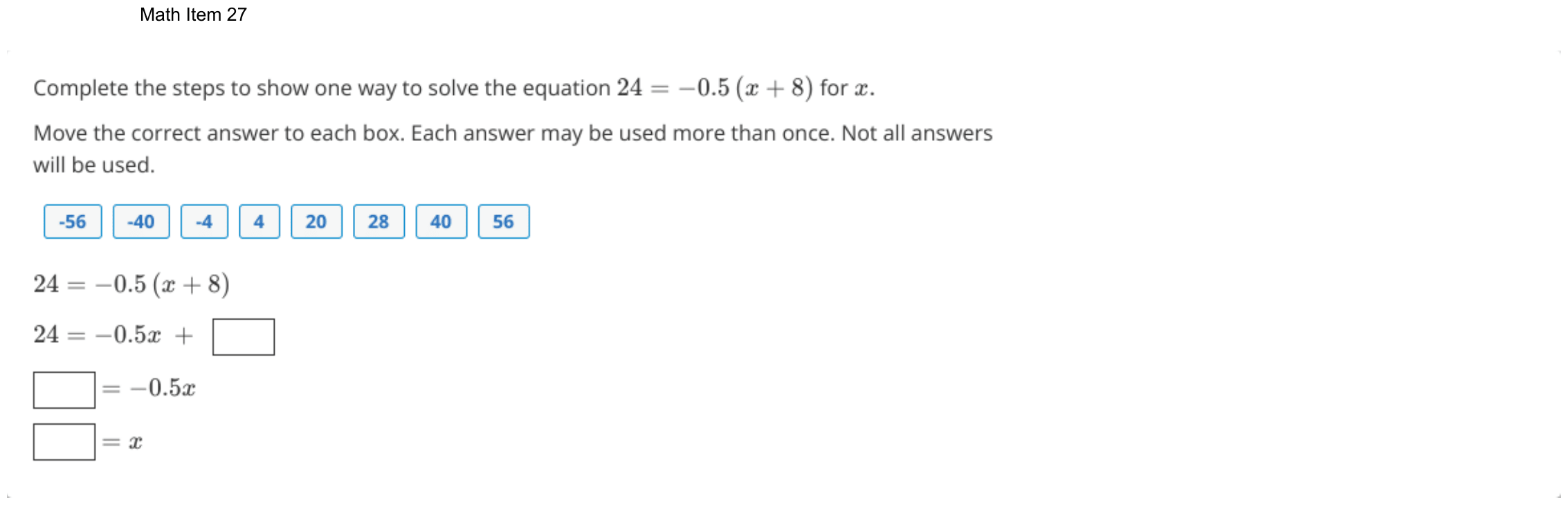
Question 29 of 120
2026 Practice Test A Math, question 32Question
What is the value of x in the equation ?
Enter your answer in the space provided. Enter only your answer.
On the test you build the answer on an on-screen keypad; here, type it. Use ^ for a power, sqrt( ) or √ for a root, pi for π, and <= or >= for ≤ and ≥.
Show the answer
Correct answer: x = -13/3
Solution:
Start with .
Subtract from both sides to move all terms involving x to one side.
Combine like terms.
Divide both sides by −3 to solve for x.
Question analysis
This equation question asks for the value of x when 6x equals 9x plus 13, typed into a box after "x =". Students solve a linear equation with the variable on both sides by gathering the x terms and dividing. With no answer choices to check against, keeping the sign of each moved term is the main challenge.
- Grade level
- Grade 8 content, by NYS standard
- Compared with grade 7
- At grade 7 The variable appears on both sides, a grade 8 topic, yet collecting it takes one subtraction and one division, much like a grade 7 two-step equation. The typed answer, with no choices to compare, adds some risk.
- Estimated difficulty
- Straightforward: two steps or one careful reading.
- Thinking it demands
- Depth of knowledge 1, recall and reproduction · mainly apply
- What makes it hard
- Error-prone arithmetic moderate
- An answer in an unexpected form minor
- Solution
- 2 steps
- Reading level
- Question and choices: about grade 5, 21 words.
- Students, last 30 days
- Not enough answers yet to show (it takes 10).
Why it is hard, traps and wrong answers (shows the answer)
Why it is hard
Two moves solve the equation, so the method is not in doubt; the points are lost in the result. Subtracting 6x instead, which gives 0 = 3x + 13, works as well but moves the sign onto the 13, and either route ends in a division that must keep the negative. The answer is not a whole number, which unsettles students who expect one, and a switch to decimals leads to a rounded entry that is not exact.
Error-prone arithmetic moderate Working it out
Collecting the x terms gives 6x − 9x = −3x, a negative coefficient, and 13 ÷ (−3) is a negative fraction that does not come out whole, so both the sign and the fraction must survive. (Brown & Burton, 1978; Junker & Sijtsma, 2001)
An answer in an unexpected form minor Choosing the answer
The answer is typed after the printed x =, with no choices to compare, and its decimal form, −4.333…, repeats forever, so only a fraction or mixed number is exact. (Enright, Morley & Sheehan, 2002)
Strategy: Subtract 9x from both sides so that x appears once, divide both sides by the coefficient left on x, and check by substituting the result into both sides of the original equation.
Traps
- Negatives and direction: Arithmetic with negative numbers, the order of a subtraction, or direction on a number line. (Moving a term across the equals sign without changing its sign is a faulty procedure.)
- Wrong operation: Adds instead of multiplying, divides the wrong way round, turns a ratio or rate upside down, or undoes a step in the wrong direction (subtracts what should be added back).
- Rounds too early: Rounds a value partway through, or rounds the wrong way, so the final answer drifts from the exact one.
The wrong answers, classified
13/3 Negatives and direction (Brown & Burton, 1978)
Reaches −3x = 13 correctly but drops the negative when dividing 13 by −3, entering a positive 13/3.
-4.33 Rounds too early (King et al., 2004)
Solves correctly but turns −13/3 into a decimal and rounds it to −4.33, which is close to the exact value but not equal to it.
-3/13 Wrong operation (Hegarty, Mayer & Monk, 1995; King et al., 2004)
Gets to −3x = 13 but divides the wrong way round, putting the coefficient −3 over the constant 13 instead of 13 over −3.
Worked solution, step by step
Formulas used
- Doing the same to both sides
- a and b are the two sides of an equation, and c is any number or term (not zero when you divide). Taking the same thing away from both sides, or dividing both by the same number, keeps the sides equal. That is how you get x by itself.
- Dividing by a negative number
- a and b are positive numbers, so −b is negative. A positive number divided by a negative number is negative. You can write the minus sign in front of the whole fraction.
- Changing a fraction to a mixed number
- Use this when the top of a fraction is bigger than the bottom. Divide a by b. q is the number of whole times b fits into a. r is the remainder, what is left over. The remainder goes on top of the leftover fraction.
Sort out the question
You need the value of x that makes true. The letter x appears on both sides, so first gather the x terms on one side. There are no choices to check against, so work carefully.
Move the x terms to one side
Subtract 9x from both sides. This clears the x term off the right side:
Since 6 − 9 = −3, the left side is −3 times x.
Divide both sides by −3
x is multiplied by −3, so divide both sides by −3:
A positive divided by a negative is negative, so x is negative.
Watch out: dropping the minus sign gives 13/3, which is wrong. Also, the number you divide by goes on the bottom. Writing −3/13 turns the fraction upside down.
Write it as a mixed number
A mixed number is a whole number with a fraction, like 4 1/3. Divide 13 by 3. The 3 fits 4 times, with 1 left over.
So .
Watch out: as a decimal, −13/3 is −4.333…, and the 3s never end. Rounding to −4.33 is close, but it is not exact. Keep the fraction.
Enter the answer
The box already shows x =, so you enter only the number. On the test, press the minus key first. Then press the fraction key, a small box over a small box. Type 13 in the top box and 3 in the bottom box. On this site, type −13/3 or −4 1/3.
So the finished answer reads x = −13/3. You type only the −13/3, which is the same as −4 1/3.
Check your answer
Put into both sides. The left side is . The right side is . Both sides equal −26, so the answer is right.
More questions like this
The original DOE question
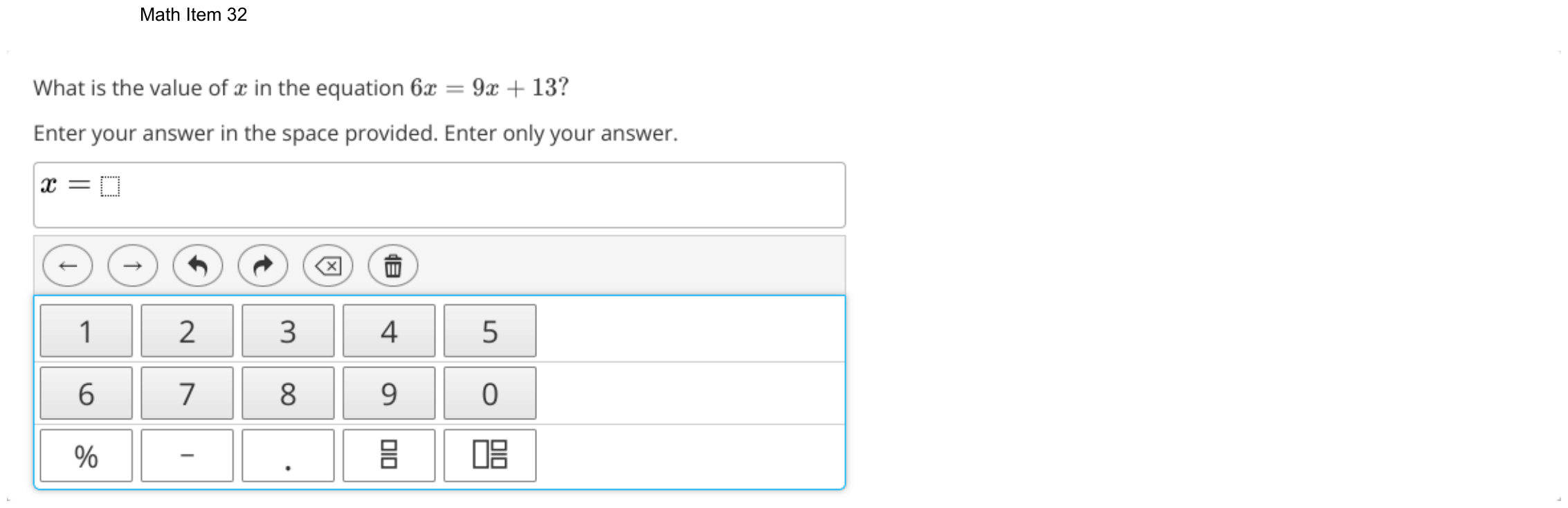
Question 30 of 120
2026 Practice Test A Math, question 37Question
When a student buys 4 notebooks, the total cost is $12. Each notebook costs the same amount. Select each point on the graph that best represents y, the total cost of x notebooks.
Select all the correct answers.
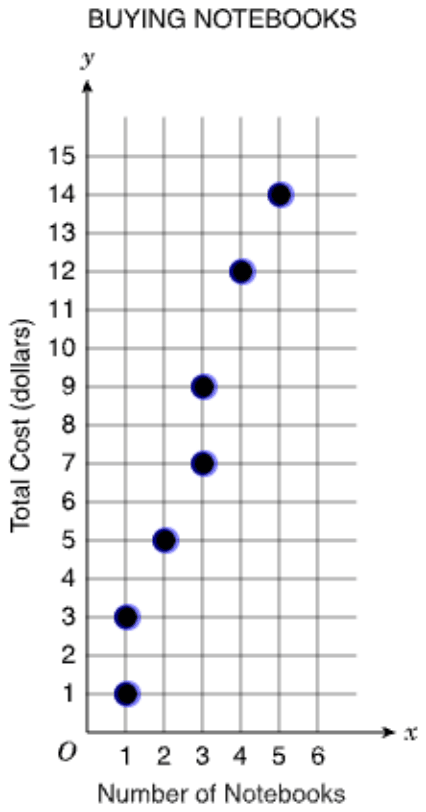
On the test you click the points in the figure; here, choose them below. The DOE has not published how answers with several parts are scored; this site counts one right only when every part is right.
- A(1, 1)
- B(1, 3)
- C(2, 5)
- D(3, 7)
- E(3, 9)
- F(4, 12)
- G(5, 14)
Show the answer
Correct answer: B, E, and F
Solution:
There are three correct points: (1, 3), (3, 9), and (4, 12).
Find the cost per notebook: .
The equation of the line is , where y is the total cost of x notebooks.
Check each point by plugging the x-value into the equation . If the y-value from the equation matches the y-value of the point, then the point is on the line .
Check all seven points:
(1, 1) y-values do not match; incorrect point
(1, 3) y-values match; CORRECT point
(2, 5) y-values do not match; incorrect point
(3, 7) y-values do not match; incorrect point
(3, 9) y-values match; CORRECT point
(4, 12) y-values match; CORRECT point
(5, 14) y-values do not match; incorrect point
Question analysis
A graph titled Buying Notebooks shows seven points, and students select every point that fits the total cost of buying notebooks, given the cost of a few notebooks and that each costs the same. It tests finding a unit rate and recognizing points of a proportional relationship. Some points line up in tempting patterns, and the item does not say how many to select.
- NYS standards
- Grade level
- Grade 7 content, by NYS standard
- Compared with grade 7
- At grade 7 Finding a unit rate and deciding which points fit a proportional relationship are grade 7 skills, and the arithmetic here is easy. What adds demand is testing all seven points with no count given, since one miss or extra pick loses the item.
- Estimated difficulty
- Straightforward: two steps or one careful reading.
- Thinking it demands
- Depth of knowledge 2, skills and concepts · mainly apply
- What makes it hard
- Solution
- 2 steps
- Reading level
- Question and choices: about grade 5, 36 words.
- Students, last 30 days
- Not enough answers yet to show (it takes 10).
Why it is hard, traps and wrong answers (shows the answer)
Why it is hard
Finding the price is one division, 12 ÷ 4 = 3, so the question is really about checking: each chosen dot must fit y = 3x exactly, and the item does not say how many do. The graph punishes judging by eye, since a straight row of dots climbs from (1, 3) at $2 a notebook and two dots sit a single gridline off the true line. Multiplying each x by 3 and reading each y from the axis, not from the pattern, settles all seven.
Every choice must be checked moderate Choosing the answer
Seven dots must each be tested against $3 a notebook, and the item never says how many fit; one missed point or one extra loses the whole item, so no dot can be skipped. (Embretson & Wetzel, 1987)
Reading a figure, table or graph minor Understanding the question
The graph stacks two dots above 1 notebook and two above 3, and each total cost has to be read off a grid ruled at every dollar up to 15. (Lesh, Post & Behr, 1987; Kirsch & Mosenthal, 1990)
A very close wrong answer minor Choosing the answer
(5, 14) sits one gridline below (5, 15), where 5 notebooks at $3 would be, and (2, 5) sits one below (2, 6), so judging by the line's direction cannot rule either out. (Embretson & Wetzel, 1987; Gorin & Embretson, 2006; Ascalon et al., 2007)
Strategy: Work out the cost of one notebook from the total given in the question, then multiply each point's x-coordinate by that price and keep only the points whose y-coordinate matches exactly.
Traps
- Misunderstands the concept: A wrong belief about a concept: that percents can be added, that area grows like length, that averages can be averaged, that a bigger denominator means a bigger fraction.
- Misreads the figure: Reads a value, label or tick spacing in a figure, table or graph wrongly.
The wrong answers, classified
A Little reason to choose it (Haladyna & Downing, 1993; Rodriguez, 2005)
No working from 4 notebooks for $12 makes one notebook cost $1, so this lowest dot mostly catches guesses, such as taking the dot nearest the origin as a start.
C Misunderstands the concept (Smith, diSessa & Roschelle, 1993; De Bock et al., 1998; Ni & Zhou, 2005)
Takes the straight row (1, 3), (2, 5), (3, 7) as the graph because its dots line up, though it climbs $2 a notebook and would meet the y-axis at $1, not the origin.
D Misunderstands the concept (Smith, diSessa & Roschelle, 1993; De Bock et al., 1998; Ni & Zhou, 2005)
Prefers the lower of the two dots above 3 notebooks because it continues the evenly spaced row from (1, 3) and (2, 5), instead of checking that 3 notebooks cost $9.
G Misreads the figure (Lesh, Post & Behr, 1987; Kirsch & Mosenthal, 1990)
Finds that 5 notebooks cost 5 × $3 = $15, then reads the dot above 5 as sitting on the top gridline, 15, when it is one line lower, at 14.
Worked solution, step by step
Formulas used
- Unit price
- The unit price is what one item costs. Divide the total cost by the number of items bought. This works because every notebook costs the same, so the total splits into equal parts.
- A proportional relationship
- y is the total cost in dollars, and x is the number of notebooks. k is the price of one notebook, the number you always multiply by. A point fits only if its y is exactly k times its x. The graph is a straight line through (0, 0).
Sort out the question
Four notebooks cost $12, and each one costs the same. On the graph, x is the number of notebooks, and y is the total cost in dollars. The graph shows seven points. You must select every point that fits. The question does not say how many fit, so test all seven.
Find the price of one notebook
Split the $12 equally among the 4 notebooks:
Each notebook costs $3. So the total cost is 3 times the number of notebooks:
Test each point
For each point, multiply its x by 3. Keep the point only if the result equals its y.
Choice Point 3 × x Fits? A (1, 1) 3 No B (1, 3) 3 Yes C (2, 5) 6 No D (3, 7) 9 No E (3, 9) 9 Yes F (4, 12) 12 Yes G (5, 14) 15 No Watch for look-alike points
Watch out: the dots (1, 3), (2, 5) and (3, 7) sit in a neat straight row. But that row climbs $2 per notebook, not $3. Lining up is not enough: (2, 5) and (3, 7), choices C and D, do not fit.
Watch out: 5 notebooks cost dollars. The dot above 5 sits one gridline lower, at 14. Read the y-axis carefully, and you will skip choice G.
Name the points
Three points fit: (1, 3), (3, 9) and (4, 12). On the test, you click each of these dots on the graph. On this site, you check their boxes. So the answers are B, E and F.
Check your answer
All three points fit : , and . They also line up with (0, 0), since 0 notebooks cost $0. And (4, 12) is the fact the question gave you.
More questions like this
The original DOE question
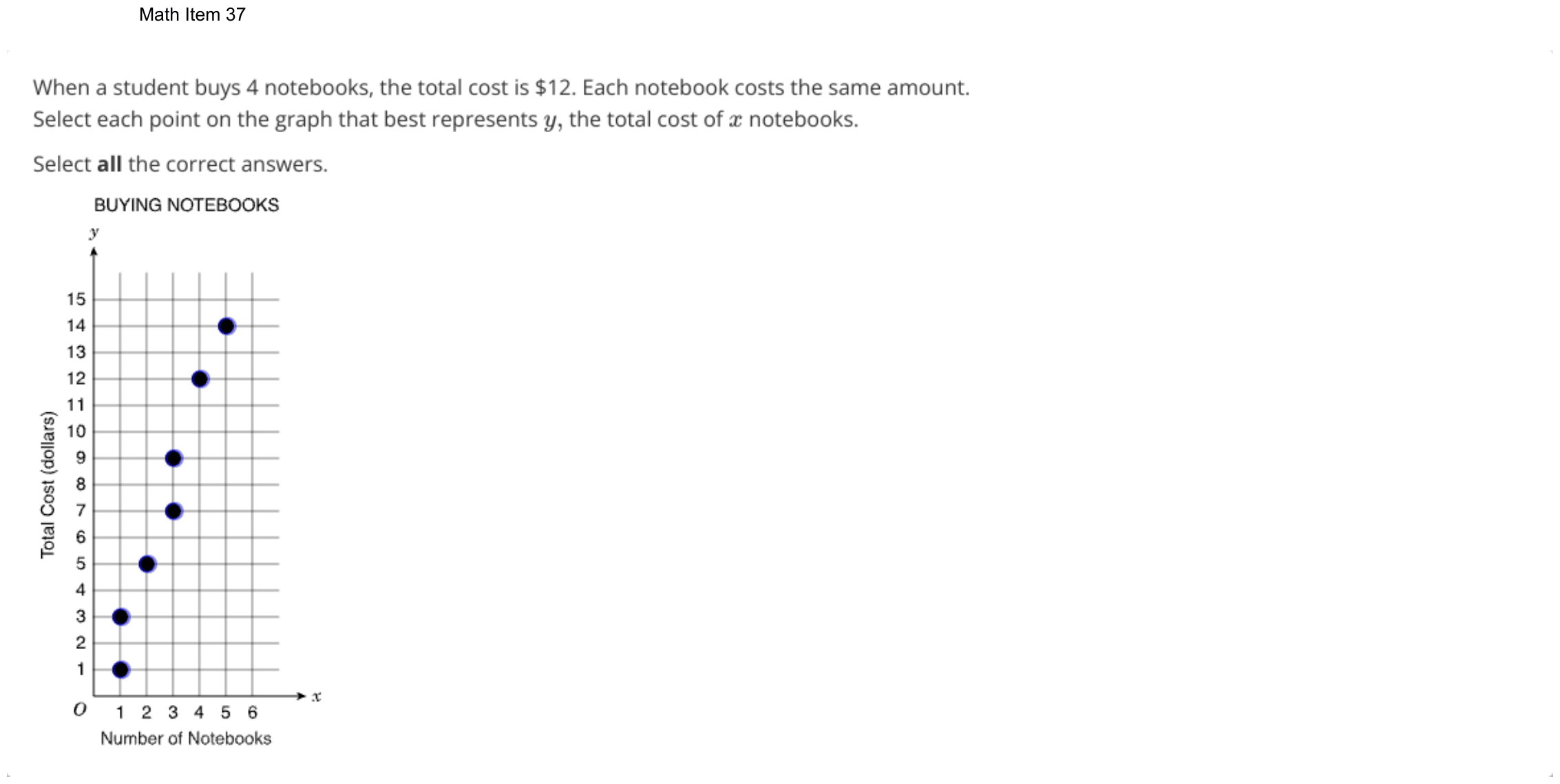
Question 31 of 120
2026 Practice Test A Math, question 43Question
Graph the solution set for the inequality .
Select a ray. Then, move the endpoint of the ray to the correct position on the number line.
On the test you draw the ray on the number line; here, choose its endpoint, whether the endpoint is closed or open, and its direction. The DOE has not published how answers with several parts are scored; this site counts one right only when every part is right.
Show the answer
Correct answer: a ray with a closed endpoint at 1, pointing right
Solution:

Solve the inequality for x, then graph the solution on the number line:
Add 5 to both sides of the inequality:
Divide both sides by 2:
Rewrite the inequality with x on the left side:
The graph of is a closed ray (solid point) beginning at 1 and extending to the right on the number line.
Question analysis
Students graph the solution set of a two-step inequality on a number line by choosing a ray: where it starts, whether its endpoint is open or closed, and which way it points. It tests solving a linear inequality and reading its solution. The variable sits on the right of the inequality symbol, so reading the result the right way round is part of the challenge.
- Grade level
- Grade 7 content, by NYS standard
- Compared with grade 7
- At grade 7 Solving a two-step inequality and graphing its solution set is a named grade 7 skill. This one puts the variable on the right of the symbol and asks students to build the graph themselves rather than pick it from four.
- Estimated difficulty
- Moderate: several steps, or a close reading with one strong distractor.
- Thinking it demands
- Depth of knowledge 1, recall and reproduction · mainly apply
- What makes it hard
- Reading a figure, table or graph moderate
- Many steps minor
- An answer in an unexpected form minor
- Solution
- 3 steps
- Reading level
- Question and choices: about grade 6, 26 words.
- Students, last 30 days
- Not enough answers yet to show (it takes 10).
Why it is hard, traps and wrong answers (shows the answer)
Why it is hard
Solving takes two routine moves; the points are lost in turning 1 ≤ x into a picture. Because x sits on the right, the symbol seems to point left, and a student who shades the way it points draws the values below 1, which all fail. The dot must also be solid, since x = 1 makes both sides −3. Testing x = 2, where 2x − 5 = −1 and −3 ≤ −1 holds, confirms the direction.
Reading a figure, table or graph moderate Understanding the question
The solution comes out as 1 ≤ x, with x on the right, so the ≤ sign points away from the shaded side; it has to be read as x ≥ 1 before the ray is drawn. (Lesh, Post & Behr, 1987; Kirsch & Mosenthal, 1990)
Many steps minor Working it out
Two solving moves, adding 5 and then halving, come before three graph choices, the endpoint, a solid dot and a direction, and a mistake in any of the five loses the item. (Daniel & Embretson, 2010; Enright, Morley & Sheehan, 2002)
An answer in an unexpected form minor Choosing the answer
The ray is built, by picking one of four ray shapes and dragging its endpoint, rather than chosen from four finished graphs, so nothing on screen flags a ray that starts at the right number but points the wrong way. (Enright, Morley & Sheehan, 2002)
Strategy: Undo the subtraction and then the multiplication on both sides, rewrite the result with x first, decide whether the endpoint is included, and test one value on your ray in the original inequality.
Traps
- Negatives and direction: Arithmetic with negative numbers, the order of a subtraction, or direction on a number line. (Moving a term across the equals sign without changing its sign is a faulty procedure.)
- Counting the ends: Inclusive or exclusive ends, fence posts, consecutive numbers: an answer that is one too many or too few, or an endpoint drawn open where it belongs closed (or the reverse).
- A faulty procedure: A systematic but wrong procedure: adding fractions straight across, applying an exponent to each term of a sum, dropping a sign when moving a term.
The wrong answers, classified
1|closed|left Negatives and direction (Brown & Burton, 1978)
Solves to 1 ≤ x but shades the way the ≤ symbol points, a rule that holds only with x on the left, so the ray covers x ≤ 1.
1|open|right Counting the ends (Brown & Burton, 1978)
Finds the right endpoint and direction but draws an open dot, leaving out 1 itself, though the "or equal to" in ≤ includes it.
-4|closed|right A faulty procedure (Brown & Burton, 1978; Tatsuoka, 1983)
Moves the −5 to the left side without changing its sign, writing −3 − 5 = −8 ≤ 2x, so the ray starts at −4.
Worked solution, step by step
Formulas used
- Doing the same to both sides
- a and b are the two sides of an inequality, and c is any number. Adding the same number to both sides keeps the inequality true. So does dividing both sides by the same positive number. Dividing by a negative number would flip the symbol, but that does not happen here.
- Turning an inequality around
- a and b are any two numbers or terms. You may swap the two sides if you also turn the symbol around. The pointed end of the symbol always faces the smaller side. So 1 ≤ x and x ≥ 1 say the same thing.
Sort out the question
The symbol ≤ means is less than or equal to. The solution set is every value of x that makes true. You show it as a ray. A ray is a dot, called the endpoint, with an arrow going one way forever. You need three things: where the dot goes, whether it is closed or open, and which way the ray points.
Add 5 to both sides
The right side is 2x − 5. Adding 5 undoes subtracting 5, so add 5 to both sides:
Watch out: taking 5 away from −3 instead gives −8 ≤ 2x. That wrong move puts the dot at −4.
Divide both sides by 2
Now x is multiplied by 2, so divide both sides by 2. You divide by a positive number, so the symbol stays the same:
Read it with x first
says 1 is less than or equal to x. So x is 1 or any number bigger than 1. With x first, that is:
Bigger numbers are to the right on a number line, so the ray points right.
Watch out: in 1 ≤ x, the symbol seems to point left. Do not follow it. A ray pointing left from 1 shows numbers that do not work.
Choose a closed dot
The words or equal to mean 1 itself is a solution. Check it: , and −3 ≤ −3 is true. So the dot at 1 is closed, which means filled in. An open dot, an empty circle, leaves the endpoint out. Use it only for < or >.
Watch out: an open dot at 1 would leave out a number that works.
Draw the ray
On the test, choose the ray with a filled dot and an arrow pointing right. Then drag its dot to 1. On this site, choose 1 for the endpoint, then closed (filled dot) and pointing right.
So the answer is a closed dot at 1, with the ray pointing right.
Check your answer
Test a number on your ray, such as 3. , and −3 ≤ 1 is true. Now test a number off the ray, such as 0. , and −3 ≤ −5 is false. So the ray points the right way.
More questions like this
The original DOE question
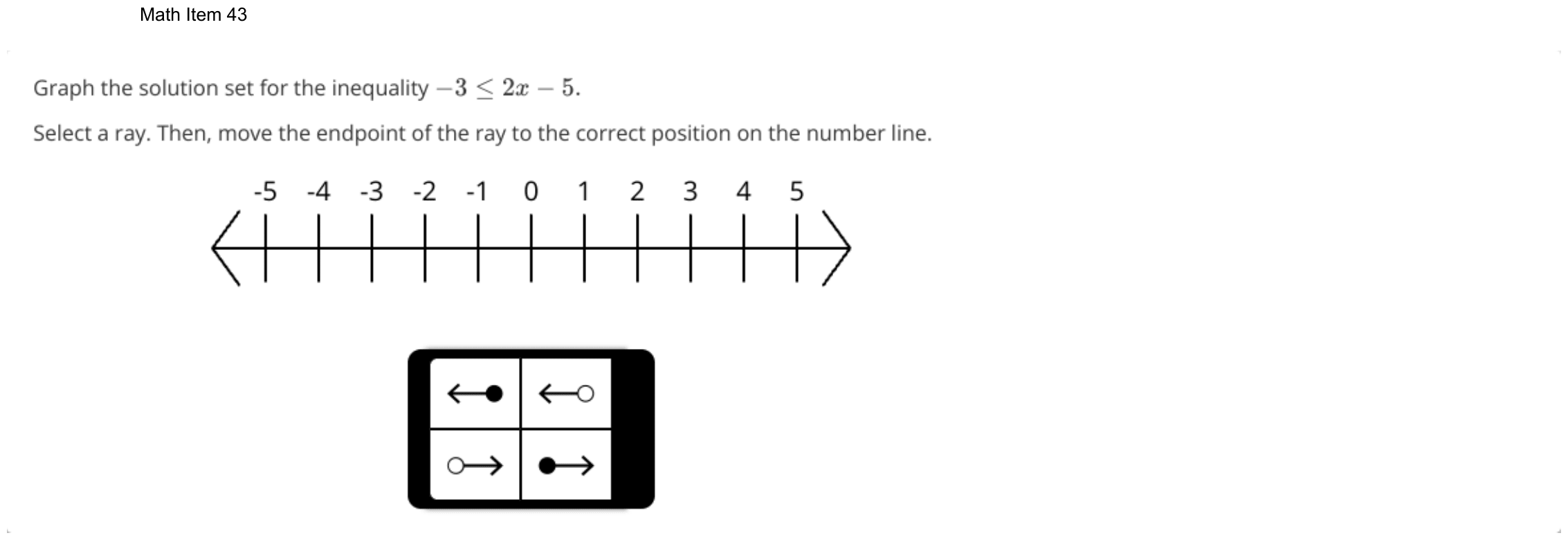
Question 32 of 120
2026 Practice Test A Math, question 50Question
Let , , and . Determine the value of .
Enter your fractional answer in the space provided. Enter only your fraction.
On the test you build the answer on an on-screen keypad; here, type it. Use ^ for a power, sqrt( ) or √ for a root, pi for π, and <= or >= for ≤ and ≥.
Show the answer
Correct answer: 7/5
Solution:
Substitute , , and in : .
Then simplify the complex fraction by multiplying the complex fraction by a form of 1, : .
Simplify after multiplying by a form of 1: .
Then simplify again and add the two fractions: .
Question analysis
This substitution question gives values for b, c and d and asks for the value of an expression made of a fraction divided by a fraction, plus another fraction. Students substitute, simplify the complex fraction and add, then type the result. Dividing fractions in the stacked form is the main hurdle, and the item wants a fraction, not a decimal.
- NYS standards
- Grade level
- Grade 7 content, by NYS standard
- Compared with grade 7
- At grade 7 Grade 7 students evaluate expressions and divide and add fractions. A fraction stacked over another fraction looks unfamiliar and there are no choices to check, but with these values the work is three short steps.
- Estimated difficulty
- Moderate: several steps, or a close reading with one strong distractor.
- Thinking it demands
- Depth of knowledge 1, recall and reproduction · mainly apply
- What makes it hard
- Error-prone arithmetic moderate
- Something you must already know minor
- An answer in an unexpected form minor
- Solution
- 3 steps
- Reading level
- Question and choices: about grade 9, 22 words.
- Students, last 30 days
- Not enough answers yet to show (it takes 10).
Why it is hard, traps and wrong answers (shows the answer)
Why it is hard
Once the values are in, the work is one fraction division and one addition, but the division is printed as a fraction over a fraction, in small type. Multiplying the two fractions, or flipping the top one, gives a sum in fifteenths that looks as finished as the right one. Noticing that the 4s cancel, so the stacked part is simply 3/5, turns the last step into adding fifths.
Error-prone arithmetic moderate Working it out
Dividing 4/5 by 4/3 means multiplying by 3/4, giving 3/5, which is then added to 4/5; multiplying straight across or flipping the top fraction instead both lead to fifteenths. (Brown & Burton, 1978; Junker & Sijtsma, 2001)
Something you must already know minor Working it out
Nothing on the page says that a fraction over a fraction is a division, or that dividing by 4/3 means multiplying by its reciprocal, and the stacked form is rare in grade 7 work. (Anderson & Krathwohl, 2001)
An answer in an unexpected form minor Choosing the answer
The value is typed into a fraction box with no choices to check against, and the item asks for a fraction, so the equal decimal 1.4 is not accepted. (Enright, Morley & Sheehan, 2002)
Strategy: Substitute the values, rewrite the stacked fraction as the top fraction times the reciprocal of the bottom one, where the 4s cancel, then add the last fraction and leave the result as a fraction.
Traps
- Wrong operation: Adds instead of multiplying, divides the wrong way round, turns a ratio or rate upside down, or undoes a step in the wrong direction (subtracts what should be added back).
- A faulty procedure: A systematic but wrong procedure: adding fractions straight across, applying an exponent to each term of a sum, dropping a sign when moving a term.
- Misreads the question: Misses or misreads a condition or a word in the question: "at least", "each", "remaining", "not".
The wrong answers, classified
28/15 Wrong operation (Hegarty, Mayer & Monk, 1995; King et al., 2004)
Multiplies 4/5 by 4/3 instead of dividing, getting 16/15, then adds 4/5, or 12/15, to reach 28/15.
37/15 A faulty procedure (Brown & Burton, 1978; Tatsuoka, 1983)
Flips the top fraction instead of the bottom one, so the stacked part becomes 5/4 × 4/3 = 5/3, and 5/3 + 4/5 = 37/15.
1.4 Misreads the question (Hegarty, Mayer & Monk, 1995)
Finds the right value but works in decimals, 0.6 + 0.8 = 1.4, and enters that, though the item asks for a fraction.
Worked solution, step by step
Formulas used
- Dividing fractions
- a, b, c and d are numbers that are not zero. To divide by a fraction, multiply by its reciprocal, the fraction flipped upside down. Flip only the fraction you divide by. It works because a fraction times its reciprocal is 1, so the reciprocal undoes the fraction, just as dividing does.
- Adding fractions with the same bottom
- d is the denominator, the bottom number, which tells the size of each piece. a and b are the numerators, the top numbers, which count the pieces. When the pieces are the same size, add the tops and keep the bottom.
Sort out the question
You know , and . You need the value of:
The first part is a fraction on top of a fraction. A fraction bar means divide, so this part is . The answer must be typed as a fraction.
Put in the numbers
Replace each letter with its value. Look closely: the bottom fraction has b under the c, not d.
So the expression becomes:
Divide the two fractions
Use the rule for dividing fractions. The reciprocal of 4/3 is 3/4. To multiply fractions, multiply the tops and multiply the bottoms:
To simplify 12/20, divide its top and bottom by 4.
Watch out: flip only the bottom fraction. Multiplying without flipping gives 16/15 and a total of 28/15. Flipping the top one gives 5/3 and a total of 37/15.
Add the last fraction
Both fractions are now fifths, so add the tops and keep the bottom:
The value is 7/5.
Enter it as a fraction
The item asks for a fraction. 7/5 equals the decimal 1.4, but 1.4 is not accepted. On the test, the answer box already holds a fraction template, a small box over a small box. Type 7 in the top box. Then click the bottom box and type 5. On this site, type 7/5.
So you would enter 7/5.
Check your answer
Check with decimals. , and 4/3 is about 1.33. Then is about 0.6, which is 3/5. Last, , and 1.4 is the same as 7/5.
More questions like this
The original DOE question
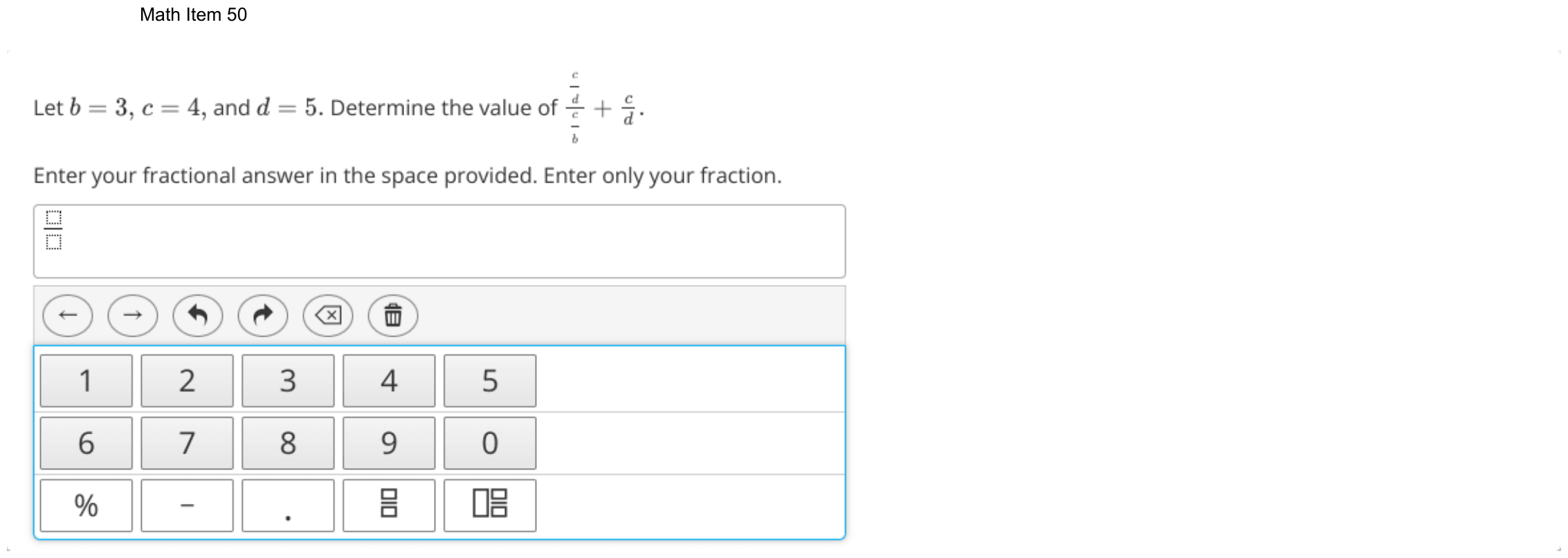
Question 33 of 120
2026 Practice Test B English, question 8Passage A Miracle Mile
A Miracle Mile
In the 1950s people compared running one mile in four minutes to scaling Mount Everest and nicknamed the feat a “dream mile.” Although such an accomplishment was considered humanly impossible, several elite runners aimed to break that supposedly impenetrable barrier. One of them was a twenty-five-year-old medical student named Roger Bannister.
Roger Bannister had tasted failure during the 1952 Olympics. There, he was favored to win the 1,500-meter competition, a distance slightly shorter than a mile, but he finished in a dismal fourth place instead. Bannister’s performance was a disappointment for him and his country, Great Britain. Determined to redeem himself, Bannister postponed his plans to retire from racing and focused on the ultimate prize—breaking the four-minute-mile barrier.
Bannister attacked the elusive milestone with a positive attitude and logical planning. The amateur athlete decided to use intensive interval training to develop endurance and speed. For these workouts, Bannister ran an interval of ten consecutive laps on a quarter-mile track, aiming for sixty seconds each lap. In between intervals, he let his body recover for two minutes.
By early 1954, Bannister had succeeded in lowering his quarter-mile pace to sixty-one seconds, but he had to shave off at least one more second in order to reach his target. Frustrated by the plateau he had reached, Bannister took a break from training and went mountain climbing for three days. The rest from running permitted his muscles to recuperate and left him feeling refreshed. When Bannister returned to the track, he completed ten quarter-mile-long intervals at fifty-nine seconds each. He finally felt prepared to attempt to break the world record.
As a member of the Amateur Athletic Association (AAA), Bannister joined the AAA team for a track meet against Oxford University. The event took place on a cinder track in Oxford on May 6, 1954. Bannister and his two AAA teammates, Chris Chataway and Chris Brasher, were close friends and frequent running partners. Chataway and Brasher agreed to help Bannister accomplish his goal by being his “rabbits.”
In track and field, rabbits are runners who enter the race solely to pace a teammate for a segment of the course. Typically, a runner settles in behind the rabbit and allows the rabbit to set an appropriate tempo. Additionally, by running behind the rabbit, the runner conserves about 15 percent of his or her effort. When the starting pistol fired, Brasher pounced into the lead, and Bannister followed behind his first rabbit.
Propelled by the excitement, Bannister lost his instinctive feel for his pace and shouted “Faster!” at Brasher. Brasher, however, remained composed and maintained his current steady but grueling pace, completing the first two laps in a desirable one minute and fifty-eight seconds. Then Chataway surged forward, leading Bannister at this same punishing rate for another lap and a half. At the beginning of the back straightaway of the track, Bannister bolted past Chataway. Bannister said, “I felt that the moment of a lifetime had come. There was no pain, only a great unity of movement and aim.” Bannister crossed the finish line in 3 minutes 59.4 seconds. The ecstatic crowd erupted the moment the timekeeper announced the word “three.”
Soon after Bannister’s achievement, four other athletes matched his performance. A new mindset had taken root among runners. Over the years, the record continued to fall. However, the current record, 3 minutes 43.13 seconds, has stood unbroken since 1999. Some question whether this record represents the limits of human ability. But perhaps there is another Bannister, an athlete who, with willpower and dedication, will accomplish the miraculous.
Question
The words “feat,” “humanly impossible,” and “impenetrable barrier” in paragraph 1 affect the tone of the paragraph because they
- Ahighlight the idea that only the most skilled runners would be able to run a four-minute mile.
- Bemphasize the idea that running a mile in less than four minutes was a seemingly unattainable goal.
- Cconvey the competitiveness among elite runners to consistently set and break speed records.
- Dshow the intensity of the training programs athletes endure in order to achieve their goals.
Show the answer
Correct answer: B
The question asks how the words “feat,” “humanly impossible,” and “impenetrable barrier” in paragraph 1 affect the tone of the paragraph.
A. Incorrect. Although paragraph 1 states that “several elite runners aimed to break that supposedly impenetrable barrier,” the words “feat,” “humanly impossible,” and “impenetrable barrier” suggest that the goal was unattainable even for the most skilled runners.
B. CORRECT. No one had ever been able to run a mile in less than four minutes, and the words “feat,” “humanly impossible,” and “impenetrable barrier” imply that the goal seemed unattainable. These words also reinforce the comparison of running a four-minute mile to “scaling Mount Everest” (paragraph 1).
C. Incorrect. The words “feat,” “humanly impossible,” and “impenetrable barrier” describe how challenging and almost impossible running a four-minute mile seemed, and while other elite runners “aimed to break that supposedly impenetrable barrier” (paragraph 1), the paragraph focuses on Roger Bannister, not the competition among elite runners seeking to break the record.
D. Incorrect. Bannister’s training program is described in paragraphs 3 and 4, and the words “feat,” “humanly impossible,” and “impenetrable barrier” are used in paragraph 1 to describe the magnitude of Bannister’s goal to run a four-minute mile. Though his training program was intense, these words relate to the intensity of the goal itself, not to the intensity of his training.
Question analysis
This tone question on “A Miracle Mile,” an article about Roger Bannister and the four-minute mile, asks how three word choices in the opening paragraph, “feat,” “humanly impossible” and “impenetrable barrier,” affect its tone. Students must read the connotations of strong words in context and decide what they stress, while choices that echo other parts of the passage compete for attention.
- Grade level
- Grade 6 reading and task
- Compared with grade 7
- Below grade 7 Grade 7 tone questions often ask students to find the telling words themselves. Here the three words are quoted and sit in one short opening paragraph, and their shared meaning is strong and plain, so one careful reading is enough.
- Estimated difficulty
- Straightforward: two steps or one careful reading.
- Thinking it demands
- Depth of knowledge 2, skills and concepts · mainly analyze
- What makes it hard
- A very close wrong answer minor
- Hard words minor
- Evidence
- Answered from one paragraph or stanza
- Reading level
- Passage: about grade 10, 587 words; question and choices: about grade 11, 80 words.
- Students, last 30 days
- Not enough answers yet to show (it takes 10).
Why it is hard, traps and wrong answers (shows the answer)
Why it is hard
The three quoted words all make the same point, and the opening comparison with “scaling Mount Everest” makes it again, so the effect is easy to sense. Points are lost on degree: the sentence holding two of the three words also names “several elite runners,” which makes a choice about only the best runners look supported. Students who hold on to “humanly impossible” rule it out, and the choices about rivalry and training fall away once they check that the words describe the goal, not the runners or their preparation.
A very close wrong answer minor Choosing the answer
The choice about only the most skilled runners and the right one both stress how hard the four-minute mile was; they differ on degree, possible for the best runners or thought impossible for anyone. (Embretson & Wetzel, 1987; Gorin & Embretson, 2006; Ascalon et al., 2007)
Hard words minor Understanding the question
“Impenetrable” and “feat” carry the tone, and a student who does not know that impenetrable means impossible to break through may miss how absolute the barrier sounded. (Perfetti, 2007; Freedle & Kostin, 1993)
Strategy: Decide what feeling the three quoted words share, then reread paragraph 1 to see what they describe, and keep only a choice that fits both the feeling and the thing described.
Traps
- Twists what the text says: Uses the text's topic and ideas but changes what it says: who did it, how much, when, or why.
- Word match: Repeats striking words or phrases from the text, so it looks supported, but its meaning does not fit the question.
- Wrong part of the text: A choice is true of another paragraph, stanza or speaker than the one asked about.
The wrong answers, classified
A Twists what the text says (King et al., 2004)
Sees that the words stress difficulty but scales it down to a feat for the best runners only, though “humanly impossible” says no runner at all was thought able to do it.
C Word match (Freedle & Kostin, 1993)
Picks up “elite runners aimed to break” from the same sentence and turns it into a rivalry over records, though the three words describe the barrier, not the runners.
D Wrong part of the text (Kirsch & Mosenthal, 1990)
Carries the intensive interval training of paragraphs 3 and 4 back to paragraph 1, where the words measure the size of the goal, not the effort of preparing for it.
Working it out, step by step
Figure out what the question asks
This is a tone question. Tone is the feeling or attitude that a writer’s words give a passage. The question names three word choices from paragraph 1. You need to decide what feeling they share and what they describe.
Find the words in paragraph 1
Paragraph 1 says people “compared running one mile in four minutes to scaling Mount Everest.” Scaling means climbing. Mount Everest is the tallest mountain on Earth. The paragraph calls running that fast a “feat.” The next sentence says “Although such an accomplishment was considered humanly impossible, several elite runners aimed to break that supposedly impenetrable barrier.”
Work out what the words mean
A feat is an amazing deed that is very hard to do. Humanly impossible means no person could ever do it. Impenetrable means impossible to break through, and a barrier is a wall. All three say the same thing. A mile under four minutes seemed like a goal no one could reach. A word for that is unattainable.
Check each choice
- A does not fit. It says the best runners could do it. But “humanly impossible” means no one could.
- B fits. The words make the four-minute mile sound out of reach.
- C does not fit. The words describe the barrier, not a contest between runners.
- D does not fit. Training comes later, in paragraphs 3 and 4. These words describe the goal itself.
Watch out: A is tempting because the same sentence mentions “several elite runners.” Elite means the very best. But even they were not expected to succeed.
Choose the answer
The three words make the goal sound almost impossible for anyone. So the answer is B, “emphasize the idea that running a mile in less than four minutes was a seemingly unattainable goal.”
Why this answer and not the closest wrong one
A is the closest wrong choice. It also says the four-minute mile was hard. But A says that only the most skilled runners could do it. The passage says it was “considered humanly impossible.” People thought no runner at all could do it. That is why B fits better.
More questions like this
The original DOE question
The passage “A Miracle Mile” as printed (page 13)
Question 34 of 120
2026 Practice Test B English, question 9Uses the passage above: “A Miracle Mile”.
Question
Read these sentences from paragraph 7.
Bannister said, “I felt that the moment of a lifetime had come. There was no pain, only a great unity of movement and aim.”
The sentences contribute to the development of ideas in the passage by showing that Bannister
- Aknew that he was about to achieve the goal he had worked toward.
- Bwas no longer experiencing personal disappointment from his past failure in the Olympics.
- Cfelt grateful to his teammates for helping him take the lead.
- Dwas satisfied that his training had helped him perfect his running technique.
Show the answer
Correct answer: A
The question asks how the sentences from paragraph 7 contribute to the development of ideas in the passage.
A. CORRECT. The sentences from paragraph 7 show that toward the end of the race, Bannister knew that the goal of breaking the four-minute-mile barrier was within his grasp and that he had the focus necessary to achieve it. The sentence following Bannister’s quotation states that he did indeed meet his goal, crossing “the finish line in 3 minutes 59.4 seconds” (paragraph 7).
B. Incorrect. The feelings Bannister expressed in the sentences from paragraph 7 did not erase those feelings related to his loss at the 1952 Olympics, which were what drove him to the achievement he was about to make.
C. Incorrect. While the quotation states that Bannister felt “unity,” this pertains to his running, not to his work with the team. The sentences from paragraph 7 capture Bannister’s focus on his chance to break the barrier and what he was feeling at that moment.
D. Incorrect. The sentences from paragraph 7 express Bannister’s realization that he was on the verge of reaching a goal. The sentences show that in the seconds before crossing the finish line, Bannister was fully focused on the end goal and was not thinking about his training or his running technique.
Question analysis
This question quotes Roger Bannister’s own words from his famous race, “I felt that the moment of a lifetime had come,” and asks how they contribute to the development of ideas in “A Miracle Mile.” Students interpret an athlete’s description of a feeling and decide what it shows about him. Each choice links the quotation to a different part of his story.
- Grade level
- Grade 7 reading and task
- Compared with grade 7
- At grade 7 Explaining what a quoted sentence adds to a passage is everyday grade 7 work, and these two sentences are short. Their abstract phrase “a great unity of movement and aim” takes some interpreting, which keeps the demand typical rather than light.
- Estimated difficulty
- Moderate: several steps, or a close reading with one strong distractor.
- Thinking it demands
- Depth of knowledge 2, skills and concepts · mainly analyze
- What makes it hard
- Reading between the lines moderate
- Figurative or literary language minor
- Evidence
- Answered from one paragraph or stanza
- Reading level
- Passage: about grade 10, 587 words; question and choices: about grade 7, 93 words.
- Students, last 30 days
- Not enough answers yet to show (it takes 10).
Why it is hard, traps and wrong answers (shows the answer)
Why it is hard
Bannister’s words describe a feeling, and each choice explains it by a different part of his story. The right reading comes from where the quotation sits: on the back straight, seconds from the finish, so “the moment of a lifetime” is the record within reach. Students who take “unity of movement” as polished form, or “no pain” as the end of his Olympic hurt, tie the quotation to his training or his past instead of to this race.
Reading between the lines moderate Working it out
The quotation never names the record; students must link “the moment of a lifetime had come” to the four-minute goal and to the finish in 3 minutes 59.4 seconds reported right after it. (Graesser, Singer & Trabasso, 1994; Kintsch, 1998)
Figurative or literary language minor Understanding the question
“A great unity of movement and aim” is abstract, and “There was no pain” can be heard as emotional relief, so the words invite readings about technique, teamwork or old disappointment. (Graesser, Singer & Trabasso, 1994; Kintsch, 1998)
Strategy: Read the quotation together with the sentences around it in paragraph 7, put Bannister’s state of mind into your own words, and test each choice against what the quotation itself says.
Traps
- Wrong part of the text: A choice is true of another paragraph, stanza or speaker than the one asked about.
- Reads too much in: A reasonable-sounding conclusion that goes further than the text allows.
- Dictionary meaning, not meaning here: A common meaning of the word that does not fit its use in this text.
The wrong answers, classified
B Reads too much in (Graesser, Singer & Trabasso, 1994)
Hears “There was no pain” as the end of the hurt from his 1952 fourth place, but the pain meant is the strain of the race, and the quotation never looks back.
C Dictionary meaning, not meaning here (Perfetti, 2007)
Takes “unity” in its everyday sense of people pulling together and credits his rabbits, though the unity is of his own “movement and aim,” just after he passed Chataway to run alone.
D Wrong part of the text (Kirsch & Mosenthal, 1990)
Brings in the training of paragraphs 3 and 4 and reads “unity of movement” as perfected technique, but the quotation records a feeling during the race, not a verdict on his preparation.
Working it out, step by step
Figure out what the question asks
This asks what Bannister’s words show about him at that moment in the race. To answer, you need to know where the quotation comes. So read the sentences just before it and just after it.
Find where the quotation comes
Paragraph 7 tells the story of the race. Just before the quotation, “Bannister bolted past Chataway.” Bolted means ran off suddenly and fast. Chataway was his second rabbit, a teammate who set the pace. Now Bannister was in front, near the end. Just after the quotation, “Bannister crossed the finish line in 3 minutes 59.4 seconds.” That is under four minutes.
Put his words in your own words
He says “I felt that the moment of a lifetime had come.” The moment of a lifetime is the most important moment a person ever has. For Bannister, that was breaking the four-minute mile. “A great unity of movement and aim” means his body and his goal were working as one. He could feel that he was about to do it.
Check each choice
- A fits. He senses that his big goal is about to happen.
- B does not fit. “There was no pain” means he felt no strain in the race. He is not thinking back to 1952.
- C does not fit. The unity is of his own “movement and aim,” not of his team. He had just passed Chataway to run alone.
- D does not fit. The words describe a feeling during the race. They say nothing about his training or his technique, which means his way of running.
Watch out: D is tempting because “unity of movement” sounds like perfect running form. But Bannister is not judging his training here. He is feeling the big moment arrive.
Choose the answer
The quotation shows Bannister sensing that his goal was near, and the next sentence shows he reached it. So the answer is A, “knew that he was about to achieve the goal he had worked toward.”
Why this answer and not the closest wrong one
D is the closest wrong choice. His training did help him, and he was running well. But the quotation is about a feeling: “the moment of a lifetime had come.” It looks ahead to the finish, not back at his practice. A matches that feeling of a goal about to be reached.
More questions like this
The original DOE question
Question 35 of 120
2026 Practice Test B English, question 10Uses the passage above: “A Miracle Mile”.
Question
Which sentence best supports the idea that Bannister needed an alternative to “logical planning” (paragraph 3) in order to accomplish his goal?
- A“Bannister’s performance was a disappointment for him and his country, Great Britain.” (paragraph 2)
- B“The amateur athlete decided to use intensive interval training to develop endurance and speed.” (paragraph 3)
- C“For these workouts, Bannister ran an interval of ten consecutive laps on a quarter-mile track, aiming for sixty seconds each lap.” (paragraph 3)
- D“Frustrated by the plateau he had reached, Bannister took a break from training and went mountain climbing for three days.” (paragraph 4)
Show the answer
Correct answer: D
The question asks which sentence best supports the idea that Bannister needed an alternative to “logical planning” (paragraph 3) in order to accomplish his goal.
A. Incorrect. The outcome of the 1952 Olympics, referenced in the sentence from paragraph 2, is what prompted Bannister to seek a new goal: “Determined to redeem himself, Bannister . . . focused on the ultimate prize—breaking the four-minute-mile barrier” (paragraph 2).
B. Incorrect. The sentence from paragraph 3 does not show an alternative to Bannister’s training plan to “develop endurance and speed” (paragraph 3) and his focus on using logical planning in order to accomplish his goal.
C. Incorrect. The sentence from paragraph 3 focuses on details of his training plan, explaining the “intensive interval training” (paragraph 3) that Bannister used to build his endurance and speed, not an alternative form of preparation.
D. CORRECT. The sentence from paragraph 4 explains that Bannister reached a point where he could not improve his time despite the strict training plan he had created. Taking a break from his training to spend time mountain climbing “permitted his muscles to recuperate and left him feeling refreshed” (paragraph 4).
Question analysis
This textual evidence question on “A Miracle Mile” asks which sentence best supports the idea that Roger Bannister needed an alternative to the “logical planning” described in paragraph 3. Students must understand what his plan was before they can recognize a departure from it. The four sentences come from paragraphs 2 to 4, which cover his Olympic loss and his training.
- Grade level
- Grade 7 reading and task
- Compared with grade 7
- At grade 7 Matching a sentence to an idea is standard grade 7 evidence work, and the four sentences come from three short, plain paragraphs. The idea itself is worded abstractly, so students must first decide what an alternative to “logical planning” would look like.
- Estimated difficulty
- Straightforward: two steps or one careful reading.
- Thinking it demands
- Depth of knowledge 2, skills and concepts · mainly evaluate
- What makes it hard
- Evidence
- Answered from several paragraphs or stanzas
- Reading level
- Passage: about grade 10, 587 words; question and choices: about grade 12, 92 words.
- Corrected from the DOE handbook
- A wrong paragraph number in the explanation was corrected.
- Students, last 30 days
- Not enough answers yet to show (it takes 10).
Why it is hard, traps and wrong answers (shows the answer)
Why it is hard
The question turns on one decision: the interval training is the logical plan, so a sentence describing it cannot show an alternative to it. Once that is settled, three days of mountain climbing stand out as the only break from the plan. Students lose the point when they read “alternative” loosely and pick the sentence that introduces the training, or when they treat the Olympic disappointment as the moment his methods had to change.
Reading between the lines minor Working it out
The stem never says what the “logical planning” was; students must see that it is the interval training of paragraph 3, so the alternative has to be a step away from that training. (Graesser, Singer & Trabasso, 1994; Kintsch, 1998)
Evidence in several places minor Working it out
The stem points to paragraph 3, where two of the four sentences sit, but the departure from the plan comes in paragraph 4, after Bannister stalls at sixty-one seconds a lap. (Kirsch & Mosenthal, 1990; Gorin & Embretson, 2006)
Strategy: First reread paragraph 3 to see what Bannister’s “logical planning” was, then ask of each sentence whether it shows that plan or something different from it.
Traps
- Supports only part of the claim: In a question about evidence: a line that backs one half of the claim but not the other, or a related point rather than the claim itself.
- True but not the answer: A choice says something accurate about the text that does not answer this question.
The wrong answers, classified
A True but not the answer (King et al., 2004; Embretson & Wetzel, 1987)
Picks the 1952 disappointment, an accurate sentence that explains why Bannister took up the goal, but it comes before the plan and shows no step away from it.
B Supports only part of the claim (King et al., 2004; Thissen, Steinberg & Fitzpatrick, 1989)
Takes the decision to use intensive interval training as the alternative, missing that this training is the logical plan itself, so the sentence shows the plan, not a departure from it.
C Supports only part of the claim (King et al., 2004; Thissen, Steinberg & Fitzpatrick, 1989)
Chooses the workout details, ten laps aimed at sixty seconds each, which spell out the plan’s routine rather than any change to it.
What was corrected from the DOE handbook, and why
- Explanation: The DOE’s explanation of Option C begins “The sentence from paragraph 4 focuses on details of his training plan.” Option C quotes a sentence from paragraph 3 (“For these workouts, Bannister ran an interval of ten consecutive laps on a quarter-mile track, aiming for sixty seconds each lap”) and labels it “(paragraph 3),” and the explanation goes on to describe the “intensive interval training” of paragraph 3. The site now says “The sentence from paragraph 3.” The DOE’s 2021–2022 guide, where this question first appeared, has the same slip.
Working it out, step by step
Figure out what the question asks
This asks for evidence: the sentence that best supports an idea. The idea is that Bannister needed an alternative to his “logical planning.” An alternative is a different way of doing something. So first find out what his plan was. Then look for a sentence where he steps away from it.
Find the logical plan in paragraph 3
Paragraph 3 says “Bannister attacked the elusive milestone with a positive attitude and logical planning.” The next sentence tells what the plan was: “The amateur athlete decided to use intensive interval training to develop endurance and speed.” Interval training means running hard for a set stretch, resting, then running hard again.
Find where the plan stopped working
Paragraph 4 says he got down to sixty-one seconds a lap, but he needed sixty. Then “Frustrated by the plateau he had reached, Bannister took a break from training and went mountain climbing for three days.” A plateau is a point where you stop getting better. Climbing was not part of his plan. Afterward, he ran each lap in fifty-nine seconds.
Check each choice
- A does not fit. It is from paragraph 2. It tells why he chose the goal, before he had any plan.
- B does not fit. Interval training is the logical plan, not an alternative to it.
- C does not fit. It is from paragraph 3. It gives details of the same plan: ten laps, sixty seconds each.
- D fits. He stops training, does something else, and it works.
Watch out: B is tempting because it describes a choice Bannister made. But that choice was the plan itself.
Choose the answer
Only D shows Bannister trying something outside his plan. So the answer is D, “Frustrated by the plateau he had reached, Bannister took a break from training and went mountain climbing for three days.”
Why this answer and not the closest wrong one
B is the closest wrong choice. It names a decision Bannister made. But that decision, interval training, was his logical plan. The question asks for a step away from the plan. Only D shows him leaving training behind. The rest “permitted his muscles to recuperate,” which means recover.
More questions like this
The original DOE question
Question 36 of 120
2026 Practice Test B English, question 11Uses the passage above: “A Miracle Mile”.
Question
Which sentence from the passage indicates that Bannister nearly made a mistake that would have cost him the world record?
- A“By early 1954, Bannister had succeeded in lowering his quarter-mile pace to sixty-one seconds, but he had to shave off at least one more second in order to reach his target.” (paragraph 4)
- B“When the starting pistol fired, Brasher pounced into the lead, and Bannister followed behind his first rabbit.” (paragraph 6)
- C“Propelled by the excitement, Bannister lost his instinctive feel for his pace and shouted ‘Faster!’ at Brasher.” (paragraph 7)
- D“At the beginning of the back straightaway of the track, Bannister bolted past Chataway.” (paragraph 7)
Show the answer
Correct answer: C
The question asks which sentence indicates that Bannister nearly made a mistake that would have cost him the world record.
A. Incorrect. The sentence from paragraph 4 describes a challenge Bannister faced during his training period, when he used “intensive interval training to develop endurance and speed” (paragraph 3). Bannister ran laps on a “quarter-mile track” (paragraph 3) and was able to control his pace at this time—unlike during the actual race to break the record.
B. Incorrect. The sentence from paragraph 6 describes the start of the race and Brasher’s role as “first rabbit” for Bannister. Bannister was behind Brasher, following their plan for breaking the record.
C. CORRECT. If Bannister had begun running faster than the “steady but grueling pace” (paragraph 7) set by his “rabbit,” he would likely not have had enough energy to finish the race. As paragraph 6 notes, “the runner conserves about 15 percent of his or her effort” by allowing the rabbit to set the pace. Bannister had “lost his instinctive feel for his pace” (paragraph 7) in the excitement of the race. If he had given in to his impulse to run faster and bypassed the rabbit at that point in the race, it would have cost him energy, and, in turn, the record.
D. Incorrect. The sentence from paragraph 7 describes how Bannister leaped ahead of Chataway, his second “rabbit,” at the appropriate time in the effort to break the record. Chataway had “surged forward, leading Bannister at this same punishing rate for another lap and a half” (paragraph 7) before Bannister moved past him.
Question analysis
This textual evidence question asks which sentence from “A Miracle Mile” shows that Roger Bannister nearly made a mistake that could have cost him the world record. The passage never says outright that he slipped, so students must use what it explains about running a race to judge which moment was a real danger. The four choices span both his training and the race itself.
- Grade level
- Grade 7 reading and task
- Compared with grade 7
- At grade 7 Grade 7 evidence questions usually match a sentence to an idea the text states. This mistake is never named as one, so students must infer which moment put the record at risk, a typical grade 7 inference within a short, clear passage.
- Estimated difficulty
- Moderate: several steps, or a close reading with one strong distractor.
- Thinking it demands
- Depth of knowledge 2, skills and concepts · mainly evaluate
- What makes it hard
- Reading between the lines moderate
- Evidence in several places minor
- Every choice must be checked minor
- Evidence
- Answered from several paragraphs or stanzas
- Reading level
- Passage: about grade 10, 587 words; question and choices: about grade 11, 102 words.
- Students, last 30 days
- Not enough answers yet to show (it takes 10).
Why it is hard, traps and wrong answers (shows the answer)
Why it is hard
The near mistake is easy to miss because it never happens: Brasher ignores the shout, and the race goes on at the planned pace. Students must see that losing his feel for the pace put the record at risk, using what paragraph 6 explains about rabbits. The sudden surge past Chataway sounds rash and the training plateau sounds like a near failure, so students who look for drama or for falling short land on the wrong moment.
Reading between the lines moderate Working it out
The passage never calls the shout of “Faster!” a mistake; students must infer it from “lost his instinctive feel for his pace” and from Brasher’s refusal to change his steady pace. (Graesser, Singer & Trabasso, 1994; Kintsch, 1998)
Evidence in several places minor Working it out
Why running faster would have cost the record is explained a paragraph earlier, in paragraph 6, where following a rabbit saves a runner about 15 percent of his or her effort. (Kirsch & Mosenthal, 1990; Gorin & Embretson, 2006)
Every choice must be checked minor Choosing the answer
Each sentence shows a setback or a bold move, from the training plateau to the final surge, so each has to be judged against the idea of a near mistake. (Embretson & Wetzel, 1987)
Strategy: For each quoted sentence, ask whether it shows Bannister doing something that could have hurt his chances, and use what the passage explains about racing to judge how serious it was.
Traps
- Reads too much in: A reasonable-sounding conclusion that goes further than the text allows.
- Supports only part of the claim: In a question about evidence: a line that backs one half of the claim but not the other, or a related point rather than the claim itself.
- Outside knowledge: A choice is plausible in the real world but not supported by this text.
The wrong answers, classified
A Supports only part of the claim (King et al., 2004; Thissen, Steinberg & Fitzpatrick, 1989)
Takes the 1954 plateau, one second short of the target pace, as the near miss, but it was a setback in training that rest overcame, not a mistake.
B Outside knowledge (King et al., 2004; Recht & Leslie, 1988)
Assumes that trailing at the start is a racing error, but paragraph 6 explains that a runner behind a rabbit saves about 15 percent of his or her effort.
D Reads too much in (Graesser, Singer & Trabasso, 1994)
Reads “bolted” as a reckless burst, but Bannister passed Chataway only after his rabbits had paced him for three and a half laps, and the move won him the record.
Working it out, step by step
Figure out what the question asks
This asks for a sentence that shows a near mistake. That is something that almost went wrong. It would have cost Bannister the record. So look for a moment when he did something that could have ruined the race.
Learn how a rabbit helps
Paragraph 6 explains rabbits. They are teammates who run in front to set the speed. It says “Typically, a runner settles in behind the rabbit and allows the rabbit to set an appropriate tempo.” Tempo means speed. Also, “by running behind the rabbit, the runner conserves about 15 percent of his or her effort.” Conserves means saves.
Find the moment that went wrong
Paragraph 7 begins “Propelled by the excitement, Bannister lost his instinctive feel for his pace and shouted” at Brasher to go faster. He lost his natural sense of how fast to run. If Brasher had sped up, Bannister could have used up his energy too soon. But Brasher “remained composed,” which means calm. He kept the steady pace, and that saved the race.
Check each choice
- A does not fit. The training plateau was a setback, not a mistake. A rest fixed it.
- B does not fit. Following a rabbit was the plan. Paragraph 6 shows that it saves effort.
- C fits. Bannister wanted to go faster too early, which could have worn him out.
- D does not fit. Passing Chataway near the end was the right move. It won him the record.
Watch out: D is tempting because “bolted” sounds wild. But he waited until his rabbits had paced him for three and a half laps.
Choose the answer
Only C shows Bannister almost doing something that could have cost him the record. So the answer is C, “Propelled by the excitement, Bannister lost his instinctive feel for his pace and shouted ‘Faster!’ at Brasher.”
Why this answer and not the closest wrong one
D is the closest wrong choice, since bolting past Chataway was a bold, sudden move. But it came at the right time, and it led to the record. In C, Bannister lost his sense of pace and wanted to speed up too early. Only his rabbit’s calm saved him. That is a near mistake.
More questions like this
The original DOE question
Question 37 of 120
2026 Practice Test B English, question 12Uses the passage above: “A Miracle Mile”.
Question
Bannister’s loss in the 1952 Olympics influenced his decision to pursue breaking the four-minute-mile barrier by
- Aallowing him to recognize his weaknesses and improve his running ability.
- Bprompting him to take a different approach to his regular training.
- Cmotivating him to prove to himself that he could set and achieve a goal.
- Dgiving him the opportunity to reach a goal no runner had ever accomplished.
Show the answer
Correct answer: C
The question asks how Bannister’s loss in the 1952 Olympics influenced his decision to pursue breaking the four-minute-mile barrier.
A. Incorrect. While Bannister recognized the weaknesses that led to his poor performance in the Olympics and worked “to develop endurance and speed” (paragraph 3), the loss made him “determined to redeem himself” (paragraph 2). The desire for redemption influenced Bannister to focus specifically on running a mile in under four minutes, rather than on winning other races or training for other distances.
B. Incorrect. Although Bannister developed an “intensive interval training” plan to improve his “endurance and speed” (paragraph 3), he applied a different approach only after his progress toward a four-minute mile reached a “plateau” (paragraph 4) in 1954. It was his desire to “shave off at least one more second in order to reach his target” (paragraph 4) that prompted him to take a break from interval training and go mountain climbing for three days.
C. CORRECT. Bannister sought to redeem himself after “he finished in a dismal fourth place” at the Olympics (paragraph 2). He thought that his performance “was a disappointment for him and his country, Great Britain,” and he responded by setting a goal to successfully conquer the four-minute mile, which was considered the “ultimate prize” (paragraph 2).
D. Incorrect. Bannister’s loss at the 1952 Olympics motivated him to change his training focus to reaching the “ultimate prize” (paragraph 2) of breaking the four-minute-mile barrier, which no other runner had accomplished. His loss at the Olympics did not present him with a specific opportunity to reach this goal.
Question analysis
This cause-and-effect question on “A Miracle Mile” asks how Roger Bannister’s disappointing finish at the 1952 Olympics shaped his decision to chase the four-minute mile. Students trace how one event led to a choice. The passage gives the reason in a single phrase, and the choices restate it alongside effects that sound believable for any athlete after a loss.
- Grade level
- Grade 7 reading and task
- Compared with grade 7
- At grade 7 Explaining how one event influenced a person’s decision is standard grade 7 work, and the cause is set out in one short paragraph. The choices put the passage’s ideas in new words, so students must match meaning rather than phrases.
- Estimated difficulty
- Moderate: several steps, or a close reading with one strong distractor.
- Thinking it demands
- Depth of knowledge 2, skills and concepts · mainly understand
- What makes it hard
- The right answer is reworded moderate
- Hard words minor
- Evidence
- Answered from one paragraph or stanza
- Reading level
- Passage: about grade 10, 587 words; question and choices: about grade 10, 64 words.
- Students, last 30 days
- Not enough answers yet to show (it takes 10).
Why it is hard, traps and wrong answers (shows the answer)
Why it is hard
The answer sits in a single phrase, but the choices compete with stories that fit any athlete after a loss, such as learning from weaknesses or changing a routine. Both sound right because Bannister did train hard afterward, yet the passage ties the loss only to his wish to redeem himself, and the change of routine comes later, from the 1954 plateau. Students who keep to the question’s focus, the decision to chase the record, find a motive rather than a method.
The right answer is reworded moderate Choosing the answer
Paragraph 2 says the loss left Bannister “determined to redeem himself”; the right choice recasts this as proving to himself he could set and reach a goal, while a wrong one reuses the passage’s word “training.” (Freedle & Kostin, 1993; Kirsch & Mosenthal, 1990)
Hard words minor Understanding the question
“Redeem himself,” to make up for a failure, is the key phrase, and a student unsure of it may not see that the loss gave him a reason rather than a lesson. (Perfetti, 2007; Freedle & Kostin, 1993)
Strategy: Find the sentence in paragraph 2 that tells how Bannister responded to the 1952 loss, restate it in your own words, and compare each choice with your restatement.
Traps
- Half right: One half of a two-part choice is right and the other is not.
- Outside knowledge: A choice is plausible in the real world but not supported by this text.
- Wrong part of the text: A choice is true of another paragraph, stanza or speaker than the one asked about.
The wrong answers, classified
A Outside knowledge (King et al., 2004; Recht & Leslie, 1988)
Supplies a familiar sports lesson, that a loss shows an athlete what to fix, but paragraph 2 makes the loss a reason to redeem himself and names no weaknesses.
B Wrong part of the text (Kirsch & Mosenthal, 1990)
Borrows the change of routine from paragraph 4, where the 1954 plateau, not the Olympic loss, sent Bannister off to climb mountains for three days.
D Half right (King et al., 2004; Thissen, Steinberg & Fitzpatrick, 1989)
Gets right that no runner had yet broken four minutes, but the loss opened no door for him; finishing fourth gave him a motive, not a chance.
Working it out, step by step
Figure out what the question asks
This asks about cause and effect. The cause is Bannister’s loss at the 1952 Olympics. The effect is his decision to chase the four-minute mile. You need to find how the first led to the second.
Read paragraph 2
Paragraph 2 says he “finished in a dismal fourth place instead.” Dismal means very disappointing. Then it says “Bannister’s performance was a disappointment for him and his country, Great Britain. Determined to redeem himself, Bannister postponed his plans to retire from racing and focused on the ultimate prize.” The prize was breaking the four-minute mile.
Understand what redeem himself means
To redeem yourself means to make up for a failure. You show that you are better than your worst moment. Bannister had let himself down. So he set a huge new goal to prove what he could do. The loss gave him a reason to try, which is a motive.
Check each choice
- A does not fit. Paragraph 2 never names any weaknesses he found.
- B does not fit. He changed his routine in paragraph 4, in 1954. That was because of a plateau, not the Olympic loss.
- C fits. He wanted to make up for the loss by reaching a big goal.
- D does not fit. Losing did not give him a chance at the record. It gave him a reason.
Watch out: A sounds like a common sports lesson: losing shows you what to fix. But the passage does not say that.
Choose the answer
The loss made Bannister “determined to redeem himself” with a new goal. So the answer is C, “motivating him to prove to himself that he could set and achieve a goal.”
Why this answer and not the closest wrong one
A is the closest wrong choice. Athletes often learn from a loss, so it sounds right. But paragraph 2 never says what Bannister was bad at. It says the loss made him “determined to redeem himself.” That is about motivation, so C fits better.
More questions like this
The original DOE question
Question 38 of 120
2026 Practice Test B English, question 13Uses the passage above: “A Miracle Mile”.
Question
How did interval training affect Bannister’s performance?
- AIt helped him learn how to moderate his pace while running.
- BIt helped him conserve effort when running with teammates.
- CIt helped him improve his pace and stamina while running.
- DIt helped him decrease his recovery time after an intense run.
Show the answer
Correct answer: C
The question asks how interval training affected Bannister’s performance.
A. Incorrect. The moderation of his pace was achieved through the use of “rabbits,” described in paragraph 6, more than through his method of interval training.
B. Incorrect. Bannister worked individually during the interval training period and then paced himself with a two-person team of “rabbits,” which were introduced in paragraph 5 and explained in paragraph 6. It was the use of “rabbits” during the race that helped him conserve some of his effort, not the interval training.
C. CORRECT. As paragraph 3 states, the goal of Bannister’s training program was to “develop endurance and speed,” which are synonyms of the words “stamina” and “pace.”
D. Incorrect. Although Bannister “let his body recover for two minutes” (paragraph 3) during interval training, this was not the primary effect of the training on Bannister’s performance. Instead, interval training allowed him to develop greater endurance and speed.
Question analysis
This question asks how interval training affected Roger Bannister’s performance as he prepared to run a mile in under four minutes, according to “A Miracle Mile.” It tests finding a detail the passage states and recognizing it in a choice that may use different words. The passage describes several parts of his preparation and race, so students must keep track of which one the question is about.
- Grade level
- Grade 6 reading and task
- Compared with grade 7
- Below grade 7 Below typical grade 7 demand: the passage states the purpose of the training in a single sentence. A grade 7 student only needs to locate it and compare the choices with it, without inferring anything.
- Estimated difficulty
- Straightforward: two steps or one careful reading.
- Thinking it demands
- Depth of knowledge 1, recall and reproduction · mainly understand
- What makes it hard
- Evidence
- Answered from one paragraph or stanza
- Reading level
- Passage: about grade 10, 587 words; question and choices: about grade 7, 48 words.
- Corrected from the DOE handbook
- The DOE’s 2026 explanations appendix skips this question; the explanation and answer key here are the DOE’s own, from its 2021–2022 guide (question 40), relettered.
- Students, last 30 days
- Not enough answers yet to show (it takes 10).
Why it is hard, traps and wrong answers (shows the answer)
Why it is hard
Paragraph 3 states what the training was for, so the task is to match that sentence and ignore details from elsewhere. The rabbits of paragraph 6, who set Bannister’s tempo and save his effort, supply two tempting effects that belong to the race, not the workouts. The two-minute rests sit in the training paragraph itself, so a student skimming for “recover” can mistake part of the method for its result.
A very close wrong answer minor Choosing the answer
The choice about moderating his pace and the right one both concern pace; only the right one matches the training’s stated aim, to “develop endurance and speed.” (Embretson & Wetzel, 1987; Gorin & Embretson, 2006; Ascalon et al., 2007)
The right answer is reworded minor Choosing the answer
The right choice turns “endurance and speed” into stamina and pace, while two wrong ones reuse the passage’s own words, “conserves” effort from paragraph 6 and “recover” from paragraph 3. (Freedle & Kostin, 1993; Kirsch & Mosenthal, 1990)
Strategy: Find the paragraph that introduces interval training, note what the training was meant to develop, and pick the choice that means the same thing.
Traps
- Wrong part of the text: A choice is true of another paragraph, stanza or speaker than the one asked about.
- Word match: Repeats striking words or phrases from the text, so it looks supported, but its meaning does not fit the question.
- Twists what the text says: Uses the text's topic and ideas but changes what it says: who did it, how much, when, or why.
The wrong answers, classified
A Twists what the text says (King et al., 2004)
Sees the sixty-second laps as practice in holding a pace, but the training aimed to build speed and endurance, and in the race his rabbits had to hold his tempo for him.
B Wrong part of the text (Kirsch & Mosenthal, 1990)
Matches the saving of “about 15 percent of his or her effort,” which paragraph 6 credits to running behind a rabbit in the race, not to interval training.
D Word match (Freedle & Kostin, 1993)
Spots “recover” in paragraph 3 and picks the choice about recovery time, though the two-minute rest is part of the workout, and nothing says it grew shorter.
What was corrected from the DOE handbook, and why
- Explanation and answer key: The 2026 printable test includes this question (Passage Set 2, Item 6), but the explanations appendix skips it: it explains only five of the six questions on “A Miracle Mile.” The question is question 40 of the DOE’s NYC Guide to the SHSAT for 2022 Admissions (the 2021–2022 guide, page 165), with the same stem and options lettered E–H. The explanation is the guide’s (page 218) and its key is G; both are relettered E–H to A–D here, so the key is C.
Working it out, step by step
Figure out what the question asks
This asks what interval training did for Bannister’s running. So find the paragraph that first describes interval training. Look for what it was meant to build.
Find interval training in paragraph 3
Paragraph 3 says “The amateur athlete decided to use intensive interval training to develop endurance and speed.” In each workout he ran ten laps, aiming for sixty seconds a lap. Then he rested for two minutes and ran again. That is what an interval is here: a hard stretch of running between rests.
See what the training did
Endurance means being able to keep going for a long time. Another word for it is stamina. Speed is how fast you run, which is your pace. Paragraph 4 shows the result. By early 1954, he had lowered “his quarter-mile pace to sixty-one seconds.” He was getting faster.
Check each choice
- A does not fit. To moderate your pace means to keep it steady and not too fast. In the race, his rabbits did that for him. He even lost his feel for his pace.
- B does not fit. Saving effort came from running behind rabbits in the race (paragraph 6).
- C fits. Stamina and pace are other words for endurance and speed.
- D does not fit. He rested two minutes between runs. Nothing says that rest got shorter.
Watch out: D is tempting because paragraph 3 mentions rest: “he let his body recover for two minutes.” But the rest is part of the workout, not a result of it.
Choose the answer
Interval training built Bannister’s speed and endurance. So the answer is C, “It helped him improve his pace and stamina while running.”
Why this answer and not the closest wrong one
A is the closest wrong choice, because it is also about pace. But the training aimed “to develop endurance and speed,” not to keep his pace in check. In the race, Bannister “lost his instinctive feel for his pace,” and Brasher had to keep it steady. C matches what the training was for.
More questions like this
The original DOE question
Question 39 of 120
2026 Practice Test B English, question 14Passage Excerpt from In Search of the Unknown
Excerpt from In Search of the Unknown
by Robert W. Chambers
It was at that time the policy of the trustees and officers of the Zoological Gardens neither to employ collectors nor to send out expeditions in search of specimens. The society decided to depend upon voluntary contributions, and I was always busy, part of the day, in dictating answers to correspondents who wrote offering their services as hunters of big game, collectors of all sorts of fauna, trappers, snarers, and also to those who offered specimens for sale, usually at exorbitant rates.
To the proprietors of . . . mangy lynxes, moth-eaten coyotes, and dancing bears I returned courteous but uncompromising refusals—of course, first submitting all such letters, together with my replies, to Professor Farrago.
One day towards the end of May, however, just as I was leaving Bronx Park to return to town, Professor Lesard, of the reptilian department, called out to me that Professor Farrago wanted to see me a moment; so I . . . retraced my steps to the temporary, wooden building occupied by Professor Farrago, general superintendent of the Zoological Gardens. The professor, who was sitting at his desk before a pile of letters and replies submitted for approval by me, pushed his glasses down and looked over them at me with a whimsical smile that suggested amusement, impatience, annoyance, and perhaps a faint trace of apology.
“Now, here’s a letter,” he said, with a deliberate gesture towards a sheet of paper impaled on a file—“a letter that I suppose you remember.” He disengaged the sheet of paper and handed it to me.
“Oh yes,” I replied, with a shrug; “of course the man is mistaken—or—”
“Or what?” demanded Professor Farrago, tranquilly, wiping his glasses.
“—Or a liar,” I replied.
After a silence he leaned back in his chair and bade me read the letter to him again, and I did so with a contemptuous tolerance for the writer, who must have been either a very innocent victim or a very stupid swindler. I said as much to Professor Farrago, but, to my surprise, he appeared to waver.
“I suppose,” he said, with his near-sighted, embarrassed smile, “that nine hundred and ninety-nine men in a thousand would throw that letter aside and condemn the writer as a liar or a fool?”
“In my opinion,” said I, “he’s one or the other.”
“He isn’t—in mine,” said the professor, placidly.
“What!” I exclaimed. “Here is a man living all alone on a strip of rock and sand between the wilderness and the sea, who wants you to send somebody to take charge of a bird that doesn’t exist!”
“How do you know,” asked Professor Farrago, “that the bird in question does not exist?”
“It is generally accepted,” I replied, sarcastically, “that the great auk has been extinct for years. Therefore I may be pardoned for doubting that our correspondent possesses a pair of them alive.”
“Oh, you young fellows,” said the professor, smiling wearily, “you embark on a theory for destinations that don’t exist.”
He leaned back in his chair, his amused eyes searching space for the imagery that made him smile.
“Like swimming squirrels, you navigate with the help of Heaven and a stiff breeze, but you never land where you hope to—do you?”
Rather red in the face, I said: “Don’t you believe the great auk to be extinct?”
“Audubon saw the great auk.”
“Who has seen a single specimen since?”
“Nobody—except our correspondent here,” he replied, laughing.
I laughed, too, considering the interview at an end, but the professor went on, coolly:
“Whatever it is that our correspondent has—and I am daring to believe that it is the great auk itself—I want you to secure it for the society.”
When my astonishment subsided my first conscious sentiment was one of pity. Clearly, Professor Farrago was on the verge of dotage—ah, what a loss to the world!
I believe now that Professor Farrago perfectly interpreted my thoughts, but he betrayed neither resentment nor impatience. I drew a chair up beside his desk—there was nothing to do but to obey, and this fool’s errand was none of my conceiving.
Together we made out a list of articles necessary for me and itemized the expenses I might incur, and I set a date for my return, allowing no margin for a successful termination to the expedition.
“Never mind that,” said the professor. “What I want you to do is to get those birds here safely. Now, how many men will you take?”
“None,” I replied, bluntly; “it’s a useless expense, unless there is something to bring back. If there is I’ll wire you, you may be sure.”
“Very well,” said Professor Farrago, good-humoredly, “you shall have all the assistance you may require. Can you leave to-night?”
The old gentleman was certainly prompt. I nodded, half-sulkily, aware of his amusement.
“So,” I said, picking up my hat, “I am to start north to find a place called Black Harbor, where there is a man named Halyard who possesses, among other household utensils, two extinct great auks—”
We were both laughing by this time. I asked him why on earth he credited the assertion of a man he had never before heard of.
“I suppose,” he replied, with the same half-apologetic, half-humorous smile, “it is instinct. I feel, somehow, that this man Halyard has got an auk—perhaps two. I can’t get away from the idea that we are on the eve of acquiring the rarest of living creatures. It’s odd for a scientist to talk as I do; doubtless you’re shocked—admit it, now!”
But I was not shocked; on the contrary, I was conscious that the same strange hope that Professor Farrago cherished was beginning, in spite of me, to stir my pulses, too.
“If he has—” I began, then stopped.
The professor and I looked hard at each other in silence.
“Go on,” he said, encouragingly.
But I had nothing more to say, for the prospect of beholding with my own eyes a living specimen of the great auk produced a series of conflicting emotions within me which rendered speech profanely superfluous.
From IN SEARCH OF THE UNKNOWN by Robert W. Chambers—Public Domain
Audubon: John James Audubon, an ornithologist and artist who created scientific illustrations of birds
dotage: a loss of reasoning brought about by old age
Question
Read paragraph 2 from the excerpt.
To the proprietors of . . . mangy lynxes, moth-eaten coyotes, and dancing bears I returned courteous but uncompromising refusals—of course, first submitting all such letters, together with my replies, to Professor Farrago.
This paragraph helps develop the plot by establishing that the narrator
- Adislikes writing refusal letters for the animals offered to the zoological society.
- Battempts to predict what the professor would say in the refusal letters.
- Cbelieves that many of the animals offered are not acceptable for the zoological society.
- Dresents the professor’s insistence on reviewing the refusal letters.
Show the answer
Correct answer: C
The question asks how paragraph 2 helps develop the plot.
A. Incorrect. As paragraph 1 indicates, writing such letters is one of the main parts of the narrator’s job (“and I was always busy, part of the day, in dictating answers to correspondents”), and he shows no indication of disliking this work. The letters are to inform people whether the zoo will accept their animals.
B. Incorrect. Paragraph 2 indicates that the narrator offers his letters to the professor merely for official approval. At the start of the excerpt, the narrator is confident in his reply and does not anticipate that his response will differ from that of the professor, so he has no need to “predict what the professor would say.”
C. CORRECT. The phrase “uncompromising refusals” in paragraph 2 indicates the confidence that the narrator initially has in his belief that the animals described in the letters are not of value to the society. This confidence is badly shaken as the plot unfolds, as when Professor Farrago states that “ ‘I am daring to believe that it is the great auk itself’ ” (paragraph 23). The narrator’s transition from an attitude of dismissive doubt to one of budding hopefulness is a major part of the plot (“But I was not shocked; on the contrary, I was conscious that the same strange hope that Professor Farrago cherished was beginning, in spite of me, to stir my pulses, too” [paragraph 34]).
D. Incorrect. The narrator does not resent the professor’s review of the letters; instead, the phrase “of course” in paragraph 2 shows that he expects to submit the letters to the professor as part of his job.
Question analysis
In this plot question on an excerpt from Robert W. Chambers’s novel In Search of the Unknown, students read paragraph 2, in which a zoo employee describes answering people who offer animals for sale. The question asks what the paragraph establishes about the narrator. Its old-fashioned vocabulary and its long, dash-broken sentence make the narrator’s attitude harder to pin down.
- Grade level
- Grade 7 reading and task
- Compared with grade 7
- At grade 7 Explaining how one paragraph develops a plot is regular grade 7 work, and this one is quoted in full. Its early-1900s wording, with words such as “proprietors” and “uncompromising,” adds some load but no unusual reasoning.
- Estimated difficulty
- Straightforward: two steps or one careful reading.
- Thinking it demands
- Depth of knowledge 2, skills and concepts · mainly analyze
- What makes it hard
- Hard words moderate
- Complex sentences minor
- The right answer is reworded minor
- Evidence
- Answered from one paragraph or stanza
- Reading level
- Passage: about grade 9, 1066 words; question and choices: about grade 11, 94 words.
- Students, last 30 days
- Not enough answers yet to show (it takes 10).
Why it is hard, traps and wrong answers (shows the answer)
Why it is hard
The paragraph’s attitude sits in its adjectives: lynxes that are “mangy,” coyotes that are “moth-eaten” and refusals that are “uncompromising.” Students who read that scorn as the narrator’s mood about his job, or who hear grumbling in “of course,” choose a feeling about the work instead of a judgment of the animals. The plot point is that the narrator starts out sure the offers are worthless, the confidence the great auk letter is about to test.
Hard words moderate Understanding the question
“Proprietors,” “uncompromising,” “mangy” and “moth-eaten” carry the meaning: the owners of shabby animals get firm refusals, and a student who misses these words cannot tell what the narrator thinks of the offers. (Perfetti, 2007; Freedle & Kostin, 1993)
Complex sentences minor Understanding the question
The paragraph is one inverted sentence that opens with “To the proprietors of,” reaches “I returned” only midway and ends with a dash clause about the professor’s review. (Abedi & Lord, 2001; Freedle & Kostin, 1993; Messick, 1989)
The right answer is reworded minor Choosing the answer
Three wrong choices repeat the paragraph’s “refusals” and “letters,” while the right one restates the scorn for the animals as a judgment that they do not suit the society. (Freedle & Kostin, 1993; Kirsch & Mosenthal, 1990)
Strategy: Paraphrase paragraph 2 in plain modern words, noting what each descriptive word reveals about the narrator, then keep only a choice those words actually support.
Traps
- Twists what the text says: Uses the text's topic and ideas but changes what it says: who did it, how much, when, or why.
- Wrong tone or attitude: Misjudges the tone, attitude or point of view, such as reading admiration as criticism, or taking a character's or subject's feelings for the author's.
- Reads too much in: A reasonable-sounding conclusion that goes further than the text allows.
The wrong answers, classified
A Twists what the text says (King et al., 2004)
Moves the scorn of “mangy” and “moth-eaten” from the animals to the task, though the refusals are “courteous” and paragraph 1 presents answering letters as routine daily work.
B Reads too much in (Graesser, Singer & Trabasso, 1994)
Builds a guessing game from his sending each reply to Professor Farrago, though he expects his refusals simply to be approved and nothing shows him second-guessing the professor.
D Wrong tone or attitude (Graesser, Singer & Trabasso, 1994)
Hears irritation in the dash and “of course,” but the phrase marks the review as routine, and his clash with the professor begins only with the great auk letter.
Working it out, step by step
Figure out what the question asks
This asks what paragraph 2 tells you about the narrator, the person telling the story. It also asks how that sets up the plot, the chain of events in a story. The paragraph is one long, old-fashioned sentence. So put it in plain words first.
Put paragraph 2 in plain words
Proprietors are owners. People wrote offering animals to the zoo. The narrator lists some: “mangy lynxes, moth-eaten coyotes, and dancing bears.” Mangy means with patchy, sick-looking fur. Moth-eaten means old and worn out. He sent the owners “courteous but uncompromising refusals.” Courteous means polite. Uncompromising means firm, with no chance of changing his mind.
Decide what it shows about him
The words “mangy” and “moth-eaten” show what he thinks of the animals. To him, they are shabby and not good enough for the zoo. He turns them all down. This sets up the plot. When the letter about the great auk comes, he is ready to reject it too. That is where the story’s conflict begins.
Check each choice
- A does not fit. His refusals are polite, and paragraph 1 shows that answering letters is his everyday job. Nothing says he dislikes it.
- B does not fit. He sends his replies to the professor to be approved. He is not guessing what the professor would say.
- C fits. He judges that the animals offered are not good enough.
- D does not fit. “Of course” shows that the review is normal. He does not resent it, or feel bitter about it.
Watch out: A is tempting because the narrator sounds scornful. But his scorn is for the animals, not for the job.
Choose the answer
Paragraph 2 shows the narrator turning down animals he thinks are unfit. So the answer is C, “believes that many of the animals offered are not acceptable for the zoological society.”
Why this answer and not the closest wrong one
A is the closest wrong choice. The narrator’s words do sound scornful. But the scorn is aimed at the animals, “mangy” and “moth-eaten,” not at the job of writing letters. His refusals are even “courteous.” C names his real judgment: these animals are not right for the zoo.
More questions like this
The original DOE question
The passage “Excerpt from In Search of the Unknown” as printed (page 21)
Question 40 of 120
2026 Practice Test B English, question 15Uses the passage above: “Excerpt from In Search of the Unknown”.
Question
Read this sentence from paragraph 3.
The professor, who was sitting at his desk before a pile of letters and replies submitted for approval by me, pushed his glasses down and looked over them at me with a whimsical smile that suggested amusement, impatience, annoyance, and perhaps a faint trace of apology.
What does the phrase “a faint trace of apology” convey about the professor?
- AIt indicates that the professor feels bad that he has to call the narrator to his office after work.
- BIt shows that the professor is hesitant to share his opinions with the narrator.
- CIt implies that the professor is uncomfortable criticizing the narrator’s work.
- DIt suggests that the professor knows that the conversation will be frustrating for the narrator.
Show the answer
Correct answer: D
The question asks what the phrase “a faint trace of apology” in paragraph 3 conveys about the professor.
A. Incorrect. The fact that the narrator had intended to leave the office for the day is not the source of the professor’s faintly apologetic manner, which is instead caused by the professor’s understanding that their conversation about the letter and the expedition is likely to cause an argument (“with a whimsical smile that suggested amusement, impatience, annoyance” [paragraph 3]). In paragraph 29, the professor asks the narrator if he can leave on an expedition that same evening, which indicates that the professor does not feel bad about taking up the narrator’s time after work.
B. Incorrect. The paragraphs that follow the sentence from paragraph 3 show the professor sharing his opinions without pause, even when his opinion of the narrator is unflattering (“ ‘Like swimming squirrels, you navigate with the help of Heaven and a stiff breeze, but you never land where you hope to—do you?’ ” [paragraph 17]).
C. Incorrect. The professor knows that the narrator will push back regarding the letter, but the professor is not uncomfortable challenging the narrator. Professor Farrago seems perfectly at ease and comfortable as he begins the discussion with the narrator.
D. CORRECT. The professor is both amused and annoyed by the narrator’s dismissal of the possibility that great auks still exist, and the professor knows that the narrator is likely to react negatively to being sent on what the narrator considers a “fool’s errand” (paragraph 25).
Question analysis
This question focuses on a single phrase in the excerpt from Robert W. Chambers’s In Search of the Unknown: as the professor looks up from a pile of letters, his whimsical smile shows “a faint trace of apology.” Students must work out what that hint of apology says about him. The phrase is brief and old-fashioned, and several explanations for it seem natural.
- Grade level
- Grade 8 reading and task
- Compared with grade 7
- Above grade 7 Grade 7 students often infer a character’s feelings from a description. Here the phrase ends a 46-word sentence of early-1900s prose, follows three other moods, and has to be interpreted from the scene as a whole, beyond typical grade 7 work.
- Estimated difficulty
- Among the hardest on the SHSAT: a non-obvious approach, heavy reading, or a well-hidden trap.
- Thinking it demands
- Depth of knowledge 3, strategic thinking · mainly analyze
- What makes it hard
- Reading between the lines major
- A very close wrong answer moderate
- Evidence in several places moderate
- Complex sentences minor
- Evidence
- Answered from several paragraphs or stanzas
- Reading level
- Passage: about grade 9, 1066 words; question and choices: about grade 10, 123 words.
- Students, last 30 days
- Not enough answers yet to show (it takes 10).
Why it is hard, traps and wrong answers (shows the answer)
Why it is hard
The phrase comes before a word of the conversation is spoken, so the reason for the apology lies ahead in the text. Two natural guesses compete with it: the professor has called the narrator back just as he was leaving, and he is about to question one of the narrator’s replies. Only a reader who follows the scene to the narrator’s scorn for the letter and the errand sees that the professor, at ease throughout, is sorry for what he is about to put the narrator through.
Reading between the lines major Working it out
Nothing explains the apology; students must reason from the talk that follows, in which the professor sends the narrator after birds the narrator believes extinct, that the professor expects resistance. (Graesser, Singer & Trabasso, 1994; Kintsch, 1998)
A very close wrong answer moderate Choosing the answer
The choice about criticizing the narrator’s work and the right one both tie the apology to the coming talk about a letter; one places discomfort in the professor, the other frustration in the narrator. (Embretson & Wetzel, 1987; Gorin & Embretson, 2006; Ascalon et al., 2007)
Evidence in several places moderate Working it out
What the professor anticipates appears only later: the narrator’s scorn for the letter in paragraphs 5–14 and his view of the trip as a “fool’s errand” in paragraph 25. (Kirsch & Mosenthal, 1990; Gorin & Embretson, 2006)
Complex sentences minor Understanding the question
The phrase closes a 46-word sentence, after a clause about the pile of letters and a run of three other moods, “amusement, impatience, annoyance.” (Abedi & Lord, 2001; Freedle & Kostin, 1993; Messick, 1989)
Strategy: Read the full sentence and then the conversation it opens, and test each choice against how the professor actually speaks and acts in that conversation.
Traps
- Reads too much in: A reasonable-sounding conclusion that goes further than the text allows.
- Half right: One half of a two-part choice is right and the other is not.
- Twists what the text says: Uses the text's topic and ideas but changes what it says: who did it, how much, when, or why.
The wrong answers, classified
A Reads too much in (Graesser, Singer & Trabasso, 1994)
Ties the apology to the timing, since Professor Lesard stopped the narrator as he was leaving Bronx Park, but the professor later asks him to leave on the trip that same night.
B Twists what the text says (King et al., 2004)
Reads the apology, and the “embarrassed smile” of paragraph 9, as reluctance to speak, though the professor states his belief in the letter plainly and even teases the narrator.
C Half right (King et al., 2004; Thissen, Steinberg & Fitzpatrick, 1989)
Rightly senses that the professor is about to challenge the narrator’s reply to a letter, but he does it “placidly” and “coolly,” with no sign of discomfort.
Working it out, step by step
Figure out what the question asks
This asks what one phrase shows about the professor: “a faint trace of apology.” Faint means slight, and a trace is a small sign. So his smile looks a little bit sorry. Why would he feel sorry? You find out from the talk that follows.
Read the whole sentence
Paragraph 3 says the professor looked at the narrator “with a whimsical smile that suggested amusement, impatience, annoyance, and perhaps a faint trace of apology.” Whimsical means playful. He is amused by the narrator and a bit annoyed with him. Then he picks up a letter the narrator has already turned down.
See what the professor is about to do
The professor is about to defend that letter. Then he sends the narrator after the birds in it. The narrator thinks the birds are extinct, or all dead. In paragraph 25 he calls the trip “this fool’s errand,” a pointless job. The professor seems to know the narrator will hate this. That is why his smile looks a little sorry.
Check each choice
- A does not fit. He later asks, “Can you leave to-night?” (paragraph 29). He is not sorry about taking the narrator’s time.
- B does not fit. He shares his opinion plainly: “He isn’t—in mine” (paragraph 11).
- C does not fit. He does challenge the narrator, but calmly. He speaks “placidly” and “coolly,” with no sign of being uneasy.
- D fits. He knows the talk will annoy the narrator.
Watch out: C is tempting because the professor is about to disagree with the narrator. But nothing shows that he is uncomfortable about it.
Choose the answer
The slight apology shows that the professor expects the narrator to be frustrated. So the answer is D, “It suggests that the professor knows that the conversation will be frustrating for the narrator.”
Why this answer and not the closest wrong one
C is the closest wrong choice. Both C and D link the apology to the talk about the letter. But C puts the bad feeling in the professor, as if he were nervous. He is not. He speaks “placidly,” which means calmly. D puts the bad feeling in the narrator, and the narrator does get upset.
More questions like this
The original DOE question
Question 41 of 120
2026 Practice Test B English, question 16Uses the passage above: “Excerpt from In Search of the Unknown”.
Question
How does the exchange between the professor and the narrator in paragraphs 8–11 contribute to the development of the characters?
- AIt establishes the conflict between the professor and the narrator concerning the validity of the letter.
- BIt suggests a theme of collaboration because the narrator and the professor regularly work together.
- CIt reveals the characters’ traits by contrasting the narrator’s distrust with how easily the professor is deceived by what he reads.
- DIt hints that the resolution will involve the narrator accepting the professor’s opinion about the content of the letter.
Show the answer
Correct answer: A
The question asks how the exchange between the professor and the narrator in paragraphs 8–11 contributes to the development of the characters.
A. CORRECT. Paragraphs 8–11 help develop the characters by revealing the difference between the opinions of the narrator and the professor. The narrator believes without any doubts that Halyard, the man who wrote the letter about the auks, is either “ ‘a liar or a fool’ ” (paragraph 9), while the professor believes in the possibility that the writer of the letter could actually be telling the truth (“I said as much to Professor Farrago, but, to my surprise, he appeared to waver” [paragraph 8]).
B. Incorrect. In paragraph 8, the narrator reacts to the letter writer with “a contemptuous tolerance,” and he is shocked to learn that the professor actually agrees with the man (paragraph 11) whom the narrator has bluntly condemned as a liar or a fool (“ ‘In my opinion,’ said I, ‘he’s one or the other.’ ” [paragraph 10]). The exchange presents an emphatic disagreement between the narrator and the professor, and it does not show them working together in a collaborative manner.
C. Incorrect. Although the narrator initially distrusts the contents of the letter and shows “contemptuous tolerance for the writer” (paragraph 8), the excerpt portrays the professor as experienced and intelligent, not as one who is easily deceived.
D. Incorrect. While the narrator does begin to consider the professor’s perspective at the end of the excerpt, paragraphs 8–11 primarily serve to establish the difference of opinion between the narrator and the professor about the writer of the letter.
Question analysis
This question on the excerpt from In Search of the Unknown asks how a short exchange in paragraphs 8–11, in which the narrator and Professor Farrago discuss a letter about a bird, contributes to the development of the two characters. Students must read what each man says and decide what the exchange adds. Some choices describe the pair accurately in part only.
- Grade level
- Grade 8 reading and task
- Compared with grade 7
- At grade 7 The task matches the grade 8 standard on how lines of dialogue reveal character, but the four paragraphs are short and the two speakers’ positions are stated outright, so the demand stays at a typical grade 7 level.
- Estimated difficulty
- Moderate: several steps, or a close reading with one strong distractor.
- Thinking it demands
- Depth of knowledge 2, skills and concepts · mainly analyze
- What makes it hard
- A very close wrong answer moderate
- How, not what minor
- Reading between the lines minor
- Evidence
- Answered from several paragraphs or stanzas
- Reading level
- Passage: about grade 9, 1066 words; question and choices: about grade 13, 90 words.
- Students, last 30 days
- Not enough answers yet to show (it takes 10).
Why it is hard, traps and wrong answers (shows the answer)
Why it is hard
The four paragraphs are short and the disagreement is plain, so most students see that the men differ about the letter. The difficulty lies in the wording of the choices. One describes the contrast in terms of character, which suits the stem, but calls the professor easily deceived, a judgment only the narrator holds. The right choice speaks of a conflict, which sounds like plot rather than character, so students must trust that the conflict is what reveals the two men.
A very close wrong answer moderate Choosing the answer
The choice that contrasts the narrator’s distrust with an easily deceived professor and the right one both set the men’s views of the letter against each other; they part on whether the professor is fooled. (Embretson & Wetzel, 1987; Gorin & Embretson, 2006; Ascalon et al., 2007)
How, not what minor Working it out
The stem asks about the characters, while the right choice names a conflict over the letter, so students must see that the disagreement itself is what reveals each man. (Anderson & Krathwohl, 2001)
Reading between the lines minor Working it out
The professor’s side is four words, “He isn’t—in mine,” and students must read them as openness to the letter’s truth, set against the narrator’s flat “one or the other.” (Graesser, Singer & Trabasso, 1994; Kintsch, 1998)
Strategy: Sum up in a phrase what each man says and does in paragraphs 8–11, then check every part of each choice against those four paragraphs, since a choice can describe one character correctly and the other not.
Traps
- Half right: One half of a two-part choice is right and the other is not.
- Wrong part of the text: A choice is true of another paragraph, stanza or speaker than the one asked about.
- True but not the answer: A choice says something accurate about the text that does not answer this question.
The wrong answers, classified
B True but not the answer (King et al., 2004; Embretson & Wetzel, 1987)
Rests on a true fact, that the narrator submits his work to the professor, but in paragraphs 8–11 the two disagree sharply and nothing shows them cooperating.
C Half right (King et al., 2004; Thissen, Steinberg & Fitzpatrick, 1989)
Gets the narrator’s distrust right but adopts his view that the professor is gullible, though the professor only declines to call the writer a liar or a fool and stays calm.
D Wrong part of the text (Kirsch & Mosenthal, 1990)
Knows that the narrator later comes to share the professor’s hope, in paragraph 34, but in paragraphs 8–11 he still insists the writer is “one or the other.”
Working it out, step by step
Figure out what the question asks
This asks what paragraphs 8–11 show about the two characters. Look at what each man says about the letter. Then compare their views.
Find the narrator’s view
In paragraph 8, the narrator reads the letter with “a contemptuous tolerance for the writer.” Contemptuous means full of scorn. He thinks the writer is “either a very innocent victim or a very stupid swindler.” A swindler is a cheat. In paragraph 10, he says the writer is a liar or a fool: “he’s one or the other.”
Find the professor’s view
The professor does not agree. In paragraph 8, the narrator notices that “to my surprise, he appeared to waver.” To waver means to be unsure. In paragraph 11, the professor answers, “He isn’t—in mine.” He means that in his opinion the writer is not a liar or a fool. So the two men clash over whether the letter is true. A clash like this is a conflict.
Check each choice
- A fits. The two men disagree about whether the letter can be trusted. Validity means whether something is true.
- B does not fit. They do work together, but here they disagree.
- C does not fit. The narrator’s distrust is right, but the professor is not fooled. He calmly refuses to call the writer a liar.
- D does not fit. The narrator starts to hope later, in paragraph 34. In paragraphs 8–11 he does not budge.
Watch out: C is tempting because half of it is true. The narrator does distrust the letter. But the idea that the professor has been fooled is only the narrator’s view.
Choose the answer
Paragraphs 8–11 set the narrator’s scorn against the professor’s open mind. So the answer is A, “It establishes the conflict between the professor and the narrator concerning the validity of the letter.”
Why this answer and not the closest wrong one
C is the closest wrong choice. It is right about the narrator’s distrust. But it speaks of “how easily the professor is deceived.” Deceived means tricked. The story never shows that. He stays calm and thinks for himself. A describes both men correctly: they disagree about the letter.
More questions like this
The original DOE question
Question 42 of 120
2026 Practice Test B English, question 17Uses the passage above: “Excerpt from In Search of the Unknown”.
Question
The professor’s observations in paragraphs 15–17 create tension in the excerpt by causing the narrator to feel
- Aflustered by the professor’s criticism of his logic.
- Bannoyed by the professor’s sarcasm about his inexperience.
- Cconfused by the professor’s lack of respect for his opinion.
- Dfrustrated by the professor’s lack of interest in his theory.
Show the answer
Correct answer: A
The question asks how the professor’s observations in paragraphs 15–17 create tension in the excerpt.
A. CORRECT. The professor criticizes “ ‘you young fellows’ ” (paragraph 15), suggesting that the ideas of young scientists like the narrator are unsupported (“ ‘like swimming squirrels’ ” [paragraph 17]) and inaccurate (“ ‘but you never land where you hope to—do you?’ ” [paragraph 17] and “ ‘you embark on a theory for destinations that don’t exist’ ” [paragraph 15]). The narrator then becomes “red in the face” (paragraph 18), indicating that the narrator is upset by the professor’s criticism, and asks the professor about the great auk in an attempt to defend himself.
B. Incorrect. While the narrator does experience a negative reaction to the professor’s words, the professor is being genuine, not sarcastic. In fact, the sarcasm comes from the narrator in paragraph 14 (“ ‘It is generally accepted,’ I replied, sarcastically, ‘that the great auk has been extinct for years. Therefore I may be pardoned for doubting that our correspondent possesses a pair of them alive’ ”), not from the professor.
C. Incorrect. The professor’s observations cause the narrator to blush with embarrassment (“rather red in the face” [paragraph 18]), but the narrator understands the point that the professor is making about the narrator’s acceptance of the idea that great auks do not exist. The narrator recognizes that the professor is criticizing his youthful ideas, not his opinion.
D. Incorrect. The professor shows amusement with the narrator’s perspective. The narrator is embarrassed and upset by the professor’s words, but the narrator does not display frustration with the professor’s lack of interest in a commonly held view of the existence of a certain species of bird.
Question analysis
In this question on In Search of the Unknown, Professor Farrago makes remarks about “you young fellows,” comparing them to swimming squirrels that never land where they hope. Students must decide how these remarks in paragraphs 15–17 make the narrator feel and so create tension. The comparison is odd and old-fashioned, and the four choices name similar negative feelings with different causes.
- Grade level
- Grade 8 reading and task
- Compared with grade 7
- Above grade 7 Grade 7 students infer feelings from a character’s reactions, usually from plainly stated emotions. Here the cause is a puzzling figurative jab about “swimming squirrels,” the reaction is shown only through a physical sign, and the choices offer four close negative feelings.
- Estimated difficulty
- Hard: combines ideas, needs a plan, and has more than one tempting wrong answer.
- Thinking it demands
- Depth of knowledge 2, skills and concepts · mainly analyze
- What makes it hard
- Figurative or literary language major
- A very close wrong answer moderate
- Reading between the lines moderate
- Evidence
- Answered from several paragraphs or stanzas
- Reading level
- Passage: about grade 9, 1066 words; question and choices: about grade 9, 52 words.
- Students, last 30 days
- Not enough answers yet to show (it takes 10).
Why it is hard, traps and wrong answers (shows the answer)
Why it is hard
The professor’s two images are odd, and students must decode them as a comment on how the narrator reasons before they can say why he blushes. Every choice names an unpleasant feeling, so the decision rests on its cause. “You young fellows” makes sarcasm about inexperience the natural guess, but the sarcasm in this scene is the narrator’s own, and the professor smiles “wearily” and speaks in earnest. The narrator’s pointed reply shows he followed the criticism, not that it confused him.
Figurative or literary language major Understanding the question
The criticism comes in images: young men who “embark on a theory for destinations that don’t exist” and who, like swimming squirrels, “never land where you hope to,” a picture of reasoning that goes astray. (Graesser, Singer & Trabasso, 1994; Kintsch, 1998)
A very close wrong answer moderate Choosing the answer
The choice about annoyance at sarcasm and the right one both name a bad reaction to the professor’s remarks; they part on the cause, sincere criticism of his logic or mockery of his youth. (Embretson & Wetzel, 1987; Gorin & Embretson, 2006; Ascalon et al., 2007)
Reading between the lines moderate Working it out
The narrator never names his feeling; it shows only in “Rather red in the face” and in the defensive question that follows about whether the great auk is extinct. (Graesser, Singer & Trabasso, 1994; Kintsch, 1998)
Strategy: Paraphrase what the professor says about “you young fellows” in paragraphs 15–17, find how the narrator reacts in paragraph 18, and choose the feeling and the cause that both fit.
Traps
- Wrong tone or attitude: Misjudges the tone, attitude or point of view, such as reading admiration as criticism, or taking a character's or subject's feelings for the author's.
- Twists what the text says: Uses the text's topic and ideas but changes what it says: who did it, how much, when, or why.
- Word match: Repeats striking words or phrases from the text, so it looks supported, but its meaning does not fit the question.
The wrong answers, classified
B Wrong tone or attitude (Graesser, Singer & Trabasso, 1994)
Hears mockery in “Oh, you young fellows,” but the professor is sincere; the sarcasm belongs to the narrator, who “sarcastically” insists in paragraph 14 that the great auk is extinct.
C Twists what the text says (King et al., 2004)
Takes the blush in paragraph 18 as confusion, though the narrator answers at once with a pointed question, which shows he understood the professor’s point well enough to push back.
D Word match (Freedle & Kostin, 1993)
Is drawn by “theory” in paragraph 15 and calls the professor uninterested, though he engages the narrator’s view closely enough to answer it with two vivid images.
Working it out, step by step
Figure out what the question asks
This asks how the professor’s words in paragraphs 15–17 make the narrator feel. Tension is a feeling of strain between characters. Each choice names a feeling and a cause. Both parts must be right.
Read what the professor says
In paragraph 15 he says, “Oh, you young fellows,” and “you embark on a theory for destinations that don’t exist.” To embark means to set out on a trip. He means young men set out with an idea toward places that are not there. Their reasoning leads them to wrong answers. In paragraph 17 he adds, “Like swimming squirrels, you navigate with the help of Heaven and a stiff breeze, but you never land where you hope to—do you?”
Understand the picture
A swimming squirrel can’t really steer. It drifts with luck and the wind. The professor is saying the narrator’s thinking drifts the same way and misses the truth. That is a criticism of his logic, or reasoning. In paragraph 18, the narrator is “Rather red in the face.” He is flustered, which means embarrassed and upset.
Check each choice
- A fits. He turns red after the professor criticizes his reasoning.
- B does not fit. Sarcasm is saying the opposite of what you mean in order to mock. The professor means what he says. The sarcastic one is the narrator, in paragraph 14.
- C does not fit. He is not confused. He fires back a sharp question right away.
- D does not fit. The professor answers the narrator’s idea closely, so he is interested in it.
Watch out: B is tempting because “you young fellows” points to the narrator’s youth. But the professor is sincere, not sarcastic.
Choose the answer
The professor says the narrator’s reasoning goes astray, and the narrator turns red. So the answer is A, “flustered by the professor’s criticism of his logic.”
Why this answer and not the closest wrong one
B is the closest wrong choice. Both A and B say the narrator feels bad. But B blames sarcasm. Paragraph 14 says the narrator “replied, sarcastically,” so the sarcasm is his own. The professor means his words seriously. A names the real cause: criticism of the narrator’s thinking.
More questions like this
The original DOE question
Question 43 of 120
2026 Practice Test B English, question 18Uses the passage above: “Excerpt from In Search of the Unknown”.
Question
How does the interaction between the narrator and the professor in paragraphs 26–28 contribute to the development of the theme?
- AIt illustrates the professor’s patience as the narrator argues against making the expedition.
- BIt reveals the narrator’s frustration with his limited role in making decisions for the zoological society.
- CIt emphasizes the professor’s desire to acquire new specimens for the zoological society at any cost.
- DIt shows the narrator’s acceptance of his assignment despite his personal objections.
Show the answer
Correct answer: D
The question asks how the interaction between the narrator and the professor in paragraphs 26–28 contributes to the development of the theme.
A. Incorrect. Paragraphs 26–28 do not show the narrator arguing against making the expedition. He instead argues that it is unnecessary for the professor to pay to send extra men on the expedition. The narrator points out that he can ask for assistance if he does, in fact, find great auks (“ ‘None,’ I replied, bluntly; ‘it’s a useless expense, unless there is something to bring back. If there is I’ll wire you, you may be sure’ ” [paragraph 28]).
B. Incorrect. When the professor criticizes the narrator’s blind acceptance of the theory about the existence of the auks, the narrator is frustrated and embarrassed. This frustration does not stem from his inability to make decisions for the zoological society.
C. Incorrect. The professor states that “ ‘what I want you to do is to get those birds here safely’ ” (paragraph 27), which indicates that his main priority is the birds’ safety rather than acquiring specimens regardless of the consequences (i.e., at any cost).
D. CORRECT. Paragraph 26 describes the professor and the narrator making practical plans for the expedition (“we made out a list of articles necessary for me and itemized the expenses I might incur”), indicating the narrator’s acceptance of his assignment while also revealing that he does not anticipate a “successful termination to the expedition.” Paragraph 28 further describes the personal objections of the narrator, who believes that adding extra men to the expedition is pointless (“ ‘a useless expense’ ”), since he does not expect to find any great auks to bring back.
Question analysis
This theme question on In Search of the Unknown asks how paragraphs 26–28, in which the narrator and Professor Farrago talk over supplies, expenses and how many men to bring, contribute to the development of the theme. Students must decode formal, old-fashioned phrasing, then judge what the interaction shows. Every choice sounds like something the excerpt might say.
- Grade level
- Grade 8 reading and task
- Compared with grade 7
- Above grade 7 Grade 7 theme questions trace an idea through clear events. Paragraphs 26–28 are dense with formal phrasing such as “allowing no margin for a successful termination,” and each choice pairs a real detail with a claim, which pushes the task above grade 7.
- Estimated difficulty
- Hard: combines ideas, needs a plan, and has more than one tempting wrong answer.
- Thinking it demands
- Depth of knowledge 2, skills and concepts · mainly analyze
- What makes it hard
- Complex sentences moderate
- Reading between the lines moderate
- How, not what minor
- Evidence
- Answered from several paragraphs or stanzas
- Reading level
- Passage: about grade 9, 1066 words; question and choices: about grade 13, 76 words.
- Students, last 30 days
- Not enough answers yet to show (it takes 10).
Why it is hard, traps and wrong answers (shows the answer)
Why it is hard
Each choice pairs a real feature of the scene with a claim, and the claims must be checked against three short paragraphs of formal prose. The narrator does object, bluntly, so the choice that has him arguing against the trip draws strongly; what he rejects is the cost of extra men, while he plans the trip itself. Students who decode “allowing no margin for a successful termination” see the whole picture: he is going, and he expects to fail.
Complex sentences moderate Understanding the question
Paragraph 26 is a 36-word sentence that ends “allowing no margin for a successful termination to the expedition,” formal wording for planning as if the search will fail. (Abedi & Lord, 2001; Freedle & Kostin, 1993; Messick, 1989)
Reading between the lines moderate Working it out
The narrator never says he accepts the trip; his acceptance shows in the planning, and his objection in the blunt “None” and “a useless expense” of paragraph 28. (Graesser, Singer & Trabasso, 1994; Kintsch, 1998)
How, not what minor Working it out
The stem asks about the theme, yet every choice describes a character’s attitude, so students must judge which attitude these paragraphs show rather than look for a stated theme. (Anderson & Krathwohl, 2001)
Strategy: Translate each of paragraphs 26–28 into plain modern words, then check each choice’s claim about the narrator or the professor against exactly what those three paragraphs show.
Traps
- Half right: One half of a two-part choice is right and the other is not.
- Too broad or too strong: A choice overstates, generalizes, or uses absolute words the text does not support.
- Wrong part of the text: A choice is true of another paragraph, stanza or speaker than the one asked about.
The wrong answers, classified
A Half right (King et al., 2004; Thissen, Steinberg & Fitzpatrick, 1989)
Gets the professor’s patience right, since he answers “Never mind that,” but the narrator never argues against going; he refuses only to take men along.
B Wrong part of the text (Kirsch & Mosenthal, 1990)
Carries over the grudging obedience of paragraph 25, “nothing to do but to obey,” though in paragraphs 26–28 the narrator sets his own return date and decides how many men to take.
C Too broad or too strong (King et al., 2004)
Inflates the professor’s wish for the birds into a desire for specimens “at any cost,” though the two men itemize expenses and he asks for the birds to arrive safely.
Working it out, step by step
Figure out what the question asks
This asks how paragraphs 26–28 build the theme. A theme is a big message of a story. Read the three paragraphs. Decide what the narrator does and what he thinks.
Read paragraph 26
Paragraph 26 says “Together we made out a list of articles necessary for me and itemized the expenses I might incur.” Articles are supplies, and itemized means listed one by one. So the narrator is planning the trip. But he sets a return date “allowing no margin for a successful termination to the expedition.” A margin is extra room. He leaves no extra time in case he finds the birds. He plans as if he will find nothing.
Read paragraphs 27 and 28
The professor asks how many men he will take. The narrator answers bluntly, which means in a short, plain way. He takes none. Extra men would be “a useless expense, unless there is something to bring back.” He still thinks the birds are not real. Yet he does not refuse to go. He accepts the job while doubting it.
Check each choice
- A does not fit. The professor is patient, but the narrator never argues against going. He only refuses to take men.
- B does not fit. Here the narrator makes decisions himself, like his return date and how many men to take.
- C does not fit. They count the costs, and the professor wants the birds safe. That is not “at any cost.”
- D fits. He plans the trip but shows he thinks it is pointless.
Watch out: A is tempting because the professor does stay calm. But the narrator is planning the trip, not fighting it.
Choose the answer
The narrator does the job while making his doubts clear. So the answer is D, “It shows the narrator’s acceptance of his assignment despite his personal objections.”
Why this answer and not the closest wrong one
A is the closest wrong choice. The professor does answer calmly, “Never mind that.” But A says the narrator argues against making the trip. He does not. He helps plan it and only objects to taking men. D captures both parts: he goes, and he still doubts.
More questions like this
The original DOE question
Question 44 of 120
2026 Practice Test B English, question 19Uses the passage above: “Excerpt from In Search of the Unknown”.
Question
Which sentence from the excerpt best explains why the professor is eager to send the narrator on an expedition?
- A“I believe now that Professor Farrago perfectly interpreted my thoughts, but he betrayed neither resentment nor impatience.” (paragraph 25)
- B“Together we made out a list of articles necessary for me and itemized the expenses I might incur, and I set a date for my return, allowing no margin for a successful termination to the expedition.” (paragraph 26)
- C“ ‘What I want you to do is to get those birds here safely.’ ” (paragraph 27)
- D“ ‘I can’t get away from the idea that we are on the eve of acquiring the rarest of living creatures.’ ” (paragraph 33)
Show the answer
Correct answer: D
The question asks which sentence from the excerpt best explains why the professor is eager to send the narrator on an expedition.
A. Incorrect. The sentence from paragraph 25 says that the professor “perfectly interpreted” the narrator’s thoughts: in paragraph 24, the narrator suspects the professor is losing his ability to reason because his request (to secure the great auk for the society) seems impossible. The professor is excited about the discovery, but the narrator doubts whether the discovery is real. The sentence does not explain why the professor is excited, however.
B. Incorrect. Paragraph 26 shows the professor and the narrator planning the logistics of the trip, but it does not explain why the professor is eager to send the narrator on the expedition.
C. Incorrect. Although the sentence from paragraph 27 expresses the professor’s interest in having the narrator bring the birds back safely, it does not show the underlying reason why the safety of the birds is so crucial, which is that the great auk is extremely rare.
D. CORRECT. The sentence from paragraph 33 reveals the professor’s excitement to get “ ‘the rarest of living creatures,’ ” the great auk. In paragraph 14, the narrator states that “it is generally accepted . . . that the great auk has been extinct for years,” which would make a living auk incredibly rare and explains the professor’s eagerness for the narrator to go on the expedition.
Question analysis
This textual evidence question asks which sentence from In Search of the Unknown best explains why Professor Farrago is eager to send the narrator to collect a pair of great auks from a man who wrote to the zoo. Students must find the sentence that gives the professor’s reason, and the four quotations, from paragraphs 25 to 33, all concern the expedition in some way.
- Grade level
- Grade 7 reading and task
- Compared with grade 7
- At grade 7 Choosing the sentence that best explains a character’s motive is standard grade 7 evidence work. The four quotations are short and labeled, but students must tell a reason for the professor’s eagerness apart from sentences that merely relate to the trip.
- Estimated difficulty
- Moderate: several steps, or a close reading with one strong distractor.
- Thinking it demands
- Depth of knowledge 2, skills and concepts · mainly evaluate
- What makes it hard
- A very close wrong answer moderate
- Reading between the lines minor
- Hard words minor
- Evidence
- Answered from several paragraphs or stanzas
- Reading level
- Passage: about grade 9, 1066 words; question and choices: about grade 12, 109 words.
- Corrected from the DOE handbook
- A detail in the explanation was attributed to the wrong paragraph; it was corrected.
- Students, last 30 days
- Not enough answers yet to show (it takes 10).
Why it is hard, traps and wrong answers (shows the answer)
Why it is hard
Every quotation concerns the expedition, so the question rests on the difference between a sentence that relates to the trip and one that gives the professor’s reason for wanting it. The order to bring the birds back safely shows his eagerness plainly and draws students who stop there. Only the sentence about “the rarest of living creatures” supplies a motive, and it gains its weight from the narrator’s earlier claim that the great auk is extinct.
A very close wrong answer moderate Choosing the answer
The professor’s order to “get those birds here safely” and the right sentence are both his words about the birds; one says what he wants, the other why he wants it. (Embretson & Wetzel, 1987; Gorin & Embretson, 2006; Ascalon et al., 2007)
Reading between the lines minor Working it out
The right sentence never mentions the expedition, and its force depends on paragraph 14, where the narrator says the great auk “has been extinct for years.” (Graesser, Singer & Trabasso, 1994; Kintsch, 1998)
Hard words minor Understanding the question
“On the eve of acquiring” is an idiom for being about to obtain, and a student who takes “eve” as evening misses that the professor feels the prize is near. (Perfetti, 2007; Freedle & Kostin, 1993)
Strategy: Restate the question as “Why does the professor want the narrator to go?” and ask of each quotation whether it gives a reason or only describes part of the plan.
Traps
- Supports only part of the claim: In a question about evidence: a line that backs one half of the claim but not the other, or a related point rather than the claim itself.
- Word match: Repeats striking words or phrases from the text, so it looks supported, but its meaning does not fit the question.
- True but not the answer: A choice says something accurate about the text that does not answer this question.
The wrong answers, classified
A True but not the answer (King et al., 2004; Embretson & Wetzel, 1987)
Picks the professor reading the narrator’s doubts with “neither resentment nor impatience,” a true picture of his calm that says nothing about why he wants the birds.
B Word match (Freedle & Kostin, 1993)
Is drawn by “the expedition” at the end of the sentence, but the list of supplies, costs and a return date is planning, not the professor’s motive.
C Supports only part of the claim (King et al., 2004; Thissen, Steinberg & Fitzpatrick, 1989)
Takes the professor’s instruction to bring the birds safely as his reason, but it states what he wants done; why the birds matter appears only in paragraph 33.
What was corrected from the DOE handbook, and why
- Explanation: The DOE’s explanation of Option A says “In the sentence from paragraph 25, the narrator suspects the professor is losing his ability to reason.” That suspicion is in paragraph 24 (“Clearly, Professor Farrago was on the verge of dotage,” where dotage is “a loss of reasoning brought about by old age”). The sentence from paragraph 25, which is Option A, says that the professor “perfectly interpreted my thoughts” and showed “neither resentment nor impatience.” The site now says: “The sentence from paragraph 25 says that the professor ‘perfectly interpreted’ the narrator’s thoughts: in paragraph 24, the narrator suspects the professor is losing his ability to reason.” The rest of the explanation is unchanged: Option A is still wrong because the sentence does not explain why the professor is eager to send the narrator.
Working it out, step by step
Figure out what the question asks
This asks for evidence: the sentence that best explains why the professor is eager to send the narrator. So look for a reason, not a plan or an order.
Recall what the narrator believes
In paragraph 14, the narrator says “that the great auk has been extinct for years.” Extinct means no longer alive anywhere on Earth. So a living great auk would be amazingly rare. The letter writer claims to have two of them.
Find the professor’s reason
In paragraph 33, the professor says, “I can’t get away from the idea that we are on the eve of acquiring the rarest of living creatures.” On the eve of means just about to. Acquiring means getting. He thinks the zoo is close to getting the rarest animal alive. That is why he is eager to send the narrator.
Check each choice
- A does not fit. It is from paragraph 25. It says the professor understood the narrator’s thoughts. Those thoughts are in paragraph 24: the professor was “on the verge of dotage,” or losing his reason in old age. A shows the professor’s calm, not his reason.
- B does not fit. It describes planning the trip, not why.
- C does not fit. It says what the professor wants done, but not why the birds matter.
- D fits. It gives his reason: a chance at the rarest of creatures.
Watch out: C is tempting because the professor is talking about the birds. But it is an order, not a reason.
Choose the answer
Only D explains what makes the trip so exciting to the professor. So the answer is D, “I can’t get away from the idea that we are on the eve of acquiring the rarest of living creatures.”
Why this answer and not the closest wrong one
C is the closest wrong choice. In C, the professor says “What I want you to do is to get those birds here safely.” That tells what he wants. D tells why he wants it: the birds may be “the rarest of living creatures.” The question asks for the reason, so D fits better.
More questions like this
The original DOE question
Question 45 of 120
2026 Practice Test B English, question 20Uses the passage above: “Excerpt from In Search of the Unknown”.
Question
How does paragraph 34 help develop the plot of the excerpt?
- AIt shows that the narrator is beginning to consider the possibility of finding the great auks.
- BIt demonstrates that the narrator is struggling to understand why the professor thinks the great auks exist.
- CIt establishes that the narrator is willing to let the professor overrule him about the great auks.
- DIt emphasizes that the narrator feels a sense of urgency to complete the expedition to locate the great auks.
Show the answer
Correct answer: A
The question asks how paragraph 34 helps develop the plot of the excerpt.
A. CORRECT. Despite his initial disbelief, the narrator admits in paragraph 34 that he is starting to feel the “same strange hope” the professor feels, which is to find the great auks (paragraph 33).
B. Incorrect. While the narrator does make an effort in paragraphs 11–22 to understand the professor’s thinking, paragraph 34 reveals that the narrator has been affected by the professor’s “strange hope” for the auks and is beginning to share this hope “in spite of” himself.
C. Incorrect. The narrator describes a feeling of hope in paragraph 34 that would not be present if he had simply been overruled by the professor and did not share any of the professor’s belief in the possibility that the auks exist. In addition, it was established before paragraph 34 that the narrator was willing to be overruled (“I drew a chair up beside his desk—there was nothing to do but to obey, and this fool’s errand was none of my conceiving” [paragraph 25]).
D. Incorrect. The narrator does not express a sense of urgency in paragraph 34 to complete the expedition. Instead, he expresses hope that the great auks might really exist.
Question analysis
This plot question on In Search of the Unknown asks how paragraph 34, a single long sentence near the end of the excerpt, helps develop the story of the narrator’s assignment to bring back two great auks. Students must put its formal phrasing into plain words and connect it to the conversation that comes before it.
- Grade level
- Grade 7 reading and task
- Compared with grade 7
- At grade 7 Explaining how a paragraph moves a plot forward is regular grade 7 work, and paragraph 34 is a single sentence. Its formal wording, such as “in spite of me” and “stir my pulses,” has to be put into plain words first.
- Estimated difficulty
- Straightforward: two steps or one careful reading.
- Thinking it demands
- Depth of knowledge 2, skills and concepts · mainly analyze
- What makes it hard
- Complex sentences minor
- Figurative or literary language minor
- Evidence
- Answered from one paragraph or stanza
- Reading level
- Passage: about grade 9, 1066 words; question and choices: about grade 10, 79 words.
- Students, last 30 days
- Not enough answers yet to show (it takes 10).
Why it is hard, traps and wrong answers (shows the answer)
Why it is hard
Put into plain words, the paragraph has the narrator admitting that the professor’s hope is starting to take hold of him, which is the turn the question asks about. The losses come from reading it through earlier scenes: his obedience in paragraph 25 makes giving way to the professor look like the point, and the word “strange” makes puzzlement look likely. The paragraph records a change in what he believes, not in what he does.
Complex sentences minor Understanding the question
Paragraph 34 is one 31-word sentence that turns on “on the contrary” and breaks its main clause with “in spite of me,” so its point, a hope beginning to stir, arrives late. (Abedi & Lord, 2001; Freedle & Kostin, 1993; Messick, 1989)
Figurative or literary language minor Understanding the question
“To stir my pulses” means to excite, and a student who reads it as a racing heart may take it for haste to leave rather than hope that the birds exist. (Graesser, Singer & Trabasso, 1994; Kintsch, 1998)
Strategy: Restate paragraph 34 in plain modern words, then test each choice against what this paragraph itself says about the narrator.
Traps
- Wrong part of the text: A choice is true of another paragraph, stanza or speaker than the one asked about.
- Reads too much in: A reasonable-sounding conclusion that goes further than the text allows.
- Twists what the text says: Uses the text's topic and ideas but changes what it says: who did it, how much, when, or why.
The wrong answers, classified
B Twists what the text says (King et al., 2004)
Takes “the same strange hope” as the narrator puzzling over the professor’s belief, though the sentence says that hope is now stirring in the narrator himself.
C Wrong part of the text (Kirsch & Mosenthal, 1990)
Brings in paragraph 25, where the narrator draws up a chair because he must obey, but paragraph 34 shows him starting to share the hope, not yielding to an order.
D Reads too much in (Graesser, Singer & Trabasso, 1994)
Reads stirring pulses as eagerness to finish the trip quickly, though the excitement is about the chance that the birds exist, and the paragraph says nothing of speed.
Working it out, step by step
Figure out what the question asks
This asks how paragraph 34 moves the story forward. Read that paragraph closely. Then decide what has changed for the narrator.
Read paragraph 34 closely
Paragraph 34 says “But I was not shocked; on the contrary, I was conscious that the same strange hope that Professor Farrago cherished was beginning, in spite of me, to stir my pulses, too.” On the contrary means the opposite is true. Cherished means held dear. To stir his pulses means to make his heart beat faster with excitement.
Put it in your own words
The professor hopes the great auks are real. Now the narrator feels that same hope starting in himself. “In spite of me” means he did not want to feel it, but he does. Before, he called the letter writer a liar or a fool. Now he is starting to think the birds might really be found.
Check each choice
- A fits. He begins to hope that the birds could be found.
- B does not fit. He is not puzzling over the professor’s belief. He is starting to share it.
- C does not fit. Giving in to the professor came earlier, in paragraph 25: “there was nothing to do but to obey.” Paragraph 34 is about hope, not obeying.
- D does not fit. Nothing in the paragraph is about hurrying.
Watch out: D is tempting because a racing pulse can sound like rushing. But the excitement is about the birds, not about speed.
Choose the answer
Paragraph 34 shows the narrator’s doubt starting to turn into hope. So the answer is A, “It shows that the narrator is beginning to consider the possibility of finding the great auks.”
Why this answer and not the closest wrong one
C is the closest wrong choice. The narrator did agree to obey the professor. But that happened in paragraph 25, and he was not happy about it. In paragraph 34, something new happens. He feels “the same strange hope” as the professor. A names that change.
More questions like this
The original DOE question
Question 46 of 120
2026 Practice Test B English, question 21Uses the passage above: “Excerpt from In Search of the Unknown”.
Question
Which sentence best demonstrates the professional relationship between the narrator and the professor?
- A“He disengaged the sheet of paper and handed it to me.” (paragraph 4)
- B“Clearly, Professor Farrago was on the verge of dotage—ah, what a loss to the world!” (paragraph 24)
- C“I drew a chair up beside his desk—there was nothing to do but to obey, and this fool’s errand was none of my conceiving.” (paragraph 25)
- D“ ‘Very well,’ said Professor Farrago, good-humoredly, ‘you shall have all the assistance you may require.’ ” (paragraph 29)
Show the answer
Correct answer: C
The question asks which sentence best demonstrates the professional relationship between the narrator and the professor.
A. Incorrect. Although the professor’s handing of the paper to the narrator indicates that they are beginning to discuss the letter about the great auk, the sentence from paragraph 4 does not convey the relationship between a subordinate employee (the narrator) and a superior (the professor).
B. Incorrect. The sentence from paragraph 24 presents the narrator’s immediate internal reaction to the professor’s words. The sentence emphasizes that the professor’s belief in the great auk’s existence is so outrageous that the narrator initially thinks the professor is starting to lose touch with reality. This is a momentary reaction to the professor’s words, not a demonstration of the professional relationship between the two.
C. CORRECT. The sentence from paragraph 25 reveals that while the narrator disagrees with the professor (“this fool’s errand was none of my conceiving”), he obeys because he works for the professor (“there was nothing to do but to obey”).
D. Incorrect. The professor’s good-humored offer of assistance in the sentence from paragraph 29 does not best demonstrate the underlying employer-employee relationship between the professor and the narrator. The narrator has to go on the expedition because the professor, his boss, told him to.
Question analysis
This textual evidence question on In Search of the Unknown asks which sentence best demonstrates the professional relationship between the narrator, who answers letters for a zoological society, and Professor Farrago. The four quotations come from different points in their conversation about a letter. Several show the two men dealing with each other, so students must weigh which one shows the relationship most clearly.
- Grade level
- Grade 7 reading and task
- Compared with grade 7
- At grade 7 Picking the sentence that best shows a relationship between characters is typical grade 7 evidence work. The four quotations are short and labeled, and the main step is deciding what a professional relationship would look like in this scene.
- Estimated difficulty
- Moderate: several steps, or a close reading with one strong distractor.
- Thinking it demands
- Depth of knowledge 2, skills and concepts · mainly evaluate
- What makes it hard
- Reading between the lines moderate
- Every choice must be checked minor
- Hard words minor
- Evidence
- Answered from several paragraphs or stanzas
- Reading level
- Passage: about grade 9, 1066 words; question and choices: about grade 10, 84 words.
- Students, last 30 days
- Not enough answers yet to show (it takes 10).
Why it is hard, traps and wrong answers (shows the answer)
Why it is hard
Several quotations show the two men interacting, and the professor’s offer of “all the assistance you may require” even shows him controlling the society’s resources. The best evidence is the sentence in which the employee’s position is plain: he disagrees, yet he must obey. Students who read “professional” loosely as anything that happens at work pick the handing over of the letter, and those who look only at the professor’s authority stop at his offer of help.
Reading between the lines moderate Working it out
Students must first decide what a professional relationship looks like here, a superior and an employee bound to carry out his orders, before they can see it in “nothing to do but to obey.” (Graesser, Singer & Trabasso, 1994; Kintsch, 1998)
Every choice must be checked minor Choosing the answer
All four sentences show the two men dealing with each other, from handing over a letter to granting help, so each must be weighed for what it shows about rank. (Embretson & Wetzel, 1987)
Hard words minor Understanding the question
The right sentence ends “this fool’s errand was none of my conceiving,” old-fashioned wording for saying the pointless trip was not his idea, which shows the disagreement that makes his obedience telling. (Perfetti, 2007; Freedle & Kostin, 1993)
Strategy: Decide first what a professional relationship between these two men involves, then ask of each quotation whether it shows that relationship or only a passing moment between them.
Traps
- Supports only part of the claim: In a question about evidence: a line that backs one half of the claim but not the other, or a related point rather than the claim itself.
- True but not the answer: A choice says something accurate about the text that does not answer this question.
- Reads too much in: A reasonable-sounding conclusion that goes further than the text allows.
The wrong answers, classified
A Reads too much in (Graesser, Singer & Trabasso, 1994)
Treats the handing over of a letter as a boss giving an order, though the gesture only opens their discussion and shows nothing about who must answer to whom.
B True but not the answer (King et al., 2004; Embretson & Wetzel, 1987)
Chooses the narrator’s private verdict that the professor is near “dotage,” an accurate view of his thoughts in paragraph 24 but a passing reaction, not a sign of their working roles.
D Supports only part of the claim (King et al., 2004; Thissen, Steinberg & Fitzpatrick, 1989)
Sees the professor granting help as a superior’s power, which is partly right, but the sentence shows his good humor more than the narrator’s duty to follow orders.
Working it out, step by step
Figure out what the question asks
This asks for the sentence that best shows their professional relationship. That means how they relate at work: who is the boss, and who must follow orders. Paragraph 3 calls Professor Farrago the “general superintendent of the Zoological Gardens.” He is the man in charge. The narrator sends him letters for approval.
Look for a sign of boss and worker
Paragraph 25 says “I drew a chair up beside his desk—there was nothing to do but to obey, and this fool’s errand was none of my conceiving.” To obey means to do what you are told. A fool’s errand is a pointless task. “None of my conceiving” means it was not his idea.
Put it in your own words
The narrator thinks the trip is silly. Still, he must do it, because the professor is his boss. A worker who disagrees but follows orders anyway shows a work relationship clearly. That is what this sentence does.
Check each choice
- A does not fit. Handing over a letter starts their talk. It shows nothing about who is in charge.
- B does not fit. It is the narrator’s private thought that the professor is losing his reason in old age. It is a passing reaction.
- C fits. The narrator must obey even though he disagrees.
- D does not fit. It shows the professor in a good mood. It does not show the narrator’s duty to follow orders.
Watch out: D is tempting because a boss is the one who offers help. But the sentence mostly shows his good humor.
Choose the answer
Only C shows the narrator following an order he does not agree with. So the answer is C, “I drew a chair up beside his desk—there was nothing to do but to obey, and this fool’s errand was none of my conceiving.”
Why this answer and not the closest wrong one
D is the closest wrong choice. The professor does have the power to offer “all the assistance you may require.” But that sentence mainly shows him being friendly. C shows the heart of the work relationship. The narrator thinks the job is foolish, yet he has “nothing to do but to obey.”
More questions like this
The original DOE question
Question 47 of 120
2026 Practice Test B English, question 22Uses the passage above: “Excerpt from In Search of the Unknown”.
Question
How does the author develop the contrast between the narrator’s point of view and the professor’s point of view?
- Aby providing both the narrator’s and professor’s thoughts on how age and experience influence each other’s reasoning
- Bby using the conversation between the narrator and the professor to emphasize their reactions to the letter
- Cby describing the professor’s persistent efforts to change the narrator’s mind about the letter
- Dby including dialogue that explains why the professor is the supervisor and the narrator is his subordinate
Show the answer
Correct answer: B
The question asks how the author develops the contrast between the narrator’s point of view and the professor’s point of view.
A. Incorrect. The excerpt does not describe the narrator’s thoughts about how age and experience influence the professor’s reasoning in enough detail to fully contrast them against the thoughts about the narrator that the professor expresses in paragraphs 15–17. The narrator’s idea that the professor might be “on the verge of dotage” (paragraph 24) is meant in a humorous way.
B. CORRECT. The primary conflict of the excerpt revolves around the narrator’s disagreement with the professor about whether the letter about the great auks could be true. As the two men converse, their contrasting attitudes toward the letter become clear: the narrator dismisses the possibility of great auks out of hand (“ ‘of course the man is mistaken’ ” [paragraph 5]; “ ‘here is a man . . . who wants you to send somebody to take charge of a bird that doesn’t exist!’ ” [paragraph 12]), while the professor calmly admits that although “ ‘nine hundred and ninety-nine men in a thousand would throw that letter aside and condemn the writer’ ” (paragraph 9), he himself believes that the writer could be telling the truth (“ ‘How do you know,’ asked Professor Farrago, ‘that the bird in question does not exist?’ ” [paragraph 13]).
C. Incorrect. The professor explains why he disagrees with the narrator (paragraphs 19–21), but he does not make persistent efforts to convince the narrator to change his mind about the letter. Instead he states that the narrator will go on an expedition to retrieve “ ‘whatever it is that our correspondent has’ ” (paragraph 23), thereby requiring the narrator to go collect the great auks whether the narrator believes in them or not.
D. Incorrect. The point of the dialogue is not to explain the subordinate-supervisor relationship between the narrator and the professor but rather to contrast what each character believes about the contents of the letter.
Question analysis
This point-of-view question asks how Robert W. Chambers develops the contrast between the narrator’s outlook and Professor Farrago’s in the excerpt from In Search of the Unknown. Students must step back from single lines and judge the author’s method across the whole excerpt. The choices describe techniques in general terms, and several connect to real moments in the story.
- Grade level
- Grade 8 reading and task
- Compared with grade 7
- Above grade 7 Analyzing how an author contrasts two characters’ points of view is the grade 7 standard itself, but here students must judge the main method across the whole excerpt, and each choice names an abstract method that touches something in the text.
- Estimated difficulty
- Hard: combines ideas, needs a plan, and has more than one tempting wrong answer.
- Thinking it demands
- Depth of knowledge 3, strategic thinking · mainly analyze
- What makes it hard
- How, not what major
- A very close wrong answer moderate
- Evidence in several places moderate
- Evidence
- Answered from the whole text
- Reading level
- Passage: about grade 9, 1066 words; question and choices: about grade 11, 84 words.
- Students, last 30 days
- Not enough answers yet to show (it takes 10).
Why it is hard, traps and wrong answers (shows the answer)
Why it is hard
The right choice is plain enough to seem too obvious, so students look for something more specific. The excerpt offers a candidate: the professor teases “you young fellows,” and the narrator decides the old man is near “dotage,” which makes age look like the method. Those remarks are passing jokes, while the men’s opposite reactions to Halyard’s letter run through the whole conversation. The question rewards judging what carries the contrast from start to end rather than what is most striking.
How, not what major Working it out
The question asks for the author’s method across the whole excerpt, and every choice names an abstract technique, so students must step back from single lines to see that the dialogue carries the contrast. (Anderson & Krathwohl, 2001)
A very close wrong answer moderate Choosing the answer
The choice about age and experience and the right one both describe the two men’s opposed views as they come out in the excerpt; they part on the subject, their ages or the letter. (Embretson & Wetzel, 1987; Gorin & Embretson, 2006; Ascalon et al., 2007)
Evidence in several places moderate Working it out
The contrast builds from the narrator’s “of course the man is mistaken” in paragraph 5 to the professor’s appeal to “instinct” in paragraph 33, so no single passage shows the method. (Kirsch & Mosenthal, 1990; Gorin & Embretson, 2006)
Strategy: For each choice, find where the excerpt does what the choice describes, and ask whether that method carries the contrast through the whole excerpt or appears only once or twice.
Traps
- Too narrow: A single detail offered as the central idea or a summary, or a summary that keeps minor details and leaves out an essential part.
- Twists what the text says: Uses the text's topic and ideas but changes what it says: who did it, how much, when, or why.
- Wrong purpose or structure: Names a purpose, structure or effect that the part does not serve, or describes what a part says when the question asks what it does.
The wrong answers, classified
A Too narrow (King et al., 2004)
Notices the jab at “you young fellows” and the narrator’s thought of “dotage,” but two passing remarks about age are not how the author builds the contrast across the excerpt.
C Twists what the text says (King et al., 2004)
Overstates the professor’s role, since he asks a few calm questions and then simply assigns the trip, never working to win the narrator over.
D Wrong purpose or structure (Anderson & Krathwohl, 2001)
Knows that the professor is the superior, but no line of dialogue explains how either man got his position; the talk is about the letter, not their ranks.
Working it out, step by step
Figure out what the question asks
This asks about the author’s method. How does the author show that the two men see things differently? Look at how the whole excerpt is built, not just one line.
Notice how the excerpt is told
Most of the excerpt is a conversation. The two men talk back and forth about the letter. Each answer shows how one man reacts to it. So their reactions to the letter are where the contrast shows up. A contrast is a clear difference between two things.
Find the two reactions
The narrator says “of course the man is mistaken” (paragraph 5). He laughs at the idea of “a bird that doesn’t exist!” (paragraph 12). The professor stays open. In paragraph 13 he asks how the narrator can be sure “that the bird in question does not exist.” In paragraph 23, he is “daring to believe” it is the great auk.
Check each choice
- A does not fit. Age comes up only twice: “you young fellows” and the narrator’s thought about “dotage.” Two short remarks do not build the contrast.
- B fits. The talk about the letter shows their opposite reactions.
- C does not fit. The professor asks a few calm questions and then simply sends the narrator. He does not keep trying to change his mind.
- D does not fit. No line explains how either man got his job.
Watch out: A is tempting because those remarks about age are real. But they are passing moments, not the author’s main method.
Choose the answer
The author builds the contrast through the two men’s talk about the letter. So the answer is B, “by using the conversation between the narrator and the professor to emphasize their reactions to the letter.”
Why this answer and not the closest wrong one
A is the closest wrong choice. The professor does tease “you young fellows,” and the narrator does think of “dotage.” But those are two quick remarks. From paragraph 5 to paragraph 33, the two men keep reacting to the letter in opposite ways. That steady back-and-forth builds the contrast, so B fits.
More questions like this
The original DOE question
Question 48 of 120
2026 Practice Test B English, question 29Passage Using Fire to Keep a Prairie Healthy
Using Fire to Keep a Prairie Healthy
Inside the 40,000-acre Joseph H. Williams Tallgrass Prairie Preserve in northern Oklahoma, herds of bison roam on the scenic land that is home to hundreds of different species of plants and animals. While one of the greatest threats to the prairie is wildfire, the use of controlled fires is actually an effective way to protect this idyllic landscape.
Fires that are started by lightning or other natural circumstances are inevitable, and the results can be disastrous. However, hundreds of years ago the American Indian people who inhabited the Great Plains area between Minnesota and Texas realized that these fires could also be helpful. The bison in the area seemed to prefer grazing on tender new grass on the recently burned land rather than on grass in the unburned areas. The American Indian people began to deliberately burn areas of land for bison to graze on, which enticed the herds away from the people’s crops.
Today conservationists at the Tallgrass Prairie Preserve and farmers in the Great Plains continue to use controlled burns for land management. Intentionally burning a portion of land can dramatically improve the quality of the vegetation that regrows there. The fires burn away weedy undergrowth and help limit the overcrowding of shrubs and trees in the burn area, creating less competition for water and nutrients. Additionally, the process of burning excess plant matter adds nitrogen, an essential element for plant growth, to the soil.
One common target of controlled burns at the preserve and the surrounding area is the invasive red cedar tree. A single red cedar tree can consume up to 40 gallons of water per day, taking this vital resource away from other plant life. These tall trees also cast shade that prevents sunlight from reaching the plants beneath them. The fast-growing red cedar trees tend to crowd out prairie grasses, the primary food source for wild and domestic animals that make the prairie their home. An imbalance in one component of the prairie’s ecosystem affects the entire web of life. Controlled burns help maintain this ecosystem’s delicate balance.
Of course, these controlled fires are intended to burn only a portion of an area. A total burn, which is a risk with an uncontrolled wildfire, would destroy all wildlife as well as the crops farmers plant for income. The key to using controlled fires is knowing which areas of land to burn and when. Conservation experts at the preserve employ the “patch-burn” approach, meaning they rotate which portion of land is burned each year. They study the land to find out which areas would most benefit from being burned, and then they arrange about a dozen burns over one-third of the land. This patch burning contains the fire within a specific area and allows animals in the burn area to safely relocate. The following year, conservationists will burn a different section of the preserve, while the land burned the previous year regrows healthier than before.
Researchers have tracked and studied the variety of plant species and animals that live on the preserve, and their studies show that the patch-burn approach has restored biodiversity to the area by promoting the growth of species that were at risk of being crowded out. The patch-burn system is so successful that the conservationists at the preserve provide training to prairie farmers about conducting controlled burns on their own land. Burning land to make it healthy may seem counterintuitive, but strategic controlled fires have helped the prairie sustain life for hundreds of years and, with careful management, will continue to do so.
Question
According to the passage, how did fires started by natural causes prompt American Indians to begin practicing controlled burns?
- Aby drawing animals in to the area to feed on the new growth sprouting from the burned land
- Bby destroying tall trees and reducing the shade that had hindered the growth of planted crops
- Cby burning off excess vegetation and increasing the availability of nutrients for the remaining plants
- Dby causing changes to the bison’s migration habits as bison herds fled from the wildfires on the prairie
Show the answer
Correct answer: A
The question asks how observing the effects of the fires started by natural causes prompted American Indians to begin practicing controlled burns.
A. CORRECT. In paragraph 2, the author states that American Indians observed bison “grazing on tender new grass on the recently burned land rather than on grass in the unburned areas.” These observations prompted the practice of controlled burns as a means of enticing “the herds away from the people’s crops.”
B. Incorrect. Although the author mentions in paragraph 4 that the primary targets of a controlled burn are red cedar trees and that “these tall trees also cast shade that prevents sunlight from reaching the plants beneath them,” this detail supports why conservationists use controlled burns today, not what initially prompted the use of controlled burns.
C. Incorrect. While the author states in paragraph 3 that “the process of burning excess plant matter adds nitrogen, an essential element for plant growth, to the soil” and that “intentionally burning a portion of land can dramatically improve the quality of the vegetation that regrows there,” these details do not explain the initial observations that prompted American Indians to practice controlled burning.
D. Incorrect. While paragraph 2 mentions that bison moved to a new area to graze because they preferred the “tender new grass on the recently burned land,” there is no indication in the passage that bison changed their migration habits in order to flee wildfires.
Question analysis
This key-details question about an article on controlled burns at an Oklahoma tallgrass prairie preserve asks how fires started by lightning or other natural causes led American Indians to begin burning land on purpose. Students must find the passage's account of that early practice, and since the article describes several effects of fire, each choice has to be checked against what those first observers actually saw.
- Grade level
- Grade 7 reading and task
- Compared with grade 7
- At grade 7 Finding a stated cause in an informational text is regular grade 7 reading. The answer sits in one short paragraph, but the article describes several effects of fire, old and new, and the choices draw on them, which keeps the demand typical.
- Estimated difficulty
- Straightforward: two steps or one careful reading.
- Thinking it demands
- Depth of knowledge 2, skills and concepts · mainly understand
- What makes it hard
- Evidence
- Answered from one paragraph or stanza
- Reading level
- Passage: about grade 11, 598 words; question and choices: about grade 9, 86 words.
- Students, last 30 days
- Not enough answers yet to show (it takes 10).
Why it is hard, traps and wrong answers (shows the answer)
Why it is hard
The stem points to one short paragraph, but the article goes on to list many more benefits of fire, and two wrong choices borrow them: shade cleared from under red cedars and nutrients returned to the soil. Both are true of controlled burns today, not of what the Great Plains peoples first noticed. Students who return to paragraph 2 and restate the bison’s taste for freshly burned grass find the answer quickly.
Every choice must be checked minor Choosing the answer
Two wrong choices name real benefits of burning from later paragraphs, cedar shade removed in paragraph 4 and nutrients freed in paragraph 3, so each must be tested against what the early peoples saw. (Embretson & Wetzel, 1987)
Reading between the lines minor Working it out
Paragraph 2 never says the bison’s grazing caused the practice; students connect “realized that these fires could also be helpful” to the preference for burned land and the deliberate burns that follow. (Graesser, Singer & Trabasso, 1994; Kintsch, 1998)
Strategy: Go to the paragraph about the Great Plains peoples of hundreds of years ago, restate in your own words what they noticed after natural fires, and test each choice against that observation.
Traps
- Wrong part of the text: A choice is true of another paragraph, stanza or speaker than the one asked about.
- True but not the answer: A choice says something accurate about the text that does not answer this question.
- Twists what the text says: Uses the text's topic and ideas but changes what it says: who did it, how much, when, or why.
The wrong answers, classified
B Wrong part of the text (Kirsch & Mosenthal, 1990)
Borrows paragraph 4’s red cedars, whose shade blocks sunlight from the plants beneath them, and adds “planted crops,” though that shade explains modern burns, not the first deliberate ones.
C True but not the answer (King et al., 2004; Embretson & Wetzel, 1987)
States paragraph 3’s real benefits, weedy undergrowth burned away and nitrogen added to the soil, but the article gives them as reasons for burning today, not as what the early peoples observed.
D Twists what the text says (King et al., 2004)
Remembers that bison moved onto burned land but turns their preference for “tender new grass” into herds fleeing wildfire, a change in migration the passage never describes.
Working it out, step by step
Figure out what the question asks
This question asks about a cause. Long ago, fires started by lightning gave American Indians an idea. They began to burn land on purpose. You need to find what they saw that led them to do it. A controlled burn is a fire that people set and keep inside a planned area.
Find the right paragraph
Paragraph 2 tells this part of the story. It says the people “realized that these fires could also be helpful.” Then it says what they noticed: “The bison in the area seemed to prefer grazing on tender new grass on the recently burned land rather than on grass in the unburned areas.”
Put it in your own words
Grazing means eating grass. After a fire, soft new grass grew, and the bison liked it best. So the people began to burn land on purpose. The new grass pulled the herds to that land. That kept the bison away from the crops. The paragraph says the burning “enticed the herds away from the people’s crops.” Enticed means tempted or drew.
Check each choice
- A is right. The burned land drew animals, the bison, to eat the new grass.
- B is wrong. The shade of tall trees comes from paragraph 4. It explains why people burn red cedars today, not how burning began.
- C is wrong. Burning off weeds and adding nutrients come from paragraph 3. Nutrients are what plants need to grow. These are reasons for burning today.
- D is wrong. The bison moved toward the fresh grass. The passage never says herds fled from fires.
Watch out: C is true about controlled burns. But the question asks what first gave the people the idea. Paragraph 2 says it was the bison.
Choose the answer
The early people saw bison come to burned land to eat the new grass. So the answer is A: “by drawing animals in to the area to feed on the new growth sprouting from the burned land.”
Why this answer and not the closest wrong one
C is the closest wrong answer, because it names real good effects of fire. But paragraph 3 gives those as reasons people burn land “today.” The question asks how burning began hundreds of years ago. Paragraph 2 says it began when people watched bison feed on burned land.
More questions like this
The original DOE question
The passage “Using Fire to Keep a Prairie Healthy” as printed (page 41)
Question 49 of 120
2026 Practice Test B English, question 30Uses the passage above: “Using Fire to Keep a Prairie Healthy”.
Question
Targeting red cedar trees in controlled burns affects the animals that live on the prairie mostly by
- Aensuring that the animals’ main food source has the conditions needed for it to thrive.
- Bendangering the animals that live near the trees scheduled for removal.
- Cmaking sure that the water supply for the animals is sufficient.
- Dreducing the animals’ natural source of shade and protection from the elements.
Show the answer
Correct answer: A
The question asks how targeting red cedar trees in controlled burns affects the animals that live on the prairie.
A. CORRECT. According to information in paragraph 4, targeting invasive red cedar trees with controlled burns affects animals that live on the prairie by ensuring that these trees do not “crowd out prairie grasses, the primary food source for wild and domestic animals that make the prairie their home.” The paragraph also states that each red cedar tree consumes “up to 40 gallons of water per day, taking this vital resource away from other plant life.” Removing red cedars thus increases the amount of water available to the prairie grasses and helps maintain favorable conditions for the animals’ main source of food.
B. Incorrect. Although the author mentions the potential danger to wildlife from an uncontrolled burn in paragraph 5, the author emphasizes that patch burning “allows animals in the burn area to safely relocate.” Therefore, the animals that live near trees scheduled for removal are not endangered by the controlled burns.
C. Incorrect. In paragraph 4, the author states that “a single red cedar tree can consume up to 40 gallons of water per day, taking this vital resource away from other plant life.” However, the author does not suggest that reducing the number of red cedar trees through controlled burns ensures a sufficient water supply for animals that live on the prairie.
D. Incorrect. In paragraph 4, the author states that “these tall trees also cast shade that prevents sunlight from reaching the plants beneath them.” However, the author does not suggest that using controlled burns to eliminate red cedar trees reduces a natural source of shade for prairie animals. The red cedar trees are invasive; therefore, the author does not consider them a “natural” part of the prairie ecosystem.
Question analysis
This question asks how burning invasive red cedar trees on purpose mostly affects the wild and domestic animals that live on the Oklahoma prairie. Students follow a chain of cause and effect through the paragraph on red cedars, which describes the trees' heavy water use, their shade and their spread, and must pick out the effect that matters most to the animals.
- Grade level
- Grade 7 reading and task
- Compared with grade 7
- At grade 7 Grade 7 readers routinely trace how one change leads to another in an informational text. This chain stays within one paragraph, but the paragraph names several things the cedars take from the prairie, and the stem's “mostly” asks for the main effect.
- Estimated difficulty
- Moderate: several steps, or a close reading with one strong distractor.
- Thinking it demands
- Depth of knowledge 2, skills and concepts · mainly analyze
- What makes it hard
- Reading between the lines moderate
- Much to keep track of minor
- The right answer is reworded minor
- Evidence
- Answered from one paragraph or stanza
- Reading level
- Passage: about grade 11, 598 words; question and choices: about grade 9, 66 words.
- Students, last 30 days
- Not enough answers yet to show (it takes 10).
Why it is hard, traps and wrong answers (shows the answer)
Why it is hard
Paragraph 4 lists three harms the red cedar does, drinking water, casting shade and crowding out grasses, and the wrong choices hand the water and the shade straight to the animals. In the text, all three harms fall on plants, and animals feel them only through the grasses they eat. Students who ask who suffers each harm see that protecting the food supply is the main effect the stem’s “mostly” asks for.
Reading between the lines moderate Working it out
Paragraph 4 never names an effect on animals; students must chain the cedars crowding out “prairie grasses,” the grasses being “the primary food source,” and the burns that remove the cedars. (Graesser, Singer & Trabasso, 1994; Kintsch, 1998)
Much to keep track of minor Working it out
The paragraph names three harms at once, 40 gallons of water a day, shade over the plants below and crowding, and students must track which living things each harm reaches. (Sweller, 1988; Carpenter, Just & Shell, 1990)
The right answer is reworded minor Choosing the answer
The right choice speaks of “conditions needed for it to thrive” without naming grass or cedars, while the wrong ones repeat the paragraph’s vivid details of water and shade. (Freedle & Kostin, 1993; Kirsch & Mosenthal, 1990)
Strategy: Reread the paragraph about red cedars and list each way the trees harm the prairie, then ask which of those harms reaches the animals and which would matter to them most.
Traps
- Twists what the text says: Uses the text's topic and ideas but changes what it says: who did it, how much, when, or why.
- Outside knowledge: A choice is plausible in the real world but not supported by this text.
The wrong answers, classified
B Outside knowledge (King et al., 2004; Recht & Leslie, 1988)
Assumes that fire near animals must endanger them, a common belief, though paragraph 5 says patch burning “allows animals in the burn area to safely relocate.”
C Twists what the text says (King et al., 2004)
Seizes on the 40 gallons a red cedar drinks each day, but the passage says that water is taken from “other plant life,” not from the animals’ supply.
D Twists what the text says (King et al., 2004)
Turns the cedars’ shade, which blocks sunlight from “the plants beneath them,” into shelter for animals, though the passage treats the invasive trees as a harm, never a natural refuge.
Working it out, step by step
Figure out what the question asks
This question asks about cause and effect. People burn red cedar trees on purpose. You need to find how that mostly helps the animals. The word “mostly” means you want the biggest effect, not just any effect.
Find what the red cedars do
Paragraph 4 is about red cedars. It names three harms. First, one tree can drink “up to 40 gallons of water per day, taking this vital resource away from other plant life.” Second, the trees “cast shade that prevents sunlight from reaching the plants beneath them.” Third, they “tend to crowd out prairie grasses, the primary food source for wild and domestic animals.”
Ask who each harm hurts
Look at who loses each time. The water is taken from “other plant life.” The shade blocks light from “the plants beneath them.” The crowding pushes out prairie grasses. So every harm falls on plants. The animals feel it through the grass, because grass is their main food. Primary means main. So burning the cedars mostly helps the animals by protecting their food.
Check each choice
- A is right. The animals’ main food source is prairie grass. With the cedars gone, the grass gets water, sunlight and room to grow.
- B is wrong. Paragraph 5 says patch burning “allows animals in the burn area to safely relocate.” Relocate means move somewhere else.
- C is wrong. The cedars take water from plants. The passage never says the animals run short of water.
- D is wrong. The shade blocks light from plants. The passage never calls it shelter for animals.
Watch out: The 40 gallons of water is a striking fact, so C is tempting. But that water is taken from “other plant life.”
Choose the answer
Burning the cedars keeps the grass healthy, and the grass feeds the animals. Thrive means grow well. So the answer is A: “ensuring that the animals’ main food source has the conditions needed for it to thrive.”
Why this answer and not the closest wrong one
C is the closest wrong answer, because paragraph 4 does talk about water. But it says the cedars take water from plants, not from animals. The grass, the animals’ main food, is what suffers from all three harms. So A fits better.
More questions like this
The original DOE question
Question 50 of 120
2026 Practice Test B English, question 31Uses the passage above: “Using Fire to Keep a Prairie Healthy”.
Question
Read this sentence from paragraph 6.
The patch-burn system is so successful that the conservationists at the preserve provide training to prairie farmers about conducting controlled burns on their own land.
The author includes this sentence to show that
- Athe conservationists are better qualified to lead preservation efforts than farmers are.
- Bthe conservationists are eager to involve others in the preservation of the prairie.
- Cthe conservationists’ efforts will restore the original beauty and biodiversity of the region.
- Dthe conservationists’ training program should serve as a model for other conservation organizations.
Show the answer
Correct answer: B
The question asks what the author intends to show by using the second sentence in paragraph 6 in the passage.
A. Incorrect. Although the author refers to the conservationists as “experts” in paragraph 5 and states that conservationists “provide training to prairie farmers” (paragraph 6), the second sentence in paragraph 6 does not imply that the conservationists are better qualified to lead preservation efforts than farmers are. Instead, the sentence shows that conservationists believe that prairie farmers are capable of performing the controlled burns that contribute to overall conservation efforts.
B. CORRECT. The conservationists are eager to involve others in the preservation of the prairie, because “studies show that the patch-burn approach has restored biodiversity to the area by promoting the growth of species that were at risk of being crowded out” and that the process has “helped the prairie sustain life for hundreds of years” (paragraph 6). The second sentence in paragraph 6 describes how conservationists are sharing their knowledge about preservation techniques with people who live on the prairie.
C. Incorrect. Although the author points out in paragraph 6 that “studies show that the patch-burn approach has restored biodiversity to the area by promoting the growth of species that were at risk of being crowded out,” the idea that controlled burns may help restore the original biodiversity of the prairie is not the focus of the second sentence in paragraph 6, which notes only that conservationists are providing training to farmers about controlled burns.
D. Incorrect. The author mentions in paragraph 6 that the patch-burn system has been “successful” and suggests in the last sentence of the paragraph that the use of controlled burns will continue to benefit the prairie ecosystem. These details imply that this system will continue to be used and may even become more widespread. However, the second sentence in paragraph 6 merely describes a patch-burn training program that already exists and does not suggest that this program should serve as a model for other organizations.
Question analysis
This question quotes a sentence from the last paragraph of the prairie article, about the preserve's conservationists training farmers to run controlled burns on their own land, and asks why the author includes it. Students must work out what this one sentence contributes, and because every choice sounds like something a successful program might show, the test is whether the sentence itself supports it.
- NYS standards
- 7R5 structure and genre features
- Grade level
- Grade 7 reading and task
- Compared with grade 7
- At grade 7 Explaining why an author includes a sentence is everyday grade 7 work. The sentence is short and plainly worded, and the choices stay close to the passage's ideas, so each must be measured against what the sentence itself says.
- Estimated difficulty
- Moderate: several steps, or a close reading with one strong distractor.
- Thinking it demands
- Depth of knowledge 2, skills and concepts · mainly analyze
- What makes it hard
- How, not what moderate
- Reading between the lines moderate
- Evidence
- Answered from one sentence or line
- Reading level
- Passage: about grade 11, 598 words; question and choices: about grade 11, 89 words.
- Students, last 30 days
- Not enough answers yet to show (it takes 10).
Why it is hard, traps and wrong answers (shows the answer)
Why it is hard
Every choice reads something into one plain sentence, so the decision is how far the sentence lets a reader go. Teaching farmers to burn their own land shows a wish to spread the work, which the right choice calls eagerness to involve others. The wrong choices go further: to a ranking of experts over farmers, to restoring the region’s original beauty, or to a model for other organizations, none of which the sentence states.
How, not what moderate Working it out
The stem asks why the author includes the training sentence, so students must say what it adds after the studies of restored biodiversity, not merely restate that farmers are trained. (Anderson & Krathwohl, 2001)
Reading between the lines moderate Working it out
Nothing in the sentence calls the conservationists “eager”; that has to be read from their choosing to teach their method to farmers so that it spreads beyond the preserve. (Graesser, Singer & Trabasso, 1994; Kintsch, 1998)
Strategy: Restate the sentence in your own words, then ask what it adds to the paragraph's account of the patch-burn system's success, rejecting any choice that claims more than the sentence says.
Traps
- Reads too much in: A reasonable-sounding conclusion that goes further than the text allows.
- Wrong part of the text: A choice is true of another paragraph, stanza or speaker than the one asked about.
- Too broad or too strong: A choice overstates, generalizes, or uses absolute words the text does not support.
The wrong answers, classified
A Reads too much in (Graesser, Singer & Trabasso, 1994)
Reads experts training farmers as a ranking of who should lead, though the sentence shows trust that farmers can run burns themselves, not a claim of superior qualifications.
C Wrong part of the text (Kirsch & Mosenthal, 1990)
Draws on the sentence before, where studies show “the patch-burn approach has restored biodiversity,” and adds “original beauty,” though the training sentence itself is about sharing the method.
D Too broad or too strong (King et al., 2004)
Takes “so successful” as an endorsement and stretches one preserve’s training of local farmers into a model that other conservation organizations should follow, a recommendation the author never makes.
Working it out, step by step
Figure out what the question asks
This question asks why the author put one sentence in the passage. The sentence says the patch-burn system works so well that the preserve’s experts train farmers. You need to decide what that sentence shows, and no more.
Read the sentence closely
The sentence says “the conservationists at the preserve provide training to prairie farmers about conducting controlled burns on their own land.” Conservationists are people who work to protect nature. Conducting means carrying out. So the experts teach farmers to do the burns themselves.
Decide what it shows
Why would experts teach their method to others? Because they want more people to help. Their method works, so they share it. Then the burns can happen on farms too, not only at the preserve. That shows they want others to join in protecting the prairie. Preservation means keeping something safe and healthy.
Check each choice
- A is wrong. Teaching farmers shows trust that farmers can do it. It doesn’t say experts should lead instead of farmers.
- B is right. Training farmers brings more people into caring for the prairie.
- C is wrong. Restored biodiversity comes from the sentence before. Biodiversity means many kinds of living things. This sentence is about sharing the method.
- D is wrong. The author never says other groups should copy this program.
Watch out: The words “so successful” make D sound right. But the sentence only says the preserve trains local farmers. It doesn’t call the program a model for others.
Choose the answer
The experts share their method so farmers can help too. So the answer is B: “the conservationists are eager to involve others in the preservation of the prairie.”
Why this answer and not the closest wrong one
D is the closest wrong answer, because “so successful” sounds like high praise. But D adds an idea the sentence never states: that other groups should copy the program. B stays with what the sentence shows, experts teaching farmers so they can help.
More questions like this
The original DOE question
Question 51 of 120
2026 Practice Test B English, question 32Uses the passage above: “Using Fire to Keep a Prairie Healthy”.
Question
Which sentence supports the idea that farmers and people who manage land may be concerned about using fire as a way to benefit the land?
- A“While one of the greatest threats to the prairie is wildfire, the use of controlled fires is actually an effective way to protect this idyllic landscape.” (paragraph 1)
- B“The American Indian people began to deliberately burn areas of land for bison to graze on, which enticed the herds away from the people’s crops.” (paragraph 2)
- C“This patch burning contains the fire within a specific area and allows animals in the burn area to safely relocate.” (paragraph 5)
- D“The following year, conservationists will burn a different section of the preserve, while the land burned the previous year regrows healthier than before.” (paragraph 5)
Show the answer
Correct answer: A
The question asks which sentence supports the idea that farmers and people who manage land may be concerned about using fire as a way to benefit the land.
A. CORRECT. The sentence from paragraph 1 supports the idea that farmers and people who manage land may be concerned about using fire as a way to benefit the land because it acknowledges that “one of the greatest threats to the prairie is wildfire.”
B. Incorrect. Although the sentence from paragraph 2 relates how American Indians “began to deliberately burn areas of land for bison to graze on” and to protect people’s crops, the sentence does not support the idea that farmers and people who manage land may be concerned about using fire as a way to benefit the land. Instead, it focuses on the cause-and-effect relationship between bison and newly burned areas.
C. Incorrect. The sentence from paragraph 5 provides details about how “patch burning contains the fire” and “allows animals in the burn area to safely relocate,” but it does not adequately support the idea that farmers and people who manage land may be concerned about using fire as a way to benefit the land, because it does not mention that wildfires can be a threat to the prairie.
D. Incorrect. While the sentence from paragraph 5 does explain how “conservationists will burn a different section of the preserve” in order to rotate the process year after year so that the burned land has time to regrow, the sentence does not support the idea that farmers and people who manage land may be concerned about using fire as a way to benefit the land because it does not mention the potential for total burns.
Question analysis
This evidence question asks which sentence from the article on controlled prairie burns supports the idea that farmers and others who manage land may be concerned about using fire to benefit it. The passage never states that concern directly, so students must infer it, and all four quoted sentences, taken from across the article, talk about burning land in some way.
- Grade level
- Grade 8 reading and task
- Compared with grade 7
- Above grade 7 Grade 7 evidence questions usually ask for support of an idea the text states. This idea, that people who manage land may worry about using fire, is never stated outright, so students must infer which sentence implies it, more than typical.
- Estimated difficulty
- Hard: combines ideas, needs a plan, and has more than one tempting wrong answer.
- Thinking it demands
- Depth of knowledge 3, strategic thinking · mainly evaluate
- What makes it hard
- Reading between the lines major
- A very close wrong answer moderate
- Every choice must be checked minor
- Evidence
- Answered from one sentence or line
- Reading level
- Passage: about grade 11, 598 words; question and choices: about grade 13, 123 words.
- Students, last 30 days
- Not enough answers yet to show (it takes 10).
Why it is hard, traps and wrong answers (shows the answer)
Why it is hard
The idea to support is about people’s feelings, yet none of the four sentences mentions farmers worrying, so students have to decide what would justify such worry. The opening sentence does it by naming wildfire as a great threat before praising controlled fire, a concession many students read past as background. The strongest pull is the sentence on containing the fire, which implies caution but presents patch burning as the answer, not the concern.
Reading between the lines major Working it out
No sentence mentions worry; students must see that calling wildfire “one of the greatest threats to the prairie” gives landowners a reason to fear fire, and that “actually” answers that fear. (Graesser, Singer & Trabasso, 1994; Kintsch, 1998)
A very close wrong answer moderate Choosing the answer
The patch-burn sentence about containing the fire “within a specific area” also hints at fire’s danger; it differs from the right one by describing the safeguard without ever naming a threat. (Embretson & Wetzel, 1987; Gorin & Embretson, 2006; Ascalon et al., 2007)
Every choice must be checked minor Choosing the answer
The four sentences come from paragraphs 1, 2 and 5, and each is about burning land, so each must be tested for a hint of risk rather than for its topic. (Embretson & Wetzel, 1987)
Strategy: Before rereading the choices, decide what a sentence would need to say to show that landowners have reason to be wary of fire, then test each quoted sentence for exactly that.
Traps
- Supports only part of the claim: In a question about evidence: a line that backs one half of the claim but not the other, or a related point rather than the claim itself.
- True but not the answer: A choice says something accurate about the text that does not answer this question.
The wrong answers, classified
B True but not the answer (King et al., 2004; Embretson & Wetzel, 1987)
Links “the people’s crops” to farmers, but the sentence tells how early burns drew bison away from the crops and shows no worry about fire itself.
C Supports only part of the claim (King et al., 2004; Thissen, Steinberg & Fitzpatrick, 1989)
Sees caution in containing the fire “within a specific area,” but the sentence explains how patch burning keeps animals safe and never says fire threatens the land.
D Supports only part of the claim (King et al., 2004; Thissen, Steinberg & Fitzpatrick, 1989)
Takes the yearly rotation as a careful precaution, but the sentence describes the schedule and land that “regrows healthier than before,” which backs the benefit, not the worry.
Working it out, step by step
Figure out what the question asks
This is an evidence question. Evidence is the words in a text that back up an idea. The idea here is that farmers might worry about using fire to help land. No sentence says farmers are worried. So look for a sentence that gives them a reason to fear fire.
Decide what the evidence needs
A sentence that supports this idea must show that fire can be dangerous. If fire can harm land, people have a reason to be careful with it. So test each sentence with one question: does it say fire is a threat?
Look closely at paragraph 1
Choice A quotes paragraph 1. Its first half says “one of the greatest threats to the prairie is wildfire.” That is a reason to fear fire. Its second half says controlled fires are “actually” helpful. The word “actually” pushes back against that fear. It means: you might expect fire to hurt the land, but here it helps.
Check each choice
- A is right. It names wildfire as a great threat. That gives farmers a reason to worry about fire.
- B is wrong. It tells how early burns drew bison away from crops. It shows no danger from fire.
- C is wrong. It tells how patch burning keeps the fire in one area. It describes a safety step but never names a threat.
- D is wrong. It describes burning a new section each year. It shows a benefit: land that “regrows healthier than before.”
Watch out: C hints that fire must be contained, or kept in, so it sounds careful. But it describes the solution, not the danger.
Choose the answer
Only one sentence names fire as a danger. So the answer is A, the sentence from paragraph 1: “While one of the greatest threats to the prairie is wildfire, the use of controlled fires is actually an effective way to protect this idyllic landscape.” Idyllic means peaceful and lovely.
Why this answer and not the closest wrong one
C is the closest wrong answer, because keeping fire “within a specific area” suggests caution. But C only explains how patch burning works. It never says fire can harm the prairie. A does, by calling wildfire one of the greatest threats.
More questions like this
The original DOE question
Question 52 of 120
2026 Practice Test B English, question 33Uses the passage above: “Using Fire to Keep a Prairie Healthy”.
Question
Read this sentence from paragraph 6.
Burning land to make it healthy may seem counterintuitive, but strategic controlled fires have helped the prairie sustain life for hundreds of years and, with careful management, will continue to do so.
The words “counterintuitive” and “strategic” in the sentence convey the idea that
- Athe safest methods are sometimes the least effective at solving complex challenges.
- Bthorough investigation of uncommon methodologies can lead to beneficial results.
- Cdetailed planning can ensure that a potentially destructive action has a positive impact.
- Dplans that entail a certain amount of risk almost always result in success.
Show the answer
Correct answer: C
The question asks which idea the words “counterintuitive” and “strategic” convey in the last sentence in paragraph 6 in the passage.
A. Incorrect. Though the author states in paragraph 6 that conservationists have used safe and “strategic” methods, those methods have not been ineffective, since “the patch-burn system is so successful that the conservationists at the preserve provide training to prairie farmers about conducting controlled burns on their own land” (paragraph 6). Therefore, the words “counterintuitive” and “strategic” in the last sentence of paragraph 6 do not convey the idea that the safest methods are sometimes the least effective at solving complex challenges.
B. Incorrect. Although the author points out in paragraph 6 that researchers’ studies have shown “that the patch-burn approach has restored biodiversity to the area by promoting the growth of species that were at risk of being crowded out,” the author does not suggest that the methodologies conservationists used to conduct the patch burns are uncommon, since the methods were used by “the American Indian people [who] began to deliberately burn areas of land for bison to graze on” (paragraph 2). Therefore, the words “counterintuitive” and “strategic” in the last sentence of paragraph 6 do not convey the idea that thorough investigation of uncommon methodologies can lead to beneficial results.
C. CORRECT. In paragraph 1, the author states that “one of the greatest threats to the prairie is wildfire,” so the idea of conducting controlled burns suggests risk and runs “counter,” or contrary, to people’s common expectations, or “intuition,” about the dangers of fires. Thus, the words “counterintuitive” and “strategic” in the last sentence of paragraph 6 convey the idea that detailed planning can ensure that a potentially destructive action has a positive impact.
D. Incorrect. The author states in paragraph 6 that “the patch-burn system is so successful that the conservationists at the preserve provide training to prairie farmers.” This statement supports the idea of the action being “strategic” in order to achieve success. However, the statement does not suggest that because the process is “counterintuitive,” or unexpected, it involves a certain amount of risk to achieve that success. Therefore, the words “counterintuitive” and “strategic” in the last sentence of paragraph 6 do not convey the idea that plans that entail a certain amount of risk almost always result in success.
Question analysis
This vocabulary question takes the last sentence of the prairie article, which says burning land to make it healthy may seem counterintuitive, and asks what the words “counterintuitive” and “strategic” convey together. Students need the meaning of a hard word built from a prefix, then must match the pair to a general statement, and the choices are worded abstractly.
- Grade level
- Grade 8 reading and task
- Compared with grade 7
- Above grade 7 A typical grade 7 vocabulary question asks what one word means in context. This one pairs a hard word, “counterintuitive,” with “strategic” and asks for the idea they express together, with four abstract general statements to weigh.
- Estimated difficulty
- Hard: combines ideas, needs a plan, and has more than one tempting wrong answer.
- Thinking it demands
- Depth of knowledge 2, skills and concepts · mainly understand
- What makes it hard
- A very close wrong answer moderate
- Hard words moderate
- Combines ideas minor
- Evidence
- Answered from one sentence or line
- Reading level
- Passage: about grade 11, 598 words; question and choices: about grade 11, 97 words.
- Students, last 30 days
- Not enough answers yet to show (it takes 10).
Why it is hard, traps and wrong answers (shows the answer)
Why it is hard
Students first need the meaning of “counterintuitive,” then must see what it says here: that burning land to heal it seems backward because fire destroys. “Strategic” supplies the other half, careful planning. The most tempting wrong answer gets the planning right but misreads the first word as “uncommon,” and others turn the pair into a rule about risk or a warning about safe methods. The question rewards translating each word before reading the abstract choices.
A very close wrong answer moderate Choosing the answer
The choice about “thorough investigation of uncommon methodologies” follows the key’s pattern, planning that leads to a good result, and differs only in calling the method uncommon instead of potentially destructive. (Embretson & Wetzel, 1987; Gorin & Embretson, 2006; Ascalon et al., 2007)
Hard words moderate Understanding the question
“Counterintuitive,” contrary to what one would expect, is an uncommon word, and the choices add “methodologies” and “entail,” so the options are as hard to read as the sentence. (Perfetti, 2007; Freedle & Kostin, 1993)
Combines ideas minor Working it out
The two words point different ways, one to burning that seems harmful and one to careful planning, and the answer must join both into a single general statement. (Embretson, 1998; Daniel & Embretson, 2010)
Strategy: Break “counterintuitive” into its parts, counter and intuitive, decide what each of the two words says about burning land, then find the statement that joins both meanings without adding claims of its own.
Traps
- Half right: One half of a two-part choice is right and the other is not.
- Too broad or too strong: A choice overstates, generalizes, or uses absolute words the text does not support.
- Twists what the text says: Uses the text's topic and ideas but changes what it says: who did it, how much, when, or why.
The wrong answers, classified
A Twists what the text says (King et al., 2004)
Reads “counterintuitive” as a hint that the safe choice fails, but the sentence praises carefully managed fire and never says safer methods are less effective.
B Half right (King et al., 2004; Thissen, Steinberg & Fitzpatrick, 1989)
Matches “strategic” to thorough investigation, since the experts “study the land,” but takes “counterintuitive” to mean uncommon, though the passage traces burning back hundreds of years.
D Too broad or too strong (King et al., 2004)
Hears risk in “counterintuitive” and success in “strategic” but turns them into a rule that risky plans “almost always” succeed, far more than one sentence about the prairie claims.
Working it out, step by step
Figure out what the question asks
This question asks about two words in the last sentence: “counterintuitive” and “strategic.” You need the idea the two words give together. So first figure out what each word means here.
Break down “counterintuitive”
Counter means against. Intuitive means what you would naturally expect. So counterintuitive means the opposite of what you would expect. The sentence says “Burning land to make it healthy may seem counterintuitive.” Fire usually destroys things. So burning land to help it seems backward. Paragraph 1 even calls wildfire “one of the greatest threats to the prairie.”
Figure out “strategic”
Strategic means carefully planned to reach a goal. Paragraph 5 shows that planning. The experts “study the land to find out which areas would most benefit from being burned.” Then they burn only part of the land each year. Put the two words together. Fire seems harmful, but careful planning makes it helpful.
Check each choice
- A is wrong. The sentence doesn’t say safe methods fail. It praises a method that works.
- B is wrong. It treats counterintuitive as if it meant uncommon. But burning isn’t new. Paragraph 2 says people did it “hundreds of years ago.”
- C is right. Strategic matches detailed planning. Counterintuitive matches an action that could destroy, fire, which turns out to help.
- D is wrong. “Almost always” is far too strong. The sentence is about prairie fires, not all risky plans.
Watch out: B gets strategic right, since the experts study the land. But counterintuitive doesn’t mean uncommon. It means against what you would expect.
Choose the answer
Fire seems destructive, but a careful plan makes it helpful. So the answer is C: “detailed planning can ensure that a potentially destructive action has a positive impact.”
Why this answer and not the closest wrong one
B is the closest wrong answer, because its first part, careful study, fits strategic. But its second part calls the method uncommon, and people have burned the prairie for hundreds of years. C fits both words: careful planning, and an action that seems harmful but helps.
More questions like this
The original DOE question
Question 53 of 120
2026 Practice Test B English, question 34Uses the passage above: “Using Fire to Keep a Prairie Healthy”.
Question
With which statement would the author most likely agree?
- AIt is important to explain the purposes and the risks of controlled burns to the people living near a proposed burn area.
- BIt is necessary to thoroughly examine a particular region in order to plan and execute a successful controlled burn.
- CMonitoring animals’ reactions after a controlled burn on the prairie is a minor part of scientists’ research.
- DConservationists should consider the helpful aspects of invasive species before executing a controlled burn.
Show the answer
Correct answer: B
The question asks with which statement the author of the passage would most likely agree.
A. Incorrect. In paragraph 5, the author states that “patch burning contains the fire within a specific area and allows animals in the burn area to safely relocate,” and paragraph 6 states that conservationists “provide [important] training to prairie farmers about conducting controlled burns on their own land.” However, the author does not explicitly take a position about the importance of explaining the purposes and the risks of controlled burns to the people living near a proposed burn area. Therefore, the evidence in the passage does not strongly suggest that the author would agree with this statement.
B. CORRECT. In paragraph 5, the author points out that conservationists “study the land to find out which areas would most benefit from being burned, and then they arrange about a dozen burns over one-third of the land” and “rotate which portion of land is burned each year” so that animals, such as bison, can “safely relocate.” Therefore, the author would most likely agree that it is necessary to thoroughly examine a particular region in order to plan and execute a successful controlled burn.
C. Incorrect. The author of the passage would be unlikely to agree that monitoring animals’ reactions after a controlled burn on the prairie is a minor part of scientists’ research. In paragraph 5, the author explains that patch burning “allows animals in the burn area to safely relocate” and that conservationists “burn a different section of the preserve” each year to ensure that animals have an abundant area to graze while other areas are being burned.
D. Incorrect. According to the information in paragraph 4, conservationists commonly target invasive red cedar trees because they are tall trees that “crowd out prairie grasses, the primary food source for wild and domestic animals that make the prairie their home.” Since the focus is on the harm that the invasive red cedar can cause, the author would be unlikely to agree that conservationists should consider the helpful aspects of invasive species before executing a controlled burn.
Question analysis
This point-of-view question asks which statement the author of the prairie-burning article would most likely agree with. Students infer the author's position from details spread through the passage, and since some choices sound like sensible advice in general, each must be traced back to what the article actually supports.
- Grade level
- Grade 7 reading and task
- Compared with grade 7
- At grade 7 Inferring what an author would agree with is typical grade 7 work on point of view. The choices draw on different paragraphs, and the author's views are stated fairly plainly, so careful checking settles it without a long chain of inference.
- Estimated difficulty
- Straightforward: two steps or one careful reading.
- Thinking it demands
- Depth of knowledge 2, skills and concepts · mainly analyze
- What makes it hard
- Every choice must be checked moderate
- Reading between the lines minor
- Evidence
- Answered from several paragraphs or stanzas
- Reading level
- Passage: about grade 11, 598 words; question and choices: about grade 11, 81 words.
- Students, last 30 days
- Not enough answers yet to show (it takes 10).
Why it is hard, traps and wrong answers (shows the answer)
Why it is hard
The right statement is close to a paraphrase of paragraph 5, where the experts study the land before choosing where to burn, so careful readers settle this quickly. The risk is a statement that sounds wise in general: explaining a burn’s purposes and risks to its neighbors is good practice, but the article never raises it. The other two contradict the text, which values research on animals and treats red cedars only as a harm.
Every choice must be checked moderate Choosing the answer
The statements touch different parts of the article, research in paragraph 6, invasive species in paragraph 4 and safety in general, so each must be traced to what the author says, if anything. (Embretson & Wetzel, 1987)
Reading between the lines minor Working it out
The author never gives an opinion on planning burns; agreement must be inferred from the report that experts “study the land” before arranging about a dozen burns. (Graesser, Singer & Trabasso, 1994; Kintsch, 1998)
Strategy: For each statement, find the paragraph it relates to and ask whether the author says something close to it, says the opposite, or says nothing; choose only a statement the text backs.
Traps
- Outside knowledge: A choice is plausible in the real world but not supported by this text.
- Twists what the text says: Uses the text's topic and ideas but changes what it says: who did it, how much, when, or why.
The wrong answers, classified
A Outside knowledge (King et al., 2004; Recht & Leslie, 1988)
Agrees with a sensible safety practice, telling neighbors about a burn’s purposes and risks, but the article discusses training farmers, never informing people who live near a burn.
C Twists what the text says (King et al., 2004)
Notices that the article says more about land than about animals and calls watching them minor, though paragraph 6 reports researchers tracking the preserve’s animals and finding biodiversity restored.
D Outside knowledge (King et al., 2004; Recht & Leslie, 1988)
Imagines a balanced view in which invasive species have helpful sides, though paragraph 4 presents the red cedar only as a threat that drinks water, blocks sunlight and crowds out grasses.
Working it out, step by step
Figure out what the question asks
This question asks which statement the author would most likely agree with. The author doesn’t state an opinion on these ideas outright. So check each statement against what the passage says. Pick the one the passage backs up.
Find what the author stresses
Paragraph 5 says “The key to using controlled fires is knowing which areas of land to burn and when.” Next it says the experts “study the land to find out which areas would most benefit from being burned.” Only after that do they plan “about a dozen burns over one-third of the land.” A dozen means 12.
Put it in your own words
The author calls knowing where and when to burn “the key.” A key is the most important part. The experts study the land before they plan a single burn. So the author thinks careful study comes first. A burn works only when people know the land well.
Check each choice
- A is wrong. This sounds like good advice. But the passage never talks about warning neighbors before a burn.
- B is right. It matches paragraph 5. The experts study the land, then plan the burns.
- C is wrong. Paragraph 6 says researchers “tracked and studied” the animals. The author treats that research as important, not minor.
- D is wrong. Paragraph 4 shows the invasive red cedar only as harmful. Invasive means spreading where it doesn’t belong.
Watch out: A is tempting because it is wise in real life. But you must pick what this author would agree with, based on the passage.
Choose the answer
The author shows the experts studying the land before they plan. Execute here means carry out. So the answer is B: “It is necessary to thoroughly examine a particular region in order to plan and execute a successful controlled burn.”
Why this answer and not the closest wrong one
A is the closest wrong answer, because explaining a burn to the neighbors is sensible. But the passage never raises it. B matches what paragraph 5 actually says: the experts “study the land” before they plan the burns.
More questions like this
The original DOE question
Question 54 of 120
2026 Practice Test B English, question 35Uses the passage above: “Using Fire to Keep a Prairie Healthy”.
Question
How do the diagram and its text provide additional support for the topic presented in the passage?
- Aby depicting how the landscape in a given area changes as the patch-burn method is applied
- Bby indicating that patch-burn fires are best suited for use in areas with certain features
- Cby revealing that the patch-burn method is used primarily on uninhabited areas of land
- Dby comparing the size of the area burned by the patch-burn method with that of unburned areas
Show the answer
Correct answer: A
The question asks how the diagram and its text provide additional support for the topic presented in the passage.
A. CORRECT. The text of the diagram states that “by using a patch-burn method, conservationists and farmers can reduce the risk of unintentional fires and control where grazing animals, such as bison, roam.” By showing the pattern of controlled burns and the resulting bison migration in a given area, the diagram depicts how the landscape changes as the patch-burn method is applied.
B. Incorrect. Although the text mentions areas “where grazing animals, such as bison, roam,” the diagram does not depict distinctive features of the land such as trees or brush and therefore does not indicate that patch-burn fires are best suited for use in areas with certain features.
C. Incorrect. While the text mentions “grazing animals, such as bison” and the diagram shows the bison grazing in only one area, the diagram and its text do not indicate that the patch-burn method is used on uninhabited land.
D. Incorrect. While the areas of land depicted in the diagram do indicate that the sizes of the areas differ, the text provided does not compare the sizes of the areas burned by the patch-burn method with those of unburned areas or indicate that this factor is important in reducing the risk of uncontrolled fires or controlling “where grazing animals, such as bison, roam.”
Question analysis
This question asks how a diagram titled “Overview of the Patch-Burn Method,” printed with the article on controlled burns at an Oklahoma prairie preserve, supports the passage's topic. The diagram shows a stretch of land divided into three areas, each with a caption, so students must take in what the picture and its text show together and tie that to the article.
- Grade level
- Grade 7 reading and task
- Compared with grade 7
- At grade 7 Explaining how a graphic adds to a text is a grade 7 skill. This diagram is simple and clearly labeled, but students must take in its three areas and captions together and match them to an abstract description, a typical demand.
- Estimated difficulty
- Moderate: several steps, or a close reading with one strong distractor.
- Thinking it demands
- Depth of knowledge 2, skills and concepts · mainly analyze
- What makes it hard
- Reading a figure, table or graph moderate
- Reading between the lines moderate
- How, not what minor
- Evidence
- Answered from the whole text
- Reading level
- Passage: about grade 11, 598 words; question and choices: about grade 9, 79 words.
- Students, last 30 days
- Not enough answers yet to show (it takes 10).
Why it is hard, traps and wrong answers (shows the answer)
Why it is hard
The diagram shows three areas side by side, and the key insight is that they are one piece of land at three moments in the patch-burn cycle. Students who read it only as a map look for spatial claims instead, about land features, people or the sizes of the areas. The caption calling the unburned area “overrun with weeds” is the likeliest snare, since it sounds like advice on which land to burn.
Reading a figure, table or graph moderate Understanding the question
The diagram’s meaning is split among a map of three shaded areas, an introduction and three captions, which must be read together to see what the picture adds to the passage. (Lesh, Post & Behr, 1987; Kirsch & Mosenthal, 1990)
Reading between the lines moderate Working it out
Nothing in the diagram mentions the passing of time; students must infer that the unburned, recently burned and previously burned areas are stages the same land passes through as the burns rotate. (Graesser, Singer & Trabasso, 1994; Kintsch, 1998)
How, not what minor Working it out
The stem asks how the diagram supports the passage, a question of function, so describing what is drawn is not enough; it must be tied to the yearly rotation of paragraph 5. (Anderson & Krathwohl, 2001)
Strategy: Read the diagram's title, introduction and three captions before the choices, sum up in one sentence what the diagram shows, and check each choice against something you can actually point to in it.
Traps
- Reads too much in: A reasonable-sounding conclusion that goes further than the text allows.
- True but not the answer: A choice says something accurate about the text that does not answer this question.
The wrong answers, classified
B Reads too much in (Graesser, Singer & Trabasso, 1994)
Reads the caption calling the unburned area “overrun with weeds” as advice on which land suits a burn, though the captions describe each stage, not features that make land suitable.
C Reads too much in (Graesser, Singer & Trabasso, 1994)
Sees no houses or people on the map and decides patch burns are kept to empty land, though bison graze there and a caption mentions crops growing.
D True but not the answer (King et al., 2004; Embretson & Wetzel, 1987)
Notices that the three shaded areas differ in size, which is true of the drawing, but no caption compares them, and size is not what the diagram explains.
Working it out, step by step
Figure out what the question asks
This question asks how the diagram helps the passage. A diagram is a drawing that explains how something works. You need to say what it adds, not just what it shows. So read its title, its short introduction and its three captions. Captions are the short notes under a picture.
Read the diagram
The title, printed in capital letters, is “Overview of the Patch-Burn Method.” The drawing shows one stretch of land. A stream splits it into three areas, labeled “Unburned Area,” “Recently Burned Area” and “Previously Burned Area.” A herd of bison stands in the recently burned area.
Read the three captions
- The unburned area “is overrun with weeds and has the greatest risk of catching fire.”
- The recently burned area “has been cleared of all plants.” Bison come to eat the fresh grass that grows there.
- The previously burned area “is cleared of weeds, and young trees and crops grow freely and thrive.”
These are three stages the same land goes through: weedy, burned, then healthy. Paragraph 5 says the experts burn a different section each year, while “the land burned the previous year regrows healthier than before.”
Check each choice
- A is right. The diagram shows land changing from weedy, to burned, to healthy as the method is used.
- B is wrong. The captions describe each stage. They don’t say some kinds of land suit burning best.
- C is wrong. Bison live in the drawing, and a caption mentions crops. Uninhabited means with no one living there, and nothing says that.
- D is wrong. The areas are different sizes in the drawing. But no caption compares sizes.
Watch out: B is tempting because “overrun with weeds” sounds like a reason to burn. But that caption describes the first stage. It is not a rule for choosing land.
Choose the answer
Depicting means showing in a picture. So the answer is A: “by depicting how the landscape in a given area changes as the patch-burn method is applied.”
Why this answer and not the closest wrong one
B is the closest wrong answer, because the weedy unburned area does sound like land that needs a fire. But the diagram gives no rules for picking land. It shows one piece of land changing, stage by stage, as the burns rotate. That is what A says.
More questions like this
The original DOE question
Question 55 of 120
2026 Practice Test B English, question 36Passage Letter from Brooklyn
Letter from Brooklyn
by Jacob Scheier
I can already see how this will end.
How I will grow tired of the bridge’s
steep incline, and the absent-minded tourists
wandering into the bicycle path.
The weather will turn cold.
But that all happens later.
For now it is the early edge of fall,
leaves green still while the air narrows,
is slightly crisp, almost grazing
the hair of my arm like a passing stranger,
as though the air has been forced into intimacy
by the brevity of daylight.
But when it starts darkening at 4,
this closeness, I know, will be a felt distance,
like someone drawing your attention
to their lack of intimacy.
These days I am still walking at a cathedral pace
beneath the branches bending across avenues,
brownstones like rows of lived-in chapels,
like a pop-up picture book I could have had as a child,
but didn’t. How Brooklyn makes me nostalgic
for the moment I am walking inside of.
These late afternoons filled
with a loneliness that makes me feel
distinctly myself, and an awareness
of how rare that is.
“Letter from Brooklyn” from LETTER FROM BROOKLYN: POEMS by Jacob Scheier, published by ECW Press. Copyright © 2013 by Jacob Scheier All rights reserved.
brevity: briefness
cathedral: meditative
chapels: private places of prayer or worship
nostalgic: yearning for the past
Question
How does the structure of the poem affect the poem’s meaning?
- AThe lack of a rhyming pattern suggests that the beauty of each passing day is unique.
- BThe lengths of the sentences represent the complexity of the thoughts being represented.
- CThe use of complete sentences implies the speaker’s appreciation for the clear beginning and ending of each season.
- DThe single long stanza reflects the continuous flow of the speaker’s thoughts.
Show the answer
Correct answer: D
The question asks how the structure of the poem affects its meaning.
A. Incorrect. Though the poem lacks a rhyming pattern, such a structure is not related to the uniqueness of the passing days. The speaker is savoring “the early edge of fall” (line 7) and describes walks taken on “these days” (line 17), but the beauty the speaker appreciates is attributed to the fall season rather than to a unique day. Further, the poem is primarily concerned with broad seasonal shifts, not the passing of each day, and the absence of rhyme does not suggest that each day is unique in its beauty.
B. Incorrect. The poem includes both long sentences (such as the one in lines 7–12) and short sentences (such as those in lines 5 and 6). However, the sentence lengths are not connected with the complexity of the ideas expressed.
C. Incorrect. A complete sentence serves to present the beginning and the end of a single thought, but the poem is not primarily concerned with the speaker’s thoughts on the “clear beginning and ending of each season.” Though it contrasts the speaker’s feelings and experiences during different seasons, the poem does not present descriptions focused specifically on the beginnings or ends of these seasons.
D. CORRECT. Unlike poems that are broken into stanzas reflecting unified groups of thoughts, this poem is one long stanza. This structure serves to emphasize the uninterrupted flow of the speaker’s thoughts from time to time and experience to experience without a clear break between any specific thoughts.
Question analysis
This poetry question asks how the structure of Jacob Scheier's “Letter from Brooklyn,” a poem about walking through the city in early fall, affects its meaning. Students must look at how the poem is built, its sentences, line breaks, stanzas and lack of rhyme, and decide which feature really shapes what the poem says.
- NYS standards
- 7R5 structure and genre features
- Grade level
- Grade 7 reading and task
- Compared with grade 7
- At grade 7 Grade 7 standards ask how a poem's form shapes its meaning. Here each choice names a feature of form that students must first confirm in the poem and then link to its meaning, a typical grade 7 poetry task on a short poem.
- Estimated difficulty
- Moderate: several steps, or a close reading with one strong distractor.
- Thinking it demands
- Depth of knowledge 2, skills and concepts · mainly analyze
- What makes it hard
- How, not what moderate
- Every choice must be checked moderate
- Something you must already know minor
- Evidence
- Answered from the whole text
- Reading level
- Passage: 217 words (a poem; reading level not measured); question and choices: about grade 8, 70 words.
- Students, last 30 days
- Not enough answers yet to show (it takes 10).
Why it is hard, traps and wrong answers (shows the answer)
Why it is hard
Checking whether a feature exists rules out little here, since the poem is unrhymed, its sentences vary widely and it has one stanza. The decision rests on which feature matches what the speaker does: thoughts move from future to present to memory without a break. The strongest pull ties the lack of rhyme to the uniqueness of each day, which sounds like the poem’s theme of rare moments but is not something rhyme or its absence can show.
How, not what moderate Working it out
The question is about form, so students must ask what the single unbroken stanza does: it carries the speaker from the coming cold back to the present walk without a pause. (Anderson & Krathwohl, 2001)
Every choice must be checked moderate Choosing the answer
Three choices name features the poem really has, no rhyme, sentences from five words to six lines, and one stanza, so the meaning each feature is given is what separates them. (Embretson & Wetzel, 1987)
Something you must already know minor Working it out
Students must know what a stanza and a rhyming pattern are, and that a poem without stanza breaks has no white space marking separate groups of thought. (Anderson & Krathwohl, 2001)
Strategy: For each choice, first check that the poem really has the feature named, then ask whether that feature fits what the speaker is doing throughout the poem, not just in one line.
Traps
- Wrong purpose or structure: Names a purpose, structure or effect that the part does not serve, or describes what a part says when the question asks what it does.
- Reads too much in: A reasonable-sounding conclusion that goes further than the text allows.
The wrong answers, classified
A Reads too much in (Graesser, Singer & Trabasso, 1994)
Applies the habit of finding meaning in free verse, linking the missing rhyme to each day’s unique beauty, which echoes “how rare that is” but follows from nothing in the form.
B Wrong purpose or structure (Anderson & Krathwohl, 2001)
Rightly sees sentences ranging from five words to six lines, but gives their length a job, matching complex thoughts, that the poem never connects to it.
C Wrong purpose or structure (Anderson & Krathwohl, 2001)
Assumes complete sentences marking each season’s clear start and end, though the last four lines are a fragment and the poem follows fall’s gradual early turn.
Working it out, step by step
Figure out what the question asks
This question asks how the poem’s structure shapes its meaning. Structure means how the poem is built: its stanzas, its sentences and its rhyme. A stanza is a group of lines set apart by a blank line. It is like a paragraph in a poem.
Look at how the poem is built
The poem has 26 lines and no blank lines, so it is one long stanza. The lines don’t rhyme. The sentences have many lengths. Line 5, “The weather will turn cold,” is short. The sentence in lines 7–12 runs six lines.
Follow the speaker’s thoughts
The speaker is the voice talking in the poem. Line 1 jumps ahead: “I can already see how this will end.” Line 6 comes back: “But that all happens later.” Then the speaker describes the fall air, then the walk, then a lonely feeling. One thought slides into the next with no stop. One unbroken stanza matches that steady flow.
Check each choice
- A is wrong. The poem has no rhyme. But missing rhyme can’t show that each day’s beauty is unique, or one of a kind.
- B is wrong. The sentences do vary in length. But the poem doesn’t link long sentences to hard thoughts.
- C is wrong. The poem isn’t about each season’s clear start and end. It describes fall just starting to turn.
- D is right. The single stanza matches thoughts that flow on with no breaks.
Watch out: Three choices name real features of the poem. So don’t stop at Is this true? Ask whether that feature really creates the meaning the choice gives it.
Choose the answer
Continuous means going on without stopping. So the answer is D: “The single long stanza reflects the continuous flow of the speaker’s thoughts.”
Why this answer and not the closest wrong one
A is the closest wrong answer, because the poem does praise a rare moment. But rhyme, or no rhyme, can’t show that each day is unique. One long stanza can show thoughts flowing without a stop. That is how the speaker thinks, from line 1 to line 26.
More questions like this
The original DOE question
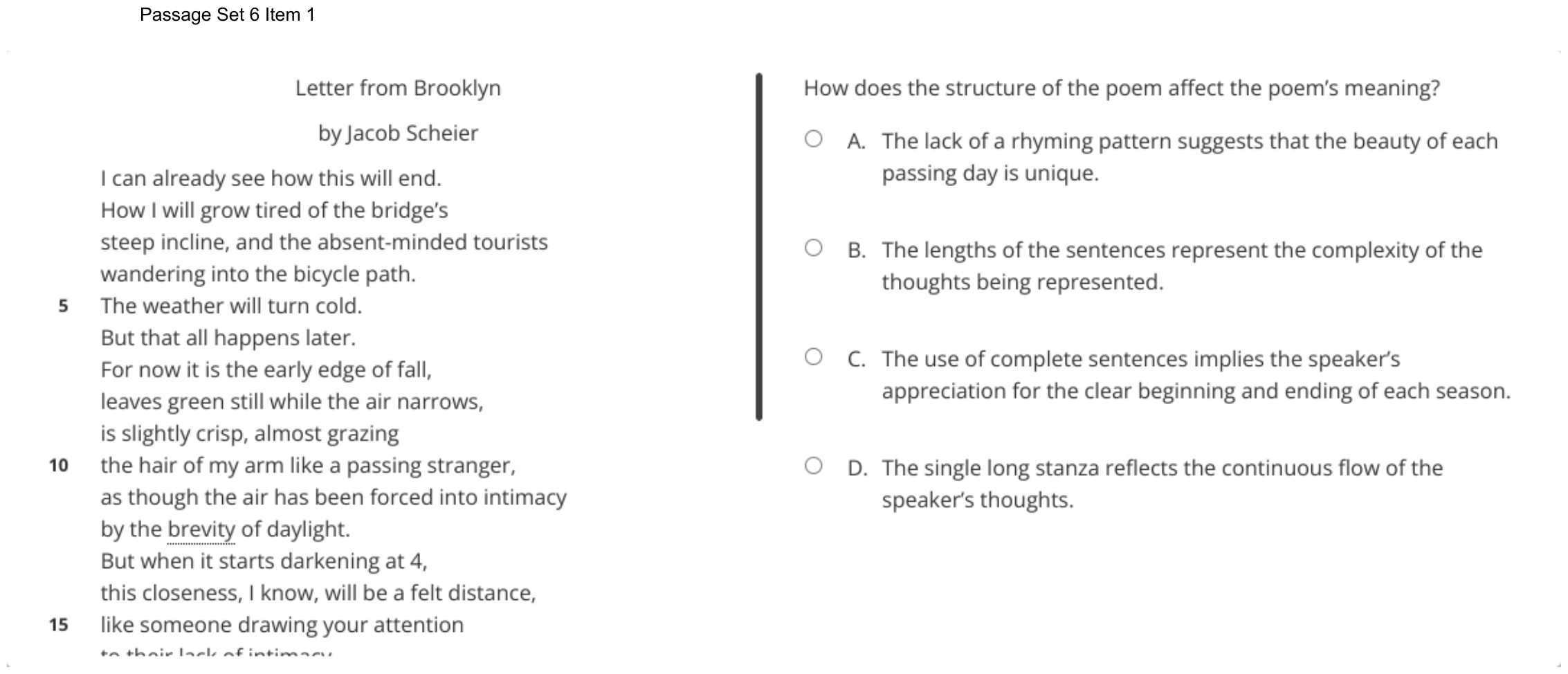
The passage “Letter from Brooklyn” as printed (page 50)
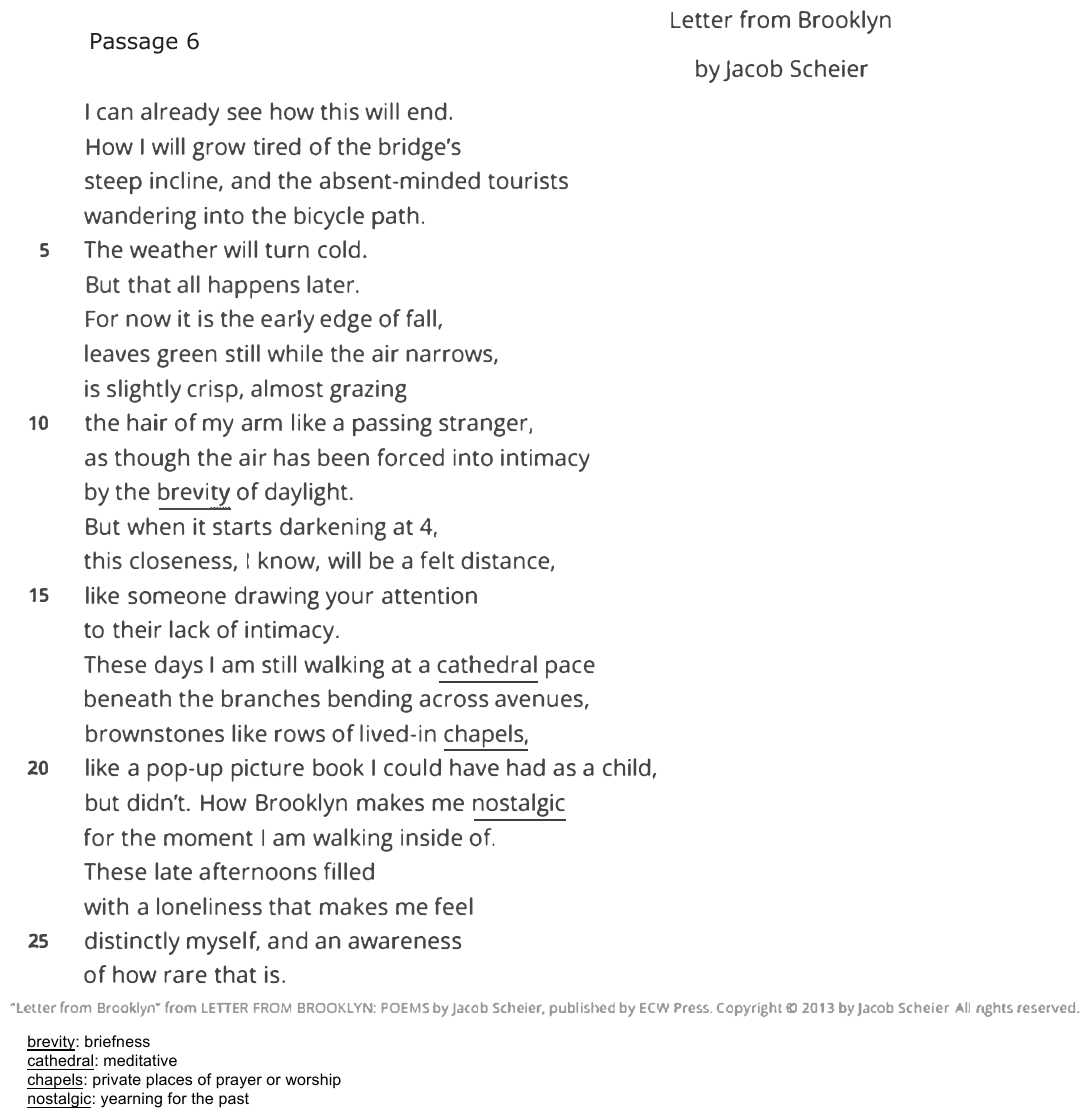
Question 56 of 120
2026 Practice Test B English, question 37Uses the passage above: “Letter from Brooklyn”.
Question
Which lines support the idea that a change in the weather will lessen the speaker’s appreciation for the city?
- A“as though the air has been forced into intimacy / by the brevity of daylight.” (lines 11–12)
- B“But when it starts darkening at 4, / this closeness, I know, will be a felt distance,” (lines 13–14)
- C“like someone drawing your attention / to their lack of intimacy.” (lines 15–16)
- D“These days I am still walking . . . / beneath the branches bending across avenues,” (lines 17–18)
Show the answer
Correct answer: B
The question asks which lines from the poem support the idea that a change in the weather will lessen the speaker’s appreciation for the city.
A. Incorrect. These lines focus on the positive way the air feels to the speaker during “the early edge of fall” (line 7). They suggest that the speaker appreciates this experience currently, while being aware that the feeling might not last.
B. CORRECT. In these lines, the speaker describes the shift in the “closeness” of the air as the weather changes and “it starts darkening at 4.” The speaker clearly indicates that the positive emotions surrounding this closeness, with “leaves green still” and the air “slightly crisp” (lines 8–9), will soon be “a felt distance,” suggesting that the turn in the weather will make the city less appealing.
C. Incorrect. Although these lines compare the darkening, changing weather to a person revealing a “lack of intimacy,” that specific comparison does not focus on a diminishing appreciation for the city.
D. Incorrect. These lines describe the “cathedral pace” (line 17) at which the speaker walks, emphasizing a meditative or thoughtful experience. Such a description suggests the speaker still appreciates the city, not that the speaker’s appreciation will lessen.
Question analysis
This evidence question asks which lines from “Letter from Brooklyn” support the idea that a change in the weather will lessen the speaker's appreciation for the city. All four choices come from the middle of the poem, where the speaker describes the feel of the early-fall air through figurative comparisons, so students must read each pair of lines closely for both parts of the idea.
- Grade level
- Grade 8 reading and task
- Compared with grade 7
- Above grade 7 Choosing lines that support an idea is standard grade 7 evidence work. Here the idea is carried by figurative comparisons about the air, and the four choices sit within a few lines of one another, so separating them takes closer reading than is typical.
- Estimated difficulty
- Hard: combines ideas, needs a plan, and has more than one tempting wrong answer.
- Thinking it demands
- Depth of knowledge 2, skills and concepts · mainly evaluate
- What makes it hard
- A very close wrong answer moderate
- Figurative or literary language moderate
- Reading between the lines minor
- Evidence
- Answered from one sentence or line
- Reading level
- Passage: 217 words (a poem; reading level not measured); question and choices: about grade 6, 74 words.
- Students, last 30 days
- Not enough answers yet to show (it takes 10).
Why it is hard, traps and wrong answers (shows the answer)
Why it is hard
All four choices come from lines 11–18, and three speak of closeness, distance or intimacy, so the vocabulary of the claim is everywhere. The idea has two parts, a change in the weather and a weaker feeling for the city, and only one pair of lines holds both. The strongest pull is the second half of the same sentence, which puts the loss of intimacy most vividly but leaves the darkening behind in the lines before.
A very close wrong answer moderate Choosing the answer
Lines 13–14 and 15–16 are one sentence split in two: the first half names the darkening at 4 and the coming distance, the second only describes what that distance feels like. (Embretson & Wetzel, 1987; Gorin & Embretson, 2006; Ascalon et al., 2007)
Figurative or literary language moderate Understanding the question
The weaker feeling for the city is never stated; it comes through images, the air’s “closeness” turning into “a felt distance,” like a person pointing out their “lack of intimacy.” (Graesser, Singer & Trabasso, 1994; Kintsch, 1998)
Reading between the lines minor Working it out
Students must accept “when it starts darkening at 4” as the change in the weather the stem names, since the lines speak of daylight, not of cold or rain. (Graesser, Singer & Trabasso, 1994; Kintsch, 1998)
Strategy: Split the idea into its two parts, a change in the weather and a weaker feeling for the city, and choose the lines that hold both on their own, without help from the lines around them.
Traps
- Supports only part of the claim: In a question about evidence: a line that backs one half of the claim but not the other, or a related point rather than the claim itself.
The wrong answers, classified
A Supports only part of the claim (King et al., 2004; Thissen, Steinberg & Fitzpatrick, 1989)
Takes “the brevity of daylight” as the coming change, but these lines say the short days force the air “into intimacy,” a closeness the speaker enjoys now.
C Supports only part of the claim (King et al., 2004; Thissen, Steinberg & Fitzpatrick, 1989)
Chooses the vivid “lack of intimacy,” which does show the feeling weakening, but these lines only finish the simile and never mention the darkening that causes it.
D Supports only part of the claim (King et al., 2004; Thissen, Steinberg & Fitzpatrick, 1989)
Hears a coming change in “still walking,” but the lines show the speaker enjoying a slow walk under the branches now and say nothing of the weather turning.
Working it out, step by step
Figure out what the question asks
This is an evidence question. The idea has two parts. First, the weather will change. Second, the speaker will enjoy the city less. You need the lines that hold both parts by themselves.
Read the lines around the choices
Lines 9–12 describe the early-fall air now. It is “almost grazing / the hair of my arm like a passing stranger.” Grazing here means lightly touching. The speaker says the air feels close, like “intimacy.” Intimacy means a warm, close feeling between people. Lines 13–16 then look ahead to shorter days.
Find both parts in lines 13–14
Lines 13–14 say: “But when it starts darkening at 4, / this closeness, I know, will be a felt distance”. Darkening at 4 means the sun setting at 4 o’clock, as days get shorter. That is the change in the weather. “This closeness” is the warm feeling the speaker has now. It will turn into distance. So the good feeling will fade.
Check each choice
- A is wrong. Lines 11–12 describe the closeness the speaker enjoys now. Nothing has faded yet.
- B is right. It names the change, the early dark, and the loss, closeness turning into “a felt distance.”
- C is wrong. Lines 15–16 finish the comparison: the distance feels like a person pointing out their “lack of intimacy.” But these lines never mention the weather.
- D is wrong. Lines 17–18 show the speaker enjoying a slow walk now. They say nothing about the weather turning.
Watch out: C is tempting because “lack of intimacy” sounds like a lost feeling. But the change in weather is back in lines 13–14.
Choose the answer
Only one pair of lines holds both the change and the fading feeling. So the answer is B, lines 13–14, which begin “But when it starts darkening at 4”.
Why this answer and not the closest wrong one
C is the closest wrong answer, because it shows the good feeling slipping away. But lines 15–16 only describe what that distance feels like. They don’t say what causes it. Lines 13–14 give both parts: the early dark and the fading closeness.
More questions like this
The original DOE question
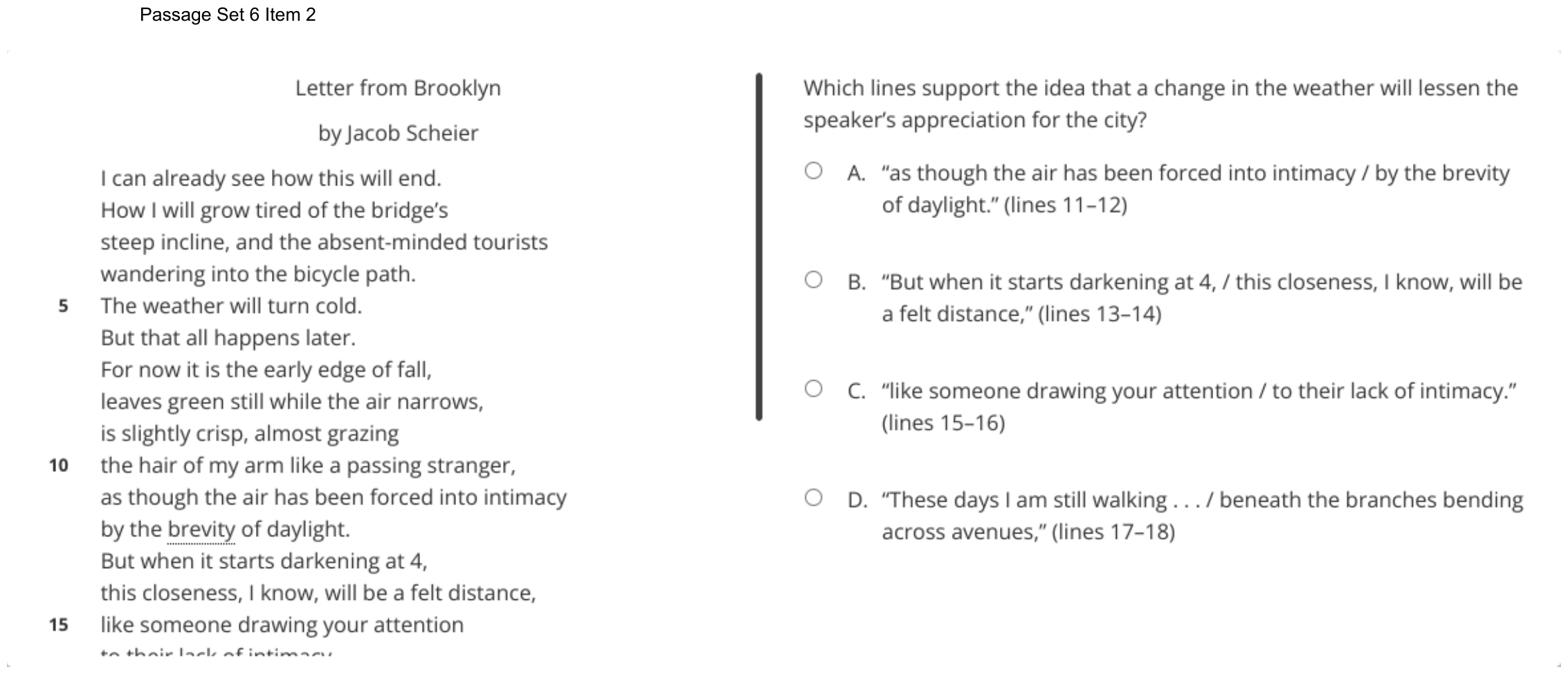
Question 57 of 120
2026 Practice Test B English, question 38Uses the passage above: “Letter from Brooklyn”.
Question
Read lines 5–6 from the poem.
The weather will turn cold.
But that all happens later.
How do the lines develop a central theme of the poem?
- AThey highlight a contrast between the different seasons.
- BThey show the sequence of the changes that are expected to occur.
- CThey warn about a problem that requires thoughtful preparation.
- DThey emphasize the importance of valuing the present.
Show the answer
Correct answer: D
The question asks how lines 5–6 develop a central theme of the poem.
A. Incorrect. In this poem, the speaker describes the impressions of one day in one season: “For now it is the early edge of fall, / leaves green still while the air narrows, / is slightly crisp” (lines 7–9). Despite the reference in line 5 to the eventual arrival of cold weather, lines 5–6 primarily emphasize the speaker’s wish to stay focused on the present moment. A contrast between seasons is not a central theme of the poem.
B. Incorrect. The words “The weather will turn cold” in line 5 refer to one change that is expected to occur, but lines 5–6 do not show a sequence of changes. The line that follows returns to the present: “For now . . .” (line 7).
C. Incorrect. Although the statement that the weather “will turn cold” in line 5 could be construed as a warning, there is no support in lines 5–6 for the idea that some problems require thoughtful preparation. The speaker is reflecting on a fleeting experience, not preparing to solve a problem.
D. CORRECT. Immediately after the line “The weather will turn cold” (line 5), the speaker returns to the current moment: “But that all happens later” (line 6). These lines help develop a central theme by emphasizing the speaker’s choice to value and focus on the present moment. The “But” at the start of line 6 shows the speaker pulling back from the future and refocusing on the present, thus emphasizing the importance of savoring “the moment I am walking inside of” (line 22).
Question analysis
This theme question quotes two short lines from early in “Letter from Brooklyn,” where the speaker says the weather will turn cold, and asks how they develop a central theme of the poem. Students must work out what the pair of lines does at that point and connect it to the whole poem, since each choice describes something two lines about the future could plausibly do.
- Grade level
- Grade 7 reading and task
- Compared with grade 7
- At grade 7 Explaining how particular lines develop a poem's theme is core grade 7 work. These two lines are short and plainly worded, so the demand lies in relating them to the theme of the whole poem, which is typical.
- Estimated difficulty
- Moderate: several steps, or a close reading with one strong distractor.
- Thinking it demands
- Depth of knowledge 2, skills and concepts · mainly analyze
- What makes it hard
- Reading between the lines moderate
- How, not what moderate
- Evidence
- Answered from one paragraph or stanza
- Reading level
- Passage: 217 words (a poem; reading level not measured); question and choices: about grade 5, 63 words.
- Students, last 30 days
- Not enough answers yet to show (it takes 10).
Why it is hard, traps and wrong answers (shows the answer)
Why it is hard
Two short, plain lines carry a theme only when read with their neighbors: the speaker forecasts cold, then dismisses it with “But that all happens later” and returns to “For now.” Students who read line 5 alone take the pair as a forecast and look for contrast, sequence or warning. The tempting contrast choice has some truth, since “But” does mark a turn, yet the turn is from future to present, not from one season to another.
Reading between the lines moderate Working it out
Line 6 never says the present matters; students infer it from “But” pulling back from the forecast and from “For now” in line 7 turning to the early fall around the speaker. (Graesser, Singer & Trabasso, 1994; Kintsch, 1998)
How, not what moderate Working it out
The stem asks how two lines develop a theme, so students must see their job, setting the future aside, rather than their content, a prediction of cold weather. (Anderson & Krathwohl, 2001)
Strategy: Read the lines just before and after lines 5–6, decide what the speaker does with the thought of cold weather, and connect that to what the poem as a whole keeps returning to.
Traps
- Wrong purpose or structure: Names a purpose, structure or effect that the part does not serve, or describes what a part says when the question asks what it does.
- Wrong part of the text: A choice is true of another paragraph, stanza or speaker than the one asked about.
- Reads too much in: A reasonable-sounding conclusion that goes further than the text allows.
The wrong answers, classified
A Wrong purpose or structure (Anderson & Krathwohl, 2001)
Sees cold weather set against early fall and hears contrast in “But,” yet the turn in line 6 is from later to now, and the poem never weighs one season against another.
B Wrong part of the text (Kirsch & Mosenthal, 1990)
Takes the opening forecast, tiring of the bridge and the tourists and then the cold, as a sequence, though lines 5–6 name one change and then set it aside.
C Reads too much in (Graesser, Singer & Trabasso, 1994)
Treats the coming cold as a problem to plan for, though the speaker makes no preparations and simply dismisses the future with “But that all happens later.”
Working it out, step by step
Figure out what the question asks
This question asks how lines 5–6 help build a theme. A theme is a big message about life that a poem keeps coming back to. So ask what these two lines do in the poem. Then link that to the whole poem.
Read the lines in place
Lines 1–5 look ahead. The speaker will grow tired of the bridge and the tourists, and “The weather will turn cold.” Then line 6 says, “But that all happens later.” Line 7 begins “For now it is the early edge of fall.” So the speaker thinks of the future, then pushes it aside.
Put it in your own words
“But” marks a turn. The speaker turns from later back to now. It is like saying, Sure, winter is coming, but it isn’t here yet. Then the poem spends many lines enjoying the fall walk. Line 22 speaks of “the moment I am walking inside of.” So lines 5–6 help show a big idea: enjoy the present while you have it.
Check each choice
- A is wrong. The turn is from later to now, not from one season to another. The poem doesn’t compare seasons.
- B is wrong. Lines 5–6 name one change, cold weather, and then set it aside. That is not a sequence, or series of steps.
- C is wrong. The speaker doesn’t get ready for the cold. The speaker simply says it “happens later.”
- D is right. The lines push the future aside so the speaker can enjoy the present.
Watch out: A is tempting because “But” signals a contrast. Ask what is being contrasted. It is later and now, not two seasons.
Choose the answer
Valuing means treating something as precious. So the answer is D: “They emphasize the importance of valuing the present.”
Why this answer and not the closest wrong one
A is the closest wrong answer, because line 6 does turn with “But.” Yet the turn moves from the future back to “For now.” The poem never weighs one season against another. It keeps coming back to the present moment, which is what D says.
More questions like this
The original DOE question
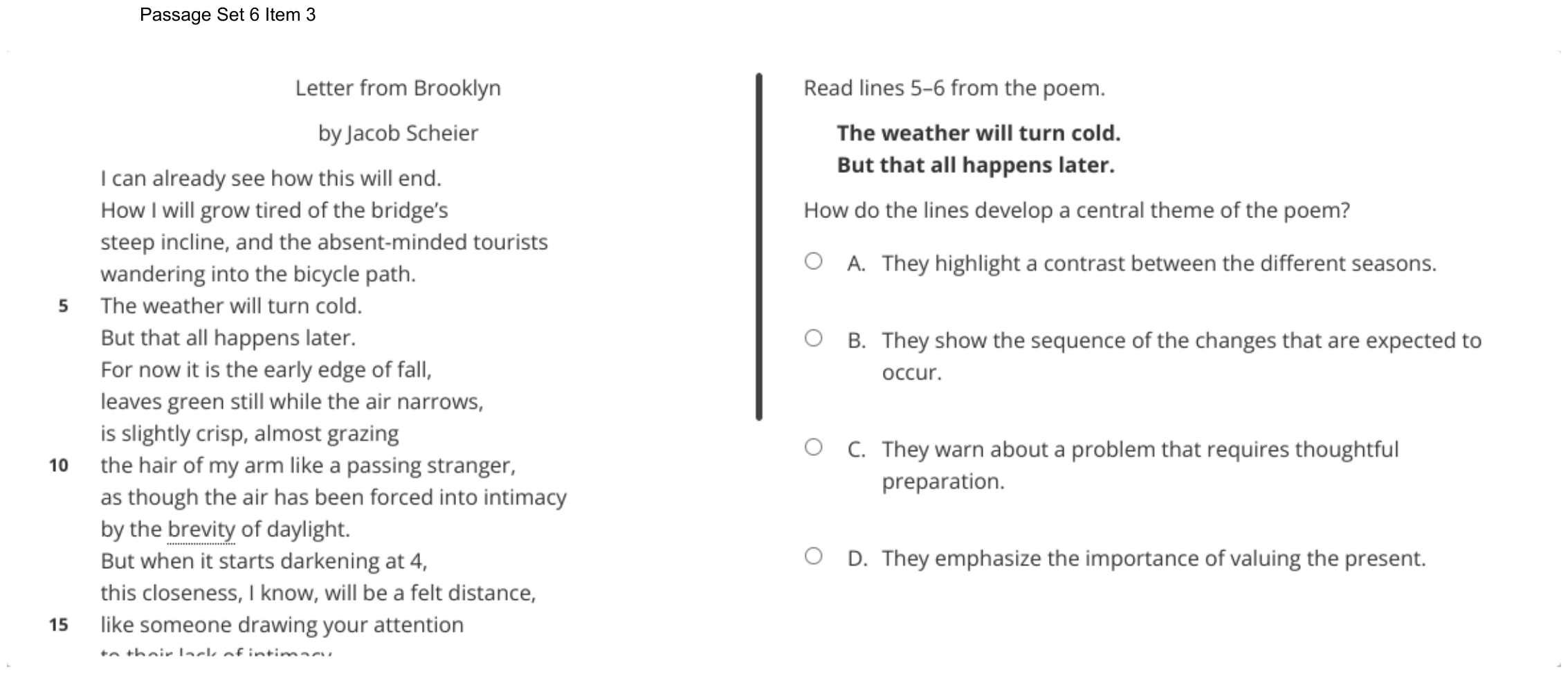
Question 58 of 120
2026 Practice Test B English, question 39Uses the passage above: “Letter from Brooklyn”.
Question
Read lines 7–9 from the poem.
For now it is the early edge of fall,
leaves green still while the air narrows,
is slightly crisp,
The word choice in the lines helps convey the speaker’s belief that
- Athe beauty of the current season should still be appreciated.
- Bthe changes in the weather signify the end of the most pleasant season.
- Cthe transition from one season to another happens swiftly and without warning.
- Dthe change in the weather is so subtle that people rarely observe or feel it.
Show the answer
Correct answer: A
The question asks what belief of the speaker is conveyed by the word choice in lines 7–9 of the poem.
A. CORRECT. Words and phrases in these lines, such as “leaves green still” and “slightly crisp,” have a positive connotation, indicating that the speaker believes in appreciating this season while it still lasts.
B. Incorrect. Although imagery such as “leaves green still” and “slightly crisp” in these lines suggests that the speaker enjoys the season, the speaker never indicates that the present season is the most pleasant of all seasons.
C. Incorrect. The phrases “the early edge of fall” and “the air narrows” in these lines imply that the season is just beginning to change, but there is no indication from these phrases that the changes will be swift and without warning. In fact, the narrowing of the air could be a warning of a greater, more gradual change in weather.
D. Incorrect. The speaker experiences the change in weather as subtle: “the air narrows, / is slightly crisp.” However, the speaker does not refer to the viewpoints of others. The entire viewpoint in the poem is personal and introspective, as represented by the use of the pronoun “I” throughout.
Question analysis
This word-choice question quotes three lines from “Letter from Brooklyn” describing the early edge of fall, when the leaves are still green and the air is slightly crisp. Students must work out what the connotations of these words reveal about the speaker's belief, and several choices mix an accurate reading of the lines with a claim they do not support.
- Grade level
- Grade 7 reading and task
- Compared with grade 7
- At grade 7 Explaining how word choice conveys a speaker's feelings is everyday grade 7 work. These three lines are short and concrete, but their meaning rests on the connotations of a few small words, which matches a typical grade 7 task.
- Estimated difficulty
- Moderate: several steps, or a close reading with one strong distractor.
- Thinking it demands
- Depth of knowledge 2, skills and concepts · mainly understand
- What makes it hard
- Figurative or literary language moderate
- Reading between the lines minor
- Evidence
- Answered from one sentence or line
- Reading level
- Passage: 217 words (a poem; reading level not measured); question and choices: about grade 5, 86 words.
- Students, last 30 days
- Not enough answers yet to show (it takes 10).
Why it is hard, traps and wrong answers (shows the answer)
Why it is hard
The three lines are short, and every choice builds on something real in them: a change in the weather, a season ending, subtlety. What separates the answer is the time words, “For now,” “early edge” and “still,” which say that something good is present and passing. Students lose the point by stretching a reasonable sense of loss into a claim about the best season, or by turning the speaker’s private notice into what other people miss.
Figurative or literary language moderate Understanding the question
The belief lies in connotation: “early edge of fall” and “leaves green still” mark a season only starting to turn, and “the air narrows” describes the change through an image. (Graesser, Singer & Trabasso, 1994; Kintsch, 1998)
Reading between the lines minor Working it out
“For now” at the start of line 7 signals that the moment will pass, and students must infer that the speaker values it for that reason, since no line states the belief. (Graesser, Singer & Trabasso, 1994; Kintsch, 1998)
Strategy: Mark the words in lines 7–9 that describe time and the feel of the air, decide whether each sounds positive, negative or neutral, then choose the belief that fits those connotations and nothing more.
Traps
- Half right: One half of a two-part choice is right and the other is not.
- Reads too much in: A reasonable-sounding conclusion that goes further than the text allows.
- Twists what the text says: Uses the text's topic and ideas but changes what it says: who did it, how much, when, or why.
The wrong answers, classified
B Reads too much in (Graesser, Singer & Trabasso, 1994)
Senses loss in a turning season, which the poem does suggest, but claims the speaker sees this as ending “the most pleasant season,” a ranking the lines never make.
C Twists what the text says (King et al., 2004)
Reads “the air narrows” as a sudden shift, though “early edge” and “slightly crisp” describe a season only beginning to turn, gradually and with clear signs.
D Half right (King et al., 2004; Thissen, Steinberg & Fitzpatrick, 1989)
Rightly hears the change as subtle in “slightly crisp,” but adds that people rarely notice it, though the lines record the speaker feeling it on the hair of an arm.
Working it out, step by step
Figure out what the question asks
This question is about word choice. The exact words a poet picks can show feelings. You need the belief that lines 7–9 show. So look at what each word suggests, not only what it means.
Mark the time words
The lines say “For now it is the early edge of fall, / leaves green still while the air narrows, / is slightly crisp.” Notice the time words. “For now” means this won’t last. “Early edge” means fall has just begun. “Still” means the leaves have not changed color yet.
Hear what the words suggest
“Slightly crisp” means a little cool and fresh. It sounds pleasant, not harsh. When the air “narrows,” it seems to tighten and grow cooler. So the speaker enjoys this moment. The time words show the speaker knows it will pass. Put together, they say: this lovely early fall is still here, so enjoy it now.
Check each choice
- A is right. “Still” and “For now” show the season is still here to enjoy.
- B is wrong. The speaker never calls this the most pleasant season. Nothing ranks the seasons.
- C is wrong. “Early edge” and “slightly” describe a slow, gentle change, not a sudden one.
- D is wrong. The change is subtle, or hard to notice. But the speaker feels it on “the hair of my arm.” The lines say nothing about other people.
Watch out: D starts out right, because the change is gentle. But it adds a claim about other people that the lines never make.
Choose the answer
The words show a pleasant season that is still here, for now. So the answer is A: “the beauty of the current season should still be appreciated.”
Why this answer and not the closest wrong one
B is the closest wrong answer, because the poem does hint that something good is ending. But the lines never call fall the best season. They say only that this pleasant time is here “for now.” That fits A: enjoy the season while it lasts.
More questions like this
The original DOE question
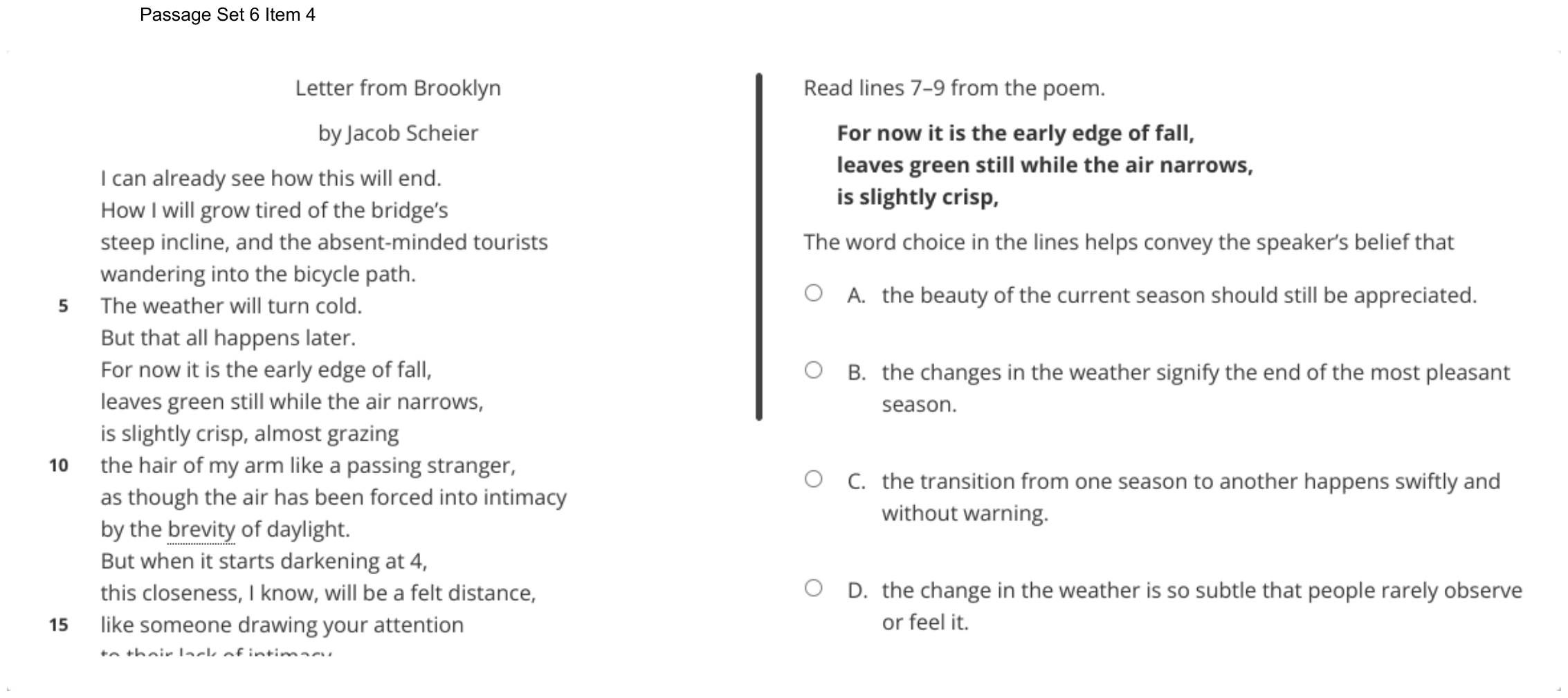
Question 59 of 120
2026 Practice Test B English, question 40Uses the passage above: “Letter from Brooklyn”.
Question
Which idea does the comparison of the brownstone houses to “a pop-up picture book I could have had as a child, / but didn’t” in lines 20–21 convey?
- AIt reveals that some people are still influenced by powerful images from childhood.
- BIt indicates that the neighborhood the speaker is walking through is charming and appealing.
- CIt suggests that the speaker has wanted to live in the neighborhood since childhood.
- DIt suggests that people often experience lingering regret from their past.
Show the answer
Correct answer: B
The question asks what the comparison of the brownstone houses to “a pop-up picture book I could have had as a child, / but didn’t” (lines 20–21) conveys.
A. Incorrect. While the lines explain that the neighborhood reminds the speaker of images from childhood pop-up books, those images are not described as very powerful or influential.
B. CORRECT. Pop-up picture books are likely to delight a child with their unique, often beautiful representations of buildings that pop up out of the page. The comparison in these lines helps explain how the speaker views these brownstones with a childlike wonder and appreciation.
C. Incorrect. Though in these lines the speaker compares this neighborhood to scenes in children’s pop-up picture books, there is no clear evidence that the speaker wants to live there, only that the speaker appreciates its appeal.
D. Incorrect. The lines state that the speaker did not have a “pop-up picture book” of the neighborhood’s brownstones as a child, but not in a way that emphasizes regret. Rather, the speaker compares the neighborhood to images from pop-up books in general to suggest that the neighborhood looks beautiful and delightful.
Question analysis
This figurative-language question asks what idea the poem conveys by comparing Brooklyn's brownstone houses to “a pop-up picture book I could have had as a child, / but didn't.” Students must interpret a simile in context, deciding how the closing words “but didn't” fit with the rest of the comparison and with the speaker's mood during the walk.
- Grade level
- Grade 7 reading and task
- Compared with grade 7
- At grade 7 Interpreting a simile in a poem is routine grade 7 work. This comparison uses a familiar childhood object, and the only complication is the added “but didn't,” which invites a reading that the rest of the lines must confirm or rule out.
- Estimated difficulty
- Straightforward: two steps or one careful reading.
- Thinking it demands
- Depth of knowledge 2, skills and concepts · mainly understand
- What makes it hard
- Figurative or literary language moderate
- Reading between the lines minor
- Evidence
- Answered from one sentence or line
- Reading level
- Passage: 217 words (a poem; reading level not measured); question and choices: about grade 8, 78 words.
- Students, last 30 days
- Not enough answers yet to show (it takes 10).
Why it is hard, traps and wrong answers (shows the answer)
Why it is hard
The core of the simile is easy: a row of brownstones looks like a pop-up picture book, something charming. The difficulty is the closing “but didn’t,” which tempts students toward regret or toward a story about the speaker’s childhood. Students who ask what the comparison says about the houses, rather than about the speaker’s past, see that the lines praise the neighborhood.
Figurative or literary language moderate Understanding the question
The simile likens brownstones to a pop-up picture book, and its point, that the street looks as delightful as a child’s book, has to be drawn from what such books are like. (Graesser, Singer & Trabasso, 1994; Kintsch, 1998)
Reading between the lines minor Working it out
The tag “but didn’t” invites a reading of regret, so students must decide from the walk at a “cathedral pace” around it that the comparison is about delight, not loss. (Graesser, Singer & Trabasso, 1994; Kintsch, 1998)
Strategy: Work out what the brownstones and a pop-up picture book have in common, decide what part “but didn't” plays in the comparison, and test each choice against what the lines actually say.
Traps
- Wrong tone or attitude: Misjudges the tone, attitude or point of view, such as reading admiration as criticism, or taking a character's or subject's feelings for the author's.
- Taking figurative language literally: A choice reads a figure of speech or image at face value.
- Too broad or too strong: A choice overstates, generalizes, or uses absolute words the text does not support.
The wrong answers, classified
A Too broad or too strong (King et al., 2004)
Generalizes from one speaker’s comparison to what “some people” feel and calls the images “powerful,” though the lines describe how the brownstones look, not lasting childhood influences.
C Taking figurative language literally (Graesser, Singer & Trabasso, 1994)
Reads “could have had as a child” as a fact about the speaker’s childhood wishes, though the simile only compares the houses to pages in a book.
D Wrong tone or attitude (Graesser, Singer & Trabasso, 1994)
Hears regret in “but didn’t” and widens it to people in general, though the speaker mentions the missing book only in passing while enjoying the walk.
Working it out, step by step
Figure out what the question asks
This question asks about a simile. A simile compares two things using like or as. Here the speaker compares brownstones to a pop-up picture book. Brownstones are old row houses built of reddish-brown stone. You need the idea this comparison gives.
Read the comparison
Lines 19–21 say “brownstones like rows of lived-in chapels, / like a pop-up picture book I could have had as a child, / but didn’t.” A pop-up book has pictures that stand up off the page when you open it. These books often show houses and streets. Children love them.
Put it in your own words
So the street looks charming and magical, like a page in a child’s favorite book. The words “but didn’t” just mean the speaker never owned such a book. Around these lines the speaker walks at a “cathedral pace.” The glossary says cathedral means “meditative,” or calm and thoughtful. The mood is peaceful and happy, not sad.
Check each choice
- A is wrong. The lines describe how the houses look. They don’t claim childhood pictures stay powerful for people.
- B is right. Comparing the houses to a pop-up book shows they look charming, or delightful.
- C is wrong. The speaker never says they wanted to live there as a child.
- D is wrong. “But didn’t” is said in passing. The speaker is enjoying the walk, not full of regret, or sorrow over the past.
Watch out: “But didn’t” can sound sad, so D is tempting. Ask what the comparison says about the houses, not about the speaker’s past.
Choose the answer
The comparison praises how the houses look. So the answer is B: “It indicates that the neighborhood the speaker is walking through is charming and appealing.”
Why this answer and not the closest wrong one
D is the closest wrong answer, because “but didn’t” hints at something missed. But the speaker is enjoying a slow walk under the branches. The simile’s job is to show how lovely the brownstones look. That points to B, not to regret.
More questions like this
The original DOE question
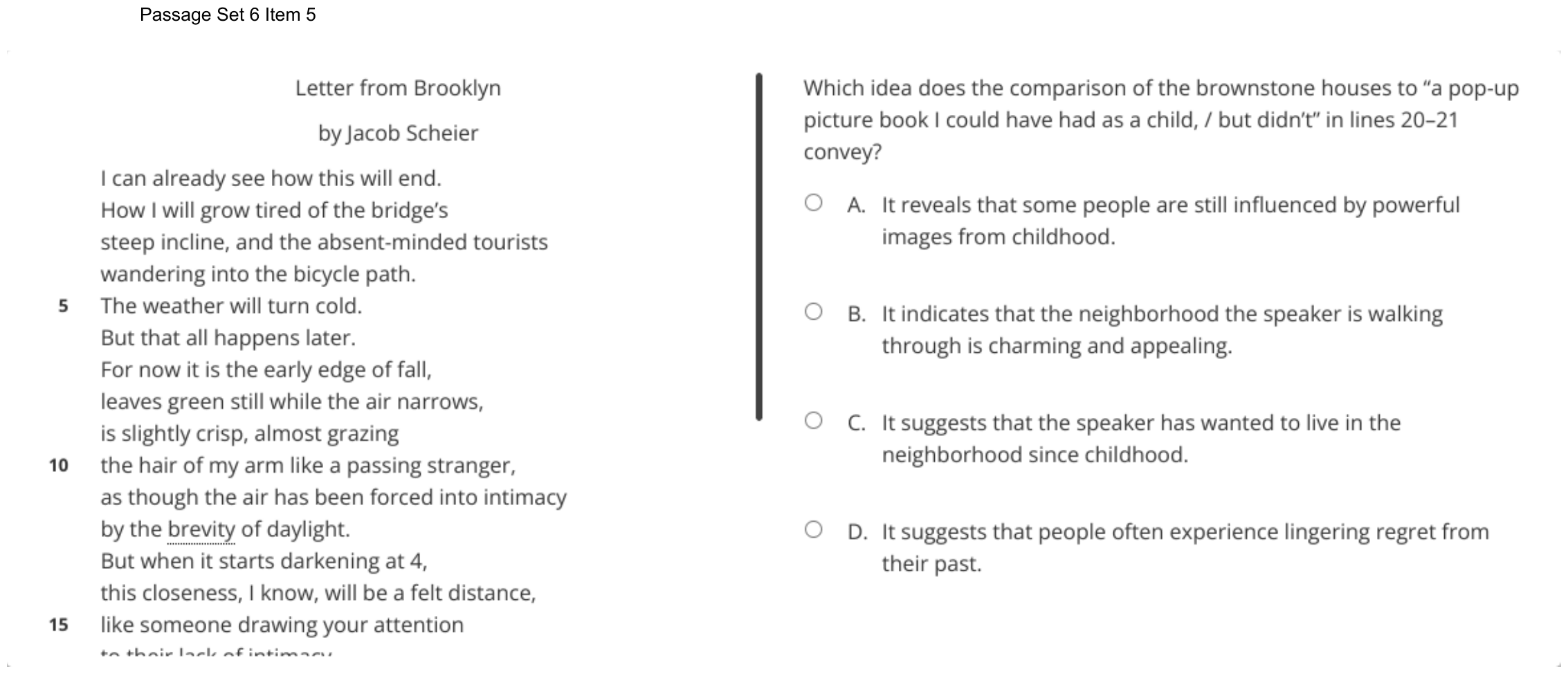
Question 60 of 120
2026 Practice Test B English, question 41Uses the passage above: “Letter from Brooklyn”.
Question
Read these lines from the poem.
I can already see how this will end. (line 1)
How Brooklyn makes me nostalgic
for the moment I am walking inside of. (lines 21–22)
The lines develop a central idea of the poem by
- Asuggesting the speaker’s desire to find a way to break free from the repetitive pattern of daily life.
- Brevealing the speaker’s feelings of disappointment over the predictable change in season.
- Cemphasizing the speaker’s awareness of the future significance of the present moment in the setting.
- Dshowing the speaker’s anticipation of specific emotions caused by an intimate knowledge of the setting.
Show the answer
Correct answer: C
The question asks how line 1 and lines 21–22 develop a central idea of the poem.
A. Incorrect. Although these lines suggest that life is governed by repetitive patterns, such as the change of seasons, they do not suggest that the speaker wishes to break free from these natural cycles of change, and a desire for freedom is not a central idea of the poem.
B. Incorrect. Although the speaker acknowledges that colder weather will inevitably bring disappointment, the speaker does not suggest in these lines that the predictability of changing weather is itself disappointing. Rather, the speaker recognizes the value of enjoying the present moment.
C. CORRECT. These lines connect the present warmer weather with the future colder weather and develop the central idea that the present “moment I am walking inside of” must be embraced because the speaker will be “nostalgic” for it in the future.
D. Incorrect. In these lines, the speaker is aware that specific emotions will occur in the future, during cold weather, but this awareness is only part of the more complex central idea of the poem, which is that current emotions and feelings must be recognized, experienced, and appreciated.
Question analysis
This central-idea question pairs the first line of “Letter from Brooklyn” with lines 21–22, where Brooklyn makes the speaker nostalgic “for the moment I am walking inside of,” and asks how they develop a central idea of the poem. Students must link excerpts from opposite ends of the poem, untangle a paradoxical image and choose among four abstract statements.
- Grade level
- Grade 8 reading and task
- Compared with grade 7
- Above grade 7 Grade 7 students analyze how lines develop a central idea. Here two excerpts twenty lines apart must be read together, one of them built on a paradox, and the four choices are long and abstract, well beyond typical grade 7 work.
- Estimated difficulty
- Among the hardest on the SHSAT: a non-obvious approach, heavy reading, or a well-hidden trap.
- Thinking it demands
- Depth of knowledge 3, strategic thinking · mainly analyze
- What makes it hard
- Figurative or literary language major
- A very close wrong answer moderate
- Evidence in several places moderate
- Evidence
- Answered from several paragraphs or stanzas
- Reading level
- Passage: 217 words (a poem; reading level not measured); question and choices: about grade 7, 99 words.
- Students, last 30 days
- Not enough answers yet to show (it takes 10).
Why it is hard, traps and wrong answers (shows the answer)
Why it is hard
This is among the hardest questions in the set because the two excerpts must be joined through a paradox and then matched to four long, abstract statements. Line 1 foresees an ending; lines 21–22 miss a moment while it is still happening, so both look at now from the future. Students who see only the foresight pick the choice about anticipated emotions, while those who hear gloom in “how this will end” settle on disappointment or a wish to escape.
Figurative or literary language major Understanding the question
Lines 21–22 are a paradox: “nostalgic,” glossed as yearning for the past, is aimed at “the moment I am walking inside of,” so the speaker already feels the present as a future memory. (Graesser, Singer & Trabasso, 1994; Kintsch, 1998)
A very close wrong answer moderate Choosing the answer
The choice about anticipating “specific emotions” shares the key’s link between future and present; it differs by tracing those feelings to knowing the setting well, which neither excerpt says. (Embretson & Wetzel, 1987; Gorin & Embretson, 2006; Ascalon et al., 2007)
Evidence in several places moderate Working it out
The excerpts are the poem’s first line and lines 21–22, twenty lines apart, and what joins them, the speaker looking ahead at the present, shows only when they are read side by side. (Kirsch & Mosenthal, 1990; Gorin & Embretson, 2006)
Strategy: Paraphrase each excerpt on its own, using the glossary's meaning of “nostalgic,” then decide what the first line and the last two share and match that to a choice.
Traps
- Half right: One half of a two-part choice is right and the other is not.
- Wrong tone or attitude: Misjudges the tone, attitude or point of view, such as reading admiration as criticism, or taking a character's or subject's feelings for the author's.
- Reads too much in: A reasonable-sounding conclusion that goes further than the text allows.
The wrong answers, classified
A Reads too much in (Graesser, Singer & Trabasso, 1994)
Links “how this will end” and growing tired of the bridge to a dull routine and imagines a wish to escape it, which the poem never expresses.
B Wrong tone or attitude (Graesser, Singer & Trabasso, 1994)
Hears resignation in “I can already see how this will end” and reads it as disappointment with the seasons, missing that the speaker treasures the present walk.
D Half right (King et al., 2004; Thissen, Steinberg & Fitzpatrick, 1989)
Rightly sees the speaker foreseeing feelings in line 1, but traces them to an “intimate knowledge of the setting,” while lines 21–22 long for the present moment itself.
Working it out, step by step
Figure out what the question asks
This question gives two pieces of the poem: line 1 and lines 21–22. You need the central idea they build together. A central idea is the main point the poem keeps working toward. Read each piece alone first, then join them.
Read line 1
Line 1 says “I can already see how this will end.” The speaker looks ahead. Lines 2–5 then list what will come: growing tired of the bridge, and the cold. So the speaker already pictures the future while living in the present.
Read lines 21–22
The lines say “How Brooklyn makes me nostalgic / for the moment I am walking inside of.” The glossary says nostalgic means “yearning for the past.” Yearning means longing. But the speaker longs for now, a moment still happening. That is a paradox, an idea that seems impossible but makes sense. The speaker knows this walk will be a precious memory.
Join the two pieces
Both pieces look at the present from the future. In line 1, the speaker sees the end coming. In lines 21–22, the speaker already misses the walk. So the speaker knows this present moment will matter later. Significance means importance.
Check each choice
- A is wrong. The speaker never wants to break free from daily routine.
- B is wrong. Line 1 can sound gloomy. But the speaker isn’t upset with the seasons. The speaker treasures the walk.
- C is right. The speaker sees that this moment in Brooklyn will be precious later.
- D is wrong. The speaker does foresee feelings. But neither piece says they come from knowing the place well.
Watch out: D gets the looking-ahead part of line 1 right. But lines 21–22 long for the moment itself, not for feelings caused by knowing the city.
Choose the answer
So the answer is C: “emphasizing the speaker’s awareness of the future significance of the present moment in the setting.”
Why this answer and not the closest wrong one
D is the closest wrong answer, because line 1 does show the speaker foreseeing feelings. But D says they come from an “intimate knowledge of the setting.” Neither piece says that. Lines 21–22 miss the moment while it is still happening. C captures that: the present will matter in the future.
More questions like this
The original DOE question
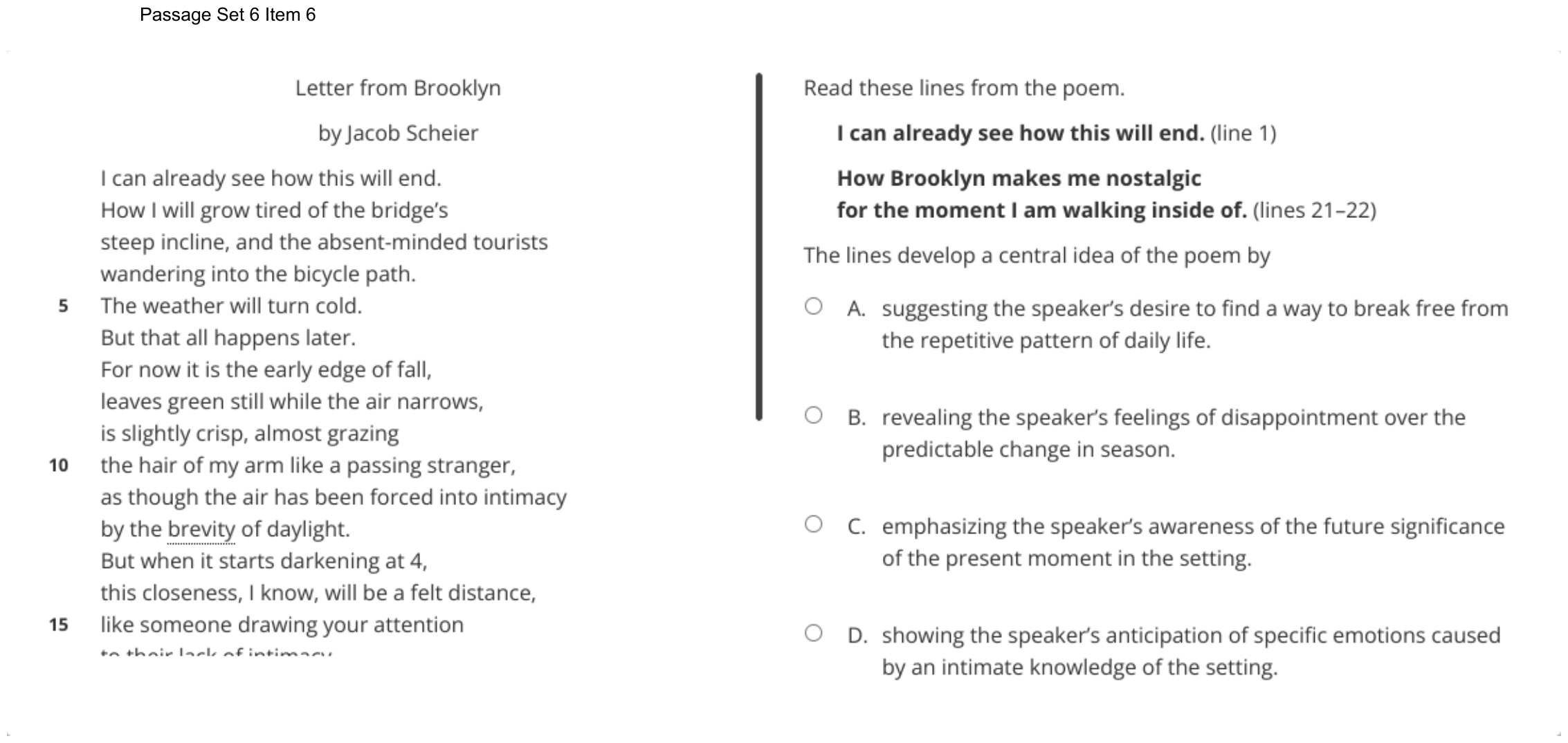
Question 61 of 120
2026 Practice Test B English, question 42Uses the passage above: “Letter from Brooklyn”.
Question
The speaker’s thoughts throughout the poem develop a theme by showing that
- Aalthough people may hold expectations for the future, some people long for present experiences while they are still happening.
- Bthough people come from different places, most people feel drawn to the special charm a city holds.
- Calthough people can make decisions about their life, there will always be some things beyond their control.
- Dthough general expectations exist, people have no way of knowing what a given day will actually bring.
Show the answer
Correct answer: A
The question asks how the speaker’s thoughts throughout the poem develop a theme.
A. CORRECT. The speaker’s thoughts develop some tension because seasonal change will inevitably come: “The weather will turn cold” (line 5). However, the speaker is still able to enjoy the present experience because “that all happens later” (line 6). In lines 21–22, the speaker begins to describe experiences that create a longing for the present, even while it is still happening (“How Brooklyn makes me nostalgic / for the moment I am walking inside of”), developing a theme of the poem.
B. Incorrect. The speaker’s thoughts reveal an appreciation for the city, but this appreciation is highly personal and individual. These thoughts do not indicate that most people will feel drawn to cities.
C. Incorrect. Some things, such as seasons, are beyond human control, as the speaker concedes: “I can already see how this will end” (line 1). However, the theme of the poem is not that certain things are inevitable, but that one can live in the present moment and enjoy that experience before change occurs.
D. Incorrect. The speaker’s thoughts are not showing that people are surprised by what the days bring; the thoughts of the speaker suggest that people experience many seasons in Brooklyn and have reasonable expectations about what these days will bring.
Question analysis
This theme question asks what theme the speaker's thoughts develop across all of “Letter from Brooklyn,” from the opening line about how things will end to the closing lines about loneliness on late afternoons. Each choice is a broad statement about people in two parts, so students must check both halves against the speaker's reflections.
- NYS standards
- 7R2 theme or central idea
- Grade level
- Grade 8 reading and task
- Compared with grade 7
- Above grade 7 Stating a theme is a grade 7 standard, often tested with one clearly fitting choice. Here every choice is a two-part general statement about people, and students must test both halves of each against a whole poem of abstract reflection, more than typical.
- Estimated difficulty
- Hard: combines ideas, needs a plan, and has more than one tempting wrong answer.
- Thinking it demands
- Depth of knowledge 3, strategic thinking · mainly analyze
- What makes it hard
- Reading between the lines moderate
- Every choice must be checked moderate
- Evidence in several places minor
- Evidence
- Answered from the whole text
- Reading level
- Passage: 217 words (a poem; reading level not measured); question and choices: about grade 9, 82 words.
- Students, last 30 days
- Not enough answers yet to show (it takes 10).
Why it is hard, traps and wrong answers (shows the answer)
Why it is hard
The four themes are broad statements about people, each in two halves, and every one can borrow something from the poem: the seasons are beyond control, the city has charm, the future brings surprises. The right one matches the speaker’s double vision, knowing what is coming and longing for the present while it lasts. The strongest pull is the theme about things beyond control, whose second half fits the turning seasons and whose first half the poem never raises.
Reading between the lines moderate Working it out
The poem never states its theme; it must be built from the speaker’s forecasts in lines 1–6 and the paradox of being “nostalgic / for the moment I am walking inside of.” (Graesser, Singer & Trabasso, 1994; Kintsch, 1998)
Every choice must be checked moderate Choosing the answer
Every choice is a two-part “although” or “though” statement about people, and three have one plausible half, so each half must be checked against the poem on its own. (Embretson & Wetzel, 1987)
Evidence in several places minor Working it out
The theme draws on the whole poem, from the opening “I can already see how this will end” to the lonely late afternoons of lines 23–26. (Kirsch & Mosenthal, 1990; Gorin & Embretson, 2006)
Strategy: Sum up in a sentence what the speaker keeps thinking about from the first line to the last, then test both halves of each choice against the poem and reject any half it does not support.
Traps
- Half right: One half of a two-part choice is right and the other is not.
- Too broad or too strong: A choice overstates, generalizes, or uses absolute words the text does not support.
- Twists what the text says: Uses the text's topic and ideas but changes what it says: who did it, how much, when, or why.
The wrong answers, classified
B Too broad or too strong (King et al., 2004)
Turns one speaker’s love of Brooklyn into a claim that “most people” feel drawn to a city’s charm, though no other person’s view appears in the poem.
C Half right (King et al., 2004; Thissen, Steinberg & Fitzpatrick, 1989)
Accepts the half about things beyond control, since the weather will turn cold regardless, but the poem says nothing about people making decisions about their lives.
D Twists what the text says (King et al., 2004)
Turns the coming season into an unknown, though the speaker opens with “I can already see how this will end” and knows exactly what the weather will bring.
Working it out, step by step
Figure out what the question asks
This question asks for the theme of the whole poem. A theme is a big message about life. Each choice has two halves, joined by although or though. Both halves must fit the poem. If one half doesn’t, the choice is wrong.
Trace the speaker’s thoughts
The poem opens by looking ahead: “I can already see how this will end.” The speaker expects to tire of the bridge, and “The weather will turn cold.” Then the speaker turns to now: “But that all happens later.” Most of the poem enjoys the fall walk. Lines 21–22 sum it up: “How Brooklyn makes me nostalgic / for the moment I am walking inside of.”
Put it in your own words
Nostalgic means longing for the past. Yet the speaker longs for the present, while it is still going on. So the speaker does two things at once. The speaker expects what the future will bring. And the speaker treasures, or deeply values, the present. That is the theme.
Check each choice
- A is right. First half: the speaker expects cold weather and boredom. Second half: the speaker longs for the walk while it is still going on.
- B is wrong. Only one person speaks in the poem. Nothing says most people feel drawn to cities.
- C is wrong. The weather is beyond anyone’s control, so its second half fits. But the poem never talks about people making decisions about their lives.
- D is wrong. The speaker knows what is coming. The future isn’t a mystery here.
Watch out: C is tempting because the speaker can’t stop the cold. But test both halves. Its first half, about making decisions, isn’t in the poem.
Choose the answer
So the answer is A: “although people may hold expectations for the future, some people long for present experiences while they are still happening.”
Why this answer and not the closest wrong one
C is the closest wrong answer, because the seasons are beyond the speaker’s control. But the poem never mentions people making decisions about their lives. A matches both halves: the speaker expects what is coming, and longs for the present while it lasts.
More questions like this
The original DOE question
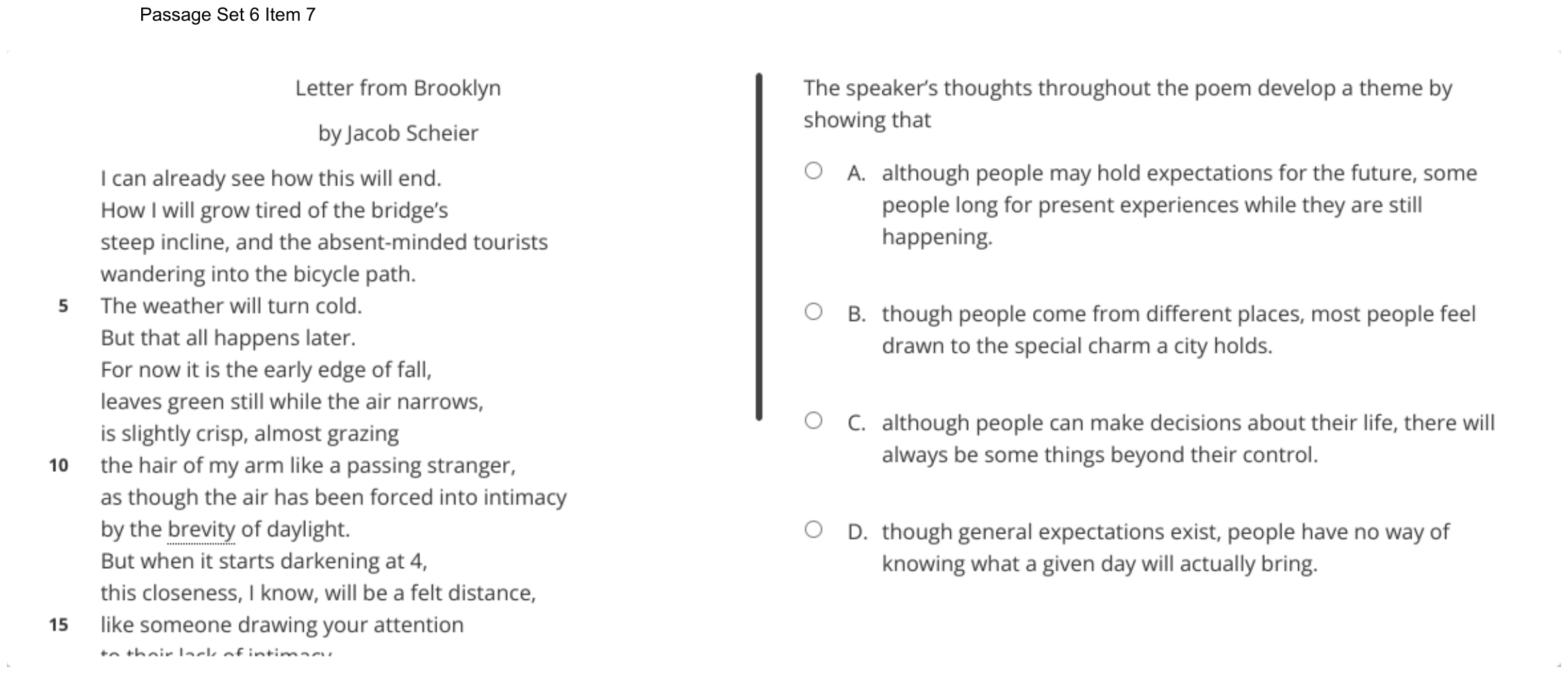
Question 62 of 120
2026 Practice Test B English, question 43Passage The End of an Era
The End of an Era
(1) In 2004, the National Aeronautics and Space Administration (NASA) landed a rover, or robotic vehicle, named Opportunity on the surface of Mars. (2) The rover’s mission was to search for evidence of water and life on the planet. (3) The rover was designed to gather data on Mars for about 90 days, but Opportunity’s assignment did not come to an end until nearly 15 years later in 2019.
(4) During the rover’s mission, a high-resolution camera on the rover’s robotic arm took magnified photographs of the surface of Mars. (5) The photographs revealed small round rocks scattered across the surface of the planet. (6) The scientists nicknamed these rocks “blueberries” based on the rocks’ resemblance to the fruit. (7) These rocks were important because their spherical shape suggested that liquid water may have flowed over them for a substantial amount of time.
(8) Opportunity continued to provide valuable data about craters and other surface features. (9) Throughout the mission, the rover traveled a total of 28.06 miles across Mars’ surface. (10) When Opportunity had traveled nearly the length of a marathon, scientists celebrated the accomplishment by naming the valley that the rover was in Marathon Valley. (11) However, in 2018, a dust storm spread all over the planet, putting the rover’s progress on hold.
(12) Prior to this planet-wide dust storm, minor dust storms had periodically deposited a layer of dust onto the solar panels of the rover. (13) These prevented it from charging its batteries. (14) Scientists then had to rely on the passing winds and dust devils to clean off the solar panels. (15) After the massive 2018 dust storm subsided, scientists expected to be able to reestablish communication with Opportunity. (16) They made repeated attempts but to no avail. (17) In 2019, NASA finally declared Opportunity’s mission complete.
(18) Opportunity was an important asset in scientists’ study of Mars; it returned valuable data about our neighbor planet and survived powerful dust storms. (19) NASA described the mission of Opportunity as “one of the most successful and enduring feats of interplanetary exploration.” (20) Even though this rover’s journey ended, other rovers still roam the surface of Mars.
Question
Which sentence should follow sentence 3 to best introduce the topic of the passage?
- ADespite the challenges of operating on the surface of another planet, the Opportunity rover made many valuable contributions to the field of space research.
- BThe Opportunity rover mission was a success because it informed NASA scientists about how water might have existed on Mars.
- CThroughout the historic mission of the Opportunity rover, NASA scientists had to overcome challenges created by the flaws in the rover’s design.
- DThe Opportunity rover mission surpassed the original timeline of the assignment and allowed scientists to collect additional data about the planet Mars.
Show the answer
Correct answer: A
The question asks for the sentence that should follow sentence 3 to best introduce the topic of the passage.
A. CORRECT. This sentence best introduces the passage’s topic: the Opportunity rover had many accomplishments on its mission, despite numerous challenges. Some of those accomplishments include providing high-resolution photographs (paragraph 2), traveling long distances (paragraph 3), and providing data about craters and other surface features (paragraph 3).
B. Incorrect. Although paragraph 2 discusses how photographs taken by the rover showed rocks that may have been shaped by water, this idea alone is not the topic of the entire passage.
C. Incorrect. While this sentence incorporates ideas about difficulties the scientists encountered because of the Opportunity rover’s design (paragraph 4), the main topic of the passage is not the design flaws and obstacles scientists encountered throughout the mission. The passage primarily focuses on the achievements of the mission.
D. Incorrect. While it is true that the Opportunity rover mission lasted much longer than planned (sentence 3), this fact is a supporting detail of the passage, not the main topic of the passage; surpassing the original timeline is only one of the rover’s many achievements mentioned in the passage.
Question analysis
This revising question works with “The End of an Era,” a passage about NASA's Opportunity rover on Mars, and asks which sentence should follow sentence 3 to best introduce the topic. Students must keep the whole passage in view, from the rover's photographs and travels to the dust storms that ended its mission, and judge which choice previews it best.
- NYS standards
- 7W2a introducing and organizing a topic
- Grade level
- Grade 7 reading and task
- Compared with grade 7
- At grade 7 Choosing a sentence that introduces a passage's topic is a standard grade 7 writing task. The passage is twenty plain sentences about one rover mission, and every choice draws on that mission, so it calls for a typical careful comparison.
- Estimated difficulty
- Moderate: several steps, or a close reading with one strong distractor.
- Thinking it demands
- Depth of knowledge 2, skills and concepts · mainly evaluate
- What makes it hard
- Evidence in several places moderate
- How sentences fit together minor
- Evidence
- Answered from the whole text
- Reading level
- Passage: about grade 11, 337 words; question and choices: about grade 14, 101 words.
- Students, last 30 days
- Not enough answers yet to show (it takes 10).
Why it is hard, traps and wrong answers (shows the answer)
Why it is hard
Sentence 3 already tells a striking story, a 90-day mission that lasted nearly fifteen years, and the most tempting continuation simply repeats it in new words. The other near misses each pick one part of the passage, the water evidence or the dust problems, and make it the whole. The question rewards skimming every paragraph first and choosing the sentence that covers both the achievements and the hardships, the pairing the final paragraph makes.
Evidence in several places moderate Working it out
The topic only emerges from the later paragraphs: the “blueberries” of sentences 4–7, the 28.06 miles of paragraph 3, the dust storms of paragraph 4 and NASA’s praise in sentence 19. (Kirsch & Mosenthal, 1990; Gorin & Embretson, 2006)
How sentences fit together minor Working it out
The new sentence follows sentence 3’s surprise that a 90-day mission lasted nearly 15 years, so it must turn from that fact to what the mission achieved. (Halliday & Hasan, 1976)
Strategy: Skim the opening sentence of each later paragraph to see what the passage covers, then ask which choice would prepare a reader for all of it.
Traps
- Too narrow: A single detail offered as the central idea or a summary, or a summary that keeps minor details and leaves out an essential part.
- Says it twice: Repeats an idea that the sentence or passage already states.
- Off the point: Adds or keeps something that does not support the paragraph's or the passage's focus, or an introduction or conclusion that misses the main point.
The wrong answers, classified
B Too narrow (King et al., 2004)
Picks the water finding of paragraph 2, a real result, but it covers one paragraph and leaves out the rover’s travels, its endurance and the dust storms.
C Off the point (Halliday & Hasan, 1976)
Builds on the dust that blocked the solar panels in paragraph 4, but the passage never blames flaws in the rover’s design and dwells on its achievements.
D Says it twice (Connors & Lunsford, 1988)
Follows sentence 3 smoothly, but saying the mission “surpassed the original timeline” only restates the 90 days that became 15 years instead of introducing what comes next.
Working it out, step by step
Figure out what the question asks
This revising question asks for a sentence to add after sentence 3. It should introduce the topic of the whole passage. A good introduction gives a preview, a quick look at everything coming. It doesn’t repeat one fact or zoom in on one part. For example, a report on a soccer season might begin: The team lost two stars but still won the title. That previews both the struggles and the wins.
Skim each paragraph
- Paragraph 2 (sentences 4–7): The rover’s camera found small round rocks that hinted at water.
- Paragraph 3 (sentences 8–11): It sent data and traveled 28.06 miles. Then a huge dust storm stopped it.
- Paragraph 4 (sentences 12–17): Dust had covered its solar panels before. After the 2018 storm, NASA could not reach it.
- Paragraph 5 (sentences 18–20): It “returned valuable data about our neighbor planet and survived powerful dust storms.”
Name the topic
So the passage covers two things. One is what the rover achieved: photos, data and miles. The other is its challenges, mainly the dust storms. Challenges are hard problems. Sentence 18 puts both together. The new sentence should preview both.
Check each choice
- A is right. It names the challenges and the “many valuable contributions.” That covers the whole passage.
- B is wrong. Water is only paragraph 2. It leaves out the travel and the dust storms.
- C is wrong. The passage never blames flaws in the rover’s design. It mostly praises the rover.
- D is wrong. Sentence 3 already says the mission lasted far past 90 days. D repeats it instead of looking ahead.
Watch out: D follows sentence 3 smoothly, so it sounds right. But it only restates sentence 3 in new words.
Choose the answer
So the answer is A: “Despite the challenges of operating on the surface of another planet, the Opportunity rover made many valuable contributions to the field of space research.”
Why this answer and not the closest wrong one
D is the closest wrong answer, because it flows right after sentence 3. But it only repeats that the mission lasted longer than planned. A previews both halves of the passage: the rover’s achievements and the challenges it survived. Sentence 18 sums up the same two ideas.
More questions like this
The original DOE question
The passage “The End of an Era” as printed (page 60)
Question 63 of 120
2026 Practice Test B English, question 44Uses the passage above: “The End of an Era”.
Question
Which word should be added to the beginning of sentence 8 to provide a better transition to the third paragraph (sentences 8–11)?
Move the correct answer to the box.
(8) ____ Opportunity continued to provide valuable data about craters and other surface features.
On the test you drag one of the tiles into the box; here, choose it.
- AOverall,
- BFurthermore,
- CMeanwhile,
- DConsequently,
Show the answer
Correct answer: C
The question asks for the word that should be added to the beginning of sentence 8 to provide a better transition to the third paragraph (sentences 8–11).
“Overall,” is incorrect and should not be added. While sentence 8 is a more general statement than sentence 7, the word “Overall” would imply that all of the third paragraph features general information about the Opportunity rover. Instead, paragraphs 2 and 3 both describe specific accomplishments of the Opportunity rover (the discovery of possible water on Mars and the distance the rover traveled), so these paragraphs require a word between them that does not transition from the specific to the general.
“Furthermore,” is incorrect and should not be added. The word “Furthermore” would suggest that the author is making an argument in paragraph 2 that is further developed by the statement in sentence 8 and the rest of paragraph 3. Because this is not the case, the word “Furthermore” is not a suitable transition from one paragraph to the next.
“Meanwhile,” is correct and should be added. The word “Meanwhile” is an appropriate transition to add to the beginning of sentence 8, since the actions of the Opportunity rover in paragraph 2 (taking photographs) and in paragraph 3 (traveling long distances) happened at the same time and both served critical functions to the overall mission.
“Consequently,” is incorrect and should not be added. The word “Consequently” would create a cause-and-effect relationship that does not exist between the paragraphs. The passage gives no indication that the rover’s actions in the third paragraph (traveling a far distance) resulted from the actions in the second paragraph (taking photographs).
Question analysis
In this transition question, sentence 8 opens the third paragraph of the Opportunity rover passage with a blank, and on the test students move one of four word tiles into the box. The paragraph before ends with the “blueberries,” small round rocks that hinted at water, so students must decide how the rover's further work relates to that discovery.
- NYS standards
- 7W2d transitions in informative writing
- Grade level
- Grade 7 reading and task
- Compared with grade 7
- Above grade 7 Choosing a transition is regular grade 7 writing work, but this one links two paragraphs, and two of the four words fit the sentence's grammar and sound natural, so the choice turns on exactly how the paragraphs relate.
- Estimated difficulty
- Hard: combines ideas, needs a plan, and has more than one tempting wrong answer.
- Thinking it demands
- Depth of knowledge 2, skills and concepts · mainly evaluate
- What makes it hard
- A very close wrong answer moderate
- How sentences fit together moderate
- Reading between the lines minor
- Evidence
- Answered from several paragraphs or stanzas
- Reading level
- Passage: about grade 11, 337 words; question and choices: about grade 9, 43 words.
- Students, last 30 days
- Not enough answers yet to show (it takes 10).
Why it is hard, traps and wrong answers (shows the answer)
Why it is hard
Two tiles sound natural in the blank, and the one most students reach for first is an all-purpose adding word. The key goes a step further: it marks the rover’s work in paragraph 3 as happening alongside the photographs of paragraph 2, a relationship the word “continued” supports. Students who test each tile against how the paragraphs relate, rather than against the sound of the sentence, also rule out a summing-up word and a cause word.
A very close wrong answer moderate Choosing the answer
“Furthermore” and “Meanwhile” both let paragraph 3 add to paragraph 2; only “Meanwhile” also says the rover’s further work went on during the same mission, as “continued” implies. (Embretson & Wetzel, 1987; Gorin & Embretson, 2006; Ascalon et al., 2007)
How sentences fit together moderate Working it out
The tile must link the “blueberries” of paragraph 2 to the craters and miles of paragraph 3, so students must decide how two paragraphs relate, not just two sentences. (Halliday & Hasan, 1976)
Reading between the lines minor Working it out
The timing is never stated; it comes from “During the rover’s mission” in sentence 4 and “continued” in sentence 8, which place both kinds of work in the same years. (Graesser, Singer & Trabasso, 1994; Kintsch, 1998)
Strategy: State in your own words how what the rover did in paragraph 2 relates to what it did in paragraph 3, then test the relationship each tile signals against that.
Traps
- Wrong transition: A connecting word or phrase that signals the wrong relationship, such as contrast where the idea continues.
The wrong answers, classified
A Wrong transition (Halliday & Hasan, 1976)
Treats sentence 8 as a summing up because it is broader than sentence 7, though paragraph 3 goes on to give new specifics such as the 28.06 miles.
B Wrong transition (Halliday & Hasan, 1976)
Adds paragraph 3 as one more achievement, which sounds natural, but “Furthermore” signals a point being built up, not two kinds of work carried on during one mission.
D Wrong transition (Halliday & Hasan, 1976)
Hears “continued” as a result of the blueberry discovery and adds a cause-and-effect link, though nothing says the rover’s later work followed from its photographs.
Working it out, step by step
Figure out what the question asks
On the test, you move one word tile into the box at the start of sentence 8. The word is a transition, a word that shows how two ideas connect. Some transitions add an idea, some show a result, some sum up, and some show time. You need the one that links paragraph 2 to paragraph 3.
Compare the two paragraphs
Paragraph 2 begins “During the rover’s mission.” It tells how the camera found the round rocks called “blueberries.” Paragraph 3 begins “Opportunity continued to provide valuable data about craters and other surface features.” Craters are bowl-shaped holes in the ground. So paragraph 3 tells about other work the rover kept doing in those same years.
Test each transition
- Overall sums things up. But paragraph 3 gives new facts, like the 28.06 miles.
- Furthermore adds one more reason to an argument, as in Dogs are loyal. Furthermore, they are fun. But paragraph 2 isn’t arguing a point. It tells what the rover did.
- Meanwhile means during that same time. It links things that go on together.
- Consequently means as a result. But the photos didn’t cause the rover’s later work.
See why “Meanwhile” fits
While the camera was finding blueberries, the rover was also studying craters and driving many miles. The word “continued” in sentence 8 shows that the work kept going. “Meanwhile” tells the reader these jobs happened during the same mission.
Watch out: “Furthermore” sounds natural in the blank, so many students choose B. But it only says here is one more point. It doesn’t show two kinds of work going on at the same time.
Choose the answer
With the tile in place, sentence 8 reads: Meanwhile, Opportunity continued to provide valuable data about craters and other surface features. So the answer is C: move the tile “Meanwhile,” into the box.
Why this answer and not the closest wrong one
B, “Furthermore,” is the closest wrong answer, because it also adds information. But it treats paragraph 2 as one point in an argument. The passage just tells what the rover did. “Meanwhile” links the two paragraphs in time, and it matches the word “continued.”
More questions like this
The original DOE question
Question 64 of 120
2026 Practice Test B English, question 45Uses the passage above: “The End of an Era”.
Question
Which revision of sentence 11 best maintains the formal style established in the passage?
- AHowever, in 2018, a dust storm covered the planet, bringing the rover’s progress to a standstill.
- BHowever, in 2018, a dust storm shrouded the planet, impermanently halting the rover’s progress.
- CHowever, in 2018, a dust storm enveloped the whole of the planet, arresting the rover’s progress for a time.
- DHowever, in 2018, a dust storm covered up the whole planet, which quickly brought a stop to the progress of the rover.
Show the answer
Correct answer: A
The question asks for the revision of sentence 11 that best maintains the formal style established in the passage.
A. CORRECT. This sentence uses clear and formal writing throughout. The phrase “covered the planet” is accurate and formal without being overly poetic, and “standstill” is a precise word for putting something “on hold,” as expressed by the original sentence, while maintaining the formal style of the passage.
B. Incorrect. Although the sentence is formal in style, the word “shrouded” is overly poetic, and the phrase “impermanently halting” is too stilted and formal for the style and tone of the passage.
C. Incorrect. Although the sentence is formal in style, the words “enveloped” and “arresting” are overly poetic, especially when used in the same sentence, and the phrases “the whole of the planet” and “for a time” are needlessly wordy and imprecise, compared with the formal scientific language of the passage.
D. Incorrect. The phrases “covered up the whole planet” and “quickly brought a stop to the progress of the rover” are less formal and unnecessarily wordy, compared with the formal style established by the rest of the passage.
Question analysis
This style question asks which revision of sentence 11, about the 2018 dust storm that covered Mars and stopped the Opportunity rover, best maintains the formal style of the passage. All four versions say the same thing, so students must compare word choice and wordiness and decide which one reads like the rest of the passage.
- Grade level
- Grade 8 reading and task
- Compared with grade 7
- Above grade 7 Keeping a formal style is grade 7 writing work, usually tested by spotting slang or casual wording. Here all four revisions keep the meaning and differ in register by degrees, so students must judge the passage's own style closely, more than typical.
- Estimated difficulty
- Hard: combines ideas, needs a plan, and has more than one tempting wrong answer.
- Thinking it demands
- Depth of knowledge 2, skills and concepts · mainly evaluate
- What makes it hard
- Something you must already know moderate
- Every choice must be checked moderate
- Hard words minor
- Evidence
- Answered from one sentence or line
- Reading level
- Passage: about grade 11, 337 words; question and choices: about grade 9, 80 words.
- Students, last 30 days
- Not enough answers yet to show (it takes 10).
Why it is hard, traps and wrong answers (shows the answer)
Why it is hard
The question turns on what “formal” means. Many students equate it with impressive words and choose the revision with “enveloped” and “arresting,” or the one with “shrouded,” missing that both are more poetic than a passage that reports dates and distances. The casual revision is easy to reject, so the real test is preferring the plainest formal sentence to the grandest one.
Something you must already know moderate Working it out
Students must know that a formal informational style is plain and precise, so words such as “shrouded,” “enveloped” and “arresting” are too ornate for a passage that reports miles and dates. (Anderson & Krathwohl, 2001)
Every choice must be checked moderate Choosing the answer
All four revisions keep the meaning of sentence 11 and differ only in register and length, so each must be heard against the passage’s voice rather than checked for errors. (Embretson & Wetzel, 1987)
Hard words minor Understanding the question
“Impermanently,” “shrouded” and “arresting,” in its sense of stopping, are uncommon words, and students must judge how they sound in the passage, not only what they mean. (Perfetti, 2007; Freedle & Kostin, 1993)
Strategy: Reread a few sentences around sentence 11 to hear the passage's voice, then check each revision for casual phrasing, needless words and words that would sound out of place in that voice.
Traps
- Wordy, vague or informal: A revision is grammatical but wordy, imprecise or too casual for the passage.
The wrong answers, classified
B Wordy, vague or informal (Connors & Lunsford, 1988)
Equates formal with elevated, so “shrouded” and “impermanently halting” seem best, though both are stilted and poetic beside the passage’s plain reporting of facts.
C Wordy, vague or informal (Connors & Lunsford, 1988)
Avoids casual words, but “enveloped” and “arresting” are poetic, and “the whole of the planet” and “for a time” add words the plain version does without.
D Wordy, vague or informal (Connors & Lunsford, 1988)
Keeps the meaning, but the casual “covered up” and the roundabout “brought a stop to the progress of the rover” make it wordier and less formal.
Working it out, step by step
Figure out what the question asks
This question asks which version of sentence 11 keeps the passage’s formal style. Formal writing is serious and clear, like a textbook. It avoids slang and casual words. But formal doesn’t mean fancy. Formal writing about science uses plain, exact words. For example, The game got called off is casual. The contest was halted indefinitely is too fancy. The game was canceled is formal and plain.
Hear the passage’s voice
Sentence 9 says “the rover traveled a total of 28.06 miles across Mars’ surface.” Sentence 12 says minor storms “deposited a layer of dust onto the solar panels.” The words are exact and plain. The passage gives dates and numbers. It doesn’t paint poetic pictures.
Check each revision
- A is right. “Covered the planet” is plain and exact. A standstill is a complete stop, a clear way to say “on hold.”
- B is wrong. “Shrouded” is poetic. A shroud is a cloth wrapped around a body. “Impermanently halting” sounds stiff and odd.
- C is wrong. “Enveloped” and “arresting” are fancy words. Here arresting means stopping. “The whole of the planet” and “for a time” add extra words.
- D is wrong. “Covered up” is casual. “Brought a stop to the progress of the rover” is wordy, or longer than it needs to be.
Watch out: Many students think formal means big words, so they choose C. But a passage of dates and miles calls for plain words.
Choose the answer
Only A is both formal and plain, like the rest of the passage. So the answer is A: “However, in 2018, a dust storm covered the planet, bringing the rover’s progress to a standstill.”
Why this answer and not the closest wrong one
C is the closest wrong answer, because it has no slang and sounds serious. But “enveloped” and “arresting” are poetic, and “the whole of the planet” is wordy. The passage reports facts in plain words. A says the same thing in the plainest formal way.
More questions like this
The original DOE question
Question 65 of 120
2026 Practice Test B English, question 46Uses the passage above: “The End of an Era”.
Question
Read this sentence.
One of Opportunity’s major contributions was finding possible evidence of the presence of water on Mars.
Where should the sentence be added to the passage?
- Abetween sentences 2 and 3
- Bat the beginning of the second paragraph (before sentence 4)
- Cat the end of the second paragraph (after sentence 7)
- Dbetween sentences 8 and 9
Show the answer
Correct answer: B
The question asks where the sentence should be added to the passage.
A. Incorrect. While sentence 2 refers to Opportunity’s mission to search for evidence of water, sentence 3 mentions the rover lasting much longer than anticipated. Placing the sentence between these two ideas, rather than at the start of the second paragraph, where it introduces the topic of the paragraph, would create a disjointed and confusing experience for the reader.
B. CORRECT. The sentence introduces the idea of finding possible evidence of water on Mars, which is the main topic of the second paragraph.
C. Incorrect. The sentence sets up the main idea of paragraph 2, which is the possibility of water on Mars. As a concluding sentence, it would be repetitive and confusing.
D. Incorrect. The sentence introduces the possibility of water on Mars, while sentences 8 and 9 discuss other surface features and the distance traveled by the rover. Adding the sentence here would create a disorganized paragraph.
Question analysis
This organization question gives a new sentence about Opportunity's possible discovery of evidence of water on Mars and asks where it should be added to the rover passage. Students must follow the order of ideas across the first three paragraphs, because the sentence echoes ideas that appear in several places and could seem to fit more than one of them.
- NYS standards
- 7W2a introducing and organizing a topic
- Grade level
- Grade 7 reading and task
- Compared with grade 7
- At grade 7 Deciding where a sentence belongs is typical grade 7 revision work. The four positions span three paragraphs of a plain passage, and the sentence's wording connects to more than one of them, so the order of ideas must be checked.
- Estimated difficulty
- Moderate: several steps, or a close reading with one strong distractor.
- Thinking it demands
- Depth of knowledge 2, skills and concepts · mainly analyze
- What makes it hard
- How sentences fit together moderate
- A very close wrong answer moderate
- Evidence
- Answered from several paragraphs or stanzas
- Reading level
- Passage: about grade 11, 337 words; question and choices: about grade 7, 52 words.
- Students, last 30 days
- Not enough answers yet to show (it takes 10).
Why it is hard, traps and wrong answers (shows the answer)
Why it is hard
The new sentence reads well in more than one place, because water comes up in sentence 2, in sentence 7 and near the “valuable data” of sentence 8. Its wording settles the matter: “One of Opportunity’s major contributions” announces a topic, so it belongs ahead of the evidence. The strongest pull places it as a closing line after sentence 7, where it restates the point the blueberries have just made.
How sentences fit together moderate Working it out
The new sentence names a contribution in general terms, so it belongs before sentence 4, where the camera and the “blueberries” supply the details, not after them. (Halliday & Hasan, 1976)
A very close wrong answer moderate Choosing the answer
The two positions in paragraph 2, before sentence 4 and after sentence 7, both keep the sentence beside the water evidence; they differ only in whether it introduces the details or sums them up. (Embretson & Wetzel, 1987; Gorin & Embretson, 2006; Ascalon et al., 2007)
Strategy: Find what the new sentence is about and where the passage discusses that, then read the sentence in each offered position and check whether it introduces, interrupts or repeats the ideas around it.
Traps
- Sentence in the wrong place: Puts a sentence where it breaks the order of ideas or separates it from what it refers to.
- Says it twice: Repeats an idea that the sentence or passage already states.
The wrong answers, classified
A Sentence in the wrong place (Halliday & Hasan, 1976)
Matches the sentence to sentence 2’s search for water, but there it announces the finding before the photographs are described and cuts into the account of the mission’s length.
C Says it twice (Connors & Lunsford, 1988)
Uses it as a wrap-up after the blueberries, a common paragraph shape, but there it only repeats sentence 7’s point about water instead of introducing the paragraph’s topic.
D Sentence in the wrong place (Halliday & Hasan, 1976)
Links “major contributions” to the “valuable data” of sentence 8, though paragraph 3 covers craters, distance traveled and the dust storm, not water.
Working it out, step by step
Figure out what the question asks
This question asks where a new sentence belongs. First find what the sentence is about. Then find where the passage talks about that. Last, decide whether the sentence should start that part, interrupt it or end it.
Read the new sentence
It says that one of Opportunity’s major contributions was “finding possible evidence of the presence of water on Mars.” It names a big idea in general terms. A sentence like that is a topic sentence. A topic sentence tells what a paragraph will be about. It usually comes first. For example, Dogs help people in many ways. comes before the details about guiding, herding and comforting.
Find where water comes up
Paragraph 2 (sentences 4–7) gives the details. The camera took close-up photos. They showed small round rocks, nicknamed “blueberries.” Sentence 7 says the rocks’ round shape “suggested that liquid water may have flowed over them.” So the new sentence should come right before these details, at the start of paragraph 2.
Check each choice
- A is wrong. Between sentences 2 and 3, it would announce the finding before the photos are described. It would also break up the facts about the mission’s length.
- B is right. Before sentence 4, it introduces the paragraph about the round rocks and water.
- C is wrong. After sentence 7, it would only repeat the point sentence 7 just made.
- D is wrong. Paragraph 3 is about craters, miles and the dust storm, not water.
Watch out: C is tempting because some paragraphs end with a summary. But sentence 7 already makes the point about water.
Choose the answer
So the answer is B: “at the beginning of the second paragraph (before sentence 4).”
Why this answer and not the closest wrong one
C is the closest wrong answer, because it keeps the sentence in the paragraph about water. But the sentence names a topic, so it works best before the details. After sentence 7, it would repeat what the blueberries just showed. Before sentence 4, it tells readers what is coming.
More questions like this
The original DOE question
Question 66 of 120
2026 Practice Test B English, question 47Uses the passage above: “The End of an Era”.
Question
What is the best way to combine sentences 12 and 13?
- APreventing the rover from charging its batteries, minor dust storms had periodically deposited a layer of dust onto the solar panels of the rover prior to this planet-wide dust storm.
- BPeriodically depositing a layer of dust onto the solar panels of the rover prior to this planet-wide dust storm, minor dust storms had prevented it from charging its batteries.
- CMinor dust storms, prior to this planet-wide dust storm, prevented the rover from charging its batteries because they had periodically deposited a layer of dust onto the solar panels of the rover.
- DPrior to this planet-wide dust storm, minor dust storms had periodically deposited a layer of dust onto the solar panels of the rover, preventing it from charging its batteries.
Show the answer
Correct answer: D
The question asks for the best way to combine sentences 12 and 13.
A. Incorrect. The phrase “this planet-wide dust storm” in the original sentence 12 makes a direct reference to sentence 11 and therefore acts as a transition that should be kept at the beginning. In this sentence, the transition phrase is placed at the end of the sentence, making the phrase confusing. In addition, the sentence is unnecessarily repetitive and wordy.
B. Incorrect. This combination unnecessarily turns sentence 12 into an overly long participial phrase, making the connection between “it” and its antecedent, “the rover,” unclear and distracting from the subject of the sentence, “minor dust storms.”
C. Incorrect. Not only does this combination move the reference to “this planet-wide dust storm” farther from sentence 11, but it is also unnecessarily wordy, adding “because” and repeating “the rover.”
D. CORRECT. This sentence efficiently and accurately adds sentence 13 to sentence 12 as a participial phrase by changing “These prevented” to “preventing,” while also retaining the meanings of the original sentences 12 and 13.
Question analysis
This sentence-combining question asks for the best way to join two sentences from the rover passage: one saying minor dust storms had periodically coated the rover's solar panels, the other saying this kept it from charging its batteries. The four versions keep the same facts in different orders, so students must judge which is clearest and most concise in context.
- Grade level
- Grade 8 reading and task
- Compared with grade 7
- Above grade 7 Combining two sentences is grade 7 work, usually with one version clearly better. These four are long, keep the same facts and differ in order and wording, so students must weigh clarity and concision across nearly identical sentences, more than typical.
- Estimated difficulty
- Hard: combines ideas, needs a plan, and has more than one tempting wrong answer.
- Thinking it demands
- Depth of knowledge 2, skills and concepts · mainly evaluate
- What makes it hard
- How sentences fit together moderate
- Every choice must be checked moderate
- Complex sentences minor
- Evidence
- Answered from one sentence or line
- Reading level
- Passage: about grade 11, 337 words; question and choices: about grade 13, 129 words.
- Corrected from the DOE handbook
- Two grammar terms in the explanation were corrected.
- Students, last 30 days
- Not enough answers yet to show (it takes 10).
Why it is hard, traps and wrong answers (shows the answer)
Why it is hard
None of the versions is plainly ungrammatical, so the ear gives little help, and the version with “because” looks best to students who value a clearly stated cause. Its cost is wordiness and a weaker link: the result comes first and the reference back to sentence 11 is buried mid-sentence. The question rewards keeping the original order, cause then effect, and folding sentence 13 in as a short closing phrase.
How sentences fit together moderate Working it out
“Prior to this planet-wide dust storm” points back to sentence 11, so the best version keeps it first; three versions move it later, which loosens the link between the two sentences. (Halliday & Hasan, 1976)
Every choice must be checked moderate Choosing the answer
All four versions keep every fact of sentences 12 and 13 and run 29 to 32 words, so none can be ruled out by content; order, pronouns and repetition decide. (Embretson & Wetzel, 1987)
Complex sentences minor Understanding the question
Each version is one long sentence built around a participial phrase or a “because” clause, and at that length a stranded “it” or a doubled “the rover” is easy to miss. (Abedi & Lord, 2001; Freedle & Kostin, 1993; Messick, 1989)
Strategy: Read sentence 11 first, then compare the versions on how smoothly each connects to it, how many words it uses, and whether every pronoun has a clear antecedent.
Traps
- Wordy, vague or informal: A revision is grammatical but wordy, imprecise or too casual for the passage.
- Unclear pronoun: A pronoun whose reference is vague or ambiguous, or one in the wrong case.
The wrong answers, classified
A Wordy, vague or informal (Connors & Lunsford, 1988)
Opens with the effect as a participial phrase, which pushes “prior to this planet-wide dust storm,” the link to sentence 11, to the end and names “the rover” twice.
B Unclear pronoun (Connors & Lunsford, 1988)
Packs sentence 12 into a 19-word opening phrase, so “it” follows “this planet-wide dust storm” and no longer points clearly to the rover buried inside the phrase.
C Wordy, vague or informal (Connors & Lunsford, 1988)
Likes the clear cause word “because,” but the result now comes first, “the rover” appears twice, and “prior to this planet-wide dust storm” splits the subject from its verb.
What was corrected from the DOE handbook, and why
- Explanation: The DOE’s explanation of Option B says the combination turns sentence 12 into “an overly long dependent clause,” and its explanation of Option D says Option D adds sentence 13 to sentence 12 “as a dependent clause” by changing “These prevented” to “preventing.” Neither is a clause: “Periodically depositing a layer of dust onto the solar panels of the rover prior to this planet-wide dust storm” (Option B) and “preventing it from charging its batteries” (Option D) have no subject or finite verb of their own. Both are participial phrases, and the site now calls them that. The reasoning and the answer, Option D, are unchanged.
Working it out, step by step
Figure out what the question asks
This question asks for the best way to join sentences 12 and 13 into one sentence. The best version keeps the meaning, uses few words and is clear. It should also connect smoothly to sentence 11, the sentence before.
Read the sentences in order
Sentence 11 tells about the giant 2018 dust storm. Sentence 12 begins “Prior to this planet-wide dust storm.” Prior to means before. That phrase points back to sentence 11, so it works best at the start. Sentence 12 says small storms put dust on the solar panels. Sentence 13 gives the result: “These prevented it from charging its batteries.”
Learn the tool: a participial phrase
A participial phrase is a group of words built on a verb form, often an -ing word. It describes something, but it has no subject and can’t stand alone. Example: The dog ran to the door. It wagged its tail. becomes The dog ran to the door, wagging its tail. Choice D does this. It turns “These prevented” into “preventing.”
Check each choice
- A is wrong. It starts with the result. It moves “prior to this planet-wide dust storm” to the end, far from sentence 11. It also says “the rover” twice.
- B is wrong. Its long opening phrase hides the rover. Then “it” comes after “minor dust storms,” so it is hard to tell what “it” means.
- C is wrong. It adds “because,” puts the result first and says “the rover” twice. It is wordier than D.
- D is right. It keeps the link to sentence 11 first, gives the cause, then adds the result as a short participial phrase.
Watch out: C looks clear because “because” names the cause. But it is longer, and it puts an extra phrase between “Minor dust storms” and its verb.
Choose the answer
So the answer is D: “Prior to this planet-wide dust storm, minor dust storms had periodically deposited a layer of dust onto the solar panels of the rover, preventing it from charging its batteries.”
Why this answer and not the closest wrong one
C is the closest wrong answer, because “because” makes the cause very clear. But C puts the result first and repeats “the rover.” D keeps the original order, cause then result. It also keeps the link to sentence 11 up front, in fewer words.
More questions like this
The original DOE question
Question 67 of 120
2026 Practice Test B English, question 48Question
In September 2016 the National Museum of African American History and Culture opened as part of the Smithsonian Institution, the museum is already the Smithsonian’s third most popular site. Experts say that they expect this newest Smithsonian facility to welcome nearly 4 million visitors a year. The museum features more than 30,000 objects, including Muhammad Ali’s boxing gloves and a dress sewn by Rosa Parks. A commemorative copy of the Emancipation Proclamation, written in 1863 during the presidency of Abraham Lincoln, is also on display at the museum.
Which part of the paragraph contains an error in sentence structure?
Select the one error.
On the test you click the words in the text; here, choose them below.
- AInstitution, the
- Byear. The
- Cobjects, including
- DProclamation, written
Show the answer
Correct answer: A
The question asks which part of the paragraph contains an error in sentence structure.
Choice 1: “Institution, the” contains an error in sentence structure. The comma between these two words creates a type of run-on sentence known as a comma splice because both clauses—“In September 2016 the National Museum of African American History and Culture opened as part of the Smithsonian Institution” and “the museum is already the Smithsonian’s third most popular site”—are independent clauses, and must be separated with either a period or semicolon. If a comma is used to join the clauses together, a conjunction such as and would need to be added after the comma [converting the comma splice into a correct compound sentence].
Choice 2: “year. The” is correctly constructed, with independent clauses on both sides of the period (“Experts say that they expect this newest Smithsonian facility to welcome nearly 4 million visitors a year” and “The museum features more than 30,000 objects, including Muhammad Ali’s boxing gloves and a dress sewn by Rosa Parks”).
Choice 3: “objects, including” is correctly constructed. The sentence is correct as written with the nonrestrictive prepositional phrase (“including Muhammad Ali’s boxing gloves and a dress sewn by Rosa Parks”) properly preceded by a comma.
Choice 4: “Proclamation, written” is correctly constructed. The sentence is correct, with the nonrestrictive participial phrase (“written in 1863 during the presidency of Abraham Lincoln”) properly offset by a comma on either side.
Question analysis
This sentence-structure question shows a short paragraph about the 2016 opening of the National Museum of African American History and Culture, with four short phrases underlined. On the test students click the one part that contains an error in sentence structure, and the long names and the commas in the paragraph can make every spot look suspicious.
- Grade level
- Grade 6 reading and task
- Compared with grade 7
- Below grade 7 Finding run-ons and fragments is taught before grade 7, and here students check four short underlined spots in one paragraph for a single error in sentence structure. Long institution names add reading load but no extra grammar.
- Estimated difficulty
- Straightforward: two steps or one careful reading.
- Thinking it demands
- Depth of knowledge 2, skills and concepts · mainly apply
- What makes it hard
- A rule that doesn't sound wrong moderate
- Complex sentences minor
- Every choice must be checked minor
- Evidence
- Answered from one paragraph or stanza
- Reading level
- Question and choices: about grade 10, 107 words.
- Corrected from the DOE handbook
- Two grammar terms in the explanation were corrected.
- Students, last 30 days
- Not enough answers yet to show (it takes 10).
Why it is hard, traps and wrong answers (shows the answer)
Why it is hard
Students no longer have to supply the fix, only find the faulty spot, so the question rests on recognizing a comma splice. The error sits in the first sentence behind a long museum name, while the phrases “including Muhammad Ali’s boxing gloves” and “written in 1863” look more suspicious to anyone unsure about phrases set off by commas. Testing each spot for a full sentence on both sides finds it quickly.
A rule that doesn't sound wrong moderate Working it out
A comma alone joins two full clauses at “Institution, the,” and because the long museum name delays the break, the comma reads as a pause rather than a missing period. (Connors & Lunsford, 1988)
Complex sentences minor Understanding the question
The first clause runs 19 words, most of them the museum’s name, so by the time “the museum is already” arrives it sounds like a continuation, not a new sentence. (Abedi & Lord, 2001; Freedle & Kostin, 1993; Messick, 1989)
Every choice must be checked minor Choosing the answer
Each of the four clickable phrases straddles a comma or a period, so students must check, at every one, whether the words on each side could stand as a sentence. (Embretson & Wetzel, 1987)
Strategy: Find the subject and main verb of each sentence and count how many complete thoughts it holds, then check whether the punctuation at each underlined spot suits what comes on either side.
Traps
- Fixes what isn't broken: Changes a part of the sentence that was already correct, while the real error stays; or, where the question asks which sentence has an error or should go, picks one that is correct and belongs.
The wrong answers, classified
B Fixes what isn't broken (Connors & Lunsford, 1988)
Suspects the break after “year” because two sentences meet there, though a period already separates two complete sentences correctly, each with its own subject and verb.
C Fixes what isn't broken (Connors & Lunsford, 1988)
Believes a phrase opening with “including” after a comma is a fragment, though it correctly attaches examples to “more than 30,000 objects” within a complete sentence.
D Fixes what isn't broken (Connors & Lunsford, 1988)
Thinks “written in 1863” cannot describe the copy without “which was,” though the sentence already has its verb “is” and the participial phrase is correctly set off.
What was corrected from the DOE handbook, and why
- Explanation: The DOE’s explanation of choice 3 calls “including Muhammad Ali’s boxing gloves and a dress sewn by Rosa Parks” a “nonrestrictive appositive phrase.” An appositive renames a noun; this phrase gives examples of the objects, and “including” followed by a noun phrase works as a preposition, so it is a prepositional phrase. The explanation of choice 4 calls “written in 1863 during the presidency of Abraham Lincoln” a “nonrestrictive clause”; it has no subject or finite verb of its own, so it is a participial phrase. The site now says “nonrestrictive prepositional phrase” and “nonrestrictive participial phrase.” Both parts are still correctly constructed, and the answer, “Institution, the,” is unchanged.
Working it out, step by step
Figure out what the question asks
This question asks you to find the one error in sentence structure. Sentence structure is how a sentence is built. On the test, you click the part with the mistake. At each part, ask: could the words on each side stand as a sentence?
Learn the rule: no comma splice
An independent clause is a group of words with a subject and a verb that can stand alone as a sentence. You can’t join two of them with just a comma. That mistake is called a comma splice. Example: I ran home, the rain started. Fix it with a period: I ran home. The rain started. You could also add and after the comma.
Test “Institution, the”
Before the comma: “In September 2016 the National Museum of African American History and Culture opened as part of the Smithsonian Institution.” That is a full sentence. After the comma: “the museum is already the Smithsonian’s third most popular site.” That is a full sentence too. Only a comma joins them, so this is a comma splice. Fix: put a period after Institution and start The museum with a capital.
Check “year. The” and “objects, including”
- “year. The” is correct. A period already separates two full sentences.
- “objects, including” is correct. A preposition is a linking word like with or for, and “including” works like one here. A prepositional phrase is that word plus the words after it. “Including Muhammad Ali’s boxing gloves and a dress sewn by Rosa Parks” is a prepositional phrase. It gives examples of the objects, and a comma correctly attaches it.
Check “Proclamation, written”
“Written in 1863 during the presidency of Abraham Lincoln” is a participial phrase. That is a group of words built on a verb form, here written, with no subject of its own. It tells when the Proclamation was written. Commas correctly set it off, and the sentence keeps its main verb, “is.”
Watch out: Phrases starting with “including” and “written” can’t stand alone, so they may look like errors. But each one is attached to a full sentence. That is correct.
Choose the answer
Only the first part joins two full sentences with just a comma. So the answer is A: “Institution, the” contains the error. On the test, you would click that phrase.
Why this answer and not the closest wrong one
“Objects, including” is the closest wrong answer, because the words after its comma can’t stand alone. But they don’t need to. That phrase only adds examples to a full sentence. At “Institution, the,” both sides are full sentences, so a comma alone is not enough.
More questions like this
The original DOE question
Question 68 of 120
2026 Practice Test B English, question 49Question
Read these sentences.
(1) Flyby missions near Jupiter have been happening since 1973.
(2) Flyby missions allow scientists to collect data about Jupiter and its moons.
What is the best way to combine the sentences to clarify the relationship between the ideas?
- AWhile flyby missions near Jupiter have been happening since 1973, scientists collect data about the planet and its moons.
- BAlthough there have been flyby missions near Jupiter since 1973, they have allowed scientists to collect data about the planet and its moons.
- CFlyby missions near Jupiter, which allow scientists to collect data about the planet and its moons, have been happening since 1973.
- DFlyby missions have been happening near Jupiter, but scientists have been collecting data about the planet and its moons since 1973.
Show the answer
Correct answer: C
The question asks for the best way to combine the sentences to clarify the relationship between the ideas.
A. Incorrect. Even though the two ideas from the original sentences are incorporated into the combined sentence, the use of the conjunction “while” in the first part of the sentence suggests that there is a simultaneous but unrelated relationship between the two ideas, which is incorrect.
B. Incorrect. The combined sentence incorporates the ideas from both sentences, but the conjunction “although” suggests that scientists were allowed to collect data even though there were flyby missions, which is an inaccurate way to express the relationship between the ideas.
C. CORRECT. This sentence is the best way to combine the sentences because it accurately reflects the relationship between the ideas by using the nonrestrictive clause “which allow scientists to collect data about the planet and its moons” to describe the purpose of the flyby missions. (Nonrestrictive clauses are adjective clauses that give additional information about a word or phrase. They sometimes begin with the relative pronoun “which” and are set off by commas.) The idea that the missions “have been happening since 1973” follows the nonrestrictive clause.
D. Incorrect. The combined sentence uses the conjunction “but” to connect the ideas in the two original sentences. This suggests a contrasting relationship between ideas, which is an inaccurate way to connect the ideas expressed in the original sentences.
Question analysis
This sentence-combining question gives two short sentences about flyby missions near Jupiter, one saying they have happened since 1973 and the other that they let scientists collect data about the planet and its moons. Students choose the combination that makes the relationship between the ideas clear, weighing what each connecting word or clause says about how the facts relate.
- NYS standards
- 7L1 grammar and usage conventions
- Grade level
- Grade 7 reading and task
- Compared with grade 7
- At grade 7 Combining two short sentences so their relationship is clear is regular grade 7 work. Both sentences here are brief and plainly related, and the versions differ mainly in their connecting words, so this is a typical, fairly quick task.
- Estimated difficulty
- Straightforward: two steps or one careful reading.
- Thinking it demands
- Depth of knowledge 2, skills and concepts · mainly evaluate
- What makes it hard
- How sentences fit together moderate
- Every choice must be checked minor
- Evidence
- Answered from one sentence or line
- Reading level
- Question and choices: about grade 9, 119 words.
- Corrected from the DOE handbook
- A wrong word in the explanation of D was corrected.
- Students, last 30 days
- Not enough answers yet to show (it takes 10).
Why it is hard, traps and wrong answers (shows the answer)
Why it is hard
The two sentences are short, and the work lies in naming how they relate before reading the versions. The most tempting one, beginning “While,” keeps both facts but drops the word “allow,” so the missions no longer explain the data. Students who test each connector against the relationship also catch the concession in “Although” and the contrast in “but,” which also moves the date onto the data collection.
How sentences fit together moderate Working it out
Students must first name the relationship, that the missions make the data possible, a link only the version with “which allow” keeps, since the others recast it as time, concession or contrast. (Halliday & Hasan, 1976)
Every choice must be checked minor Choosing the answer
All four versions keep both facts and read smoothly, so each joining word, “While,” “Although,” “which” and “but,” has to be tested for what it claims. (Embretson & Wetzel, 1987)
Strategy: Before reading the choices, decide in a few words how the two facts are connected, then reject any version whose joining word signals a different relationship or shifts what a detail describes.
Traps
- Wrong transition: A connecting word or phrase that signals the wrong relationship, such as contrast where the idea continues.
- Changes the meaning: A revision is correct English but no longer says what the writer meant.
The wrong answers, classified
A Wrong transition (Halliday & Hasan, 1976)
Keeps both facts and reads smoothly, but “While” presents the missions and the data collection as merely happening at the same time and drops “allow,” the link between them.
B Wrong transition (Halliday & Hasan, 1976)
Treats “Although” as a neutral joining word, but it makes the data collection happen in spite of the missions, when the missions are what make it possible.
D Changes the meaning (Connors & Lunsford, 1988)
Joins the facts with “but,” implying a contrast, and moves “since 1973” from the missions to the data collection, so the date now describes something else.
What was corrected from the DOE handbook, and why
- Explanation: Rejecting D, the handbook's explanation says “but” “suggests an adverse relationship between ideas”. “Adverse” means harmful; the point is that “but” signals a contrast, which the two sentences don't have. It now says “a contrasting relationship”. The answer, C, is unchanged.
Working it out, step by step
Figure out what the question asks
This question asks for the best way to join two sentences. The joined sentence must show how the ideas are related. So first decide how they connect. Then pick the version whose joining word shows that link.
Find the relationship
Sentence 1 says flyby missions near Jupiter “have been happening since 1973.” A flyby mission sends a spacecraft past a planet without landing. Sentence 2 says the missions “allow scientists to collect data about Jupiter and its moons.” Data means facts and measurements. So sentence 2 tells what the missions do for scientists. The ideas don’t contrast, or clash. They fit together.
Learn the tool: a which clause
A clause is a group of words with a subject and a verb. A which clause adds extra facts about a noun. Commas set it off. Example: My bike, which has red wheels, is new. The extra facts describe the bike. In C, “which allow scientists to collect data about the planet and its moons” describes the missions.
Check each choice
- A is wrong. “While” makes the two facts just happen at the same time. It drops “allow,” so the missions no longer explain the data.
- B is wrong. “Although” means in spite of the fact that. It suggests scientists got data even though there were missions. That is backward.
- C is right. The which clause tells what the missions do, and the date stays with the missions.
- D is wrong. “But” signals a contrast that isn’t there. It also moves “since 1973” onto the data collecting.
Watch out: A reads smoothly and keeps both facts. But “While” loses the link: the missions are what make the data possible.
Choose the answer
So the answer is C: “Flyby missions near Jupiter, which allow scientists to collect data about the planet and its moons, have been happening since 1973.”
Why this answer and not the closest wrong one
A is the closest wrong answer, because it keeps both facts and sounds fine. But “While” only says two things happen at once. It drops the word “allow,” which shows the missions make the data collection possible. C keeps that link with its which clause.
More questions like this
The original DOE question
Question 69 of 120
2026 Practice Test B English, question 50Question
Which sentence in the paragraph contains an error in construction and should be revised?
(1) On the evening of July 13, 2019, a major power outage affected the Upper West Side of Manhattan in New York City. (2) Leaving approximately 73,000 residents without electricity for three long hours, lights did not function, refrigerators did not stay cold, and air conditioners did not work. (3) Longtime city residents were particularly confused because an eerily similar event had occurred years earlier—on the exact same day! (4) The famous New York City Blackout of 1977, which lasted for 25 hours, also happened on July 13, an odd coincidence to say the least.
Move the answer to the box. There is only one error in construction.
Contains an error in construction
On the test you drag one of the tiles into the box; here, choose it.
- ASentence 1
- BSentence 2
- CSentence 3
- DSentence 4
Show the answer
Correct answer: B
The question asks which sentence in the paragraph contains an error in construction.
Sentence 1: Construction is correct. An introductory prepositional phrase is correctly punctuated in sentence 1 and describes when the power outage occurred. Similarly, the direct object, “the Upper West Side of Manhattan in New York City,” is presented clearly in terms of what area was “affected” by the power outage.
Sentence 2: Contains an error in construction. In sentence 2, the phrase “Leaving approximately 73,000 residents without electricity for three long hours” is a dangling modifier because it is not clearly modifying any word or words in the sentence. It actually further describes the “power outage” in sentence 1. In clear and correct construction, all modifiers should be in the same sentence as and near the words they describe in order to avoid confusion.
Sentence 3: Construction is correct. A dash is used appropriately in sentence 3 to show a break in thought and to introduce the phrase “on the exact same day.”
Sentence 4: Construction is correct. Two commas are used correctly in sentence 4 to set off the nonessential clause “which lasted for 25 hours” from the rest of the sentence. Similarly, one comma is used to set off the nonessential appositive “an odd coincidence to say the least.” Both of these elements are nonessential to the sentence’s overall meaning and are thus correctly separated from the sentence by the use of commas.
Question analysis
This editing question gives a four-sentence paragraph about the July 13, 2019, blackout on Manhattan's Upper West Side, which fell on the same date as the famous 1977 New York City blackout. On the test students move one sentence tile into a box marked as containing an error in construction, and since the error is not named, every sentence must be checked.
- NYS standards
- 7L1 grammar and usage conventions
- Grade level
- Grade 7 reading and task
- Compared with grade 7
- At grade 7 Finding a sentence with a construction error in a short paragraph is typical grade 7 editing. The question does not name the kind of error, and the paragraph's dash, exclamation point and added phrases all give students something to second-guess.
- Estimated difficulty
- Moderate: several steps, or a close reading with one strong distractor.
- Thinking it demands
- Depth of knowledge 2, skills and concepts · mainly analyze
- What makes it hard
- A rule that doesn't sound wrong moderate
- Every choice must be checked moderate
- Evidence
- Answered from one paragraph or stanza
- Reading level
- Question and choices: about grade 8, 122 words.
- Students, last 30 days
- Not enough answers yet to show (it takes 10).
Why it is hard, traps and wrong answers (shows the answer)
Why it is hard
The dangling phrase is easy to accept because the reader already knows from sentence 1 what left the residents in the dark. Students who do not ask what the opening phrase describes look elsewhere, and sentence 4 is the likeliest victim, since its closing phrase about an odd coincidence seems to hang loose. The question rewards naming the subject of each sentence and checking that every added phrase belongs to it.
A rule that doesn't sound wrong moderate Working it out
The opening phrase of sentence 2, “Leaving approximately 73,000 residents without electricity,” has no word to modify; it sounds acceptable because sentence 1’s power outage supplies the missing subject. (Connors & Lunsford, 1988)
Every choice must be checked moderate Choosing the answer
The error is not named, and three sentences hold features that invite doubt: sentence 1’s date and place names, sentence 3’s dash and exclamation point, sentence 4’s two set-off phrases. (Embretson & Wetzel, 1987)
Strategy: Take the sentences one at a time: name the subject and main verb, ask what each opening or added phrase describes, and check whether each mark of punctuation has a job.
Traps
- Fixes what isn't broken: Changes a part of the sentence that was already correct, while the real error stays; or, where the question asks which sentence has an error or should go, picks one that is correct and belongs.
The wrong answers, classified
A Fixes what isn't broken (Connors & Lunsford, 1988)
Suspects the long opening date or the string of place names, though sentence 1 has a clear subject and verb and its introductory phrase is correctly punctuated.
C Fixes what isn't broken (Connors & Lunsford, 1988)
Treats the dash and the exclamation point as errors because they look informal, though the dash correctly sets off “on the exact same day” and the sentence is complete.
D Fixes what isn't broken (Connors & Lunsford, 1988)
Rightly checks what each phrase describes but decides “an odd coincidence to say the least” dangles, though it correctly sums up the whole clause before it.
Working it out, step by step
Figure out what the question asks
This question asks which sentence is built wrong. On the test, you move one sentence tile into the box. The question doesn’t name the kind of error. So check each sentence. Find its subject, who or what the sentence is about, and its verb.
Learn the rule: no dangling modifier
A modifier is a word or phrase that describes something. An opening phrase must describe the subject right after the comma. If it can’t, it is a dangling modifier. Example: Running to the bus, my backpack fell. The backpack wasn’t running! Fix: Running to the bus, I dropped my backpack.
Test sentence 2
Sentence 2 opens with “Leaving approximately 73,000 residents without electricity for three long hours.” What did the leaving? The power outage did, but the outage is back in sentence 1. After the comma, the subject is “lights.” Lights didn’t leave people without power. So the opening phrase dangles. One fix: The outage left about 73,000 residents without electricity for three long hours. Then a new sentence lists what stopped working.
Check the other sentences
- Sentence 1 is correct. Its opening phrase tells when, and a comma sets it off. Its subject is “a major power outage,” and its verb is “affected.”
- Sentence 3 is correct. The dash sets off “on the exact same day” for effect. The sentence is complete.
- Sentence 4 is correct. Commas set off “which lasted for 25 hours.” The ending, “an odd coincidence to say the least,” sums up the fact before it.
Watch out: Sentence 4 tempts many students, because its ending seems to hang loose. But it names the whole fact before it, the same date. That is allowed.
Choose the answer
Only sentence 2 has an opening phrase with nothing to describe. So the answer is B: move the tile “Sentence 2” into the box labeled “Contains an error in construction.”
Why this answer and not the closest wrong one
Sentence 4 is the closest wrong answer, because “an odd coincidence to say the least” seems loose. But it sums up the whole idea before it, which is correct. In sentence 2, the opening phrase should describe the outage. Yet the word after the comma is “lights.”
More questions like this
The original DOE question
Question 70 of 120
2026 Practice Test B English, question 51Question
How should the paragraph be revised?
(1) Danielle spent several hours preparing for an upcoming audition for a play at the community theater. (2) First she did vocal exercises to practice her diction and projection so that her words would carry clearly throughout the large auditorium. (3) Then she studies the text of the monologue to better understand the emotions, and motivations of the character she plans to portray. (4) Finally she recited her monologue in front of a mirror many times, making slight adjustments and improvements to her performance each time.
- ASentence 1: Change spent to had spent, AND insert a comma after play.
- BSentence 2: Change did to does, AND insert a comma after projection.
- CSentence 3: Change studies to studied, AND delete the comma after emotions.
- DSentence 4: Change recited to recites, AND delete the comma after times.
Show the answer
Correct answer: C
The question asks how the paragraph should be revised.
A. Incorrect. The revisions in this option introduce new errors. The word “spent” is correct in the simple past tense because it encompasses the actions described throughout the rest of the paragraph, all of which happened during those “several hours.” Additionally, adding a comma after the word “play” would be incorrect because it would unnecessarily separate the prepositional phrase “at the community theater” from the rest of the sentence.
B. Incorrect. The revisions in this option introduce new errors. The word “did” is correct as written in the past tense because the past tense is used throughout the paragraph. There is no comma needed after the word “projection” because “so” is functioning not as a conjunction but rather as part of the conjunction phrase “so that,” which does not take a comma.
C. CORRECT. Changing the word “studies” from the present tense to the past tense “studied” is necessary to match the past tense established in the paragraph (“spent,” “recited”). Additionally, the comma after the word “emotions” needs to be removed because the words “emotions and motivations” are part of a group (series) of two elements, and when there are only two elements in a series, a comma is not used.
D. Incorrect. The revisions in this option introduce new errors. The word “recited” is correct as written in the past tense because the past tense is used throughout the paragraph. Also, removing the comma after “times” is incorrect because the comma is needed in order to separate the modifying phrase “making slight adjustments and improvements to her performance each time” from the main clause.
Question analysis
This grammar and punctuation question gives a four-sentence paragraph about Danielle preparing for an audition at the community theater, with eight spots underlined. Each answer choice pairs a verb change with a comma change in a single sentence, so students must judge verb tense and comma use together and accept a choice only if both of its edits are needed.
- Grade level
- Grade 6 reading and task
- Compared with grade 7
- Below grade 7 Keeping verb tense consistent and using commas correctly are taught before grade 7, and this paragraph is short and plain. Each choice bundles two edits, so a student who spots one real error can confirm the answer with the other.
- Estimated difficulty
- Routine: one familiar step, little to misread.
- Thinking it demands
- Depth of knowledge 1, recall and reproduction · mainly apply
- What makes it hard
- Evidence
- Answered from one paragraph or stanza
- Reading level
- Question and choices: about grade 10, 133 words.
- Students, last 30 days
- Not enough answers yet to show (it takes 10).
Why it is hard, traps and wrong answers (shows the answer)
Why it is hard
The shift to “Then she studies” stands out in a story told in the past tense with “spent,” “did” and “recited,” and finding either half of the right option is enough to choose it. That makes this one of the easiest editing questions. Students who miss it usually trust a half-remembered comma rule, such as a comma before “so,” and stop checking the verb in the same option.
A rule that doesn't sound wrong minor Working it out
Only two nouns, “emotions” and “motivations,” follow “the,” so the comma between them has no job, yet a habit of putting commas before “and” in lists hides it. (Connors & Lunsford, 1988)
Every choice must be checked minor Choosing the answer
The four options each pair a tense change with a comma change, one option per sentence, and an option is right only when both of its edits repair real errors. (Embretson & Wetzel, 1987)
Strategy: Find the tense of the paragraph's first verb, check every underlined verb against it, and then confirm that the comma change in the same choice is needed too.
The wrong answers, classified
A Verb tense or form (Connors & Lunsford, 1988)
Thinks “had spent” is needed because the preparing came before the audition, and accepts a comma after “play” that would cut off “at the community theater.”
B Punctuation (Connors & Lunsford, 1988)
Applies the rule of a comma before “so” joining two clauses, missing that “so that” opens a purpose clause with no comma, and accepts the present-tense “does.”
D Verb tense or form (Connors & Lunsford, 1988)
Notices that the tenses clash but takes the present-tense “studies” as the standard, shifts “recited” to match, and drops the comma that sets off “making slight adjustments.”
Working it out, step by step
Figure out what the question asks
This question asks how to fix the paragraph. Each choice makes two changes in one sentence: a verb change and a comma change. A choice is right only if both changes fix real errors. So check both halves.
Rule 1: keep one tense
Tense is when an action happens: past, present or future. A story should stay in one tense. Example: I woke up and eat breakfast mixes tenses. It should be I woke up and ate breakfast. This paragraph is in the past: “spent,” “did,” “recited.” But sentence 3 says “Then she studies.” That is present tense. It should be “studied.”
Rule 2: no comma between two
When only two things are joined by and, don’t put a comma between them. Example: I like apples and pears. Sentence 3 says “the emotions, and motivations.” There are only two things, so the comma should go. Fixed: the emotions and motivations of the character.
Check each choice
- A is wrong. “Spent” is already correct past tense. A comma after “play” would cut off “at the community theater.”
- B is wrong. “Does” is present tense, so it would create an error. And no comma goes before “so that.”
- C is right. “Studied” fixes the tense, and dropping the comma fixes the pair.
- D is wrong. “Recites” would create an error. The comma after “times” is needed to set off “making slight adjustments and improvements to her performance each time.”
Watch out: B tempts students who remember a comma before “so.” But “so that” tells a purpose, why she practiced, and takes no comma.
Choose the answer
So the answer is C: “Sentence 3: Change studies to studied, AND delete the comma after emotions.”
Why this answer and not the closest wrong one
B is the closest wrong answer, because many students put a comma before “so.” But “so that” explains a purpose, and it takes no comma. Also, B’s change to “does” would break the past tense. Both of C’s changes fix real errors.
More questions like this
The original DOE question
Question 71 of 120
2026 Practice Test B Math, question 2Question
The list shows the results of a survey. A survey was taken to see whether students like basketball, soccer, both, or neither. These were the results:
- 25 students like basketball.
- 19 students like soccer.
- 7 students like both basketball and soccer.
- 10 students don’t like either basketball or soccer.
Use the information provided to determine how many students were surveyed and how many like only soccer.
Move the correct answer to each box.
There were students surveyed, and students like only soccer.
On the test you drag tiles into the boxes; here, choose each box’s tile from its menu. Each tile can be used once. The DOE has not published how answers with several parts are scored; this site counts one right only when every part is right.
Show the answer
Correct answer: blank 1: 47; blank 2: 12
There were 47 students surveyed, and 12 students like only soccer.
To determine how many students were surveyed, start with the total number of students who like basketball and soccer separately and subtract the number of students who were counted twice.
There were 25 students who like basketball, 19 students who like soccer, and 7 students who like both basketball and soccer.
So, the total number of students who like basketball or soccer is .
Then, add the students who don’t like either basketball or soccer: 10 students don’t like either sport.
Total students surveyed:
To determine how many students like only soccer, subtract the number of students who like both basketball and soccer from the total number of students who like soccer.
Students who like only soccer:
Question analysis
This survey problem lists how many students like basketball, soccer, both sports or neither, and students drag number tiles into two boxes: how many were surveyed and how many like only soccer. It is a Venn diagram counting question. Keeping track of the students who like both sports, who appear in two of the listed counts, is the tricky part.
- NYS standards
- 7.SP.8b sample spaces for compound events
- Grade level
- Grade 7 content, by NYS standard
- Compared with grade 7
- At grade 7 Overlapping groups like these are seldom taught on their own in grade 7, though the arithmetic is simple whole-number addition and subtraction. Two results come from the same four facts, and both boxes must be right to score.
- Estimated difficulty
- Moderate: several steps, or a close reading with one strong distractor.
- Thinking it demands
- Depth of knowledge 2, skills and concepts · mainly apply
- What makes it hard
- Much to keep track of moderate
- Turning words into math minor
- Solution
- 4 steps
- Reading level
- Question and choices: about grade 6, 78 words.
- Students, last 30 days
- Not enough answers yet to show (it takes 10).
Why it is hard, traps and wrong answers (shows the answer)
Why it is hard
The arithmetic is light; the work is keeping track of one overlap that touches both answers. Students often remove the 7 for one box and not the other, and the pool holds 54 and 19, the tiles those half-finished methods produce. A sketch of two overlapping circles, with 7 in the middle, 18 and 12 beside it and 10 outside, turns both boxes into reading off the picture.
Much to keep track of moderate Working it out
The 7 students who like both sports sit inside the 25 and inside the 19, so they come out once for the total and again for only soccer, and both boxes must be right to score. (Sweller, 1988; Carpenter, Just & Shell, 1990)
Turning words into math minor Understanding the question
The list never says that the 25 basketball fans already include the 7 who like both sports, and only the word “only” in the question separates the 12 from all 19 soccer fans. (Hegarty, Mayer & Monk, 1995; Koedinger & Nathan, 2004)
Strategy: Sketch two overlapping circles, write the students who like both sports in the middle, fill each outer part by subtraction, then add every region and the students who like neither.
Traps
- Overlapping groups: Things in two groups at once are counted twice, or not subtracted.
- Misreads the question: Misses or misreads a condition or a word in the question: "at least", "each", "remaining", "not".
The wrong answers, classified
FA Overlapping groups (King et al., 2004)
Adds 25 + 19 + 10 = 54 for the total, counting the 7 fans of both sports twice, yet takes them out of the soccer fans correctly to get 12.
EB Misreads the question (Hegarty, Mayer & Monk, 1995)
Removes the overlap correctly to find the 47 surveyed, then fills the second box with all 19 soccer fans, overlooking “only” and the 7 of them who also like basketball.
FB Overlapping groups (King et al., 2004)
Ignores the line about the 7 who like both sports, adding 25 + 19 + 10 = 54 and copying the 19 soccer fans straight from the list.
Worked solution, step by step
Formulas used
- Counting two groups that overlap
- B is the number who like basketball, and S is the number who like soccer. The students who like both are inside B and inside S, so B + S counts them twice. Subtract them once to fix that. Then add the students who like neither sport, since they are in neither group.
- Only one group
- S is everyone who likes soccer, and both is the number who like both sports. Only soccer means the soccer fans who do not also like basketball. Take the both group out of the soccer group to find them.
Sort out the question
The survey gives you four facts:
- 25 students like basketball.
- 19 students like soccer.
- 7 students like both sports.
- 10 students like neither sport.
You need two numbers. The first box is how many students were surveyed in all. The second box is how many like only soccer, which means soccer but not basketball. Each tile can be used once.
See who is counted twice
The 7 students who like both sports are part of the 25 basketball fans. They are also part of the 19 soccer fans. So if you add 25 and 19, those 7 students get counted two times.
A Venn diagram shows this. It is a picture of two circles that overlap. The 7 go in the middle, where the circles share space.
Count who likes at least one sport
Use the overlap rule. Add the two groups, then take away the 7 who were counted twice:
So 37 students like basketball, soccer or both.
Add the students who like neither
The 10 students who like neither sport are not in either group. They were still surveyed, so add them:
So 47 students were surveyed.
Watch out: adding 25 + 19 + 10 = 54 counts the 7 students twice. The tile 54 is waiting for that mistake.
Find who likes only soccer
The 19 soccer fans include the 7 who like basketball too. Take those 7 away:
So 12 students like only soccer.
Watch out: the word only matters. The tile 19 counts every soccer fan, not just the ones who like only soccer.
Fill in both boxes
On the test, you drag the tile 47 into the first box and the tile 12 into the second box. On this site, you choose each tile from its box’s menu.
So the boxes get 47 and 12: there were 47 students surveyed, and 12 students like only soccer.
Check your answer
Split the students into four groups that do not overlap. Only basketball is . Both sports is 7. Only soccer is 12. Neither is 10. Add the four groups: . That matches the first box.
More questions like this
The original DOE question
Question 72 of 120
2026 Practice Test B Math, question 3Question
At a diner, 18 dozen buns were used yesterday for 150 lunch customers. Today, there were 250 lunch customers. Assuming that the bun usage rate is the same for both days, which proportions can be used to determine how many dozen buns are needed for 250 lunch customers?
Select the three correct answers.
Choose every answer that is correct, then check. The DOE has not published how answers with several parts are scored; this site counts one right only when every part is right.
- A
- B
- C
- D
- E
Show the answer
Correct answer: A, C, and D
The three correct answers are:
Set up a proportion to compare the number of buns per customer. These are all equivalent:
To check for equivalency, solve each proportion for x.
Each of the three correct proportions simplifies to .
Then solve for x to determine how many dozen buns are needed for 250 lunch customers:
Question analysis
A diner used 18 dozen buns for 150 lunch customers yesterday, and students select the three proportions, out of five, that can find how many dozen buns 250 customers need at the same rate. It tests setting up proportions and recognizing equivalent ones. All five equations use the same numbers, so each has to be checked for which quantities it pairs.
- Grade level
- Grade 7 content, by NYS standard
- Compared with grade 7
- At grade 7 Setting up a proportion from a rate is everyday grade 7 work. Here nothing is solved: five setups built from the same numbers must each be judged, some arranged in unfamiliar ways, and all three usable ones found.
- Estimated difficulty
- Moderate: several steps, or a close reading with one strong distractor.
- Thinking it demands
- Depth of knowledge 2, skills and concepts · mainly apply
- What makes it hard
- Every choice must be checked moderate
- A very close wrong answer moderate
- An answer in an unexpected form minor
- Much to keep track of minor
- Solution
- 3 steps
- Reading level
- Question and choices: about grade 6, 54 words.
- Students, last 30 days
- Not enough answers yet to show (it takes 10).
Why it is hard, traps and wrong answers (shows the answer)
Why it is hard
Nothing needs solving here; the question is which pairings keep the usage rate fixed. Students who check only for buns over customers on both sides find exactly three such setups, two of them wrong, and pass over the two right ones written another way. The wrong pair gives 10.8 dozen, fewer buns for more customers, which a quick sense check would catch, and cross-multiplying every setup settles all five.
Every choice must be checked moderate Choosing the answer
All five setups are built from 18, 150, 250 and x, so none can be dismissed on sight; each has to be cross-multiplied and compared with 150x = 18 × 250. (Embretson & Wetzel, 1987)
A very close wrong answer moderate Choosing the answer
The first two setups differ only in where 150 and 250 sit, 18/150 = x/250 against 18/250 = x/150, and both show buns over customers on each side, so a units check passes both. (Embretson & Wetzel, 1987; Gorin & Embretson, 2006; Ascalon et al., 2007)
An answer in an unexpected form minor Choosing the answer
One right setup puts customers over dozens of buns, and another sets today’s x over yesterday’s 18 equal to 250 customers over 150, forms that look wrong to students who learned only rate equals rate. (Enright, Morley & Sheehan, 2002)
Much to keep track of minor Working it out
Three of the five must be picked and all three must be right to score, so the verdict on each setup has to be kept until the last one is tested. (Sweller, 1988; Carpenter, Just & Shell, 1990)
Strategy: Write one proportion you trust by matching both units and days, cross-multiply it, then cross-multiply each choice and keep only those that give the same equation.
Traps
- Misunderstands the concept: A wrong belief about a concept: that percents can be added, that area grows like length, that averages can be averaged, that a bigger denominator means a bigger fraction.
- Answer in another form: The right answer is written differently from the way you worked it out.
The wrong answers, classified
B Misunderstands the concept (Smith, diSessa & Roschelle, 1993; De Bock et al., 1998; Ni & Zhou, 2005)
Checks only that both fractions show dozens of buns over customers, missing that 18 sits over today’s 250 customers; cross-multiplying gives 250x = 2,700, so x = 10.8.
D Misunderstands the concept (Smith, diSessa & Roschelle, 1993; De Bock et al., 1998; Ni & Zhou, 2005)
Left out by students who expect each fraction to compare buns with customers, not seeing that today over yesterday for buns and for customers also gives 150x = 4,500.
E Misunderstands the concept (Smith, diSessa & Roschelle, 1993; De Bock et al., 1998; Ni & Zhou, 2005)
Accepts x over 150 because it shows buns over customers like the trusted setup, but today’s buns sit over yesterday’s customers, which yields only 10.8 dozen for more people.
Worked solution, step by step
Formulas used
- A rate
- The rate is how many dozen buns are used for each customer. Yesterday it was 18 dozen over 150 customers. Today it is x dozen over 250 customers. The question says the rate is the same both days, so those two fractions are equal.
- Cross-multiplying a proportion
- A proportion says two fractions are equal. a and c are the tops, and b and d are the bottoms. Multiply each top by the other bottom, and the two products are equal. This turns any proportion into a plain equation, so you can compare setups that look different.
Sort out the question
Yesterday the diner used 18 dozen buns for 150 customers. Today it has 250 customers. Let x be the number of dozen buns needed today. The bun usage rate is the same both days.
A proportion is two equal fractions. You must pick the three proportions that give the right value of x.
Write one proportion you trust
Put each day’s buns over that same day’s customers. The rates are equal, so the fractions are equal:
This is choice A. Cross-multiply it:
Any choice that leads to 150x = 4,500 is a right one.
Solve for x
Divide both sides by 150 to get x by itself:
So the diner needs 30 dozen buns today. A wrong setup gives a different number.
Test choices C and D
Cross-multiply each one.
- C: gives . That is the same equation, so C works. It is choice A with both fractions flipped.
- D: gives . The same equation again, so D works too.
D compares today with yesterday. Today’s buns over yesterday’s buns equals today’s customers over yesterday’s customers.
Watch out: D looks odd because it puts buns over buns. Do not skip it. It still keeps the rate the same.
Test choices B and E
- B: gives , so 250x = 2,700.
- E: gives , the same 250x = 2,700.
Both give . That is fewer buns for more customers, which makes no sense.
Watch out: B and E show buns over customers, so they look right. But each one mixes up the days. B puts yesterday’s 18 dozen over today’s 250 customers. E puts today’s buns over yesterday’s 150 customers.
Name the three answers
Choices A, C and D all give 150x = 4,500, so x = 30. On the test, you check the box next to each one. So the answers are A, C and D.
Check your answer
Find the buns a second way. Today has times as many customers as yesterday. So it needs 5/3 times as many buns: dozen. That matches the 30 from choices A, C and D.
More questions like this
The original DOE question
Question 73 of 120
2026 Practice Test B Math, question 4Question
Maria is playing a game in which players earn points called minks, zogs, and barts.
Maria has 60 zogs and 24 barts. She wants to exchange her zogs and barts for minks.
How many minks will Maria receive from the exchange?
Enter your answer in the space.
Fill-in question: work out the answer and type it as a number.
Show the answer
Correct answer: 116
Step 1: Convert the zogs to minks.
Since , divide the number of zogs Maria has by 3: .
So, .
Step 2: Convert the barts to minks.
Since , multiply the number of barts by 4 (because 1 bart is equal to 4 minks): .
So, .
Step 3: Add the mink conversions.
Add the results from Steps 1 and 2 to find the total number of minks Maria will receive: .
Question analysis
In a game with made-up points called minks, zogs and barts, Maria trades 60 zogs and 24 barts for minks, and students type how many minks she receives. It tests unit conversion with invented units and a fraction. One rate says a mink equals a fraction of a bart, so deciding whether to multiply or divide is the tricky part.
- Grade level
- Grade 6 content, by NYS standard
- Compared with grade 7
- At grade 7 Converting units with a given rate is grade 6 ratio reasoning. Invented units remove any real-world sense check, and the two conversions run in opposite directions, one through a fraction, which matches the care grade 7 problems need.
- Estimated difficulty
- Moderate: several steps, or a close reading with one strong distractor.
- Thinking it demands
- Depth of knowledge 2, skills and concepts · mainly apply
- What makes it hard
- Turning words into math moderate
- Many steps minor
- An answer in an unexpected form minor
- Solution
- 3 steps
- Reading level
- Question and choices: about grade 2, 47 words.
- Students, last 30 days
- Not enough answers yet to show (it takes 10).
Why it is hard, traps and wrong answers (shows the answer)
Why it is hard
Each step is one multiplication, division or addition; the risk is direction. The two rates point opposite ways, three zogs to a mink but four minks to a bart, and the fraction in the second rate invites dividing by 4. Asking of each unit whether one of it is worth more or less than a mink fixes the direction before any arithmetic, and it also shows why the 60 and the 24 can never simply be added.
Turning words into math moderate Understanding the question
Both rates put the mink on the left, so “1 mink = 1/4 bart” has to be turned around into 1 bart = 4 minks, and the invented units give no sense of which is worth more. (Hegarty, Mayer & Monk, 1995; Koedinger & Nathan, 2004)
Many steps minor Working it out
Two conversions run in opposite directions, dividing the zogs by 3 and multiplying the barts by 4, and their results are added, so a slip in either step changes the total. (Daniel & Embretson, 2010; Enright, Morley & Sheehan, 2002)
An answer in an unexpected form minor Choosing the answer
The total is typed into a box with no choices to compare, so a conversion done the wrong way still produces a believable whole number that nothing on screen questions. (Enright, Morley & Sheehan, 2002)
Strategy: For each kind of point, decide whether one of it is worth more or less than a mink, then multiply or divide to turn it into minks, and add the two results.
Traps
- Wrong operation: Adds instead of multiplying, divides the wrong way round, turns a ratio or rate upside down, or undoes a step in the wrong direction (subtracts what should be added back).
- Units or scale: The answer is wanted in other units, or a rate or scale must be converted first.
The wrong answers, classified
26 Wrong operation (Hegarty, Mayer & Monk, 1995; King et al., 2004)
Gets 20 minks from the zogs but divides the barts by 4, 24 ÷ 4 = 6, as if a bart were worth a quarter of a mink, for 20 + 6 = 26.
276 Wrong operation (Hegarty, Mayer & Monk, 1995; King et al., 2004)
Multiplies the 60 zogs by 3, as if each zog were worth 3 minks, then adds the 96 minks from the barts correctly: 180 + 96 = 276.
84 Units or scale (King et al., 2004)
Adds the 60 zogs and 24 barts as they stand, 60 + 24 = 84, without converting either kind of point into minks first.
Worked solution, step by step
Formulas used
- Converting with a rate
- Number of points is how many zogs or barts Maria has. Minks for one point is what one zog, or one bart, is worth in minks. Find that worth first for each kind of point. Then multiply, because every point of the same kind trades for the same number of minks.
Sort out the question
Maria trades two kinds of points for minks. You know:
- 3 zogs trade for 1 mink.
- 1 mink is worth of a bart.
- Maria has 60 zogs and 24 barts.
You need the total number of minks. Zogs and barts are different units, like dimes and dollars. So you cannot just add them.
Watch out: 60 + 24 = 84 adds zogs to barts. That is not a number of minks.
Find what one zog is worth
It takes 3 zogs to make 1 mink. So one zog is only part of a mink. One zog is worth of a mink.
A zog is smaller than a mink. So Maria will get fewer minks than she has zogs.
Turn the bart rule around
The rule says 1 mink is of a bart. So a mink is a quarter of a bart. It takes 4 quarters to make a whole:
So 4 minks make 1 bart. One bart is worth 4 minks. A bart is bigger than a mink.
Watch out: the fraction tempts you to divide by 4. Then 24 barts become only 6 minks, and the total is 26.
Change the zogs into minks
Use the rate. Each of the 60 zogs is worth 1/3 of a mink:
Multiplying by 1/3 is the same as dividing by 3. So 60 zogs trade for 20 minks.
Watch out: multiplying 60 by 3 gives 180. That treats a zog as bigger than a mink, and the total becomes 276.
Change the barts into minks
Each of the 24 barts is worth 4 minks:
So 24 barts trade for 96 minks.
Add the minks
Both amounts are now in minks, so you can add them:
Maria receives 116 minks. Type only the number in the box, with no units. So you would enter 116.
Check your answer
Work backward. 20 minks are worth zogs. 96 minks are worth barts. Both match what Maria started with. Also, a bart is worth more than a mink, so 24 barts should give many more than 24 minks. They do.
More questions like this
The original DOE question
Question 74 of 120
2026 Practice Test B Math, question 13Question
A basket contains 3 apples, 4 oranges, 5 bananas, and 8 pears.
If one piece of fruit is randomly pulled from the basket, what is the probability that it will be a pear?
Select the place on the number line to plot the point.
On the test you click a point on the number line; here, choose it from the menu.
Show the answer
Correct answer: the point 0.4
The total number of fruits is:
The probability of picking a pear is:
Question analysis
A basket holds apples, oranges, bananas and pears, and students find the probability that a piece of fruit pulled at random is a pear, then plot it as a point on a number line from 0 to 1. It tests simple probability as a part of a whole. With no choices to pick from, the fraction has to be turned into tenths to find its place.
- Grade level
- Grade 6 content, by NYS standard
- Compared with grade 7
- Below grade 7 Finding the probability of a simple event from counts is grade 6 work in New York. This one adds four whole numbers, forms one fraction and plots it among marked tenths, a shorter and more routine task than grade 7 probability.
- Estimated difficulty
- Routine: one familiar step, little to misread.
- Thinking it demands
- Depth of knowledge 1, recall and reproduction · mainly apply
- What makes it hard
- Solution
- 3 steps
- Reading level
- Question and choices: about grade 6, 40 words.
- Students, last 30 days
- Not enough answers yet to show (it takes 10).
Why it is hard, traps and wrong answers (shows the answer)
Why it is hard
Adding the four counts to 20 and writing 8 over 20 is routine, so most students succeed. The losses come from the number line: its decimal labels make it easy to read the 8 pears as 0.8, and a part-to-part fraction such as 8/12 falls between marks and has to be rounded, which should prompt a second look. Simplifying 8/20 to 2/5 and then to 4/10 makes the mark plain.
Something you must already know minor Working it out
The question does not say that a probability is the favorable count over the whole count, here the 8 pears over all 20 pieces of fruit rather than over the other 12. (Anderson & Krathwohl, 2001)
An answer in an unexpected form minor Choosing the answer
The number line is labeled only in tenths from 0 to 1, so 8/20 has to be rewritten as a decimal before the right mark can be chosen. (Enright, Morley & Sheehan, 2002)
Strategy: Add up all the fruit for the total, write the number of pears over that total, rewrite the fraction in tenths, and select that mark on the line.
Traps
- Answers a different question: A choice is right for another quantity: the other unknown, the rest instead of the part, the part instead of the whole.
- Misunderstands the concept: A wrong belief about a concept: that percents can be added, that area grows like length, that averages can be averaged, that a bigger denominator means a bigger fraction.
The wrong answers, classified
0.8 Numbers taken from the question (Hegarty, Mayer & Monk, 1995)
Takes the 8 pears straight to the mark labeled 0.8, never dividing by the 20 pieces of fruit in the basket.
0.7 Misunderstands the concept (Smith, diSessa & Roschelle, 1993; De Bock et al., 1998; Ni & Zhou, 2005)
Compares the 8 pears with the 12 other pieces of fruit, 8/12 or about 0.67, a part-to-part ratio, and plots the nearest tenth.
0.6 Answers a different question (King et al., 2004; Hegarty, Mayer & Monk, 1995)
Puts the 12 apples, oranges and bananas over the 20 pieces of fruit, plotting the chance of not getting a pear instead of getting one.
Worked solution, step by step
Formulas used
- Probability of an event
- P is the probability, the chance that something happens. It goes from 0 (never) to 1 (always). The top counts the results you want, here pears. The bottom counts every possible result, here every piece of fruit. It works when each result is equally likely, like grabbing fruit without looking.
- Equal fractions
- a is the top of a fraction, and b is the bottom. n is any number except 0. Dividing the top and the bottom by the same number gives an equal fraction. Use it to get 10 on the bottom, which is easy to write as a decimal.
Sort out the question
The basket has 3 apples, 4 oranges, 5 bananas and 8 pears. You pull out one piece without looking. You need the probability that it is a pear. Then you plot that number as a point. The number line runs from 0 to 1, with a mark at every tenth.
Count all the fruit
The bottom of the fraction is every piece of fruit you could pull out. Add all four kinds:
There are 20 pieces of fruit in all.
Write the probability as a fraction
Use the probability formula. There are 8 pears out of 20 pieces of fruit:
Watch out: the bottom is all the fruit, not just the other fruit. compares the pears with the 12 fruits that are not pears. It is about 0.67, and it leads you to the mark at 0.7. And 12 over 20 is the chance of not getting a pear.
Change it to tenths
The number line is marked in tenths. So rewrite the fraction with 10 on the bottom. Divide the top and the bottom by 2:
Four tenths is written 0.4.
Watch out: the 8 pears do not make 0.8. That skips dividing by the 20 pieces of fruit.
Plot the point
Start at 0 and count four marks to the right: 0.1, 0.2, 0.3, 0.4. On the test, you click the mark labeled 0.4. On this site, you choose 0.4 from the menu.
So the answer is the point at 0.4.
Check your answer
The chance of not getting a pear is . A pear and not a pear cover every result, so the two must add to 1: . Also, pears are less than half of the fruit, so the point should be left of 0.5. It is.
More questions like this
The original DOE question

Question 75 of 120
2026 Practice Test B Math, question 16Question
Which tables represent a proportional relationship between the number of books purchased and the total cost?
Select the two correct answers.
Choose every answer that is correct, then check. The DOE has not published how answers with several parts are scored; this site counts one right only when every part is right.
- A
Number of Books Purchased 10 15 20 25 Total Cost ($) 40 60 80 100 - B
Number of Books Purchased 10 15 20 25 Total Cost ($) 70 110 150 250 - C
Number of Books Purchased 10 15 20 25 Total Cost ($) 80 120 160 200 - D
Number of Books Purchased 10 15 20 25 Total Cost ($) 90 130 170 210 - E
Number of Books Purchased 10 15 20 25 Total Cost ($) 100 100 100 100
Show the answer
Correct answer: A and C
The two tables that represent a proportional relationship are tables A and C.
In table A, the total costs divided by the numbers of books for each set of quantities are:
These ratios are equivalent; therefore, these quantities are in a proportional relationship.
In table C, the total costs divided by the numbers of books for each set of quantities are:
These ratios are equivalent; therefore, these quantities are in a proportional relationship.
Question analysis
Five tables list the total cost of buying 10, 15, 20 and 25 books, and students select the two tables that show a proportional relationship between books and cost. It tests recognizing proportional relationships from a constant unit rate. A steady rise in cost is not enough on its own, so each pair of values has to be checked.
- Grade level
- Grade 7 content, by NYS standard
- Compared with grade 7
- At grade 7 Deciding from a table whether two quantities are proportional is a core grade 7 skill, and the divisions here are easy. The demand lies in checking every column of five tables rather than judging by how the costs change.
- Estimated difficulty
- Straightforward: two steps or one careful reading.
- Thinking it demands
- Depth of knowledge 2, skills and concepts · mainly apply
- What makes it hard
- A very close wrong answer moderate
- Every choice must be checked minor
- Something you must already know minor
- Solution
- 2 steps
- Reading level
- Question and choices: about grade 5, 51 words.
- Students, last 30 days
- Not enough answers yet to show (it takes 10).
Why it is hard, traps and wrong answers (shows the answer)
Why it is hard
The divisions are easy, so the question tests what proportional means. Three tables grow by the same amount for every 5 books, and the one with a $10 head start looks just as regular as the right one it copies; only its cost per book, drifting from $9 down to $8.40, gives it away. The flat $100 table and the one that jumps to $250 catch fewer students, and dividing the first and last column of each table is a quick, reliable check.
A very close wrong answer moderate Choosing the answer
The table running $90, $130, $170, $210 is the $80-to-$200 table with $10 added to every cost; both climb $40 for each 5 books, and only the cost per book separates them. (Embretson & Wetzel, 1987; Gorin & Embretson, 2006; Ascalon et al., 2007)
Every choice must be checked minor Choosing the answer
Five tables of four columns each have to be tested by dividing cost by books, and both right tables must be picked to score, so no table can be judged from one column. (Embretson & Wetzel, 1987)
Something you must already know minor Working it out
Students must know that proportional means the same cost per book in every column, a line through zero, not merely a cost that grows by the same amount each time. (Anderson & Krathwohl, 2001)
Strategy: Divide the total cost by the number of books in every column of each table; a table is proportional only when that cost per book stays the same all the way across.
Traps
- Misunderstands the concept: A wrong belief about a concept: that percents can be added, that area grows like length, that averages can be averaged, that a bigger denominator means a bigger fraction.
The wrong answers, classified
B Misunderstands the concept (Smith, diSessa & Roschelle, 1993; De Bock et al., 1998; Ni & Zhou, 2005)
Sees the cost climb $40 for each 5 books across the first three columns and stops checking, though the cost per book goes $7, about $7.33, $7.50, then $10.
D Misunderstands the concept (Smith, diSessa & Roschelle, 1993; De Bock et al., 1998; Ni & Zhou, 2005)
Takes the steady rise of $40 for every 5 books as proportional, but 90 ÷ 10 = 9 while 210 ÷ 25 = 8.4, so the cost per book is not constant.
E Misunderstands the concept (Smith, diSessa & Roschelle, 1993; De Bock et al., 1998; Ni & Zhou, 2005)
Mistakes a cost that never changes for a constant ratio, though $100 for 10 books is $10 a book and $100 for 25 books is $4 a book.
Worked solution, step by step
Formulas used
- Cost per book
- This is the unit rate, the price of one book. Divide the total cost in dollars by the number of books bought. If every book has the same price, this number comes out the same in every column.
- A proportional relationship
- x is the number of books, and y is the total cost in dollars. k is the cost per book, a number that never changes. In a proportional relationship, y is always k times x. So 0 books cost $0, and twice as many books cost twice as much.
Sort out the question
Each table shows the total cost of 10, 15, 20 and 25 books. Proportional means the cost per book is the same in every column. In other words, each book has one fixed price. You must pick the two tables where that is true.
Test the first table
Divide each total cost by its number of books. For table A:
Every column gives $4 per book. So table A is proportional.
Test the other four tables
Do the same division for every table. The numbers are dollars per book:
Table 10 books 15 books 20 books 25 books Same? A 4 4 4 4 Yes B 7 about 7.33 7.50 10 No C 8 8 8 8 Yes D 9 about 8.67 8.50 8.40 No E 10 about 6.67 5 4 No Only tables A and C keep the same price all the way across.
Watch for steady growth
Watch out: table D climbs $40 for every 5 more books, just like table C. That steady climb looks proportional, but it is not enough. D starts $10 higher than C, so its price per book slides from $9 down to $8.40.
Watch out: table E never changes. But $100 for 10 books is $10 each, and $100 for 25 books is $4 each. A total that stays the same is not a price that stays the same.
Name the two answers
Table A charges $4 per book and table C charges $8 per book, in every column. On the test, you check the box next to each of those tables. So the answers are A and C.
Check your answer
In a proportional table, twice the books cost twice as much. In table A, 10 books cost $40 and 20 books cost $80, which is double. In table C, $80 doubles to $160. In table D, $90 would have to double to $180, but the table shows $170. So D fails.
More questions like this
The original DOE question
Question 76 of 120
2026 Practice Test B Math, question 17Question
How many positive integers satisfy the inequality ?
Enter your answer in the space.
Fill-in question: work out the answer and type it as a number.
Show the answer
Correct answer: 15
Solve the inequality for x.
There are 15 positive integers that are less than 16.
Question analysis
This inequality question asks how many positive integers make x + 7 < 23 true, and the count is typed into a box. Students solve a one-step inequality, then count its whole-number solutions. The strict less-than sign and the word positive decide where the count starts and stops, so both ends need checking.
- Grade level
- Grade 7 content, by NYS standard
- Compared with grade 7
- Below grade 7 Grade 7 inequality problems usually take two steps, such as 2x − 5 > 9. This one needs a single subtraction; the care goes into counting the whole-number solutions and deciding whether the boundary itself counts.
- Estimated difficulty
- Straightforward: two steps or one careful reading.
- Thinking it demands
- Depth of knowledge 1, recall and reproduction · mainly apply
- What makes it hard
- Solution
- 2 steps
- Reading level
- Question and choices: about grade 12, 14 words.
- Students, last 30 days
- Not enough answers yet to show (it takes 10).
Why it is hard, traps and wrong answers (shows the answer)
Why it is hard
One subtraction solves the inequality, so the points are lost in the count that follows. The boundary 16 is the last number the solving produces and is easy to type in, or to count up to; checking that 16 + 7 is 23, which is not less than 23, rules it out. Listing 1 through 15, the positive integers below the boundary, settles the count.
An answer in an unexpected form minor Choosing the answer
Solving gives x < 16, but the box asks how many positive integers make the inequality true, a count that still has to be made after the solving is done. (Enright, Morley & Sheehan, 2002)
Much to keep track of minor Working it out
Two conditions set the ends of the count at once: the word positive starts it at 1 rather than 0, and the strict < stops it below 16. (Sweller, 1988; Carpenter, Just & Shell, 1990)
Strategy: Undo the addition to find the boundary for x, then count the positive whole numbers below it, checking the largest one and the boundary in the original inequality.
Traps
- Counting the ends: Inclusive or exclusive ends, fence posts, consecutive numbers: an answer that is one too many or too few, or an endpoint drawn open where it belongs closed (or the reverse).
- A faulty procedure: A systematic but wrong procedure: adding fractions straight across, applying an exponent to each term of a sum, dropping a sign when moving a term.
The wrong answers, classified
16 Counting the ends (Brown & Burton, 1978)
Solves to x < 16 and then enters 16, either the boundary itself or a count of 1 through 16, though x = 16 makes x + 7 equal 23, not less than it.
29 A faulty procedure (Brown & Burton, 1978; Tatsuoka, 1983)
Moves the 7 to the right side without changing its sign, 23 + 7 = 30, and counts the 29 positive integers below 30.
Worked solution, step by step
Formulas used
- Doing the same to both sides
- a and b are the two sides of an inequality, and c is any number. Taking the same number away from both sides keeps the inequality true. Think of two people who each walk down the same number of stairs: the lower one stays lower. Use it to get x by itself.
Sort out the question
An inequality compares two amounts. The sign < means is less than. A positive integer is a whole number bigger than 0: 1, 2, 3, and so on. You need to count how many of them make true. The answer is a count, not a value of x.
Get x by itself
The 7 is added to x. Subtracting 7 undoes adding 7, so subtract 7 from both sides:
So x must be less than 16.
Watch out: adding 7 to 23 instead gives x < 30, and a count of 29.
Check the boundary number
The number 16 is the boundary, where the solutions stop. Does 16 itself work? Try it:
But 23 is not less than 23. It is equal. So 16 does not count. The largest number that works is 15, since , and 22 is less than 23.
Watch out: entering 16 counts the boundary, which fails.
Count the positive integers
The numbers that work start at 1, the smallest positive integer. Zero is not positive. They stop at 15:
Counting from 1 up to 15 gives 15 numbers.
Enter the count
There are 15 positive integers that make the inequality true. Type the count in the box as a plain whole number. So you would enter 15.
Check your answer
Test both ends. For 1: , and 8 is less than 23, so 1 works. For 15: 22 is less than 23, so 15 works. For 16: 23 is not less than 23, so 16 fails. That leaves exactly the numbers 1 through 15.
More questions like this
The original DOE question

Question 77 of 120
2026 Practice Test B Math, question 24Question
A chemical decays in such a way that the amount left at the end of each week is 20% less than the amount at the beginning of that same week. What percentage of the original amount is left after two weeks?
- A40%
- B60%
- C64%
- D80%
Show the answer
Correct answer: C
Let x be the original amount of the chemical. It loses 20% after each week, which means 80% of the chemical remains at the end of each week. End of first week:
At the end of the second week, 80% of the amount left at the end of the first week remains.
End of second week: or 64%
Question analysis
A chemical loses 20% of the amount present at the start of each week, and students find what percentage of the original amount is left after two weeks. It tests applying a percent decrease more than once. The question turns on which amount each week's loss is measured against.
- NYS standards
- 7.RP.3 multistep ratio and percent problems
- Grade level
- Grade 7 content, by NYS standard
- Compared with grade 7
- Above grade 7 A typical grade 7 percent task applies one increase or decrease to one amount. This one applies a weekly decrease twice in a row, an early form of exponential decay that goes beyond typical grade 7 work.
- Estimated difficulty
- Hard: combines ideas, needs a plan, and has more than one tempting wrong answer.
- Thinking it demands
- Depth of knowledge 2, skills and concepts · mainly apply
- What makes it hard
- A very close wrong answer major
- Turning words into math moderate
- Variables instead of numbers minor
- Solution
- 2 steps
- Reading level
- Question and choices: about grade 8, 40 words.
- Students, last 30 days
- Not enough answers yet to show (it takes 10).
Why it is hard, traps and wrong answers (shows the answer)
Why it is hard
Two equal decreases in a row feel like one decrease of twice the size, and that is the trap: 20% and 20% suggest 40% gone. The stem states the rule, each loss measured from that week’s start, in one quick phrase. Working week by week from 100 shows the second loss is 16, not 20, which separates the answer from the choice four points away, while stopping after one week or reporting the loss costs the point more simply.
A very close wrong answer major Choosing the answer
The choices 60% and 64% sit four percentage points apart, so a rough estimate cannot choose between them; only seeing that the second 20% is taken from 80, not 100, does. (Embretson & Wetzel, 1987; Gorin & Embretson, 2006; Ascalon et al., 2007)
Turning words into math moderate Understanding the question
The phrase “the amount at the beginning of that same week” sets each week’s base, so the second week’s 20% is measured from what was left after the first week. (Hegarty, Mayer & Monk, 1995; Koedinger & Nathan, 2004)
Variables instead of numbers minor Understanding the question
No starting amount is given, so students must pick one, such as 100 grams, or work with a percent of a percent, 0.8 × 0.8. (Koedinger & Nathan, 2004; Enright, Morley & Sheehan, 2002)
Strategy: Use a starting amount of 100 so that percents become units, find what remains after the first week, then apply the same 20% loss to that remainder.
Traps
- Percent of the wrong amount: Finding the whole from a part, or a percent change measured from the wrong starting amount.
- Stops one step early: A choice is a number from partway through the solution.
- Answers a different question: A choice is right for another quantity: the other unknown, the rest instead of the part, the part instead of the whole.
The wrong answers, classified
A Answers a different question (King et al., 2004; Hegarty, Mayer & Monk, 1995)
Adds the weekly losses, 20% + 20% = 40%, and gives that figure, which describes the amount lost rather than the percentage still left.
B Percent of the wrong amount (Parker & Leinhardt, 1995)
Subtracts 20% of the original amount twice, 100 − 20 − 20 = 60, though the second week’s 20% comes from the 80% left, not the starting amount.
D Stops one step early (King et al., 2004; Gierl et al., 2017)
Finds that 80% remains after the first week and stops, never taking the second week’s 20% from that remainder.
Worked solution, step by step
Formulas used
- Percent of an amount
- p is the percent, and amount is the whole you take the percent of. Percent means out of 100, so 20% is 20/100. Multiply to find the part. Be sure the amount is the right whole. Here, each week uses the amount at the start of that week.
- Percent left after a loss
- The whole amount is 100%. If 20% goes away, the rest stays. So 80% of each week’s starting amount is left at the end of that week. Keeping 80% is the same as multiplying by 0.8.
Sort out the question
Each week the chemical loses 20% of what it has. The key words are “the amount at the beginning of that same week.” So each week’s 20% comes from that week’s starting amount. No amount is given. You need the percent of the original amount that is left after two weeks.
Pick an easy starting amount
Pretend the chemical starts at 100 grams. With 100, the number of grams left is the same as the percent left. Any starting amount gives the same percent, so choose the easiest one.
Work out the first week
Use the percent formula. The first week starts with 100 grams:
The chemical loses 20 grams, so grams are left. That is 80% after one week.
Watch out: 80% is only the first week. Stopping here gives choice D.
Work out the second week
The second week starts with 80 grams, not 100. So take 20% of 80:
This time the chemical loses only 16 grams, so grams are left.
Watch out: taking away 20 grams again uses the original amount. That gives 60%, choice B. Choice A, 40%, adds the two losses. But the question asks what is left, and only 36% was lost.
Read the answer as a percent
Week Start (grams) Loss (grams) Left (grams) 1 100 20 80 2 80 16 64 Another way: each week keeps 80%, or 0.8, of its start. Two weeks gives , which is 64%.
64 grams out of the original 100 grams is 64%. So the answer is C, 64%.
Check your answer
Think about the size of the second loss. The second week starts with less, so it loses less than 20 grams. That means more than 60% is left. It does lose something, so less than 80% is left. Of the four choices, only 64% is between 60% and 80%.
More questions like this
The original DOE question
Question 78 of 120
2026 Practice Test B Math, question 28Question
A circle has a radius of 5 inches. What is the area of the circle in terms of ?
Use to express your answer.
Enter your answer in the space provided. Enter only your answer.
On the test you build the answer on an on-screen keypad; here, type it. Use ^ for a power, sqrt( ) or √ for a root, pi for π, and <= or >= for ≤ and ≥.
Show the answer
Correct answer: 25π
Solution:
The area of a circle is its radius squared times .
Question analysis
This circle question gives a radius of 5 inches and asks for the area in terms of π, typed into a box rather than chosen. Students recall and apply the formula for the area of a circle. The formula is not printed on the test, and the area and circumference formulas are easy to mix up.
- NYS standards
- 7.G.4 circle area and circumference
- Grade level
- Grade 7 content, by NYS standard
- Compared with grade 7
- At grade 7 Finding the area of a circle from its radius is the grade 7 circle standard applied directly, in one routine calculation. Typing the answer in terms of π, with no choices to compare, adds a little risk.
- Estimated difficulty
- Straightforward: two steps or one careful reading.
- Thinking it demands
- Depth of knowledge 1, recall and reproduction · mainly apply
- What makes it hard
- Solution
- 2 steps
- Reading level
- Question and choices: about grade 4, 35 words.
- Students, last 30 days
- Not enough answers yet to show (it takes 10).
Why it is hard, traps and wrong answers (shows the answer)
Why it is hard
This is one formula and one square, so the question comes down to recall and to the form of the answer. The area and circumference formulas both pair π with the radius, and 2πr gives a tidy value with π in it that looks just as right. The other losses are about form: replacing π with 3.14, which the instructions rule out twice, or dropping π after squaring 5.
Something you must already know moderate Working it out
The formula A = πr² is not printed with the question, and the circumference formula 2πr uses the same r and π, so recalling the wrong one gives a value that looks just as finished. (Anderson & Krathwohl, 2001)
An answer in an unexpected form minor Choosing the answer
The answer is built on a keypad with a π key and must keep π as a symbol; a decimal worked out with 3.14 is not accepted, and no choices show the expected form. (Enright, Morley & Sheehan, 2002)
Strategy: Recall the area formula rather than the circumference formula, square the radius before multiplying, and leave π as a symbol instead of replacing it with 3.14.
Traps
- Wrong formula: Uses a related but wrong formula: perimeter for area, diameter for radius, area for volume, or a misremembered one.
- A formula you must know: Needs a formula the test does not give: area, circumference, volume, probability rules.
- Misreads the question: Misses or misreads a condition or a word in the question: "at least", "each", "remaining", "not".
The wrong answers, classified
10π Wrong formula (King et al., 2004)
Uses the circumference formula 2πr, or doubles the radius instead of squaring it, so 2 × 5 gives 10π, the distance around the circle.
78.5 Misreads the question (Hegarty, Mayer & Monk, 1995)
Finds the area correctly but replaces π with 3.14, 25 × 3.14 = 78.5, though the question asks for the area in terms of π.
25 Stops one step early (King et al., 2004; Gierl et al., 2017)
Squares the radius, 5 × 5 = 25, and stops before multiplying by π, so the entry leaves out the π the instructions ask for.
Worked solution, step by step
Formulas used
- Area of a circle
- A is the area, the space inside the circle. r is the radius, the distance from the center to the edge. π (pi) is a fixed number, a little more than 3. r² means r times r. Square the radius first, then multiply by π. The area is in square units.
- Circumference of a circle
- C is the circumference, the distance around the circle. r is the radius, and π is the same number as above. This formula measures a length, not the space inside. It is here so you can tell the two formulas apart.
Sort out the question
The circle has a radius of 5 inches. The radius is the distance from the center to the edge. You need the area, the space inside the circle. In terms of π means π stays in the answer as a symbol. Do not change it to 3.14.
Choose the area formula
The area formula is . It uses the radius squared.
Watch out: the circumference formula, , also uses π and the radius. It gives , the distance around the circle in inches. That is not the area.
Square the radius
Squaring a number means multiplying it by itself:
Watch out: squaring is not doubling. would lead to 10π again.
Multiply by π
Put 25 into the formula in place of r²:
The area is 25π square inches. Write the number first and then π, the way you write 3x for 3 times x.
Watch out: leave π as π. Using 3.14 gives 78.5, which is not accepted. Dropping π leaves 25, which is not the area.
Enter it with the π key
On the test, the keypad has a π key in its bottom left corner. Press 2, then 5, then the π key. You do not need a times sign. Enter only the answer, with no A = and no units. On this site, type 25π or 25pi.
So you would enter 25π.
Check your answer
Estimate. π is a little more than 3, so 25π is a little more than 75 square inches. A square drawn around the circle is 10 inches on each side, so its area is 100 square inches. The circle fits inside that square, so its area must be less than 100. It is.
More questions like this
The original DOE question
Question 79 of 120
2026 Practice Test B Math, question 31Question
A pizza shop offers a choice of 3 sizes (small, medium, and large) and 7 different toppings. Different pizzas can be created by changing the size and the choice of toppings. If Cody wants to order a pizza with exactly 2 different toppings, how many different pizzas can he create?
- A6
- B21
- C63
- D126
Show the answer
Correct answer: C
Figure out how many different topping pairs are possible. Use 1, 2, 3, 4, 5, 6, 7 to represent the toppings, and create a list of possible pairs:
1,2; 1,3; 1,4; 1,5; 1,6; 1,7
2,3; 2,4; 2,5; 2,6; 2,7
3,4; 3,5; 3,6; 3,7
4,5; 4,6; 4,7
5,6; 5,7
6,7
So there are 21 different topping combinations for one pizza.
Since there are 3 pizza sizes, multiply the total number of combinations by 3 to get the total number of different pizzas Cody can create: .
Question analysis
Cody orders a pizza with exactly 2 of 7 toppings in one of 3 sizes, and students count how many different pizzas he could create. It tests counting combinations, where the order of the toppings does not matter, combined with a second choice. The challenge is to count every possible pizza exactly once.
- NYS standards
- 7.SP.8b sample spaces for compound events
- Grade level
- Grade 7 content, by NYS standard
- Compared with grade 7
- Above grade 7 In grade 7, compound events are usually ordered pairs, such as a coin with a number cube. Here an unordered pair of toppings is chosen from seven and then matched with three sizes, a combination count beyond typical grade 7 work.
- Estimated difficulty
- Hard: combines ideas, needs a plan, and has more than one tempting wrong answer.
- Thinking it demands
- Depth of knowledge 2, skills and concepts · mainly apply
- What makes it hard
- Combines ideas moderate
- Something you must already know minor
- Solution
- 3 steps
- Reading level
- Question and choices: about grade 8, 47 words.
- Students, last 30 days
- Not enough answers yet to show (it takes 10).
Why it is hard, traps and wrong answers (shows the answer)
Why it is hard
The question packs two counts into one sentence, each with its own trap. Order does not matter among the toppings, while the size multiplies every pair, and students tend to remember one of these and forget the other. Listing pairs systematically, each topping matched only with later ones, keeps the first count honest, and the stem’s “changing the size and the choice of toppings” is the reminder that size counts too.
Combines ideas moderate Working it out
Two counts are joined: the unordered pairs of toppings from 7, then the 3 sizes each pair can come in, and a mistake in either count changes the total. (Embretson, 1998; Daniel & Embretson, 2010)
Something you must already know minor Working it out
Students must know that a pizza with mushroom and onion is the same as one with onion and mushroom, so the ordered count 7 × 6 has to be halved. (Anderson & Krathwohl, 2001)
Strategy: Number the toppings 1 to 7, list each pair once by matching every topping only with higher-numbered ones, count the list, then bring in the choice of size.
Traps
- Stops one step early: A choice is a number from partway through the solution.
- Overlapping groups: Things in two groups at once are counted twice, or not subtracted.
The wrong answers, classified
A Numbers taken from the question (Hegarty, Mayer & Monk, 1995)
Multiplies the 3 sizes by the 2 toppings Cody wants, using the number of toppings on the pizza instead of the number of possible pairs.
B Stops one step early (King et al., 2004; Gierl et al., 2017)
Lists or counts the 21 pairs of toppings correctly, then stops without giving each pair its 3 possible sizes.
D Overlapping groups (King et al., 2004)
Counts ordered pairs, 7 × 6 = 42, so each pair of toppings appears twice, and then multiplies by the 3 sizes to reach 126.
Worked solution, step by step
Formulas used
- The counting principle
- m is the number of ways to make one choice, and n is the number of ways to make a second choice. Every first choice can go with every second choice, so you multiply. Here, every pair of toppings can come in every size.
- Pairs when order does not matter
- n is the number of items to choose from. There are n ways to pick a first item and n − 1 ways to pick a different second one. That counts each pair twice, once in each order. Dividing by 2 counts each pair once.
Sort out the question
Each of Cody’s pizzas has one size and exactly 2 different toppings. There are 3 sizes and 7 toppings. Pizzas differ by “changing the size and the choice of toppings.” So a small and a large with the same toppings are two different pizzas. You need to count every pizza once.
List the topping pairs
Order does not matter: onion with peppers is the same pizza as peppers with onion. So number the toppings 1 to 7, and pair each one only with bigger numbers. Then no pair shows up twice.
Topping Pairs with Pairs 1 2, 3, 4, 5, 6, 7 6 2 3, 4, 5, 6, 7 5 3 4, 5, 6, 7 4 4 5, 6, 7 3 5 6, 7 2 6 7 1 There are 21 different pairs of toppings.
Check the pairs with the formula
Use the pairs formula with 7 toppings:
Watch out: 7 × 6 = 42 counts every pair twice, once as 1 then 2 and once as 2 then 1. Keeping 42 leads to , choice D.
Bring in the sizes
Each of the 21 topping pairs can come in any of the 3 sizes. Use the counting principle:
Watch out: stopping at 21 leaves out the sizes, which gives choice B. Choice A, 6, multiplies the 3 sizes by the 2 toppings on one pizza. That does not count pizzas.
Give the answer
There are 21 topping pairs, and each one comes in 3 sizes. Cody can create 63 different pizzas. So the answer is C, 63.
Check your answer
Count one size at a time. A small pizza can have any of the 21 pairs, so there are 21 small pizzas. There are also 21 medium and 21 large ones: . That is more than the 21 pairs but fewer than 126, so it is reasonable.
More questions like this
The original DOE question
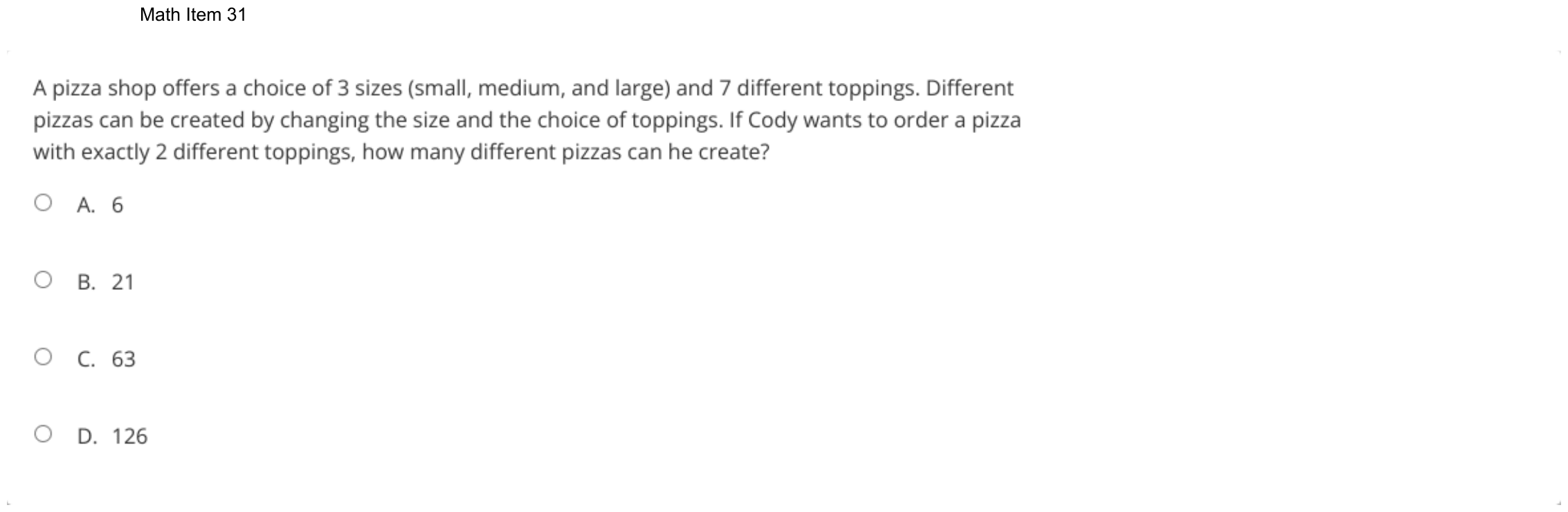
Question 80 of 120
2026 Practice Test B Math, question 46Question
Amiya subscribes to an online streaming service. She pays a onetime setup fee of $50, plus $20 per month for service.
Write an equation that can be used to determine the total amount Amiya will pay, y, for x months of service.
Enter your equation in the space provided. Enter only the equation.
On the test you build the answer on an on-screen keypad; here, type it. Use ^ for a power, sqrt( ) or √ for a root, pi for π, and <= or >= for ≤ and ≥.
Show the answer
Correct answer: y = 20x + 50
Solution:
An equation of the form can be used to represent the total amount Amiya will pay.
Using the information from the scenario, the onetime setup fee of $50 is the constant term (q), and the $20 per month of service is the coefficient (p) of the number of months (x).
So, the equation that can be used to determine the total amount Amiya will pay, y, for x months of service is .
Question analysis
Amiya pays a one-time setup fee plus a monthly charge for a streaming service, and students type an equation for her total cost y after x months. It tests writing a linear equation from a word problem with a starting amount and a rate. The two dollar amounts play different roles, so which one goes with x has to be thought through.
- NYS standards
- Grade level
- Grade 7 content, by NYS standard
- Compared with grade 7
- At grade 7 Writing an equation for a fixed fee plus a steady monthly charge is a familiar grade 7 task, and the numbers are whole. Typing the full equation, with both variables and no choices to compare, makes it less forgiving.
- Estimated difficulty
- Straightforward: two steps or one careful reading.
- Thinking it demands
- Depth of knowledge 2, skills and concepts · mainly apply
- What makes it hard
- Turning words into math moderate
- An answer in an unexpected form minor
- Solution
- 2 steps
- Reading level
- Question and choices: about grade 6, 51 words.
- Students, last 30 days
- Not enough answers yet to show (it takes 10).
Why it is hard, traps and wrong answers (shows the answer)
Why it is hard
The numbers are small and whole, so the work is in the roles. The $50 is paid once and the $20 every month, and a student who places them in the order they appear writes the fee as the monthly rate; others leave the fee out entirely. Checking the equation at x = 1 and x = 2, where Amiya has paid $70 and then $90, shows at once whether each amount is in the right place.
Turning words into math moderate Understanding the question
Only the words “onetime setup fee” and “per month” tell which amount is multiplied by x and which is added once, and the $50 comes first in the sentence. (Hegarty, Mayer & Monk, 1995; Koedinger & Nathan, 2004)
An answer in an unexpected form minor Choosing the answer
The whole equation, with y, an equals sign and x, is built on a keypad with no choices, so a reversed or incomplete equation looks as finished as the right one. (Enright, Morley & Sheehan, 2002)
Strategy: Work out Amiya's total for 1 month and for 2 months by hand, see which amount is added again each month, and build an equation that gives both totals.
Traps
- Misunderstands the concept: A wrong belief about a concept: that percents can be added, that area grows like length, that averages can be averaged, that a bigger denominator means a bigger fraction.
- Stops one step early: A choice is a number from partway through the solution.
- Numbers taken from the question: Combines the numbers in the question without a model of the situation, or is simply a number that appears in the question.
The wrong answers, classified
y = 20x Stops one step early (King et al., 2004; Gierl et al., 2017)
Multiplies the $20 monthly charge by x months but never adds the one-time $50 setup fee, so the equation gives only the cost of service.
y = 50x + 20 Misunderstands the concept (Smith, diSessa & Roschelle, 1993; De Bock et al., 1998; Ni & Zhou, 2005)
Attaches x to the $50 fee and adds the $20 once, putting the numbers into y = mx + b in the order they appear rather than by which one repeats.
y = 70x Numbers taken from the question (Hegarty, Mayer & Monk, 1995)
Adds the $50 fee and the $20 charge into $70 and multiplies by the months, which would charge the setup fee again every month.
Worked solution, step by step
Formulas used
- Total cost with a fee and a rate
- y is the total cost in dollars, and x is the number of months. The rate is the amount paid every month. You multiply it by x because it is paid once for each month. The fee is paid only once, so you add it once, no matter how many months.
Sort out the question
Amiya pays two kinds of charges:
- a setup fee of $50, paid one time only;
- a charge of $20 for every month of service.
y is her total cost in dollars, and x is the number of months. You need an equation that links them. The answer is an equation, not a number.
Work out a few totals
Find the total for a few months by hand. Each month adds one more $20:
Months Monthly charges ($) Total ($) 1 2 3 The $50 shows up once in every total. The $20 shows up once for each month.
Match each number to its job
Use the fee-and-rate model, . The rate is the amount that repeats each month, $20. It multiplies the months, so it becomes 20x. The fee, $50, is paid once, so it is added once.
Watch out: the $50 comes first in the question, but it is not the rate. charges $50 a month. charges the fee every month. forgets the fee.
Write the equation
Put the rate and the fee into the model:
Here 20x means 20 times x. An equal form is fine too, such as , because you can add in either order.
Enter it on the keypad
Type the whole equation, including y =. Without it, you have an expression, not an equation. On the test, the keypad has x, y and = keys. Press y, =, 2, 0, x, +, 5, 0. You do not need a times sign or dollar signs. On this site, type it the same way.
So you would enter y = 20x + 50.
Check your answer
Test the equation with the totals you found. For 1 month, , and Amiya pays $50 + $20 = $70. For 2 months, . Both match. For 0 months, y = 50, just the setup fee.
More questions like this
The original DOE question
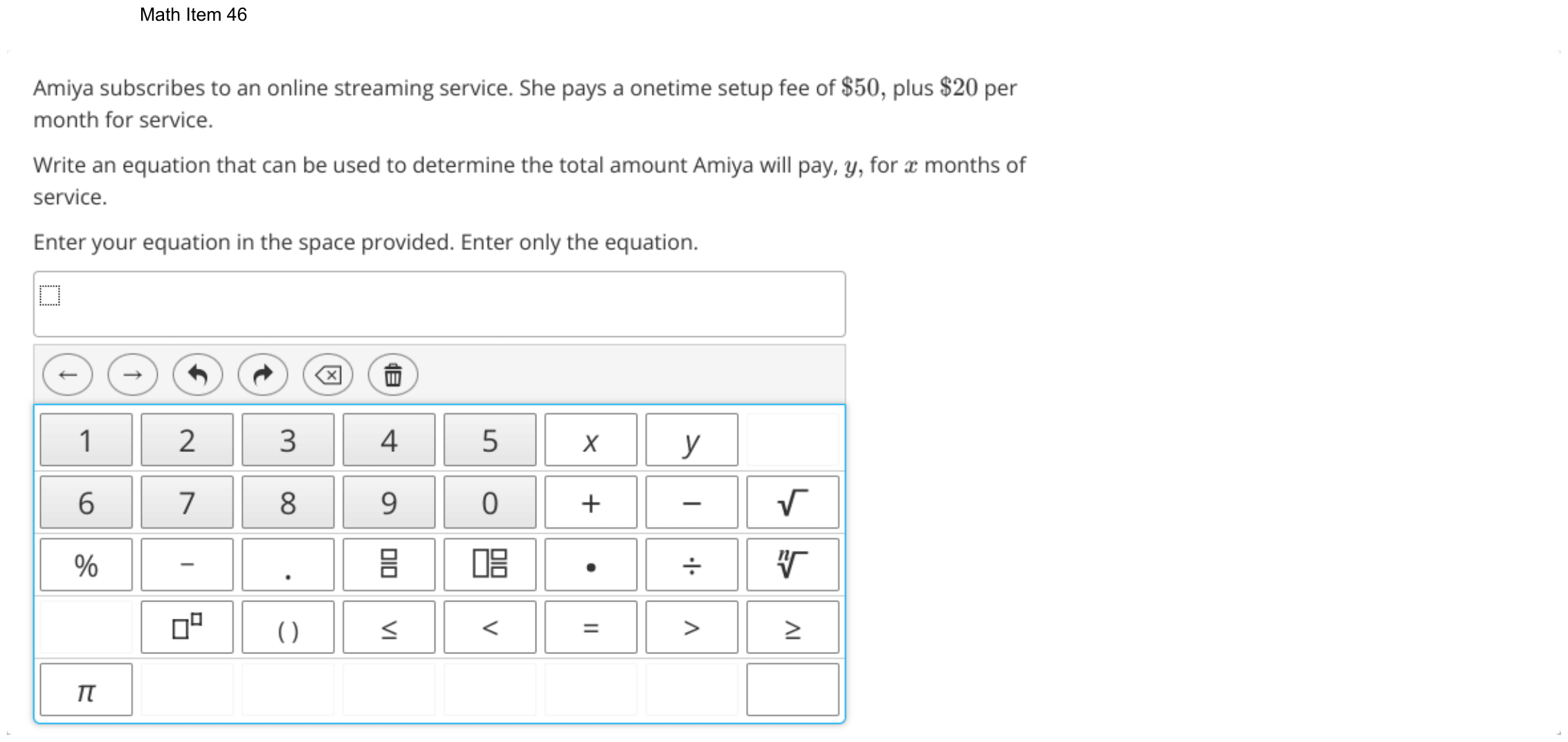
Question 81 of 120
2025 Practice Test A English, question 9Passage Excerpt from “Scribe Like an Egyptian”
Excerpt from “Scribe Like an Egyptian”
by Hilary Wilson
In ancient Egypt, literacy was the key to success. However, contrary to popular belief, not all Egyptian scribes understood hieroglyphs. Many relied instead on the simpler hieratic script for the multitude of everyday documents generated by the Egyptian bureaucracy.
Hieroglyphs—“the Words of God”—compose a writing system with more than 1,000 distinct characters, the meanings of which were lost for 1,500 years before they were deciphered by Jean-François Champollion in 1822. Including both ideograms (which convey a whole word or idea, either concrete or abstract, in a single sign) and phonograms (representing either an alphabetic sound or a group of consonants), [the writing system] was used in formal inscriptions on tomb and temple walls as well as on elaborate funerary papyri. For everyday purposes, however, scribes used a shorthand version of the hieroglyphic script known as hieratic, which was quicker to write and more economical of space. The two writings existed side by side for at least 2,500 years.
Scraps of ancient hieratic writing, mostly penned by student scribes on limestone flakes called ostraca, suggest that no matter how humble his origins, an educated Egyptian could achieve almost anything. Horemheb (d.1292 B.C.) is a good example. Born of middle-ranking parents, his scribal training led to an army career. From Scribe of Recruits, during the reign of Akhenaten (1353–1336 B.C.), Horemheb rose through the military ranks and, by the rule of Tutankhamun (1332–1323 B.C.), he was commander in chief of the Egyptian forces. As a close adviser of the young Pharaoh, Horemheb was appointed “Deputy of the King throughout the Two Lands,” and might have expected to succeed to the throne should the king die childless. He had to wait a few years, but eventually Horemheb achieved the pinnacle of his career by becoming the last king of the 18th Dynasty, making his mark by instituting dramatic reforms to the organisation of the army, the judiciary and administration in general. The lasting success of these changes owed much to his scribal background. . . .
But education was not available to all. Government departments and major temples supported schools, where boys commenced their training at six or seven, sometimes earlier. To these boarding establishments . . . family or household servants delivered the students’ food and drink rations daily for several years, during which time the student was not contributing to the family’s income. Boys from poorer families could only hope to be educated with support from a wealthier relative or patron, or through apprenticeship to an older scribe, perhaps the local clerk or land agent, who would teach them the basics of the scribe’s craft. This limited the scope for employment but such “on the job” training allowed apprentices to help out at home while learning. . . .
Scribal education began with the elementary principles of the hieratic script. The lowliest scribes, who trained for just five or six years, probably learned only the rudiments of the hieroglyphic script. Students were set exemplar documents and extracts from popular texts to copy, to practice their hieratic handwriting on basic-format letters, reports and contracts, while absorbing the good advice contained in the texts. Surviving examples of copy-work sometimes include tutors’ corrections added in red. Some significant Egyptian literary works survive almost exclusively from student copies.
A schoolboy “dictionary” of hieroglyphs with their hieratic equivalents shows that a knowledge of more than 450 signs was required for everyday writing purposes. Lessons in record-keeping and filing and labelling enabled any half-competent scribe to perform that most essential of all scribal functions: the making and updating of lists. For professions such as those of government official, priest or lawyer, a scribe would train for several more years, increasing his vocabulary to perhaps a thousand or more signs. Those with the best handwriting or drawing skills might follow the craft of creating beautifully illustrated copies of funerary texts, commonly called Books of the Dead. Others could become draughtsmen, artists or architects. Doctors compiled their own collections of medication recipes, treatments and associated incantations, many copied from texts found in the House of Life, the temple library. Lawyers had to be familiar with the corpus of civil and religious laws and precedents found in the official records, which were administered by archivists. Egypt’s bureaucratic society depended on the skills of an army of scribes of all ranks from filing clerk to tax assessor. For young Egyptians, “be a scribe” was the best of career advice.
From “Scribe Like an Egyptian” by Hilary Wilson from HISTORY TODAY, August 8, 2019. Copyright © 2019 by History Today Ltd. Company.
bureaucracy: an administrative staff of government officials
funerary papyri: a sheet or scroll of papyrus containing religious images and hieroglyphs meant to help the deceased be reborn in the afterlife
rudiments: basics
schoolboy: slang that refers to materials used during the course of receiving an education
draughtsmen: people who draw plans of machinery or structures
corpus: a collection of writings
Question
Which sentence from the excerpt best supports the idea that there were different levels of education for a scribe?
- A“However, contrary to popular belief, not all Egyptian scribes understood hieroglyphs.” (paragraph 1)
- B“For everyday purposes, however, scribes used a shorthand version of the hieroglyphic script known as hieratic, which was quicker to write and more economical of space.” (paragraph 2)
- C“This limited the scope for employment but such ‘on the job’ training allowed apprentices to help out at home while learning.” (paragraph 4)
- D“For professions such as those of government official, priest or lawyer, a scribe would train for several more years, increasing his vocabulary to perhaps a thousand or more signs.” (paragraph 6)
Show the answer
Correct answer: D
The question asks for a sentence from the excerpt that best supports the idea that different levels of education were available to scribes.
A. Incorrect. The sentence from paragraph 1 provides evidence that Egyptian scribes used two different forms of writing, but it does not address the topic of education or the different levels of education that were available to scribes.
B. Incorrect. The advantages and purposes of hieratic script are described in this sentence from paragraph 2, but this explanation of the advantages and purposes does not suggest that there were different levels of education for scribes.
C. Incorrect. The fact that scribes could learn their trade through apprenticeships as discussed in this sentence from paragraph 4 does provide evidence that another method of learning to be a scribe was possible, but this process was for a limited entry into becoming a scribe, not the continued education scribes would need in order to work in specific areas.
D. CORRECT. By explaining that certain professions required additional years of training, this sentence from paragraph 6 supports the idea that different levels of education existed for scribes.
Question analysis
This evidence question on Hilary Wilson’s “Scribe Like an Egyptian,” a magazine article about how ancient Egyptian scribes learned their trade, asks which quoted sentence best supports the idea that scribes received different levels of education. The four sentences come from paragraphs 1, 2, 4 and 6, and more than one seems to touch on the idea, so close reading of each decides it.
- Grade level
- Grade 8 reading and task
- Compared with grade 7
- Above grade 7 Choosing the sentence that best supports an idea is routine grade 7 evidence work. Here several quotations touch on ways scribes differed, and the article’s dense, technical wording makes those differences harder to sort than usual.
- Estimated difficulty
- Hard: combines ideas, needs a plan, and has more than one tempting wrong answer.
- Thinking it demands
- Depth of knowledge 3, strategic thinking · mainly evaluate
- What makes it hard
- Reading between the lines moderate
- Every choice must be checked moderate
- Hard words minor
- Evidence
- Answered from several paragraphs or stanzas
- Reading level
- Passage: about grade 12, 810 words; question and choices: about grade 13, 110 words.
- Students, last 30 days
- Not enough answers yet to show (it takes 10).
Why it is hard, traps and wrong answers (shows the answer)
Why it is hard
Two of the wrong sentences are not off topic: one says not all scribes understood hieroglyphs, the other that apprenticeship narrowed a scribe’s job prospects, and both imply that scribes differed. The question rewards asking what the idea actually claims, that schooling itself came in stages, and only the sentence about professions that required more years of training says so outright. Students who stop at the first sentence suggesting a difference lose the point.
Reading between the lines moderate Working it out
The right sentence never says “levels”; students must see that training “for several more years” for official, priest or lawyer posts means a higher tier of schooling than the basic course. (Graesser, Singer & Trabasso, 1994; Kintsch, 1998)
Every choice must be checked moderate Choosing the answer
Two other quotations also hint at differences among scribes, paragraph 1’s “not all Egyptian scribes understood hieroglyphs” and paragraph 4’s “limited the scope for employment,” so each must be weighed, not just scanned. (Embretson & Wetzel, 1987)
Hard words minor Understanding the question
Terms such as “hieratic,” “economical of space” and “scope for employment” slow the reading of the quotations, and the shorthand sentence is hard to dismiss until hieratic is understood as a script. (Perfetti, 2007; Freedle & Kostin, 1993)
Strategy: Ask what a sentence would have to say to prove that scribal education came in levels, then test each quotation against that and prefer a direct statement over a hint.
Traps
- Supports only part of the claim: In a question about evidence: a line that backs one half of the claim but not the other, or a related point rather than the claim itself.
- True but not the answer: A choice says something accurate about the text that does not answer this question.
The wrong answers, classified
A Supports only part of the claim (King et al., 2004; Thissen, Steinberg & Fitzpatrick, 1989)
Reads “not all Egyptian scribes understood hieroglyphs” as proof of different levels of schooling, but it reports a difference in knowledge without saying anything about how scribes were taught.
B True but not the answer (King et al., 2004; Embretson & Wetzel, 1987)
Picks the sentence on hieratic as a faster everyday shorthand, which describes how scribes wrote, not how long or how far any of them studied.
C Supports only part of the claim (King et al., 2004; Thissen, Steinberg & Fitzpatrick, 1989)
Sees that on-the-job training “limited the scope for employment” and takes it for a lower level of education, though the sentence contrasts two routes into the trade, not stages of study.
Working it out, step by step
Figure out what the question asks
This asks for the sentence that best supports one idea: scribes could get “different levels of education.” A level is a stage. Some scribes studied for a short time, and others went on to study more. You need a sentence that shows a difference in schooling, not just any difference between scribes.
Find what each level looked like
Paragraphs 5 and 6 describe the training. Paragraph 5 says the lowest scribes studied for only five or six years. They learned just the basics of hieroglyphs. Paragraph 6 says that more than 450 signs were needed for everyday writing. Then choice D adds a higher level: “For professions such as those of government official, priest or lawyer, a scribe would train for several more years, increasing his vocabulary to perhaps a thousand or more signs.”
Work out what choice D means
A profession is a job that needs special training. Choice D says some jobs needed more years of study and more signs, perhaps over a thousand. A basic scribe stopped sooner and knew fewer signs. So schooling came in stages: a basic course, and then more years for the top jobs. That is what the question means by levels of education.
Check each choice
- A does not fit. It says not all scribes understood hieroglyphs. That is a difference in what scribes knew. It says nothing about how they were taught.
- B does not fit. It explains hieratic, a faster shorthand way of writing. That is about writing, not schooling.
- C does not fit. It is about apprentices, who learned on the job from an older scribe. That is a different way into the work, not a higher or lower stage of study.
- D fits. Some jobs needed several more years of training.
Watch out: A is tempting because it shows that scribes were not all alike. But it never mentions school.
Choose the answer
Only one sentence shows some scribes studying for years after the basic course. So the answer is D.
Why this answer and not the closest wrong one
A is the closest wrong choice. It shows that some scribes knew hieroglyphs and others did not. But it doesn’t say why, or how long anyone studied. D says plainly that some jobs needed several more years of training. That is a level of education above the basic one.
More questions like this
The original DOE question
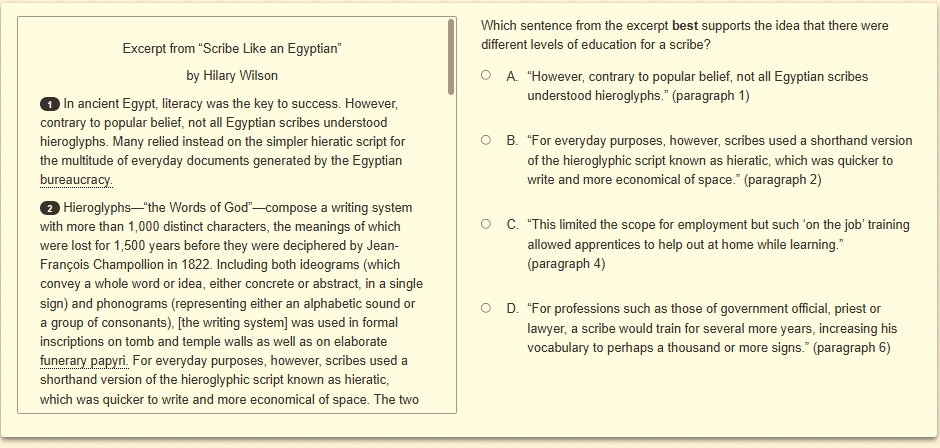
The passage “Excerpt from “Scribe Like an Egyptian”” as shown on the test
Question 82 of 120
2025 Practice Test A English, question 10Uses the passage above: “Excerpt from “Scribe Like an Egyptian””.
Question
Read this sentence from paragraph 2.
Including both ideograms (which convey a whole word or idea, either concrete or abstract, in a single sign) and phonograms (representing either an alphabetic sound or a group of consonants), [the writing system] was used in formal inscriptions on tomb and temple walls as well as on elaborate funerary papyri.
The author’s purpose for including the sentence is to
- Aexplain that hieroglyphs were reserved for royal and religious purposes.
- Bdemonstrate the methods experts use to interpret hieroglyphs.
- Cclarify the significance of hieroglyphs in language and literature.
- Ddescribe the basic features of hieroglyphs and how they were typically used.
Show the answer
Correct answer: D
The question asks for an explanation of the author’s purpose for including a sentence in paragraph 2 that describes the two types of hieroglyphs and the main uses of this particular writing system.
A. Incorrect. The sentence explains that hieroglyphs were used for formal inscriptions, but it does not suggest that these inscriptions were limited to royal and religious contexts.
B. Incorrect. The sentence describes the two basic types of hieroglyphs, ideograms and phonograms, but it does not address how experts interpret the ancient writing system. A sentence earlier in the paragraph explains that the hieroglyphs were deciphered by Champollion, but it does not explain how he deciphered them.
C. Incorrect. Although the sentence explains that the hieroglyphs were typically used for formal inscriptions, it does not provide an explanation of the significance or importance of hieroglyphs in the Egyptian language.
D. CORRECT. The sentence explains that hieroglyphs included both phonograms and ideograms that were used in formal inscriptions and funeral papyri; therefore, this sentence achieves the purpose of describing the basic features of hieroglyphs as conveying either words and ideas or sounds, in addition to explaining the common uses for the writing system.
Question analysis
This author’s-purpose question quotes a long, technical sentence from paragraph 2 of “Scribe Like an Egyptian” about the ancient Egyptian hieroglyphic writing system, and asks why the author includes it. Students must make sense of its specialist vocabulary before they can say what the sentence contributes to the paragraph and to the article.
- Grade level
- Grade 8 reading and task
- Compared with grade 7
- At grade 7 Explaining why an author includes a sentence is regular grade 7 work. This one is long, with definitions in parentheses and a bracketed insert, but it is quoted in full, so the task stays within one sentence.
- Estimated difficulty
- Straightforward: two steps or one careful reading.
- Thinking it demands
- Depth of knowledge 2, skills and concepts · mainly analyze
- What makes it hard
- Complex sentences moderate
- Hard words minor
- How, not what minor
- Evidence
- Answered from one sentence or line
- Reading level
- Passage: about grade 12, 810 words; question and choices: about grade 11, 103 words.
- Students, last 30 days
- Not enough answers yet to show (it takes 10).
Why it is hard, traps and wrong answers (shows the answer)
Why it is hard
Once the parentheses are set aside, the sentence says two simple things: what kinds of signs hieroglyphs were, and where they appeared. The wrong purposes each go one step beyond that, turning tombs and temples into an exclusive royal and religious use, borrowing Champollion’s deciphering from the sentence before, or claiming a significance the sentence never weighs. Students who untangle the syntax first find the matching purpose quickly.
Complex sentences moderate Understanding the question
The quoted sentence runs fifty words, two parenthetical definitions come before the verb, and its subject, the bracketed “[the writing system],” appears only after thirty words of description. (Abedi & Lord, 2001; Freedle & Kostin, 1993; Messick, 1989)
Hard words minor Understanding the question
“Ideograms,” “phonograms” and “funerary papyri” are specialist terms; the parentheses define the first two, but students who stall on them may not reach the sentence’s plain point about where the signs were used. (Perfetti, 2007; Freedle & Kostin, 1993)
How, not what minor Working it out
The stem asks why the author includes the sentence, so students must match the job it does in paragraph 2 to a purpose, and only one purpose stays within what the sentence actually covers. (Anderson & Krathwohl, 2001)
Strategy: Restate the quoted sentence in plain words, setting the parentheses aside at first, then choose the purpose that fits everything the sentence says and nothing more.
Traps
- Reads too much in: A reasonable-sounding conclusion that goes further than the text allows.
- Wrong part of the text: A choice is true of another paragraph, stanza or speaker than the one asked about.
- Wrong purpose or structure: Names a purpose, structure or effect that the part does not serve, or describes what a part says when the question asks what it does.
The wrong answers, classified
A Reads too much in (Graesser, Singer & Trabasso, 1994)
Reads “formal inscriptions on tomb and temple walls” and “funerary papyri” as royal and religious only, though the sentence names where hieroglyphs usually appeared, not a rule reserving them.
B Wrong part of the text (Kirsch & Mosenthal, 1990)
Remembers that Champollion deciphered the signs, which the sentence before reports, and takes this sentence for an account of how experts read them, though it never mentions interpreting.
C Wrong purpose or structure (Anderson & Krathwohl, 2001)
Chooses an important-sounding purpose, the significance of hieroglyphs in language and literature, though the sentence never says why the script mattered or mentions any literature.
Working it out, step by step
Figure out what the question asks
This asks why the author put this sentence in paragraph 2. In other words, what job does the sentence do? First work out what the sentence says. Then pick the purpose that matches all of it and adds nothing extra.
Untangle the long sentence
The sentence is long, so set the parentheses aside at first. The main part says the writing system “was used in formal inscriptions on tomb and temple walls as well as on elaborate funerary papyri.” An inscription is writing carved or painted on something. Funerary means having to do with burials. Papyri are scrolls made from papyrus, a kind of early paper.
Read the parentheses
Now add back the two kinds of signs. Ideograms “convey a whole word or idea” in one sign. Phonograms stand for “either an alphabetic sound or a group of consonants.” Consonants are letter sounds like b, t and m. So one kind of hieroglyph shows a meaning, and the other shows a sound.
Sum up the sentence’s job
Put the two parts together. The sentence tells what hieroglyphs were made of: signs for ideas and signs for sounds. It also tells where people usually used them: on tombs, temples and burial scrolls. So its job is to describe what hieroglyphs were like and how they were used.
Check each choice
- A does not fit. The sentence says where hieroglyphs usually appeared. It never says they were reserved, or kept only, for kings and religion.
- B does not fit. The sentence before it says Champollion figured out the signs. This sentence never says how experts read them.
- C does not fit. The sentence never says why hieroglyphs mattered, and it never mentions literature.
- D fits. It names both parts: the basic features and the usual uses.
Watch out: Tombs and temples sound royal and religious, so A tempts. But “used in” is not the same as “reserved for.”
Choose the answer
The sentence describes the two kinds of signs and where they were usually used. So the answer is D.
Why this answer and not the closest wrong one
A is the closest wrong choice. Tombs and temples do suggest kings and religion. But the sentence only lists where hieroglyphs were used. It never says they were kept for those uses alone. D matches everything the sentence says and adds nothing it doesn’t.
More questions like this
The original DOE question
Question 83 of 120
2025 Practice Test A English, question 11Uses the passage above: “Excerpt from “Scribe Like an Egyptian””.
Question
Which statement summarizes the process that schools used to train scribes?
- ABoys had to memorize around 450 hieratic signs. Once they had learned these, they were expected to copy literary texts that contained valuable lessons.
- BBoys spent at least five years learning hieratic signs, which they practiced by copying texts. During this period, they were also introduced to basic hieroglyphs.
- CBoys spent five or six years learning the basics of hieratic script. After this period, they could become apprentices and begin learning hieroglyphics.
- DBoys were taught two different scripts. They practiced both types by copying lists and eventually progressed to writing letters, reports, and contracts.
Show the answer
Correct answer: B
The question asks for the best summary of the process that schools used to train scribes.
A. Incorrect. This summary incorrectly explains that scribes were expected to learn 450 hieratic signs instead of 450 hieroglyphs along with their hieratic versions as explained in paragraph 6. In paragraph 5, the author explains that scribes copied texts as part of the process of learning the scripts rather than as practice after the signs had already been memorized.
B. CORRECT. Paragraph 5 explains that students began by learning hieratic script and studied for about five or six years by using “exemplar documents and extracts from popular texts to copy, to practice their hieratic handwriting.” The paragraph also explains that during this time, they learned only the basics of hieroglyphic script.
C. Incorrect. Although paragraph 5 does explain that the scribes spent five or six years learning hieratic script, it does not suggest that hieroglyphs were learned only during apprenticeships.
D. Incorrect. This summary correctly explains that scribes learned two types of scripts, but the second sentence of the summary is incorrect. In paragraph 5, the author explains that the students copied from exemplar texts, but the author clearly states that the purpose of this copy work was “to practice their hieratic handwriting” and does not suggest that the copy work was used to practice hieroglyphs. Paragraph 6 explains that scribes could make lists as part of their professional skills but does not suggest that copy work was used to help them learn this task. Paragraph 5 mentions letters, reports, and contracts as the formats students practiced on while copying, not as a later stage of their training.
Question analysis
This summary question on “Scribe Like an Egyptian” asks which statement sums up how ancient Egyptian schools trained young scribes. Each choice is a two-sentence summary that combines years of study, kinds of script and copying practice, so students must check every detail against what the article says about scribal education.
- Grade level
- Grade 8 reading and task
- Compared with grade 7
- Above grade 7 Summarizing a process is a grade 7 standard, but these four summaries are long, two-part and mostly accurate, and the details they mix up come from three different paragraphs, so judging them asks more than typical grade 7 work.
- Estimated difficulty
- Hard: combines ideas, needs a plan, and has more than one tempting wrong answer.
- Thinking it demands
- Depth of knowledge 2, skills and concepts · mainly understand
- What makes it hard
- A very close wrong answer moderate
- Evidence in several places moderate
- The right answer is reworded minor
- Evidence
- Answered from several paragraphs or stanzas
- Reading level
- Passage: about grade 12, 810 words; question and choices: about grade 7, 104 words.
- Corrected from the DOE handbook
- A detail in the explanation that misdescribes the excerpt was corrected.
- Students, last 30 days
- Not enough answers yet to show (it takes 10).
Why it is hard, traps and wrong answers (shows the answer)
Why it is hard
Every wrong summary opens with something true or nearly true, so a quick reading of first sentences cannot separate them. Most of the errors concern order: one makes copying follow memorizing, one turns apprenticeship into a later stage where hieroglyphs begin, and one makes the copied letters, reports and contracts a later step. Students who check the order of training against paragraph 5, not just the facts, find the only summary with nothing out of place.
A very close wrong answer moderate Choosing the answer
The apprenticeship summary repeats the right one’s opening, years of hieratic study, and parts from it on one phrase: hieroglyphs come “After this period” instead of “During this period.” (Embretson & Wetzel, 1987; Gorin & Embretson, 2006; Ascalon et al., 2007)
Evidence in several places moderate Working it out
The details sit in three paragraphs: the five or six years, the copying and the hieroglyph basics in paragraph 5, apprenticeship in paragraph 4, and the 450-sign dictionary and list-making in paragraph 6. (Kirsch & Mosenthal, 1990; Gorin & Embretson, 2006)
The right answer is reworded minor Choosing the answer
The right summary puts the text in new words, “at least five years” and “basic hieroglyphs,” while wrong ones repeat its own details: “five or six years,” the “450” signs, “letters, reports, and contracts.” (Freedle & Kostin, 1993; Kirsch & Mosenthal, 1990)
Strategy: Note what the article says students learned, for how long and by what method, then check both sentences of each summary against those notes; one wrong detail rules a summary out.
Traps
- Half right: One half of a two-part choice is right and the other is not.
- Twists what the text says: Uses the text's topic and ideas but changes what it says: who did it, how much, when, or why.
The wrong answers, classified
A Twists what the text says (King et al., 2004)
Takes paragraph 6’s 450 signs, hieroglyphs listed with their hieratic forms, as hieratic signs to memorize first, and makes copying come afterward, though copying was how students learned.
C Half right (King et al., 2004; Thissen, Steinberg & Fitzpatrick, 1989)
Gets the five or six years of hieratic right, then makes apprenticeship, the other route paragraph 4 offers poorer boys, a later stage where hieroglyphs are first taught.
D Half right (King et al., 2004; Thissen, Steinberg & Fitzpatrick, 1989)
Rightly says two scripts were taught, then claims students copied lists for both and only later wrote letters, reports and contracts, though paragraph 5 ties copying to hieratic and to those very formats.
What was corrected from the DOE handbook, and why
- Explanation: The DOE’s explanation of Option D ends: “Paragraph 6 explains that scribes could make lists and write letters as part of their professional skills but does not suggest that copy work was used to help them learn these tasks.” Paragraph 6 mentions the making and updating of lists, but not letters. Letters come up in paragraph 5, where students copy texts “to practice their hieratic handwriting” on basic-format letters, reports and contracts, so the excerpt does tie the copy work to letters. The site now says that paragraph 6 explains that scribes could make lists as part of their professional skills but does not suggest that copy work was used to help them learn this task, and that paragraph 5 mentions letters, reports, and contracts as the formats students practiced on while copying, not as a later stage of their training. Option D is still wrong, and the answer, B, is unchanged.
Working it out, step by step
Figure out what the question asks
This asks for the best summary of how schools trained scribes. A summary retells the main steps in a few words. Each choice has two sentences. Both must match the article, including the order of the steps. One wrong detail rules a choice out.
Find the training in paragraph 5
Paragraph 5 says training began with the basics of hieratic script. The lowest scribes studied for five or six years, and others studied longer. In that time they learned only the basics of hieroglyphs. Students were given “exemplar documents and extracts from popular texts to copy, to practice their hieratic handwriting.” Exemplar means model. Extracts are short pieces. So they learned by copying good examples.
Sort out paragraphs 4 and 6
Two other paragraphs hold details that look alike. Paragraph 4 describes apprenticeship. An apprentice learns on the job from a skilled worker. It was another way in for boys from poorer families, not a step after school. Paragraph 6 mentions a list of hieroglyphs with their hieratic forms. It says more than 450 signs were needed for everyday writing. It never says students memorized them before copying.
Check each choice
- A does not fit. The 450 signs were hieroglyphs paired with their hieratic forms. And copying was how students learned, not a step after memorizing.
- B fits. Students spent at least five years on hieratic, practiced by copying, and learned basic hieroglyphs along the way.
- C does not fit. Apprenticeship was a different route, not a later stage. Hieroglyphs were not saved for apprentices.
- D does not fit. The copying was to practice hieratic. Lists come up in paragraph 6 as a job skill, not as practice. Letters, reports and contracts were what students copied, not a later stage.
Choose the answer
Watch out: C starts out right, with five or six years of hieratic. Then it says hieroglyphs came “After this period” instead of during it. That one change makes it wrong.
Only B gets every detail and the order right. So the answer is B.
Why this answer and not the closest wrong one
C is the closest wrong choice. It gets the five or six years of hieratic right. But it says hieroglyphs came afterward, through apprenticeship. Paragraph 5 says students learned the basics of hieroglyphs during their schooling. Apprenticeship was a separate path for poorer boys. B says “During this period,” which matches.
More questions like this
The original DOE question
Question 84 of 120
2025 Practice Test A English, question 12Uses the passage above: “Excerpt from “Scribe Like an Egyptian””.
Question
Which claim is best supported by the information presented in paragraphs 3 and 4?
- AEducation was difficult for the common citizens of Egypt to obtain.
- BOnce students began studying to become scribes, their future held more possibilities.
- CIf someone wanted to become a scribe, support from outside sources such as the government or a temple was necessary.
- DBecoming a successful scribe required a student’s family to sacrifice time and money in order to ensure the best education.
Show the answer
Correct answer: B
The question asks for the claim that is best supported by the details in paragraphs 3 and 4.
A. Incorrect. While paragraph 4 does explain that boys from poorer families had more challenges in receiving an education, the paragraph also provides examples of obtaining a patron or getting an apprenticeship as ways that these aspiring scribes could attain an education. Furthermore, the details in paragraph 3 do not provide any support for the claim that “common citizens” had difficulty getting an education because that paragraph focuses on the example of one person who was able to become a king as a result of his background as a scribe.
B. CORRECT. In paragraph 3, the author provides an example of a person who used his skills as a scribe to rise through the ranks of society by describing the achievements of Horemheb to support the idea that “no matter how humble his origins, an educated Egyptian could achieve almost anything.” The author continues in paragraph 4 to explain that with the proper support, some young Egyptians could become educated, thereby opening more opportunities for themselves.
C. Incorrect. Paragraph 4 explains that schools were supported by the government and religious institutions, but it also explains that apprenticeships were a method of learning the craft of the scribe. As the paragraph indicates, boys could also be helped in their education by support from “a wealthier relative or patron.”
D. Incorrect. In paragraph 4, the author details the sacrifices that families made to keep their sons at the schools, while boys from poorer families could only hope for a patron or an apprenticeship. Paragraph 4 also explains that apprentices could help out at home while learning, so the sacrifice of time and money was not required of every family.
Question analysis
This inference question asks which claim is best supported by paragraphs 3 and 4 of “Scribe Like an Egyptian,” which tell the story of the scribe Horemheb and describe who could get a scribal education in ancient Egypt. Students must weigh each claim against both paragraphs together, and several claims echo a single sentence closely enough to look supported.
- Grade level
- Grade 8 reading and task
- Compared with grade 7
- Above grade 7 Choosing the claim a passage best supports is core grade 7 work. Here the claim must fit two paragraphs that do different jobs, one telling a single man’s story and one explaining access to schooling, and some choices fit only part of that.
- Estimated difficulty
- Hard: combines ideas, needs a plan, and has more than one tempting wrong answer.
- Thinking it demands
- Depth of knowledge 3, strategic thinking · mainly evaluate
- What makes it hard
- Evidence in several places moderate
- The right answer is reworded moderate
- Reading between the lines minor
- Evidence
- Answered from several paragraphs or stanzas
- Reading level
- Passage: about grade 12, 810 words; question and choices: about grade 10, 75 words.
- Corrected from the DOE handbook
- A misdescription of the passage in the explanation of one wrong answer was corrected.
- Students, last 30 days
- Not enough answers yet to show (it takes 10).
Why it is hard, traps and wrong answers (shows the answer)
Why it is hard
The trap is a claim that paragraph 4 seems to state almost word for word, which makes it feel safer than the right one. But the question asks for support from both paragraphs, and Horemheb’s story points the other way, toward what schooling made possible. The two other wrong claims harden paragraph 4’s details into rules, a necessary sponsor or a required family sacrifice, so words like “necessary” and “required” are the ones to test.
Evidence in several places moderate Working it out
The claim must fit two paragraphs that do different work: paragraph 3 follows Horemheb from army scribe to king, and paragraph 4 explains who could pay for schooling and what the alternatives were. (Kirsch & Mosenthal, 1990; Gorin & Embretson, 2006)
The right answer is reworded moderate Choosing the answer
The right claim restates paragraph 3’s “an educated Egyptian could achieve almost anything” in new words, while the most tempting wrong one nearly copies paragraph 4’s opening, “education was not available to all.” (Freedle & Kostin, 1993; Kirsch & Mosenthal, 1990)
Reading between the lines minor Working it out
Students must connect Horemheb’s rise with paragraph 4’s account of who got schooling to see that both paragraphs are about education opening doors, a link the author leaves implicit. (Graesser, Singer & Trabasso, 1994; Kintsch, 1998)
Strategy: Sum up paragraph 3 and paragraph 4 in a sentence each, then test every claim against both summaries, watching for words that make a claim stronger than the text.
Traps
- Too narrow: A single detail offered as the central idea or a summary, or a summary that keeps minor details and leaves out an essential part.
- Too broad or too strong: A choice overstates, generalizes, or uses absolute words the text does not support.
- Reads too much in: A reasonable-sounding conclusion that goes further than the text allows.
The wrong answers, classified
A Too narrow (King et al., 2004)
Rests on paragraph 4’s opening, “education was not available to all,” and ignores paragraph 3, whose Horemheb shows an educated man rising from modest origins to the throne.
C Too broad or too strong (King et al., 2004)
Makes the government and temple schools of paragraph 4 “necessary,” overlooking its other routes: help from “a wealthier relative or patron,” or apprenticeship to a working scribe.
D Reads too much in (Graesser, Singer & Trabasso, 1994)
Turns the rations and lost income that some families bore in paragraph 4 into a requirement for every successful scribe, and adds “the best education,” which the paragraph never mentions.
What was corrected from the DOE handbook, and why
- Explanation: The DOE’s explanation of D said paragraph 4 details sacrifices “necessary for some poorer families,” and that paragraph 3’s Horemheb, born of middle-ranking parents, shows the sacrifice was not required of all families. In paragraph 4 the rations and lost income are those of families whose sons were at the schools; poorer boys could only hope for a patron or an apprenticeship; and paragraph 3 says nothing about what Horemheb’s family gave up. The explanation now says so: D is wrong because apprentices could help out at home while learning, so not every family made the sacrifice.
Working it out, step by step
Figure out what the question asks
This asks which claim is best supported by paragraphs 3 and 4 together. A claim is a statement that someone says is true. The right claim must fit both paragraphs. Watch for strong words, like “necessary,” that go further than the text.
Sum up paragraph 3
Paragraph 3 tells about Horemheb. His parents were middle-ranking, not rich or powerful. His training as a scribe led to a job in the army. He rose to lead the army, then to serve the young king, and in the end he became king himself. The author uses him to show that “no matter how humble his origins, an educated Egyptian could achieve almost anything.” Humble origins means an ordinary family background.
Sum up paragraph 4
Paragraph 4 opens by saying that not everyone could get an education. Government offices and big temples ran schools. Families sent food and drink for years, while the boy earned nothing for them. Poorer boys could hope for help from “a wealthier relative or patron.” A patron is someone who pays for another person’s training. Or they could learn on the job from a working scribe. That path led to fewer jobs.
Put the two paragraphs together
Both paragraphs are about what schooling could do for a boy. Paragraph 3 shows a man rising all the way to king because he trained as a scribe. Paragraph 4 shows that, with the right support, boys could get that schooling. It even notes that the on-the-job path led to fewer jobs. So education opened doors. That is what choice B says.
Check each choice
- A does not fit. It matches only the start of paragraph 4. Paragraph 4 also gives ways in for poorer boys, and paragraph 3 shows a man from an ordinary family rising to the top.
- B fits. Both paragraphs show schooling leading to more possibilities.
- C does not fit. A government or temple school was not “necessary.” A relative, a patron or an apprenticeship could also work.
- D does not fit. Apprentices could help out at home while they learned, so not every family gave up time and money. And the paragraphs never mention “the best education.”
Choose the answer
The claim that fits both paragraphs is that schooling gave a boy more possibilities. So the answer is B.
Why this answer and not the closest wrong one
A is the closest wrong choice, because paragraph 4 begins by saying not everyone could get an education. But the question asks about paragraphs 3 and 4. Paragraph 3 tells of a scribe from an ordinary family who became king. Paragraph 4 shows ways around the cost. Both point to what education made possible, which is B.
More questions like this
The original DOE question
Question 85 of 120
2025 Practice Test A English, question 13Uses the passage above: “Excerpt from “Scribe Like an Egyptian””.
Question
Hieratic script was particularly valuable in a bureaucratic government because
- Ausing hieratic script was an efficient way for scribes to produce large amounts of documentation.
- Bmany members of the general public could comprehend information that was written in hieratic script.
- Cknowledge of hieratic script prepared scribes to serve their society in increasingly challenging roles.
- Dpeople from different professional backgrounds could easily communicate with one another in hieratic script.
Show the answer
Correct answer: A
The question asks why hieratic script was especially valuable in a bureaucratic government.
A. CORRECT. Hieratic script is described in paragraph 1 as being simpler for the “multitude of everyday documents” generated by the government and as “quicker to write and more economical of space” in paragraph 2. The logical conclusion based on these details is that hieratic script was more efficient for the large amounts of documentation produced by the government.
B. Incorrect. In paragraph 4, the author explains that “education was not available to all,” suggesting that only people who were educated could read and write. The excerpt as a whole does not provide sufficient information to indicate what portion of the general public would be able to comprehend material written in hieratic script.
C. Incorrect. The idea that becoming a scribe could lead to taking different positions in society is addressed in paragraphs 3, 4, and 6. However, the use of hieratic script in the fields of medicine, law, or religion does not necessarily explain the value of the script for the bureaucratic government referenced in the question.
D. Incorrect. Although different professions such as doctors and lawyers used hieratic script, the author uses these professions as examples of different job opportunities for scribes in paragraph 6. There is no discussion in the excerpt about different professions communicating with each other, and these professions were not necessarily part of the bureaucratic government.
Question analysis
This inference question on “Scribe Like an Egyptian” asks why hieratic, one of the two scripts of ancient Egypt, was especially valuable to a bureaucratic government. The article never gives the reason in a single sentence, so students must connect what it says about Egypt’s bureaucracy with what it says about the script itself. Each choice offers a reasonable-sounding benefit.
- Grade level
- Grade 7 reading and task
- Compared with grade 7
- At grade 7 Drawing a conclusion from two neighboring paragraphs is typical grade 7 inference work. The word “bureaucratic” and the article’s formal style add some load, but the details needed are close together and plainly stated.
- Estimated difficulty
- Straightforward: two steps or one careful reading.
- Thinking it demands
- Depth of knowledge 2, skills and concepts · mainly understand
- What makes it hard
- Evidence in several places minor
- Hard words minor
- Reading between the lines minor
- Evidence
- Answered from several paragraphs or stanzas
- Reading level
- Passage: about grade 12, 810 words; question and choices: about grade 13, 68 words.
- Students, last 30 days
- Not enough answers yet to show (it takes 10).
Why it is hard, traps and wrong answers (shows the answer)
Why it is hard
The two facts that answer the question sit a few lines apart in the first two paragraphs, so the work is mostly connecting them. The wrong reasons all sound like advantages a simpler script might bring, public readability, career preparation, communication across professions, and each rests on a guess or on the excerpt’s talk of scribal careers rather than on what it says hieratic was used for. Students who return to the description of hieratic itself avoid them.
Evidence in several places minor Working it out
The reason is split between paragraph 1, where hieratic serves the “multitude of everyday documents,” and paragraph 2, where it is “quicker to write and more economical of space.” (Kirsch & Mosenthal, 1990; Gorin & Embretson, 2006)
Hard words minor Understanding the question
The stem turns on “bureaucratic,” a word students must connect to a government that runs on paperwork; without it, the link to large amounts of documentation is hard to see. (Perfetti, 2007; Freedle & Kostin, 1993)
Reading between the lines minor Working it out
No sentence says why hieratic helped the government; students must combine speed and compactness with the sheer volume of records to reach efficiency. (Graesser, Singer & Trabasso, 1994; Kintsch, 1998)
Strategy: Find the sentences that describe hieratic script and what it was used for, then pick the choice those sentences support rather than one that only sounds like an advantage.
Traps
- Reads too much in: A reasonable-sounding conclusion that goes further than the text allows.
- True but not the answer: A choice says something accurate about the text that does not answer this question.
- Outside knowledge: A choice is plausible in the real world but not supported by this text.
The wrong answers, classified
B Reads too much in (Graesser, Singer & Trabasso, 1994)
Reasons that a simpler script must have been readable by ordinary people, though paragraph 4 says “education was not available to all” and the excerpt never says the public read hieratic.
C True but not the answer (King et al., 2004; Embretson & Wetzel, 1987)
Recalls the careers in paragraphs 3 and 6 that schooling opened to scribes, which is true of the excerpt but explains a scribe’s prospects, not why the government valued hieratic.
D Outside knowledge (King et al., 2004; Recht & Leslie, 1988)
Imagines hieratic as a shared language linking doctors, lawyers and officials, a sensible-sounding benefit the excerpt never raises; paragraph 6 names those professions only as careers for scribes.
Working it out, step by step
Figure out what the question asks
This asks why hieratic script was so useful to a bureaucratic government. A bureaucracy is a government run by many officials, with lots of paperwork. Hieratic is the quick, simple form of Egyptian writing. Look for what the article says about hieratic and what it was used for.
Find the evidence in paragraphs 1 and 2
Paragraph 1 says many scribes used hieratic for the “multitude of everyday documents” that the government produced. Multitude means a huge number. Paragraph 2 says hieratic was “quicker to write and more economical of space.” Economical of space means it took up less room on the page.
Connect the two facts
Put the facts together. The government made a huge number of papers. Hieratic was fast to write and used less space. So scribes could turn out lots of papers quickly. Getting a lot done with little time and effort is called being efficient.
Check each choice
- A fits. Hieratic let scribes make large amounts of paperwork quickly.
- B does not fit. Paragraph 4 says “education was not available to all.” The article never says ordinary people could read hieratic.
- C does not fit. Training did lead to careers, but that explains a scribe’s chances, not why the government valued the script.
- D does not fit. Paragraph 6 lists jobs like doctor and lawyer as careers for scribes. It never says those workers wrote to each other in hieratic.
Watch out: B sounds sensible, since a simpler script seems easier for anyone to read. But that is a guess, not something the article says.
Choose the answer
Hieratic was fast and compact, and the government needed a huge number of documents. So the answer is A.
Why this answer and not the closest wrong one
B is the closest wrong choice, because a simpler script does sound easier to read. But the article says only some Egyptians got an education. It never says the public could read hieratic. A rests on two facts the article states: the government made a “multitude of everyday documents,” and hieratic was quicker to write.
More questions like this
The original DOE question
Question 86 of 120
2025 Practice Test A English, question 14Uses the passage above: “Excerpt from “Scribe Like an Egyptian””.
Question
The diagram after paragraph 6 best provides additional support for the topic of the excerpt by
- Ademonstrating the place of scribes in ancient Egyptian social structure.
- Bdepicting the types of tasks performed by each social class.
- Cindicating that scribes were able to easily improve their social ranking.
- Dcomparing the social positions of each social class in ancient Egypt.
Show the answer
Correct answer: A
The question asks how the diagram of ancient Egyptian class structure supports the topic of the excerpt.
A. CORRECT. The focus of the excerpt is the opportunities available to scribes in different professions and how people became scribes and therefore improved their position. By illustrating the position of the scribes in the class structure of ancient Egypt, the diagram supports the idea that scribes were valuable members of society.
B. Incorrect. The professions of the different social classes are shown in the diagram, but it does not address specific tasks. Furthermore, the main topic of the excerpt is the role of the scribes in society rather than the tasks performed by the different social classes.
C. Incorrect. While the diagram does show the position of scribes in the social hierarchy, it does not provide an illustration of movement between the different classes or rankings, so the diagram does not support the idea that scribes were able to improve their social standing.
D. Incorrect. The diagram shows the class structure as hierarchical and can support readers’ efforts to compare the different social positions. However, the role of scribes in society, rather than a general comparison of different classes, is the main focus of the excerpt.
Question analysis
This question on “Scribe Like an Egyptian” asks how the diagram after paragraph 6, a pyramid of ancient Egyptian social classes from the pharaoh at the top to unskilled workers at the base, gives additional support to the excerpt’s topic. Students must decide what the excerpt is mainly about and then judge what the graphic adds, and several choices describe something the pyramid really shows.
- Grade level
- Grade 7 reading and task
- Compared with grade 7
- At grade 7 Linking a graphic to a text is regular grade 7 work, and this five-level pyramid is simple and clearly labeled. The demand lies in naming the excerpt’s topic first and judging how the diagram bears on it.
- Estimated difficulty
- Moderate: several steps, or a close reading with one strong distractor.
- Thinking it demands
- Depth of knowledge 2, skills and concepts · mainly analyze
- What makes it hard
- A very close wrong answer moderate
- Reading a figure, table or graph moderate
- How, not what minor
- Evidence
- Answered from the whole text
- Reading level
- Passage: about grade 12, 810 words; question and choices: about grade 9, 57 words.
- Students, last 30 days
- Not enough answers yet to show (it takes 10).
Why it is hard, traps and wrong answers (shows the answer)
Why it is hard
More than one choice is true of the pyramid, so the question is decided by the excerpt’s topic, not by the picture alone. Students who look only at the diagram see a ranking of all the classes; students who remember that the article is about scribes look for where scribes stand. The choice about rising easily borrows Horemheb’s story from the text and credits it to a drawing that shows no movement.
A very close wrong answer moderate Choosing the answer
The choice about comparing every class’s position differs from the right one in a single detail, all classes rather than scribes, and both are true of the pyramid. (Embretson & Wetzel, 1987; Gorin & Embretson, 2006; Ascalon et al., 2007)
Reading a figure, table or graph moderate Understanding the question
Scribes are not a tier of their own: they share the third of five tiers with merchants and craftsmen, below the pharaoh, nobles and priests and above farmers, herders and laborers. (Lesh, Post & Behr, 1987; Kirsch & Mosenthal, 1990)
How, not what minor Working it out
The stem asks how the diagram supports the excerpt’s topic, so students must first decide the topic is scribes, then judge what the picture adds to it. (Anderson & Krathwohl, 2001)
Strategy: State the excerpt’s topic in a few words, then test each choice twice: is it true of the diagram, and does it connect the diagram to that topic?
Traps
- True but not the answer: A choice says something accurate about the text that does not answer this question.
- Wrong part of the text: A choice is true of another paragraph, stanza or speaker than the one asked about.
- Wrong purpose or structure: Names a purpose, structure or effect that the part does not serve, or describes what a part says when the question asks what it does.
The wrong answers, classified
B Wrong purpose or structure (Anderson & Krathwohl, 2001)
Notices the small figures at work, such as the herders with their cattle, and takes tasks as the diagram’s point, though its labels name classes and the excerpt is about scribes.
C Wrong part of the text (Kirsch & Mosenthal, 1990)
Carries Horemheb’s rise from scribe to king in paragraph 3 over to the diagram, which shows fixed tiers with no arrows or movement, and nothing about rising easily.
D True but not the answer (King et al., 2004; Embretson & Wetzel, 1987)
Describes what the pyramid plainly does, rank all five classes against one another, which is accurate but misses why the diagram belongs with an excerpt about scribes.
Working it out, step by step
Figure out what the question asks
This asks how the diagram after paragraph 6 adds to the topic of the excerpt. First name the topic. Then ask two things about each choice. Is it true of the diagram? And does it connect the diagram to that topic?
Name the excerpt’s topic
The excerpt is about scribes, people trained to read and write for others. It tells how they learned, who could study, and what jobs they could get. Every paragraph comes back to scribes. So the diagram should add something about scribes.
Read the diagram
The diagram is a pyramid with five levels. From the top down, they are the Pharaoh, nobles and priests, then “Traders, shopkeepers, scribes, and artisans,” then herders and farmers, and last unskilled workers. Artisans are skilled craftspeople. Scribes sit in the third level, the middle one. They are below the ruler and the nobles, and above farmers and workers.
Check each choice
- A fits. The diagram shows where scribes stood in Egyptian society, which ties it to the topic.
- B does not fit. The labels name groups of people, not the tasks each group did.
- C does not fit. The levels are fixed, and nothing in the diagram shows anyone moving up. Horemheb’s rise comes from paragraph 3, not the diagram.
- D does not fit. The pyramid does rank all the classes. But that alone does not connect it to an excerpt about scribes.
Watch out: More than one choice is true of the picture. The right one must also fit the topic.
Choose the answer
The diagram supports the topic by showing where scribes fit among the classes of ancient Egypt. So the answer is A.
Why this answer and not the closest wrong one
D is the closest wrong choice, because the pyramid really does compare every class. But the excerpt is about scribes, not about every class. A is true of the diagram too, and it also links the diagram to the topic. It points to the place of scribes in the middle level.
More questions like this
The original DOE question
Question 87 of 120
2025 Practice Test A English, question 15Uses the passage above: “Excerpt from “Scribe Like an Egyptian””.
Question
Based on the excerpt, which statement would the author most strongly agree with?
- ABoys in Egypt were encouraged to enter the same profession as older male relatives.
- BKnowledge of hieroglyphs was helpful to Egyptians who were interested in becoming scribes.
- CHieratic script was more practical to ancient Egyptians than hieroglyphs were.
- DBoys in Egypt who studied for only a few years were unlikely to find employment as scribes.
Show the answer
Correct answer: C
The question asks for a statement with which the author would most strongly agree.
A. Incorrect. The author only addresses boys who entered the profession of scribes. While the author does address the role of the family in supporting a boy’s education or securing an apprenticeship, the author does not provide any discussion to support the idea that boys were only encouraged to follow the professions of their male relatives.
B. Incorrect. The author explains that communication using hieroglyphs was not widely practiced in everyday correspondence and that hieratic script was the more popular form of writing. While being able to read and use hieroglyphs would have been helpful, it was not common for citizens to use this formal form of communication. In addition, scribes were trained to learn hieroglyphs and hieratic script as part of their education, so prior ability to read or compose hieroglyphs was not a requirement.
C. CORRECT. As described in paragraph 2, hieratic script was more efficient and economical than hieroglyphs. Because this script was used for “everyday purposes,” it was the more practical of the scripts as hieroglyphs were reserved for “formal inscriptions.”
D. Incorrect. In paragraph 6, the author indicates that “any half-competent scribe” could become employed in making and updating lists. While the paragraph later indicates that scribes would need to study several more years to be employed in a wider range of professions, there is no indication that employment as a scribe would be unavailable to a boy who studied for only a few years.
Question analysis
This point-of-view question asks which statement the author of “Scribe Like an Egyptian” would most strongly agree with. The four statements deal with family careers, knowledge of hieroglyphs, Egypt’s two scripts and the length of training, so students must test each one against the article and separate what the author says from what merely sounds likely.
- Grade level
- Grade 8 reading and task
- Compared with grade 7
- At grade 7 Inferring which statement an author would accept is typical grade 7 work. The four statements draw on different parts of a dense article, and some sound sensible without being backed by it, so each must be checked carefully.
- Estimated difficulty
- Moderate: several steps, or a close reading with one strong distractor.
- Thinking it demands
- Depth of knowledge 2, skills and concepts · mainly analyze
- What makes it hard
- Every choice must be checked moderate
- Reading between the lines moderate
- Evidence
- Answered from several paragraphs or stanzas
- Reading level
- Passage: about grade 12, 810 words; question and choices: about grade 9, 68 words.
- Students, last 30 days
- Not enough answers yet to show (it takes 10).
Why it is hard, traps and wrong answers (shows the answer)
Why it is hard
The right statement is a comparison the author never makes in so many words, while the statement about hieroglyphs sounds like something any author on scribes would accept. The question rewards asking which statement the excerpt itself backs most firmly, and paragraph 2’s contrast between everyday and formal writing does that directly. The two statements about boys rest on assumptions, sons following relatives and short training leaving boys jobless, that the excerpt never makes and partly contradicts.
Every choice must be checked moderate Choosing the answer
The four statements cover four topics, family careers, hieroglyphs, the two scripts and length of training, so each has to be traced to its own paragraph before they can be compared. (Embretson & Wetzel, 1987)
Reading between the lines moderate Working it out
The author never ranks the scripts; “more practical” has to be drawn from paragraph 2, where hieratic is for “everyday purposes” and quicker to write, while hieroglyphs go on “formal inscriptions.” (Graesser, Singer & Trabasso, 1994; Kintsch, 1998)
Strategy: For each statement, find the paragraph that deals with its topic and decide whether the author says it, implies it or never addresses it; keep the one with the firmest support.
Traps
- Reads too much in: A reasonable-sounding conclusion that goes further than the text allows.
- Twists what the text says: Uses the text's topic and ideas but changes what it says: who did it, how much, when, or why.
- Outside knowledge: A choice is plausible in the real world but not supported by this text.
The wrong answers, classified
A Outside knowledge (King et al., 2004; Recht & Leslie, 1988)
Applies the familiar idea that sons follow their fathers’ trades, perhaps prompted by paragraph 4’s “wealthier relative,” though the excerpt never says boys were steered toward relatives’ professions.
B Twists what the text says (King et al., 2004)
Builds on paragraph 6, where more signs led to better posts, but shifts the benefit to the time before training, though boys learned the signs at school starting at six or seven.
D Reads too much in (Graesser, Singer & Trabasso, 1994)
Infers from paragraph 6’s extra years for officials, priests and lawyers that short training meant no job, though “any half-competent scribe” could keep lists and the least-trained scribes studied only five or six years.
Working it out, step by step
Figure out what the question asks
This asks which statement the author would most strongly agree with. The author may not say it in the same words, but the excerpt must clearly back it. The four choices cover four topics, so find the paragraph for each one.
Find what the author says about the scripts
Paragraph 1 says many scribes used the simpler hieratic script for everyday papers. Paragraph 2 says hieroglyphs went on “formal inscriptions,” such as tomb and temple walls. Hieratic was used for “everyday purposes.” It was faster to write and took less space. Formal means used for special, serious occasions.
Work out what that means
Practical means useful for real, everyday needs. The author shows hieratic doing the daily work, such as letters, reports and contracts. Hieroglyphs were kept for special uses. So the author would agree that hieratic was more practical than hieroglyphs. The author never uses the words “more practical,” but the facts point there.
Check each choice
- A does not fit. The excerpt never says boys were pushed into a relative’s job.
- B does not fit. Boys learned the signs at school, starting at six or seven. The excerpt never says knowing hieroglyphs beforehand helped. Paragraph 1 even says not all scribes understood them.
- C fits. Hieratic was quicker, smaller and used for everyday work.
- D does not fit. Paragraph 6 says “any half-competent scribe” could keep lists. Half-competent means only partly skilled. The lowest scribes studied only five or six years and still worked.
Watch out: B sounds like something any author would accept. But the excerpt does not back it.
Choose the answer
The excerpt shows hieratic doing the everyday work, faster and in less space. So the answer is C.
Why this answer and not the closest wrong one
B is the closest wrong choice. Knowing hieroglyphs sounds helpful for a future scribe. But boys learned their signs at school, and paragraph 1 says not all scribes understood hieroglyphs at all. C rests on paragraph 2, where hieratic is quicker to write and used for “everyday purposes.”
More questions like this
The original DOE question
Question 88 of 120
2025 Practice Test A English, question 16Passage Excerpt from Winter Wheat
Excerpt from Winter Wheat
by Mildred Walker
Ellen, the narrator, is preparing to leave her parents and the family farm for college the next day.
I love Dad’s way of talking that makes him seem different from other ranchers. He’s lived here twenty-three years, but he still says “back East where I come from.” He’s the one who gets excited when I do about spring coming or a serial running in the magazine we’re both reading, but it’s what Mom says that I depend on. When Mom used to say “Don’t worry” about my pet chicken or dog or new calf, it always got well. Dad is always talking of going some place, not now, but next year, maybe. Mom seems to think of nothing farther away than today or perhaps yesterday or tomorrow morning.
Mom folded the ironing board and put it inside their bedroom that was just off the kitchen. She carried in the freshly ironed clothes. Dad went back to his paper. When Mom came back she took beans from the cupboard to soak for tomorrow. Dad always said Mom could make all the dishes he’d had back in Vermont as well as though she were a New Englander herself, instead of a Russian. All of a sudden, I realized that tomorrow when those beans would be ready to eat I’d be going away. It gave me a funny feeling.
“I’ll be taking the train tomorrow night,” I said aloud, more to hear it myself.
“We can drive you into town in the afternoon,” Dad said, dropping his paper on the floor.
“There’s no need to go to town; she can catch the train at Gotham just as well. We haven’t nothing to take us into town for,” Mom said.
“Well, we don’t have to decide tonight,” Dad said, but I knew he wanted to go into Clark City. It wouldn’t be so flat as just seeing me go off on the train from Gotham. My going away was hard on both of them; they were so different—and I was part of them both. It made me uncomfortable to think of leaving them.
While I was getting ready for bed in my room that’s off the front room, I saw how it would be if I left from town. We’d go in right after dinner and go around to the stores, Dad going one way and Mom and I another. Dad would probably have his hair cut at the barbershop and stop in the bank and meet someone he knew to talk to. Then we’d meet at the big store on the corner and go to the cafeteria for supper. The train stops ten minutes or so at the station in town and there are other people and excitement and you have time to wave from the platform and then again from your window by your seat. We went to the station in Clark City to see the Goodals off when they went back to Iowa.
If I left from Gotham, we’d just drive down in the truck and wait till the train came. It only stops long enough for you to get on and you hardly have time to taste the flavor of going away.
I sat on the bed in my pyjamas with my arms around my knees. I couldn’t keep from thinking of that time Dad went back East. I tried to, and then I just sat still and looked straight at it. Sometimes that’s better than working so hard to keep from looking at what’s in your mind.
Dad went all the way back to Vermont. . . . It was in November and it was already dark when the train came through Gotham. Even now, I could feel how cold and dark it was. I held Mom’s hand. Dad was so dressed-up he seemed strange. . . . We stood there without saying anything until Dad told Mom to remember to call Mr. Bardich, our neighbor, if the cow didn’t calve tomorrow.
“I’ll manage,” Mom snapped back.
“I wish you could go, Anna,” Dad said to Mom, “and we could take Ellen.” . . .
“Good-by, Anna Petrovna,” he said, looking at Mom. I had never heard him call her by two names before.
“Good-by,” Mom said, standing still, without smiling.
Then he was gone and the crossroads were darker than ever. The train light shone on the high window in the top of the grain elevator for a moment and then that too was dark. We got into our old Ford and Mom drove back to the house. My throat ached all the way. The name Dad had called Mom kept saying itself in my ears: “Anna Petrovna, Anna Petrovna.” . . .
Our house seemed lonely when we came back to it. It seemed to be hiding under the coulee. I went with Mom to put the truck in the barn that was bigger than the house. I think Mom was prouder of our barn than the house, anyway. We walked back to look at the cow that was going to calve. She was just a big light blob in the dark, waiting. I had thought she was exciting this morning, but now she seemed sad, too.
The wind blew when we walked across the open space to the house and I couldn’t help shivering with the cold. Inside the house it was warm, but empty.
“Bring your nightgown in here and I heat you some milk,” Mom said.
I drank the milk sitting on a stool in front of the stove. It tasted good, but the lonely ache in my throat was still there. I picked up my clothes and hung them neatly behind the stove and put my cup on the sink board. Mom was fixing oatmeal for tomorrow morning.
“Good night, Mom,” I said almost timidly, standing beside her. She seemed wrapped around in a kind of strangeness. Then she turned around and drew me to her. The front of her dress was warm from the stove. I felt the comfortable heat through my gown. She laid her hand against my face and it felt rough and hard but firm. I dared ask her something I wanted to know.
“Mom, was that really your name—what Dad called you?”
Her voice sounded surprised. “Why, Yeléna, you know that; Anna Petrovna. You know I am born in Russia, in Seletskoe.”
“Yes, but I didn’t know your other name,” I said.
“Anna Petrovna Webb.” She pronounced it slowly. “Once I think what a funny name Ben Webb is!” She laughed. Her laugh was warm and low like our kitchen, and comfortable. The house seemed natural and right again. . . .
But now that I am grown, I feel the wall of strangeness between them, more than when I was a child. I wondered how they would get along without me.
From WINTER WHEAT by Mildred Walker, published by University of Nebraska Press. Copyright © 1944 by Harcourt, Brace and Company, Inc. Copyright renewed 1971 by Mildred Walker. All rights reserved.
serial: story published in short segments at regular intervals
coulee: small gulch or ravine
Question
Which sentence from the excerpt supports the idea that Ellen understands what her father is really thinking, and which sentence supports the idea that Ellen and her father share similar interests?
Move the correct answer to each box.
Supports the idea that Ellen understands what her father is really thinking
Supports the idea that Ellen and her father share similar interests
On the test you drag tiles into the boxes; here, choose each box’s tile from its menu. Each tile can be used once. The DOE has not published how answers with several parts are scored; this site counts one right only when every part is right.
Show the answer
Correct answer: blank 1: “Well, we don’t have to decide tonight,” Dad said, but I knew he wanted to go into Clark City.” (paragraph 6); blank 2: “He’s the one who gets excited when I do about spring coming or a serial running in the magazine we’re both reading” (paragraph 1)
The question asks for the identification of one sentence that supports the idea that Ellen understands what her father is really thinking, and one sentence that supports the idea that Ellen and her father share similar interests.
A. Incorrect. (“I love Dad’s way of talking that makes him seem different from other ranchers.” [paragraph 1]) This sentence from paragraph 1 presents a unique quality that Ellen loves about her father, but it does not provide evidence for the idea that Ellen and her father share similar interests or that Ellen understands what her father is really thinking.
B. CORRECT. (“He’s the one who gets excited when I do about spring coming or a serial running in the magazine we’re both reading” [paragraph 1]) This sentence from paragraph 1 shows that Ellen and her father both get excited about the coming of spring and share an enthusiasm for reading magazine serials (stories published in serial installments). Thus, it provides clear evidence for the idea that Ellen and her father share similar interests.
C. CORRECT. (“ ‘Well, we don’t have to decide tonight,’ Dad said, but I knew he wanted to go into Clark City.” [paragraph 6]) This sentence from paragraph 6 provides evidence that Ellen and her father share the same unspoken wish to go to Clark City rather than for Ellen to catch the train at Gotham, as suggested in paragraph 5 by Ellen’s mother. This quotation reveals that Ellen understands the true preference that her father is not expressing aloud, thereby providing evidence for the idea that Ellen understands what her father is really thinking.
D. Incorrect. (“We’d go in right after dinner and go around to the stores, Dad going one way and Mom and I another.” [paragraph 7]) Although this sentence from paragraph 7 indicates that Ellen can predict how her father would behave in a particular scenario, it does not show that Ellen understands what her father is really thinking, nor does it provide evidence for the idea that Ellen and her father share similar interests.
Question analysis
This evidence question on an excerpt from Mildred Walker’s 1944 novel Winter Wheat asks for one quotation showing that Ellen understands what her father is really thinking and another showing that the two share interests. On the test students drag two of four sentence tiles into labeled boxes, so each quotation’s exact wording decides where it belongs, if anywhere.
- Grade level
- Grade 7 reading and task
- Compared with grade 7
- At grade 7 Matching quotations to ideas about a character is grade 7 evidence work, and the novel’s language is plain. Placing two of four tiles, with credit only when both are right, adds a step, and every tile mentions Ellen’s father.
- Estimated difficulty
- Moderate: several steps, or a close reading with one strong distractor.
- Thinking it demands
- Depth of knowledge 2, skills and concepts · mainly evaluate
- What makes it hard
- Much to keep track of moderate
- Reading between the lines minor
- Evidence
- Answered from several paragraphs or stanzas
- Reading level
- Passage: about grade 4, 1179 words; question and choices: about grade 9, 61 words.
- Corrected from the DOE handbook
- A repeated word in the explanation was corrected.
- Students, last 30 days
- Not enough answers yet to show (it takes 10).
Why it is hard, traps and wrong answers (shows the answer)
Why it is hard
Each box has a tile that matches it closely, so the question is less about finding evidence than about not being drawn by the near misses. Ellen’s detailed picture of the town trip in paragraph 7 shows she knows her father’s habits, which can pass for knowing his mind, and the tiles about shared excitement and a shared wish can each seem to fit the other box. Because credit needs both placements, one doubtful tile costs the whole question.
Much to keep track of moderate Working it out
Two boxes must both be right, and all four tiles mention Dad, so each tile has to be held against two different ideas before the two that fit neither can be set aside. (Sweller, 1988; Carpenter, Just & Shell, 1990)
Reading between the lines minor Working it out
The first box turns on the gap between what Dad says and what Ellen knows: “Dad said, but I knew he wanted” marks a wish he does not speak aloud. (Graesser, Singer & Trabasso, 1994; Kintsch, 1998)
Strategy: Treat the boxes as two separate evidence questions: restate each idea in your own words, then test all four tiles against it before placing one, since two tiles fit neither box.
Traps
- Supports only part of the claim: In a question about evidence: a line that backs one half of the claim but not the other, or a related point rather than the claim itself.
- Reads too much in: A reasonable-sounding conclusion that goes further than the text allows.
The wrong answers, classified
DB Reads too much in (Graesser, Singer & Trabasso, 1994)
Puts the town-trip tile in the first box because Ellen can foresee how Dad will spend the afternoon in town, though foreseeing his errands is not knowing an unspoken wish.
BC Supports only part of the claim (King et al., 2004; Thissen, Steinberg & Fitzpatrick, 1989)
Swaps the right tiles, reading Dad’s excitement, which he shows openly, as a hidden thought Ellen grasps, and their one shared wish for Clark City as a shared interest.
CA True but not the answer (King et al., 2004; Embretson & Wetzel, 1987)
Fills the first box correctly but puts Ellen’s love of Dad’s way of talking in the second, though admiring how he speaks is her feeling, not an interest they share.
What was corrected from the DOE handbook, and why
- Explanation: The DOE’s explanation of Option D says the sentence does not “provide evidence for the idea that that Ellen and her father share similar interests,” with “that” printed twice. The site prints it once.
Working it out, step by step
Figure out what the question asks
This question has two boxes, and each needs a different idea. Box 1: Ellen knows what Dad is really thinking, even when he doesn’t say it. Box 2: Ellen and Dad like the same things. On the test you drag a tile into each box. On this site you pick each box’s tile from a menu. Two tiles are left over.
Find a hidden thought for box 1
In paragraph 5, Mom says Ellen can catch the train at Gotham, the nearby stop. Then paragraph 6 says “ ‘Well, we don’t have to decide tonight,’ Dad said, but I knew he wanted to go into Clark City.” Dad’s words put off the choice. But Ellen knows his real wish, the trip into town. The word “but” marks the gap between what he says and what she knows.
Find a shared interest for box 2
Paragraph 1 says Dad is “the one who gets excited when I do about spring coming or a serial running in the magazine we’re both reading.” A serial is a story printed in parts, one part in each issue of a magazine. Ellen and Dad look forward to spring together, and they read the same story. Those are shared interests.
Rule out the other two tiles
- “I love Dad’s way of talking that makes him seem different from other ranchers.” (paragraph 1) This is Ellen’s feeling about how Dad talks. It is not a hidden thought, and it is not an interest they share.
- “We’d go in right after dinner and go around to the stores, Dad going one way and Mom and I another.” (paragraph 7) Ellen pictures how a trip to town would go. Knowing Dad’s habits is not knowing his unspoken wish. And here they split up.
Watch out: Don’t swap the two right tiles. Dad shows his excitement openly, so it is not a hidden thought.
Fill in both boxes
- Box 1, Ellen understands what her father is really thinking: “Well, we don’t have to decide tonight,” Dad said, but I knew he wanted to go into Clark City.” (paragraph 6)
- Box 2, Ellen and her father share similar interests: “He’s the one who gets excited when I do about spring coming or a serial running in the magazine we’re both reading” (paragraph 1)
Both boxes must be right to get the point.
Why this answer and not the closest wrong one
The town-trip tile is the closest wrong choice for box 1. In paragraph 7, Ellen can picture just what Dad would do in town. But that shows she knows his habits. In paragraph 6, Dad says one thing, and Ellen knows he wants another. That is knowing what he is really thinking.
More questions like this
The original DOE question
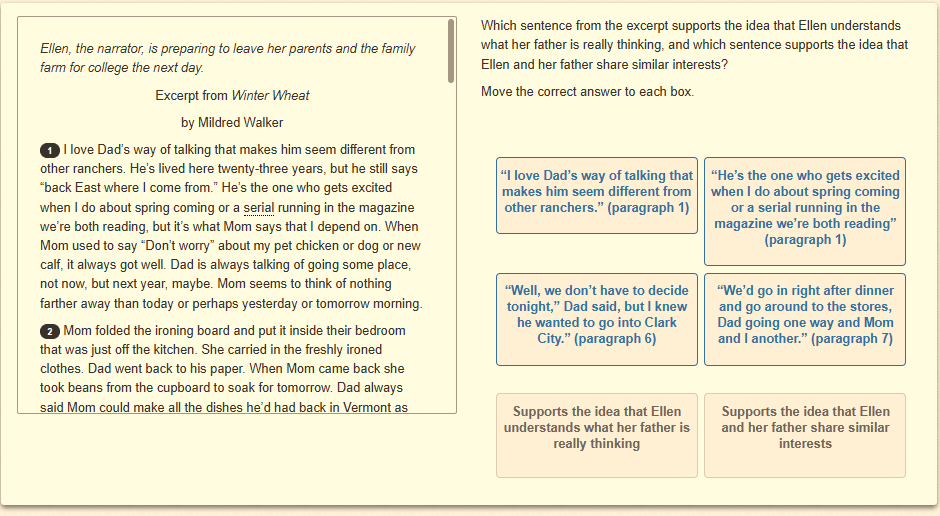
The passage “Excerpt from Winter Wheat” as shown on the test
Question 89 of 120
2025 Practice Test A English, question 17Uses the passage above: “Excerpt from Winter Wheat”.
Question
Read these sentences from paragraph 2.
Dad always said Mom could make all the dishes he’d had back in Vermont as well as though she were a New Englander herself, instead of a Russian. All of a sudden, I realized that tomorrow when those beans would be ready to eat I’d be going away. It gave me a funny feeling.
The sentences help develop a theme of the excerpt by
- Asuggesting that life presents people with many challenges.
- Bimplying that the stress of major life events can cause confusion.
- Cdemonstrating that moving on from the familiar is a common human experience.
- Demphasizing the idea that people can easily learn the routines of being part of a new culture.
Show the answer
Correct answer: C
The question asks how the sentences in paragraph 2 help develop a theme of the excerpt.
A. Incorrect. Although the sentences from paragraph 2 describe Ellen’s “funny feeling” upon realizing that she will no longer be home when the beans that her mother is making are ready to eat, the details do not show that life presents many challenges. Additionally, the theme that life presents people with many challenges is not a theme found in the excerpt.
B. Incorrect. The sentences from paragraph 2 state that Ellen has “a funny feeling” while awaiting a major life event, but they do not indicate that she is confused or stressed. The details in the sentences convey a sense of wistfulness, but the theme that the stress of major life events causes confusion is not found in the excerpt.
C. CORRECT. The sentences from paragraph 2 show that Ellen’s mother has moved on from the familiar and left her childhood home behind, just as Ellen is about to do. This information links the experiences of parent and child and helps develop the theme that moving beyond the familiar is a common human experience.
D. Incorrect. Although the sentences from paragraph 2 show that Ellen’s mother has learned to cook New England food very well (“as though she were a New Englander herself”), they do not provide information about how easy or difficult it was for Ellen’s mother to learn a new way of cooking. The theme that people can easily learn the routines of a new culture is not a theme found in the excerpt.
Question analysis
This theme question quotes three sentences from paragraph 2 of the Winter Wheat excerpt, about Mom’s cooking and Ellen’s sudden realization that she is leaving, and asks how they help develop a theme. Students must connect a small kitchen moment to an idea that runs through the whole excerpt, choosing among theme statements that range from narrow to very general.
- Grade level
- Grade 8 reading and task
- Compared with grade 7
- Above grade 7 Explaining how details develop a theme is a grade 7 standard. These sentences never state the idea, so students must infer it from a remark about Mom’s cooking and Ellen’s passing feeling, then link it to the whole excerpt, more than typical grade 7 work.
- Estimated difficulty
- Hard: combines ideas, needs a plan, and has more than one tempting wrong answer.
- Thinking it demands
- Depth of knowledge 3, strategic thinking · mainly analyze
- What makes it hard
- Reading between the lines major
- Evidence in several places moderate
- How, not what minor
- Evidence
- Answered from the whole text
- Reading level
- Passage: about grade 4, 1179 words; question and choices: about grade 7, 117 words.
- Students, last 30 days
- Not enough answers yet to show (it takes 10).
Why it is hard, traps and wrong answers (shows the answer)
Why it is hard
The quoted sentences seem to be about cooking and a passing mood, and the link to a theme hides in where the parents come from. Students who miss that Dad and Mom both left homes far away read the passage as being about Mom’s skill or Ellen’s nerves, and pick a theme built on one of those. The vague choice about life’s challenges catches students who sense that leaving is hard but cannot pin the theme to these details.
Reading between the lines major Working it out
The theme is never stated: students must notice that “back in Vermont” and “instead of a Russian” mean both parents left their first homes, just as Ellen realizes she will be “going away.” (Graesser, Singer & Trabasso, 1994; Kintsch, 1998)
Evidence in several places moderate Working it out
A theme of the excerpt must hold beyond paragraph 2, so the choice has to be checked against Dad’s trip back East in the flashback and Mom’s Russian name in paragraph 22. (Kirsch & Mosenthal, 1990; Gorin & Embretson, 2006)
How, not what minor Working it out
The stem asks how the sentences develop a theme, so a remark about cooking has to be read for what it reveals about the parents’ pasts, not for its subject. (Anderson & Krathwohl, 2001)
Strategy: Note what each quoted sentence tells you about the person in it, then pick the theme that these details and the rest of the excerpt both support.
Traps
- Reads too much in: A reasonable-sounding conclusion that goes further than the text allows.
- Too broad or too strong: A choice overstates, generalizes, or uses absolute words the text does not support.
- Wrong tone or attitude: Misjudges the tone, attitude or point of view, such as reading admiration as criticism, or taking a character's or subject's feelings for the author's.
The wrong answers, classified
A Too broad or too strong (King et al., 2004)
Chooses a theme loose enough to fit almost any story; the sentences show the parents’ pasts and a sudden realization, not a series of challenges.
B Wrong tone or attitude (Graesser, Singer & Trabasso, 1994)
Hears stress and confusion in Ellen’s “funny feeling,” though the sentences suggest a quiet, wistful realization, and nothing in the excerpt shows her confused about leaving.
D Reads too much in (Graesser, Singer & Trabasso, 1994)
Seizes on Mom cooking “as though she were a New Englander herself” and adds that adapting was easy, which the sentence never says; it praises her skill, not the ease of learning.
Working it out, step by step
Figure out what the question asks
This asks how three sentences from paragraph 2 help build a theme. A theme is a big idea about life that a story keeps showing. Look at what each sentence tells you about the people in it, not just at its subject, cooking.
Read the sentence about Mom and Dad
The first sentence says “Dad always said Mom could make all the dishes he’d had back in Vermont as well as though she were a New Englander herself, instead of a Russian.” Vermont is a state far to the east, in New England. Dad grew up there. Mom came from Russia. So both parents left the places where they grew up.
Read the sentences about Ellen
The next sentences say “All of a sudden, I realized that tomorrow when those beans would be ready to eat I’d be going away. It gave me a funny feeling.” The beans are soaking for tomorrow’s meal. Ellen sees that she won’t be home to eat them. She is about to leave her own home, just as her parents once left theirs.
Find the theme
Put the two parts together. Dad left Vermont, Mom left Russia, and now Ellen is leaving the farm. Each of them moves on from a familiar place. So the sentences show that leaving what you know is something many people go through. Ellen’s “funny feeling” is wistful, a quiet sadness, like missing home before you go.
Check each choice
- A does not fit. It is so broad it could fit almost any story. These sentences show leaving home, not many challenges.
- B does not fit. Ellen’s feeling is quiet and wistful. Nothing shows her stressed or confused.
- C fits. Parents and daughter all move on from a familiar home.
- D does not fit. Dad praises Mom’s cooking, but the sentence never says learning it was easy.
Choose the answer
The sentences link Ellen’s leaving to her parents’ own leaving long ago. So the answer is C.
Why this answer and not the closest wrong one
B is the closest wrong choice, because a “funny feeling” before a big change could sound like stress. But Ellen is not mixed up or panicked. She simply realizes she will be gone tomorrow. The sentences tie that moment to her parents’ moves from Vermont and Russia. That shared experience of leaving is C.
More questions like this
The original DOE question
Question 90 of 120
2025 Practice Test A English, question 18Uses the passage above: “Excerpt from Winter Wheat”.
Question
Read this sentence from paragraph 3.
“I’ll be taking the train tomorrow night,” I said aloud, more to hear it myself.
This remark contributes to the conflict in the excerpt by
- Arevealing Dad’s reasons for wanting to drive to the city.
- Bcausing tension between Mom and Dad.
- Cleading Ellen to distance herself from both Mom and Dad.
- Dshowing Mom’s reluctance to plan that far in advance.
Show the answer
Correct answer: B
The question asks how the sentence from paragraph 3 contributes to the conflict in the excerpt.
A. Incorrect. Although Ellen’s father does want to drive to the city, this sentence does not reveal his reasons for wanting to do so. Ellen’s father’s wish to drive to the city is important to the conflict of the excerpt not because of his underlying reasons but because his wish differs from Ellen’s mother’s wish to take Ellen to the train at Gotham—a difference of opinion that introduces tension between the parents.
B. CORRECT. The sentence causes Ellen’s parents to propose competing options for taking her to the train, and the resulting conversation recalls fraught memories of an earlier leave-taking in the family. The disagreement between Ellen’s mother and father over where to take Ellen to catch the train heightens the tension between them. Because the primary conflict of the excerpt is Ellen’s anxiety about the effect her leaving will have on the relationship between her parents, this remark contributes to the conflict by bringing her parents’ disagreement into view.
C. Incorrect. Although Ellen will put physical distance between herself and her parents on the following day, the remark she makes does not lead her to emotionally distance herself from her parents. Moreover, the emotional distance between Ellen and her parents is not the primary source of conflict in the excerpt.
D. Incorrect. While paragraph 1 states that Ellen’s mother “seems to think of nothing farther away than today or perhaps yesterday or tomorrow morning,” the sentence in paragraph 3 does not show any reluctance to plan far in advance. Moreover, planning for the future is not a source of conflict in the excerpt.
Question analysis
This plot question quotes Ellen’s remark in paragraph 3 of the Winter Wheat excerpt, said aloud mostly so she can hear it herself, and asks how it contributes to the excerpt’s conflict. Students must first work out what the conflict is, since the story has no fight or villain, and then follow what the remark leads to.
- Grade level
- Grade 8 reading and task
- Compared with grade 7
- At grade 7 Analyzing how a line of dialogue drives a plot matches the grade 8 wording of the standard. The remark is short and plain, though, and what it sets off plays out in the next few paragraphs, which keeps the demand typical.
- Estimated difficulty
- Moderate: several steps, or a close reading with one strong distractor.
- Thinking it demands
- Depth of knowledge 2, skills and concepts · mainly analyze
- What makes it hard
- Reading between the lines moderate
- Evidence in several places moderate
- How, not what minor
- Evidence
- Answered from several paragraphs or stanzas
- Reading level
- Passage: about grade 4, 1179 words; question and choices: about grade 5, 65 words.
- Students, last 30 days
- Not enough answers yet to show (it takes 10).
Why it is hard, traps and wrong answers (shows the answer)
Why it is hard
The remark itself is plain, and neither parent raises a voice in reply, so the tension it causes is easy to miss. Students who do not see that the excerpt’s real problem is Ellen’s worry about her parents look for a more visible effect, such as Dad’s wish to drive her or Mom’s habit of thinking no farther than tomorrow. The question rewards reading the remark together with the quiet exchange it starts in paragraphs 4 to 6.
Reading between the lines moderate Working it out
The excerpt never names its conflict; students must infer from paragraph 6 and the closing paragraph that Ellen worries about her very different parents getting along once she leaves. (Graesser, Singer & Trabasso, 1994; Kintsch, 1998)
Evidence in several places moderate Working it out
The remark’s effect unfolds over the next three paragraphs: Dad offers to drive into town, Mom says the Gotham train will do, and Dad puts off the decision. (Kirsch & Mosenthal, 1990; Gorin & Embretson, 2006)
How, not what minor Working it out
The question asks what the remark does for the plot, not what it says; a plain statement of travel plans matters only for the disagreement it sets off. (Anderson & Krathwohl, 2001)
Strategy: Name the excerpt’s central problem in your own words first, then reread the remark with the paragraphs right after it and pick the choice that shows how the remark feeds that problem.
Traps
- Twists what the text says: Uses the text's topic and ideas but changes what it says: who did it, how much, when, or why.
- Wrong part of the text: A choice is true of another paragraph, stanza or speaker than the one asked about.
- Reads too much in: A reasonable-sounding conclusion that goes further than the text allows.
The wrong answers, classified
A Twists what the text says (King et al., 2004)
Sees that the remark prompts Dad’s offer to drive Ellen into town but credits it with revealing his reasons, which neither the remark nor his offer gives; Ellen guesses one later.
C Reads too much in (Graesser, Singer & Trabasso, 1994)
Turns Ellen’s coming departure into an emotional withdrawal, though after speaking she grows no more distant; she worries about her parents and, in the flashback, clings to Mom.
D Wrong part of the text (Kirsch & Mosenthal, 1990)
Recalls paragraph 1’s comment that Mom thinks no farther ahead than tomorrow morning, but the remark shows nothing of the kind: Mom answers it at once with a plan of her own.
Working it out, step by step
Figure out what the question asks
This asks how Ellen’s remark adds to the conflict, the main problem in the story. The remark itself is plain. It just says when she will leave. So look at what happens right after she says it.
Name the story’s conflict
In paragraph 6, Ellen says her going away was hard on both parents. They were very different, and she was part of them both. In paragraph 25, she says she feels a distance between them. She wonders how they will get along without her. So the conflict is Ellen’s worry about her two very different parents once she is gone.
See what the remark sets off
Right after Ellen speaks, her parents disagree. In paragraph 4, Dad offers to drive her into town. In paragraph 5, Mom says there is no need, because Ellen can catch the train at Gotham. In paragraph 6, Dad puts off the choice, though Ellen knows he wants to go to town. Neither parent shouts, but they want different things.
Connect the remark to the conflict
Ellen’s simple remark brings her parents’ differences into the open. Their quiet disagreement shows the tension between them. Tension is a tight, uneasy feeling between people. That tension is just what worries Ellen about leaving. So the remark feeds the conflict by causing tension between Mom and Dad.
Check each choice
- A does not fit. Dad offers to drive, but no one explains why he wants to.
- B fits. The remark leads straight to the parents’ disagreement.
- C does not fit. Ellen doesn’t pull away from her parents. She worries about them.
- D does not fit. Paragraph 1 says Mom doesn’t think far ahead. But here Mom answers at once with a plan of her own.
Watch out: D borrows a detail from paragraph 1. The remark itself shows nothing of the kind.
Choose the answer
The remark starts a quiet disagreement about how Ellen will leave. So the answer is B.
Why this answer and not the closest wrong one
A is the closest wrong choice, because the remark does lead to Dad’s offer to drive. But Dad never gives his reasons. What matters is that Mom wants something else. Their different wishes show the tension between them, and that tension is what Ellen worries about. That is B.
More questions like this
The original DOE question
Question 91 of 120
2025 Practice Test A English, question 19Uses the passage above: “Excerpt from Winter Wheat”.
Question
Read this sentence from paragraph 9.
I tried to, and then I just sat still and looked straight at it.
How does the phrase “looked straight at it” contribute to the meaning of the excerpt?
- AIt shows that Ellen is willing to deal with a problem directly instead of ignoring it.
- BIt suggests that Ellen studies all parts of an issue and not just its surface.
- CIt illustrates that Ellen examines both sides of an argument.
- DIt implies that Ellen is eager to seek wisdom from past experiences.
Show the answer
Correct answer: A
The question asks how the phrase “looked straight at it” in paragraph 9 contributes to the meaning of the excerpt.
A. CORRECT. The phrase shows Ellen deciding to directly confront the memory even though she initially wanted to ignore it (“I couldn’t keep from thinking of that time Dad went back East. I tried to” [paragraph 9]). Though the memory is emotionally fraught for Ellen, the phrase “looked straight at it” shows that she is willing to face problems—such as a painful family memory—head-on.
B. Incorrect. The phrase in paragraph 9 does not show Ellen studying all parts of an issue but rather forcing herself to focus on something she would have preferred not to think about.
C. Incorrect. In looking “straight at” the memory, Ellen is not considering both sides of an argument. Instead, she is making herself think about an uncomfortable memory that she had been trying to avoid revisiting. The phrase indicates that she is finally willing to directly confront an unsettling recollection.
D. Incorrect. Given the detail in paragraph 9 that Ellen initially attempted to keep from thinking about her father’s trip to Vermont, the phrase “looked straight at it” indicates a willingness, but not an eagerness, to seek wisdom from reflecting on past experiences.
Question analysis
This word-meaning question quotes a sentence from paragraph 9 of the Winter Wheat excerpt, where Ellen sits on her bed the night before she leaves home, and asks how the phrase “looked straight at it” contributes to the excerpt’s meaning. Students must work out what “it” refers to and read the phrase figuratively, using the sentences around it.
- Grade level
- Grade 7 reading and task
- Compared with grade 7
- At grade 7 Interpreting a figurative phrase in context is routine grade 7 work. The phrase is short and quoted with its sentence, but its meaning depends on the sentence before it, so students cannot judge it from the quotation alone.
- Estimated difficulty
- Straightforward: two steps or one careful reading.
- Thinking it demands
- Depth of knowledge 2, skills and concepts · mainly understand
- What makes it hard
- Figurative or literary language moderate
- Reading between the lines minor
- Evidence
- Answered from one paragraph or stanza
- Reading level
- Passage: about grade 4, 1179 words; question and choices: about grade 6, 87 words.
- Students, last 30 days
- Not enough answers yet to show (it takes 10).
Why it is hard, traps and wrong answers (shows the answer)
Why it is hard
Once “it” is traced to the memory of Dad’s leaving, the phrase reads naturally as facing something hard, and the sentence that follows it in paragraph 9 says as much. The wrong choices make the act more intellectual than it is, studying every part or weighing two sides, or make Ellen eager when she has just tried not to think about it. Students who read the phrase only by itself are likeliest to slip.
Figurative or literary language moderate Understanding the question
Nothing is literally looked at: “it” is a memory, so “looked straight at it” means facing the painful thought of Dad’s trip back East instead of pushing it away. (Graesser, Singer & Trabasso, 1994; Kintsch, 1998)
Reading between the lines minor Working it out
What “it” refers to, and what “I tried to” leaves out, both sit in the sentence before, “I couldn’t keep from thinking of that time Dad went back East.” (Graesser, Singer & Trabasso, 1994; Kintsch, 1998)
Strategy: Reread the sentence before the quoted one to find what “it” is, picture what looking straight at that would mean, and test each choice against the whole of paragraph 9.
Traps
- Reads too much in: A reasonable-sounding conclusion that goes further than the text allows.
- Half right: One half of a two-part choice is right and the other is not.
- Twists what the text says: Uses the text's topic and ideas but changes what it says: who did it, how much, when, or why.
The wrong answers, classified
B Reads too much in (Graesser, Singer & Trabasso, 1994)
Reads “looked straight at it” as close study of an issue from every angle, but Ellen is making herself face a memory she tried to avoid, not analyzing its parts.
C Twists what the text says (King et al., 2004)
Keeps the idea of looking at something carefully but turns it into weighing both sides of an argument, though Ellen sits alone with a memory and no one is arguing.
D Half right (King et al., 2004; Thissen, Steinberg & Fitzpatrick, 1989)
Rightly sees Ellen turning back to a past experience but calls her eager to learn from it, though paragraph 9 shows she first tried hard not to think of it.
Working it out, step by step
Figure out what the question asks
This asks what the phrase “looked straight at it” adds to the meaning of the excerpt. First you need to know what “it” is. Then picture what looking straight at that thing would mean.
Find what “it” means
Paragraph 9 says “I couldn’t keep from thinking of that time Dad went back East. I tried to.” So “it” is a memory of the night Dad left on a trip. “I tried to” means Ellen tried not to think about it. The memory is painful, so she tried to push it away.
Picture the phrase
Ellen can’t look at a memory with her eyes. So “looked straight at it” is a figure of speech, words that mean more than they literally say. It means she stopped running from the memory and faced it. The next sentence in paragraph 9 agrees. It says facing a thought is sometimes better than working hard to avoid it.
Check each choice
- A fits. Ellen faces a hard memory instead of ignoring it.
- B does not fit. She is not studying every part of an issue. She is making herself think about one painful memory.
- C does not fit. No one is arguing, so there are no two sides to weigh.
- D does not fit. Ellen first tried hard not to think about the memory, so she isn’t eager.
Watch out: D is half right, since Ellen does turn to the past. But eager means wanting to do something, and at first she didn’t want to.
Choose the answer
The phrase shows Ellen choosing to face a painful memory head-on. So the answer is A.
Why this answer and not the closest wrong one
D is the closest wrong choice, because Ellen does think about a past experience. But paragraph 9 says she first tried to keep from thinking about it. Only then did she sit still and face it. She is willing, not eager. That makes A the better fit: she deals with the problem directly.
More questions like this
The original DOE question
Question 92 of 120
2025 Practice Test A English, question 20Uses the passage above: “Excerpt from Winter Wheat”.
Question
The words “cold” and “dark” affect the tone in paragraph 10 by
- Ahighlighting the feeling of unpredictability among the family members.
- Bshowing the feelings of anger and resentment Ellen directs toward her parents.
- Cexaggerating the feeling of regret Dad experiences when leaving his family.
- Demphasizing the feelings of separation and loss that Ellen feels.
Show the answer
Correct answer: D
The question asks how the words “cold” and “dark” affect the tone in paragraph 10.
A. Incorrect. The mood of paragraph 10 is primarily one of sadness as Ellen says goodbye to her father at the train station. The words “cold” and “dark” do not convey unpredictability but rather emphasize Ellen’s feeling of loss over the departure of her father.
B. Incorrect. Although the father’s departure causes tension with his wife (“ ‘I’ll manage,’ Mom snapped back” [paragraph 11]), Ellen does not display anger or resentment toward her parents.
C. Incorrect. Although Ellen’s father states that he wishes his family could come with him on the trip to Vermont (“ ‘I wish you could go, Anna,’ Dad said to Mom, ‘and we could take Ellen’ ” [paragraph 12]), the words “cold” and “dark” describe Ellen’s perspective on her father’s departure. They create a tone of sadness from Ellen at being left behind rather than a tone of regret from her father because he has to leave.
D. CORRECT. In paragraph 10, Ellen states, “I could feel how cold and dark it was.” The words “cold” and “dark” highlight her emotional response to the departure of her father, emphasizing the almost physical sense of grief she feels at being separated from someone so precious to her.
Question analysis
This tone question asks how the words “cold” and “dark” affect the tone of paragraph 10 of the Winter Wheat excerpt, where Ellen remembers waiting for the train one November night as her father set off for Vermont. Students must decide what the two words add beyond describing the night itself.
- Grade level
- Grade 7 reading and task
- Compared with grade 7
- At grade 7 Explaining how word choice shapes tone is regular grade 7 work. The two words are named in the question and sit in one short paragraph, so the main step is seeing that they carry feeling as well as describing a November night.
- Estimated difficulty
- Straightforward: two steps or one careful reading.
- Thinking it demands
- Depth of knowledge 2, skills and concepts · mainly analyze
- What makes it hard
- Figurative or literary language moderate
- Reading between the lines minor
- Evidence
- Answered from one paragraph or stanza
- Reading level
- Passage: about grade 4, 1179 words; question and choices: about grade 10, 53 words.
- Students, last 30 days
- Not enough answers yet to show (it takes 10).
Why it is hard, traps and wrong answers (shows the answer)
Why it is hard
The two words are named in the stem and appear together in a single sentence of paragraph 10, so the main step is seeing that they describe a feeling as well as the weather. The wrong choices shift the feeling to someone else or swap it for another, borrowing Mom’s sharp reply and Dad’s wish from the paragraphs just after. Students who keep their attention on Ellen waiting for the train in paragraph 10 have little trouble.
Figurative or literary language moderate Understanding the question
“Cold” and “dark” describe a November night, yet the grown narrator says she “could feel how cold and dark it was,” so the weather words carry her sense of loss as Dad leaves. (Graesser, Singer & Trabasso, 1994; Kintsch, 1998)
Reading between the lines minor Working it out
Paragraph 10 never names a feeling; the sadness comes from details such as Ellen holding Mom’s hand and Dad seeming strange in his good clothes. (Graesser, Singer & Trabasso, 1994; Kintsch, 1998)
Strategy: Reread paragraph 10 and ask what Ellen is going through at that moment, then choose the option that names the feeling the two words strengthen and the person who has it.
Traps
- Wrong tone or attitude: Misjudges the tone, attitude or point of view, such as reading admiration as criticism, or taking a character's or subject's feelings for the author's.
- Wrong part of the text: A choice is true of another paragraph, stanza or speaker than the one asked about.
The wrong answers, classified
A Wrong tone or attitude (Graesser, Singer & Trabasso, 1994)
Links darkness with not knowing what comes next, but nothing in paragraph 10 is uncertain: Dad’s trip is settled, and the words deepen Ellen’s sadness, not suspense.
B Wrong tone or attitude (Graesser, Singer & Trabasso, 1994)
Carries the sharpness of Mom’s “I’ll manage” into Ellen’s feelings and calls it anger at her parents, though Ellen holds her mother’s hand and blames no one.
C Wrong part of the text (Kirsch & Mosenthal, 1990)
Gives the feeling to Dad because in paragraph 12 he wishes his wife and daughter could come, though the cold and dark are what Ellen feels as she waits to see him off.
Working it out, step by step
Figure out what the question asks
This asks how two words, “cold” and “dark,” affect the tone of paragraph 10. Tone is the feeling the writing gives off. Ask whose feeling it is and what that feeling is.
Find the words in paragraph 10
Paragraph 10 begins Ellen’s memory of the night Dad left for Vermont. It was November, and dark when the train came. Ellen says that even now, years later, “I could feel how cold and dark it was.” She held Mom’s hand. Dad looked strange in his good clothes. They stood there without talking.
Work out the feeling
Cold and dark describe a November night. But Ellen can still feel them years later, so the words carry her feelings too. Cold and dark are lonely, sad words. Her father is leaving, and she feels cut off from him. The words stress her sense of separation and loss.
Check each choice
- A does not fit. Nothing is uncertain. Dad’s trip is planned, and the words make the scene sad, not unpredictable.
- B does not fit. Ellen holds Mom’s hand. She blames no one, so there is no anger.
- C does not fit. Dad says in paragraph 12 that he wishes they could come. But the cold and dark are what Ellen feels, not Dad.
- D fits. The words deepen Ellen’s sadness at being separated from her father.
Watch out: C borrows Dad’s wish from a later paragraph and gives him the feeling.
Choose the answer
“Cold” and “dark” show how lonely and sad Ellen felt as her father left. So the answer is D.
Why this answer and not the closest wrong one
C is the closest wrong choice, because Dad does wish his family could come with him. But that wish is in paragraph 12. In paragraph 10, Ellen says “I could feel how cold and dark it was.” The feeling belongs to her. The words stress her sense of being separated from her father, which is D.
More questions like this
The original DOE question
Question 93 of 120
2025 Practice Test A English, question 21Uses the passage above: “Excerpt from Winter Wheat”.
Question
Read these sentences from the excerpt.
Mom seems to think of nothing farther away than today or perhaps yesterday or tomorrow morning. (paragraph 1)
Mom was fixing oatmeal for tomorrow morning. (paragraph 19)
The sentences help develop a central idea of the excerpt by
- Asuggesting that practical people focus on current needs rather than worrying about the future.
- Bshowing that parents tend to consider the needs of their children before thinking of themselves.
- Crevealing that it is sometimes important to plan ahead.
- Dillustrating that dreaming about the future is a waste of time.
Show the answer
Correct answer: A
The question asks how the sentences from paragraph 1 and paragraph 19 help develop a central idea of the excerpt.
A. CORRECT. The sentences illustrate a practical aspect of Ellen’s mother’s personality and show that she is concerned with an immediate task that needs to be completed. The details in these sentences help develop the central idea that practical people focus on current needs—such as preparing food for the following day—rather than worrying about the future.
B. Incorrect. These sentences do not show Ellen’s mother focusing on her daughter’s needs before her own, and the idea that parents consider their own needs only after considering those of their children is not a central idea of the excerpt.
C. Incorrect. Although the sentence from paragraph 19 shows Ellen’s mother planning a few hours ahead by preparing the next morning’s breakfast, the idea that it is sometimes important to plan ahead is not a central idea of the excerpt, nor is it supported by the sentence from paragraph 1.
D. Incorrect. The details in the sentences do not show that it is a waste of time to dream about the future. The sentences highlight the tendency of Ellen’s mother to focus her attention on the practical necessities of the moment, but the idea that dreaming about the future is a waste of time is not a central idea of the excerpt.
Question analysis
This central-idea question quotes two sentences about Ellen’s mother from paragraphs 1 and 19 of the Winter Wheat excerpt, far apart in the story, and asks how they help develop a central idea. Students must see what the two sentences have in common and decide which general statement about people they actually support.
- Grade level
- Grade 7 reading and task
- Compared with grade 7
- At grade 7 Connecting repeated details about a character to a central idea is typical grade 7 work. Both sentences are short and plain, but they sit eighteen paragraphs apart, and the choices are broad statements that must be checked for overreach.
- Estimated difficulty
- Moderate: several steps, or a close reading with one strong distractor.
- Thinking it demands
- Depth of knowledge 2, skills and concepts · mainly analyze
- What makes it hard
- Reading between the lines moderate
- Evidence in several places minor
- Every choice must be checked minor
- Evidence
- Answered from several paragraphs or stanzas
- Reading level
- Passage: about grade 4, 1179 words; question and choices: about grade 7, 91 words.
- Students, last 30 days
- Not enough answers yet to show (it takes 10).
Why it is hard, traps and wrong answers (shows the answer)
Why it is hard
Read alone, the oatmeal sentence looks like a lesson in getting ready for tomorrow, which is why the planning choice tempts. Paired with paragraph 1’s description of Mom, though, it shows a mind fixed on the next practical task, the opposite of thinking far ahead. The other wrong choices go past the sentences, into parents’ sacrifices or a verdict on daydreaming, and students who keep both sentences in view can set them aside.
Reading between the lines moderate Working it out
Neither sentence states an idea; students must see what they share, Mom’s attention stopping at today and tomorrow morning, and then decide what general statement that habit supports. (Graesser, Singer & Trabasso, 1994; Kintsch, 1998)
Evidence in several places minor Working it out
The sentences come from paragraphs 1 and 19, and paragraph 1 sets Mom’s present-minded talk against Dad’s plans for next year, a contrast that frames the idea. (Kirsch & Mosenthal, 1990; Gorin & Embretson, 2006)
Every choice must be checked minor Choosing the answer
Three choices speak of the future, planning or dreaming, so each must be tested against both sentences, not just the oatmeal for tomorrow morning. (Embretson & Wetzel, 1987)
Strategy: Say in your own words what both sentences show about how Mom thinks and acts, then choose the statement that follows from that without going further than the sentences do.
Traps
- Too broad or too strong: A choice overstates, generalizes, or uses absolute words the text does not support.
- Too narrow: A single detail offered as the central idea or a summary, or a summary that keeps minor details and leaves out an essential part.
- Outside knowledge: A choice is plausible in the real world but not supported by this text.
The wrong answers, classified
B Outside knowledge (King et al., 2004; Recht & Leslie, 1988)
Brings in the common belief that parents put children first, treating breakfast-making as self-sacrifice, though neither sentence sets Mom’s needs against Ellen’s or says whom the oatmeal is for.
C Too narrow (King et al., 2004)
Builds a lesson about planning on the oatmeal prepared for the next morning alone, a single detail that paragraph 1’s picture of Mom’s short horizon works against.
D Too broad or too strong (King et al., 2004)
Hardens Mom’s focus on the present into a verdict that dreaming is “a waste of time,” a judgment the excerpt never passes on Dad’s talk of travel or anyone’s.
Working it out, step by step
Figure out what the question asks
This asks how two sentences about Mom help build a central idea, a main idea the story develops. Find what the two sentences have in common. Then pick the idea that follows from both, without going further.
Read the first sentence
Paragraph 1 says “Mom seems to think of nothing farther away than today or perhaps yesterday or tomorrow morning.” Just before this, Ellen says Dad is always talking about going places next year. So Mom is different. Her mind stays on the here and now.
Read the second sentence
Paragraph 19 says “Mom was fixing oatmeal for tomorrow morning.” This is the night Dad left on his trip, and Ellen is sad. But Mom does the next useful job, making breakfast. Again her mind goes no farther than tomorrow morning.
Find the shared idea
Both sentences show Mom as practical. Practical means focused on real, useful tasks. She deals with what needs doing now and next, not with far-off plans or dreams. So the sentences develop the idea that practical people focus on current needs instead of worrying about the future.
Check each choice
- A fits. Both sentences show Mom focused on today’s needs.
- B does not fit. Neither sentence weighs Mom’s needs against Ellen’s.
- C does not fit. Oatmeal for the next morning is a small step, not planning ahead. Paragraph 1 says Mom doesn’t think far ahead at all.
- D does not fit. The story never says dreaming is a waste of time. It doesn’t judge Dad’s talk of travel.
Watch out: Read alone, the oatmeal sentence looks like planning ahead. Read it together with paragraph 1.
Choose the answer
Both sentences show Mom paying attention to what is needed now, not to the far future. So the answer is A.
Why this answer and not the closest wrong one
C is the closest wrong choice, because making oatmeal for tomorrow does look like planning. But paragraph 1 says Mom thinks no farther ahead than tomorrow morning. The oatmeal is just the next job, not a long-range plan. Together the sentences show a practical mind fixed on present needs, which is A.
More questions like this
The original DOE question
Question 94 of 120
2025 Practice Test A English, question 22Uses the passage above: “Excerpt from Winter Wheat”.
Question
The flashback in paragraphs 10–24 affects the plot by
- Ashowing that the departure of one member of the family makes extra work for those left on the farm.
- Bshowing that the bond within the family persists even when its members are apart.
- Cexplaining why Ellen fears that leaving her parents will be too difficult.
- Dillustrating the close connection Ellen has with both of her parents.
Show the answer
Correct answer: D
The question asks how the flashback in paragraphs 10–24 affects the plot of the excerpt.
A. Incorrect. The flashback does not show that Ellen and her mother faced extra work as a result of the father’s trip to Vermont. Although paragraph 19 describes Ellen’s mother making oatmeal for the next day’s breakfast, this task was not extra work.
B. Incorrect. Although the flashback highlights Ellen’s fondness for each of her parents, it describes her father’s initial departure only and does not show what happened to the familial bond while he is away.
C. Incorrect. Although Ellen describes the memory of her father’s departure as something she wanted to avoid thinking about, she does not fear that it will be too difficult to leave her parents. Instead, she is concerned about what will happen to her parents’ relationship when she is no longer there.
D. CORRECT. The flashback illustrates the close connection that Ellen has with her parents by describing her sadness over the departure of her father (“My throat ached all the way” [paragraph 15]) and presenting a moment of comfort and reassurance between Ellen and her mother (“She laid her hand against my face and it felt rough and hard but firm” [paragraph 20]).
Question analysis
This text-structure question asks how the long flashback in paragraphs 10–24 of the Winter Wheat excerpt, Ellen’s memory of the night her father left by train for Vermont, affects the plot. Students must hold fifteen paragraphs in mind, see why the narrator recalls that night just before her own departure, and choose among several believable effects.
- Grade level
- Grade 8 reading and task
- Compared with grade 7
- Above grade 7 Grade 7 students study how a flashback shapes a story. This one runs through most of the excerpt, so students must sum up a long stretch of narrative and then tell apart choices that are close in meaning, more than typical grade 7 work.
- Estimated difficulty
- Among the hardest on the SHSAT: a non-obvious approach, heavy reading, or a well-hidden trap.
- Thinking it demands
- Depth of knowledge 3, strategic thinking · mainly analyze
- What makes it hard
- Evidence in several places major
- A very close wrong answer moderate
- How, not what moderate
- Evidence
- Answered from the whole text
- Reading level
- Passage: about grade 4, 1179 words; question and choices: about grade 7, 64 words.
- Students, last 30 days
- Not enough answers yet to show (it takes 10).
Why it is hard, traps and wrong answers (shows the answer)
Why it is hard
The flashback is most of the excerpt, and it carries several things at once: grief at Dad’s leaving, the parents’ stiffness with each other, Mom’s comfort, the mystery of her Russian name. The two strongest wrong choices sound like plot effects, a bond lasting through absence or a fear of leaving, while the key describes a relationship, so students looking for an event to point to may pass it by. Students must sum up the whole memory and test each choice against what it actually shows.
Evidence in several places major Working it out
The support for “both of her parents” lies in two separate stretches of a fifteen-paragraph flashback: Ellen’s aching throat after Dad’s train leaves in paragraph 15, and Mom’s hand on her face in paragraph 20. (Kirsch & Mosenthal, 1990; Gorin & Embretson, 2006)
A very close wrong answer moderate Choosing the answer
The choice about the family bond persisting while members are apart shares the right one’s subject, family closeness, and differs in one claim, that the bond lasts through a separation the flashback never follows. (Embretson & Wetzel, 1987; Gorin & Embretson, 2006; Ascalon et al., 2007)
How, not what moderate Working it out
The stem asks how the flashback affects the plot, yet the keyed effect is about character, so students must accept that the memory works by showing Ellen’s ties to each parent before she leaves. (Anderson & Krathwohl, 2001)
Strategy: Summarize what happens in the flashback and how Ellen feels at each stage, then compare it with the present-day scenes before and after it and decide what the memory adds.
Traps
- Twists what the text says: Uses the text's topic and ideas but changes what it says: who did it, how much, when, or why.
- Reads too much in: A reasonable-sounding conclusion that goes further than the text allows.
- Outside knowledge: A choice is plausible in the real world but not supported by this text.
The wrong answers, classified
A Outside knowledge (King et al., 2004; Recht & Leslie, 1988)
Assumes a farmer’s absence must mean more chores, perhaps from Dad’s reminder about the cow and Mom’s “I’ll manage,” though the flashback never shows Ellen and Mom burdened with extra work.
B Reads too much in (Graesser, Singer & Trabasso, 1994)
Sees the warmth between Ellen and her parents and stretches it into a bond that lasts through a long separation, though the memory ends the night Dad leaves.
C Twists what the text says (King et al., 2004)
Ties the flashback to Ellen’s unease about leaving but misplaces the worry: what troubles her is how her parents will manage without her, not whether leaving will be too hard.
Working it out, step by step
Figure out what the question asks
This asks how the flashback in paragraphs 10–24 affects the story. A flashback is a scene from the past that interrupts the present. Here Ellen, about to leave for college, remembers the night Dad left for Vermont years ago. Sum up what the memory shows, then test each choice.
Sum up the flashback
Ellen and Mom see Dad off at the train in the cold dark. On the drive home, Ellen says “My throat ached all the way.” At home, Mom comforts her: “She laid her hand against my face and it felt rough and hard but firm.” Later, Mom laughs warmly about her name, and the house feels right again.
See what the memory shows
An aching throat is the tight, sore feeling you get when you hold back tears. That shows how much Ellen loves her father. Mom’s firm hand and warm laugh show how close Ellen is to her mother. So the flashback shows Ellen’s strong tie to both parents.
Check each choice
- A does not fit. The flashback never shows Ellen and Mom with extra farm work.
- B does not fit. The memory ends the night Dad leaves. It never shows the family while he is away.
- C does not fit. Ellen’s worry is about how her parents will get along without her, not about whether leaving will be too hard.
- D fits. It shows Ellen’s love for Dad and her closeness to Mom.
Watch out: B also talks about family closeness. But it says the bond lasts through time apart, which the flashback never shows.
Choose the answer
The flashback shows how close Ellen is to her father and to her mother. So the answer is D.
Why this answer and not the closest wrong one
B is the closest wrong choice, because it also describes a strong family bond. But B says the bond lasts while family members are apart. The flashback stops on the night Dad leaves, so it never shows that. It does show Ellen grieving for Dad and comforted by Mom. That is D.
More questions like this
The original DOE question
Question 95 of 120
2025 Practice Test A English, question 23Uses the passage above: “Excerpt from Winter Wheat”.
Question
Which sentence from the excerpt provides evidence that Mom wants Ellen to understand the family’s heritage?
- A“Mom folded the ironing board and put it inside their bedroom that was just off the kitchen.” (paragraph 2)
- B“ ‘There’s no need to go to town; she can catch the train at Gotham just as well.’ ” (paragraph 5)
- C“We’d go in right after dinner and go around to the stores, Dad going one way and Mom and I another.” (paragraph 7)
- D“ ‘Why, Yeléna, you know that; Anna Petrovna.’ ” (paragraph 22)
Show the answer
Correct answer: D
The question asks which sentence from the excerpt provides evidence that Mom wants Ellen to understand the family’s heritage.
A. Incorrect. Although this sentence from paragraph 2 describes a domestic moment that takes place within the family home, it does not relate to the heritage of either parent and therefore does not provide evidence that her mother wants Ellen to understand the family’s heritage.
B. Incorrect. Although this sentence from paragraph 5 provides the name of the train station closest to Ellen’s family’s farm, the train stop at Gotham is not related to the family’s heritage. Therefore, this sentence does not provide clear evidence that her mother wants Ellen to understand the family’s heritage.
C. Incorrect. Although this sentence from paragraph 7 describes an aspect of the family dynamic (Ellen predicts that while browsing in stores in town, “Dad [would go] one way and Mom and I another”), their shopping habits do not provide clear evidence that her mother wants Ellen to understand the family’s heritage.
D. CORRECT. In this sentence from paragraph 22, Ellen’s mother addresses her by the Russian version of her name (Yeléna) and repeats her own Russian name (Anna Petrovna). The choice to call her daughter Yeléna instead of Ellen follows immediately after Ellen asks, “Mom, was that really your name—what Dad called you?” (paragraph 21), and the mother’s surprised response provides evidence that she both wants and expects Ellen to understand the family’s Russian heritage.
Question analysis
This evidence question asks which quoted sentence from the Winter Wheat excerpt shows that Mom wants Ellen to understand the family’s heritage. The four sentences, from paragraphs 2, 5, 7 and 22, all involve Mom, so students must reread each one in its paragraph to see what it really shows about her.
- Grade level
- Grade 6 reading and task
- Compared with grade 7
- Below grade 7 Finding the sentence that supports a stated idea is everyday grade 7 work. The quotations are short and plainly worded and the idea is concrete, so one careful rereading of each in context is enough, a lighter task than usual.
- Estimated difficulty
- Routine: one familiar step, little to misread.
- Thinking it demands
- Depth of knowledge 2, skills and concepts · mainly evaluate
- What makes it hard
- Evidence
- Answered from several paragraphs or stanzas
- Reading level
- Passage: about grade 4, 1179 words; question and choices: about grade 8, 83 words.
- Students, last 30 days
- Not enough answers yet to show (it takes 10).
Why it is hard, traps and wrong answers (shows the answer)
Why it is hard
Only one of the four sentences touches the family’s origins at all, so a student who knows what heritage means can rule out the others at a glance. The small risk lies with students who match “Mom wants” to any line where Mom states a preference, or who do not recognize the Russian names, since the quotation stops before Mom mentions Russia.
Reading between the lines minor Working it out
The quoted line never mentions heritage; students must see that Mom calling Ellen “Yeléna” and repeating “Anna Petrovna,” as things Ellen should already know, shows her wish to pass on their Russian roots. (Graesser, Singer & Trabasso, 1994; Kintsch, 1998)
Evidence in several places minor Working it out
The names’ Russian origin is clearest outside the quotation, in the rest of paragraph 22, where Mom names her birthplace, and in paragraph 2’s “instead of a Russian.” (Kirsch & Mosenthal, 1990; Gorin & Embretson, 2006)
Strategy: Define heritage in your own words, then reread each quoted sentence in its paragraph and ask whether it shows Mom handing something about the family on to Ellen.
Traps
- True but not the answer: A choice says something accurate about the text that does not answer this question.
- Supports only part of the claim: In a question about evidence: a line that backs one half of the claim but not the other, or a related point rather than the claim itself.
The wrong answers, classified
A True but not the answer (King et al., 2004; Embretson & Wetzel, 1987)
Picks an everyday moment of Mom putting away the ironing board, perhaps remembering that paragraph 2 also mentions her Russian roots, though this sentence shows only housework.
B Supports only part of the claim (King et al., 2004; Thissen, Steinberg & Fitzpatrick, 1989)
Matches “Mom wants” to Mom’s spoken preference that Ellen catch the train at Gotham, which backs half the idea, a wish of Mom’s, but concerns travel, not heritage.
C True but not the answer (King et al., 2004; Embretson & Wetzel, 1987)
Notices Mom and Ellen shopping together in Ellen’s imagined trip to town, a sign of closeness, but going around the stores says nothing about where the family comes from.
Working it out, step by step
Figure out what the question asks
This asks which sentence shows that Mom wants Ellen to understand the family’s heritage. Heritage is the history and traditions a family passes down, such as where it came from. Look for a sentence where Mom shares something about the family’s roots.
Look at the conversation
At the train, Dad called Mom Anna Petrovna, a name Ellen had never heard him use. In paragraph 21, Ellen asks, “Mom, was that really your name—what Dad called you?” In paragraph 22, Mom answers, “Why, Yeléna, you know that; Anna Petrovna.” Then she reminds Ellen that she was born in Russia.
Work out what Mom’s answer shows
Mom calls her daughter Yeléna, the Russian form of Ellen. She repeats her own Russian name. She also says “you know that,” as if Ellen should already know. Mom is surprised that Ellen doesn’t. That shows Mom wants and expects Ellen to know where the family comes from.
Check each choice
- A does not fit. Folding the ironing board is housework. It says nothing about the family’s past.
- B does not fit. Mom does want something here, the train at Gotham. But that is about travel, not heritage.
- C does not fit. Shopping in town shows family habits, not family roots.
- D fits. Mom uses Russian names and expects Ellen to know them.
Watch out: B tempts because it shows what Mom wants. But the question asks what she wants Ellen to understand about the family.
Choose the answer
Only one sentence has Mom passing on the family’s Russian roots. So the answer is D.
Why this answer and not the closest wrong one
B is the closest wrong choice, because Mom states a wish in it: Ellen can catch the train at Gotham. But that wish is about the trip, not the family’s past. In D, Mom uses the Russian names Yeléna and Anna Petrovna. She is surprised that Ellen doesn’t know them. That shows she wants Ellen to understand her heritage.
More questions like this
The original DOE question
Question 96 of 120
2025 Practice Test A English, question 24Uses the passage above: “Excerpt from Winter Wheat”.
Question
What is Ellen’s primary mood at key points in the excerpt?
Move the correct answer to each box in the table.
| Paragraphs | Ellen’s Primary Mood |
|---|---|
| 1–2 | |
| 7–8 | |
| 9–10 |
On the test you drag tiles into the boxes; here, choose each box’s tile from its menu. Each tile can be used once. The DOE has not published how answers with several parts are scored; this site counts one right only when every part is right.
Show the answer
Correct answer: blank 1: Affectionate; blank 2: Wishful; blank 3: Worried
The question asks for identification of Ellen’s primary mood in key points in the excerpt—paragraphs 1–2, paragraphs 7–8, and paragraphs 9–10.
B. Affectionate: CORRECT. Ellen’s primary mood in paragraphs 1–2 is affectionate. She states in the first sentence of paragraph 1 that she loves her father’s way of talking and then describes with affection her mother’s reassuring certainty and her father’s appreciation of her mother’s cooking.
E. Wishful: CORRECT. Ellen’s primary mood in paragraphs 7–8 is wishful as she pictures the two departure scenarios available to her. She expresses in detail her longing for the “other people and excitement” at the train station in town, along with her wish to have plenty of “time to wave from the platform and then again from your window by your seat,” and her dislike of the idea of leaving from Gotham, where the train “only stops long enough for you to get on and you hardly have time to taste the flavor of going away.”
C. Worried: CORRECT. Ellen’s primary mood in paragraphs 9–10 is worried. Her worry is suggested by the description of her posture in the first sentence of paragraph 9 (“I sat . . . with my arms around my knees”). In the next sentence, she reveals that she “couldn’t keep from thinking,” or worrying, about her concern that her departure will be as tense as the time her father left for a trip to Vermont.
A. Calm: Incorrect. Ellen’s mood is not primarily calm in any of the paragraphs in the table. In paragraphs 1–2, her reflections might seem to focus on calm times, but any mood of calm is shattered by her sudden realization that she’d “be going away” the next day. Similarly, although paragraph 7 describes what might be a calm or routine day of shopping in town, she is imagining the scene in great detail as a way of making a difficult decision about where she would prefer to catch the train. Finally, in paragraphs 9–10, Ellen is far from calm as she forces herself to look “straight at” an upsetting childhood memory of seeing her father off on a long train trip.
D. Jealous: Incorrect. Ellen’s mood is not primarily jealous in any of the paragraphs in the table. In paragraphs 1–2, she admires and enjoys the positive atmosphere created by her father’s praise of her mother, rather than expressing jealousy. The contrast in paragraphs 7–8 between her narration of the two possible departure plans might seem to suggest that Ellen is jealous of the family whom she and her parents once watched depart from the town, but instead, her narration reflects Ellen’s wishful desire to recreate that pleasurable town visit as part of her own departure. In paragraphs 9–10, her flashback memory is focused on the stiffness of her parents’ behavior and includes no indications that she feels jealousy of either parent.
Question analysis
This question on the Winter Wheat excerpt asks students to identify Ellen’s primary mood at three points in the story: paragraphs 1–2, 7–8 and 9–10. On the test students drag mood words from five tiles into a table, and each stretch of the story mixes more than one feeling, so they must judge which feeling dominates each one.
- Grade level
- Grade 7 reading and task
- Compared with grade 7
- At grade 7 Tracking how a narrator’s feelings change across a story is grade 7 work, and the writing is plain. Placing three tiles with all-or-nothing credit, where each stretch holds mixed feelings, raises the demand only somewhat.
- Estimated difficulty
- Moderate: several steps, or a close reading with one strong distractor.
- Thinking it demands
- Depth of knowledge 2, skills and concepts · mainly understand
- What makes it hard
- Reading between the lines moderate
- Much to keep track of moderate
- Evidence
- Answered from several paragraphs or stanzas
- Reading level
- Passage: about grade 4, 1179 words; question and choices: about grade 6, 24 words.
- Corrected from the DOE handbook
- The punctuation of an ellipsis in a quotation was corrected.
- Students, last 30 days
- Not enough answers yet to show (it takes 10).
Why it is hard, traps and wrong answers (shows the answer)
Why it is hard
Each stretch of the story holds more than one feeling, so the word “primary” does the work. The quiet evening of paragraphs 1–2 and Ellen sitting still in paragraph 9 both invite Calm, though the first is full of her fondness for her parents and the second shows her forcing herself to face a painful memory. With three placements that must all be right, a student who settles for the setting’s mood in either row loses the question.
Reading between the lines moderate Working it out
No mood is named: affection must be read from “I love Dad’s way of talking,” wishfulness from Ellen picturing waving from the platform, and worry from her arms around her knees. (Graesser, Singer & Trabasso, 1994; Kintsch, 1998)
Much to keep track of moderate Working it out
Three rows, five tiles that cannot be reused, and credit only when all three are right: each stretch must be judged on its own while the two leftover moods are kept out. (Sweller, 1988; Carpenter, Just & Shell, 1990)
Strategy: Reread each stretch of paragraphs by itself and name Ellen’s main feeling in your own words before looking at the tiles, then place the closest tile; two tiles will be left over.
Traps
- Wrong tone or attitude: Misjudges the tone, attitude or point of view, such as reading admiration as criticism, or taking a character's or subject's feelings for the author's.
The wrong answers, classified
BEA Wrong tone or attitude (Graesser, Singer & Trabasso, 1994)
Reads Ellen sitting still and looking “straight at” the memory in paragraph 9 as calm, though she has just failed to stop thinking of Dad’s leaving and is bracing to face it.
AEC Wrong tone or attitude (Graesser, Singer & Trabasso, 1994)
Puts Calm in the first row because paragraphs 1–2 show a quiet evening of ironing and reading, taking the scene’s mood for Ellen’s, which is warm affection for both parents.
BDC Wrong tone or attitude (Graesser, Singer & Trabasso, 1994)
Puts Jealous in the middle row, reading envy into Ellen’s memory of seeing another family off from the town station, when she is only wishing for a send-off like theirs.
What was corrected from the DOE handbook, and why
- Explanation: The DOE’s explanation of “Worried” quotes the first sentence of paragraph 9 as “I sat. . . with my arms around my knees,” with the first dot set against “sat,” as if a sentence ended there. The words are left out from the middle of the sentence, so the site spaces the ellipsis as the DOE’s explanations do elsewhere: “I sat . . . with my arms around my knees.”
Working it out, step by step
Figure out what the question asks
This table asks for Ellen’s primary mood, her main feeling, in three parts of the story. Each part may hold more than one feeling, so pick the strongest. On the test you drag a tile into each box. On this site you pick from a menu in each row. Each tile is used once, so two are left over.
Read paragraphs 1–2
Ellen begins by saying she loves the way Dad talks. She likes that he gets excited about the same things she does. She admires how sure Mom is that things will turn out well. She tells how Dad praises Mom’s cooking. These details are warm and loving. Affectionate means showing love and fondness. So the mood is Affectionate.
Read paragraphs 7–8
Ellen pictures leaving from Clark City. The family would shop and eat supper in town. At the station there would be “other people and excitement.” She would have “time to wave from the platform and then again from your window by your seat.” At Gotham, the train “only stops long enough for you to get on.” She longs for the big send-off. So the mood is Wishful.
Read paragraphs 9–10
Paragraph 9 begins “I sat . . . with my arms around my knees.” People often curl up like that when they feel uneasy. Ellen “couldn’t keep from thinking” of the night Dad left on a trip. That parting was sad and tense. She fears her own leaving may be like it. So the mood is Worried.
Rule out the two extra tiles
- Calm does not fit any row. In paragraph 9, Ellen sits still. But she is bracing herself to face a painful memory, not resting. And the quiet evening of paragraphs 1–2 is full of warm feeling for her parents.
- Jealous does not fit any row. Ellen remembers seeing another family off at the town station. She wants a send-off like theirs, but she doesn’t resent them.
Watch out: Sitting still is not the same as feeling calm.
Fill in the table
- Paragraphs 1–2: Affectionate
- Paragraphs 7–8: Wishful
- Paragraphs 9–10: Worried
All three rows must be right to get the point.
Why this answer and not the closest wrong one
Calm is the closest wrong tile, for paragraphs 9–10. Ellen sits still, and that can look calm. But she has just tried and failed to stop thinking about Dad’s leaving. Her arms are wrapped around her knees. She is facing a memory that upsets her, so Worried fits better.
More questions like this
The original DOE question
Question 97 of 120
2025 Practice Test A English, question 37Passage Excerpt from “The Spirit of the Herd”
Excerpt from “The Spirit of the Herd”
by Dallas Lore Sharp
In this excerpt, published in 1914, author and professor Dallas Lore Sharp describes a summer cattle roundup in Oregon. The heat and dust had been relentless for three days. The cowboys were exhausted, and the cattle were restless. The ranch boss, Wade, had led the drive to a watering place, only to find it empty.
Along with the wagon had come the fresh horses—one of them being Peroxide Jim, a supple, powerful, clean-limbed buckskin, a horse, I think, that had as fine and intelligent an animal-face as any creature I ever saw. Wade had been saving this horse for emergency work. And why should he not have been saved fresh for just such a need as this? Are there not superior horses as well as superior men—a Peroxide Jim to complement a Wade?
The horse knew the cattle business and knew his rider perfectly; and though there was nothing like sentiment about the boss of the P Ranch riders, his faith in Peroxide Jim was complete. . . .
The desert, where the herd was camped, was one of the highest of a series of tablelands, or benches; it lay as level as a floor, rimmed by sheer rock, from which there was a drop to the bench of sage below. The herd when overtaken by the dusk had been headed for a pass descending to the next lower bench, but was now halted within a mile of the rim rock on the east, where there was a perpendicular fall of about three hundred feet. . . .
In the taut silence of the stirless desert night, with the tension of the herd at the snapping-point, any quick, unwonted sight or sound would stampede them. The sneezing of a horse, the flare of a match, would be enough to send the whole four thousand headlong—blind, frenzied, trampling—till spent and scattered over the plain.
And so, as he rode, Wade began to sing. The rider ahead of him took up the air and passed it on until, above the stepping stir of the hoofs rose the faint voices of the men, and all the herd was bound about by the slow plaintive measures of some old song. It was not to soothe their savage breasts that the riders sang to the cattle, but rather to preempt the dreaded silence, to relieve the tension, and so to prevent the shock of any sudden startling noise.
So they sang and rode and the night wore on to one o’clock, when Wade, coming up on the rim-rock side, felt a cool breeze fan his face, and caught a breath of fresh, moist wind with the taste of water in it.
He checked his horse instantly, listening as the wind swept past him over the cattle. But they must already have smelled it, for they had ceased their milling, the whole herd standing motionless, the indistinct forms close to him in the dark showing their bald faces lifted to drink the sweet wet breath that came over the rim. Then they started on again, but faster, and with a rumbling now from their hoarse throats that tightened Wade’s grip on the reins.
The sound seemed to come out of the earth, a low, rumbling mumble, as dark as the night and as wide as the plain, a thick, inarticulate bellow that stood every rider stiff in his stirrups. . . .
Then the breeze caught the dust and carried it back from the gray-coated, ghostly shapes, and Wade saw that the animals were still moving in a circle. He must keep them going. He touched his horse to ride on with them, when across the black sky flashed a vivid streak of lightning.
There was a snort from the steers, a quick clap of horns and hoofs from far within the herd, a tremor of the plain, a roar, a surging mass—and Wade was riding the flank of a wild stampede. Before him, behind him, beside him, pressing hard upon his horse, galloped the frenzied steers, and beyond them a multitude borne on, and bearing him on, by the heave of the galloping herd.
Wade was riding for his life. He knew it. His horse knew it. He was riding to turn the herd, too, back from the rim, as the horse also knew. The cattle were after water—water-mad—ready to go over the precipice to get it, carrying horse and rider with them. Wade was the only rider between the herd and the rim. It was black as death. He could see nothing in the sage, could scarcely discern the pounding, panting shadows at his side. He knew that he was being borne toward the rim, how fast he could not tell, but he knew by the swish of the brush against his tapaderos and the plunging of the horse that the ground was growing stonier, that they were nearing the rocks.
To outrun the herd was his only chance for life. If he could come up with the leaders he might not only escape, but even stand a chance of heading them off upon the plain and saving the herd. There were cattle still ahead of him; how many, what part of them all, he could not make out in the dark. But the horse knew. The reins hung on his straight neck, where his rider had dropped them, as, yelling and firing over the wild herd, he had given this horse the race to win, to lose.
They were riding the rim. Close on their left bore down the flank of the herd, and on their right, under their very feet, was a precipice, so close that they felt its blackness—its three hundred feet of fall! . . .
. . . Then Wade found himself racing neck and neck with a big white steer, which the horse, with marvelous instinct, seemed to pick out from a bunch, and to cling to, forcing him gradually ahead, till, cutting him free from the bunch entirely, he bore him off into the swishing sage.
The steers coming on close behind followed their leader, and in, after them, swung others. The tide was turning from the rim. More and more were veering, and within a short time the whole herd, bearing off from the cliffs, was pounding over the open plains.
Whose race was it? It was Peroxide Jim’s, according to Wade, for not by word or by touch of hand or knee had the horse been directed in the run. From the flash of the lightning the horse had taken the bit, had covered an indescribably perilous path at top speed, had outrun the herd and turned it from the edge of the rim rock, without a false step or a tremor of fear.
From “The Spirit of the Herd” by Dallas Lore Sharp—Public Domain
tablelands: plateaus, flat areas of land sharply elevated from the surrounding area
tapaderos: leather covers for stirrups
Question
How does paragraph 9 fit into the overall structure of the excerpt?
- AIt hints at the change in the setting that caused Wade to suddenly become alert.
- BIt creates a false sense of calm that shows how unprepared the men were for what was about to happen.
- CIt introduces the idea that Wade was a skillful leader in unpredictable circumstances.
- DIt presents the incident that caused the main conflict Wade and Peroxide Jim addressed.
Show the answer
Correct answer: D
The question asks how paragraph 9 fits into the overall structure of the excerpt.
A. Incorrect. Wade was alert long before the events of paragraph 9. In paragraph 5, he began singing to the cattle because he knew that they were on the verge of stampeding. He was even more alert when he “caught a breath of fresh, moist wind with the taste of water in it” (paragraph 6) and heard the low rumbling of the herd in paragraph 8: “The sound seemed to come out of the earth, a low, rumbling mumble.”
B. Incorrect. Wade and the other riders were not calm; rather, they were alert and attempting to keep the cattle calm by singing to them. They were as prepared as they could be for what was about to happen, as shown in paragraph 1, through the selection of fresh horses and, specifically, Wade’s choice to ride Peroxide Jim in the face of possible danger: “Wade had been saving this horse for emergency work.”
C. Incorrect. Although Wade’s leadership is implied in paragraph 9 (“He must keep them going. He touched his horse to ride on with them”), his leadership is revealed in earlier portions of the excerpt as well (“Wade had been saving this horse” [paragraph 1]; “Wade began to sing” [paragraph 5]), so this is not new information being introduced in paragraph 9 of the excerpt.
D. CORRECT. Paragraph 9 describes the lightning strike that made the cattle panic and stampede. The stampede is the main conflict Wade and Peroxide Jim addressed in the excerpt; and therefore, paragraph 9 fits into the overall structure of the excerpt by presenting the incident that caused the main conflict.
Question analysis
This text-structure question asks how paragraph 9 of “The Spirit of the Herd,” Dallas Lore Sharp’s account of a cattle drive through the Oregon desert at night, fits into the overall structure of the excerpt. Students must judge what the paragraph does at that moment in the story, and several choices describe something real in the scene around it.
- Grade level
- Grade 8 reading and task
- Compared with grade 7
- At grade 7 Explaining how a paragraph fits a story’s structure is typical grade 7 work. The 1914 prose is dense, but this paragraph is short and its role is clear once the paragraphs around it are read.
- Estimated difficulty
- Moderate: several steps, or a close reading with one strong distractor.
- Thinking it demands
- Depth of knowledge 2, skills and concepts · mainly analyze
- What makes it hard
- How, not what moderate
- Evidence in several places moderate
- Complex sentences minor
- Evidence
- Answered from the whole text
- Reading level
- Passage: about grade 8, 1160 words; question and choices: about grade 7, 73 words.
- Corrected from the DOE handbook
- A paragraph number and a detail that is not in the excerpt were corrected in the explanation.
- Students, last 30 days
- Not enough answers yet to show (it takes 10).
Why it is hard, traps and wrong answers (shows the answer)
Why it is hard
Paragraph 9 is short and its turning point comes in its final words, so a student who reads it as a pause in the night’s tension, or as a portrait of Wade, can miss that it sets off everything after it. The wrong choices each describe something that happens around this point in the story, which is why checking what came earlier matters: Wade was already alert and already leading. Seeing the paragraph as the hinge between suspense and stampede settles it.
How, not what moderate Working it out
The question asks what paragraph 9 does in the sequence of events, and its job is carried by its last clause, the lightning that the next paragraph turns into a stampede. (Anderson & Krathwohl, 2001)
Evidence in several places moderate Working it out
Ruling out the choices about alertness and leadership means looking back: Wade starts the singing in paragraph 5, reins in his horse at the moist wind in paragraph 7, and had saved Peroxide Jim in paragraph 1. (Kirsch & Mosenthal, 1990; Gorin & Embretson, 2006)
Complex sentences minor Understanding the question
The paragraph’s key event arrives at the end of a long sentence in inverted order, “across the black sky flashed a vivid streak of lightning,” after Wade’s plan to keep riding. (Abedi & Lord, 2001; Freedle & Kostin, 1993; Messick, 1989)
Strategy: Sum up what happens before, during and after paragraph 9 in a few words each, then pick the choice that describes the paragraph’s role in that sequence.
Traps
- Wrong part of the text: A choice is true of another paragraph, stanza or speaker than the one asked about.
- Wrong purpose or structure: Names a purpose, structure or effect that the part does not serve, or describes what a part says when the question asks what it does.
- Wrong tone or attitude: Misjudges the tone, attitude or point of view, such as reading admiration as criticism, or taking a character's or subject's feelings for the author's.
The wrong answers, classified
A Wrong part of the text (Kirsch & Mosenthal, 1990)
Connects the breeze that clears the dust in paragraph 9 to Wade’s alertness, but the change that alerted him was the moist wind of paragraph 6, and he was watchful even earlier.
B Wrong tone or attitude (Graesser, Singer & Trabasso, 1994)
Takes the clearing dust and the herd’s steady circling as a lull, then calls the riders unprepared, though they were tense and ready, singing to the herd on fresh horses.
C Wrong purpose or structure (Anderson & Krathwohl, 2001)
Sees leadership in Wade’s resolve that “He must keep them going,” which is there, but paragraph 9 does not introduce it: he had saved his best horse and started the singing earlier.
What was corrected from the DOE handbook, and why
- Explanation: The DOE’s explanation of Option A says “In paragraph 4, he began singing to the cattle.” Wade begins to sing in paragraph 5 (“And so, as he rode, Wade began to sing”), as the explanation of Option C itself says; paragraph 4 describes the tension that makes the singing necessary. The same explanation says Wade “heard thunder in paragraph 8,” but the excerpt has no thunder: the sound in paragraph 8 is the herd’s “thick, inarticulate bellow,” the rumbling that comes “from their hoarse throats” in paragraph 7. The site now says “In paragraph 5, he began singing” and “heard the low rumbling of the herd in paragraph 8.” Option A is still wrong, and the answer, D, is unchanged.
Working it out, step by step
Figure out what the question asks
This asks how paragraph 9 fits into the structure of the excerpt. Structure is the order of events and how the parts connect. Ask what happens before paragraph 9, in it, and right after it.
Sum up what comes before
Before paragraph 9, the night is tense. In paragraph 1, Wade had been saving Peroxide Jim, his best horse, for an emergency. In paragraph 5, “Wade began to sing” to keep the herd from being startled. In paragraph 6, he caught a moist wind. In paragraph 8, the herd’s low rumbling “stood every rider stiff in his stirrups.” Everyone is alert.
Read paragraph 9
Paragraph 9 says the breeze cleared the dust, and Wade saw that the animals “were still moving in a circle.” He decided “He must keep them going.” Then the paragraph ends with the key event: “across the black sky flashed a vivid streak of lightning.” Vivid means very bright.
See what comes right after
Paragraph 10 begins with a snort from the steers and a roar. Then “Wade was riding the flank of a wild stampede.” A stampede is a sudden wild run by a frightened herd. The rest of the excerpt is Wade and Peroxide Jim racing to turn the herd from the cliff. So the lightning in paragraph 9 sets off the main conflict.
Check each choice
- A does not fit. Wade was alert long before. He began singing in paragraph 5, caught the moist wind in paragraph 6 and heard the herd rumbling in paragraph 8.
- B does not fit. The riders were not calm or unprepared. They were singing to the herd, and Wade had a fresh horse ready.
- C does not fit. Wade’s leadership shows earlier, when he saved his best horse and started the singing.
- D fits. The lightning causes the stampede that Wade and Peroxide Jim must stop.
Choose the answer
Paragraph 9 ends with the lightning that starts the stampede, the problem the rest of the excerpt is about. So the answer is D.
Why this answer and not the closest wrong one
C is the closest wrong choice, because Wade does lead in paragraph 9 when he decides “He must keep them going.” But C says the paragraph introduces his leadership. We already saw it in paragraph 1, when he saved his best horse, and in paragraph 5, when he started the singing. What is new in paragraph 9 is the lightning.
More questions like this
The original DOE question
The passage “Excerpt from “The Spirit of the Herd”” as printed (page 41)
Question 98 of 120
2025 Practice Test A English, question 55Question
Which revision corrects the error in sentence structure in the paragraph?
The land on Earth has not always been separated into the seven continents, at one time a massive supercontinent, known as Pangaea, covered one-third of Earth’s surface. Additionally, the supercontinent was surrounded by ocean waters called Panthalassa, much of which were in Earth’s Southern Hemisphere. Geologists believe that the supercontinent split apart over millions of years because of the movement of the tectonic plates that form Earth’s crust. In fact, experts predict that over the next 250 million years the movement of the plates will cause the seven continents to merge into a supercontinent again.
- Acontinents. At
- Bsurface; additionally,
- CPanthalassa. Much
- Dcrust, in fact,
Show the answer
Correct answer: A
The question asks for the revision that corrects the error in sentence structure in the paragraph.
A. CORRECT. The first sentence of the paragraph is a run-on because both clauses—“The land on Earth has not always been separated into the seven continents” and “at one time a massive supercontinent, known as Pangaea, covered one-third of Earth’s surface”—are independent clauses. Independent clauses are complete sentences, and two complete sentences should not be combined with just a comma. The revision is correct because it separates the two sentences by placing a period where it is needed after “continents” and by capitalizing the word “At.”
B. Incorrect. While adding a semicolon after “surface” can be considered a correct way to separate the independent clauses “at one time a massive supercontinent, known as Pangaea, covered one-third of Earth’s surface” and “Additionally, the supercontinent was surrounded by ocean waters called Panthalassa, much of which were in Earth’s Southern Hemisphere,” this change does not address the sentence structure error in the paragraph (the run-on sentence). The use of a period separating the independent clauses (complete sentences) is correct as is.
C. Incorrect. Adding a period after “Panthalassa” would separate the dependent clause “much of which were in Earth’s Southern Hemisphere” from its antecedent: “ocean waters called Panthalassa.” The dependent clause cannot stand on its own, because it shares elements with the main clause. A dependent clause is not a complete sentence and must be joined with an independent clause. The clause beginning with “much of which” is an adjective clause that modifies “ocean waters.” Changing the comma to a period creates a new error (a sentence fragment) and does not address the existing sentence structure error at the beginning of the paragraph (the run-on sentence).
D. Incorrect. Removing the period after “crust” would create a run-on sentence because the period is needed to separate two complete sentences—“Geologists believe that the supercontinent split apart over millions of years because of the movement of the tectonic plates that form Earth’s crust” and “In fact, experts predict that over the next 250 million years the movement of the plates will cause the seven continents to merge into a supercontinent again.” A comma after “crust” would combine these sentences into a run-on, creating a new error in the sentence without fixing the existing sentence structure error (the run-on sentence) at the beginning of the paragraph.
Question analysis
This editing question shows a short paragraph about Pangaea, the supercontinent that once covered a third of Earth’s surface, and the ocean around it, with four underlined spots, and asks which revision corrects the error in sentence structure. Each revision changes only punctuation and capitals at one spot, so the decision rests on how the clauses around each spot fit together.
- Grade level
- Grade 6 reading and task
- Compared with grade 7
- Below grade 7 Fixing run-ons and fragments is taught well before grade 7, and this item tests that basic skill in one short paragraph. The sentences are long, with an appositive and a clause beginning “much of which,” but the grammar involved stays simple.
- Estimated difficulty
- Straightforward: two steps or one careful reading.
- Thinking it demands
- Depth of knowledge 2, skills and concepts · mainly apply
- What makes it hard
- A rule that doesn't sound wrong moderate
- Every choice must be checked minor
- Complex sentences minor
- Evidence
- Answered from one paragraph or stanza
- Reading level
- Question and choices: about grade 9, 114 words.
- Corrected from the DOE handbook
- Two grammar terms in the explanation were corrected.
- Students, last 30 days
- Not enough answers yet to show (it takes 10).
Why it is hard, traps and wrong answers (shows the answer)
Why it is hard
The error is in the first sentence, but it hides behind a comma that sounds like an ordinary pause, while the later spots carry features that look riskier: a transition word, a clause beginning “much of which,” the phrase “in fact.” Students who test each spot for a complete sentence on both sides find the splice at once. Those who look for a revision that merely sounds polished are drawn to the semicolon, which is correct but fixes nothing.
A rule that doesn't sound wrong moderate Working it out
The comma after “continents” joins two complete sentences, and because “at one time” sounds like an introductory phrase continuing the thought, the splice reads as a natural pause. (Connors & Lunsford, 1988)
Every choice must be checked minor Choosing the answer
Each revision changes only punctuation at one underlined spot, and the semicolon one is correct English, so students must ask whether each spot was wrong to begin with, not only whether the change looks right. (Embretson & Wetzel, 1987)
Complex sentences minor Understanding the question
The paragraph’s sentences are long, with the appositive “known as Pangaea” and the clause “much of which were,” whose odd-sounding verb draws suspicion to a spot that is correctly punctuated. (Abedi & Lord, 2001; Freedle & Kostin, 1993; Messick, 1989)
Strategy: At each underlined spot, read the words on both sides and ask whether each side could stand as a sentence, then pick the revision that leaves every sentence correctly joined or separated.
Traps
- Fixes what isn't broken: Changes a part of the sentence that was already correct, while the real error stays; or, where the question asks which sentence has an error or should go, picks one that is correct and belongs.
- Fragment or run-on: Creates or keeps a sentence fragment, a run-on sentence or a comma splice.
The wrong answers, classified
B Fixes what isn't broken (Connors & Lunsford, 1988)
Knows a semicolon can join two clauses before “additionally” and picks that tidy-looking change, though the period it replaces was already correct and the comma splice up front remains.
C Fragment or run-on (Connors & Lunsford, 1988)
Treats the long second sentence as a run-on and splits it after “Panthalassa,” leaving “Much of which were in Earth’s Southern Hemisphere” as a fragment with no main clause.
D Fragment or run-on (Connors & Lunsford, 1988)
Thinks “in fact” belongs inside the sentence before it, set off by commas, which joins two complete sentences with only a comma and creates the error the paragraph already has.
What was corrected from the DOE handbook, and why
- Explanation: The DOE’s explanation of Option C says a period after “Panthalassa” would separate the dependent clause “much of which were in Earth’s Southern Hemisphere” “from its subject: ‘ocean waters called Panthalassa.’” The clause has a subject of its own, “much”; “ocean waters called Panthalassa” is its antecedent, the noun phrase that “which” refers to. The explanation also calls the clause “an adjective for ‘ocean waters’”; a clause is not an adjective but an adjective (relative) clause, which modifies the noun. The site now says “from its antecedent” and “an adjective clause that modifies ‘ocean waters.’” The reasoning and the answer, A, are unchanged.
Working it out, step by step
Learn the rule for joining sentences
An independent clause is a group of words with a subject and a verb that can stand alone as a sentence. Two of them can’t be joined with only a comma. That mistake is a run-on sentence, also called a comma splice. For example: I love soccer, my brother loves chess. Fix it with a period: I love soccer. My brother loves chess.
Test each underlined spot
At each spot, read the words on both sides. Ask: could each side stand alone as a sentence?
- After “continents”: both sides are complete. A comma joins them, so this is an error.
- After “surface”: a period already separates two sentences. That is correct.
- After “Panthalassa”: the words after the comma can’t stand alone. The comma is correct.
- After “crust”: a period already separates two sentences. That is correct.
Look closely at the first sentence
The first part says “The land on Earth has not always been separated into the seven continents.” That is a full sentence. The second part says “at one time a massive supercontinent, known as Pangaea, covered one-third of Earth’s surface.” Its subject is “supercontinent,” and its verb is “covered.” So it is a full sentence too. The words “At one time” start a new sentence.
Show the fix
Change the comma to a period, and capitalize the next word: The land on Earth has not always been separated into the seven continents. At one time a massive supercontinent, known as Pangaea, covered one-third of Earth’s surface. Now each sentence stands on its own. That is the revision continents. At.
Check each choice
- A is right. It splits the run-on into two sentences.
- B is wrong. A semicolon could join those two sentences, but the period there was already correct. It fixes nothing.
- C is wrong. “Much of which were in Earth’s Southern Hemisphere” is a dependent clause, a group of words with a verb that can’t be a sentence by itself. “Which” points back to “ocean waters called Panthalassa,” its antecedent. So the clause must stay attached.
- D is wrong. A comma after “crust” would join two full sentences. That makes a new run-on.
Choose the answer
Only the comma after “continents” joins two complete sentences. So the answer is A, continents. At.
Why this answer and not the closest wrong one
B is the closest wrong choice, because a semicolon can correctly join two sentences. But the spot after “surface” already had a period, which was correct. Changing it does not fix the real error. The comma splice after “continents” would still be there. Only A fixes it.
More questions like this
The original DOE question
Question 99 of 120
2025 Practice Test B English, question 3Passage Excerpt from “It’s Time to Stop Thinking That All Non-Native Species Are Evil”
Excerpt from “It’s Time to Stop Thinking That All Non-Native Species Are Evil”
by Emma Marris
The author of this opinion article attended a symposium, or conference, in Missoula, Montana, at which biologists and other scientists discussed species of plants and animals that are not native to the areas in which they live.
Invasive species are scary. It was ecologist Charles Elton, back in the 1950s, who introduced the militaristic “invasion” metaphor to describe exotic plants and animals—but there’s no question some can be extremely destructive.
The brown tree snake has eaten a dozen kinds of forest birds in Guam to extinction; zebra mussels clog pipes around the Great Lakes; the common house cat turns out to be, in Australia, a mercilessly effective killer of cute, fluffy marsupials like the bilby and the numbat.
As scientists have sounded the alarm about these pests, the public has gotten the message. Citizen groups rip out non-native plants. Native gardens have become increasingly popular, both as ways to celebrate the unique flora of each region and as tiny hot spots of diversity. Native trees provide food for native bugs, which feed native birds. Food chains developed over thousands of years of co-evolution unfold in our backyards. . . .
So we’ve learned, scientists and laypeople alike, that native species are good and non-natives are bad.
Julian Olden, a biologist at the University of Washington, Seattle, who co-organized the symposium, recently polled nearly 2,000 ecologists. Among his findings: a substantial number of them said they would immediately eradicate a hypothetical non-native forest plant, even if it were shown to have no effect on the forest. Olden calls this the “guilty even when proven innocent” approach.
That kind of approach is not very useful on a rapidly changing planet.
Exotics Are Everywhere
Climate change is making it harder even to decide who the invaders are.
How, scientists at the symposium wondered, do you define “native” on a warming planet, when plants and animals are already moving toward the poles or up mountainsides in search of climate conditions they can tolerate? Should we consider them “invasive” in their new homes? Regardless of what we label them, conservationists will be reluctant to remove them from their new environs—to do so would stymie1 their chances of adapting to the warmer future we’re creating.
And then there are the non-natives that we actually like. Most domestic crops are exotic in most of the places they’re grown, but there are even wild exotics that “do good,” forming useful relationships with native species.
Edwin Grosholz of the University of California, Davis, told the recent symposium about one such relationship. On beaches in his state, non-native spartina grass has become important habitat for the endangered California clapper rail, a plump shorebird with a downward curving bill more at home on land than in the air. A project to rip out and poison the spartina—which grows in dense swaths that exclude many other shorebirds—saw clapper rail numbers go tumbling downward.
There are other examples like that. The endangered southwestern willow flycatcher nests in “invasive” tamarisk shrubs. Many native (and beautiful) Hawaiian flowers are now pollinated by the Japanese white-eye bird—because the native pollinators have been driven extinct by other non-native species.
Should we impose further risk on already endangered natives by severing these relationships? Or should we admire the resilience of nature and let such “well-behaved” exotics stay? . . .
Leave them alone, more and more conservationists are arguing, and stop focusing obsessively on categorizing species as native or non-native. Mark Davis, an ecologist at Macalester College in St. Paul, Minnesota, once considered himself an “invasion biologist”—but not anymore. “I am actively trying to get the field to retire the invader narrative,” he said in Missoula.
A Good Thing, Not the Only Thing
After all, nativeness is just one environmental value, and arguably not as important as preventing extinctions and preserving biodiversity. In some cases we can best serve biodiversity by leaving the non-natives alone or even—brace yourself, now—introducing them on purpose.
This is the thinking behind, for example, installing the Aldabra tortoise on the islands of Mauritius. The islands lost their own large tortoises, and the fruiting plants that formerly had their seeds moved around by these fruit-loving reptiles have been on the decline. A tortoise that’s related to the island’s large tortoises—a non-native from the Seychelles in the Indian Ocean that was intentionally introduced in 2004—is now handling some of that work.
Most of the time, for the time being, conserving species still means focusing on supporting them in their historical habitats, planting natives and removing non-natives. We can and should do that in places where it is feasible and important to us.
From “It’s Time to Stop Thinking That All Non-Native Species Are Evil” by Emma Marris from NATIONAL GEOGRAPHIC MAGAZINE, July 24, 2014. Copyright © 2014 by National Geographic Society.
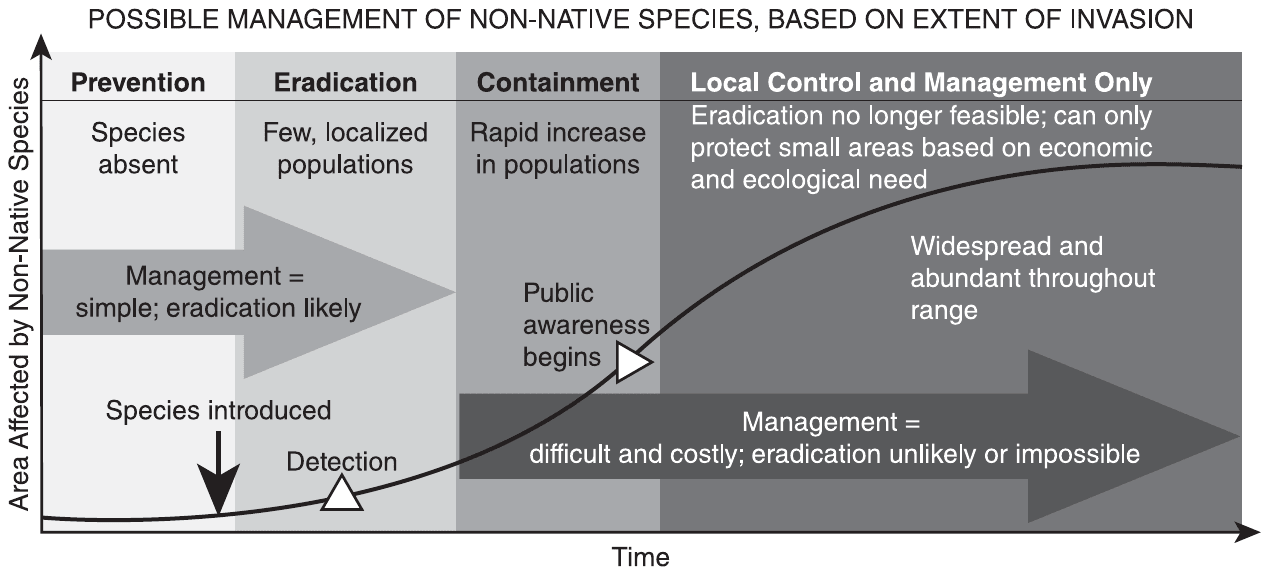
1stymie: hinder or interfere with
Question
Which two phrases from paragraph 3 most affect the tone of the excerpt?
Move the two correct answers to the box.
Phrases That Most Affect the Tone of the Excerpt
On the test you drag tiles into the box; here, choose them below. The DOE has not published how answers with several parts are scored; this site counts one right only when every part is right.
- A“sounded the alarm”
- B“gotten the message”
- C“rip out”
- D“become increasingly popular”
- E“provide food”
Show the answer
Correct answer: A and C
The question asks for the two phrases from paragraph 3 that most affect the tone of the excerpt.
A. “sounded the alarm”: CORRECT. This phrase affects the tone of the excerpt by conveying the stark sense of urgency surrounding the debate over the ecological impact of non-native species. The reference to an alarm sounding evokes the feeling of being on high alert.
B. “gotten the message”: Incorrect. This phrase does not most affect the tone of the excerpt.
C. “rip out”: CORRECT. This phrase affects the tone of the excerpt by vividly depicting the effect of widespread misunderstanding of non-native species.
D. “become increasingly popular”: Incorrect. This phrase does not most affect the tone of the excerpt.
E. “provide food”: Incorrect. This phrase does not most affect the tone of the excerpt.
Question analysis
This select-two tone question on Emma Marris’s opinion article about non-native species lists five short phrases from paragraph 3 and asks which two most affect the tone of the excerpt. On the test students move two tiles into a box, and both must be right. All five are common, everyday expressions, so students must weigh how strongly each one colors the excerpt.
- Grade level
- Grade 7 reading and task
- Compared with grade 7
- At grade 7 Typical grade 7 tone questions quote the words and ask what effect they have. Here students pick the two phrases themselves from five in one short paragraph and compare how much feeling each carries, which keeps the demand at grade level.
- Estimated difficulty
- Moderate: several steps, or a close reading with one strong distractor.
- Thinking it demands
- Depth of knowledge 2, skills and concepts · mainly analyze
- What makes it hard
- A very close wrong answer moderate
- Figurative or literary language moderate
- Much to keep track of minor
- Evidence
- Answered from one paragraph or stanza
- Reading level
- Passage: about grade 11, 815 words; question and choices: about grade 3, 42 words.
- Students, last 30 days
- Not enough answers yet to show (it takes 10).
Why it is hard, traps and wrong answers (shows the answer)
Why it is hard
Most students hear the urgency of “sounded the alarm” at once, and the point is lost on the second pick. The idiom that ends the same sentence sounds just as colorful, while “rip out” is a short, everyday verb whose force is easy to read past as plain weeding. Swapping each phrase for a neutral word and asking how much feeling is lost separates them, and credit comes only when both tiles are right.
A very close wrong answer moderate Choosing the answer
“Sounded the alarm” and “gotten the message” are paired idioms in the first sentence of paragraph 3, both about the warning passing from scientists to the public, and only the first carries urgency. (Embretson & Wetzel, 1987; Gorin & Embretson, 2006; Ascalon et al., 2007)
Figurative or literary language moderate Understanding the question
The tone lives in connotation: “sounded the alarm” borrows the picture of a siren or bell, and “rip out” shows plants torn up by force where “remove” would sound flat. (Graesser, Singer & Trabasso, 1994; Kintsch, 1998)
Much to keep track of minor Working it out
Five tiles compete for one box and both picks must be right, so each phrase’s charge has to be weighed against the other four, since the stem asks which affect the tone “most.” (Sweller, 1988; Carpenter, Just & Shell, 1990)
Strategy: Swap each phrase for a plain word with the same meaning, reread its sentence, and keep the two whose replacement changes the feeling of the passage the most.
Traps
- Wrong tone or attitude: Misjudges the tone, attitude or point of view, such as reading admiration as criticism, or taking a character's or subject's feelings for the author's.
- Taking figurative language literally: A choice reads a figure of speech or image at face value.
The wrong answers, classified
B Wrong tone or attitude (Graesser, Singer & Trabasso, 1994)
Hears an idiom as colorful as “sounded the alarm” in the same sentence and takes it as equally charged, though “gotten the message” only says the public accepted the warning.
D Wrong tone or attitude (Graesser, Singer & Trabasso, 1994)
Hears approval in the word “popular” and takes it as setting the tone, though “become increasingly popular” is a neutral report of a trend in gardening.
E Wrong tone or attitude (Graesser, Singer & Trabasso, 1994)
Is drawn by the pleasant picture of native trees feeding bugs that feed birds, though “provide food” is plain, factual wording that any science textbook might use.
C Taking figurative language literally (Graesser, Singer & Trabasso, 1994)
Left out by students who read “rip out” as a plain account of weeding, missing that the verb pictures citizen groups tearing up plants by force, where “remove” would be neutral.
Working it out, step by step
Figure out what the question asks
This is a tone question. Tone is the feeling or attitude that a writer’s words give a passage. You need the two phrases from paragraph 3 that carry the most feeling. Words can carry feeling beyond their plain meaning. On the test you drag two tiles into the box. On this site, you choose two of the five. Both must be right.
Read paragraph 3 in its place
The excerpt opens with “Invasive species are scary.” Paragraph 2 lists the harm some invaders do. Then paragraph 3 says “As scientists have sounded the alarm about these pests, the public has gotten the message. Citizen groups rip out non-native plants.” The rest of the paragraph is calm. It says native gardens are popular, and native trees feed bugs that feed birds.
Swap each phrase for plain words
A good test is to swap each phrase for plain words with the same meaning. Then ask how much feeling is lost.
- “sounded the alarm” becomes warned. An alarm is a loud bell for danger, like a fire alarm. The sense of danger is lost.
- “gotten the message” becomes understood. Little changes.
- “rip out” becomes remove. To rip is to tear roughly and fast. The force is lost.
- “become increasingly popular” becomes grown more common. Little changes.
- “provide food” becomes feed. Nothing changes.
See what the two phrases do
Urgency is the feeling that something must be done right now. “Sounded the alarm” makes non-native species sound like an emergency. “Rip out” shows people tearing up plants with force. Together they make the fight against non-natives sound urgent and harsh. That matches paragraph 1, which calls the word “invasion” militaristic, or warlike. The author goes on to question treating every non-native as bad.
Check each of the five tiles
- A fits. It adds urgency.
- B does not fit. It is an idiom, a saying whose meaning differs from its words. It only means the public understood.
- C fits. It adds force.
- D does not fit. It calmly reports a trend in gardening.
- E does not fit. It is plain, factual wording.
Watch out: B sits in the same sentence as A, and it sounds just as colorful. But it adds no danger and no force.
Choose both answers
So the answers are A and C. On the test, move the tiles “sounded the alarm” and “rip out” into the box Phrases That Most Affect the Tone of the Excerpt. You need both to get the point.
Why this answer and not the closest wrong one
B is the closest wrong choice. It is an idiom in the same sentence as A, so it seems just as strong. But swap in understood, and the feeling barely changes. C is easier to miss because it is short. Swap in remove, and the force is gone.
More questions like this
The original DOE question
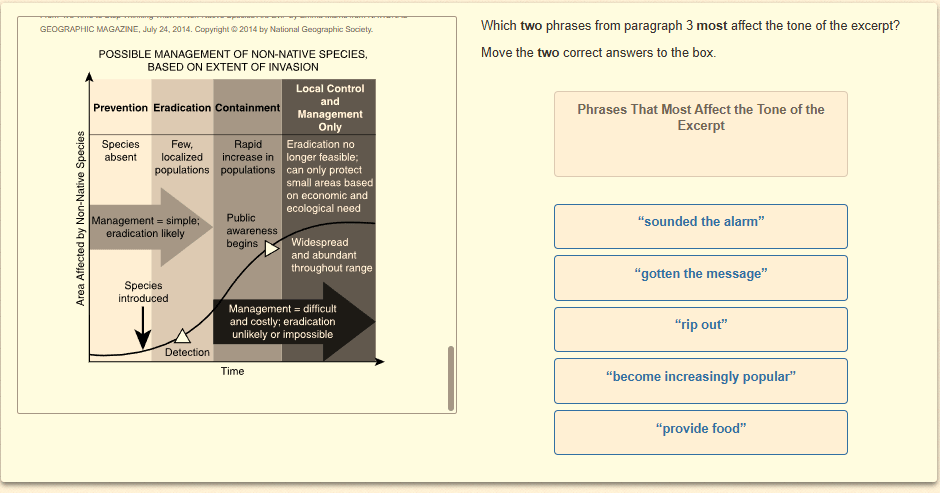
The passage “Excerpt from “It’s Time to Stop Thinking That All Non-Native Species Are Evil”” as printed (pages 68–70)
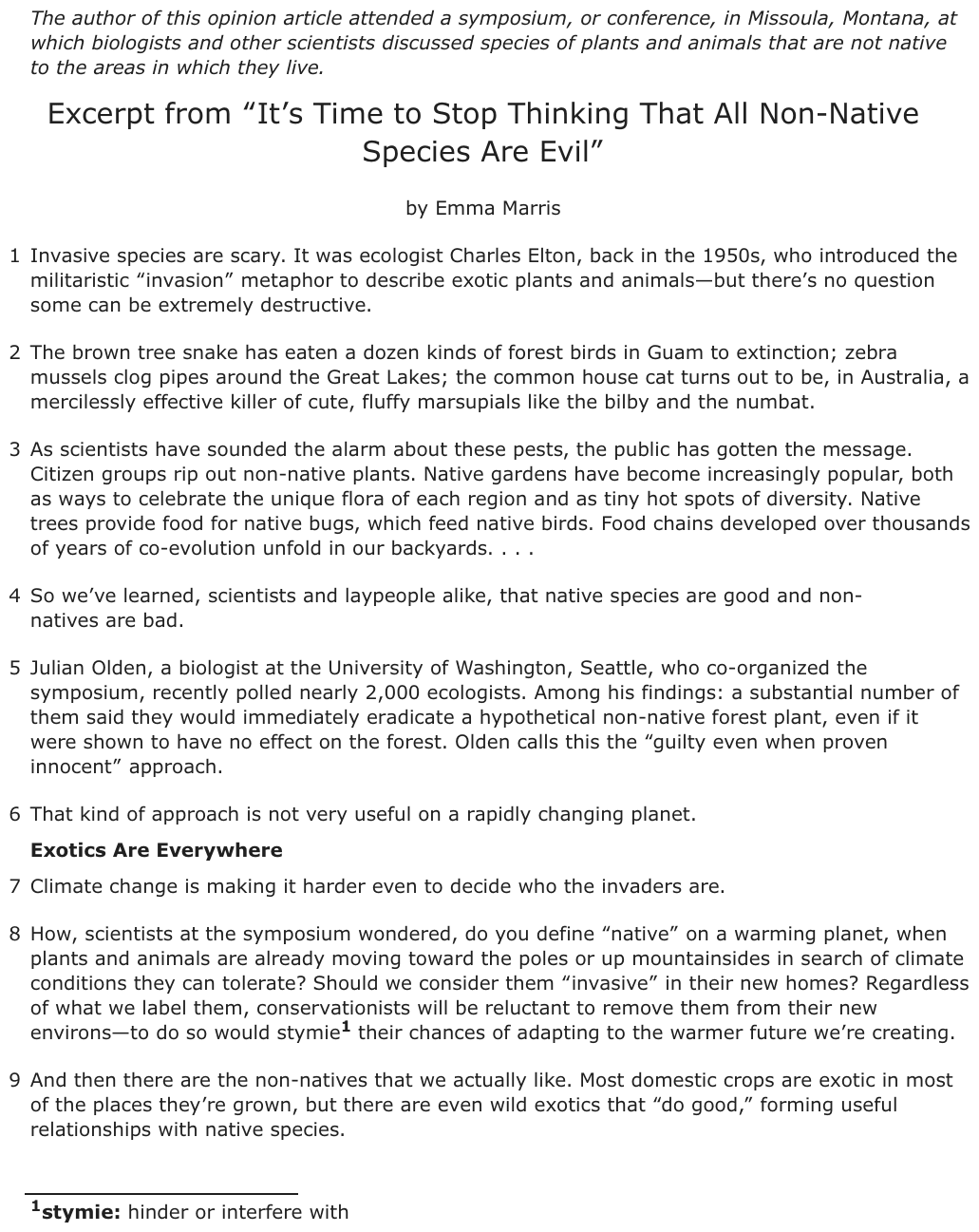
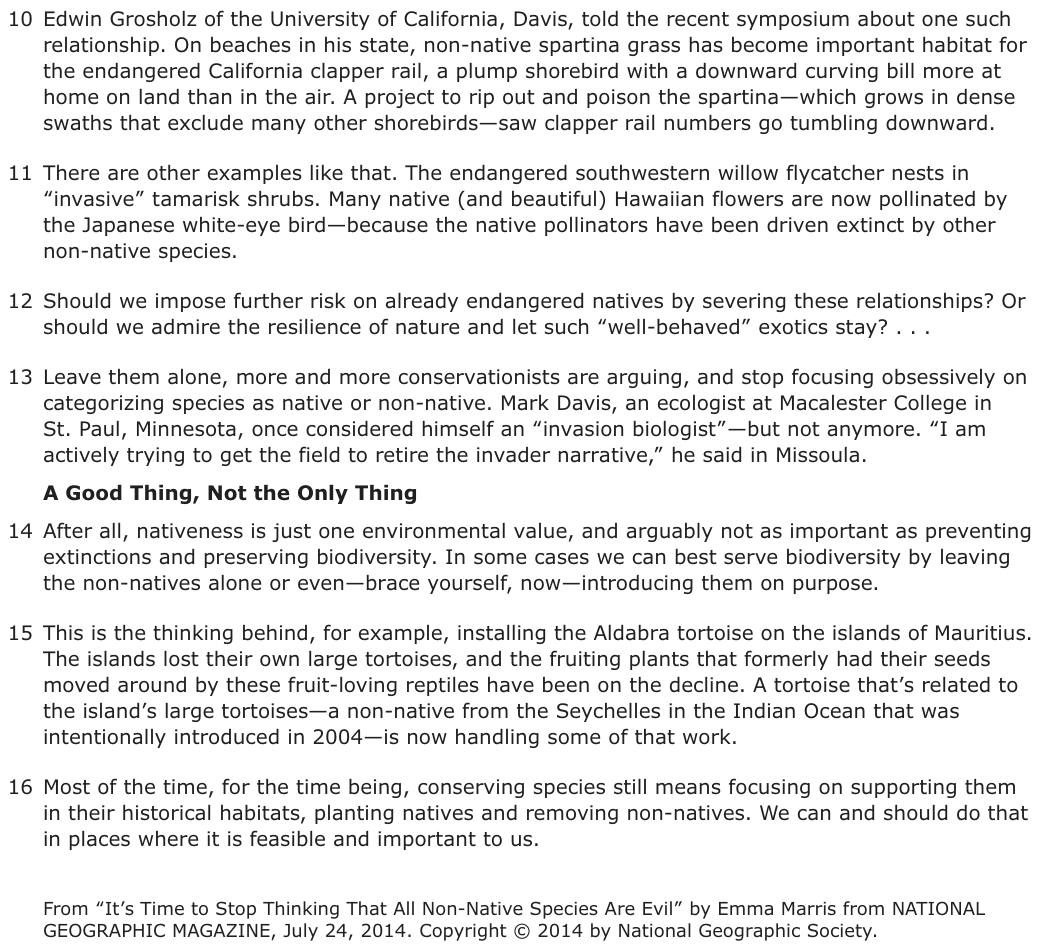
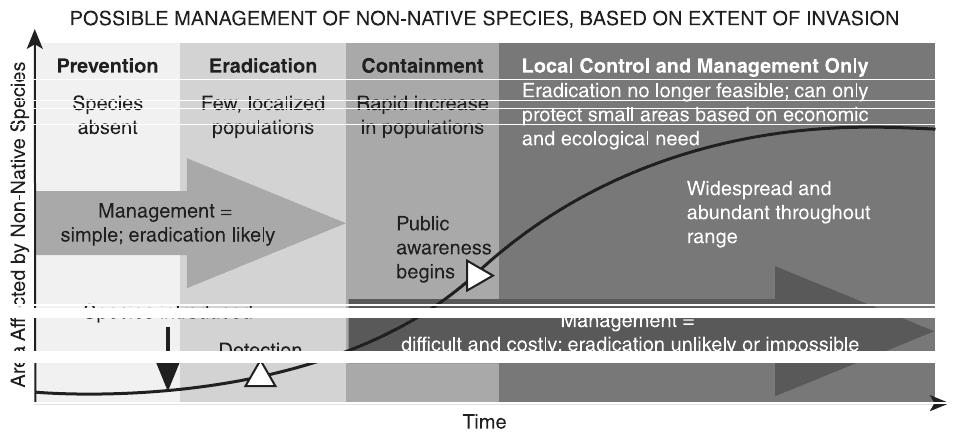
Question 100 of 120
2025 Practice Test B English, question 8Uses the passage above: “Excerpt from “It’s Time to Stop Thinking That All Non-Native Species Are Evil””.
Question
Determine whether each sentence from the excerpt presents a claim or presents evidence to support a claim.
Select all the correct answers.
Choose one answer in each row, then check. The DOE has not published how answers with several parts are scored; this site counts one right only when every part is right.
| Presents a Claim | Presents Evidence | |
|---|---|---|
| “That kind of approach is not very useful on a rapidly changing planet.” (paragraph 6) | ||
| “A project to rip out and poison the spartina—which grows in dense swaths that exclude many other shorebirds—saw clapper rail numbers go tumbling downward.” (paragraph 10) | ||
| “In some cases we can best serve biodiversity by leaving the non-natives alone or even—brace yourself, now—introducing them on purpose.” (paragraph 14) | ||
| “A tortoise that’s related to the island’s large tortoises—a non-native from the Seychelles in the Indian Ocean that was intentionally introduced in 2004—is now handling some of that work.” (paragraph 15) |
Show the answer
Correct answer: “That kind of approach is not very useful on a rapidly changing planet.” (paragraph 6): Presents a Claim; “A project to rip out and poison the spartina—which grows in dense swaths that exclude many other shorebirds—saw clapper rail numbers go tumbling downward.” (paragraph 10): Presents Evidence; “In some cases we can best serve biodiversity by leaving the non-natives alone or even—brace yourself, now—introducing them on purpose.” (paragraph 14): Presents a Claim; “A tortoise that’s related to the island’s large tortoises—a non-native from the Seychelles in the Indian Ocean that was intentionally introduced in 2004—is now handling some of that work.” (paragraph 15): Presents Evidence
The question asks which quotations from the excerpt present a claim and which present evidence in support of a claim. (A claim is a statement made as part of an argument that can be supported or proved with evidence. Supporting evidence can include facts, figures, details, quotations, or other sources of data and information that can be evaluated by others.)
Row 1: Presents a claim [“That kind of approach is not very useful on a rapidly changing planet.” (paragraph 6)]. The phrase “is not very useful” indicates that the sentence expresses a claim—an arguable statement, or in this case an opinion, for which the author must provide proof.
Row 2: Presents evidence [“A project to rip out and poison the spartina—which grows in dense swaths that exclude many other shorebirds—saw clapper rail numbers go tumbling downward.” (paragraph 10)]. Despite its figurative language (“tumbling downward”), this sentence does not present a claim that must be supported by evidence. Instead, the sentence provides factual information—that numbers of clapper rail birds decreased when spartina grass was removed—that is evidence for another claim, that non-native plants can be welcome sometimes.
Row 3: Presents a claim [“In some cases we can best serve biodiversity by leaving the non-natives alone or even—brace yourself, now—introducing them on purpose.” (paragraph 14)]. The wording “we can best serve” signals that this sentence presents a claim—a statement being made as part of an argument that needs proof in order to be accepted—regarding the best way to achieve biodiversity.
Row 4: Presents evidence [“A tortoise that’s related to the island’s large tortoises—a non-native from the Seychelles in the Indian Ocean that was intentionally introduced in 2004—is now handling some of that work.” (paragraph 15)]. Although this sentence does not provide statistics, quotations, or other obvious markers that signal evidence, it does provide a factual example—non-native tortoises are now moving the seeds of fruiting plants in a way that preserves the diversity of plant life on the islands of Mauritius—that is used to support the author’s claim that non-native species can help preserve diversity.
Question analysis
This table-grid question on the opinion article about non-native species gives four sentences, from paragraphs 6, 10, 14 and 15, and asks whether each presents a claim or presents evidence to support a claim. Students make four separate decisions, and credit comes only when every row is right, so each sentence must be judged by the job it does in the author’s argument.
- Grade level
- Grade 7 reading and task
- Compared with grade 7
- At grade 7 Telling a claim from the evidence for it is core grade 7 argument work. The four sentences come labeled with their paragraphs, but they are long and broken by dashes and asides, and all four must be sorted correctly, a typical demand overall.
- Estimated difficulty
- Moderate: several steps, or a close reading with one strong distractor.
- Thinking it demands
- Depth of knowledge 2, skills and concepts · mainly analyze
- What makes it hard
- Much to keep track of moderate
- How, not what minor
- Complex sentences minor
- Figurative or literary language minor
- Evidence
- Answered from several paragraphs or stanzas
- Reading level
- Passage: about grade 11, 815 words; question and choices: about grade 8, 22 words.
- Students, last 30 days
- Not enough answers yet to show (it takes 10).
Why it is hard, traps and wrong answers (shows the answer)
Why it is hard
The two claims carry the author’s judgment in a few words, “not very useful” and “we can best serve,” while the two evidence rows report what happened. Students go wrong when they sort by surface: dramatic wording makes the spartina report sound like opinion, and the tortoise sentence, with no number or quotation, can pass for the author’s assertion. Asking whether a sentence judges or reports settles each row, but all four must be right for credit.
Much to keep track of moderate Working it out
Sentences from paragraphs 6, 10, 14 and 15 are judged one at a time, and the question is scored right only when all four rows are, so one doubtful row costs the point. (Sweller, 1988; Carpenter, Just & Shell, 1990)
How, not what minor Working it out
Each row asks what a sentence does in the argument, not what it is about: rows 3 and 4 both concern bringing in non-natives on purpose, but one argues for it and one reports it. (Anderson & Krathwohl, 2001)
Complex sentences minor Understanding the question
In the two evidence rows, 17 and 22 words separate the subject from its verb, “A project … saw” and “A tortoise … is now handling,” most of them inside dashes. (Abedi & Lord, 2001; Freedle & Kostin, 1993; Messick, 1989)
Figurative or literary language minor Understanding the question
Row 2 reports a result in vivid words, a project to “rip out and poison” the grass and clapper rail numbers that “go tumbling downward,” so a report can sound like an opinion. (Graesser, Singer & Trabasso, 1994; Kintsch, 1998)
Strategy: For each sentence, ask whether it states a judgment the author must argue for or reports something that happened or was found, and sort it by that test alone.
Traps
- Wrong purpose or structure: Names a purpose, structure or effect that the part does not serve, or describes what a part says when the question asks what it does.
- Wrong tone or attitude: Misjudges the tone, attitude or point of view, such as reading admiration as criticism, or taking a character's or subject's feelings for the author's.
The wrong answers, classified
1:B Wrong purpose or structure (Anderson & Krathwohl, 2001)
Takes “a rapidly changing planet” as plain fact, the climate change the next section describes, and misses that “not very useful” is the author’s own verdict on the approach Olden describes.
2:A Wrong tone or attitude (Graesser, Singer & Trabasso, 1994)
Hears opinion in the vivid “rip out and poison” and “go tumbling downward,” though the sentence reports what happened to clapper rail numbers once a project removed the spartina.
3:B Wrong purpose or structure (Anderson & Krathwohl, 2001)
Sees that the sentence backs the case for leaving non-natives alone and so calls it support, missing that “we can best serve” is itself a claim, which the tortoise example then backs.
4:A Wrong purpose or structure (Anderson & Krathwohl, 2001)
Expects evidence to come as numbers, studies or quotations, so takes the plain report that a tortoise brought in during 2004 “is now handling some of that work” as an assertion.
Working it out, step by step
Figure out what the question asks
Decide the job each of the four sentences does in the argument. A claim is a statement the author wants you to accept, such as an opinion or a judgment. People could disagree with it, so it needs support. Evidence is a fact, an example or an event that backs up a claim. Ask: does the sentence judge, or does it report what happened?
Sort the sentence from paragraph 6
Row 1 says “That kind of approach is not very useful on a rapidly changing planet.” The approach is the one in paragraph 5. There, many ecologists said they would wipe out a non-native plant even if it had no effect on the forest. The words “not very useful” are the author’s judgment. Someone could disagree, so the article has to argue for it. This sentence presents a claim.
Watch out: “A rapidly changing planet” sounds like a fact. But the point of the sentence is the judgment about the approach.
Sort the sentence from paragraph 10
Row 2 is long, so set aside the part between the dashes. What is left says “A project to rip out and poison the spartina” saw clapper rail numbers fall. Spartina is a grass that is not native to California. The clapper rail is an endangered shorebird that lives in it. So the sentence reports what happened: the grass was removed, and the birds declined. It backs the claim in paragraph 9 that some non-natives “do good.” This row presents evidence.
Watch out: Vivid words like “go tumbling downward” can sound like an opinion. But they only mean the numbers fell fast. Strong wording does not turn a report into a claim.
Sort the sentence from paragraph 14
Row 3 says “In some cases we can best serve biodiversity by leaving the non-natives alone or even—brace yourself, now—introducing them on purpose.” Biodiversity is the variety of living things in a place. The words “we can best serve” show the author’s judgment about what is best. “Brace yourself” shows she expects you to be surprised. A surprising idea needs proof. This sentence presents a claim.
Sort the sentence from paragraph 15
Row 4 also has a long part between dashes. Without it, the sentence says “A tortoise that’s related to the island’s large tortoises” is “now handling some of that work.” The sentence before explains the work. The islands lost their own large tortoises, which used to spread the seeds of fruiting plants. Now a non-native tortoise, brought in on purpose in 2004, does part of that job. It is a real example. It backs row 3’s claim. This row presents evidence.
Watch out: Evidence does not need numbers or quotations. An example of what happened counts.
Fill in the table
- Row 1 (paragraph 6): Presents a Claim
- Row 2 (paragraph 10): Presents Evidence
- Row 3 (paragraph 14): Presents a Claim
- Row 4 (paragraph 15): Presents Evidence
On the test and on this site, click one circle in each row. All four rows must be right to get the point.
Why this answer and not the closest wrong one
Row 2 is the hardest. “Rip out and poison” and “tumbling downward” sound strong, like an opinion. But the sentence reports a project and its result: the bird numbers fell. Nobody judges what is best. So it is evidence for the claim that some non-natives “do good.”
More questions like this
The original DOE question
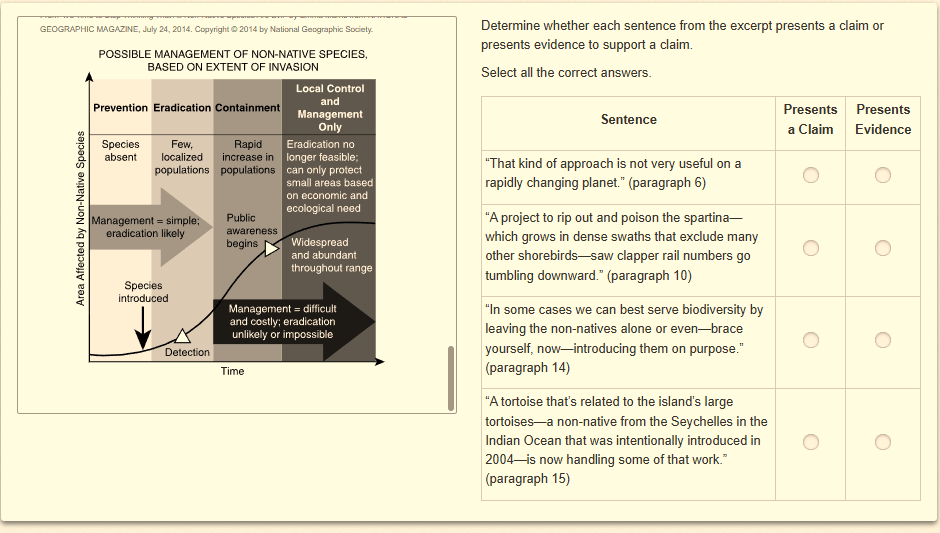
Question 101 of 120
2025 Practice Test B English, question 15Passage A Miracle Mile
A Miracle Mile
In the 1950s people compared running one mile in four minutes to scaling Mount Everest and nicknamed the feat a “dream mile.” Although such an accomplishment was considered humanly impossible, several elite runners aimed to break that supposedly impenetrable barrier. One of them was a twenty-five-year-old medical student named Roger Bannister.
Roger Bannister had tasted failure during the 1952 Olympics. There, he was favored to win the 1,500-meter competition, a distance slightly shorter than a mile, but he finished in a dismal fourth place instead. Bannister’s performance was a disappointment for him and his country, Great Britain. Determined to redeem himself, Bannister postponed his plans to retire from racing and focused on the ultimate prize—breaking the four-minute-mile barrier.
Bannister attacked the elusive milestone with a positive attitude and logical planning. The amateur athlete decided to use intensive interval training to develop endurance and speed. For these workouts, Bannister ran an interval of ten consecutive laps on a quarter-mile track, aiming for sixty seconds each lap. In between intervals, he let his body recover for two minutes.
By early 1954, Bannister had succeeded in lowering his quarter-mile pace to sixty-one seconds, but he had to shave off at least one more second in order to reach his target. Frustrated by the plateau he had reached, Bannister took a break from training and went mountain climbing for three days. The rest from running permitted his muscles to recuperate and left him feeling refreshed. When Bannister returned to the track, he completed ten quarter-mile-long intervals at fifty-nine seconds each. He finally felt prepared to attempt to break the world record.
As a member of the Amateur Athletic Association (AAA), Bannister joined the AAA team for a track meet against Oxford University. The event took place on a cinder track in Oxford on May 6, 1954. Bannister and his two AAA teammates, Chris Chataway and Chris Brasher, were close friends and frequent running partners. Chataway and Brasher agreed to help Bannister accomplish his goal by being his “rabbits.”
In track and field, rabbits are runners who enter the race solely to pace a teammate for a segment of the course. Typically, a runner settles in behind the rabbit and allows the rabbit to set an appropriate tempo. Additionally, by running behind the rabbit, the runner conserves about 15 percent of his or her effort. When the starting pistol fired, Brasher pounced into the lead, and Bannister followed behind his first rabbit.
Propelled by the excitement, Bannister lost his instinctive feel for his pace and shouted “Faster!” at Brasher. Brasher, however, remained composed and maintained his current steady but grueling pace, completing the first two laps in a desirable one minute and fifty-eight seconds. Then Chataway surged forward, leading Bannister at this same punishing rate for another lap and a half. At the beginning of the back straightaway of the track, Bannister bolted past Chataway. Bannister said, “I felt that the moment of a lifetime had come. There was no pain, only a great unity of movement and aim.” Bannister crossed the finish line in 3 minutes 59.4 seconds. The ecstatic crowd erupted the moment the timekeeper announced the word “three.”
Soon after Bannister’s achievement, four other athletes matched his performance. A new mindset had taken root among runners. Over the years, the record continued to fall. However, the current record, 3 minutes 43.13 seconds, has stood unbroken since 1999. Some question whether this record represents the limits of human ability. But perhaps there is another Bannister, an athlete who, with willpower and dedication, will accomplish the miraculous.
Question
How does the author’s use of chronological structure contribute to the development of ideas in the passage?
- AIt presents the increasing physical effects of Bannister’s training methods as he prepared to break the four-minute-mile barrier.
- BIt shows the increase in Bannister’s confidence in his ability to break the four-minute-mile barrier.
- CIt emphasizes the key events in Bannister’s life that inspired him to break the four-minute-mile barrier.
- DIt highlights the progression of Bannister’s training and details about his successful attempt to break the four-minute-mile barrier.
Show the answer
Correct answer: D
The question asks how the author’s use of chronological structure contributes to the development of ideas in the passage.
A. Incorrect. While paragraph 4 mentions the “plateau” Bannister dealt with and the break that “permitted his muscles to recuperate,” the chronological structure of the passage focuses mainly on the progression of Bannister’s process over time.
B. Incorrect. Even though the passage suggests that Bannister’s ability to break the four-minute-mile barrier improved and that he felt “prepared to attempt to break the world record” (paragraph 4), the chronological structure of the passage primarily serves to show how Bannister’s progress over time led to his success.
C. Incorrect. The chronological structure of the passage begins with an acknowledgment that Bannister was inspired to break the four-minute-mile barrier by his loss at the 1952 Olympics (paragraph 2); however, the overall organization of the passage highlights his dedicated efforts over time to break the four-minute-mile barrier.
D. CORRECT. The chronological structure of the passage follows the progression of Bannister’s training from his loss at the 1952 Olympics to the race where he ran the first sub-four-minute mile on May 6, 1954 (paragraph 5).
Question analysis
This text-structure question asks how the chronological structure of “A Miracle Mile,” an article about Roger Bannister’s attempt to run a mile in under four minutes, contributes to the development of its ideas. The article moves from the 1950s to the present day, and each choice names a thread a reader might trace through it, so students must decide which one the time order really follows.
- Grade level
- Grade 7 reading and task
- Compared with grade 7
- Below grade 7 Grade 7 students analyze how an author organizes a text. Here the stem names the structure, and the article moves through dated events in plain prose, so seeing what the order brings out is lighter than most grade 7 structure questions.
- Estimated difficulty
- Straightforward: two steps or one careful reading.
- Thinking it demands
- Depth of knowledge 2, skills and concepts · mainly analyze
- What makes it hard
- How, not what minor
- Every choice must be checked minor
- Evidence in several places minor
- Evidence
- Answered from the whole text
- Reading level
- Passage: about grade 10, 587 words; question and choices: about grade 13, 84 words.
- Students, last 30 days
- Not enough answers yet to show (it takes 10).
Why it is hard, traps and wrong answers (shows the answer)
Why it is hard
The article tells Bannister’s story in order, and the right choice simply names what that order follows: training that improves, then the race itself. Each wrong choice picks a thread the text touches without tracing, a confidence present from the start, a physical toll mentioned once, an inspiration that comes only from 1952. Students who sum up each paragraph in a few words see that only the training and the race run all the way through.
How, not what minor Working it out
The stem names the structure and asks what it does, so students must say which thread the time order follows from the 1952 Olympics to May 6, 1954, not retell the events. (Anderson & Krathwohl, 2001)
Every choice must be checked minor Choosing the answer
Each wrong thread has a foothold: “a positive attitude” and “finally felt prepared” for confidence, muscles that needed to “recuperate” for physical effects, and the 1952 loss for inspiration. (Embretson & Wetzel, 1987)
Evidence in several places minor Working it out
A thread counts only if it runs from paragraph 2 to paragraph 7, so it must cover both the training of paragraphs 3 and 4 and the race told in paragraphs 5 to 7. (Kirsch & Mosenthal, 1990; Gorin & Embretson, 2006)
Strategy: Note in a few words what each paragraph covers, in order, then choose the description that matches what the whole sequence follows rather than one detail along the way.
Traps
- Twists what the text says: Uses the text's topic and ideas but changes what it says: who did it, how much, when, or why.
- Reads too much in: A reasonable-sounding conclusion that goes further than the text allows.
- Too narrow: A single detail offered as the central idea or a summary, or a summary that keeps minor details and leaves out an essential part.
The wrong answers, classified
A Twists what the text says (King et al., 2004)
Recalls the plateau and the muscles that needed to “recuperate” in paragraph 4, but the article tracks lap times falling from sixty-one to fifty-nine seconds, not a physical toll that grows.
B Reads too much in (Graesser, Singer & Trabasso, 1994)
Follows Bannister from “Frustrated by the plateau” to “finally felt prepared” and “the moment of a lifetime,” but he began with “a positive attitude,” and the order traces training, not confidence.
C Too narrow (King et al., 2004)
Starts from the 1952 Olympic loss that left him “Determined to redeem himself,” but that single event belongs to paragraph 2, and the later paragraphs follow training and a race, not further inspirations.
Working it out, step by step
Figure out what the question asks
This is a structure question. Chronological structure means telling events in time order, from first to last. The question asks what that order helps the passage show. So sum up each paragraph in a few words. Then see which thread runs through all of them.
Sum up each paragraph in order
- Paragraph 1: In the 1950s, a four-minute mile seemed impossible.
- Paragraph 2: Bannister loses at the 1952 Olympics and sets his goal.
- Paragraph 3: He makes a training plan.
- Paragraph 4: By early 1954, his laps get faster.
- Paragraph 5: A race is set for May 6, 1954. Two teammates will set his pace.
- Paragraphs 6–7: The race is run. He finishes in 3 minutes 59.4 seconds.
- Paragraph 8: Other runners match him, and over the years the record is lowered.
See what the order follows
Most of the passage follows two things. First, his training improves step by step. The track is a quarter mile, so four laps make a mile. Sixty seconds a lap would be exactly four minutes. He goes from sixty-one seconds a lap to fifty-nine, so the goal comes within reach. Second, the passage gives details of the race. It is set up in paragraph 5 and run in paragraphs 6 and 7. Progression means step-by-step progress.
Check each choice
- A does not fit. His body comes up only now and then, as when a rest “permitted his muscles to recuperate” in paragraph 4. Recuperate means recover. The passage never tracks effects that grow, and A leaves out the race.
- B does not fit. He had “a positive attitude” from the start, in paragraph 3. The order follows what he did, not how sure he felt.
- C does not fit. Only one event inspired him, the 1952 loss in paragraph 2. After that come training and the race.
- D fits. The order traces his training and then the record-breaking race.
Watch out: B is tempting because he “finally felt prepared” in paragraph 4. But that is one moment, not the thread of the whole passage.
Choose the answer
The time order follows Bannister’s training as it improves, then the race where he broke the barrier. So the answer is D, “It highlights the progression of Bannister’s training and details about his successful attempt to break the four-minute-mile barrier.”
Why this answer and not the closest wrong one
B is the closest wrong choice. Bannister does end up ready, and he “finally felt prepared” in paragraph 4. But he began with “a positive attitude,” so his confidence does not build from low to high. The paragraphs follow his training and then the race itself. Only D names both.
More questions like this
The original DOE question
The passage “A Miracle Mile” as printed (page 13)
Question 102 of 120
2025 Practice Test B English, question 35Passage Using Fire to Keep a Prairie Healthy
Using Fire to Keep a Prairie Healthy
Inside the 40,000-acre Joseph H. Williams Tallgrass Prairie Preserve in northern Oklahoma, herds of bison roam on the scenic land that is home to hundreds of different species of plants and animals. While one of the greatest threats to the prairie is wildfire, the use of controlled fires is actually an effective way to protect this idyllic landscape.
Fires that are started by lightning or other natural circumstances are inevitable, and the results can be disastrous. However, hundreds of years ago the American Indian people who inhabited the Great Plains area between Minnesota and Texas realized that these fires could also be helpful. The bison in the area seemed to prefer grazing on tender new grass on the recently burned land rather than on grass in the unburned areas. The American Indian people began to deliberately burn areas of land for bison to graze on, which enticed the herds away from the people’s crops.
Today conservationists at the Tallgrass Prairie Preserve and farmers in the Great Plains continue to use controlled burns for land management. Intentionally burning a portion of land can dramatically improve the quality of the vegetation that regrows there. The fires burn away weedy undergrowth and help limit the overcrowding of shrubs and trees in the burn area, creating less competition for water and nutrients. Additionally, the process of burning excess plant matter adds nitrogen, an essential element for plant growth, to the soil.
One common target of controlled burns at the preserve and the surrounding area is the invasive red cedar tree. A single red cedar tree can consume up to 40 gallons of water per day, taking this vital resource away from other plant life. These tall trees also cast shade that prevents sunlight from reaching the plants beneath them. The fast-growing red cedar trees tend to crowd out prairie grasses, the primary food source for wild and domestic animals that make the prairie their home. An imbalance in one component of the prairie’s ecosystem affects the entire web of life. Controlled burns help maintain this ecosystem’s delicate balance.
Of course, these controlled fires are intended to burn only a portion of an area. A total burn, which is a risk with an uncontrolled wildfire, would destroy all wildlife as well as the crops farmers plant for income. The key to using controlled fires is knowing which areas of land to burn and when. Conservation experts at the preserve employ the “patch-burn” approach, meaning they rotate which portion of land is burned each year. They study the land to find out which areas would most benefit from being burned, and then they arrange about a dozen burns over one-third of the land. This patch burning contains the fire within a specific area and allows animals in the burn area to safely relocate. The following year, conservationists will burn a different section of the preserve, while the land burned the previous year regrows healthier than before.
Researchers have tracked and studied the variety of plant species and animals that live on the preserve, and their studies show that the patch-burn approach has restored biodiversity to the area by promoting the growth of species that were at risk of being crowded out. The patch-burn system is so successful that the conservationists at the preserve provide training to prairie farmers about conducting controlled burns on their own land. Burning land to make it healthy may seem counterintuitive, but strategic controlled fires have helped the prairie sustain life for hundreds of years and, with careful management, will continue to do so.
Question
Which details from the passage best convey the central idea that using the patch-burn method is an effective way to protect and manage prairie land?
- Athe explanation that conservationists use the alternating burn pattern of the patch-burn method in order to allow the animals in the area to avoid the fire
- Bthe information that conservationists evaluate which land would most benefit from a controlled burn before applying the patch-burn method
- Cthe information that conservationists have determined that the patch-burn method has promoted the growth of species that were at risk of being crowded out
- Dthe explanation that conservationists are able to control the fire in the patch-burn method by arranging separate burns across the designated portion of land
Show the answer
Correct answer: C
The question asks which details from the passage best convey the central idea that using the patch-burn method is an effective way to protect and manage prairie land.
A. Incorrect. The author explains in paragraph 5 that “patch burning contains the fire within a specific area and allows animals in the burn area to safely relocate.” This explanation conveys two supporting ideas: the patch-burn method is controllable, and patch-burn fires do not pose a threat to animals. However, this explanation does not address the broader central idea that the patch-burn method is an effective way to protect and manage prairie land.
B. Incorrect. In paragraph 5, the author states that “the key to using controlled fires is knowing which areas of land to burn and when.” The author then provides information about how conservation experts “study the land to find out which areas would most benefit from being burned.” However, these details convey supporting ideas rather than the central idea that using the patch-burn method is an effective way to protect and manage prairie land.
C. CORRECT. In paragraph 3, the author states that “fires burn away weedy undergrowth and help limit the overcrowding of shrubs and trees in the burn area, creating less competition for water and nutrients.” Also, in paragraph 6, the author states that patch burning “has restored biodiversity to the area by promoting the growth of species that were at risk of being crowded out.” These details directly convey the central idea that using the patch-burn method is an effective way to protect and manage prairie land.
D. Incorrect. The author explains in paragraph 5 how conservationists “arrange about a dozen burns over one-third of the land,” which helps show how the patch-burn method is applied by conservationists. However, this is a supporting detail that conveys the idea that the burns are deliberately set and carefully controlled. This detail does not convey the central idea that using the patch-burn method is an effective way to manage and protect prairie land.
Question analysis
This evidence question on the article about controlled burns at an Oklahoma tallgrass prairie preserve asks which details best convey the central idea that the patch-burn method is an effective way to protect and manage prairie land. Every choice reports something the article really says about the method, so students must decide which details speak most directly to the central idea as stated.
- Grade level
- Grade 7 reading and task
- Compared with grade 7
- At grade 7 Matching details to a stated central idea is regular grade 7 work, and the article is short and clearly written. Each choice is a long, accurate description, so the work lies in judging relevance rather than truth, which is typical.
- Estimated difficulty
- Moderate: several steps, or a close reading with one strong distractor.
- Thinking it demands
- Depth of knowledge 2, skills and concepts · mainly evaluate
- What makes it hard
- Every choice must be checked moderate
- Evidence in several places minor
- A lot to read minor
- Evidence
- Answered from several paragraphs or stanzas
- Reading level
- Passage: about grade 11, 598 words; question and choices: about grade 13, 118 words.
- Students, last 30 days
- Not enough answers yet to show (it takes 10).
Why it is hard, traps and wrong answers (shows the answer)
Why it is hard
The central idea joins three words, protect, manage and effective, and each wrong choice speaks to protect or manage with a step in carrying out the method: keeping animals safe, choosing the land, controlling the fire. Only a result shows that the method is effective, and the one result offered is the return of species once at risk of being crowded out. Students who ask what each detail proves, not what it is about, separate how the method works from whether it works.
Every choice must be checked moderate Choosing the answer
All four choices report the patch-burn method accurately, the animals’ safe relocation, the study of the land, the dozen burns and the restored species, so truth rules none out; each must be tested for proof the method works. (Embretson & Wetzel, 1987)
Evidence in several places minor Working it out
Three choices come from paragraph 5, where the method is explained, while the result that shows it works, restored biodiversity, sits in paragraph 6, after the description ends. (Kirsch & Mosenthal, 1990; Gorin & Embretson, 2006)
A lot to read minor Understanding the question
Each choice is a noun phrase of 19 to 26 words opening “the explanation that” or “the information that,” so four long details must be unpacked before they can be compared. (Kintsch, 1998; Gorin & Embretson, 2006; Freedle & Kostin, 1993)
Strategy: Restate the central idea in your own words, noting what “effective” requires, then ask of each choice whether that detail would persuade a doubtful reader of the whole idea.
Traps
- Supports only part of the claim: In a question about evidence: a line that backs one half of the claim but not the other, or a related point rather than the claim itself.
The wrong answers, classified
A Supports only part of the claim (King et al., 2004; Thissen, Steinberg & Fitzpatrick, 1989)
Links “protect” in the central idea to the animals’ chance to “safely relocate” in paragraph 5, a true detail of how patch burns are run, not proof they improve the prairie.
B Supports only part of the claim (King et al., 2004; Thissen, Steinberg & Fitzpatrick, 1989)
Hears effectiveness in “would most benefit,” but experts studying the land before a burn shows how they plan where to burn, not that the burns have worked.
D Supports only part of the claim (King et al., 2004; Thissen, Steinberg & Fitzpatrick, 1989)
Connects “manage” and “protect” to fire kept under control by arranging “about a dozen burns over one-third of the land,” which shows how the method is applied, not what it achieves.
Working it out, step by step
Figure out what the question asks
This asks which details best support a central idea. A central idea is a main point the whole passage develops. Here the idea is given: the patch-burn method is an effective way to protect and manage prairie land. Effective means it works and gets good results. So look for details that show results, not just how the method is done.
Find how the method works
Paragraph 5 explains the patch-burn method. The experts “rotate which portion of land is burned each year.” Rotate means take turns. First, “They study the land to find out which areas would most benefit from being burned.” Then “they arrange about a dozen burns over one-third of the land.” This “contains the fire within a specific area and allows animals in the burn area to safely relocate.” These details tell how the method is done.
Find what the method achieves
Paragraph 6 gives the results. Researchers studied the plants and animals on the preserve. Their studies show “that the patch-burn approach has restored biodiversity to the area by promoting the growth of species that were at risk of being crowded out.” Biodiversity means many kinds of living things. A species is one kind of plant or animal. Crowded out means pushed aside, the way red cedars crowd out prairie grasses in paragraph 4. So the method helped species that were losing ground. That shows it works.
Check each choice
- A does not fit. Animals escaping safely shows the burns are done with care. It does not show the land gets healthier.
- B does not fit. Studying the land is a planning step before a burn. It shows how the experts choose, not whether the burns work.
- C fits. It reports a result: the method helped species that were at risk.
- D does not fit. Arranging a dozen burns shows how the fire is kept under control. It does not show what the burns achieve.
Watch out: D sounds like “manage,” since the experts control the fire. But controlling a fire is part of doing the method. Only a result proves the method is effective.
Choose the answer
Only one choice shows the patch-burn method getting good results. So the answer is C, “the information that conservationists have determined that the patch-burn method has promoted the growth of species that were at risk of being crowded out.”
Why this answer and not the closest wrong one
D is the closest wrong choice. Careful control sounds like good management. But D only describes how the burns are set up. A method can be done carefully and still fail. C gives the proof that it works: studies show the burns “restored biodiversity.” Paragraph 6 even calls the system “so successful.”
More questions like this
The original DOE question
The passage “Using Fire to Keep a Prairie Healthy” as printed (page 41)
Question 103 of 120
2025 Practice Test B English, question 44Passage Letter from Brooklyn
Letter from Brooklyn
by Jacob Scheier
I can already see how this will end.
How I will grow tired of the bridge’s
steep incline, and the absent-minded tourists
wandering into the bicycle path.
The weather will turn cold.
But that all happens later.
For now it is the early edge of fall,
leaves green still while the air narrows,
is slightly crisp, almost grazing
the hair of my arm like a passing stranger,
as though the air has been forced into intimacy
by the brevity of daylight.
But when it starts darkening at 4,
this closeness, I know, will be a felt distance,
like someone drawing your attention
to their lack of intimacy.
These days I am still walking at a cathedral pace
beneath the branches bending across avenues,
brownstones like rows of lived-in chapels,
like a pop-up picture book I could have had as a child,
but didn’t. How Brooklyn makes me nostalgic
for the moment I am walking inside of.
These late afternoons filled
with a loneliness that makes me feel
distinctly myself, and an awareness
of how rare that is.
“Letter from Brooklyn” from LETTER FROM BROOKLYN: POEMS by Jacob Scheier, published by ECW Press. Copyright © 2013 by Jacob Scheier All rights reserved.
brevity: briefness
cathedral: meditative
chapels: private places of prayer or worship
nostalgic: yearning for the past
Question
The details in lines 9–12 convey a central idea of the poem by
- Ashowing that the cool weather makes the speaker reflect more deeply on life.
- Bsuggesting that the speaker feels uncomfortable with what the coming weather signifies.
- Cimplying that the sensations the speaker experiences during the fall season are fleeting.
- Dsuggesting that the thought of fall approaching increases the loneliness the speaker feels.
Show the answer
Correct answer: C
The question asks how lines 9–12 convey a central idea of the poem.
A. Incorrect. Although the speaker discusses the very beginning of cool weather in these lines, the speaker does not reflect on life in these lines.
B. Incorrect. Although the description in these lines likens the movement of crisp air to “a passing stranger,” that comparison does not have a negative connotation in this context; it does not suggest that the speaker is uncomfortable. Rather, it is used to describe the subtle physical sensation of cool air on the speaker’s arm.
C. CORRECT. By using a description of the crisp air as “a passing stranger” and the daylight as being brief, these lines express the poem’s central idea that the joy of early fall is temporary or fleeting.
D. Incorrect. Although the speaker acknowledges the coming fall in these lines, there is no mention of loneliness. The speaker reveals a loneliness in lines 23–26 but gives no hint of that feeling in lines 9–12. Further, this loneliness is not a central idea of the poem.
Question analysis
This central-idea question on Jacob Scheier’s poem “Letter from Brooklyn” asks how lines 9–12, where the crisp early-fall air grazes the speaker’s arm, convey a central idea of the poem. Students must interpret a simile and a personification packed into four short lines and connect what they suggest to the poem as a whole, while each choice names a different feeling or idea.
- Grade level
- Grade 8 reading and task
- Compared with grade 7
- Above grade 7 Grade 7 students explain how particular lines develop a central idea. These four lines make their point only through a simile and a personification about air and daylight, and linking them to the whole poem takes more interpretation than typical grade 7 work.
- Estimated difficulty
- Hard: combines ideas, needs a plan, and has more than one tempting wrong answer.
- Thinking it demands
- Depth of knowledge 2, skills and concepts · mainly analyze
- What makes it hard
- Figurative or literary language major
- Reading between the lines moderate
- The right answer is reworded minor
- Evidence
- Answered from one paragraph or stanza
- Reading level
- Passage: 217 words (a poem; reading level not measured); question and choices: about grade 8, 63 words.
- Students, last 30 days
- Not enough answers yet to show (it takes 10).
Why it is hard, traps and wrong answers (shows the answer)
Why it is hard
The four lines describe a sensation, cool air almost grazing an arm, and the central idea sits in two small words, “passing” and “brevity.” The strongest pull hears the stranger and the air “forced into intimacy” as unwelcome, borrowing the unease the poem saves for the darkening of lines 13–16. Other choices bring in moods from elsewhere, the meditative walk and the loneliness of the last lines, so students must judge only what lines 9–12 themselves suggest.
Figurative or literary language major Understanding the question
The lines never say the moment is short: the air almost grazes the speaker’s arm “like a passing stranger” and is “forced into intimacy / by the brevity of daylight,” so “passing” and “brevity” carry the idea. (Graesser, Singer & Trabasso, 1994; Kintsch, 1998)
Reading between the lines moderate Working it out
Students must tie the brief touch and the short days to a central idea the poem never states, that early fall is slipping away, framed by “For now” in line 7 and “But when it starts darkening” in line 13. (Graesser, Singer & Trabasso, 1994; Kintsch, 1998)
The right answer is reworded minor Choosing the answer
The right choice says “fleeting” where the lines say “passing” and “brevity,” while a wrong choice borrows the poem’s own word “loneliness” from line 24, which makes it look supported. (Freedle & Kostin, 1993; Kirsch & Mosenthal, 1990)
Strategy: Paraphrase lines 9–12 in plain words, checking the glossary for unfamiliar words, then decide what the comparison suggests about the speaker’s experience and test each choice against these four lines.
Traps
- Wrong part of the text: A choice is true of another paragraph, stanza or speaker than the one asked about.
- Wrong tone or attitude: Misjudges the tone, attitude or point of view, such as reading admiration as criticism, or taking a character's or subject's feelings for the author's.
- Reads too much in: A reasonable-sounding conclusion that goes further than the text allows.
The wrong answers, classified
A Reads too much in (Graesser, Singer & Trabasso, 1994)
Senses that the poem is meditative and credits the cool air with prompting deep thought, though lines 9–12 record a light, passing touch on the arm, not reflections on life.
B Wrong tone or attitude (Graesser, Singer & Trabasso, 1994)
Hears something unwelcome in “a passing stranger” and in air “forced into intimacy,” though the touch is light and the closeness enjoyed; unease arrives only with the darkening of lines 13–16.
D Wrong part of the text (Kirsch & Mosenthal, 1990)
Brings the “loneliness” of lines 23–26 into lines that never mention it, and even there it makes the speaker feel “distinctly myself,” not lonelier as fall approaches.
Working it out, step by step
Figure out what the question asks
This asks how lines 9–12 help build a central idea. A central idea is a main point the poem keeps coming back to. First work out what the four lines say. Then see how they connect to the rest of the poem. Test each choice against these four lines.
Read lines 9–12
The sentence is about the air, named in line 8. Lines 9–12 say it “is slightly crisp, almost grazing / the hair of my arm like a passing stranger, / as though the air has been forced into intimacy / by the brevity of daylight.” Crisp means cool and fresh. Grazing here means lightly touching. Intimacy means closeness. The glossary says brevity means “briefness.”
Work out the comparisons
“Like a passing stranger” is a simile, a comparison that uses like or as. A stranger who passes you on the street is there for a moment, then gone. So the cool air touches the speaker lightly and briefly. The next lines treat the air like a person pushed into closeness by the short daylight. Giving human feelings to something that isn’t human is called personification. Both “passing” and “brevity” point to the same thing: this feeling won’t last.
Connect the lines to the poem
The rest of the poem agrees. Line 7 begins “For now it is the early edge of fall.” Lines 13–14 look ahead: “But when it starts darkening at 4,” this closeness “will be a felt distance.” Lines 21–22 say Brooklyn makes the speaker “nostalgic / for the moment I am walking inside of.” So a central idea is that this early-fall moment is precious and passes quickly. Fleeting means lasting only a short time.
Check each choice
- A does not fit. These lines describe a touch on the skin, not thoughts about life.
- B does not fit. The touch is light, and the speaker enjoys the closeness now. The worry comes later, in lines 13–16.
- C fits. “Passing” and “brevity” show that the feelings of early fall won’t last.
- D does not fit. Lines 9–12 never mention loneliness, which comes in line 24. And line 7 says fall has already begun.
Watch out: B is tempting because “stranger” and “forced into intimacy” can sound unpleasant. But the stranger only passes by, and the touch is light.
Choose the answer
The brief touch and the short daylight show that this early-fall moment slips away fast. Sensations are feelings you get through your senses, like touch. So the answer is C, “implying that the sensations the speaker experiences during the fall season are fleeting.”
Why this answer and not the closest wrong one
B is the closest wrong choice, because “forced” and “stranger” can sound unpleasant. But line 14 calls this feeling “this closeness,” and losing it is what will feel bad. So the closeness is welcome now. What lines 9–12 stress is how brief it is, which is C.
More questions like this
The original DOE question
The passage “Letter from Brooklyn” as printed (page 50)
Question 104 of 120
2025 Practice Test B English, question 48Uses the passage above: “Letter from Brooklyn”.
Question
The poet develops the speaker’s point of view by
- Aproviding details about the speaker’s longing to be in a different place.
- Bshowing the speaker’s sense of unease about the passing seasons.
- Cincluding details about the speaker’s hope that life will remain unchanged.
- Dshowing the speaker’s desire to treasure and appreciate the changes taking place.
Show the answer
Correct answer: D
The question asks how the poet develops the speaker’s point of view.
A. Incorrect. The speaker concedes that at some point, Brooklyn will become tiresome (lines 2–4). However, the bulk of the poem reveals the speaker’s appreciation for experiencing Brooklyn, not a desire to be in some other place.
B. Incorrect. Cold weather is inevitable, and the speaker is well aware of this future shift as well as the change in attitude it will bring. Nevertheless, the speaker does not focus on this future but rather embraces the current season, describing it in vivid detail.
C. Incorrect. The speaker is not hopeful that life will remain unchanged. Rather, the speaker accepts and appreciates the seasonal changes that occur.
D. CORRECT. The speaker’s point of view is largely positive and appreciative of the shift in seasons. This point of view is developed by language that shows a close connection between the speaker and the setting. For example, the speaker uses words such as “intimacy” (line 11) and “closeness” (line 14) and the description of the “pop-up picture book” (line 20). Finally, the conclusion emphasizes the point of view: “These late afternoons filled / with a loneliness that makes me feel / distinctly myself, and an awareness / of how rare that is” (lines 23–26).
Question analysis
This point-of-view question asks how the poet develops the speaker’s point of view in “Letter from Brooklyn,” in which the speaker walks through the city at the start of fall knowing that colder, darker days lie ahead. The speaker’s thoughts move between the present and the future, so students must weigh the whole poem, and each choice names a different attitude.
- Grade level
- Grade 8 reading and task
- Compared with grade 7
- Above grade 7 Typical grade 7 point-of-view questions focus on one passage or stanza. This one asks for the speaker’s attitude across a whole poem of shifting moods, and several choices rest on real lines, so judging the overall view takes more than typical grade 7 work.
- Estimated difficulty
- Hard: combines ideas, needs a plan, and has more than one tempting wrong answer.
- Thinking it demands
- Depth of knowledge 3, strategic thinking · mainly analyze
- What makes it hard
- Evidence in several places moderate
- Reading between the lines moderate
- Every choice must be checked minor
- Evidence
- Answered from the whole text
- Reading level
- Passage: 217 words (a poem; reading level not measured); question and choices: about grade 7, 54 words.
- Students, last 30 days
- Not enough answers yet to show (it takes 10).
Why it is hard, traps and wrong answers (shows the answer)
Why it is hard
The poem opens by predicting its own end and returns to the coming dark in lines 13–16, so a reader who weighs those lines heavily finds unease, and the speaker does feel some. But the speaker turns back to the present each time, with “But that all happens later” and “These days I am still walking,” and the closing lines call the moment rare. The point of view is a wish to savor what is passing, and only a choice that fits the whole poem, not its most anxious lines, matches it.
Evidence in several places moderate Working it out
The point of view has to hold from line 1 to line 26 while the poem swings between the future, tiring of the bridge and darkening at 4, and the present walk under the branches. (Kirsch & Mosenthal, 1990; Gorin & Embretson, 2006)
Reading between the lines moderate Working it out
No line names the speaker’s attitude; it has to be drawn from “For now,” the walk “at a cathedral pace,” the nostalgia “for the moment I am walking inside of” and “how rare that is.” (Graesser, Singer & Trabasso, 1994; Kintsch, 1998)
Every choice must be checked minor Choosing the answer
Three wrong choices rest on real lines, tiring of the bridge’s “steep incline,” the “felt distance” of line 14 and the nostalgia of lines 21–22, so each must be weighed against the whole poem. (Embretson & Wetzel, 1987)
Strategy: Sum up in one sentence how the speaker feels about the present walk and about the season ahead, then pick the choice that holds true from the first line to the last.
Traps
- Wrong tone or attitude: Misjudges the tone, attitude or point of view, such as reading admiration as criticism, or taking a character's or subject's feelings for the author's.
- Reads too much in: A reasonable-sounding conclusion that goes further than the text allows.
- Twists what the text says: Uses the text's topic and ideas but changes what it says: who did it, how much, when, or why.
The wrong answers, classified
A Twists what the text says (King et al., 2004)
Turns the forecast that the speaker “will grow tired” of the bridge and the tourists into a present longing to be elsewhere, though the rest of the poem savors Brooklyn’s streets.
B Wrong tone or attitude (Graesser, Singer & Trabasso, 1994)
Fixes on the coming cold and the “felt distance” of lines 13–16, real notes of unease, and takes them for the whole view, though “But that all happens later” sets the future aside.
C Reads too much in (Graesser, Singer & Trabasso, 1994)
Reads nostalgia “for the moment I am walking inside of” as a wish that nothing change, though the speaker opens by accepting “how this will end” and treasures the moment because it passes.
Working it out, step by step
Figure out what the question asks
This asks about point of view: how the speaker, the voice talking in the poem, feels about what is happening. The question is about the whole poem, not a few lines. So follow the speaker’s feelings from line 1 to line 26. The right choice must fit all of it.
Follow the speaker’s thoughts
The poem moves back and forth in time. Lines 1–5 look ahead: “I can already see how this will end.” The speaker will tire of the bridge, and “The weather will turn cold.” Line 6 turns back: “But that all happens later.” Lines 7–12 describe the cool air of early fall. Lines 13–16 look ahead again, to days that get dark at 4 o’clock. Line 17 returns to now: “These days I am still walking at a cathedral pace.”
See how the speaker treats now
The glossary says cathedral means “meditative,” or calm and thoughtful. The speaker walks slowly to take everything in. Brownstones look “like a pop-up picture book.” Lines 21–22 say “How Brooklyn makes me nostalgic / for the moment I am walking inside of.” Nostalgic means “yearning for the past.” Yet the speaker longs for right now. In the last lines, even the loneliness of late afternoon is welcome. It makes the speaker feel “distinctly myself,” and aware “of how rare that is.”
Put the point of view in words
The speaker knows this season will end. That is why each moment matters. The speaker notices the first signs of fall, like the crisp air, and savors them. To treasure something is to value it highly. So the speaker wants to treasure and appreciate the changes happening now.
Check each choice
- A does not fit. Lines 2–4 say the speaker will tire of the bridge someday. But the speaker enjoys Brooklyn now and never wishes to be elsewhere.
- B does not fit. Lines 13–16 show some unease about the dark days ahead. But each time, the speaker turns back to the present.
- C does not fit. The speaker knows from line 1 that this will end, and treasures the moment because it will pass.
- D fits. The speaker savors the early-fall walk while it lasts.
Watch out: B rests on real lines: the closeness the speaker feels now “will be a felt distance” (line 14). But that is one part of the poem, not the whole view.
Choose the answer
The speaker knows the season will change and holds on to each moment of it. So the answer is D, “showing the speaker’s desire to treasure and appreciate the changes taking place.”
Why this answer and not the closest wrong one
B is the closest wrong choice, because lines 13–16 do show unease. But each time the poem looks ahead, the speaker turns back to now: “But that all happens later” and “These days I am still walking.” The poem ends by calling the moment rare. The main feeling is a wish to treasure the present, which is D.
More questions like this
The original DOE question
Question 105 of 120
2024 Test A English, question 19Passage At Dusk
At Dusk
by Natasha Trethewey
At first I think she is calling a child,
my neighbor, leaning through her doorway
at dusk, street lamps just starting to hum
the backdrop of evening. Then I hear
the high-pitched wheedling1 we send out
to animals who know only sound, not
the meanings of our words—here here—
nor how they sometimes fall short.
In another yard, beyond my neighbor’s
sight, the cat lifts her ears, turns first
toward the voice, then back
to the constellation of fireflies flickering
near her head. It’s as if she can’t decide
whether to leap over the low hedge,
the neat row of flowers, and bound
onto the porch, into the steady circle
of light, or stay where she is: luminous
possibility—all that would keep her
away from home—flitting before her.
I listen as my neighbor’s voice trails off.
She’s given up calling for now, left me
to imagine her inside the house waiting,
perhaps in a chair in front of the TV,
or walking around, doing small tasks;
left me to wonder that I too might lift
my voice, sure of someone out there,
send it over the lines stitching here
to there, certain the sounds I make
are enough to call someone home.
“At Dusk” from NATIVE GUARD by Natasha Trethewey, published by Houghton Mifflin Company. Copyright © 2006 by Natasha Trethewey. All rights reserved.
1wheedling: speaking in a flattering manner
Question
Which lines from the poem best support the idea that the neighbor’s efforts to call the cat home directly affect the speaker?
- A“At first I think she is calling a child, / my neighbor” (lines 1–2)
- B“the high-pitched wheedling we send out / to animals who know only sound” (lines 5–6)
- C“I listen as my neighbor’s voice trails off. / She’s given up calling for now” (lines 20–21)
- D“left me to wonder that I too might lift / my voice, sure of someone out there” (lines 25–26)
Show the answer
Correct answer: D
The question asks for the best textual support for the idea that the neighbor’s actions in calling the cat directly affect the speaker of the poem.
A. Incorrect. Lines 1–2 show that the speaker has noticed the neighbor’s calling and guessed the reason for it. The speaker at first believes that the neighbor is “calling a child,” but then the speaker notices a sound associated with the time of day—the “street lamps just starting to hum / the backdrop of evening” (lines 3–4). However, the poem does not describe any direct effects on the speaker’s own opinions or behavior caused by these aspects of the surroundings.
B. Incorrect. The “high-pitched wheedling” sound the speaker mentions in line 5 might be assumed to have an annoying effect. However, the poem includes no indication that the sound has any direct effect on the speaker or that the speaker has any personal reaction to the sound. Instead, in lines 6–7, the speaker concentrates on explaining the reason people make the sound: to communicate with “animals who know only sound, not / the meanings of our words.”
C. Incorrect. In lines 20–21, the speaker actively listens “as my neighbor’s voice trails off,” which could be interpreted as an effect of the neighbor’s call. However, the speaker’s listening soon comes to an end because the neighbor has “given up calling for now,” and the poem does not describe any direct effects on the speaker’s own opinions or behavior caused by listening. Therefore, lines 20–21 do not best support the idea that the neighbor’s actions directly affect the speaker of the poem.
D. CORRECT. In lines 25–26, after observing the neighbor calling the cat, the speaker begins to reflect on the speaker’s own behavior and motivations, wondering if, like the neighbor, the speaker “might lift” the speaker’s voice to call someone who is surely “out there.” The speaker’s description of being left “to wonder” indicates that the speaker’s thoughts are a direct effect of observing the neighbor’s efforts to call the cat.
Question analysis
This reading question asks which lines from Natasha Trethewey's poem At Dusk best support the idea that a neighbor's efforts to call her cat home directly affect the speaker. Every option quotes lines connected to the calling, so students must tell lines that merely describe the scene from lines that show its effect on the person watching.
- NYS standards
- 7R1 textual evidence and inferences
- Grade level
- Grade 7 reading and task
- Compared with grade 7
- At grade 7 Choosing lines that support an idea is grade 7 evidence work. The quotations are short and the poem's language is plain, but each must be checked against a specific claim, a typical grade 7 task.
- Estimated difficulty
- Moderate: several steps, or a close reading with one strong distractor.
- Thinking it demands
- Depth of knowledge 2, skills and concepts · mainly evaluate
- What makes it hard
- Reading between the lines moderate
- Every choice must be checked moderate
- Evidence
- Answered from one sentence or line
- Reading level
- Passage: 236 words (a poem; reading level not measured); question and choices: about grade 5, 79 words.
- Students, last 30 days
- Not enough answers yet to show (it takes 10).
Why it is hard, traps and wrong answers (shows the answer)
Why it is hard
Every quotation shows the speaker noticing the call in some way, so the question is how strong a connection “directly affect” requires. The listening lines are the trap: they stop one line short of “left me,” where the effect begins. Students who ask what the calling makes the speaker think or want find the lines in which the speaker imagines calling out too.
Reading between the lines moderate Working it out
Students must decide what counts as an effect on the speaker: hearing and listening are reactions, but only lines 25–26 show the calling changing what the speaker thinks or wants. (Graesser, Singer & Trabasso, 1994; Kintsch, 1998)
Every choice must be checked moderate Choosing the answer
All four quotations involve the speaker and the calling, from “I think” to “we send out” to “I listen,” so each has to be tested for an effect, not just a connection. (Embretson & Wetzel, 1987)
Strategy: For each quotation, ask what the speaker does, thinks or feels because of the calling; lines that only report a sound or an event show no effect.
Traps
- Supports only part of the claim: In a question about evidence: a line that backs one half of the claim but not the other, or a related point rather than the claim itself.
- True but not the answer: A choice says something accurate about the text that does not answer this question.
The wrong answers, classified
A Supports only part of the claim (King et al., 2004; Thissen, Steinberg & Fitzpatrick, 1989)
Takes the speaker's first guess, that a child is being called, as an effect, but the lines only record how the speaker interpreted the sound, not any change it caused.
B True but not the answer (King et al., 2004; Embretson & Wetzel, 1987)
Chooses the lines on the “high-pitched wheedling,” which explain how people call animals in general and show no personal reaction from the speaker.
C Supports only part of the claim (King et al., 2004; Thissen, Steinberg & Fitzpatrick, 1989)
Treats “I listen” as the effect, but these lines report the voice fading and the neighbor stopping, and the speaker's response begins only with “left me” after them.
Working it out, step by step
Figure out what the question asks
You need the lines that best show the neighbor’s calling has a direct effect on the speaker. The speaker is the “I” who tells the poem. An effect here is a change in what the speaker thinks, feels or does.
Find where the effect begins
In line 20 the neighbor’s voice “trails off.” She has given up calling, and that “left me” with new thoughts. First it “left me / to imagine her inside the house waiting” (lines 21–22). Then it “left me to wonder that I too might lift / my voice, sure of someone out there” (lines 25–26).
Work out what the lines mean
“I too” means the speaker now thinks of doing what the neighbor did. The speaker imagines calling out to someone, the way the neighbor called the cat. Watching her call has changed the speaker’s own thoughts and wishes. That is a direct effect.
Check each choice
- A is wrong. Lines 1–2 show only the speaker’s first guess about the sound. Nothing changes for the speaker.
- B is wrong. Lines 5–6 explain how people in general call animals. They show no reaction from the speaker.
- C is wrong. Lines 20–21 show the speaker listening as the calling stops. The effect starts after them, with “left me.”
- D is right. The speaker wonders about lifting “my voice” too.
Watch out: C is tempting because “I listen” is a reaction. But hearing a sound is not the same as being changed by it.
Choose the answer
Lines 25–26 show the calling making the speaker want to call out too. So the answer is D.
Why this answer and not the closest wrong one
C is the closest wrong answer. In it the speaker does listen to the neighbor. But the lines only report her voice fading and the calling ending. The speaker’s own response begins with “left me to wonder,” in line 25. There the speaker thinks of calling someone too. That is the direct effect.
More questions like this
The original DOE question
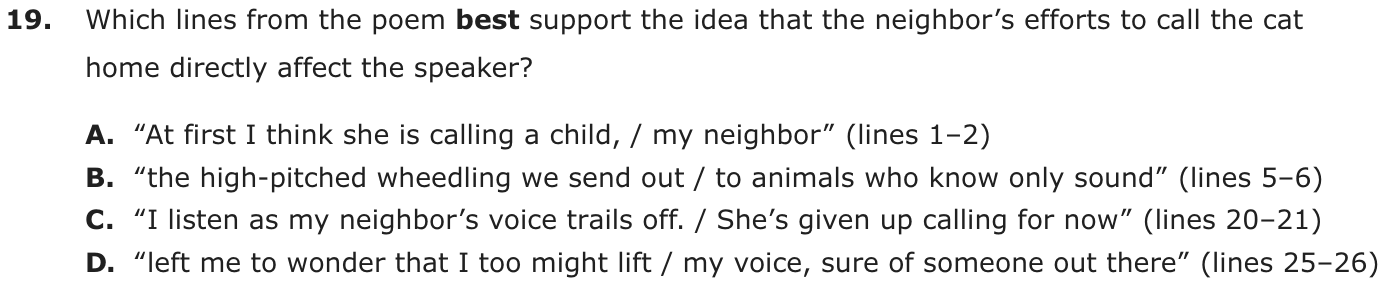
The passage “At Dusk” as printed (page 48)
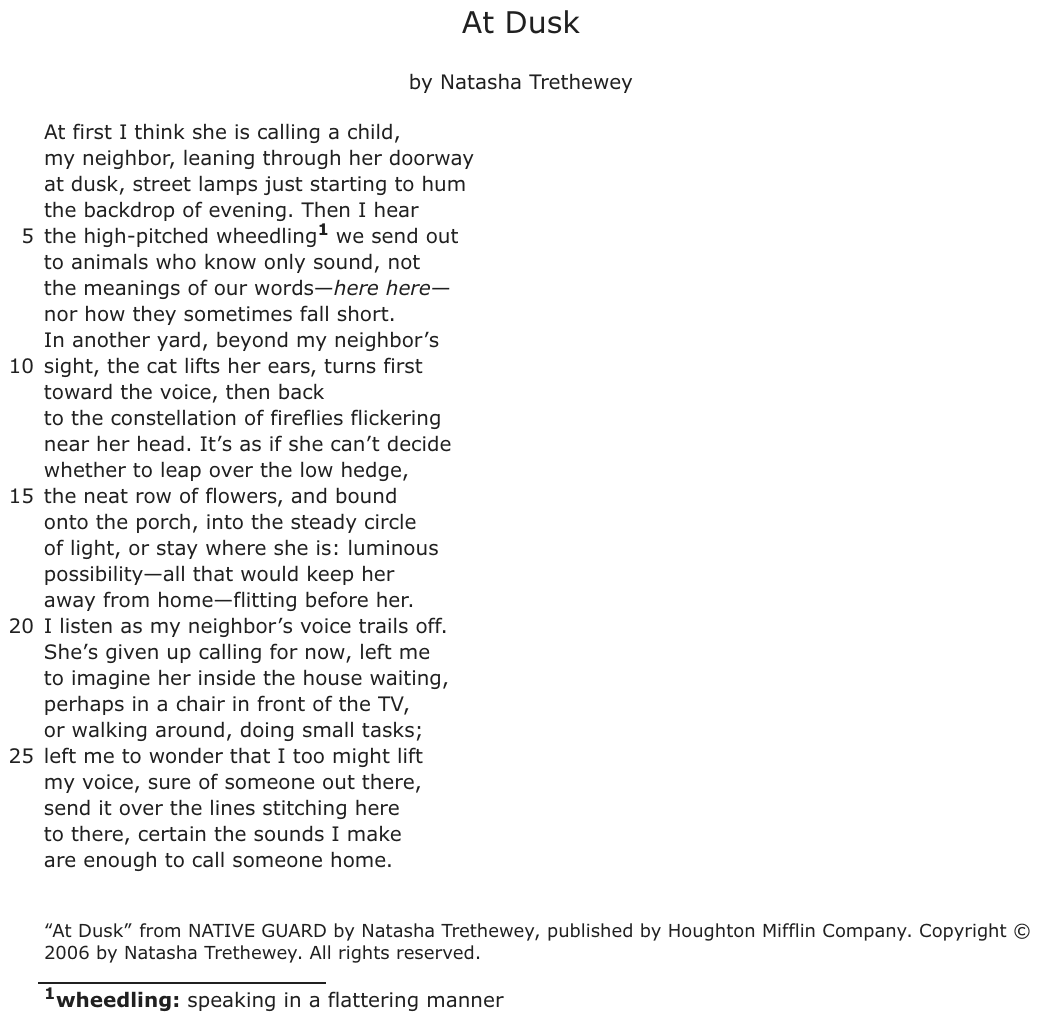
Question 106 of 120
2024 Test A English, question 20Uses the passage above: “At Dusk”.
Question
The isolation of the words “—here here—” in line 7 contributes to the meaning of the poem mainly by
- Ademonstrating how people try to communicate in familiar ways but are still sometimes misunderstood.
- Bshowing how people can feel desperate to connect with others but give up quickly when their first attempts are ignored.
- Cusing the unspoken bond between the neighbor and her cat to highlight the understanding people have with their pets.
- Dillustrating the use of a simple expression to call home those who are loved and missed.
Show the answer
Correct answer: D
The question asks how the isolation of the words “—here here—” in line 7 mainly contributes to the meaning of the poem.
A. Incorrect. The words “—here here—” do interrupt the speaker’s observation in lines 7–8 that “our words . . . / . . . sometimes fall short.” However, in lines 5–7, the speaker observes that the neighbor accompanies her words with a “high-pitched wheedling” that people “send out” because they are aware that animals “know only sound, not / the meanings of our words,” indicating that the neighbor does not actually expect her words to be understood. The description of the cat’s response in lines 10–11 (“the cat lifts her ears, turns first / toward the voice, then back”) does not suggest that the neighbor’s message is misunderstood but rather suggests that the cat prefers not to respond to it.
B. Incorrect. In lines 20–21, the “neighbor’s voice trails off,” and she does give up calling the cat. However, rather than any desperation to connect, the neighbor’s use of a “high-pitched wheedling” (line 5) simply indicates her understanding that the cat, like other animals, understands “only sound, not / the meanings of our words” (lines 6–7) such as “here here.” Furthermore, the neighbor does not give up quickly. In lines 21–22, the speaker says the neighbor has “given up calling for now” but is still “waiting” for the cat.
C. Incorrect. In lines 4–7, the speaker describes the neighbor calling to the cat with a “high-pitched wheedling.” The sound may indicate a bond between the neighbor and the cat because the neighbor does understand that animals “know only sound, not / the meanings of our words” (lines 6–7). However, the use of the words “here here” in line 7 does not indicate that bond, because they are used as an example of the type of words that animals do not understand.
D. CORRECT. The speaker’s initial thought in line 1 that the neighbor is calling a child, rather than a cat, suggests that the neighbor loves and misses the cat. Lines 4–7 then present the speaker’s observation that the neighbor uses a “high-pitched wheedling,” to emphasize the simple words of her call, “—here here—.” The idea that the words are an example of a simple expression used to call home a missed loved one is reinforced in lines 25–29, when the speaker is “left . . . to wonder” whether the speaker, too, “might lift / [his or her] voice” and be able “to call someone home.”
Question analysis
This reading question asks how setting off the words here here with dashes in line 7 adds to the meaning of At Dusk, Natasha Trethewey's poem about a neighbor calling her cat at nightfall. Students must work out what two plain, isolated words contribute to the whole poem, choosing among four readings about how people and animals communicate and connect.
- Grade level
- Grade 8 reading and task
- Compared with grade 7
- Above grade 7 Grade 7 students explain how a line adds to a poem, but here the feature is a tiny typographic choice, and its meaning has to be built from the whole poem rather than nearby lines, which goes beyond typical grade 7 work.
- Estimated difficulty
- Among the hardest on the SHSAT: a non-obvious approach, heavy reading, or a well-hidden trap.
- Thinking it demands
- Depth of knowledge 3, strategic thinking · mainly analyze
- What makes it hard
- A very close wrong answer major
- Evidence in several places moderate
- How, not what moderate
- Evidence
- Answered from the whole text
- Reading level
- Passage: 236 words (a poem; reading level not measured); question and choices: about grade 9, 87 words.
- Corrected from the DOE handbook
- A grammar slip in the explanation was corrected.
- Students, last 30 days
- Not enough answers yet to show (it takes 10).
Why it is hard, traps and wrong answers (shows the answer)
Why it is hard
The words sit inside a sentence about animals not knowing the meanings of our words and about words that “sometimes fall short,” so the nearest lines point toward miscommunication. The poem's frame points elsewhere: it opens with a call that sounds like a parent's, ends with the speaker hoping a voice can “call someone home,” and even repeats “here” in line 27. Students who read only around line 7 choose the misunderstanding; those who connect the isolated call to the first and last lines see what it is for.
A very close wrong answer major Choosing the answer
The misunderstanding choice and the right one agree that “here here” is a familiar way of calling; they part only on what it shows, failed communication or a call home to someone missed. (Embretson & Wetzel, 1987; Gorin & Embretson, 2006; Ascalon et al., 2007)
Evidence in several places moderate Working it out
The right reading rests on lines far from line 7: the speaker's first guess that a child is being called, and the last line's wish “to call someone home.” (Kirsch & Mosenthal, 1990; Gorin & Embretson, 2006)
How, not what moderate Working it out
The question asks what setting two words apart with dashes and italics does for the poem, a typographic choice whose purpose the poem never explains. (Anderson & Krathwohl, 2001)
Strategy: Ask what the two words are meant to do and whom they are aimed at, then keep the choice that the poem's other lines confirm.
Traps
- Wrong purpose or structure: Names a purpose, structure or effect that the part does not serve, or describes what a part says when the question asks what it does.
- Twists what the text says: Uses the text's topic and ideas but changes what it says: who did it, how much, when, or why.
- Reads too much in: A reasonable-sounding conclusion that goes further than the text allows.
The wrong answers, classified
A Wrong purpose or structure (Anderson & Krathwohl, 2001)
Reads the words through line 8's “sometimes fall short” as failed communication, but the cat does hear and turn toward the call, and the ending hopes such sounds can bring someone home.
B Twists what the text says (King et al., 2004)
Sees the neighbor stop calling and calls her desperate and quick to quit, though she has given up only “for now” and is still waiting inside.
C Reads too much in (Graesser, Singer & Trabasso, 1994)
Assumes an owner and a pet share a silent understanding, but “here here” is spoken aloud, and the poem offers it as words animals cannot follow.
What was corrected from the DOE handbook, and why
- Explanation: In rejecting choice C, the handbook reads “the use of the words “here here” in line 7 do not indicate that bond.” It now reads “does not,” to agree with “use.”
Working it out, step by step
Figure out what the question asks
In line 7 the words here here are set apart by dashes and slanted letters (italics). The question asks what this does for the poem’s meaning. Think about what the words are for and who they are aimed at.
Look at line 7
Line 7 reads “the meanings of our words—here here—.” These are the words the neighbor calls to her cat. Setting them apart lets you hear them, as if spoken aloud. They are simple words that mean “come here.” Lines 6–7 say animals know “only sound, not / the meanings of our words.”
Connect to the start and end
In line 1 the speaker first thinks the neighbor “is calling a child.” So the call sounds like a parent calling someone they love. The poem ends with the hope that a voice can be “enough to call someone home” (line 29). So here here is a simple call to bring a loved one home.
Check each choice
- A is wrong. The cat isn’t confused. She “lifts her ears” and turns “toward the voice.” She just doesn’t come yet.
- B is wrong. The neighbor isn’t shown as desperate. She stops only “for now,” and the speaker pictures her waiting inside.
- C is wrong. Here here is spoken out loud. The poem treats it as words animals don’t understand, not a silent bond.
- D is right. It is a simple call to someone loved and missed.
Watch out: Line 8 says words “sometimes fall short,” which points toward A. But read the first and last lines too.
Choose the answer
The two words stand for the simple call people use to bring loved ones home. So the answer is D.
Why this answer and not the closest wrong one
A is the closest wrong answer, because line 8 says our words “sometimes fall short.” But the cat does hear the call and turn toward it. And the poem ends by hoping the sounds “are enough to call someone home.” D links the two words to that wish, and to the first guess that a child is being called.
More questions like this
The original DOE question
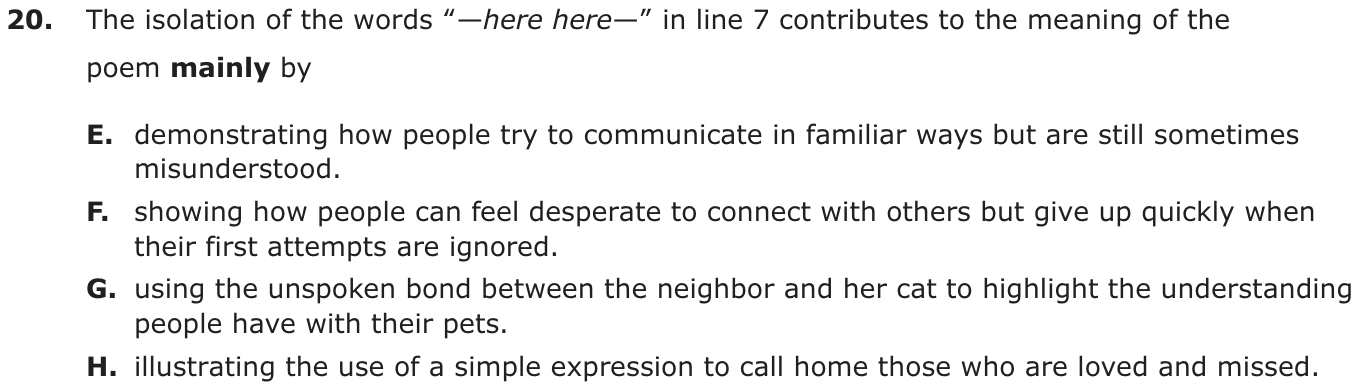
Question 107 of 120
2024 Test A English, question 21Uses the passage above: “At Dusk”.
Question
The details in lines 10–17 about the cat convey a central idea of the poem by
- Ashowing that returning home after experiencing independence is challenging.
- Bsuggesting that caring for others means allowing them to grow and to roam freely.
- Cimplying that expecting to feel at home in the natural world leads to disappointment.
- Demphasizing the conflicting desires to return to the familiar and to explore the unknown.
Show the answer
Correct answer: D
The question asks how the details in lines 10–17 convey a central idea of the poem.
A. Incorrect. In lines 10–17, the speaker says that the cat’s actions—she “turns first / toward the voice, then back”—make the cat seem “as if she can’t decide” whether to return home or to explore “the constellation of fireflies flickering / near her head.” However, while the cat is indecisive, it is not the experience of independence that causes this conflict for the cat but rather the “luminous / possibility . . . flitting before her” (lines 17–19).
B. Incorrect. The neighbor’s calling of the cat indicates that she does allow it to roam outside regularly. However, the details in these lines focus not on whether allowing the cat to roam is an expression of caring but on the cat’s reaction to the neighbor’s calls, “as if she can’t decide” (line 13) whether to return home “into the steady circle / of light” (lines 16–17) or stay and enjoy the “luminous / possibility” (lines 17–18) that the night offers. Furthermore, the neighbor’s “wheedling” (line 5) and the timing of her call, “at dusk” (line 3), introduce the possibility that encouraging others to come home expresses more caring than allowing them to roam freely.
C. Incorrect. Lines 10–17 describe the reactions of the cat, who is exploring the natural world, including a “constellation of fireflies flickering / near her head,” when the neighbor calls to her. The poet describes the cat’s conflict by saying that “It’s as if she can’t decide” whether to stay outdoors or return “into the steady circle / of light” at home with the neighbor. However, the cat’s indecision demonstrates that, rather than being a disappointment, the natural world is as appealing as home.
D. CORRECT. Lines 10–11 describe how the cat “turns first / toward the voice, then back,” indicating that the cat is experiencing a conflict. To the speaker, the cat seems “as if she can’t decide” (line 13) between exploring “the constellation of fireflies” (line 12) outdoors and returning to the familiar “steady circle / of light” (lines 16–17) indoors. This central idea that someone might experience a conflict between exploring and returning to the familiar is suggested again in lines 28–29 when the speaker wonders whether “the sounds I make / are enough to call someone home.”
Question analysis
This reading question asks how the lines describing a cat in another yard, as the neighbor calls from her doorway, convey a central idea of Natasha Trethewey's poem At Dusk. Students must turn a concrete picture of an animal's behavior into a general idea and check each proposed lesson against what the cat actually does in these lines.
- Grade level
- Grade 7 reading and task
- Compared with grade 7
- At grade 7 Showing how specific lines convey a central idea is grade 7 work. The cat's behavior is concrete and easy to picture, so the step from image to idea is a typical grade 7 poetry task.
- Estimated difficulty
- Moderate: several steps, or a close reading with one strong distractor.
- Thinking it demands
- Depth of knowledge 2, skills and concepts · mainly understand
- What makes it hard
- Figurative or literary language moderate
- Reading between the lines minor
- Evidence
- Answered from one paragraph or stanza
- Reading level
- Passage: 236 words (a poem; reading level not measured); question and choices: about grade 9, 66 words.
- Corrected from the DOE handbook
- A grammar slip in the explanation was corrected.
- Students, last 30 days
- Not enough answers yet to show (it takes 10).
Why it is hard, traps and wrong answers (shows the answer)
Why it is hard
The lines show a cat turning toward the voice and back to the fireflies, then hesitating between the porch light and the night, so the idea is a pull in two directions. The most tempting wrong answer also describes trouble going home but explains it by time spent away, a cause these lines never give. Other choices bring in lessons about caring for pets or about nature letting us down, which the bright images of the night contradict.
Figurative or literary language moderate Understanding the question
The two pulls are images, “the constellation of fireflies flickering” for the unknown and “the steady circle / of light” on the porch for the familiar, and both must be read that way. (Graesser, Singer & Trabasso, 1994; Kintsch, 1998)
Reading between the lines minor Working it out
Students must turn one cat's hesitation in a yard into an idea about people, a step these lines leave to the reader until the speaker's own wish at the end of the poem. (Graesser, Singer & Trabasso, 1994; Kintsch, 1998)
Strategy: Describe in plain words what the cat does in lines 10–17 and why, then choose the general idea that matches that behavior without adding causes the lines never give.
Traps
- Half right: One half of a two-part choice is right and the other is not.
- Outside knowledge: A choice is plausible in the real world but not supported by this text.
- Twists what the text says: Uses the text's topic and ideas but changes what it says: who did it, how much, when, or why.
The wrong answers, classified
A Half right (King et al., 2004; Thissen, Steinberg & Fitzpatrick, 1989)
Rightly sees that going home is hard for the cat but blames a taste of independence, when the lines show her drawn by the fireflies now, not changed by time away.
B Outside knowledge (King et al., 2004; Recht & Leslie, 1988)
Brings in a familiar belief that caring means letting loved ones roam, but lines 10–17 describe the cat's choice, not how the neighbor shows care.
C Twists what the text says (King et al., 2004)
Turns the poem's picture of nature upside down: the fireflies and the “luminous / possibility” make the outdoors appealing, not a source of disappointment.
What was corrected from the DOE handbook, and why
- Explanation: In rejecting choice A, the handbook reads “the cat’s actions—she “turns first / toward the voice, then back”—makes the cat seem.” It now reads “make,” to agree with “actions.”
Working it out, step by step
Figure out what the question asks
Lines 10–17 are about the cat. A central idea is a main message of the poem. You need the idea that these details about the cat show.
Read what the cat does
The cat “lifts her ears, turns first / toward the voice, then back / to the constellation of fireflies flickering / near her head” (lines 10–13). Then the speaker says, “It’s as if she can’t decide” (line 13). She could leap “onto the porch, into the steady circle / of light” (lines 16–17). Or she could “stay where she is” (line 17).
Work out what it means
The porch light is home. It is familiar, something the cat knows well. The fireflies are like a “constellation,” a group of stars. They stand for the unknown night and its wonders. The cat is pulled both ways. Part of her wants home. Part of her wants to stay out and explore.
Check each choice
- A is wrong. Going home is hard for the cat. But the reason is the fireflies near her now. The lines never say she got used to being free.
- B is wrong. These lines are about the cat’s choice. They say nothing about caring for her or letting her roam.
- C is wrong. Nature is not disappointing here. The fireflies make the outdoors glow.
- D is right. The cat is torn between the familiar porch and the unknown night.
Watch out: A sounds close, because the cat really does have trouble going home. But A adds a cause the poem never gives.
Choose the answer
The cat turns toward home and then back to the fireflies. So the answer is D.
Why this answer and not the closest wrong one
A is the closest wrong answer. It is right that going home is hard for the cat. But A blames a taste of freedom from time spent away. The poem says nothing about that. It shows two pulls at once: the voice and light of home, and the fireflies close by. D names both desires.
More questions like this
The original DOE question

Question 108 of 120
2024 Test A English, question 22Uses the passage above: “At Dusk”.
Question
The phrases “luminous possibility” and “all that would keep her / away from home” (lines 17–19) affect the poem by
- Ahighlighting the cat’s lack of concern for the neighbor.
- Bimplying that the speaker finds the cat’s current situation interesting.
- Csuggesting that the cat is compelled by its sense of wonder to remain outdoors.
- Dindicating that the speaker supports the cat’s decision to ignore the neighbor.
Show the answer
Correct answer: C
The question asks how the phrases “luminous possibility” and “all that would keep her / away from home” (lines 17–19) affect the poem.
A. Incorrect. In lines 20–21, the neighbor’s voice “trails off,” and the speaker states that “she’s given up calling for now,” which could be interpreted as a lack of concern. However, these lines describe the neighbor rather than the cat. The phrases from lines 17–19 are used to explain that what keeps the cat from returning home is the allure of “luminous possibility.” The use of the phrase “all that would keep her” suggests that the cat would likely return home to the security of “the steady circle / of light” (lines 16–17) if not for the possibilities offered by the night, implying that the cat usually prefers to be at home with the neighbor. The phrases do not highlight a lack of concern for the neighbor on the part of the cat.
B. Incorrect. While the phrase “luminous possibility” does convey a high degree of interest, it is used to describe why being outside at night appeals to the cat. It does not describe the speaker’s interest in the cat. The speaker observes the cat as it tries to decide between returning home and staying out and then concludes that it is only “luminous / possibility . . . that would keep [the cat] / away from home.”
C. CORRECT. The phrases are used to explain that the cat, though tempted to return home, is also tempted or compelled by “luminous possibility” to remain outdoors. The phrases convey a sense of wonder about what the night may offer, and it is the powerful effect of this sense of wonder (“all that would keep her / away from home”) that ultimately tempts the cat to remain outdoors rather than return to the comforts of home.
D. Incorrect. Lines 17–19 present the speaker’s observations about the cat as it tries to decide whether to stay where it is or return home. The speaker explains that it is only “luminous possibility” that can convince the cat to stay rather than return to the comforts of home. While the speaker then imagines the neighbor indoors, there is no indication that the speaker supports the cat’s decision. The speaker merely notes that the neighbor stops calling to the cat “for now” (line 21), and then the speaker reflects on the possible results of calling someone home.
Question analysis
This reading question asks how the phrases luminous possibility and all that would keep her away from home, which describe what surrounds a cat in a nearby yard, affect the poem At Dusk. Students must interpret abstract, figurative wording and work out whose feelings it conveys: the cat's, the neighbor's or the speaker's.
- Grade level
- Grade 8 reading and task
- Compared with grade 7
- At grade 7 Explaining how word choice affects a poem is grade 7 work. These phrases are abstract and broken across lines, which adds some challenge, but the lines around them are concrete, so the task stays within typical grade 7 demand.
- Estimated difficulty
- Moderate: several steps, or a close reading with one strong distractor.
- Thinking it demands
- Depth of knowledge 2, skills and concepts · mainly analyze
- What makes it hard
- Figurative or literary language moderate
- Reading between the lines minor
- Complex sentences minor
- Evidence
- Answered from one paragraph or stanza
- Reading level
- Passage: 236 words (a poem; reading level not measured); question and choices: about grade 8, 63 words.
- Students, last 30 days
- Not enough answers yet to show (it takes 10).
Why it is hard, traps and wrong answers (shows the answer)
Why it is hard
The phrases belong to the speaker but describe what tempts the cat, and the choices exploit that by offering the speaker's interest or approval, or the cat's indifference to its owner. The words “all that would keep her / away from home” imply that home still pulls at the cat, so only an attraction strong enough to hold her outside fits. Students who first settle whose experience the phrases describe can rule out most choices at once.
Figurative or literary language moderate Understanding the question
“Luminous possibility” is abstract, an unnamed promise glowing in the dusk, and students must see it as what draws the cat, the counterweight to “the steady circle / of light” at home. (Graesser, Singer & Trabasso, 1994; Kintsch, 1998)
Reading between the lines minor Working it out
The phrases are the speaker's words about the cat, so students must work out that they convey the cat's pull, not the speaker's opinion or the neighbor's feelings. (Graesser, Singer & Trabasso, 1994; Kintsch, 1998)
Complex sentences minor Understanding the question
The phrases are broken across lines 17–19 and set off by dashes, so “flitting before her” is separated from “possibility” by the inserted “all that would keep her / away from home.” (Abedi & Lord, 2001; Freedle & Kostin, 1993; Messick, 1989)
Strategy: Decide first who or what the phrases describe, then keep only choices about that same subject and check that the phrases themselves show what each one claims.
Traps
- Wrong tone or attitude: Misjudges the tone, attitude or point of view, such as reading admiration as criticism, or taking a character's or subject's feelings for the author's.
- Reads too much in: A reasonable-sounding conclusion that goes further than the text allows.
The wrong answers, classified
A Reads too much in (Graesser, Singer & Trabasso, 1994)
Reads the cat's staying out as indifference to its owner, though “all that would keep her / away from home” implies home would win without the night's attractions.
B Wrong tone or attitude (Graesser, Singer & Trabasso, 1994)
Notices that “luminous possibility” is the speaker's lyrical phrase and takes it as the speaker's own interest, when it describes the wonder drawing the cat.
D Reads too much in (Graesser, Singer & Trabasso, 1994)
Assumes that describing the night so warmly means the speaker approves of the cat ignoring the neighbor, an opinion the poem never states.
Working it out, step by step
Figure out what the question asks
You need to know what two phrases do in the poem. First decide who they describe. Here they describe the cat and what pulls at her.
Find the phrases in lines 17–19
The cat could go home, “or stay where she is: luminous / possibility—all that would keep her / away from home—flitting before her.”
Work out what the words mean
“Luminous” means glowing with light. “Possibility” means what might happen. “Flitting” means darting quickly about, like the fireflies near her head. So the glowing night is full of exciting chances. It is everything that “would keep her / away from home.” That sense of wonder is what holds the cat outside.
Check each choice
- A is wrong. “All that would keep her / away from home” means home pulls at her too. She isn’t uncaring.
- B is wrong. The phrases describe what draws the cat, not how the speaker feels.
- C is right. The night’s glow and wonder tempt the cat to stay out. “Compelled” means strongly pulled.
- D is wrong. The speaker never says the cat is right to stay out.
Watch out: B is tempting because “luminous possibility” is the speaker’s own beautiful wording. But the speaker uses it to show what the cat sees.
Choose the answer
The phrases show a wonder strong enough to hold the cat outdoors. So the answer is C.
Why this answer and not the closest wrong one
B is the closest wrong answer. The speaker does choose these glowing words. But they describe the night that is “flitting before her,” the cat. They explain what keeps her “away from home.” C fits, because the phrases show the cat drawn by wonder to stay outside.
More questions like this
The original DOE question
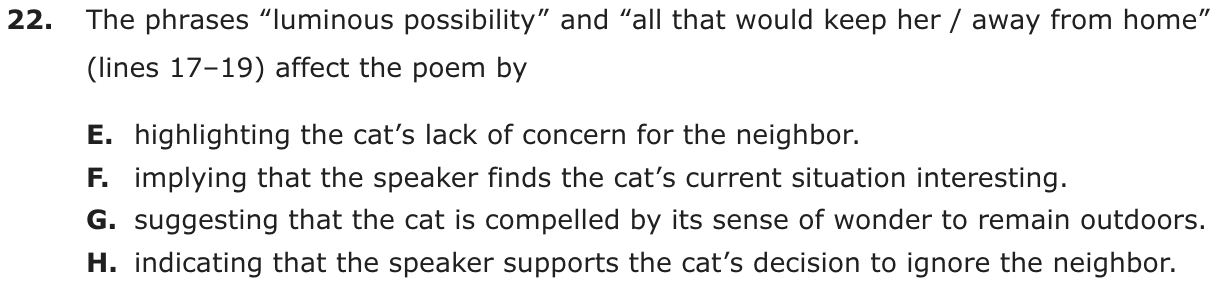
Question 109 of 120
2024 Test A English, question 23Uses the passage above: “At Dusk”.
Question
Read lines 11–13 from the poem.
toward the voice, then back
to the constellation of fireflies flickering
near her head
Which idea from the poem does the imagery in these lines help convey?
- AThe cat lacks a preference for going in or staying out.
- BThe cat is eager to see what will happen next.
- CThe cat wants to understand the unpredictable behavior of the fireflies.
- DThe cat is fascinated by the natural world and finds the indoors unremarkable.
Show the answer
Correct answer: D
The question asks which idea the imagery in lines 11–13 helps convey.
A. Incorrect. Line 13 includes the speaker’s observation that the cat seems “as if she can’t decide” whether to stay outside or go to the neighbor. However, the imagery of the “constellation of fireflies flickering” in line 12 suggests that the cat does have a preference for exploring the more exciting “luminous / possibility” (lines 17–18) of the outdoors.
B. Incorrect. The imagery in lines 10–11 of the cat turning “first / toward the voice, then back” might seem to suggest that the cat is eagerly watching both the neighbor and the fireflies to see what will happen next. However, line 13, in which the cat seems “as if she can’t decide,” indicates that what will happen next is actually under the cat’s control.
C. Incorrect. The imagery in lines 12–13 of the “fireflies flickering / near her head” does indicate the fireflies’ unpredictable behavior. However, the imagery in lines 10–11 of the cat turning “first / toward the voice, then back” establishes that the cat’s attention is split between the fireflies and the “high-pitched wheedling” (line 5) of the neighbor’s voice, rather than being fully captured by wanting to understand the fireflies.
D. CORRECT. The imagery in line 12 of “the constellation of fireflies flickering” suggests that the outdoors holds fascinating attractions, an idea supported by the description in lines 17–18 of the cat’s current location outdoors as one filled with “luminous / possibility.” The imagery in lines 10–11 of the cat turning “first / toward the voice, then back” indicates that the cat has considered but rejected the option of returning indoors, and the description in lines 16–17 of the indoors as offering only a “steady circle / of light” suggests that the indoors seems unremarkable to the cat in comparison to the outdoors.
Question analysis
This reading question quotes three lines from At Dusk in which a cat turns from a calling voice back to fireflies flickering near her head, and asks which idea the imagery helps convey. Students must interpret a visual image in light of the lines around it and judge how far the poem supports each reading of the cat's attention.
- Grade level
- Grade 8 reading and task
- Compared with grade 7
- Above grade 7 Grade 7 students explain what imagery conveys, but this image is brief and the four ideas offered for it differ in subtle ways, so ruling them out takes closer reading than typical grade 7 work.
- Estimated difficulty
- Hard: combines ideas, needs a plan, and has more than one tempting wrong answer.
- Thinking it demands
- Depth of knowledge 3, strategic thinking · mainly analyze
- What makes it hard
- Reading between the lines major
- Figurative or literary language moderate
- Evidence in several places minor
- Evidence
- Answered from one paragraph or stanza
- Reading level
- Passage: 236 words (a poem; reading level not measured); question and choices: about grade 6, 77 words.
- Students, last 30 days
- Not enough answers yet to show (it takes 10).
Why it is hard, traps and wrong answers (shows the answer)
Why it is hard
The answer is the best available rather than a perfect one: its first half is plain in the image of the cat turning back to the fireflies, while its second half rests on the comparison with a steady porch light. Meanwhile the very next words say she “can't decide,” which makes indifference look like the safe reading. The question rewards seeing that being torn is not the same as having no preference, since the image shows which way she turns.
Reading between the lines major Working it out
The quoted lines never mention the indoors, so the claim that the cat finds it unremarkable has to be drawn from the contrast with “the steady circle / of light” in lines 16–17. (Graesser, Singer & Trabasso, 1994; Kintsch, 1998)
Figurative or literary language moderate Understanding the question
“The constellation of fireflies flickering” turns insects into a field of stars beside the cat's head, and that image of wonder is what students are asked to interpret. (Graesser, Singer & Trabasso, 1994; Kintsch, 1998)
Evidence in several places minor Working it out
The words right after the quotation say “It's as if she can't decide,” and the evidence that tips the balance sits in lines 16–19, outside the three lines quoted. (Kirsch & Mosenthal, 1990; Gorin & Embretson, 2006)
Strategy: Picture the cat's movements in these three lines, then test each choice against the words of lines 10–19 and drop any idea the image does not actually show.
Traps
- Twists what the text says: Uses the text's topic and ideas but changes what it says: who did it, how much, when, or why.
- Reads too much in: A reasonable-sounding conclusion that goes further than the text allows.
- Word match: Repeats striking words or phrases from the text, so it looks supported, but its meaning does not fit the question.
The wrong answers, classified
A Twists what the text says (King et al., 2004)
Takes “as if she can't decide” in line 13 to mean the cat has no preference, but being torn means feeling two pulls, and these lines show her turning back to the fireflies.
B Reads too much in (Graesser, Singer & Trabasso, 1994)
Reads the cat's turning back and forth as eager waiting for what will happen, though the lines show attention divided between two pulls, not suspense.
C Word match (Freedle & Kostin, 1993)
Repeats the fireflies' flickering from the image and invents a wish to understand their behavior, when the lines show fascination with the lights, not curiosity about insects.
Working it out, step by step
Figure out what the question asks
Imagery is language that helps you see, hear or feel a scene. You need the idea that the images in lines 11–13 help show.
Picture lines 10–13
The cat “turns first / toward the voice, then back / to the constellation of fireflies flickering / near her head.” A constellation is a group of stars that forms a picture. So the fireflies are like little stars blinking around her. She hears the call, but she turns back to them.
Compare outdoors and indoors
Outside, the night sparkles like stars. Lines 17–18 call it “luminous / possibility,” full of glowing chances. Home is “the steady circle / of light” on the porch (lines 16–17). Steady means it does not change. Next to the flickering stars, that light is plain. Unremarkable means not special.
Check each choice
- A is wrong. The cat “can’t decide,” but that means she feels two pulls. The image shows her turning back to the fireflies.
- B is wrong. She is not waiting for something to happen. Her attention is split between two pulls.
- C is wrong. She is drawn to the fireflies’ glow, not trying to figure out how they act.
- D is right. She is fascinated by the night, and the porch light is plain next to it.
Watch out: A is tempting because of line 13. But being torn is not the same as having no preference.
Choose the answer
The poem never says the cat has made up her mind. But the images make the night magical and home ordinary. That fits D best. So the answer is D.
Why this answer and not the closest wrong one
A is the closest wrong answer, since the next words say “It’s as if she can’t decide.” But a cat with no preference would not care either way. This cat turns back to the fireflies, which shows a strong pull. D fits that pull, and the plain “steady circle / of light” shows why home seems less special.
More questions like this
The original DOE question
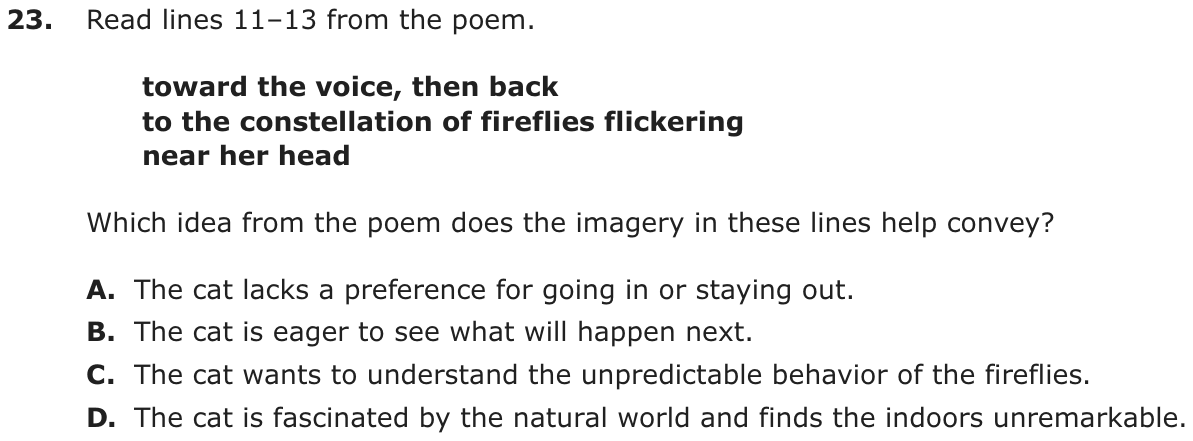
Question 110 of 120
2024 Test A English, question 24Uses the passage above: “At Dusk”.
Question
How does the setting affect the events of the poem?
- AIt enables the speaker to regularly overhear the neighbor calling for her cat at dusk.
- BIt allows the speaker to observe the neighbor quietly without interacting with her.
- CIt shows how living in close proximity helps the speaker feel connected to the neighbor.
- DIt shows how feeling isolated causes the speaker to imagine interactions with the neighbor.
Show the answer
Correct answer: B
The question asks how the setting affects the events discussed in the poem.
A. Incorrect. In line 2, the speaker refers to the woman calling for her cat as “my neighbor,” which clearly suggests that the speaker lives next door to the woman. However, although the two live next door to each other, line 1 suggests that perhaps the speaker does not regularly overhear the neighbor because the speaker initially thinks that the neighbor is “calling a child” and only later realizes the neighbor is calling to a cat. Although the setting places the speaker and the neighbor in close proximity, the poem does not indicate the frequency or regularity with which the speaker overhears the neighbor.
B. CORRECT. In the first four lines, the speaker observes the actions of the neighbor as the neighbor leans out to call for the cat at dusk. Despite the speaker’s observation of the neighbor, there is no indication that the neighbor notices the speaker. The reader can conclude that because of the time of day and the speaker being in the house next door, the speaker can observe the neighbor without being observed by her or having to interact with her.
C. Incorrect. The setting of the poem is a neighborhood at nightfall, as indicated by “at dusk” in line 3, the reference to “another yard” in line 9, and the flickering fireflies in line 12. However, while the speaker is close enough to the neighbor to overhear her calling to the cat, there is no indication that the speaker feels connected to the neighbor. Instead, the speaker expresses curiosity about the neighbor after the neighbor goes inside, and the speaker is “left . . . / to imagine her inside the house waiting” (lines 21–22). The fact the speaker initially thought that the neighbor was calling a child indicates that the speaker is not familiar with the neighbor and her habits, and there is no indication that the speaker feels connected to the neighbor.
D. Incorrect. In lines 22–24, the speaker imagines what the neighbor may be doing while the neighbor is waiting inside for the cat to return, but the speaker is imagining the neighbor’s solitary experience after the neighbor has momentarily “given up” on calling to the cat (line 21). The speaker does not imagine personally interacting with the neighbor but rather briefly imagines what the neighbor is doing at home while the cat is away.
Question analysis
This reading question asks how the setting of At Dusk, a neighborhood at nightfall where a woman leans from her doorway to call her cat, affects the events of the poem. Because so little happens, students must infer the setting's role from small details, and several choices sound reasonable without being supported by the poem.
- Grade level
- Grade 8 reading and task
- Compared with grade 7
- Above grade 7 Grade 7 students analyze how setting shapes events, usually in a story with a clear plot. This poem has almost no action, so the student must reason from a handful of details about place and time, which is harder than typical grade 7 work.
- Estimated difficulty
- Hard: combines ideas, needs a plan, and has more than one tempting wrong answer.
- Thinking it demands
- Depth of knowledge 3, strategic thinking · mainly analyze
- What makes it hard
- A very close wrong answer major
- Reading between the lines moderate
- Evidence
- Answered from the whole text
- Reading level
- Passage: 236 words (a poem; reading level not measured); question and choices: about grade 8, 67 words.
- Students, last 30 days
- Not enough answers yet to show (it takes 10).
Why it is hard, traps and wrong answers (shows the answer)
Why it is hard
Little happens in this poem, so the setting's role must be built from small details: a neighbor at her doorway at dusk, a cat in another yard, a speaker who hears and watches but never speaks. The strongest wrong answer is right about overhearing and wrong only in claiming it happens regularly, which the speaker's first mistaken guess argues against. The other choices supply a feeling of closeness or of isolation that the poem never states.
A very close wrong answer major Choosing the answer
The overhearing choice describes what the setting allows almost as well as the right one and fails on a single word, “regularly,” since the poem records one evening and the speaker first mistakes the call. (Embretson & Wetzel, 1987; Gorin & Embretson, 2006; Ascalon et al., 2007)
Reading between the lines moderate Working it out
The setting's effect is never stated; it has to be inferred from the speaker hearing and watching from nearby while the neighbor, “leaning through her doorway,” never seems to notice anyone. (Graesser, Singer & Trabasso, 1994; Kintsch, 1998)
Strategy: Picture the scene from the speaker's position, then check each choice word by word against the poem and reject any that claims something the poem never states.
Traps
- Too broad or too strong: A choice overstates, generalizes, or uses absolute words the text does not support.
- Reads too much in: A reasonable-sounding conclusion that goes further than the text allows.
- Twists what the text says: Uses the text's topic and ideas but changes what it says: who did it, how much, when, or why.
The wrong answers, classified
A Too broad or too strong (King et al., 2004)
Rightly sees that living next door lets the speaker overhear the call, but “regularly” is unsupported, and the first guess about a child suggests the call is unfamiliar.
C Reads too much in (Graesser, Singer & Trabasso, 1994)
Connects living close by with the poem's interest in connection and the speaker's “I too,” but the speaker never claims to feel close to the neighbor.
D Twists what the text says (King et al., 2004)
Notices the speaker picturing the neighbor indoors and calls it imagined interaction, but the speaker pictures her alone, waiting or doing small tasks, and never mentions feeling isolated.
Working it out, step by step
Figure out what the question asks
The setting is where and when a story or poem takes place. You need to see how the setting shapes what happens in the poem.
Picture the setting
It is “dusk” (line 3), the dim time just after sunset. The neighbor is “leaning through her doorway” (line 2). The cat is “In another yard” (line 9). The speaker is close enough to hear and watch it all. But the speaker never speaks to the neighbor. Nothing shows the neighbor notices the speaker.
Work out the effect
Living next door puts the speaker close by. In the fading light, the speaker can watch quietly. So the speaker sees the neighbor and the cat without joining in. The whole poem is what the speaker sees, hears and imagines from there.
Check each choice
- A is wrong. The word “regularly” is the problem. The poem shows one evening.
- B is right. The speaker watches from nearby and never talks with the neighbor.
- C is wrong. The speaker never says they feel close to the neighbor.
- D is wrong. The poem never says the speaker feels lonely. The speaker pictures the neighbor alone inside, not the two of them talking.
Watch out: A is almost right, since living nearby does let the speaker overhear. One word makes it wrong.
Choose the answer
The setting lets the speaker watch quietly from close by. So the answer is B.
Why this answer and not the closest wrong one
A is the closest wrong answer. Living next door does let the speaker hear the call. But nothing says it happens often. The poem tells about one evening. At first the speaker even thinks a child is being called. B fits what the poem shows: the speaker watches without ever talking to the neighbor.
More questions like this
The original DOE question

Question 111 of 120
2024 Test A English, question 25Uses the passage above: “At Dusk”.
Question
The poet develops a theme about making connections with others mainly through the
- Aexploration of the desires of the speaker and the neighbor.
- Bspeaker’s observations of the sights and sounds in the neighborhood.
- Cspeculations the speaker makes about what the neighbor does inside her house.
- Dspeaker’s explanation of the cat’s thoughts and actions.
Show the answer
Correct answer: A
The question asks for an explanation of how the poet develops a theme about making connections with others.
A. CORRECT. The speaker first describes the neighbor calling the cat in a “high-pitched wheedling” (line 5) voice before giving up and returning indoors. The neighbor’s desire to have the cat return home prompts the speaker to wonder whether the speaker could call out and be “certain the sounds . . . / are enough to call someone home” (lines 28–29). These final lines most develop the theme of connection by conveying a desire to be able to prompt someone’s return.
B. Incorrect. Line 1, in which the speaker at first thinks the sound in the neighborhood is the neighbor “calling a child,” might be assumed to introduce a theme of making connections with others. However, other descriptions of the sights and sounds of the neighborhood, including the time of day—“at dusk, street lamps just starting to hum / the backdrop of evening” (lines 3–4) and “constellation of fireflies flickering” (line 12) near the cat—have no relationship to a theme of connection.
C. Incorrect. In lines 22–24, the speaker imagines the neighbor’s activities inside her house: “perhaps in a chair in front of the TV, / or walking around, doing small tasks.” Although the speaker does imagine the neighbor is doing these things to pass time while “waiting” (line 22) for the cat, the neighbor’s actions—and even the speaker’s imagining—are carried out alone, so they do not develop a theme of connection.
D. Incorrect. Lines 10–19 present the speaker’s observations of the cat, which “turns first / toward the voice, then back” when the neighbor calls, then appears “as if she can’t decide” whether to return to the neighbor or stay outside. Although the cat’s indecision about whether to heed the neighbor’s call might seem to develop a theme about making connections, lines 10–19 focus more on the relative appeal of the cat’s two options—returning to “the steady circle / of light” at home or pursuing the “luminous / possibility . . . flitting before her”—than on any connection between the cat and its owner or between the speaker and the neighbor.
Question analysis
This reading question asks which element of Natasha Trethewey's poem At Dusk mainly develops its theme about making connections with others. All four choices describe something that really happens in the poem, from neighborhood sights to a cat's hesitation, so students must weigh how much each part contributes to that theme.
- Grade level
- Grade 8 reading and task
- Compared with grade 7
- Above grade 7 Analyzing how a theme develops is grade 7 work, but here the student must rank four genuine features of the poem by how much each builds the theme, a comparison that asks more than typical grade 7 work.
- Estimated difficulty
- Hard: combines ideas, needs a plan, and has more than one tempting wrong answer.
- Thinking it demands
- Depth of knowledge 3, strategic thinking · mainly analyze
- What makes it hard
- Every choice must be checked moderate
- Evidence in several places moderate
- The right answer is reworded minor
- Evidence
- Answered from the whole text
- Reading level
- Passage: 236 words (a poem; reading level not measured); question and choices: about grade 8, 53 words.
- Students, last 30 days
- Not enough answers yet to show (it takes 10).
Why it is hard, traps and wrong answers (shows the answer)
Why it is hard
The question asks what mainly carries the theme, and every choice is a real part of the poem, so ruling choices out means ranking them, not spotting errors. The cat takes up the most lines and is the one being called home, which makes it the strongest lure, though its lines are about her choice between two places. What builds the theme is the neighbor's wish to bring the cat home, echoed by the speaker's wish to call someone home.
Every choice must be checked moderate Choosing the answer
All four choices name something that really fills the poem, so each must be weighed by how much it builds the theme of connection, not by whether it is there. (Embretson & Wetzel, 1987)
Evidence in several places moderate Working it out
The theme is built from the two ends of the poem: the neighbor calling and then waiting in lines 1–8 and 20–22, and the speaker's wish in lines 25–29 to send a voice out. (Kirsch & Mosenthal, 1990; Gorin & Embretson, 2006)
The right answer is reworded minor Choosing the answer
The right choice speaks of “desires,” a word the poem never uses, while the wrong ones echo its sounds, the neighbor's house and the cat. (Freedle & Kostin, 1993; Kirsch & Mosenthal, 1990)
Strategy: For each choice, find the lines it refers to and ask how directly they bear on making connections with others; keep the choice whose lines do so most fully.
Traps
- Wrong part of the text: A choice is true of another paragraph, stanza or speaker than the one asked about.
- Too narrow: A single detail offered as the central idea or a summary, or a summary that keeps minor details and leaves out an essential part.
- True but not the answer: A choice says something accurate about the text that does not answer this question.
The wrong answers, classified
B True but not the answer (King et al., 2004; Embretson & Wetzel, 1987)
Picks the poem's sights and sounds, the humming street lamps and the fireflies, which set the scene at dusk but are not where the poem says anything about reaching others.
C Too narrow (King et al., 2004)
Chooses the speaker picturing the neighbor in front of the TV, a real moment of imagining another life, but three lines of solitary tasks cannot carry the theme alone.
D Wrong part of the text (Kirsch & Mosenthal, 1990)
Notices how many lines follow the cat, the one being called home, but they weigh the porch light against the night, not one person reaching toward another.
Working it out, step by step
Figure out what the question asks
A theme is a big message about life. This poem has a theme about making connections, or reaching out to others. You need the part of the poem that mainly builds that theme.
Look at what the neighbor wants
The neighbor wants her cat to come home. She calls out at dusk with a “high-pitched wheedling” (line 5). Wheedling means sweet-talking. When she stops, the speaker pictures her “inside the house waiting” (line 22). Her wish is to reach the cat and bring her back.
Look at what the speaker wants
Her calling “left me to wonder that I too might lift / my voice” (lines 25–26). The speaker hopes the sounds “are enough to call someone home” (line 29). So the speaker wants to reach someone too. Both people wish to call someone back to them. That shared wish builds the theme of connection.
Check each choice
- A is right. The desires, or wishes, of the neighbor and the speaker carry the theme.
- B is wrong. The humming street lamps and the fireflies set the scene. They don’t show anyone reaching out.
- C is wrong. The guesses about the neighbor inside fill only three lines, and they show her alone.
- D is wrong. The cat lines weigh home against the night. They don’t show one person reaching another.
Watch out: D is tempting because the cat fills many lines. But they are about her choice, not about a connection.
Choose the answer
The poem builds its theme through what the neighbor and the speaker both want. So the answer is A.
Why this answer and not the closest wrong one
D is the closest wrong answer, since the cat takes up lines 10–19. But those lines weigh the porch light against the glowing night. The theme of connection comes from two wishes. The neighbor wants to call the cat home. The speaker wants to “call someone home” too. A names those desires.
More questions like this
The original DOE question

Question 112 of 120
2024 Test A English, question 51Passage Excerpt from “It’s Time to Stop Thinking That All Non-Native Species Are Evil”
Excerpt from “It’s Time to Stop Thinking That All Non-Native Species Are Evil”
by Emma Marris
The author of this opinion article attended a symposium, or conference, in Missoula, Montana, at which biologists and other scientists discussed species of plants and animals that are not native to the areas in which they live.
Invasive species are scary. It was ecologist Charles Elton, back in the 1950s, who introduced the militaristic “invasion” metaphor to describe exotic plants and animals—but there’s no question some can be extremely destructive.
The brown tree snake has eaten a dozen kinds of forest birds in Guam to extinction; zebra mussels clog pipes around the Great Lakes; the common house cat turns out to be, in Australia, a mercilessly effective killer of cute, fluffy marsupials like the bilby and the numbat.
As scientists have sounded the alarm about these pests, the public has gotten the message. Citizen groups rip out non-native plants. Native gardens have become increasingly popular, both as ways to celebrate the unique flora of each region and as tiny hot spots of diversity. Native trees provide food for native bugs, which feed native birds. Food chains developed over thousands of years of co-evolution unfold in our backyards. . . .
So we’ve learned, scientists and laypeople alike, that native species are good and non-natives are bad.
Julian Olden, a biologist at the University of Washington, Seattle, who co-organized the symposium, recently polled nearly 2,000 ecologists. Among his findings: a substantial number of them said they would immediately eradicate a hypothetical non-native forest plant, even if it were shown to have no effect on the forest. Olden calls this the “guilty even when proven innocent” approach.
That kind of approach is not very useful on a rapidly changing planet.
Exotics Are Everywhere
Climate change is making it harder even to decide who the invaders are.
How, scientists at the symposium wondered, do you define “native” on a warming planet, when plants and animals are already moving toward the poles or up mountainsides in search of climate conditions they can tolerate? Should we consider them “invasive” in their new homes? Regardless of what we label them, conservationists will be reluctant to remove them from their new environs—to do so would stymie1 their chances of adapting to the warmer future we’re creating.
And then there are the non-natives that we actually like. Most domestic crops are exotic in most of the places they’re grown, but there are even wild exotics that “do good,” forming useful relationships with native species.
Edwin Grosholz of the University of California, Davis, told the recent symposium about one such relationship. On beaches in his state, non-native spartina grass has become important habitat for the endangered California clapper rail, a plump shorebird with a downward curving bill more at home on land than in the air. A project to rip out and poison the spartina—which grows in dense swaths that exclude many other shorebirds—saw clapper rail numbers go tumbling downward.
There are other examples like that. The endangered southwestern willow flycatcher nests in “invasive” tamarisk shrubs. Many native (and beautiful) Hawaiian flowers are now pollinated by the Japanese white-eye bird—because the native pollinators have been driven extinct by other non-native species.
Should we impose further risk on already endangered natives by severing these relationships? Or should we admire the resilience of nature and let such “well-behaved” exotics stay? . . .
Leave them alone, more and more conservationists are arguing, and stop focusing obsessively on categorizing species as native or non-native. Mark Davis, an ecologist at Macalester College in St. Paul, Minnesota, once considered himself an “invasion biologist”—but not anymore. “I am actively trying to get the field to retire the invader narrative,” he said in Missoula.
A Good Thing, Not the Only Thing
After all, nativeness is just one environmental value, and arguably not as important as preventing extinctions and preserving biodiversity. In some cases we can best serve biodiversity by leaving the non-natives alone or even—brace yourself, now—introducing them on purpose.
This is the thinking behind, for example, installing the Aldabra tortoise on the islands of Mauritius. The islands lost their own large tortoises, and the fruiting plants that formerly had their seeds moved around by these fruit-loving reptiles have been on the decline. A tortoise that’s related to the island’s large tortoises—a non-native from the Seychelles in the Indian Ocean that was intentionally introduced in 2004—is now handling some of that work.
Most of the time, for the time being, conserving species still means focusing on supporting them in their historical habitats, planting natives and removing non-natives. We can and should do that in places where it is feasible and important to us.
From “It’s Time to Stop Thinking That All Non-Native Species Are Evil” by Emma Marris from NATIONAL GEOGRAPHIC MAGAZINE, July 24, 2014. Copyright © 2014 by National Geographic Society.
1stymie: hinder or interfere with
Question
Which sentence from the excerpt supports the conclusion that Elton’s “militaristic ‘invasion’ metaphor” (paragraph 1) has influenced scientific understanding of non-native species?
- A“Among [Olden’s] findings: a substantial number of them said they would immediately eradicate a hypothetical non-native forest plant, even if it were shown to have no effect on the forest.” (paragraph 5)
- B“Regardless of what we label them, conservationists will be reluctant to remove them from their new environs—to do so would stymie their chances of adapting to the warmer future we’re creating.” (paragraph 8)
- C“A project to rip out and poison the spartina—which grows in dense swaths that exclude many other shorebirds—saw clapper rail numbers go tumbling downward.” (paragraph 10)
- D“In some cases we can best serve biodiversity by leaving the non-natives alone or even—brace yourself, now—introducing them on purpose.” (paragraph 14)
Show the answer
Correct answer: A
The question asks which sentence from the excerpt supports the conclusion that Elton’s “militaristic ‘invasion’ metaphor” (paragraph 1) has influenced scientific understanding of non-native species.
A. CORRECT. This sentence shows that of the 2,000 ecologists Olden polled, many said they think it is right to “immediately eradicate” non-native plants even if they are demonstrably harmless in their new environment. The response of these ecologists supports that Elton’s metaphor discussed in paragraph 1 has influenced scientific understanding.
B. Incorrect. Rather than supporting the idea that the militaristic metaphor has influenced scientists, this sentence shows that conservationists, at any rate, are happy to let non-native species thrive wherever they can, given global warming.
C. Incorrect. While this sentence does refer to efforts to eradicate a non-native species, the main point of it is that these efforts ended up harming a native species (the clapper rail shorebird).
D. Incorrect. In contrast to supporting the idea that the militaristic invasion metaphor has influenced scientific understanding of non-native species, this sentence puts forth the bold idea of treating non-native species as something to be welcomed.
Question analysis
This evidence question asks which sentence from an opinion article about non-native species supports the conclusion that ecologist Charles Elton's war-like “invasion” metaphor has shaped how scientists think. Students must work out what attitude the metaphor implies and then judge which quotation shows that attitude at work in science.
- Grade level
- Grade 8 reading and task
- Compared with grade 7
- At grade 7 Finding evidence for a stated conclusion is grade 7 work. This conclusion is abstract, about a metaphor's influence on thinking, and the vocabulary, such as eradicate and environs, adds load, but the choices are fairly distinct.
- Estimated difficulty
- Moderate: several steps, or a close reading with one strong distractor.
- Thinking it demands
- Depth of knowledge 2, skills and concepts · mainly evaluate
- What makes it hard
- Reading between the lines moderate
- Hard words minor
- Evidence
- Answered from several paragraphs or stanzas
- Reading level
- Passage: about grade 11, 815 words; question and choices: about grade 16, 135 words.
- Corrected from the DOE handbook
- A wording slip in the explanation was corrected.
- Students, last 30 days
- Not enough answers yet to show (it takes 10).
Why it is hard, traps and wrong answers (shows the answer)
Why it is hard
The conclusion is abstract, that a figure of speech shaped how scientists think, so the student has to translate it into behavior: treating every non-native as an enemy to destroy. The spartina sentence describes exactly that kind of attack, which makes it tempting, but its point is the harm the attack did to a native bird. Two other sentences show conservationists and the author moving away from the invasion view, the opposite of what is asked.
Reading between the lines moderate Working it out
The right sentence never mentions Elton or war; eradicating a plant even when it is “shown to have no effect” must be recognized as the invasion mindset, which Olden calls “guilty even when proven innocent”. (Graesser, Singer & Trabasso, 1994; Kintsch, 1998)
Hard words minor Understanding the question
“Militaristic”, “eradicate”, “environs” and “stymie” all appear in the stem or the choices, and only “stymie” is footnoted. (Perfetti, 2007; Freedle & Kostin, 1993)
Strategy: Work out what attitude the invasion metaphor encourages toward non-native species, then test each sentence for evidence that scientists hold that attitude.
Traps
- Supports only part of the claim: In a question about evidence: a line that backs one half of the claim but not the other, or a related point rather than the claim itself.
The wrong answers, classified
B Supports only part of the claim (King et al., 2004; Thissen, Steinberg & Fitzpatrick, 1989)
Picks a sentence about labels and conservationists, but it says they would hesitate to remove species moving with the climate, the opposite of the war-like attitude in question.
C Supports only part of the claim (King et al., 2004; Thissen, Steinberg & Fitzpatrick, 1989)
Spots a war-like campaign, ripping out and poisoning spartina, but the sentence's point is that removal hurt the clapper rail, and it says nothing about how scientists think.
D Supports only part of the claim (King et al., 2004; Thissen, Steinberg & Fitzpatrick, 1989)
Chooses the author's case for leaving non-natives alone or even introducing them, which shows thinking turning against the invasion metaphor, not shaped by it.
What was corrected from the DOE handbook, and why
- Explanation: The handbook reads “many said they think it is right to “immediately eradicate” non-native species plants.” Paragraph 5 is about “a hypothetical non-native forest plant,” so the explanation now reads “non-native plants.”
Working it out, step by step
Unpack the conclusion
A metaphor describes one thing as if it were another. In paragraph 1, Elton called the spread of non-native species an “invasion,” as if they were an enemy army. Militaristic means having to do with war. So the conclusion says this war-like way of talking has shaped how scientists think about non-native species.
Picture that way of thinking
If you see a species as an invader, you treat it as an enemy. You want to get rid of it, whether or not it does any harm. So look for a sentence that shows scientists thinking this way.
Find the scientists’ answers
Paragraph 5 describes a poll of nearly 2,000 ecologists, scientists who study living things and where they live. Many said they would “immediately eradicate,” or wipe out, a non-native plant. They would do it “even if it were shown to have no effect on the forest.” The plant would do no harm, yet they would destroy it. Olden calls this “guilty even when proven innocent.”
Check each choice
- A fits: scientists would destroy a harmless plant just because it is non-native, which is the invasion way of thinking.
- B is wrong because conservationists being reluctant, or unwilling, to remove species is the opposite attitude.
- C is wrong because its point is that removing the grass hurt a native bird, not what scientists believe.
- D is wrong because the author argues for leaving non-natives alone, which goes against the invasion idea.
Watch out: C describes an attack on a plant, so it sounds war-like. But it tells what happened, not how scientists think.
Choose the answer
Only A shows scientists treating a non-native species as an enemy, even when it is harmless. So the answer is A.
Why this answer and not the closest wrong one
C comes closest, because ripping out and poisoning a plant looks like the war the metaphor describes. But the sentence reports that this harmed the clapper rail. It doesn’t show what scientists believe. A shows many ecologists ready to destroy even a harmless plant, which is the invasion way of thinking at work.
More questions like this
The original DOE question
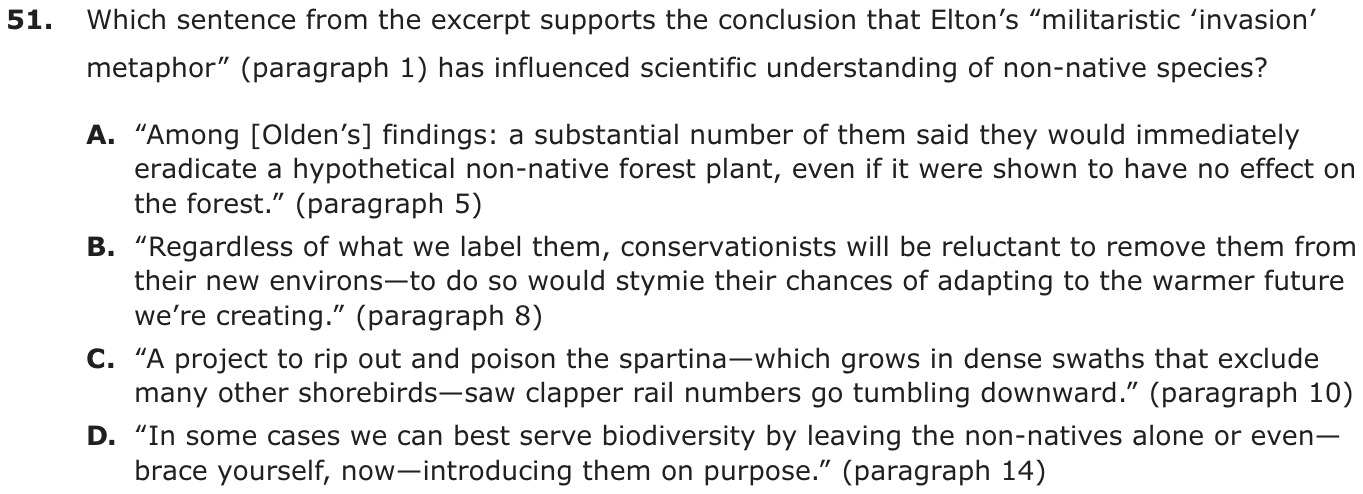
The passage “Excerpt from “It’s Time to Stop Thinking That All Non-Native Species Are Evil”” as printed (pages 68–70)
Question 113 of 120
2024 Test A English, question 52Uses the passage above: “Excerpt from “It’s Time to Stop Thinking That All Non-Native Species Are Evil””.
Question
Which detail provides the most relevant support for the claim that “climate change is making it harder even to decide who the invaders are” (paragraph 7)?
- Athe mention in paragraph 8 of non-native species that are forced to seek new habitats
- Bthe acknowledgment in paragraph 9 that non-native species include many domestic crops
- Cthe description in paragraph 11 of the interactions between native and non-native species
- Dthe account in paragraph 13 of an ecologist who changed his beliefs about non-native species
Show the answer
Correct answer: A
The question asks which detail provides the most relevant support for the claim that “climate change is making it harder even to decide who the invaders are” (paragraph 7).
A. CORRECT. The fact that many plants and animals have no choice but to seek out “climate conditions they can tolerate” (paragraph 8) makes it much harder to decide whether to call these species invaders.
B. Incorrect. The fact that many domestic crops are non-native species has nothing to do with climate change affecting our discernment of which species are invaders.
C. Incorrect. The description in paragraph 11 of native and non-native species interacting never suggests that climate change is a factor in these interactions and never suggests that climate change muddies our understanding of which species is native and which is non-native.
D. Incorrect. While the example of Mark Davis so thoroughly changing his beliefs about non-native species is a powerful one, the role that climate change might have played in this reversal is never discussed.
Question analysis
Here students choose the detail that gives the most relevant support to the claim that climate change is making it harder even to decide which species are invaders, in an article rethinking non-native species. Each choice names a paragraph, and the article gives several different reasons to question the label, so every detail must be checked against the whole claim.
- Grade level
- Grade 7 reading and task
- Compared with grade 7
- Below grade 7 Judging which detail supports a claim is grade 7 argument work, but here the choices name their paragraphs, the claim is short and specific, and only one key idea must be matched, so the task is lighter than typical.
- Estimated difficulty
- Straightforward: two steps or one careful reading.
- Thinking it demands
- Depth of knowledge 2, skills and concepts · mainly evaluate
- What makes it hard
- Evidence
- Answered from one paragraph or stanza
- Reading level
- Passage: about grade 11, 815 words; question and choices: about grade 11, 76 words.
- Students, last 30 days
- Not enough answers yet to show (it takes 10).
Why it is hard, traps and wrong answers (shows the answer)
Why it is hard
The claim has two parts, climate change as the cause and blurred labels as the effect, and every wrong detail muddies the word “invader” without any help from the climate. Crops, helpful partnerships and a converted invasion biologist all complicate the label, so a student who checks only the effect finds four plausible answers. Only paragraph 8 talks about a warming planet.
Every choice must be checked minor Choosing the answer
The choices describe paragraphs instead of quoting them, so each of paragraphs 8, 9, 11 and 13 must be reread for a link to climate. (Embretson & Wetzel, 1987)
The right answer is reworded minor Choosing the answer
The right choice says “forced to seek new habitats” where paragraph 8 says species are moving “toward the poles or up mountainsides in search of climate conditions they can tolerate”. (Freedle & Kostin, 1993; Kirsch & Mosenthal, 1990)
Strategy: Name the cause and the effect in the claim, then test each detail for both; a detail that fits only one part is not the most relevant support.
Traps
- Supports only part of the claim: In a question about evidence: a line that backs one half of the claim but not the other, or a related point rather than the claim itself.
The wrong answers, classified
B Supports only part of the claim (King et al., 2004; Thissen, Steinberg & Fitzpatrick, 1989)
Points to crops as non-natives people like, which complicates the label “invader”, but paragraph 9 never connects them to a changing climate.
C Supports only part of the claim (King et al., 2004; Thissen, Steinberg & Fitzpatrick, 1989)
Picks the helpful pairings of native and non-native species in paragraph 11, which blur good and bad but have nothing to do with a warming planet.
D Supports only part of the claim (King et al., 2004; Thissen, Steinberg & Fitzpatrick, 1989)
Chooses Mark Davis's turn away from invasion biology, a striking change of mind that nothing in paragraph 13 ties to climate change.
Working it out, step by step
Split the claim into two parts
This asks for the detail that best supports a claim. The claim has a cause and an effect. The cause is climate change. The effect is that it is harder to tell which species are invaders. The best support must connect both parts.
Find where climate comes up
Paragraph 8 comes right after the claim, and it talks about “a warming planet.” Plants and animals “are already moving toward the poles or up mountainsides in search of climate conditions they can tolerate.” To tolerate means to be able to live with. As places get hotter, many species move to cooler ones.
See why the labels get harder
When a species moves to a new place, it is not native there. But it didn’t really invade. Heat pushed it out of its old home. So scientists ask whether such species should be called invasive “in their new homes.” Climate change blurs the line between native and invader.
Check each choice
- A fits: species forced to move by the climate link the cause to the effect.
- B is wrong because crops are non-natives people like, but paragraph 9 never mentions climate.
- C is wrong because the helpful pairings in paragraph 11 have nothing to do with climate change.
- D is wrong because nothing ties Mark Davis’s change of mind to a warming planet.
Watch out: B, C and D all make the word invader less clear. But only A shows climate change doing it.
Choose the answer
Only A shows climate change making the word invader hard to apply. So the answer is A.
Why this answer and not the closest wrong one
B comes closest, since crops are non-natives we welcome, and that does complicate the word invader. But paragraph 9 says nothing about climate. A has both parts of the claim: a warming planet, and species that end up in new homes where the old labels don’t fit.
More questions like this
The original DOE question
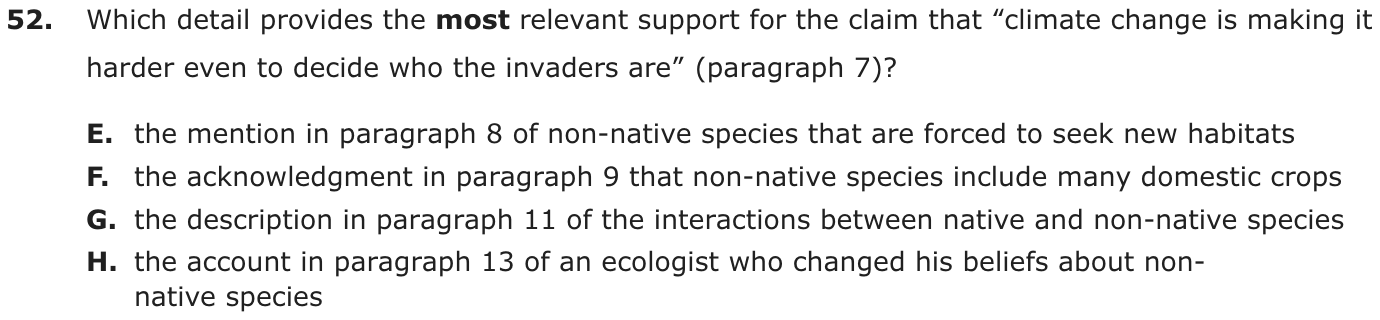
Question 114 of 120
2024 Test A English, question 54Uses the passage above: “Excerpt from “It’s Time to Stop Thinking That All Non-Native Species Are Evil””.
Question
Which sentence from the excerpt supports the idea that some species are able to adjust to change?
- A“Native gardens have become increasingly popular, both as ways to celebrate the unique flora of each region and as tiny hot spots of diversity.” (paragraph 3)
- B“Many native (and beautiful) Hawaiian flowers are now pollinated by the Japanese white-eye bird—because the native pollinators have been driven extinct by other non-native species.” (paragraph 11)
- C“After all, nativeness is just one environmental value, and arguably not as important as preventing extinctions and preserving biodiversity.” (paragraph 14)
- D“The islands lost their own large tortoises, and the fruiting plants that formerly had their seeds moved around by these fruit-loving reptiles have been on the decline.” (paragraph 15)
Show the answer
Correct answer: B
The question asks which sentence from the excerpt supports the idea that some species are able to adjust to change.
A. Incorrect. This sentence discusses native gardens, featuring native species, which presumably have no need to adjust to change.
B. CORRECT. This sentence demonstrates that some species—in this case, Hawaiian flowers—have adapted well to change: the flowers thrive thanks to new pollinators.
C. Incorrect. This sentence focuses on the importance of “preventing extinctions and preserving biodiversity” but does not address the fact that being able to adjust to change is one thing that helps achieve those goals.
D. Incorrect. Far from demonstrating that some species can adjust to change, this sentence discusses species that were not adjusting to the loss of large tortoises and were therefore “on the decline.”
Question analysis
Using an article that argues not every non-native species is harmful, this evidence question asks students to pick the sentence showing that some species are able to adjust to change. Students must decide what adjusting to change would look like in nature, then find a quotation that actually shows a species doing it.
- NYS standards
- 7R1 textual evidence and inferences
- Grade level
- Grade 7 reading and task
- Compared with grade 7
- At grade 7 Selecting a sentence that supports an idea is typical grade 7 evidence work. The quotations are labeled, but the idea is stated generally and must be recognized inside a specific ecological example, a small inference that keeps the item at grade level.
- Estimated difficulty
- Moderate: several steps, or a close reading with one strong distractor.
- Thinking it demands
- Depth of knowledge 2, skills and concepts · mainly evaluate
- What makes it hard
- Reading between the lines moderate
- A very close wrong answer moderate
- Evidence
- Answered from one sentence or line
- Reading level
- Passage: about grade 11, 815 words; question and choices: about grade 14, 117 words.
- Students, last 30 days
- Not enough answers yet to show (it takes 10).
Why it is hard, traps and wrong answers (shows the answer)
Why it is hard
The idea is general and every choice is specific, so the student must recognize adjustment inside an ecological example. The Mauritius sentence is the trap: the paragraph it comes from ends with a new tortoise taking over, which is adjustment, but the quoted sentence stops at the decline. Judging only the words quoted, and asking whether a species carried on after a change, separates the two.
Reading between the lines moderate Working it out
The right sentence never says “adjust”; Hawaiian flowers now pollinated by a newcomer after their native pollinators died out must be recognized as species coping with a change. (Graesser, Singer & Trabasso, 1994; Kintsch, 1998)
A very close wrong answer moderate Choosing the answer
The Hawaiian sentence and the Mauritius sentence both describe plants losing the animals that served them; they part on the outcome, a new pollinator or a decline. (Embretson & Wetzel, 1987; Gorin & Embretson, 2006; Ascalon et al., 2007)
Strategy: For each quotation, ask whether a species faces a change and whether the sentence shows it carrying on successfully; judge only the words quoted.
Traps
- Supports only part of the claim: In a question about evidence: a line that backs one half of the claim but not the other, or a related point rather than the claim itself.
- True but not the answer: A choice says something accurate about the text that does not answer this question.
The wrong answers, classified
A True but not the answer (King et al., 2004; Embretson & Wetzel, 1987)
Picks the popularity of native gardens, which is about what people plant and celebrate, not about any species coping with a change in its world.
C True but not the answer (King et al., 2004; Embretson & Wetzel, 1987)
Chooses the author's ranking of nativeness below preventing extinctions, a statement of values that shows no species adapting to anything.
D Supports only part of the claim (King et al., 2004; Thissen, Steinberg & Fitzpatrick, 1989)
Remembers that a new tortoise later took over seed-spreading on Mauritius, but the quoted sentence shows only the change, plants declining after their tortoises vanished, not any adjustment.
Working it out, step by step
Know what the question asks
To adjust to change means to keep going when something important in your world changes. You need a sentence that shows a species facing a change and carrying on. Judge only the words in each quoted sentence.
Look for a change
Choice B says the native pollinators of some Hawaiian flowers “have been driven extinct.” Extinct means gone forever. Pollinators are animals that carry pollen between flowers so the plants can make seeds. Losing them is a huge change for the flowers.
Look for the adjustment
The same sentence says the flowers “are now pollinated by the Japanese white-eye bird.” A new bird does the job the old pollinators used to do. So the flowers carried on after the change. That is adjusting.
Check each choice
- B fits: the flowers lost their pollinators and gained a new one.
- A is wrong because native gardens are about what people like to plant, and no species adjusts to anything.
- C is wrong because it states the author’s values and shows no species at all.
- D is wrong because the plants “have been on the decline,” which means they are getting fewer, not adjusting.
Watch out: Later in paragraph 15, a new tortoise takes over some of the lost tortoises’ work. But the sentence in D stops at the decline.
Choose the answer
Only B shows a species carrying on after a big change. So the answer is B.
Why this answer and not the closest wrong one
D comes closest, because it also shows plants losing the animals that helped them. But D’s sentence ends with the plants in decline. B’s sentence goes further: a new bird now does the work, so the flowers carry on. That is a species adjusting to change.
More questions like this
The original DOE question
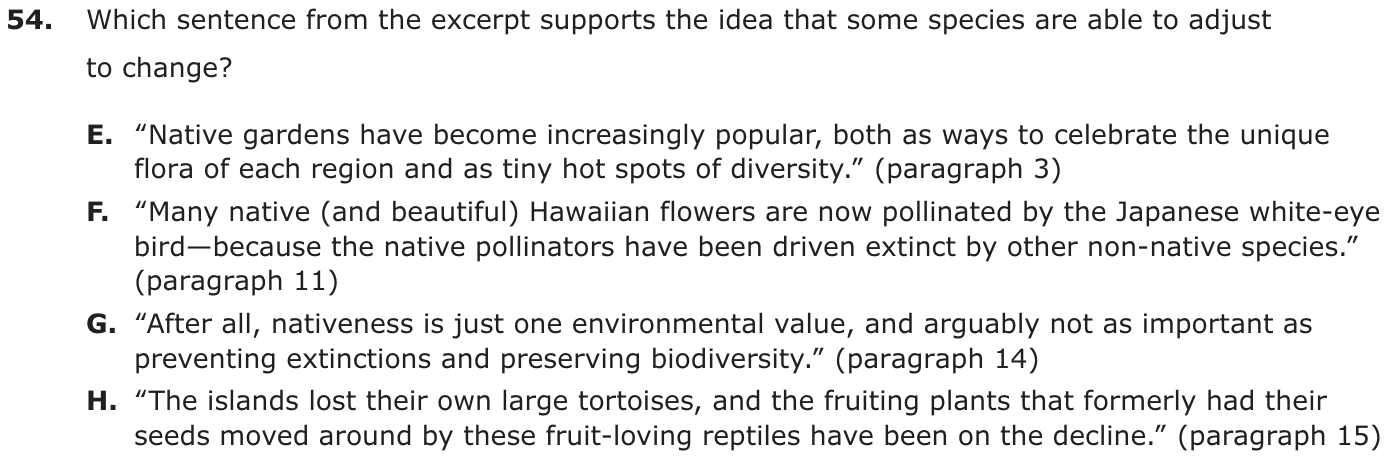
Question 115 of 120
2024 Test A English, question 55Uses the passage above: “Excerpt from “It’s Time to Stop Thinking That All Non-Native Species Are Evil””.
Question
The details in the section “A Good Thing, Not the Only Thing” convey a central idea of the excerpt by suggesting that
- Asome non-native species can replace native species that are unable to survive on their own.
- Bdecisions about whether to keep non-native species should be considered on an individual basis.
- Cthe scientists who study rapidly changing ecosystems agree that non-native species enhance biodiversity.
- Da natural habitat that is healthy should be able to support a blend of native and non-native species.
Show the answer
Correct answer: B
The question asks how the details in the section “A Good Thing, Not the Only Thing” convey a central idea of the excerpt.
A. Incorrect. While paragraph 15 does discuss introducing non-native Aldabra tortoises to replace native tortoises that no longer exist, the real point of this section is to show that non-native species can sometimes help support native species that still exist but are struggling. In this case, the Aldabra tortoises are now moving seeds around for the fruiting plants on the islands where the tortoises have been introduced.
B. CORRECT. This section discusses situations in which non-native species should be kept (as in the example of the Aldabra tortoises in paragraph 15) but also asserts that “most of the time . . . conserving species still means focusing on supporting them in their historical habitats, planting natives and removing non-natives” (paragraph 16). This section makes the point that the issue of non-natives needs to be considered on a case-by-case basis.
C. Incorrect. This section does not claim that non-native species always or even usually enhance biodiversity; rather, it states that “in some cases we can best serve biodiversity by leaving the non-natives alone or even—brace yourself, now—introducing them on purpose” (paragraph 14), later adding that “most of the time . . . conserving species still means focusing on supporting them in their historical habitats, planting natives and removing non-natives” (paragraph 16).
D. Incorrect. While the section happens to give a good example of a habitat that supports both native and non-native species (the islands of Mauritius), it never suggests that being able to do so is a defining characteristic of healthy habitats.
Question analysis
This central-idea question asks how the details in the final section of an article on non-native species, titled “A Good Thing, Not the Only Thing,” convey a central idea of the excerpt. Students must sum up the section as a whole, including its example of a tortoise brought to the islands of Mauritius, and match it to the article's larger argument.
- Grade level
- Grade 8 reading and task
- Compared with grade 7
- Above grade 7 Explaining how a section conveys a central idea is grade 7 work, but this section mixes an argument, an example and a closing paragraph, and the choices differ in how far they generalize from it, which demands more than typical.
- Estimated difficulty
- Hard: combines ideas, needs a plan, and has more than one tempting wrong answer.
- Thinking it demands
- Depth of knowledge 3, strategic thinking · mainly understand
- What makes it hard
- The right answer is reworded moderate
- Evidence in several places moderate
- Evidence
- Answered from several paragraphs or stanzas
- Reading level
- Passage: about grade 11, 815 words; question and choices: about grade 11, 82 words.
- Students, last 30 days
- Not enough answers yet to show (it takes 10).
Why it is hard, traps and wrong answers (shows the answer)
Why it is hard
The section's most memorable content is an example, the Aldabra tortoise doing the work of the islands' lost tortoises, and a choice built on it is the strongest pull. The central idea sits instead in the qualifiers at the start and end of the section: some cases favor non-natives, most still call for removing them. Students who summarize all three paragraphs in a sentence, including the last, arrive at the case-by-case reading.
The right answer is reworded moderate Choosing the answer
The right choice's “on an individual basis” appears nowhere in the section, while the wrong choices echo it: a non-native standing in for natives, “biodiversity”, natives alongside non-natives. (Freedle & Kostin, 1993; Kirsch & Mosenthal, 1990)
Evidence in several places moderate Working it out
The case-by-case idea comes only from joining paragraph 14's “In some cases” to paragraph 16's “Most of the time” and “where it is feasible and important to us”. (Kirsch & Mosenthal, 1990; Gorin & Embretson, 2006)
Strategy: Sum up the section's three paragraphs in one sentence of your own, including its example and its final paragraph, then compare that sentence with each choice.
Traps
- Too narrow: A single detail offered as the central idea or a summary, or a summary that keeps minor details and leaves out an essential part.
- Too broad or too strong: A choice overstates, generalizes, or uses absolute words the text does not support.
- Reads too much in: A reasonable-sounding conclusion that goes further than the text allows.
The wrong answers, classified
A Too narrow (King et al., 2004)
Builds on the Aldabra tortoise standing in for Mauritius's lost tortoises, a single example, and misses the closing point that most conservation still means removing non-natives.
C Too broad or too strong (King et al., 2004)
Turns “In some cases” into a consensus that non-natives enhance biodiversity, though the section limits the claim and the article shows ecologists divided over it.
D Reads too much in (Graesser, Singer & Trabasso, 1994)
Draws a rule about healthy habitats from the Mauritius example, though the section never defines a healthy habitat or says it should hold a mix of species.
Working it out, step by step
Know what the question asks
A section is a part of an article under its own heading. This one runs from paragraph 14 to paragraph 16. You need to sum up the whole section, including its last paragraph. Then match that summary to a central idea.
Read paragraph 14
It says that “in some cases” we help nature most “by leaving the non-natives alone.” We might even bring them in “on purpose.” The words “in some cases” are the key. They mean sometimes, not always.
Read the example and the ending
Paragraph 15 gives an example. A non-native tortoise was brought to Mauritius to spread the seeds of fruiting plants. Then paragraph 16 says that “most of the time,” saving species still means “planting natives and removing non-natives.” We should do that “where it is feasible and important to us.” Feasible means possible.
Put the section together
Sometimes it is best to keep a non-native species. Most of the time it is best to remove it. So each case has to be judged on its own. That is what “on an individual basis” means.
Check each choice
- B fits: deciding case by case matches both “in some cases” and “most of the time.”
- A is wrong because the tortoise is one example, and the section ends by saying removal is still the usual choice.
- C is wrong because the section never says scientists agree, and “in some cases” is far from always.
- D is wrong because the section never says what a healthy habitat should hold.
Watch out: A is built on the section’s most memorable detail. But the main idea comes from the words that limit the claim.
Choose the answer
The section says to keep non-natives in some cases and remove them in others. So the answer is B.
Why this answer and not the closest wrong one
A comes closest, because the Aldabra tortoise really does take over work the lost tortoises once did. But that is one case. The section ends by saying that most of the time we still remove non-natives. B covers both sides: some cases call for keeping them, and others call for removing them.
More questions like this
The original DOE question
Question 116 of 120
2024 Test A English, question 56Uses the passage above: “Excerpt from “It’s Time to Stop Thinking That All Non-Native Species Are Evil””.
Question
Climate change has affected efforts to manage invasive species mainly by causing ecologists to
- Acall upon the public to be more tolerant of the presence of non-native species.
- Badmit that past attempts to eliminate non-native species have damaged the environment.
- Cfind ways of ensuring that native species are not harmed by the arrival of new species.
- Dacknowledge that it is not realistic for some species to remain in their native habitats.
Show the answer
Correct answer: D
This question asks how climate change has mainly affected efforts to manage invasive species.
A. Incorrect. While ecologists are now arguing for some non-native species to be left alone (paragraph 13), they are arguing specifically on behalf of “well-behaved” non-native species (paragraph 12), not non-native species in general.
B. Incorrect. While paragraph 10 describes how removing a non-native species negatively affected a native species, the excerpt never discusses the idea that attempts to eliminate non-native species might have damaged the environment.
C. Incorrect. While the excerpt refers to climate change causing plants and animals to move to more tolerable environments (paragraph 8), it does not specifically discuss ways to ensure that the arrival of these non-native species does not harm native species.
D. CORRECT. As paragraph 8 says, “plants and animals are already moving toward the poles” because of climate change, and ecologists recognize that those species need to do so to adapt “to the warmer future we’re creating.”
Question analysis
This question asks how climate change has mainly affected efforts to manage invasive species, according to an article arguing that not all non-native species are harmful. Students must locate the article's brief discussion of a warming planet and recognize its point when it is restated in different words.
- Grade level
- Grade 8 reading and task
- Compared with grade 7
- At grade 7 Tracing how one factor shapes an idea is grade 7 work. The relevant discussion is a single paragraph, but it is built from long questions rather than statements, and the choices restate it abstractly, so the item sits at a typical grade 7 level.
- Estimated difficulty
- Moderate: several steps, or a close reading with one strong distractor.
- Thinking it demands
- Depth of knowledge 2, skills and concepts · mainly understand
- What makes it hard
- The right answer is reworded moderate
- Complex sentences minor
- Reading between the lines minor
- Evidence
- Answered from several paragraphs or stanzas
- Reading level
- Passage: about grade 11, 815 words; question and choices: about grade 10, 71 words.
- Students, last 30 days
- Not enough answers yet to show (it takes 10).
Why it is hard, traps and wrong answers (shows the answer)
Why it is hard
Climate change is discussed in only one paragraph, and that paragraph mostly asks questions, so the student has to work out what the scientists concluded from what they wondered. The wrong choices borrow ideas from later in the article, leaving well-behaved exotics alone and the spartina project, or bring in a common conservation goal, and none of them is tied to a warming planet. Finding paragraph 8 first makes the rest straightforward.
The right answer is reworded moderate Choosing the answer
The right choice's “not realistic for some species to remain in their native habitats” shares no words with paragraph 8, which speaks of plants and animals “moving toward the poles or up mountainsides”. (Freedle & Kostin, 1993; Kirsch & Mosenthal, 1990)
Complex sentences minor Understanding the question
Paragraph 8 makes its point through questions, the first broken by “scientists at the symposium wondered”, so what ecologists accept has to be pulled out of what they ask. (Abedi & Lord, 2001; Freedle & Kostin, 1993; Messick, 1989)
Reading between the lines minor Working it out
The acknowledgment is implied: reluctance to remove species that would otherwise lose their chance of “adapting to the warmer future” shows that staying put is no longer an option. (Graesser, Singer & Trabasso, 1994; Kintsch, 1998)
Strategy: Find where the article actually discusses a warming planet and what the scientists there are wondering about, then match a choice to that discussion.
Traps
- Wrong part of the text: A choice is true of another paragraph, stanza or speaker than the one asked about.
- Too broad or too strong: A choice overstates, generalizes, or uses absolute words the text does not support.
- Outside knowledge: A choice is plausible in the real world but not supported by this text.
The wrong answers, classified
A Wrong part of the text (Kirsch & Mosenthal, 1990)
Borrows paragraph 13's plea to leave non-natives alone, which concerns well-behaved exotics and is made within the field, not to the public, and has no link to climate.
B Too broad or too strong (King et al., 2004)
Stretches one failed removal, the spartina project of paragraph 10, into ecologists admitting that past removals harmed the environment, and that example has nothing to do with climate.
C Outside knowledge (King et al., 2004; Recht & Leslie, 1988)
Assumes the rule the article questions, that newcomers threaten natives, so protecting natives seems the obvious response, but paragraph 8 talks of letting moving species adapt.
Working it out, step by step
Know what the question asks
This asks how climate change has changed the way scientists handle non-native species. First find the part of the article that talks about climate. Then see what the scientists there accept.
Find the climate paragraph
Paragraphs 7 and 8 are about climate change. Paragraph 8 says that on “a warming planet,” plants and animals “are already moving toward the poles or up mountainsides.” They are looking for “climate conditions they can tolerate,” which means weather they can survive.
See what the scientists accept
Paragraph 8 says conservationists “will be reluctant to remove them.” Reluctant means unwilling. Removing them “would stymie” their “chances of adapting to the warmer future.” The footnote says stymie means to hinder, or hold back. In other words, scientists accept that these species can’t stay where they were. To survive, they have to move.
Check each choice
- D fits: ecologists admit that some species can’t realistically stay in their native homes.
- A is wrong because the call to leave non-natives alone in paragraphs 12 and 13 is about “well-behaved” ones, not climate.
- B is wrong because the one failed removal in paragraph 10 has nothing to do with climate.
- C is wrong because paragraph 8 talks about letting moving species adapt, not shielding natives from newcomers.
Watch out: A sounds close because it is also about putting up with non-natives. But it comes from a part of the article that never mentions climate.
Choose the answer
Climate change has made ecologists accept that some species must leave their old homes. So the answer is D.
Why this answer and not the closest wrong one
A comes closest, because the article does argue for leaving some non-natives alone. But that argument is about helpful newcomers, and it never mentions climate. Paragraphs 7 and 8 are where climate change comes up. There, scientists accept that many species must leave their old homes to survive, which is D.
More questions like this
The original DOE question

Question 117 of 120
2024 Test A English, question 57Uses the passage above: “Excerpt from “It’s Time to Stop Thinking That All Non-Native Species Are Evil””.
Question
How does the chart provide additional support for a central idea of the excerpt?
- Aby implying that the public becomes aware of non-native species only after removal is impossible
- Bby showing that the complete removal of non-native species is usually not achievable after a certain period of time
- Cby demonstrating why non-native species can be destructive if they are not removed from an area immediately
- Dby explaining how some conservation groups have approached the removal of non-native species
Show the answer
Correct answer: B
The question asks how the chart provides additional support for a central idea of the excerpt.
A. Incorrect. The chart indicates that the public tends to become aware of non-native species once eradication is “unlikely or impossible,” not strictly impossible. Furthermore, this idea is not a central idea of the excerpt.
B. CORRECT. The chart strongly suggests that once “rapid increase in populations” of non-native species has occurred, eradication will be “unlikely or impossible.”
C. Incorrect. While the chart does show that non-native species can eventually be impossible to eradicate, it never addresses the issue of how the non-native species might be destructive to their new environments.
D. Incorrect. The chart shows how non-native species become harder and harder to remove as their population grows but does not explain how any conservation groups have approached their removal.
Question analysis
This question asks how a chart titled “Possible Management of Non-Native Species, Based on Extent of Invasion” supports a central idea of an article arguing that not all non-native species are harmful. Students must read the chart's stages, labels and curve, then decide which statement the chart actually shows and which also fits the article's argument.
- Grade level
- Grade 8 reading and task
- Compared with grade 7
- At grade 7 Grade 7 students connect graphics to a text, but this chart packs four stages, two arrows, a curve and several labels into one figure, and its pattern must be linked to an argument made in words, demanding but within upper grade 7.
- Estimated difficulty
- Moderate: several steps, or a close reading with one strong distractor.
- Thinking it demands
- Depth of knowledge 2, skills and concepts · mainly analyze
- What makes it hard
- Reading a figure, table or graph moderate
- A very close wrong answer moderate
- Combines ideas minor
- Evidence
- Answered from the whole text
- Reading level
- Passage: about grade 11, 815 words; question and choices: about grade 12, 78 words.
- Students, last 30 days
- Not enough answers yet to show (it takes 10).
Why it is hard, traps and wrong answers (shows the answer)
Why it is hard
The chart is easy to read in outline, simple management on the left and costly, likely failed eradication on the right, and the right choice restates that contrast. The pull comes from the “Public awareness begins” marker, placed at the border of the stage where eradication is no longer feasible, which makes a statement about public awareness look like a faithful reading. It is nearly faithful, but it describes one marker, not a central idea the article develops.
Reading a figure, table or graph moderate Understanding the question
The chart packs four shaded stages, two arrows, an S-shaped curve and three markers into one figure, and its message lies in the arrows: eradication “likely” early, “unlikely or impossible” later. (Lesh, Post & Behr, 1987; Kirsch & Mosenthal, 1990)
A very close wrong answer moderate Choosing the answer
The right choice and the public-awareness choice both read the late stages where removal fails; the awareness marker even sits on the border of “Eradication no longer feasible”, so only centrality separates them. (Embretson & Wetzel, 1987; Gorin & Embretson, 2006; Ascalon et al., 2007)
Combines ideas minor Working it out
The chart's pattern has to be matched to the article's argument that nativeness is one value among several and that removal makes sense only where “feasible and important to us”. (Embretson, 1998; Daniel & Embretson, 2010)
Strategy: Read the chart's title, axes and stage labels, say in one sentence what it shows happening over time, then ask which part of the article's argument that pattern supports.
Traps
- Too narrow: A single detail offered as the central idea or a summary, or a summary that keeps minor details and leaves out an essential part.
- Reads too much in: A reasonable-sounding conclusion that goes further than the text allows.
- Wrong part of the text: A choice is true of another paragraph, stanza or speaker than the one asked about.
The wrong answers, classified
A Too narrow (King et al., 2004)
Reads the “Public awareness begins” marker, which sits where eradication becomes unlikely or impossible, as the chart's point, though it is one label and public awareness is not a central idea.
C Reads too much in (Graesser, Singer & Trabasso, 1994)
Takes the rising curve of area affected as proof of damage, but the chart tracks spread and the difficulty of removal, never harm, and the article questions removing non-natives on reflex.
D Wrong part of the text (Kirsch & Mosenthal, 1990)
Credits the chart with the citizen groups of paragraph 3 and the spartina project of paragraph 10, but it shows general stages of possible management, not any group's actual approach.
Working it out, step by step
Know what the question asks
This asks how the chart supports a central idea, a main point of the article. First read the chart and say in your own words what it shows. Then link that to the article’s argument.
Read the chart from left to right
Time moves from left to right. The curve shows how much area a non-native species covers. Eradication means wiping a species out completely. Early on, the arrow says management is “simple” and eradication is “likely.” Then the species spreads fast. From there on, management is “difficult and costly,” and eradication is “unlikely or impossible.” In the last stage it is “no longer feasible,” or no longer possible.
Link the chart to the article
The article argues that we shouldn’t treat every non-native species the same way. Paragraph 16 says we should remove non-natives “in places where it is feasible and important to us.” The chart shows when removal is possible: mostly early, before the species spreads. After that, wiping it out usually can’t be done.
Check each choice
- B fits: complete removal is usually not possible after a certain time, which is the chart’s main message.
- A is wrong because the “Public awareness begins” marker is one small label, and the article never discusses when the public notices.
- C is wrong because the chart shows how far a species spreads, not how much damage it does.
- D is wrong because the chart shows general stages, not what any real group has done.
Watch out: A reads the marker correctly, since it does sit late, where removal is already hard. But it picks a detail, not the chart’s main point.
Choose the answer
The chart shows that removal works only early, which backs up the article’s argument. So the answer is B.
Why this answer and not the closest wrong one
A comes closest, since the chart does place “Public awareness begins” late, when removal is already hard. But that is one small marker, and the article never says when the public first notices a species. B states the chart’s main message, that removal works only early. That backs up the article’s point that removing non-natives isn’t always possible.
More questions like this
The original DOE question
Question 118 of 120
2024 Test B English, question 23Passage Excerpt from Do Them No Harm!
Excerpt from Do Them No Harm!
by Zoa L. Swayne
This narrative is about the Nez Perce, an American Indian tribe, in what is now northern Idaho. The tribe is preparing for a gathering before the coming winter.
In the moon of Ta-Yum, the hottest days of summer, when salmon spawn in the little streams and huckleberries ripen in the high mountains, people from many villages of the Chopunnish Nation gathered in the Oyaip Prairie for the work and festivities of their annual camas1 harvest.
From far and near The People came. . . .
Should a stranger enter their homeland and ask, “Where are you from?” the reply was always, “We are Nee-mee-poo, The People who live here in this place.”
It was a time of Lawtiwa-mah-ton—a time of being friends together—when The People came for this last chance to enjoy being together before the Cold Moons kept them close to their fires. The visiting and trading, the foot racing and horse racing, and the gambling and stick games would be remembered and talked about long after they had forgotten the drudgery of digging and roasting camas, picking berries, or drying meat and fish. Lawtiwa-mah-ton! It was good to be friends together.
As was their custom since wahk-kee-ma, a time far back beyond the memory of man, they set up their camps in the same locations their parents and grandparents had occupied before them. Red Bear’s people, from Kamiah, made their camp near the trail that came out of the mountains. Their neighbors in Kamiah Valley, The People from Tee-e-lap-a-lo, had their camp close by. Across the wide meadow, by the great roasting pits, the camps of the Te-wap-poo and Ask-kah-poo were located. The tepees and ish-nash, brush shelters, of other groups nestled in their accustomed areas in and among the pines in such numbers that they encircled the entire meadow land.
Red Bear’s people had traveled all summer with neighboring bands, gathering and preparing roots, picking and drying berries, drying and smoking meat and fish for their winter food supply. Now they were at the Oyaip camp. The women worked hard to dig and cure as many bags of roots as they could during the warm, sunny days, for the sharp night air brought warnings that WARM was going and COLD was coming.
Everyone helped in some way. Most of the men fished or hunted for meat. While many of the women dug and roasted camas, other women and older children picked and dried berries.
And the younger children played. They played at hunting. They played with the babies. They played with their horses and puppies. They learned how to live through their play.
This sun, happiness, peace, and quiet blessed the Red Bear camp. All were busy with their daily tasks, until sudden cries came from the children playing by the trail.
“People coming! People coming! People coming on the trail from the high mountains!” they called as they ran to their elders, who looked sharply at the figures of approaching horsemen.
Were they friends or enemies? Did they bring good news or bad?
“Who can it be? What brings them here?” were the questions in every mind.
“Could they be the four hunters who had gone to Buffalo Country two summers past? Would they have news of the families who had gone long ago to Buffalo Country and never returned?”
It was customary for a hunting party to be gone for more than one season.
“Looks like hunters,” the older men agreed. “Looks like they had good hunting. Maybe our four hunters. [They have] been gone many moons.”
“Looks like five people—not four,” others observed.
Excitement grew as the riders came close enough to be recognized.
“A-a-a-a-a, they are our four hunters! But who is the fifth person?” they asked.
“Looks like a woman. Who is she?”
The hunters rode up to the welcoming crowd, proud to show off the loads of meat, hides, and other trophies of their hunt. They paraded around the encampment for all to see how strong their Hunting Power had been—what great hunters they, themselves, were.
Red Bear’s people rejoiced at their hunters’ success. Good hunters brought good to everybody. The meat meant plenty of food and the hides meant soft-tanned robes to give comfort through the Cold Moons. But it was the sight of the frail figure of the woman that aroused their curiosity. Who was she? Where had she come from? . . .
“Belongs to Red Bear people. Gone then come back,” the hunters said, as they dismounted and unloaded their packs. . . .
Now they could see! She was the daughter of the family gone so long ago! The girl-child who had left came back now—a grown woman.
“Wat-ku-ese!” the women cried. “Gone-from-Home-then-Come-Back. Wat-ku-ese!” And Wat-ku-ese was her name from that time on.
Gentle arms lifted Wat-ku-ese from her horse. The women brought her food and made a place for her to rest. For many suns they cared for her until she became stronger.
One evening Wat-ku-ese told her story for all to hear.
From DO THEM NO HARM!: Lewis and Clark Among the Nez Perce by Zoa L. Swayne. Published by Caxton Press. Copyright © 1990 by Zoa L. Swayne. Orofino, Idaho and Legacy House, Inc. Orofino, Idaho. All rights reserved.
1camas: a wild, edible plant
Question
Paragraph 1 contributes to the setting of the excerpt by establishing that
- Athe story’s location is a plentiful place that allows The People to enjoy a comfortable gathering.
- Bthe events in the story occurred in the past and are being remembered by The People.
- Cthe camp in the story is changing and that the changes are causing problems for The People.
- Dthe story’s plot begins as The People are observing their land and what it offers them.
Show the answer
Correct answer: A
The question asks how paragraph 1 contributes to the setting of the excerpt.
A. CORRECT. Paragraph 1 describes summer “when salmon spawn,” “huckleberries ripen,” and The People gather for “their annual camas harvest.” These descriptions show the abundance of food in the place where the excerpt occurs.
B. Incorrect. Although the setting refers to past events, the narration is not by The People. In addition, the voice narrating the excerpt is not an element of the setting.
C. Incorrect. Nothing in paragraph 1 suggests that the camp is changing in any way. The People gather annually in this place. In addition, the language used to describe the setting does not suggest any problems.
D. Incorrect. The People are not making observations about the setting in paragraph 1. They are described as performing actions, such as gathering “for the work and festivities of their annual . . . harvest.”
Question analysis
This setting question asks what the opening paragraph of Zoa L. Swayne’s narrative Do Them No Harm! establishes about the time and place of the Nez Perce camas harvest. The paragraph is one long sentence crowded with unfamiliar names, so students must look past them to the details and decide what kind of place and season they describe.
- Grade level
- Grade 6 reading and task
- Compared with grade 7
- Below grade 7 Seeing how an opening paragraph sets the scene matches the grade 6 standard, which names setting directly. The paragraph is one long sentence with unfamiliar Nez Perce names, but its details are concrete and the task is a single inference.
- Estimated difficulty
- Straightforward: two steps or one careful reading.
- Thinking it demands
- Depth of knowledge 2, skills and concepts · mainly analyze
- What makes it hard
- Reading between the lines moderate
- Complex sentences minor
- Evidence
- Answered from one paragraph or stanza
- Reading level
- Passage: about grade 5, 885 words; question and choices: about grade 8, 76 words.
- Students, last 30 days
- Not enough answers yet to show (it takes 10).
Why it is hard, traps and wrong answers (shows the answer)
Why it is hard
The paragraph is crowded with names, but its details are concrete: fish, berries, a harvest, festivities. Students who add them up see abundance and a happy gathering; those who look past them reach for ideas about who tells the story or about changes to come. The choice about The People observing their land is the subtle one, because the land’s gifts are there but no one in the paragraph is watching them.
Reading between the lines moderate Working it out
Paragraph 1 never calls the place plentiful; that has to be inferred from salmon that “spawn in the little streams,” huckleberries that “ripen,” and many villages gathering for the camas harvest. (Graesser, Singer & Trabasso, 1994; Kintsch, 1998)
Complex sentences minor Understanding the question
Paragraph 1 is a single sentence that opens with “In the moon of Ta-Yum,” a second time phrase and a “when” clause, so its subject, “people from many villages,” arrives only halfway through. (Abedi & Lord, 2001; Freedle & Kostin, 1993; Messick, 1989)
Strategy: Underline every detail in paragraph 1 about time, place and activity, then decide what overall impression of the setting they create before reading the choices.
Traps
- Half right: One half of a two-part choice is right and the other is not.
- Twists what the text says: Uses the text's topic and ideas but changes what it says: who did it, how much, when, or why.
- Reads too much in: A reasonable-sounding conclusion that goes further than the text allows.
The wrong answers, classified
B Half right (King et al., 2004; Thissen, Steinberg & Fitzpatrick, 1989)
Rightly notes that the story is set in the past, then adds that The People are remembering it, though an outside narrator tells the story.
C Reads too much in (Graesser, Singer & Trabasso, 1994)
Senses change in the coming cold of later paragraphs and reads trouble into the opening, though paragraph 1 describes a yearly gathering with no hint of problems.
D Twists what the text says (King et al., 2004)
Sees what the land offers, salmon, berries and camas, but has The People surveying it, when paragraph 1 shows them gathering to work and celebrate, not observing.
Working it out, step by step
Figure out what the question asks
The setting of a story is where and when it takes place. This asks what paragraph 1 tells you about the setting. The paragraph is one long sentence with many new names. Look past the names to the details.
Find the details
Paragraph 1 says it is “the hottest days of summer.” It is a time “when salmon spawn in the little streams and huckleberries ripen in the high mountains.” To spawn means to lay eggs. To ripen means to get ready to eat. People from many villages come to the Oyaip Prairie “for the work and festivities” of their yearly harvest. Festivities are celebrations.
Decide what the details show
Fish, berries and a harvest all mean food. So this is a place with plenty to eat. Many villages come together to work and to celebrate. So it is a happy gathering, too. The paragraph shows a rich, friendly place.
Check each choice
- A fits: a plentiful place where The People gather in comfort. Plentiful means having a lot.
- B: the story does happen in the past. But a narrator tells it. A narrator is the voice telling the story. The People are not remembering it.
- C: nothing in paragraph 1 is changing or causing problems. The gathering happens every year.
- D: The People are not studying the land. They have come to work and celebrate.
Watch out: D mentions what the land offers, which is in paragraph 1. But no one in the paragraph is watching the land.
Pick the answer
Paragraph 1 sets up a place full of food and good company. So the answer is A.
Why this answer and not the closest wrong one
D is a close wrong answer, because the land’s gifts, fish, berries and camas, are all in paragraph 1. But D says The People are observing the land. They are not. They have come “for the work and festivities” of the harvest. A sums up what the details show: plenty of food and a happy gathering.
More questions like this
The original DOE question
The passage “Excerpt from Do Them No Harm!” as printed (pages 177–178)
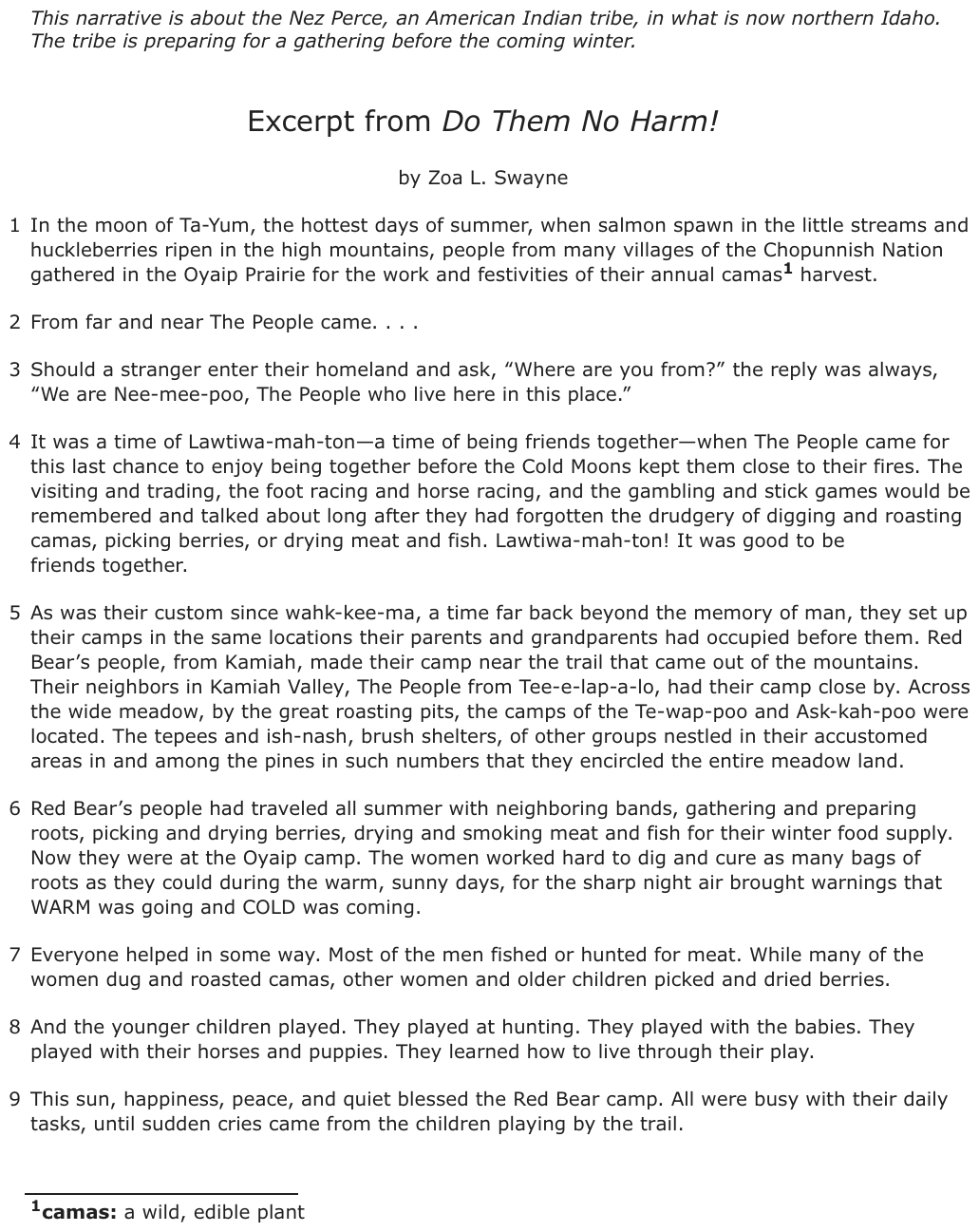
Question 119 of 120
2024 Test B English, question 24Uses the passage above: “Excerpt from Do Them No Harm!”.
Question
In paragraphs 4 and 6, the beginning of the change in seasons affects the characters mainly by
- Acausing them to collect their bounty and feel eager to celebrate before it becomes cold.
- Bmaking them want to rest and relax before the challenging work of the harvest begins.
- Cforcing them to give up leisure time to prepare their camp for the coming winter.
- Dallowing them to trade the goods they have prepared during the warm months.
Show the answer
Correct answer: A
The question asks how the beginning of the change of seasons mainly affects the characters.
A. CORRECT. Paragraph 4 describes the time as the last chance for The People to be together “before the Cold Moons kept them close to their fires.” Paragraph 6 tells about how the women were working hard to dig and cure roots, because “WARM was going and COLD was coming.” These paragraphs describe both celebration and preparation before the winter comes.
B. Incorrect. Paragraphs 4 and 6 describe the characters working hard, but there is no discussion of them wanting to rest and relax.
C. Incorrect. While both paragraphs describe some of the work involved in the harvest, paragraph 4 also lists a number of leisure activities, such as visiting, foot racing, horse racing, gambling, and stick games. The characters are still taking the time to relax.
D. Incorrect. While paragraph 4 mentions trading in a list of activities that the characters are doing, this is just one of many activities. Allowing the characters to trade goods is not the way the change in seasons mainly affects them.
Question analysis
This question on how setting shapes characters asks how the first signs of winter mainly affect The People in paragraphs 4 and 6 of Do Them No Harm!, a narrative about a Nez Perce harvest gathering. Students must draw on two separate paragraphs and pick the effect both support, among choices that each borrow real activities from the story.
- Grade level
- Grade 7 reading and task
- Compared with grade 7
- At grade 7 Explaining how setting shapes what characters do is typical grade 7 work on story elements. Students combine details from two separate paragraphs, a step beyond reading one, but the language is plain and the details concrete.
- Estimated difficulty
- Moderate: several steps, or a close reading with one strong distractor.
- Thinking it demands
- Depth of knowledge 2, skills and concepts · mainly analyze
- What makes it hard
- A very close wrong answer moderate
- Evidence in several places minor
- Evidence
- Answered from several paragraphs or stanzas
- Reading level
- Passage: about grade 5, 885 words; question and choices: about grade 7, 73 words.
- Students, last 30 days
- Not enough answers yet to show (it takes 10).
Why it is hard, traps and wrong answers (shows the answer)
Why it is hard
Each paragraph shows a different response to the coming winter, play in paragraph 4 and hard work in paragraph 6, and only one choice keeps both. Students who read paragraph 6 alone see work under pressure and decide the cold costs The People their free time, though paragraph 4 lists races and games. The question rewards checking each choice against both paragraphs, not just the one read last.
A very close wrong answer moderate Choosing the answer
The right choice and the one about giving up leisure both have The People preparing before the cold; they differ only in whether the season brings celebration or takes it away. (Embretson & Wetzel, 1987; Gorin & Embretson, 2006; Ascalon et al., 2007)
Evidence in several places minor Working it out
The answer must fit both paragraphs: paragraph 4’s racing, gambling and stick games before “the Cold Moons” and paragraph 6’s women digging roots because “COLD was coming.” (Kirsch & Mosenthal, 1990; Gorin & Embretson, 2006)
Strategy: Find what paragraphs 4 and 6 each say about the approaching cold, then note what The People do because of it, and choose the effect that fits both paragraphs.
Traps
- Half right: One half of a two-part choice is right and the other is not.
- Too narrow: A single detail offered as the central idea or a summary, or a summary that keeps minor details and leaves out an essential part.
- Reversed relationship: Cause and effect, or the order of events, turned around.
The wrong answers, classified
B Reversed relationship (King et al., 2004)
Puts rest before work, though the harvest is already under way at the Oyaip camp, and nothing shows The People wanting to relax before it begins.
C Half right (King et al., 2004; Thissen, Steinberg & Fitzpatrick, 1989)
Sees the hard work of digging and curing roots before winter but misses paragraph 4’s racing, games and visiting, so the loss of leisure is invented.
D Too narrow (King et al., 2004)
Seizes on trading, one item in paragraph 4’s list of activities, and treats that single detail as the main effect of the coming cold.
Working it out, step by step
Figure out what the question asks
Summer is ending and winter is coming. This asks how that change mainly affects the characters in paragraphs 4 and 6. Your answer has to fit both paragraphs, not just one.
Read paragraph 4
Paragraph 4 calls this time “this last chance to enjoy being together before the Cold Moons kept them close to their fires.” The Cold Moons are the winter months. The People enjoy “the foot racing and horse racing, and the gambling and stick games.” So, before winter, they celebrate together.
Read paragraph 6
Paragraph 6 says “The women worked hard to dig and cure as many bags of roots as they could during the warm, sunny days.” To cure food means to dry it so it keeps. Why rush? Because “the sharp night air brought warnings that WARM was going and COLD was coming.” So, before winter, they also gather and store food.
Check each choice
- A fits both: they collect their bounty and celebrate before the cold. Bounty means a large supply of good things, like food.
- B: no one wants to rest before the work. The harvest work is already going on.
- C: they don’t give up leisure, which is free time for fun. Paragraph 4 is full of races and games.
- D: trading is only one item in paragraph 4’s list. It is not the main effect.
Pick the answer
Watch out: C is tempting if you read only paragraph 6, which is all hard work. But paragraph 4 shows play. Only one choice fits both paragraphs. So the answer is A.
Why this answer and not the closest wrong one
C is the closest wrong answer. Like A, it has The People getting ready for winter. But C says they give up their free time. Paragraph 4 says the opposite: races, games and visiting fill this “last chance to enjoy being together.” A keeps both the work and the fun.
More questions like this
The original DOE question

Question 120 of 120
2024 Test B English, question 25Uses the passage above: “Excerpt from Do Them No Harm!”.
Question
How do paragraphs 7 and 9 convey a central idea of the excerpt?
- Aby explaining that The People often explore different areas, which shows the value of trying new things
- Bby revealing that The People must complete many tasks, which shows the necessity of being organized
- Cby suggesting that The People are influenced by the weather, which shows their close relationship with nature
- Dby demonstrating that The People work together, which shows the importance of contributing to the community
Show the answer
Correct answer: D
The question asks how paragraphs 7 and 9 convey a central idea of the excerpt.
A. Incorrect. Paragraphs 7 and 9 describe activities that The People do at the Red Bear camp. They do not describe The People exploring new areas.
B. Incorrect. While paragraph 7 lists some of the activities that The People did to help, neither paragraph emphasizes that The People need to be organized.
C. Incorrect. Paragraph 9 mentions how the sun blessed the Red Bear camp. However, these paragraphs do not otherwise mention weather.
D. CORRECT. Paragraph 7 lists activities that The People do with one another. Paragraph 9 states that “all were busy with their daily tasks.” Everyone is contributing to the community in their preparation for winter.
Question analysis
This central idea question asks how two short paragraphs, one listing the camp’s chores and one describing a peaceful day, convey a central idea of the Nez Perce narrative. Each choice joins a statement about The People with a broader lesson, so students must check that both parts are supported by those two paragraphs.
- Grade level
- Grade 7 reading and task
- Compared with grade 7
- At grade 7 Linking paragraphs to a central idea is standard grade 7 work. Both paragraphs are short and plainly worded, but each choice pairs a claim about The People with a broader lesson, and both halves must hold.
- Estimated difficulty
- Straightforward: two steps or one careful reading.
- Thinking it demands
- Depth of knowledge 2, skills and concepts · mainly analyze
- What makes it hard
- Evidence
- Answered from several paragraphs or stanzas
- Reading level
- Passage: about grade 5, 885 words; question and choices: about grade 10, 77 words.
- Students, last 30 days
- Not enough answers yet to show (it takes 10).
Why it is hard, traps and wrong answers (shows the answer)
Why it is hard
Both paragraphs are short and plainly worded, and paragraph 7’s first sentence nearly states the idea. The wrong choices each pair something near the text with a lesson it does not teach: the division of jobs read as a call for organization, the blessing of the sun read as dependence on weather. Checking that each half of a choice appears in paragraphs 7 and 9 avoids them.
A very close wrong answer minor Choosing the answer
The right choice and the one about many tasks both start from paragraph 7’s list of jobs; they part on the lesson drawn, contributing to the community or being organized. (Embretson & Wetzel, 1987; Gorin & Embretson, 2006; Ascalon et al., 2007)
Reading between the lines minor Working it out
The lesson is never stated: “Everyone helped in some way” and “All were busy with their daily tasks” have to be read as a picture of a community where each person contributes. (Graesser, Singer & Trabasso, 1994; Kintsch, 1998)
Strategy: Note what paragraphs 7 and 9 actually describe, then check both halves of each choice: the detail must appear there and the lesson must follow from it.
Traps
- Half right: One half of a two-part choice is right and the other is not.
- Wrong part of the text: A choice is true of another paragraph, stanza or speaker than the one asked about.
- Twists what the text says: Uses the text's topic and ideas but changes what it says: who did it, how much, when, or why.
The wrong answers, classified
A Twists what the text says (King et al., 2004)
Turns the summer of travel and gathering in paragraph 6 into exploring new places, though paragraph 5 says each group camps where its parents and grandparents camped.
B Half right (King et al., 2004; Thissen, Steinberg & Fitzpatrick, 1989)
Rightly sees the many tasks of paragraph 7, but the stress falls on everyone helping, and neither paragraph draws a lesson about being organized.
C Wrong part of the text (Kirsch & Mosenthal, 1990)
Links the sun that “blessed” the camp in paragraph 9 with the coming cold of paragraphs 4 and 6, but paragraphs 7 and 9 dwell on daily work, not weather.
Working it out, step by step
Figure out what the question asks
A central idea is a big point the story keeps showing. This asks how paragraphs 7 and 9 show one. Each choice has two parts: something The People do, and a lesson. Both parts must come from these paragraphs.
Read paragraphs 7 and 9
Paragraph 7 begins “Everyone helped in some way.” Then it lists jobs. Men fished and hunted. Women dug and roasted camas. Other women and older children picked and dried berries. Paragraph 9 says “All were busy with their daily tasks.”
Decide what the paragraphs show
Every person has a job, and every job helps the whole group. The food they gather will feed everyone through the winter. So the paragraphs show people working together. The lesson is that each person’s part matters to the community. A community is a group of people who live and work together.
Check each choice
- D fits. The People work together, which shows that helping the community matters.
- A: no one explores new places. Paragraph 5 says they camp where their parents and grandparents camped.
- B: there are many tasks, but nothing says being organized is the point. The point is that everyone helps.
- C: paragraph 9 mentions the sun once. The paragraphs are about work, not weather.
Watch out: B starts out right, with many tasks. But its lesson doesn’t come from the text.
Pick the answer
Both paragraphs stress that everyone takes part in the work. That shows how much each person gives to the group. So the answer is D.
Why this answer and not the closest wrong one
B is the closest wrong answer, because paragraph 7 does list many jobs. But the paragraph stresses who does them: “Everyone helped in some way.” Nothing says the jobs need careful planning. D draws the lesson the paragraphs really show: each person pitches in for the group.
More questions like this
The original DOE question