Passage Excerpt from Winter Wheat
Excerpt from Winter Wheat
by Mildred Walker
Ellen, the narrator, is preparing to leave her parents and the family farm for college the next day.
I love Dad’s way of talking that makes him seem different from other ranchers. He’s lived here twenty-three years, but he still says “back East where I come from.” He’s the one who gets excited when I do about spring coming or a serial running in the magazine we’re both reading, but it’s what Mom says that I depend on. When Mom used to say “Don’t worry” about my pet chicken or dog or new calf, it always got well. Dad is always talking of going some place, not now, but next year, maybe. Mom seems to think of nothing farther away than today or perhaps yesterday or tomorrow morning.
Mom folded the ironing board and put it inside their bedroom that was just off the kitchen. She carried in the freshly ironed clothes. Dad went back to his paper. When Mom came back she took beans from the cupboard to soak for tomorrow. Dad always said Mom could make all the dishes he’d had back in Vermont as well as though she were a New Englander herself, instead of a Russian. All of a sudden, I realized that tomorrow when those beans would be ready to eat I’d be going away. It gave me a funny feeling.
“I’ll be taking the train tomorrow night,” I said aloud, more to hear it myself.
“We can drive you into town in the afternoon,” Dad said, dropping his paper on the floor.
“There’s no need to go to town; she can catch the train at Gotham just as well. We haven’t nothing to take us into town for,” Mom said.
“Well, we don’t have to decide tonight,” Dad said, but I knew he wanted to go into Clark City. It wouldn’t be so flat as just seeing me go off on the train from Gotham. My going away was hard on both of them; they were so different—and I was part of them both. It made me uncomfortable to think of leaving them.
While I was getting ready for bed in my room that’s off the front room, I saw how it would be if I left from town. We’d go in right after dinner and go around to the stores, Dad going one way and Mom and I another. Dad would probably have his hair cut at the barbershop and stop in the bank and meet someone he knew to talk to. Then we’d meet at the big store on the corner and go to the cafeteria for supper. The train stops ten minutes or so at the station in town and there are other people and excitement and you have time to wave from the platform and then again from your window by your seat. We went to the station in Clark City to see the Goodals off when they went back to Iowa.
If I left from Gotham, we’d just drive down in the truck and wait till the train came. It only stops long enough for you to get on and you hardly have time to taste the flavor of going away.
I sat on the bed in my pyjamas with my arms around my knees. I couldn’t keep from thinking of that time Dad went back East. I tried to, and then I just sat still and looked straight at it. Sometimes that’s better than working so hard to keep from looking at what’s in your mind.
Dad went all the way back to Vermont. . . . It was in November and it was already dark when the train came through Gotham. Even now, I could feel how cold and dark it was. I held Mom’s hand. Dad was so dressed-up he seemed strange. . . . We stood there without saying anything until Dad told Mom to remember to call Mr. Bardich, our neighbor, if the cow didn’t calve tomorrow.
“I’ll manage,” Mom snapped back.
“I wish you could go, Anna,” Dad said to Mom, “and we could take Ellen.” . . .
“Good-by, Anna Petrovna,” he said, looking at Mom. I had never heard him call her by two names before.
“Good-by,” Mom said, standing still, without smiling.
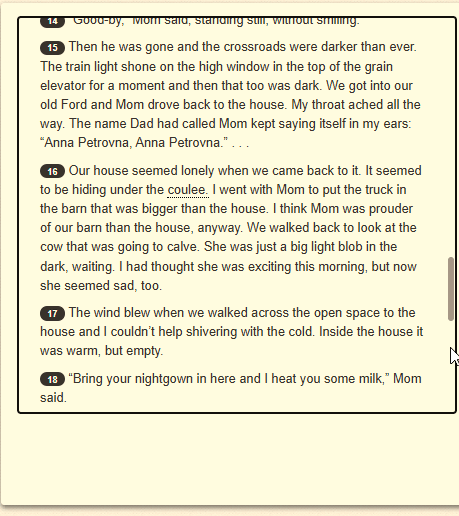
Then he was gone and the crossroads were darker than ever. The train light shone on the high window in the top of the grain elevator for a moment and then that too was dark. We got into our old Ford and Mom drove back to the house. My throat ached all the way. The name Dad had called Mom kept saying itself in my ears: “Anna Petrovna, Anna Petrovna.” . . .
Our house seemed lonely when we came back to it. It seemed to be hiding under the coulee. I went with Mom to put the truck in the barn that was bigger than the house. I think Mom was prouder of our barn than the house, anyway. We walked back to look at the cow that was going to calve. She was just a big light blob in the dark, waiting. I had thought she was exciting this morning, but now she seemed sad, too.
The wind blew when we walked across the open space to the house and I couldn’t help shivering with the cold. Inside the house it was warm, but empty.
“Bring your nightgown in here and I heat you some milk,” Mom said.
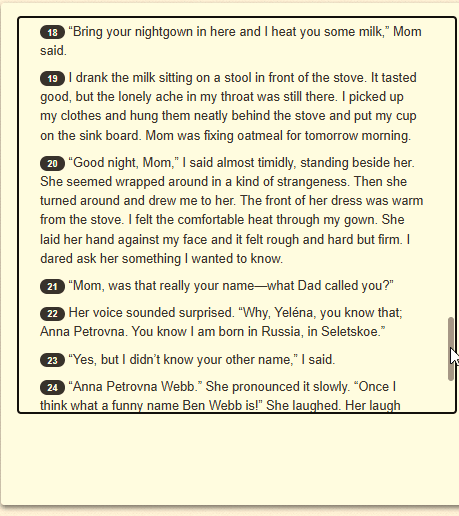
I drank the milk sitting on a stool in front of the stove. It tasted good, but the lonely ache in my throat was still there. I picked up my clothes and hung them neatly behind the stove and put my cup on the sink board. Mom was fixing oatmeal for tomorrow morning.
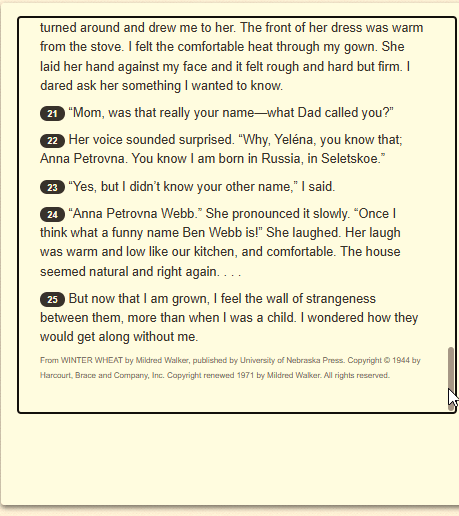
“Good night, Mom,” I said almost timidly, standing beside her. She seemed wrapped around in a kind of strangeness. Then she turned around and drew me to her. The front of her dress was warm from the stove. I felt the comfortable heat through my gown. She laid her hand against my face and it felt rough and hard but firm. I dared ask her something I wanted to know.
“Mom, was that really your name—what Dad called you?”
Her voice sounded surprised. “Why, Yeléna, you know that; Anna Petrovna. You know I am born in Russia, in Seletskoe.”
“Yes, but I didn’t know your other name,” I said.
“Anna Petrovna Webb.” She pronounced it slowly. “Once I think what a funny name Ben Webb is!” She laughed. Her laugh was warm and low like our kitchen, and comfortable. The house seemed natural and right again. . . .
But now that I am grown, I feel the wall of strangeness between them, more than when I was a child. I wondered how they would get along without me.
From WINTER WHEAT by Mildred Walker, published by University of Nebraska Press. Copyright © 1944 by Harcourt, Brace and Company, Inc. Copyright renewed 1971 by Mildred Walker. All rights reserved.
serial: story published in short segments at regular intervals
coulee: small gulch or ravine
Question
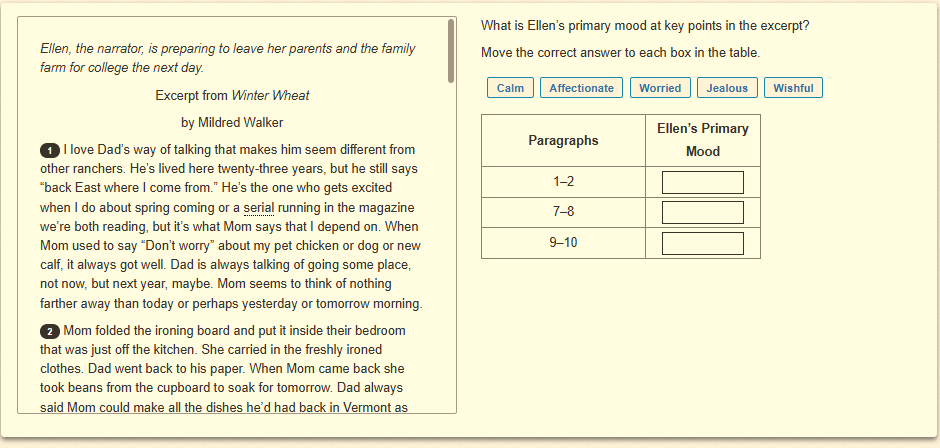
What is Ellen’s primary mood at key points in the excerpt?
Move the correct answer to each box in the table.
| Paragraphs | Ellen’s Primary Mood |
|---|---|
| 1–2 | |
| 7–8 | |
| 9–10 |
On the test you drag tiles into the boxes; here, choose each box’s tile from its menu. Each tile can be used once. The DOE has not published how answers with several parts are scored; this site counts one right only when every part is right.
Show the answer
Correct answer: blank 1: Affectionate; blank 2: Wishful; blank 3: Worried
The question asks for identification of Ellen’s primary mood in key points in the excerpt—paragraphs 1–2, paragraphs 7–8, and paragraphs 9–10.
B. Affectionate: CORRECT. Ellen’s primary mood in paragraphs 1–2 is affectionate. She states in the first sentence of paragraph 1 that she loves her father’s way of talking and then describes with affection her mother’s reassuring certainty and her father’s appreciation of her mother’s cooking.
E. Wishful: CORRECT. Ellen’s primary mood in paragraphs 7–8 is wishful as she pictures the two departure scenarios available to her. She expresses in detail her longing for the “other people and excitement” at the train station in town, along with her wish to have plenty of “time to wave from the platform and then again from your window by your seat,” and her dislike of the idea of leaving from Gotham, where the train “only stops long enough for you to get on and you hardly have time to taste the flavor of going away.”
C. Worried: CORRECT. Ellen’s primary mood in paragraphs 9–10 is worried. Her worry is suggested by the description of her posture in the first sentence of paragraph 9 (“I sat . . . with my arms around my knees”). In the next sentence, she reveals that she “couldn’t keep from thinking,” or worrying, about her concern that her departure will be as tense as the time her father left for a trip to Vermont.
A. Calm: Incorrect. Ellen’s mood is not primarily calm in any of the paragraphs in the table. In paragraphs 1–2, her reflections might seem to focus on calm times, but any mood of calm is shattered by her sudden realization that she’d “be going away” the next day. Similarly, although paragraph 7 describes what might be a calm or routine day of shopping in town, she is imagining the scene in great detail as a way of making a difficult decision about where she would prefer to catch the train. Finally, in paragraphs 9–10, Ellen is far from calm as she forces herself to look “straight at” an upsetting childhood memory of seeing her father off on a long train trip.
D. Jealous: Incorrect. Ellen’s mood is not primarily jealous in any of the paragraphs in the table. In paragraphs 1–2, she admires and enjoys the positive atmosphere created by her father’s praise of her mother, rather than expressing jealousy. The contrast in paragraphs 7–8 between her narration of the two possible departure plans might seem to suggest that Ellen is jealous of the family whom she and her parents once watched depart from the town, but instead, her narration reflects Ellen’s wishful desire to recreate that pleasurable town visit as part of her own departure. In paragraphs 9–10, her flashback memory is focused on the stiffness of her parents’ behavior and includes no indications that she feels jealousy of either parent.
Question analysis
This question on the Winter Wheat excerpt asks students to identify Ellen’s primary mood at three points in the story: paragraphs 1–2, 7–8 and 9–10. On the test students drag mood words from five tiles into a table, and each stretch of the story mixes more than one feeling, so they must judge which feeling dominates each one.
- Grade level
- Grade 7 reading and task
- Compared with grade 7
- At grade 7 Tracking how a narrator’s feelings change across a story is grade 7 work, and the writing is plain. Placing three tiles with all-or-nothing credit, where each stretch holds mixed feelings, raises the demand only somewhat.
- Estimated difficulty
- Moderate: several steps, or a close reading with one strong distractor.
- Thinking it demands
- Depth of knowledge 2, skills and concepts · mainly understand
- What makes it hard
- Reading between the lines moderate
- Much to keep track of moderate
- Evidence
- Answered from several paragraphs or stanzas
- Reading level
- Passage: about grade 4, 1179 words; question and choices: about grade 6, 24 words.
- Corrected from the DOE handbook
- The punctuation of an ellipsis in a quotation was corrected.
- Students, last 30 days
- Not enough answers yet to show (it takes 10).
Why it is hard, traps and wrong answers (shows the answer)
Why it is hard
Each stretch of the story holds more than one feeling, so the word “primary” does the work. The quiet evening of paragraphs 1–2 and Ellen sitting still in paragraph 9 both invite Calm, though the first is full of her fondness for her parents and the second shows her forcing herself to face a painful memory. With three placements that must all be right, a student who settles for the setting’s mood in either row loses the question.
Reading between the lines moderate Working it out
No mood is named: affection must be read from “I love Dad’s way of talking,” wishfulness from Ellen picturing waving from the platform, and worry from her arms around her knees. (Graesser, Singer & Trabasso, 1994; Kintsch, 1998)
Much to keep track of moderate Working it out
Three rows, five tiles that cannot be reused, and credit only when all three are right: each stretch must be judged on its own while the two leftover moods are kept out. (Sweller, 1988; Carpenter, Just & Shell, 1990)
Strategy: Reread each stretch of paragraphs by itself and name Ellen’s main feeling in your own words before looking at the tiles, then place the closest tile; two tiles will be left over.
Traps
- Wrong tone or attitude: Misjudges the tone, attitude or point of view, such as reading admiration as criticism, or taking a character's or subject's feelings for the author's.
The wrong answers, classified
BEA Wrong tone or attitude (Graesser, Singer & Trabasso, 1994)
Reads Ellen sitting still and looking “straight at” the memory in paragraph 9 as calm, though she has just failed to stop thinking of Dad’s leaving and is bracing to face it.
AEC Wrong tone or attitude (Graesser, Singer & Trabasso, 1994)
Puts Calm in the first row because paragraphs 1–2 show a quiet evening of ironing and reading, taking the scene’s mood for Ellen’s, which is warm affection for both parents.
BDC Wrong tone or attitude (Graesser, Singer & Trabasso, 1994)
Puts Jealous in the middle row, reading envy into Ellen’s memory of seeing another family off from the town station, when she is only wishing for a send-off like theirs.
What was corrected from the DOE handbook, and why
- Explanation: The DOE’s explanation of “Worried” quotes the first sentence of paragraph 9 as “I sat. . . with my arms around my knees,” with the first dot set against “sat,” as if a sentence ended there. The words are left out from the middle of the sentence, so the site spaces the ellipsis as the DOE’s explanations do elsewhere: “I sat . . . with my arms around my knees.”
Working it out, step by step
Figure out what the question asks
This table asks for Ellen’s primary mood, her main feeling, in three parts of the story. Each part may hold more than one feeling, so pick the strongest. On the test you drag a tile into each box. On this site you pick from a menu in each row. Each tile is used once, so two are left over.
Read paragraphs 1–2
Ellen begins by saying she loves the way Dad talks. She likes that he gets excited about the same things she does. She admires how sure Mom is that things will turn out well. She tells how Dad praises Mom’s cooking. These details are warm and loving. Affectionate means showing love and fondness. So the mood is Affectionate.
Read paragraphs 7–8
Ellen pictures leaving from Clark City. The family would shop and eat supper in town. At the station there would be “other people and excitement.” She would have “time to wave from the platform and then again from your window by your seat.” At Gotham, the train “only stops long enough for you to get on.” She longs for the big send-off. So the mood is Wishful.
Read paragraphs 9–10
Paragraph 9 begins “I sat . . . with my arms around my knees.” People often curl up like that when they feel uneasy. Ellen “couldn’t keep from thinking” of the night Dad left on a trip. That parting was sad and tense. She fears her own leaving may be like it. So the mood is Worried.
Rule out the two extra tiles
- Calm does not fit any row. In paragraph 9, Ellen sits still. But she is bracing herself to face a painful memory, not resting. And the quiet evening of paragraphs 1–2 is full of warm feeling for her parents.
- Jealous does not fit any row. Ellen remembers seeing another family off at the town station. She wants a send-off like theirs, but she doesn’t resent them.
Watch out: Sitting still is not the same as feeling calm.
Fill in the table
- Paragraphs 1–2: Affectionate
- Paragraphs 7–8: Wishful
- Paragraphs 9–10: Worried
All three rows must be right to get the point.
Why this answer and not the closest wrong one
Calm is the closest wrong tile, for paragraphs 9–10. Ellen sits still, and that can look calm. But she has just tried and failed to stop thinking about Dad’s leaving. Her arms are wrapped around her knees. She is facing a memory that upsets her, so Worried fits better.
More questions like this
The original DOE question
The passage “Excerpt from Winter Wheat” as shown on the test