Also in 2025 Practice Test B Math, question 3.
Question
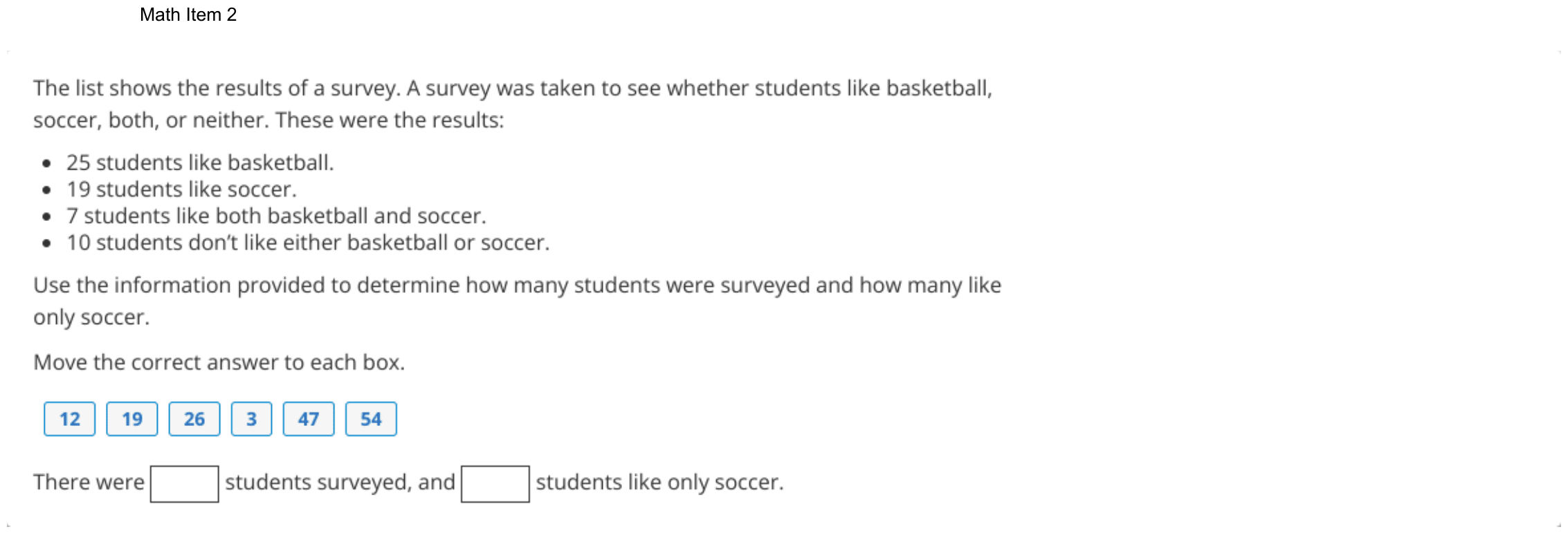
The list shows the results of a survey. A survey was taken to see whether students like basketball, soccer, both, or neither. These were the results:
- 25 students like basketball.
- 19 students like soccer.
- 7 students like both basketball and soccer.
- 10 students don’t like either basketball or soccer.
Use the information provided to determine how many students were surveyed and how many like only soccer.
Move the correct answer to each box.
There were students surveyed, and students like only soccer.
On the test you drag tiles into the boxes; here, choose each box’s tile from its menu. Each tile can be used once. The DOE has not published how answers with several parts are scored; this site counts one right only when every part is right.
Show the answer
Correct answer: blank 1: 47; blank 2: 12
There were 47 students surveyed, and 12 students like only soccer.
To determine how many students were surveyed, start with the total number of students who like basketball and soccer separately and subtract the number of students who were counted twice.
There were 25 students who like basketball, 19 students who like soccer, and 7 students who like both basketball and soccer.
So, the total number of students who like basketball or soccer is .
Then, add the students who don’t like either basketball or soccer: 10 students don’t like either sport.
Total students surveyed:
To determine how many students like only soccer, subtract the number of students who like both basketball and soccer from the total number of students who like soccer.
Students who like only soccer:
Question analysis
This survey problem lists how many students like basketball, soccer, both sports or neither, and students drag number tiles into two boxes: how many were surveyed and how many like only soccer. It is a Venn diagram counting question. Keeping track of the students who like both sports, who appear in two of the listed counts, is the tricky part.
- NYS standards
- 7.SP.8b sample spaces for compound events
- Grade level
- Grade 7 content, by NYS standard
- Compared with grade 7
- At grade 7 Overlapping groups like these are seldom taught on their own in grade 7, though the arithmetic is simple whole-number addition and subtraction. Two results come from the same four facts, and both boxes must be right to score.
- Estimated difficulty
- Moderate: several steps, or a close reading with one strong distractor.
- Thinking it demands
- Depth of knowledge 2, skills and concepts · mainly apply
- What makes it hard
- Much to keep track of moderate
- Turning words into math minor
- Solution
- 4 steps
- Reading level
- Question and choices: about grade 6, 78 words.
- Students, last 30 days
- Not enough answers yet to show (it takes 10).
Why it is hard, traps and wrong answers (shows the answer)
Why it is hard
The arithmetic is light; the work is keeping track of one overlap that touches both answers. Students often remove the 7 for one box and not the other, and the pool holds 54 and 19, the tiles those half-finished methods produce. A sketch of two overlapping circles, with 7 in the middle, 18 and 12 beside it and 10 outside, turns both boxes into reading off the picture.
Much to keep track of moderate Working it out
The 7 students who like both sports sit inside the 25 and inside the 19, so they come out once for the total and again for only soccer, and both boxes must be right to score. (Sweller, 1988; Carpenter, Just & Shell, 1990)
Turning words into math minor Understanding the question
The list never says that the 25 basketball fans already include the 7 who like both sports, and only the word “only” in the question separates the 12 from all 19 soccer fans. (Hegarty, Mayer & Monk, 1995; Koedinger & Nathan, 2004)
Strategy: Sketch two overlapping circles, write the students who like both sports in the middle, fill each outer part by subtraction, then add every region and the students who like neither.
Traps
- Overlapping groups: Things in two groups at once are counted twice, or not subtracted.
- Misreads the question: Misses or misreads a condition or a word in the question: "at least", "each", "remaining", "not".
The wrong answers, classified
FA Overlapping groups (King et al., 2004)
Adds 25 + 19 + 10 = 54 for the total, counting the 7 fans of both sports twice, yet takes them out of the soccer fans correctly to get 12.
EB Misreads the question (Hegarty, Mayer & Monk, 1995)
Removes the overlap correctly to find the 47 surveyed, then fills the second box with all 19 soccer fans, overlooking “only” and the 7 of them who also like basketball.
FB Overlapping groups (King et al., 2004)
Ignores the line about the 7 who like both sports, adding 25 + 19 + 10 = 54 and copying the 19 soccer fans straight from the list.
Worked solution, step by step
Formulas used
- Counting two groups that overlap
- B is the number who like basketball, and S is the number who like soccer. The students who like both are inside B and inside S, so B + S counts them twice. Subtract them once to fix that. Then add the students who like neither sport, since they are in neither group.
- Only one group
- S is everyone who likes soccer, and both is the number who like both sports. Only soccer means the soccer fans who do not also like basketball. Take the both group out of the soccer group to find them.
Sort out the question
The survey gives you four facts:
- 25 students like basketball.
- 19 students like soccer.
- 7 students like both sports.
- 10 students like neither sport.
You need two numbers. The first box is how many students were surveyed in all. The second box is how many like only soccer, which means soccer but not basketball. Each tile can be used once.
See who is counted twice
The 7 students who like both sports are part of the 25 basketball fans. They are also part of the 19 soccer fans. So if you add 25 and 19, those 7 students get counted two times.
A Venn diagram shows this. It is a picture of two circles that overlap. The 7 go in the middle, where the circles share space.
Count who likes at least one sport
Use the overlap rule. Add the two groups, then take away the 7 who were counted twice:
So 37 students like basketball, soccer or both.
Add the students who like neither
The 10 students who like neither sport are not in either group. They were still surveyed, so add them:
So 47 students were surveyed.
Watch out: adding 25 + 19 + 10 = 54 counts the 7 students twice. The tile 54 is waiting for that mistake.
Find who likes only soccer
The 19 soccer fans include the 7 who like basketball too. Take those 7 away:
So 12 students like only soccer.
Watch out: the word only matters. The tile 19 counts every soccer fan, not just the ones who like only soccer.
Fill in both boxes
On the test, you drag the tile 47 into the first box and the tile 12 into the second box. On this site, you choose each tile from its box’s menu.
So the boxes get 47 and 12: there were 47 students surveyed, and 12 students like only soccer.
Check your answer
Split the students into four groups that do not overlap. Only basketball is . Both sports is 7. Only soccer is 12. Neither is 10. Add the four groups: . That matches the first box.
More questions like this
The original DOE question