Also in 2026 Practice Test B Math, question 1; 2025 Practice Test B Math, question 2.
Question
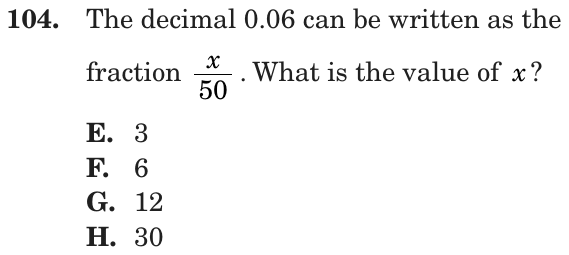
The decimal 0.06 can be written as the fraction . What is the value of ?
- A3
- B6
- C12
- D30
Show the answer
Correct answer: A
Simplify the fraction to find the answer:
Question analysis
This question asks students to rewrite the decimal 0.06 as an equivalent fraction with a denominator of 50 and give the missing numerator. It tests converting between decimals and fractions. The step that trips students up is moving from hundredths to fiftieths, which means scaling the numerator in the right direction.
- NYS standards
- 6.NS.3 multi-digit decimal operations
- Grade level
- Grade 6 content, by NYS standard
- Compared with grade 7
- Below grade 7 Converting a decimal to an equivalent fraction is upper elementary and grade 6 work. This is a single routine conversion with no context and no traps beyond a place-value slip, well below grade 7 demand.
- Estimated difficulty
- Routine: one familiar step, little to misread.
- Thinking it demands
- Depth of knowledge 1, recall and reproduction · mainly apply
- What makes it hard
- Error-prone arithmetic minor
- Solution
- 2 steps
- Reading level
- Question and choices: about grade 6, 15 words.
- Students, last 30 days
- Not enough answers yet to show (it takes 10).
Why it is hard, traps and wrong answers (shows the answer)
Why it is hard
A one-idea question: write 0.06 as a fraction and rename it with a denominator of 50. The only real risk is keeping the 6 when the denominator changes, or scaling the numerator in the wrong direction. Checking that 3 ÷ 50 really gives 0.06 settles it.
Error-prone arithmetic minor Working it out
The decimal is in hundredths but the target denominator is 50, so the numerator has to be halved along with the denominator rather than kept as 6. (Brown & Burton, 1978; Junker & Sijtsma, 2001)
Strategy: Write the decimal as a fraction over 100, then find the equivalent fraction over 50 by dividing numerator and denominator by the same number.
Traps
- Stops one step early: A choice is a number from partway through the solution.
The wrong answers, classified
B Stops one step early (King et al., 2004; Gierl et al., 2017)
Writes 0.06 as 6/100 and keeps 6 as the numerator even though the denominator has changed from 100 to 50.
C Wrong operation (Hegarty, Mayer & Monk, 1995; King et al., 2004)
Doubles the 6 instead of halving it, scaling the numerator up while the denominator goes down from 100 to 50.
D An arithmetic slip (Junker & Sijtsma, 2001)
Reads 0.06 as 0.6 and multiplies by 50, a decimal-place slip that makes the numerator ten times too large.
Worked solution, step by step
Formulas used
- Equivalent fractions
- a is the top number and b is the bottom number. k is any number that divides both. Dividing the top and bottom by the same number keeps the value the same. Use it to give a fraction a new bottom number.
Sort out the question
You need to write 0.06 as a fraction with 50 on the bottom. The top number of that fraction is . You need to find .
Write the decimal as a fraction
0.06 has two digits after the decimal point. That means it counts hundredths. So 0.06 is six hundredths.
Change the bottom to 50
To turn 100 into 50, divide by 2. The rule for equivalent fractions says to do the same to the top.
So .
Watch out: the 6 must change too. Keeping the 6 gives choice B. Doubling it to 12 gives choice C.
Give the answer
The fraction is the same amount as 0.06, and its top number is 3. So the answer is A, 3.
Check your answer
Divide to turn the fraction back into a decimal: . You can also multiply: . Both match. Choice D, 30, comes from reading 0.06 as 0.6.
More questions like this
The original DOE question