Also in 2026 Practice Test B Math, question 41; 2025 Practice Test B Math, question 48.
Question
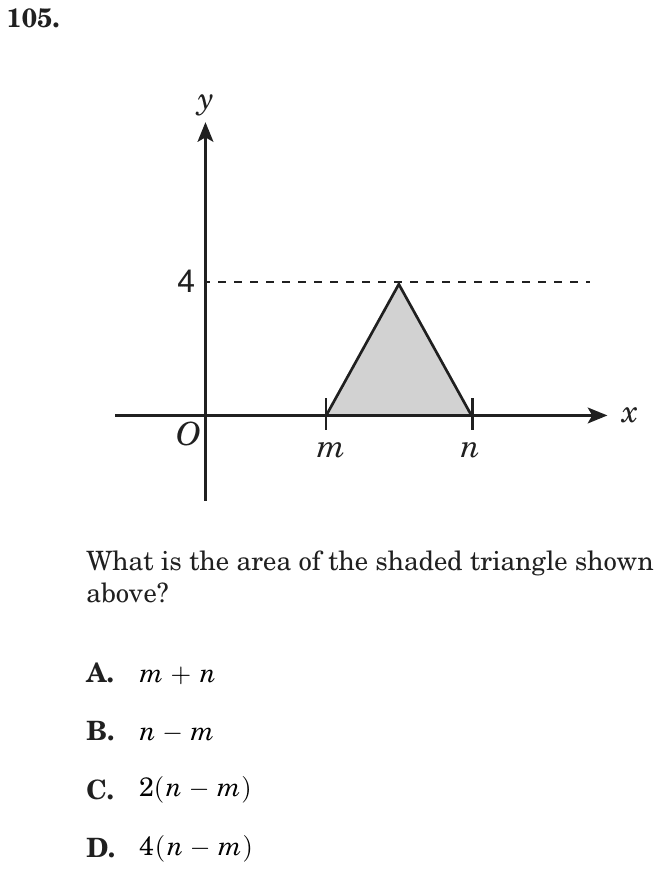
What is the area of the shaded triangle shown above?
- A
- B
- C
- D
Show the answer
Correct answer: C
The height of the triangle is 4 units. The length of the base is . So the area is
Question analysis
Students find the area of a shaded triangle drawn on coordinate axes, with its base between the points m and n on the x-axis and its top vertex at a height of 4. It tests the triangle area formula with an algebraic side length. Writing the base as an expression in m and n is the step that needs care.
- Grade level
- Grade 6 content, by NYS standard
- Compared with grade 7
- At grade 7 Triangle area is grade 6 content, but a base written with two variables is less familiar. With only two steps, the demand matches typical grade 7 work that mixes geometry with algebraic expressions.
- Estimated difficulty
- Moderate: several steps, or a close reading with one strong distractor.
- Thinking it demands
- Depth of knowledge 2, skills and concepts · mainly apply
- What makes it hard
- Variables instead of numbers moderate
- Reading a figure, table or graph moderate
- A very close wrong answer moderate
- Solution
- 2 steps
- Reading level
- Question and choices: about grade 7, 14 words.
- Students, last 30 days
- Not enough answers yet to show (it takes 10).
Why it is hard, traps and wrong answers (shows the answer)
Why it is hard
The arithmetic is trivial, but students must treat a length as a difference of coordinates and keep a formula's one half when the answer is a letter expression. Those who forget the half, or who stop at the base length, find their result among the choices. Trying m = 1 and n = 4 gives a triangle of area 6 that checks the expressions quickly.
Variables instead of numbers moderate Understanding the question
The base runs from m to n on the x-axis, so its length is the expression n − m, and the area stays in letters with no number to check. (Koedinger & Nathan, 2004; Enright, Morley & Sheehan, 2002)
Reading a figure, table or graph moderate Understanding the question
The height, 4, is read from the dashed line through the apex rather than labeled on the triangle, and the base endpoints appear only as tick labels. (Lesh, Post & Behr, 1987; Kirsch & Mosenthal, 1990)
A very close wrong answer moderate Choosing the answer
4(n − m) is the right 2(n − m) doubled, written the same way except for the coefficient; only remembering the one half in a triangle's area separates them. (Embretson & Wetzel, 1987; Gorin & Embretson, 2006; Ascalon et al., 2007)
Strategy: Write the base as the difference between its endpoint values, read the height from the figure, and apply one-half times base times height.
Traps
- A formula you must know: Needs a formula the test does not give: area, circumference, volume, probability rules.
- Wrong formula: Uses a related but wrong formula: perimeter for area, diameter for radius, area for volume, or a misremembered one.
- Stops one step early: A choice is a number from partway through the solution.
The wrong answers, classified
A Numbers taken from the question (Hegarty, Mayer & Monk, 1995)
Adds the two labels, m + n, as if the base were the sum of the endpoints, and goes no further with the height.
B Stops one step early (King et al., 2004; Gierl et al., 2017)
Finds the base length n − m correctly and gives it as the area, never multiplying by the height or taking one half.
D Wrong formula (King et al., 2004)
Multiplies the base n − m by the height 4 but forgets the one half in the triangle area formula.
Worked solution, step by step
Formulas used
- Area of a triangle
- A is the area. b is the base, the side the triangle sits on. h is the height, the straight-up distance from the base to the top corner. You take half because a triangle is half of a rectangle with the same base and height.
- Length along the x-axis
- The right end and the left end are the numbers where a segment starts and stops on the x-axis. Subtracting the smaller from the larger tells how long the segment is.
Read the figure
The shaded triangle sits on the x-axis, the flat number line. Its base runs from to . Its top corner touches the dashed line at height 4. You need the area, written with the letters and .
Find the length of the base
The base starts at and ends at . Use the length rule: right end minus left end.
Watch out: adding the ends, , does not give a length. That is choice A.
Find the height
The height is the straight-up distance from the base to the top corner. The top corner is on the dashed line, which is at 4 on the y-axis. So the height is 4.
Find the area
Use the triangle area formula.
Half of 4 is 2, so the area is .
Watch out: forgetting the one half gives , choice D. Stopping at the base gives , choice B.
Give the answer
The area is 2 times the length of the base. So the answer is C, .
Check your answer
Try numbers. Say and . The base is 3 and the height is 4, so the area is . Choice C gives . It matches. Choice D would give 12.
More questions like this
The original DOE question