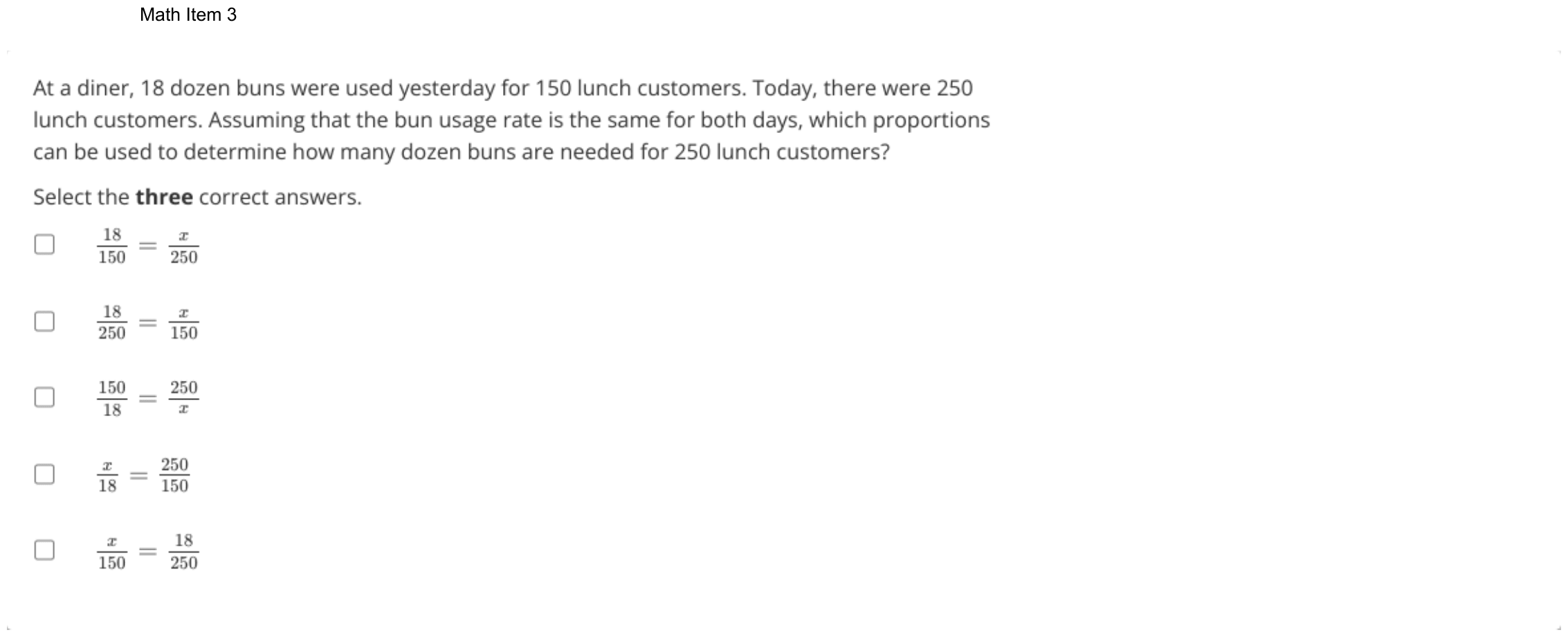
Also in 2025 Practice Test B Math, question 4.
Question
At a diner, 18 dozen buns were used yesterday for 150 lunch customers. Today, there were 250 lunch customers. Assuming that the bun usage rate is the same for both days, which proportions can be used to determine how many dozen buns are needed for 250 lunch customers?
Select the three correct answers.
Choose every answer that is correct, then check. The DOE has not published how answers with several parts are scored; this site counts one right only when every part is right.
- A
- B
- C
- D
- E
Show the answer
Correct answer: A, C, and D
The three correct answers are:
Set up a proportion to compare the number of buns per customer. These are all equivalent:
To check for equivalency, solve each proportion for x.
Each of the three correct proportions simplifies to .
Then solve for x to determine how many dozen buns are needed for 250 lunch customers:
Question analysis
A diner used 18 dozen buns for 150 lunch customers yesterday, and students select the three proportions, out of five, that can find how many dozen buns 250 customers need at the same rate. It tests setting up proportions and recognizing equivalent ones. All five equations use the same numbers, so each has to be checked for which quantities it pairs.
- Grade level
- Grade 7 content, by NYS standard
- Compared with grade 7
- At grade 7 Setting up a proportion from a rate is everyday grade 7 work. Here nothing is solved: five setups built from the same numbers must each be judged, some arranged in unfamiliar ways, and all three usable ones found.
- Estimated difficulty
- Moderate: several steps, or a close reading with one strong distractor.
- Thinking it demands
- Depth of knowledge 2, skills and concepts · mainly apply
- What makes it hard
- Every choice must be checked moderate
- A very close wrong answer moderate
- An answer in an unexpected form minor
- Much to keep track of minor
- Solution
- 3 steps
- Reading level
- Question and choices: about grade 6, 54 words.
- Students, last 30 days
- Not enough answers yet to show (it takes 10).
Why it is hard, traps and wrong answers (shows the answer)
Why it is hard
Nothing needs solving here; the question is which pairings keep the usage rate fixed. Students who check only for buns over customers on both sides find exactly three such setups, two of them wrong, and pass over the two right ones written another way. The wrong pair gives 10.8 dozen, fewer buns for more customers, which a quick sense check would catch, and cross-multiplying every setup settles all five.
Every choice must be checked moderate Choosing the answer
All five setups are built from 18, 150, 250 and x, so none can be dismissed on sight; each has to be cross-multiplied and compared with 150x = 18 × 250. (Embretson & Wetzel, 1987)
A very close wrong answer moderate Choosing the answer
The first two setups differ only in where 150 and 250 sit, 18/150 = x/250 against 18/250 = x/150, and both show buns over customers on each side, so a units check passes both. (Embretson & Wetzel, 1987; Gorin & Embretson, 2006; Ascalon et al., 2007)
An answer in an unexpected form minor Choosing the answer
One right setup puts customers over dozens of buns, and another sets today’s x over yesterday’s 18 equal to 250 customers over 150, forms that look wrong to students who learned only rate equals rate. (Enright, Morley & Sheehan, 2002)
Much to keep track of minor Working it out
Three of the five must be picked and all three must be right to score, so the verdict on each setup has to be kept until the last one is tested. (Sweller, 1988; Carpenter, Just & Shell, 1990)
Strategy: Write one proportion you trust by matching both units and days, cross-multiply it, then cross-multiply each choice and keep only those that give the same equation.
Traps
- Misunderstands the concept: A wrong belief about a concept: that percents can be added, that area grows like length, that averages can be averaged, that a bigger denominator means a bigger fraction.
- Answer in another form: The right answer is written differently from the way you worked it out.
The wrong answers, classified
B Misunderstands the concept (Smith, diSessa & Roschelle, 1993; De Bock et al., 1998; Ni & Zhou, 2005)
Checks only that both fractions show dozens of buns over customers, missing that 18 sits over today’s 250 customers; cross-multiplying gives 250x = 2,700, so x = 10.8.
D Misunderstands the concept (Smith, diSessa & Roschelle, 1993; De Bock et al., 1998; Ni & Zhou, 2005)
Left out by students who expect each fraction to compare buns with customers, not seeing that today over yesterday for buns and for customers also gives 150x = 4,500.
E Misunderstands the concept (Smith, diSessa & Roschelle, 1993; De Bock et al., 1998; Ni & Zhou, 2005)
Accepts x over 150 because it shows buns over customers like the trusted setup, but today’s buns sit over yesterday’s customers, which yields only 10.8 dozen for more people.
Worked solution, step by step
Formulas used
- A rate
- The rate is how many dozen buns are used for each customer. Yesterday it was 18 dozen over 150 customers. Today it is x dozen over 250 customers. The question says the rate is the same both days, so those two fractions are equal.
- Cross-multiplying a proportion
- A proportion says two fractions are equal. a and c are the tops, and b and d are the bottoms. Multiply each top by the other bottom, and the two products are equal. This turns any proportion into a plain equation, so you can compare setups that look different.
Sort out the question
Yesterday the diner used 18 dozen buns for 150 customers. Today it has 250 customers. Let x be the number of dozen buns needed today. The bun usage rate is the same both days.
A proportion is two equal fractions. You must pick the three proportions that give the right value of x.
Write one proportion you trust
Put each day’s buns over that same day’s customers. The rates are equal, so the fractions are equal:
This is choice A. Cross-multiply it:
Any choice that leads to 150x = 4,500 is a right one.
Solve for x
Divide both sides by 150 to get x by itself:
So the diner needs 30 dozen buns today. A wrong setup gives a different number.
Test choices C and D
Cross-multiply each one.
- C: gives . That is the same equation, so C works. It is choice A with both fractions flipped.
- D: gives . The same equation again, so D works too.
D compares today with yesterday. Today’s buns over yesterday’s buns equals today’s customers over yesterday’s customers.
Watch out: D looks odd because it puts buns over buns. Do not skip it. It still keeps the rate the same.
Test choices B and E
- B: gives , so 250x = 2,700.
- E: gives , the same 250x = 2,700.
Both give . That is fewer buns for more customers, which makes no sense.
Watch out: B and E show buns over customers, so they look right. But each one mixes up the days. B puts yesterday’s 18 dozen over today’s 250 customers. E puts today’s buns over yesterday’s 150 customers.
Name the three answers
Choices A, C and D all give 150x = 4,500, so x = 30. On the test, you check the box next to each one. So the answers are A, C and D.
Check your answer
Find the buns a second way. Today has times as many customers as yesterday. So it needs 5/3 times as many buns: dozen. That matches the 30 from choices A, C and D.
More questions like this
The original DOE question