Also in 2025 Practice Test B Math, question 5.
Question
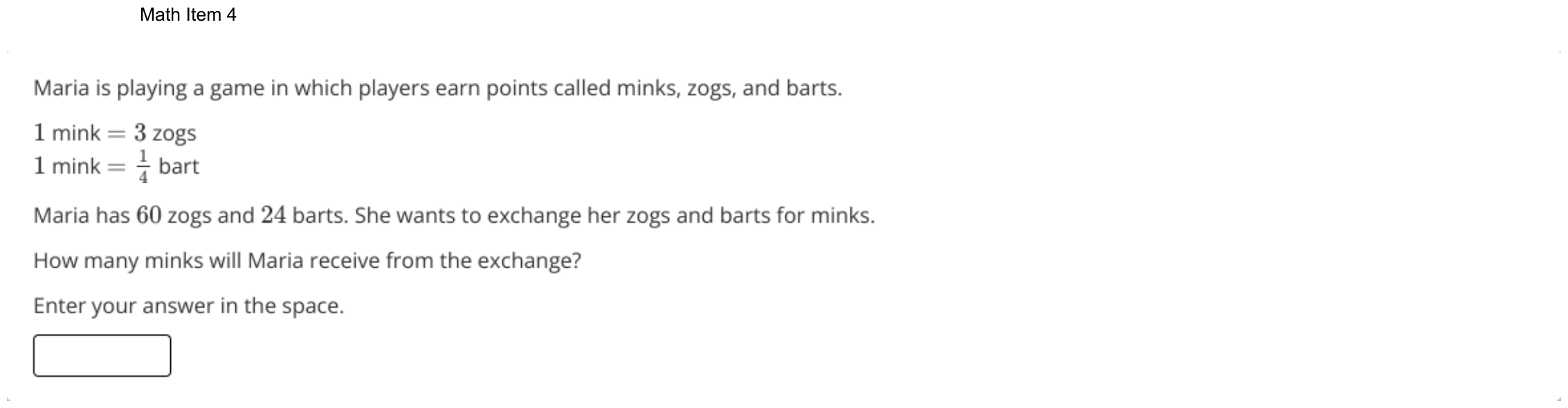
Maria is playing a game in which players earn points called minks, zogs, and barts.
Maria has 60 zogs and 24 barts. She wants to exchange her zogs and barts for minks.
How many minks will Maria receive from the exchange?
Enter your answer in the space.
Fill-in question: work out the answer and type it as a number.
Show the answer
Correct answer: 116
Step 1: Convert the zogs to minks.
Since , divide the number of zogs Maria has by 3: .
So, .
Step 2: Convert the barts to minks.
Since , multiply the number of barts by 4 (because 1 bart is equal to 4 minks): .
So, .
Step 3: Add the mink conversions.
Add the results from Steps 1 and 2 to find the total number of minks Maria will receive: .
Question analysis
In a game with made-up points called minks, zogs and barts, Maria trades 60 zogs and 24 barts for minks, and students type how many minks she receives. It tests unit conversion with invented units and a fraction. One rate says a mink equals a fraction of a bart, so deciding whether to multiply or divide is the tricky part.
- Grade level
- Grade 6 content, by NYS standard
- Compared with grade 7
- At grade 7 Converting units with a given rate is grade 6 ratio reasoning. Invented units remove any real-world sense check, and the two conversions run in opposite directions, one through a fraction, which matches the care grade 7 problems need.
- Estimated difficulty
- Moderate: several steps, or a close reading with one strong distractor.
- Thinking it demands
- Depth of knowledge 2, skills and concepts · mainly apply
- What makes it hard
- Turning words into math moderate
- Many steps minor
- An answer in an unexpected form minor
- Solution
- 3 steps
- Reading level
- Question and choices: about grade 2, 47 words.
- Students, last 30 days
- Not enough answers yet to show (it takes 10).
Why it is hard, traps and wrong answers (shows the answer)
Why it is hard
Each step is one multiplication, division or addition; the risk is direction. The two rates point opposite ways, three zogs to a mink but four minks to a bart, and the fraction in the second rate invites dividing by 4. Asking of each unit whether one of it is worth more or less than a mink fixes the direction before any arithmetic, and it also shows why the 60 and the 24 can never simply be added.
Turning words into math moderate Understanding the question
Both rates put the mink on the left, so “1 mink = 1/4 bart” has to be turned around into 1 bart = 4 minks, and the invented units give no sense of which is worth more. (Hegarty, Mayer & Monk, 1995; Koedinger & Nathan, 2004)
Many steps minor Working it out
Two conversions run in opposite directions, dividing the zogs by 3 and multiplying the barts by 4, and their results are added, so a slip in either step changes the total. (Daniel & Embretson, 2010; Enright, Morley & Sheehan, 2002)
An answer in an unexpected form minor Choosing the answer
The total is typed into a box with no choices to compare, so a conversion done the wrong way still produces a believable whole number that nothing on screen questions. (Enright, Morley & Sheehan, 2002)
Strategy: For each kind of point, decide whether one of it is worth more or less than a mink, then multiply or divide to turn it into minks, and add the two results.
Traps
- Wrong operation: Adds instead of multiplying, divides the wrong way round, turns a ratio or rate upside down, or undoes a step in the wrong direction (subtracts what should be added back).
- Units or scale: The answer is wanted in other units, or a rate or scale must be converted first.
The wrong answers, classified
26 Wrong operation (Hegarty, Mayer & Monk, 1995; King et al., 2004)
Gets 20 minks from the zogs but divides the barts by 4, 24 ÷ 4 = 6, as if a bart were worth a quarter of a mink, for 20 + 6 = 26.
276 Wrong operation (Hegarty, Mayer & Monk, 1995; King et al., 2004)
Multiplies the 60 zogs by 3, as if each zog were worth 3 minks, then adds the 96 minks from the barts correctly: 180 + 96 = 276.
84 Units or scale (King et al., 2004)
Adds the 60 zogs and 24 barts as they stand, 60 + 24 = 84, without converting either kind of point into minks first.
Worked solution, step by step
Formulas used
- Converting with a rate
- Number of points is how many zogs or barts Maria has. Minks for one point is what one zog, or one bart, is worth in minks. Find that worth first for each kind of point. Then multiply, because every point of the same kind trades for the same number of minks.
Sort out the question
Maria trades two kinds of points for minks. You know:
- 3 zogs trade for 1 mink.
- 1 mink is worth of a bart.
- Maria has 60 zogs and 24 barts.
You need the total number of minks. Zogs and barts are different units, like dimes and dollars. So you cannot just add them.
Watch out: 60 + 24 = 84 adds zogs to barts. That is not a number of minks.
Find what one zog is worth
It takes 3 zogs to make 1 mink. So one zog is only part of a mink. One zog is worth of a mink.
A zog is smaller than a mink. So Maria will get fewer minks than she has zogs.
Turn the bart rule around
The rule says 1 mink is of a bart. So a mink is a quarter of a bart. It takes 4 quarters to make a whole:
So 4 minks make 1 bart. One bart is worth 4 minks. A bart is bigger than a mink.
Watch out: the fraction tempts you to divide by 4. Then 24 barts become only 6 minks, and the total is 26.
Change the zogs into minks
Use the rate. Each of the 60 zogs is worth 1/3 of a mink:
Multiplying by 1/3 is the same as dividing by 3. So 60 zogs trade for 20 minks.
Watch out: multiplying 60 by 3 gives 180. That treats a zog as bigger than a mink, and the total becomes 276.
Change the barts into minks
Each of the 24 barts is worth 4 minks:
So 24 barts trade for 96 minks.
Add the minks
Both amounts are now in minks, so you can add them:
Maria receives 116 minks. Type only the number in the box, with no units. So you would enter 116.
Check your answer
Work backward. 20 minks are worth zogs. 96 minks are worth barts. Both match what Maria started with. Also, a bart is worth more than a mink, so 24 barts should give many more than 24 minks. They do.
More questions like this
The original DOE question