Also in 2025 Practice Test B English, question 55.
Question
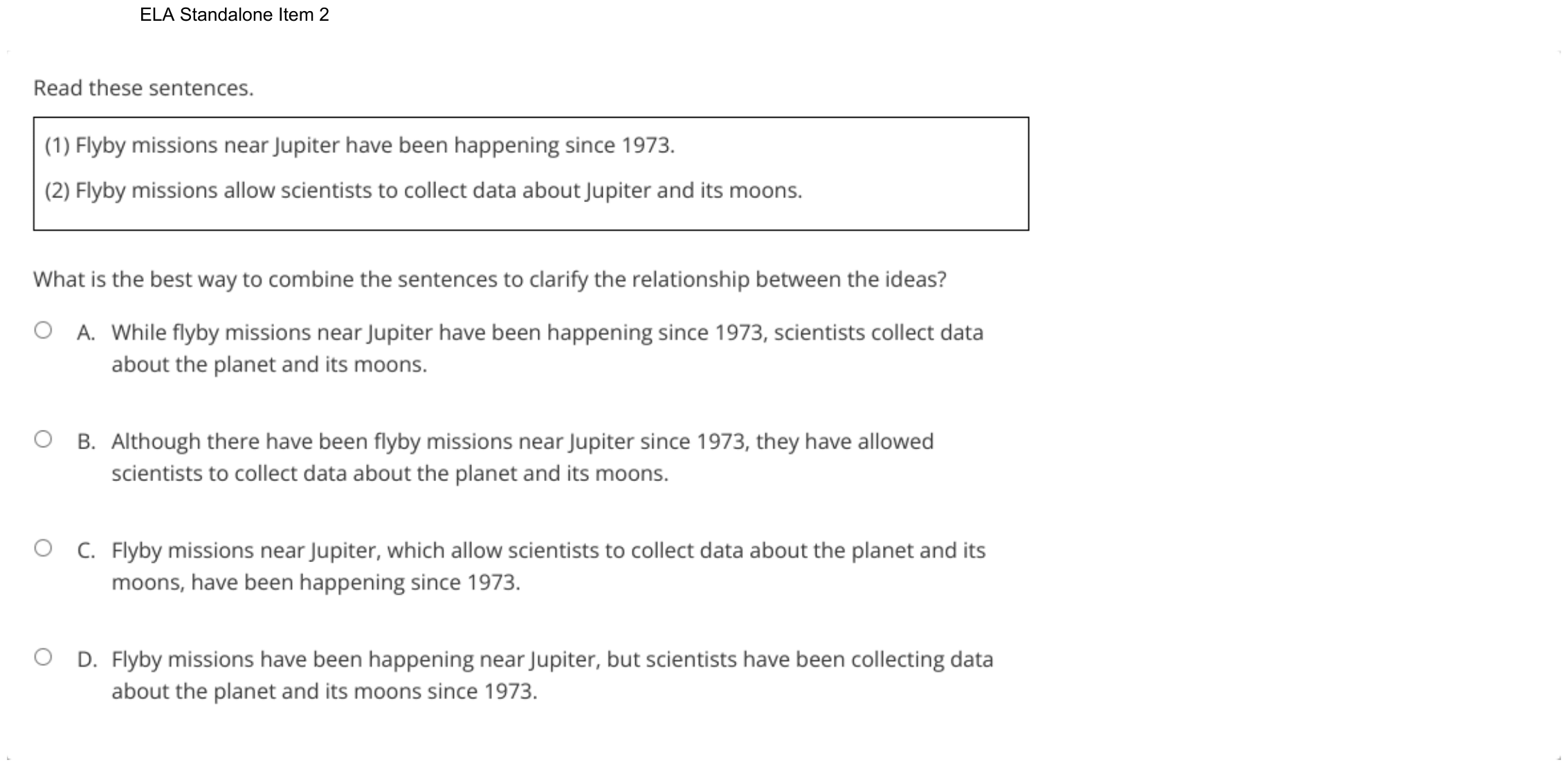
Read these sentences.
(1) Flyby missions near Jupiter have been happening since 1973.
(2) Flyby missions allow scientists to collect data about Jupiter and its moons.
What is the best way to combine the sentences to clarify the relationship between the ideas?
- AWhile flyby missions near Jupiter have been happening since 1973, scientists collect data about the planet and its moons.
- BAlthough there have been flyby missions near Jupiter since 1973, they have allowed scientists to collect data about the planet and its moons.
- CFlyby missions near Jupiter, which allow scientists to collect data about the planet and its moons, have been happening since 1973.
- DFlyby missions have been happening near Jupiter, but scientists have been collecting data about the planet and its moons since 1973.
Show the answer
Correct answer: C
The question asks for the best way to combine the sentences to clarify the relationship between the ideas.
A. Incorrect. Even though the two ideas from the original sentences are incorporated into the combined sentence, the use of the conjunction “while” in the first part of the sentence suggests that there is a simultaneous but unrelated relationship between the two ideas, which is incorrect.
B. Incorrect. The combined sentence incorporates the ideas from both sentences, but the conjunction “although” suggests that scientists were allowed to collect data even though there were flyby missions, which is an inaccurate way to express the relationship between the ideas.
C. CORRECT. This sentence is the best way to combine the sentences because it accurately reflects the relationship between the ideas by using the nonrestrictive clause “which allow scientists to collect data about the planet and its moons” to describe the purpose of the flyby missions. (Nonrestrictive clauses are adjective clauses that give additional information about a word or phrase. They sometimes begin with the relative pronoun “which” and are set off by commas.) The idea that the missions “have been happening since 1973” follows the nonrestrictive clause.
D. Incorrect. The combined sentence uses the conjunction “but” to connect the ideas in the two original sentences. This suggests a contrasting relationship between ideas, which is an inaccurate way to connect the ideas expressed in the original sentences.
Question analysis
This sentence-combining question gives two short sentences about flyby missions near Jupiter, one saying they have happened since 1973 and the other that they let scientists collect data about the planet and its moons. Students choose the combination that makes the relationship between the ideas clear, weighing what each connecting word or clause says about how the facts relate.
- NYS standards
- 7L1 grammar and usage conventions
- Grade level
- Grade 7 reading and task
- Compared with grade 7
- At grade 7 Combining two short sentences so their relationship is clear is regular grade 7 work. Both sentences here are brief and plainly related, and the versions differ mainly in their connecting words, so this is a typical, fairly quick task.
- Estimated difficulty
- Straightforward: two steps or one careful reading.
- Thinking it demands
- Depth of knowledge 2, skills and concepts · mainly evaluate
- What makes it hard
- How sentences fit together moderate
- Every choice must be checked minor
- Evidence
- Answered from one sentence or line
- Reading level
- Question and choices: about grade 9, 119 words.
- Corrected from the DOE handbook
- A wrong word in the explanation of D was corrected.
- Students, last 30 days
- Not enough answers yet to show (it takes 10).
Why it is hard, traps and wrong answers (shows the answer)
Why it is hard
The two sentences are short, and the work lies in naming how they relate before reading the versions. The most tempting one, beginning “While,” keeps both facts but drops the word “allow,” so the missions no longer explain the data. Students who test each connector against the relationship also catch the concession in “Although” and the contrast in “but,” which also moves the date onto the data collection.
How sentences fit together moderate Working it out
Students must first name the relationship, that the missions make the data possible, a link only the version with “which allow” keeps, since the others recast it as time, concession or contrast. (Halliday & Hasan, 1976)
Every choice must be checked minor Choosing the answer
All four versions keep both facts and read smoothly, so each joining word, “While,” “Although,” “which” and “but,” has to be tested for what it claims. (Embretson & Wetzel, 1987)
Strategy: Before reading the choices, decide in a few words how the two facts are connected, then reject any version whose joining word signals a different relationship or shifts what a detail describes.
Traps
- Wrong transition: A connecting word or phrase that signals the wrong relationship, such as contrast where the idea continues.
- Changes the meaning: A revision is correct English but no longer says what the writer meant.
The wrong answers, classified
A Wrong transition (Halliday & Hasan, 1976)
Keeps both facts and reads smoothly, but “While” presents the missions and the data collection as merely happening at the same time and drops “allow,” the link between them.
B Wrong transition (Halliday & Hasan, 1976)
Treats “Although” as a neutral joining word, but it makes the data collection happen in spite of the missions, when the missions are what make it possible.
D Changes the meaning (Connors & Lunsford, 1988)
Joins the facts with “but,” implying a contrast, and moves “since 1973” from the missions to the data collection, so the date now describes something else.
What was corrected from the DOE handbook, and why
- Explanation: Rejecting D, the handbook's explanation says “but” “suggests an adverse relationship between ideas”. “Adverse” means harmful; the point is that “but” signals a contrast, which the two sentences don't have. It now says “a contrasting relationship”. The answer, C, is unchanged.
Working it out, step by step
Figure out what the question asks
This question asks for the best way to join two sentences. The joined sentence must show how the ideas are related. So first decide how they connect. Then pick the version whose joining word shows that link.
Find the relationship
Sentence 1 says flyby missions near Jupiter “have been happening since 1973.” A flyby mission sends a spacecraft past a planet without landing. Sentence 2 says the missions “allow scientists to collect data about Jupiter and its moons.” Data means facts and measurements. So sentence 2 tells what the missions do for scientists. The ideas don’t contrast, or clash. They fit together.
Learn the tool: a which clause
A clause is a group of words with a subject and a verb. A which clause adds extra facts about a noun. Commas set it off. Example: My bike, which has red wheels, is new. The extra facts describe the bike. In C, “which allow scientists to collect data about the planet and its moons” describes the missions.
Check each choice
- A is wrong. “While” makes the two facts just happen at the same time. It drops “allow,” so the missions no longer explain the data.
- B is wrong. “Although” means in spite of the fact that. It suggests scientists got data even though there were missions. That is backward.
- C is right. The which clause tells what the missions do, and the date stays with the missions.
- D is wrong. “But” signals a contrast that isn’t there. It also moves “since 1973” onto the data collecting.
Watch out: A reads smoothly and keeps both facts. But “While” loses the link: the missions are what make the data possible.
Choose the answer
So the answer is C: “Flyby missions near Jupiter, which allow scientists to collect data about the planet and its moons, have been happening since 1973.”
Why this answer and not the closest wrong one
A is the closest wrong answer, because it keeps both facts and sounds fine. But “While” only says two things happen at once. It drops the word “allow,” which shows the missions make the data collection possible. C keeps that link with its which clause.
More questions like this
The original DOE question