Also in 2025 Practice Test B English, question 56.
Question
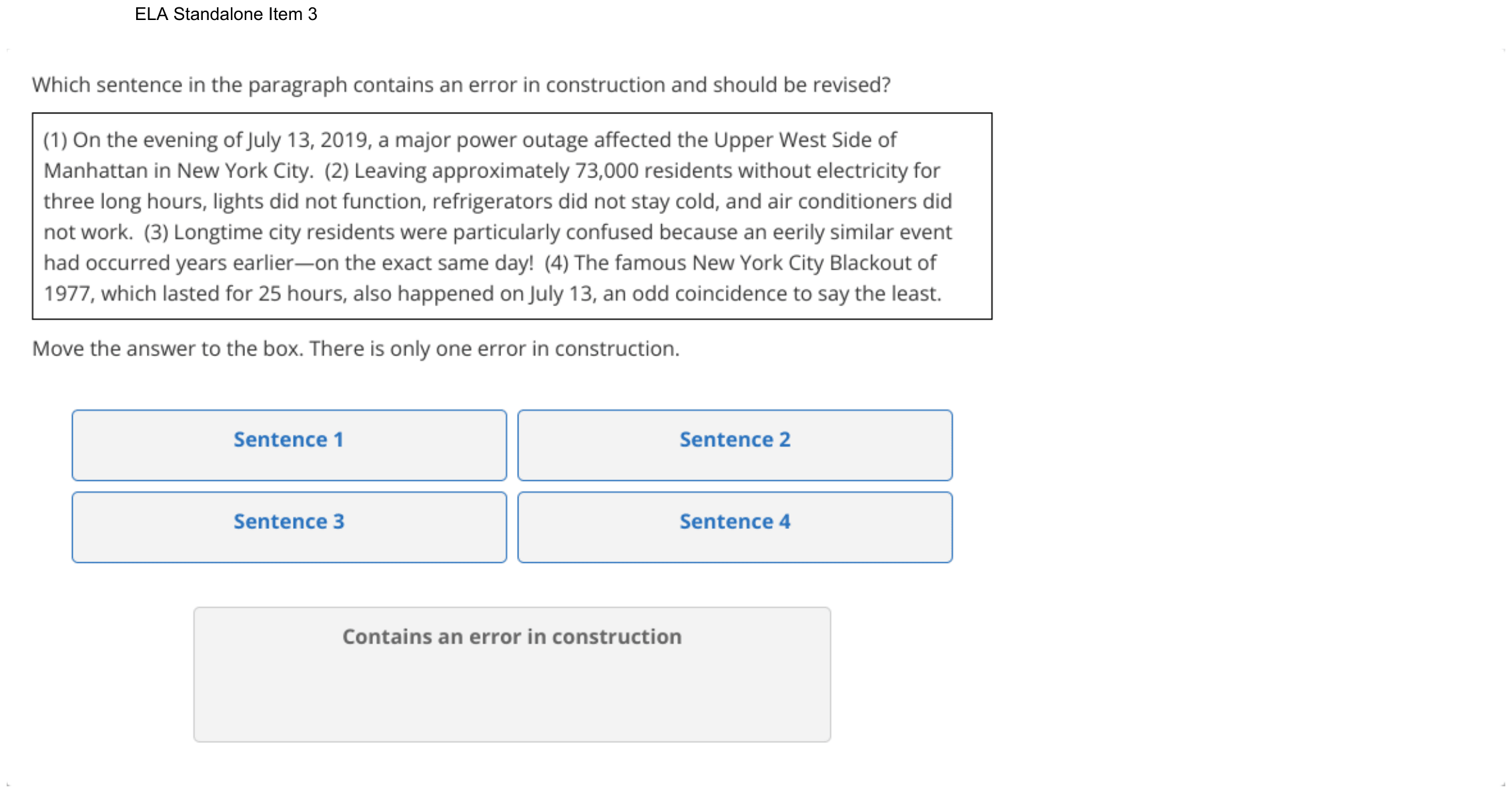
Which sentence in the paragraph contains an error in construction and should be revised?
(1) On the evening of July 13, 2019, a major power outage affected the Upper West Side of Manhattan in New York City. (2) Leaving approximately 73,000 residents without electricity for three long hours, lights did not function, refrigerators did not stay cold, and air conditioners did not work. (3) Longtime city residents were particularly confused because an eerily similar event had occurred years earlier—on the exact same day! (4) The famous New York City Blackout of 1977, which lasted for 25 hours, also happened on July 13, an odd coincidence to say the least.
Move the answer to the box. There is only one error in construction.
Contains an error in construction
On the test you drag one of the tiles into the box; here, choose it.
- ASentence 1
- BSentence 2
- CSentence 3
- DSentence 4
Show the answer
Correct answer: B
The question asks which sentence in the paragraph contains an error in construction.
Sentence 1: Construction is correct. An introductory prepositional phrase is correctly punctuated in sentence 1 and describes when the power outage occurred. Similarly, the direct object, “the Upper West Side of Manhattan in New York City,” is presented clearly in terms of what area was “affected” by the power outage.
Sentence 2: Contains an error in construction. In sentence 2, the phrase “Leaving approximately 73,000 residents without electricity for three long hours” is a dangling modifier because it is not clearly modifying any word or words in the sentence. It actually further describes the “power outage” in sentence 1. In clear and correct construction, all modifiers should be in the same sentence as and near the words they describe in order to avoid confusion.
Sentence 3: Construction is correct. A dash is used appropriately in sentence 3 to show a break in thought and to introduce the phrase “on the exact same day.”
Sentence 4: Construction is correct. Two commas are used correctly in sentence 4 to set off the nonessential clause “which lasted for 25 hours” from the rest of the sentence. Similarly, one comma is used to set off the nonessential appositive “an odd coincidence to say the least.” Both of these elements are nonessential to the sentence’s overall meaning and are thus correctly separated from the sentence by the use of commas.
Question analysis
This editing question gives a four-sentence paragraph about the July 13, 2019, blackout on Manhattan's Upper West Side, which fell on the same date as the famous 1977 New York City blackout. On the test students move one sentence tile into a box marked as containing an error in construction, and since the error is not named, every sentence must be checked.
- NYS standards
- 7L1 grammar and usage conventions
- Grade level
- Grade 7 reading and task
- Compared with grade 7
- At grade 7 Finding a sentence with a construction error in a short paragraph is typical grade 7 editing. The question does not name the kind of error, and the paragraph's dash, exclamation point and added phrases all give students something to second-guess.
- Estimated difficulty
- Moderate: several steps, or a close reading with one strong distractor.
- Thinking it demands
- Depth of knowledge 2, skills and concepts · mainly analyze
- What makes it hard
- A rule that doesn't sound wrong moderate
- Every choice must be checked moderate
- Evidence
- Answered from one paragraph or stanza
- Reading level
- Question and choices: about grade 8, 122 words.
- Students, last 30 days
- Not enough answers yet to show (it takes 10).
Why it is hard, traps and wrong answers (shows the answer)
Why it is hard
The dangling phrase is easy to accept because the reader already knows from sentence 1 what left the residents in the dark. Students who do not ask what the opening phrase describes look elsewhere, and sentence 4 is the likeliest victim, since its closing phrase about an odd coincidence seems to hang loose. The question rewards naming the subject of each sentence and checking that every added phrase belongs to it.
A rule that doesn't sound wrong moderate Working it out
The opening phrase of sentence 2, “Leaving approximately 73,000 residents without electricity,” has no word to modify; it sounds acceptable because sentence 1’s power outage supplies the missing subject. (Connors & Lunsford, 1988)
Every choice must be checked moderate Choosing the answer
The error is not named, and three sentences hold features that invite doubt: sentence 1’s date and place names, sentence 3’s dash and exclamation point, sentence 4’s two set-off phrases. (Embretson & Wetzel, 1987)
Strategy: Take the sentences one at a time: name the subject and main verb, ask what each opening or added phrase describes, and check whether each mark of punctuation has a job.
Traps
- Fixes what isn't broken: Changes a part of the sentence that was already correct, while the real error stays; or, where the question asks which sentence has an error or should go, picks one that is correct and belongs.
The wrong answers, classified
A Fixes what isn't broken (Connors & Lunsford, 1988)
Suspects the long opening date or the string of place names, though sentence 1 has a clear subject and verb and its introductory phrase is correctly punctuated.
C Fixes what isn't broken (Connors & Lunsford, 1988)
Treats the dash and the exclamation point as errors because they look informal, though the dash correctly sets off “on the exact same day” and the sentence is complete.
D Fixes what isn't broken (Connors & Lunsford, 1988)
Rightly checks what each phrase describes but decides “an odd coincidence to say the least” dangles, though it correctly sums up the whole clause before it.
Working it out, step by step
Figure out what the question asks
This question asks which sentence is built wrong. On the test, you move one sentence tile into the box. The question doesn’t name the kind of error. So check each sentence. Find its subject, who or what the sentence is about, and its verb.
Learn the rule: no dangling modifier
A modifier is a word or phrase that describes something. An opening phrase must describe the subject right after the comma. If it can’t, it is a dangling modifier. Example: Running to the bus, my backpack fell. The backpack wasn’t running! Fix: Running to the bus, I dropped my backpack.
Test sentence 2
Sentence 2 opens with “Leaving approximately 73,000 residents without electricity for three long hours.” What did the leaving? The power outage did, but the outage is back in sentence 1. After the comma, the subject is “lights.” Lights didn’t leave people without power. So the opening phrase dangles. One fix: The outage left about 73,000 residents without electricity for three long hours. Then a new sentence lists what stopped working.
Check the other sentences
- Sentence 1 is correct. Its opening phrase tells when, and a comma sets it off. Its subject is “a major power outage,” and its verb is “affected.”
- Sentence 3 is correct. The dash sets off “on the exact same day” for effect. The sentence is complete.
- Sentence 4 is correct. Commas set off “which lasted for 25 hours.” The ending, “an odd coincidence to say the least,” sums up the fact before it.
Watch out: Sentence 4 tempts many students, because its ending seems to hang loose. But it names the whole fact before it, the same date. That is allowed.
Choose the answer
Only sentence 2 has an opening phrase with nothing to describe. So the answer is B: move the tile “Sentence 2” into the box labeled “Contains an error in construction.”
Why this answer and not the closest wrong one
Sentence 4 is the closest wrong answer, because “an odd coincidence to say the least” seems loose. But it sums up the whole idea before it, which is correct. In sentence 2, the opening phrase should describe the outage. Yet the word after the comma is “lights.”
More questions like this
The original DOE question