Also in 2025 Practice Test B Math, question 28.
Question
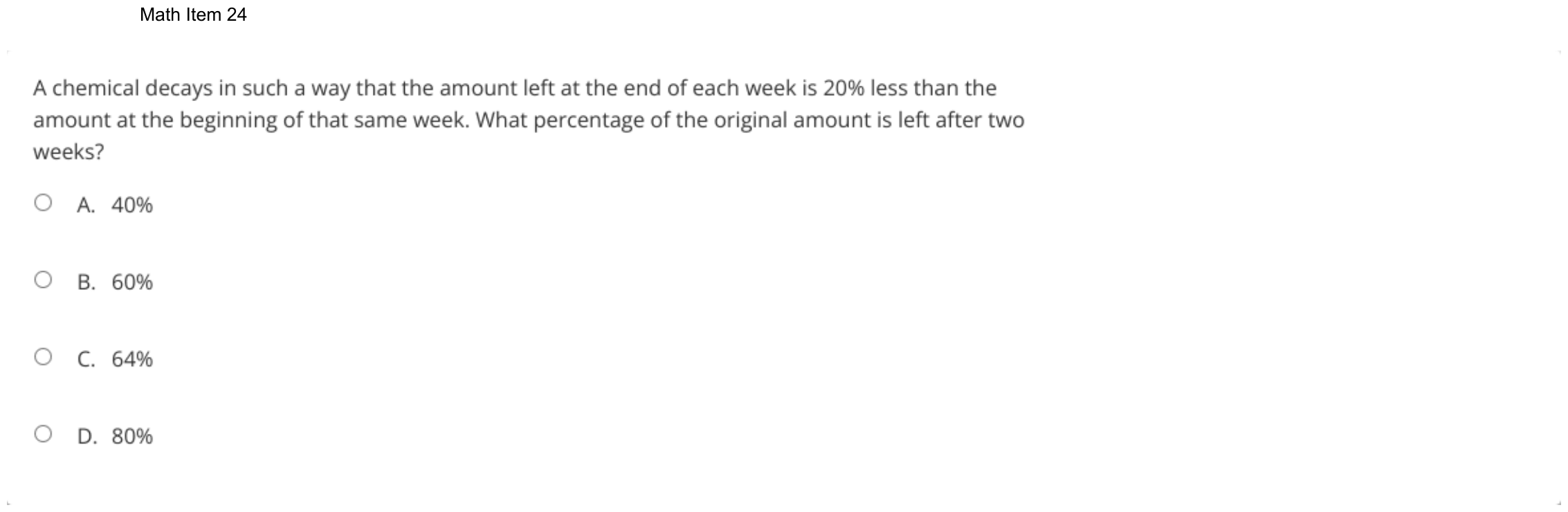
A chemical decays in such a way that the amount left at the end of each week is 20% less than the amount at the beginning of that same week. What percentage of the original amount is left after two weeks?
- A40%
- B60%
- C64%
- D80%
Show the answer
Correct answer: C
Let x be the original amount of the chemical. It loses 20% after each week, which means 80% of the chemical remains at the end of each week. End of first week:
At the end of the second week, 80% of the amount left at the end of the first week remains.
End of second week: or 64%
Question analysis
A chemical loses 20% of the amount present at the start of each week, and students find what percentage of the original amount is left after two weeks. It tests applying a percent decrease more than once. The question turns on which amount each week's loss is measured against.
- NYS standards
- 7.RP.3 multistep ratio and percent problems
- Grade level
- Grade 7 content, by NYS standard
- Compared with grade 7
- Above grade 7 A typical grade 7 percent task applies one increase or decrease to one amount. This one applies a weekly decrease twice in a row, an early form of exponential decay that goes beyond typical grade 7 work.
- Estimated difficulty
- Hard: combines ideas, needs a plan, and has more than one tempting wrong answer.
- Thinking it demands
- Depth of knowledge 2, skills and concepts · mainly apply
- What makes it hard
- A very close wrong answer major
- Turning words into math moderate
- Variables instead of numbers minor
- Solution
- 2 steps
- Reading level
- Question and choices: about grade 8, 40 words.
- Students, last 30 days
- Not enough answers yet to show (it takes 10).
Why it is hard, traps and wrong answers (shows the answer)
Why it is hard
Two equal decreases in a row feel like one decrease of twice the size, and that is the trap: 20% and 20% suggest 40% gone. The stem states the rule, each loss measured from that week’s start, in one quick phrase. Working week by week from 100 shows the second loss is 16, not 20, which separates the answer from the choice four points away, while stopping after one week or reporting the loss costs the point more simply.
A very close wrong answer major Choosing the answer
The choices 60% and 64% sit four percentage points apart, so a rough estimate cannot choose between them; only seeing that the second 20% is taken from 80, not 100, does. (Embretson & Wetzel, 1987; Gorin & Embretson, 2006; Ascalon et al., 2007)
Turning words into math moderate Understanding the question
The phrase “the amount at the beginning of that same week” sets each week’s base, so the second week’s 20% is measured from what was left after the first week. (Hegarty, Mayer & Monk, 1995; Koedinger & Nathan, 2004)
Variables instead of numbers minor Understanding the question
No starting amount is given, so students must pick one, such as 100 grams, or work with a percent of a percent, 0.8 × 0.8. (Koedinger & Nathan, 2004; Enright, Morley & Sheehan, 2002)
Strategy: Use a starting amount of 100 so that percents become units, find what remains after the first week, then apply the same 20% loss to that remainder.
Traps
- Percent of the wrong amount: Finding the whole from a part, or a percent change measured from the wrong starting amount.
- Stops one step early: A choice is a number from partway through the solution.
- Answers a different question: A choice is right for another quantity: the other unknown, the rest instead of the part, the part instead of the whole.
The wrong answers, classified
A Answers a different question (King et al., 2004; Hegarty, Mayer & Monk, 1995)
Adds the weekly losses, 20% + 20% = 40%, and gives that figure, which describes the amount lost rather than the percentage still left.
B Percent of the wrong amount (Parker & Leinhardt, 1995)
Subtracts 20% of the original amount twice, 100 − 20 − 20 = 60, though the second week’s 20% comes from the 80% left, not the starting amount.
D Stops one step early (King et al., 2004; Gierl et al., 2017)
Finds that 80% remains after the first week and stops, never taking the second week’s 20% from that remainder.
Worked solution, step by step
Formulas used
- Percent of an amount
- p is the percent, and amount is the whole you take the percent of. Percent means out of 100, so 20% is 20/100. Multiply to find the part. Be sure the amount is the right whole. Here, each week uses the amount at the start of that week.
- Percent left after a loss
- The whole amount is 100%. If 20% goes away, the rest stays. So 80% of each week’s starting amount is left at the end of that week. Keeping 80% is the same as multiplying by 0.8.
Sort out the question
Each week the chemical loses 20% of what it has. The key words are “the amount at the beginning of that same week.” So each week’s 20% comes from that week’s starting amount. No amount is given. You need the percent of the original amount that is left after two weeks.
Pick an easy starting amount
Pretend the chemical starts at 100 grams. With 100, the number of grams left is the same as the percent left. Any starting amount gives the same percent, so choose the easiest one.
Work out the first week
Use the percent formula. The first week starts with 100 grams:
The chemical loses 20 grams, so grams are left. That is 80% after one week.
Watch out: 80% is only the first week. Stopping here gives choice D.
Work out the second week
The second week starts with 80 grams, not 100. So take 20% of 80:
This time the chemical loses only 16 grams, so grams are left.
Watch out: taking away 20 grams again uses the original amount. That gives 60%, choice B. Choice A, 40%, adds the two losses. But the question asks what is left, and only 36% was lost.
Read the answer as a percent
Week Start (grams) Loss (grams) Left (grams) 1 100 20 80 2 80 16 64 Another way: each week keeps 80%, or 0.8, of its start. Two weeks gives , which is 64%.
64 grams out of the original 100 grams is 64%. So the answer is C, 64%.
Check your answer
Think about the size of the second loss. The second week starts with less, so it loses less than 20 grams. That means more than 60% is left. It does lose something, so less than 80% is left. Of the four choices, only 64% is between 60% and 80%.
More questions like this
The original DOE question