Also in 2025 Practice Test B English, question 45.
Passage Letter from Brooklyn
Letter from Brooklyn
by Jacob Scheier
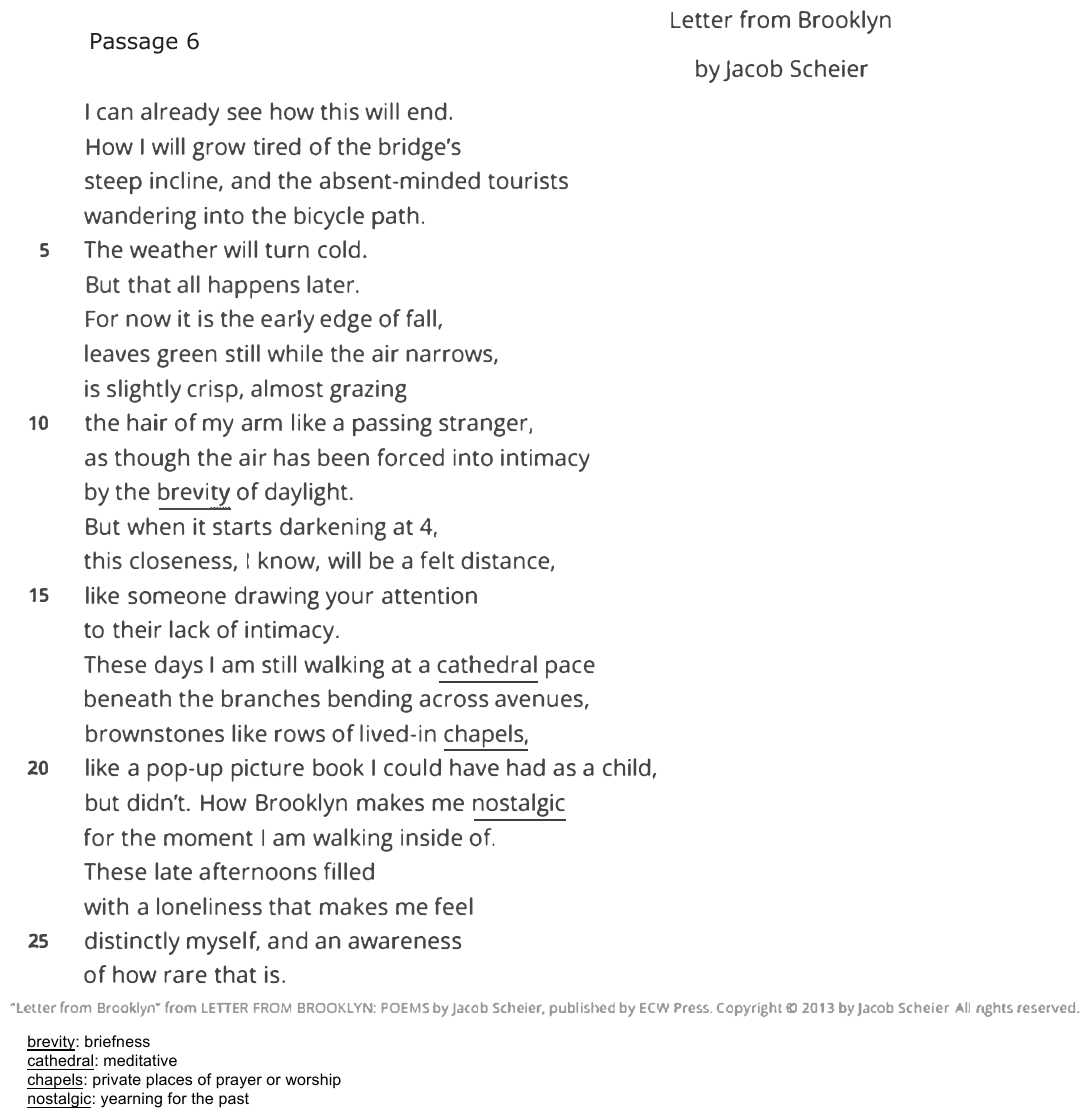
I can already see how this will end.
How I will grow tired of the bridge’s
steep incline, and the absent-minded tourists
wandering into the bicycle path.
The weather will turn cold.
But that all happens later.
For now it is the early edge of fall,
leaves green still while the air narrows,
is slightly crisp, almost grazing
the hair of my arm like a passing stranger,
as though the air has been forced into intimacy
by the brevity of daylight.
But when it starts darkening at 4,
this closeness, I know, will be a felt distance,
like someone drawing your attention
to their lack of intimacy.
These days I am still walking at a cathedral pace
beneath the branches bending across avenues,
brownstones like rows of lived-in chapels,
like a pop-up picture book I could have had as a child,
but didn’t. How Brooklyn makes me nostalgic
for the moment I am walking inside of.
These late afternoons filled
with a loneliness that makes me feel
distinctly myself, and an awareness
of how rare that is.
“Letter from Brooklyn” from LETTER FROM BROOKLYN: POEMS by Jacob Scheier, published by ECW Press. Copyright © 2013 by Jacob Scheier All rights reserved.
brevity: briefness
cathedral: meditative
chapels: private places of prayer or worship
nostalgic: yearning for the past
Question
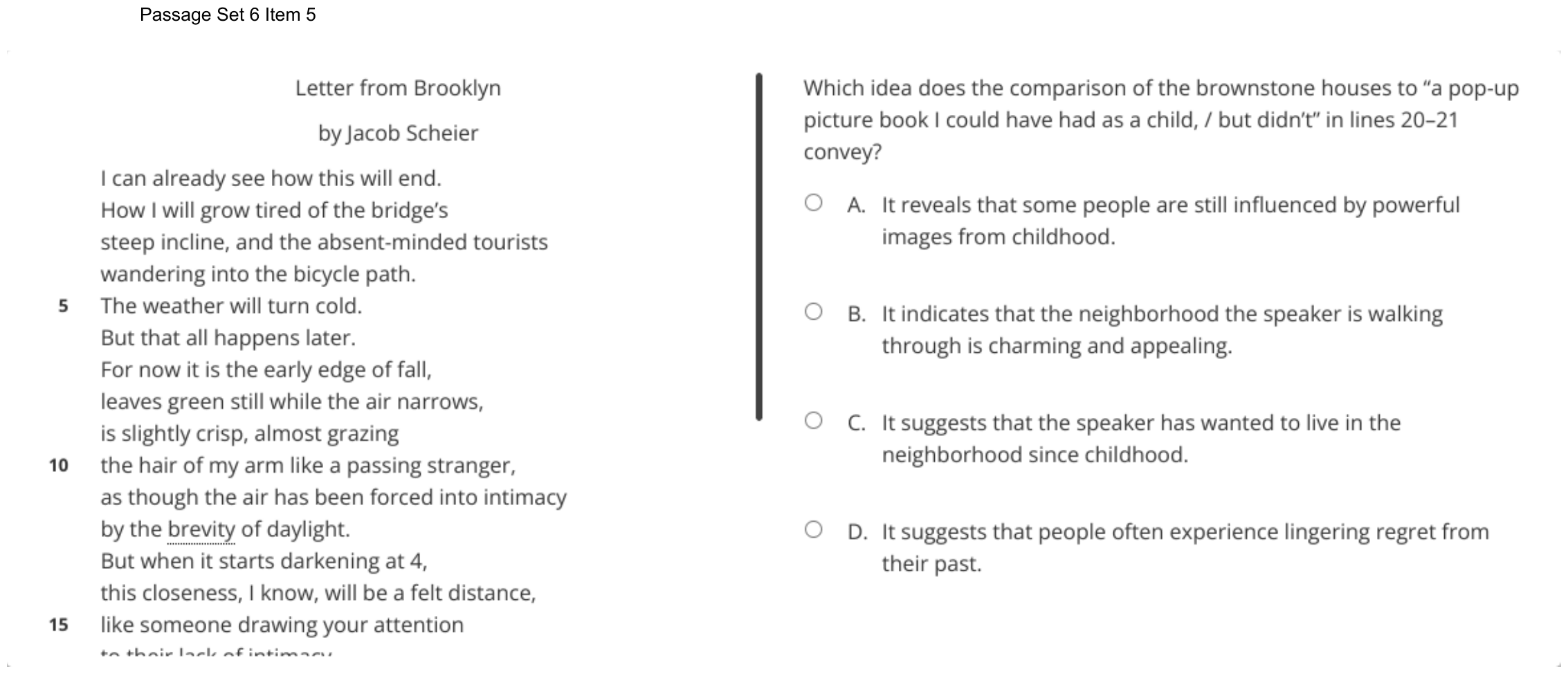
Which idea does the comparison of the brownstone houses to “a pop-up picture book I could have had as a child, / but didn’t” in lines 20–21 convey?
- AIt reveals that some people are still influenced by powerful images from childhood.
- BIt indicates that the neighborhood the speaker is walking through is charming and appealing.
- CIt suggests that the speaker has wanted to live in the neighborhood since childhood.
- DIt suggests that people often experience lingering regret from their past.
Show the answer
Correct answer: B
The question asks what the comparison of the brownstone houses to “a pop-up picture book I could have had as a child, / but didn’t” (lines 20–21) conveys.
A. Incorrect. While the lines explain that the neighborhood reminds the speaker of images from childhood pop-up books, those images are not described as very powerful or influential.
B. CORRECT. Pop-up picture books are likely to delight a child with their unique, often beautiful representations of buildings that pop up out of the page. The comparison in these lines helps explain how the speaker views these brownstones with a childlike wonder and appreciation.
C. Incorrect. Though in these lines the speaker compares this neighborhood to scenes in children’s pop-up picture books, there is no clear evidence that the speaker wants to live there, only that the speaker appreciates its appeal.
D. Incorrect. The lines state that the speaker did not have a “pop-up picture book” of the neighborhood’s brownstones as a child, but not in a way that emphasizes regret. Rather, the speaker compares the neighborhood to images from pop-up books in general to suggest that the neighborhood looks beautiful and delightful.
Question analysis
This figurative-language question asks what idea the poem conveys by comparing Brooklyn's brownstone houses to “a pop-up picture book I could have had as a child, / but didn't.” Students must interpret a simile in context, deciding how the closing words “but didn't” fit with the rest of the comparison and with the speaker's mood during the walk.
- Grade level
- Grade 7 reading and task
- Compared with grade 7
- At grade 7 Interpreting a simile in a poem is routine grade 7 work. This comparison uses a familiar childhood object, and the only complication is the added “but didn't,” which invites a reading that the rest of the lines must confirm or rule out.
- Estimated difficulty
- Straightforward: two steps or one careful reading.
- Thinking it demands
- Depth of knowledge 2, skills and concepts · mainly understand
- What makes it hard
- Figurative or literary language moderate
- Reading between the lines minor
- Evidence
- Answered from one sentence or line
- Reading level
- Passage: 217 words (a poem; reading level not measured); question and choices: about grade 8, 78 words.
- Students, last 30 days
- Not enough answers yet to show (it takes 10).
Why it is hard, traps and wrong answers (shows the answer)
Why it is hard
The core of the simile is easy: a row of brownstones looks like a pop-up picture book, something charming. The difficulty is the closing “but didn’t,” which tempts students toward regret or toward a story about the speaker’s childhood. Students who ask what the comparison says about the houses, rather than about the speaker’s past, see that the lines praise the neighborhood.
Figurative or literary language moderate Understanding the question
The simile likens brownstones to a pop-up picture book, and its point, that the street looks as delightful as a child’s book, has to be drawn from what such books are like. (Graesser, Singer & Trabasso, 1994; Kintsch, 1998)
Reading between the lines minor Working it out
The tag “but didn’t” invites a reading of regret, so students must decide from the walk at a “cathedral pace” around it that the comparison is about delight, not loss. (Graesser, Singer & Trabasso, 1994; Kintsch, 1998)
Strategy: Work out what the brownstones and a pop-up picture book have in common, decide what part “but didn't” plays in the comparison, and test each choice against what the lines actually say.
Traps
- Wrong tone or attitude: Misjudges the tone, attitude or point of view, such as reading admiration as criticism, or taking a character's or subject's feelings for the author's.
- Taking figurative language literally: A choice reads a figure of speech or image at face value.
- Too broad or too strong: A choice overstates, generalizes, or uses absolute words the text does not support.
The wrong answers, classified
A Too broad or too strong (King et al., 2004)
Generalizes from one speaker’s comparison to what “some people” feel and calls the images “powerful,” though the lines describe how the brownstones look, not lasting childhood influences.
C Taking figurative language literally (Graesser, Singer & Trabasso, 1994)
Reads “could have had as a child” as a fact about the speaker’s childhood wishes, though the simile only compares the houses to pages in a book.
D Wrong tone or attitude (Graesser, Singer & Trabasso, 1994)
Hears regret in “but didn’t” and widens it to people in general, though the speaker mentions the missing book only in passing while enjoying the walk.
Working it out, step by step
Figure out what the question asks
This question asks about a simile. A simile compares two things using like or as. Here the speaker compares brownstones to a pop-up picture book. Brownstones are old row houses built of reddish-brown stone. You need the idea this comparison gives.
Read the comparison
Lines 19–21 say “brownstones like rows of lived-in chapels, / like a pop-up picture book I could have had as a child, / but didn’t.” A pop-up book has pictures that stand up off the page when you open it. These books often show houses and streets. Children love them.
Put it in your own words
So the street looks charming and magical, like a page in a child’s favorite book. The words “but didn’t” just mean the speaker never owned such a book. Around these lines the speaker walks at a “cathedral pace.” The glossary says cathedral means “meditative,” or calm and thoughtful. The mood is peaceful and happy, not sad.
Check each choice
- A is wrong. The lines describe how the houses look. They don’t claim childhood pictures stay powerful for people.
- B is right. Comparing the houses to a pop-up book shows they look charming, or delightful.
- C is wrong. The speaker never says they wanted to live there as a child.
- D is wrong. “But didn’t” is said in passing. The speaker is enjoying the walk, not full of regret, or sorrow over the past.
Watch out: “But didn’t” can sound sad, so D is tempting. Ask what the comparison says about the houses, not about the speaker’s past.
Choose the answer
The comparison praises how the houses look. So the answer is B: “It indicates that the neighborhood the speaker is walking through is charming and appealing.”
Why this answer and not the closest wrong one
D is the closest wrong answer, because “but didn’t” hints at something missed. But the speaker is enjoying a slow walk under the branches. The simile’s job is to show how lovely the brownstones look. That points to B, not to regret.
More questions like this
The original DOE question
The passage “Letter from Brooklyn” as printed (page 50)