Also in 2025 Practice Test B English, question 46.
Passage Letter from Brooklyn
Letter from Brooklyn
by Jacob Scheier
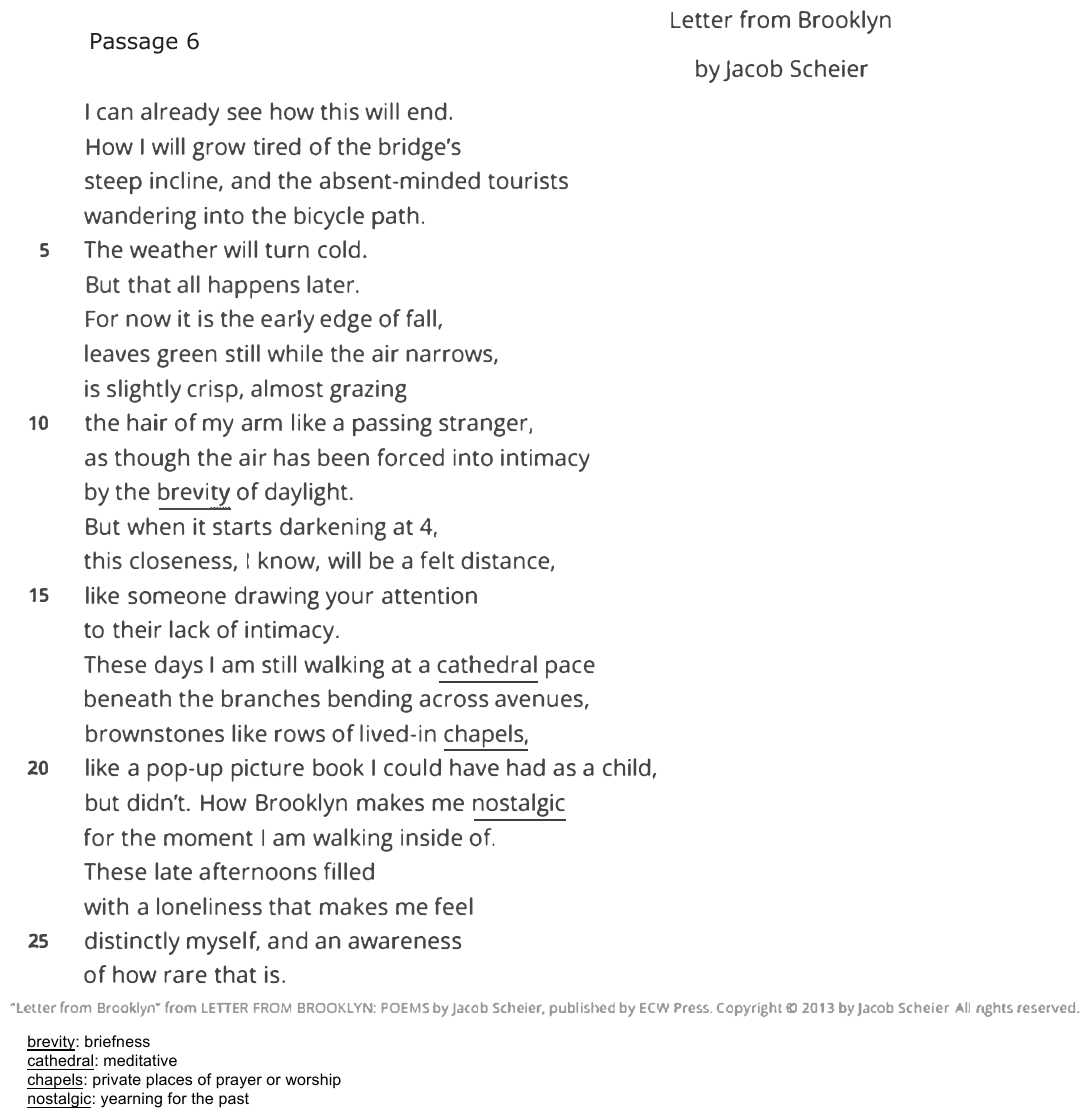
I can already see how this will end.
How I will grow tired of the bridge’s
steep incline, and the absent-minded tourists
wandering into the bicycle path.
The weather will turn cold.
But that all happens later.
For now it is the early edge of fall,
leaves green still while the air narrows,
is slightly crisp, almost grazing
the hair of my arm like a passing stranger,
as though the air has been forced into intimacy
by the brevity of daylight.
But when it starts darkening at 4,
this closeness, I know, will be a felt distance,
like someone drawing your attention
to their lack of intimacy.
These days I am still walking at a cathedral pace
beneath the branches bending across avenues,
brownstones like rows of lived-in chapels,
like a pop-up picture book I could have had as a child,
but didn’t. How Brooklyn makes me nostalgic
for the moment I am walking inside of.
These late afternoons filled
with a loneliness that makes me feel
distinctly myself, and an awareness
of how rare that is.
“Letter from Brooklyn” from LETTER FROM BROOKLYN: POEMS by Jacob Scheier, published by ECW Press. Copyright © 2013 by Jacob Scheier All rights reserved.
brevity: briefness
cathedral: meditative
chapels: private places of prayer or worship
nostalgic: yearning for the past
Question
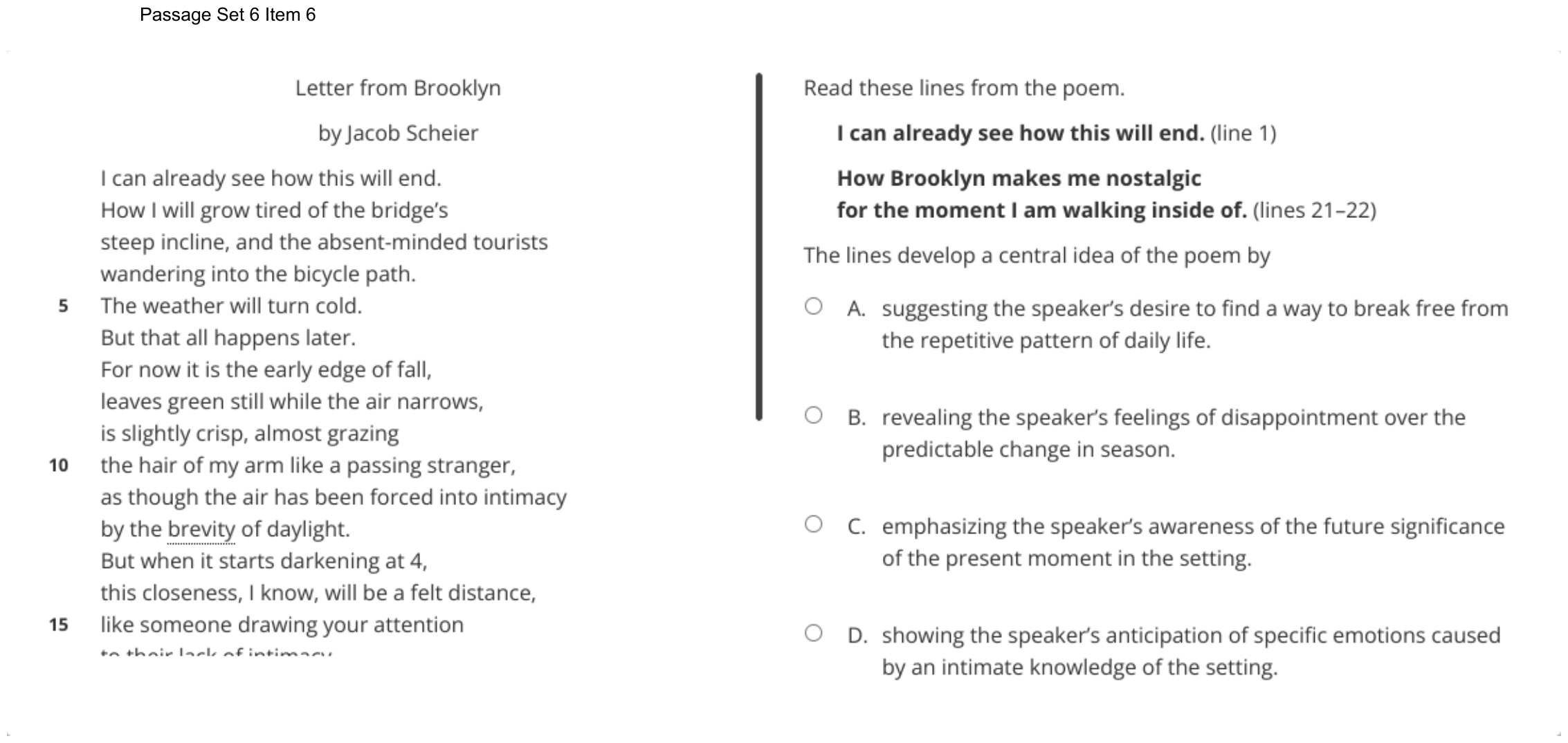
Read these lines from the poem.
I can already see how this will end. (line 1)
How Brooklyn makes me nostalgic
for the moment I am walking inside of. (lines 21–22)
The lines develop a central idea of the poem by
- Asuggesting the speaker’s desire to find a way to break free from the repetitive pattern of daily life.
- Brevealing the speaker’s feelings of disappointment over the predictable change in season.
- Cemphasizing the speaker’s awareness of the future significance of the present moment in the setting.
- Dshowing the speaker’s anticipation of specific emotions caused by an intimate knowledge of the setting.
Show the answer
Correct answer: C
The question asks how line 1 and lines 21–22 develop a central idea of the poem.
A. Incorrect. Although these lines suggest that life is governed by repetitive patterns, such as the change of seasons, they do not suggest that the speaker wishes to break free from these natural cycles of change, and a desire for freedom is not a central idea of the poem.
B. Incorrect. Although the speaker acknowledges that colder weather will inevitably bring disappointment, the speaker does not suggest in these lines that the predictability of changing weather is itself disappointing. Rather, the speaker recognizes the value of enjoying the present moment.
C. CORRECT. These lines connect the present warmer weather with the future colder weather and develop the central idea that the present “moment I am walking inside of” must be embraced because the speaker will be “nostalgic” for it in the future.
D. Incorrect. In these lines, the speaker is aware that specific emotions will occur in the future, during cold weather, but this awareness is only part of the more complex central idea of the poem, which is that current emotions and feelings must be recognized, experienced, and appreciated.
Question analysis
This central-idea question pairs the first line of “Letter from Brooklyn” with lines 21–22, where Brooklyn makes the speaker nostalgic “for the moment I am walking inside of,” and asks how they develop a central idea of the poem. Students must link excerpts from opposite ends of the poem, untangle a paradoxical image and choose among four abstract statements.
- Grade level
- Grade 8 reading and task
- Compared with grade 7
- Above grade 7 Grade 7 students analyze how lines develop a central idea. Here two excerpts twenty lines apart must be read together, one of them built on a paradox, and the four choices are long and abstract, well beyond typical grade 7 work.
- Estimated difficulty
- Among the hardest on the SHSAT: a non-obvious approach, heavy reading, or a well-hidden trap.
- Thinking it demands
- Depth of knowledge 3, strategic thinking · mainly analyze
- What makes it hard
- Figurative or literary language major
- A very close wrong answer moderate
- Evidence in several places moderate
- Evidence
- Answered from several paragraphs or stanzas
- Reading level
- Passage: 217 words (a poem; reading level not measured); question and choices: about grade 7, 99 words.
- Students, last 30 days
- Not enough answers yet to show (it takes 10).
Why it is hard, traps and wrong answers (shows the answer)
Why it is hard
This is among the hardest questions in the set because the two excerpts must be joined through a paradox and then matched to four long, abstract statements. Line 1 foresees an ending; lines 21–22 miss a moment while it is still happening, so both look at now from the future. Students who see only the foresight pick the choice about anticipated emotions, while those who hear gloom in “how this will end” settle on disappointment or a wish to escape.
Figurative or literary language major Understanding the question
Lines 21–22 are a paradox: “nostalgic,” glossed as yearning for the past, is aimed at “the moment I am walking inside of,” so the speaker already feels the present as a future memory. (Graesser, Singer & Trabasso, 1994; Kintsch, 1998)
A very close wrong answer moderate Choosing the answer
The choice about anticipating “specific emotions” shares the key’s link between future and present; it differs by tracing those feelings to knowing the setting well, which neither excerpt says. (Embretson & Wetzel, 1987; Gorin & Embretson, 2006; Ascalon et al., 2007)
Evidence in several places moderate Working it out
The excerpts are the poem’s first line and lines 21–22, twenty lines apart, and what joins them, the speaker looking ahead at the present, shows only when they are read side by side. (Kirsch & Mosenthal, 1990; Gorin & Embretson, 2006)
Strategy: Paraphrase each excerpt on its own, using the glossary's meaning of “nostalgic,” then decide what the first line and the last two share and match that to a choice.
Traps
- Half right: One half of a two-part choice is right and the other is not.
- Wrong tone or attitude: Misjudges the tone, attitude or point of view, such as reading admiration as criticism, or taking a character's or subject's feelings for the author's.
- Reads too much in: A reasonable-sounding conclusion that goes further than the text allows.
The wrong answers, classified
A Reads too much in (Graesser, Singer & Trabasso, 1994)
Links “how this will end” and growing tired of the bridge to a dull routine and imagines a wish to escape it, which the poem never expresses.
B Wrong tone or attitude (Graesser, Singer & Trabasso, 1994)
Hears resignation in “I can already see how this will end” and reads it as disappointment with the seasons, missing that the speaker treasures the present walk.
D Half right (King et al., 2004; Thissen, Steinberg & Fitzpatrick, 1989)
Rightly sees the speaker foreseeing feelings in line 1, but traces them to an “intimate knowledge of the setting,” while lines 21–22 long for the present moment itself.
Working it out, step by step
Figure out what the question asks
This question gives two pieces of the poem: line 1 and lines 21–22. You need the central idea they build together. A central idea is the main point the poem keeps working toward. Read each piece alone first, then join them.
Read line 1
Line 1 says “I can already see how this will end.” The speaker looks ahead. Lines 2–5 then list what will come: growing tired of the bridge, and the cold. So the speaker already pictures the future while living in the present.
Read lines 21–22
The lines say “How Brooklyn makes me nostalgic / for the moment I am walking inside of.” The glossary says nostalgic means “yearning for the past.” Yearning means longing. But the speaker longs for now, a moment still happening. That is a paradox, an idea that seems impossible but makes sense. The speaker knows this walk will be a precious memory.
Join the two pieces
Both pieces look at the present from the future. In line 1, the speaker sees the end coming. In lines 21–22, the speaker already misses the walk. So the speaker knows this present moment will matter later. Significance means importance.
Check each choice
- A is wrong. The speaker never wants to break free from daily routine.
- B is wrong. Line 1 can sound gloomy. But the speaker isn’t upset with the seasons. The speaker treasures the walk.
- C is right. The speaker sees that this moment in Brooklyn will be precious later.
- D is wrong. The speaker does foresee feelings. But neither piece says they come from knowing the place well.
Watch out: D gets the looking-ahead part of line 1 right. But lines 21–22 long for the moment itself, not for feelings caused by knowing the city.
Choose the answer
So the answer is C: “emphasizing the speaker’s awareness of the future significance of the present moment in the setting.”
Why this answer and not the closest wrong one
D is the closest wrong answer, because line 1 does show the speaker foreseeing feelings. But D says they come from an “intimate knowledge of the setting.” Neither piece says that. Lines 21–22 miss the moment while it is still happening. C captures that: the present will matter in the future.
More questions like this
The original DOE question
The passage “Letter from Brooklyn” as printed (page 50)