Passage Letter from Brooklyn
Letter from Brooklyn
by Jacob Scheier
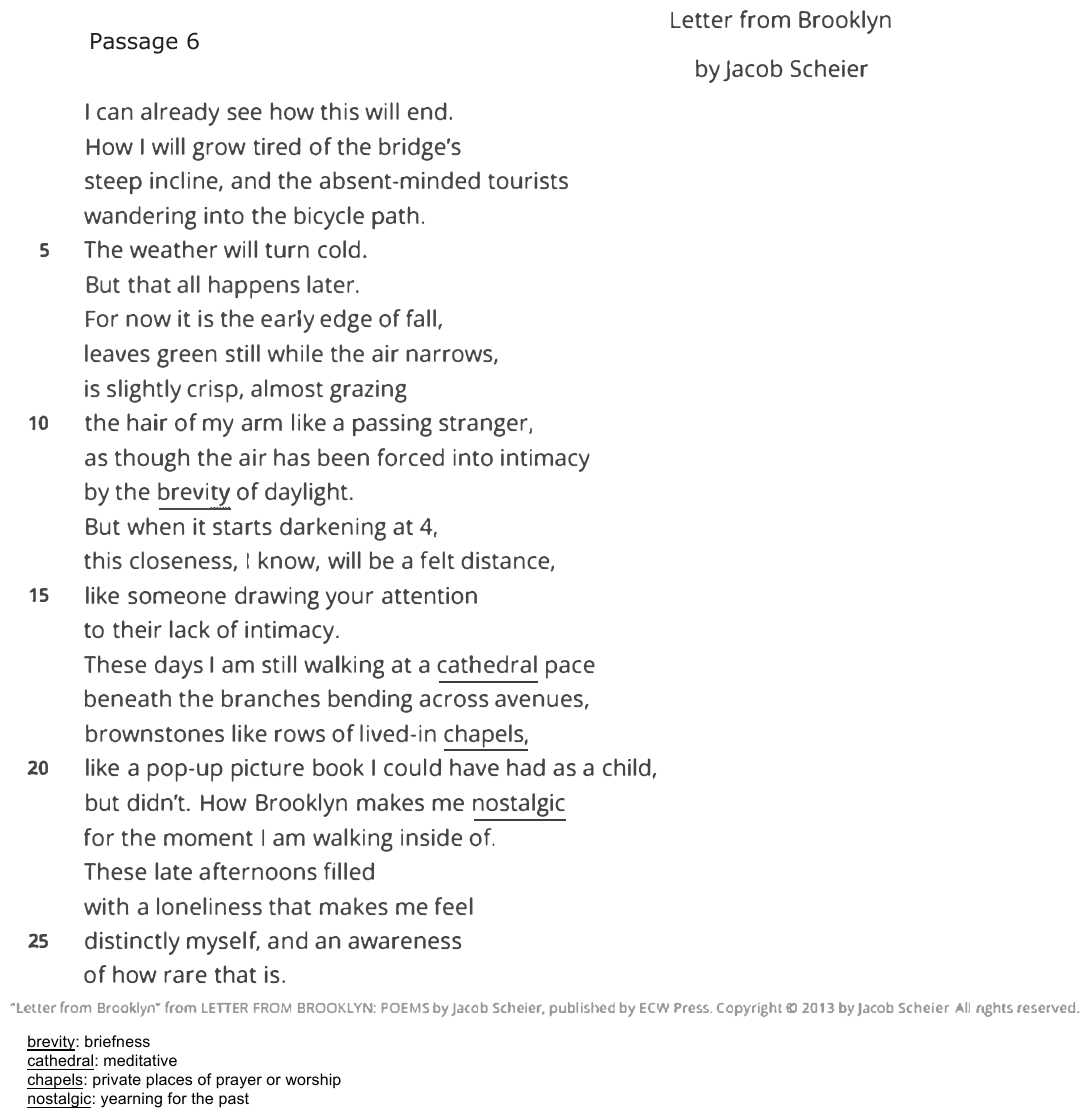
I can already see how this will end.
How I will grow tired of the bridge’s
steep incline, and the absent-minded tourists
wandering into the bicycle path.
The weather will turn cold.
But that all happens later.
For now it is the early edge of fall,
leaves green still while the air narrows,
is slightly crisp, almost grazing
the hair of my arm like a passing stranger,
as though the air has been forced into intimacy
by the brevity of daylight.
But when it starts darkening at 4,
this closeness, I know, will be a felt distance,
like someone drawing your attention
to their lack of intimacy.
These days I am still walking at a cathedral pace
beneath the branches bending across avenues,
brownstones like rows of lived-in chapels,
like a pop-up picture book I could have had as a child,
but didn’t. How Brooklyn makes me nostalgic
for the moment I am walking inside of.
These late afternoons filled
with a loneliness that makes me feel
distinctly myself, and an awareness
of how rare that is.
“Letter from Brooklyn” from LETTER FROM BROOKLYN: POEMS by Jacob Scheier, published by ECW Press. Copyright © 2013 by Jacob Scheier All rights reserved.
brevity: briefness
cathedral: meditative
chapels: private places of prayer or worship
nostalgic: yearning for the past
Question
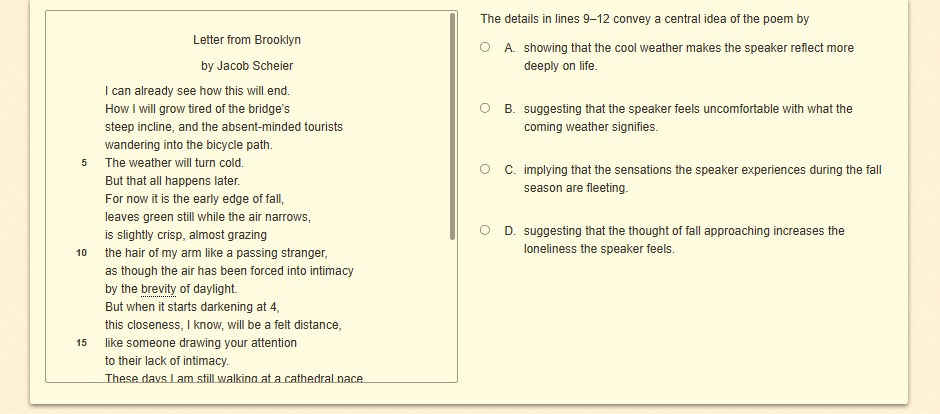
The details in lines 9–12 convey a central idea of the poem by
- Ashowing that the cool weather makes the speaker reflect more deeply on life.
- Bsuggesting that the speaker feels uncomfortable with what the coming weather signifies.
- Cimplying that the sensations the speaker experiences during the fall season are fleeting.
- Dsuggesting that the thought of fall approaching increases the loneliness the speaker feels.
Show the answer
Correct answer: C
The question asks how lines 9–12 convey a central idea of the poem.
A. Incorrect. Although the speaker discusses the very beginning of cool weather in these lines, the speaker does not reflect on life in these lines.
B. Incorrect. Although the description in these lines likens the movement of crisp air to “a passing stranger,” that comparison does not have a negative connotation in this context; it does not suggest that the speaker is uncomfortable. Rather, it is used to describe the subtle physical sensation of cool air on the speaker’s arm.
C. CORRECT. By using a description of the crisp air as “a passing stranger” and the daylight as being brief, these lines express the poem’s central idea that the joy of early fall is temporary or fleeting.
D. Incorrect. Although the speaker acknowledges the coming fall in these lines, there is no mention of loneliness. The speaker reveals a loneliness in lines 23–26 but gives no hint of that feeling in lines 9–12. Further, this loneliness is not a central idea of the poem.
Question analysis
This central-idea question on Jacob Scheier’s poem “Letter from Brooklyn” asks how lines 9–12, where the crisp early-fall air grazes the speaker’s arm, convey a central idea of the poem. Students must interpret a simile and a personification packed into four short lines and connect what they suggest to the poem as a whole, while each choice names a different feeling or idea.
- Grade level
- Grade 8 reading and task
- Compared with grade 7
- Above grade 7 Grade 7 students explain how particular lines develop a central idea. These four lines make their point only through a simile and a personification about air and daylight, and linking them to the whole poem takes more interpretation than typical grade 7 work.
- Estimated difficulty
- Hard: combines ideas, needs a plan, and has more than one tempting wrong answer.
- Thinking it demands
- Depth of knowledge 2, skills and concepts · mainly analyze
- What makes it hard
- Figurative or literary language major
- Reading between the lines moderate
- The right answer is reworded minor
- Evidence
- Answered from one paragraph or stanza
- Reading level
- Passage: 217 words (a poem; reading level not measured); question and choices: about grade 8, 63 words.
- Students, last 30 days
- Not enough answers yet to show (it takes 10).
Why it is hard, traps and wrong answers (shows the answer)
Why it is hard
The four lines describe a sensation, cool air almost grazing an arm, and the central idea sits in two small words, “passing” and “brevity.” The strongest pull hears the stranger and the air “forced into intimacy” as unwelcome, borrowing the unease the poem saves for the darkening of lines 13–16. Other choices bring in moods from elsewhere, the meditative walk and the loneliness of the last lines, so students must judge only what lines 9–12 themselves suggest.
Figurative or literary language major Understanding the question
The lines never say the moment is short: the air almost grazes the speaker’s arm “like a passing stranger” and is “forced into intimacy / by the brevity of daylight,” so “passing” and “brevity” carry the idea. (Graesser, Singer & Trabasso, 1994; Kintsch, 1998)
Reading between the lines moderate Working it out
Students must tie the brief touch and the short days to a central idea the poem never states, that early fall is slipping away, framed by “For now” in line 7 and “But when it starts darkening” in line 13. (Graesser, Singer & Trabasso, 1994; Kintsch, 1998)
The right answer is reworded minor Choosing the answer
The right choice says “fleeting” where the lines say “passing” and “brevity,” while a wrong choice borrows the poem’s own word “loneliness” from line 24, which makes it look supported. (Freedle & Kostin, 1993; Kirsch & Mosenthal, 1990)
Strategy: Paraphrase lines 9–12 in plain words, checking the glossary for unfamiliar words, then decide what the comparison suggests about the speaker’s experience and test each choice against these four lines.
Traps
- Wrong part of the text: A choice is true of another paragraph, stanza or speaker than the one asked about.
- Wrong tone or attitude: Misjudges the tone, attitude or point of view, such as reading admiration as criticism, or taking a character's or subject's feelings for the author's.
- Reads too much in: A reasonable-sounding conclusion that goes further than the text allows.
The wrong answers, classified
A Reads too much in (Graesser, Singer & Trabasso, 1994)
Senses that the poem is meditative and credits the cool air with prompting deep thought, though lines 9–12 record a light, passing touch on the arm, not reflections on life.
B Wrong tone or attitude (Graesser, Singer & Trabasso, 1994)
Hears something unwelcome in “a passing stranger” and in air “forced into intimacy,” though the touch is light and the closeness enjoyed; unease arrives only with the darkening of lines 13–16.
D Wrong part of the text (Kirsch & Mosenthal, 1990)
Brings the “loneliness” of lines 23–26 into lines that never mention it, and even there it makes the speaker feel “distinctly myself,” not lonelier as fall approaches.
Working it out, step by step
Figure out what the question asks
This asks how lines 9–12 help build a central idea. A central idea is a main point the poem keeps coming back to. First work out what the four lines say. Then see how they connect to the rest of the poem. Test each choice against these four lines.
Read lines 9–12
The sentence is about the air, named in line 8. Lines 9–12 say it “is slightly crisp, almost grazing / the hair of my arm like a passing stranger, / as though the air has been forced into intimacy / by the brevity of daylight.” Crisp means cool and fresh. Grazing here means lightly touching. Intimacy means closeness. The glossary says brevity means “briefness.”
Work out the comparisons
“Like a passing stranger” is a simile, a comparison that uses like or as. A stranger who passes you on the street is there for a moment, then gone. So the cool air touches the speaker lightly and briefly. The next lines treat the air like a person pushed into closeness by the short daylight. Giving human feelings to something that isn’t human is called personification. Both “passing” and “brevity” point to the same thing: this feeling won’t last.
Connect the lines to the poem
The rest of the poem agrees. Line 7 begins “For now it is the early edge of fall.” Lines 13–14 look ahead: “But when it starts darkening at 4,” this closeness “will be a felt distance.” Lines 21–22 say Brooklyn makes the speaker “nostalgic / for the moment I am walking inside of.” So a central idea is that this early-fall moment is precious and passes quickly. Fleeting means lasting only a short time.
Check each choice
- A does not fit. These lines describe a touch on the skin, not thoughts about life.
- B does not fit. The touch is light, and the speaker enjoys the closeness now. The worry comes later, in lines 13–16.
- C fits. “Passing” and “brevity” show that the feelings of early fall won’t last.
- D does not fit. Lines 9–12 never mention loneliness, which comes in line 24. And line 7 says fall has already begun.
Watch out: B is tempting because “stranger” and “forced into intimacy” can sound unpleasant. But the stranger only passes by, and the touch is light.
Choose the answer
The brief touch and the short daylight show that this early-fall moment slips away fast. Sensations are feelings you get through your senses, like touch. So the answer is C, “implying that the sensations the speaker experiences during the fall season are fleeting.”
Why this answer and not the closest wrong one
B is the closest wrong choice, because “forced” and “stranger” can sound unpleasant. But line 14 calls this feeling “this closeness,” and losing it is what will feel bad. So the closeness is welcome now. What lines 9–12 stress is how brief it is, which is C.
More questions like this
The original DOE question
The passage “Letter from Brooklyn” as printed (page 50)