Also in 2025 Practice Test A English, question 50.
Passage The Benefits of Indoor Plants
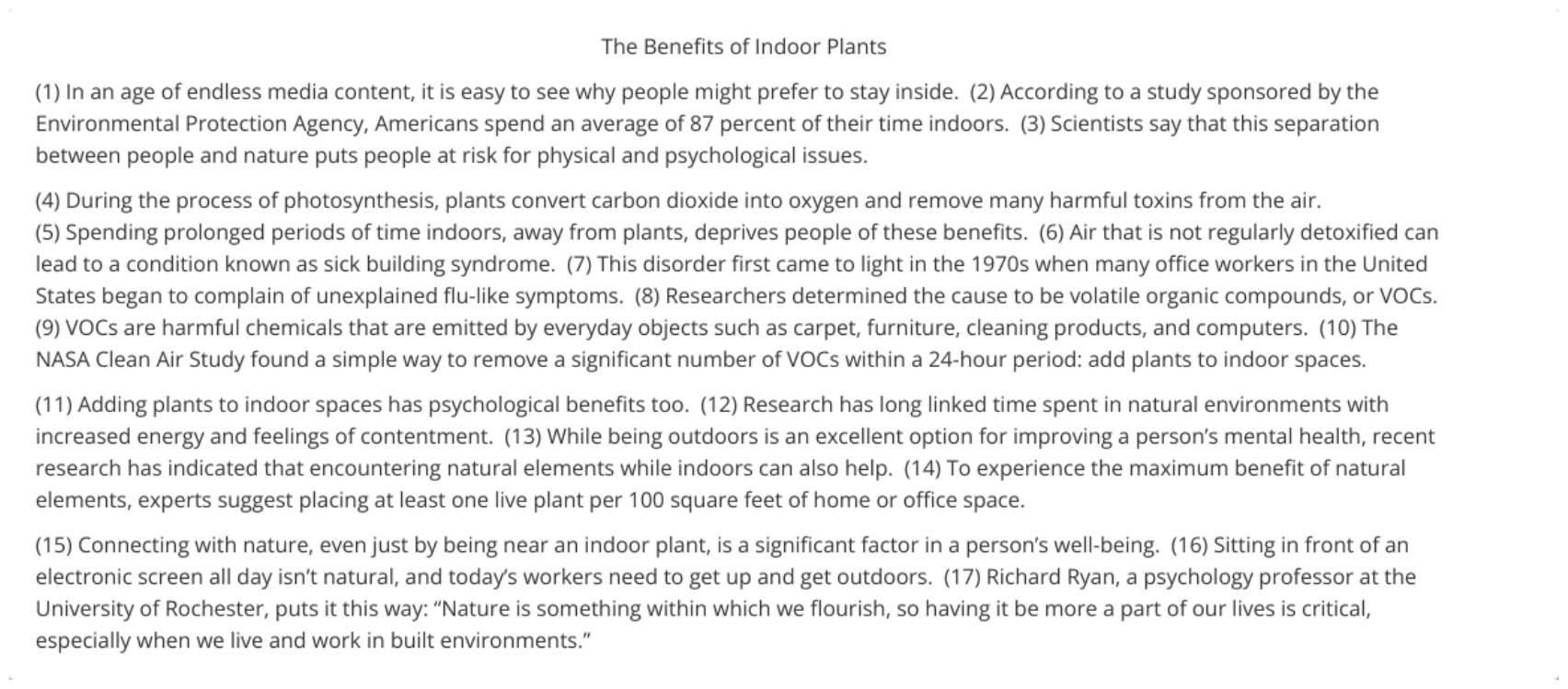
The Benefits of Indoor Plants
(1) In an age of endless media content, it is easy to see why people might prefer to stay inside. (2) According to a study sponsored by the Environmental Protection Agency, Americans spend an average of 87 percent of their time indoors. (3) Scientists say that this separation between people and nature puts people at risk for physical and psychological issues.
(4) During the process of photosynthesis, plants convert carbon dioxide into oxygen and remove many harmful toxins from the air. (5) Spending prolonged periods of time indoors, away from plants, deprives people of these benefits. (6) Air that is not regularly detoxified can lead to a condition known as sick building syndrome. (7) This disorder first came to light in the 1970s when many office workers in the United States began to complain of unexplained flu-like symptoms. (8) Researchers determined the cause to be volatile organic compounds, or VOCs. (9) VOCs are harmful chemicals that are emitted by everyday objects such as carpet, furniture, cleaning products, and computers. (10) The NASA Clean Air Study found a simple way to remove a significant number of VOCs within a 24-hour period: add plants to indoor spaces.
(11) Adding plants to indoor spaces has psychological benefits too. (12) Research has long linked time spent in natural environments with increased energy and feelings of contentment. (13) While being outdoors is an excellent option for improving a person’s mental health, recent research has indicated that encountering natural elements while indoors can also help. (14) To experience the maximum benefit of natural elements, experts suggest placing at least one live plant per 100 square feet of home or office space.
(15) Connecting with nature, even just by being near an indoor plant, is a significant factor in a person’s well-being. (16) Sitting in front of an electronic screen all day isn’t natural, and today’s workers need to get up and get outdoors. (17) Richard Ryan, a psychology professor at the University of Rochester, puts it this way: “Nature is something within which we flourish, so having it be more a part of our lives is critical, especially when we live and work in built environments.”
Question
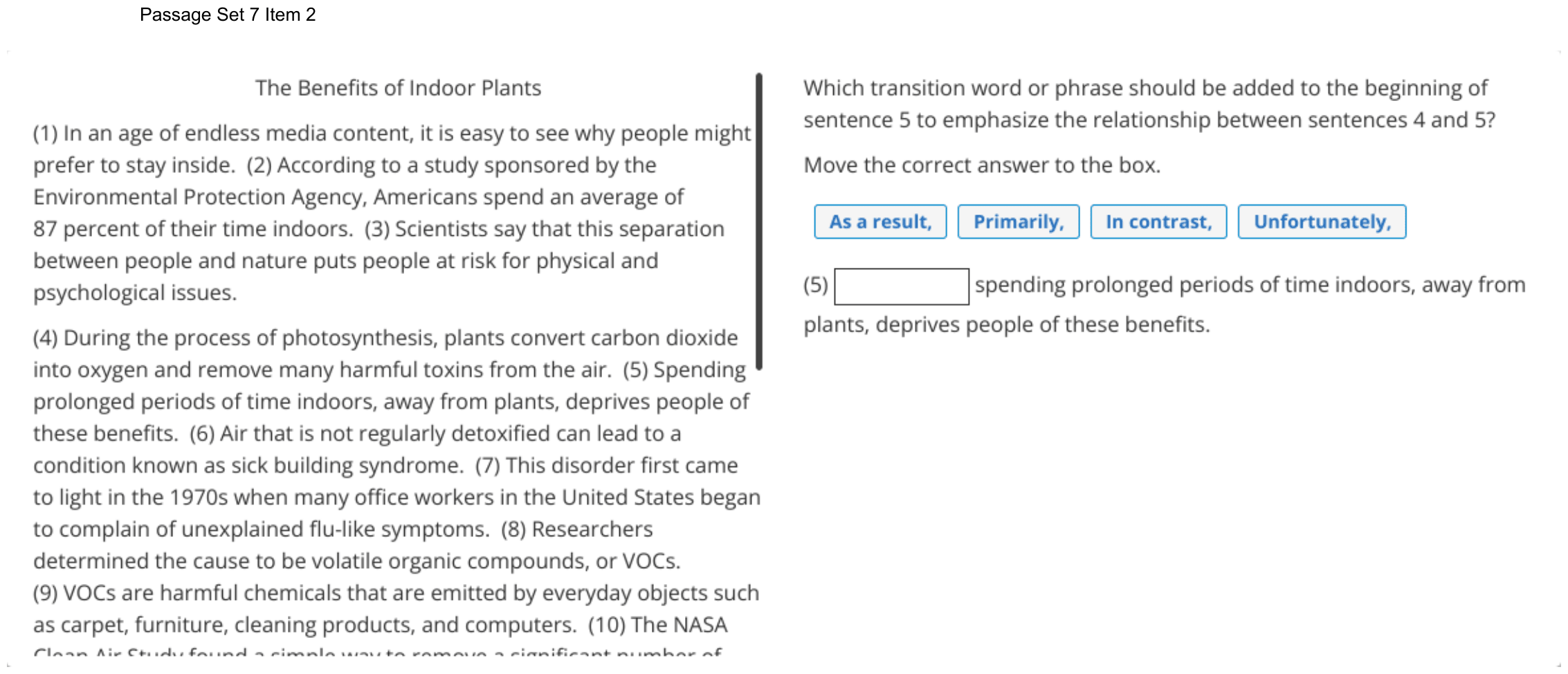
Which transition word or phrase should be added to the beginning of sentence 5 to emphasize the relationship between sentences 4 and 5?
Move the correct answer to the box.
(5) ____ spending prolonged periods of time indoors, away from plants, deprives people of these benefits.
On the test you drag one of the tiles into the box; here, choose it.
- AAs a result,
- BPrimarily,
- CIn contrast,
- DUnfortunately,
Show the answer
Correct answer: D
The question asks for the transition word or phrase that should be added to the beginning of sentence 5.
“As a result,” is incorrect and should not be added. The transition phrase “As a result” conveys a cause-and-effect relationship that does not exist between the ideas in sentence 4 and sentence 5. Although the plants’ conversion of carbon dioxide into oxygen removes harmful toxins from the air, the process of photosynthesis (sentence 4) does not deprive people of the plants’ benefits (sentence 5).
“Primarily,” is incorrect and should not be added. Although the passage describes why people should spend time nearby or in close proximity to plants, the idea in sentence 5 shifts from the benefits described in sentence 4 to what people lose without them, rather than elaborating on sentence 4. The transition word “Primarily” incorrectly suggests that the sentences describe the same idea.
“In contrast,” is incorrect and should not be added. Although sentence 4 describes a positive idea (plants are beneficial) and sentence 5 describes a negative idea (deprivation), the transition phrase “In contrast” conveys an inaccurate relationship between the ideas in the sentences. Sentence 5 is not arguing against the beneficial effect of plants and should not begin with a transition that implies opposition.
“Unfortunately,” is correct and should be added. The relationship between the ideas in the sentences is correctly conveyed with the transition word “Unfortunately,” which signals the shift from the positive effect described in sentence 4 (plants are helpful) to the emphasis in sentence 5 that the positive effect is dependent on proximity or nearness to plants.
Question analysis
In this revising question, sentence 5 of the indoor-plants passage has a blank at its start, and on the test students move one of four word tiles into the box. They must decide how sentence 5, on what long stretches indoors cost people, relates to sentence 4, on what plants do for the air, since every tile is a common transition that sounds possible.
- NYS standards
- 7W2d transitions in informative writing
- Grade level
- Grade 7 reading and task
- Compared with grade 7
- At grade 7 Choosing a transition that shows how two sentences relate is routine grade 7 writing work. The two sentences are short and the four options familiar, but more than one sounds acceptable on a first reading, so the demand is a careful but typical one.
- Estimated difficulty
- Moderate: several steps, or a close reading with one strong distractor.
- Thinking it demands
- Depth of knowledge 2, skills and concepts · mainly evaluate
- What makes it hard
- How sentences fit together moderate
- Reading between the lines minor
- Evidence
- Answered from one paragraph or stanza
- Reading level
- Passage: about grade 12, 346 words; question and choices: about grade 7, 48 words.
- Corrected from the DOE handbook
- The explanation contradicted itself about how sentences 4 and 5 relate; one sentence was corrected.
- Students, last 30 days
- Not enough answers yet to show (it takes 10).
Why it is hard, traps and wrong answers (shows the answer)
Why it is hard
Two of the tiles name relationships that seem to fit at first: sentence 5 does follow from sentence 4, and it does turn from good news to bad. Neither is exact, because spending time indoors is not caused by photosynthesis, and missing out on a benefit does not oppose it. The answer is a word of regret rather than a logical connector, which students trained on cause and contrast words may not consider first.
How sentences fit together moderate Working it out
Sentence 5's “these benefits” points back to sentence 4's cleaner air, and the link is a downside of what was just praised, people indoors missing out, which neither cause nor opposition captures. (Halliday & Hasan, 1976)
Reading between the lines minor Working it out
The right tile signals the writer's regret rather than a logical link, so students who look only for cause, contrast or emphasis must infer that a negative turn is what the sentences need. (Graesser, Singer & Trabasso, 1994; Kintsch, 1998)
Strategy: Say in your own words what sentence 4 states and what sentence 5 adds, name the link between them before looking at the tiles, then reject any tile that claims a relationship the sentences do not have.
Traps
- Wrong transition: A connecting word or phrase that signals the wrong relationship, such as contrast where the idea continues.
The wrong answers, classified
A Wrong transition (Halliday & Hasan, 1976)
Hears sentence 5 as a consequence of sentence 4, but time spent indoors is not a result of photosynthesis; the loss comes from being away from plants.
B Wrong transition (Halliday & Hasan, 1976)
Uses “Primarily” to stress sentence 5's point, but the word ranks one idea above others and expresses no relationship to sentence 4 at all.
C Wrong transition (Halliday & Hasan, 1976)
Senses the turn from plants' benefits to people missing them and calls it a contrast, but sentence 5 does not dispute sentence 4; it depends on its “these benefits.”
What was corrected from the DOE handbook, and why
- Explanation: Rejecting “Primarily,”, the handbook's explanation says sentence 5 “is actually in opposition to the idea in sentence 4”. Rejecting “In contrast,”, the same explanation says sentence 5 “is not arguing against the beneficial effect of plants and should not begin with a transition that implies opposition”, and it explains the answer as a shift from the benefits to what people lose. The first sentence now describes that shift. The answer, “Unfortunately,”, is unchanged.
Working it out, step by step
Figure out what the question asks
You need a transition to start sentence 5. A transition is a word or phrase that shows how two ideas connect. On the test, you drag one tile into the box. To choose, first work out how sentence 5 connects to sentence 4.
Read sentences 4 and 5
Sentence 4 gives good news. Photosynthesis is how plants make food from sunlight, air and water. As they do it, plants “convert carbon dioxide into oxygen and remove many harmful toxins from the air.” Toxins are poisons. Sentence 5 says that spending long stretches indoors, away from plants, “deprives people of these benefits.” To deprive means to keep someone from having something.
Name the link between them
“These benefits” points back to sentence 4. So sentence 5 doesn’t argue with sentence 4. It agrees that plants help. Then it adds bad news: people stuck indoors miss out on that help. You need a word that turns from good news to a downside.
Learn what each tile signals
- As a result, shows cause and effect: It rained hard. As a result, the game was canceled.
- Primarily, means mainly. It ranks one thing above others.
- In contrast, shows two things that are opposites: Cats like to be alone. In contrast, dogs like company.
- Unfortunately, signals bad news: The pool is great. Unfortunately, it is closed today.
Test each tile in sentence 5
- A, As a result, is wrong. Photosynthesis doesn’t cause people to stay indoors. Sentence 4 is not the cause of sentence 5.
- B, Primarily, is wrong. It shows no link to sentence 4 at all.
- C, In contrast, is wrong. Sentence 5 doesn’t oppose sentence 4. It builds on “these benefits.”
- D, Unfortunately, is right. It turns from what plants do for us to what we lose without them.
Watch out: The ideas do go from good to bad, so “In contrast” is tempting. But missing out on a benefit is not the opposite of the benefit. That is the trap in C.
Choose the answer
With the tile in place, sentence 5 reads: Unfortunately, spending prolonged periods of time indoors, away from plants, deprives people of these benefits. Prolonged means long. So the answer is D: move the tile “Unfortunately,” into the box.
Why this answer and not the closest wrong one
“In contrast,” is the closest wrong tile, since sentence 5 does turn from good news to bad. But a contrast needs two ideas that pull against each other. Sentence 5 depends on sentence 4’s “these benefits” and says people miss them. “Unfortunately,” fits that turn exactly.
More questions like this
The original DOE question
The passage “The Benefits of Indoor Plants” as printed (page 60)