Passage Excerpt from Winter Wheat
Excerpt from Winter Wheat
by Mildred Walker
Ellen, the narrator, is preparing to leave her parents and the family farm for college the next day.
The text of this excerpt is not reproduced here for copyright reasons. Read it as printed on the test under “The original DOE question” on each question’s page.
From WINTER WHEAT by Mildred Walker, published by University of Nebraska Press. Copyright © 1944 by Harcourt, Brace and Company, Inc. Copyright renewed 1971 by Mildred Walker. All rights reserved.
Question
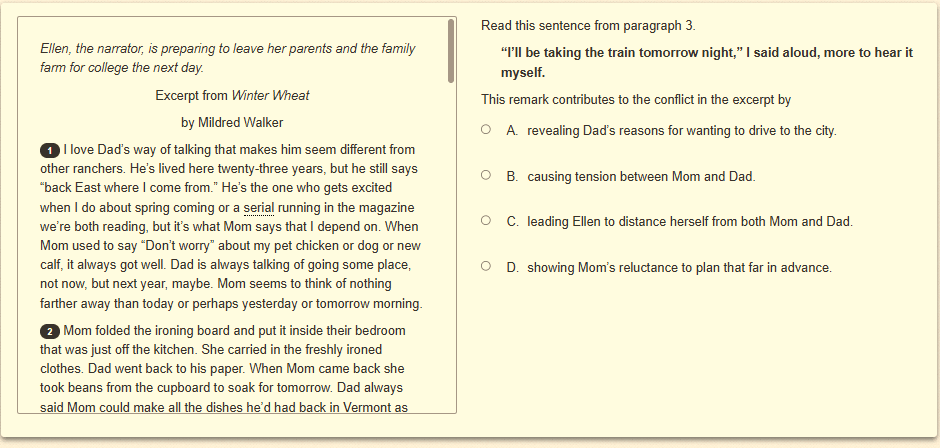
Read this sentence from paragraph 3.
“I’ll be taking the train tomorrow night,” I said aloud, more to hear it myself.
This remark contributes to the conflict in the excerpt by
- Arevealing Dad’s reasons for wanting to drive to the city.
- Bcausing tension between Mom and Dad.
- Cleading Ellen to distance herself from both Mom and Dad.
- Dshowing Mom’s reluctance to plan that far in advance.
Show the answer
Correct answer: B
The question asks how the sentence from paragraph 3 contributes to the conflict in the excerpt.
A. Incorrect. Although Ellen’s father does want to drive to the city, this sentence does not reveal his reasons for wanting to do so. Ellen’s father’s wish to drive to the city is important to the conflict of the excerpt not because of his underlying reasons but because his wish differs from Ellen’s mother’s wish to take Ellen to the train at Gotham—a difference of opinion that introduces tension between the parents.
B. CORRECT. The sentence causes Ellen’s parents to propose competing options for taking her to the train, and the resulting conversation recalls fraught memories of an earlier leave-taking in the family. The disagreement between Ellen’s mother and father over where to take Ellen to catch the train heightens the tension between them. Because the primary conflict of the excerpt is Ellen’s anxiety about the effect her leaving will have on the relationship between her parents, this remark contributes to the conflict by bringing her parents’ disagreement into view.
C. Incorrect. Although Ellen will put physical distance between herself and her parents on the following day, the remark she makes does not lead her to emotionally distance herself from her parents. Moreover, the emotional distance between Ellen and her parents is not the primary source of conflict in the excerpt.
D. Incorrect. While paragraph 1 states that Ellen’s mother “seems to think of nothing farther away than today or perhaps yesterday or tomorrow morning,” the sentence in paragraph 3 does not show any reluctance to plan far in advance. Moreover, planning for the future is not a source of conflict in the excerpt.
Question analysis
This plot question quotes Ellen’s remark in paragraph 3 of the Winter Wheat excerpt, said aloud mostly so she can hear it herself, and asks how it contributes to the excerpt’s conflict. Students must first work out what the conflict is, since the story has no fight or villain, and then follow what the remark leads to.
- Grade level
- Grade 8 reading and task
- Compared with grade 7
- At grade 7 Analyzing how a line of dialogue drives a plot matches the grade 8 wording of the standard. The remark is short and plain, though, and what it sets off plays out in the next few paragraphs, which keeps the demand typical.
- Estimated difficulty
- Moderate: several steps, or a close reading with one strong distractor.
- Thinking it demands
- Depth of knowledge 2, skills and concepts · mainly analyze
- What makes it hard
- Reading between the lines moderate
- Evidence in several places moderate
- How, not what minor
- Evidence
- Answered from several paragraphs or stanzas
- Reading level
- Passage: about grade 6, 80 words; question and choices: about grade 5, 65 words.
- Students, last 30 days
- Not enough answers yet to show (it takes 10).
Why it is hard, traps and wrong answers (shows the answer)
Why it is hard
The remark itself is plain, and neither parent raises a voice in reply, so the tension it causes is easy to miss. Students who do not see that the excerpt’s real problem is Ellen’s worry about her parents look for a more visible effect, such as Dad’s wish to drive her or Mom’s habit of thinking no farther than tomorrow. The question rewards reading the remark together with the quiet exchange it starts in paragraphs 4 to 6.
Reading between the lines moderate Working it out
The excerpt never names its conflict; students must infer from paragraph 6 and the closing paragraph that Ellen worries about her very different parents getting along once she leaves. (Graesser, Singer & Trabasso, 1994; Kintsch, 1998)
Evidence in several places moderate Working it out
The remark’s effect unfolds over the next three paragraphs: Dad offers to drive into town, Mom says the Gotham train will do, and Dad puts off the decision. (Kirsch & Mosenthal, 1990; Gorin & Embretson, 2006)
How, not what minor Working it out
The question asks what the remark does for the plot, not what it says; a plain statement of travel plans matters only for the disagreement it sets off. (Anderson & Krathwohl, 2001)
Strategy: Name the excerpt’s central problem in your own words first, then reread the remark with the paragraphs right after it and pick the choice that shows how the remark feeds that problem.
Traps
- Twists what the text says: Uses the text's topic and ideas but changes what it says: who did it, how much, when, or why.
- Wrong part of the text: A choice is true of another paragraph, stanza or speaker than the one asked about.
- Reads too much in: A reasonable-sounding conclusion that goes further than the text allows.
The wrong answers, classified
A Twists what the text says (King et al., 2004)
Sees that the remark prompts Dad’s offer to drive Ellen into town but credits it with revealing his reasons, which neither the remark nor his offer gives; Ellen guesses one later.
C Reads too much in (Graesser, Singer & Trabasso, 1994)
Turns Ellen’s coming departure into an emotional withdrawal, though after speaking she grows no more distant; she worries about her parents and, in the flashback, clings to Mom.
D Wrong part of the text (Kirsch & Mosenthal, 1990)
Recalls paragraph 1’s comment that Mom thinks no farther ahead than tomorrow morning, but the remark shows nothing of the kind: Mom answers it at once with a plan of her own.
Working it out, step by step
Figure out what the question asks
This asks how Ellen’s remark adds to the conflict, the main problem in the story. The remark itself is plain. It just says when she will leave. So look at what happens right after she says it.
Name the story’s conflict
In paragraph 6, Ellen says her going away was hard on both parents. They were very different, and she was part of them both. In paragraph 25, she says she feels a distance between them. She wonders how they will get along without her. So the conflict is Ellen’s worry about her two very different parents once she is gone.
See what the remark sets off
Right after Ellen speaks, her parents disagree. In paragraph 4, Dad offers to drive her into town. In paragraph 5, Mom says there is no need, because Ellen can catch the train at Gotham. In paragraph 6, Dad puts off the choice, though Ellen knows he wants to go to town. Neither parent shouts, but they want different things.
Connect the remark to the conflict
Ellen’s simple remark brings her parents’ differences into the open. Their quiet disagreement shows the tension between them. Tension is a tight, uneasy feeling between people. That tension is just what worries Ellen about leaving. So the remark feeds the conflict by causing tension between Mom and Dad.
Check each choice
- A does not fit. Dad offers to drive, but no one explains why he wants to.
- B fits. The remark leads straight to the parents’ disagreement.
- C does not fit. Ellen doesn’t pull away from her parents. She worries about them.
- D does not fit. Paragraph 1 says Mom doesn’t think far ahead. But here Mom answers at once with a plan of her own.
Watch out: D borrows a detail from paragraph 1. The remark itself shows nothing of the kind.
Choose the answer
The remark starts a quiet disagreement about how Ellen will leave. So the answer is B.
Why this answer and not the closest wrong one
A is the closest wrong choice, because the remark does lead to Dad’s offer to drive. But Dad never gives his reasons. What matters is that Mom wants something else. Their different wishes show the tension between them, and that tension is what Ellen worries about. That is B.
More questions like this
The original DOE question
The passage “Excerpt from Winter Wheat” as shown on the test