Also in 2025 Practice Test A Math, question 19.
Question
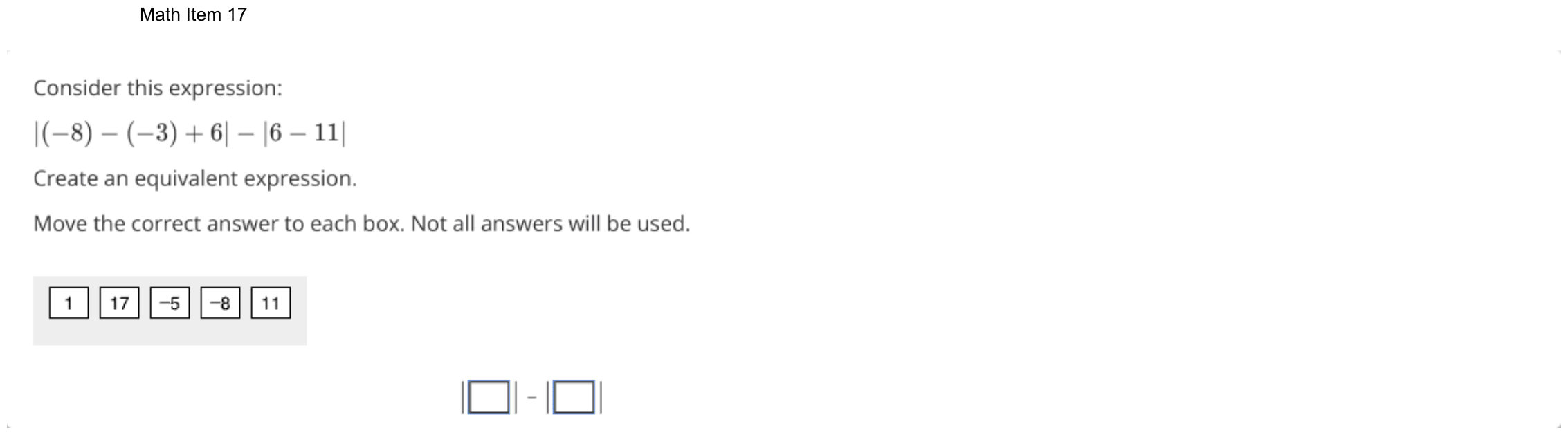
Consider this expression:
Create an equivalent expression.
Move the correct answer to each box. Not all answers will be used.
|| − ||
On the test you drag tiles into the boxes; here, choose each box’s tile from its menu. Each tile can be used once. The DOE has not published how answers with several parts are scored; this site counts one right only when every part is right.
Show the answer
Correct answer: blank 1: 1; blank 2: −5
To create an expression equivalent to :
Step 1: Simplify the first absolute value term.
Simplify the second absolute value term.
Therefore the equivalent expression is
.
Question analysis
This absolute value question shows an expression with two pairs of bars and asks students to build an equivalent one by placing number tiles in two boxes. It tests subtracting negative integers and understanding what absolute value bars do. Not every tile is used, and several tiles match the results of common sign mistakes.
- Grade level
- Grade 7 content, by NYS standard
- Compared with grade 7
- At grade 7 Simplifying signed integers inside absolute value bars, including subtracting a negative, is core grade 7 work. This asks only for the values inside the bars, not the final number, but one sign slip leads straight to a wrong tile.
- Estimated difficulty
- Straightforward: two steps or one careful reading.
- Thinking it demands
- Depth of knowledge 1, recall and reproduction · mainly apply
- What makes it hard
- Error-prone arithmetic moderate
- Many steps minor
- An answer in an unexpected form minor
- Solution
- 3 steps
- Reading level
- Question and choices: about grade 6, 21 words.
- Students, last 30 days
- Not enough answers yet to show (it takes 10).
Why it is hard, traps and wrong answers (shows the answer)
Why it is hard
Every move here involves a sign, and the tiles are built from the usual misreadings of absolute value: 11 for making each number positive before combining, 17 for erasing every minus sign. A slip on − (−3) gives −5 for the first pair, but the second pair needs the only −5 tile, so that slip leaves a box with no tile to fit. Students who simplify each inside completely, and leave the bars untouched, finish quickly.
Error-prone arithmetic moderate Working it out
Inside the first bars, subtracting −3 must become adding 3, so −8 + 3 = −5, and adding 6 then crosses zero to reach 1; reading − (−3) as − 3 gives −5 instead. (Brown & Burton, 1978; Junker & Sijtsma, 2001)
Many steps minor Working it out
Two pairs of bars are simplified separately, and both boxes need the right tile, kept in the original order, before the answer is right. (Daniel & Embretson, 2010; Enright, Morley & Sheehan, 2002)
An answer in an unexpected form minor Choosing the answer
Each box takes what is left inside a pair of bars, not its absolute value, so the second box needs the tile −5 rather than a 5, and the expression's value, −4, is never entered. (Enright, Morley & Sheehan, 2002)
Strategy: Rewrite subtracting −3 as adding 3, then simplify the inside of each pair of bars separately, left to right; each box replaces the inside of one pair, in the same order.
Traps
- A faulty procedure: A systematic but wrong procedure: adding fractions straight across, applying an exponent to each term of a sum, dropping a sign when moving a term.
- Misunderstands the concept: A wrong belief about a concept: that percents can be added, that area grows like length, that averages can be averaged, that a bigger denominator means a bigger fraction.
- Negatives and direction: Arithmetic with negative numbers, the order of a subtraction, or direction on a number line. (Moving a term across the equals sign without changing its sign is a faulty procedure.)
The wrong answers, classified
EC A faulty procedure (Brown & Burton, 1978; Tatsuoka, 1983)
Takes the absolute value of each number before combining, so the first bars become 8 − 3 + 6 = 11; the same rule still gives 6 − 11 = −5 in the second.
BC Misunderstands the concept (Smith, diSessa & Roschelle, 1993; De Bock et al., 1998; Ni & Zhou, 2005)
Believes absolute value bars make everything inside positive, so it drops every minus sign and adds 8 + 3 + 6 = 17, then works the short pair 6 − 11 normally.
CA Negatives and direction (Brown & Burton, 1978)
Simplifies both insides correctly but places −5 first and 1 second, reversing the subtraction so the expression equals 5 − 1 = 4 instead of 1 − 5 = −4.
Worked solution, step by step
Formulas used
- Subtracting a negative number
- a is any number, and b is a positive number, so −b is negative. Subtracting a negative number is the same as adding its opposite, the same number with the other sign. Think of money: taking away a debt of $3 leaves you $3 richer.
- Absolute value
- The bars around a number stand for its absolute value. a is any number. The absolute value is how far a is from 0 on a number line, so it is never negative. Both |5| and |−5| equal 5. Always simplify inside the bars first.
Sort out the question
The expression has two pairs of absolute value bars. The new expression keeps both pairs, with a box inside each one:
Each box gets the number you reach when you simplify inside that pair of bars. The bars stay, so you do not take the absolute value yet. Some tiles are not used.
Simplify inside the first bars
Inside the first bars is . Subtracting −3 is the same as adding 3. Work from left to right:
The first box gets the tile 1.
Watch out: the bars do not make each number positive before you combine. Changing −8 and −3 to 8 and 3 first gives 8 − 3 + 6 = 11. Dropping every minus sign gives 8 + 3 + 6 = 17. Both are tiles, and both are wrong.
Simplify inside the second bars
Inside the second bars is . You take a bigger number from a smaller one, so the result is negative:
The second box gets the tile −5.
Watch out: do not change −5 to 5. The bars are still there in the new expression, so the box holds what is inside them.
Keep the boxes in order
The first bars came first, so 1 goes in the first box and −5 in the second. The new expression has the same value as the old one:
Swapping the tiles gives , which is not equal. So the boxes get 1 and −5, making |1| − |−5|.
On the test, you drag each tile into its box. On this site, you choose it from the box’s menu.
Check your answer
Use a number line for the first pair. Start at −8 and move 3 to the right to reach −5. Then move 6 more to the right to reach 1. For the second pair, start at 6 and move 11 to the left. You land on −5. Both boxes check out.
More questions like this
The original DOE question