Much to keep track of
Question 1 of 75
2026 Practice Test A English, question 7Passage Snowy Mountains
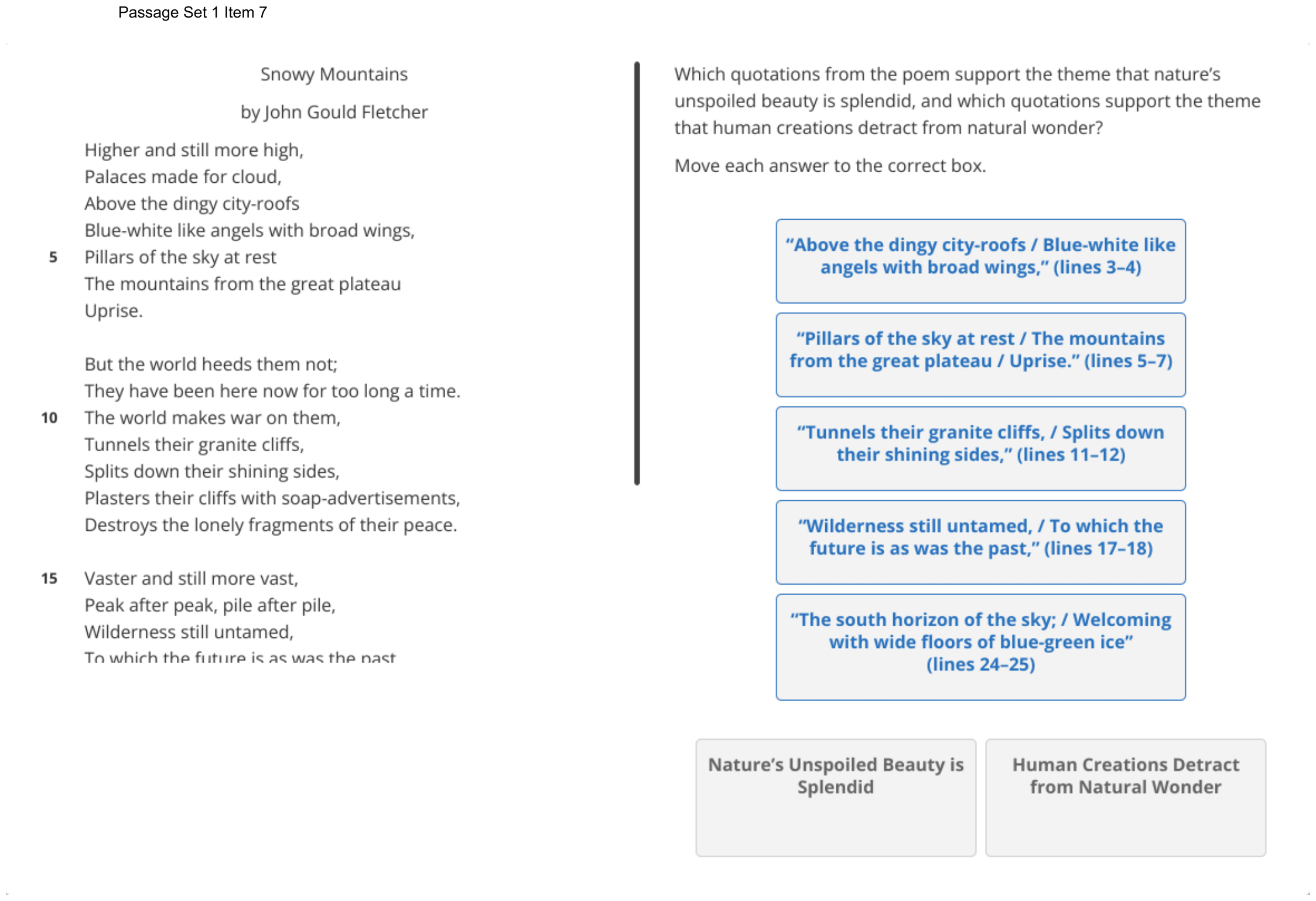
Snowy Mountains
by John Gould Fletcher
Higher and still more high,
Palaces made for cloud,
Above the dingy city-roofs
Blue-white like angels with broad wings,
Pillars of the sky at rest
The mountains from the great plateau
Uprise.
But the world heeds them not;
They have been here now for too long a time.
The world makes war on them,
Tunnels their granite cliffs,
Splits down their shining sides,
Plasters their cliffs with soap-advertisements,
Destroys the lonely fragments of their peace.
Vaster and still more vast,
Peak after peak, pile after pile,
Wilderness still untamed,
To which the future is as was the past,
Barrier spread by Gods,
Sunning their shining foreheads,
Barrier broken down by those who do not need
The joy of time-resisting storm-worn stone,
The mountains swing along
The south horizon of the sky;
Welcoming with wide floors of blue-green ice
The mists that dance and drive before the sun.
“Snowy Mountains” by John Gould Fletcher—Public Domain
Question
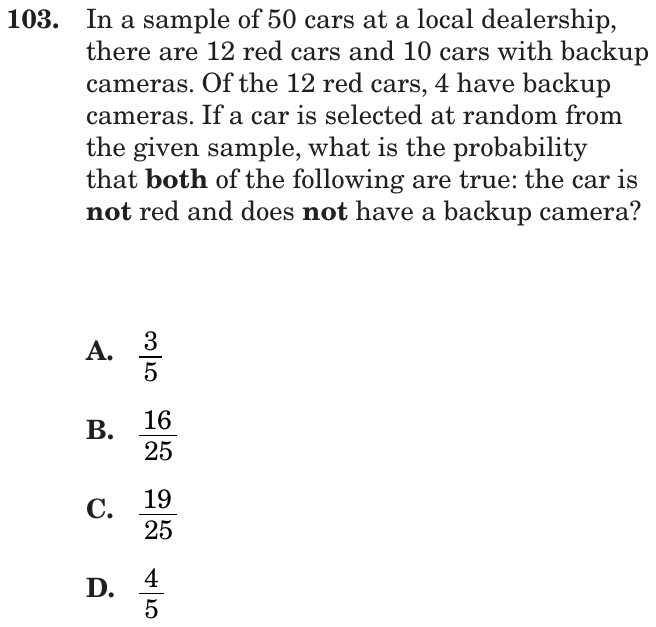
Which quotations from the poem support the theme that nature’s unspoiled beauty is splendid, and which quotations support the theme that human creations detract from natural wonder?
Move each answer to the correct box.
Choose one answer in each row, then check. The DOE has not published how answers with several parts are scored; this site counts one right only when every part is right.
| Nature’s Unspoiled Beauty is Splendid | Human Creations Detract from Natural Wonder | |
|---|---|---|
| “Above the dingy city-roofs / Blue-white like angels with broad wings,” (lines 3–4) | ||
| “Pillars of the sky at rest / The mountains from the great plateau / Uprise.” (lines 5–7) | ||
| “Tunnels their granite cliffs, / Splits down their shining sides,” (lines 11–12) | ||
| “Wilderness still untamed, / To which the future is as was the past,” (lines 17–18) | ||
| “The south horizon of the sky; / Welcoming with wide floors of blue-green ice” (lines 24–25) |
Show the answer
Correct answer: “Above the dingy city-roofs / Blue-white like angels with broad wings,” (lines 3–4): Human Creations Detract from Natural Wonder; “Pillars of the sky at rest / The mountains from the great plateau / Uprise.” (lines 5–7): Nature’s Unspoiled Beauty is Splendid; “Tunnels their granite cliffs, / Splits down their shining sides,” (lines 11–12): Human Creations Detract from Natural Wonder; “Wilderness still untamed, / To which the future is as was the past,” (lines 17–18): Nature’s Unspoiled Beauty is Splendid; “The south horizon of the sky; / Welcoming with wide floors of blue-green ice” (lines 24–25): Nature’s Unspoiled Beauty is Splendid
The question identifies two themes and asks which quotations from the poem support each theme. Each quotation should be moved to one of the two boxes: “Nature’s Unspoiled Beauty is Splendid” or “Human Creations Detract from Natural Wonder.”
“Above the dingy city-roofs / Blue-white like angels with broad wings,” (lines 3–4)
This quotation supports the theme that human creations detract from natural wonder. The lines describe the city-roofs as “dingy,” suggesting that they mar the lovely background of the blue-white mountains, which are compared to angels, a simile that vividly conveys the wonder of nature. The description in the lines primarily serves to create a contrast between the city’s unsightly appearance and the beauty of the mountains, thereby providing support for the theme that human creations (i.e. the city) detract from natural wonder.
“Pillars of the sky at rest / The mountains from the great plateau / Uprise.” (lines 5–7)
This quotation supports the theme that nature’s unspoiled beauty is splendid. By describing the mountains as “pillars of the sky” that “uprise” dramatically from a large plateau, the lines primarily convey a sense of the mountains’ dramatic and impressive size. The description suggests that the mountains are holding up the sky, a powerful image of an unspoiled, natural landscape.
“Tunnels their granite cliffs, / Splits down their shining sides,” (lines 11–12)
The quotation supports the theme that human creations detract from natural wonder. The words “tunnels” and “splits” emphasize that human intervention in nature is destructive, breaking apart the “shining sides” of the mountain. These lines suggest that human creations—such as building a tunnel through a mountain—detract from natural wonder, diminishing its beauty and serenity.
“Wilderness still untamed, / To which the future is as was the past,” (lines 17–18)
The quotation supports the theme that nature’s unspoiled beauty is splendid by indicating that the natural mountainous landscape is both splendid and unspoiled (“wilderness still untamed”). The phrase “to which the future is as was the past” suggests that nature in its unspoiled state is timeless or eternal, further supporting the theme.
“The south horizon of the sky; / Welcoming with wide floors of blue-green ice” (lines 24–25)
The quotation supports the theme that nature’s unspoiled beauty is splendid. The reference to the “wide floors of blue-green ice” emphasizes that the landscape is beautiful, and the description in the lines conveys the grandiose splendor of nature, conveying an image of the “south horizon of the sky” majestically “welcoming” one’s eye, inviting appreciation of its unspoiled beauty.
Question analysis
This sorting question on the poem “Snowy Mountains” gives two themes, the splendor of unspoiled nature and the way human creations detract from natural wonder, and asks students to place five quotations under them. The quotations come from all three stanzas. Students make five separate judgments, and a line’s most vivid image is not always the best guide to where it belongs.
- Grade level
- Grade 7 reading and task
- Compared with grade 7
- At grade 7 Matching quotations to a stated theme is routine grade 7 evidence work, and both themes are given. The added demand is volume: five separate judgments on lines from all three stanzas of old-fashioned verse, each of which must land in the right box.
- Estimated difficulty
- Moderate: several steps, or a close reading with one strong distractor.
- Thinking it demands
- Depth of knowledge 2, skills and concepts · mainly analyze
- What makes it hard
- Much to keep track of moderate
- Reading between the lines moderate
- Figurative or literary language minor
- Evidence
- Answered from several paragraphs or stanzas
- Reading level
- Passage: 161 words (a poem; reading level not measured); question and choices: about grade 9, 34 words.
- Students, last 30 days
- Not enough answers yet to show (it takes 10).
Why it is hard, traps and wrong answers (shows the answer)
Why it is hard
Most tiles sort quickly once a student asks whether people appear in the lines. The first tile is the hard one: its angel simile is pure splendor, yet the “dingy city-roofs” beneath it set the city against the peaks, and only that contrast fits the second theme. The tunneling lines hide their human actor outside the tile. With five placements that must all be right, one hasty tile loses the question.
Much to keep track of moderate Working it out
Five tiles from all three stanzas go into two boxes and every placement must be right, so a student holds both themes in mind while judging each quotation on its own. (Sweller, 1988; Carpenter, Just & Shell, 1990)
Reading between the lines moderate Working it out
Two tiles name no person: in lines 3–4 the human presence is only the “dingy city-roofs,” and in lines 11–12 the subject, “The world,” sits back in line 10, outside the tile. (Graesser, Singer & Trabasso, 1994; Kintsch, 1998)
Figurative or literary language minor Understanding the question
The splendor is carried by images rather than statements, the mountains as “angels,” “Pillars of the sky” and “wide floors of blue-green ice,” which students must read as praise of untouched nature. (Graesser, Singer & Trabasso, 1994; Kintsch, 1998)
Strategy: Read each quotation to the end and ask whether it shows something people have made or done; then sort it by what the lines as a whole are about, not by one word.
Traps
- Supports only part of the claim: In a question about evidence: a line that backs one half of the claim but not the other, or a related point rather than the claim itself.
- Taking figurative language literally: A choice reads a figure of speech or image at face value.
- Word match: Repeats striking words or phrases from the text, so it looks supported, but its meaning does not fit the question.
The wrong answers, classified
1:A Supports only part of the claim (King et al., 2004; Thissen, Steinberg & Fitzpatrick, 1989)
Files the lines under splendor for the angel simile, which shows beauty but not beauty unspoiled; the “dingy city-roofs” put a human creation right beneath it.
2:B Taking figurative language literally (Graesser, Singer & Trabasso, 1994)
Takes “Pillars” as something people build, a human structure, when the metaphor makes the mountains themselves the columns that hold up the sky.
3:A Word match (Freedle & Kostin, 1993)
Is drawn by “granite cliffs” and “shining sides,” words of admiration, and misses that “Tunnels” and “Splits” are what “The world” of line 10 does to the mountains.
4:B Reads too much in (Graesser, Singer & Trabasso, 1994)
Reads “still untamed” as a sign that people are trying to tame the land, though the lines praise a wilderness that people have not changed and that time leaves as it was.
5:B Wrong part of the text (Kirsch & Mosenthal, 1990)
Remembers that the last stanza blames those who broke down the “Barrier” in lines 21–22 and carries that charge to lines 24–25, which only picture ice and sky.
Working it out, step by step
Figure out what the question asks
This is a sorting question. You get two themes. A theme is a big idea a poem keeps coming back to. The first theme says nature that people have not spoiled is splendid, which means grand and beautiful. The second says things people make detract from nature, which means they take away from its wonder. For each quotation, ask: does it show something people made or did?
Sort the lines about the city
Lines 3 and 4 say “Above the dingy city-roofs / Blue-white like angels with broad wings.” The angel picture is beautiful. But right under the mountains are “dingy city-roofs.” Dingy means dirty and dull. City roofs are something people built. The lines set the dirty city against the shining mountains. So this quotation shows a human creation taking away from nature’s wonder.
Sort the lines about the pillars
Lines 5 to 7 say “Pillars of the sky at rest / The mountains from the great plateau / Uprise.” Pillars are tall posts that hold something up. A plateau is a high, flat stretch of land. The mountains rise up like giant posts holding up the sky. No people appear here. This quotation shows how splendid untouched nature is.
Sort the lines about tunnels
Lines 11 and 12 say “Tunnels their granite cliffs, / Splits down their shining sides.” These lines do not say who does this. Look back at line 10: “The world makes war on them.” So “the world,” meaning people, cuts tunnels and splits the mountains. The cliffs shine, but people are breaking them. This quotation shows human creations hurting nature.
Sort the last two quotations
Lines 17 and 18 say “Wilderness still untamed, / To which the future is as was the past.” Untamed means not controlled or changed by people. The second line means the mountains will stay as they always were. Lines 24 and 25 say “The south horizon of the sky; / Welcoming with wide floors of blue-green ice.” That is a picture of sky and ice, with no people in it. Both praise unspoiled nature.
Place each quotation in its box
- Lines 3–4 (the city roofs): Human Creations Detract from Natural Wonder
- Lines 5–7 (the pillars): Nature’s Unspoiled Beauty is Splendid
- Lines 11–12 (the tunnels): Human Creations Detract from Natural Wonder
- Lines 17–18 (the wilderness): Nature’s Unspoiled Beauty is Splendid
- Lines 24–25 (the ice): Nature’s Unspoiled Beauty is Splendid
Drag each tile into its box. All five must be right to get the point.
Why this answer and not the closest wrong one
Lines 3 and 4 are the hardest tile. The angel image alone would fit the first box. But that box is about beauty that is unspoiled. These lines put the dingy city right under the shining peaks. The dirty roofs spoil the view, so the tile belongs in the second box.
More questions like this
The original DOE question
The passage “Snowy Mountains” as printed (page 142)
Question 2 of 75
2026 Practice Test A English, question 13Passage The Best Laid Plans of Ravens
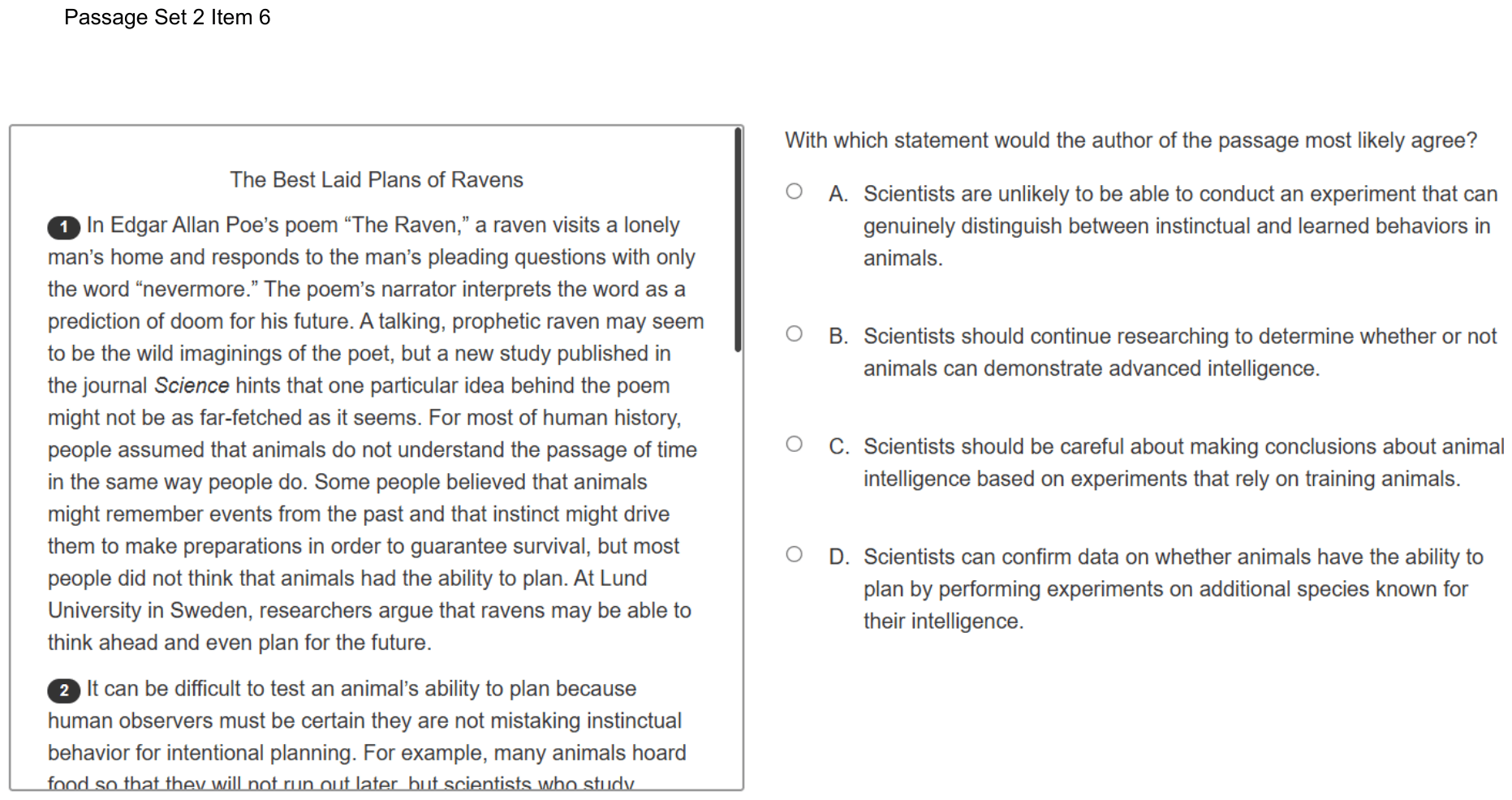
The Best Laid Plans of Ravens
In Edgar Allan Poe’s poem “The Raven,” a raven visits a lonely man’s home and responds to the man’s pleading questions with only the word “nevermore.” The poem’s narrator interprets the word as a prediction of doom for his future. A talking, prophetic raven may seem to be the wild imaginings of the poet, but a new study published in the journal Science hints that one particular idea behind the poem might not be as far-fetched as it seems. For most of human history, people assumed that animals do not understand the passage of time in the same way people do. Some people believed that animals might remember events from the past and that instinct might drive them to make preparations in order to guarantee survival, but most people did not think that animals had the ability to plan. At Lund University in Sweden, researchers argue that ravens may be able to think ahead and even plan for the future.
It can be difficult to test an animal’s ability to plan because human observers must be certain they are not mistaking instinctual behavior for intentional planning. For example, many animals hoard food so that they will not run out later, but scientists who study animals would not call hoarding a decision to plan for the future. This action is merely instinctual. Cognitive scientists argue that in order for an animal’s behavior to qualify as preparing for the future, the animal must use specific decision-making skills to solve a problem.
To avoid mistaking instinctual behavior for evidence of decision-making, the Lund University researchers designed two experiments to test ravens’ ability to plan. Ravens belong to the corvid family, a group of birds known for their intelligence. A study in 2007 showed that corvids have the tendency to save only certain types of food, which suggests that they are planning for the future rather than acting on instinct. In order to investigate that theory, the researchers had to design experiments that would achieve results that could not be explained by an instinctual behavior of food hoarding. Therefore, the ravens were taught two behaviors that they do not normally perform in the wild.
For the first experiment, the researchers showed the birds how to use a small stone to open a box and get treats. Once the ravens learned the behavior, the researchers presented the birds with four stones. Only one stone was the right size to open the box. The birds learned to select that stone and set it aside until the researchers presented the box. The second experiment involved bartering. A researcher would trade the ravens a large treat for a bottle cap. Later, the researchers presented the ravens with a group of items, including small treats and the bottle cap. The ravens chose the bottle cap over the treats and waited for the original researcher to trade with them again so that they could get more treats. In both experiments, the ravens waited patiently for up to seventeen hours for the researcher to return.
The results of these experiments are exciting, but more evidence needs to be gathered before scientists can fully conclude that ravens can plan for the future. Some scientists argue that the ravens might be choosing the stone and bottle cap because the ravens have been trained to do so, not necessarily because the ravens are thinking ahead. Regardless, like other recent advances in animal science, these experiments show that ravens could be much smarter than first believed, and scientists now believe that ravens do actually think about their own future.
Question
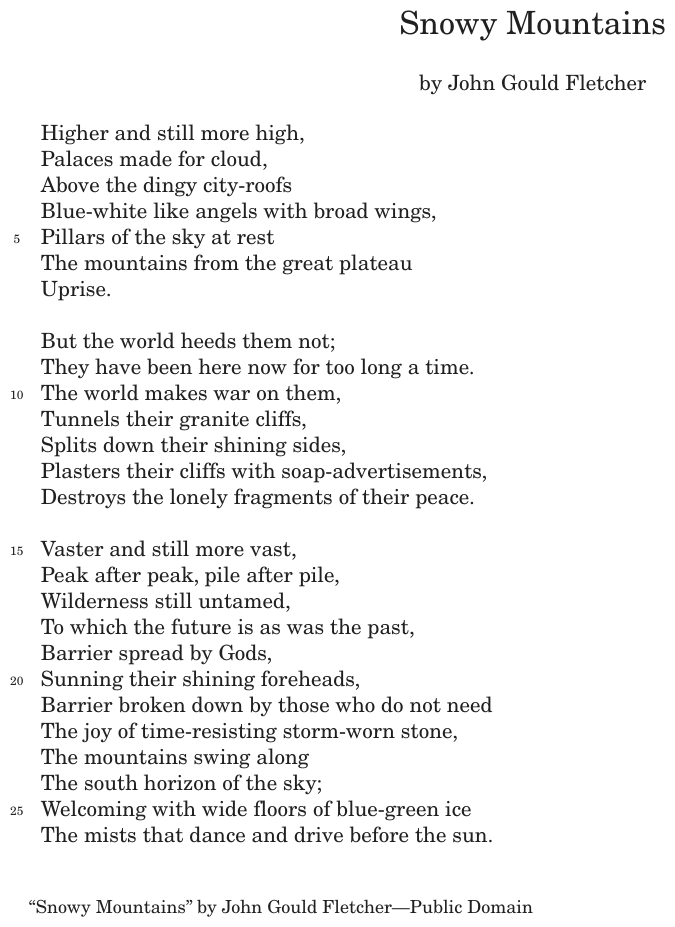
With which statement would the author of the passage most likely agree?
- AScientists are unlikely to be able to conduct an experiment that can genuinely distinguish between instinctual and learned behaviors in animals.
- BScientists should continue researching to determine whether or not animals can demonstrate advanced intelligence.
- CScientists should be careful about making conclusions about animal intelligence based on experiments that rely on training animals.
- DScientists can confirm data on whether animals have the ability to plan by performing experiments on additional species known for their intelligence.
Show the answer
Correct answer: B
The question asks the reader to choose the statement with which the author of the passage would most likely agree.
A. Incorrect. It is very likely that additional experiments or changes to the experiments presented can help scientists tell the difference between the types of behavior that the animals are showing. The current research supports “other recent advances in animal science” and also shows that ravens are “much smarter” (paragraph 5) than previously believed, making them excellent candidates for further research.
B. CORRECT. As paragraph 5 notes, “more evidence needs to be gathered before scientists can fully conclude that ravens can plan for the future.” The evidence is not yet considered definitive because “some scientists argue that the ravens might be choosing the stone and bottle cap because the ravens have been trained to do so, not necessarily because the ravens are thinking ahead” (paragraph 5). Therefore, more research is needed in order to draw a complete conclusion as to whether or not the animals are demonstrating advanced intelligence or simply the results of training.
C. Incorrect. The passage shows that the scientists did not draw conclusions based on one experiment alone. The passage also states in paragraph 5 that additional research and experiments are necessary in order to obtain conclusive evidence of ravens’ abilities to think and plan ahead.
D. Incorrect. The passage claims that more evidence must be gathered in order to make a claim that animals can definitely plan for the future. The evidence presented helps scientists “believe that ravens do actually think about their own future” (paragraph 5), but more confirmation is needed. The passage does not discuss performing experiments on additional species.
Question analysis
This inference question asks which statement the author of “The Best Laid Plans of Ravens” would most likely agree with. Students must work out the author’s own view of the raven experiments and of research into animal thinking. The article reports more than one viewpoint, so students have to keep track of which ideas belong to the author.
- Grade level
- Grade 7 reading and task
- Compared with grade 7
- At grade 7 Inferring which statement an author would accept is common grade 7 work. The author’s view is stated fairly plainly in the last paragraph, but that paragraph also reports what other scientists argue, so students must separate the author’s position from theirs.
- Estimated difficulty
- Moderate: several steps, or a close reading with one strong distractor.
- Thinking it demands
- Depth of knowledge 3, strategic thinking · mainly analyze
- What makes it hard
- Reading between the lines moderate
- A very close wrong answer moderate
- Much to keep track of minor
- Evidence
- Answered from one paragraph or stanza
- Reading level
- Passage: about grade 11, 599 words; question and choices: about grade 15, 87 words.
- Students, last 30 days
- Not enough answers yet to show (it takes 10).
Why it is hard, traps and wrong answers (shows the answer)
Why it is hard
The passage reports several opinions, and the hard part is telling which one is the author’s. Students who notice the training objection in paragraph 5 often adopt it as the author’s warning, but “Regardless” shows the author weighing it and moving on to a hopeful view that still calls for more evidence. The other wrong choices either turn “difficult” into “unlikely” or bring in research the article never mentions.
Reading between the lines moderate Working it out
The author’s view is never stated as advice; it has to be read from paragraph 5, where “more evidence needs to be gathered” is followed by “Regardless” and a hopeful conclusion. (Graesser, Singer & Trabasso, 1994; Kintsch, 1998)
A very close wrong answer moderate Choosing the answer
The choice about caution with experiments that train animals shares the right one’s careful stance and differs in one detail, training, the objection the author raises only to set aside. (Embretson & Wetzel, 1987; Gorin & Embretson, 2006; Ascalon et al., 2007)
Much to keep track of minor Working it out
The article mixes four voices, what people long assumed, the Lund researchers, “some scientists” who doubt them and the author, and each statement must be traced to the right one. (Sweller, 1988; Carpenter, Just & Shell, 1990)
Strategy: Find the sentences where the author speaks in their own voice, especially in paragraph 5, and pick the statement that follows from them without adding claims the article never makes.
Traps
- Wrong tone or attitude: Misjudges the tone, attitude or point of view, such as reading admiration as criticism, or taking a character's or subject's feelings for the author's.
- Too broad or too strong: A choice overstates, generalizes, or uses absolute words the text does not support.
- Outside knowledge: A choice is plausible in the real world but not supported by this text.
The wrong answers, classified
A Too broad or too strong (King et al., 2004)
Builds on paragraph 2’s point that planning is “difficult” to test and hardens it into “unlikely,” a pessimism the author, who finds the results “exciting,” never expresses.
C Wrong tone or attitude (Graesser, Singer & Trabasso, 1994)
Takes the objection that the ravens may only have been trained, which “some scientists” raise, as the author’s own view, though the author answers it with “Regardless.”
D Outside knowledge (King et al., 2004; Recht & Leslie, 1988)
Offers a sensible research idea, testing other clever species, that the article never suggests; the author’s call for more evidence concerns ravens alone.
Working it out, step by step
Figure out what the question asks
This asks which statement the author would most likely agree with. You must find the author’s own view. The article also reports what other people think, so keep those ideas apart.
Sort out the voices in paragraph 5
Paragraph 5 says “Some scientists argue that the ravens might be choosing the stone and bottle cap because the ravens have been trained to do so.” That is what other scientists think. The author’s own words are “The results of these experiments are exciting, but more evidence needs to be gathered.”
Put the author’s view in plain words
The author thinks the research is promising but not finished. After the doubt, the author says “Regardless,” which means “even so,” and stays hopeful. So the author wants scientists to keep studying until they can be sure.
Check each choice
- A does not fit. The author never says a good test is unlikely. The author finds the results exciting.
- B fits. The author says more evidence must be gathered.
- C does not fit. The worry about training belongs to “some scientists.” The author sets it aside with “Regardless.”
- D does not fit. The article never mentions testing other kinds of animals.
Watch out: C sounds careful, like a scientist. But it repeats the other scientists’ view, not the author’s.
Choose the answer
The author wants scientists to keep gathering evidence before anyone decides. So the answer is B.
Why this answer and not the closest wrong one
C is the closest wrong choice. It sounds careful, and the author is careful too. But the warning about training comes from “some scientists.” The author answers it with “Regardless” and stays hopeful. The author’s own point is that “more evidence needs to be gathered.” That matches B.
More questions like this
The original DOE question
The passage “The Best Laid Plans of Ravens” as printed (page 12)
Question 3 of 75
2026 Practice Test A Math, question 8Question
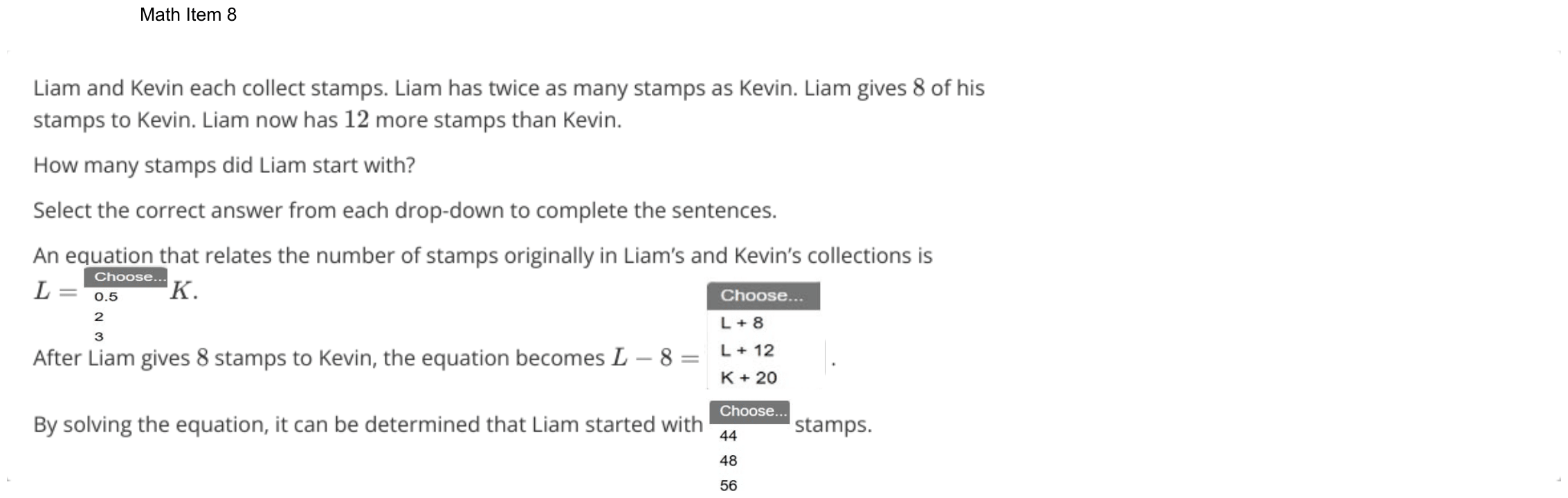
Liam and Kevin each collect stamps. Liam has twice as many stamps as Kevin. Liam gives 8 of his stamps to Kevin. Liam now has 12 more stamps than Kevin.
How many stamps did Liam start with?
Select the correct answer from each drop-down to complete the sentences.
An equation that relates the number of stamps originally in Liam’s and Kevin’s collections is .
After Liam gives 8 stamps to Kevin, the equation becomes .
By solving the equation, it can be determined that Liam started with stamps.
Choose an answer from each menu, then check. The DOE has not published how answers with several parts are scored; this site counts one right only when every part is right.
Show the answer
Correct answer: blank 1: 2; blank 2: K + 20; blank 3: 56
Liam originally has twice as many stamps as Kevin, so the equation is .
After Liam gives 8 stamps to Kevin, the equation becomes , which simplifies to .
Substitute into the equation: .
Solve for K:
Substitute to find L: .
So, Liam started with 56 stamps.
Question analysis
This word problem about two stamp collections is answered with three drop-down menus: an equation for the starting counts, an equation for after Liam gives Kevin 8 stamps, and the number Liam started with. Students turn "twice as many" and "12 more" into algebra and solve. Tracking both boys' counts before and after the gift is the tricky part, and every menu must be right.
- Grade level
- Grade 8 content, by NYS standard
- Compared with grade 7
- Above grade 7 Grade 7 students solve one equation in one unknown. The menus lay out the equations, but the problem still ties two unknowns together before and after a gift, a grade 8 system, and all three menus must be right.
- Estimated difficulty
- Moderate: several steps, or a close reading with one strong distractor.
- Thinking it demands
- Depth of knowledge 2, skills and concepts · mainly apply
- What makes it hard
- Turning words into math moderate
- Much to keep track of moderate
- Solution
- 4 steps
- Reading level
- Question and choices: about grade 5, 86 words.
- Students, last 30 days
- Not enough answers yet to show (it takes 10).
Why it is hard, traps and wrong answers (shows the answer)
Why it is hard
The menus do much of the setting up, since each sentence already shows the shape of its equation. The second menu is the hard one: the 8 stamps leave Liam and join Kevin before the gap of 12 is measured. Solving gives Kevin's 28 first, and K + 20 then equals 48, Liam's count after the gift, which waits on the last menu beside his starting 56. Testing each starting count against the story is a quick check on the last menu.
Turning words into math moderate Understanding the question
The gift changes both counts, so "Liam now has 12 more stamps than Kevin" compares Liam's L − 8 with Kevin's K + 8, and the second menu's K + 20 holds a 20 that appears nowhere in the stem. (Hegarty, Mayer & Monk, 1995; Koedinger & Nathan, 2004)
Much to keep track of moderate Working it out
Each boy has a count before and after the gift, four numbers in all, and all three menus must be right; the last asks for Liam's start, not the 48 he has after giving 8 away. (Sweller, 1988; Carpenter, Just & Shell, 1990)
Strategy: Let K be Kevin's starting count, write each boy's count after the gift in terms of K, and set Liam's 12 above Kevin's; testing each number in the last menu is a fast check.
Traps
- Answers a different question: A choice is right for another quantity: the other unknown, the rest instead of the part, the part instead of the whole.
- Follows a key word: Picks the operation from a single word rather than the situation: "removed" so subtract, "of" so multiply, "more" so add, when the situation needs something else.
- Equation written backwards: Writes a comparison the wrong way round, word for word: "six times as many students as professors" as 6S = P. The bigger quantity gets the bigger number.
The wrong answers, classified
BCB Answers a different question (King et al., 2004; Hegarty, Mayer & Monk, 1995)
Sets up both equations and solves for Kevin's 28, then takes the value of K + 20, 48, which is Liam's count after the gift, not at the start.
BBC Follows a key word (Hegarty, Mayer & Monk, 1995)
Follows the words "12 more" to L + 12, adding 12 to Liam's own count instead of Kevin's, then finds 56 by testing the three counts against the story.
ACC Equation written backwards (Clement, Lochhead & Monk, 1981)
Writes "twice as many stamps as Kevin" backwards, as 2L = K, and picks 0.5, giving Liam half of Kevin's stamps, while the other two menus are right.
Worked solution, step by step
Formulas used
- Twice as many as
- L is the number of stamps Liam starts with, and K is the number Kevin starts with. Twice as many means 2 times as many, so Liam’s count is 2 times Kevin’s. Because L and 2K are equal, you can put 2K in place of L in any equation.
- Doing the same to both sides
- a and b are the two sides of an equation, and c is any number or term. An equation is like a balanced scale. Add the same thing to both sides, or take the same thing away from both, and the scale stays level. This is how you move a term to the other side.
Sort out the question
Let L be Liam’s stamps at the start and K be Kevin’s. You know three facts:
- Liam has twice as many stamps as Kevin.
- Liam gives 8 of his stamps to Kevin.
- After that, Liam has 12 more stamps than Kevin.
The first menu finishes the starting equation. The second finishes the equation after the gift. The third is Liam’s count at the start.
Fill in the first menu
Twice as many means 2 times as many. Liam has twice as many as Kevin, so:
Pick 2 in the first menu.
Watch out: the 0.5 in the menu turns the fact around. would give Liam half as many as Kevin. Liam has more, so his count must be the bigger one.
Write both counts after the gift
The gift changes both counts. Liam loses 8 stamps, and Kevin gains those same 8.
- Liam now has stamps.
- Kevin now has stamps.
Liam has 12 more than Kevin. So Liam’s count equals Kevin’s count plus 12:
Pick K + 20 in the second menu.
Watch out: the 12 goes on Kevin’s count, not Liam’s. Picking L + 12 adds it to the wrong boy.
Solve for K
Now use the first equation. Since , put 2K in place of L:
Subtract K from both sides. Then add 8 to both sides. Each move keeps the scale level.
Kevin started with 28 stamps.
Find Liam’s starting count
Liam started with twice as many as Kevin:
Liam started with 56 stamps.
Watch out: is Liam’s count after the gift. The menu offers 48, but the question asks about the start.
So the menus read 2, K + 20 and 56.
Check your answer
At the start, Liam has 56 stamps and Kevin has 28, and 56 is twice 28. After the gift, Liam has 48 and Kevin has 36. , so Liam has 12 more. Every fact fits.
More questions like this
The original DOE question
Question 4 of 75
2026 Practice Test B English, question 30Passage Using Fire to Keep a Prairie Healthy
Using Fire to Keep a Prairie Healthy
Inside the 40,000-acre Joseph H. Williams Tallgrass Prairie Preserve in northern Oklahoma, herds of bison roam on the scenic land that is home to hundreds of different species of plants and animals. While one of the greatest threats to the prairie is wildfire, the use of controlled fires is actually an effective way to protect this idyllic landscape.
Fires that are started by lightning or other natural circumstances are inevitable, and the results can be disastrous. However, hundreds of years ago the American Indian people who inhabited the Great Plains area between Minnesota and Texas realized that these fires could also be helpful. The bison in the area seemed to prefer grazing on tender new grass on the recently burned land rather than on grass in the unburned areas. The American Indian people began to deliberately burn areas of land for bison to graze on, which enticed the herds away from the people’s crops.
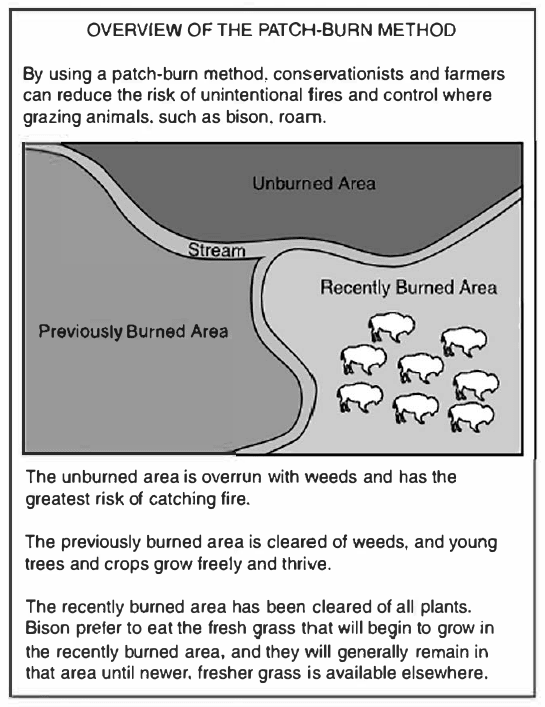
Today conservationists at the Tallgrass Prairie Preserve and farmers in the Great Plains continue to use controlled burns for land management. Intentionally burning a portion of land can dramatically improve the quality of the vegetation that regrows there. The fires burn away weedy undergrowth and help limit the overcrowding of shrubs and trees in the burn area, creating less competition for water and nutrients. Additionally, the process of burning excess plant matter adds nitrogen, an essential element for plant growth, to the soil.
One common target of controlled burns at the preserve and the surrounding area is the invasive red cedar tree. A single red cedar tree can consume up to 40 gallons of water per day, taking this vital resource away from other plant life. These tall trees also cast shade that prevents sunlight from reaching the plants beneath them. The fast-growing red cedar trees tend to crowd out prairie grasses, the primary food source for wild and domestic animals that make the prairie their home. An imbalance in one component of the prairie’s ecosystem affects the entire web of life. Controlled burns help maintain this ecosystem’s delicate balance.
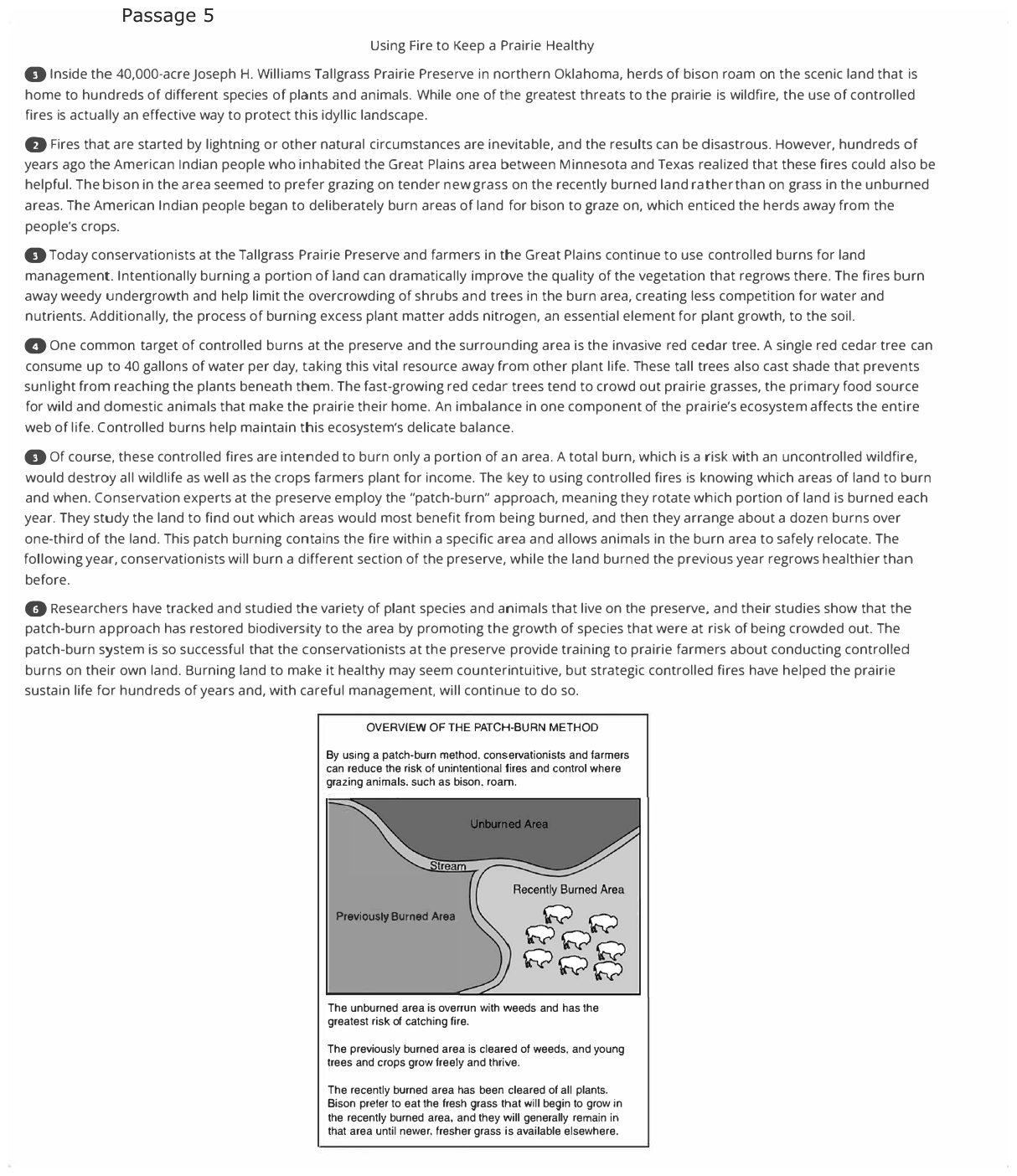
Of course, these controlled fires are intended to burn only a portion of an area. A total burn, which is a risk with an uncontrolled wildfire, would destroy all wildlife as well as the crops farmers plant for income. The key to using controlled fires is knowing which areas of land to burn and when. Conservation experts at the preserve employ the “patch-burn” approach, meaning they rotate which portion of land is burned each year. They study the land to find out which areas would most benefit from being burned, and then they arrange about a dozen burns over one-third of the land. This patch burning contains the fire within a specific area and allows animals in the burn area to safely relocate. The following year, conservationists will burn a different section of the preserve, while the land burned the previous year regrows healthier than before.
Researchers have tracked and studied the variety of plant species and animals that live on the preserve, and their studies show that the patch-burn approach has restored biodiversity to the area by promoting the growth of species that were at risk of being crowded out. The patch-burn system is so successful that the conservationists at the preserve provide training to prairie farmers about conducting controlled burns on their own land. Burning land to make it healthy may seem counterintuitive, but strategic controlled fires have helped the prairie sustain life for hundreds of years and, with careful management, will continue to do so.
Question
Targeting red cedar trees in controlled burns affects the animals that live on the prairie mostly by
- Aensuring that the animals’ main food source has the conditions needed for it to thrive.
- Bendangering the animals that live near the trees scheduled for removal.
- Cmaking sure that the water supply for the animals is sufficient.
- Dreducing the animals’ natural source of shade and protection from the elements.
Show the answer
Correct answer: A
The question asks how targeting red cedar trees in controlled burns affects the animals that live on the prairie.
A. CORRECT. According to information in paragraph 4, targeting invasive red cedar trees with controlled burns affects animals that live on the prairie by ensuring that these trees do not “crowd out prairie grasses, the primary food source for wild and domestic animals that make the prairie their home.” The paragraph also states that each red cedar tree consumes “up to 40 gallons of water per day, taking this vital resource away from other plant life.” Removing red cedars thus increases the amount of water available to the prairie grasses and helps maintain favorable conditions for the animals’ main source of food.
B. Incorrect. Although the author mentions the potential danger to wildlife from an uncontrolled burn in paragraph 5, the author emphasizes that patch burning “allows animals in the burn area to safely relocate.” Therefore, the animals that live near trees scheduled for removal are not endangered by the controlled burns.
C. Incorrect. In paragraph 4, the author states that “a single red cedar tree can consume up to 40 gallons of water per day, taking this vital resource away from other plant life.” However, the author does not suggest that reducing the number of red cedar trees through controlled burns ensures a sufficient water supply for animals that live on the prairie.
D. Incorrect. In paragraph 4, the author states that “these tall trees also cast shade that prevents sunlight from reaching the plants beneath them.” However, the author does not suggest that using controlled burns to eliminate red cedar trees reduces a natural source of shade for prairie animals. The red cedar trees are invasive; therefore, the author does not consider them a “natural” part of the prairie ecosystem.
Question analysis
This question asks how burning invasive red cedar trees on purpose mostly affects the wild and domestic animals that live on the Oklahoma prairie. Students follow a chain of cause and effect through the paragraph on red cedars, which describes the trees' heavy water use, their shade and their spread, and must pick out the effect that matters most to the animals.
- Grade level
- Grade 7 reading and task
- Compared with grade 7
- At grade 7 Grade 7 readers routinely trace how one change leads to another in an informational text. This chain stays within one paragraph, but the paragraph names several things the cedars take from the prairie, and the stem's “mostly” asks for the main effect.
- Estimated difficulty
- Moderate: several steps, or a close reading with one strong distractor.
- Thinking it demands
- Depth of knowledge 2, skills and concepts · mainly analyze
- What makes it hard
- Reading between the lines moderate
- Much to keep track of minor
- The right answer is reworded minor
- Evidence
- Answered from one paragraph or stanza
- Reading level
- Passage: about grade 11, 598 words; question and choices: about grade 9, 66 words.
- Students, last 30 days
- Not enough answers yet to show (it takes 10).
Why it is hard, traps and wrong answers (shows the answer)
Why it is hard
Paragraph 4 lists three harms the red cedar does, drinking water, casting shade and crowding out grasses, and the wrong choices hand the water and the shade straight to the animals. In the text, all three harms fall on plants, and animals feel them only through the grasses they eat. Students who ask who suffers each harm see that protecting the food supply is the main effect the stem’s “mostly” asks for.
Reading between the lines moderate Working it out
Paragraph 4 never names an effect on animals; students must chain the cedars crowding out “prairie grasses,” the grasses being “the primary food source,” and the burns that remove the cedars. (Graesser, Singer & Trabasso, 1994; Kintsch, 1998)
Much to keep track of minor Working it out
The paragraph names three harms at once, 40 gallons of water a day, shade over the plants below and crowding, and students must track which living things each harm reaches. (Sweller, 1988; Carpenter, Just & Shell, 1990)
The right answer is reworded minor Choosing the answer
The right choice speaks of “conditions needed for it to thrive” without naming grass or cedars, while the wrong ones repeat the paragraph’s vivid details of water and shade. (Freedle & Kostin, 1993; Kirsch & Mosenthal, 1990)
Strategy: Reread the paragraph about red cedars and list each way the trees harm the prairie, then ask which of those harms reaches the animals and which would matter to them most.
Traps
- Twists what the text says: Uses the text's topic and ideas but changes what it says: who did it, how much, when, or why.
- Outside knowledge: A choice is plausible in the real world but not supported by this text.
The wrong answers, classified
B Outside knowledge (King et al., 2004; Recht & Leslie, 1988)
Assumes that fire near animals must endanger them, a common belief, though paragraph 5 says patch burning “allows animals in the burn area to safely relocate.”
C Twists what the text says (King et al., 2004)
Seizes on the 40 gallons a red cedar drinks each day, but the passage says that water is taken from “other plant life,” not from the animals’ supply.
D Twists what the text says (King et al., 2004)
Turns the cedars’ shade, which blocks sunlight from “the plants beneath them,” into shelter for animals, though the passage treats the invasive trees as a harm, never a natural refuge.
Working it out, step by step
Figure out what the question asks
This question asks about cause and effect. People burn red cedar trees on purpose. You need to find how that mostly helps the animals. The word “mostly” means you want the biggest effect, not just any effect.
Find what the red cedars do
Paragraph 4 is about red cedars. It names three harms. First, one tree can drink “up to 40 gallons of water per day, taking this vital resource away from other plant life.” Second, the trees “cast shade that prevents sunlight from reaching the plants beneath them.” Third, they “tend to crowd out prairie grasses, the primary food source for wild and domestic animals.”
Ask who each harm hurts
Look at who loses each time. The water is taken from “other plant life.” The shade blocks light from “the plants beneath them.” The crowding pushes out prairie grasses. So every harm falls on plants. The animals feel it through the grass, because grass is their main food. Primary means main. So burning the cedars mostly helps the animals by protecting their food.
Check each choice
- A is right. The animals’ main food source is prairie grass. With the cedars gone, the grass gets water, sunlight and room to grow.
- B is wrong. Paragraph 5 says patch burning “allows animals in the burn area to safely relocate.” Relocate means move somewhere else.
- C is wrong. The cedars take water from plants. The passage never says the animals run short of water.
- D is wrong. The shade blocks light from plants. The passage never calls it shelter for animals.
Watch out: The 40 gallons of water is a striking fact, so C is tempting. But that water is taken from “other plant life.”
Choose the answer
Burning the cedars keeps the grass healthy, and the grass feeds the animals. Thrive means grow well. So the answer is A: “ensuring that the animals’ main food source has the conditions needed for it to thrive.”
Why this answer and not the closest wrong one
C is the closest wrong answer, because paragraph 4 does talk about water. But it says the cedars take water from plants, not from animals. The grass, the animals’ main food, is what suffers from all three harms. So A fits better.
More questions like this
The original DOE question
The passage “Using Fire to Keep a Prairie Healthy” as printed (page 41)
Question 5 of 75
2026 Practice Test B Math, question 2Question
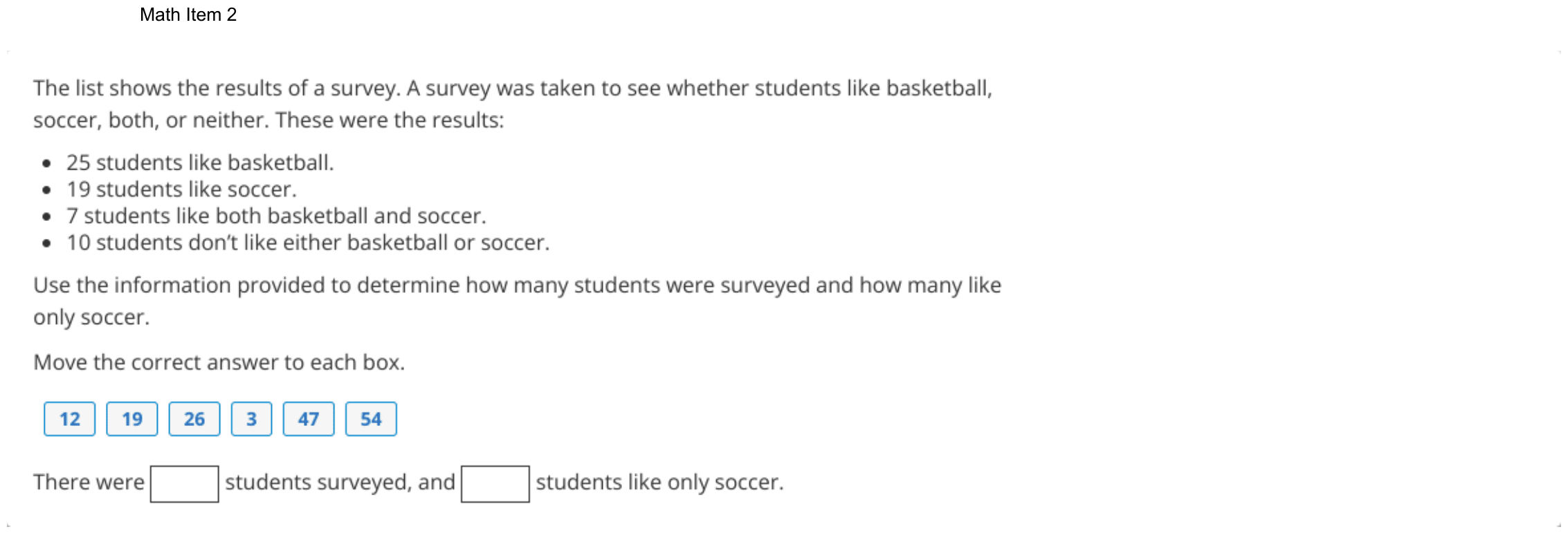
The list shows the results of a survey. A survey was taken to see whether students like basketball, soccer, both, or neither. These were the results:
- 25 students like basketball.
- 19 students like soccer.
- 7 students like both basketball and soccer.
- 10 students don’t like either basketball or soccer.
Use the information provided to determine how many students were surveyed and how many like only soccer.
Move the correct answer to each box.
There were students surveyed, and students like only soccer.
On the test you drag tiles into the boxes; here, choose each box’s tile from its menu. Each tile can be used once. The DOE has not published how answers with several parts are scored; this site counts one right only when every part is right.
Show the answer
Correct answer: blank 1: 47; blank 2: 12
There were 47 students surveyed, and 12 students like only soccer.
To determine how many students were surveyed, start with the total number of students who like basketball and soccer separately and subtract the number of students who were counted twice.
There were 25 students who like basketball, 19 students who like soccer, and 7 students who like both basketball and soccer.
So, the total number of students who like basketball or soccer is .
Then, add the students who don’t like either basketball or soccer: 10 students don’t like either sport.
Total students surveyed:
To determine how many students like only soccer, subtract the number of students who like both basketball and soccer from the total number of students who like soccer.
Students who like only soccer:
Question analysis
This survey problem lists how many students like basketball, soccer, both sports or neither, and students drag number tiles into two boxes: how many were surveyed and how many like only soccer. It is a Venn diagram counting question. Keeping track of the students who like both sports, who appear in two of the listed counts, is the tricky part.
- NYS standards
- 7.SP.8b sample spaces for compound events
- Grade level
- Grade 7 content, by NYS standard
- Compared with grade 7
- At grade 7 Overlapping groups like these are seldom taught on their own in grade 7, though the arithmetic is simple whole-number addition and subtraction. Two results come from the same four facts, and both boxes must be right to score.
- Estimated difficulty
- Moderate: several steps, or a close reading with one strong distractor.
- Thinking it demands
- Depth of knowledge 2, skills and concepts · mainly apply
- What makes it hard
- Much to keep track of moderate
- Turning words into math minor
- Solution
- 4 steps
- Reading level
- Question and choices: about grade 6, 78 words.
- Students, last 30 days
- Not enough answers yet to show (it takes 10).
Why it is hard, traps and wrong answers (shows the answer)
Why it is hard
The arithmetic is light; the work is keeping track of one overlap that touches both answers. Students often remove the 7 for one box and not the other, and the pool holds 54 and 19, the tiles those half-finished methods produce. A sketch of two overlapping circles, with 7 in the middle, 18 and 12 beside it and 10 outside, turns both boxes into reading off the picture.
Much to keep track of moderate Working it out
The 7 students who like both sports sit inside the 25 and inside the 19, so they come out once for the total and again for only soccer, and both boxes must be right to score. (Sweller, 1988; Carpenter, Just & Shell, 1990)
Turning words into math minor Understanding the question
The list never says that the 25 basketball fans already include the 7 who like both sports, and only the word “only” in the question separates the 12 from all 19 soccer fans. (Hegarty, Mayer & Monk, 1995; Koedinger & Nathan, 2004)
Strategy: Sketch two overlapping circles, write the students who like both sports in the middle, fill each outer part by subtraction, then add every region and the students who like neither.
Traps
- Overlapping groups: Things in two groups at once are counted twice, or not subtracted.
- Misreads the question: Misses or misreads a condition or a word in the question: "at least", "each", "remaining", "not".
The wrong answers, classified
FA Overlapping groups (King et al., 2004)
Adds 25 + 19 + 10 = 54 for the total, counting the 7 fans of both sports twice, yet takes them out of the soccer fans correctly to get 12.
EB Misreads the question (Hegarty, Mayer & Monk, 1995)
Removes the overlap correctly to find the 47 surveyed, then fills the second box with all 19 soccer fans, overlooking “only” and the 7 of them who also like basketball.
FB Overlapping groups (King et al., 2004)
Ignores the line about the 7 who like both sports, adding 25 + 19 + 10 = 54 and copying the 19 soccer fans straight from the list.
Worked solution, step by step
Formulas used
- Counting two groups that overlap
- B is the number who like basketball, and S is the number who like soccer. The students who like both are inside B and inside S, so B + S counts them twice. Subtract them once to fix that. Then add the students who like neither sport, since they are in neither group.
- Only one group
- S is everyone who likes soccer, and both is the number who like both sports. Only soccer means the soccer fans who do not also like basketball. Take the both group out of the soccer group to find them.
Sort out the question
The survey gives you four facts:
- 25 students like basketball.
- 19 students like soccer.
- 7 students like both sports.
- 10 students like neither sport.
You need two numbers. The first box is how many students were surveyed in all. The second box is how many like only soccer, which means soccer but not basketball. Each tile can be used once.
See who is counted twice
The 7 students who like both sports are part of the 25 basketball fans. They are also part of the 19 soccer fans. So if you add 25 and 19, those 7 students get counted two times.
A Venn diagram shows this. It is a picture of two circles that overlap. The 7 go in the middle, where the circles share space.
Count who likes at least one sport
Use the overlap rule. Add the two groups, then take away the 7 who were counted twice:
So 37 students like basketball, soccer or both.
Add the students who like neither
The 10 students who like neither sport are not in either group. They were still surveyed, so add them:
So 47 students were surveyed.
Watch out: adding 25 + 19 + 10 = 54 counts the 7 students twice. The tile 54 is waiting for that mistake.
Find who likes only soccer
The 19 soccer fans include the 7 who like basketball too. Take those 7 away:
So 12 students like only soccer.
Watch out: the word only matters. The tile 19 counts every soccer fan, not just the ones who like only soccer.
Fill in both boxes
On the test, you drag the tile 47 into the first box and the tile 12 into the second box. On this site, you choose each tile from its box’s menu.
So the boxes get 47 and 12: there were 47 students surveyed, and 12 students like only soccer.
Check your answer
Split the students into four groups that do not overlap. Only basketball is . Both sports is 7. Only soccer is 12. Neither is 10. Add the four groups: . That matches the first box.
More questions like this
The original DOE question
Question 6 of 75
2026 Practice Test B Math, question 3Question
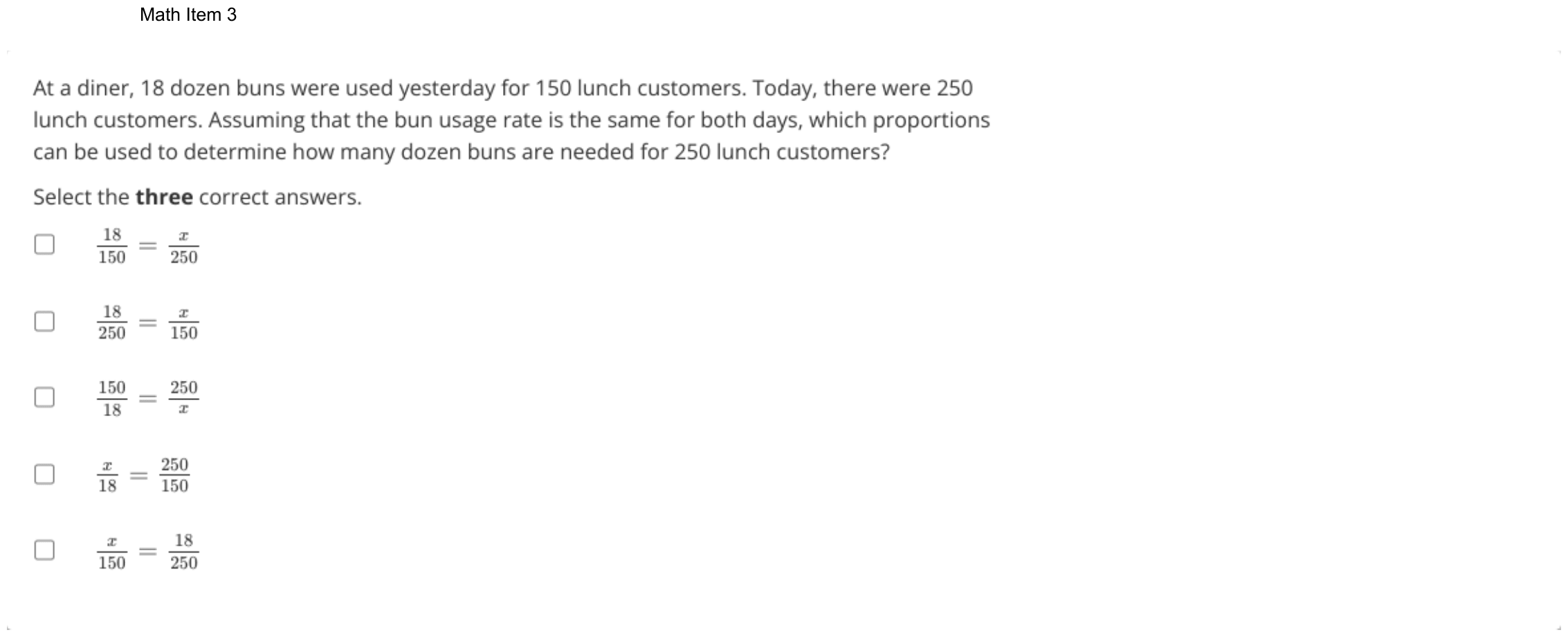
At a diner, 18 dozen buns were used yesterday for 150 lunch customers. Today, there were 250 lunch customers. Assuming that the bun usage rate is the same for both days, which proportions can be used to determine how many dozen buns are needed for 250 lunch customers?
Select the three correct answers.
Choose every answer that is correct, then check. The DOE has not published how answers with several parts are scored; this site counts one right only when every part is right.
- A
- B
- C
- D
- E
Show the answer
Correct answer: A, C, and D
The three correct answers are:
Set up a proportion to compare the number of buns per customer. These are all equivalent:
To check for equivalency, solve each proportion for x.
Each of the three correct proportions simplifies to .
Then solve for x to determine how many dozen buns are needed for 250 lunch customers:
Question analysis
A diner used 18 dozen buns for 150 lunch customers yesterday, and students select the three proportions, out of five, that can find how many dozen buns 250 customers need at the same rate. It tests setting up proportions and recognizing equivalent ones. All five equations use the same numbers, so each has to be checked for which quantities it pairs.
- Grade level
- Grade 7 content, by NYS standard
- Compared with grade 7
- At grade 7 Setting up a proportion from a rate is everyday grade 7 work. Here nothing is solved: five setups built from the same numbers must each be judged, some arranged in unfamiliar ways, and all three usable ones found.
- Estimated difficulty
- Moderate: several steps, or a close reading with one strong distractor.
- Thinking it demands
- Depth of knowledge 2, skills and concepts · mainly apply
- What makes it hard
- Every choice must be checked moderate
- A very close wrong answer moderate
- An answer in an unexpected form minor
- Much to keep track of minor
- Solution
- 3 steps
- Reading level
- Question and choices: about grade 6, 54 words.
- Students, last 30 days
- Not enough answers yet to show (it takes 10).
Why it is hard, traps and wrong answers (shows the answer)
Why it is hard
Nothing needs solving here; the question is which pairings keep the usage rate fixed. Students who check only for buns over customers on both sides find exactly three such setups, two of them wrong, and pass over the two right ones written another way. The wrong pair gives 10.8 dozen, fewer buns for more customers, which a quick sense check would catch, and cross-multiplying every setup settles all five.
Every choice must be checked moderate Choosing the answer
All five setups are built from 18, 150, 250 and x, so none can be dismissed on sight; each has to be cross-multiplied and compared with 150x = 18 × 250. (Embretson & Wetzel, 1987)
A very close wrong answer moderate Choosing the answer
The first two setups differ only in where 150 and 250 sit, 18/150 = x/250 against 18/250 = x/150, and both show buns over customers on each side, so a units check passes both. (Embretson & Wetzel, 1987; Gorin & Embretson, 2006; Ascalon et al., 2007)
An answer in an unexpected form minor Choosing the answer
One right setup puts customers over dozens of buns, and another sets today’s x over yesterday’s 18 equal to 250 customers over 150, forms that look wrong to students who learned only rate equals rate. (Enright, Morley & Sheehan, 2002)
Much to keep track of minor Working it out
Three of the five must be picked and all three must be right to score, so the verdict on each setup has to be kept until the last one is tested. (Sweller, 1988; Carpenter, Just & Shell, 1990)
Strategy: Write one proportion you trust by matching both units and days, cross-multiply it, then cross-multiply each choice and keep only those that give the same equation.
Traps
- Misunderstands the concept: A wrong belief about a concept: that percents can be added, that area grows like length, that averages can be averaged, that a bigger denominator means a bigger fraction.
- Answer in another form: The right answer is written differently from the way you worked it out.
The wrong answers, classified
B Misunderstands the concept (Smith, diSessa & Roschelle, 1993; De Bock et al., 1998; Ni & Zhou, 2005)
Checks only that both fractions show dozens of buns over customers, missing that 18 sits over today’s 250 customers; cross-multiplying gives 250x = 2,700, so x = 10.8.
D Misunderstands the concept (Smith, diSessa & Roschelle, 1993; De Bock et al., 1998; Ni & Zhou, 2005)
Left out by students who expect each fraction to compare buns with customers, not seeing that today over yesterday for buns and for customers also gives 150x = 4,500.
E Misunderstands the concept (Smith, diSessa & Roschelle, 1993; De Bock et al., 1998; Ni & Zhou, 2005)
Accepts x over 150 because it shows buns over customers like the trusted setup, but today’s buns sit over yesterday’s customers, which yields only 10.8 dozen for more people.
Worked solution, step by step
Formulas used
- A rate
- The rate is how many dozen buns are used for each customer. Yesterday it was 18 dozen over 150 customers. Today it is x dozen over 250 customers. The question says the rate is the same both days, so those two fractions are equal.
- Cross-multiplying a proportion
- A proportion says two fractions are equal. a and c are the tops, and b and d are the bottoms. Multiply each top by the other bottom, and the two products are equal. This turns any proportion into a plain equation, so you can compare setups that look different.
Sort out the question
Yesterday the diner used 18 dozen buns for 150 customers. Today it has 250 customers. Let x be the number of dozen buns needed today. The bun usage rate is the same both days.
A proportion is two equal fractions. You must pick the three proportions that give the right value of x.
Write one proportion you trust
Put each day’s buns over that same day’s customers. The rates are equal, so the fractions are equal:
This is choice A. Cross-multiply it:
Any choice that leads to 150x = 4,500 is a right one.
Solve for x
Divide both sides by 150 to get x by itself:
So the diner needs 30 dozen buns today. A wrong setup gives a different number.
Test choices C and D
Cross-multiply each one.
- C: gives . That is the same equation, so C works. It is choice A with both fractions flipped.
- D: gives . The same equation again, so D works too.
D compares today with yesterday. Today’s buns over yesterday’s buns equals today’s customers over yesterday’s customers.
Watch out: D looks odd because it puts buns over buns. Do not skip it. It still keeps the rate the same.
Test choices B and E
- B: gives , so 250x = 2,700.
- E: gives , the same 250x = 2,700.
Both give . That is fewer buns for more customers, which makes no sense.
Watch out: B and E show buns over customers, so they look right. But each one mixes up the days. B puts yesterday’s 18 dozen over today’s 250 customers. E puts today’s buns over yesterday’s 150 customers.
Name the three answers
Choices A, C and D all give 150x = 4,500, so x = 30. On the test, you check the box next to each one. So the answers are A, C and D.
Check your answer
Find the buns a second way. Today has times as many customers as yesterday. So it needs 5/3 times as many buns: dozen. That matches the 30 from choices A, C and D.
More questions like this
The original DOE question
Question 7 of 75
2026 Practice Test B Math, question 17Question
How many positive integers satisfy the inequality ?
Enter your answer in the space.
Fill-in question: work out the answer and type it as a number.
Show the answer
Correct answer: 15
Solve the inequality for x.
There are 15 positive integers that are less than 16.
Question analysis
This inequality question asks how many positive integers make x + 7 < 23 true, and the count is typed into a box. Students solve a one-step inequality, then count its whole-number solutions. The strict less-than sign and the word positive decide where the count starts and stops, so both ends need checking.
- Grade level
- Grade 7 content, by NYS standard
- Compared with grade 7
- Below grade 7 Grade 7 inequality problems usually take two steps, such as 2x − 5 > 9. This one needs a single subtraction; the care goes into counting the whole-number solutions and deciding whether the boundary itself counts.
- Estimated difficulty
- Straightforward: two steps or one careful reading.
- Thinking it demands
- Depth of knowledge 1, recall and reproduction · mainly apply
- What makes it hard
- Solution
- 2 steps
- Reading level
- Question and choices: about grade 12, 14 words.
- Students, last 30 days
- Not enough answers yet to show (it takes 10).
Why it is hard, traps and wrong answers (shows the answer)
Why it is hard
One subtraction solves the inequality, so the points are lost in the count that follows. The boundary 16 is the last number the solving produces and is easy to type in, or to count up to; checking that 16 + 7 is 23, which is not less than 23, rules it out. Listing 1 through 15, the positive integers below the boundary, settles the count.
An answer in an unexpected form minor Choosing the answer
Solving gives x < 16, but the box asks how many positive integers make the inequality true, a count that still has to be made after the solving is done. (Enright, Morley & Sheehan, 2002)
Much to keep track of minor Working it out
Two conditions set the ends of the count at once: the word positive starts it at 1 rather than 0, and the strict < stops it below 16. (Sweller, 1988; Carpenter, Just & Shell, 1990)
Strategy: Undo the addition to find the boundary for x, then count the positive whole numbers below it, checking the largest one and the boundary in the original inequality.
Traps
- Counting the ends: Inclusive or exclusive ends, fence posts, consecutive numbers: an answer that is one too many or too few, or an endpoint drawn open where it belongs closed (or the reverse).
- A faulty procedure: A systematic but wrong procedure: adding fractions straight across, applying an exponent to each term of a sum, dropping a sign when moving a term.
The wrong answers, classified
16 Counting the ends (Brown & Burton, 1978)
Solves to x < 16 and then enters 16, either the boundary itself or a count of 1 through 16, though x = 16 makes x + 7 equal 23, not less than it.
29 A faulty procedure (Brown & Burton, 1978; Tatsuoka, 1983)
Moves the 7 to the right side without changing its sign, 23 + 7 = 30, and counts the 29 positive integers below 30.
Worked solution, step by step
Formulas used
- Doing the same to both sides
- a and b are the two sides of an inequality, and c is any number. Taking the same number away from both sides keeps the inequality true. Think of two people who each walk down the same number of stairs: the lower one stays lower. Use it to get x by itself.
Sort out the question
An inequality compares two amounts. The sign < means is less than. A positive integer is a whole number bigger than 0: 1, 2, 3, and so on. You need to count how many of them make true. The answer is a count, not a value of x.
Get x by itself
The 7 is added to x. Subtracting 7 undoes adding 7, so subtract 7 from both sides:
So x must be less than 16.
Watch out: adding 7 to 23 instead gives x < 30, and a count of 29.
Check the boundary number
The number 16 is the boundary, where the solutions stop. Does 16 itself work? Try it:
But 23 is not less than 23. It is equal. So 16 does not count. The largest number that works is 15, since , and 22 is less than 23.
Watch out: entering 16 counts the boundary, which fails.
Count the positive integers
The numbers that work start at 1, the smallest positive integer. Zero is not positive. They stop at 15:
Counting from 1 up to 15 gives 15 numbers.
Enter the count
There are 15 positive integers that make the inequality true. Type the count in the box as a plain whole number. So you would enter 15.
Check your answer
Test both ends. For 1: , and 8 is less than 23, so 1 works. For 15: 22 is less than 23, so 15 works. For 16: 23 is not less than 23, so 16 fails. That leaves exactly the numbers 1 through 15.
More questions like this
The original DOE question

Question 8 of 75
2026 Practice Test C English, question 8Passage Excerpt from “Niagara Falls”
Excerpt from “Niagara Falls”
by Rupert Brooke
The real secret of the beauty and terror of the Falls is not their height or width, but the feeling of colossal power and of unintelligible disaster caused by the plunge of that vast body of water. If that were taken away, there would be little visible change, but the heart would be gone.
The American Falls do not inspire this feeling in the same way as the Canadian. It is because they are less in volume, and because the water does not fall so much into one place. By comparison their beauty is almost delicate and fragile. They are extraordinarily level, one long curtain of lacework and woven foam. Seen from opposite, when the sun is on them, they are blindingly white, and the clouds of spray show dark against them. With both Falls the colour of the water is the ever-altering wonder. Greens and blues, purples and whites, melt into one another, fade, and come again, and change with the changing sun. Sometimes they are as richly diaphanous as a precious stone, and glow from within with a deep, inexplicable light. Sometimes the white intricacies of dropping foam become opaque and creamy. And always there are the rainbows. If you come suddenly upon the Falls from above, a great double rainbow, very vivid, spanning the extent of spray from top to bottom, is the first thing you see. If you wander along the cliff opposite, a bow springs into being in the American Falls, accompanies you courteously on your walk, dwindles and dies as the mist ends, and awakens again as you reach the Canadian tumult. And the bold traveller who attempts the trip under the American Falls sees, when he dare open his eyes to anything, tiny baby rainbows, some four or five yards in span, leaping from rock to rock among the foam, and gambolling beside him, barely out of hand’s reach, as he goes. One I saw in that place was a complete circle, such as I have never seen before, and so near that I could put my foot on it. It is a terrifying journey, beneath and behind the Falls. The senses are battered and bewildered by the thunder of the water and the assault of wind and spray; or rather, the sound is not of falling water, but merely of falling; a noise of unspecified ruin. So, if you are close behind the endless clamour, the sight cannot recognise liquid in the masses that hurl past. You are dimly and pitifully aware that sheets of light and darkness are falling in great curves in front of you. Dull omnipresent foam washes the face. Farther away, in the roar and hissing, clouds of spray seem literally to slide down some invisible plane of air.
Beyond the foot of the Falls the river is like a slipping floor of marble, green with veins of dirty white, made by the scum that was foam. It slides very quietly and slowly down for a mile or two, sullenly exhausted. Then it turns to a dull sage green, and hurries more swiftly, smooth and ominous. As the walls of the ravine close in, trouble stirs, and the waters boil and eddy. These are the lower rapids, a sight more terrifying than the Falls, because less intelligible. Close in its bands of rock the river surges tumultuously forward, writhing and leaping as if inspired by a demon. It is pressed by the straits into a visibly convex form. Great planes of water slide past. Sometimes it is thrown up into a pinnacle of foam higher than a house, or leaps with incredible speed from the crest of one vast wave to another, along the shining curve between, like the spring of a wild beast. Its motion continually suggests muscular action. The power manifest in these rapids moves one with a different sense of awe and terror from that of the Falls. Here the inhuman life and strength are spontaneous, active, almost resolute. . . . A place of fear.
One is drawn back, strangely, to a contemplation of the Falls, at every hour, and especially by night, when the cloud of spray becomes an immense visible ghost, straining and wavering high above the river, white and pathetic and translucent. The Victorian lies very close below the surface in every man. There one can sit and let great cloudy thoughts of destiny and the passage of empires drift through the mind; for such dreams are at home by Niagara. I could not get out of my mind the thought of a friend, who said that the rainbows over the Falls were like the arts and beauty and goodness, with regard to the stream of life—caused by it, thrown upon its spray, but unable to stay or direct or affect it, and ceasing when it ceased. In all comparisons that rise in the heart, the river, with its multitudinous waves and its single current, likens itself to a life, whether of an individual or of a community. A man’s life is of many flashing moments, and yet one stream; a nation’s flows through all its citizens, and yet is more than they. In such places, one is aware, with an almost insupportable and yet comforting certitude, that both men and nations are hurried onwards to their ruin or ending as inevitably as this dark flood. Some go down to it unreluctant, and meet it, like the river, not without nobility. And as incessant, as inevitable, and as unavailing as the spray that hangs over the Falls, is the white cloud of human crying. . . . With some such thoughts does the platitudinous heart win from the confusion and thunder of a Niagara peace that the quietest plains or most stable hills can never give.
From LETTERS FROM AMERICA by Rupert Brooke—Public Domain
diaphanous: sheer, translucent
platitudinous: clichéd, common
Question
Read this sentence from paragraph 3.
These are the lower rapids, a sight more terrifying than the Falls, because less intelligible.
Which statement best describes how the sentence fits into the overall structure of the excerpt?
- AIt signals a change from the positive aspects of the Falls to the negative aspects.
- BIt indicates a progression from the literal description of the water to a discussion of timeless truths.
- CIt reinforces a shift from the qualities of the Falls to the qualities of the river.
- DIt introduces a contrast between the obvious and the hidden features of the rapids.
Show the answer
Correct answer: C
The question asks for the statement that best describes how the sentence from paragraph 3 fits into the overall structure of the excerpt.
A. Incorrect. Although in paragraph 2 the author describes the beauty of the Falls as both an “ever-altering wonder” and an “assault of wind and spray,” in paragraph 3 the author does not signal a change from the positive aspects of the Falls to the negative aspects. Instead, the author provides a description of the river and the rapids below the Falls.
B. Incorrect. While the author compares the water of the river to “a slipping floor of marble, green with veins of dirty white, made by the scum that was foam” in paragraph 3, the statement that the lower rapids are “more terrifying than the Falls, because less intelligible” does not indicate a progression from the literal description of the water to a discussion of timeless truths. Instead, the author is merely describing all aspects of the rapids, both literally and figuratively.
C. CORRECT. The first sentence of paragraph 3 moves the description “beyond the foot of the Falls” to “the river” and then the paragraph begins to describe this location in further detail (“a dull sage green,” “hurries more swiftly,” “smooth and ominous,” “waters boil and eddy”) before reinforcing this shift by confirming it again with the words “These are the lower rapids, a sight more terrifying than the Falls.”
D. Incorrect. Although the author states that the waters of the rapids “boil and eddy” and suggests that the rapids are “less intelligible,” these statements do not introduce a contrast between the obvious and the hidden features of the rapids. They merely describe a feature and the sight of the lower rapids.
Question analysis
This text structure question quotes a sentence from paragraph 3 of Rupert Brooke’s “Niagara Falls,” in which the lower rapids are called “more terrifying than the Falls,” and asks how it fits the excerpt’s overall organization. It rewords a question from the 2018 handbook’s Test B. Every choice describes a turn the essay could plausibly take, so students need a clear picture of what each paragraph covers.
- NYS standards
- 7R5 structure and genre features
- Grade level
- Grade 8 reading and task
- Compared with grade 7
- Above grade 7 A typical grade 7 structure question asks what one paragraph adds. This one asks where a sentence from the middle of paragraph 3 fits in the whole essay, which means summing up four long paragraphs of century-old prose.
- Estimated difficulty
- Hard: combines ideas, needs a plan, and has more than one tempting wrong answer.
- Thinking it demands
- Depth of knowledge 3, strategic thinking · mainly analyze
- What makes it hard
- How, not what major
- Much to keep track of moderate
- Hard words moderate
- Evidence
- Answered from several paragraphs or stanzas
- Reading level
- Passage: about grade 9, 987 words; question and choices: about grade 8, 97 words.
- Students, last 30 days
- Not enough answers yet to show (it takes 10).
Why it is hard, traps and wrong answers (shows the answer)
Why it is hard
A sentence that compares the rapids with the Falls is easy to misplace, because both of its subjects appear elsewhere in the excerpt. The strongest pull is a real turn in the essay, from describing water to musing on destiny, that comes a paragraph later, while “more terrifying” draws students who forget that terror runs through the excerpt from its first sentence. The 2026 verb “reinforces” rewards those who saw that paragraph 3 had already left the Falls with “Beyond the foot of the Falls the river.”
How, not what major Working it out
The task is to place one sentence in the essay’s plan, and the sentence pulls the wrong way: it mentions “the Falls” and “more terrifying,” though its job is to confirm that paragraph 3 has already moved downstream to the rapids. (Anderson & Krathwohl, 2001)
Much to keep track of moderate Working it out
Placing the sentence takes a summary of all four long paragraphs at once: the Falls’ power, the two Falls’ beauty and the trip behind them, the river below, and the night thoughts on destiny. (Sweller, 1988; Carpenter, Just & Shell, 1990)
Hard words moderate Understanding the question
“Less intelligible” means harder to make sense of; a student who takes it as harder to see is led toward a contrast between obvious and hidden features of the rapids. (Perfetti, 2007; Freedle & Kostin, 1993)
Strategy: Sum up each of the four paragraphs in a few words, find where this sentence sits in that outline, and choose the description of the essay’s movement at exactly that point.
Traps
- Wrong part of the text: A choice is true of another paragraph, stanza or speaker than the one asked about.
The wrong answers, classified
A Twists what the text says (King et al., 2004)
Takes “more terrifying” as the essay’s first turn from the Falls’ beauty to their dangers, but this sentence is about the rapids, and paragraph 1 already speaks of “unintelligible disaster.”
B Wrong part of the text (Kirsch & Mosenthal, 1990)
Names a turn the excerpt really makes, from describing the water to “thoughts of destiny and the passage of empires,” but that turn comes in paragraph 4, not at the rapids.
D Wrong purpose or structure (Anderson & Krathwohl, 2001)
Reads “less intelligible” as less visible and finds a contrast between obvious and hidden features, though rapids that “boil and eddy” and leap like “a wild beast” are in plain view.
Working it out, step by step
Figure out what the question asks
This is a text structure question. Structure is the plan of a piece of writing: what each part does and how the parts connect. You get one sentence from paragraph 3. You must decide what job it does in the plan of the whole excerpt. So first sum up what each of the four paragraphs is about.
Sum up the four paragraphs
- Paragraph 1: the real secret of the Falls is “the feeling of colossal power.” Colossal means huge.
- Paragraph 2: the two Falls, their colors, the rainbows, and the scary trip behind the water.
- Paragraph 3: the river below the Falls and its wild rapids.
- Paragraph 4: the author goes back to the Falls at night and thinks about life and destiny, or what happens in the end.
See where paragraph 3 begins
Paragraph 3 opens with “Beyond the foot of the Falls the river is like a slipping floor of marble.” Beyond the foot means past the bottom. So the author has already left the Falls. He follows the river as it “hurries more swiftly” and the waters “boil and eddy,” or swirl. Then comes the sentence: “These are the lower rapids, a sight more terrifying than the Falls, because less intelligible.” Rapids are a stretch of fast, rough water. Less intelligible means harder to make sense of.
Decide what the sentence does
The sentence names the new place: the lower rapids. It also sets the rapids against the Falls. That tells you again that the essay has moved from the Falls to the river below them. To reinforce something is to make it stronger. The sentence reinforces a shift, or change of subject, that the paragraph’s first sentence began.
Check each choice
- A does not fit. Terror is not new here. Paragraph 1 already speaks of “unintelligible disaster,” and paragraph 2 calls the trip behind the Falls “a terrifying journey.”
- B does not fit. The essay does turn to big, timeless ideas, but in paragraph 4, not here.
- C fits. The sentence confirms the move from the Falls to the river.
- D does not fit. The rapids are in plain sight. “Less intelligible” means harder to understand, not hidden.
Watch out: B names a real turn in the essay. But it comes one paragraph later, with “thoughts of destiny and the passage of empires.”
Choose the answer
The sentence names the rapids and compares them with the Falls. That confirms the essay has moved downstream. So the answer is C, “It reinforces a shift from the qualities of the Falls to the qualities of the river.”
Why this answer and not the closest wrong one
B is the closest wrong choice, because the essay really does move from describing water to big ideas about life. But that move comes in paragraph 4, at night. The sentence in paragraph 3 is still describing water. Its job is to name the rapids and confirm that the essay has left the Falls for the river.
More questions like this
The original DOE question
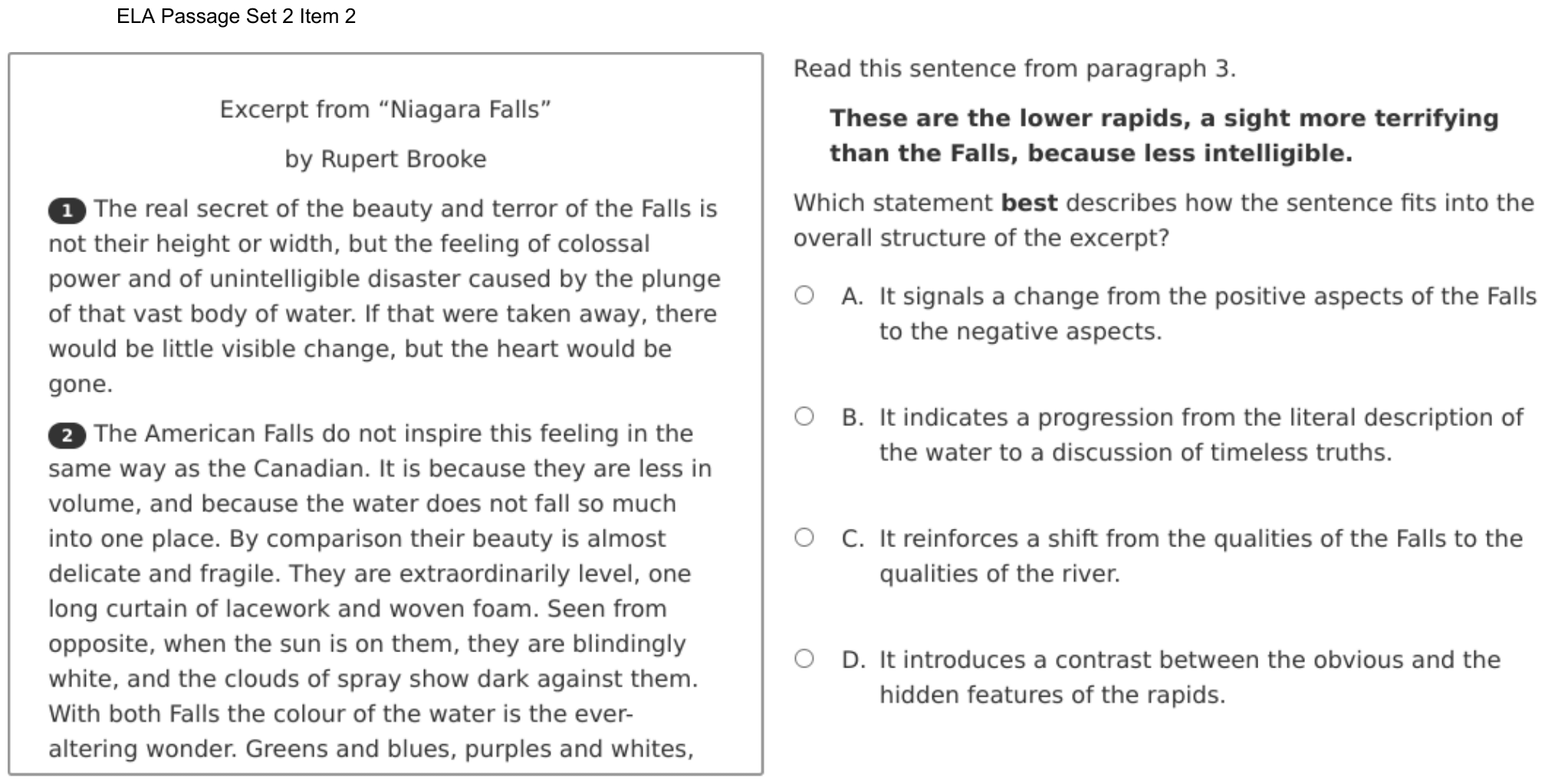
The passage “Excerpt from “Niagara Falls”” as printed (pages 134–135)
Question 9 of 75
2026 Practice Test C English, question 40Passage Excerpt from “Growing Peppers on the ISS Is Just the Start of Space Farming”
Excerpt from “Growing Peppers on the ISS Is Just the Start of Space Farming”
by Melanie Canales
The author, Melanie Canales, is a first-generation Peruvian American farmer and beekeeper based in Virginia’s Shenandoah Valley, on lands of the indigenous Monacan and Manahoac tribes. Her work focuses on creating healthy relationships between people and their surrounding ecosystems.
Unburdened by the constraints of gravity, red and green peppers jut out at 45-degree angles inside the Advanced Plant Habitat (APH), a sort of space terrarium not much larger than a microwave. Four chile pepper plants stand effortlessly upright, despite the dozens of glossy fruits weighing them down. These plants have lived entirely in space; their leaves have never been chewed on by insects or rustled by a summer breeze, [and] their stems are unfamiliar with bending toward the sun’s arc across the sky. Scissors glint under the tank’s white and blue lights as astronaut Mark Vande Hei and his team snip the stems of those that are ready for harvest. The peppers whirl around their heads until the astronauts catch them and tape them against a board to photograph.
Back on Earth, the Plant Habitat-04 team of engineers and plant scientists are observing and conferring with the astronauts. Of the 26 peppers in this batch, only the 14 finest will stay on the International Space Station [ISS] for consumption. The rest will be wrapped in foil, sealed in a Ziploc bag, then frozen at a brisk −80 degrees, until they can come roaring back to Earth in the next cargo capsule to be studied later. Now, after a 137-day growth cycle, the astronauts remove the plants from the module and trash them. Project Plant Habitat-04 is complete. It’s taco night on the ISS.
Since 2014, NASA1 has experimented with growing lettuces, brassicas,2 and zinnias3 in space, an endeavor that relies on highly specialized technology over 50 years in the making. [Fall 2021’s] two successful pepper harvests . . . will provide data on the nutritional and psychological benefits of growing vegetables on-craft, as well as a crop’s ability to reliably produce long-term in microgravity. While controlled environmental agriculture is not new, the APH experiment represents an evolution in specialized growth habitats. It doesn’t aim to re-create Earth’s conditions, but to perfect each isolated variable of plant growth in the clinical environment of a spaceship.
“The Advanced Plant Habitat is the most complex plant growth system on orbit today,” says Lashelle Spencer, a plant scientist at NASA’s Kennedy Space Center. Its more than 180 sensors control and monitor temperature, humidity, and carbon dioxide. The astronauts can adjust the color and intensity of the light, and how much moisture the plants’ roots are getting. It waters itself.
It’s the day after Thanksgiving, and Spencer has been at Kennedy since 5 a.m. to facilitate the peppers’ final harvest. As part of the project team, she played a crucial role in preparing the seeds that were sent hurtling into space in June and guiding the astronauts through maintaining the plants in orbit. . . . Though astronauts can spend upwards of 100 days in space, their on-mission meals come dehydrated and pre-packaged; their vitamins and minerals are isolated in supplements, which lose nutritional value the longer they’re stored. Spencer’s goal is to create the conditions necessary for cultivating healthy plants in space, so those plants can sustain healthy astronauts on long-term missions. Astronaut food is great, she says—“especially the shrimp cocktail. But you’re missing that crunch. You’re missing that fresh pop of flavor, the green flavor that’s not there in that packaged food.”
The sensory experience of growing productive crops can also help mitigate4 the psychological effects of long-term space travel. . . . Spencer says the team cracked open the door of the APH every day to observe their vegetable companions with all the tenderness of home gardeners. When harvest day came, they batted their bounty around the ISS, taking selfies and delighting in watching the fruits pirouetting around the spacecraft. . . .
“We were thinking no heat, so that [the peppers] wouldn’t be dangerous, but maybe the astronauts need a little spice in their life,” says Paul Bosland, who along with his colleagues at the Chile Pepper Institute genetically engineered5 the NuMex Española Improved chile pepper seeds grown in Plant Habitat-04. . . .
Working with NASA, Bosland cultivated a variety that could accommodate both the nutritional needs of astronauts as well as the logistics of growing a plant in space. . . .
. . . The experiment is helping gather the data necessary to determine the nutritional content of crops grown in space, and therefore how many people they can feed, and for how long. Though much is still unknown, Spencer is certain of one thing that future astronauts will need to do: “I think in an optimal world, a scientist like me would say that they would be growing plants from day one. From the day they left to the day they came back, they would be growing them.”
From “Growing Peppers on the ISS Is Just the Start of Space Farming” by Melanie Canales from WIRED, December 21, 2021. Copyright © 2021 Condé Nast. All rights reserved.
1NASA: National Aeronautics and Space Administration
2brassicas: a large genus of herbs, such as broccoli and cabbage
3zinnias: a genus of herbs and low shrubs that have flowers at their heads
4mitigate: to make something less severe or harmful
5genetically engineered: combined parts of DNA from different plants to produce a new plant
Question
What is the relationship between the scientists and the astronauts in carrying out the plant-growing experiments?
Move the correct answer to each box.
Scientists on earth are primarily responsible for for conducting plant experiments in space, while the astronauts aboard the International Space Station are responsible for for the experiment.
On the test you drag tiles into the boxes; here, choose each box’s tile from its menu. Each tile can be used once. The DOE has not published how answers with several parts are scored; this site counts one right only when every part is right.
Show the answer
Correct answer: blank 1: developing the materials and systems; blank 2: growing the plants to harvest
The question asks for the two phrases that should be added to the sentence to explain the relationship between the scientists and the astronauts in carrying out the plant-growing experiments.
CORRECT. The phrase “growing the plants to harvest” should be added to the second box in the sentence. Paragraphs 1 and 2 of the excerpt show that astronauts aboard the ISS are responsible for tending to the plants in the system and harvesting them after the growth cycle is complete.
Incorrect. The phrase “documenting the nutritional goals” should not be added to either box in the sentence. While the excerpt does mention that the experiment is helping gather data about the nutritional value of the peppers, there is no evidence that either the scientists on Earth or the astronauts aboard the ISS are tasked with documenting specific nutritional goals.
Incorrect. The phrase “analyzing the environment” should not be added to either box in the sentence. Although the experiment requires control of environmental factors like light and moisture, the excerpt does not describe or primarily focus on describing how either the scientists on Earth or the astronauts aboard the ISS are responsible for formally analyzing the environment of the habitat as part of the experiment.
CORRECT. The phrase “developing the materials and systems” should be added to the first box in the sentence. The excerpt explains that the scientists on Earth create and prepare the systems, seeds, and equipment needed for the plant-growing experiments in space.
Incorrect. The phrase “determining the most nutritional plants” should not be added to either box in the sentence. Although growing nutritious plants is important, the excerpt does not focus on the scientists on Earth or the astronauts aboard the ISS evaluating or selecting plants based on their nutritional value.
Question analysis
This question asks students to complete a sentence describing how scientists on Earth and astronauts aboard the International Space Station divided the work of the pepper-growing experiment. On the test students drag phrase tiles into two boxes, choosing from five. Each group’s role must be pieced together from details spread across the excerpt, and each tile names a task in general words that must be matched to the text.
- Grade level
- Grade 7 reading and task
- Compared with grade 7
- At grade 7 Explaining how the people in an informational text relate to one another is grade 7 work. Filling two boxes from five tiles with all-or-nothing credit adds some demand, but the excerpt shows the two groups doing clearly different jobs.
- Estimated difficulty
- Moderate: several steps, or a close reading with one strong distractor.
- Thinking it demands
- Depth of knowledge 2, skills and concepts · mainly analyze
- What makes it hard
- The right answer is reworded moderate
- Evidence in several places moderate
- Much to keep track of minor
- Evidence
- Answered from several paragraphs or stanzas
- Reading level
- Passage: about grade 10, 890 words; question and choices: about grade 13, 50 words.
- Students, last 30 days
- Not enough answers yet to show (it takes 10).
Why it is hard, traps and wrong answers (shows the answer)
Why it is hard
The astronauts’ box is the easy half, since the excerpt opens with the crew snipping and catching ripe peppers. The scientists’ box is where points are lost: the right tile is abstract, while the tempting ones name nutrition and the environment, both prominent in the article. Students who match a tile to a phrase they remember, rather than to everything the people on Earth are shown doing, fill the first box wrongly.
The right answer is reworded moderate Choosing the answer
The scientists’ tile, “developing the materials and systems,” sums up preparing seeds, engineering a variety and building the habitat in words the excerpt never uses, while the nutrition tile echoes paragraph 9. (Freedle & Kostin, 1993; Kirsch & Mosenthal, 1990)
Evidence in several places moderate Working it out
The scientists’ work is scattered: the habitat’s technology in paragraphs 3 and 4, Spencer preparing seeds in paragraph 5, Bosland’s engineered variety in paragraphs 7 and 8; the crew’s tending and harvest fill paragraphs 1 and 2. (Kirsch & Mosenthal, 1990; Gorin & Embretson, 2006)
Much to keep track of minor Working it out
Two boxes must both be right from five tiles that cannot be reused, so each group’s whole role must be held in mind while three plausible-sounding tiles are rejected. (Sweller, 1988; Carpenter, Just & Shell, 1990)
Strategy: List what the people on Earth did and what the crew in orbit did, then fill each box with the tile that sums up its list, not one that echoes a single word of the excerpt.
Traps
- Word match: Repeats striking words or phrases from the text, so it looks supported, but its meaning does not fit the question.
- Twists what the text says: Uses the text's topic and ideas but changes what it says: who did it, how much, when, or why.
The wrong answers, classified
EA Word match (Freedle & Kostin, 1993)
Matches “determining the most nutritional plants” to paragraph 9’s “determine the nutritional content of crops,” though the scientists engineered one variety rather than picking the most nutritious among many.
CA Twists what the text says (King et al., 2004)
Gives the scientists “analyzing the environment” because paragraph 2 shows them “observing and conferring,” though the excerpt shows them preparing seeds and systems while the habitat’s sensors monitor conditions.
DC Twists what the text says (King et al., 2004)
Fills the scientists’ box correctly but gives the crew “analyzing the environment,” since they can adjust the light and moisture, though their job is tending the plants through to harvest.
Working it out, step by step
Figure out what the question asks
You need to finish a sentence about who did what. The first box tells what the scientists on Earth did. The second box tells what the astronauts in space did. On the test you drag a tile into each box. Here, you pick each box’s tile from a menu. Each tile can be used only once, and three tiles are left over.
List what the scientists did
- Spencer played “a crucial role in preparing the seeds that were sent hurtling into space” (paragraph 5).
- Bosland and his colleagues “genetically engineered” the pepper seeds (paragraph 7). The footnote says they “combined parts of DNA from different plants to produce a new plant.”
- Growing plants in space “relies on highly specialized technology over 50 years in the making” (paragraph 3).
So the scientists made and got ready what the experiment needed: seeds and machines.
List what the astronauts did
- They “can adjust the color and intensity of the light” for the plants (paragraph 4).
- “The team cracked open the door of the APH every day” to check on the plants (paragraph 6).
- They “snip the stems of those that are ready for harvest” (paragraph 1).
- They finish “after a 137-day growth cycle” (paragraph 2).
So the astronauts cared for the plants until the peppers were ripe, then picked them.
Match a tile to each list
The scientists’ list is about making things: seeds, a new pepper and a high-tech habitat. The tile developing the materials and systems sums that up. Materials are the things you use, like seeds. Systems are machines with many parts, like the habitat. The astronauts’ list is about care and picking. The tile growing the plants to harvest sums that up.
Rule out the other tiles
- documenting the nutritional goals: no one in the article writes down nutrition goals.
- analyzing the environment: the habitat’s sensors “control and monitor” conditions. The crew adjusts light and water, but that is caring for plants, not studying them.
- determining the most nutritional plants: paragraph 9 says the data will “determine the nutritional content of crops.” But no one picks the healthiest plants. Bosland made one special kind.
Watch out: The last tile repeats words from paragraph 9, so it is tempting for the first box. Matching a word is not the same as matching the job.
Fill in both boxes
Scientists on Earth develop the materials and systems for the experiment. Astronauts grow the plants to harvest. So the first box gets developing the materials and systems, and the second box gets growing the plants to harvest.
Why this answer and not the closest wrong one
The most tempting wrong tile for the first box is determining the most nutritional plants, because it echoes paragraph 9. But the scientists in the article prepared seeds, engineered a new pepper and built the habitat. That is developing materials and systems. Nobody compares plants to find the most nutritious one.
More questions like this
The original DOE question
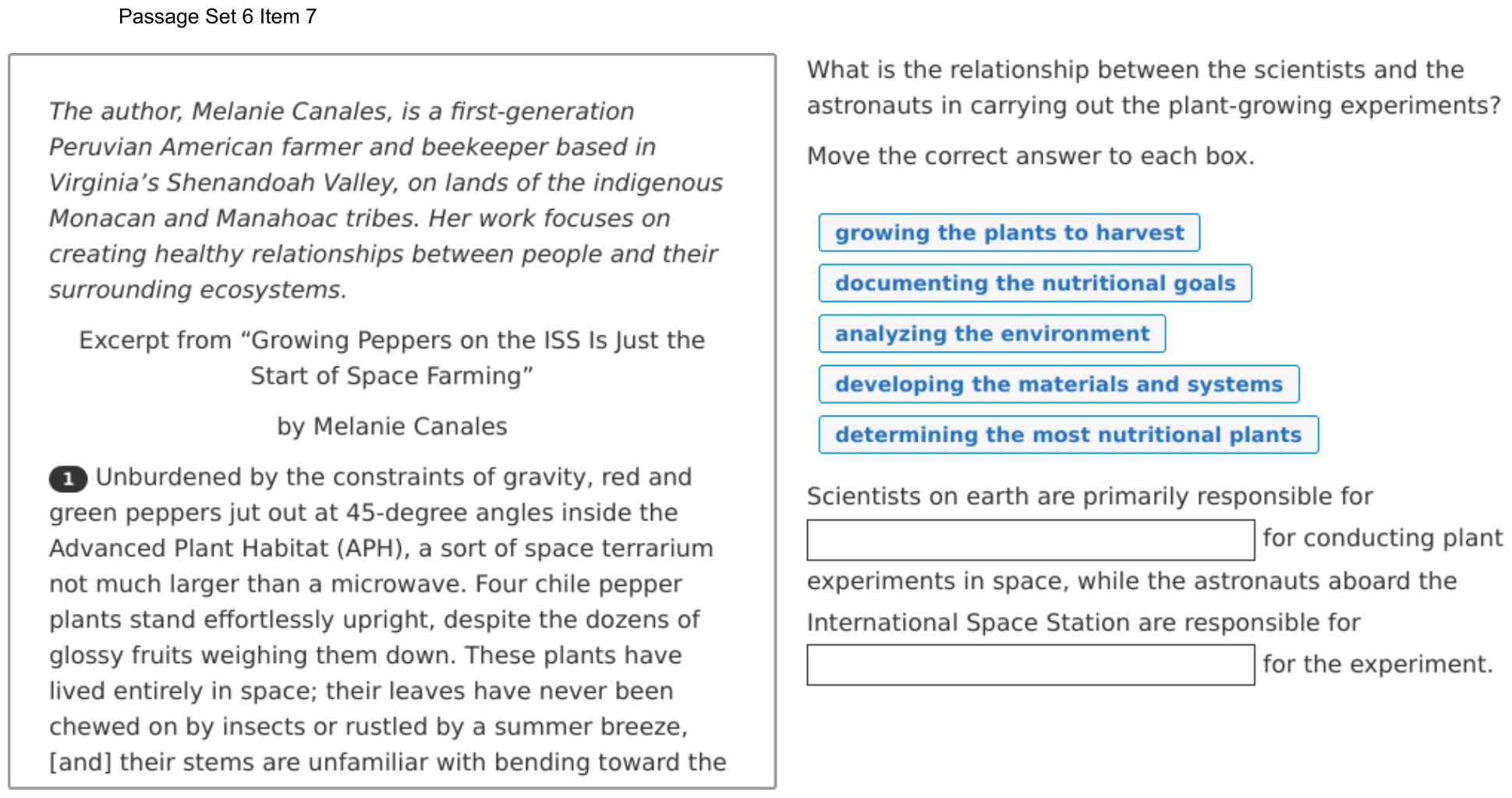
The passage “Excerpt from “Growing Peppers on the ISS Is Just the Start of Space Farming”” as printed (pages 50–51)
Question 10 of 75
2026 Practice Test C English, question 45Passage New York City and the Hudson Valley Brickmaking Industry
New York City and the Hudson Valley Brickmaking Industry
(1) Residents of New York City cannot help but notice that the buildings they are surrounded by are predominantly made of brick. (2) Indeed, one author described the bricks that make up some of New York City’s most recognizable landmarks, including the Empire State Building and the arches of the Brooklyn Bridge, as “an inescapable presence.” (3) Nearly 65 million people visit New York City every year to see these and other attractions. (4) Why was so much brick used in buildings constructed during the century before World War II? (5) The answer involves an explosion in New York City’s population that caused an increase in demand for bricks starting in the mid-1800s and lasting into the 1940s that affected the area more than 100 miles up the Hudson River Valley toward Albany. (6) When demand later declined, the industry would entirely disappear.
(7) New York City’s appetite for brick was fueled by surging population and demand for safer building materials. (8) The city’s population ballooned from about 313,000 people in 1840 to more than 7 million a century later. (9) Following large, destructive fires in the 1830s, the city had enacted laws requiring the use of fire-resistant materials. (10) Bricks turned out to be an inexpensive way for builders to quickly throw together a lot of structures while keeping building owners and safety inspectors happy.
(11) The brickmaking industry in the Hudson Valley skyrocketed. (12) At the industry’s peak, approximately 130 brick factories crammed themselves into a 120-mile stretch along the Hudson River. (13) These factories employed much of the region’s population. (14) Population growth in the Hudson River Valley after the mid-1800s was substantial, though percentage increases were smaller than those in New York City. (15) Even though the factories operated only during the summers, their production was immense. (16) Hudson Valley factories shipped over a billion bricks on barges down the river to New York City annually. (17) In fact, The New York Times declared, “It’s fairly safe to assume that any brick building constructed between 1800 and 1950 includes some form of sediment from the banks of the Hudson River.”
(18) History has proven, however, that boom times eventually end. (19) Shifting architectural trends halted not only the Hudson Valley’s brickmaking boom, but its entire industry. (20) Starting early in the twentieth century, architects and builders increasingly favored steel, glass, and concrete instead of brick. (21) By 1979, reduced demand for brick had driven every Hudson Valley brick factory out of business.
(22) The Hudson Valley’s brickmaking legacy lives on in the architecture of New York City. (23) Throughout the city, famous and ordinary buildings stand as evidence of the remarkable productivity achieved by the Valley’s brickmakers. (24) The brick buildings surrounding New Yorkers today serve as a reminder that, as one amateur brick historian put it, “The skyline of New York City used to be the landscape of the Hudson River Valley.”
Question
Which two sentences present information irrelevant to the ideas in the passage and should be deleted?
Move the two correct answers to the box.
Should Be Deleted
On the test you drag tiles into the box; here, choose them below. The DOE has not published how answers with several parts are scored; this site counts one right only when every part is right.
- A“Nearly 65 million people visit New York City every year to see these and other attractions.” (sentence 3)
- B“The city’s population ballooned from about 313,000 people in 1840 to more than 7 million a century later.” (sentence 8)
- C“Population growth in the Hudson River Valley after the mid-1800s was substantial, though percentage increases were smaller than those in New York City.” (sentence 14)
- D“History has proven, however, that boom times eventually end.” (sentence 18)
- E“Throughout the city, famous and ordinary buildings stand as evidence of the remarkable productivity achieved by the Valley’s brickmakers.” (sentence 23)
Show the answer
Correct answer: A and C
The question asks which two sentences present information irrelevant to the ideas of the passage and should be deleted.
CORRECT. “Nearly 65 million people visit New York City every year to see these and other attractions” (sentence 3) presents irrelevant information and should be deleted. While the statistic is interesting, it focuses on tourism, which is not relevant to either the topic of the passage—the growth and decline of the brickmaking industry—or to the ideas in the first paragraph (sentences 1–6), which focus on the prominence of brick in New York City’s buildings.
Incorrect. “The city’s population ballooned from about 313,000 people in 1840 to more than 7 million a century later” (sentence 8) is relevant to the ideas of the passage and should not be deleted. The numerical details in sentence 8 about the rapid growth in New York City provide relevant evidence that supports a central idea of the passage: that the brickmaking industry of the Hudson River Valley expanded quickly to supply the demands of builders who were, in turn, meeting the demands of a booming population.
CORRECT. “Population growth in the Hudson River Valley after the mid-1800s was substantial, though percentage increases were smaller than those in New York City” (sentence 14) presents irrelevant details and should be deleted. The information in sentence 14 comparing population growth rates between the region and New York City is not needed to develop the passage’s central focus on the rise and decline of the Hudson River Valley’s brickmaking industry. The sentence also does not support ideas in the third paragraph (sentences 11–17). Although it mentions that brick factories employed much of the Hudson River Valley population, the productivity of the factories, rather than the Valley’s population, is the topic of the paragraph.
Incorrect. “History has proven, however, that boom times eventually end” (sentence 18) is relevant to the ideas of the passage and should not be deleted. Sentence 18 effectively introduces the central idea of the passage: the decline of the Hudson River Valley brickmaking industry. The sentence also serves as a clear transition from the third paragraph (sentences 11–17), which provides evidence of the industry’s boom, to the fourth paragraph (sentences 18–21), which provides details about how the industry came to an end.
Incorrect. “Throughout the city, famous and ordinary buildings stand as evidence of the remarkable productivity achieved by the Valley’s brickmakers” (sentence 23) is relevant to the ideas of the passage and should not be deleted. The mention of famous and ordinary buildings provides an effective link to introductory sentences 1 and 2, strengthening the passage’s conclusion, while also emphasizing the productivity of the Hudson Valley brickmaking industry detailed in the third paragraph (sentences 11–17).
Question analysis
This revising question asks which two of five sentences from the passage on the Hudson Valley brickmaking industry present irrelevant information and should be deleted. On the test students move two sentence tiles into a box labeled Should Be Deleted, and both must be right. The five sentences come one from each paragraph, so each must be judged against its own paragraph and the whole passage.
- NYS standards
- 7W2b developing a topic
- Grade level
- Grade 7 reading and task
- Compared with grade 7
- Above grade 7 Grade 7 revision usually asks for one off-topic sentence within one paragraph. Here students check five sentences spread over the whole passage, must find two, and get credit only if both are right, a broader demand than typical grade 7 work.
- Estimated difficulty
- Hard: combines ideas, needs a plan, and has more than one tempting wrong answer.
- Thinking it demands
- Depth of knowledge 2, skills and concepts · mainly analyze
- What makes it hard
- A very close wrong answer moderate
- How sentences fit together moderate
- Much to keep track of minor
- Evidence
- Answered from the whole text
- Reading level
- Passage: about grade 12, 465 words; question and choices: about grade 10, 114 words.
- Corrected from the DOE handbook
- A missing hyphen in a quotation in the explanation was restored.
- A grammatical error in the explanation was corrected.
- Students, last 30 days
- Not enough answers yet to show (it takes 10).
Why it is hard, traps and wrong answers (shows the answer)
Why it is hard
Sentence 3 announces itself: tourism has nothing to do with brick. The second deletion is the trap, because sentence 14 sits after a sentence about factories employing the region’s population and looks like a continuation. Students who reject population as a topic often delete sentence 8 instead, which measures a cause the passage names, and students who judge by sound cut the general “boom times eventually end,” which turns the passage toward the industry’s decline.
A very close wrong answer moderate Choosing the answer
Sentences 8 and 14 are both population statistics; what separates them is that sentence 8 measures the “surging population” sentence 7 names as a cause, while the Valley’s growth in sentence 14 explains nothing. (Embretson & Wetzel, 1987; Gorin & Embretson, 2006; Ascalon et al., 2007)
How sentences fit together moderate Working it out
Each kept sentence earns its place by its links: sentence 18 turns from boom to decline, sentence 23 echoes the landmarks of sentences 1–2, and sentence 14 merely follows sentence 13’s “region’s population.” (Halliday & Hasan, 1976)
Much to keep track of minor Working it out
Five tiles, one from each paragraph, are judged against both their paragraph and the whole passage, and both picks must be right, so two relevance tests run side by side. (Sweller, 1988; Carpenter, Just & Shell, 1990)
Strategy: Sum up the passage’s topic in one phrase, then read each of the five sentences in its paragraph and ask whether removing it would leave a gap in the ideas around it; delete only sentences that leave none.
Traps
- Fixes what isn't broken: Changes a part of the sentence that was already correct, while the real error stays; or, where the question asks which sentence has an error or should go, picks one that is correct and belongs.
- Off the point: Adds or keeps something that does not support the paragraph's or the passage's focus, or an introduction or conclusion that misses the main point.
The wrong answers, classified
B Fixes what isn't broken (Connors & Lunsford, 1988)
Sees a population figure in a passage about bricks and cuts it, missing that sentence 7 names “surging population” as a cause of demand and sentence 8 measures it.
D Fixes what isn't broken (Connors & Lunsford, 1988)
Hears “boom times eventually end” as a cliché that adds nothing, though sentence 18 opens the fourth paragraph and turns the passage from the industry’s growth to its decline.
E Fixes what isn't broken (Connors & Lunsford, 1988)
Thinks sentence 23 only repeats the conclusion around it, though it ties the brickmakers’ output back to the famous buildings of sentences 1–2.
C Off the point (Halliday & Hasan, 1976)
Left unchosen by students who link it to factories that “employed much of the region’s population,” though the paragraph is about the factories’ output, not the Valley’s growth.
What was corrected from the DOE handbook, and why
- Explanation: The handbook’s explanation quotes sentence 14 as “Population growth in the Hudson River Valley after the mid 1800s was substantial.” The passage and the tile say “mid-1800s,” so the site now quotes it that way.
- Explanation: The handbook’s explanation says “The information in sentence 14 comparing population growth rates between the region and New York City are not needed.” The subject is “information,” so the site now says “is not needed.”
Working it out, step by step
Figure out what the question asks
You need to find two sentences that don’t belong. A sentence is irrelevant when it has nothing to do with the main ideas. You can delete it without leaving a gap. On the test you drag two tiles into the Should Be Deleted box. Here, you choose two of the five. Both must be right.
Name the topic of the passage
The passage explains why New York City has so many brick buildings. It tells how the Hudson Valley brick industry grew to meet that demand, then died out. Each paragraph has its own job. Paragraph 1 asks why so much brick was used. Paragraph 2 gives the causes. Paragraph 3 shows how much the factories made. Paragraph 4 tells how the industry ended. Paragraph 5 sums up.
Test sentences 3 and 14
Sentence 3 says: “Nearly 65 million people visit New York City every year to see these and other attractions.” That is about tourists, not bricks. Sentence 14 says: “Population growth in the Hudson River Valley after the mid-1800s was substantial, though percentage increases were smaller than those in New York City.” Paragraph 3 is about how much the factories made, “over a billion bricks” a year. How fast the Valley grew explains nothing about bricks.
Test the other three sentences
- Sentence 8 stays. Sentence 7 says the hunger for brick was “fueled by surging population.” Sentence 8 gives the numbers that show it.
- Sentence 18 stays. It turns the passage from the boom to the decline. A boom is a time of fast growth.
- Sentence 23 stays. It links back to the famous buildings in sentences 1 and 2 and praises the brickmakers.
Watch out: Sentence 14 comes right after one about factories that “employed much of the region’s population.” So it seems to fit. But it changes the topic from factories to population.
Choose the answers
Sentences 3 and 14 add facts that don’t help explain the brick industry. So the answers are A and C. Move these two tiles into the Should Be Deleted box. A is “Nearly 65 million people visit New York City every year to see these and other attractions.” (sentence 3). C is “Population growth in the Hudson River Valley after the mid-1800s was substantial, though percentage increases were smaller than those in New York City.” (sentence 14).
Why this answer and not the closest wrong one
B is the closest wrong answer, since sentences 8 and 14 are both about population. But sentence 8 measures the “surging population” that sentence 7 names as a cause of the demand for brick. Sentence 14 explains nothing about bricks. So delete 14 and keep 8.
More questions like this
The original DOE question
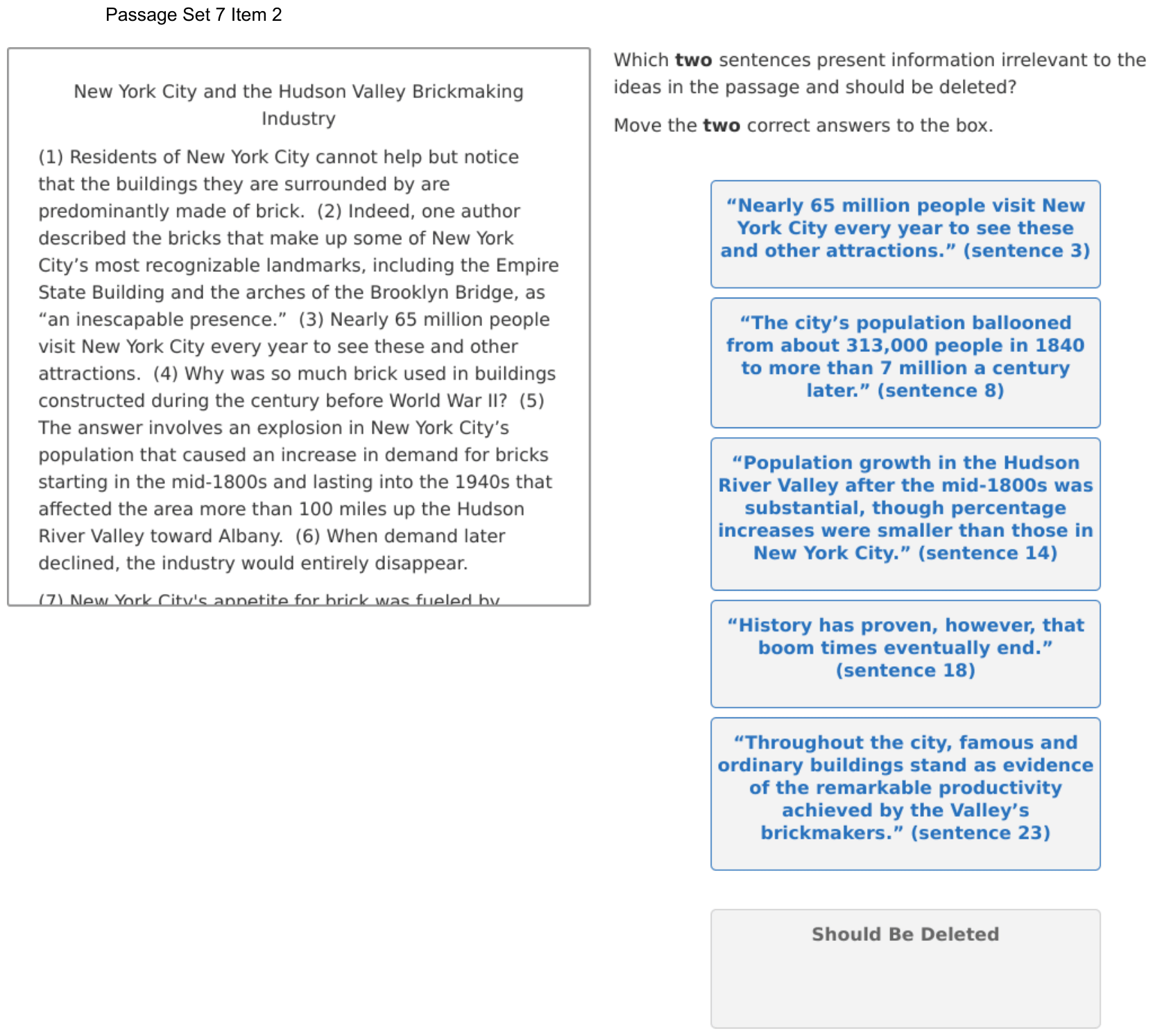
The passage “New York City and the Hudson Valley Brickmaking Industry” as printed (page 64)
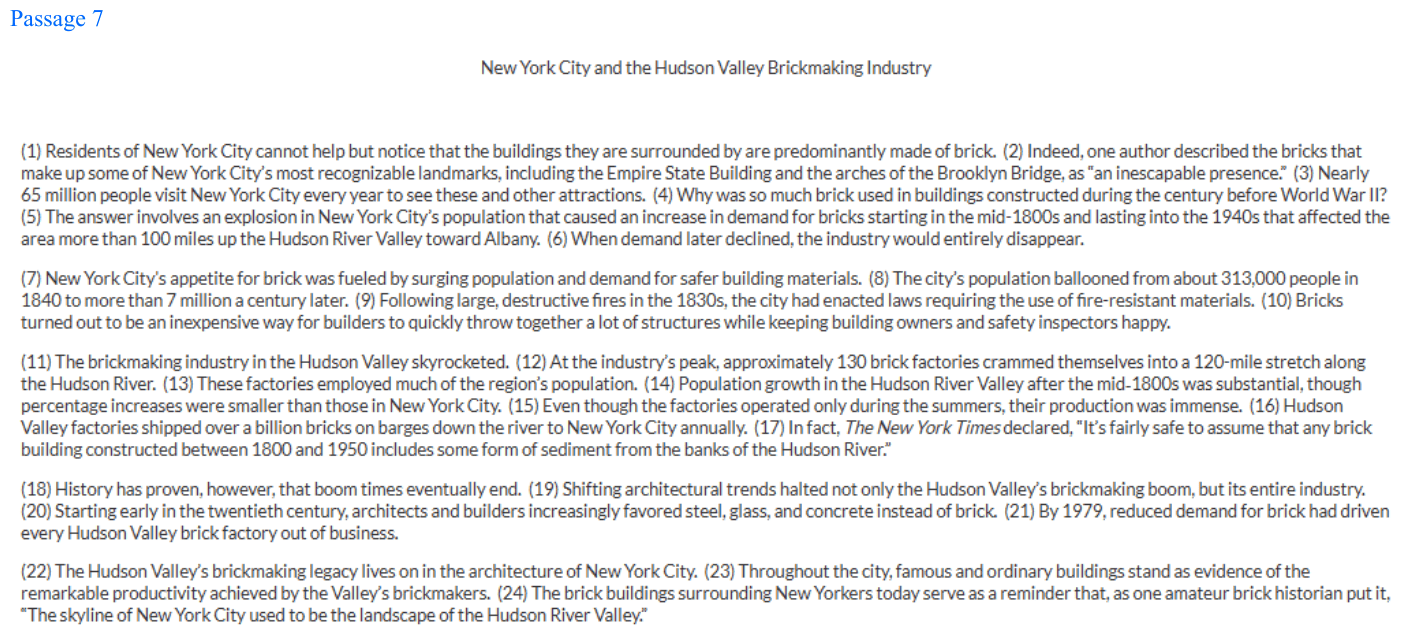
Question 11 of 75
2026 Practice Test C Math, question 4Question
A person buys a used car with a down payment of $1,200 and makes monthly payments of $275 for 3 years. What is the total amount the person pays for the car?
- A$2,025
- B$9,900
- C$11,100
- D$13,500
Show the answer
Correct answer: C
Determine the total cost of the car by adding the down payment to the total monthly payments over 3 years.
There are 12 months in a year, so multiply (12 months/year × 3 years) to get a total of 36 months. Determine the total monthly payments by multiplying the monthly payment ($275) × the total number of months (36):
Determine the total cost of the car by adding the down payment ($1,200) to the total monthly payments ($9,900):
The total cost of the car is $11,100.
Question analysis
A used car is bought with a down payment of $1,200 followed by monthly payments of $275 for 3 years, and students find the total paid. The work is to count the payments, multiply, and add the down payment. Mixing up years and months, or forgetting the money paid up front, leads to the wrong totals among the choices.
- NYS standards
- Grade level
- Grade 6 content, by NYS standard
- Compared with grade 7
- Below grade 7 A total made of one payment up front plus equal monthly payments is a short whole-number calculation, simpler than grade 7 word problems with percents or negatives. The only conversion is from years to months.
- Estimated difficulty
- Routine: one familiar step, little to misread.
- Thinking it demands
- Depth of knowledge 2, skills and concepts · mainly apply
- What makes it hard
- Much to keep track of minor
- Error-prone arithmetic minor
- Solution
- 3 steps
- Reading level
- Question and choices: about grade 5, 29 words.
- Students, last 30 days
- Not enough answers yet to show (it takes 10).
Why it is hard, traps and wrong answers (shows the answer)
Why it is hard
The situation is familiar and the method direct, so this is one of the easier questions on the test. Points are lost in two places: turning 3 years into 36 payments, and remembering the money paid up front after the long multiplication. Each slip, like paying the down payment once a year, leads to a listed total, so checking that the answer holds exactly one $1,200 and 36 payments of $275 is worth the seconds.
Much to keep track of minor Working it out
The $1,200 down payment is paid once while the $275 repeats every month, so it has to be set aside while 36 payments are totaled and then added at the end. (Sweller, 1988; Carpenter, Just & Shell, 1990)
Error-prone arithmetic minor Working it out
The product 275 × 36 = 9,900 is a two-digit multiplication done by hand; splitting it as 275 × 4 = 1,100 and then 1,100 × 9 makes it quick and safe. (Brown & Burton, 1978; Junker & Sijtsma, 2001)
Strategy: Turn 3 years into a number of months, multiply the monthly payment by it, and add the down payment once at the end.
Traps
- Stops one step early: A choice is a number from partway through the solution.
- Units or scale: The answer is wanted in other units, or a rate or scale must be converted first.
- Misreads the question: Misses or misreads a condition or a word in the question: "at least", "each", "remaining", "not".
The wrong answers, classified
A Units or scale (King et al., 2004)
Multiplies the $275 by 3, the number of years, instead of by 36 months, then adds the $1,200 down payment: 825 + 1,200 = 2,025.
B Stops one step early (King et al., 2004; Gierl et al., 2017)
Finds the 36 monthly payments, 36 × $275 = $9,900, and stops without adding the $1,200 down payment made at the start.
D Misreads the question (Hegarty, Mayer & Monk, 1995)
Works out one year as $1,200 + 12 × $275 = $4,500 and multiplies by 3, so the down payment is paid three times instead of once.
Worked solution, step by step
Formulas used
- Changing years into months
- Each year has 12 months. Multiply the number of years by 12 to get the number of months. You need months here because a payment is made every month.
- Total cost with a down payment
- The down payment is money paid once, at the start. The monthly payment is paid every month. Multiply it by the number of months to get all the monthly payments. Then add the down payment only once, because it is paid only once.
Sort out the question
The person pays $1,200 once, at the start. This is the down payment. Then the person pays $275 every month for 3 years. You need the total amount paid for the car.
The payments come once a month, but the time is given in years. So change the years into months first.
Change 3 years into months
Use the months formula:
So the person makes 36 monthly payments.
Watch out: multiplying $275 by 3 counts only 3 payments. That leads to choice A, $2,025.
Add up the monthly payments
Multiply $275 by 36. A quick way is to split 36 into 4 × 9:
So the 36 payments add up to $9,900.
Watch out: stopping here gives choice B, $9,900. The down payment is still missing.
Add the down payment once
Use the total-cost formula:
The person pays $11,100 in all. Adding $1,200 for every year counts it three times. That gives choice D, $13,500.
So the answer is C, $11,100.
Check your answer
Estimate. $275 is a little less than $300, and . Add the $1,200: . The real total should be a little less than $12,000. $11,100 fits.
More questions like this
The original DOE question
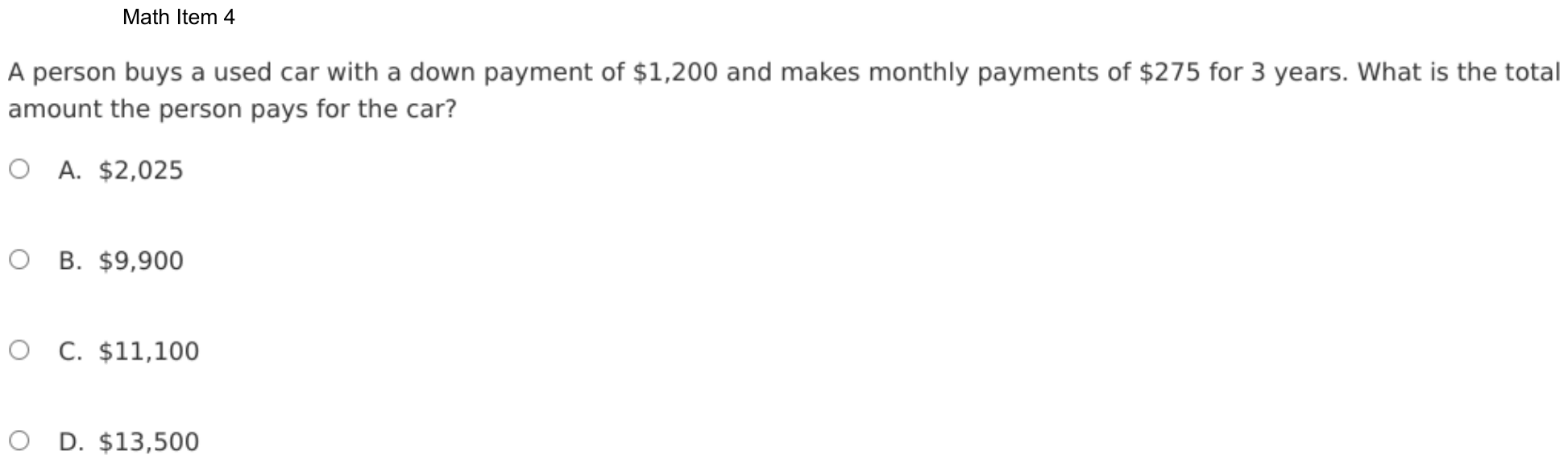
Question 12 of 75
2026 Practice Test C Math, question 8Question
Jordan is helping plan snacks for a school dance. He knows that 0.75 of the students voted for pizza, and he wants to record the same amount using a fraction.
Which fractions are equivalent to the decimal 0.75?
Select the four correct answers.
Choose every answer that is correct, then check. The DOE has not published how answers with several parts are scored; this site counts one right only when every part is right.
- A
- B
- C
- D
- E
- F
Show the answer
Correct answer: A, B, C, and E
Check each fraction to determine whether it is equal to 0.75 when simplified or converted to a decimal.
This is the most common fraction equal to 0.75.
Simplifies to 3/4, because 15 and 20 can both be divided by 5.
This is a direct match to 0.75 when written as a decimal.
, which is less than 0.75.
Simplifies to because both 6 and 8 can be divided by 2.
, which is more than 0.75.
Question analysis
Jordan wants to record 0.75 of the students' pizza votes as a fraction, and students select the four fractions, out of six, that equal 0.75. It tests converting between decimals and fractions and recognizing equivalent fractions. Each choice has to be checked by its value, not by how its numbers look.
- NYS standards
- 7.NS.2d fractions to decimals by long division
- Grade level
- Grade 7 content, by NYS standard
- Compared with grade 7
- Below grade 7 Matching fractions to a decimal such as 0.75 builds on grade 4 to 6 work, and the denominators here divide easily. The added demand is the format: four of the six must be chosen, and one wrong or missing pick loses the item.
- Estimated difficulty
- Straightforward: two steps or one careful reading.
- Thinking it demands
- Depth of knowledge 1, recall and reproduction · mainly apply
- What makes it hard
- Every choice must be checked moderate
- A very close wrong answer minor
- Much to keep track of minor
- Solution
- 2 steps
- Reading level
- Question and choices: about grade 5, 47 words.
- Students, last 30 days
- Not enough answers yet to show (it takes 10).
Why it is hard, traps and wrong answers (shows the answer)
Why it is hard
Three of the four right fractions, 3/4, 75/100 and 6/8, are familiar forms of 0.75, so the item comes down to the fourth. Students who stop after the familiar ones must decide between 15/20, which needs dividing by 5 to recognize, and 8/10, which sits close to 0.75 on a number line. Dividing each numerator by its denominator, or scaling 3/4 up by 5, settles it.
Every choice must be checked moderate Choosing the answer
Six fractions with six different denominators have to be tested one by one, by dividing or by simplifying, since 15/20 and 8/10 cannot be judged by how they look. (Embretson & Wetzel, 1987)
A very close wrong answer minor Choosing the answer
8/10 is 0.8, only 0.05 above 0.75, and it follows 6/8 by adding 2 to the top and the bottom, so it looks like one more member of the family. (Embretson & Wetzel, 1987; Gorin & Embretson, 2006; Ascalon et al., 2007)
Much to keep track of minor Working it out
Four of the six must be chosen and all four must be right for the item to count, so each verdict has to be kept while the remaining fractions are tested. (Sweller, 1988; Carpenter, Just & Shell, 1990)
Strategy: Turn each choice into a decimal by dividing its numerator by its denominator, or reduce it to lowest terms, and keep only the ones whose value is exactly the decimal given.
Traps
- Misunderstands the concept: A wrong belief about a concept: that percents can be added, that area grows like length, that averages can be averaged, that a bigger denominator means a bigger fraction.
The wrong answers, classified
D Little reason to choose it (Haladyna & Downing, 1993; Rodriguez, 2005)
No usual working links 2/5 to 0.75, since 2 ÷ 5 = 0.4, so it mostly catches students filling the fourth slot by guessing.
F Misunderstands the concept (Smith, diSessa & Roschelle, 1993; De Bock et al., 1998; Ni & Zhou, 2005)
Builds 8/10 from 6/8 by adding 2 to the top and the bottom, as if equal additions kept a fraction's value, or accepts 0.8 as close enough.
Worked solution, step by step
Formulas used
- Changing a fraction to a decimal
- a is the numerator, the top. b is the denominator, the bottom. A fraction bar means divide. So dividing the top by the bottom gives the fraction’s value as a decimal.
- Equivalent fractions
- a is the top and b is the bottom. n is a number that goes evenly into both. Dividing the top and the bottom by the same number gives an equal fraction. Equivalent fractions name the same amount in different ways.
Sort out the question
Six fractions are given, A to F. You need the four that equal the decimal 0.75. Equivalent means equal in value. Test every choice, because some fractions look alike but are not equal.
Write 0.75 as a fraction
0.75 means 75 hundredths:
So choice C works. Now simplify it. 25 goes into both 75 and 100:
So choice A, 3/4, works too.
Test choices B and E
Simplify each one to see if it becomes 3/4:
- B: 5 goes into 15 and 20. . It works.
- E: 2 goes into 6 and 8. . It works.
Test choices D and F
Divide the top by the bottom:
- D: . That is less than 0.75.
- F: . That is more than 0.75.
Watch out: F looks like 6/8 with 2 added to the top and the bottom. Adding the same number to both changes the value. Only multiplying or dividing both keeps it.
Name the four answers
A, B, C and E all equal 0.75. On the test, you check the box beside each of them. On this site, you choose all four, then check your answer.
So the answers are A, B, C and E.
Check your answer
Turn each answer into a decimal. , , and all give 0.75. Exactly four choices passed, and the question asks for four. So none were missed.
More questions like this
The original DOE question
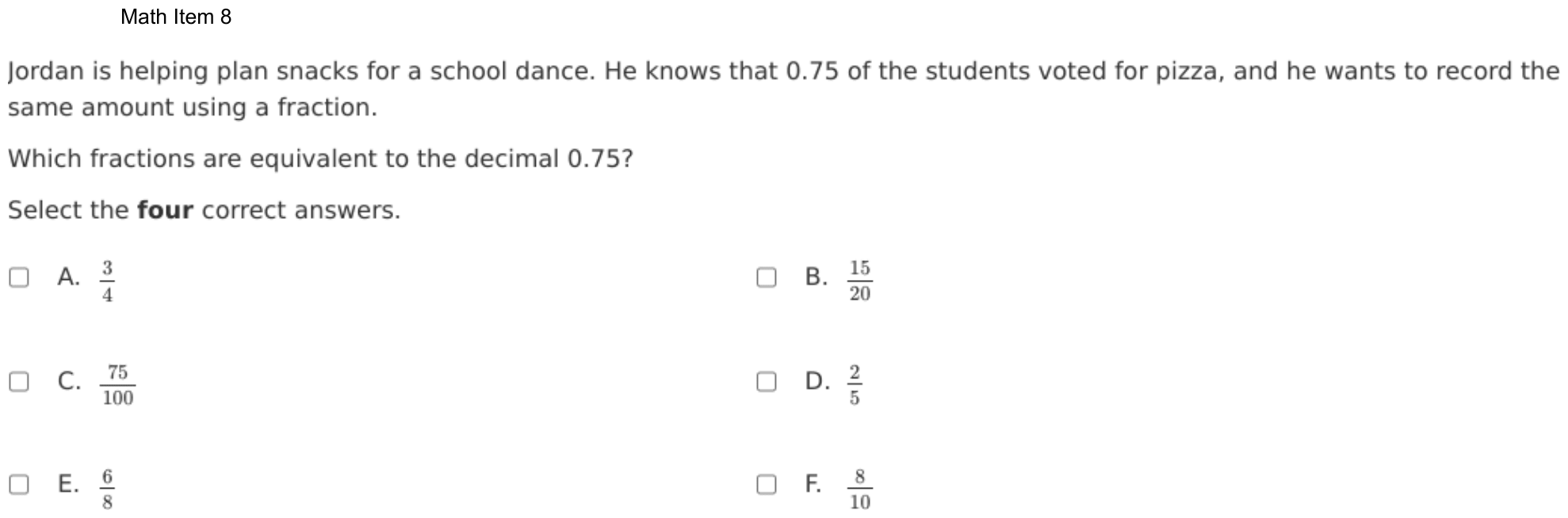
Question 13 of 75
2026 Practice Test C Math, question 20Question
Two circles, with centers at A and C, are shown. Line segment AB is congruent to line segment DE.
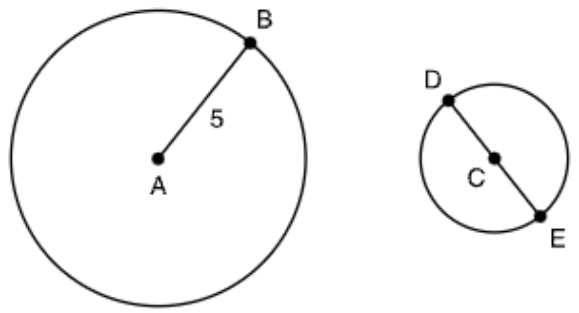
Determine the area, A, and the circumference, C, of each circle to complete the table.
Select one answer in each row.
Choose one answer in each row, then check. The DOE has not published how answers with several parts are scored; this site counts one right only when every part is right.
| Circle A | Circle C | Neither | |
|---|---|---|---|
Show the answer
Correct answer: A = 25π: Circle A; C = 5π: Circle C
: Circle A
: Circle C
As shown in the illustration, AB (the radius of Circle A) is 5 units in length. Since DE (the diameter of Circle C) is congruent to AB, we know it is also 5 units in length.
Circle A:
We know the radius of Circle A is 5 so the answer to row 1 is A.
Circle C:
We have to look for the circle with a diameter of 5. That is circle C.
Question analysis
Two circles centered at A and C are shown: radius AB of Circle A is labeled 5, and segment DE, drawn through C, is congruent to AB. Students decide whether an area of 25π and a circumference of 5π each belong to Circle A, Circle C or neither. Keeping radius and diameter apart, and area and circumference, is the challenge.
- NYS standards
- 7.G.4 circle area and circumference
- Grade level
- Grade 7 content, by NYS standard
- Compared with grade 7
- At grade 7 Applying the area and circumference formulas is the grade 7 circle standard. This gives a radius for one circle and, for the other, a segment known only through congruence, and both rows of the table must be right.
- Estimated difficulty
- Moderate: several steps, or a close reading with one strong distractor.
- Thinking it demands
- Depth of knowledge 2, skills and concepts · mainly apply
- What makes it hard
- Reading a figure, table or graph moderate
- Something you must already know moderate
- Much to keep track of minor
- Solution
- 4 steps
- Reading level
- Question and choices: about grade 5, 40 words.
- Students, last 30 days
- Not enough answers yet to show (it takes 10).
Why it is hard, traps and wrong answers (shows the answer)
Why it is hard
Circle A is direct: its labeled radius of 5 gives an area of 25π. Circle C is where points are lost, since its size comes from a sentence rather than a label, and the segment through its center is a diameter, so its circumference is 5π while its area is only 6.25π. The row labels favor guessers, because the A and C in A = 25π and C = 5π match the circles' names, though they stand for area and circumference.
Reading a figure, table or graph moderate Understanding the question
Circle C's size is shown only by segment DE, drawn through center C with no label, and only the stem's sentence that DE is congruent to AB makes it a diameter of 5. (Lesh, Post & Behr, 1987; Kirsch & Mosenthal, 1990)
Something you must already know moderate Working it out
Neither A = πr² nor C = πd is given, and one circle is measured by a radius and the other by a diameter, so each formula needs the right length. (Anderson & Krathwohl, 2001)
Much to keep track of minor Working it out
Four values are in play, areas of 25π and 6.25π and circumferences of 10π and 5π, and both rows must be matched correctly for the item to count. (Sweller, 1988; Carpenter, Just & Shell, 1990)
Strategy: Write down the radius and the diameter of each circle, compute both circles' areas and circumferences in terms of π, then match each value in the table.
Traps
- Wrong formula: Uses a related but wrong formula: perimeter for area, diameter for radius, area for volume, or a misremembered one.
- Misreads the question: Misses or misreads a condition or a word in the question: "at least", "each", "remaining", "not".
- A formula you must know: Needs a formula the test does not give: area, circumference, volume, probability rules.
The wrong answers, classified
1:B Wrong formula (King et al., 2004)
Squares the diameter instead of the radius, so Circle C's area seems to be π × 5² = 25π while Circle A's becomes 100π.
1:C Wrong formula (King et al., 2004)
Uses 2πr for the area, so Circle A seems to have an area of 10π and Circle C one of 5π, and no circle seems to have 25π.
2:A Wrong formula (King et al., 2004)
Uses π times the radius for the circumference, so Circle A's radius of 5 seems to give a circumference of 5π.
2:C Misreads the question (Hegarty, Mayer & Monk, 1995)
Overlooks that DE is congruent to AB, so Circle C has no known size, and with Circle A's circumference at 10π picks Neither.
Worked solution, step by step
Formulas used
- Area of a circle
- A is the area, the space inside the circle. r is the radius, the distance from the center to the edge. π (pi) is a fixed number, a little more than 3. Square the radius, then multiply by π.
- Circumference of a circle
- C is the circumference, the distance around the circle. d is the diameter, the distance across the circle through its center. A diameter is twice as long as a radius. Multiply the diameter by π.
Sort out the question
Circle A has its center at A. Its radius, AB, is 5. Circle C has its center at C. Segment DE goes through C, so it is a diameter. Congruent means the same length, so DE is 5 too.
Careful: in the table, A means area and C means circumference. Circle A and Circle C are just names.
Find each radius and diameter
Circle A: the radius is 5, so the diameter is .
Circle C: the diameter is 5, so the radius is .
Watch out: without the sentence about DE, Circle C seems to have no size. Then you might pick Neither for the second row.
Check the area row
Use the area formula for each circle. For Circle A:
For Circle C:
Only Circle A has an area of 25π.
Watch out: squaring Circle C’s diameter instead of its radius gives 25π by mistake.
Check the circumference row
Use the circumference formula for each circle. For Circle A:
For Circle C:
Only Circle C has a circumference of 5π.
Watch out: π times the radius is not the circumference. It would give Circle A 5π.
Fill in the table
Choose one button in each row. In the row for A = 25π, choose the Circle A column. In the row for C = 5π, choose the Circle C column. Neither stays empty.
So the answers are A = 25π: Circle A and C = 5π: Circle C.
Check your answer
Compare sizes. Circle A’s radius, 5, is twice Circle C’s radius, 2.5. So the distance around Circle C should be half of Circle A’s 10π. Half of 10π is 5π, which matches. And the bigger circle has the bigger area, 25π.
More questions like this
The original DOE question
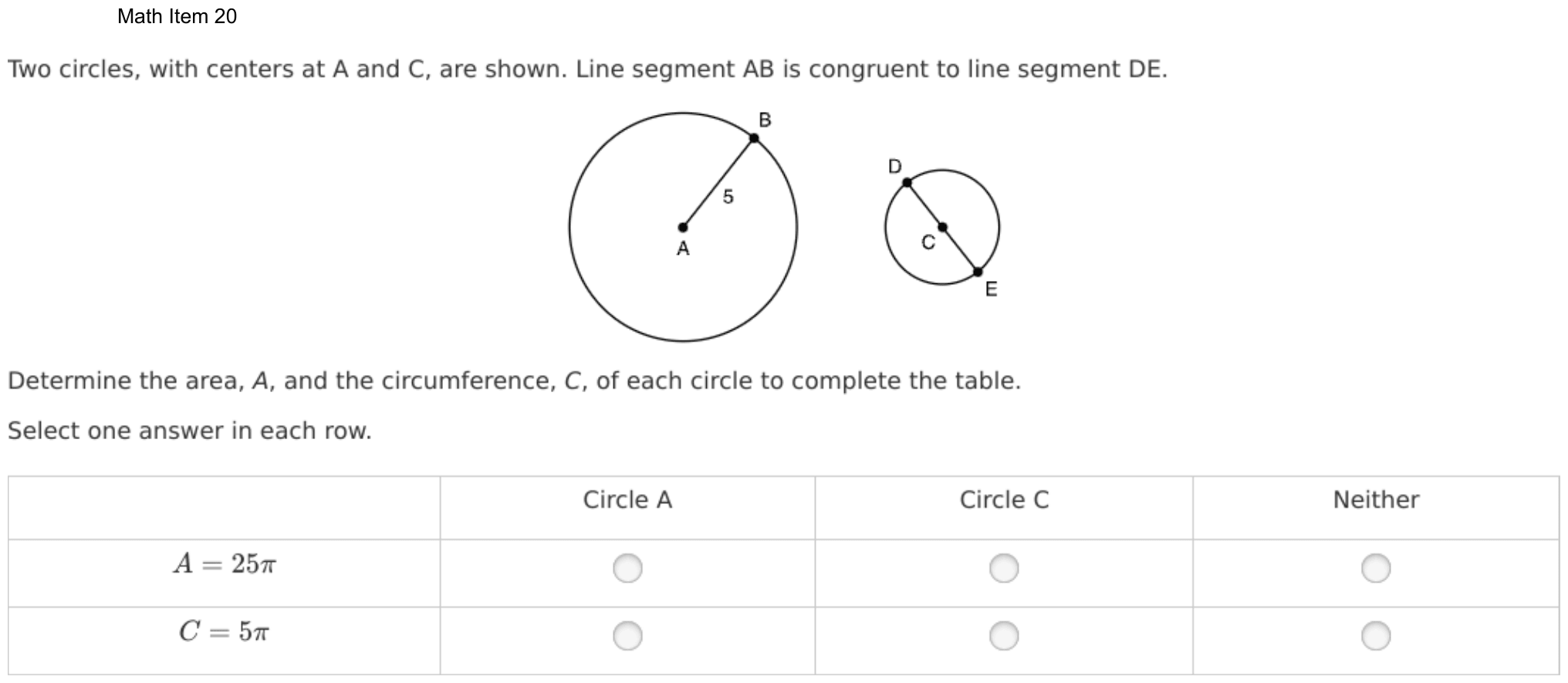
Question 14 of 75
2026 Practice Test C Math, question 21Question
In a fruit basket, the ratio of apples to oranges is the same as the ratio of cherries to walnuts. If there are 6 oranges, 16 cherries, and 48 walnuts, how many apples are there?
- A2
- B3
- C18
- D38
Show the answer
Correct answer: A
The ratios of the items are equal, so they can be expressed using a proportion.
Let a represent the number of apples, o the number of oranges, c the number of cherries, and w the number of walnuts. Write a proportion showing apples:oranges is equal to cherries:walnuts:
Substitute the given values for oranges (6), cherries (16), and walnuts (48):
Cross multiply to form an equation to solve for the number of apples (a):
Solve for the value of a:
Question analysis
In a fruit basket, the ratio of apples to oranges equals the ratio of cherries to walnuts, and students find the number of apples from the counts of oranges, cherries and walnuts. It tests setting up and solving a proportion. Matching each quantity to its place in the ratio matters, since the wrong order gives a very different count.
- Grade level
- Grade 6 content, by NYS standard
- Compared with grade 7
- Below grade 7 Equal ratios with whole numbers are grade 6 work, and the numbers divide evenly. Grade 7 proportion problems are usually longer; here the only care is keeping apples with oranges in the same order as cherries with walnuts.
- Estimated difficulty
- Straightforward: two steps or one careful reading.
- Thinking it demands
- Depth of knowledge 2, skills and concepts · mainly apply
- What makes it hard
- Turning words into math minor
- Much to keep track of minor
- Solution
- 2 steps
- Reading level
- Question and choices: about grade 7, 32 words.
- Students, last 30 days
- Not enough answers yet to show (it takes 10).
Why it is hard, traps and wrong answers (shows the answer)
Why it is hard
The numbers divide evenly, since 16/48 is 1/3, so the work is in the setup. Writing the two ratios in the order the sentence gives them makes the apples a third of the oranges; writing either one upside down makes them three times the oranges. A quick sense check helps: cherries are fewer than walnuts, so apples must be fewer than oranges.
Turning words into math minor Understanding the question
The sentence pairs apples with oranges and cherries with walnuts in the same order, so a/6 = 16/48; reading either pair the other way turns one ratio upside down. (Hegarty, Mayer & Monk, 1995; Koedinger & Nathan, 2004)
Much to keep track of minor Working it out
Four kinds of fruit are named and three counts given, and the unknown apples must be matched with the smaller count, the cherries, not the larger, the walnuts. (Sweller, 1988; Carpenter, Just & Shell, 1990)
Strategy: Write apples over oranges equal to cherries over walnuts, simplify the known ratio, and scale it to match the 6 oranges.
Traps
- Wrong operation: Adds instead of multiplying, divides the wrong way round, turns a ratio or rate upside down, or undoes a step in the wrong direction (subtracts what should be added back).
- Stops one step early: A choice is a number from partway through the solution.
- Misunderstands the concept: A wrong belief about a concept: that percents can be added, that area grows like length, that averages can be averaged, that a bigger denominator means a bigger fraction.
The wrong answers, classified
B Stops one step early (King et al., 2004; Gierl et al., 2017)
Divides the 48 walnuts by the 16 cherries to get the factor 3 and stops before using it to divide the 6 oranges.
C Wrong operation (Hegarty, Mayer & Monk, 1995; King et al., 2004)
Turns one ratio upside down, setting apples over oranges equal to 48 over 16, so the apples come out as 3 × 6 = 18.
D Misunderstands the concept (Smith, diSessa & Roschelle, 1993; De Bock et al., 1998; Ni & Zhou, 2005)
Reasons with differences instead of ratios, taking the gap of 32 between walnuts and cherries and adding it to the 6 oranges.
Worked solution, step by step
Formulas used
- Equal ratios
- A ratio compares two amounts. Writing it as a fraction puts the first thing named on top. The question says the two ratios are the same, so the two fractions are equal. Keep the same order in both.
Sort out the question
A ratio compares two amounts. The ratio of apples to oranges equals the ratio of cherries to walnuts. You know there are 6 oranges, 16 cherries and 48 walnuts. You need the number of apples.
Write the proportion
Put the first thing of each pair on top. Apples go with oranges, and cherries go with walnuts. Let a be the number of apples:
Watch out: keep the order the same. Writing 48 over 16 flips the second ratio. That gives 18, choice C.
Simplify the known ratio
16 goes into both 16 and 48. Divide the top and the bottom by 16:
So there is 1 cherry for every 3 walnuts. There must also be 1 apple for every 3 oranges.
Find the apples
Now the proportion is:
The bottom 6 is 3 × 2, so the top is 1 × 2. That makes .
Watch out: is choice B, but that is not the number of apples. And 38 comes from using differences instead of ratios.
So the answer is A, 2.
Check your answer
Compare the ratios. Apples to oranges is 2 to 6. Cherries to walnuts is 16 to 48. In both, the second number is 3 times the first: and . So the ratios are equal.
More questions like this
The original DOE question
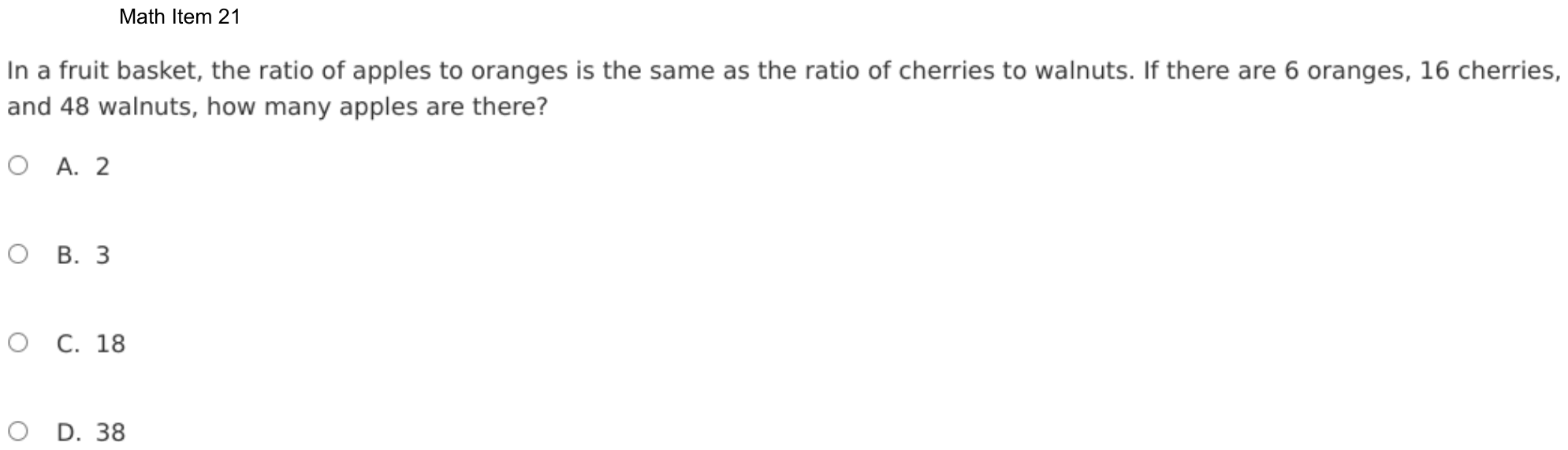
Question 15 of 75
2026 Practice Test C Math, question 24Question
In a showing of an artist’s works, the ratio of the number of paintings, drawings, and photographs shown is 3:5:4, respectively. If the number of drawings shown was 45, what is the total number of photographs and paintings that were shown?
- A36
- B63
- C84
- D108
Show the answer
Correct answer: B
The ratio of paintings to drawings to photographs is .
First, determine the number of actual paintings and photographs.
Since the number of actual drawings is 45, each ratio is multiplied by 9, since .
| Type | Ratio | Actual Number |
|---|---|---|
| Paintings | 3 | 27 |
| Drawings | 5 | 45 |
| Photographs | 4 | 36 |
Then, add the actual number of paintings and photographs.
Question analysis
An art showing has paintings, drawings and photographs in the ratio 3:5:4, and 45 drawings were shown. Students find the total number of photographs and paintings. It tests using a three-part ratio to find actual amounts, and the question asks for two of the three groups together, not any single group or the whole show.
- Grade level
- Grade 7 content, by NYS standard
- Compared with grade 7
- At grade 7 Scaling a ratio from one known part is grade 6 and 7 work. A three-part ratio, and a question about two of the three groups combined, make it a three-step task typical of grade 7 ratio problems.
- Estimated difficulty
- Moderate: several steps, or a close reading with one strong distractor.
- Thinking it demands
- Depth of knowledge 2, skills and concepts · mainly apply
- What makes it hard
- Much to keep track of moderate
- Turning words into math minor
- Solution
- 3 steps
- Reading level
- Question and choices: about grade 10, 39 words.
- Students, last 30 days
- Not enough answers yet to show (it takes 10).
Why it is hard, traps and wrong answers (shows the answer)
Why it is hard
The scale factor comes from one division, 45 ÷ 5 = 9, so the risk lies in what to do with it. Two tempting results are listed: the photographs alone, and the whole show with the drawings added in. Multiplying the 3 + 4 = 7 parts for paintings and photographs by 9 gives the total in one step and avoids both.
Much to keep track of moderate Working it out
The ratio has three parts, the known count belongs to the middle part, drawings, and the question wants the first and third parts combined, so three roles must be tracked. (Sweller, 1988; Carpenter, Just & Shell, 1990)
Turning words into math minor Understanding the question
The word respectively assigns 3, 5 and 4 to paintings, drawings and photographs in that order, and the question then names two of them in the other order. (Hegarty, Mayer & Monk, 1995; Koedinger & Nathan, 2004)
Strategy: Find how many works each ratio part stands for from the drawings, multiply it by the parts for paintings and for photographs, and add only those two.
Traps
- Stops one step early: A choice is a number from partway through the solution.
- Answers a different question: A choice is right for another quantity: the other unknown, the rest instead of the part, the part instead of the whole.
The wrong answers, classified
A Stops one step early (King et al., 2004; Gierl et al., 2017)
Finds the photographs, 4 × 9 = 36, and stops before adding the 27 paintings that the question also asks about.
C Numbers taken from the question (Hegarty, Mayer & Monk, 1995)
Multiplies the 7 parts for paintings and photographs by 12, the total of the ratio's parts, instead of by 9.
D Answers a different question (King et al., 2004; Hegarty, Mayer & Monk, 1995)
Finds every group correctly but adds the 45 drawings too, giving the whole show, 108, rather than the paintings and photographs.
Worked solution, step by step
Formulas used
- Using the parts of a ratio
- The ratio 3:5:4 splits the show into equal parts. Parts is how many parts a group has. Each part stands for the same number of works. Find that number from the group you know, then multiply each group’s parts by it.
Sort out the question
The ratio of paintings to drawings to photographs is 3:5:4. Respectively means in that order: 3 for paintings, 5 for drawings and 4 for photographs. There were 45 drawings. You need the number of photographs and paintings together.
Find the value of one part
Drawings are 5 parts, and there were 45 drawings:
So each part of the ratio stands for 9 works.
Find each group
Multiply each group’s parts by 9:
Type Parts Actual number Paintings 3 Drawings 5 Photographs 4 The drawings row gives 45, which matches the question.
Add only the two groups asked for
Add the paintings and the photographs:
Watch out: 36 alone, choice A, leaves out the paintings. Adding the 45 drawings too gives 108, choice D, the whole show.
So the answer is B, 63.
Check your answer
Paintings and photographs are parts. Each part is 9 works, so . That matches. Also, 63 to 45 is the same as 7 to 5, just as the ratio says.
More questions like this
The original DOE question
Question 16 of 75
2026 Practice Test C Math, question 34Question
A teacher will randomly select 3 students to be on a school committee. He will choose either a student from Classroom A or a student from Classroom B with each selection. This tree diagram shows the selection possibilities.
What is the probability that the teacher will select 2 students from Classroom A and 1 student from Classroom B (in any order) for the committee?
- A
- B
- C
- D
Show the answer
Correct answer: B
The tree diagram shows that each of the 3 randomly selected students is from Classroom A or Classroom B. So the first chosen is either A or B, represented by the left column of the diagram.
The second student is either A or B, so if the first is A, the first two chosen will be either AA or AB. If the first is B, then the first two chosen will be either BA or BB, represented by the middle column.
The third student is either A or B, so if the first 2 were AA, the group of 3 would be either AAA or AAB. These outcomes are represented by the top two boxes of the right column. This pattern is followed so that 8 distinct outcomes can be visualized in order:
AAA, AAB, ABA, ABB, BAA, BAB, BBA, BBB
Since the order does not matter, there are 3 groups made up of 2 students from Classroom A and 1 student from Classroom B: AAB, ABA, and BAA.
Out of 8 possible outcomes, 3 outcomes have 2 students from Classroom A and 1 student from Classroom B. Therefore, the probability is 3 out of 8, or .
Question analysis
A teacher picks 3 students for a committee, each from Classroom A or Classroom B, and a tree diagram shows every possible sequence of picks. Students find the probability of getting 2 students from A and 1 from B in any order. Reading the tree as a list of outcomes, and counting each order, is the key.
- NYS standards
- Grade level
- Grade 7 content, by NYS standard
- Compared with grade 7
- At grade 7 Finding a compound probability from a tree diagram is a grade 7 standard, and here the tree is already drawn. Listing its paths and counting the ones that fit the event, in any order, is typical grade 7 classwork.
- Estimated difficulty
- Straightforward: two steps or one careful reading.
- Thinking it demands
- Depth of knowledge 2, skills and concepts · mainly apply
- What makes it hard
- Reading a figure, table or graph moderate
- Much to keep track of minor
- Solution
- 3 steps
- Reading level
- Question and choices: about grade 7, 65 words.
- Students, last 30 days
- Not enough answers yet to show (it takes 10).
Why it is hard, traps and wrong answers (shows the answer)
Why it is hard
The tree does the hard part of the setup, but it shows each outcome only as a path through three columns, not as a list. The parenthesis “in any order” is the key phrase: missing it leaves a single path, while reading the event loosely, as at least two from Classroom A, adds A, A, A. Writing out all eight paths and marking those with exactly two A’s settles the count.
Reading a figure, table or graph moderate Understanding the question
The tree prints only A or B in each box, so the eight three-pick outcomes, such as A, B, A, have to be read by tracing each path across all three columns. (Lesh, Post & Behr, 1987; Kirsch & Mosenthal, 1990)
Much to keep track of minor Working it out
All eight paths must be tracked while counting those with exactly two A’s and one B, and “in any order” means three of them count, not just A, A, B. (Sweller, 1988; Carpenter, Just & Shell, 1990)
Strategy: Follow each path through the tree to write out every three-letter outcome, mark the ones with exactly two A's and one B, and divide by the total number of outcomes.
Traps
- Misreads the question: Misses or misreads a condition or a word in the question: "at least", "each", "remaining", "not".
- Answers a different question: A choice is right for another quantity: the other unknown, the rest instead of the part, the part instead of the whole.
The wrong answers, classified
A Misreads the question (Hegarty, Mayer & Monk, 1995)
Counts only the path A, A, B, missing the stem’s “in any order”, so it finds 1 of the 8 outcomes instead of 3.
C Answers a different question (King et al., 2004; Hegarty, Mayer & Monk, 1995)
Counts every outcome with at least two picks from Classroom A, adding A, A, A to the three right paths, so 4 of 8, or 1/2.
D Answers a different question (King et al., 2004; Hegarty, Mayer & Monk, 1995)
Counts every outcome that mixes the two classrooms, including those with two from B, so 6 of the 8 outcomes, or 3/4.
Worked solution, step by step
Formulas used
- Probability
- P is the probability, the chance something happens. The top counts the outcomes that fit the event. The bottom counts every outcome that can happen. This works when every outcome is equally likely, like each path through this tree.
Sort out the question
The teacher picks 3 students, one at a time. Each pick is from Classroom A or Classroom B.
You need the chance of getting 2 students from A and 1 from B. The words “in any order” matter. They mean the B can be the first, second or third pick.
List every path in the tree
Each path from left to right is one outcome, or possible result. The top path is A, then A, then A. Read all of them:
AAA, AAB, ABA, ABB, BAA, BAB, BBA, BBB
Each pick has 2 choices, so there are outcomes in all.
Mark the ones that fit
Look for exactly two A’s and one B. Three outcomes fit: AAB, ABA and BAA.
Watch out: counting only AAB misses “in any order” and gives , choice A. AAA has three A’s, not two. Counting it too gives , choice C. Counting every mixed outcome gives , choice D, but three of those have two B’s.
Find the probability
Use the probability formula. 3 outcomes fit, out of 8:
So the answer is B, .
Check your answer
Count every outcome by type. Two A’s and one B: 3 outcomes. Two B’s and one A: 3 outcomes (ABB, BAB, BBA). All A’s: 1. All B’s: 1. , so each outcome was counted once.
More questions like this
The original DOE question
Question 17 of 75
2026 Practice Test C Math, question 36Question
A deck of 52 playing cards contains 13 hearts. Sara has 12 cards from this deck in her hand, 3 of which are hearts. The other cards remain in the deck. What is the probability that a card drawn at random from the remainder of the deck will be a heart?
- A
- B
- C
- D
Show the answer
Correct answer: B
First, determine the number of cards in the remaining deck:
Next, determine the number of hearts left in the remaining deck:
Last, determine the probability of drawing a heart from the remaining deck:
Question analysis
A standard deck of 52 playing cards has 13 hearts, and Sara holds 12 cards, 3 of them hearts. Students find the probability that a card drawn at random from the rest of the deck is a heart. Her hand changes both the number of hearts and the number of cards left, so both counts must be updated.
- NYS standards
- 6.SP.8a uniform probability models
- Grade level
- Grade 6 content, by NYS standard
- Compared with grade 7
- At grade 7 Finding a simple probability is grade 6 content. This one adds a step many grade 7 problems skip: the cards in Sara's hand must be taken out of both the hearts and the whole deck first.
- Estimated difficulty
- Straightforward: two steps or one careful reading.
- Thinking it demands
- Depth of knowledge 2, skills and concepts · mainly apply
- What makes it hard
- Much to keep track of minor
- Turning words into math minor
- Solution
- 3 steps
- Reading level
- Question and choices: about grade 3, 51 words.
- Students, last 30 days
- Not enough answers yet to show (it takes 10).
Why it is hard, traps and wrong answers (shows the answer)
Why it is hard
The careful route takes two subtractions and a fraction: 10 hearts among 40 cards. The numbers are kind, because Sara’s hand is a quarter hearts, just like the full deck, so a student who ignores her hand and divides 13 by 52 also reaches 1/4. The wrong choices come from describing her hand instead of the deck, or from comparing hearts with the cards that are not hearts.
Much to keep track of minor Working it out
Four counts are in play, 52 cards, 13 hearts, Sara’s 12 cards and her 3 hearts, and both the hearts and the total must be reduced before the fraction is formed. (Sweller, 1988; Carpenter, Just & Shell, 1990)
Turning words into math minor Understanding the question
“The other cards remain in the deck” and “the remainder of the deck” point to the 40 cards Sara is not holding, not to the full 52 or to her hand. (Hegarty, Mayer & Monk, 1995; Koedinger & Nathan, 2004)
Strategy: Work out how many cards are left in the deck and how many of them are hearts, then write the hearts left over the cards left and simplify.
Traps
- Answers a different question: A choice is right for another quantity: the other unknown, the rest instead of the part, the part instead of the whole.
- Misunderstands the concept: A wrong belief about a concept: that percents can be added, that area grows like length, that averages can be averaged, that a bigger denominator means a bigger fraction.
- Numbers taken from the question: Combines the numbers in the question without a model of the situation, or is simply a number that appears in the question.
The wrong answers, classified
A Numbers taken from the question (Hegarty, Mayer & Monk, 1995)
Matches the 10 hearts left in the deck to the 10 in 1/10, never dividing them by the 40 cards that remain.
C Answers a different question (King et al., 2004; Hegarty, Mayer & Monk, 1995)
Puts Sara’s 3 hearts over the deck’s 13, or her 12 cards over 52, both 3/13, which describes her hand rather than the cards left.
D Misunderstands the concept (Smith, diSessa & Roschelle, 1993; De Bock et al., 1998; Ni & Zhou, 2005)
Compares the 10 hearts left with the 30 other cards left, a part-to-part ratio of 1 to 3, instead of with all 40 cards.
Worked solution, step by step
Formulas used
- Probability
- P is the probability, the chance something happens. The top counts the cards that are hearts. The bottom counts every card you could draw. Each card is equally likely to be drawn, so the fraction gives the chance.
Sort out the question
A full deck has 52 cards, and 13 of them are hearts. Sara holds 12 cards, and 3 of those are hearts. The rest of the cards stay in the deck.
You need the chance that a card drawn from the rest of the deck is a heart. Her hand changes both counts.
Count the cards left
Take Sara’s 12 cards out of the deck:
So 40 cards are left in the deck.
Count the hearts left
Sara holds 3 of the 13 hearts. Take those out:
So 10 hearts are left in the deck.
Find the probability
Use the probability formula. Put the hearts left over all the cards left, then simplify:
Watch out: comparing the 10 hearts with the 30 cards that are not hearts gives , choice D. The bottom must be all 40 cards. Choice C, , describes Sara’s hand, not the deck. Choice A, , uses the 10 hearts but forgets the 40 cards.
Give the answer
The chance of drawing a heart from the rest of the deck is 1 in 4.
So the answer is B, .
Check your answer
10 is one quarter of 40, because . Here is another check. Sara’s hand is 3 hearts out of 12, which is also one quarter. Taking a hand that is one quarter hearts out of a deck that is one quarter hearts leaves one quarter hearts.
More questions like this
The original DOE question
Question 18 of 75
2026 Practice Test C Math, question 39Question
A shipment contains 170 small boxes of medical supplies. In a random sample of 20 of these boxes, 8 have damage and the others are undamaged. Based on this sample, what is the best prediction of the number of undamaged boxes in the shipment, not including the boxes in the random sample?
- A60
- B68
- C90
- D102
Show the answer
Correct answer: C
Determine the fraction of undamaged boxes in the sample, given 8 of the 20 boxes are damaged.
Subtract the number of boxes in the sample from 170.
Basing the prediction of undamaged boxes on the sample, multiply the number of boxes not in the sample by the fraction of undamaged boxes in the sample.
Question analysis
A shipment holds 170 boxes of medical supplies, and in a random sample of 20, 8 are damaged. Students predict how many undamaged boxes are in the shipment, leaving out the boxes in the sample. It tests using a sample to make a prediction, and the question's two conditions each lead to a different tempting wrong choice.
- Grade level
- Grade 7 content, by NYS standard
- Compared with grade 7
- At grade 7 Predicting from a random sample is grade 7 proportional reasoning. This version adds two conditions, undamaged rather than damaged and the shipment without the sample, so it takes three steps and a close reading.
- Estimated difficulty
- Moderate: several steps, or a close reading with one strong distractor.
- Thinking it demands
- Depth of knowledge 2, skills and concepts · mainly apply
- What makes it hard
- Much to keep track of moderate
- Many steps minor
- Solution
- 3 steps
- Reading level
- Question and choices: about grade 8, 49 words.
- Students, last 30 days
- Not enough answers yet to show (it takes 10).
Why it is hard, traps and wrong answers (shows the answer)
Why it is hard
The proportion itself is routine; the question is built around two conditions that each change the numbers. The stem reports the damaged boxes, but the question asks about undamaged ones, and its bold not removes the 20 sampled boxes from the shipment. Each wrong choice matches one way of mishandling the two conditions, so checking the result against both words, undamaged and not, is what the question rewards.
Much to keep track of moderate Working it out
Two conditions point away from the obvious numbers: the question wants undamaged boxes while the stem counts the 8 damaged, and it leaves out the 20 sampled, so 150 boxes, not 170. (Sweller, 1988; Carpenter, Just & Shell, 1990)
Many steps minor Working it out
Three steps follow in order, the undamaged share 12/20, the 150 boxes outside the sample, and their product, and each wrong turn lands on a listed choice. (Daniel & Embretson, 2010; Enright, Morley & Sheehan, 2002)
Strategy: Find the fraction of the sample that is undamaged, count the boxes that were not sampled, and multiply; then check that the answer describes the group of boxes asked about.
Traps
- Misreads the question: Misses or misreads a condition or a word in the question: "at least", "each", "remaining", "not".
- Answers a different question: A choice is right for another quantity: the other unknown, the rest instead of the part, the part instead of the whole.
The wrong answers, classified
A Answers a different question (King et al., 2004; Hegarty, Mayer & Monk, 1995)
Uses the damaged share, 8 of 20 or 0.4, instead of the undamaged share, taking it of the 150 unsampled boxes: 0.4 × 150 = 60.
B Answers a different question (King et al., 2004; Hegarty, Mayer & Monk, 1995)
Takes the damaged share of the whole shipment, 0.4 × 170 = 68, answering for damaged boxes and keeping the 20 sampled ones as well.
D Misreads the question (Hegarty, Mayer & Monk, 1995)
Finds the undamaged share, 0.6, but takes it of all 170 boxes, missing the bold not that leaves the 20 sampled boxes out: 0.6 × 170 = 102.
Worked solution, step by step
Formulas used
- Predicting from a sample
- A sample is a small group chosen at random from a bigger group. The fraction is the share of the sample with some feature. A random sample is likely to look like the bigger group. So use the same share of the group you are predicting for.
Sort out the question
The shipment has 170 boxes. A random sample of 20 boxes was checked, and 8 of them were damaged.
You need to predict the undamaged boxes in the shipment, not counting the 20 in the sample. Two words matter: undamaged and not.
Find the undamaged share
The sample has undamaged boxes. Write that as a share of the sample, and simplify:
So 0.6, or 60%, of the sample is undamaged.
Watch out: is the damaged share. Using it leads to choice A or B.
Count the boxes outside the sample
The question leaves out the 20 boxes in the sample. Take them away from the shipment:
So the prediction is about 150 boxes.
Make the prediction
Use the same undamaged share for the 150 boxes:
About 90 of those boxes should be undamaged.
Watch out: , choice D, forgets the bold not. It counts the sample boxes again.
Give the answer
The best prediction is 90 undamaged boxes outside the sample.
So the answer is C, 90.
Check your answer
Predict the damaged boxes outside the sample too: . Then , every box outside the sample. Also, 12 out of 20 is a bit more than half. And 90 is a bit more than half of 150.
More questions like this
The original DOE question
Question 19 of 75
2026 Practice Test D English, question 4Passage A Memory Revolution
A Memory Revolution
A high school senior logs on to a computer at the library to double-check the application due date listed on a college admissions website. Nearby, a librarian helps a group of biology students use a database to search for recent studies about mammals. In the past few decades, the Internet has become an integral component of daily life for many people. The seemingly limitless power of search engines made the Internet search extremely common, and today people increasingly rely on the Internet’s vast accumulation of sources to access all types of information. Scientists are beginning to examine how this reliance is modifying the strategies people use to store and prioritize information in their mind.
A Dependable and Valuable Asset
Psychologist Benjamin Storm from the University of California, Santa Cruz, and researchers Sean Stone and Aaron Benjamin devised an experiment to study students’ tendency to depend on the Internet for facts. To begin, the scientists divided sixty participants into multiple groups, including an “Internet” group and a “memory” group, and placed them in front of computers. The Internet group was required to use the search engine Google to answer eight challenging trivia questions. In contrast, participants in the memory group were permitted to use only their personal knowledge to answer the questions. In the second round, the researchers administered notably easier questions. This time, they allowed each group the option of using Google as they answered. Their results showed that 83 percent of the Internet group continued to consult Google in the second round, while only 63 percent of the memory group chose to do so.
People’s growing inclination to rely on the Internet in order to retrieve information, particularly facts and figures, is called cognitive offloading. Canadian researcher Evan F. Risko and British researcher Sam Gilbert, who have written extensively about the topic, say a similar process has been taking place for centuries. In the past, people used resources like encyclopedias to assist their memories; however, today the Internet, serving as a vast extended memory, allows people to digitally access and retrieve much larger volumes of information. Consequently, people’s minds are free for other cognitive feats, such as connecting data, learning new information, or solving problems.
Filing Information Away
The use of the Internet also appears to be modifying the strategies people use to store information in their mind. Researchers Betsy Sparrow from Columbia University, Jenny Liu from the University of Wisconsin-Madison, and Daniel Wegner from Harvard University conducted several studies to discover how people efficiently manage their information intake.
To begin, the researchers examined how people evaluate which information deserves their effort to remember. For this experiment, participants read forty trivia facts, such as “An ostrich’s eye is bigger than its brain,” and typed the statements into a computer file. Half the participants had been previously told the file would be saved, while half believed it would be erased. Next, the participants wrote down every fact they could recall. Those who believed the information would be erased and no longer available could recall 40 percent more facts than those who thought the information would be saved.
In another experiment, the same researchers tested the ability of study participants to remember where to access information. For this trial, participants read and typed trivia statements, which they saved in folders with generic names such as “Facts” and “Items.” After spending ten minutes writing down all the facts they could recall from memory, participants were asked which folder contained a particular fact based on a keyword. For example, “Which folder has the fact about ostriches?” Overall, participants recalled the information’s location more often than the content itself, correctly identifying 49 percent of the folders for specific facts while remembering only 23 percent of the actual trivia. The researchers concluded that our memory is adapting to the Internet age by prioritizing where to locate information even when the specific details are forgotten. According to Sparrow, the Internet has become an important form of transactive memory, an external source of the recollections and associative networks that constitute memory.
As the Internet’s resources continue to expand our “external” memory, some question whether the process may cause people to depend too heavily on technology. However, Steven Pinker, a professor of psychology at Harvard University, says, “Knowledge is increasing exponentially; human brainpower and waking hours are not. Fortunately, the Internet and information technologies are helping us manage, search and retrieve our collective intellectual output at different scales, from Twitter and previews to e-books and online encyclopedias. Far from making us stupid, these technologies are the only things that will keep us smart.”
Question
The study described in paragraph 6 influenced researchers’ ideas about memory in the digital age by
- Ahighlighting instances when organizing detailed information made it easier to remember.
- Bconfirming that keywords can be remembered more easily than large amounts of information.
- Cidentifying a shift in focus from remembering specific information to knowing where to find it.
- Demphasizing that remembering a basic idea is more important than storing detailed information.
Show the answer
Correct answer: C
The question asks how the study described in paragraph 6 influenced researchers’ ideas about memory in the digital age.
A. Incorrect. The study required participants to organize information into folders, but the results suggest that organizing the information did not make the information easier to remember; instead, participants remembered the folder in which to find the information but forgot the information itself.
B. Incorrect. Although the participants in the study were given a keyword, such as “ostrich,” when asked to remember “which folder contained a particular fact,” the study was significant for researchers because it demonstrated that “our memory is adapting to the Internet age by prioritizing where to locate information even when the specific details are forgotten” (paragraph 6). The study confirmed that participants were remembering where the information was stored, because they were able to provide the name of the folder where the information was stored.
C. CORRECT. The study in paragraph 6 demonstrated that participants were better able to recall where to find certain information than to recall the information itself. This influenced researchers’ ideas about memory in the digital age: “Overall, participants recalled the information’s location more often than the content itself, correctly identifying 49 percent of the folders for specific facts while remembering only 23 percent of the actual trivia” (paragraph 6).
D. Incorrect. The study did not examine the relative importance of remembering basic information or storing detailed information. It examined the effect of the Internet on the information that people remember and concluded that human memory “is adapting to the Internet age by prioritizing where to locate information” (paragraph 6).
Question analysis
This development-of-ideas question on “A Memory Revolution” asks how the folder experiment in paragraph 6, where participants saved trivia statements in folders named “Facts” and “Items” and were later quizzed, influenced researchers’ ideas about memory in the digital age. Students must understand what the experiment measured and what the researchers made of it, while the choices echo its keywords, folders and details.
- Grade level
- Grade 7 reading and task
- Compared with grade 7
- At grade 7 Explaining how a study shaped researchers’ thinking is typical grade 7 work with informational texts. The researchers state their conclusion in paragraph 6, which shortens the search, though the paragraph’s percentages and terms such as “transactive memory” need care.
- Estimated difficulty
- Straightforward: two steps or one careful reading.
- Thinking it demands
- Depth of knowledge 2, skills and concepts · mainly understand
- What makes it hard
- A very close wrong answer minor
- Much to keep track of minor
- Evidence
- Answered from one paragraph or stanza
- Reading level
- Passage: about grade 14, 763 words; question and choices: about grade 13, 67 words.
- Corrected from the DOE handbook
- A mislabeled term in the explanation was corrected.
- Students, last 30 days
- Not enough answers yet to show (it takes 10).
Why it is hard, traps and wrong answers (shows the answer)
Why it is hard
The researchers state their conclusion in paragraph 6, that memory is “prioritizing where to locate information even when the specific details are forgotten,” so the question mostly rewards recognizing it in new words. The risk lies in the experiment’s moving parts: a student who mixes up the folder, the fact and the keyword can believe that filing helped recall or that keywords were the finding. The closest wrong choice keeps the downgrading of detail and swaps a basic idea in for location.
A very close wrong answer minor Choosing the answer
The choice about a basic idea mirrors the key’s first half, detailed information losing out; it differs only in what wins, a basic idea instead of knowing where the information is kept. (Embretson & Wetzel, 1987; Gorin & Embretson, 2006; Ascalon et al., 2007)
Much to keep track of minor Working it out
Paragraph 6 juggles three things a participant might recall, the fact, its folder and the keyword cue, plus two percentages, so students must keep straight that 49 percent is folders and 23 percent is trivia. (Sweller, 1988; Carpenter, Just & Shell, 1990)
Strategy: Locate the researchers’ own conclusion in paragraph 6, restate it in plain words, and choose the option that matches it, not one that borrows a word from the description of the experiment.
Traps
- Reads too much in: A reasonable-sounding conclusion that goes further than the text allows.
- Word match: Repeats striking words or phrases from the text, so it looks supported, but its meaning does not fit the question.
- Twists what the text says: Uses the text's topic and ideas but changes what it says: who did it, how much, when, or why.
The wrong answers, classified
A Reads too much in (Graesser, Singer & Trabasso, 1994)
Assumes filing the facts in folders must have helped people remember them, though participants recalled only 23 percent of the trivia while naming the right folder 49 percent of the time.
B Word match (Freedle & Kostin, 1993)
Seizes on “keyword” in paragraph 6, but the keyword was only the cue in the question put to participants; what they remembered best was a folder with a generic name such as “Facts.”
D Twists what the text says (King et al., 2004)
Reads “prioritizing” as a ranking of what matters and turns knowing where a fact is kept into remembering a basic idea, though participants recalled locations, not the gist of the facts.
What was corrected from the DOE handbook, and why
- Explanation: The DOE’s explanation of Option B ends by saying that participants “were able to provide the name of the folder (keyword) where the information was stored.” In paragraph 6 the keyword is the cue the participants were given (the same explanation begins “the participants in the study were given a keyword, such as ‘ostrich’”); the folders had generic names such as “Facts” and “Items.” Calling the folder name a keyword makes the sentence seem to support Option B (“keywords can be remembered more easily”), the option it is rejecting. The site drops “(keyword).”
Working it out, step by step
Figure out what the question asks
This asks what the study in paragraph 6 taught the researchers about memory today. The researchers state their own conclusion in the paragraph. Find it, put it in plain words, and match it to a choice.
Follow the steps of the study
Participants typed trivia facts and saved them in folders. The folders had plain names, such as “Facts” and “Items.” Later each person got a keyword, a hint word, in a question like “Which folder has the fact about ostriches?” The result: “participants recalled the information’s location more often than the content itself, correctly identifying 49 percent of the folders for specific facts while remembering only 23 percent of the actual trivia.”
Read the researchers’ conclusion
Paragraph 6 says “our memory is adapting to the Internet age by prioritizing where to locate information even when the specific details are forgotten.” To prioritize is to put first. So people now put first knowing where a fact is kept. They may forget the fact itself. That is a shift in focus, a change in what memory pays attention to.
Check each choice
- A does not fit. Filing the facts in folders did not help people remember them. They recalled only 23 percent of the facts.
- B does not fit. The keyword, like “ostriches,” was only the hint in the question. What people remembered was the folder, such as “Facts.”
- C fits. Memory shifted from the facts themselves to where to find them.
- D does not fit. People remembered locations, not a basic idea of each fact.
Watch out: D is tempting because “prioritizing” sounds like deciding what matters most. But the study ranked nothing. It found that people recalled where facts were, not what they said.
Choose the answer
The study showed people remembering where facts were kept better than the facts. So the answer is C, “identifying a shift in focus from remembering specific information to knowing where to find it.”
Why this answer and not the closest wrong one
D is the closest wrong choice. Like C, it says detailed facts lose out. But it says a basic idea wins instead. In the study, what won was location: 49 percent of the folders against 23 percent of the facts. C names location, so C matches the researchers’ own conclusion.
More questions like this
The original DOE question
The passage “A Memory Revolution” as printed (pages 3–4)
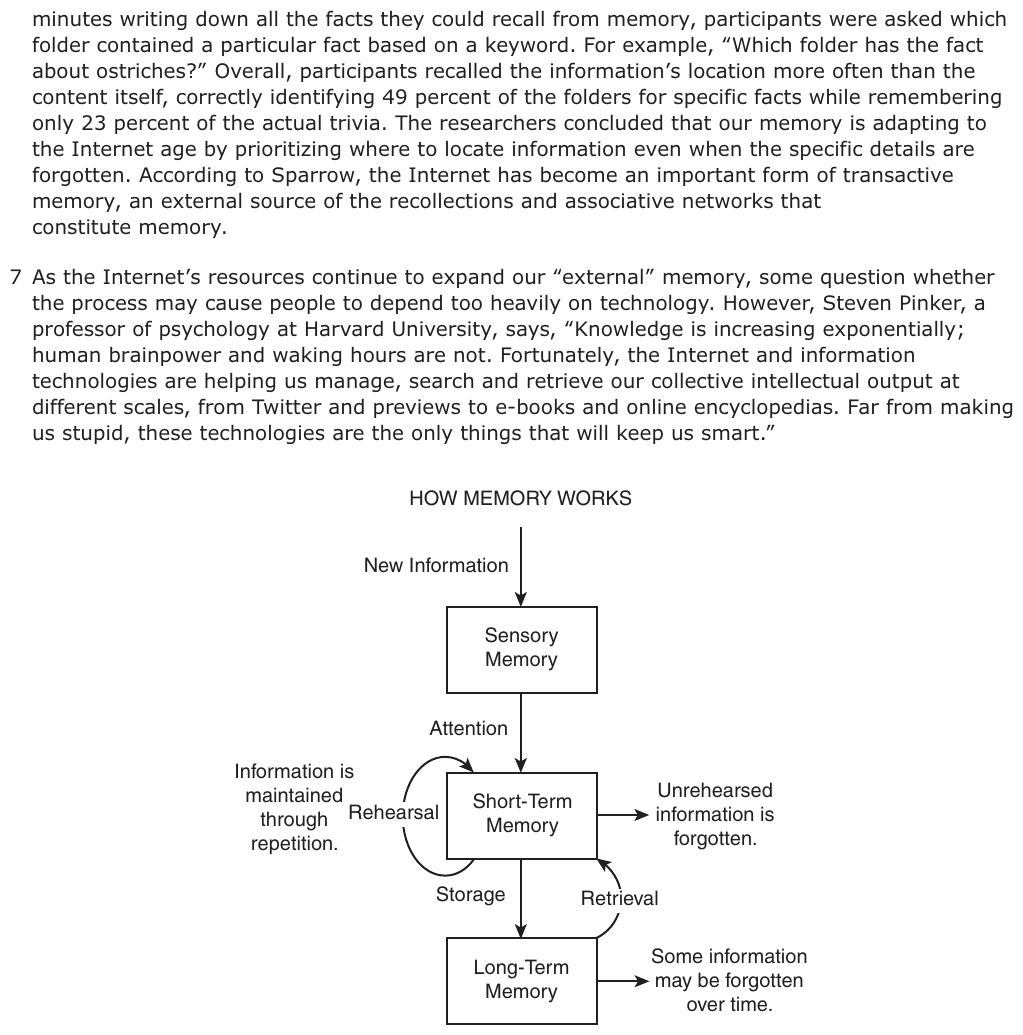
Question 20 of 75
2026 Practice Test D English, question 36Passage Martial Arts for the Mind and Body
Martial Arts for the Mind and Body
(1) The martial arts blend a series of physical movements with strategic mental discipline so that practitioners can defend themselves, physically defeat an opponent, or both. (2) Historians are unsure of exactly when and where martial arts were first used. (3) Martial arts have been practiced by several different societies for many centuries. (4) Martial arts such as karate, kung fu, tae kwon do, and judo are still taught and practiced as methods of self-defense, but they offer students more than that. (5) The study of martial arts can provide students with a way to enhance their mental discipline as well as their physical fitness.
(6) Discipline, focus, and respect are important qualities for everyone to have. (7) However, for most people these qualities are not innate; they must be learned and practiced. (8) The study of martial arts can provide an opportunity to develop these skills. (9) Students are rewarded for their dedication by passing tests and advancing to higher ranks or levels. (10) For example, in a typical tae kwon do class, students learn discipline by diligently practicing moves, improve focus by listening carefully, and demonstrate respect by bowing to the instructor and following directions.
(11) For teenagers, martial arts classes provide a safe and structured environment for gaining physical skills, building confidence, and enjoying a sense of community. (12) A lot of teens go through hard situations as they try to do well in school and in life. (13) A martial arts class can provide teens with a physical outlet for stress while also challenging them mentally. (14) Participating in a martial arts program also helps children and teens focus on self-improvement rather than on competition. (15) Progressing through levels of achievement involves mastering more physically demanding techniques. (16) It requires students to take responsibility and be accountable for achieving set goals. (17) Students gain confidence and experience companionship with other students who are progressing through the ranks.
(18) Adults who practice martial arts can experience many of the same benefits that younger people do, but perhaps the greatest of these is health and fitness. (19) Adult martial arts students often see changes in their body within weeks of beginning a program.
(20) For people interested in studying a martial art, there are many ways to learn and practice. (21) In addition to private studios, community recreation centers often offer low-cost or free martial arts classes. (22) There are even online videos that introduce students to the basic concepts. (23) People should study martial arts.
Question
Where should sentence 10 be moved to improve the organization of the second paragraph (sentences 6–10)?
- Ato the beginning of the paragraph (before sentence 6)
- Bbetween sentences 6 and 7
- Cbetween sentences 7 and 8
- Dbetween sentences 8 and 9
Show the answer
Correct answer: D
The question asks where sentence 10 should be moved to improve the organization of the second paragraph.
A. Incorrect. Starting this paragraph with sentence 10 would weaken the paragraph’s organization because it would place a supporting detail sentence (sentence 10) before the topic sentence (sentence 6). Sentence 6 belongs at the beginning of the paragraph because it introduces the topic—the qualities of discipline, focus, and respect. Sentence 10 supports the key idea of the paragraph, that these qualities can be developed through the study of martial arts. If sentence 10 preceded sentence 6, the transitional phrase “for example” would refer to an unspecified topic and idea.
B. Incorrect. Sentence 6 presents the idea that “discipline, focus, and respect are important qualities for everyone to have,” but the example in sentence 10 does not directly relate to this idea. Sentence 10 explains how martial arts develop these qualities, not why they are important qualities to have. Because sentence 10 is not directly related to the idea in sentence 6 (the qualities are important), it should not follow sentence 6.
C. Incorrect. Sentences 7 and 8 should not be separated, because the idea presented in sentence 8—that “the study of martial arts can provide an opportunity to develop these skills”—is directly related to the idea from sentence 7—that the skills of discipline, focus, and respect “are not innate; they must be learned and practiced.” Sentence 10 supports the idea from sentence 8 by describing an example from a typical martial arts class, so sentence 10 should not precede sentence 8.
D. CORRECT. This option is correct because sentence 10 logically follows and supports the idea in sentence 8 that “the study of martial arts can provide an opportunity to develop” the qualities of discipline, focus, and respect. Sentence 10 explains this idea with examples, describing three specific ways that students in a typical tae kwon do class develop discipline, focus, and respect—by “diligently practicing,” “listening carefully,” and “bowing to the instructor and following directions.”
Question analysis
This organization question asks where sentence 10, a “For example” sentence describing a typical tae kwon do class, should be moved within the second paragraph of the martial arts passage. Students must work out what idea the example illustrates and read the paragraph with the sentence in each position, since several spots sound acceptable.
- Grade level
- Grade 7 reading and task
- Compared with grade 7
- At grade 7 Placing a sentence where it supports the right idea is regular grade 7 revision work. The paragraph is five plain sentences and the opening “For example” is a strong clue, which keeps the demand typical of grade 7.
- Estimated difficulty
- Moderate: several steps, or a close reading with one strong distractor.
- Thinking it demands
- Depth of knowledge 2, skills and concepts · mainly analyze
- What makes it hard
- How sentences fit together moderate
- A very close wrong answer minor
- Much to keep track of minor
- Evidence
- Answered from one paragraph or stanza
- Reading level
- Passage: about grade 11, 402 words; question and choices: about grade 7, 31 words.
- Students, last 30 days
- Not enough answers yet to show (it takes 10).
Why it is hard, traps and wrong answers (shows the answer)
Why it is hard
The example sentence fits loosely almost anywhere in a paragraph about discipline, focus and respect, so students have to ask what exactly it is an example of. The slot just before sentence 8 is the trap: the class’s practicing seems to illustrate sentence 7’s claim that the qualities “must be learned and practiced,” but the paragraph has not yet brought in martial arts. Those who match the example to sentence 8’s claim about martial arts place it correctly.
How sentences fit together moderate Working it out
Sentence 10 opens with “For example,” so it must follow the claim it illustrates, sentence 8’s point that studying martial arts can “develop these skills,” before sentence 9 turns to rewards. (Halliday & Hasan, 1976)
A very close wrong answer minor Choosing the answer
The slots before and after sentence 8 are neighbors, and the tae kwon do class could seem to illustrate sentence 7 as well as sentence 8, so only rereading tells them apart. (Embretson & Wetzel, 1987; Gorin & Embretson, 2006; Ascalon et al., 2007)
Much to keep track of minor Working it out
Each of the four positions means rereading a five-sentence paragraph in a new order in your head while keeping track of what “these qualities” and “these skills” refer to. (Sweller, 1988; Carpenter, Just & Shell, 1990)
Strategy: Ask which sentence the tae kwon do class is an example of, then reread the paragraph with sentence 10 placed right after it and check that every sentence still follows the one before.
Traps
- Sentence in the wrong place: Puts a sentence where it breaks the order of ideas or separates it from what it refers to.
The wrong answers, classified
A Sentence in the wrong place (Halliday & Hasan, 1976)
Moves the example to the front, where “For example” would point back to nothing and the topic sentence would come after its own illustration.
B Sentence in the wrong place (Halliday & Hasan, 1976)
Places the example after sentence 6, but the class shows how the qualities are built, not why everyone needs them, and it would cut sentence 7’s “However” off from sentence 6.
C Sentence in the wrong place (Halliday & Hasan, 1976)
Hears sentence 7’s “learned and practiced” echoed in “learn” and “practicing,” but the example must come after sentence 8, which first connects the qualities to martial arts.
Working it out, step by step
Figure out what the question asks
This asks where to move sentence 10 so paragraph 2 reads in a better order. Sentence 10 starts with “For example.” So it must come right after the idea it is an example of.
Name the rule
An example goes right after the claim it shows. “For example” points back to the sentence before it. For instance: Reading builds your word power. For example, you meet new words in every book. If the example came first, it would point back to nothing.
Find what sentence 10 shows
Sentence 10 says students “learn discipline by diligently practicing moves, improve focus by listening carefully, and demonstrate respect by bowing to the instructor and following directions.” Diligently means with steady, careful effort. This shows how martial arts build those three qualities. Sentence 8 makes that claim: “The study of martial arts can provide an opportunity to develop these skills.” So sentence 10 belongs right after sentence 8.
Read the new order
Now the paragraph runs 6, 7, 8, 10, 9. Sentence 6 names the qualities. Sentence 7 says they “must be learned and practiced.” Sentence 8 says martial arts can build them. Sentence 10 gives the tae kwon do example. Then sentence 9 tells how students are rewarded. Each sentence leads to the next.
Check each choice
- A is wrong. “For example” would point back to nothing.
- B is wrong. Sentence 6 says why the qualities matter, but the class shows how they are built. It would also cut sentence 7’s “However” off from sentence 6.
- C is wrong. Sentence 7 never mentions martial arts. Sentence 8 is the first to link the qualities to martial arts.
- D is right. The example follows the claim it shows.
Watch out: Sentence 7 says “learned and practiced,” and sentence 10 uses “learn” and “practicing.” That echo pulls you toward C.
Choose the answer
Sentence 10 gives an example of sentence 8’s claim. It belongs right after it. So the answer is D, “between sentences 8 and 9.”
Why this answer and not the closest wrong one
C is the closest wrong answer, because sentence 7 talks about learning and practice too. But sentence 7 does not mention martial arts. Sentence 8 claims that martial arts can build these skills, and the tae kwon do class is an example of exactly that. So the example belongs right after sentence 8.
More questions like this
The original DOE question
The passage “Martial Arts for the Mind and Body” as printed (page 52)
Question 21 of 75
2026 Practice Test D English, question 49Question
Read this sentence.
Robert Cornelius is credited with taking the first, official selfie as a daguerreotype, an image recorded on a copper plate coated in silver, using a process that was more complicated than photos of today which are digitized or printed from film and do not require subjects to sit for nearly fifteen minutes to avoid blurring the image.
Which two edits should be made to correct the sentence?
Select the two correct answers.
Choose every answer that is correct, then check. The DOE has not published how answers with several parts are scored; this site counts one right only when every part is right.
- ADelete the comma after first.
- BDelete the comma after daguerreotype.
- CDelete the comma after silver.
- DAdd a comma after today.
- EAdd a comma after film.
Show the answer
Correct answer: A and D
The question asks which two edits should be made to correct the sentence.
A. CORRECT. The comma after “first” must be deleted to correct the sentence. The adjectives “first” and “official” are not coordinate adjectives that independently modify the noun “selfie.” Cornelius did not take the “first selfie” and also the “official selfie.” Rather, he took the first selfie that was considered official. Placing a comma between the words “first” and “official” incorrectly separates two adjectives that work together to describe the selfie.
B. Incorrect. The comma after “daguerreotype” must not be deleted, because it is used correctly to introduce an explanation. The phrase “an image recorded on a copper plate coated in silver” is an appositive—a noun phrase that defines “daguerreotype.”
C. Incorrect. The comma after “silver” is placed correctly, marking the end of the phrase “an image recorded on a copper plate coated in silver” that defines “daguerreotype.” Because the sentence continues to explain the process Robert Cornelius used, the comma after “silver” is needed to end the appositive and separate it from the phrase that follows.
D. CORRECT. A comma is needed after “today” because the following phrase, “which are digitized or printed from film,” is a nonrestrictive clause that gives nonessential information about the “photos of today” preceding it.
E. Incorrect. No comma is needed after “film,” because the words “and do not require subjects to sit” are part of the same relative clause that begins with “which are digitized…”. The conjunction “and” joins two predicates within the same clause. Both actions belong to the same clause and the same subject (which); they are not separate independent clauses that need to be punctuated with a comma.
Question analysis
This punctuation question gives one long sentence about Robert Cornelius, credited with one of the earliest selfies, and the daguerreotype, an image made on a silver-coated copper plate, and asks which two of five comma edits correct it. Five words are underlined, and each needs its own decision about a comma, with credit only when both chosen edits are right.
- NYS standards
- 7L2 capitalization, punctuation, and spelling
- Grade level
- Grade 8 reading and task
- Compared with grade 7
- Above grade 7 The comma rules tested appear in the grade 6 and 7 standards, but the sentence runs 57 words, two of the rules are subtle ones, and both selections must be right, which makes this harder than typical grade 7 editing.
- Estimated difficulty
- Hard: combines ideas, needs a plan, and has more than one tempting wrong answer.
- Thinking it demands
- Depth of knowledge 2, skills and concepts · mainly apply
- What makes it hard
- A rule that doesn't sound wrong major
- Much to keep track of moderate
- Complex sentences moderate
- Evidence
- Answered from one sentence or line
- Reading level
- Question and choices: about grade 7, 100 words.
- Corrected from the DOE handbook
- A grammar term in the explanation was corrected.
- Students, last 30 days
- Not enough answers yet to show (it takes 10).
Why it is hard, traps and wrong answers (shows the answer)
Why it is hard
The sentence is long, two of its five decisions turn on subtle comma rules, and the site counts the answer right only when both edits are right. The comma before “and do not require” is the strongest trap, because a comma before “and” is a habit many students apply without checking whether a new clause begins. The paired commas around “an image recorded on a copper plate coated in silver” are already correct, and deleting either one breaks the pair.
A rule that doesn't sound wrong major Working it out
Both needed edits rest on rules students rarely hear: “first, official” are not coordinate adjectives, so no comma, and “which are digitized” adds nonessential detail about photos of today, so it needs one. (Connors & Lunsford, 1988)
Much to keep track of moderate Working it out
There are five comma decisions in one sentence and both selections must be right to score, so each edit is judged on its own while the rest of the sentence is held in mind. (Sweller, 1988; Carpenter, Just & Shell, 1990)
Complex sentences moderate Understanding the question
The sentence runs 57 words and stacks an appositive, a participial phrase beginning “using a process,” and a relative clause with two verbs, so finding where each phrase starts and ends is itself the task. (Abedi & Lord, 2001; Freedle & Kostin, 1993; Messick, 1989)
Strategy: Take the five underlined words one at a time: name what the phrase after each one does in the sentence, decide whether a comma belongs there, and choose only the two edits you are sure of.
Traps
- Punctuation: A comma, semicolon, colon, dash or apostrophe used where it does not belong, or missing where it does.
The wrong answers, classified
B Punctuation (Connors & Lunsford, 1988)
Deletes the comma that opens the appositive “an image recorded on a copper plate coated in silver,” which defines daguerreotype and must be set off from it.
C Punctuation (Connors & Lunsford, 1988)
Deletes the comma that closes the same appositive, perhaps feeling the sentence has too many commas, though a phrase set off mid-sentence needs a comma on each side.
E Punctuation (Connors & Lunsford, 1988)
Applies the habit of a comma before “and,” though here “and” joins two verbs that share one subject, “which,” inside one clause, not two complete clauses.
A Punctuation (Connors & Lunsford, 1988)
Left out by students who think a comma always separates two adjectives, though “first” describes “official selfie” as a unit, so the adjectives are not coordinate.
D Punctuation (Connors & Lunsford, 1988)
Left out by students who read “photos of today which are digitized” as one essential phrase, missing that the which-clause adds nonessential detail and needs a comma.
What was corrected from the DOE handbook, and why
- Explanation: The DOE’s explanation of Option C says the comma after “silver” “is needed to separate the clauses.” Neither side of that comma is a clause. Before it is the appositive “an image recorded on a copper plate coated in silver,” as the explanations of Options B and C say; after it is the phrase “using a process that was more complicated…,” a participial phrase with no subject of its own. The comma ends the appositive. The site now says the comma “is needed to end the appositive and separate it from the phrase that follows.”
Working it out, step by step
Figure out what the question asks
This asks which two comma edits fix the sentence. Five words are underlined. Decide about each comma one at a time. You must pick both right edits.
Check the comma after first
A comma goes between two describing words only if each one describes the noun on its own. Test it: can you put “and” between them? A long and hard test works, so you write a long, hard test. But the first and official selfie sounds wrong. “First” describes “official selfie” as a unit. So delete the comma after first. That is A.
Check the commas around silver
“An image recorded on a copper plate coated in silver” tells what a daguerreotype is. A phrase that renames the noun just before it is called an appositive. An appositive in the middle of a sentence needs a comma on each side. Example: My dog, a small beagle, loves walks. So keep the commas after daguerreotype and silver. B and C are wrong.
Check the comma after today
A clause is a group of words with its own verb. “Which are digitized or printed from film” is a clause that adds extra facts about photos of today. A “which” clause that adds extra facts gets a comma before it. Example: I read that book, which is very long. So add a comma after today. That is D.
Check the comma after film
The words “and do not require subjects to sit” are part of the same “which” clause. “Which” is the subject of both verbs, “are digitized or printed” and “do not require.” When “and” joins two verbs that share one subject, no comma goes before it. Example: She sings and dances. So E is wrong.
Watch out: Many students put a comma before every “and.” That leads to E. A comma goes before “and” when it joins two full sentences, not two verbs.
Choose the answers
Delete the comma after first, and add a comma after today. So the answers are A and D. Be sure to select both of them.
Why this answer and not the closest wrong one
E is the closest wrong answer, because a comma before “and” is a common habit. But after film, “and” joins two verbs that share one subject, “which.” No new sentence starts there, so no comma belongs. A and D fix the two real errors.
More questions like this
The original DOE question
Question 22 of 75
2026 Practice Test D Math, question 9Question
Let m be a negative integer and k be a positive integer.
Which of the expressions below must result in a positive value?
Select the three correct answers.
Choose every answer that is correct, then check. The DOE has not published how answers with several parts are scored; this site counts one right only when every part is right.
- A
- B
- C
- D
- E
Show the answer
Correct answer: A, B, and D
Each of the expressions must be considered:
, where m is a negative integer and k is a positive integer: Correct
The “−” in front of m acts like a multiplier that flips the sign of m, so is positive when m is negative and k is positive.
, where m is a negative integer and k is a positive integer: Correct
The “−” in front of m acts like a multiplier that flips the sign of m, so is positive when m is negative and k is positive.
, where m is a negative integer and k is a positive integer:
A negative number minus a positive number gives a negative number.
, where m is a negative integer and k is a positive integer: Correct
A positive times a negative is a negative. Then, taking the opposite of that makes it positive.
, where m is a negative integer and k is a positive integer:
A negative divided by a positive remains negative.
Therefore, , , and must all result in a positive number.
Question analysis
Given that m is a negative integer and k a positive integer, students select the three expressions, out of five, that must have a positive value. It tests the sign rules for adding, subtracting, multiplying and dividing integers. Minus signs in front of letters, and letters in place of numbers, make each sign easy to misjudge, and all three must be found.
- NYS standards
- Grade level
- Grade 7 content, by NYS standard
- Compared with grade 7
- At grade 7 Sign rules for adding, subtracting, multiplying and dividing integers are core grade 7 content. Here they are applied to letters with known signs instead of numbers, across five expressions, and all three right ones must be chosen with no wrong one.
- Estimated difficulty
- Moderate: several steps, or a close reading with one strong distractor.
- Thinking it demands
- Depth of knowledge 2, skills and concepts · mainly analyze
- What makes it hard
- Variables instead of numbers moderate
- Every choice must be checked moderate
- Much to keep track of minor
- Solution
- 3 steps
- Reading level
- Question and choices: about grade 8, 33 words.
- Students, last 30 days
- Not enough answers yet to show (it takes 10).
Why it is hard, traps and wrong answers (shows the answer)
Why it is hard
Each expression needs only one sign rule, but the minus signs are placed to mislead. In −k · m the leading minus seems to make the result negative until the sign of m is counted, and in m − k two negatives seem to cancel, though subtracting makes the result more negative. Substituting one negative and one positive value into all five gives three positive results and two negative ones, the count the item asks for.
Variables instead of numbers moderate Understanding the question
Only the signs of m and k are known, so the sign of each expression must be reasoned from the rules or tested with values such as m = −2 and k = 3. (Koedinger & Nathan, 2004; Enright, Morley & Sheehan, 2002)
Every choice must be checked moderate Choosing the answer
All five expressions mix the same two letters with minus signs, so none can be dismissed at a glance; each is judged on its own and exactly three must be picked. (Embretson & Wetzel, 1987)
Much to keep track of minor Working it out
The item scores only when all three positive expressions are chosen and both negative ones left out, so five separate verdicts must be kept and combined. (Sweller, 1988; Carpenter, Just & Shell, 1990)
Strategy: Substitute sample values, such as m = −2 and k = 3, into all five expressions and note each sign, then confirm with the sign rules that no other values could change it.
Traps
- Negatives and direction: Arithmetic with negative numbers, the order of a subtraction, or direction on a number line. (Moving a term across the equals sign without changing its sign is a faulty procedure.)
- Misunderstands the concept: A wrong belief about a concept: that percents can be added, that area grows like length, that averages can be averaged, that a bigger denominator means a bigger fraction.
The wrong answers, classified
C Misunderstands the concept (Smith, diSessa & Roschelle, 1993; De Bock et al., 1998; Ni & Zhou, 2005)
Sees two negatives, m and the minus before k, and applies “two negatives make a positive” to subtraction, though a negative minus a positive moves further below zero.
D Negatives and direction (Brown & Burton, 1978)
Left out by students who read the leading minus in −k · m as making the product negative, missing that m is negative too, so the product is positive.
E Negatives and direction (Brown & Burton, 1978)
Sees no minus sign in m/k and takes it as positive, forgetting that m itself is negative, so the quotient of a negative and a positive is negative.
Worked solution, step by step
Formulas used
- The opposite of a number
- a is any positive number, so −a is negative. A minus sign in front of a number or letter means its opposite: the same distance from 0, on the other side. The opposite of a negative number is positive. So if m is negative, −m is positive.
- Signs when you multiply or divide
- a and b are positive numbers, so −a and −b are negative. Two negatives multiply to a positive. A negative and a positive multiply or divide to a negative. These rules tell you the sign of an answer without knowing the numbers.
Sort out the question
m is a negative integer, a whole number below 0, such as −2. k is a positive integer, such as 3. You must pick the three expressions that are always positive. Check all five, and test m = −2 and k = 3 as you go.
Understand the minus in front
A minus sign in front of a letter means the opposite of that number. Since m is negative, −m is positive. Since k is positive, −k is negative. With the test values, −m = 2 and −k = −3.
Check choices A and B
A: is a positive plus a positive, so it is always positive. Test: 2 + 3 = 5.
B: is a positive times a positive, so it is always positive. The dot · means times. Test: 2 × 3 = 6.
Check choices C and E
C: starts below 0 and moves further down, so it is always negative. Test: −2 − 3 = −5.
E: is a negative divided by a positive, so it is always negative. Test: −2 ÷ 3 = −2/3.
Watch out: two negatives make a positive only when you multiply or divide them. Choice C subtracts, so it stays negative. Choice E shows no minus sign, but m itself is negative.
Check choice D
D: is a negative times a negative, so it is always positive. Test: −3 × (−2) = 6.
Watch out: the minus sign in front makes D look negative. But m is negative too, and the two negatives make a positive. Skipping D leaves you one answer short.
Choose the three answers
Choices C and E are always negative, so leave them out. The three positive ones are A, B and D. On the test, you check the box next to each one.
So the answers are A, B and D.
Check your answer
Try different values, such as m = −10 and k = 1. A: 10 + 1 = 11. B: 10 × 1 = 10. D: −1 × (−10) = 10. All three are positive again. C gives −11 and E gives −10, both negative.
More questions like this
The original DOE question
Question 23 of 75
2026 Practice Test D Math, question 29Question
Karl has one red spinner and one blue spinner. Each spinner is divided into 4 equal sections, numbered 1 through 4. He spins each spinner once and writes down the number that each lands on. What is the probability that the two numbers, when multiplied together, will have 4 as a product?
- A
- B
- C
- D
Show the answer
Correct answer: B
There are four possible outcomes for each spin of the spinner:
1, 2, 3, 4
The possible outcomes of two spins are:
Of the 16 possible outcomes, only 3 pairings have a product of 4: 14, 22, and 41.
Therefore, the probability that the two numbers resulting from two consecutive spins have a product of 4 is .
Question analysis
Karl spins a red spinner and a blue spinner, each with four equal sections numbered 1 to 4, and multiplies the two results. This compound probability question asks for the chance that the product is 4. Students build the sample space of outcomes, and listing every pair rather than the ones that come to mind is the safe route.
- NYS standards
- Grade level
- Grade 7 content, by NYS standard
- Compared with grade 7
- At grade 7 Finding a compound probability from a list or table of equally likely outcomes is standard grade 7 work. Two four-section spinners give a small sample space that is quick to write out, and the event needs one careful scan of the products.
- Estimated difficulty
- Moderate: several steps, or a close reading with one strong distractor.
- Thinking it demands
- Depth of knowledge 2, skills and concepts · mainly apply
- What makes it hard
- Something you must already know moderate
- Much to keep track of minor
- Solution
- 3 steps
- Reading level
- Question and choices: about grade 5, 52 words.
- Students, last 30 days
- Not enough answers yet to show (it takes 10).
Why it is hard, traps and wrong answers (shows the answer)
Why it is hard
The question is decided by the count of favorable outcomes, not by any calculation. Students who think of 4 only as 2 × 2 find one outcome, and those who think in factor pairs find two, which is not a listed choice and should send them back to the table. A 4-by-4 grid of products, red down the side and blue across, shows all three cells at once.
Something you must already know moderate Working it out
Nothing in the stem says that red 1 with blue 4 and red 4 with blue 1 are separate outcomes, or that two four-part spinners give 16 equally likely pairs. (Anderson & Krathwohl, 2001)
Much to keep track of minor Working it out
All 16 pairs must be scanned for a product of 4, and the two pairs that use 1 and 4 are easy to miss beside the obvious 2 times 2. (Sweller, 1988; Carpenter, Just & Shell, 1990)
Strategy: Make a 4-by-4 table with the red spinner's numbers down the side and the blue spinner's across the top, write each product in its cell, and count the cells that match.
Traps
- Misreads the question: Misses or misreads a condition or a word in the question: "at least", "each", "remaining", "not".
- Stops one step early: A choice is a number from partway through the solution.
The wrong answers, classified
A Stops one step early (King et al., 2004; Gierl et al., 2017)
Finds only the double, 2 and 2, and stops, missing the two outcomes in which a 1 on one spinner meets a 4 on the other.
C Little reason to choose it (Haladyna & Downing, 1993; Rodriguez, 2005)
No count of the 16 outcomes gives a denominator of 7, so 4/7 has no working behind it and mostly attracts guesses.
D Misreads the question (Hegarty, Mayer & Monk, 1995)
Counts the 7 outcomes in which either spinner shows a 4, reading “4 as a product” as a pair that simply contains a 4.
Worked solution, step by step
Formulas used
- Probability of an event
- P is the probability, the chance that something happens. An outcome is one possible result. This works when every outcome is equally likely, like landing on equal sections of a spinner.
- Counting outcomes of two actions
- a is the number of results for the first action, and b is the number for the second. Each result of the first can go with each result of the second, so you multiply.
Sort out the question
Karl spins two spinners, one red and one blue. Each has 4 equal sections, numbered 1 to 4. He multiplies the two numbers. You need the probability that the product, the answer to a multiplication, is 4.
Count all the outcomes
The red spinner has 4 results, and so does the blue one. Each red result can go with each blue result:
So there are 16 outcomes, all equally likely. Red 1 with blue 4 is not the same as red 4 with blue 1. They come from different spinners.
Make a table of products
Write each product in a table. Red goes down the side and blue goes across the top.
Red × Blue 1 2 3 4 1 1 2 3 4 2 2 4 6 8 3 3 6 9 12 4 4 8 12 16 Three cells show 4: red 1 with blue 4, red 2 with blue 2, and red 4 with blue 1.
Watch out: thinking of 4 only as 2 × 2 finds one outcome. That gives 1/16, choice A.
Find the probability
Use the probability rule. Three outcomes give 4, out of 16 in all:
Watch out: 7 outcomes have a 4 on at least one spinner. But that counts pairs that show a 4, not pairs whose product is 4. That mistake gives 7/16, choice D.
So the answer is B, .
Check your answer
List the ways to multiply two numbers from 1 to 4 and get 4: , and . That is 3 ways. The table has 16 cells, and 13 of them are not 4. So a small chance like 3/16 makes sense.
More questions like this
The original DOE question
Question 24 of 75
2026 Practice Test D Math, question 31Question
A box contains an unknown number of green marbles. An experimenter adds 100 red marbles to the box, mixes the marbles thoroughly, and then draws out 10 marbles at random. Assume that this sample is representative of the proportion in the box. If there are 2 red marbles and 8 green marbles in this sample, approximately how many green marbles are in the box?
- A80
- B300
- C400
- D500
Show the answer
Correct answer: C
In this context, the phrase “this sample is representative” means that the ratio of 2 red marbles to 8 green marbles is the same as the ratio of red to green marbles in the entire box. Use this ratio of 2 to 8 to set up a proportion and solve, where x represents the number of green marbles in the box.
Question analysis
An experimenter adds 100 red marbles to a box of green marbles, mixes them, and draws a sample of 10 with 2 red and 8 green. This sampling question asks students to estimate how many green marbles the box holds. It applies a ratio from a representative sample, worked from a count known for the box rather than for the sample.
- Grade level
- Grade 6 content, by NYS standard
- Compared with grade 7
- At grade 7 Using a representative sample to reason about a population is grade 6 and 7 work. The twist is that the known count, the 100 red marbles added, belongs to the box rather than the sample, so the usual scaling runs in an unfamiliar direction.
- Estimated difficulty
- Moderate: several steps, or a close reading with one strong distractor.
- Thinking it demands
- Depth of knowledge 2, skills and concepts · mainly apply
- What makes it hard
- Turning words into math moderate
- Much to keep track of minor
- Solution
- 2 steps
- Reading level
- Question and choices: about grade 8, 60 words.
- Students, last 30 days
- Not enough answers yet to show (it takes 10).
Why it is hard, traps and wrong answers (shows the answer)
Why it is hard
This is the logic of estimating a population by tagging, and the twist is that the known count belongs to the marbles that were added, not to the ones being estimated. Scaling the sample up by 50, so that its 2 red become the box’s 100, turns its 8 green into the estimate in one step. Students who scale by way of the whole box often stop at the box’s total, and those who treat 100 as the whole box scale the wrong amount.
Turning words into math moderate Understanding the question
The 100 red marbles are counted in the box, while the 2 red and 8 green are counted in a sample of 10, so “representative of the proportion” must become 2 : 8 = 100 : x. (Hegarty, Mayer & Monk, 1995; Koedinger & Nathan, 2004)
Much to keep track of minor Working it out
Three ratios can be read from the sample, red to green, red to all and green to all, and only the first two connect to the known 100 red marbles. (Sweller, 1988; Carpenter, Just & Shell, 1990)
Strategy: Use the sample's ratio of red to green marbles, then scale it up until the red part matches the 100 red marbles known to be in the box.
Traps
- Answers a different question: A choice is right for another quantity: the other unknown, the rest instead of the part, the part instead of the whole.
- Misunderstands the concept: A wrong belief about a concept: that percents can be added, that area grows like length, that averages can be averaged, that a bigger denominator means a bigger fraction.
The wrong answers, classified
A Misreads the question (Hegarty, Mayer & Monk, 1995)
Scales the sample’s 8 green in 10 up to 100 marbles, getting 80, as if the 100 red marbles added were every marble in the box.
B Misunderstands the concept (Smith, diSessa & Roschelle, 1993; De Bock et al., 1998; Ni & Zhou, 2005)
Reads the sample’s 2 to 8 as red to all marbles, so 2/8 = 100/400 makes 400 marbles in the box, then subtracts the 100 red ones.
D Answers a different question (King et al., 2004; Hegarty, Mayer & Monk, 1995)
Uses 2 red in 10 marbles to find 500 marbles in the whole box, then stops without taking away the 100 red ones to leave the green.
Worked solution, step by step
Formulas used
- Equal ratios (a proportion)
- A ratio compares two amounts. A proportion says two ratios are equal. A sample that is representative has the same mix as the whole box. So the box is the sample scaled up.
Sort out the question
You know:
- The box has an unknown number of green marbles.
- 100 red marbles are added to the box.
- A sample of 10 marbles has 2 red and 8 green.
Representative means the sample has the same mix as the box. You need the number of green marbles in the box. Notice that the 100 red marbles are counted in the box, not in the sample.
Set up the proportion
In the sample, red to green is 2 to 8. In the box, red to green is 100 to x, where x is the number of green marbles. The two ratios are equal:
Scale up the sample
How do you get from 2 red to 100 red? Multiply by 50, since . The green marbles grow by the same factor:
So the box has about 400 green marbles.
Avoid the tempting wrong totals
Watch out: there is another way that can trip you up. In the sample, 2 of 10 marbles are red. So the 100 red marbles are 2/10 of the box, and the box holds 500 marbles in all. But 100 of those are red. Stopping at 500 gives choice D.
Taking away the red ones gives green marbles, the same answer. Treating 100 as the whole box gives 80 green, choice A. Reading 2 to 8 as red to all marbles gives 300, choice B.
So the answer is C, 400.
Check your answer
Picture the finished box: 400 green and 100 red, so 500 marbles. The red part is . The sample had red too. The mix matches, so 400 makes sense.
More questions like this
The original DOE question
Question 25 of 75
2026 Practice Test D Math, question 37Question
What 3-digit number between 630 and 650 is divisible by both 5 and 8?
Enter your answer in the space.
Fill-in question: work out the answer and type it as a number.
Show the answer
Correct answer: 640
The final digit of the three-digit number is 0. Each of the digits 0 through 9, inclusive, must be considered.
To narrow the choices, first consider that the number between 630 and 650 must be divisible by both 5 and 8.
A number divisible by 5 must end in 0 or 5. Therefore, the only possibilities are 0 and 5.
-
If the number ended in 0, the whole number 640 must also be divisible by 8:
Both result in a remainder of 0.
-
If the number ended in 5, the whole numbers 635 and 645 must also be divisible by 8:
Dividing 635 by 5 results in a remainder of 0, but dividing 635 by 8 results in a remainder of 3.
Dividing 645 by 5 results in a remainder of 0, but dividing 645 by 8 results in a remainder of 5.
Therefore, 640 is the only whole number between 630 and 650 that is divisible by both 5 and 8.
Question analysis
This number question asks for the 3-digit number between 630 and 650 that is divisible by both 5 and 8, typed into a box. Students use divisibility rules or common multiples to find it. The work is short, but the number has to pass both tests, so checking only one divisor is the easy slip.
- NYS standards
- 6.NS.4 common factors and multiples
- Grade level
- Grade 6 content, by NYS standard
- Compared with grade 7
- Below grade 7 Common multiples are grade 6 content. Divisibility by 5 limits the last digit, and only a few numbers lie between 630 and 650, so this is a quick check, shorter than typical grade 7 work.
- Estimated difficulty
- Routine: one familiar step, little to misread.
- Thinking it demands
- Depth of knowledge 1, recall and reproduction · mainly apply
- What makes it hard
- Solution
- 2 steps
- Reading level
- Question and choices: about grade 5, 16 words.
- Students, last 30 days
- Not enough answers yet to show (it takes 10).
Why it is hard, traps and wrong answers (shows the answer)
Why it is hard
Few numbers need checking, so most students succeed; the risk is testing only one divisor. Students who start from multiples of 8 meet 632 first, and those who start from multiples of 5 can slip on 645 ÷ 8. Using the least common multiple, 40, shows at once that the number must be a multiple of 40, which leaves one candidate in the range.
Much to keep track of minor Working it out
Each candidate must pass two tests, divisible by 5 and by 8, and both ends of the range, 630 and 650, pass the first test but fail the second. (Sweller, 1988; Carpenter, Just & Shell, 1990)
Something you must already know minor Working it out
The shortcut that a multiple of 5 ends in 0 or 5 is assumed, and it cuts the search to 635, 640 and 645 before any division by 8. (Anderson & Krathwohl, 2001)
Strategy: Use divisibility by 5 to limit the last digit, then check only those few numbers in the range for divisibility by 8.
Traps
- Misreads the question: Misses or misreads a condition or a word in the question: "at least", "each", "remaining", "not".
- Stops one step early: A choice is a number from partway through the solution.
The wrong answers, classified
632 Misreads the question (Hegarty, Mayer & Monk, 1995)
Takes the first multiple of 8 after 630, 8 × 79 = 632, and stops without checking divisibility by 5, which a number ending in 2 fails.
645 An arithmetic slip (Junker & Sijtsma, 2001)
Picks a number ending in 5 so that 5 divides it, then slips on the check for 8, which leaves a remainder of 5.
40 Stops one step early (King et al., 2004; Gierl et al., 2017)
Finds the least common multiple of 5 and 8, 40, and enters it, one step before finding its multiple between 630 and 650.
Worked solution, step by step
Formulas used
- Divisible by 5
- Divisible means it divides evenly, with no remainder. A whole number is divisible by 5 only when its last digit is 0 or 5. That is because counting by 5s always lands on a number ending in 0 or 5.
- Least common multiple
- The least common multiple, or LCM, is the smallest number that both 5 and 8 divide evenly. 5 and 8 share no factor except 1, so their LCM is their product. Any number divisible by both is a multiple of 40.
Sort out the question
You need a 3-digit number between 630 and 650. It must be divisible by 5 and also by 8. Between means 630 and 650 themselves do not count.
Use the rule for 5
A number divisible by 5 ends in 0 or 5. Between 630 and 650, only three numbers do:
Only these need checking for 8.
Test each number for 8
Divide each one by 8 and look at the remainder, the amount left over:
- 635 ÷ 8 = 79, with 3 left over.
- 640 ÷ 8 = 80, with nothing left over.
- 645 ÷ 8 = 80, with 5 left over.
Only 640 divides evenly by 8.
Watch out: 645 passes the test for 5 but fails for 8. And 632, which is , passes for 8 but ends in 2, so it fails for 5.
Enter the number
640 passes both tests. Type the whole number in the box.
Watch out: 40 is the smallest number divisible by 5 and 8, but it is not between 630 and 650.
So you would enter 640.
Check your answer
Use the LCM. A number divisible by both 5 and 8 must be a multiple of 40. . The multiples next to it are 600 and 680, which are outside the range. So 640 is the only one.
More questions like this
The original DOE question
Question 26 of 75
2025 Practice Test A English, question 16Passage Excerpt from Winter Wheat
Excerpt from Winter Wheat
by Mildred Walker
Ellen, the narrator, is preparing to leave her parents and the family farm for college the next day.
The text of this excerpt is not reproduced here for copyright reasons. Read it as printed on the test under “The original DOE question” on each question’s page.
From WINTER WHEAT by Mildred Walker, published by University of Nebraska Press. Copyright © 1944 by Harcourt, Brace and Company, Inc. Copyright renewed 1971 by Mildred Walker. All rights reserved.
Question
Which sentence from the excerpt supports the idea that Ellen understands what her father is really thinking, and which sentence supports the idea that Ellen and her father share similar interests?
Move the correct answer to each box.
Supports the idea that Ellen understands what her father is really thinking
Supports the idea that Ellen and her father share similar interests
On the test you drag tiles into the boxes; here, choose each box’s tile from its menu. Each tile can be used once. The DOE has not published how answers with several parts are scored; this site counts one right only when every part is right.
Show the answer
Correct answer: blank 1: “Well, we don’t have to decide tonight,” Dad said, but I knew he wanted to go into Clark City.” (paragraph 6); blank 2: “He’s the one who gets excited when I do about spring coming or a serial running in the magazine we’re both reading” (paragraph 1)
The question asks for the identification of one sentence that supports the idea that Ellen understands what her father is really thinking, and one sentence that supports the idea that Ellen and her father share similar interests.
A. Incorrect. (“I love Dad’s way of talking that makes him seem different from other ranchers.” [paragraph 1]) This sentence from paragraph 1 presents a unique quality that Ellen loves about her father, but it does not provide evidence for the idea that Ellen and her father share similar interests or that Ellen understands what her father is really thinking.
B. CORRECT. (“He’s the one who gets excited when I do about spring coming or a serial running in the magazine we’re both reading” [paragraph 1]) This sentence from paragraph 1 shows that Ellen and her father both get excited about the coming of spring and share an enthusiasm for reading magazine serials (stories published in serial installments). Thus, it provides clear evidence for the idea that Ellen and her father share similar interests.
C. CORRECT. (“ ‘Well, we don’t have to decide tonight,’ Dad said, but I knew he wanted to go into Clark City.” [paragraph 6]) This sentence from paragraph 6 provides evidence that Ellen and her father share the same unspoken wish to go to Clark City rather than for Ellen to catch the train at Gotham, as suggested in paragraph 5 by Ellen’s mother. This quotation reveals that Ellen understands the true preference that her father is not expressing aloud, thereby providing evidence for the idea that Ellen understands what her father is really thinking.
D. Incorrect. (“We’d go in right after dinner and go around to the stores, Dad going one way and Mom and I another.” [paragraph 7]) Although this sentence from paragraph 7 indicates that Ellen can predict how her father would behave in a particular scenario, it does not show that Ellen understands what her father is really thinking, nor does it provide evidence for the idea that Ellen and her father share similar interests.
Question analysis
This evidence question on an excerpt from Mildred Walker’s 1944 novel Winter Wheat asks for one quotation showing that Ellen understands what her father is really thinking and another showing that the two share interests. On the test students drag two of four sentence tiles into labeled boxes, so each quotation’s exact wording decides where it belongs, if anywhere.
- Grade level
- Grade 7 reading and task
- Compared with grade 7
- At grade 7 Matching quotations to ideas about a character is grade 7 evidence work, and the novel’s language is plain. Placing two of four tiles, with credit only when both are right, adds a step, and every tile mentions Ellen’s father.
- Estimated difficulty
- Moderate: several steps, or a close reading with one strong distractor.
- Thinking it demands
- Depth of knowledge 2, skills and concepts · mainly evaluate
- What makes it hard
- Much to keep track of moderate
- Reading between the lines minor
- Evidence
- Answered from several paragraphs or stanzas
- Reading level
- Passage: about grade 6, 80 words; question and choices: about grade 9, 61 words.
- Corrected from the DOE handbook
- A repeated word in the explanation was corrected.
- Students, last 30 days
- Not enough answers yet to show (it takes 10).
Why it is hard, traps and wrong answers (shows the answer)
Why it is hard
Each box has a tile that matches it closely, so the question is less about finding evidence than about not being drawn by the near misses. Ellen’s detailed picture of the town trip in paragraph 7 shows she knows her father’s habits, which can pass for knowing his mind, and the tiles about shared excitement and a shared wish can each seem to fit the other box. Because credit needs both placements, one doubtful tile costs the whole question.
Much to keep track of moderate Working it out
Two boxes must both be right, and all four tiles mention Dad, so each tile has to be held against two different ideas before the two that fit neither can be set aside. (Sweller, 1988; Carpenter, Just & Shell, 1990)
Reading between the lines minor Working it out
The first box turns on the gap between what Dad says and what Ellen knows: “Dad said, but I knew he wanted” marks a wish he does not speak aloud. (Graesser, Singer & Trabasso, 1994; Kintsch, 1998)
Strategy: Treat the boxes as two separate evidence questions: restate each idea in your own words, then test all four tiles against it before placing one, since two tiles fit neither box.
Traps
- Supports only part of the claim: In a question about evidence: a line that backs one half of the claim but not the other, or a related point rather than the claim itself.
- Reads too much in: A reasonable-sounding conclusion that goes further than the text allows.
The wrong answers, classified
DB Reads too much in (Graesser, Singer & Trabasso, 1994)
Puts the town-trip tile in the first box because Ellen can foresee how Dad will spend the afternoon in town, though foreseeing his errands is not knowing an unspoken wish.
BC Supports only part of the claim (King et al., 2004; Thissen, Steinberg & Fitzpatrick, 1989)
Swaps the right tiles, reading Dad’s excitement, which he shows openly, as a hidden thought Ellen grasps, and their one shared wish for Clark City as a shared interest.
CA True but not the answer (King et al., 2004; Embretson & Wetzel, 1987)
Fills the first box correctly but puts Ellen’s love of Dad’s way of talking in the second, though admiring how he speaks is her feeling, not an interest they share.
What was corrected from the DOE handbook, and why
- Explanation: The DOE’s explanation of Option D says the sentence does not “provide evidence for the idea that that Ellen and her father share similar interests,” with “that” printed twice. The site prints it once.
Working it out, step by step
Figure out what the question asks
This question has two boxes, and each needs a different idea. Box 1: Ellen knows what Dad is really thinking, even when he doesn’t say it. Box 2: Ellen and Dad like the same things. On the test you drag a tile into each box. On this site you pick each box’s tile from a menu. Two tiles are left over.
Find a hidden thought for box 1
In paragraph 5, Mom says Ellen can catch the train at Gotham, the nearby stop. Then paragraph 6 says “ ‘Well, we don’t have to decide tonight,’ Dad said, but I knew he wanted to go into Clark City.” Dad’s words put off the choice. But Ellen knows his real wish, the trip into town. The word “but” marks the gap between what he says and what she knows.
Find a shared interest for box 2
Paragraph 1 says Dad is “the one who gets excited when I do about spring coming or a serial running in the magazine we’re both reading.” A serial is a story printed in parts, one part in each issue of a magazine. Ellen and Dad look forward to spring together, and they read the same story. Those are shared interests.
Rule out the other two tiles
- “I love Dad’s way of talking that makes him seem different from other ranchers.” (paragraph 1) This is Ellen’s feeling about how Dad talks. It is not a hidden thought, and it is not an interest they share.
- “We’d go in right after dinner and go around to the stores, Dad going one way and Mom and I another.” (paragraph 7) Ellen pictures how a trip to town would go. Knowing Dad’s habits is not knowing his unspoken wish. And here they split up.
Watch out: Don’t swap the two right tiles. Dad shows his excitement openly, so it is not a hidden thought.
Fill in both boxes
- Box 1, Ellen understands what her father is really thinking: “Well, we don’t have to decide tonight,” Dad said, but I knew he wanted to go into Clark City.” (paragraph 6)
- Box 2, Ellen and her father share similar interests: “He’s the one who gets excited when I do about spring coming or a serial running in the magazine we’re both reading” (paragraph 1)
Both boxes must be right to get the point.
Why this answer and not the closest wrong one
The town-trip tile is the closest wrong choice for box 1. In paragraph 7, Ellen can picture just what Dad would do in town. But that shows she knows his habits. In paragraph 6, Dad says one thing, and Ellen knows he wants another. That is knowing what he is really thinking.
More questions like this
The original DOE question
The passage “Excerpt from Winter Wheat” as shown on the test
Question 27 of 75
2025 Practice Test A English, question 24Uses the passage above: “Excerpt from Winter Wheat”.
Question
What is Ellen’s primary mood at key points in the excerpt?
Move the correct answer to each box in the table.
| Paragraphs | Ellen’s Primary Mood |
|---|---|
| 1–2 | |
| 7–8 | |
| 9–10 |
On the test you drag tiles into the boxes; here, choose each box’s tile from its menu. Each tile can be used once. The DOE has not published how answers with several parts are scored; this site counts one right only when every part is right.
Show the answer
Correct answer: blank 1: Affectionate; blank 2: Wishful; blank 3: Worried
The question asks for identification of Ellen’s primary mood in key points in the excerpt—paragraphs 1–2, paragraphs 7–8, and paragraphs 9–10.
B. Affectionate: CORRECT. Ellen’s primary mood in paragraphs 1–2 is affectionate. She states in the first sentence of paragraph 1 that she loves her father’s way of talking and then describes with affection her mother’s reassuring certainty and her father’s appreciation of her mother’s cooking.
E. Wishful: CORRECT. Ellen’s primary mood in paragraphs 7–8 is wishful as she pictures the two departure scenarios available to her. She expresses in detail her longing for the “other people and excitement” at the train station in town, along with her wish to have plenty of “time to wave from the platform and then again from your window by your seat,” and her dislike of the idea of leaving from Gotham, where the train “only stops long enough for you to get on and you hardly have time to taste the flavor of going away.”
C. Worried: CORRECT. Ellen’s primary mood in paragraphs 9–10 is worried. Her worry is suggested by the description of her posture in the first sentence of paragraph 9 (“I sat . . . with my arms around my knees”). In the next sentence, she reveals that she “couldn’t keep from thinking,” or worrying, about her concern that her departure will be as tense as the time her father left for a trip to Vermont.
A. Calm: Incorrect. Ellen’s mood is not primarily calm in any of the paragraphs in the table. In paragraphs 1–2, her reflections might seem to focus on calm times, but any mood of calm is shattered by her sudden realization that she’d “be going away” the next day. Similarly, although paragraph 7 describes what might be a calm or routine day of shopping in town, she is imagining the scene in great detail as a way of making a difficult decision about where she would prefer to catch the train. Finally, in paragraphs 9–10, Ellen is far from calm as she forces herself to look “straight at” an upsetting childhood memory of seeing her father off on a long train trip.
D. Jealous: Incorrect. Ellen’s mood is not primarily jealous in any of the paragraphs in the table. In paragraphs 1–2, she admires and enjoys the positive atmosphere created by her father’s praise of her mother, rather than expressing jealousy. The contrast in paragraphs 7–8 between her narration of the two possible departure plans might seem to suggest that Ellen is jealous of the family whom she and her parents once watched depart from the town, but instead, her narration reflects Ellen’s wishful desire to recreate that pleasurable town visit as part of her own departure. In paragraphs 9–10, her flashback memory is focused on the stiffness of her parents’ behavior and includes no indications that she feels jealousy of either parent.
Question analysis
This question on the Winter Wheat excerpt asks students to identify Ellen’s primary mood at three points in the story: paragraphs 1–2, 7–8 and 9–10. On the test students drag mood words from five tiles into a table, and each stretch of the story mixes more than one feeling, so they must judge which feeling dominates each one.
- Grade level
- Grade 7 reading and task
- Compared with grade 7
- At grade 7 Tracking how a narrator’s feelings change across a story is grade 7 work, and the writing is plain. Placing three tiles with all-or-nothing credit, where each stretch holds mixed feelings, raises the demand only somewhat.
- Estimated difficulty
- Moderate: several steps, or a close reading with one strong distractor.
- Thinking it demands
- Depth of knowledge 2, skills and concepts · mainly understand
- What makes it hard
- Reading between the lines moderate
- Much to keep track of moderate
- Evidence
- Answered from several paragraphs or stanzas
- Reading level
- Passage: about grade 6, 80 words; question and choices: about grade 6, 24 words.
- Corrected from the DOE handbook
- The punctuation of an ellipsis in a quotation was corrected.
- Students, last 30 days
- Not enough answers yet to show (it takes 10).
Why it is hard, traps and wrong answers (shows the answer)
Why it is hard
Each stretch of the story holds more than one feeling, so the word “primary” does the work. The quiet evening of paragraphs 1–2 and Ellen sitting still in paragraph 9 both invite Calm, though the first is full of her fondness for her parents and the second shows her forcing herself to face a painful memory. With three placements that must all be right, a student who settles for the setting’s mood in either row loses the question.
Reading between the lines moderate Working it out
No mood is named: affection must be read from “I love Dad’s way of talking,” wishfulness from Ellen picturing waving from the platform, and worry from her arms around her knees. (Graesser, Singer & Trabasso, 1994; Kintsch, 1998)
Much to keep track of moderate Working it out
Three rows, five tiles that cannot be reused, and credit only when all three are right: each stretch must be judged on its own while the two leftover moods are kept out. (Sweller, 1988; Carpenter, Just & Shell, 1990)
Strategy: Reread each stretch of paragraphs by itself and name Ellen’s main feeling in your own words before looking at the tiles, then place the closest tile; two tiles will be left over.
Traps
- Wrong tone or attitude: Misjudges the tone, attitude or point of view, such as reading admiration as criticism, or taking a character's or subject's feelings for the author's.
The wrong answers, classified
BEA Wrong tone or attitude (Graesser, Singer & Trabasso, 1994)
Reads Ellen sitting still and looking “straight at” the memory in paragraph 9 as calm, though she has just failed to stop thinking of Dad’s leaving and is bracing to face it.
AEC Wrong tone or attitude (Graesser, Singer & Trabasso, 1994)
Puts Calm in the first row because paragraphs 1–2 show a quiet evening of ironing and reading, taking the scene’s mood for Ellen’s, which is warm affection for both parents.
BDC Wrong tone or attitude (Graesser, Singer & Trabasso, 1994)
Puts Jealous in the middle row, reading envy into Ellen’s memory of seeing another family off from the town station, when she is only wishing for a send-off like theirs.
What was corrected from the DOE handbook, and why
- Explanation: The DOE’s explanation of “Worried” quotes the first sentence of paragraph 9 as “I sat. . . with my arms around my knees,” with the first dot set against “sat,” as if a sentence ended there. The words are left out from the middle of the sentence, so the site spaces the ellipsis as the DOE’s explanations do elsewhere: “I sat . . . with my arms around my knees.”
Working it out, step by step
Figure out what the question asks
This table asks for Ellen’s primary mood, her main feeling, in three parts of the story. Each part may hold more than one feeling, so pick the strongest. On the test you drag a tile into each box. On this site you pick from a menu in each row. Each tile is used once, so two are left over.
Read paragraphs 1–2
Ellen begins by saying she loves the way Dad talks. She likes that he gets excited about the same things she does. She admires how sure Mom is that things will turn out well. She tells how Dad praises Mom’s cooking. These details are warm and loving. Affectionate means showing love and fondness. So the mood is Affectionate.
Read paragraphs 7–8
Ellen pictures leaving from Clark City. The family would shop and eat supper in town. At the station there would be “other people and excitement.” She would have “time to wave from the platform and then again from your window by your seat.” At Gotham, the train “only stops long enough for you to get on.” She longs for the big send-off. So the mood is Wishful.
Read paragraphs 9–10
Paragraph 9 begins “I sat . . . with my arms around my knees.” People often curl up like that when they feel uneasy. Ellen “couldn’t keep from thinking” of the night Dad left on a trip. That parting was sad and tense. She fears her own leaving may be like it. So the mood is Worried.
Rule out the two extra tiles
- Calm does not fit any row. In paragraph 9, Ellen sits still. But she is bracing herself to face a painful memory, not resting. And the quiet evening of paragraphs 1–2 is full of warm feeling for her parents.
- Jealous does not fit any row. Ellen remembers seeing another family off at the town station. She wants a send-off like theirs, but she doesn’t resent them.
Watch out: Sitting still is not the same as feeling calm.
Fill in the table
- Paragraphs 1–2: Affectionate
- Paragraphs 7–8: Wishful
- Paragraphs 9–10: Worried
All three rows must be right to get the point.
Why this answer and not the closest wrong one
Calm is the closest wrong tile, for paragraphs 9–10. Ellen sits still, and that can look calm. But she has just tried and failed to stop thinking about Dad’s leaving. Her arms are wrapped around her knees. She is facing a memory that upsets her, so Worried fits better.
More questions like this
The original DOE question
Question 28 of 75
2025 Practice Test B English, question 3Passage Excerpt from “It’s Time to Stop Thinking That All Non-Native Species Are Evil”
Excerpt from “It’s Time to Stop Thinking That All Non-Native Species Are Evil”
by Emma Marris
The author of this opinion article attended a symposium, or conference, in Missoula, Montana, at which biologists and other scientists discussed species of plants and animals that are not native to the areas in which they live.
Invasive species are scary. It was ecologist Charles Elton, back in the 1950s, who introduced the militaristic “invasion” metaphor to describe exotic plants and animals—but there’s no question some can be extremely destructive.
The brown tree snake has eaten a dozen kinds of forest birds in Guam to extinction; zebra mussels clog pipes around the Great Lakes; the common house cat turns out to be, in Australia, a mercilessly effective killer of cute, fluffy marsupials like the bilby and the numbat.
As scientists have sounded the alarm about these pests, the public has gotten the message. Citizen groups rip out non-native plants. Native gardens have become increasingly popular, both as ways to celebrate the unique flora of each region and as tiny hot spots of diversity. Native trees provide food for native bugs, which feed native birds. Food chains developed over thousands of years of co-evolution unfold in our backyards. . . .
So we’ve learned, scientists and laypeople alike, that native species are good and non-natives are bad.
Julian Olden, a biologist at the University of Washington, Seattle, who co-organized the symposium, recently polled nearly 2,000 ecologists. Among his findings: a substantial number of them said they would immediately eradicate a hypothetical non-native forest plant, even if it were shown to have no effect on the forest. Olden calls this the “guilty even when proven innocent” approach.
That kind of approach is not very useful on a rapidly changing planet.
Exotics Are Everywhere
Climate change is making it harder even to decide who the invaders are.
How, scientists at the symposium wondered, do you define “native” on a warming planet, when plants and animals are already moving toward the poles or up mountainsides in search of climate conditions they can tolerate? Should we consider them “invasive” in their new homes? Regardless of what we label them, conservationists will be reluctant to remove them from their new environs—to do so would stymie1 their chances of adapting to the warmer future we’re creating.
And then there are the non-natives that we actually like. Most domestic crops are exotic in most of the places they’re grown, but there are even wild exotics that “do good,” forming useful relationships with native species.
Edwin Grosholz of the University of California, Davis, told the recent symposium about one such relationship. On beaches in his state, non-native spartina grass has become important habitat for the endangered California clapper rail, a plump shorebird with a downward curving bill more at home on land than in the air. A project to rip out and poison the spartina—which grows in dense swaths that exclude many other shorebirds—saw clapper rail numbers go tumbling downward.
There are other examples like that. The endangered southwestern willow flycatcher nests in “invasive” tamarisk shrubs. Many native (and beautiful) Hawaiian flowers are now pollinated by the Japanese white-eye bird—because the native pollinators have been driven extinct by other non-native species.
Should we impose further risk on already endangered natives by severing these relationships? Or should we admire the resilience of nature and let such “well-behaved” exotics stay? . . .
Leave them alone, more and more conservationists are arguing, and stop focusing obsessively on categorizing species as native or non-native. Mark Davis, an ecologist at Macalester College in St. Paul, Minnesota, once considered himself an “invasion biologist”—but not anymore. “I am actively trying to get the field to retire the invader narrative,” he said in Missoula.
A Good Thing, Not the Only Thing
After all, nativeness is just one environmental value, and arguably not as important as preventing extinctions and preserving biodiversity. In some cases we can best serve biodiversity by leaving the non-natives alone or even—brace yourself, now—introducing them on purpose.
This is the thinking behind, for example, installing the Aldabra tortoise on the islands of Mauritius. The islands lost their own large tortoises, and the fruiting plants that formerly had their seeds moved around by these fruit-loving reptiles have been on the decline. A tortoise that’s related to the island’s large tortoises—a non-native from the Seychelles in the Indian Ocean that was intentionally introduced in 2004—is now handling some of that work.
Most of the time, for the time being, conserving species still means focusing on supporting them in their historical habitats, planting natives and removing non-natives. We can and should do that in places where it is feasible and important to us.
From “It’s Time to Stop Thinking That All Non-Native Species Are Evil” by Emma Marris from NATIONAL GEOGRAPHIC MAGAZINE, July 24, 2014. Copyright © 2014 by National Geographic Society.
1stymie: hinder or interfere with
Question
Which two phrases from paragraph 3 most affect the tone of the excerpt?
Move the two correct answers to the box.
Phrases That Most Affect the Tone of the Excerpt
On the test you drag tiles into the box; here, choose them below. The DOE has not published how answers with several parts are scored; this site counts one right only when every part is right.
- A“sounded the alarm”
- B“gotten the message”
- C“rip out”
- D“become increasingly popular”
- E“provide food”
Show the answer
Correct answer: A and C
The question asks for the two phrases from paragraph 3 that most affect the tone of the excerpt.
A. “sounded the alarm”: CORRECT. This phrase affects the tone of the excerpt by conveying the stark sense of urgency surrounding the debate over the ecological impact of non-native species. The reference to an alarm sounding evokes the feeling of being on high alert.
B. “gotten the message”: Incorrect. This phrase does not most affect the tone of the excerpt.
C. “rip out”: CORRECT. This phrase affects the tone of the excerpt by vividly depicting the effect of widespread misunderstanding of non-native species.
D. “become increasingly popular”: Incorrect. This phrase does not most affect the tone of the excerpt.
E. “provide food”: Incorrect. This phrase does not most affect the tone of the excerpt.
Question analysis
This select-two tone question on Emma Marris’s opinion article about non-native species lists five short phrases from paragraph 3 and asks which two most affect the tone of the excerpt. On the test students move two tiles into a box, and both must be right. All five are common, everyday expressions, so students must weigh how strongly each one colors the excerpt.
- Grade level
- Grade 7 reading and task
- Compared with grade 7
- At grade 7 Typical grade 7 tone questions quote the words and ask what effect they have. Here students pick the two phrases themselves from five in one short paragraph and compare how much feeling each carries, which keeps the demand at grade level.
- Estimated difficulty
- Moderate: several steps, or a close reading with one strong distractor.
- Thinking it demands
- Depth of knowledge 2, skills and concepts · mainly analyze
- What makes it hard
- A very close wrong answer moderate
- Figurative or literary language moderate
- Much to keep track of minor
- Evidence
- Answered from one paragraph or stanza
- Reading level
- Passage: about grade 11, 815 words; question and choices: about grade 3, 42 words.
- Students, last 30 days
- Not enough answers yet to show (it takes 10).
Why it is hard, traps and wrong answers (shows the answer)
Why it is hard
Most students hear the urgency of “sounded the alarm” at once, and the point is lost on the second pick. The idiom that ends the same sentence sounds just as colorful, while “rip out” is a short, everyday verb whose force is easy to read past as plain weeding. Swapping each phrase for a neutral word and asking how much feeling is lost separates them, and credit comes only when both tiles are right.
A very close wrong answer moderate Choosing the answer
“Sounded the alarm” and “gotten the message” are paired idioms in the first sentence of paragraph 3, both about the warning passing from scientists to the public, and only the first carries urgency. (Embretson & Wetzel, 1987; Gorin & Embretson, 2006; Ascalon et al., 2007)
Figurative or literary language moderate Understanding the question
The tone lives in connotation: “sounded the alarm” borrows the picture of a siren or bell, and “rip out” shows plants torn up by force where “remove” would sound flat. (Graesser, Singer & Trabasso, 1994; Kintsch, 1998)
Much to keep track of minor Working it out
Five tiles compete for one box and both picks must be right, so each phrase’s charge has to be weighed against the other four, since the stem asks which affect the tone “most.” (Sweller, 1988; Carpenter, Just & Shell, 1990)
Strategy: Swap each phrase for a plain word with the same meaning, reread its sentence, and keep the two whose replacement changes the feeling of the passage the most.
Traps
- Wrong tone or attitude: Misjudges the tone, attitude or point of view, such as reading admiration as criticism, or taking a character's or subject's feelings for the author's.
- Taking figurative language literally: A choice reads a figure of speech or image at face value.
The wrong answers, classified
B Wrong tone or attitude (Graesser, Singer & Trabasso, 1994)
Hears an idiom as colorful as “sounded the alarm” in the same sentence and takes it as equally charged, though “gotten the message” only says the public accepted the warning.
D Wrong tone or attitude (Graesser, Singer & Trabasso, 1994)
Hears approval in the word “popular” and takes it as setting the tone, though “become increasingly popular” is a neutral report of a trend in gardening.
E Wrong tone or attitude (Graesser, Singer & Trabasso, 1994)
Is drawn by the pleasant picture of native trees feeding bugs that feed birds, though “provide food” is plain, factual wording that any science textbook might use.
C Taking figurative language literally (Graesser, Singer & Trabasso, 1994)
Left out by students who read “rip out” as a plain account of weeding, missing that the verb pictures citizen groups tearing up plants by force, where “remove” would be neutral.
Working it out, step by step
Figure out what the question asks
This is a tone question. Tone is the feeling or attitude that a writer’s words give a passage. You need the two phrases from paragraph 3 that carry the most feeling. Words can carry feeling beyond their plain meaning. On the test you drag two tiles into the box. On this site, you choose two of the five. Both must be right.
Read paragraph 3 in its place
The excerpt opens with “Invasive species are scary.” Paragraph 2 lists the harm some invaders do. Then paragraph 3 says “As scientists have sounded the alarm about these pests, the public has gotten the message. Citizen groups rip out non-native plants.” The rest of the paragraph is calm. It says native gardens are popular, and native trees feed bugs that feed birds.
Swap each phrase for plain words
A good test is to swap each phrase for plain words with the same meaning. Then ask how much feeling is lost.
- “sounded the alarm” becomes warned. An alarm is a loud bell for danger, like a fire alarm. The sense of danger is lost.
- “gotten the message” becomes understood. Little changes.
- “rip out” becomes remove. To rip is to tear roughly and fast. The force is lost.
- “become increasingly popular” becomes grown more common. Little changes.
- “provide food” becomes feed. Nothing changes.
See what the two phrases do
Urgency is the feeling that something must be done right now. “Sounded the alarm” makes non-native species sound like an emergency. “Rip out” shows people tearing up plants with force. Together they make the fight against non-natives sound urgent and harsh. That matches paragraph 1, which calls the word “invasion” militaristic, or warlike. The author goes on to question treating every non-native as bad.
Check each of the five tiles
- A fits. It adds urgency.
- B does not fit. It is an idiom, a saying whose meaning differs from its words. It only means the public understood.
- C fits. It adds force.
- D does not fit. It calmly reports a trend in gardening.
- E does not fit. It is plain, factual wording.
Watch out: B sits in the same sentence as A, and it sounds just as colorful. But it adds no danger and no force.
Choose both answers
So the answers are A and C. On the test, move the tiles “sounded the alarm” and “rip out” into the box Phrases That Most Affect the Tone of the Excerpt. You need both to get the point.
Why this answer and not the closest wrong one
B is the closest wrong choice. It is an idiom in the same sentence as A, so it seems just as strong. But swap in understood, and the feeling barely changes. C is easier to miss because it is short. Swap in remove, and the force is gone.
More questions like this
The original DOE question
The passage “Excerpt from “It’s Time to Stop Thinking That All Non-Native Species Are Evil”” as printed (pages 68–70)
Question 29 of 75
2025 Practice Test B English, question 8Uses the passage above: “Excerpt from “It’s Time to Stop Thinking That All Non-Native Species Are Evil””.
Question
Determine whether each sentence from the excerpt presents a claim or presents evidence to support a claim.
Select all the correct answers.
Choose one answer in each row, then check. The DOE has not published how answers with several parts are scored; this site counts one right only when every part is right.
| Presents a Claim | Presents Evidence | |
|---|---|---|
| “That kind of approach is not very useful on a rapidly changing planet.” (paragraph 6) | ||
| “A project to rip out and poison the spartina—which grows in dense swaths that exclude many other shorebirds—saw clapper rail numbers go tumbling downward.” (paragraph 10) | ||
| “In some cases we can best serve biodiversity by leaving the non-natives alone or even—brace yourself, now—introducing them on purpose.” (paragraph 14) | ||
| “A tortoise that’s related to the island’s large tortoises—a non-native from the Seychelles in the Indian Ocean that was intentionally introduced in 2004—is now handling some of that work.” (paragraph 15) |
Show the answer
Correct answer: “That kind of approach is not very useful on a rapidly changing planet.” (paragraph 6): Presents a Claim; “A project to rip out and poison the spartina—which grows in dense swaths that exclude many other shorebirds—saw clapper rail numbers go tumbling downward.” (paragraph 10): Presents Evidence; “In some cases we can best serve biodiversity by leaving the non-natives alone or even—brace yourself, now—introducing them on purpose.” (paragraph 14): Presents a Claim; “A tortoise that’s related to the island’s large tortoises—a non-native from the Seychelles in the Indian Ocean that was intentionally introduced in 2004—is now handling some of that work.” (paragraph 15): Presents Evidence
The question asks which quotations from the excerpt present a claim and which present evidence in support of a claim. (A claim is a statement made as part of an argument that can be supported or proved with evidence. Supporting evidence can include facts, figures, details, quotations, or other sources of data and information that can be evaluated by others.)
Row 1: Presents a claim [“That kind of approach is not very useful on a rapidly changing planet.” (paragraph 6)]. The phrase “is not very useful” indicates that the sentence expresses a claim—an arguable statement, or in this case an opinion, for which the author must provide proof.
Row 2: Presents evidence [“A project to rip out and poison the spartina—which grows in dense swaths that exclude many other shorebirds—saw clapper rail numbers go tumbling downward.” (paragraph 10)]. Despite its figurative language (“tumbling downward”), this sentence does not present a claim that must be supported by evidence. Instead, the sentence provides factual information—that numbers of clapper rail birds decreased when spartina grass was removed—that is evidence for another claim, that non-native plants can be welcome sometimes.
Row 3: Presents a claim [“In some cases we can best serve biodiversity by leaving the non-natives alone or even—brace yourself, now—introducing them on purpose.” (paragraph 14)]. The wording “we can best serve” signals that this sentence presents a claim—a statement being made as part of an argument that needs proof in order to be accepted—regarding the best way to achieve biodiversity.
Row 4: Presents evidence [“A tortoise that’s related to the island’s large tortoises—a non-native from the Seychelles in the Indian Ocean that was intentionally introduced in 2004—is now handling some of that work.” (paragraph 15)]. Although this sentence does not provide statistics, quotations, or other obvious markers that signal evidence, it does provide a factual example—non-native tortoises are now moving the seeds of fruiting plants in a way that preserves the diversity of plant life on the islands of Mauritius—that is used to support the author’s claim that non-native species can help preserve diversity.
Question analysis
This table-grid question on the opinion article about non-native species gives four sentences, from paragraphs 6, 10, 14 and 15, and asks whether each presents a claim or presents evidence to support a claim. Students make four separate decisions, and credit comes only when every row is right, so each sentence must be judged by the job it does in the author’s argument.
- Grade level
- Grade 7 reading and task
- Compared with grade 7
- At grade 7 Telling a claim from the evidence for it is core grade 7 argument work. The four sentences come labeled with their paragraphs, but they are long and broken by dashes and asides, and all four must be sorted correctly, a typical demand overall.
- Estimated difficulty
- Moderate: several steps, or a close reading with one strong distractor.
- Thinking it demands
- Depth of knowledge 2, skills and concepts · mainly analyze
- What makes it hard
- Much to keep track of moderate
- How, not what minor
- Complex sentences minor
- Figurative or literary language minor
- Evidence
- Answered from several paragraphs or stanzas
- Reading level
- Passage: about grade 11, 815 words; question and choices: about grade 8, 22 words.
- Students, last 30 days
- Not enough answers yet to show (it takes 10).
Why it is hard, traps and wrong answers (shows the answer)
Why it is hard
The two claims carry the author’s judgment in a few words, “not very useful” and “we can best serve,” while the two evidence rows report what happened. Students go wrong when they sort by surface: dramatic wording makes the spartina report sound like opinion, and the tortoise sentence, with no number or quotation, can pass for the author’s assertion. Asking whether a sentence judges or reports settles each row, but all four must be right for credit.
Much to keep track of moderate Working it out
Sentences from paragraphs 6, 10, 14 and 15 are judged one at a time, and the question is scored right only when all four rows are, so one doubtful row costs the point. (Sweller, 1988; Carpenter, Just & Shell, 1990)
How, not what minor Working it out
Each row asks what a sentence does in the argument, not what it is about: rows 3 and 4 both concern bringing in non-natives on purpose, but one argues for it and one reports it. (Anderson & Krathwohl, 2001)
Complex sentences minor Understanding the question
In the two evidence rows, 17 and 22 words separate the subject from its verb, “A project … saw” and “A tortoise … is now handling,” most of them inside dashes. (Abedi & Lord, 2001; Freedle & Kostin, 1993; Messick, 1989)
Figurative or literary language minor Understanding the question
Row 2 reports a result in vivid words, a project to “rip out and poison” the grass and clapper rail numbers that “go tumbling downward,” so a report can sound like an opinion. (Graesser, Singer & Trabasso, 1994; Kintsch, 1998)
Strategy: For each sentence, ask whether it states a judgment the author must argue for or reports something that happened or was found, and sort it by that test alone.
Traps
- Wrong purpose or structure: Names a purpose, structure or effect that the part does not serve, or describes what a part says when the question asks what it does.
- Wrong tone or attitude: Misjudges the tone, attitude or point of view, such as reading admiration as criticism, or taking a character's or subject's feelings for the author's.
The wrong answers, classified
1:B Wrong purpose or structure (Anderson & Krathwohl, 2001)
Takes “a rapidly changing planet” as plain fact, the climate change the next section describes, and misses that “not very useful” is the author’s own verdict on the approach Olden describes.
2:A Wrong tone or attitude (Graesser, Singer & Trabasso, 1994)
Hears opinion in the vivid “rip out and poison” and “go tumbling downward,” though the sentence reports what happened to clapper rail numbers once a project removed the spartina.
3:B Wrong purpose or structure (Anderson & Krathwohl, 2001)
Sees that the sentence backs the case for leaving non-natives alone and so calls it support, missing that “we can best serve” is itself a claim, which the tortoise example then backs.
4:A Wrong purpose or structure (Anderson & Krathwohl, 2001)
Expects evidence to come as numbers, studies or quotations, so takes the plain report that a tortoise brought in during 2004 “is now handling some of that work” as an assertion.
Working it out, step by step
Figure out what the question asks
Decide the job each of the four sentences does in the argument. A claim is a statement the author wants you to accept, such as an opinion or a judgment. People could disagree with it, so it needs support. Evidence is a fact, an example or an event that backs up a claim. Ask: does the sentence judge, or does it report what happened?
Sort the sentence from paragraph 6
Row 1 says “That kind of approach is not very useful on a rapidly changing planet.” The approach is the one in paragraph 5. There, many ecologists said they would wipe out a non-native plant even if it had no effect on the forest. The words “not very useful” are the author’s judgment. Someone could disagree, so the article has to argue for it. This sentence presents a claim.
Watch out: “A rapidly changing planet” sounds like a fact. But the point of the sentence is the judgment about the approach.
Sort the sentence from paragraph 10
Row 2 is long, so set aside the part between the dashes. What is left says “A project to rip out and poison the spartina” saw clapper rail numbers fall. Spartina is a grass that is not native to California. The clapper rail is an endangered shorebird that lives in it. So the sentence reports what happened: the grass was removed, and the birds declined. It backs the claim in paragraph 9 that some non-natives “do good.” This row presents evidence.
Watch out: Vivid words like “go tumbling downward” can sound like an opinion. But they only mean the numbers fell fast. Strong wording does not turn a report into a claim.
Sort the sentence from paragraph 14
Row 3 says “In some cases we can best serve biodiversity by leaving the non-natives alone or even—brace yourself, now—introducing them on purpose.” Biodiversity is the variety of living things in a place. The words “we can best serve” show the author’s judgment about what is best. “Brace yourself” shows she expects you to be surprised. A surprising idea needs proof. This sentence presents a claim.
Sort the sentence from paragraph 15
Row 4 also has a long part between dashes. Without it, the sentence says “A tortoise that’s related to the island’s large tortoises” is “now handling some of that work.” The sentence before explains the work. The islands lost their own large tortoises, which used to spread the seeds of fruiting plants. Now a non-native tortoise, brought in on purpose in 2004, does part of that job. It is a real example. It backs row 3’s claim. This row presents evidence.
Watch out: Evidence does not need numbers or quotations. An example of what happened counts.
Fill in the table
- Row 1 (paragraph 6): Presents a Claim
- Row 2 (paragraph 10): Presents Evidence
- Row 3 (paragraph 14): Presents a Claim
- Row 4 (paragraph 15): Presents Evidence
On the test and on this site, click one circle in each row. All four rows must be right to get the point.
Why this answer and not the closest wrong one
Row 2 is the hardest. “Rip out and poison” and “tumbling downward” sound strong, like an opinion. But the sentence reports a project and its result: the bird numbers fell. Nobody judges what is best. So it is evidence for the claim that some non-natives “do good.”
More questions like this
The original DOE question
Question 30 of 75
2024 Test A English, question 45Passage Excerpt from The Highest Tide
Excerpt from The Highest Tide
by Jim Lynch
The narrator’s summer job is collecting marine specimens in Puget Sound, Washington. In this excerpt, he is looking for specimens in the mudflats before daybreak. Mudflats, or flats, are coastal landforms created when sediment and silt from tides are deposited as the tides recede.
I rounded the oyster beds, to the far side. . . . It was low tide by then, and I saw the water hesitating at its apex, neither leaving nor returning, patiently waiting for the gravitational gears to shift. Dozens of anxious clams started squirting in unison like they did whenever vibrating grains of sand warned them predators were approaching. I stopped and waited with them, to actually see the moment when the tide started returning with its invisible buffet of plankton for the clams, oysters, mussels and other filter feeders. It was right then, ankle deep in the Sound, feet numbing, eyes relaxed, that I saw the nudibranch.1
In all my time on the flats I’d never seen one before. I’d read about them, sure. I’d handled them at aquariums but never in the wild, and I’d never even seen a photo of one this stunning. It was just three inches long but with dozens of fluorescent, orange-tipped hornlike plumes jutting from the back of its see-through body that appeared to be lit from within.
Nudibranchs are often called the butterflies of the sea, but even that understates their dazzle. Almost everything else in the northern Pacific is dressed to blend with pale surroundings. Nudibranchs don’t bother, in part because they taste so lousy they don’t need camouflage to survive. But also, I decided right then, because their beauty is so startling it earns them a free pass, the same way everyday life brakes for peacocks, parade floats. . . .
The dark mudflats loomed like wet, flattened dunes stretching deep into Skookumchuck Bay in front of our house. From a distance, they looked too barren to support sea life. Up close, they still did, unless you knew where to find the hearty clams, worms and tiny creatures that flourish in mud. . . . I’m not sure why I decided to take a look. It was still an hour before sunrise, and I knew exactly what the bars2 looked like in the moonlight, but for some reason, I couldn’t resist.
I heard it long before I saw it. It was an exhale, a release of sorts, and I instantly wondered if a whale was stranded again. We had a young minke3 stuck out there two summers prior, and it made similar noises until the tide rose high enough for rescuers to help free it. . . . I looked for a hulking silhouette but couldn’t find one. I waited, but there were no more sounds. Still, I went toward what I thought I’d heard, avoiding stepping into the mud until I had to. I knew the flats well enough to know I could get stuck just about anywhere. The general rule was you didn’t venture out past the shells and gravel with an incoming tide. I sank up to my knees twice, and numbing water filled my boots.
. . . I kept stepping toward the one sound I’d heard, a growing part of me hoping I’d find nothing at all. When I stopped to rest and yank up my socks, my headlamp crossed it. My first thought? A giant octopus.
Puget Sound has some of the biggest octopi in the world. They often balloon to a hundred pounds. Even the great Jacques Cousteau4 himself came to study them. But when I saw the long tubular shape of its upper body and the tangle of tentacles below it, I knew it was more than an octopus. I came closer, within fifty feet, close enough to see its large cylindrical siphon5 quiver. I couldn’t tell if it was making any sounds at that point, because it was impossible to hear anything over the blood in my ears. . . .
The creature’s body came to a triangular point above narrow fins that lay flat on the mud like wings, but it was hard to be sure exactly where it all began or ended, or how long its tentacles truly were, because I was afraid to pry my eyes off its jumble of arms for more than half a second. I didn’t know whether I was within reach, and its arms were as big around as my ankle and lined with suckers the size of half-dollars. If they even twitched I would have run. So, I was looking at it and not looking at it while my heart spangled my vision. I saw fragments, pieces, and tried to fuse them in my mind but couldn’t be certain of the whole. I knew what it had to be, but I wouldn’t allow myself to even think the two words. Then I gradually realized the dark shiny disc in the middle of the rubbery mass was too perfectly round to be mud or a reflection.
It was too late to smother my scream. Its eye was the size of a hubcap.6
From THE HIGHEST TIDE by Jim Lynch. Copyright © 2005 by Jim Lynch. Used by permission of Bloomsbury USA. All rights reserved.
1nudibranch: type of sea slug
2bars: sandbars
3minke: species of small whale
4Jacques Cousteau: renowned French oceanographer
5siphon: tube-like organ that is used for drawing in or removing fluids
6hubcap: removable cap over the end of a wheel axle
Question
The narrator’s actions in paragraph 5 reveal that he is
- Aexpecting to see the familiar sight of a stranded minke.
- Bconfident about exploring farther into the mudflats.
- Cunconcerned about becoming stuck in the mudflats.
- Ddetermined to discover the source of the sound.
Show the answer
Correct answer: D
The question asks what the narrator’s actions in paragraph 5 reveal about him.
A. Incorrect. The paragraph begins with the narrator wondering “if a whale was stranded again” because of one that had gotten stuck before and had “made similar noises.” However, the narrator explains that he “looked for a hulking silhouette but couldn’t find one” before he “went toward what [he] thought [he’d] heard,” so readers can conclude that he continues to walk through the dangerous mudflats not because he expects to find a whale but because he is curious to find out what made the noise.
B. Incorrect. The fact that the narrator knows about a whale that was stranded on the mudflats “two summers prior” indicates that he is familiar with the area, and he does mention that he has some knowledge of the mudflats. However, in the paragraph, he reveals that his knowledge is of the dangers there: “I knew the flats well enough to know I could get stuck just about anywhere.” He also explains that as he moves, he avoids “stepping into the mud until [he] had to.” The fact that he acknowledges the danger and tries to avoid it indicates that he is cautious rather than confident.
C. Incorrect. In the paragraph, the narrator’s recollection that even though he could not see the silhouette of a whale, “still, [he] went toward what [he] thought [he’d] heard” might make him seem unconcerned about getting stuck. However, even as he continues, he moves carefully, avoiding “stepping into the mud until [he] had to” because he knows the mudflats “well enough to know [he] could get stuck just about anywhere.”
D. CORRECT. In the paragraph, the narrator describes the dangers of walking on the mudflats by stating that he “knew the flats well enough to know [he] could get stuck just about anywhere,” but he continues walking toward the sound. Despite knowing the dangers, he still “went toward what [he] thought [he’d] heard,” and this shows that he is determined to find out what made the sound.
Question analysis
This inference question asks what the narrator's actions reveal about him when he hears a strange sound on the mudflats before dawn and sets off toward it. Students must read what he does alongside what he says he knows about the flats, and several choices fit one detail of the paragraph but not the whole of it.
- Grade level
- Grade 7 reading and task
- Compared with grade 7
- At grade 7 Inferring a character's trait from actions is core grade 7 literary reading. The evidence sits in one paragraph and the actions are concrete, so the item is typical, though the long paragraph mixes memory, rules and movement.
- Estimated difficulty
- Straightforward: two steps or one careful reading.
- Thinking it demands
- Depth of knowledge 2, skills and concepts · mainly understand
- What makes it hard
- Reading between the lines moderate
- Much to keep track of minor
- Evidence
- Answered from one paragraph or stanza
- Reading level
- Passage: about grade 6, 902 words; question and choices: about grade 8, 41 words.
- Students, last 30 days
- Not enough answers yet to show (it takes 10).
Why it is hard, traps and wrong answers (shows the answer)
Why it is hard
Paragraph 5 shows two things at once, a narrator who knows exactly how dangerous the flats are and one who keeps walking toward a sound anyway. Choices that see only the walking call him confident or unconcerned, and the one that sees only his first thought has him expecting a whale. The word “Still”, after his search for a silhouette comes up empty, is the hinge that shows determination.
Reading between the lines moderate Working it out
The trait is never named; it must be drawn from what he does, especially “Still, I went toward what I thought I'd heard” after seeing nothing and hearing nothing more. (Graesser, Singer & Trabasso, 1994; Kintsch, 1998)
Much to keep track of minor Working it out
The paragraph mixes a memory of the stranded minke, a rule about incoming tides and his own steps, and the student must keep his caution and his persistence in view together. (Sweller, 1988; Carpenter, Just & Shell, 1990)
Strategy: List what the narrator does in paragraph 5, step by step, and note what he knows while doing it; then ask what those actions, taken together, say about him.
Traps
- Wrong tone or attitude: Misjudges the tone, attitude or point of view, such as reading admiration as criticism, or taking a character's or subject's feelings for the author's.
- Twists what the text says: Uses the text's topic and ideas but changes what it says: who did it, how much, when, or why.
The wrong answers, classified
A Twists what the text says (King et al., 2004)
Builds on his first thought that a whale was stranded again, but he finds no silhouette and keeps going, and one stranding two summers before hardly makes it a familiar sight.
B Wrong tone or attitude (Graesser, Singer & Trabasso, 1994)
Reads “I knew the flats well” as confidence, but he knew them well enough to know he could get stuck anywhere, which is wariness, not confidence.
C Wrong tone or attitude (Graesser, Singer & Trabasso, 1994)
Takes his pressing on as indifference, ignoring that he avoids stepping into the mud until he has to because he knows how easily he could sink.
Working it out, step by step
Know what the question asks
This asks you to make an inference about a character. You judge what the narrator is like from what he does. The text never names the trait, so look closely at his actions.
List his actions in paragraph 5
He hears a sound and wonders if a whale is stranded. He “looked for a hulking silhouette but couldn’t find one.” He waits, but hears nothing more. Then he says, “Still, I went toward what I thought I’d heard.” He sinks to his knees twice, and cold water fills his boots.
Notice what he knows
He knows the danger. He says, “I knew the flats well enough to know I could get stuck just about anywhere.” The word “Still” matters here. It means even so. Even with no whale in sight and no more sounds, he keeps heading toward the noise.
Check each choice
- D fits: he keeps going toward the sound despite the danger, so he is determined to find its source.
- A is wrong because he finds no whale and keeps going, and one stranding two summers ago is not a familiar sight.
- B is wrong because knowing he could get stuck anywhere makes him careful, not confident.
- C is wrong because he avoids “stepping into the mud until I had to,” so he does worry about getting stuck.
Watch out: B and C notice only that he keeps walking. They miss how carefully he moves.
Choose the answer
He presses on toward the sound even though he knows the mud is dangerous. So the answer is D.
Why this answer and not the closest wrong one
B comes closest, because he says he knows the flats well. But what he knows is how easily he could get stuck, so he is careful, not confident. Pressing on anyway, after seeing nothing and hearing nothing more, shows determination.
More questions like this
The original DOE question
The passage “Excerpt from The Highest Tide” as printed (pages 64–65)
Question 31 of 75
2024 Test A Math, question 14Question
A museum has a room in the shape of a rectangle. The area of the floor is 960 square feet. In a scale drawing of the museum, 1 inch = 20 feet. If the length of the room is 2 inches in the scale drawing, what is the width of this room in the scale drawing?
- A in.
- B in.
- C24 in.
- D40 in.
Show the answer
Correct answer: A
The scale is 1 inch = 20 feet, and the length in the scale drawing is 2 inches, so the actual length is 40 feet.
The actual width is 24 feet.
Let x equal the width of the scale drawing, in inches.
Question analysis
A scale drawing problem: a museum room has a floor area of 960 square feet, the drawing's scale is 1 inch to 20 feet, and the room is 2 inches long in the drawing. Students find the room's width in the drawing. They must move between drawing inches and real feet, and back again, without mixing them.
- Grade level
- Grade 7 content, by NYS standard
- Compared with grade 7
- At grade 7 Scale drawings are grade 7 content, and grade 7 tasks usually convert one length. This one converts to real size, uses the area to find a second side, and converts back: three steps with a units trap.
- Estimated difficulty
- Moderate: several steps, or a close reading with one strong distractor.
- Thinking it demands
- Depth of knowledge 2, skills and concepts · mainly apply
- What makes it hard
- Combines ideas moderate
- Much to keep track of minor
- Solution
- 3 steps
- Reading level
- Question and choices: about grade 2, 57 words.
- Students, last 30 days
- Not enough answers yet to show (it takes 10).
Why it is hard, traps and wrong answers (shows the answer)
Why it is hard
Scale questions usually convert one length; this one needs a round trip, from the drawing to the real room and back. The real width of 24 feet appears partway through and is a choice, so students who lose track of units stop there. The last conversion, 24/20, then has to be written as a mixed number, and its fraction part is where a hurried student slips.
Combines ideas moderate Working it out
The 960 square feet is a real-world area, so the scale cannot be applied to it directly; the length must go to feet, the width come from the area, and then return to inches. (Embretson, 1998; Daniel & Embretson, 2010)
Much to keep track of minor Working it out
Four lengths in two units are in play, 2 inches, 40 feet, 24 feet and the width on the drawing, and each must stay labeled with its unit. (Sweller, 1988; Carpenter, Just & Shell, 1990)
Strategy: Convert the 2-inch length to real feet, divide the area by it to get the real width, then use the scale to change that width back to inches.
Traps
- Units or scale: The answer is wanted in other units, or a rate or scale must be converted first.
- Answers a different question: A choice is right for another quantity: the other unknown, the rest instead of the part, the part instead of the whole.
The wrong answers, classified
B An arithmetic slip (Junker & Sijtsma, 2001)
Gets the real width of 24 feet and divides by 20 correctly, but writes the remainder 4/20 as 1/4 instead of 1/5.
C Units or scale (King et al., 2004)
Finds the room's real width, 960 ÷ 40 = 24 feet, and gives it as the drawing's width without converting back at 1 inch per 20 feet.
D Answers a different question (King et al., 2004; Hegarty, Mayer & Monk, 1995)
Converts the 2-inch length to the real 40 feet and gives that number, answering for the length instead of the width and in the wrong units.
Worked solution, step by step
Formulas used
- Area of a rectangle
- A is the area, the space the floor covers. l is the length and w is the width. The floor is like rows of 1-foot squares, with w rows and l squares in each row. So you multiply.
- Using the scale
- The scale says 1 inch on the drawing stands for 20 feet in the real room. The drawing length is in inches, and the real length is in feet. To go back from feet to inches, divide by 20.
Sort out the question
The real room is a rectangle with a floor area of 960 square feet. On the drawing, 1 inch stands for 20 feet. The room is 2 inches long on the drawing. You need its width on the drawing, in inches. The area is in real feet, so you must switch between the drawing and the room.
Find the real length
The real room is 40 feet long. Watch out: 40 is the real length, not the width on the drawing. Choosing 40 in., choice D, is wrong.
Find the real width
Use the area of the rectangle. You know the area and the length.
The real room is 24 feet wide. Watch out: this width is in real feet. Choosing 24 in., choice C, skips changing it back to the drawing.
Change the width to the drawing
Every 20 feet is 1 inch on the drawing. So undo the scale: divide the real width by 20.
To simplify , divide the top and bottom by 4. Watch out: it is , not , so choice B is wrong. So the answer is A, in.
Check your answer
Go the other way. On the drawing, the room is 2 inches by inches. In real feet that is 40 by 24, since . And square feet, the real area.
More questions like this
The original DOE question
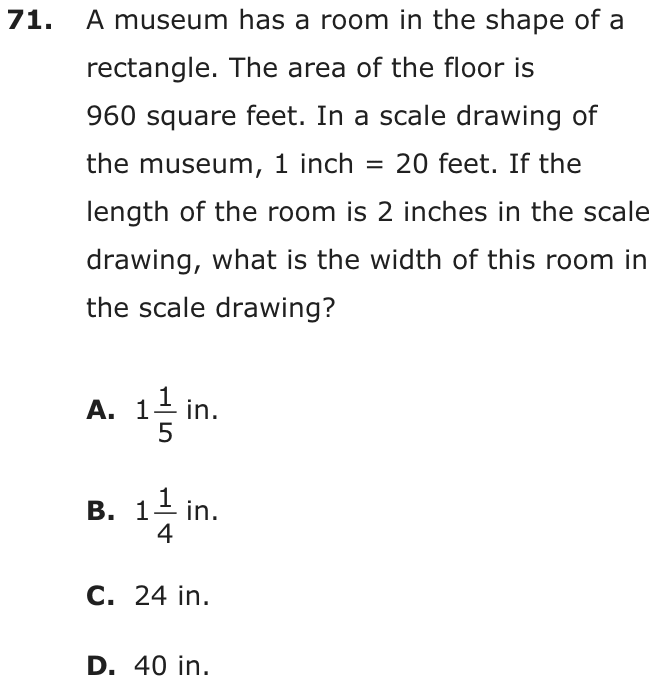
Question 32 of 75
2024 Test A Math, question 18Question
Each number in a sequence is formed by doubling the previous number and then adding 1. If the 9th number in the sequence is 63, what is the 10th number minus the 7th number?
- A96
- B111
- C112
- D127
Show the answer
Correct answer: C
First, write an equation based on the rule described in the item. Let x be the previous number in the sequence and y be the number in the sequence. The ninth number in the sequence is 63.
Determine the 10th number in the sequence, y, by making and solving:
Determine the 8th number in the sequence, x, by making and solving:
Subtract one from both sides of the equation.
Determine the 7th number in the sequence, x, by making and solving:
Subtract the 7th number in the sequence from the 10th number:
The difference is 112.
Question analysis
A sequence question: each number is found by doubling the one before it and adding 1, and the 9th number is 63. Students find the 10th number minus the 7th. That means running the rule forward once and backward twice, while keeping track of which position each number holds.
- Grade level
- Grade 7 content, by NYS standard
- Compared with grade 7
- Above grade 7 Grade 7 students solve two-step equations but rarely have to run a rule backward through a sequence. This mixes forward and backward steps with position counting, so it asks for more planning than a typical grade 7 task.
- Estimated difficulty
- Hard: combines ideas, needs a plan, and has more than one tempting wrong answer.
- Thinking it demands
- Depth of knowledge 2, skills and concepts · mainly apply
- What makes it hard
- No obvious method moderate
- Many steps moderate
- Much to keep track of minor
- Solution
- 4 steps
- Reading level
- Question and choices: about grade 7, 32 words.
- Corrected from the DOE handbook
- A misplaced parenthesis in the explanation’s working was corrected.
- Students, last 30 days
- Not enough answers yet to show (it takes 10).
Why it is hard, traps and wrong answers (shows the answer)
Why it is hard
Applying the rule forward is routine; running it backward is not, and the question needs both. Students must also count positions carefully, since the 9th number is given and the 7th is two steps back, not one. Each listed wrong answer stops or slips at a different stage, so writing the four numbers in a row, 15, 31, 63 and 127, before subtracting is the reliable way.
No obvious method moderate Working it out
The rule is stated only forward, double and add 1, but the 7th and 8th numbers come before the given 9th, so the rule must be undone: subtract 1, then halve. (Schoenfeld, 1985)
Many steps moderate Working it out
One forward step reaches the 10th number, 127, two backward steps reach the 8th and 7th, 31 and 15, and a final subtraction finishes. (Daniel & Embretson, 2010; Enright, Morley & Sheehan, 2002)
Much to keep track of minor Working it out
Four positions and their values, 7th to 10th, have to be kept straight, and the 8th number is easy to mistake for the 7th. (Sweller, 1988; Carpenter, Just & Shell, 1990)
Strategy: Apply the rule to 63 to get the 10th number; to go back a position, subtract 1 and halve, doing it twice to reach the 7th; then subtract.
Traps
- Counting the ends: Inclusive or exclusive ends, fence posts, consecutive numbers: an answer that is one too many or too few, or an endpoint drawn open where it belongs closed (or the reverse).
- Stops one step early: A choice is a number from partway through the solution.
The wrong answers, classified
A Counting the ends (Brown & Burton, 1978)
Steps back only once from the 9th number and subtracts the 8th, 127 − 31 = 96, one position short of the 7th.
B Misreads the question (Hegarty, Mayer & Monk, 1995)
Doubles 63 to 126 but forgets to add 1 on that step, then subtracts the correct 7th number: 126 − 15 = 111.
D Stops one step early (King et al., 2004; Gierl et al., 2017)
Finds the 10th number, 2 × 63 + 1 = 127, and stops without subtracting the 7th number from it.
What was corrected from the DOE handbook, and why
- Explanation: Finding the 7th number, the handbook writes “2x + (1 − 1 = 31 − 1)”, with the closing parenthesis after the whole equation, so the line reads as an equation inside an expression (and 1 − 1 = 31 − 1 is false). The site now reads 2x + (1 − 1) = 31 − 1, the same step the handbook writes correctly for the 8th number (2x + (1 − 1) = 63 − 1). It leads to 2x = 30 and x = 15 as before.
Worked solution, step by step
Formulas used
- The sequence rule
- A sequence is a list of numbers that follows a rule. x is a number in the list, and y is the next number. To get the next number, double x and then add 1.
- Going back one number
- y is a number in the list, and x is the one just before it. To go back, undo the rule in reverse order. The rule doubles and then adds 1. So first subtract 1, then divide by 2.
Sort out the question
Each number is “formed by doubling the previous number and then adding 1”. Previous means the one just before. The 9th number is 63. You need the 10th number minus the 7th number. So you go forward one number and back two numbers.
Find the 10th number
Use the rule with x = 63.
The 10th number is 127. Watch out: remember to add 1. Doubling only gives 126 and leads to 111, choice B.
Plan how to go back
The 7th number comes before the 9th, so you must undo the rule. The rule doubled, then added 1. Undo the last step first: subtract 1. Then undo the doubling: divide by 2.
Find the 8th number
The 8th number is 31. Watch out: 31 is the 8th number, not the 7th. Using it gives , choice A.
Find the 7th number
Step back once more, from the 8th number. Use the same rule with y = 31.
The 7th number is 15.
Subtract the 7th from the 10th
Watch out: 127 alone is choice D. You still have to subtract the 7th number. So the answer is C, 112.
Check your answer
Go forward from 15 using the rule. , then , then . You land on 63 as the 9th number, so the list is right. And .
More questions like this
The original DOE question
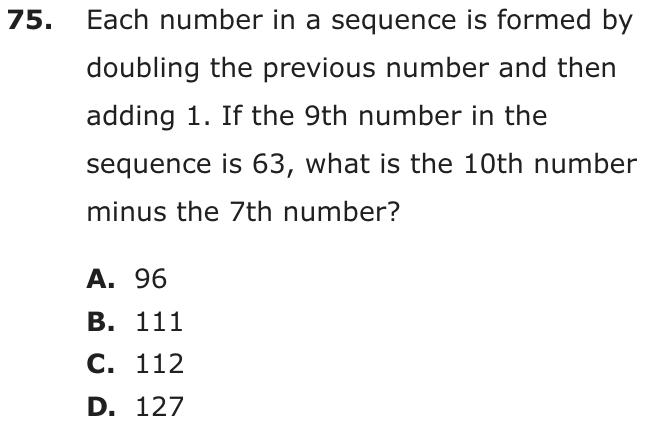
Question 33 of 75
2024 Test A Math, question 27Question
On Wednesday, a baker produced 100 more loaves of bread than were produced on Tuesday. On Thursday, the baker produced 50 fewer loaves than were produced on Tuesday. If the total number of loaves produced on all three days was 230, how many loaves were produced on Wednesday?
- A60
- B80
- C120
- D160
Show the answer
Correct answer: D
Let t represent the number of loaves of bread produced on Tuesday.
First, determine the number of loaves of bread produced on Tuesday, t, using the number of loaves produced on Wednesday, , the number produced on Thursday, , and the total number produced on these three days, 230:
Next, determine the number of loaves of bread produced on Wednesday, , when :
The number of loaves of bread produced on Wednesday is 160.
Question analysis
A word problem about a baker's bread over three days: Wednesday's output is 100 loaves more than Tuesday's, Thursday's is 50 fewer than Tuesday's, and the total is 230. Students find the number of loaves made on Wednesday. Writing every day in terms of Tuesday, and answering for the right day, are the keys.
- Grade level
- Grade 7 content, by NYS standard
- Compared with grade 7
- At grade 7 Writing and solving an equation of the form px + q = r from a word problem is a core grade 7 standard. This is a typical three-step version, with one negative adjustment and an extra step after solving.
- Estimated difficulty
- Straightforward: two steps or one careful reading.
- Thinking it demands
- Depth of knowledge 2, skills and concepts · mainly apply
- What makes it hard
- Turning words into math moderate
- Much to keep track of minor
- Solution
- 3 steps
- Reading level
- Question and choices: about grade 7, 45 words.
- Corrected from the DOE handbook
- A misplaced parenthesis in the explanation’s working was corrected.
- Students, last 30 days
- Not enough answers yet to show (it takes 10).
Why it is hard, traps and wrong answers (shows the answer)
Why it is hard
Writing all three days in terms of Tuesday turns the story into 3t + 50 = 230, a routine equation. The trap comes after it is solved: the value found is Tuesday's, and it is a listed choice. Students who label t as Tuesday from the start, and reread the question before choosing, add the 100 loaves and are done.
Turning words into math moderate Understanding the question
Both comparisons are made with Tuesday, 100 more loaves on Wednesday and 50 fewer on Thursday, so the three days become t, t + 100 and t − 50. (Hegarty, Mayer & Monk, 1995; Koedinger & Nathan, 2004)
Much to keep track of minor Working it out
The equation's unknown is Tuesday's count, while the question asks for Wednesday's, so one more step remains after the equation is solved. (Sweller, 1988; Carpenter, Just & Shell, 1990)
Strategy: Let t be Tuesday's loaves, write Wednesday and Thursday in terms of t, set the sum equal to 230, solve for t, and add 100.
Traps
- Answers a different question: A choice is right for another quantity: the other unknown, the rest instead of the part, the part instead of the whole.
- Numbers taken from the question: Combines the numbers in the question without a model of the situation, or is simply a number that appears in the question.
The wrong answers, classified
A Answers a different question (King et al., 2004; Hegarty, Mayer & Monk, 1995)
Solves 3t + 50 = 230 for Tuesday's loaves, t = 60, and gives that instead of Wednesday's t + 100.
B Numbers taken from the question (Hegarty, Mayer & Monk, 1995)
Subtracts both 100 and 50 from the total, 230 − 100 − 50 = 80, combining the numbers without writing each day in terms of Tuesday.
C Misreads the question (Hegarty, Mayer & Monk, 1995)
Finds Tuesday's 60, then gets Wednesday by subtraction, 230 − 60 − 50, taking Thursday as 50 loaves instead of 60 − 50 = 10.
What was corrected from the DOE handbook, and why
- Explanation: The handbook writes “3t + (50 − 50 = 230 − 50)”, with the closing parenthesis after the whole equation, so the line reads as an equation inside an expression (and 50 − 50 = 230 − 50 is false). The site now reads 3t + (50 − 50) = 230 − 50: subtract 50 from both sides, giving 3t = 180 as before.
Worked solution, step by step
Formulas used
- Keeping an equation balanced
- a and b are the two sides of an equation, and c is any number. An equation is like a balanced scale. If you subtract the same thing from both sides, it stays balanced. The same is true if you divide both sides by the same number that is not zero.
Sort out the question
The baker made bread on Tuesday, Wednesday and Thursday. Wednesday had 100 more loaves than Tuesday. Thursday had 50 fewer loaves than Tuesday. All three days add up to 230 loaves. You need the number of loaves made on Wednesday.
Write each day using Tuesday
Both other days are compared with Tuesday. So call Tuesday’s loaves t.
Day Loaves Tuesday Wednesday Thursday 100 more means add 100. 50 fewer means subtract 50.
Write the equation and combine
Group the t’s together and the plain numbers together. Three t’s make 3t, and .
Watch out: do not just subtract 100 and 50 from 230. That gives 80, choice B, and skips writing each day with t.
Solve for Tuesday
Subtract 50 from both sides. Then divide both sides by 3.
Tuesday had 60 loaves. Watch out: 60 is Tuesday, choice A. The question asks about Wednesday.
Find Wednesday’s loaves
Wednesday had 100 more loaves than Tuesday, so add 100 to t.
Wednesday had 160 loaves. So the answer is D, 160.
Check your answer
Find all three days. Tuesday is 60, Wednesday is 160, and Thursday is . Add them: . That is the total in the question, so 160 is right.
More questions like this
The original DOE question
Question 34 of 75
2024 Test A Math, question 44Question
A tank with a 500-gallon capacity currently contains 75 gallons of water. Additional water is poured into this tank at a rate of 5 gallons per minute. After 45 minutes of adding water, what percentage of the tank’s total capacity will be filled? (Assume that there is no loss of water from the tank.)
- A45%
- B55%
- C60%
- D70%
Show the answer
Correct answer: C
If 5 gallons of water is added to the tank per minute for 45 minutes, then gallons is added to the tank.
The tank started with 75 gallons of water in it. After the 45 minutes, it contains gallons, assuming no loss of water.
The tank has a capacity of 500 gallons, and .
Rewrite decimal 0.6 as a percentage:
Question analysis
A 500-gallon tank holds 75 gallons, and water flows in at 5 gallons per minute for 45 minutes. This rate and percent word problem asks what percentage of the tank's capacity will then be filled. Students find the water added, the new amount in the tank and its percent of 500, keeping track of every quantity of water.
- Grade level
- Grade 7 content, by NYS standard
- Compared with grade 7
- At grade 7 Grade 7 students solve multistep rate and percent problems. This one combines a pouring rate, a starting amount and a percent of capacity in three short steps with friendly numbers, which matches typical grade 7 work.
- Estimated difficulty
- Straightforward: two steps or one careful reading.
- Thinking it demands
- Depth of knowledge 2, skills and concepts · mainly apply
- What makes it hard
- Much to keep track of minor
- Many steps minor
- Solution
- 3 steps
- Reading level
- Question and choices: about grade 8, 51 words.
- Students, last 30 days
- Not enough answers yet to show (it takes 10).
Why it is hard, traps and wrong answers (shows the answer)
Why it is hard
The numbers are friendly, so the question tests whether students track every quantity of water. Forgetting the 75 gallons that were there from the start is the costly slip, because the share of the tank that was poured in is itself a listed choice. A quick check, that 300 gallons is more than half of 500 but well under three quarters, confirms the answer.
Much to keep track of minor Working it out
The 75 gallons already in the tank, given in the first sentence, must be held aside through the rate calculation and added back before dividing. (Sweller, 1988; Carpenter, Just & Shell, 1990)
Many steps minor Working it out
The chain runs from 5 gallons a minute for 45 minutes to 225 gallons, then to 300 gallons in the tank, then to 300 out of 500 as a percent. (Daniel & Embretson, 2010; Enright, Morley & Sheehan, 2002)
Strategy: Multiply the rate by the time to get the water added, account for the water already in the tank, and divide the total by the 500-gallon capacity.
Traps
- Stops one step early: A choice is a number from partway through the solution.
- Answers a different question: A choice is right for another quantity: the other unknown, the rest instead of the part, the part instead of the whole.
The wrong answers, classified
A Stops one step early (King et al., 2004; Gierl et al., 2017)
Finds that the 225 gallons poured in fill 45% of the tank and stops before adding the 15% filled by the 75 gallons already there.
B Answers a different question (King et al., 2004; Hegarty, Mayer & Monk, 1995)
Leaves out the starting 75 gallons and gives the share still empty after pouring, (500 − 225) ÷ 500 = 55%, instead of the share filled.
D Little reason to choose it (Haladyna & Downing, 1993; Rodriguez, 2005)
No common working gives 70%, which would need 350 gallons, as if water flowed for 55 minutes; it mostly draws guesses.
Worked solution, step by step
Formulas used
- Amount from a rate
- The rate is how much water goes in each minute, here 5 gallons. The time is how many minutes it runs. Multiply them to get the amount added. It works because the same amount goes in every minute.
- Percent of a whole
- The part is the amount you have, and the whole is the full amount. Dividing gives what fraction of the whole you have. Multiplying by 100 turns it into a percent, which means out of 100.
Sort out the question
The tank holds at most 500 gallons. That is its capacity. It already has 75 gallons in it. Water is added at 5 gallons per minute for 45 minutes. You need the percent of the tank that will be full.
Find the water added
The same amount of water goes in every minute, so multiply the rate by the time.
So 225 gallons are poured in during the 45 minutes.
Find the total water in the tank
Add the water that was already there.
The tank holds 300 gallons after 45 minutes. Watch out: don’t forget the first 75 gallons. The 225 gallons alone fill 45% of the tank, choice A.
Find the percent full
The tank is 60% full. Watch out: find the part that is full, not the part that is empty. Choice B, 55%, is the empty part if you also forget the first 75 gallons.
So the answer is C, 60%.
Check your answer
10% of 500 gallons is 50 gallons. The tank has 300 gallons, which is 6 groups of 50. So it is 60% full. Also, 300 gallons is less than 500, so the tank never overflows.
More questions like this
The original DOE question
Question 35 of 75
2024 Test A Math, question 45Question
Misha wants to use ribbon to make 2 straps for a backpack. The ribbon costs $5.00 a yard. If each strap requires yards of ribbon, how much will Misha pay for the ribbon (not including tax)?
- A$4.00
- B$6.25
- C$11.25
- D$12.50
Show the answer
Correct answer: D
Each strap requires yards of ribbon, and ribbon costs $5.00 a yard.
, so the ribbon for each strap costs $6.25.
Misha wants to make 2 straps.
, so the cost of the ribbon for 2 straps is $12.50.
Question analysis
Misha needs ribbon for 2 backpack straps, each using 1 1/4 yards, and ribbon costs $5.00 a yard. This cost word problem asks how much she will pay for the ribbon before tax. Students multiply a mixed number by a price per yard and by the number of straps; it is short, but both the mixed number and the two straps need care.
- Grade level
- Grade 6 content, by NYS standard
- Compared with grade 7
- Below grade 7 Multiplying a mixed number by a whole number and finding a total cost are grade 5 and 6 skills. With two short steps and friendly numbers, this is easier than typical grade 7 problems with percents or negatives.
- Estimated difficulty
- Routine: one familiar step, little to misread.
- Thinking it demands
- Depth of knowledge 2, skills and concepts · mainly apply
- What makes it hard
- Error-prone arithmetic minor
- Much to keep track of minor
- Solution
- 2 steps
- Reading level
- Question and choices: about grade 5, 35 words.
- Students, last 30 days
- Not enough answers yet to show (it takes 10).
Why it is hard, traps and wrong answers (shows the answer)
Why it is hard
The question is short and the numbers are friendly; points are lost by stopping at one strap or by mishandling the mixed number. Pricing a single strap gives a listed choice, as does doubling only the whole-number part of 1 1/4. Finding the total ribbon first, 2 1/2 yards, before multiplying by the price keeps both errors away.
Error-prone arithmetic minor Working it out
The length per strap is a mixed number, 1 1/4 yards, so the arithmetic is easiest as 2 × 1.25 = 2.5 yards, then 2.5 × $5.00. (Brown & Burton, 1978; Junker & Sijtsma, 2001)
Much to keep track of minor Working it out
The number of straps comes in the first sentence and the length of each in the last, so the 2 has to be carried through to the cost. (Sweller, 1988; Carpenter, Just & Shell, 1990)
Strategy: Find the total ribbon first by doubling the length for one strap, then multiply the yards by $5.00; writing 1 1/4 as 1.25 keeps the arithmetic simple.
Traps
- Stops one step early: A choice is a number from partway through the solution.
- A faulty procedure: A systematic but wrong procedure: adding fractions straight across, applying an exponent to each term of a sum, dropping a sign when moving a term.
- Wrong operation: Adds instead of multiplying, divides the wrong way round, turns a ratio or rate upside down, or undoes a step in the wrong direction (subtracts what should be added back).
The wrong answers, classified
A Wrong operation (Hegarty, Mayer & Monk, 1995; King et al., 2004)
Divides the price by the length, $5.00 ÷ 1.25 = 4, instead of multiplying yards by dollars per yard.
B Stops one step early (King et al., 2004; Gierl et al., 2017)
Prices the ribbon for one strap, 1 1/4 × $5.00 = $6.25, and forgets that Misha is making 2 straps.
C A faulty procedure (Brown & Burton, 1978; Tatsuoka, 1983)
Doubles only the whole-number part of 1 1/4, getting 2 1/4 yards instead of 2 1/2, and pays 2.25 × $5.00 = $11.25.
Worked solution, step by step
Formulas used
- Cost
- Price per unit is the cost of one unit, here $5.00 for one yard. Number of units is how many you buy, here yards of ribbon. Multiply them to get the total before tax.
Sort out the question
Misha makes 2 straps. Each strap needs yards of ribbon. A yard is a length of 3 feet. Ribbon costs $5.00 a yard. You need the total cost for both straps, with no tax.
Find the total ribbon
First change the mixed number to a decimal. One quarter is 0.25, so is 1.25. Then double it for 2 straps.
Misha needs 2.5 yards of ribbon. Watch out: double the whole mixed number, the 1 and the quarter. Doubling only the 1 gives yards and $11.25, choice C.
Find the cost
The ribbon costs $12.50. Watch out: this is for both straps. One strap’s ribbon costs $6.25, choice B. Don’t stop there.
So the answer is D, $12.50.
Check your answer
Estimate. Each strap needs a bit more than 1 yard, so both need a bit more than 2 yards. Two yards cost $10, so the answer should be a bit more than $10. $12.50 fits. Also, 2 yards cost $10 and the extra half yard costs $2.50, which makes $12.50.
More questions like this
The original DOE question
Question 36 of 75
2024 Test B Math, question 4Question
At one location, the temperature increased from −7° F to 4° F between 5:00 a.m. and 9:00 a.m. By 11:00 a.m., the temperature was 3.5 times the 9:00 a.m. temperature. What was the total increase in temperature between 5:00 a.m. and 11:00 a.m., in degrees Fahrenheit?
Grid-in question: work out the answer and enter it as a number.
Show the answer
Correct answer: 21
The 11:00 a.m. temperature is 3.5 times the 9:00 a.m. temperature. The 9:00 a.m. temperature was 4° F.
The temperature increased from −7° F at 5:00 a.m. to 14° F at 11:00 a.m., which is an increase of 21° F.
Question analysis
A temperature word problem with negative numbers: the temperature rises from −7° F to 4° F by 9:00 a.m., and by 11:00 a.m. it is 3.5 times the 9:00 a.m. reading. Students find the total rise from 5:00 to 11:00 a.m. Subtracting a negative starting temperature is where most slips happen.
- Grade level
- Grade 7 content, by NYS standard
- Compared with grade 7
- At grade 7 Using signed numbers for temperature change is standard grade 7 work. This adds a decimal multiplier and asks for a change rather than a temperature, two short steps, which keeps it at a typical grade 7 level.
- Estimated difficulty
- Moderate: several steps, or a close reading with one strong distractor.
- Thinking it demands
- Depth of knowledge 2, skills and concepts · mainly apply
- What makes it hard
- Error-prone arithmetic moderate
- Turning words into math minor
- Much to keep track of minor
- Solution
- 2 steps
- Reading level
- Question and choices: about grade 5, 43 words.
- Students, last 30 days
- Not enough answers yet to show (it takes 10).
Why it is hard, traps and wrong answers (shows the answer)
Why it is hard
Finding the 11:00 a.m. temperature is a single multiplication; the points are lost in the subtraction that follows. A rise that starts below zero has two parts, 7 degrees up to zero and 14 more above it, and students who treat −7 as 7 lose the first part. The times in the stem also invite measuring from 9:00 a.m. instead of 5:00 a.m., which covers only the last two hours.
Error-prone arithmetic moderate Working it out
The last step is 14 − (−7): subtracting the negative starting temperature means adding 7, and the part of the rise below zero is easy to leave out. (Brown & Burton, 1978; Junker & Sijtsma, 2001)
Turning words into math minor Understanding the question
“3.5 times the 9:00 a.m. temperature” multiplies the reading of 4°, not the 11-degree rise, and “total increase” runs from the 5:00 a.m. reading, not from 9:00. (Hegarty, Mayer & Monk, 1995; Koedinger & Nathan, 2004)
Much to keep track of minor Working it out
Three times of day carry three temperatures, −7°, 4° and 14°, and the answer compares the first with the last, not either of them with the middle one. (Sweller, 1988; Carpenter, Just & Shell, 1990)
Strategy: Find the 11:00 a.m. temperature from the 9:00 a.m. one, then subtract the 5:00 a.m. temperature from it, remembering that subtracting a negative number adds its size.
Traps
- Negatives and direction: Arithmetic with negative numbers, the order of a subtraction, or direction on a number line. (Moving a term across the equals sign without changing its sign is a faulty procedure.)
- Stops one step early: A choice is a number from partway through the solution.
- Answers a different question: A choice is right for another quantity: the other unknown, the rest instead of the part, the part instead of the whole.
The wrong answers, classified
7 Negatives and direction (Brown & Burton, 1978)
Finds 14° at 11:00 a.m. but subtracts 7 instead of −7, so 14 − 7 = 7, leaving out the part of the rise below zero.
14 Stops one step early (King et al., 2004; Gierl et al., 2017)
Finds the 11:00 a.m. temperature, 4 × 3.5 = 14, and grids it without subtracting the 5:00 a.m. temperature to get the increase.
10 Answers a different question (King et al., 2004; Hegarty, Mayer & Monk, 1995)
Measures the rise from 9:00 a.m. instead of 5:00 a.m., 14 − 4 = 10, which is only the last two hours of the total increase.
Worked solution, step by step
Formulas used
- Change in temperature
- End is the last temperature, and start is the first one. Subtract start from end to find how much it went up. It works with negative numbers too. A positive change means the temperature rose.
- Subtracting a negative number
- a is any number, and −b is a negative number. Taking away a negative is the same as adding its size. On a thermometer, going from −7 up to 0 is 7 degrees, so those 7 degrees get added.
Sort out what you know
There are three times and three temperatures, in degrees Fahrenheit (°F).
- 5:00 a.m.: −7°F, which is 7 degrees below zero
- 9:00 a.m.: 4°F
- 11:00 a.m.: 3.5 times the 9:00 a.m. temperature
You need the total increase from 5:00 a.m. to 11:00 a.m. That is how much warmer it got from the first time to the last.
Find the 11:00 temperature
“3.5 times the 9:00 a.m. temperature” means 3.5 times 4°F.
At 11:00 a.m. it was 14°F. Watch out: 14 is a temperature, not the increase. Gridding 14 stops too early.
Subtract the start from the end
The increase runs from 5:00 a.m. to 11:00 a.m. So it starts at −7°F and ends at 14°F.
Watch out: start at 5:00 a.m., not at 9:00 a.m. Starting from 4°F gives only 10.Subtract the negative number
Taking away a negative number is the same as adding its size.
The temperature rose 21°F. Watch out: writing 14 − 7 = 7 loses the minus sign. It skips the 7 degrees the air warmed just to reach zero.
So you would grid 21.
Check your answer
Count up on a thermometer. From −7°F up to 0°F is 7 degrees. From 0°F up to 14°F is 14 more. . Or add the two parts of the morning: it rose 11 degrees by 9:00 and 10 more by 11:00, and .
More questions like this
The original DOE question
Question 37 of 75
2024 Test B Math, question 11Question
In a sports league, each team has 36 players and 3 coaches. There are also a number of team assistants. The ratio of team assistants to players is . What is the ratio of coaches to assistants?
- A
- B
- C
- D
Show the answer
Correct answer: B
Let x be the number of assistants.
Since the ratio of assistants to players is , then:
There are a total of 6 assistants.
So the ratio of coaches to assistants is .
Question analysis
A ratio word problem about a sports team with 36 players, 3 coaches and an unknown number of assistants, where the ratio of assistants to players is 1 to 6. Students find how many assistants there are, then form a new ratio of coaches to assistants. Keeping the order of each ratio straight matters.
- Grade level
- Grade 6 content, by NYS standard
- Compared with grade 7
- Below grade 7 Finding a missing amount from a ratio and then writing a second ratio is grade 6 ratio reasoning with whole numbers. Typical grade 7 work adds fractions, rates or percents, which this two-step problem does not.
- Estimated difficulty
- Straightforward: two steps or one careful reading.
- Thinking it demands
- Depth of knowledge 2, skills and concepts · mainly apply
- What makes it hard
- Turning words into math minor
- Much to keep track of minor
- Solution
- 2 steps
- Reading level
- Question and choices: about grade 5, 39 words.
- Students, last 30 days
- Not enough answers yet to show (it takes 10).
Why it is hard, traps and wrong answers (shows the answer)
Why it is hard
Two short steps, finding 6 assistants and then writing 3 to 6, make this one of the easier ratio questions. The care needed is in keeping each ratio's order and its two groups straight, since the given ratio compares assistants with players and the asked one compares coaches with assistants. None of the wrong choices matches a common slip closely, so students who find the 6 assistants seldom go wrong.
Turning words into math minor Understanding the question
“The ratio of team assistants to players is 1/6” must become 6 assistants for 36 players, and the question then asks for a ratio in a new order, coaches first. (Hegarty, Mayer & Monk, 1995; Koedinger & Nathan, 2004)
Much to keep track of minor Working it out
Three groups are named, 36 players, 3 coaches and an unknown number of assistants, and each ratio pairs a different two of them. (Sweller, 1988; Carpenter, Just & Shell, 1990)
Strategy: Use the 1 to 6 ratio to find the number of assistants from the 36 players, then write coaches over assistants, in that order, and simplify.
Traps
- Answers a different question: A choice is right for another quantity: the other unknown, the rest instead of the part, the part instead of the whole.
- Misunderstands the concept: A wrong belief about a concept: that percents can be added, that area grows like length, that averages can be averaged, that a bigger denominator means a bigger fraction.
The wrong answers, classified
A Answers a different question (King et al., 2004; Hegarty, Mayer & Monk, 1995)
Compares the 9 coaches and assistants together with the 36 players, 9/36 = 1/4, a ratio of all the staff to players that the question never asks for.
C Little reason to choose it (Haladyna & Downing, 1993; Rodriguez, 2005)
No common working gives 2/3; it equals the 6 assistants over all 9 staff, which puts the wrong group on top and a total underneath.
D Misunderstands the concept (Smith, diSessa & Roschelle, 1993; De Bock et al., 1998; Ni & Zhou, 2005)
Reads the ratio 1/6 as the assistants' share of everyone and gives the other 5/6, as if that remaining share described the coaches.
Worked solution, step by step
Formulas used
- Ratio as a fraction
- A ratio compares two amounts. The group named first goes on top, and the group named second goes on the bottom. Order matters. Assistants to players is not the same as players to assistants.
- Equal ratios
- a and b are the two numbers in a ratio, written as a fraction. n is any number except zero. Multiplying both numbers by the same n gives an equal ratio. This is how you scale a small ratio up to real counts.
Sort out what you know
Each team has 36 players and 3 coaches. It also has some assistants, but you are not told how many. The ratio of assistants to players is 1/6. That means 1 assistant for every 6 players. You need the ratio of coaches to assistants.
Find the number of assistants
Write the ratio as a fraction, assistants on top and players on the bottom. To get from 6 players to 36, multiply by 6. Do the same to the top.
So there are 6 assistants for the 36 players.
Write the new ratio
Now the order changes. Coaches come first, so coaches go on top.
Divide the top and the bottom by 3 to simplify.
Avoid the traps and answer
Watch out: use only coaches and assistants. Putting all 9 staff over the 36 players gives 1/4, choice A. Putting the 6 assistants over all 9 staff gives 2/3, choice C. And 1/6 is not a share of everyone, so 5/6, choice D, has no meaning here.So the answer is B, .
Check your answer
A ratio of 1/2 means 1 coach for every 2 assistants. With 3 coaches, that makes 6 assistants. Then 6 assistants to 36 players is , the ratio the question gave.
More questions like this
The original DOE question
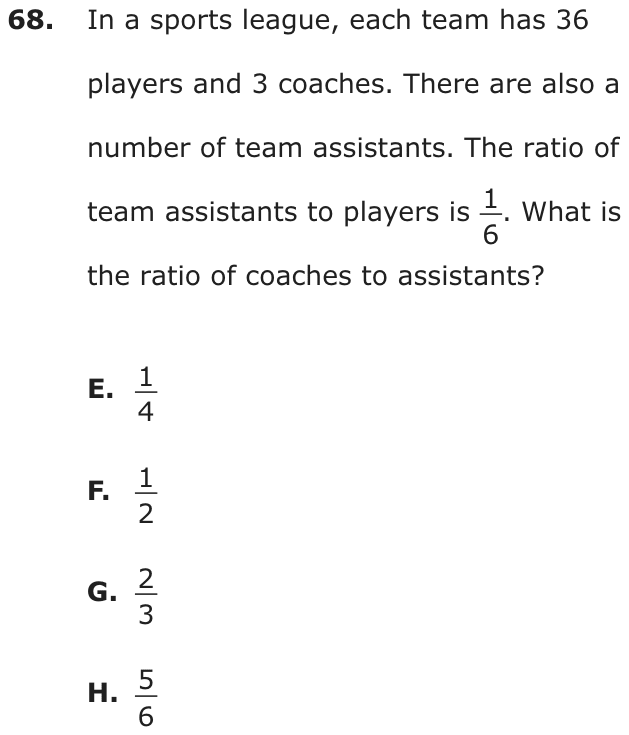
Question 38 of 75
2024 Test B Math, question 35Question
The high temperature on Monday was x° F. On Tuesday, the high temperature was 84° F, which was a 5% increase from Monday’s high temperature. On Wednesday, the high temperature was 10% lower than it was on Monday. How much lower was the high temperature on Wednesday than the high temperature on Monday?
- A4.0° F
- B8.0° F
- C8.4° F
- D8.8° F
Show the answer
Correct answer: B
The temperature on Tuesday was 84° F, which was 5% higher than the temperature on Monday.
This can be represented by the equation .
Dividing both sides of this equation by 1.05 gives .
Therefore, the temperature on Monday was 80° F.
Since the temperature on Wednesday was 10% lower than the temperature on Monday, the difference between the two temperatures would equal .
Question analysis
Tuesday's high temperature is given along with its percent increase over Monday's, and Wednesday's high is a percent below Monday's. Students find how many degrees cooler Wednesday was than Monday. It tests percent increase and decrease, and the difficulty is working back to Monday, the base for both percents, rather than starting from Tuesday's number.
- Grade level
- Grade 7 content, by NYS standard
- Compared with grade 7
- Above grade 7 Grade 7 percent problems usually apply a percent to a known amount. Here Monday's temperature must first be recovered from a percent increase and then a second percent applied to it, a reverse step most grade 7 students find unfamiliar.
- Estimated difficulty
- Moderate: several steps, or a close reading with one strong distractor.
- Thinking it demands
- Depth of knowledge 2, skills and concepts · mainly apply
- What makes it hard
- Turning words into math moderate
- A very close wrong answer moderate
- Much to keep track of minor
- Solution
- 3 steps
- Reading level
- Question and choices: about grade 5, 54 words.
- Students, last 30 days
- Not enough answers yet to show (it takes 10).
Why it is hard, traps and wrong answers (shows the answer)
Why it is hard
The question turns on noticing that both percents are measured from Monday, a temperature the stem never states. Students who take 10% of the only temperature given, 84, land on a listed choice just 0.4 degree off. Working back from 84 is forgiving: the exact 84 ÷ 1.05 = 80 and even the rougher 84 × 0.95 = 79.8 lead to the same choice, so the real test is not skipping Monday.
Turning words into math moderate Understanding the question
"84° F, which was a 5% increase from Monday’s high temperature" makes 84 the result of the increase, so Monday comes from solving 1.05x = 84, not from 5% of 84. (Hegarty, Mayer & Monk, 1995; Koedinger & Nathan, 2004)
A very close wrong answer moderate Choosing the answer
The choices 8.0, 8.4 and 8.8 lie within a degree of each other, so only the base of the 10%, Monday's 80 rather than Tuesday's 84, separates them. (Embretson & Wetzel, 1987; Gorin & Embretson, 2006; Ascalon et al., 2007)
Much to keep track of minor Working it out
Three days and two percents have to be kept apart: the 5% compares Tuesday with Monday, and the 10% compares Wednesday with Monday. (Sweller, 1988; Carpenter, Just & Shell, 1990)
Strategy: Let Monday's temperature be x, write Tuesday's 84 degrees as 1.05 times x and solve, then take 10 percent of Monday's value.
Traps
- Percent of the wrong amount: Finding the whole from a part, or a percent change measured from the wrong starting amount.
- Answers a different question: A choice is right for another quantity: the other unknown, the rest instead of the part, the part instead of the whole.
- Wrong operation: Adds instead of multiplying, divides the wrong way round, turns a ratio or rate upside down, or undoes a step in the wrong direction (subtracts what should be added back).
The wrong answers, classified
A Answers a different question (King et al., 2004; Hegarty, Mayer & Monk, 1995)
Finds Monday's 80° F and then gives the 4-degree rise from Monday to Tuesday, 84 − 80, instead of Wednesday's 10% drop.
C Percent of the wrong amount (Parker & Leinhardt, 1995)
Takes 10% of Tuesday's 84° F, getting 8.4, instead of first working back to Monday's temperature, the base for Wednesday's drop.
D Wrong operation (Hegarty, Mayer & Monk, 1995; King et al., 2004)
Undoes Tuesday's increase in the wrong direction, adding 5% to 84 to get 88.2° F for Monday, then takes 10% of it, about 8.8.
Worked solution, step by step
Formulas used
- Percent increase
- old is the starting amount. p is the percent it goes up. new is the amount after. The 1 keeps all of the old amount, and p over 100 adds the extra part. So a 5% rise means multiply by 1.05.
- Percent of a number
- The whole is the amount the percent is taken of. The percent tells how many out of every 100. The part is the piece you get, here a number of degrees.
Sort out the question
Monday’s high is unknown. Call it x degrees. Tuesday’s high was 84°F, which is 5% more than Monday. Wednesday’s high was 10% less than Monday.
You need how many degrees lower Wednesday was than Monday. Both percents compare with Monday. So find Monday first.
Write an equation for Tuesday
Tuesday is Monday plus 5% of Monday. That is 105% of Monday. Use the percent increase formula with p = 5.
Solve for Monday
Divide both sides by 1.05 to undo the multiplying.
Monday’s high was 80°F. Watch out: 84 is the result of the increase, not the start. Adding 5% to 84 gives about 88.2°F. Then 10% of that is about 8.8, choice D.
Find Wednesday’s drop
Wednesday was 10% lower than Monday. So the drop is 10% of Monday’s 80°F.
Wednesday was 8 degrees lower. Watch out: Taking 10% of Tuesday’s 84 gives 8.4, choice C. The 10% is of Monday’s high. Also, 84 − 80 = 4, choice A, is Tuesday’s rise, not Wednesday’s drop.
So the answer is B, 8.0°F.
Check your answer
Work forward from 80°F. 5% of 80 is 4, and 80 + 4 = 84. That matches Tuesday. Then 80 − 8 = 72, so Wednesday’s high was 72°F. That is 8 degrees below Monday.
More questions like this
The original DOE question
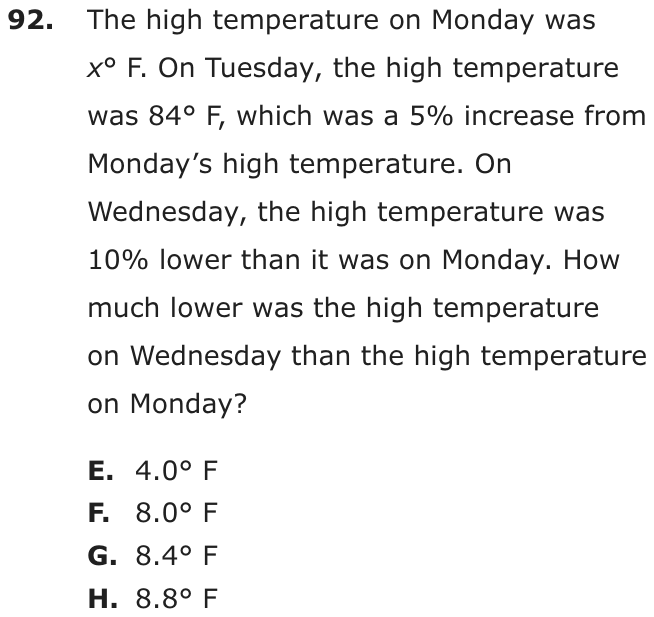
Question 39 of 75
2024 Test B Math, question 36Question
The integers , n, and are factors of 168. What is the greatest possible value of n?
- A3
- B7
- C14
- D84
Show the answer
Correct answer: B
First, determine all possible factors of 168. One method of doing this is to use a table to list pairs of factors.
| Factors of 168 | |
|---|---|
| 1 | 168 |
| 2 | 84 |
| 3 | 56 |
| 4 | 42 |
| 6 | 28 |
| 7 | 24 |
| 8 | 21 |
| 12 | 14 |
Then determine the group of three sequential factors , n, and where n is as large as possible. This group is 6, 7, and 8, where .
Question analysis
Three consecutive integers, written as n − 1, n and n + 1, must all be factors of 168, and students find the greatest possible value of n. It tests factors and consecutive integers. The catch is that a number can be a factor while its neighbors are not, so every member of the run needs checking.
- NYS standards
- 6.NS.4 common factors and multiples
- Grade level
- Grade 6 content, by NYS standard
- Compared with grade 7
- At grade 7 Listing factors is grade 6 work, but here students must read n − 1, n and n + 1 as three consecutive integers and search the factor list for the largest such run. Pairing algebraic notation with factors matches grade 7 demand.
- Estimated difficulty
- Straightforward: two steps or one careful reading.
- Thinking it demands
- Depth of knowledge 2, skills and concepts · mainly apply
- What makes it hard
- Solution
- 2 steps
- Reading level
- Question and choices: about grade 7, 17 words.
- Students, last 30 days
- Not enough answers yet to show (it takes 10).
Why it is hard, traps and wrong answers (shows the answer)
Why it is hard
Once the factors of 168 are listed in order, 1, 2, 3, 4, 6, 7, 8, 12 and up, the runs of three in a row stand out, and the last of them is 6, 7, 8. Students lose points by stopping at the first run they see or by checking only n itself. Testing each choice with its two neighbors, starting from the largest, settles it in under a minute.
Variables instead of numbers minor Understanding the question
The stem names the numbers only as (n − 1), n and (n + 1), which has to be read as three whole numbers in a row that all divide 168. (Koedinger & Nathan, 2004; Enright, Morley & Sheehan, 2002)
Much to keep track of minor Working it out
Each candidate must pass three divisibility tests at once, for itself and for both neighbors, while the search continues for the greatest such n. (Sweller, 1988; Carpenter, Just & Shell, 1990)
Strategy: List the factor pairs of 168 in order, then look along the list for three whole numbers in a row; or test each choice together with its two neighbors.
Traps
- Misreads the question: Misses or misreads a condition or a word in the question: "at least", "each", "remaining", "not".
- Stops one step early: A choice is a number from partway through the solution.
The wrong answers, classified
A Stops one step early (King et al., 2004; Gierl et al., 2017)
Finds the run 2, 3, 4 among the small factors and stops searching, missing the later run 6, 7, 8 that 168 also contains.
C Misreads the question (Hegarty, Mayer & Monk, 1995)
Checks only that 14 divides 168, since 12 × 14 = 168, without testing its neighbors; neither 13 nor 15 is a factor.
D Misreads the question (Hegarty, Mayer & Monk, 1995)
Takes the largest factor below 168 itself, 84, for the greatest n, ignoring that 83 and 85 would also have to divide 168.
Worked solution, step by step
Formulas used
- Factor pair
- a and b are whole numbers. If a times b equals 168, then a and b are both factors of 168. A factor divides a number with no remainder. Listing every pair, from small a upward, finds every factor.
Sort out the question
A factor of 168 divides 168 with no remainder. The numbers n − 1, n and n + 1 are three whole numbers in a row, such as 6, 7 and 8. The middle one is n.
All three must be factors of 168. You need the greatest n that works.
List the factor pairs of 168
Try each whole number from 1 up. When it divides 168, write it with its partner. Stop when the pairs meet, after 12 and 14.
Small factor Partner 1 168 2 84 3 56 4 42 6 28 7 24 8 21 12 14 Look for three in a row
Here are all the factors in order:
1, 2, 3, 4, 6, 7, 8, 12, 14, 21, 24, 28, 42, 56, 84, 168
The runs of three in a row are 1, 2, 3, then 2, 3, 4, then 6, 7, 8. No other three factors sit side by side.
Pick the greatest middle number
The middle numbers of the runs are 2, 3 and 7. The greatest is 7, so n = 7.
Watch out: Stopping at the run 2, 3, 4 gives 3, choice A. Keep looking. Also, 14 and 84 are factors, but their neighbors are not. Neither 13 nor 15 divides 168, so 14, choice C, fails. For 84, choice D, neither 83 nor 85 is a factor.
So the answer is B, 7.
Check your answer
Divide 168 by each number in the run: , and . All three are whole numbers, so 6, 7 and 8 are all factors.
More questions like this
The original DOE question
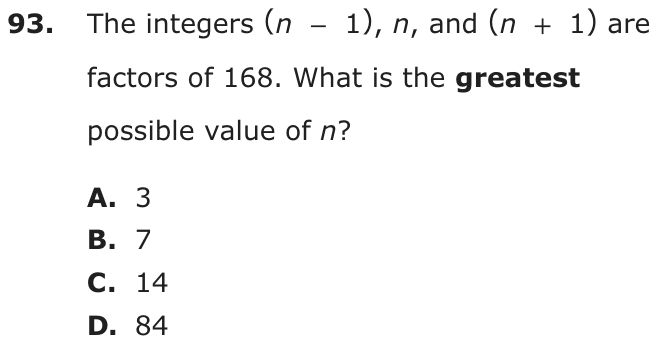
Question 40 of 75
2024 Test B Math, question 55Question
Typically, an amusement park sells 3 times as many tickets on Sunday as on any weekday, and 4 times as many tickets on Saturday as on Sunday. If the number of tickets sold on Saturday and Sunday totaled 30,000, how many tickets are expected to be sold on the following Monday?
- A2,000
- B2,500
- C3,000
- D4,285
Show the answer
Correct answer: A
First, determine the number of tickets sold on Sunday, x, using the total number of tickets sold on Saturday and Sunday, 30,000, and the number of tickets sold on Saturday, .
Then determine the number of tickets expected to be sold on Monday, y, using the number of tickets sold on Sunday, 6,000.
The number of tickets expected to be sold on Monday is 2,000.
Question analysis
An amusement park sells 3 times as many tickets on Sunday as on a weekday and 4 times as many on Saturday as on Sunday. Given the weekend total, students find the expected ticket sales for the following Monday. It tests writing an equation from multiplicative comparisons, and the trap is comparing Saturday with the wrong day.
- Grade level
- Grade 7 content, by NYS standard
- Compared with grade 7
- At grade 7 Writing and solving a one-variable equation from a word problem is grade 7 work. Two linked multiplicative comparisons, with Saturday measured against Sunday rather than a weekday, add a layer of translation, but the equation itself stays simple.
- Estimated difficulty
- Moderate: several steps, or a close reading with one strong distractor.
- Thinking it demands
- Depth of knowledge 2, skills and concepts · mainly apply
- What makes it hard
- Turning words into math moderate
- Much to keep track of minor
- Solution
- 3 steps
- Reading level
- Question and choices: about grade 12, 48 words.
- Students, last 30 days
- Not enough answers yet to show (it takes 10).
Why it is hard, traps and wrong answers (shows the answer)
Why it is hard
The question is two comparisons chained through Sunday, and most wrong answers come from linking them incorrectly. Students who read Saturday's 4 times as 4 weekdays, or who leave Sunday out of the 30,000, find listed answers, one of them from a division that does not come out even. Letting a weekday be one share, so Sunday is 3 and Saturday 12, makes the weekend 15 shares and the check easy.
Turning words into math moderate Understanding the question
"4 times as many tickets on Saturday as on Sunday" compares Saturday with Sunday, not with a weekday, so Saturday is 4 × 3 = 12 weekdays' worth. (Hegarty, Mayer & Monk, 1995; Koedinger & Nathan, 2004)
Much to keep track of minor Working it out
Three days have to be held in relation at once, a weekday, Sunday and Saturday, with the 30,000 covering only the last two. (Sweller, 1988; Carpenter, Just & Shell, 1990)
Strategy: Let Sunday's sales be the unknown, write Saturday as 4 times it, solve the weekend equation for Sunday, then divide Sunday's figure by 3 for a weekday.
Traps
- Misreads the question: Misses or misreads a condition or a word in the question: "at least", "each", "remaining", "not".
- Wrong operation: Adds instead of multiplying, divides the wrong way round, turns a ratio or rate upside down, or undoes a step in the wrong direction (subtracts what should be added back).
The wrong answers, classified
B Misreads the question (Hegarty, Mayer & Monk, 1995)
Makes Saturday 3 × 4 = 12 weekdays' worth but divides all 30,000 by 12, leaving Sunday's 3 shares out of the weekend total.
C Wrong operation (Hegarty, Mayer & Monk, 1995; King et al., 2004)
Adds the multipliers, so Saturday is 3 + 4 = 7 weekdays' worth; with Sunday's 3 the weekend is 10 shares, and 30,000 ÷ 10 = 3,000.
D Misreads the question (Hegarty, Mayer & Monk, 1995)
Reads Saturday as 4 times a weekday rather than 4 times Sunday, so splits 30,000 into 3 + 4 = 7 shares of about 4,285.7.
Worked solution, step by step
Formulas used
- Undoing multiplication
- x is the unknown number. a and b are known numbers. Division undoes multiplication. So if a times x is b, you find x by dividing b by a. This is the same as dividing both sides by a.
Sort out the question
Sunday sells 3 times as many tickets as a weekday. Saturday sells 4 times as many as Sunday. Saturday and Sunday together sell 30,000.
Monday is a weekday. You need Monday’s tickets. Notice that Saturday is compared with Sunday, not with a weekday.
Write an equation for the weekend
Let x be Sunday’s tickets. Then Saturday’s tickets are 4x. Together they make 30,000.
Solve for Sunday
Use the rule for undoing multiplication. Divide both sides by 5.
Sunday sells 6,000 tickets. Saturday sells .
Find Monday’s tickets
Sunday sells 3 times as many as a weekday. Let y be Monday’s tickets.
Watch out: If you read Saturday as 4 times a weekday, you split 30,000 into 7 shares. That gives about 4,285, choice D. Dividing 30,000 by 12 leaves out Sunday and gives 2,500, choice B.
So the answer is A, 2,000.
Check your answer
Think in shares. A weekday is 1 share. Sunday is 3 shares, and Saturday is shares. The weekend is 15 shares, and . It matches.
More questions like this
The original DOE question
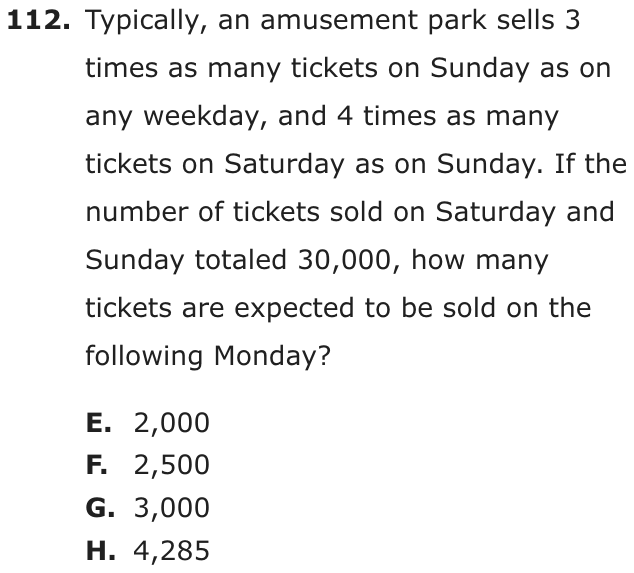
Question 41 of 75
2023 Test A English, question 15Passage A Memory Revolution
A Memory Revolution
A high school senior logs on to a computer at the library to double-check the application due date listed on a college admissions website. Nearby, a librarian helps a group of biology students use a database to search for recent studies about mammals. In the past few decades, the Internet has become an integral component of daily life for many people. The seemingly limitless power of search engines made the Internet search extremely common, and today people increasingly rely on the Internet’s vast accumulation of sources to access all types of information. Scientists are beginning to examine how this reliance is modifying the strategies people use to store and prioritize information in their mind.
A Dependable and Valuable Asset
Psychologist Benjamin Storm from the University of California, Santa Cruz, and researchers Sean Stone and Aaron Benjamin devised an experiment to study students’ tendency to depend on the Internet for facts. To begin, the scientists divided sixty participants into multiple groups, including an “Internet” group and a “memory” group, and placed them in front of computers. The Internet group was required to use the search engine Google to answer eight challenging trivia questions. In contrast, participants in the memory group were permitted to use only their personal knowledge to answer the questions. In the second round, the researchers administered notably easier questions. This time, they allowed each group the option of using Google as they answered. Their results showed that 83 percent of the Internet group continued to consult Google in the second round, while only 63 percent of the memory group chose to do so.
People’s growing inclination to rely on the Internet in order to retrieve information, particularly facts and figures, is called cognitive offloading. Canadian researcher Evan F. Risko and British researcher Sam Gilbert, who have written extensively about the topic, say a similar process has been taking place for centuries. In the past, people used resources like encyclopedias to assist their memories; however, today the Internet, serving as a vast extended memory, allows people to digitally access and retrieve much larger volumes of information. Consequently, people’s minds are free for other cognitive feats, such as connecting data, learning new information, or solving problems.
Filing Information Away
The use of the Internet also appears to be modifying the strategies people use to store information in their mind. Researchers Betsy Sparrow from Columbia University, Jenny Liu from the University of Wisconsin-Madison, and Daniel Wegner from Harvard University conducted several studies to discover how people efficiently manage their information intake.
To begin, the researchers examined how people evaluate which information deserves their effort to remember. For this experiment, participants read forty trivia facts, such as “An ostrich’s eye is bigger than its brain,” and typed the statements into a computer file. Half the participants had been previously told the file would be saved, while half believed it would be erased. Next, the participants wrote down every fact they could recall. Those who believed the information would be erased and no longer available could recall 40 percent more facts than those who thought the information would be saved.
In another experiment, the same researchers tested the ability of study participants to remember where to access information. For this trial, participants read and typed trivia statements, which they saved in folders with generic names such as “Facts” and “Items.” After spending ten minutes writing down all the facts they could recall from memory, participants were asked which folder contained a particular fact based on a keyword. For example, “Which folder has the fact about ostriches?” Overall, participants recalled the information’s location more often than the content itself, correctly identifying 49 percent of the folders for specific facts while remembering only 23 percent of the actual trivia. The researchers concluded that our memory is adapting to the Internet age by prioritizing where to locate information even when the specific details are forgotten. According to Sparrow, the Internet has become an important form of transactive memory, an external source of the recollections and associative networks that constitute memory.
As the Internet’s resources continue to expand our “external” memory, some question whether the process may cause people to depend too heavily on technology. However, Steven Pinker, a professor of psychology at Harvard University, says, “Knowledge is increasing exponentially; human brainpower and waking hours are not. Fortunately, the Internet and information technologies are helping us manage, search and retrieve our collective intellectual output at different scales, from Twitter and previews to e-books and online encyclopedias. Far from making us stupid, these technologies are the only things that will keep us smart.”
Question
Which sentence from the passage suggests that using Internet search engines may lead people to rely less on their own ability to recall information?
- A“In the past few decades, the Internet has become an integral component of daily life for many people.” (paragraph 1)
- B“The Internet group was required to use the search engine Google to answer eight challenging trivia questions.” (paragraph 2)
- C“Their results showed that 83 percent of the Internet group continued to consult Google in the second round, while only 63 percent of the memory group chose to do so.” (paragraph 2)
- D“For this experiment, participants read forty trivia facts, such as ‘An ostrich’s eye is bigger than its brain,’ and typed the statements into a computer file.” (paragraph 5)
Show the answer
Correct answer: C
The question asks which sentence from the passage suggests that using Internet search engines may lead people to rely less on their own ability to recall information.
A. Incorrect. While the sentence in paragraph 1 refers to the increase in use that has made the Internet “an integral component” of everyday life for many people, it does not address memory or explain the effect of Internet use on a person’s ability to recall information.
B. Incorrect. Although the sentence in paragraph 2 refers to research that was conducted to determine how the use of the Internet affects a person’s memory, the sentence simply explains one guideline of the study. The fact that the study required one group of participants to use Google does not indicate whether using a search engine affects the degree to which people rely on their own ability to recall information.
C. CORRECT. The sentence in paragraph 2 states that “83 percent of the Internet group continued to consult Google in the second round” and that “only 63 percent of the memory group chose to do so.” These statistics suggest that using Google in the first round resulted in participants in the Internet group relying more heavily on the Internet search engine to recall information in the second round, whereas participants who had not used Google in the first round were more likely to rely on their own ability to recall information.
D. Incorrect. The sentence in paragraph 5 describes a task presented to participants in a research study. Although the study was designed to examine “how people evaluate which information deserves their effort to remember” (paragraph 5), the sentence does not indicate that use of Internet search engines prompted people to rely less on their own ability to recall information.
Question analysis
This evidence question on “A Memory Revolution,” an article about how search engines are changing the ways people store and find information, asks which sentence suggests that searching online may lead people to depend less on their own recall. The four quotations come from paragraphs 1, 2 and 5, and each touches on the Internet, a study or memory, so students must test what each one actually shows.
- Grade level
- Grade 7 reading and task
- Compared with grade 7
- At grade 7 Choosing the sentence that supports an idea is routine grade 7 evidence work. Here the idea appears in the question but in none of the quotations, so students must infer which one implies it from what the passage says around each.
- Estimated difficulty
- Moderate: several steps, or a close reading with one strong distractor.
- Thinking it demands
- Depth of knowledge 2, skills and concepts · mainly evaluate
- What makes it hard
- Reading between the lines moderate
- A very close wrong answer minor
- Much to keep track of minor
- Evidence
- Answered from several paragraphs or stanzas
- Reading level
- Passage: about grade 14, 763 words; question and choices: about grade 13, 117 words.
- Students, last 30 days
- Not enough answers yet to show (it takes 10).
Why it is hard, traps and wrong answers (shows the answer)
Why it is hard
None of the four quotations states the idea in the question, so each has to be judged by what it implies. Paragraph 2’s experiment supplies both the most tempting wrong sentence and the right one, and they differ as a study’s setup differs from its findings. Students who settle for the sentence that names a search engine, or for any line about remembering trivia, overlook that only a measured result can show an effect on how people recall.
Reading between the lines moderate Working it out
The right sentence gives only two percentages and never mentions memory; students must infer that reaching for Google on “notably easier questions” shows less trust in one’s own recall, and that first-round searching set the Internet group apart. (Graesser, Singer & Trabasso, 1994; Kintsch, 1998)
A very close wrong answer minor Choosing the answer
Two quotations come from paragraph 2’s Google study and both name the Internet group; one states the rule for the first round, the other what the group chose once Google was optional. (Embretson & Wetzel, 1987; Gorin & Embretson, 2006; Ascalon et al., 2007)
Much to keep track of minor Working it out
Reading 83 and 63 percent correctly means holding two groups and two rounds in mind: which group had to search at first, and that in round two both could choose Google. (Sweller, 1988; Carpenter, Just & Shell, 1990)
Strategy: Put the idea in your own words, then reread each quoted sentence in its paragraph and ask whether it shows people relying more on a search engine and less on their own memory.
Traps
- Supports only part of the claim: In a question about evidence: a line that backs one half of the claim but not the other, or a related point rather than the claim itself.
- True but not the answer: A choice says something accurate about the text that does not answer this question.
The wrong answers, classified
A True but not the answer (King et al., 2004; Embretson & Wetzel, 1987)
Takes the opening claim that the Internet is “an integral component of daily life” as a sign of dependence, but the sentence only sets the scene and says nothing about recall.
B Supports only part of the claim (King et al., 2004; Thissen, Steinberg & Fitzpatrick, 1989)
Finds the right study and the words “search engine Google,” but this sentence states only what the Internet group had to do in round one, not how it behaved afterward.
D Supports only part of the claim (King et al., 2004; Thissen, Steinberg & Fitzpatrick, 1989)
Recalls that the ostrich-fact experiment found people remembered less when they expected a file to be saved, but this sentence only describes the typing task, and no search engine is involved.
Working it out, step by step
Figure out what the question asks
This is an evidence question. You need the sentence that best supports an idea. The idea is that using search engines may make people lean less on their own memory. To recall means to bring back to mind. A search engine is a website, like Google, that finds information for you. Look for a sentence that shows people trusting Google more than their own memory.
Find the study in paragraph 2
Paragraph 2 tells about an experiment with two groups. “The Internet group was required to use the search engine Google to answer eight challenging trivia questions.” The memory group could use only what they already knew. Then came a second round of “notably easier questions.” This time, each group could choose whether to use Google.
Read the results
Group Round 1 Round 2: chose Google Internet group had to use Google 83 percent Memory group memory only 63 percent The round 2 questions were easier. People had a better chance of knowing the answers on their own. Yet the Internet group still turned to Google more often. That is 20 more people out of every 100. Using Google first seems to have made them lean on it instead of their own memory.
Check each choice
- A is wrong. It says the Internet is “an integral component,” or a key part, of daily life. It says nothing about memory.
- B is wrong. It gives a rule of the study: what the Internet group had to do in round 1. A rule is not a result, so it can’t show an effect.
- C is right. It gives the result. The group that had used Google kept choosing it, even when the questions got easier.
- D is wrong. It tells about the typing task in a different study. That study tested memory, but no search engine was used.
Watch out: B is tempting because it names Google and the same study. But it only tells what people were told to do, not what they chose.
Choose the answer
Only C shows what people did once they were free to choose. The Internet group leaned on Google more than the memory group did. So the answer is C.
Why this answer and not the closest wrong one
B is the closest wrong answer, since it comes from the same study. But B only tells what the Internet group had to do at the start. C shows what happened next. Given a choice, 83 percent of that group still used Google, but only 63 percent of the memory group did. That gap is the evidence.
More questions like this
The original DOE question
The passage “A Memory Revolution” as printed (pages 3–4)
Question 42 of 75
2023 Test A Math, question 5Question
The mean value of 8 numbers is 17. Three of these numbers (9, 11, and 20) are discarded. What is the mean of the 5 remaining numbers?
Grid-in question: work out the answer and enter it as a number.
Show the answer
Correct answer: 19.2
First, find the sum of the original 8 numbers. Let x equal the sum of those numbers and use the mean formula to solve for x:
Next, subtract the 3 discarded numbers from the sum:
Finally, calculate the mean of the remaining 5 numbers by dividing the new sum, 96, by 5:
Question analysis
Eight numbers have a mean of 17, and three of them, 9, 11 and 20, are removed. This statistics grid-in asks for the mean of the five numbers that are left. Students have to rebuild the total from the mean before removing anything, and then divide by the new count rather than the old one.
- Grade level
- Grade 6 content, by NYS standard
- Compared with grade 7
- At grade 7 Finding a mean is grade 6 content, but working back from a mean to a total, removing values and averaging again is a typical grade 7 multistep task. As a grid-in, it offers no choices to check a wrong total against.
- Estimated difficulty
- Moderate: several steps, or a close reading with one strong distractor.
- Thinking it demands
- Depth of knowledge 2, skills and concepts · mainly apply
- What makes it hard
- Many steps moderate
- Much to keep track of minor
- An answer in an unexpected form minor
- Solution
- 3 steps
- Reading level
- Question and choices: about grade 3, 21 words.
- Students, last 30 days
- Not enough answers yet to show (it takes 10).
Why it is hard, traps and wrong answers (shows the answer)
Why it is hard
A mean cannot be adjusted directly when numbers are removed, so the question rewards switching from the mean to the total and back. The removed numbers, 9, 11 and 20, average less than 17, so the new mean must rise above 17; that quick check rules out an answer such as 12. Points are lost by dividing by the wrong count or by stopping at the new total.
Many steps moderate Working it out
Three operations come in a fixed order: multiply the mean by 8 to get 136, subtract 9, 11 and 20 to leave 96, then divide by the numbers that remain. (Daniel & Embretson, 2010; Enright, Morley & Sheehan, 2002)
Much to keep track of minor Working it out
The count changes partway through, from 8 numbers to 5, and the divisor at the end must be the new count, not the 8 from the first sentence. (Sweller, 1988; Carpenter, Just & Shell, 1990)
An answer in an unexpected form minor Choosing the answer
The answer, 19.2, is a decimal that must be gridded with its point, and with no choices a total of 96 or a mean over 8 numbers looks complete. (Enright, Morley & Sheehan, 2002)
Strategy: Turn the mean into a total by multiplying by 8, subtract the three discarded numbers, and divide what is left by the count of numbers that remain.
Traps
- Misreads the question: Misses or misreads a condition or a word in the question: "at least", "each", "remaining", "not".
- Stops one step early: A choice is a number from partway through the solution.
The wrong answers, classified
12 Misreads the question (Hegarty, Mayer & Monk, 1995)
Finds the remaining total, 136 − 40 = 96, correctly but divides it by the original 8 numbers instead of the 5 that are left.
96 Stops one step early (King et al., 2004; Gierl et al., 2017)
Subtracts the three discarded numbers from the total of 136 and grids the new sum, 96, without dividing by the 5 numbers left.
27.2 Misreads the question (Hegarty, Mayer & Monk, 1995)
Turns the mean into the total, 136, and divides it by 5 without first subtracting the three discarded numbers, 9, 11 and 20.
Worked solution, step by step
Formulas used
- Mean, or average
- The mean is the average. The sum is what you get when you add all the numbers. Divide it by how many numbers there are. The mean is the value each number would have if the total were shared out equally.
- Sum from a mean
- This is the mean formula turned around. If you know the mean and how many numbers there are, multiply them to get the sum. It works even when you don’t know the numbers themselves.
Sort out the question
There are 8 numbers. Their mean, or average, is 17. You don’t know what the 8 numbers are. Three of them, 9, 11 and 20, are discarded, or thrown away. That leaves 5 numbers. You need the mean of those 5 numbers.
Find the sum of all 8 numbers
You can’t add the 8 numbers, because you don’t know them. But the mean tells you their sum.
The 8 numbers add up to 136.
Take away the three discarded numbers
Subtract the three numbers that were thrown away.
The 5 numbers left add up to 96. Watch out: 96 is a sum, not a mean, so gridding 96 is wrong. Also, dividing 136 by 5 without subtracting first gives 27.2, which is wrong.
Divide by the 5 numbers left
Now use the mean formula for the numbers that are left.
Watch out: divide by 5, not by 8. Only 5 numbers are left. Dividing by 8 gives 12. So you would grid 19.2, with the decimal point in its own column.
Check your answer
The three numbers thrown away add to 40, so their mean is about 13. That is less than 17. Removing small numbers should make the mean go up, and 19.2 is more than 17. Also, , the sum of the 5 numbers left.
More questions like this
The original DOE question
Question 43 of 75
2023 Test A Math, question 14Question
If n is an odd integer that is less than −3.25, what is the greatest possible value of n?
- A−1
- B−2
- C−3
- D−5
Show the answer
Correct answer: D
The two greatest integers less than −3.25 are −4 and −5. Since −4 is even, the answer is −5.
Question analysis
This question asks for the greatest odd integer that is less than −3.25. Students compare negative numbers on a number line and apply two conditions at once, odd and less than. With negatives, the greater number is the one closer to zero, which makes the two conditions easy to misapply.
- Grade level
- Grade 6 content, by NYS standard
- Compared with grade 7
- Below grade 7 Ordering negative numbers is grade 6 content, and the question adds only the condition that the integer be odd. It is lighter than typical grade 7 work, though the order of negatives still trips up students who compare their sizes.
- Estimated difficulty
- Straightforward: two steps or one careful reading.
- Thinking it demands
- Depth of knowledge 1, recall and reproduction · mainly apply
- What makes it hard
- Error-prone arithmetic minor
- Much to keep track of minor
- Solution
- 2 steps
- Reading level
- Question and choices: about grade 7, 18 words.
- Students, last 30 days
- Not enough answers yet to show (it takes 10).
Why it is hard, traps and wrong answers (shows the answer)
Why it is hard
The question is short, but it asks students to reason on the negative side of 0, where greater means closer to 0 and the size of the digits misleads. The integers just below −3.25 are −4 and then −5, and the first of those is even. Sketching a number line, or reading less than as to the left of, keeps the direction straight.
Error-prone arithmetic minor Working it out
On the negative side, less means farther from 0, so the integers below −3.25 run −4, −5, −6; −3, though its digit is closer to 3.25, lies to the right. (Brown & Burton, 1978; Junker & Sijtsma, 2001)
Much to keep track of minor Working it out
Three conditions apply at once, odd, less than −3.25 and the greatest such value, and checking only two of them leads to a listed choice. (Sweller, 1988; Carpenter, Just & Shell, 1990)
Strategy: Picture −3.25 on a number line, list the integers to its left starting with the closest, and take the first one that is odd.
Traps
- Negatives and direction: Arithmetic with negative numbers, the order of a subtraction, or direction on a number line. (Moving a term across the equals sign without changing its sign is a faulty procedure.)
- Misreads the question: Misses or misreads a condition or a word in the question: "at least", "each", "remaining", "not".
The wrong answers, classified
A Misreads the question (Hegarty, Mayer & Monk, 1995)
Picks the greatest odd number offered, −1, without checking the condition that n be less than −3.25; −1 lies to its right on the number line.
B Little reason to choose it (Haladyna & Downing, 1993; Rodriguez, 2005)
The choice −2 is even, so it breaks the condition that n be odd, and it is also greater than −3.25; it mostly catches guesses.
C Negatives and direction (Brown & Burton, 1978)
Looks for the odd integer just past −3.25 but steps toward 0, taking −3, though −3 is greater than −3.25, not less.
Worked solution, step by step
Formulas used
- Comparing negative numbers
- a and b are positive numbers, and a is bigger. On a number line, numbers get smaller as you move left. A negative number farther from 0 is farther left. So it is smaller, even though its digits look bigger.
Sort out the question
n has to pass three tests. It is an integer, a whole number with no decimal part. It is odd, so it is not a multiple of 2. And it is less than −3.25. Of all the numbers that pass, you need the greatest one. That is the one farthest to the right on a number line.
Picture −3.25 on a number line
−3.25 sits between −4 and −3. Less than −3.25 means to the left of it.
So −4 is less than −3.25, but −3 is greater. Watch out: −3 is not less than −3.25. It is to the right, closer to 0. For negative numbers, the one closer to 0 is greater. Picking −3 is choice C.
Find the odd integers to the left
The integers less than −3.25, starting with the closest, are −4, −5, −6 and so on. The greatest one is −4. But −4 is even, since 4 = 2 × 2. So skip it. The next one, −5, is odd. Watch out: −1 is odd, but it is greater than −3.25, so choice A breaks the rule. So the answer is D, −5.
Check your answer
Check all three tests for −5. It is an integer. It is odd. It is to the left of −3.25, so it is less. The only integer between −5 and −3.25 is −4, and it is even. So no greater number works.
More questions like this
The original DOE question
Question 44 of 75
2023 Test A Math, question 24Question
A student uses Spinner R and Spinner T to generate a list of two-digit numbers.
Spinner R determines the digit in the tens place, and Spinner T determines the digit in the ones place. What is the probability that the two-digit number determined by spinning each spinner one time is a prime number?
- A
- B
- C
- D
Show the answer
Correct answer: A
Spinner R has 4 equal sections and Spinner T has 6 equal sections, so the number of possible two-digit numbers that can be created is found by multiplying 4 and 6, which is 24. List the possible outcomes:
| 11 | 11 | 12 | 13 | 14 | 14 |
| 21 | 21 | 22 | 23 | 24 | 24 |
| 31 | 31 | 32 | 33 | 34 | 34 |
| 41 | 41 | 42 | 43 | 44 | 44 |
There are 9 prime numbers out of 24 possible outcomes: 11, 11, 13, 23, 31, 31, 41, 41, and 43.
So the probability that the two-digit number created is a prime number is , which is equivalent to .
Question analysis
Spinner R, with four equal sections, gives the tens digit and Spinner T, with six equal sections and some labels repeated, gives the ones digit of a two-digit number. Students find the probability that the number is prime. Building the full table of outcomes, counting repeated sections separately, and checking whether each number is prime all take care.
- NYS standards
- Grade level
- Grade 7 content, by NYS standard
- Compared with grade 7
- Above grade 7 Listing a sample space for two spinners is grade 7 work, usually with distinct labels and a simple event. Here one spinner repeats two numbers, the space has 24 outcomes, and each two-digit result must be tested for being prime.
- Estimated difficulty
- Hard: combines ideas, needs a plan, and has more than one tempting wrong answer.
- Thinking it demands
- Depth of knowledge 2, skills and concepts · mainly apply
- What makes it hard
- Reading a figure, table or graph moderate
- Much to keep track of moderate
- Something you must already know minor
- Solution
- 4 steps
- Reading level
- Question and choices: about grade 7, 57 words.
- Students, last 30 days
- Not enough answers yet to show (it takes 10).
Why it is hard, traps and wrong answers (shows the answer)
Why it is hard
The question combines a compound sample space with a test for primes, and its figure adds a twist: two labels repeat on Spinner T. Counting the 24 section pairs rather than the 16 different numbers is the careful route, though here both happen to give the same fraction. The points are lost in the prime test, where 33 is easy to count as prime, and in writing the count as a share of all 24 outcomes.
Reading a figure, table or graph moderate Understanding the question
Spinner T has six equal sections but only four labels, with 1 and 4 each appearing twice, so the 24 equally likely outcomes include repeats such as 11 and 11. (Lesh, Post & Behr, 1987; Kirsch & Mosenthal, 1990)
Much to keep track of moderate Working it out
Twenty-four two-digit numbers have to be built and each tested for primality while the repeated sections are kept track of; a 4-by-6 table is the reliable way to hold them. (Sweller, 1988; Carpenter, Just & Shell, 1990)
Something you must already know minor Working it out
Which two-digit numbers are prime is not given; students must test 21, 33, 43 and the rest themselves, and 21 = 3 × 7 and 33 = 3 × 11 look prime at a glance. (Anderson & Krathwohl, 2001)
Strategy: Make a 4-by-6 table with Spinner R's digits as tens and Spinner T's six sections as ones, mark each prime, and count every section, including repeated labels.
Traps
- An arithmetic slip: The right method with a plausible arithmetic error: a digit, a place value or a times-table fact.
- Misunderstands the concept: A wrong belief about a concept: that percents can be added, that area grows like length, that averages can be averaged, that a bigger denominator means a bigger fraction.
- Answers a different question: A choice is right for another quantity: the other unknown, the rest instead of the part, the part instead of the whole.
The wrong answers, classified
B An arithmetic slip (Junker & Sijtsma, 2001)
Counts 33 as prime, missing that 33 = 3 × 11, so 10 of the 24 outcomes look prime and 10/24 reduces to 5/12.
C Misunderstands the concept (Smith, diSessa & Roschelle, 1993; De Bock et al., 1998; Ni & Zhou, 2005)
Finds the 9 prime outcomes but compares them with the 15 that are not prime, a part-to-part ratio, 9/15 = 3/5, instead of dividing by all 24.
D Answers a different question (King et al., 2004; Hegarty, Mayer & Monk, 1995)
Counts the 15 outcomes that are not prime and gives 15/24 = 5/8, the probability of the opposite event.
Worked solution, step by step
Formulas used
- Counting outcomes
- a is the number of equal sections on the first spinner, and b is the number on the second. Each section of the first can go with each section of the second. So the number of pairs is a times b.
- Probability
- P is the probability, the chance that something happens. Possible results are all the results that are equally likely. Wanted results are the ones you are looking for. The chance is the fraction of all the results that you want.
Sort out the question
Spinner R gives the tens digit. Spinner T gives the ones digit. Together they make a two-digit number, like 23. You need the chance that the number is prime. A prime number has exactly two factors, 1 and itself. For example, 13 is prime, but 21 = 3 × 7 is not.
Count all the outcomes
Spinner R has 4 equal sections. Spinner T has 6 equal sections. Look closely: T has two 1s and two 4s. Each section counts as its own outcome.
There are 24 outcomes, all equally likely.
Make a table of the numbers
Each row is a tens digit from R. Each column is a section of T. Prime numbers are in bold.
R 1 1 2 3 4 4 1 11 11 12 13 14 14 2 21 21 22 23 24 24 3 31 31 32 33 34 34 4 41 41 42 43 44 44 Count the prime numbers
Numbers ending in 2 or 4 are even, so 2 divides them. They are not prime. Check the rest. 11, 13, 23, 31, 41 and 43 are prime. But 21 = 3 × 7 and 33 = 3 × 11 are not. Count every section, so 11, 31 and 41 each count twice. That makes 3 + 1 + 2 + 3 = 9 primes. Watch out: counting 33 as prime gives , choice B.
Find the probability
Watch out: divide by all 24 outcomes. Comparing the 9 primes with the 15 others gives , choice C. So the answer is A, .
Check your answer
There are numbers that are not prime. Their chance is . And , as it should be. Notice that , choice D, is the chance of not prime.
More questions like this
The original DOE question
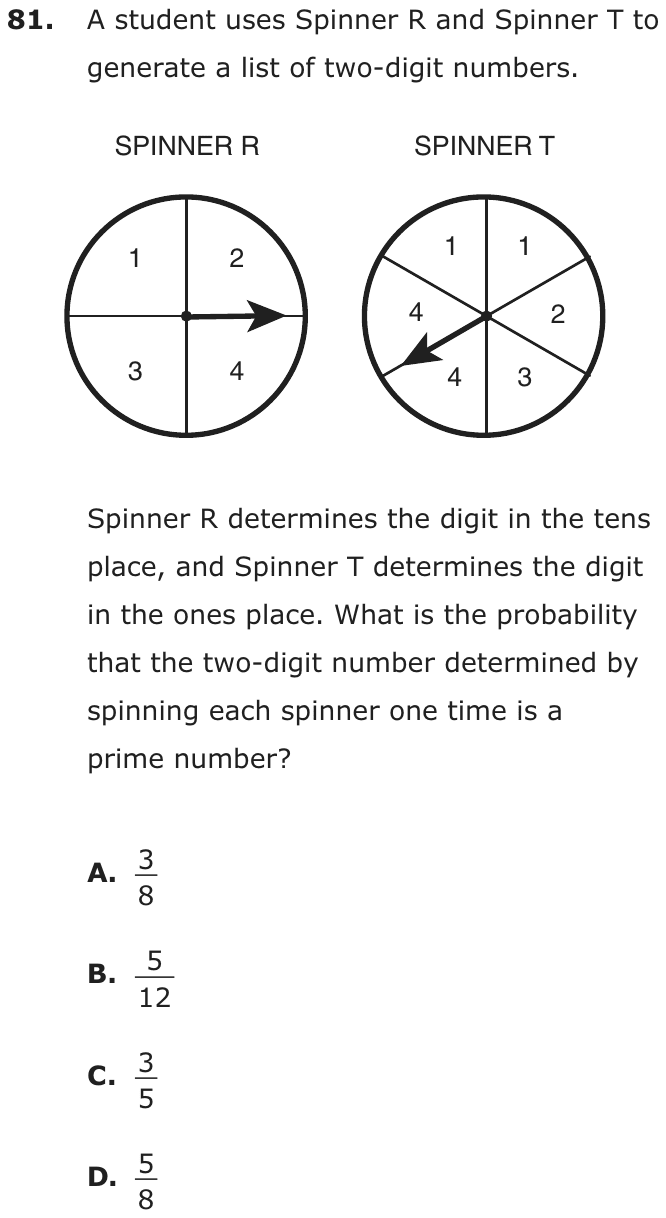
Question 45 of 75
2023 Test A Math, question 32Question
Mei-Ling is one of 6 members of a committee. If 2 members of that committee are selected to go to a conference, how many of the possible pairs of members would include Mei-Ling?
- A5
- B6
- C10
- D12
Show the answer
Correct answer: A
Call the 6 members A, B, C, D, E, and M (for Mei-Ling). The possible combinations are AB, AC, AD, AE, AM, BC, BD, BE, BM, CD, CE, CM, DE, DM, and EM. Of those pairs, 5 include Mei-Ling.
Question analysis
This counting question describes a six-member committee sending two members to a conference and asks how many of the possible pairs include Mei-Ling. Students count combinations in which order does not matter. The traps are counting a pair twice, pairing Mei-Ling with herself, or multiplying the numbers in the question instead of listing the pairs.
- NYS standards
- 7.SP.8b sample spaces for compound events
- Grade level
- Grade 7 content, by NYS standard
- Compared with grade 7
- At grade 7 Grade 7 students count outcomes with organized lists and tree diagrams. Here the list of pairs is short and a single condition, that one named person belongs to the pair, filters it, which matches routine grade 7 counting work.
- Estimated difficulty
- Straightforward: two steps or one careful reading.
- Thinking it demands
- Depth of knowledge 2, skills and concepts · mainly apply
- What makes it hard
- Turning words into math minor
- Much to keep track of minor
- Solution
- 2 steps
- Reading level
- Question and choices: about grade 8, 31 words.
- Students, last 30 days
- Not enough answers yet to show (it takes 10).
Why it is hard, traps and wrong answers (shows the answer)
Why it is hard
The count is small enough to list, so the question rewards a clear picture of what a pair is: two different people, in no particular order. The tempting errors count Mei-Ling as her own partner, count each pair twice, or multiply the two numbers in the stem. Writing the five pairs out, M with each of A through E, takes seconds and rules out all three.
Turning words into math minor Understanding the question
Pairs that include Mei-Ling are simply Mei-Ling with each of the other 5 members, a count of her possible partners, though the phrase “possible pairs” invites counting all 15 pairs. (Hegarty, Mayer & Monk, 1995; Koedinger & Nathan, 2004)
Much to keep track of minor Working it out
Listing pairs by letter, as the explanation does with A to E and M, means tracking which pairs are already written, so that AM and MA are not both counted. (Sweller, 1988; Carpenter, Just & Shell, 1990)
Strategy: Label the members with letters and list every pair that contains Mei-Ling, remembering that a pair is two different people and that order does not matter.
Traps
- Counting the ends: Inclusive or exclusive ends, fence posts, consecutive numbers: an answer that is one too many or too few, or an endpoint drawn open where it belongs closed (or the reverse).
- Overlapping groups: Things in two groups at once are counted twice, or not subtracted.
- Numbers taken from the question: Combines the numbers in the question without a model of the situation, or is simply a number that appears in the question.
The wrong answers, classified
B Counting the ends (Brown & Burton, 1978)
Counts all 6 committee members as possible partners, forgetting that Mei-Ling cannot be paired with herself, one more than the real count.
C Overlapping groups (King et al., 2004)
Counts ordered pairs, Mei-Ling with a partner and that partner with Mei-Ling, as different, so each of the 5 pairs is counted twice.
D Numbers taken from the question (Hegarty, Mayer & Monk, 1995)
Multiplies the 6 members by the 2 people chosen, 6 × 2 = 12, a product of the stem's numbers that counts no actual pairs.
Worked solution, step by step
Formulas used
- Number of pairs in a group
- n is the number of people in the group. Each person can pair up with the n − 1 others. Multiplying counts every pair twice, once from each partner’s side. So you divide by 2.
Sort out the question
The committee has 6 members, and Mei-Ling is one of them. Two members go to the conference together. That makes a pair. You don’t need every possible pair. You only need the pairs that include Mei-Ling.
Find Mei-Ling’s possible partners
A pair with Mei-Ling is Mei-Ling plus one other member. Call Mei-Ling M, and call the other members A, B, C, D and E. Her pairs are M with A, M with B, M with C, M with D and M with E. That is 5 pairs.
Watch out: she can’t be paired with herself. Counting all 6 members as partners gives 6, choice B.
Don’t count a pair twice
Mei-Ling with A is the same pair as A with Mei-Ling. The same two people go either way. Watch out: counting both orders doubles the count to 10, choice C. Multiplying 6 × 2 = 12 gives choice D, but that does not count any pairs.
Check against all the pairs
Count every pair in the committee.
Each pair has 2 people, so the 15 pairs have 30 name spots. All 6 members get the same share: . So the answer is A, 5.
Check your answer
List all 15 pairs: AB, AC, AD, AE, AM, BC, BD, BE, BM, CD, CE, CM, DE, DM, EM. Now circle the ones with M in them: AM, BM, CM, DM, EM. There are exactly 5.
More questions like this
The original DOE question
Question 46 of 75
2023 Test A Math, question 42Question
How many members of the set shown above are multiples of 6 but not multiples of 9?
- A11
- B13
- C20
- D22
Show the answer
Correct answer: D
First, list the first several multiples of 6: 6, 12, 18, 24, 30, 36, 42, 48, 54 . . .
Every third multiple (i.e., 18, 36, 54, . . .) is also a multiple of 9. Thus, of the multiples of 6 are not multiples of 9.
Next, calculate how many multiples of 6 are in the given number range. The last multiple of 6 would be 198. So, there are a total of multiples of 6. Since of those are not multiples of 9, the answer is .
Question analysis
This number properties question shows the set of whole numbers from 1 to 200 and asks how many of them are multiples of 6 but not multiples of 9. Students count multiples in a range and remove the overlap, the numbers divisible by both. Finding the right common multiple, and removing only the overlap, is where it gets tricky.
- NYS standards
- 6.NS.4 common factors and multiples
- Grade level
- Grade 6 content, by NYS standard
- Compared with grade 7
- Above grade 7 Multiples and common multiples are grade 6 content, but counting the members of a set that meet one condition and fail another is rare in grade 7 work. The overlap between the two kinds of multiples must be found and removed exactly.
- Estimated difficulty
- Hard: combines ideas, needs a plan, and has more than one tempting wrong answer.
- Thinking it demands
- Depth of knowledge 2, skills and concepts · mainly apply
- What makes it hard
- No obvious method moderate
- Much to keep track of minor
- Turning words into math minor
- Solution
- 3 steps
- Reading level
- Question and choices: about grade 6, 16 words.
- Students, last 30 days
- Not enough answers yet to show (it takes 10).
Why it is hard, traps and wrong answers (shows the answer)
Why it is hard
Counting multiples of 6 is routine; the harder decision is how to remove the ones that are also multiples of 9. Those are the multiples of 18, the least common multiple, not of 54 or 15, and students who count them correctly must still subtract them rather than report them. Listing 6, 12, 18, 24, 30, 36 shows the pattern, two kept for every one removed, which also gives the answer as two thirds of 33.
No obvious method moderate Working it out
The stem never mentions a common multiple: students must see that the multiples of 6 that are also multiples of 9 are the multiples of 18, every third multiple of 6. (Schoenfeld, 1985)
Much to keep track of minor Working it out
Three counts are in play at once, 33 multiples of 6 up to 198, 11 multiples of 18 up to 198, and their difference, and two of them are listed choices. (Sweller, 1988; Carpenter, Just & Shell, 1990)
Turning words into math minor Understanding the question
The bold not in “multiples of 6 but not multiples of 9” asks for what is left after a removal, a set difference rather than a count of the numbers removed. (Hegarty, Mayer & Monk, 1995; Koedinger & Nathan, 2004)
Strategy: Count the multiples of 6 up to 200, find the smallest number that is a multiple of both 6 and 9, count its multiples in the set, and subtract.
Traps
- Answers a different question: A choice is right for another quantity: the other unknown, the rest instead of the part, the part instead of the whole.
- Misunderstands the concept: A wrong belief about a concept: that percents can be added, that area grows like length, that averages can be averaged, that a bigger denominator means a bigger fraction.
The wrong answers, classified
A Answers a different question (King et al., 2004; Hegarty, Mayer & Monk, 1995)
Counts the 11 multiples of 18, the numbers to be removed, and gives that count instead of the multiples of 6 that remain.
B Misunderstands the concept (Smith, diSessa & Roschelle, 1993; De Bock et al., 1998; Ni & Zhou, 2005)
Takes 6 + 9 = 15 as the step between numbers divisible by both, and gives its 13 multiples up to 195, the numbers it would remove.
C Misunderstands the concept (Smith, diSessa & Roschelle, 1993; De Bock et al., 1998; Ni & Zhou, 2005)
Uses 6 + 9 = 15 instead of 18 as the common multiple and removes its 13 multiples from the 33 multiples of 6, leaving 20.
Worked solution, step by step
Formulas used
- Counting multiples
- n is the number whose multiples you count, such as 6. The first multiple is n × 1, the second is n × 2, and so on. So if the largest multiple in the set is n × k, there are k multiples in all.
- Least common multiple
- The least common multiple, or LCM, is the smallest number that two numbers both divide evenly. A number is a multiple of both 6 and 9 exactly when it is a multiple of 18.
Sort out the question
The set holds the whole numbers from 1 to 200. A multiple of 6 is a number that 6 divides evenly, like 6, 12 or 18. You need the multiples of 6 that are not multiples of 9. So count all the multiples of 6. Then take away those that are also multiples of 9.
Count the multiples of 6
200 is not a multiple of 6, but 198 is. So 198 is the last multiple of 6 in the set.
There are 33 multiples of 6.
Find the numbers to take away
List the multiples of 6: 6, 12, 18, 24, 30, 36. The first one 9 also divides is 18, then 36. So every third multiple of 6 is also a multiple of 9.
Watch out: the shared multiples are multiples of 18, not of 6 + 9 = 15. Using 15 leads to 13 or 20, choices B and C.
Count the multiples of 18
The last multiple of 18 in the set is also 198.
There are 11 of them. Watch out: these are the numbers you take away, not the answer. Stopping here gives 11, choice A.
Take away the multiples of 18
There are 22 multiples of 6 left over. So the answer is D, 22.
Check your answer
Every third multiple of 6 is a multiple of 18, so two out of every three multiples of 6 stay. Two thirds of 33 is . That matches. Test one: 30 is a multiple of 6, and 30 ÷ 9 is not a whole number, so 30 counts.
More questions like this
The original DOE question
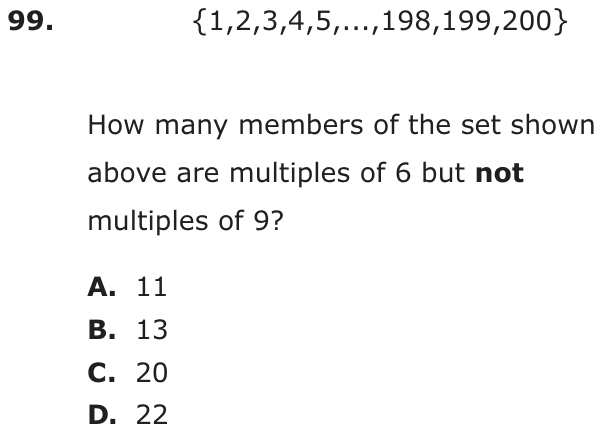
Question 47 of 75
2023 Test B Math, question 13Question
Shiow-Chen has a box that contains 4 green cards, 7 yellow cards, and 6 red cards. She randomly draws one card at a time from the box and does not return the cards to the box after they have been drawn. The first card she draws is yellow. The second card she draws is green. What is the probability that the third card she draws will also be green?
- A
- B
- C
- D
Show the answer
Correct answer: A
After Shiow-Chen draws a yellow card and a green card, the remaining cards are 3 green, 6 yellow, and 6 red. The probability of drawing a green card from that group is:
Question analysis
Shiow-Chen's box holds 4 green, 7 yellow and 6 red cards, and she draws cards one at a time without putting them back. Her first card is yellow and her second is green. Students find the probability that the third card is also green, which means updating both the green count and the total first.
- NYS standards
- 6.SP.8a uniform probability models
- Grade level
- Grade 6 content, by NYS standard
- Compared with grade 7
- At grade 7 Simple probability is grade 6 content. The extra demand is tracking two earlier draws that were not put back, which changes the counts for the third draw, a step typical grade 7 problems often leave out.
- Estimated difficulty
- Moderate: several steps, or a close reading with one strong distractor.
- Thinking it demands
- Depth of knowledge 2, skills and concepts · mainly apply
- What makes it hard
- Much to keep track of moderate
- Turning words into math minor
- Solution
- 3 steps
- Reading level
- Question and choices: about grade 3, 70 words.
- Students, last 30 days
- Not enough answers yet to show (it takes 10).
Why it is hard, traps and wrong answers (shows the answer)
Why it is hard
The probability itself is one fraction, but it has to be built from a box that two draws have already changed. Students who use the original 17 cards, or who compare green with the other colors instead of with all the cards, reach listed choices that look reasonable. Listing the counts after each draw, then putting the green cards over all the cards left, avoids both.
Much to keep track of moderate Working it out
Three color counts and the total must each be updated after two draws, 4 green, 7 yellow and 6 red becoming 3, 6 and 6 out of 15, before the third draw is considered. (Sweller, 1988; Carpenter, Just & Shell, 1990)
Turning words into math minor Understanding the question
“Does not return the cards” and the two named draws are the conditions that change the box, and the stem states them in passing before asking about the third card. (Hegarty, Mayer & Monk, 1995; Koedinger & Nathan, 2004)
Strategy: Take the two drawn cards out of the box: lower the yellow and green counts by one each, recount the total, then put the green cards left over the cards left.
Traps
- Without replacement: In a second pick there is one fewer item, which changes the probability.
- Misunderstands the concept: A wrong belief about a concept: that percents can be added, that area grows like length, that averages can be averaged, that a bigger denominator means a bigger fraction.
The wrong answers, classified
B Without replacement (Fischbein & Schnarch, 1997)
Uses the full box, 4 green cards out of 17, as if neither of the first two cards had been taken out.
C Misunderstands the concept (Smith, diSessa & Roschelle, 1993; De Bock et al., 1998; Ni & Zhou, 2005)
Updates the counts correctly but compares the 3 green cards with the 12 cards of other colors, 3/12 = 1/4, a part-to-part ratio.
D Misunderstands the concept (Smith, diSessa & Roschelle, 1993; De Bock et al., 1998; Ni & Zhou, 2005)
Treats the three colors as equally likely, giving green a 1-in-3 chance whatever the number of cards of each color.
Worked solution, step by step
Formulas used
- Probability
- P is the probability, how likely something is, from 0 (never) to 1 (always). The top counts the results you want, here green cards. The bottom counts every possible result, here every card in the box. It works when each result is equally likely, as in a random draw.
Sort out the question
The box starts with 4 green, 7 yellow and 6 red cards. Shiow-Chen draws cards one at a time, and she does not put them back. The first card is yellow, and the second is green. You need the probability that the third card is green.
Take out the two cards
The cards are not put back, so the box changes. Lower the yellow count by 1 and the green count by 1.
Color At the start After two draws Green 4 3 Yellow 7 6 Red 6 6 Total 17 15 Use the probability formula
For the third draw, the results you want are the 3 green cards left. The total is the 15 cards left.
Watch out: using the full box gives , choice B. But two cards are gone.
Simplify and answer
Divide the top and bottom by 3.
Watch out: compare the green cards with all 15 cards, not with the 12 cards of other colors. That gives , choice C. And the three colors are not equally likely, so is wrong too. So the answer is A, .
Check your answer
17 cards minus the 2 drawn leaves 15. One fifth of 15 is 3, the number of green cards left. Also, the chance went down from . That makes sense, because a green card was taken out.
More questions like this
The original DOE question
Question 48 of 75
2023 Test B Math, question 21Question
If m and n are positive integers, how many of the five expressions above are equivalent to ?
- A1
- B2
- C3
- D4
Show the answer
Correct answer: D
Since m and n are positive, the value of is also positive. Of the five options given:
is negative.
is positive.
is positive.
is positive.
is positive.
There are 4 expressions that are positive, and each one is equal to .
Question analysis
Five expressions are listed: −mn, (−m)(−n), |mn|, |−mn| and |(−m)(−n)|. If m and n are positive integers, students count how many are equivalent to mn. It tests the sign rules for multiplying negatives together with what absolute value does, and each expression has to be judged on its own.
- Grade level
- Grade 7 content, by NYS standard
- Compared with grade 7
- At grade 7 Multiplying signed numbers and absolute value are grade 6 and 7 content. Checking five expressions one by one takes longer than a typical single computation, but each check uses a familiar rule.
- Estimated difficulty
- Moderate: several steps, or a close reading with one strong distractor.
- Thinking it demands
- Depth of knowledge 2, skills and concepts · mainly analyze
- What makes it hard
- Variables instead of numbers moderate
- Much to keep track of minor
- Something you must already know minor
- Solution
- 5 steps
- Reading level
- Question and choices: about grade 10, 23 words.
- Students, last 30 days
- Not enough answers yet to show (it takes 10).
Why it is hard, traps and wrong answers (shows the answer)
Why it is hard
Each expression takes only a moment, but the answer is a count, so one misjudged expression changes it. The minus signs are designed to unsettle: four of the five expressions show at least one, and only one of those actually stays negative. Substituting small positive numbers and comparing each value with mn turns the question into arithmetic.
Variables instead of numbers moderate Understanding the question
The five expressions use only m and n, so each sign rule has to be applied in general unless the student substitutes values such as m = 2 and n = 3. (Koedinger & Nathan, 2004; Enright, Morley & Sheehan, 2002)
Much to keep track of minor Working it out
Five expressions are judged one at a time and a count kept, and two of them combine the product rule for negatives with absolute value bars. (Sweller, 1988; Carpenter, Just & Shell, 1990)
Something you must already know minor Working it out
The rules that two negative factors give a positive product and that absolute value removes a minus sign are assumed, not stated. (Anderson & Krathwohl, 2001)
Strategy: Pick small values such as m = 2 and n = 3, evaluate each of the five expressions, and count the ones equal to 6.
Traps
- Negatives and direction: Arithmetic with negative numbers, the order of a subtraction, or direction on a number line. (Moving a term across the equals sign without changing its sign is a faulty procedure.)
- Misunderstands the concept: A wrong belief about a concept: that percents can be added, that area grows like length, that averages can be averaged, that a bigger denominator means a bigger fraction.
The wrong answers, classified
A Negatives and direction (Brown & Burton, 1978)
Treats any minus sign as making the value negative, even inside bars or in a product of two negatives, so counts only |mn|.
B Misunderstands the concept (Smith, diSessa & Roschelle, 1993; De Bock et al., 1998; Ni & Zhou, 2005)
Accepts |mn| and (−m)(−n) but believes bars cannot cancel a minus sign written inside them, rejecting |−mn| and |(−m)(−n)|.
C Negatives and direction (Brown & Burton, 1978)
Thinks a negative times a negative stays negative, so rejects (−m)(−n) along with −mn and counts only the three absolute values.
Worked solution, step by step
Formulas used
- Multiplying two negatives
- a and b are positive numbers. A negative number times a negative number gives a positive number. The two minus signs cancel out. One negative and one positive give a negative.
- Absolute value
- The bars around a number mean absolute value. It is how far the number is from 0 on a number line. A distance is never negative, so |−6| = 6 and |6| = 6. The bars remove any minus sign.
Sort out the question
m and n are positive integers. That means whole numbers greater than 0. Writing mn means m times n, so mn is positive. You need to count how many of the five expressions always equal mn.
Pick numbers to test
Pick easy values: and . Then . Any expression that equals mn must come out to 6.
Test the first two expressions
This is negative, so it does not equal 6.
A negative times a negative is positive, so this one equals 6. Watch out: if you think a negative times a negative stays negative, you reject this one and get 3, choice C.
Test the three absolute values
All three equal 6, because absolute value bars remove a minus sign. Watch out: the bars work even when the minus sign is inside them. Rejecting the last two gives 2, choice B.
Count the matches
Four expressions equal mn: , , and . Only does not. The sign rules work the same for any positive m and n, not just 2 and 3. So the answer is D, 4.
Check your answer
Try other numbers, such as and . Then . The five expressions give −5, 5, 5, 5 and 5. Again, four of them match mn.
More questions like this
The original DOE question
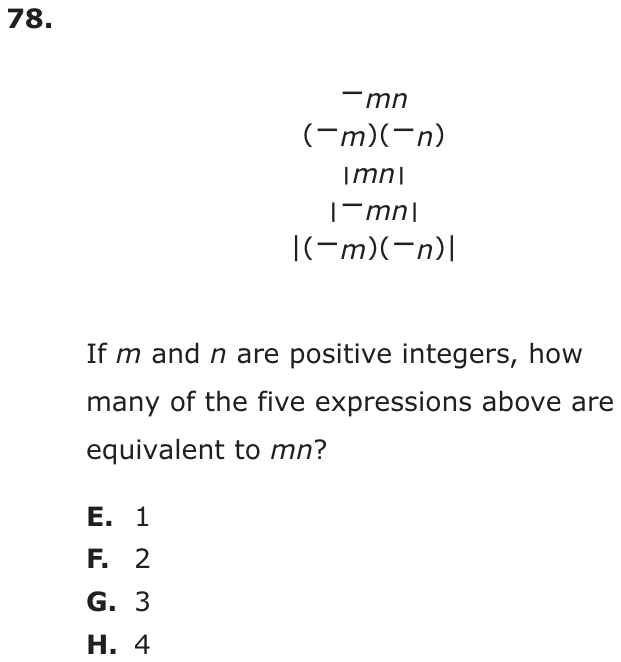
Question 49 of 75
2023 Test B Math, question 35Question
In Center City, the ratio of people to dogs is , and the ratio of dogs to cats is . What is the ratio of people to cats?
- A
- B
- C
- D
Show the answer
Correct answer: C
Take each ratio and solve for dogs:
And
Set the two expressions for d equal to each other and solve for :
So, the ratio of people to cats is .
Question analysis
A ratio question about Center City, where the ratio of people to dogs and the ratio of dogs to cats are both given. Students link the two ratios through the dogs to find the ratio of people to cats. It tests combining ratios, a step that goes wrong when the given numbers are paired up as written.
- Grade level
- Grade 7 content, by NYS standard
- Compared with grade 7
- At grade 7 Grade 7 ratio problems usually work with a single ratio. Here two ratios share the dogs but give them different numbers of parts, so one ratio must be rescaled before people and cats can be compared.
- Estimated difficulty
- Moderate: several steps, or a close reading with one strong distractor.
- Thinking it demands
- Depth of knowledge 2, skills and concepts · mainly apply
- What makes it hard
- No obvious method moderate
- Much to keep track of minor
- Solution
- 3 steps
- Reading level
- Question and choices: about grade 5, 32 words.
- Students, last 30 days
- Not enough answers yet to show (it takes 10).
Why it is hard, traps and wrong answers (shows the answer)
Why it is hard
The question rewards seeing that the dogs link the two ratios but are counted differently in each. Reading the people’s 4 and the cats’ 2 straight off the page gives a tidy 2 : 1, and it is the trap most students fall into. Rewriting people to dogs as 12 : 3 makes one chain, 12 : 3 : 2, from which people to cats is 12 : 2.
No obvious method moderate Working it out
Dogs are 1 part in the first ratio and 3 parts in the second, so the ratios cannot be joined until 4 : 1 is rescaled to 12 : 3; nothing in the stem says to do this. (Schoenfeld, 1985)
Much to keep track of minor Working it out
Three groups, people, dogs and cats, run through two ratios, and students must keep track of which number belongs to which group while scaling. (Sweller, 1988; Carpenter, Just & Shell, 1990)
Strategy: Rewrite both ratios with the same number for dogs, so that people to dogs to cats becomes one three-part ratio, then read off people to cats and simplify.
Traps
- Numbers taken from the question: Combines the numbers in the question without a model of the situation, or is simply a number that appears in the question.
- Stops one step early: A choice is a number from partway through the solution.
The wrong answers, classified
A Numbers taken from the question (Hegarty, Mayer & Monk, 1995)
Pairs the people’s 4 from the first ratio with the cats’ 2 from the second, 4 : 2 = 2 : 1, without first matching the dogs’ parts.
B Numbers taken from the question (Hegarty, Mayer & Monk, 1995)
Adds the two ratios term by term, (4 + 3) : (1 + 2) = 7 : 3, treating ratio terms as amounts that can be combined.
D Stops one step early (King et al., 2004; Gierl et al., 2017)
Multiplies people per dog by the dogs’ 3, 4 × 3 = 12, and stops before dividing by the cats’ 2, giving 12 : 1.
Worked solution, step by step
Formulas used
- Equivalent ratios
- a and b are the two amounts in a ratio, in order. k is any number you choose, except 0. Multiplying both amounts by the same number keeps the comparison the same. For example, 4 : 1 and 12 : 3 both mean 4 people for every dog.
Sort out the question
A ratio compares two amounts. People to dogs is 4 : 1. That means 4 people for every 1 dog. Dogs to cats is 3 : 2. That means 3 dogs for every 2 cats.
You need people to cats. Dogs show up in both ratios, so they are the link.
Make the dog numbers match
The dogs are 1 in the first ratio and 3 in the second. To join the ratios, the dog numbers must be the same. So multiply both parts of the first ratio by 3.
Now there are 12 people for every 3 dogs.
Join the two ratios
Both ratios now have 3 dogs. So you can write all three groups in one ratio.
For every 12 people, there are 3 dogs and 2 cats.
Read off and simplify
People to cats is 12 : 2. Divide both parts by 2.
Watch out: Taking the 4 people and the 2 cats straight from the problem gives 4 : 2 = 2 : 1, choice A. That skips matching the dogs. Stopping at 12 : 1, without using the 2 cats, gives choice D.
So the answer is C, 6 : 1.
Check your answer
Build a small town. Start with 2 cats. The second ratio gives 3 dogs. The first ratio gives 4 people for each dog, so 4 × 3 = 12 people. That is 12 people for 2 cats, or 6 people for each cat.
More questions like this
The original DOE question
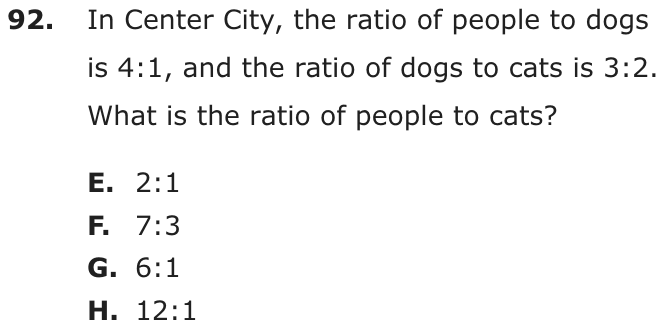
Question 50 of 75
2023 Test B Math, question 50Question
A student made a list of all possible products of 2 different numbers in the set above. What fraction of the products are odd?
- A
- B
- C
- D
Show the answer
Correct answer: B
First, list the products:
Of the 10 products, 3 are odd. The fraction is .
Question analysis
A student lists every product of two different numbers from the set 3, 4, 5, 6, 7. Students find what fraction of those products are odd. It tests listing outcomes systematically without counting a pair twice, and reasoning about odd and even numbers.
- NYS standards
- Grade level
- Grade 7 content, by NYS standard
- Compared with grade 7
- At grade 7 Organized lists of outcomes are grade 7 work. Here students list the products of pairs from five numbers, without repeating a pair or pairing a number with itself, then count the ones that fit.
- Estimated difficulty
- Moderate: several steps, or a close reading with one strong distractor.
- Thinking it demands
- Depth of knowledge 2, skills and concepts · mainly apply
- What makes it hard
- Much to keep track of moderate
- Something you must already know minor
- Solution
- 3 steps
- Reading level
- Question and choices: about grade 6, 28 words.
- Students, last 30 days
- Not enough answers yet to show (it takes 10).
Why it is hard, traps and wrong answers (shows the answer)
Why it is hard
The count of odd products is easy, since only 3, 5 and 7 can make one; the total is where students go wrong. Counting ordered pairs, 5 × 4 = 20, while listing odd products once mixes two kinds of counting. Writing the 10 pairs in order, 3 with each larger number, then 4, and so on, keeps the total honest.
Much to keep track of moderate Working it out
Listing the products of 2 different numbers from five means tracking 10 pairs, with no pair repeated in reverse order and no number paired with itself. (Sweller, 1988; Carpenter, Just & Shell, 1990)
Something you must already know minor Working it out
The shortcut, that a product is odd only when both factors are odd, cuts the work to counting pairs from 3, 5 and 7, but it must be known. (Anderson & Krathwohl, 2001)
Strategy: List each pair of different numbers once, then find each product, or use the fact that a product is odd only when both factors are odd, and count.
Traps
- Overlapping groups: Things in two groups at once are counted twice, or not subtracted.
- Misunderstands the concept: A wrong belief about a concept: that percents can be added, that area grows like length, that averages can be averaged, that a bigger denominator means a bigger fraction.
- Answers a different question: A choice is right for another quantity: the other unknown, the rest instead of the part, the part instead of the whole.
The wrong answers, classified
A Overlapping groups (King et al., 2004)
Counts ordered pairs for the total, 5 × 4 = 20, so each pair appears twice, but counts the odd products once, 3, giving 3/20.
C Misunderstands the concept (Smith, diSessa & Roschelle, 1993; De Bock et al., 1998; Ni & Zhou, 2005)
Assumes about half of all products are odd, as odd and even numbers come equally often, without listing the products or checking any.
D Answers a different question (King et al., 2004; Hegarty, Mayer & Monk, 1995)
Gives the share of the numbers in the set that are odd, 3 of 5, instead of the share of the products, never forming any products.
Worked solution, step by step
Formulas used
- Fraction of a list
- The top counts the products that are odd. The bottom counts all the products in the list. A product is the answer when you multiply. The fraction tells what share of the list is odd.
- Odd times odd
- An odd number can’t be split into pairs, like 3 or 7. An even number can, like 4. A product is odd only when both numbers are odd. If either number is even, the product is even, because it splits into pairs.
Sort out the question
The set has 3, 4, 5, 6 and 7. The student multiplies 2 different numbers, every possible way. A product is the answer to a multiplication. Each pair counts once, since 3 × 4 and 4 × 3 give the same product. You need the fraction of the products that are odd.
List every pair once
Pair 3 with each bigger number. Then pair 4 with each bigger number, and so on. This way no pair is counted twice.
3 × 4 = 12 3 × 5 = 15 3 × 6 = 18 3 × 7 = 21 4 × 5 = 20 4 × 6 = 24 4 × 7 = 28 5 × 6 = 30 5 × 7 = 35 6 × 7 = 42 There are 10 products.
Count the odd products
The odd products are 15, 21 and 35. That makes 3. They come from the only pairs where both numbers are odd: 3 and 5, 3 and 7, and 5 and 7.
Write the fraction
Use the fraction formula.
Watch out: Counting 4 × 3 as well as 3 × 4 makes 20 pairs. Then , choice A, mixes two ways of counting. And , choice D, is the share of the numbers that are odd, not the products.
So the answer is B, .
Check your answer
Count without listing. Each of the 5 numbers can pair with 4 others, which makes 20. But that counts every pair twice, so there are 20 ÷ 2 = 10 pairs. Only the odd numbers 3, 5 and 7 make odd products, and they form 3 pairs.
More questions like this
The original DOE question
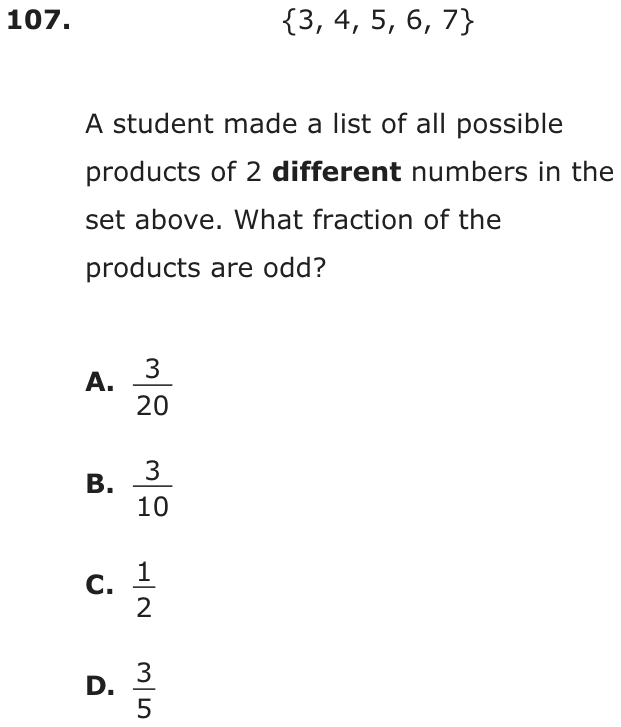
Question 51 of 75
2018 Test A English, question 6Passage Moving through Mountains
Moving through Mountains
(1) An age-old proverb says that necessity is the mother of invention. (2) Centuries of human ingenuity in the face of obstacles prove this to be true. (3) For many years the Swiss Alps, a mountain range spanning southern Switzerland and northern Italy, were such an obstacle. (4) Roads and railways had to navigate around the mountains or through winding tunnels inside the mountains, making the transportation of people and goods difficult and time consuming. (5) In 2016 these burdens were eased with the completion of the Gotthard Base Tunnel.
(6) Construction of the high-speed railway tunnel began in 1996. (7) The tunnel was created through the use of tunnel-boring machines, which are giant drills with a flat rotating head called a cutter head. (8) Each of the tunnel-boring machines used during the construction of the tunnel was about the length of four football fields arranged end-to-end. (9) During the seventeen-year construction period, 28 million tons of rock were removed, enough to rebuild the Great Pyramid of Giza five times. (10) This massive construction project is reported to have cost $12 billion. (11) After that, 4 million cubic meters of concrete, or enough concrete to build eighty-four Empire State Buildings, were used to construct and support the tunnel.
(12) By 2020 the high-speed railway will carry more than 250 freight trains and 55 passenger trains a day, with most traveling at speeds of around 100 to 125 miles per hour. (13) It will be faster for people to travel between northern and southern Europe. (14) The travel time between the European cities of Zurich, Switzerland, and Milan, Italy, will be reduced by an hour. (15) Many European leaders compare the Gotthard Base Tunnel to the Channel Tunnel, a 33-mile underwater tunnel that connects the United Kingdom and France. (16) While there is no roadway in the Channel Tunnel, people can drive their cars onto special trains that will carry vehicles through to the other side.
(17) Just as traffic congestion in major cities led to the construction of underground local transportation, natural formations, such as mountain ranges, have also sent people underground for faster, easier, and cheaper methods of transportation across larger areas. (18) There is renewed interest in constructing innovative methods of transportation that will help eliminate problems associated with traveling to and from certain areas.
Question
Where should sentence 11 be moved in order to improve the organization of the second paragraph (sentences 6–11)?
- Ato the beginning of the paragraph (before sentence 6)
- Bbetween sentences 6 and 7
- Cbetween sentences 8 and 9
- Dbetween sentences 9 and 10
Show the answer
Correct answer: D
The Answer is (D)
The question asks where sentence 11, which completes the detailed steps of how the tunnel was built, should be moved within the second paragraph in order to improve the organization of the paragraph.
Option D, placing the sentence between sentences 9 and 10, is correct because placing the sentence there helps the reader understand the full sequence of steps performed in constructing the tunnel before the cost of the project is introduced.
Option A, placing the sentence at the beginning of the paragraph (before sentence 6), is incorrect because it would not make sense since the process of building the tunnel has not yet been introduced.
Similarly, Option B is incorrect because placing the sentence after sentence 6 would not make sense given that adding concrete would have to happen after the rock was broken down and removed from the tunnel.
Option C, placing the sentence between sentences 8 and 9, would also be incorrect because the use of concrete did not take place before the removal of “28 million tons of rock” (sentence 9).
Question analysis
This revising question asks where to move a sentence about the concrete used to support the Gotthard Base Tunnel so the second paragraph is better organized. Students must follow the order of the construction steps and notice what the sentence's opening words refer back to, since several positions sound acceptable at a glance.
- Grade level
- Grade 7 reading and task
- Compared with grade 7
- At grade 7 Ordering sentences logically is a grade 7 writing skill. Here the student follows a sequence of construction steps and a time-order signal word, a short, typical grade 7 revision task with four nearby positions to compare.
- Estimated difficulty
- Moderate: several steps, or a close reading with one strong distractor.
- Thinking it demands
- Depth of knowledge 2, skills and concepts · mainly analyze
- What makes it hard
- How sentences fit together major
- A very close wrong answer moderate
- Much to keep track of minor
- Every choice must be checked minor
- Evidence
- Answered from one paragraph or stanza
- Reading level
- Passage: about grade 11, 362 words; question and choices: about grade 7, 33 words.
- Students, last 30 days
- Not enough answers yet to show (it takes 10).
Why it is hard, traps and wrong answers (shows the answer)
Why it is hard
The question turns on two signal phrases: what “After that” must follow, and what “This massive construction project” sums up. Students who see only that the concrete belongs with the digging often park it beside the machine details, before the rock has been cleared. Those who try each position in context see that lining the tunnel can only follow removing the rock.
How sentences fit together major Working it out
Sentence 11 opens with “After that”, so it must follow the rock removal in sentence 9, while “This massive construction project” in sentence 10 reads best as the paragraph's close. (Halliday & Hasan, 1976)
A very close wrong answer moderate Choosing the answer
Moving the sentence between sentences 8 and 9 differs from the right spot, between 9 and 10, by a single sentence, and only seeing that sentence 9's rock removal must come first tells them apart. (Embretson & Wetzel, 1987; Gorin & Embretson, 2006; Ascalon et al., 2007)
Much to keep track of minor Working it out
The construction steps, from the 1996 start through the machines, the 28 million tons of rock and the concrete, have to be kept in order across six sentences. (Sweller, 1988; Carpenter, Just & Shell, 1990)
Every choice must be checked minor Choosing the answer
Each of the four positions has to be tried by rereading the paragraph with the concrete sentence in place, since several sound acceptable at a glance. (Embretson & Wetzel, 1987)
Strategy: Look at the signal words that open sentence 11 and ask what event they must follow. Then read the paragraph with the sentence in each position to check the order of events.
Traps
- Sentence in the wrong place: Puts a sentence where it breaks the order of ideas or separates it from what it refers to.
The wrong answers, classified
A Sentence in the wrong place (Halliday & Hasan, 1976)
Moves the sentence to open the paragraph, where “After that” would follow the 2016 completion in sentence 5, putting the concrete work after the tunnel was finished.
B Sentence in the wrong place (Halliday & Hasan, 1976)
Reads “After that” as following the 1996 start of construction, which sounds smooth but has the tunnel lined with concrete before any machine had bored it.
C Sentence in the wrong place (Halliday & Hasan, 1976)
Sees that the concrete comes after the machines did their work but places it before sentence 9, so the tunnel is lined before its 28 million tons of rock are removed.
Working it out, step by step
Figure out what the question asks
Sentence 11 is in the wrong spot. You need to move it so paragraph 2 tells events in the right order. Paragraph 2 is sentences 6 to 11.
Look at the clue words in sentence 11
Sentence 11 says: “After that, 4 million cubic meters of concrete, or enough concrete to build eighty-four Empire State Buildings, were used to construct and support the tunnel.” “After that” is a transition, a word or phrase that links ideas. It tells you the concrete came after some other event. You need to find that event.
Put the building steps in order
Think about how you build a tunnel. First you dig out the rock. Then you line the hole with concrete to hold it up.
- Sentence 6: work began in 1996.
- Sentences 7 and 8: the machines that did the digging.
- Sentence 9: “28 million tons of rock were removed.”
- Sentence 10: the project cost $12 billion.
The concrete must come after the rock is removed. So sentence 11 belongs right after sentence 9.
Read the paragraph in the new order
Sentence 9 removes the rock. “After that,” the concrete is poured. Then sentence 10 sums up “This massive construction project” and its cost. The cost makes a good last point. Right now, sentence 11 comes after the cost. So “After that” seems to mean after paying. That makes no sense.
Check each choice
- A, before sentence 6: “After that” would point back to sentence 5, after the tunnel was finished.
- B, after sentence 6: the concrete would come before any digging.
- C, between 8 and 9: the tunnel would be lined before the rock was removed.
- D, between 9 and 10: the concrete comes right after the rock is removed.
Watch out: C is only one spot away from D. Ask yourself: is the rock gone yet? In C, it isn’t.
Pick the answer
So the answer is D, between sentences 9 and 10.
Now the paragraph goes: start, machines, digging, concrete, cost.
Why this answer and not the closest wrong one
Choice C is close because it puts the concrete after the machines. But sentence 9 is where the rock is removed, and you can’t line a tunnel that is still full of rock. Only D puts “After that” right after the rock removal.
More questions like this
The original DOE question

The passage “Moving through Mountains” as printed (page 48)
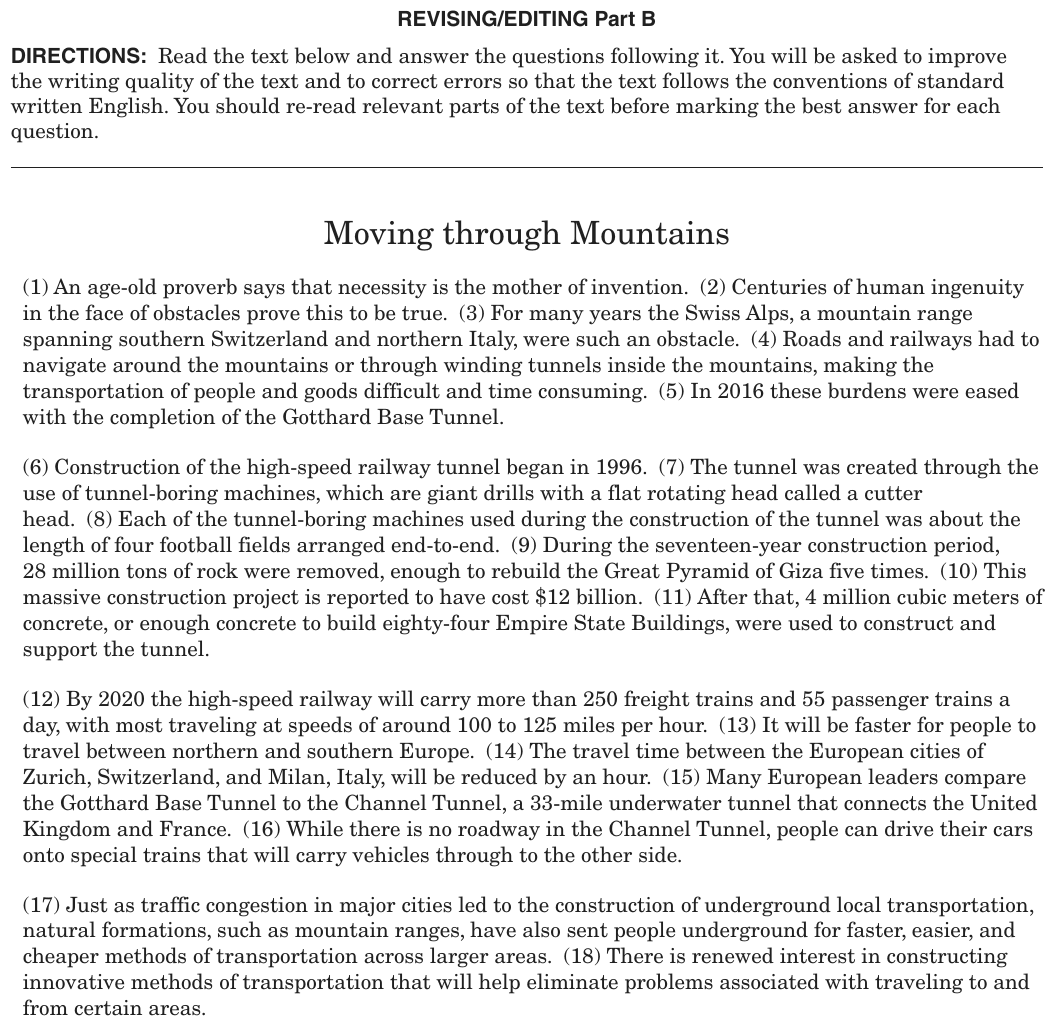
Question 52 of 75
2018 Test A English, question 37Passage Ruins of a Fabled City
Ruins of a Fabled City
The African country of Zimbabwe took its name from the Shona word meaning “stone enclosures” or “venerated houses.” In fact, today dozens of stone ruins are scattered throughout Zimbabwe and other areas in southeastern Africa. One of these ruins, known as Great Zimbabwe, was once a fabled city that inspired tales that circulated throughout Europe. Where was this remarkable city, and who had built it? For centuries the mystery occupied the minds of explorers and treasure seekers.
The first reports to Europeans of Great Zimbabwe were spread a thousand years ago by Arab traders sailing between the Middle East and the east coast of Africa. The traders told of the fabulous wealth of a mysterious stone city in the African interior. In the trader’s tales, that city became associated with the Europeans’ understanding of Middle Eastern history—the Queen of Sheba, King Solomon and his legendary gold mines, long since lost to the world. By the sixteenth century, Portuguese explorers regularly visited East Africa, searching for King Solomon’s gold, but they never found Great Zimbabwe. In 1552, a Portuguese historian, João de Barros, recorded a story told by Arabs about a city with a “square fortress of masonry within and without, built of stones of marvelous size, and there appears to be no mortar joining them.”
In fact, Great Zimbabwe was a marvel. In one area a massive wall more than thirty feet high and twenty feet thick created a great enclosure. Another area contained a fortress-like series of walls, corridors, and steps built into the bluff that overlooks the ruins. Throughout the city, each stone was precisely fitted to the others without the use of mortar.
In the 1870s Karl Mauch, a German geologist, was the first European to see Great Zimbabwe, by then in ruins. Mauch realized that he had “rediscovered” the fabled city from de Barros’s story. He jumped to the conclusion that Great Zimbabwe had been built by the Queen of Sheba. British authorities sent a British journalist, Richard Hall, to Great Zimbabwe to investigate Mauch’s report. Archaeology was still in its infancy, and Hall, convinced that the structures had been built by ancient people from the Middle East, dug up and discarded archaeological deposits that would have revealed much about the true history of Great Zimbabwe. Later European excavations destroyed even more valuable evidence.
In the twentieth century, after excavating areas that had not been disturbed, David Randall-MacIver, a Scottish Egyptologist, and Gertrude Caton-Thompson, an English archaeologist, concluded that the ruins were unmistakably African in origin. Great Zimbabwe was most likely built during the fourteenth or fifteenth century by the ancestors of the present-day Shona people. Recent carbon-14 dating supports their conclusion. Great Zimbabwe was once home to an estimated 20,000 people, the center of a great Shona kingdom. Wealthy Shona kings traded their ivory and gold in coastal towns for other goods, thus accounting for the discovery of beads and other foreign wares in the ruins.
One mystery of Great Zimbabwe had been solved. Another mystery remains: why was the settlement at Great Zimbabwe abandoned, leaving the magnificent stone architecture to fall into ruins?
Question
What was the main way that Karl Mauch’s conclusions about Great Zimbabwe in paragraph 4 affected later archaeological investigations?
- AArchaeologists from all over Europe became interested in excavating the area.
- BArchaeologists made assumptions about the history of the ruins before excavating.
- CArchaeologists started to believe that many of the past accounts recorded about the ruins were true.
- DArchaeologists realized it was unlikely that an ancient culture could build such grand structures.
Show the answer
Correct answer: B
The answer is (B)
The question asks for an explanation of how Mauch’s conclusions influenced later investigations.
Option B is the best option because Mauch’s conclusion that Great Zimbabwe “had been built by the Queen of Sheba” (paragraph 4) affected later investigations of the ruins by causing archaeologists to destroy evidence without examining it, as they assumed that Mauch’s conclusions were accurate (paragraph 4).
Option A is incorrect because, while archaeologists were interested in the area, this was not the main effect of Mauch’s conclusions, as described in the passage.
Option C is incorrect because people searched for Great Zimbabwe because they already believed the stories told by Arab traders and historians like de Barros (paragraph 2), not because of Mauch’s conclusions.
Option D is incorrect because, although the city was considered impressive (paragraph 3), Mauch’s conclusions did not influence whether people believed an ancient culture could have built the city.
Question analysis
This cause-and-effect question asks how Karl Mauch's 1870s conclusions about Great Zimbabwe shaped the investigations that came after him. Students must trace the effect through paragraph 4, where later visitors dug at the site, while keeping the older traders' tales and Portuguese searches in their proper order.
- Grade level
- Grade 7 reading and task
- Compared with grade 7
- At grade 7 Grade 7 informational reading asks how events and ideas influence one another, which is exactly this task. The effect is implied rather than stated, but it sits in one paragraph, keeping the demand typical for grade 7.
- Estimated difficulty
- Moderate: several steps, or a close reading with one strong distractor.
- Thinking it demands
- Depth of knowledge 2, skills and concepts · mainly analyze
- What makes it hard
- Reading between the lines moderate
- A very close wrong answer moderate
- Much to keep track of minor
- Evidence
- Answered from one paragraph or stanza
- Reading level
- Passage: about grade 11, 524 words; question and choices: about grade 11, 70 words.
- Students, last 30 days
- Not enough answers yet to show (it takes 10).
Why it is hard, traps and wrong answers (shows the answer)
Why it is hard
The cause and effect is implied across two sentences of paragraph 4, so students must connect Mauch's leap to the Queen of Sheba with Hall's conviction and the evidence he threw away. The passage's long run of legends makes the older accounts feel like a consequence of Mauch, when they came first. The key rewards reading for what investigators did differently because of him, not what anyone believed at some point.
Reading between the lines moderate Working it out
The passage never says Mauch's conclusion caused anything; the link comes from Hall being sent “to investigate Mauch's report” and arriving “convinced” of Middle Eastern builders. (Graesser, Singer & Trabasso, 1994; Kintsch, 1998)
A very close wrong answer moderate Choosing the answer
B and C both say later investigators took beliefs about the ruins' history for granted; C differs in one detail, since trust in the old accounts began centuries before Mauch rather than because of him. (Embretson & Wetzel, 1987; Gorin & Embretson, 2006; Ascalon et al., 2007)
Much to keep track of minor Working it out
Students must keep the order of believers straight: Arab traders, Portuguese explorers, de Barros in 1552, Mauch in the 1870s, then Hall and later European diggers. (Sweller, 1988; Carpenter, Just & Shell, 1990)
Strategy: Find what Mauch concluded, then read the sentences about the next people to dig at the site and ask how his conclusion shows up in what they did.
Traps
- Reversed relationship: Cause and effect, or the order of events, turned around.
- Too broad or too strong: A choice overstates, generalizes, or uses absolute words the text does not support.
- Outside knowledge: A choice is plausible in the real world but not supported by this text.
The wrong answers, classified
A Too broad or too strong (King et al., 2004)
Inflates the British inquiry and the “later European excavations” into archaeologists from all over Europe, and treats their interest as Mauch's main effect.
C Reversed relationship (King et al., 2004)
Flips the order: trust in the traders' tales and de Barros's account came long before Mauch and shaped his conclusion, not the other way round.
D Outside knowledge (King et al., 2004; Recht & Leslie, 1988)
Echoes the real colonial-era doubt that Africans built the city, but in the passage Hall credits ancient Middle Eastern builders, so investigators did think an ancient culture built it.
Working it out, step by step
Figure out what the question asks
This is a cause-and-effect question. It asks how Karl Mauch’s ideas changed what later people did at the ruins.
Find the evidence in paragraph 4
Mauch “jumped to the conclusion that Great Zimbabwe had been built by the Queen of Sheba.” Then Richard Hall was sent “to investigate Mauch’s report.”
Hall arrived “convinced that the structures had been built by ancient people from the Middle East.” So he “dug up and discarded archaeological deposits.” Later digs “destroyed even more valuable evidence.”
Work out the effect
To jump to a conclusion is to decide something before you have proof. Mauch did that. Hall came to check Mauch’s report, already sure of a story like Mauch’s. He decided the answer before he dug. So he threw away clues. “Deposits” here means layers of old things in the ground. They could have shown the true history.
Check each choice
- A The passage never says people from all over Europe became interested.
- B fits. The diggers made assumptions (beliefs taken as true without proof) before they dug.
- C People trusted the old tales centuries before Mauch, so he did not cause that.
- D Hall still thought an ancient people built the city, just not Africans.
Choose the answer
Mauch’s guess led later diggers to decide the city’s history before they dug. So the answer is B.
Why this answer and not the closest wrong one
C is the closest trap. It also says people trusted ideas about the ruins. But trust in the old tales began with Arab traders, and de Barros wrote his story down in 1552. Mauch came in the 1870s. C gets the order backward. B names what changed after Mauch.
More questions like this
The original DOE question
The passage “Ruins of a Fabled City” as printed (page 68)
Question 53 of 75
2018 Test A English, question 52Passage The Year without a Summer
The Year without a Summer
The eruption of the Philippine volcano Mount Pinatubo in June 1991 sent a huge cloud of gas and dust encircling the globe. The dust and ash from Mount Pinatubo was blamed for a two-year decrease in global temperature, changes in weather patterns, and damage to the ozone layer. The situation brings to mind a time now remembered as “The Year without a Summer,” a meteorological event that occurred 175 years earlier. At that time, harsh weather conditions plagued much of eastern North America and, to a lesser extent, northern Europe.
April 1816 brought typical spring weather to upstate New York and New England; trees budded, and farmers prepared to plow and plant. In May, however, the expected warm temperatures failed to arrive. Most people remained optimistic, waiting for the summer that was “just around the corner.” They waited in vain. During the first week of June, ten inches of snow fell on New England. Throughout the month, temperatures rarely rose above the 30s. Many farmers replanted crops several times, only to see them stunted or destroyed by sleet, hail, and icy winds. July and August brought little improvement. During most days the temperature stayed in the 40s. Farmers’ diaries document the farmers’ daily struggles with near-freezing temperatures, failing crops, and dying farm animals. The few crops that managed to survive were killed by frost in mid-September. Winter came early in New England and was unusually severe. Even the South was affected; on July 4, the high temperature for Savannah, Georgia, was only 46 degrees Fahrenheit!
Some religious leaders warned their congregations that the unusual weather meant that the end of the world was drawing near. Other leaders attributed the cool weather to unusual sunspot activity. The proliferation of the newly invented lightning rod was also blamed as some people believed that lightning rods had interrupted the natural temperature balance of Earth, causing the cooler temperatures.
It was not until October that the first plausible explanation for “The Year without a Summer” was suggested. Friedrich Bessel, a German astronomer, reported seeing thick clouds of dust in the upper atmosphere. He theorized that these dust particles screened portions of Earth from the warming rays of the sun. It was discovered that in April 1815, Mount Tambora, an Indonesian volcano, had erupted with such force that it had sent an estimated 100 cubic miles of fine dust into the atmosphere. Witnesses to the eruption reported that the sky remained dark for two days. The dust then rose high into the stratosphere, where it encircled the world for several years to come.
Skeptics in 1816 doubted that a faraway volcano could steal their summer. However, most present-day researchers believe Bessel’s explanation to be generally correct, demonstrating the global nature of weather. The dust in the atmosphere eventually settled, and the spring of 1817 was back to normal.
Question
What is the most likely reason farmers persisted in replanting their crops?
- AThey believed that the cold weather could not continue all summer long.
- BThey thought that crops would be able to survive even though the weather remained cold.
- CThey believed that the improved weather conditions of July would last.
- DThey thought the June snowfalls would provide needed moisture.
Show the answer
Correct answer: A
The answer is (A)
The question asks for the sentence that provides the best reason for the farmers replanting their crops. Paragraph 2 states that “farmers prepared to plow and plant” because they “expected warm temperatures” and were “optimistic.” This suggests that the farmers kept replanting their crops because they expected the weather to return to normal, which is reflected in Option A.
Option B is incorrect because the cold weather and the snow actually worsened growing conditions (paragraph 2).
Option C is incorrect because, while “July and August brought little improvement” (paragraph 2), it is throughout the month of June that farmers replanted crops.
Option D is incorrect because, while the farmers kept replanting their crops with the expectation of normal weather to return, the passage does not state that was because the farmers thought the snow would provide moisture.
Question analysis
This inference question asks why New England farmers kept replanting their crops during the cold summer of 1816. The reason is never stated outright, so students must infer it from paragraph 2's month-by-month account while keeping track of when the replanting took place.
- NYS standards
- 7R1 textual evidence and inferences
- Grade level
- Grade 7 reading and task
- Compared with grade 7
- At grade 7 Inferring a group's motive from nearby clues is routine grade 7 work. The clue sits a few sentences before the replanting, and only the order of the months needs care, so the demand is typical.
- Estimated difficulty
- Straightforward: two steps or one careful reading.
- Thinking it demands
- Depth of knowledge 2, skills and concepts · mainly understand
- What makes it hard
- Reading between the lines moderate
- Much to keep track of minor
- A very close wrong answer minor
- Evidence
- Answered from one paragraph or stanza
- Reading level
- Passage: about grade 9, 469 words; question and choices: about grade 6, 59 words.
- Students, last 30 days
- Not enough answers yet to show (it takes 10).
Why it is hard, traps and wrong answers (shows the answer)
Why it is hard
The clue to the farmers' motive sits a few sentences before their replanting, in the optimism of people waiting for a summer that never came. Students who answer from farming sense rather than the passage reach for crops that tolerate cold or snow that waters fields. Keeping the months in order also matters, since the July and August sentence says conditions barely improved.
Reading between the lines moderate Working it out
The reason is never stated beside the replanting; it comes two sentences earlier, where people “remained optimistic, waiting for the summer that was ‘just around the corner.’” (Graesser, Singer & Trabasso, 1994; Kintsch, 1998)
Much to keep track of minor Working it out
Paragraph 2 runs month by month, April buds, May's missing warmth, June snow, a cold July and August, September frost, and students must place the replanting in that sequence. (Sweller, 1988; Carpenter, Just & Shell, 1990)
A very close wrong answer minor Choosing the answer
A and C both say the farmers counted on warm weather coming; C differs in one detail, an improvement in July, which the passage denies with “July and August brought little improvement.” (Embretson & Wetzel, 1987; Gorin & Embretson, 2006; Ascalon et al., 2007)
Strategy: Read paragraph 2 in order, noting what people expected each month and when the replanting happened; the best reason fits both.
Traps
- Reads too much in: A reasonable-sounding conclusion that goes further than the text allows.
- Twists what the text says: Uses the text's topic and ideas but changes what it says: who did it, how much, when, or why.
- Outside knowledge: A choice is plausible in the real world but not supported by this text.
The wrong answers, classified
B Reads too much in (Graesser, Singer & Trabasso, 1994)
Assumes the farmers trusted new plantings to survive the cold, a guess the passage never supports; it says people waited for warmth that never came.
C Twists what the text says (King et al., 2004)
Misreads “July and August brought little improvement” as an improvement, and moves the reason for June's replanting to a later month.
D Outside knowledge (King et al., 2004; Recht & Leslie, 1988)
Applies real farming sense that snow brings moisture, but nothing in the passage links the June snowfall to the farmers' decisions.
Working it out, step by step
Figure out what the question asks
This is an inference question. An inference is a smart guess based on clues. The passage doesn’t say outright why the farmers kept replanting. You must figure it out.
Find the clues in paragraph 2
Paragraph 2 goes month by month. In May, “the expected warm temperatures failed to arrive.” Still, people “remained optimistic.” They were waiting for a summer that seemed “just around the corner.”
Then snow fell in June. That month, “Many farmers replanted crops several times.”
Work out what the clues mean
Optimistic means hopeful that things will turn out well. “Just around the corner” means coming very soon. So people expected warm weather any day.
That explains the replanting. Farmers kept planting again because they believed the cold had to end soon. Summer, they thought, was on its way.
Check each choice
- A fits. They believed the cold could not last all summer.
- B The passage shows crops dying in the cold, not farmers trusting them to survive it.
- C The replanting was in June. And “July and August brought little improvement.”
- D The passage never says the farmers wanted the snow for water.
Choose the answer
The farmers kept replanting because they expected the cold to end soon. So the answer is A.
Why this answer and not the closest wrong one
C is the closest trap. Like A, it says farmers expected warm weather. But C says July got better and they trusted that. The passage says “July and August brought little improvement,” and the replanting was in June. A fits the hopeful waiting the passage describes.
More questions like this
The original DOE question

The passage “The Year without a Summer” as printed (page 76)
Question 54 of 75
2018 Test A English, question 54Uses the passage above: “The Year without a Summer”.
Question
How does paragraph 3 contribute to the passage?
- AIt presents the most probable cause of the 1816 weather.
- BIt shows how nineteenth-century people explained the 1816 weather.
- CIt presents a theory about the 1816 weather that some skeptics doubted.
- DIt includes eyewitness reports to describe the source of the 1816 weather.
Show the answer
Correct answer: B
The answer is (B)
The question asks for the purpose and importance of paragraph 3 to the passage. Paragraph 3 describes how nineteenth-century religious and other leaders tried to account for the cooler weather in 1816. Some leaders thought it was “the end of the world,” “sunspot activity,” or the proliferation of a new invention. How this information contributed to the passage is stated in Option B.
Option A is incorrect because the causes described in paragraph 3 were not the most probable cause, as “the first plausible explanation”—Bessel’s—is described later in the passage.
Option C is incorrect because more than one theory is presented in paragraph 3.
Option D is incorrect because the ideas described are not included in paragraph 3.
Question analysis
This text structure question asks what paragraph 3 of “The Year without a Summer” contributes to the passage. Students must place the paragraph within the passage's account of the cold summer, which means knowing what the paragraphs before and after it do.
- NYS standards
- 7R5 structure and genre features
- Grade level
- Grade 7 reading and task
- Compared with grade 7
- At grade 7 Explaining a paragraph's role is standard grade 7 structure work. The paragraph is short, but nearby paragraphs also discuss causes of the cold, so students must keep them apart; overall the demand is typical.
- Estimated difficulty
- Straightforward: two steps or one careful reading.
- Thinking it demands
- Depth of knowledge 2, skills and concepts · mainly analyze
- What makes it hard
- Much to keep track of moderate
- How, not what minor
- A very close wrong answer minor
- Evidence
- Answered from several paragraphs or stanzas
- Reading level
- Passage: about grade 9, 469 words; question and choices: about grade 7, 46 words.
- Students, last 30 days
- Not enough answers yet to show (it takes 10).
Why it is hard, traps and wrong answers (shows the answer)
Why it is hard
Paragraph 3 is short and clear on its own, but the paragraphs around it also deal with causes, and the wrong choices are built from those neighbors: the plausible explanation and eyewitnesses from paragraph 4, the skeptics from paragraph 5. A student who summarizes paragraph 3 before reading the choices, as three guesses made at the time, has little trouble; one who checks choices against a general memory of the passage can be caught.
Much to keep track of moderate Working it out
Paragraphs 3, 4 and 5 all deal with explanations, the guesses of 1816, Bessel's dust theory, the skeptics, and each wrong choice borrows from one of them. (Sweller, 1988; Carpenter, Just & Shell, 1990)
How, not what minor Working it out
The stem asks what paragraph 3 contributes, so students must name its role, a record of how people at the time accounted for the cold, not just list its theories. (Anderson & Krathwohl, 2001)
A very close wrong answer minor Choosing the answer
A and B both say paragraph 3 explains the 1816 weather; they differ in one phrase, since A calls it “the most probable cause,” a label the passage gives only to Bessel's dust theory in paragraph 4. (Embretson & Wetzel, 1987; Gorin & Embretson, 2006; Ascalon et al., 2007)
Strategy: Summarize paragraph 3 in a few words, do the same for the paragraphs around it, and pick the choice that matches paragraph 3's own job.
Traps
- Wrong part of the text: A choice is true of another paragraph, stanza or speaker than the one asked about.
The wrong answers, classified
A Wrong part of the text (Kirsch & Mosenthal, 1990)
Credits paragraph 3 with Bessel's dust theory from paragraph 4, which the passage calls “the first plausible explanation.”
C Wrong part of the text (Kirsch & Mosenthal, 1990)
Borrows the skeptics from paragraph 5, who doubted the volcano theory, and overlooks that paragraph 3 offers several guesses, not one doubted theory.
D Wrong part of the text (Kirsch & Mosenthal, 1990)
Brings in the witnesses to the Tambora eruption from paragraph 4; paragraph 3 contains no eyewitness reports.
Working it out, step by step
Figure out what the question asks
This is a structure question. It asks what job paragraph 3 does in the passage. Sum it up first, then compare it with the paragraphs around it.
Read paragraph 3
Paragraph 3 lists three guesses from 1816. Some religious leaders said “the end of the world was drawing near.” Others blamed “unusual sunspot activity.” Some people blamed the new lightning rod.
Work out its job
All three ideas come from people living at the time, in the nineteenth century (the 1800s). None of them turned out to be right. So the paragraph shows how people back then tried to explain the cold.
The real cause comes next. Paragraph 4 calls Bessel’s idea “the first plausible explanation.” Plausible means believable.
Check each choice
- A The most probable cause, Bessel’s dust, is in paragraph 4, not 3.
- B fits. It shows how people of the 1800s explained the weather.
- C Paragraph 3 gives several guesses, not one theory. The skeptics (doubters) come in paragraph 5.
- D The eyewitness reports, about Mount Tambora, are in paragraph 4.
Choose the answer
Paragraph 3 shows how people at the time explained the strange weather. So the answer is B.
Why this answer and not the closest wrong one
A is the closest trap. A and B both say paragraph 3 explains the weather. But A calls it “the most probable cause.” The passage saves that label for Bessel’s idea in paragraph 4, “the first plausible explanation.” Paragraph 3’s guesses were wrong, so B fits.
More questions like this
The original DOE question
Question 55 of 75
2018 Test A English, question 57Uses the passage above: “The Year without a Summer”.
Question
The cold summer of 1816 was most likely caused by
- Aunusual sunspot activity.
- Bthe excessive use of lightning rods.
- Cdamage to the ozone layer.
- Dan increase of dust in the atmosphere.
Show the answer
Correct answer: D
The answer is (D)
The question asks for the likely cause of the cold summer of 1816, based on the reason given in the passage. Researchers today believe that Bessel’s theory that “dust particles screened portions of Earth from the warming rays of the sun” is the most logical and probable (paragraph 5). His ideas are summarized in paragraph 4, and Option D restates his theory, making Option D the correct answer.
Option A is incorrect because this was a possibility considered by some leaders, but there is no evidence in the passage that this theory was supported by thorough scientific research.
Option B is incorrect because this theory was thought to be a possible cause by some people, but Bessel’s theory is the most probable.
Option C explains damage that was caused by the Mount Pinatubo eruption in 1991 (paragraph 1), but that damage is not the cause of the cold summer of 1816.
Question analysis
Students must identify the most likely cause of the cold summer of 1816 according to “The Year without a Summer.” The passage reports several explanations from different people and times, so students must notice which one the author and today's researchers treat as correct.
- NYS standards
- 7R1 textual evidence and inferences
- Grade level
- Grade 6 reading and task
- Compared with grade 7
- Below grade 7 This asks for a cause the passage names and endorses, a quick locate task below typical grade 7 demand. The only care needed is to separate the accepted explanation from theories the passage sets aside.
- Estimated difficulty
- Routine: one familiar step, little to misread.
- Thinking it demands
- Depth of knowledge 1, recall and reproduction · mainly understand
- What makes it hard
- Evidence
- Answered from several paragraphs or stanzas
- Reading level
- Passage: about grade 9, 469 words; question and choices: about grade 5, 30 words.
- Students, last 30 days
- Not enough answers yet to show (it takes 10).
Why it is hard, traps and wrong answers (shows the answer)
Why it is hard
The passage settles this question in plain terms, calling Bessel's idea the first plausible explanation and saying present-day researchers accept it. The wrong choices are causes the passage mentions without endorsing, two of them in its exact words, so a student matching phrases rather than following the argument can be misled. The 1991 ozone damage is the trap for anyone who blends the two eruptions.
Much to keep track of minor Working it out
The passage mentions four proposed causes, the end of the world, sunspots, lightning rods and Bessel's dust, plus the ozone damage of 1991, and only the dust is endorsed by today's researchers. (Sweller, 1988; Carpenter, Just & Shell, 1990)
The right answer is reworded minor Choosing the answer
Two wrong choices copy the passage exactly, “unusual sunspot activity” and “damage to the ozone layer,” while the key recasts Bessel's “thick clouds of dust” as “an increase of dust.” (Freedle & Kostin, 1993; Kirsch & Mosenthal, 1990)
Strategy: Find where the passage calls an explanation “plausible” and where present-day researchers weigh in, then match the explanation they accept to a choice.
Traps
- Wrong part of the text: A choice is true of another paragraph, stanza or speaker than the one asked about.
The wrong answers, classified
A Wrong part of the text (Kirsch & Mosenthal, 1990)
Picks the sunspot theory some 1816 leaders proposed, which the passage reports in its exact words but never calls plausible.
B Wrong part of the text (Kirsch & Mosenthal, 1990)
Chooses the lightning rod theory, a belief of 1816 that the passage mentions only to show how people guessed at the cause.
C Wrong part of the text (Kirsch & Mosenthal, 1990)
Borrows the ozone damage blamed on Mount Pinatubo in 1991 from paragraph 1, mixing up the two eruptions.
Working it out, step by step
Figure out what the question asks
This is a key-detail question. It asks what most likely caused the cold summer. Careful: the passage mentions several causes, but it backs only one.
Find the cause the passage backs
Paragraph 4 gives “the first plausible explanation.” Bessel saw “thick clouds of dust in the upper atmosphere.” He thought “these dust particles screened portions of Earth from the warming rays of the sun.”
Paragraph 5 adds that “most present-day researchers believe Bessel’s explanation to be generally correct.”
Put it in your own words
Plausible means believable. Screened means blocked, like a window shade. Portions means parts. So the dust blocked some sunlight, and parts of Earth got colder. The dust came from the Mount Tambora eruption. Scientists today agree with this idea.
Check each choice
- A Sunspots were a guess from 1816. The passage never calls it likely.
- B Lightning rods were another 1816 guess. The passage doesn’t back it either.
- C Ozone damage was blamed on Mount Pinatubo in 1991. It had nothing to do with 1816.
- D fits. More dust in the atmosphere blocked the sun.
Choose the answer
Dust from the volcano is the cause today’s scientists accept. So the answer is D.
Why this answer and not the closest wrong one
A is a trap because its words, “unusual sunspot activity,” come straight from paragraph 3. But the passage only reports that guess. It never says the guess was right. C mixes up the two volcanoes. D is the one cause the passage calls “plausible” and says scientists accept.
More questions like this
The original DOE question
Question 56 of 75
2018 Test A Math, question 4Question
A survey asked students what pets they have. Based on the results, the following statements are all true.
- 20 students have cats.
- 23 students have dogs.
- 3 students have both dogs and cats.
- 5 students have no dogs or cats.
How many students were surveyed?
Grid-in question: work out the answer and enter it as a number.
Show the answer
Correct answer: 45
Let x = number of students with only cats as pets.
Let y = number of students with only dogs as pets.
Calculate x and y using the given information:
There are 20 students who have cats, and of those 20 students, 3 have both cats and dogs.
Thus,
There are 23 students who have dogs, and of those 23 students, 3 have both cats and dogs.
Thus,
To find the total number of students surveyed, add the number of students who only have cats (x), the number of students who only have dogs (y), the number of students who have both (3), and the number of students who have neither (5):
Question analysis
A grid-in counting question about a survey of students' pets: some have cats, some dogs, some both, and some neither. Students find how many were surveyed by sorting everyone into groups without counting anyone twice. The students who own both pets are the trap in this classic Venn diagram problem.
- NYS standards
- 7.SP.8b sample spaces for compound events
- Grade level
- Grade 7 content, by NYS standard
- Compared with grade 7
- At grade 7 Grade 7 classes organize outcomes in lists and tables, but overlapping groups like these are rarely taught directly. The arithmetic is simple whole-number addition and subtraction; the demand lies in spotting the double count.
- Estimated difficulty
- Moderate: several steps, or a close reading with one strong distractor.
- Thinking it demands
- Depth of knowledge 2, skills and concepts · mainly apply
- What makes it hard
- Turning words into math moderate
- Much to keep track of minor
- An answer in an unexpected form minor
- Solution
- 3 steps
- Reading level
- Question and choices: about grade 3, 41 words.
- Students, last 30 days
- Not enough answers yet to show (it takes 10).
Why it is hard, traps and wrong answers (shows the answer)
Why it is hard
The arithmetic is small; the trap is in the wording. Because each bullet reads like a separate group, students tend to add the numbers as listed and count the students with both pets twice. A Venn diagram with the overlap filled in first solves the problem, and the remaining risk is forgetting that students with no pets were surveyed too.
Turning words into math moderate Understanding the question
The statement "20 students have cats" already includes the 3 who have both pets, and so does "23 students have dogs", which the separate bulleted list hides. (Hegarty, Mayer & Monk, 1995; Koedinger & Nathan, 2004)
Much to keep track of minor Working it out
Four facts, two overlapping groups, their overlap and an outside group of 5 with neither pet, all have to be placed before anything is added. (Sweller, 1988; Carpenter, Just & Shell, 1990)
An answer in an unexpected form minor Choosing the answer
As a grid-in it gives no choices, so a total that counts the 3 twice or leaves out the 5 looks just as finished as the right one. (Enright, Morley & Sheehan, 2002)
Strategy: Draw two overlapping circles: put the both-pets group in the middle, subtract it from each pet total to fill the outer parts, then add every region and the students with neither.
Traps
- Overlapping groups: Things in two groups at once are counted twice, or not subtracted.
The wrong answers, classified
48 Overlapping groups (King et al., 2004)
Adds 20 + 23 + 5 = 48, counting the 3 students with both pets once among the cat owners and again among the dog owners.
40 Answers a different question (King et al., 2004; Hegarty, Mayer & Monk, 1995)
Removes the overlap correctly, 20 + 23 − 3 = 40, but counts only the pet owners, leaving out the 5 surveyed students with no dogs or cats.
51 Numbers taken from the question (Hegarty, Mayer & Monk, 1995)
Adds all four numbers in the list, 20 + 23 + 3 + 5 = 51, treating the both-pets group as an extra group of students.
Worked solution, step by step
Formulas used
- Counting two groups that overlap
- T is the total number of students. C is the number with cats, and D is the number with dogs. B is the number with both pets, and N is the number with neither. Students with both are counted in C and again in D, so you subtract B once. Then add N.
Sort out the four facts
You need the number of students who were surveyed. Here is what you know:
- 20 students have cats.
- 23 students have dogs.
- 3 students have both dogs and cats.
- 5 students have no dogs or cats.
The tricky part: the 3 students with both pets are already inside the 20 and inside the 23.
Split the pet owners into groups
Picture two circles that overlap, one for cats and one for dogs. The overlap holds the 3 students with both pets. Take them out of each pet total to find who has only one kind of pet.
So 17 students have only cats.
So 20 students have only dogs.
Add every group once
Now every student is in exactly one group.
Group Students Only cats 17 Only dogs 20 Both pets 3 Neither pet 5 The formula gives the same total.
Avoid the traps and answer
Watch out: adding counts the 3 students with both pets twice. That gives 48. Watch out: the 5 students with no pets were surveyed too. Leaving them out gives 40. Adding all four numbers in the list gives 51, which is also wrong. So you would grid 45.
Check your answer
Check each fact against your groups. Cat owners: . Dog owners: . Both: 3. Neither: 5. Every fact matches, so 45 students were surveyed.
More questions like this
The original DOE question
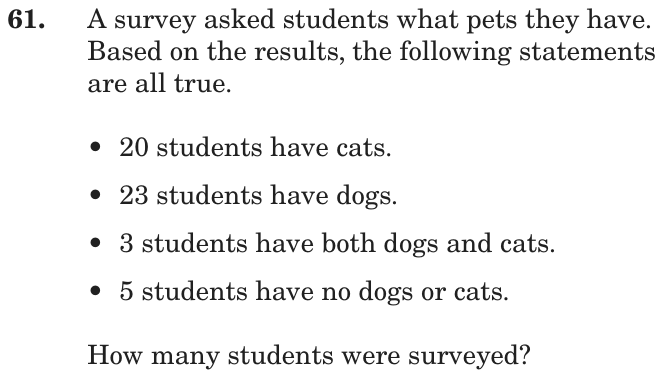
Question 57 of 75
2018 Test A Math, question 9Question
Jenny starts a game with twice as many marbles as Keiko. Jenny gives Keiko 5 marbles, but she still has 10 more than Keiko. How many marbles did Jenny have to start with?
- A25
- B30
- C35
- D40
Show the answer
Correct answer: D
Set up some equations. Jenny (J) has twice as many marbles as Keiko (K):
Jenny gives Keiko 5 marbles, so now they each have: J − 5 and K + 5 marbles. Jenny still has 10 more than Keiko:
To find how many marbles Jenny had to start with, solve J = 2K for K and substitute that into the second equation:
In equation J = 2K, solve for K:
Substitute in for K.
marbles
Question analysis
A two-variable word problem about marbles: Jenny starts with twice as many as Keiko, gives Keiko 5, and still has 10 more. Students set up equations for before and after the trade and solve for Jenny's starting number. The trade changes both players' counts, and the question asks about the start, not the end.
- Grade level
- Grade 8 content, by NYS standard
- Compared with grade 7
- Above grade 7 Grade 7 students solve one equation in one unknown. This needs two related unknowns and a before-and-after change, which leads to a system of equations or a variable on both sides, both grade 8 skills.
- Estimated difficulty
- Hard: combines ideas, needs a plan, and has more than one tempting wrong answer.
- Thinking it demands
- Depth of knowledge 2, skills and concepts · mainly apply
- What makes it hard
- Turning words into math major
- Much to keep track of moderate
- Solution
- 4 steps
- Reading level
- Question and choices: about grade 4, 31 words.
- Students, last 30 days
- Not enough answers yet to show (it takes 10).
Why it is hard, traps and wrong answers (shows the answer)
Why it is hard
Most of the difficulty is in setting up the equations, not solving them. The gift of 5 marbles changes both counts, so the gap between the girls shrinks by 10, not 5, and students who take the marbles from Jenny without giving them to Keiko reach a consistent but wrong answer. Two other choices are true counts from after the trade, so finishing the algebra is not the same as answering the question. Testing the choices backward is a fast, safe alternative.
Turning words into math major Understanding the question
Three relations hide in two sentences: "twice as many", the gift of 5 that lowers Jenny's count and raises Keiko's, and "still has 10 more", which compares the counts after the gift. (Hegarty, Mayer & Monk, 1995; Koedinger & Nathan, 2004)
Much to keep track of moderate Working it out
Each girl has a count before and after the trade, four quantities in all, and the question asks for only one of them, Jenny's at the start. (Sweller, 1988; Carpenter, Just & Shell, 1990)
Strategy: Work backward from the choices: halve each one for Keiko's start, move 5 marbles from Jenny to Keiko, and check whether Jenny ends with exactly 10 more.
Traps
- Misreads the question: Misses or misreads a condition or a word in the question: "at least", "each", "remaining", "not".
- Answers a different question: A choice is right for another quantity: the other unknown, the rest instead of the part, the part instead of the whole.
The wrong answers, classified
A Answers a different question (King et al., 2004; Hegarty, Mayer & Monk, 1995)
Solves correctly for Keiko's start, 20, then reports her count after receiving the 5 marbles, 25, instead of Jenny's starting count.
B Misreads the question (Hegarty, Mayer & Monk, 1995)
Subtracts the 5 marbles from Jenny but forgets that Keiko gains them, solving 2K − 5 = K + 10 to get K = 15 and J = 30.
C Answers a different question (King et al., 2004; Hegarty, Mayer & Monk, 1995)
Gives Jenny's count after she hands over 5 marbles, 40 − 5 = 35, instead of the number she had at the start.
Worked solution, step by step
Formulas used
- Twice as many
- J is the number of marbles Jenny starts with, and K is the number Keiko starts with. Twice as many means 2 times as many, so J equals 2 times K. Because J and 2K are equal, you can write 2K anywhere you see J.
- Keeping an equation balanced
- a and b are the two sides of an equation, and c is any number or term. An equation is like a balanced scale. If you subtract the same thing from both sides, it stays balanced. The same is true if you add the same thing, or divide both sides by the same number that is not zero.
Sort out the question
Let K be Keiko’s marbles at the start. Jenny starts with twice as many, so she has 2K. Then Jenny gives Keiko 5 marbles. After that, “she still has 10 more than Keiko”. You need Jenny’s count at the start, before the gift.
Write the counts after the gift
The gift changes both counts. Jenny loses 5, and Keiko gains 5.
- Jenny now has .
- Keiko now has .
Jenny has 10 more than Keiko. So Jenny’s count equals Keiko’s count plus 10.
Watch out: Keiko gains the 5 marbles too. Taking 5 from Jenny but not adding 5 to Keiko leads to 30, choice B.
Solve for K
Add the numbers on the right side first.
Subtract K from both sides. Then add 5 to both sides. Each move keeps the equation balanced.
Keiko started with 20 marbles.
Find Jenny’s starting count
Jenny started with twice as many as Keiko.
Watch out: 25 is Keiko’s count after the gift, choice A. 35 is Jenny’s count after the gift, choice C. The question asks about the start. So the answer is D, 40.
Check your answer
Start: Jenny has 40 and Keiko has 20, and 40 is twice 20. After the gift, Jenny has 35 and Keiko has 25. , so Jenny still has 10 more. Every fact fits.
More questions like this
The original DOE question
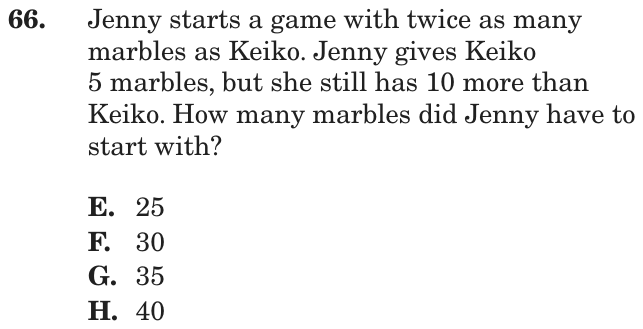
Question 58 of 75
2018 Test A Math, question 19Question
In Centerville, 45% of the population is female, and 60% of the population commutes to work daily. Of the total Centerville population, 21% are females who commute to work daily. What percentage of the total Centerville population are males who do not commute to work daily?
- A15%
- B16%
- C24%
- D39%
Show the answer
Correct answer: B
Create a table with the information provided in the problem and use subtraction to fill in the rest of the table:
| Female | Male | TOTAL | |
| Commutes to work | 21% | 39% (60 − 21) |
60% |
| Does not commute to work | 24% (45 − 21) |
16% (40 − 24) |
40% (100 − 60) |
| TOTAL | 45% | 100% |
16% of the population is male and does not commute to work.
Question analysis
A percent problem about overlapping groups in a town's population: the percents who are female, who commute daily, and who are female commuters are given. Students find the percent who are male and do not commute. A two-way table helps, since several of its cells are easy to confuse with the one asked for.
- Grade level
- Grade 7 content, by NYS standard
- Compared with grade 7
- Above grade 7 Grade 7 percent problems usually take a percent of one quantity. This needs two overlapping categories organized in a two-way table, which is not in New York's grade 7 standards, with three subtractions and two tempting cells.
- Estimated difficulty
- Hard: combines ideas, needs a plan, and has more than one tempting wrong answer.
- Thinking it demands
- Depth of knowledge 2, skills and concepts · mainly analyze
- What makes it hard
- No obvious method moderate
- Much to keep track of moderate
- Turning words into math moderate
- Solution
- 3 steps
- Reading level
- Question and choices: about grade 12, 43 words.
- Students, last 30 days
- Not enough answers yet to show (it takes 10).
Why it is hard, traps and wrong answers (shows the answer)
Why it is hard
The question gives three overlapping percents and asks for the one group none of them describes directly. Without a table, students tend to subtract the given numbers in some order, and several orders yield a listed choice. The last trap is the word "not", since the males who do commute are one cell away. Filling every cell of a two-by-two table before answering takes under a minute and leaves nothing to guess.
No obvious method moderate Working it out
Nothing in the wording points to a two-way table, yet the four groups, female or male by commuting or not, fall into place only once one is drawn. (Schoenfeld, 1985)
Much to keep track of moderate Working it out
Three given percents, 45, 60 and 21, plus their complements, 55 and 40, have to be kept straight while the cells are filled in by subtraction. (Sweller, 1988; Carpenter, Just & Shell, 1990)
Turning words into math moderate Understanding the question
"Of the total Centerville population, 21% are females who commute" is a share of everyone, not of the females, and belongs in a single cell of the table. (Hegarty, Mayer & Monk, 1995; Koedinger & Nathan, 2004)
Strategy: Make a two-by-two table of female and male against commutes and does not commute, fill in the totals, and complete each cell by subtraction.
Traps
- Misreads the question: Misses or misreads a condition or a word in the question: "at least", "each", "remaining", "not".
- Stops one step early: A choice is a number from partway through the solution.
The wrong answers, classified
A Numbers taken from the question (Hegarty, Mayer & Monk, 1995)
Subtracts one given percent from another, 60 − 45 = 15, without placing the 21% of female commuters anywhere.
C Stops one step early (King et al., 2004; Gierl et al., 2017)
Fills in the first empty cell, females who do not commute, 45 − 21 = 24, and stops before using it to reach the males' cell.
D Misreads the question (Hegarty, Mayer & Monk, 1995)
Finds the males who commute, 60 − 21 = 39, missing the word not in the question.
Worked solution, step by step
Formulas used
- Parts add up to the whole
- In a two-way table, every row and every column splits a group into two parts. a and b are the two parts, and W is the whole group. If you know the whole and one part, subtract to find the other part.
Sort out the question
Every number is a percent of the whole town. 45% of people are female. 60% commute, which means they travel to work every day. 21% are females who commute. You need the percent who are “males who do not commute to work daily”.
Make a two-way table
A two-way table sorts people two ways at once: female or male, and commutes or not. Put in what you know. The whole town is 100%.
Female Male Total Commute 21% ? 60% Do not commute ? ? ? Total 45% ? 100% Fill in the two totals
Everyone is female or male, so the males are what is left.
Everyone either commutes or does not.
So 55% are male, and 40% do not commute.
Find the males who commute
Use the commute row. All commuters are 60%, and the female commuters are 21%.
So 39% are males who commute. Watch out: the question says do not commute. Picking 39% is choice D.
Find the males who do not commute
Use the male column. All males are 55%, and the males who commute are 39%.
Watch out: 24% is the females who do not commute, . That is choice C. So the answer is B, 16%.
Check your answer
Find the same cell another way. Females who do not commute: . All who do not commute: 40%. So males who do not commute: . The answers match.
More questions like this
The original DOE question
Question 59 of 75
2018 Test A Math, question 22Question
1 sind = 4 lorgs
2 plunks = 5 dalts
5 sinds = 2 harps
1 plunk = 3 harps
A nation has five types of coins: sinds, dalts, lorgs, harps, and plunks. The relationship between the coins is shown above. Which coin is most valuable?
- Asind
- Bdalt
- Charp
- Dplunk
Show the answer
Correct answer: D
1 sind = 4 lorgs,
so 1 sind > 1 lorg.
2 harps = 5 sinds,
so 1 harp > 1 sind.
1 plunk = 3 harps,
so 1 plunk > 1 harp,
meaning that 1 plunk > 1 sind and 1 lorg.
2 plunks = 5 dalts,
so 1 plunk > 1 dalt.
Therefore, the plunk is the most valuable.
Question analysis
This reasoning question invents a money system: four exchange rates link five made-up coins. Students compare the coins step by step to find which one is worth the most. The rates run in different directions, so it is easy to misjudge which side of an equation holds the more valuable coin.
- Grade level
- Grade 6 content, by NYS standard
- Compared with grade 7
- At grade 7 Grade 6 and 7 ratio work converts between two units at a time. Chaining four invented rates and comparing values with no common unit given is less familiar, though the arithmetic stays simple.
- Estimated difficulty
- Moderate: several steps, or a close reading with one strong distractor.
- Thinking it demands
- Depth of knowledge 2, skills and concepts · mainly analyze
- What makes it hard
- Turning words into math moderate
- Much to keep track of moderate
- No obvious method minor
- Solution
- 3 steps
- Reading level
- Question and choices: about grade 1, 38 words.
- Students, last 30 days
- Not enough answers yet to show (it takes 10).
Why it is hard, traps and wrong answers (shows the answer)
Why it is hard
There is little arithmetic, but the relationships have to be read the right way round and chained. Students who think a larger count means a more valuable coin rank the coins backward, and students who stop after one or two links pick a coin that beats only its neighbor. Writing each coin's worth in lorgs, 4 for a sind, 10 for a harp, 12 for a dalt and 30 for a plunk, makes the ranking plain.
Turning words into math moderate Understanding the question
In "2 plunks = 5 dalts" the coin with the larger count is worth less, the reverse of what the bigger number suggests, and the same holds in all four equations. (Hegarty, Mayer & Monk, 1995; Koedinger & Nathan, 2004)
Much to keep track of moderate Working it out
Five coins and four exchange rates have to be linked into one ranking; dalts connect only through plunks, and lorgs only through sinds. (Sweller, 1988; Carpenter, Just & Shell, 1990)
No obvious method minor Working it out
Nothing says how to compare coins that never appear in the same equation; converting every coin to lorgs, or chaining inequalities, has to be chosen. (Schoenfeld, 1985)
Strategy: Rewrite every coin in terms of lorgs, which only ever appear as the smaller unit, following the rates one link at a time, then compare.
Traps
- Equation written backwards: Writes a comparison the wrong way round, word for word: "six times as many students as professors" as 6S = P. The bigger quantity gets the bigger number.
- Stops one step early: A choice is a number from partway through the solution.
The wrong answers, classified
A Equation written backwards (Clement, Lochhead & Monk, 1981)
Reads every equation backward, giving more value to the coin with the larger count, so 5 sinds = 2 harps puts sinds above harps and 1 plunk = 3 harps puts harps above plunks.
B Equation written backwards (Clement, Lochhead & Monk, 1981)
Reads 2 plunks = 5 dalts backward, giving the bigger value to the coin with the bigger count, so the dalt seems to outrank the plunk.
C Stops one step early (King et al., 2004; Gierl et al., 2017)
Sees from 5 sinds = 2 harps that a harp beats a sind and stops, missing the last line, 1 plunk = 3 harps.
Worked solution, step by step
Formulas used
- Value of a group of coins
- V is what a group of coins is worth. n is the number of coins, and v is what one coin is worth. Here every value is counted in lorgs, the smallest coin. Using one unit for all the coins lets you compare them.
Sort out the question
There are five coins and four trading rules. You need the coin that is worth the most. Read each rule carefully. In 2 plunks = 5 dalts, it takes more dalts to match. So each dalt is worth less than a plunk. More coins on one side means each of those coins is worth less.
Pick one coin to measure with
Measure every coin in lorgs, the way you might measure every length in inches. The first rule says 1 sind = 4 lorgs. So one sind is worth 4 lorgs.
Find a harp’s value in lorgs
The rule 5 sinds = 2 harps links harps to sinds. First find what 5 sinds are worth.
So 2 harps are worth 20 lorgs, and 1 harp is worth half of that.
One harp is worth 10 lorgs.
Find a plunk’s value in lorgs
The rule 1 plunk = 3 harps says a plunk is worth 3 harps.
One plunk is worth 30 lorgs.
Find a dalt’s value in lorgs
The rule 2 plunks = 5 dalts links dalts to plunks. Two plunks are worth lorgs. So 5 dalts are worth 60 lorgs too.
One dalt is worth 12 lorgs.
Compare all five coins
Coin Value in lorgs lorg 1 sind 4 harp 10 dalt 12 plunk 30 Watch out: 5 dalts trade for only 2 plunks, so a dalt is worth less. Reading that rule backward leads to choice B. Watch out: the harp beats the sind, but the plunk beats the harp. Stopping early gives choice C. So the answer is D, plunk.
Check your answer
Test each rule with the lorg values. 2 plunks = 60 lorgs, and 5 dalts = 60 lorgs. 5 sinds = 20 lorgs, and 2 harps = 20 lorgs. 1 plunk = 30 lorgs, and 3 harps = 30 lorgs. Every rule balances.
More questions like this
The original DOE question
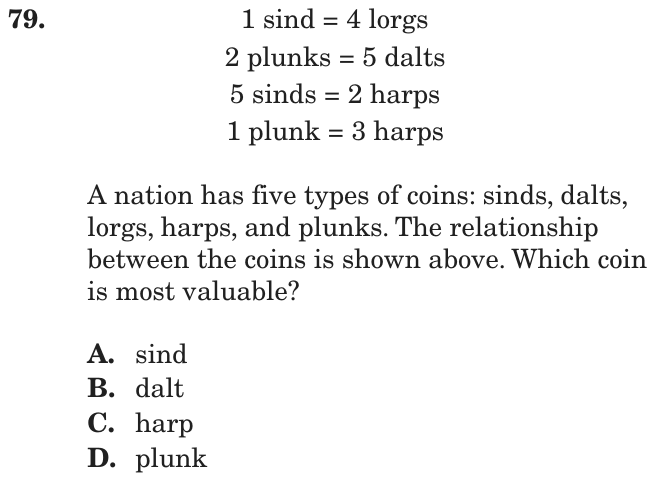
Question 60 of 75
2018 Test A Math, question 31Question
How many positive even factors of 48 are greater than 24 and less than 48?
- A0
- B1
- C2
- D12
Show the answer
Correct answer: A
List the factors of 48:
1 and 48, 2 and 24, 3 and 16, 4 and 12, 6 and 8
There are no factors greater than 24 and less than 48.
Question analysis
This number properties question asks how many positive even factors of 48 are greater than 24 and less than 48. Students list the factors of 48 and test which ones fall strictly inside that range. Reading both conditions precisely, and listing every factor without skipping any, is what matters.
- NYS standards
- 6.NS.4 common factors and multiples
- Grade level
- Grade 6 content, by NYS standard
- Compared with grade 7
- Below grade 7 Listing the factors of a two-digit number is grade 6 work, and here it takes one short list. The only demand beyond routine is reading both conditions exactly, which grade 7 students already do regularly.
- Estimated difficulty
- Straightforward: two steps or one careful reading.
- Thinking it demands
- Depth of knowledge 1, recall and reproduction · mainly apply
- What makes it hard
- A very close wrong answer moderate
- Much to keep track of minor
- Solution
- 2 steps
- Reading level
- Question and choices: about grade 7, 12 words.
- Students, last 30 days
- Not enough answers yet to show (it takes 10).
Why it is hard, traps and wrong answers (shows the answer)
Why it is hard
The factor list is short, so the question is decided by the conditions. The pairs 2 and 24 and 1 and 48 put the only candidates exactly on the boundaries, and the strict words "greater than" and "less than" exclude them. Students also tend to distrust an answer of zero, which nudges them toward counting an endpoint.
A very close wrong answer moderate Choosing the answer
The choices 0 and 1 differ by a single factor, so the count cannot be sized up; only checking whether 48 itself, or 24, falls strictly inside the range separates them. (Embretson & Wetzel, 1987; Gorin & Embretson, 2006; Ascalon et al., 2007)
Much to keep track of minor Working it out
Each factor must pass three tests at once, even, greater than 24 and less than 48, and the factor list itself must be complete. (Sweller, 1988; Carpenter, Just & Shell, 1990)
Strategy: List the factors of 48 in pairs, starting from 1 × 48, then check each one against both conditions: it must be even and lie strictly between 24 and 48.
Traps
- Counting the ends: Inclusive or exclusive ends, fence posts, consecutive numbers: an answer that is one too many or too few, or an endpoint drawn open where it belongs closed (or the reverse).
- Misreads the question: Misses or misreads a condition or a word in the question: "at least", "each", "remaining", "not".
The wrong answers, classified
B Counting the ends (Brown & Burton, 1978)
Counts one boundary factor, usually 48 itself, as inside the range, reading "less than 48" as "48 or less".
C Counting the ends (Brown & Burton, 1978)
Counts both 24 and 48, treating "greater than 24 and less than 48" as if the range included both of its ends.
D Misreads the question (Hegarty, Mayer & Monk, 1995)
Drops the condition that the numbers be factors of 48 and counts the even numbers from 26 up to and including 48, which makes 12.
Worked solution, step by step
Formulas used
- Factor pairs
- n is the number you start with, here 48. If two whole numbers a and b multiply to make n, both are factors of n. A factor divides n with nothing left over. Listing factors in pairs makes sure you skip none.
Sort out what the question asks
A factor of 48 is a whole number that divides 48 with nothing left over. You need factors that pass three tests. They must be even. They must be greater than 24. They must be less than 48.
“Less than 48” means 48 itself does not count. “Greater than 24” means 24 does not count either.
List the factors of 48 in pairs
Start with 1 and work up. Each pair multiplies to 48:
The next number, 7, does not divide 48. After 6 and 8 the pairs repeat. So the factors are 1, 2, 3, 4, 6, 8, 12, 16, 24 and 48.
Look between 24 and 48
In the list, the factor right after 24 is 48. Nothing falls between them.
Here is why. A factor bigger than 24 must pair with a number smaller than 2. The only such number is 1, and it pairs with 48. So no factor of 48 is between 24 and 48, even or odd.
Give the answer
Watch out: 24 and 48 are both factors, but they sit on the edges. Counting 48 gives 1, which is choice B. Counting both gives 2, which is choice C.
So the answer is A, 0.
Check your answer
Try the even numbers 26, 28, and so on up to 46. Dividing 48 by any of them gives more than 1 but less than 2. That is never a whole number, so none of them is a factor. Choice D, 12, counts even numbers without checking that they are factors.
More questions like this
The original DOE question
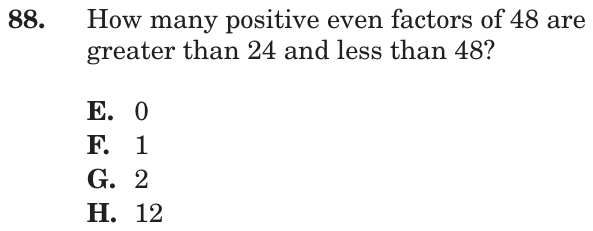
Question 61 of 75
2018 Test A Math, question 33Question
Johan leased a car for three years. He paid a one-time fee of $1,000, and an additional $300 per month for the full three years. At the end of the three years, what is the total amount Johan paid for leasing this car?
- A$1,900
- B$4,600
- C$10,800
- D$11,800
Show the answer
Correct answer: D
Three years is 36 months (12 × 3).
Set up an expression to find the total amount Johan paid:
Question analysis
This word problem about leasing a car combines a one-time fee with a monthly payment over three years and asks for the total amount paid. Students must convert years to months, multiply by the monthly payment and add the fee. Leaving out one piece of the cost, or mixing years with months, is the usual slip.
- NYS standards
- Grade level
- Grade 6 content, by NYS standard
- Compared with grade 7
- Below grade 7 This is a short total-cost calculation with whole numbers, easier than typical grade 7 word problems, which bring in percents, negative numbers or fractions. The only care needed is turning years into months.
- Estimated difficulty
- Routine: one familiar step, little to misread.
- Thinking it demands
- Depth of knowledge 2, skills and concepts · mainly apply
- What makes it hard
- Much to keep track of minor
- A very close wrong answer minor
- Solution
- 3 steps
- Reading level
- Question and choices: about grade 4, 41 words.
- Students, last 30 days
- Not enough answers yet to show (it takes 10).
Why it is hard, traps and wrong answers (shows the answer)
Why it is hard
This is the easiest kind of multi-step word problem: whole numbers, a familiar money situation and a direct method. The only places to slip are changing three years into 36 months and remembering the one-time fee after the long multiplication. Each slip has its own choice, so a quick check that both costs are in the total is worth the seconds.
Much to keep track of minor Working it out
The $1,000 fee is paid once while the $300 repeats monthly, so it must be held aside while 36 × 300 is computed. (Sweller, 1988; Carpenter, Just & Shell, 1990)
A very close wrong answer minor Choosing the answer
The choices $11,800 and $10,800 differ by only $1,000 out of about $11,000, so a rough total cannot separate them; only including the one-time fee does. (Embretson & Wetzel, 1987; Gorin & Embretson, 2006; Ascalon et al., 2007)
Strategy: Count the months in the lease first, multiply the monthly payment by that number, and then add the one-time fee.
Traps
- Stops one step early: A choice is a number from partway through the solution.
- Units or scale: The answer is wanted in other units, or a rate or scale must be converted first.
The wrong answers, classified
A Units or scale (King et al., 2004)
Multiplies $300 by 3 years instead of 36 months, getting $900, then adds the $1,000 fee to reach $1,900.
B Misreads the question (Hegarty, Mayer & Monk, 1995)
Charges the $300 for only 12 months, one year rather than the full three, so 3,600 + 1,000 gives $4,600.
C Stops one step early (King et al., 2004; Gierl et al., 2017)
Finds the 36 monthly payments, 36 × $300 = $10,800, and stops before adding the one-time $1,000 fee.
Worked solution, step by step
Formulas used
- Total cost with a fee
- T is the total paid. f is the one-time fee, paid only once. m is the monthly payment. n is the number of months. You multiply first because the monthly payment repeats every month. Then you add the fee once.
Sort out what you know
Johan paid $1,000 one time. He also paid $300 every month for 3 years. You need the total he paid.
The payments are counted by the month, but the time is given in years. So first change the years to months.
Count the months
Each year has 12 months:
So Johan made 36 monthly payments. Watch out: multiplying $300 by 3 years instead of 36 months gives $900. Adding the fee then gives $1,900, which is choice A.
Add up the monthly payments
Multiply the monthly payment by the number of months:
The monthly payments add up to $10,800.
Add the one-time fee
Use the formula. The fee goes in once:
Watch out: $10,800 is choice C. It leaves out the $1,000 fee. So the answer is D, $11,800.
Check your answer
Round to check. $300 a month for 36 months is a bit more than $10,000. Add the $1,000 fee and you get a bit more than $11,000. $11,800 fits. Choices A and B are far too small for three years of payments.
More questions like this
The original DOE question
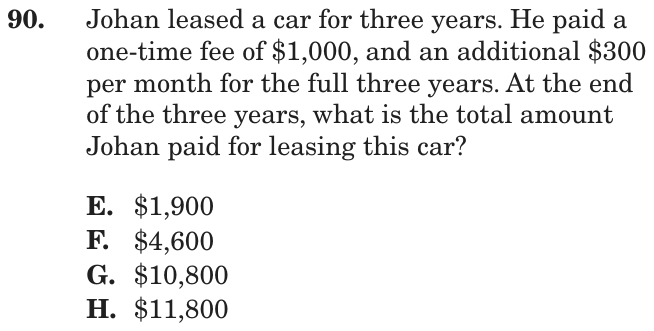
Question 62 of 75
2018 Test A Math, question 34Question
There are 6 different cookies on a plate. Aiden will choose 2 of these cookies to pack in his lunch. How many different pairs of 2 cookies can he choose from the 6?
- A12
- B15
- C30
- D36
Show the answer
Correct answer: B
Create a list of the possible pairs. Let the cookies be named A, B, C, D, E, and F.
AB, AC, AD, AE, AF
BC, BD, BE, BF
CD, CE, CF
DE, DF
EF
There are a total of 15 possible pairs of cookies that Aiden can choose.
Question analysis
This counting question asks how many different pairs of cookies Aiden can choose from six different cookies on a plate. Students must count combinations, where taking the same two cookies in a different order is not a new pair. The challenge is that the order of picking does not matter, so each pair must be counted once.
- NYS standards
- 7.SP.8b sample spaces for compound events
- Grade level
- Grade 7 content, by NYS standard
- Compared with grade 7
- At grade 7 Grade 7 students list the outcomes of compound events with organized lists and tree diagrams. Counting pairs is close to that work, but students must notice that the order of choosing does not matter.
- Estimated difficulty
- Moderate: several steps, or a close reading with one strong distractor.
- Thinking it demands
- Depth of knowledge 2, skills and concepts · mainly apply
- What makes it hard
- Much to keep track of moderate
- Solution
- 2 steps
- Reading level
- Question and choices: about grade 4, 29 words.
- Students, last 30 days
- Not enough answers yet to show (it takes 10).
Why it is hard, traps and wrong answers (shows the answer)
Why it is hard
Students who know the multiplication principle are the most at risk, because it counts each pair twice. The question rewards noticing that a pair has no order, either by listing systematically or by halving 6 × 5. The list of 15 pairs takes under a minute, so there is no time pressure to justify a shortcut.
Much to keep track of moderate Working it out
Listing all pairs by hand means tracking which have been written so none is repeated or skipped, which an organized list such as AB to AF handles. (Sweller, 1988; Carpenter, Just & Shell, 1990)
Strategy: Name the cookies with letters and list the pairs systematically: the first cookie with every later one, then the second with every later one, and so on.
Traps
- Overlapping groups: Things in two groups at once are counted twice, or not subtracted.
- Without replacement: In a second pick there is one fewer item, which changes the probability.
The wrong answers, classified
A Numbers taken from the question (Hegarty, Mayer & Monk, 1995)
Multiplies the 6 cookies by the 2 being chosen, a product of the stem's numbers that does not count any pairs.
C Overlapping groups (King et al., 2004)
Counts ordered picks, 6 choices then 5, so every pair such as AB and BA is counted twice, giving 30 instead of half that.
D Without replacement (Fischbein & Schnarch, 1997)
Uses 6 × 6, as if the first cookie went back on the plate, which counts order and also allows the same cookie twice.
Worked solution, step by step
Formulas used
- Number of pairs
- n is how many things you choose from. Each of the n things can pair with the n − 1 others. That counts every pair twice, once from each side, so you divide by 2.
Sort out the question
There are 6 different cookies. Aiden picks 2 of them. A pair is just two cookies together.
Order does not matter. Picking cookie 1 then cookie 2 gives the same pair as cookie 2 then cookie 1. You need to count the different pairs.
List the pairs in order
Number the cookies 1 to 6. Pair cookie 1 with every cookie after it. Then pair cookie 2 with every cookie after it, and so on. Only pairing with later numbers stops you from listing a pair twice.
Start with Pairs How many 1 1-2, 1-3, 1-4, 1-5, 1-6 5 2 2-3, 2-4, 2-5, 2-6 4 3 3-4, 3-5, 3-6 3 4 4-5, 4-6 2 5 5-6 1 Add up the pairs
Each row has one fewer pair than the row above it. That is because one fewer cookie comes after it. Add the last column of the table:
There are 15 different pairs.
Check with the pairs formula
Put n = 6 into the formula:
Watch out: 6 × 5 = 30 counts each pair twice, once for each order. Stopping there gives choice C. And 6 × 6 = 36, choice D, lets Aiden pick the same cookie twice. So the answer is B, 15.
Check your answer
Think of handshakes. Each of 6 people shakes hands with the 5 others. That looks like 30 handshakes, but each handshake has two people in it, so it was counted twice. 30 ÷ 2 = 15, which matches the list.
More questions like this
The original DOE question
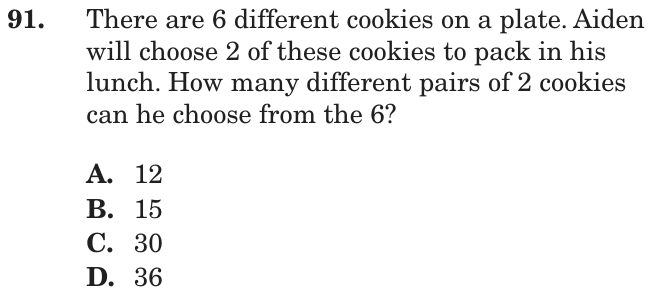
Question 63 of 75
2018 Test A Math, question 35Question
For a presentation, Deion can create 5 slides in 20 minutes, working at a constant rate. Kyra can create 3 slides in 10 minutes, working at her own constant rate. What is the total number of slides the two of them can create in one hour?
- A16
- B30
- C33
- D55
Show the answer
Correct answer: C
Set up proportions to figure out how many slides Deion and Kyra can create in 1 hour:
Deion
Deion can create 15 slides in 1 hour.
Kyra
Kyra can create 18 slides in 1 hour.
Add Deion and Kyra to figure out how many slides they can create together in 1 hour:
15 + 18 = 33.
Question analysis
This rate word problem says how many slides Deion makes in 20 minutes and Kyra makes in 10 minutes, then asks how many slides they make together in one hour. Students must scale each person's rate to an hour before combining. Because their time periods differ, the two rates cannot simply be added as given.
- NYS standards
- 6.RP.3b unit rate problems
- Grade level
- Grade 6 content, by NYS standard
- Compared with grade 7
- At grade 7 Grade 7 rate problems often ask for a single unit rate. This one needs two rates over different time periods, each scaled to an hour and then combined, which is typical grade 7 work built on grade 6 content.
- Estimated difficulty
- Straightforward: two steps or one careful reading.
- Thinking it demands
- Depth of knowledge 2, skills and concepts · mainly apply
- What makes it hard
- Much to keep track of moderate
- Many steps minor
- A very close wrong answer minor
- Solution
- 3 steps
- Reading level
- Question and choices: about grade 5, 42 words.
- Students, last 30 days
- Not enough answers yet to show (it takes 10).
Why it is hard, traps and wrong answers (shows the answer)
Why it is hard
The arithmetic is easy once each person is scaled to an hour on their own; the trouble is the urge to combine first. Adding the slides and the minutes into one rate treats two different rates like fractions added across the top and bottom, and it gives a listed answer. Keeping the two workers separate until the last step avoids every trap.
Much to keep track of moderate Working it out
Deion's rate is given per 20 minutes and Kyra's per 10, so each needs its own scale factor to an hour, 3 and 6, before the totals can be added. (Sweller, 1988; Carpenter, Just & Shell, 1990)
Many steps minor Working it out
Two scalings and an addition: 5 × 3 = 15 for Deion, 3 × 6 = 18 for Kyra, then the sum, each a simple step. (Daniel & Embretson, 2010; Enright, Morley & Sheehan, 2002)
A very close wrong answer minor Choosing the answer
The choices 33 and 30 differ by only 3 slides, so a rough sense of the total cannot separate them; only scaling Kyra's own rate to 18 an hour, not 15, does. (Embretson & Wetzel, 1987; Gorin & Embretson, 2006; Ascalon et al., 2007)
Strategy: Find how many 20-minute blocks and how many 10-minute blocks fit in 60 minutes, scale each person's slides by that number, and then add the two totals.
Traps
- A faulty procedure: A systematic but wrong procedure: adding fractions straight across, applying an exponent to each term of a sum, dropping a sign when moving a term.
- Units or scale: The answer is wanted in other units, or a rate or scale must be converted first.
The wrong answers, classified
A A faulty procedure (Brown & Burton, 1978; Tatsuoka, 1983)
Adds the rates straight across, 5 + 3 slides in 20 + 10 minutes, then doubles 8 slides per 30 minutes to get 16 in an hour.
B Misreads the question (Hegarty, Mayer & Monk, 1995)
Finds Deion's 15 slides an hour and doubles it for the two of them, missing that Kyra works at her own, faster rate.
D Units or scale (King et al., 2004)
Adds the per-minute rates, 0.25 + 0.3 = 0.55 slides, then scales by 100 instead of 60 minutes, getting 55.
Worked solution, step by step
Formulas used
- Amount of work
- a is the amount of work done, here slides. r is the rate: how much gets done in one block of time. t is the number of those blocks. Use it when someone works at a steady speed.
Sort out what you know
Deion makes 5 slides every 20 minutes. Kyra makes 3 slides every 10 minutes. Each works at a constant rate, which means a steady speed that does not change.
One hour is 60 minutes. You need how many slides they make together in 60 minutes.
Find Deion’s slides in an hour
Deion’s rate is 5 slides per 20-minute block. An hour holds 3 of those blocks, since 60 ÷ 20 = 3:
Deion makes 15 slides in an hour.
Find Kyra’s slides in an hour
Kyra’s rate is 3 slides per 10-minute block. An hour holds 6 of those blocks, since 60 ÷ 10 = 6:
Kyra makes 18 slides in an hour. Watch out: Kyra has her own rate. Doubling Deion’s 15 to get 30, choice B, treats her as if she worked at his speed.
Add the two amounts
Together they make 33 slides. Watch out: do not add the slides and the minutes first. Mixing 5 + 3 slides with 20 + 10 minutes blends two different rates and leads to choice A, 16.
So the answer is C, 33.
Check your answer
Compare per minute. Deion makes 5 ÷ 20 = 0.25 slide a minute, and Kyra makes 3 ÷ 10 = 0.3. Together that is 0.55 slide a minute. Times 60 minutes gives 33. Choice D, 55, comes from multiplying by 100 instead of 60.
More questions like this
The original DOE question
Question 64 of 75
2018 Test A Math, question 40Question
In the set of consecutive integers from 12 to 30, inclusive, there are four integers that are multiples of both 2 and 3. How many integers in this set are multiples of neither 2 nor 3?
- A5
- B6
- C13
- D15
Show the answer
Correct answer: B
The question asks for integers from 12 to 30 that are not divisible by 2 or 3. The set of consecutive integers is
{12, 13, 14, 15, 16, 17, 18, 19, 20, 21, 22, 23, 24, 25, 26, 27, 28, 29, 30}
Since all even numbers are divisible by 2, eliminate all even numbers, leaving the odd numbers in the set:
{13, 15, 17, 19, 21, 23, 25, 27, 29}
Eliminate those integers that are multiples of 3 (15, 21, and 27). The remaining integers are:
{13, 17, 19, 23, 25, 29}
Therefore, there are 6 numbers in the set that are multiples of neither 2 nor 3.
Question analysis
This number properties question takes the integers from 12 to 30, inclusive, and asks how many are multiples of neither 2 nor 3. Students must count the whole set, remove multiples of 2 and of 3 without removing any number twice, and count what remains. Inclusive endpoints and the overlap make it easy to miscount.
- NYS standards
- 6.NS.4 common factors and multiples
- Grade level
- Grade 6 content, by NYS standard
- Compared with grade 7
- Above grade 7 Multiples are sixth-grade content, but grade 7 problems rarely ask students to count a set under two overlapping conditions. The inclusive range and the numbers that are multiples of both make this longer and trickier than usual.
- Estimated difficulty
- Hard: combines ideas, needs a plan, and has more than one tempting wrong answer.
- Thinking it demands
- Depth of knowledge 2, skills and concepts · mainly apply
- What makes it hard
- Much to keep track of moderate
- A very close wrong answer moderate
- Solution
- 3 steps
- Reading level
- Question and choices: about grade 9, 30 words.
- Students, last 30 days
- Not enough answers yet to show (it takes 10).
Why it is hard, traps and wrong answers (shows the answer)
Why it is hard
The question gives the overlap, four multiples of both 2 and 3, which invites a subtraction method with three places to go wrong: the count of the set, the overlap, and the final complement. Each of those errors has its own choice. Listing the 19 numbers and crossing out evens and then odd multiples of 3 is slower to describe but faster and safer to do.
Much to keep track of moderate Working it out
Each of the 19 integers must be checked against two conditions, and the four multiples of 6 meet both, so they must be removed once, not twice. (Sweller, 1988; Carpenter, Just & Shell, 1990)
A very close wrong answer moderate Choosing the answer
The choices 5 and 6 differ by one, the result of counting 30 − 12 = 18 integers instead of 19, so only counting the inclusive set exactly separates them. (Embretson & Wetzel, 1987; Gorin & Embretson, 2006; Ascalon et al., 2007)
Strategy: Cross out every even number first, then cross out the odd multiples of 3 that remain, and count the survivors; listing all nineteen numbers is quick enough.
Traps
- Answers a different question: A choice is right for another quantity: the other unknown, the rest instead of the part, the part instead of the whole.
- Counting the ends: Inclusive or exclusive ends, fence posts, consecutive numbers: an answer that is one too many or too few, or an endpoint drawn open where it belongs closed (or the reverse).
The wrong answers, classified
A Counting the ends (Brown & Burton, 1978)
Counts 30 − 12 = 18 integers instead of 19, then subtracts the 13 multiples of 2 or 3 and gets 5.
C Answers a different question (King et al., 2004; Hegarty, Mayer & Monk, 1995)
Counts the integers that are multiples of 2 or 3, the 13 to be crossed out, and gives that count instead of the 6 left over.
D Misreads the question (Hegarty, Mayer & Monk, 1995)
Subtracts only the four multiples of both 2 and 3 from the 19 integers, reading "neither 2 nor 3" as "not both 2 and 3".
Worked solution, step by step
Formulas used
- Counting whole numbers in a list
- a is the first number and b is the last. n is how many whole numbers there are, counting both ends. You add 1 because subtracting counts the gaps, and there is one more number than gaps.
Sort out the question
The set is every integer (whole number) from 12 to 30. “Inclusive” means 12 and 30 are both in.
A multiple of 2 is an even number. A multiple of 3 is a number in the 3 times table. You need the numbers that are neither: not even, and not in the 3 times table.
Count the numbers in the set
There are 19 integers. Watch out: 30 − 12 = 18 forgets one end. That slip leads to choice A, 5.
Cross out the even numbers
Every even number is a multiple of 2, so remove them all. The odd numbers are left:
13, 15, 17, 19, 21, 23, 25, 27, 29
That is 9 numbers.
Cross out the multiples of 3
Check each odd number for 3. A quick test: add its digits. If the sum is in the 3 times table, so is the number. That removes 15, 21 and 27. These are left:
13, 17, 19, 23, 25, 29
Watch out: only 12, 18, 24 and 30 are multiples of both. Removing just those gives 19 − 4 = 15, choice D. “Neither” means you remove every multiple of 2 and every multiple of 3.
Count what is left
Six numbers are left. Watch out: 13 is how many you crossed out, choice C. The question asks for the ones left. So the answer is B, 6.
Check your answer
Count another way. Of the 19 numbers, 10 are even. Of the 9 odd ones, 3 are multiples of 3. So 10 + 3 = 13 are crossed out, and 19 − 13 = 6 are left. Same answer.
More questions like this
The original DOE question
Question 65 of 75
2018 Test A Math, question 41Question
The graph above shows the number of schools per city for five small cities. Cities M and N each have 500 students per school. City P has 400 students per school. Cities Q and R each have 700 students per school. Which of the five cities has the greatest number of students?
- ACity M
- BCity P
- CCity Q
- DCity R
Show the answer
Correct answer: C
Take each city’s number of schools and multiply by the number of students. It is not necessary to calculate all 5 of these.
Cities M and N have the same number of students per school, so just calculate the number of students in City M because it has more schools than City N.
The same goes for Q and R — only Q needs to be calculated because it has more schools than R.
M= 8 × 500 = 4,000
P = 9 × 400 = 3,600
Q = 6 × 700 = 4,200
City Q has the greatest number of students.
Question analysis
This graph question shows the number of schools in each of five small cities and gives the number of students per school for each city. Students multiply schools by students per school to compare the total number of students. Comparing only the bars, or only the rates, can mislead.
- Grade level
- Grade 6 content, by NYS standard
- Compared with grade 7
- Below grade 7 Reading a bar graph and multiplying is familiar from grade 6. Grade 7 data tasks often add percents or compare distributions; this one needs only a few whole-number products, so it is easier than typical grade 7 work.
- Estimated difficulty
- Straightforward: two steps or one careful reading.
- Thinking it demands
- Depth of knowledge 2, skills and concepts · mainly apply
- What makes it hard
- A very close wrong answer moderate
- Much to keep track of minor
- Reading a figure, table or graph minor
- Solution
- 3 steps
- Reading level
- Question and choices: about grade 2, 57 words.
- Corrected from the DOE handbook
- A misstatement in the explanation was corrected.
- Students, last 30 days
- Not enough answers yet to show (it takes 10).
Why it is hard, traps and wrong answers (shows the answer)
Why it is hard
Neither the tallest bar nor the highest rate wins, which is the point of the question: total students depend on both. The explanation's shortcut, comparing only M, P and Q because N and R each share a rate with a taller bar, cuts the work to three products. The top two totals are close, so the products must actually be computed rather than estimated.
A very close wrong answer moderate Choosing the answer
City M's 4,000 students and City Q's 4,200 differ by only 200, so judging from bar heights and rates cannot separate them; only computing 8 × 500 and 6 × 700 does. (Embretson & Wetzel, 1987; Gorin & Embretson, 2006; Ascalon et al., 2007)
Much to keep track of minor Working it out
The rates come in three groups in the stem, 500 for M and N, 400 for P, 700 for Q and R, and each must be matched to its bar. (Sweller, 1988; Carpenter, Just & Shell, 1990)
Reading a figure, table or graph minor Understanding the question
The number of schools comes only from the bar heights, read against gridlines from 0 to 10; all five bars end exactly on a gridline. (Lesh, Post & Behr, 1987; Kirsch & Mosenthal, 1990)
Strategy: For each city, multiply the number of schools read from the graph by its students per school and compare the products; cities that share a rate need only their school counts compared.
Traps
- Stops one step early: A choice is a number from partway through the solution.
- Answers a different question: A choice is right for another quantity: the other unknown, the rest instead of the part, the part instead of the whole.
The wrong answers, classified
A Stops one step early (King et al., 2004; Gierl et al., 2017)
Computes M's 8 × 500 = 4,000 and P's 9 × 400 = 3,600 and stops, never working out Q's 6 × 700 = 4,200.
B Answers a different question (King et al., 2004; Hegarty, Mayer & Monk, 1995)
Picks the tallest bar, P's nine schools, which answers which city has the most schools rather than the most students.
D Numbers taken from the question (Hegarty, Mayer & Monk, 1995)
Picks a city with the stem's highest rate, 700 students per school, without noticing that R has only 4 schools to Q's 6.
What was corrected from the DOE handbook, and why
- Explanation: The handbook says “Cities M and N have the same number of students”. They have the same number of students per school (500), not the same total: M has 8 × 500 = 4,000 and N has 5 × 500 = 2,500, which is why only City M, with more schools, needs to be calculated. The sentence now says “the same number of students per school”.
Worked solution, step by step
Formulas used
- Total students in a city
- S is the total number of students in a city. n is the number of schools, read from the bar. s is the number of students in each school. You multiply because every school in that city has the same number of students.
Read the graph
The bar graph shows how many schools each city has. Read the top of each bar against the numbers on the left. M has 8, N has 5, P has 9, Q has 6 and R has 4.
The question gives the students per school. You need the city with the most students in all.
Multiply for each city
Use the formula for each city:
City Schools Students per school Total students M 8 500 4,000 N 5 500 2,500 P 9 400 3,600 Q 6 700 4,200 R 4 700 2,800 Compare the totals
The biggest total is 4,200, for City Q.
Watch out: City P has the tallest bar, but that means the most schools, not the most students. That leads to choice B. City M’s 4,000 is close, so do not stop before you work out Q. That is choice A.
So the answer is C, City Q.
Check your answer
A shortcut: M and N both have 500 per school, and M has more schools, so M beats N. Q and R both have 700, and Q beats R. So only M, P and Q matter: 4,000, 3,600 and 4,200. Q still wins.
More questions like this
The original DOE question
Question 66 of 75
2018 Test A Math, question 46Question
SCORES ON BIOLOGY TEST
| Section | Lowest Score | Range |
| I | 65 | 28 |
| II | 62 | 25 |
| III | 67 | 22 |
Mr. Blake’s biology class is divided into three sections. The same test was given to each section. The table above shows both the lowest score and the range of scores on this test for each section. What is the overall range of all scores in all three sections?
- A25
- B27
- C28
- D31
Show the answer
Correct answer: D
First, calculate the highest score for each section by adding the lowest score to the range:
Section I: 65 + 28 = 93
Section II: 62 + 25 = 87
Section III: 67 + 22 = 89
The overall highest score is 93, and the overall lowest score is 62. Thus the overall range is 93 − 62 = 31.
Question analysis
This statistics question uses a table of the lowest score and the range for three sections of a biology class and asks for the range of all the scores combined. Students must rebuild each section's highest score from its lowest score and range, then compare across sections. Reversing the usual range calculation is the tricky part.
- Grade level
- Grade 6 content, by NYS standard
- Compared with grade 7
- At grade 7 Grade 7 students compute a range from a list of data. Here they must work backward from range to the highest score in each section and then combine three groups, one step beyond routine.
- Estimated difficulty
- Moderate: several steps, or a close reading with one strong distractor.
- Thinking it demands
- Depth of knowledge 2, skills and concepts · mainly apply
- What makes it hard
- No obvious method moderate
- A very close wrong answer moderate
- Much to keep track of minor
- Solution
- 3 steps
- Reading level
- Question and choices: about grade 2, 59 words.
- Students, last 30 days
- Not enough answers yet to show (it takes 10).
Why it is hard, traps and wrong answers (shows the answer)
Why it is hard
Range is usually computed from a list, so working backward from it is the unfamiliar part. The key fact, that the overall lowest and highest scores come from different sections, is invisible until all three highest scores are written down. Every wrong choice comes from skipping that step and reasoning with the ranges as given.
No obvious method moderate Working it out
The table gives each section's lowest score and range but no highest score, so students must reverse the range formula, high = low + range, before comparing sections. (Schoenfeld, 1985)
A very close wrong answer moderate Choosing the answer
The choices 28 and 27 sit within 4 of 31, so a sense of the spread cannot separate them; only rebuilding the highest scores, which puts the top at 93, does. (Embretson & Wetzel, 1987; Gorin & Embretson, 2006; Ascalon et al., 2007)
Much to keep track of minor Working it out
The overall lowest, 62, comes from Section II and the overall highest, 93, from Section I, so values from two rows must be combined. (Sweller, 1988; Carpenter, Just & Shell, 1990)
Strategy: Add each section's range to its lowest score to get its highest score, then subtract the lowest of all scores from the highest of all scores.
Traps
- Answers a different question: A choice is right for another quantity: the other unknown, the rest instead of the part, the part instead of the whole.
The wrong answers, classified
A Misunderstands the concept (Smith, diSessa & Roschelle, 1993; De Bock et al., 1998; Ni & Zhou, 2005)
Averages the three section ranges, (28 + 25 + 22) ÷ 3 = 25, as if the overall range were a typical section's range.
B Answers a different question (King et al., 2004; Hegarty, Mayer & Monk, 1995)
Leaves Section I out, taking the top score as Section III's 67 + 22 = 89, which gives the range of Sections II and III only.
C Answers a different question (King et al., 2004; Hegarty, Mayer & Monk, 1995)
Takes Section I's range, 28, the largest in the table, giving one section's spread instead of the spread across all three.
Worked solution, step by step
Formulas used
- Range
- R is the range, the spread of the scores. H is the highest score and L is the lowest score. The range tells how far apart the top and bottom scores are. If you know L and R, then H = L + R.
Sort out what you know
The table gives each section’s lowest score and its range. The range is the highest score minus the lowest score.
The bold overall means one range for all three sections together. For that you need the highest and lowest scores of all.
Find each section’s highest score
Turn the range formula around: highest = lowest + range.
Section Lowest Range Highest I 65 28 65 + 28 = 93 II 62 25 62 + 25 = 87 III 67 22 67 + 22 = 89 Pick the overall highest and lowest
The highest score of all is 93, from Section I. The lowest score of all is 62, from Section II. They come from different sections, and that is fine.
Subtract to find the range
Watch out: 28 is just Section I’s range, choice C. Averaging the three ranges gives 25, choice A. Neither covers all the scores at once.
So the answer is D, 31.
Check your answer
The overall range must be at least as big as each section’s range, because it covers all their scores. 31 is bigger than 28, 25 and 22, so it is reasonable. Also, 62 + 31 = 93, the top score.
More questions like this
The original DOE question
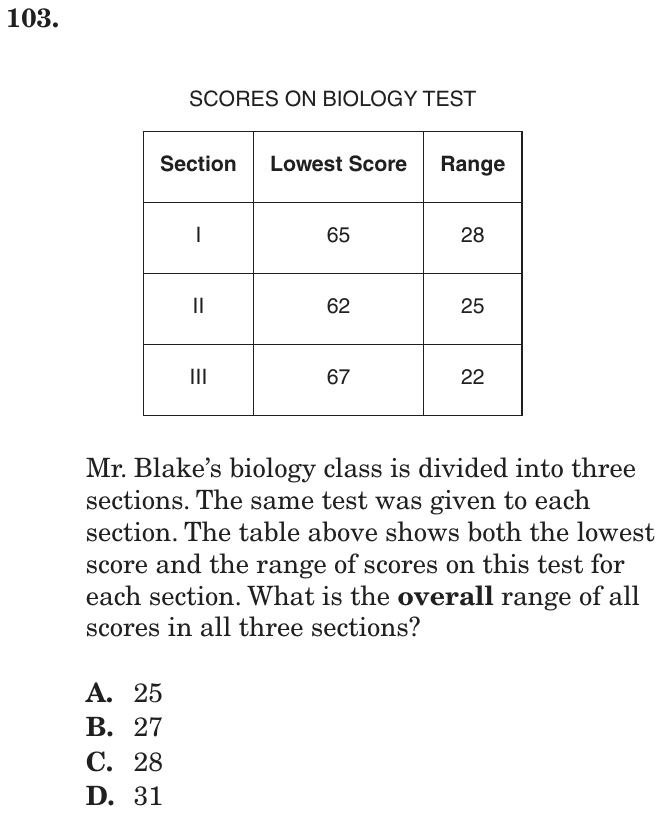
Question 67 of 75
2018 Test A Math, question 52Question
Each week, Leon has fixed expenses of $1,250 at his furniture shop. It costs him $150 to make a chair in his shop, and he sells each chair for $275. What is Leon’s profit if he makes and sells 25 chairs in 1 week?
- A$1,875
- B$2,500
- C$3,125
- D$4,375
Show the answer
Correct answer: A
Each chair costs Leon $150 to make, and he sells the chair for $275.
His profit is found by subtracting the cost from the price:
$275 − $150 = $125 per chair
If Leon makes and sells 25 chairs in a week, his initial profit is
25 × $125 = $3,125
However, Leon has additional fixed expenses of $1,250 per week, so this cost must also be subtracted to arrive at the profit. His final profit is
$3,125 − $1,250 = $1,875
Question analysis
This profit word problem gives Leon's weekly fixed expenses at his furniture shop, the cost to make each chair and its selling price, then asks his profit for 25 chairs in one week. Students must find the profit on each chair, multiply, and account for the fixed expenses. Forgetting the fixed expenses, or adding them, are the main slips.
- NYS standards
- Grade level
- Grade 7 content, by NYS standard
- Compared with grade 7
- At grade 7 Multi-step money problems are standard grade 7 work. This one has three whole-number steps and a familiar profit idea, so it matches typical grade 7 demand, with the fixed cost as the detail to remember.
- Estimated difficulty
- Moderate: several steps, or a close reading with one strong distractor.
- Thinking it demands
- Depth of knowledge 2, skills and concepts · mainly apply
- What makes it hard
- Much to keep track of moderate
- Something you must already know minor
- Solution
- 3 steps
- Reading level
- Question and choices: about grade 3, 39 words.
- Students, last 30 days
- Not enough answers yet to show (it takes 10).
Why it is hard, traps and wrong answers (shows the answer)
Why it is hard
The arithmetic is whole-number and friendly, so the question is about bookkeeping: which amounts are income, which are costs, and which happen once a week. The fixed expenses are named first in the stem and are easy to forget by the time the per-chair profit is multiplied. A final check that revenue minus all costs, 6,875 − 3,750 − 1,250, gives the same result confirms it.
Much to keep track of moderate Working it out
Three dollar amounts play different roles, a weekly fixed expense, a cost per chair and a price per chair, and each must enter the profit with the right sign. (Sweller, 1988; Carpenter, Just & Shell, 1990)
Something you must already know minor Working it out
The bold "profit" is not defined; students must know it means money taken in minus every cost, including costs that do not depend on the number of chairs. (Anderson & Krathwohl, 2001)
Strategy: Subtract the cost from the price to get the profit per chair, multiply by the number of chairs, then subtract the week's fixed expenses.
Traps
- Stops one step early: A choice is a number from partway through the solution.
- Wrong operation: Adds instead of multiplying, divides the wrong way round, turns a ratio or rate upside down, or undoes a step in the wrong direction (subtracts what should be added back).
The wrong answers, classified
B Numbers taken from the question (Hegarty, Mayer & Monk, 1995)
Multiplies the $150 cost by 25 chairs and subtracts the $1,250, treating the cost of making a chair as money earned.
C Stops one step early (King et al., 2004; Gierl et al., 2017)
Finds the profit on 25 chairs at $125 each, $3,125, and stops before subtracting the $1,250 fixed expenses.
D Wrong operation (Hegarty, Mayer & Monk, 1995; King et al., 2004)
Adds the $1,250 fixed expenses to the $3,125 chair profit instead of subtracting them, treating an expense as income.
Worked solution, step by step
Formulas used
- Profit
- P is the profit, the money Leon keeps. I is the income, the money he takes in from sales. C is the total cost: every dollar he spends, including fixed expenses. Profit is what is left after all costs are paid.
Sort out what you know
Leon pays $1,250 each week no matter what. These are fixed expenses, like rent. Each chair costs $150 to make, and he sells each one for $275.
He makes and sells 25 chairs. Profit is the money left after paying all the costs.
Find the profit on one chair
Each chair sells for $275 but costs $150 to make. Subtract to see what he keeps:
He keeps $125 on each chair he sells.
Find the profit on 25 chairs
The chairs bring in $3,125 more than they cost to make. Watch out: $3,125 is choice C, but it is not the final profit. The fixed expenses still have to be paid.
Subtract the fixed expenses
Watch out: the $1,250 is money spent, so subtract it. Adding it gives $4,375, choice D. So the answer is A, $1,875.
Check your answer
Work it the long way. Sales: 25 × $275 = $6,875. Costs: 25 × $150 = $3,750, plus $1,250, which makes $5,000. Profit: $6,875 − $5,000 = $1,875. Same answer.
More questions like this
The original DOE question
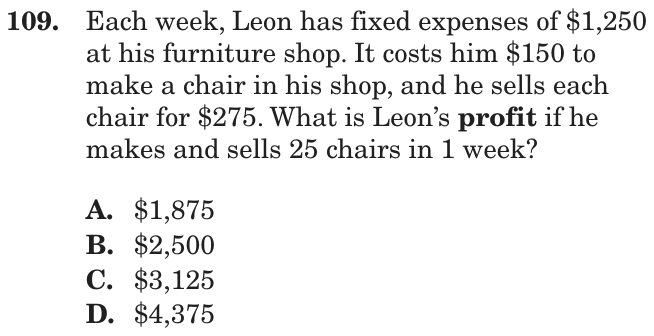
Question 68 of 75
2018 Test B English, question 27Passage Excerpt from “Niagara Falls”
Excerpt from “Niagara Falls”
by Rupert Brooke
The real secret of the beauty and terror of the Falls is not their height or width, but the feeling of colossal power and of unintelligible disaster caused by the plunge of that vast body of water. If that were taken away, there would be little visible change, but the heart would be gone.
The American Falls do not inspire this feeling in the same way as the Canadian. It is because they are less in volume, and because the water does not fall so much into one place. By comparison their beauty is almost delicate and fragile. They are extraordinarily level, one long curtain of lacework and woven foam. Seen from opposite, when the sun is on them, they are blindingly white, and the clouds of spray show dark against them. With both Falls the colour of the water is the ever-altering wonder. Greens and blues, purples and whites, melt into one another, fade, and come again, and change with the changing sun. Sometimes they are as richly diaphanous as a precious stone, and glow from within with a deep, inexplicable light. Sometimes the white intricacies of dropping foam become opaque and creamy. And always there are the rainbows. If you come suddenly upon the Falls from above, a great double rainbow, very vivid, spanning the extent of spray from top to bottom, is the first thing you see. If you wander along the cliff opposite, a bow springs into being in the American Falls, accompanies you courteously on your walk, dwindles and dies as the mist ends, and awakens again as you reach the Canadian tumult. And the bold traveller who attempts the trip under the American Falls sees, when he dare open his eyes to anything, tiny baby rainbows, some four or five yards in span, leaping from rock to rock among the foam, and gambolling beside him, barely out of hand’s reach, as he goes. One I saw in that place was a complete circle, such as I have never seen before, and so near that I could put my foot on it. It is a terrifying journey, beneath and behind the Falls. The senses are battered and bewildered by the thunder of the water and the assault of wind and spray; or rather, the sound is not of falling water, but merely of falling; a noise of unspecified ruin. So, if you are close behind the endless clamour, the sight cannot recognise liquid in the masses that hurl past. You are dimly and pitifully aware that sheets of light and darkness are falling in great curves in front of you. Dull omnipresent foam washes the face. Farther away, in the roar and hissing, clouds of spray seem literally to slide down some invisible plane of air.
Beyond the foot of the Falls the river is like a slipping floor of marble, green with veins of dirty white, made by the scum that was foam. It slides very quietly and slowly down for a mile or two, sullenly exhausted. Then it turns to a dull sage green, and hurries more swiftly, smooth and ominous. As the walls of the ravine close in, trouble stirs, and the waters boil and eddy. These are the lower rapids, a sight more terrifying than the Falls, because less intelligible. Close in its bands of rock the river surges tumultuously forward, writhing and leaping as if inspired by a demon. It is pressed by the straits into a visibly convex form. Great planes of water slide past. Sometimes it is thrown up into a pinnacle of foam higher than a house, or leaps with incredible speed from the crest of one vast wave to another, along the shining curve between, like the spring of a wild beast. Its motion continually suggests muscular action. The power manifest in these rapids moves one with a different sense of awe and terror from that of the Falls. Here the inhuman life and strength are spontaneous, active, almost resolute. . . . A place of fear.
One is drawn back, strangely, to a contemplation of the Falls, at every hour, and especially by night, when the cloud of spray becomes an immense visible ghost, straining and wavering high above the river, white and pathetic and translucent. The Victorian lies very close below the surface in every man. There one can sit and let great cloudy thoughts of destiny and the passage of empires drift through the mind; for such dreams are at home by Niagara. I could not get out of my mind the thought of a friend, who said that the rainbows over the Falls were like the arts and beauty and goodness, with regard to the stream of life—caused by it, thrown upon its spray, but unable to stay or direct or affect it, and ceasing when it ceased. In all comparisons that rise in the heart, the river, with its multitudinous waves and its single current, likens itself to a life, whether of an individual or of a community. A man’s life is of many flashing moments, and yet one stream; a nation’s flows through all its citizens, and yet is more than they. In such places, one is aware, with an almost insupportable and yet comforting certitude, that both men and nations are hurried onwards to their ruin or ending as inevitably as this dark flood. Some go down to it unreluctant, and meet it, like the river, not without nobility. And as incessant, as inevitable, and as unavailing as the spray that hangs over the Falls, is the white cloud of human crying. . . . With some such thoughts does the platitudinous heart win from the confusion and thunder of a Niagara peace that the quietest plains or most stable hills can never give.
From LETTERS FROM AMERICA by Rupert Brooke—Public Domain
diaphanous: sheer, translucent
platitudinous: clichéd, common
Question
Read this sentence from paragraph 3.
These are the lower rapids, a sight more terrifying than the Falls, because less intelligible.
Which statement best describes how the sentence fits into the overall structure of the excerpt?
- AIt signals a change from the positive aspects of the Falls to the negative aspects.
- BIt indicates a progression from the literal description of the water to a discussion of timeless truths.
- CIt highlights a shift from the qualities of the Falls to the qualities of the river.
- DIt introduces a contrast between the obvious and the hidden features of the rapids.
Show the answer
Correct answer: C
The question asks for the statement that best describes how the sentence from paragraph 3 fits into the overall structure of the excerpt. The first sentence of paragraph 3 moves the description “beyond the foot of the Falls” to “the river” and then begins to describe this location before confirming it again with the words “these are the lower rapids.” This emphasis on the shift in location is best stated in Option C, making it the correct response.
Option A is incorrect because, as the first sentence in paragraph 3 states, the paragraph describes the river and not aspects of the Falls.
Option B is incorrect because the entire paragraph describes only the literal movements of the river.
Option D is incorrect because the features of the rapids, as described in paragraph 3, are all obvious and not hidden.
Question analysis
This text structure question asks how a sentence about the lower rapids fits into the overall organization of Rupert Brooke’s excerpt about Niagara Falls. Students need a mental map of all four paragraphs, because every choice describes a believable shift in the essay and only a clear sense of what each paragraph covers separates them.
- NYS standards
- 7R5 structure and genre features
- Grade level
- Grade 8 reading and task
- Compared with grade 7
- Above grade 7 Grade 7 structure questions usually ask what one paragraph does; this one asks how a mid-paragraph sentence fits the whole essay, which requires summarizing four dense paragraphs of century-old prose.
- Estimated difficulty
- Hard: combines ideas, needs a plan, and has more than one tempting wrong answer.
- Thinking it demands
- Depth of knowledge 3, strategic thinking · mainly analyze
- What makes it hard
- How, not what major
- Much to keep track of moderate
- Hard words moderate
- Evidence
- Answered from several paragraphs or stanzas
- Reading level
- Passage: about grade 9, 987 words; question and choices: about grade 8, 97 words.
- Students, last 30 days
- Not enough answers yet to show (it takes 10).
Why it is hard, traps and wrong answers (shows the answer)
Why it is hard
Structure questions about a single sentence are hard when the sentence itself compares two things, here the rapids and the Falls. Students lose the point by choosing a shift that does occur somewhere in the excerpt, or by reading “more terrifying” as the first negative note in an essay that has been about terror from its first line. Placing the sentence means seeing that paragraph 3 leaves the Falls for the river.
How, not what major Working it out
The question asks where the sentence sits in the excerpt’s plan, and its own words mislead: it names “the Falls” and “terrifying,” though its role is to name the new subject, the river’s lower rapids. (Anderson & Krathwohl, 2001)
Much to keep track of moderate Working it out
Students need a map of four long paragraphs at once, the Falls’ power, the two Falls’ beauty, the river below, and night reflections, to see what changes at this sentence. (Sweller, 1988; Carpenter, Just & Shell, 1990)
Hard words moderate Understanding the question
“Less intelligible” means harder to understand, and students who take it to mean less visible are led toward a contrast between obvious and hidden features. (Perfetti, 2007; Freedle & Kostin, 1993)
Strategy: Before reading the choices, jot a few words on what each paragraph is about, then see what changes just before and after this sentence.
Traps
- Wrong part of the text: A choice is true of another paragraph, stanza or speaker than the one asked about.
The wrong answers, classified
A Twists what the text says (King et al., 2004)
Hears “more terrifying” as a turn from the Falls’ beauty to their dangers, but the rapids are not the Falls, and paragraphs 1 and 2 already describe the Falls’ terror.
B Wrong part of the text (Kirsch & Mosenthal, 1990)
Names a real progression in the excerpt, from description to reflections on destiny and empires, but that turn comes with paragraph 4, not with the rapids.
D Wrong purpose or structure (Anderson & Krathwohl, 2001)
Reads “less intelligible” as less visible and sees a contrast between obvious and hidden features, though the surging, leaping rapids are described in full view.
Working it out, step by step
Figure out what the question asks
This asks about structure: how the essay is put together. What change in the essay does this sentence mark?
Map the four paragraphs
- Paragraph 1: the power of the Falls.
- Paragraph 2: the beauty of the two Falls, and the trip behind them.
- Paragraph 3: the river below the Falls and its rapids.
- Paragraph 4: thoughts about life and history while watching the Falls.
See what changes in paragraph 3
Paragraph 3 begins “Beyond the foot of the Falls the river is like a slipping floor of marble.” “Beyond the foot” means past the bottom. The author has moved down the river. Then this sentence names the new place: “These are the lower rapids.” Rapids are parts of a river where water rushes fast over rocks. So the sentence marks a shift from the Falls to the river.
Check each choice
- A is wrong. The terror of the Falls was already in paragraph 1. And the rapids are not the Falls.
- B is wrong. The essay does move to deep thoughts, but that happens in paragraph 4.
- C is right. The focus moves from the Falls to the river.
- D is wrong. “Less intelligible” means harder to understand, not hidden. The rapids are in plain view.
Watch out: B names a real shift in the essay, but in the wrong place.
Choose the answer
The sentence names a new part of the river to describe. So the answer is C.
Why this answer and not the closest wrong one
B is the closest wrong answer, because the essay really does move from describing water to thinking about life. But that turn comes in paragraph 4, with “thoughts of destiny.” This sentence still describes water, just a different part of it. That is the shift in C.
More questions like this
The original DOE question
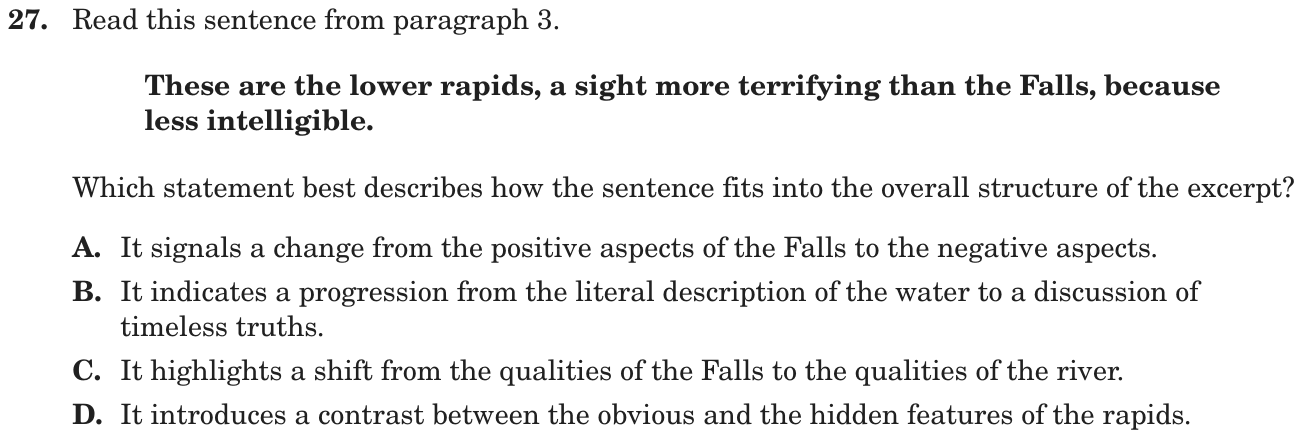
The passage “Excerpt from “Niagara Falls”” as printed (pages 134–135)
Question 69 of 75
2018 Test B English, question 33Passage Uncovering the Past
Uncovering the Past
Archaeology as a distinct branch of science is only about two centuries old. The first archaeological activities focused largely on the search for clues about earlier human societies. In the nineteenth century, most archaeologists were amateurs trained in ancient languages and history. Many were art historians whose interest lay in the artwork and monuments of ancient civilizations. For the most part, their excavations were aimed at uncovering and removing priceless artwork and other valuable artifacts for museum display. Collectively, these early archaeologists are now considered traditional archaeologists.
Today, however, there is a different approach to archaeology, one that tries to reconstruct the everyday life of people in ancient times by applying the scientific methods of a range of specialized fields. Modern archaeologists take full advantage of available technology. Laptop computers enable digging teams to record their finds at each level of an excavation. With sketchpad computer software, archaeologists can draw their finds in the field. Three-dimensional computer modeling enables researchers to create floor plans and elevations for the structures they uncover. Archaeologists can also use remote sensing technologies such as radar and lidar, which is similar to radar but it uses laser light instead of radio waves. These technologies enable scientists to detect traces of early settlements that are not visible to the human eye.
The excavations at Kourion, a Roman port city on the island of Cyprus in the Mediterranean Sea, serve as an example of the modern approach. Portions of Kourion had been unexpectedly buried by a massive earthquake in the fourth century A.D. Traditional archaeologists were interested primarily in the remains of Kourion’s theater, temple, and classical monuments. They also collected precious objects, such as jewelry, found in nearby tombs. Modern archaeologists, however, have focused their studies and excavations on the settlement itself. This preserved seaport has proved to be a gold mine of important information about everyday life sixteen centuries ago.
During one excavation of a house at Kourion, for example, forensic anthropologists were able to reconstruct the skeleton of a young girl, whom they called Camelia. On the basis of her teeth, they determined her age to be about thirteen, although measurement of her skeleton showed that she was only the size of a modern eleven-year-old. The study of the teeth also confirmed her sex and pointed to her excellent health; Camelia had no cavities. Even after centuries, the forensic scientists could study the physical evidence in ways similar to those used in criminal investigations to determine the circumstances of Camelia’s death.
Other specialists on this excavation included a zooarchaeologist, who identified animal remains, including the skeleton of a mule found near Camelia. Another specialist, a paleobotanist, studied the contents of a bake oven at the site and identified four domesticated grains among the charred crumbs—evidence of a kind of ancient multigrain bread.
Although the archaeologists at this site unearthed a few beautiful items, the excavation did not uncover any priceless artwork for museums. Nonetheless, the archaeological processes used in Kourion have given us a valuable insight into everyday life in a Roman city.
Question
What would a traditional archaeologist be most interested in finding at a site like Kourion?
- Aa human skeleton
- Bbeautiful jewelry or ceramics
- Cevidence of foods eaten
- Dthe remains of animals
Show the answer
Correct answer: B
The question asks what artifacts a traditional archaeologist would be interested in finding based on the material in the passage. The passage explains that, unlike modern archaeologists, traditional archaeologists are interested in valuable items from the past rather than learning about the people from the past and their lifestyles. Jewelry and ceramics are examples of valuable items, which makes Option B correct.
Option A is incorrect because human skeletons would be valuable to modern archaeologists, not traditional archaeologists.
Option C is incorrect because it is a detail that relates to modern archaeologists’ efforts to study people, not just valuable items.
Option D is incorrect because the remains of animals would also advance the goals of modern, rather than traditional, archaeologists.
Question analysis
This inference question asks what a traditional archaeologist would most want to find at Kourion, the Roman port city described in “Uncovering the Past.” Students apply the passage’s account of how older and newer archaeologists differ to a new case, and every choice is something an archaeologist might plausibly dig up.
- NYS standards
- 7R1 textual evidence and inferences
- Grade level
- Grade 6 reading and task
- Compared with grade 7
- Below grade 7 Easier than typical grade 7 inference work: the passage names what traditional archaeologists collected at this very site, so the task is mostly recall and matching, with little real inference.
- Estimated difficulty
- Routine: one familiar step, little to misread.
- Thinking it demands
- Depth of knowledge 2, skills and concepts · mainly understand
- What makes it hard
- Much to keep track of minor
- Reading between the lines minor
- Evidence
- Answered from several paragraphs or stanzas
- Reading level
- Passage: about grade 13, 514 words; question and choices: about grade 8, 30 words.
- Students, last 30 days
- Not enough answers yet to show (it takes 10).
Why it is hard, traps and wrong answers (shows the answer)
Why it is hard
This is one of the easier questions in the set because paragraph 3 names jewelry among the precious objects traditional archaeologists took from tombs near Kourion. The only real risk is recalling the striking finds of paragraphs 4 and 5, Camelia’s skeleton, the mule and the bake oven, without noticing that modern specialists made them. Ceramics are never mentioned, but they fit the passage’s picture of valuable objects.
Much to keep track of minor Working it out
Every choice is something an archaeologist could find at Kourion, and three of them come from the modern team in paragraphs 4 and 5, so each find must be sorted by which group wanted it. (Sweller, 1988; Carpenter, Just & Shell, 1990)
Reading between the lines minor Working it out
The stem asks what a traditional archaeologist “would” want, a hypothetical, though paragraph 3 nearly answers it: traditional archaeologists “collected precious objects, such as jewelry, found in nearby tombs.” (Graesser, Singer & Trabasso, 1994; Kintsch, 1998)
Strategy: Reread what the passage says traditional archaeologists looked for, at Kourion and in general, then choose the item that fits that description.
Traps
- Wrong part of the text: A choice is true of another paragraph, stanza or speaker than the one asked about.
The wrong answers, classified
A Wrong part of the text (Kirsch & Mosenthal, 1990)
Recalls Camelia, the most memorable find in the passage, but her skeleton was reconstructed by forensic anthropologists studying everyday life, the modern approach, not by collectors of valuables.
C Wrong part of the text (Kirsch & Mosenthal, 1990)
Remembers the paleobotanist who found four grains in a bake oven, work that serves the modern goal of learning how people lived rather than collecting precious objects.
D Wrong part of the text (Kirsch & Mosenthal, 1990)
Draws on the zooarchaeologist who identified a mule skeleton near Camelia, a modern specialist’s finding about daily life rather than a valuable object of the kind traditional archaeologists sought.
Working it out, step by step
Figure out what the question asks
This is an inference question. An inference is a smart guess based on clues in the text. The question asks what a traditional archaeologist would want to find at Kourion. Traditional archaeologists are the early ones from paragraph 1, not today’s scientists.
Find what traditional archaeologists wanted
Paragraph 1 says their digs “were aimed at uncovering and removing priceless artwork and other valuable artifacts for museum display.” Paragraph 3 talks about Kourion itself. It says traditional archaeologists cared about the theater and the temple. “They also collected precious objects, such as jewelry, found in nearby tombs.”
Put the clue in plain words
An artifact is an object that people made long ago. “Precious” and “priceless” both mean worth a lot. So the traditional group hunted for beautiful, valuable things to show in museums. Jewelry is named. Ceramics (pots and dishes made of baked clay) are not named. But fine ones are the same kind of prize.
Check each choice
- A is wrong. Camelia’s skeleton was studied by forensic anthropologists, scientists who study human bones. They were part of the modern team in paragraph 4.
- B fits. Jewelry is exactly what paragraph 3 says they collected.
- C is wrong. The grains in the bake oven were found by a paleobotanist, an expert in old plants. This expert was on the modern team in paragraph 5.
- D is wrong. The mule skeleton was found by a zooarchaeologist, an expert in old animal remains. This expert was also on the modern team.
Choose the answer
Traditional archaeologists wanted valuable objects for museums. Every other choice is something the modern team studied. So the answer is B, “beautiful jewelry or ceramics.”
Why this answer and not the closest wrong one
Every choice is something found at Kourion, so ask who wanted it. The skeleton, the grains and the animal bones all teach about daily life. That was the modern goal. Only jewelry is a treasure for a museum case.
More questions like this
The original DOE question

The passage “Uncovering the Past” as printed (page 138)
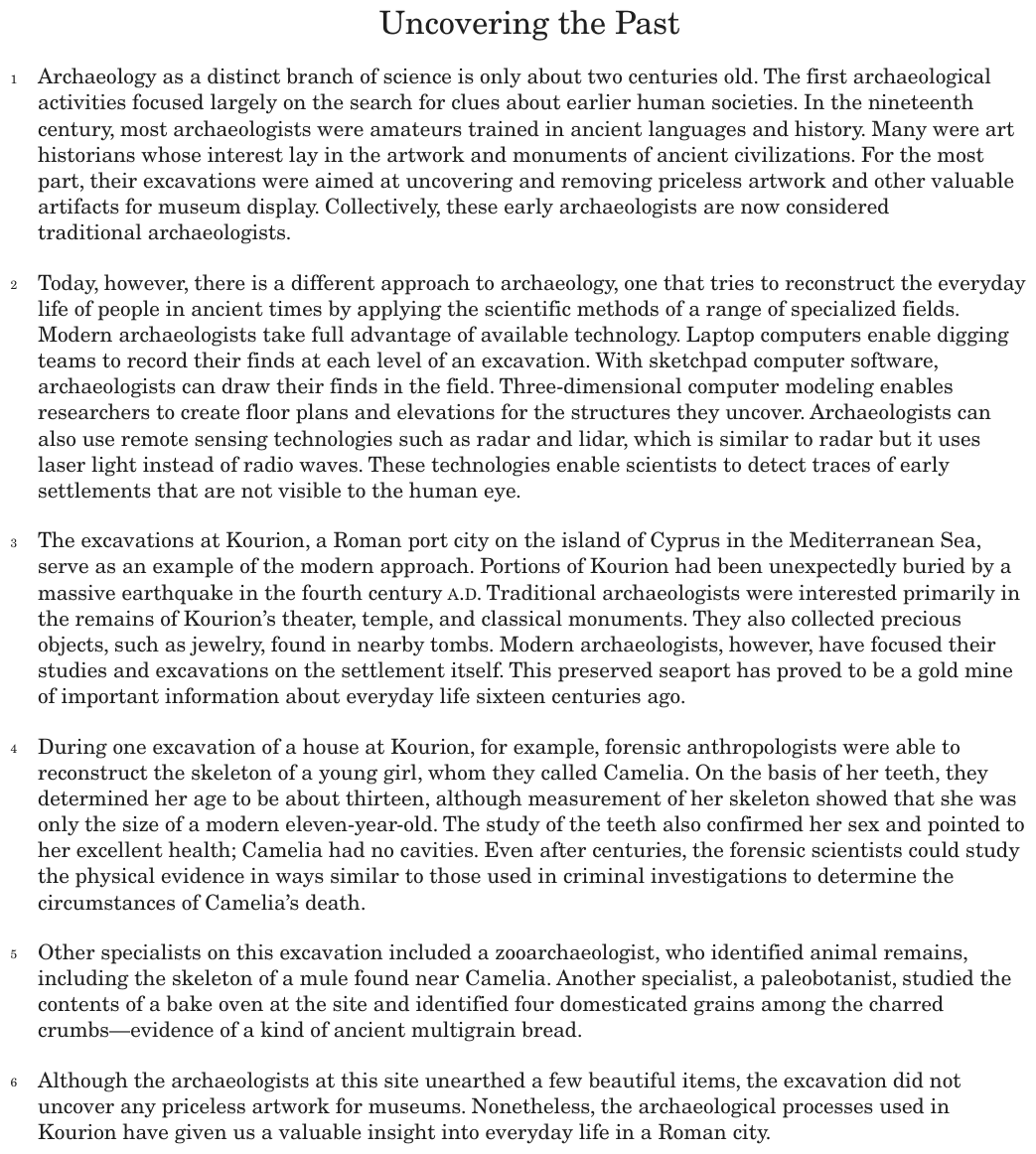
Question 70 of 75
2018 Test B English, question 49Passage Invention of the Telegraph
Samuel Morse, an American inventor, is credited with creating the electronic telegraph, a communication device that allows users to send messages using a system of short and long pulses that represent letters, numbers, and punctuation. In 1843 the United States Congress passed the Telegraph Bill, which provided Morse with the funds to build an electric telegraph system.
Invention of the Telegraph
Earlier Signal Systems
Long before Samuel F. B. Morse electrically transmitted his famous message “What hath God wrought?” from Washington to Baltimore on May 24, 1844, there were signaling systems that enabled people to communicate over distances. Most were visual or “semaphore” systems using flags or lights. In the eighteenth century, such systems used an observer who would decipher a signal from a high tower on a distant hill and then send it on to the next station. The young American republic wanted just such a system along its entire Atlantic coast and offered a prize of $30,000 for a workable proposal. The framers of this legislation had no way of knowing that when they used the word “telegraph” to refer to this visual semaphore system, they would be offered an entirely new and revolutionary means of communication—electricity.
The Growth of an Idea
The idea of using electricity to communicate over distance is said to have occurred to Morse during a conversation aboard ship when he was returning from Europe in 1832. Michael Faraday’s recently invented electromagnet was much discussed by the ship’s passengers, and when Morse came to understand how it worked, he speculated that it might be possible to send a coded message over a wire. While a student at Yale College years before, he had written his parents a letter about how interesting he found the lectures on electricity. Despite what he had learned at Yale, Morse found when he began to develop his idea that he had little real understanding of the nature of electricity, and after sporadic attempts to work with batteries, magnets, and wires, he finally turned for help to a colleague at the University of the City of New York, Leonard D. Gale.
Gale was a professor of chemistry and familiar with the electrical work of Princeton’s Joseph Henry, a true pioneer in the new field. Well before Morse had his shipboard idea about a telegraph, Henry rang a bell at a distance by opening and closing an electric circuit. In 1831, he had published an article, of which Morse was unaware, that contained details suggesting the idea of an electric telegraph. Gale’s help and his knowledge of this article proved crucial to Morse’s telegraph system because Gale not only pointed out flaws in the system but showed Morse how he could regularly boost the strength of a signal and overcome the distance problems he had encountered by using a relay system Henry had invented. Henry’s experiments, Gale’s assistance, and, soon after, hiring the young technician Alfred Vail were keys to Morse’s success.
Obstacles and Opportunities
By December 1837, Morse had enough confidence in his new system to apply for the federal government’s appropriation, and during the next year he conducted demonstrations of his telegraph both in New York and Washington.
However, when the economic disaster known as the Panic of 1837 took hold of the nation and caused a long depression, Morse was forced to wait for better times. It was during this period that Morse visited Europe again and tried not only to secure patent protection overseas but to examine competing telegraph systems in England. . . .
By 1843, the country was beginning to recover economically, and Morse again asked Congress for the $30,000 that would allow him to build a telegraph line from Washington to Baltimore, forty miles away. The House of Representatives eventually passed the bill containing the Morse appropriation, and the Senate approved it in the final hours of that Congress’s last session. With President Tyler’s signature, Morse received the cash he needed and began to carry out plans for an underground telegraph line.
Realizing a Great Invention
Morse had hired the ingenious construction engineer Ezra Cornell to lay the pipe carrying the wire, and although Cornell did his job superbly, one of Morse’s partners, Congressman F. O. J. Smith, had purchased wire with defective insulation. Too much time had been wasted laying bad wire, and with the project on a rigid deadline, something had to be done quickly. Cornell suggested that the fastest and cheapest way of connecting Washington and Baltimore was to string wires overhead on trees and poles. The desperate Morse gave the go-ahead, and the line was completed in time for the dramatic and spectacularly successful link between the Supreme Court chamber of the Capitol building and the railroad station in Baltimore.
Soon, as overhead wires connected cities up and down the Atlantic coast, the dots-and-dashes method that recorded messages on a long moving strip of paper was replaced by the operator’s ability to interpret the code in real time. . . . Telegraph lines soon extended westward, and within Morse’s own lifetime they connected the continents of Europe and America.
“Invention of the Telegraph”—Public Domain/Library of Congress
legislation: Telegraph Bill
dots-and-dashes method: the short and long pulses of Morse code that are sent and received by telegraph operators
The first transatlantic electric telegraph message was sent in 1858, and by 1902 the British All-Red Line connected most of the world.
Source: U.S. Bureau of the Census. Historical Statistics of the United States, Colonial Times to 1970, Bicentennial Edition, Part 2. Washington, D.C., 1975.
Question
Which statement describes how the author’s use of sequencing in paragraph 3 contributes to the overall structure of the passage?
- AIt shows that several people were simultaneously attempting to create an electric telegraph.
- BIt shows how the invention of the electric telegraph depended on information and techniques discovered by others.
- CIt shows that multiple means of long-distance communication were being used at the same time.
- DIt shows how quickly long-distance communication changed from visual signals to electrical signals.
Show the answer
Correct answer: B
The question asks how the use of sequencing, or arranging in chronological order, in paragraph 3 contributes to the overall structure of the passage. Paragraph 3 outlines the information that Gale knew who Henry was (“Well before Morse had his shipboard idea about a telegraph, Henry rang a bell at a distance by opening and closing an electric circuit”) and that Gale told Morse. Gale’s input was “crucial to Morse’s telegraph system,” and hiring Vail was an additional and necessary help.
Therefore, Option B is correct because the creation of Morse’s telegraph involved a series of steps that each built upon earlier ideas and inventions from others, such as Henry, Gale, and Vail.
Option A is incorrect because, although the inventions and advancements of others assisted in the development of the telegraph, the passage does not suggest that the other men were attempting to create their own telegraph systems.
Option C is incorrect because the only other long-distance communication system mentioned in the passage is the outdated semaphore system discussed in paragraph 1.
Option D is incorrect because the telegraph system was in development for more than ten years because of the lack of funding and the need for further experimentation.
Question analysis
Students explain how the sequence of events in paragraph 3 of “Invention of the Telegraph” contributes to the passage’s overall structure. The paragraph names several people and their roles in a few long sentences, and the choices make claims about the invention’s history that must each be checked against it.
- Grade level
- Grade 8 reading and task
- Compared with grade 7
- At grade 7 Sequencing is familiar grade 7 structure work. This paragraph packs several people and dates into long sentences, but once the order is clear the role of the sequence is fairly direct, so the demand is typical.
- Estimated difficulty
- Moderate: several steps, or a close reading with one strong distractor.
- Thinking it demands
- Depth of knowledge 2, skills and concepts · mainly analyze
- What makes it hard
- Complex sentences moderate
- How, not what moderate
- Much to keep track of minor
- Evidence
- Answered from one paragraph or stanza
- Reading level
- Passage: about grade 11, 910 words; question and choices: about grade 12, 77 words.
- Students, last 30 days
- Not enough answers yet to show (it takes 10).
Why it is hard, traps and wrong answers (shows the answer)
Why it is hard
Paragraph 3 is dense, but its last sentence nearly states the answer: Henry’s experiments, Gale’s help and Vail were “keys to Morse’s success.” Students lose the point when Henry’s telegraph-like article makes them imagine a race, or when the stem’s “overall structure” sends them back to the semaphore towers of paragraph 1. The question rewards reading the time markers as a chain of borrowed knowledge.
Complex sentences moderate Understanding the question
The key facts sit in embedded sentences, such as “an article, of which Morse was unaware, that contained details suggesting the idea,” and a 53-word sentence on what Gale showed Morse. (Abedi & Lord, 2001; Freedle & Kostin, 1993; Messick, 1989)
How, not what moderate Working it out
The stem asks what the order of events contributes to the passage’s structure, so students must see the time words, “Well before,” “In 1831,” “soon after,” as showing Morse building on others’ work. (Anderson & Krathwohl, 2001)
Much to keep track of minor Working it out
Four people, Henry, Gale, Vail and Morse, and two of Henry’s inventions have to be kept straight to see who supplied what to whom. (Sweller, 1988; Carpenter, Just & Shell, 1990)
Strategy: Put the events of paragraph 3 in order, noting who did what and when, then ask what that order shows about Morse’s invention.
Traps
- Twists what the text says: Uses the text's topic and ideas but changes what it says: who did it, how much, when, or why.
- Too broad or too strong: A choice overstates, generalizes, or uses absolute words the text does not support.
- Wrong part of the text: A choice is true of another paragraph, stanza or speaker than the one asked about.
The wrong answers, classified
A Twists what the text says (King et al., 2004)
Reads Henry’s article “suggesting the idea of an electric telegraph” as a rival effort, but the paragraph places Henry’s work “well before” Morse’s and shows it helping him.
C Wrong part of the text (Kirsch & Mosenthal, 1990)
Brings back the flag and light systems of paragraph 1, which came before the telegraph; paragraph 3 describes no other means of communication in use alongside it.
D Too broad or too strong (King et al., 2004)
Follows the passage’s overall move from semaphore to electricity but adds “how quickly,” though Morse’s idea of 1832 did not become a working line until 1844.
Working it out, step by step
Figure out what the question asks
This asks about sequencing in paragraph 3. Sequencing means putting events in time order. You need to say what that order shows about Morse’s invention.
Put paragraph 3’s events in order
Paragraph 3 uses time words. “Well before Morse had his shipboard idea about a telegraph, Henry rang a bell at a distance.” It adds that “In 1831, he had published an article” that hinted at an electric telegraph. Then Gale showed Morse “a relay system Henry had invented.” Last, Morse hired Alfred Vail “soon after.”
See what the order shows
A relay is a device that boosts a signal so it can travel farther. Each event in the order is someone else’s work that helped Morse. Henry’s work came first. Gale passed it on. Vail added his skill. The last sentence sums it up: these were all “keys to Morse’s success.” So Morse built his telegraph on what others had found.
Check each choice
- A is wrong. Henry’s work came “well before” Morse’s and helped him. Nobody was racing at the same time.
- B fits. The order shows Morse depending on earlier work by Henry, Gale and Vail.
- C is wrong. Paragraph 3 talks only about electric work. Flags and lights are in paragraph 1.
- D is wrong. Nothing here shows speed. Morse’s idea came in 1832, and his line opened in 1844.
Choose the answer
The time order shows one person’s work feeding the next, all leading to Morse. So the answer is B, “It shows how the invention of the electric telegraph depended on information and techniques discovered by others.”
Why this answer and not the closest wrong one
A is the strongest trap, because Henry’s article had details “suggesting the idea of an electric telegraph.” That can sound like a rival. But the time words show Henry came first, and Gale used his work to help Morse. Earlier work that helps is what B describes.
More questions like this
The original DOE question
The passage “Invention of the Telegraph” as printed (pages 146–148)
Question 71 of 75
2018 Test B Math, question 8Question
Based on the statement above, which variable has the greatest value?
- A
- B
- C
- D
Show the answer
Correct answer: D
Break the equations apart to each equal :
Pick a number to substitute into the equations, and solve the equations to find the values of , , , , and .
Let . Since all the equations are equal to 2, substitute 2 to find each variable.
Variable has the greatest value.
Question analysis
This algebra question sets five expressions equal to one another and to a positive number, then asks which variable has the greatest value. It tests whether students can rewrite each variable in terms of one shared value and compare them. What makes it tricky is that there are no numbers to compute, so each variable's size has to be reasoned out.
- Grade level
- Grade 7 content, by NYS standard
- Compared with grade 7
- Above grade 7 Grade 7 students rewrite expressions to see how quantities relate, usually one equation at a time. This chain of five linked expressions, with no numbers to compute and a positivity condition to use, is a reasoning task beyond routine grade 7 work.
- Estimated difficulty
- Hard: combines ideas, needs a plan, and has more than one tempting wrong answer.
- Thinking it demands
- Depth of knowledge 3, strategic thinking · mainly analyze
- What makes it hard
- Variables instead of numbers major
- No obvious method moderate
- Much to keep track of minor
- Solution
- 3 steps
- Reading level
- Question and choices: about grade 10, 16 words.
- Students, last 30 days
- Not enough answers yet to show (it takes 10).
Why it is hard, traps and wrong answers (shows the answer)
Why it is hard
The question rewards a strategy, not a calculation: once the shared value is named, each variable follows in one line and R is clearly largest. Without that step, students judge by how the expressions look, and the look is backwards, since the 3 in 3N makes N small and the 7 under R makes R large. The positivity condition at the end is easy to skip but is what fixes the order.
Variables instead of numbers major Understanding the question
There are no numbers to compute: five variables are tied together in the one chain M = 3N = P/4 = Q + 5 = R/7, and each must be compared through the shared value. (Koedinger & Nathan, 2004; Enright, Morley & Sheehan, 2002)
No obvious method moderate Working it out
Nothing says how to compare; the efficient move is to name the common value, or pick one such as 12, and rewrite each variable, which students must think of themselves. (Schoenfeld, 1985)
Much to keep track of minor Working it out
Five relations and the condition > 0 must be held at once; the condition matters, since with a negative common value the order of M, N, P and R would reverse. (Sweller, 1988; Carpenter, Just & Shell, 1990)
Strategy: Call the shared value k, a positive number, and rewrite each variable as an expression in k; or substitute a convenient positive value such as 12 and compare the results.
Traps
- Equation written backwards: Writes a comparison the wrong way round, word for word: "six times as many students as professors" as 6S = P. The bigger quantity gets the bigger number.
The wrong answers, classified
A Equation written backwards (Clement, Lochhead & Monk, 1981)
Reads P/4 and R/7 as a quarter and a seventh of M, the reverse of the truth, so M looks largest of all.
B Equation written backwards (Clement, Lochhead & Monk, 1981)
Reads the 3 in 3N as making N three times as large, when 3N = M actually makes N one third of M.
C Stops one step early (King et al., 2004; Gierl et al., 2017)
Correctly sees that P is four times M but stops there without checking R, which at seven times M is larger.
Worked solution, step by step
Formulas used
- Undoing division
- a is the top of the fraction, b is the bottom, and c is the result. Multiplying undoes dividing. So if a divided by b is c, then a is b times c.
- Undoing multiplication
- b is the number multiplied by a, and c is the result. Dividing undoes multiplying. So to get a alone, divide c by b.
Understand the chain
The statement is a chain of equal signs. It says five expressions all have the same value. The last part says that value is greater than 0, so it is positive.
You need to find which letter has the largest value.
Pick a value to test
All five expressions are equal, so give them one shared value. Pick a positive number that 3 divides evenly. That way N will be a whole number.
Let the shared value be 12. Then , and each of the other four expressions also equals 12.
Solve for each letter
Undo each operation to find each letter. Divide to undo times. Multiply to undo divide. Subtract to undo plus.
Compare the values
The values are M = 12, N = 4, P = 48, Q = 7 and R = 84. R is the largest.
Watch out: 3N does not make N big. It means 3 times N equals M, so N is only one third of M. That trap points to choice B. Also, P is big, but R is bigger. Check every letter before you pick choice C.
So the answer is D, R.
Check your answer
Think without numbers. R divided by 7 is M, so R is 7 times M. P is only 4 times M. N is a third of M, and Q is 5 less than M. Since M is positive, 7 times M is the biggest.
More questions like this
The original DOE question
Question 72 of 75
2018 Test B Math, question 12Question
A bag contains 75 marbles that are red, blue, or green. The ratio of red to blue marbles is , and the ratio of blue to green marbles is . If 2 blue marbles are removed and replaced with 2 green marbles, what will be the new ratio of red to green marbles?
- A
- B
- C
- D
Show the answer
Correct answer: D
The ratio of red to blue to green is 15 : 7 : 3.
Find the proportion of blue marbles. Add the numbers of the ratio and use the total sum as the denominator:
Find the proportion of green marbles:
Since there are a total of 75 marbles, the number of blue marbles is
The number of green marbles is
The number of red marbles is
If 2 blue marbles are removed and replaced with 2 green marbles, the number of blue marbles is now 19 and the number of green marbles is now 11. The ratio of red marbles to green marbles is 45 : 11.
Question analysis
This ratio problem describes a bag of 75 marbles with a red-to-blue ratio and a blue-to-green ratio that share the blue term, then swaps 2 blue marbles for 2 green ones. Students combine the ratios, find the actual number of each color, and form a new ratio. The swap at the end is what turns a routine ratio exercise into a long one.
- NYS standards
- 7.RP.3 multistep ratio and percent problems
- Grade level
- Grade 7 content, by NYS standard
- Compared with grade 7
- Above grade 7 Grade 7 ratio problems usually involve one ratio and one scaling step. This links two ratios through a shared term, converts to counts and then changes the counts, a longer chain than typical grade 7 work.
- Estimated difficulty
- Moderate: several steps, or a close reading with one strong distractor.
- Thinking it demands
- Depth of knowledge 2, skills and concepts · mainly apply
- What makes it hard
- Many steps moderate
- Much to keep track of minor
- Turning words into math minor
- Solution
- 5 steps
- Reading level
- Question and choices: about grade 5, 54 words.
- Students, last 30 days
- Not enough answers yet to show (it takes 10).
Why it is hard, traps and wrong answers (shows the answer)
Why it is hard
Each step is easy because both ratios share the 7 for blue, so the work is about keeping the chain going without stopping early. The main danger is doing the swap on the ratio numbers or forgetting it altogether. Two of the wrong choices, 5:1 and 15:3, are the same ratio, so a student who notices that can rule out both before doing any arithmetic.
Many steps moderate Working it out
The chain is long: merge 15:7 and 7:3 into 15:7:3, find that 25 parts make 75 marbles, scale to 45, 21 and 9, then add 2 to the green count. (Daniel & Embretson, 2010; Enright, Morley & Sheehan, 2002)
Much to keep track of minor Working it out
Three colors' counts must be tracked through the swap, which lowers blue and raises green while red stays where it was. (Sweller, 1988; Carpenter, Just & Shell, 1990)
Turning words into math minor Understanding the question
The phrase “2 blue marbles are removed and replaced with 2 green marbles” must be read as changing the actual counts, not the ratio numbers 7 and 3. (Hegarty, Mayer & Monk, 1995; Koedinger & Nathan, 2004)
Strategy: Merge the two ratios into one red-to-blue-to-green ratio, scale it so the parts total 75, make the swap on those counts, then write red to green.
Traps
- Stops one step early: A choice is a number from partway through the solution.
The wrong answers, classified
A Misunderstands the concept (Smith, diSessa & Roschelle, 1993; De Bock et al., 1998; Ni & Zhou, 2005)
Treats the ratio's 3 as the actual number of green marbles and adds the 2 swapped marbles to it, getting 15:5, or 3:1.
B Stops one step early (King et al., 2004; Gierl et al., 2017)
Finds the counts 45 red and 9 green correctly but forgets the swap, giving the original ratio 45:9 in lowest terms.
C Numbers taken from the question (Hegarty, Mayer & Monk, 1995)
Reads red and green straight off the combined ratio 15:7:3, with no counts and no swap; it equals 5:1 anyway.
Worked solution, step by step
Formulas used
- Value of one part
- A ratio like 15:7:3 splits a total into equal parts. The sum of the ratio numbers is how many parts there are. Dividing the total by that sum tells how many marbles are in one part.
Write down what you know
There are 75 marbles: red, blue and green. A ratio compares two amounts. Red to blue is 15:7. Blue to green is 7:3.
Then 2 blue marbles are taken out, and 2 green ones are put in. You need the new ratio of red to green.
Join the two ratios
Blue is 7 in both ratios. So you can join them into one ratio.
This means for every 15 red marbles, there are 7 blue and 3 green.
Find the size of one part
The ratio has parts in all. The 75 marbles fill those 25 parts.
Each part is 3 marbles.
Count each color
Multiply each ratio number by 3 to get the real counts.
So there are 45 red, 21 blue and 9 green. They add to 75, so the counts are right.
Make the swap
Take out 2 blue: blue. Put in 2 green: green. Red does not change. It is still 45.
The new ratio of red to green is 45:11. It cannot be simplified, because 45 and 11 share no factor except 1.
Watch out: 45:9 is the ratio before the swap. It simplifies to 5:1, choice B. Choice C, 15:3, is that same old ratio. Make the swap with the real counts.
So the answer is D, 45:11.
Check your answer
Count the marbles after the swap: . The total is still 75, as it should be. A swap moves marbles in and out but does not change the total.
More questions like this
The original DOE question
Question 73 of 75
2018 Test B Math, question 27Question
Nicole’s age now is three times Carmen’s age. If Carmen will be 17 in two years, how old was Nicole 5 years ago?
- A38 yr
- B40 yr
- C45 yr
- D50 yr
Show the answer
Correct answer: B
First, find out how old Nicole and Carmen are now.
Let = Nicole’s age now. Let = Carmen’s age now.
(Carmen’s age now)
(Nicole’s age now)
(Nicole’s age 5 years ago)
Question analysis
This age word problem says Nicole is three times as old as Carmen now, and that Carmen will be 17 in two years. Students work out both present ages and then go back five years for Nicole. Keeping the times straight is the tricky part: two years ahead for Carmen, five years back for Nicole.
- Grade level
- Grade 7 content, by NYS standard
- Compared with grade 7
- At grade 7 Grade 7 students write simple equations from word problems. Age problems like this one take three short steps, and the shifts in time are the only real hurdle, so the demand is typical of grade 7.
- Estimated difficulty
- Straightforward: two steps or one careful reading.
- Thinking it demands
- Depth of knowledge 2, skills and concepts · mainly apply
- What makes it hard
- Turning words into math moderate
- Much to keep track of minor
- Solution
- 3 steps
- Reading level
- Question and choices: about grade 1, 25 words.
- Students, last 30 days
- Not enough answers yet to show (it takes 10).
Why it is hard, traps and wrong answers (shows the answer)
Why it is hard
The arithmetic is short, but the question moves through three points in time, and only one of them carries the three-times relationship. Students who find Nicole's present age often stop there, since it is a choice. Labeling each age with its time, now or then, keeps the two-year and five-year shifts with the right person and in the right direction.
Turning words into math moderate Understanding the question
Three points in time appear, now, in two years and 5 years ago, and “three times Carmen's age” holds only for now, so each shift must be applied to the right person. (Hegarty, Mayer & Monk, 1995; Koedinger & Nathan, 2004)
Much to keep track of minor Working it out
Students must hold Carmen's future age 17, her present age 15, Nicole's present age 45 and the 5-year shift while deciding which to report. (Sweller, 1988; Carpenter, Just & Shell, 1990)
Strategy: Find Carmen's age now by going back two years from 17, triple it for Nicole's current age, then subtract five.
Traps
- Stops one step early: A choice is a number from partway through the solution.
- Negatives and direction: Arithmetic with negative numbers, the order of a subtraction, or direction on a number line. (Moving a term across the equals sign without changing its sign is a faulty procedure.)
The wrong answers, classified
A Misreads the question (Hegarty, Mayer & Monk, 1995)
Applies the two-year shift to Nicole as well, subtracting both 2 and 5 from her present age of 45.
C Stops one step early (King et al., 2004; Gierl et al., 2017)
Finds Nicole's present age, three times 15, and stops before going back 5 years.
D Negatives and direction (Brown & Burton, 1978)
Adds 5 years to Nicole's present age instead of subtracting, giving her age 5 years from now.
Worked solution, step by step
Formulas used
- Age at another time
- n is a number of years. To find an age in the future, add n to the age now. To find an age in the past, subtract n instead. Everyone gets older at the same speed, one year per year.
Sort out the times
The question talks about three times: now, two years from now, and 5 years ago. Nicole is 3 times as old as Carmen now.
Carmen will be 17 in two years. You need Nicole’s age 5 years ago.
Find Carmen's age now
In two years Carmen will be 17. So right now she is 2 years younger.
Carmen is 15 now.
Find Nicole's age now
Nicole’s age now is three times Carmen’s age now.
Nicole is 45 now.
Watch out: 45 is her age now, choice C. The question asks about 5 years ago.
Go back 5 years
Going back in time means subtracting.
Nicole was 40 five years ago.
Watch out: Adding 5 gives 50, choice D. Also, the 2 years only apply to Carmen. Taking 2 more years off Nicole gives 38, choice A.
So the answer is B, 40 yr.
Check your answer
Work forward from your answer. Nicole was 40 five years ago, so she is 45 now. Carmen is a third of that, 15. In two years Carmen will be 17. That matches the question.
More questions like this
The original DOE question
Question 74 of 75
2018 Test B Math, question 41Question
Points , , , and represent −3, −1, 0, and 2, respectively, on a number line. How many units is the midpoint of from the midpoint of ?
- A1
- B2
- C3
- D4
Show the answer
Correct answer: C
Find the midpoint of and :
Half the length of is unit.
The midpoint of is located 1 unit from each endpoint, so the midpoint is at −2.
Half the length of is unit.
The midpoint of RS is located 1 unit from each endpoint, so the midpoint is at 1. The distance between the two midpoints is 1 −(−2) = 3 units.
Question analysis
Four points on a number line are given by their coordinates, some of them negative, and students find the distance between the midpoints of two segments. It tests locating midpoints and measuring distance with negative numbers. The care needed is in placing each midpoint correctly and in measuring a distance that crosses zero.
- Grade level
- Grade 7 content, by NYS standard
- Compared with grade 7
- At grade 7 Distance on a number line with negative numbers is grade 7 content. Finding two midpoints first adds a step, but the numbers are small integers, so the demand matches typical grade 7 practice.
- Estimated difficulty
- Straightforward: two steps or one careful reading.
- Thinking it demands
- Depth of knowledge 2, skills and concepts · mainly apply
- What makes it hard
- Error-prone arithmetic moderate
- Much to keep track of minor
- Solution
- 3 steps
- Reading level
- Question and choices: about grade 12, 26 words.
- Corrected from the DOE handbook
- Two mislabeled steps in the explanation were corrected.
- Students, last 30 days
- Not enough answers yet to show (it takes 10).
Why it is hard, traps and wrong answers (shows the answer)
Why it is hard
Each step is simple, but the negative coordinates make the last subtraction easy to get wrong, and there is no picture to check against. Students who sketch the line and mark −2 and 1 can count the three units directly. The wrong choices come from confusing a segment's length with the gap between midpoints, or from counting tick marks instead of spaces.
Error-prone arithmetic moderate Working it out
The midpoint of PQ is at −2, so the final distance is 1 − (−2); dropping the negative sign at that step turns 3 into 1. (Brown & Burton, 1978; Junker & Sijtsma, 2001)
Much to keep track of minor Working it out
Four labeled points and two midpoints have to be held at once, and the question draws no number line, so sketching one is the safe move. (Sweller, 1988; Carpenter, Just & Shell, 1990)
Strategy: Average the coordinates of each segment's endpoints to place its midpoint, then find the distance between the two midpoints as the absolute value of their difference.
Traps
- Negatives and direction: Arithmetic with negative numbers, the order of a subtraction, or direction on a number line. (Moving a term across the equals sign without changing its sign is a faulty procedure.)
- Answers a different question: A choice is right for another quantity: the other unknown, the rest instead of the part, the part instead of the whole.
The wrong answers, classified
A Negatives and direction (Brown & Burton, 1978)
Computes the distance between the midpoints −2 and 1 as 2 − 1 = 1, dropping the negative sign instead of finding 1 − (−2).
B Answers a different question (King et al., 2004; Hegarty, Mayer & Monk, 1995)
Gives the length of PQ or of RS, 2 units each, rather than the distance between the two segments' midpoints.
D Counting the ends (Brown & Burton, 1978)
Counts the tick marks from −2 to 1, which are four, instead of the three unit spaces between them.
What was corrected from the DOE handbook, and why
- Explanation: The handbook labels (−1 − (−3))/2 = 1 unit as the “Midpoint of PQ” and (2 − 0)/2 = 1 unit as the “Midpoint of RS.” Those are half the lengths of the segments, not their midpoints: as the next sentences say, the midpoint of PQ is at −2 and the midpoint of RS is at 1. The site labels them “Half the length of PQ” and “Half the length of RS.” The distance between the midpoints is still 3 units.
Worked solution, step by step
Formulas used
- Midpoint on a number line
- a and b are the numbers at the two ends of a segment. The midpoint is the point exactly halfway between them. Adding the ends and dividing by 2 finds their average, which is the middle.
- Distance on a number line
- The right number is the point farther to the right on the number line. The left number is the other point. Subtracting tells how many units apart they are. Taking the left from the right keeps the answer positive.
Sort out what you know
P is at −3, Q is at −1, R is at 0 and S is at 2. A segment is the piece of a line between two points. So runs from −3 to −1. You need the distance between the midpoint of PQ and the midpoint of RS. A quick sketch of a number line helps.
Find the midpoint of PQ
Use the midpoint formula with −3 and −1.
The midpoint of PQ is at −2.
Find the midpoint of RS
Use the midpoint formula with 0 and 2.
The midpoint of RS is at 1.
Find the distance between them
The midpoint at 1 is to the right of the one at −2. Use the distance formula.
Subtracting a negative number is the same as adding.
Watch out: dropping the minus sign gives , choice A. Counting the tick marks −2, −1, 0 and 1 gives 4, choice D. Count the spaces between marks instead.
Give the answer
The midpoints are at −2 and 1, which are 3 units apart. So the answer is C, 3.
Check your answer
Count the jumps on a number line. Going from −2 to −1 is one jump. Going from −1 to 0 is two, and going from 0 to 1 is three. So the midpoints are 3 units apart.
More questions like this
The original DOE question
Question 75 of 75
2018 Test B Math, question 46Question
In a sample of 50 cars at a local dealership, there are 12 red cars and 10 cars with backup cameras. Of the 12 red cars, 4 have backup cameras. If a car is selected at random from the given sample, what is the probability that both of the following are true: the car is not red and does not have a backup camera?
- A
- B
- C
- D
Show the answer
Correct answer: B
Create a chart using the given information and use subtraction to figure out how many cars are not red and do not have a back-up camera:
| Red | Not Red | TOTAL | |
| Back-up Camera | 4 | 6 (10-4) |
10 |
| No back-up Camera | 32 (38-6) |
||
| TOTAL | 12 | 38 (50-12) |
50 |
The probability of selecting a car that meets both conditions from the total of 50 cars at the dealership is .
Question analysis
In a sample of 50 cars, 12 are red, 10 have backup cameras, and 4 of the red cars have cameras. Students find the probability that a randomly chosen car is neither red nor equipped with a camera. It tests compound probability with overlapping groups, and the overlap between red cars and camera cars is what makes it tricky.
- NYS standards
- Grade level
- Grade 7 content, by NYS standard
- Compared with grade 7
- Above grade 7 Grade 7 compound probability usually uses a ready-made table or tree. Here students must build the two-way table from words, handle an overlap, and use a "not this and not that" condition, several steps beyond typical work.
- Estimated difficulty
- Hard: combines ideas, needs a plan, and has more than one tempting wrong answer.
- Thinking it demands
- Depth of knowledge 2, skills and concepts · mainly apply
- What makes it hard
- Much to keep track of major
- Many steps moderate
- A very close wrong answer moderate
- Complex sentences minor
- Solution
- 4 steps
- Reading level
- Question and choices: about grade 6, 63 words.
- Corrected from the DOE handbook
- A grammar slip in the explanation was corrected.
- Students, last 30 days
- Not enough answers yet to show (it takes 10).
Why it is hard, traps and wrong answers (shows the answer)
Why it is hard
This is an overlap problem dressed as probability: the hard part is counting the cars that avoid both features, not the division by 50. A two-way table makes it routine, but students working in their heads often keep only one of the two conditions. The question rewards placing the 4 red cars with cameras in the table before doing any subtraction.
Much to keep track of major Working it out
Three overlapping counts, 12 red, 10 with cameras and 4 that are both, must be sorted into four groups before the wanted one, neither red nor with a camera, can be found. (Sweller, 1988; Carpenter, Just & Shell, 1990)
Many steps moderate Working it out
Find the non-red cars with cameras, 10 − 4 = 6, and the non-red cars, 50 − 12 = 38, subtract to get 32, then simplify 32/50. (Daniel & Embretson, 2010; Enright, Morley & Sheehan, 2002)
A very close wrong answer moderate Choosing the answer
19/25, or 38/50, has the same denominator as the right 16/25 and sits just above it; only removing the 6 non-red cars that have cameras from the 38 separates them. (Embretson & Wetzel, 1987; Gorin & Embretson, 2006; Ascalon et al., 2007)
Complex sentences minor Understanding the question
The last sentence stacks "both of the following are true", a colon and two negatives, "not red" and "does not have"; untangling it is reading work, not extra math. (Abedi & Lord, 2001; Freedle & Kostin, 1993; Messick, 1989)
Strategy: Draw a two-way table with red and not red across, camera and no camera down, fill in the given counts, and complete the missing cells by subtraction.
Traps
- Misreads the question: Misses or misreads a condition or a word in the question: "at least", "each", "remaining", "not".
- Answers a different question: A choice is right for another quantity: the other unknown, the rest instead of the part, the part instead of the whole.
The wrong answers, classified
A Answers a different question (King et al., 2004; Hegarty, Mayer & Monk, 1995)
Finds the 6 non-red cars with cameras and divides by the 10 camera cars, 6/10 = 3/5, a different probability from the one asked.
C Misreads the question (Hegarty, Mayer & Monk, 1995)
Uses only the 38 cars that are not red, 38/50, and ignores the second condition that the car also lacks a backup camera.
D Misreads the question (Hegarty, Mayer & Monk, 1995)
Counts only the 40 cars without backup cameras, 40/50, dropping the requirement that the car must not be red as well.
What was corrected from the DOE handbook, and why
- Explanation: The handbook says “a car that meet both conditions”; the site says “a car that meets both conditions.”
Worked solution, step by step
Formulas used
- Probability
- P is the probability, the chance that something happens. The top counts the results you want. The bottom counts every possible result. Use it when each result is equally likely, like picking one at random.
Sort out what you know
There are 50 cars. Of these, 12 are red and 10 have backup cameras. Of the red cars, 4 have cameras. You pick one car at random. You need the chance that “both of the following are true”: the car is not red, and it has no camera.
Set up a two-way table
A two-way table sorts each car by two things at once: its color and its camera. Put in the numbers you know.
Red Not red Total Camera 4 ? 10 No camera ? Total 12 ? 50 Fill in the missing numbers
Not red with a camera: cars.
All cars that are not red: cars.
Not red with no camera: cars.
Watch out: the 38 cars that are not red include 6 with cameras. Using 38 gives , choice C. Using all 40 cars with no camera gives , choice D.
Write the probability
Use the probability formula. There are 32 cars you want out of 50 cars in all.
Divide the top and bottom by 2.
So the answer is B, .
Check your answer
Finish the table. Red cars with no camera: . Now add the four inside boxes: . That is every car, so the numbers fit. Also, the cars with no camera are , and too.
More questions like this
The original DOE question