Question
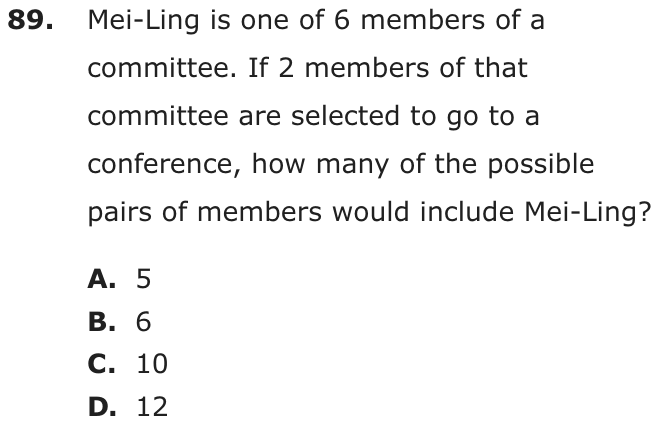
Mei-Ling is one of 6 members of a committee. If 2 members of that committee are selected to go to a conference, how many of the possible pairs of members would include Mei-Ling?
- A5
- B6
- C10
- D12
Show the answer
Correct answer: A
Call the 6 members A, B, C, D, E, and M (for Mei-Ling). The possible combinations are AB, AC, AD, AE, AM, BC, BD, BE, BM, CD, CE, CM, DE, DM, and EM. Of those pairs, 5 include Mei-Ling.
Question analysis
This counting question describes a six-member committee sending two members to a conference and asks how many of the possible pairs include Mei-Ling. Students count combinations in which order does not matter. The traps are counting a pair twice, pairing Mei-Ling with herself, or multiplying the numbers in the question instead of listing the pairs.
- NYS standards
- 7.SP.8b sample spaces for compound events
- Grade level
- Grade 7 content, by NYS standard
- Compared with grade 7
- At grade 7 Grade 7 students count outcomes with organized lists and tree diagrams. Here the list of pairs is short and a single condition, that one named person belongs to the pair, filters it, which matches routine grade 7 counting work.
- Estimated difficulty
- Straightforward: two steps or one careful reading.
- Thinking it demands
- Depth of knowledge 2, skills and concepts · mainly apply
- What makes it hard
- Turning words into math minor
- Much to keep track of minor
- Solution
- 2 steps
- Reading level
- Question and choices: about grade 8, 31 words.
- Students, last 30 days
- Not enough answers yet to show (it takes 10).
Why it is hard, traps and wrong answers (shows the answer)
Why it is hard
The count is small enough to list, so the question rewards a clear picture of what a pair is: two different people, in no particular order. The tempting errors count Mei-Ling as her own partner, count each pair twice, or multiply the two numbers in the stem. Writing the five pairs out, M with each of A through E, takes seconds and rules out all three.
Turning words into math minor Understanding the question
Pairs that include Mei-Ling are simply Mei-Ling with each of the other 5 members, a count of her possible partners, though the phrase “possible pairs” invites counting all 15 pairs. (Hegarty, Mayer & Monk, 1995; Koedinger & Nathan, 2004)
Much to keep track of minor Working it out
Listing pairs by letter, as the explanation does with A to E and M, means tracking which pairs are already written, so that AM and MA are not both counted. (Sweller, 1988; Carpenter, Just & Shell, 1990)
Strategy: Label the members with letters and list every pair that contains Mei-Ling, remembering that a pair is two different people and that order does not matter.
Traps
- Counting the ends: Inclusive or exclusive ends, fence posts, consecutive numbers: an answer that is one too many or too few, or an endpoint drawn open where it belongs closed (or the reverse).
- Overlapping groups: Things in two groups at once are counted twice, or not subtracted.
- Numbers taken from the question: Combines the numbers in the question without a model of the situation, or is simply a number that appears in the question.
The wrong answers, classified
B Counting the ends (Brown & Burton, 1978)
Counts all 6 committee members as possible partners, forgetting that Mei-Ling cannot be paired with herself, one more than the real count.
C Overlapping groups (King et al., 2004)
Counts ordered pairs, Mei-Ling with a partner and that partner with Mei-Ling, as different, so each of the 5 pairs is counted twice.
D Numbers taken from the question (Hegarty, Mayer & Monk, 1995)
Multiplies the 6 members by the 2 people chosen, 6 × 2 = 12, a product of the stem's numbers that counts no actual pairs.
Worked solution, step by step
Formulas used
- Number of pairs in a group
- n is the number of people in the group. Each person can pair up with the n − 1 others. Multiplying counts every pair twice, once from each partner’s side. So you divide by 2.
Sort out the question
The committee has 6 members, and Mei-Ling is one of them. Two members go to the conference together. That makes a pair. You don’t need every possible pair. You only need the pairs that include Mei-Ling.
Find Mei-Ling’s possible partners
A pair with Mei-Ling is Mei-Ling plus one other member. Call Mei-Ling M, and call the other members A, B, C, D and E. Her pairs are M with A, M with B, M with C, M with D and M with E. That is 5 pairs.
Watch out: she can’t be paired with herself. Counting all 6 members as partners gives 6, choice B.
Don’t count a pair twice
Mei-Ling with A is the same pair as A with Mei-Ling. The same two people go either way. Watch out: counting both orders doubles the count to 10, choice C. Multiplying 6 × 2 = 12 gives choice D, but that does not count any pairs.
Check against all the pairs
Count every pair in the committee.
Each pair has 2 people, so the 15 pairs have 30 name spots. All 6 members get the same share: . So the answer is A, 5.
Check your answer
List all 15 pairs: AB, AC, AD, AE, AM, BC, BD, BE, BM, CD, CE, CM, DE, DM, EM. Now circle the ones with M in them: AM, BM, CM, DM, EM. There are exactly 5.
More questions like this
The original DOE question