Question
Read this sentence.
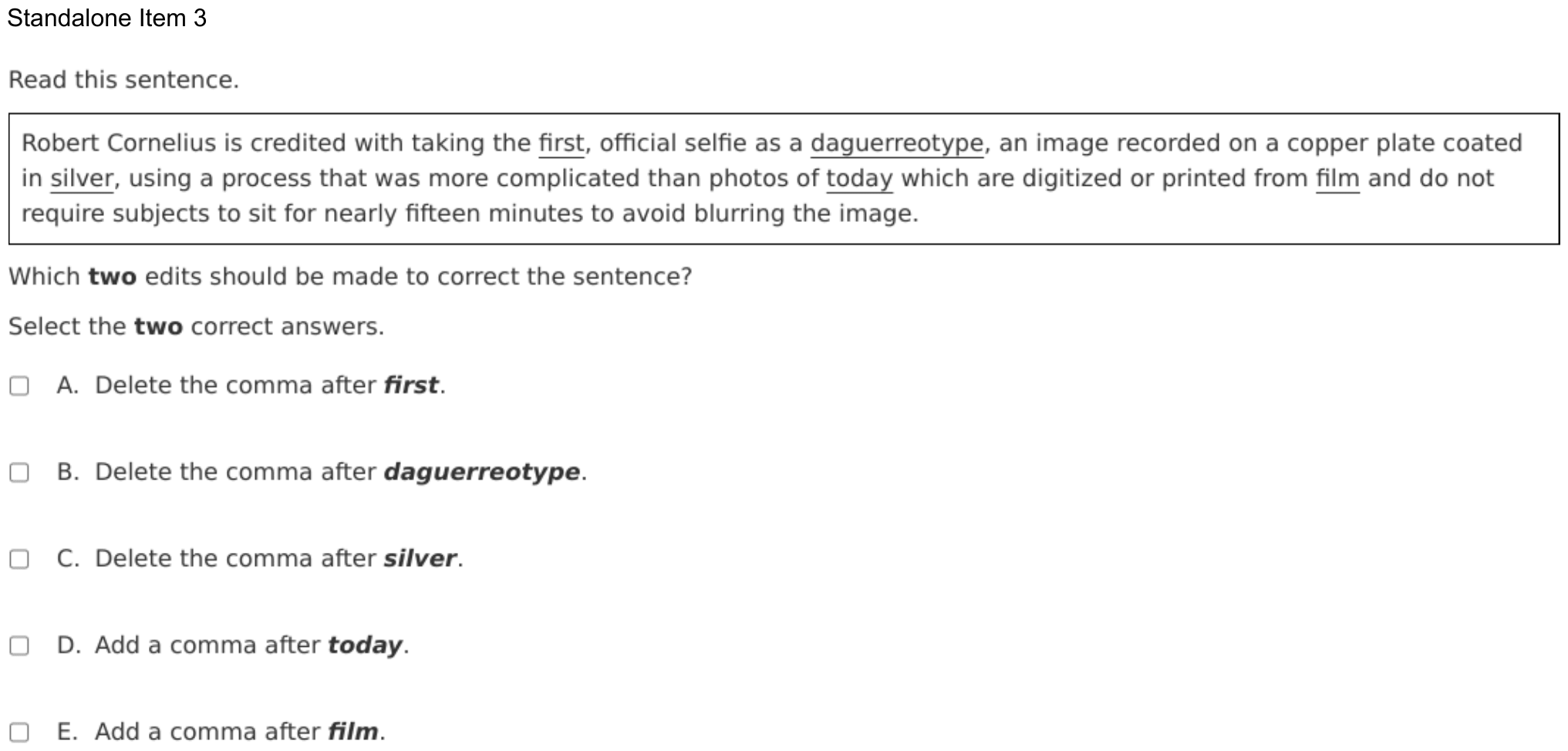
Robert Cornelius is credited with taking the first, official selfie as a daguerreotype, an image recorded on a copper plate coated in silver, using a process that was more complicated than photos of today which are digitized or printed from film and do not require subjects to sit for nearly fifteen minutes to avoid blurring the image.
Which two edits should be made to correct the sentence?
Select the two correct answers.
Choose every answer that is correct, then check. The DOE has not published how answers with several parts are scored; this site counts one right only when every part is right.
- ADelete the comma after first.
- BDelete the comma after daguerreotype.
- CDelete the comma after silver.
- DAdd a comma after today.
- EAdd a comma after film.
Show the answer
Correct answer: A and D
The question asks which two edits should be made to correct the sentence.
A. CORRECT. The comma after “first” must be deleted to correct the sentence. The adjectives “first” and “official” are not coordinate adjectives that independently modify the noun “selfie.” Cornelius did not take the “first selfie” and also the “official selfie.” Rather, he took the first selfie that was considered official. Placing a comma between the words “first” and “official” incorrectly separates two adjectives that work together to describe the selfie.
B. Incorrect. The comma after “daguerreotype” must not be deleted, because it is used correctly to introduce an explanation. The phrase “an image recorded on a copper plate coated in silver” is an appositive—a noun phrase that defines “daguerreotype.”
C. Incorrect. The comma after “silver” is placed correctly, marking the end of the phrase “an image recorded on a copper plate coated in silver” that defines “daguerreotype.” Because the sentence continues to explain the process Robert Cornelius used, the comma after “silver” is needed to end the appositive and separate it from the phrase that follows.
D. CORRECT. A comma is needed after “today” because the following phrase, “which are digitized or printed from film,” is a nonrestrictive clause that gives nonessential information about the “photos of today” preceding it.
E. Incorrect. No comma is needed after “film,” because the words “and do not require subjects to sit” are part of the same relative clause that begins with “which are digitized…”. The conjunction “and” joins two predicates within the same clause. Both actions belong to the same clause and the same subject (which); they are not separate independent clauses that need to be punctuated with a comma.
Question analysis
This punctuation question gives one long sentence about Robert Cornelius, credited with one of the earliest selfies, and the daguerreotype, an image made on a silver-coated copper plate, and asks which two of five comma edits correct it. Five words are underlined, and each needs its own decision about a comma, with credit only when both chosen edits are right.
- NYS standards
- 7L2 capitalization, punctuation, and spelling
- Grade level
- Grade 8 reading and task
- Compared with grade 7
- Above grade 7 The comma rules tested appear in the grade 6 and 7 standards, but the sentence runs 57 words, two of the rules are subtle ones, and both selections must be right, which makes this harder than typical grade 7 editing.
- Estimated difficulty
- Hard: combines ideas, needs a plan, and has more than one tempting wrong answer.
- Thinking it demands
- Depth of knowledge 2, skills and concepts · mainly apply
- What makes it hard
- A rule that doesn't sound wrong major
- Much to keep track of moderate
- Complex sentences moderate
- Evidence
- Answered from one sentence or line
- Reading level
- Question and choices: about grade 7, 100 words.
- Corrected from the DOE handbook
- A grammar term in the explanation was corrected.
- Students, last 30 days
- Not enough answers yet to show (it takes 10).
Why it is hard, traps and wrong answers (shows the answer)
Why it is hard
The sentence is long, two of its five decisions turn on subtle comma rules, and the site counts the answer right only when both edits are right. The comma before “and do not require” is the strongest trap, because a comma before “and” is a habit many students apply without checking whether a new clause begins. The paired commas around “an image recorded on a copper plate coated in silver” are already correct, and deleting either one breaks the pair.
A rule that doesn't sound wrong major Working it out
Both needed edits rest on rules students rarely hear: “first, official” are not coordinate adjectives, so no comma, and “which are digitized” adds nonessential detail about photos of today, so it needs one. (Connors & Lunsford, 1988)
Much to keep track of moderate Working it out
There are five comma decisions in one sentence and both selections must be right to score, so each edit is judged on its own while the rest of the sentence is held in mind. (Sweller, 1988; Carpenter, Just & Shell, 1990)
Complex sentences moderate Understanding the question
The sentence runs 57 words and stacks an appositive, a participial phrase beginning “using a process,” and a relative clause with two verbs, so finding where each phrase starts and ends is itself the task. (Abedi & Lord, 2001; Freedle & Kostin, 1993; Messick, 1989)
Strategy: Take the five underlined words one at a time: name what the phrase after each one does in the sentence, decide whether a comma belongs there, and choose only the two edits you are sure of.
Traps
- Punctuation: A comma, semicolon, colon, dash or apostrophe used where it does not belong, or missing where it does.
The wrong answers, classified
B Punctuation (Connors & Lunsford, 1988)
Deletes the comma that opens the appositive “an image recorded on a copper plate coated in silver,” which defines daguerreotype and must be set off from it.
C Punctuation (Connors & Lunsford, 1988)
Deletes the comma that closes the same appositive, perhaps feeling the sentence has too many commas, though a phrase set off mid-sentence needs a comma on each side.
E Punctuation (Connors & Lunsford, 1988)
Applies the habit of a comma before “and,” though here “and” joins two verbs that share one subject, “which,” inside one clause, not two complete clauses.
A Punctuation (Connors & Lunsford, 1988)
Left out by students who think a comma always separates two adjectives, though “first” describes “official selfie” as a unit, so the adjectives are not coordinate.
D Punctuation (Connors & Lunsford, 1988)
Left out by students who read “photos of today which are digitized” as one essential phrase, missing that the which-clause adds nonessential detail and needs a comma.
What was corrected from the DOE handbook, and why
- Explanation: The DOE’s explanation of Option C says the comma after “silver” “is needed to separate the clauses.” Neither side of that comma is a clause. Before it is the appositive “an image recorded on a copper plate coated in silver,” as the explanations of Options B and C say; after it is the phrase “using a process that was more complicated…,” a participial phrase with no subject of its own. The comma ends the appositive. The site now says the comma “is needed to end the appositive and separate it from the phrase that follows.”
Working it out, step by step
Figure out what the question asks
This asks which two comma edits fix the sentence. Five words are underlined. Decide about each comma one at a time. You must pick both right edits.
Check the comma after first
A comma goes between two describing words only if each one describes the noun on its own. Test it: can you put “and” between them? A long and hard test works, so you write a long, hard test. But the first and official selfie sounds wrong. “First” describes “official selfie” as a unit. So delete the comma after first. That is A.
Check the commas around silver
“An image recorded on a copper plate coated in silver” tells what a daguerreotype is. A phrase that renames the noun just before it is called an appositive. An appositive in the middle of a sentence needs a comma on each side. Example: My dog, a small beagle, loves walks. So keep the commas after daguerreotype and silver. B and C are wrong.
Check the comma after today
A clause is a group of words with its own verb. “Which are digitized or printed from film” is a clause that adds extra facts about photos of today. A “which” clause that adds extra facts gets a comma before it. Example: I read that book, which is very long. So add a comma after today. That is D.
Check the comma after film
The words “and do not require subjects to sit” are part of the same “which” clause. “Which” is the subject of both verbs, “are digitized or printed” and “do not require.” When “and” joins two verbs that share one subject, no comma goes before it. Example: She sings and dances. So E is wrong.
Watch out: Many students put a comma before every “and.” That leads to E. A comma goes before “and” when it joins two full sentences, not two verbs.
Choose the answers
Delete the comma after first, and add a comma after today. So the answers are A and D. Be sure to select both of them.
Why this answer and not the closest wrong one
E is the closest wrong answer, because a comma before “and” is a common habit. But after film, “and” joins two verbs that share one subject, “which.” No new sentence starts there, so no comma belongs. A and D fix the two real errors.
More questions like this
The original DOE question