Question
Read this sentence.
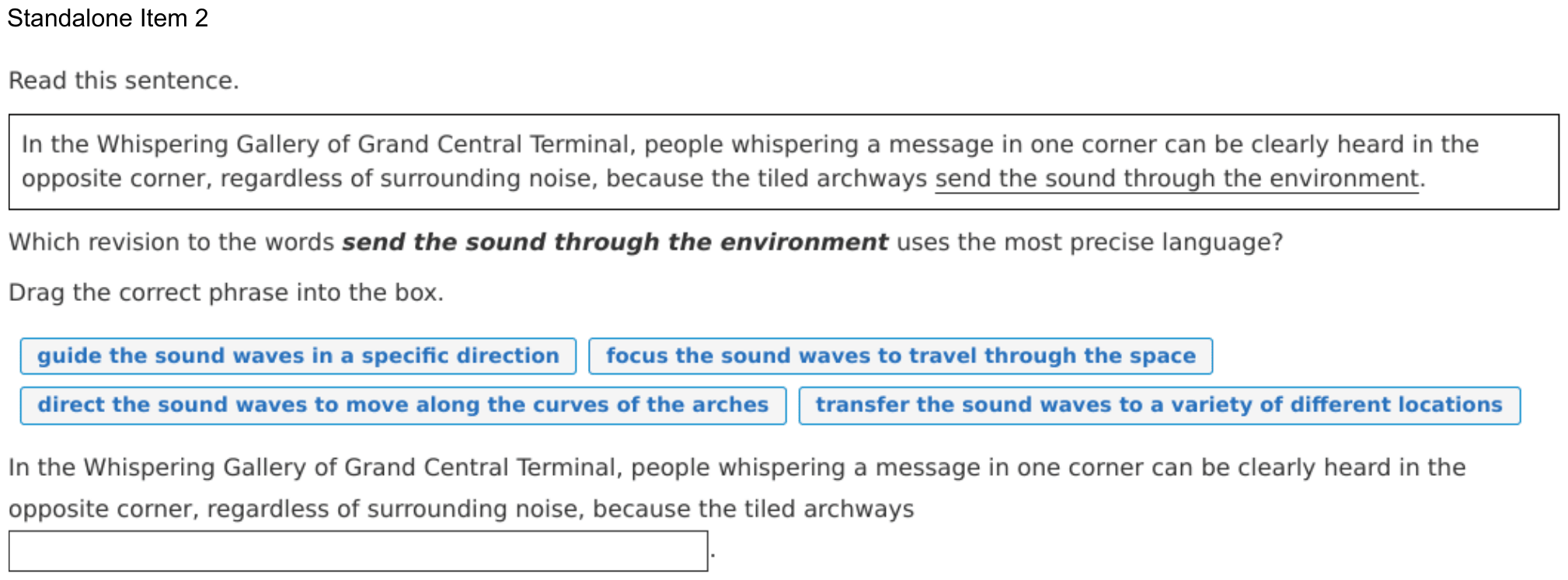
In the Whispering Gallery of Grand Central Terminal, people whispering a message in one corner can be clearly heard in the opposite corner, regardless of surrounding noise, because the tiled archways send the sound through the environment.
Which revision to the words send the sound through the environment uses the most precise language?
Drag the correct phrase into the box.
In the Whispering Gallery of Grand Central Terminal, people whispering a message in one corner can be clearly heard in the opposite corner, regardless of surrounding noise, because the tiled archways ____.
On the test you drag one of the tiles into the box; here, choose it.
- Aguide the sound waves in a specific direction
- Bfocus the sound waves to travel through the space
- Cdirect the sound waves to move along the curves of the arches
- Dtransfer the sound waves to a variety of different locations
Show the answer
Correct answer: C
The question asks for the revision to the words send the sound through the environment that uses the most precise language.
Incorrect. The phrase “guide the sound waves in a specific direction” is not the most precise revision. “A specific direction” does not explain precisely where the sound waves travel.
Incorrect. The phrase “focus the sound waves to travel through the space” is not the most precise revision, because it does not precisely describe where the waves move. The phrase “through the space” does not provide the reader with more specific information as to where in the space the sound waves travel.
CORRECT. The phrase “direct the sound waves to move along the curves of the arches” uses precise language to explain how the waves travel. The wording “direct the sound waves” is more specific than “send the sound” as in the original sentence, and the action “move along the curves” conveys more detail than the phrase “through the environment.”
Incorrect. The phrase “transfer the sound waves to a variety of different locations” is not the most precise revision, because it does not precisely convey where the waves move to. The phrase “variety of different locations” is vague and does not add clarity.
Question analysis
This precise-language question gives a sentence about the Whispering Gallery in Grand Central Terminal, where a whisper in one corner is heard in the opposite corner, and asks which revision of “send the sound through the environment” is most precise. On the test students drag one of four phrase tiles into the box, and every tile sounds more technical than the original.
- NYS standards
- 7L3a precise and concise language
- Grade level
- Grade 6 reading and task
- Compared with grade 7
- Below grade 7 Replacing vague wording with exact wording is taught by grade 6. Here it is one sentence about a familiar place and four phrase tiles, a single judgment, which is lighter than typical grade 7 revision of a whole paragraph.
- Estimated difficulty
- Straightforward: two steps or one careful reading.
- Thinking it demands
- Depth of knowledge 1, recall and reproduction · mainly evaluate
- What makes it hard
- A very close wrong answer moderate
- Every choice must be checked minor
- Evidence
- Answered from one sentence or line
- Reading level
- Question and choices: about grade 8, 133 words.
- Corrected from the DOE handbook
- A misquotation of the sentence in the explanation was corrected.
- Students, last 30 days
- Not enough answers yet to show (it takes 10).
Why it is hard, traps and wrong answers (shows the answer)
Why it is hard
All four tiles upgrade “send the sound” to “the sound waves” with a sharper verb, so the original’s vagueness survives only in the endings. The tile that promises “a specific direction” sounds precise because of that word, yet it never names the direction; the key is the only tile that says where the sound travels. Dragging a tile into the box adds nothing to the task beyond picking one choice.
A very close wrong answer moderate Choosing the answer
The “specific direction” tile is built like the key, a precise verb and “the sound waves”; the two differ only in the ending, a direction never named versus “along the curves of the arches.” (Embretson & Wetzel, 1987; Gorin & Embretson, 2006; Ascalon et al., 2007)
Every choice must be checked minor Choosing the answer
Every tile sounds more exact than the original, so students must ask of each one whether a reader could tell how the sound gets from one corner to the opposite one. (Embretson & Wetzel, 1987)
Strategy: Reread the whole sentence, then ask of each tile whether a reader could picture exactly how the sound gets from one corner of the gallery to the other.
Traps
- Wordy, vague or informal: A revision is grammatical but wordy, imprecise or too casual for the passage.
- Changes the meaning: A revision is correct English but no longer says what the writer meant.
The wrong answers, classified
A Wordy, vague or informal (Connors & Lunsford, 1988)
Trusts the word “specific,” which sounds exact, but “a specific direction” never says which direction, so the phrase stays as vague as the original.
B Wordy, vague or informal (Connors & Lunsford, 1988)
Is drawn by the technical “focus the sound waves,” but “through the space” just restates “through the environment” and says nothing about the archways.
D Changes the meaning (Connors & Lunsford, 1988)
Picks the scientific-sounding “transfer,” but sending sound to “a variety of different locations” contradicts a whisper heard in the one opposite corner, and the phrase repeats itself.
What was corrected from the DOE handbook, and why
- Explanation: The DOE’s explanation of the correct phrase says that “move along the curves” conveys more detail than “the phrase ‘moving through the environment.’” The sentence in the question says the archways “send the sound through the environment”; the word “moving” is not in it. The site now quotes the sentence’s own words: “the phrase ‘through the environment.’”
Working it out, step by step
Figure out what the question asks
This asks which phrase is most precise. Precise language is exact. It tells the reader just what happens, so they can picture it. The phrase you pick replaces the underlined words.
See what the sentence needs
The sentence says a whisper in one corner “can be clearly heard in the opposite corner.” Why? “because the tiled archways send the sound through the environment.” That ending is vague, or unclear. “Through the environment” could mean anywhere. A better phrase would say how the sound gets from one corner to the other.
Name the rule
Precise writing swaps general words for exact ones. For example, The dog went over there is vague. The dog ran under the porch is precise. Now you know just where the dog went.
Check each choice
- A is wrong. “A specific direction” sounds exact. But it never says which direction.
- B is wrong. “Through the space” is just another way to say “through the environment.”
- C is right. “Along the curves of the arches” tells exactly where the sound travels. It follows the curved arches to the far corner.
- D is wrong. “A variety of different locations” is vague. It also clashes with a whisper heard in one corner. And “variety” and “different” say the same thing twice.
Watch out: The word “specific” makes A sound precise. Ask whether you can picture the path. With A, you can’t.
Choose the answer
With the tile in place, the sentence ends because the tiled archways direct the sound waves to move along the curves of the arches. So the answer is C. On the test, you drag the tile “direct the sound waves to move along the curves of the arches” into the box.
Why this answer and not the closest wrong one
A is the closest wrong answer. It has a strong verb, “guide,” and the word “specific.” But it never names the direction, so the reader still can’t picture the path. C says exactly where the sound goes: along the curves of the arches. That explains how a whisper reaches the opposite corner.
More questions like this
The original DOE question