Also in 2026 Practice Test B Math, question 35; 2025 Practice Test B Math, question 41.
Question
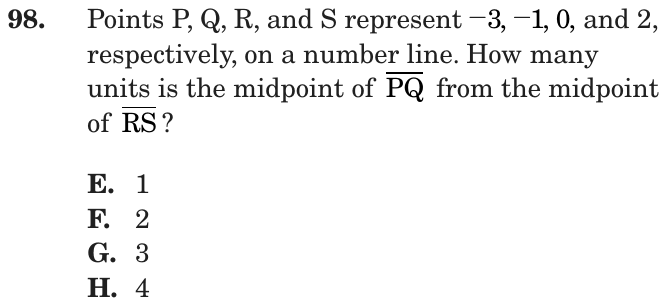
Points , , , and represent −3, −1, 0, and 2, respectively, on a number line. How many units is the midpoint of from the midpoint of ?
- A1
- B2
- C3
- D4
Show the answer
Correct answer: C
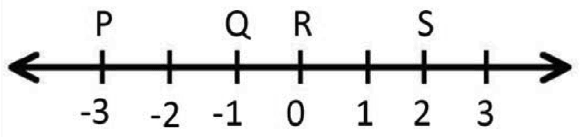
Find the midpoint of and :
Half the length of is unit.
The midpoint of is located 1 unit from each endpoint, so the midpoint is at −2.
Half the length of is unit.
The midpoint of RS is located 1 unit from each endpoint, so the midpoint is at 1. The distance between the two midpoints is 1 −(−2) = 3 units.
Question analysis
Four points on a number line are given by their coordinates, some of them negative, and students find the distance between the midpoints of two segments. It tests locating midpoints and measuring distance with negative numbers. The care needed is in placing each midpoint correctly and in measuring a distance that crosses zero.
- Grade level
- Grade 7 content, by NYS standard
- Compared with grade 7
- At grade 7 Distance on a number line with negative numbers is grade 7 content. Finding two midpoints first adds a step, but the numbers are small integers, so the demand matches typical grade 7 practice.
- Estimated difficulty
- Straightforward: two steps or one careful reading.
- Thinking it demands
- Depth of knowledge 2, skills and concepts · mainly apply
- What makes it hard
- Error-prone arithmetic moderate
- Much to keep track of minor
- Solution
- 3 steps
- Reading level
- Question and choices: about grade 12, 26 words.
- Corrected from the DOE handbook
- Two mislabeled steps in the explanation were corrected.
- Students, last 30 days
- Not enough answers yet to show (it takes 10).
Why it is hard, traps and wrong answers (shows the answer)
Why it is hard
Each step is simple, but the negative coordinates make the last subtraction easy to get wrong, and there is no picture to check against. Students who sketch the line and mark −2 and 1 can count the three units directly. The wrong choices come from confusing a segment's length with the gap between midpoints, or from counting tick marks instead of spaces.
Error-prone arithmetic moderate Working it out
The midpoint of PQ is at −2, so the final distance is 1 − (−2); dropping the negative sign at that step turns 3 into 1. (Brown & Burton, 1978; Junker & Sijtsma, 2001)
Much to keep track of minor Working it out
Four labeled points and two midpoints have to be held at once, and the question draws no number line, so sketching one is the safe move. (Sweller, 1988; Carpenter, Just & Shell, 1990)
Strategy: Average the coordinates of each segment's endpoints to place its midpoint, then find the distance between the two midpoints as the absolute value of their difference.
Traps
- Negatives and direction: Arithmetic with negative numbers, the order of a subtraction, or direction on a number line. (Moving a term across the equals sign without changing its sign is a faulty procedure.)
- Answers a different question: A choice is right for another quantity: the other unknown, the rest instead of the part, the part instead of the whole.
The wrong answers, classified
A Negatives and direction (Brown & Burton, 1978)
Computes the distance between the midpoints −2 and 1 as 2 − 1 = 1, dropping the negative sign instead of finding 1 − (−2).
B Answers a different question (King et al., 2004; Hegarty, Mayer & Monk, 1995)
Gives the length of PQ or of RS, 2 units each, rather than the distance between the two segments' midpoints.
D Counting the ends (Brown & Burton, 1978)
Counts the tick marks from −2 to 1, which are four, instead of the three unit spaces between them.
What was corrected from the DOE handbook, and why
- Explanation: The handbook labels (−1 − (−3))/2 = 1 unit as the “Midpoint of PQ” and (2 − 0)/2 = 1 unit as the “Midpoint of RS.” Those are half the lengths of the segments, not their midpoints: as the next sentences say, the midpoint of PQ is at −2 and the midpoint of RS is at 1. The site labels them “Half the length of PQ” and “Half the length of RS.” The distance between the midpoints is still 3 units.
Worked solution, step by step
Formulas used
- Midpoint on a number line
- a and b are the numbers at the two ends of a segment. The midpoint is the point exactly halfway between them. Adding the ends and dividing by 2 finds their average, which is the middle.
- Distance on a number line
- The right number is the point farther to the right on the number line. The left number is the other point. Subtracting tells how many units apart they are. Taking the left from the right keeps the answer positive.
Sort out what you know
P is at −3, Q is at −1, R is at 0 and S is at 2. A segment is the piece of a line between two points. So runs from −3 to −1. You need the distance between the midpoint of PQ and the midpoint of RS. A quick sketch of a number line helps.
Find the midpoint of PQ
Use the midpoint formula with −3 and −1.
The midpoint of PQ is at −2.
Find the midpoint of RS
Use the midpoint formula with 0 and 2.
The midpoint of RS is at 1.
Find the distance between them
The midpoint at 1 is to the right of the one at −2. Use the distance formula.
Subtracting a negative number is the same as adding.
Watch out: dropping the minus sign gives , choice A. Counting the tick marks −2, −1, 0 and 1 gives 4, choice D. Count the spaces between marks instead.
Give the answer
The midpoints are at −2 and 1, which are 3 units apart. So the answer is C, 3.
Check your answer
Count the jumps on a number line. Going from −2 to −1 is one jump. Going from −1 to 0 is two, and going from 0 to 1 is three. So the midpoints are 3 units apart.
More questions like this
The original DOE question