Also in 2025 Practice Test B Math, question 42.
Question
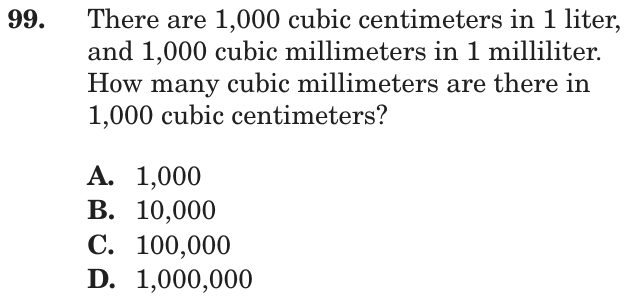
There are 1,000 cubic centimeters in 1 liter, and 1,000 cubic millimeters in 1 milliliter. How many cubic millimeters are there in 1,000 cubic centimeters?
- A1,000
- B10,000
- C100,000
- D1,000,000
Show the answer
Correct answer: D
If 1 L = 1,000 cu cm, then 1 L = 1,000 mL. Set up a proportion, letting = the amount of cubic millimeters in 1,000 cubic centimeters.
Solve for : 1,000,000 cubic millimeters are in 1,000 cubic centimeters.
Question analysis
The question gives two metric facts, cubic centimeters per liter and cubic millimeters per milliliter, and asks how many cubic millimeters are in 1,000 cubic centimeters. It tests chaining unit conversions with volume units. The hard part is that the two facts do not connect without a link the question leaves out.
- NYS standards
- 6.RP.3d converting measurement units
- Grade level
- Grade 6 content, by NYS standard
- Compared with grade 7
- Above grade 7 Grade 6 and 7 students convert units with one given factor. This needs three linked conversions, one using a fact the question does not state, and involves cubic units, which most grade 7 students find unfamiliar.
- Estimated difficulty
- Hard: combines ideas, needs a plan, and has more than one tempting wrong answer.
- Thinking it demands
- Depth of knowledge 2, skills and concepts · mainly apply
- What makes it hard
- Something you must already know moderate
- Many steps moderate
- Solution
- 3 steps
- Reading level
- Question and choices: about grade 13, 20 words.
- Corrected from the DOE handbook
- The units in the explanation’s proportion were corrected.
- Students, last 30 days
- Not enough answers yet to show (it takes 10).
Why it is hard, traps and wrong answers (shows the answer)
Why it is hard
The question gives two conversion facts that do not connect until the student supplies the link between liters and milliliters. Students who instead reach for 1 centimeter = 10 millimeters often scale a volume like a length or an area and land short by a factor of 10 or 100. Writing the unit at every step, so the units cancel, keeps both factors of 1,000 in view.
Something you must already know moderate Working it out
The chain needs 1 liter = 1,000 milliliters, which the stem never states, yet it is the only link between its two conversion facts. (Anderson & Krathwohl, 2001)
Many steps moderate Working it out
Three conversions in a row, cubic centimeters to liters, liters to milliliters and milliliters to cubic millimeters, multiply out to 1,000 × 1,000. (Daniel & Embretson, 2010; Enright, Morley & Sheehan, 2002)
Strategy: Build a chain from cubic centimeters to liters, liters to milliliters, and milliliters to cubic millimeters, writing the units at every step so they cancel.
Traps
- Units or scale: The answer is wanted in other units, or a rate or scale must be converted first.
- Stops one step early: A choice is a number from partway through the solution.
The wrong answers, classified
A Stops one step early (King et al., 2004; Gierl et al., 2017)
Converts 1,000 cubic centimeters to 1 liter, or 1,000 milliliters, and stops before the last step from milliliters to cubic millimeters.
B Units or scale (King et al., 2004)
Uses the length factor 1 cm = 10 mm for cubic units, multiplying 1,000 by 10 instead of by 10 × 10 × 10.
C Units or scale (King et al., 2004)
Squares the length factor, treating 1 cubic centimeter as 100 cubic millimeters, which is right for area but not for volume.
What was corrected from the DOE handbook, and why
- Explanation: The handbook’s proportion is 1,000 cu mm / 1 L = x cu mm / 1,000 cu mm. But 1,000 cubic millimeters make 1 milliliter, not 1 liter, and the second denominator should be the 1,000 mL that equal 1,000 cubic centimeters. The site uses 1,000 cu mm / 1 mL = x cu mm / 1,000 mL, which gives x = 1,000,000 cubic millimeters.
Worked solution, step by step
Formulas used
- Volume of a cube
- V is the volume, the space inside the cube. s is the length of one side. A cube has the same length, width and height, so you multiply the side by itself three times.
Sort out what you know
You are told two facts. 1 liter (L) is 1,000 cubic centimeters (cu cm). 1 milliliter (mL) is 1,000 cubic millimeters (cu mm). You need the number of cu mm in 1,000 cu cm.
One fact is missing. 1 liter is 1,000 milliliters. The word milli means one thousandth.
Change cubic centimeters to liters
The first fact says 1,000 cu cm is exactly 1 liter. So the amount in the question is 1 liter of space.
Change liters to milliliters
One liter is 1,000 milliliters. So 1,000 cu cm is the same as 1,000 mL.
Watch out: you are not done yet. The question asks for cubic millimeters. Stopping at 1,000 gives choice A.
Change milliliters to cubic millimeters
Each milliliter is 1,000 cu mm. There are 1,000 milliliters, so multiply.
So 1,000 cu cm is 1,000,000 cu mm. The answer is D, 1,000,000.
Check your answer
Use the cube formula. A cube 1 cm on each side is 10 mm on each side. Its volume is cu mm. So 1,000 cu cm is cu mm. Using only one 10 gives choice B. Using two 10s gives choice C.
More questions like this
The original DOE question