Passage New York City and the Hudson Valley Brickmaking Industry
New York City and the Hudson Valley Brickmaking Industry
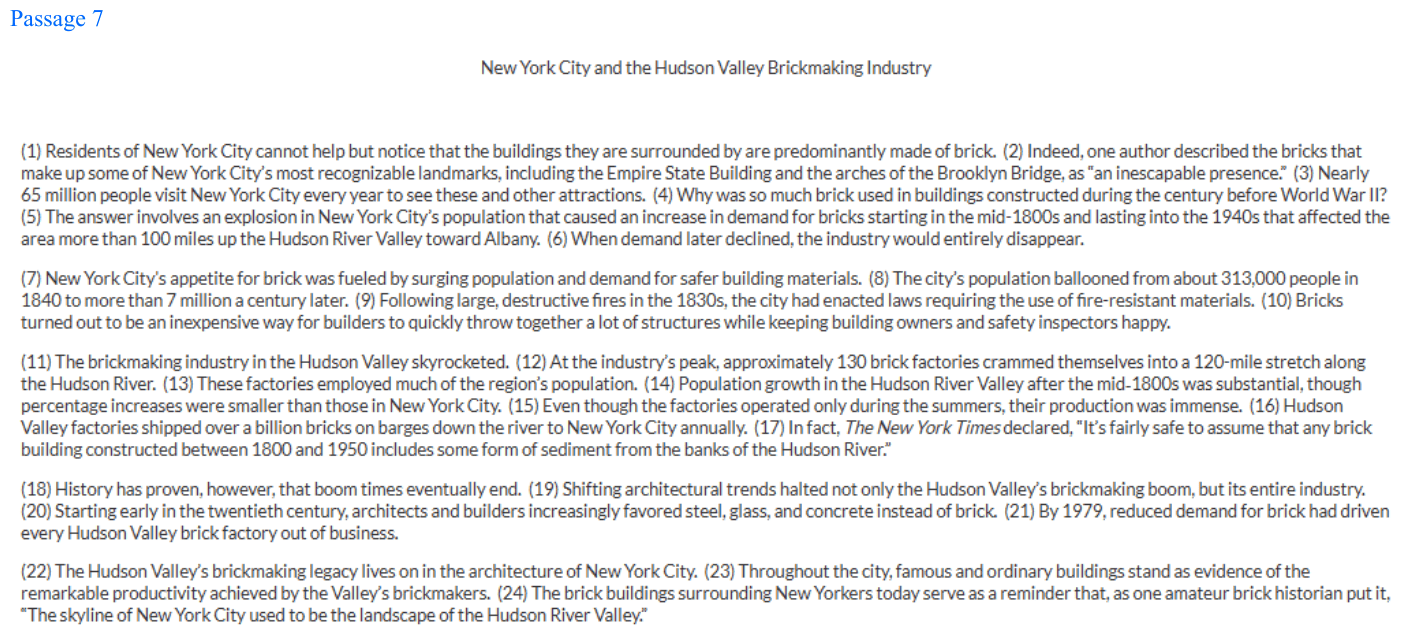
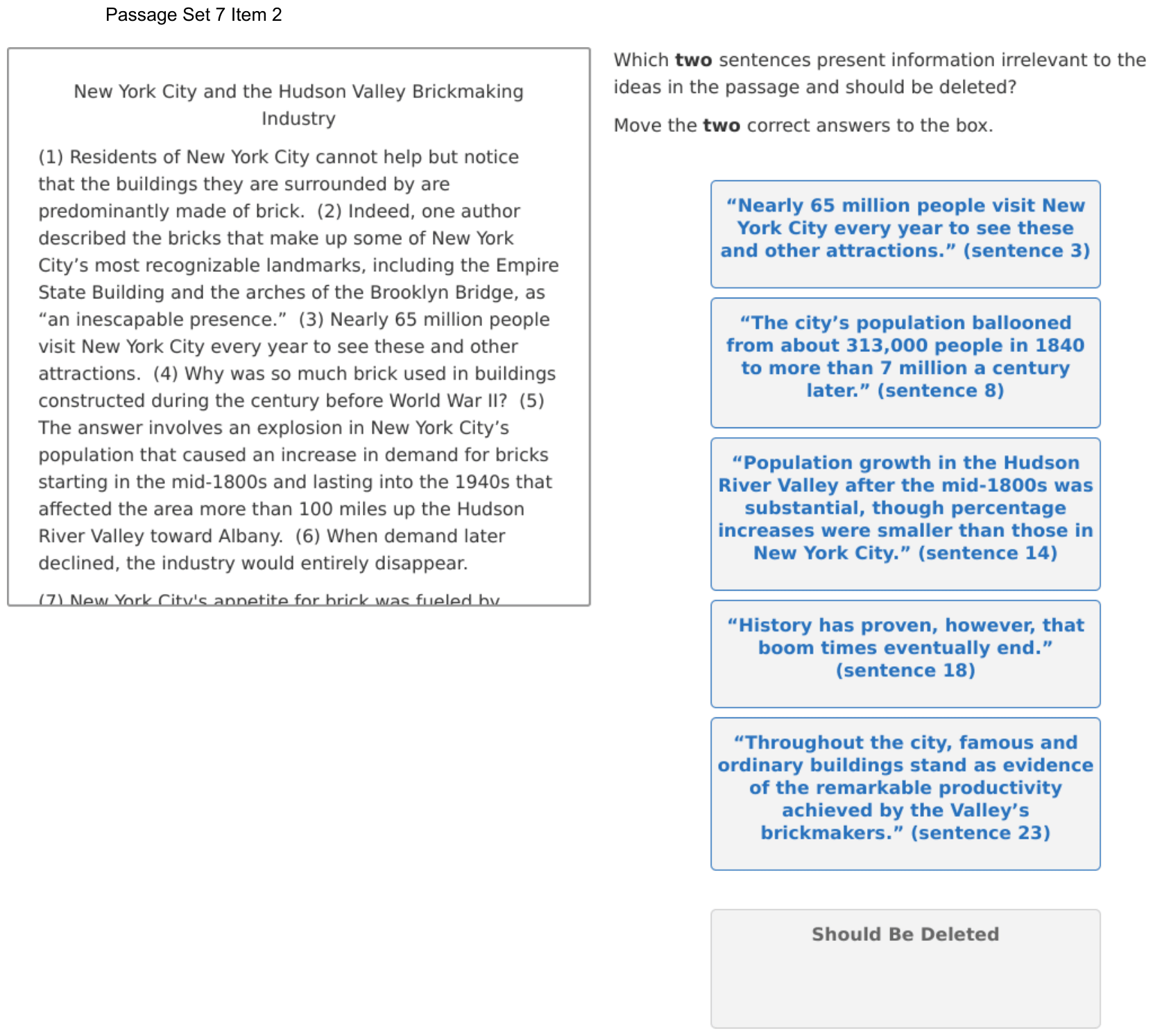
(1) Residents of New York City cannot help but notice that the buildings they are surrounded by are predominantly made of brick. (2) Indeed, one author described the bricks that make up some of New York City’s most recognizable landmarks, including the Empire State Building and the arches of the Brooklyn Bridge, as “an inescapable presence.” (3) Nearly 65 million people visit New York City every year to see these and other attractions. (4) Why was so much brick used in buildings constructed during the century before World War II? (5) The answer involves an explosion in New York City’s population that caused an increase in demand for bricks starting in the mid-1800s and lasting into the 1940s that affected the area more than 100 miles up the Hudson River Valley toward Albany. (6) When demand later declined, the industry would entirely disappear.
(7) New York City’s appetite for brick was fueled by surging population and demand for safer building materials. (8) The city’s population ballooned from about 313,000 people in 1840 to more than 7 million a century later. (9) Following large, destructive fires in the 1830s, the city had enacted laws requiring the use of fire-resistant materials. (10) Bricks turned out to be an inexpensive way for builders to quickly throw together a lot of structures while keeping building owners and safety inspectors happy.
(11) The brickmaking industry in the Hudson Valley skyrocketed. (12) At the industry’s peak, approximately 130 brick factories crammed themselves into a 120-mile stretch along the Hudson River. (13) These factories employed much of the region’s population. (14) Population growth in the Hudson River Valley after the mid-1800s was substantial, though percentage increases were smaller than those in New York City. (15) Even though the factories operated only during the summers, their production was immense. (16) Hudson Valley factories shipped over a billion bricks on barges down the river to New York City annually. (17) In fact, The New York Times declared, “It’s fairly safe to assume that any brick building constructed between 1800 and 1950 includes some form of sediment from the banks of the Hudson River.”
(18) History has proven, however, that boom times eventually end. (19) Shifting architectural trends halted not only the Hudson Valley’s brickmaking boom, but its entire industry. (20) Starting early in the twentieth century, architects and builders increasingly favored steel, glass, and concrete instead of brick. (21) By 1979, reduced demand for brick had driven every Hudson Valley brick factory out of business.
(22) The Hudson Valley’s brickmaking legacy lives on in the architecture of New York City. (23) Throughout the city, famous and ordinary buildings stand as evidence of the remarkable productivity achieved by the Valley’s brickmakers. (24) The brick buildings surrounding New Yorkers today serve as a reminder that, as one amateur brick historian put it, “The skyline of New York City used to be the landscape of the Hudson River Valley.”
Question
Which two sentences present information irrelevant to the ideas in the passage and should be deleted?
Move the two correct answers to the box.
Should Be Deleted
On the test you drag tiles into the box; here, choose them below. The DOE has not published how answers with several parts are scored; this site counts one right only when every part is right.
- A“Nearly 65 million people visit New York City every year to see these and other attractions.” (sentence 3)
- B“The city’s population ballooned from about 313,000 people in 1840 to more than 7 million a century later.” (sentence 8)
- C“Population growth in the Hudson River Valley after the mid-1800s was substantial, though percentage increases were smaller than those in New York City.” (sentence 14)
- D“History has proven, however, that boom times eventually end.” (sentence 18)
- E“Throughout the city, famous and ordinary buildings stand as evidence of the remarkable productivity achieved by the Valley’s brickmakers.” (sentence 23)
Show the answer
Correct answer: A and C
The question asks which two sentences present information irrelevant to the ideas of the passage and should be deleted.
CORRECT. “Nearly 65 million people visit New York City every year to see these and other attractions” (sentence 3) presents irrelevant information and should be deleted. While the statistic is interesting, it focuses on tourism, which is not relevant to either the topic of the passage—the growth and decline of the brickmaking industry—or to the ideas in the first paragraph (sentences 1–6), which focus on the prominence of brick in New York City’s buildings.
Incorrect. “The city’s population ballooned from about 313,000 people in 1840 to more than 7 million a century later” (sentence 8) is relevant to the ideas of the passage and should not be deleted. The numerical details in sentence 8 about the rapid growth in New York City provide relevant evidence that supports a central idea of the passage: that the brickmaking industry of the Hudson River Valley expanded quickly to supply the demands of builders who were, in turn, meeting the demands of a booming population.
CORRECT. “Population growth in the Hudson River Valley after the mid-1800s was substantial, though percentage increases were smaller than those in New York City” (sentence 14) presents irrelevant details and should be deleted. The information in sentence 14 comparing population growth rates between the region and New York City is not needed to develop the passage’s central focus on the rise and decline of the Hudson River Valley’s brickmaking industry. The sentence also does not support ideas in the third paragraph (sentences 11–17). Although it mentions that brick factories employed much of the Hudson River Valley population, the productivity of the factories, rather than the Valley’s population, is the topic of the paragraph.
Incorrect. “History has proven, however, that boom times eventually end” (sentence 18) is relevant to the ideas of the passage and should not be deleted. Sentence 18 effectively introduces the central idea of the passage: the decline of the Hudson River Valley brickmaking industry. The sentence also serves as a clear transition from the third paragraph (sentences 11–17), which provides evidence of the industry’s boom, to the fourth paragraph (sentences 18–21), which provides details about how the industry came to an end.
Incorrect. “Throughout the city, famous and ordinary buildings stand as evidence of the remarkable productivity achieved by the Valley’s brickmakers” (sentence 23) is relevant to the ideas of the passage and should not be deleted. The mention of famous and ordinary buildings provides an effective link to introductory sentences 1 and 2, strengthening the passage’s conclusion, while also emphasizing the productivity of the Hudson Valley brickmaking industry detailed in the third paragraph (sentences 11–17).
Question analysis
This revising question asks which two of five sentences from the passage on the Hudson Valley brickmaking industry present irrelevant information and should be deleted. On the test students move two sentence tiles into a box labeled Should Be Deleted, and both must be right. The five sentences come one from each paragraph, so each must be judged against its own paragraph and the whole passage.
- NYS standards
- 7W2b developing a topic
- Grade level
- Grade 7 reading and task
- Compared with grade 7
- Above grade 7 Grade 7 revision usually asks for one off-topic sentence within one paragraph. Here students check five sentences spread over the whole passage, must find two, and get credit only if both are right, a broader demand than typical grade 7 work.
- Estimated difficulty
- Hard: combines ideas, needs a plan, and has more than one tempting wrong answer.
- Thinking it demands
- Depth of knowledge 2, skills and concepts · mainly analyze
- What makes it hard
- A very close wrong answer moderate
- How sentences fit together moderate
- Much to keep track of minor
- Evidence
- Answered from the whole text
- Reading level
- Passage: about grade 12, 465 words; question and choices: about grade 10, 114 words.
- Corrected from the DOE handbook
- A missing hyphen in a quotation in the explanation was restored.
- A grammatical error in the explanation was corrected.
- Students, last 30 days
- Not enough answers yet to show (it takes 10).
Why it is hard, traps and wrong answers (shows the answer)
Why it is hard
Sentence 3 announces itself: tourism has nothing to do with brick. The second deletion is the trap, because sentence 14 sits after a sentence about factories employing the region’s population and looks like a continuation. Students who reject population as a topic often delete sentence 8 instead, which measures a cause the passage names, and students who judge by sound cut the general “boom times eventually end,” which turns the passage toward the industry’s decline.
A very close wrong answer moderate Choosing the answer
Sentences 8 and 14 are both population statistics; what separates them is that sentence 8 measures the “surging population” sentence 7 names as a cause, while the Valley’s growth in sentence 14 explains nothing. (Embretson & Wetzel, 1987; Gorin & Embretson, 2006; Ascalon et al., 2007)
How sentences fit together moderate Working it out
Each kept sentence earns its place by its links: sentence 18 turns from boom to decline, sentence 23 echoes the landmarks of sentences 1–2, and sentence 14 merely follows sentence 13’s “region’s population.” (Halliday & Hasan, 1976)
Much to keep track of minor Working it out
Five tiles, one from each paragraph, are judged against both their paragraph and the whole passage, and both picks must be right, so two relevance tests run side by side. (Sweller, 1988; Carpenter, Just & Shell, 1990)
Strategy: Sum up the passage’s topic in one phrase, then read each of the five sentences in its paragraph and ask whether removing it would leave a gap in the ideas around it; delete only sentences that leave none.
Traps
- Fixes what isn't broken: Changes a part of the sentence that was already correct, while the real error stays; or, where the question asks which sentence has an error or should go, picks one that is correct and belongs.
- Off the point: Adds or keeps something that does not support the paragraph's or the passage's focus, or an introduction or conclusion that misses the main point.
The wrong answers, classified
B Fixes what isn't broken (Connors & Lunsford, 1988)
Sees a population figure in a passage about bricks and cuts it, missing that sentence 7 names “surging population” as a cause of demand and sentence 8 measures it.
D Fixes what isn't broken (Connors & Lunsford, 1988)
Hears “boom times eventually end” as a cliché that adds nothing, though sentence 18 opens the fourth paragraph and turns the passage from the industry’s growth to its decline.
E Fixes what isn't broken (Connors & Lunsford, 1988)
Thinks sentence 23 only repeats the conclusion around it, though it ties the brickmakers’ output back to the famous buildings of sentences 1–2.
C Off the point (Halliday & Hasan, 1976)
Left unchosen by students who link it to factories that “employed much of the region’s population,” though the paragraph is about the factories’ output, not the Valley’s growth.
What was corrected from the DOE handbook, and why
- Explanation: The handbook’s explanation quotes sentence 14 as “Population growth in the Hudson River Valley after the mid 1800s was substantial.” The passage and the tile say “mid-1800s,” so the site now quotes it that way.
- Explanation: The handbook’s explanation says “The information in sentence 14 comparing population growth rates between the region and New York City are not needed.” The subject is “information,” so the site now says “is not needed.”
Working it out, step by step
Figure out what the question asks
You need to find two sentences that don’t belong. A sentence is irrelevant when it has nothing to do with the main ideas. You can delete it without leaving a gap. On the test you drag two tiles into the Should Be Deleted box. Here, you choose two of the five. Both must be right.
Name the topic of the passage
The passage explains why New York City has so many brick buildings. It tells how the Hudson Valley brick industry grew to meet that demand, then died out. Each paragraph has its own job. Paragraph 1 asks why so much brick was used. Paragraph 2 gives the causes. Paragraph 3 shows how much the factories made. Paragraph 4 tells how the industry ended. Paragraph 5 sums up.
Test sentences 3 and 14
Sentence 3 says: “Nearly 65 million people visit New York City every year to see these and other attractions.” That is about tourists, not bricks. Sentence 14 says: “Population growth in the Hudson River Valley after the mid-1800s was substantial, though percentage increases were smaller than those in New York City.” Paragraph 3 is about how much the factories made, “over a billion bricks” a year. How fast the Valley grew explains nothing about bricks.
Test the other three sentences
- Sentence 8 stays. Sentence 7 says the hunger for brick was “fueled by surging population.” Sentence 8 gives the numbers that show it.
- Sentence 18 stays. It turns the passage from the boom to the decline. A boom is a time of fast growth.
- Sentence 23 stays. It links back to the famous buildings in sentences 1 and 2 and praises the brickmakers.
Watch out: Sentence 14 comes right after one about factories that “employed much of the region’s population.” So it seems to fit. But it changes the topic from factories to population.
Choose the answers
Sentences 3 and 14 add facts that don’t help explain the brick industry. So the answers are A and C. Move these two tiles into the Should Be Deleted box. A is “Nearly 65 million people visit New York City every year to see these and other attractions.” (sentence 3). C is “Population growth in the Hudson River Valley after the mid-1800s was substantial, though percentage increases were smaller than those in New York City.” (sentence 14).
Why this answer and not the closest wrong one
B is the closest wrong answer, since sentences 8 and 14 are both about population. But sentence 8 measures the “surging population” that sentence 7 names as a cause of the demand for brick. Sentence 14 explains nothing about bricks. So delete 14 and keep 8.
More questions like this
The original DOE question
The passage “New York City and the Hudson Valley Brickmaking Industry” as printed (page 64)