Passage New York City and the Hudson Valley Brickmaking Industry
New York City and the Hudson Valley Brickmaking Industry
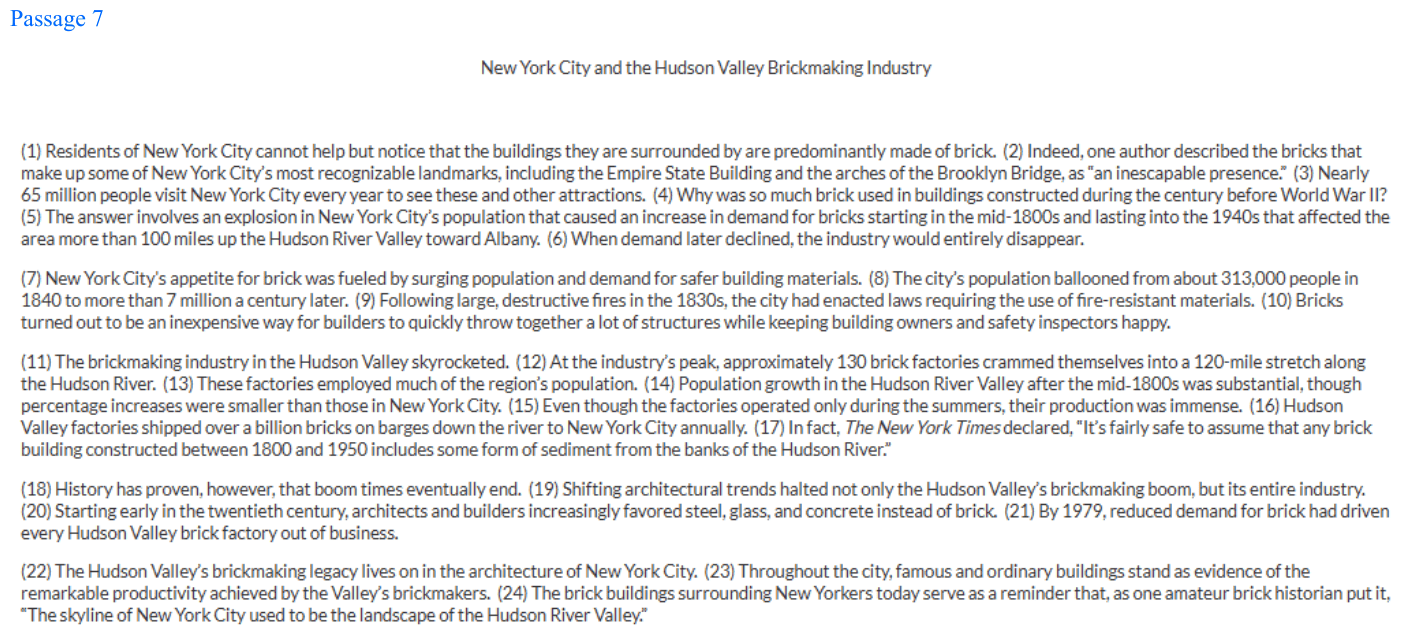
(1) Residents of New York City cannot help but notice that the buildings they are surrounded by are predominantly made of brick. (2) Indeed, one author described the bricks that make up some of New York City’s most recognizable landmarks, including the Empire State Building and the arches of the Brooklyn Bridge, as “an inescapable presence.” (3) Nearly 65 million people visit New York City every year to see these and other attractions. (4) Why was so much brick used in buildings constructed during the century before World War II? (5) The answer involves an explosion in New York City’s population that caused an increase in demand for bricks starting in the mid-1800s and lasting into the 1940s that affected the area more than 100 miles up the Hudson River Valley toward Albany. (6) When demand later declined, the industry would entirely disappear.
(7) New York City’s appetite for brick was fueled by surging population and demand for safer building materials. (8) The city’s population ballooned from about 313,000 people in 1840 to more than 7 million a century later. (9) Following large, destructive fires in the 1830s, the city had enacted laws requiring the use of fire-resistant materials. (10) Bricks turned out to be an inexpensive way for builders to quickly throw together a lot of structures while keeping building owners and safety inspectors happy.
(11) The brickmaking industry in the Hudson Valley skyrocketed. (12) At the industry’s peak, approximately 130 brick factories crammed themselves into a 120-mile stretch along the Hudson River. (13) These factories employed much of the region’s population. (14) Population growth in the Hudson River Valley after the mid-1800s was substantial, though percentage increases were smaller than those in New York City. (15) Even though the factories operated only during the summers, their production was immense. (16) Hudson Valley factories shipped over a billion bricks on barges down the river to New York City annually. (17) In fact, The New York Times declared, “It’s fairly safe to assume that any brick building constructed between 1800 and 1950 includes some form of sediment from the banks of the Hudson River.”
(18) History has proven, however, that boom times eventually end. (19) Shifting architectural trends halted not only the Hudson Valley’s brickmaking boom, but its entire industry. (20) Starting early in the twentieth century, architects and builders increasingly favored steel, glass, and concrete instead of brick. (21) By 1979, reduced demand for brick had driven every Hudson Valley brick factory out of business.
(22) The Hudson Valley’s brickmaking legacy lives on in the architecture of New York City. (23) Throughout the city, famous and ordinary buildings stand as evidence of the remarkable productivity achieved by the Valley’s brickmakers. (24) The brick buildings surrounding New Yorkers today serve as a reminder that, as one amateur brick historian put it, “The skyline of New York City used to be the landscape of the Hudson River Valley.”
Question
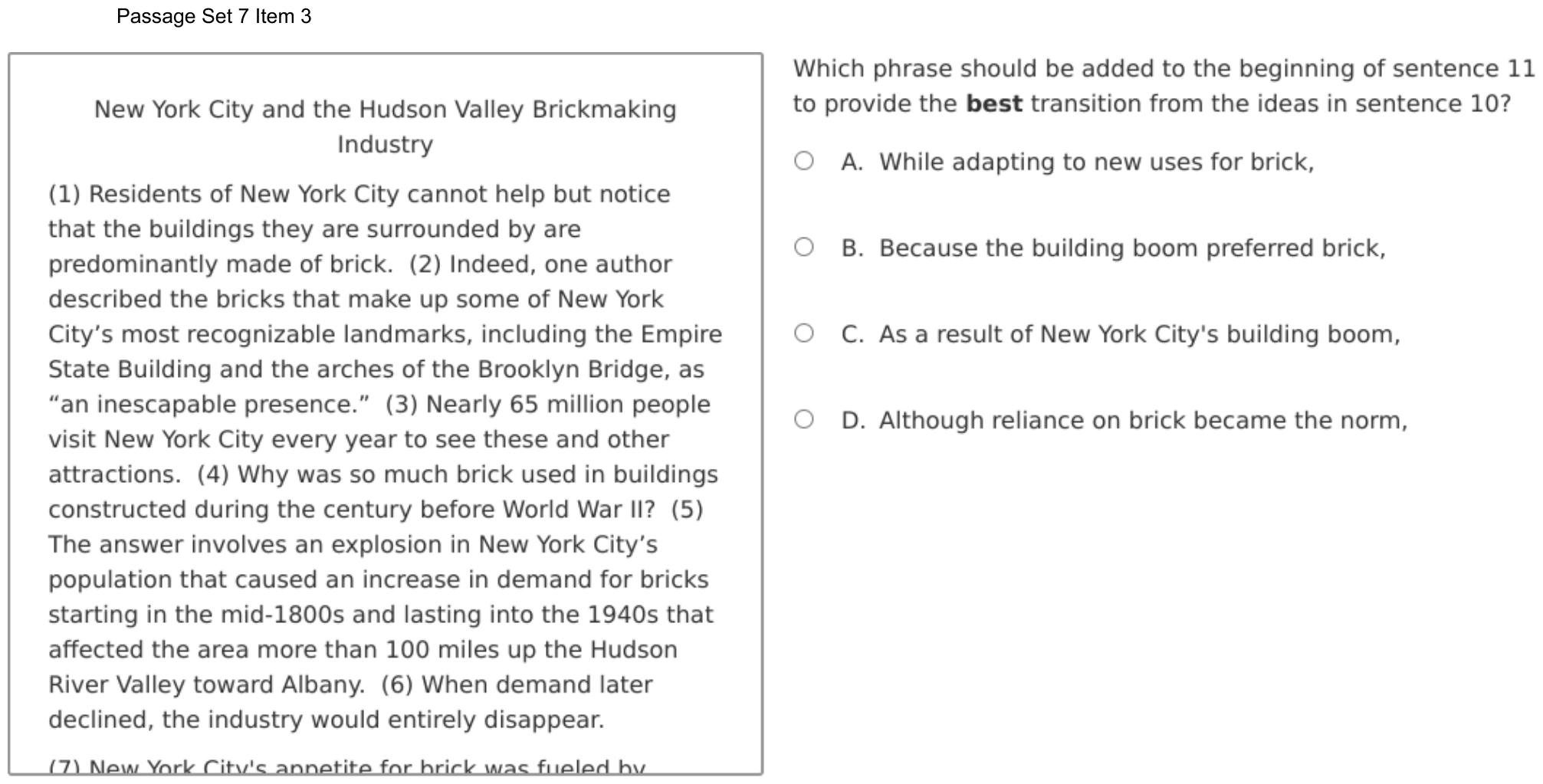
Which phrase should be added to the beginning of sentence 11 to provide the best transition from the ideas in sentence 10?
- AWhile adapting to new uses for brick,
- BBecause the building boom preferred brick,
- CAs a result of New York City’s building boom,
- DAlthough reliance on brick became the norm,
Show the answer
Correct answer: C
The question asks which phrase should be added to the beginning of sentence 11 to provide the best transition from the ideas in sentence 10.
A. Incorrect. The phrase “While adapting to new uses for brick” is not the best transition to place at the beginning of sentence 11 because it does not accurately describe the content of sentence 10. Although sentence 10 conveys that brick was a low-cost way for builders to adapt to two new demands—New York City’s need for a lot of new buildings and its recently changed fire-safety laws—neither sentence 10 nor any of the preceding sentences in the second paragraph (sentences 7–10) indicate that builders found any new ways to use bricks. The focus is on the amount of bricks used, rather than any changes in how the builders used them.
B. Incorrect. Although the phrase “Because the building boom preferred brick” accurately indicates a cause-and-effect relationship between builders using a lot of bricks and the skyrocketing brick production mentioned in sentence 11, it overstates the position of builders described in sentence 10. While sentence 10 says that builders found bricks to be a low-cost way of meeting several needs, it does not say that builders actually preferred to use bricks. In addition, the phrase is awkward and imprecise because a “building boom” cannot literally “prefer” something. Thus, this is not the best transition phrase to add to sentence 11.
C. CORRECT. The transition phrase “As a result of New York City’s building boom” clearly conveys the cause-and-effect relationship between sentence 10, which describes a trend among New York City’s builders to use a lot of bricks to “quickly throw together a lot of structures while keeping building owners and safety inspectors happy,” and sentence 11, which points out a result of the building trend: brickmaking skyrocketed in the nearby Hudson River Valley.
D. Incorrect. The word “although” in the transition phrase “Although reliance on brick became the norm,” incorrectly indicates an opposing relationship that does not exist between the ideas in sentences 10 and 11. Sentence 10 explains how using a lot of bricks helped New York City’s builders meet the demands of a building boom and new safety regulations. As sentence 16 details, many of the bricks made in the Hudson River Valley were shipped “down the river to New York City.” Thus, it is not logical that the skyrocketing growth of the brickmaking industry in the Hudson River Valley described in sentence 11 happened “although” or despite New York City builders using a lot of brick. Therefore, this transition is not the best one to place at the beginning of sentence 11.
Question analysis
This transition question asks which phrase should open sentence 11 of the brickmaking passage, where the third paragraph begins with the Hudson Valley industry that “skyrocketed,” to connect it with sentence 10 about how New York City’s builders used brick. Students must name the relationship between the two paragraphs, and more than one phrase sounds reasonable on a first reading.
- NYS standards
- 7W2d transitions in informative writing
- Grade level
- Grade 7 reading and task
- Compared with grade 7
- At grade 7 Choosing a transition that shows how ideas relate is standard grade 7 writing work. Here the link crosses from one paragraph to the next, and each phrase must be checked for the relationship it signals and for accurate wording, a typical grade 7 demand.
- Estimated difficulty
- Moderate: several steps, or a close reading with one strong distractor.
- Thinking it demands
- Depth of knowledge 2, skills and concepts · mainly evaluate
- What makes it hard
- How sentences fit together moderate
- A very close wrong answer moderate
- Evidence
- Answered from several paragraphs or stanzas
- Reading level
- Passage: about grade 12, 465 words; question and choices: about grade 5, 49 words.
- Students, last 30 days
- Not enough answers yet to show (it takes 10).
Why it is hard, traps and wrong answers (shows the answer)
Why it is hard
Most students sense that the Hudson Valley boom follows from New York City’s appetite for brick, which rules out the contrast of “Although” quickly. The real decision is between two phrases that both signal a cause: one names the building boom accurately, the other gives the boom a preference it cannot have and that sentence 10 never states. The question rewards checking a transition’s own words as well as the relationship it signals.
How sentences fit together moderate Working it out
The phrase must bridge two paragraphs: sentence 10 ends the account of New York City’s builders turning to brick, and sentence 11 opens with the Hudson Valley industry that “skyrocketed,” its result. (Halliday & Hasan, 1976)
A very close wrong answer moderate Choosing the answer
The “Because the building boom preferred brick” phrase signals the same cause and effect as the key; only its wording, a boom that “preferred” something, separates the two. (Embretson & Wetzel, 1987; Gorin & Embretson, 2006; Ascalon et al., 2007)
Strategy: Before reading the phrases, name how sentence 11 relates to sentences 7–10, then pick the phrase that signals that relationship and is also accurate and logical in its own words.
Traps
- Wrong transition: A connecting word or phrase that signals the wrong relationship, such as contrast where the idea continues.
- Changes the meaning: A revision is correct English but no longer says what the writer meant.
- Wordy, vague or informal: A revision is grammatical but wordy, imprecise or too casual for the passage.
The wrong answers, classified
A Changes the meaning (Connors & Lunsford, 1988)
Accepts an opener about “adapting to new uses for brick,” though sentence 10 describes builders using more brick, not new uses, and “While” hides the cause and effect.
B Wordy, vague or informal (Connors & Lunsford, 1988)
Sees the cause and effect correctly but accepts a phrase in which a building boom “preferred” brick, which is illogical and claims a preference sentence 10 never states.
D Wrong transition (Halliday & Hasan, 1976)
Likes “reliance on brick became the norm” as a summary of sentence 10, but “Although” signals a contrast where the Valley’s growth follows from that reliance.
Working it out, step by step
Figure out what the question asks
A transition is a word or phrase that shows how two ideas connect. You need one to start sentence 11. It must show how sentence 11 follows from sentence 10. It must also make sense in its own words.
Read sentences 10 and 11
Sentence 10 says bricks were a cheap way for builders “to quickly throw together a lot of structures.” That ends a paragraph about New York City’s huge demand for brick. Sentence 11 starts a new paragraph: “The brickmaking industry in the Hudson Valley skyrocketed.” Skyrocketed means it grew very fast.
Name the link between them
Why did the brick industry grow so fast? Because New York City was building so much with brick. So sentence 10 is the cause, and sentence 11 is the effect. Here is a made-up example: It rained all week. As a result, the river rose. You need a phrase that shows cause and effect, in accurate words.
Check each phrase
- A is wrong. The passage never mentions “new uses for brick.” Builders used more brick, not new kinds. “While” also hides the cause.
- B is wrong. It shows cause and effect, but a building boom can’t “prefer” anything. Only people can. And sentence 10 says brick was cheap, not that builders liked it best.
- C is right. “As a result of” shows cause and effect. A building boom, a time of very fast building, matches sentences 7–10.
- D is wrong. “Although” signals a contrast, a turn against the idea before. There is no contrast here.
Watch out: B gets the link right. Its words are what make it wrong.
Choose the answer
With the phrase in place, sentence 11 reads: As a result of New York City’s building boom, the brickmaking industry in the Hudson Valley skyrocketed. So the answer is C, “As a result of New York City’s building boom,”
Why this answer and not the closest wrong one
B is the closest wrong answer. Like C, it shows that the Valley’s growth was caused by the building boom. But it says the boom “preferred” brick, as if a boom could have opinions. Sentence 10 also never says brick was preferred. C names the cause in clear, accurate words.
More questions like this
The original DOE question
The passage “New York City and the Hudson Valley Brickmaking Industry” as printed (page 64)