Question
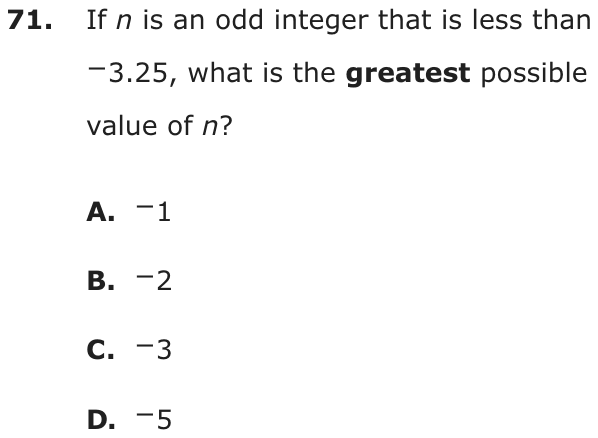
If n is an odd integer that is less than −3.25, what is the greatest possible value of n?
- A−1
- B−2
- C−3
- D−5
Show the answer
Correct answer: D
The two greatest integers less than −3.25 are −4 and −5. Since −4 is even, the answer is −5.
Question analysis
This question asks for the greatest odd integer that is less than −3.25. Students compare negative numbers on a number line and apply two conditions at once, odd and less than. With negatives, the greater number is the one closer to zero, which makes the two conditions easy to misapply.
- Grade level
- Grade 6 content, by NYS standard
- Compared with grade 7
- Below grade 7 Ordering negative numbers is grade 6 content, and the question adds only the condition that the integer be odd. It is lighter than typical grade 7 work, though the order of negatives still trips up students who compare their sizes.
- Estimated difficulty
- Straightforward: two steps or one careful reading.
- Thinking it demands
- Depth of knowledge 1, recall and reproduction · mainly apply
- What makes it hard
- Error-prone arithmetic minor
- Much to keep track of minor
- Solution
- 2 steps
- Reading level
- Question and choices: about grade 7, 18 words.
- Students, last 30 days
- Not enough answers yet to show (it takes 10).
Why it is hard, traps and wrong answers (shows the answer)
Why it is hard
The question is short, but it asks students to reason on the negative side of 0, where greater means closer to 0 and the size of the digits misleads. The integers just below −3.25 are −4 and then −5, and the first of those is even. Sketching a number line, or reading less than as to the left of, keeps the direction straight.
Error-prone arithmetic minor Working it out
On the negative side, less means farther from 0, so the integers below −3.25 run −4, −5, −6; −3, though its digit is closer to 3.25, lies to the right. (Brown & Burton, 1978; Junker & Sijtsma, 2001)
Much to keep track of minor Working it out
Three conditions apply at once, odd, less than −3.25 and the greatest such value, and checking only two of them leads to a listed choice. (Sweller, 1988; Carpenter, Just & Shell, 1990)
Strategy: Picture −3.25 on a number line, list the integers to its left starting with the closest, and take the first one that is odd.
Traps
- Negatives and direction: Arithmetic with negative numbers, the order of a subtraction, or direction on a number line. (Moving a term across the equals sign without changing its sign is a faulty procedure.)
- Misreads the question: Misses or misreads a condition or a word in the question: "at least", "each", "remaining", "not".
The wrong answers, classified
A Misreads the question (Hegarty, Mayer & Monk, 1995)
Picks the greatest odd number offered, −1, without checking the condition that n be less than −3.25; −1 lies to its right on the number line.
B Little reason to choose it (Haladyna & Downing, 1993; Rodriguez, 2005)
The choice −2 is even, so it breaks the condition that n be odd, and it is also greater than −3.25; it mostly catches guesses.
C Negatives and direction (Brown & Burton, 1978)
Looks for the odd integer just past −3.25 but steps toward 0, taking −3, though −3 is greater than −3.25, not less.
Worked solution, step by step
Formulas used
- Comparing negative numbers
- a and b are positive numbers, and a is bigger. On a number line, numbers get smaller as you move left. A negative number farther from 0 is farther left. So it is smaller, even though its digits look bigger.
Sort out the question
n has to pass three tests. It is an integer, a whole number with no decimal part. It is odd, so it is not a multiple of 2. And it is less than −3.25. Of all the numbers that pass, you need the greatest one. That is the one farthest to the right on a number line.
Picture −3.25 on a number line
−3.25 sits between −4 and −3. Less than −3.25 means to the left of it.
So −4 is less than −3.25, but −3 is greater. Watch out: −3 is not less than −3.25. It is to the right, closer to 0. For negative numbers, the one closer to 0 is greater. Picking −3 is choice C.
Find the odd integers to the left
The integers less than −3.25, starting with the closest, are −4, −5, −6 and so on. The greatest one is −4. But −4 is even, since 4 = 2 × 2. So skip it. The next one, −5, is odd. Watch out: −1 is odd, but it is greater than −3.25, so choice A breaks the rule. So the answer is D, −5.
Check your answer
Check all three tests for −5. It is an integer. It is odd. It is to the left of −3.25, so it is less. The only integer between −5 and −3.25 is −4, and it is even. So no greater number works.
More questions like this
The original DOE question