2019
This test has the first 120 of the 228 questions that match.
Question 1 of 120
2026 Practice Test A English, question 8Passage The Best Laid Plans of Ravens
The Best Laid Plans of Ravens
In Edgar Allan Poe’s poem “The Raven,” a raven visits a lonely man’s home and responds to the man’s pleading questions with only the word “nevermore.” The poem’s narrator interprets the word as a prediction of doom for his future. A talking, prophetic raven may seem to be the wild imaginings of the poet, but a new study published in the journal Science hints that one particular idea behind the poem might not be as far-fetched as it seems. For most of human history, people assumed that animals do not understand the passage of time in the same way people do. Some people believed that animals might remember events from the past and that instinct might drive them to make preparations in order to guarantee survival, but most people did not think that animals had the ability to plan. At Lund University in Sweden, researchers argue that ravens may be able to think ahead and even plan for the future.
It can be difficult to test an animal’s ability to plan because human observers must be certain they are not mistaking instinctual behavior for intentional planning. For example, many animals hoard food so that they will not run out later, but scientists who study animals would not call hoarding a decision to plan for the future. This action is merely instinctual. Cognitive scientists argue that in order for an animal’s behavior to qualify as preparing for the future, the animal must use specific decision-making skills to solve a problem.
To avoid mistaking instinctual behavior for evidence of decision-making, the Lund University researchers designed two experiments to test ravens’ ability to plan. Ravens belong to the corvid family, a group of birds known for their intelligence. A study in 2007 showed that corvids have the tendency to save only certain types of food, which suggests that they are planning for the future rather than acting on instinct. In order to investigate that theory, the researchers had to design experiments that would achieve results that could not be explained by an instinctual behavior of food hoarding. Therefore, the ravens were taught two behaviors that they do not normally perform in the wild.
For the first experiment, the researchers showed the birds how to use a small stone to open a box and get treats. Once the ravens learned the behavior, the researchers presented the birds with four stones. Only one stone was the right size to open the box. The birds learned to select that stone and set it aside until the researchers presented the box. The second experiment involved bartering. A researcher would trade the ravens a large treat for a bottle cap. Later, the researchers presented the ravens with a group of items, including small treats and the bottle cap. The ravens chose the bottle cap over the treats and waited for the original researcher to trade with them again so that they could get more treats. In both experiments, the ravens waited patiently for up to seventeen hours for the researcher to return.
The results of these experiments are exciting, but more evidence needs to be gathered before scientists can fully conclude that ravens can plan for the future. Some scientists argue that the ravens might be choosing the stone and bottle cap because the ravens have been trained to do so, not necessarily because the ravens are thinking ahead. Regardless, like other recent advances in animal science, these experiments show that ravens could be much smarter than first believed, and scientists now believe that ravens do actually think about their own future.
Question
Read this sentence from paragraph 1.
At Lund University in Sweden, researchers argue that ravens may be able to think ahead and even plan for the future.
Which sentence from paragraph 4 provides support for this argument?
- A“Once the ravens learned the behavior, the researchers presented the birds with four stones.”
- B“A researcher would trade the ravens a large treat for a bottle cap.”
- C“Later, the researchers presented the ravens with a group of items, including small treats and the bottle cap.”
- D“The ravens chose the bottle cap over the treats and waited for the original researcher to trade with them again so that they could get more treats.”
Show the answer
Correct answer: D
The question asks which sentence from paragraph 4 supports the argument presented in the sentence from paragraph 1.
A. Incorrect. This sentence from paragraph 4 refers to the ravens’ ability to adapt and learn but not to plan and think ahead.
B. Incorrect. This sentence from paragraph 4 relates the actions of the researcher rather than the actions of the ravens and does not provide evidence in support of the argument that ravens have the ability to think and plan ahead.
C. Incorrect. This sentence from paragraph 4 does not describe a behavior of the ravens that would support the argument in the sentence from paragraph 1; instead it relates the actions of the researchers without giving any information about the ravens’ responses.
D. CORRECT. This sentence from paragraph 4 shows that the ravens seem to make a decision, which involves a thought process. The ravens chose to wait for the researcher rather than take the treats, suggesting that the ravens understood that the researcher would trade a larger treat for the bottle cap.
Question analysis
This evidence question on the science article “The Best Laid Plans of Ravens” quotes the claim from paragraph 1 that ravens may be able to think ahead and plan for the future. Students choose the sentence from paragraph 4, where two experiments are described, that supports it. Every choice comes from the same experiments, so each must be weighed against the claim.
- Grade level
- Grade 7 reading and task
- Compared with grade 7
- At grade 7 Choosing the sentence that backs a quoted claim is standard grade 7 evidence work. The claim is printed in the question and all four choices come from one paragraph, so the search is short, though each sentence must be tested against the claim.
- Estimated difficulty
- Straightforward: two steps or one careful reading.
- Thinking it demands
- Depth of knowledge 2, skills and concepts · mainly evaluate
- What makes it hard
- Evidence
- Answered from one paragraph or stanza
- Reading level
- Passage: about grade 11, 599 words; question and choices: about grade 8, 107 words.
- Students, last 30 days
- Not enough answers yet to show (it takes 10).
Why it is hard, traps and wrong answers (shows the answer)
Why it is hard
The claim is about what ravens can do, and only one of the four sentences shows the birds deciding anything. Students who read quickly accept any sentence about the experiments, especially the one where the ravens have just learned a skill, because learning sounds like intelligence. Asking who acts in each sentence, the birds or the researchers, settles the question in seconds.
Reading between the lines minor Working it out
The right sentence never says “plan”; students must see that choosing the cap over the treats and waiting “so that they could get more treats” is acting now for a later reward. (Graesser, Singer & Trabasso, 1994; Kintsch, 1998)
Every choice must be checked minor Choosing the answer
All four sentences come from paragraph 4’s experiments, and three of them report what the researchers did, so each must be checked for a decision made by the ravens. (Embretson & Wetzel, 1987)
Strategy: Underline “think ahead” and “plan” in the quoted claim, then ask of each sentence whether it, on its own, would convince a doubter that ravens can do that.
Traps
- Supports only part of the claim: In a question about evidence: a line that backs one half of the claim but not the other, or a related point rather than the claim itself.
- True but not the answer: A choice says something accurate about the text that does not answer this question.
The wrong answers, classified
A Supports only part of the claim (King et al., 2004; Thissen, Steinberg & Fitzpatrick, 1989)
Takes “Once the ravens learned the behavior” as proof of planning, but learning to open a box shows only that the birds can be taught, and the rest is the researchers’ act.
B True but not the answer (King et al., 2004; Embretson & Wetzel, 1987)
Picks the opening of the bartering test because it mentions the trade, yet the sentence reports only what a researcher offered, not anything the ravens decided.
C True but not the answer (King et al., 2004; Embretson & Wetzel, 1987)
Knows the bottle-cap test holds the evidence and picks its setup, the researchers laying out treats and the cap, one sentence before the ravens make their choice.
Working it out, step by step
Figure out what the question asks
This asks for evidence: the sentence that best supports a claim. The claim is that ravens “may be able to think ahead and even plan for the future.” To plan is to decide now what you will do later, so you get something you want. You need a sentence from paragraph 4 that shows ravens doing that.
Ask who acts in each sentence
Only something the ravens do can prove what ravens can do. So check each choice for its doer. In A, B and C, the researchers do most of the acting. They hand out stones, offer a trade and set out items. Only one sentence shows the ravens making a choice of their own.
Find the ravens’ choice
Paragraph 4 says “The ravens chose the bottle cap over the treats and waited for the original researcher to trade with them again so that they could get more treats.” The ravens could have eaten a small treat right away. Instead they took a bottle cap, which is worthless by itself. They kept it because the researcher would trade a large treat for it later.
Explain why this shows planning
The words “so that” give the reason for the choice. The ravens gave up something now to get something better later. That is exactly what planning ahead means. You do the same thing when you save your allowance for a bigger toy next month.
Check each choice
- A does not fit. The ravens have only learned a skill. The rest of the sentence tells what the researchers did next.
- B does not fit. It tells what a researcher offered, not what the ravens decided.
- C does not fit. It is the setup of the test, before the ravens choose anything.
- D fits. The ravens choose now and wait for a later reward.
Watch out: A sounds smart because the ravens “learned the behavior.” But being taught a skill is not the same as thinking ahead.
Choose the answer
Only one sentence shows the ravens making a choice now for a reward later. So the answer is D.
Why this answer and not the closest wrong one
A is the closest wrong choice, because learning a skill sounds clever. But learning to open a box shows only that the birds can be taught. It says nothing about the future. In D, the ravens pass up treats today to get more treats later. That is planning.
More questions like this
The original DOE question
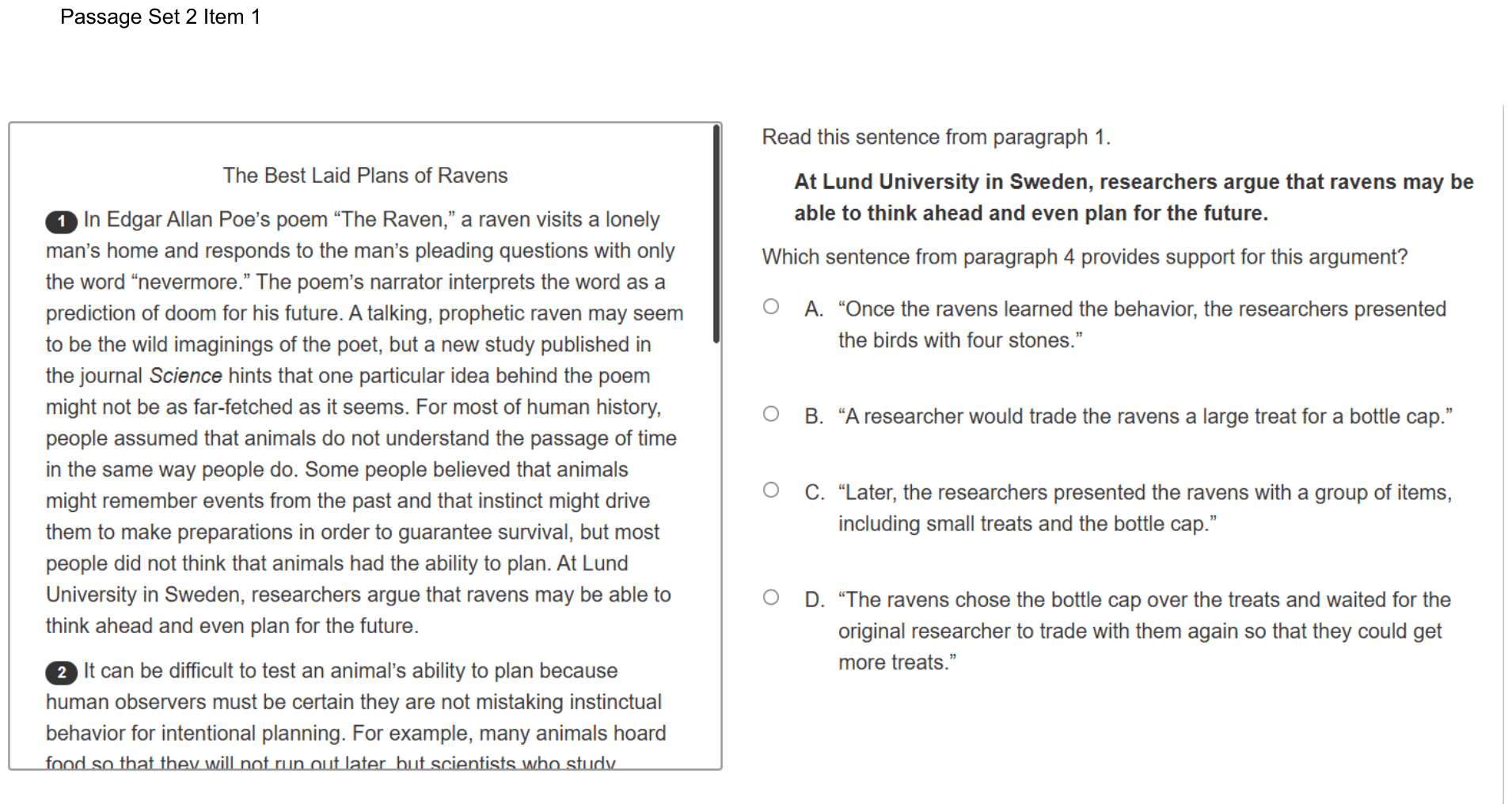
The passage “The Best Laid Plans of Ravens” as printed (page 12)
Question 2 of 120
2026 Practice Test A English, question 9Uses the passage above: “The Best Laid Plans of Ravens”.
Question
Read these sentences from paragraph 2.
For example, many animals hoard food so that they will not run out later, but scientists who study animals would not call hoarding a decision to plan for the future. This action is merely instinctual.
Which statement describes the effect of the phrase “merely instinctual” in the passage?
- AIt implies that animals are skilled at finding and saving food for later consumption.
- BIt conveys that many animals will usually prioritize gathering food over other activities.
- CIt suggests that animals often store more food than they will be able to consume.
- DIt emphasizes that many animals collect food automatically rather than with true intention.
Show the answer
Correct answer: D
The question asks which statement describes the effect in the passage of the phrase “merely instinctual” from paragraph 2.
A. Incorrect. The passage does not question animals’ ability to find and save food but rather whether this or other behavior involves thought and planning for the future.
B. Incorrect. While the sentence states that “many animals hoard food,” the passage does not suggest that they give priority of thought to this activity; they hoard food out of instinct.
C. Incorrect. Although the passage discusses animals’ tendency to store a great deal of food, it does not suggest that their hoarding goes beyond their needs.
D. CORRECT. The passage suggests that in order for an animal’s actions to qualify as planning for the future, “the animal must use specific decision-making skills to solve a problem” (paragraph 2). The behavior of hoarding food is based on instinct and done automatically without real thought.
Question analysis
This word-in-context question from “The Best Laid Plans of Ravens” asks about the effect of the phrase “merely instinctual,” which the article applies to food hoarding in paragraph 2. Students read two quoted sentences and decide what the phrase emphasizes about how animals behave. The choices all sound like reasonable facts about animals, so the answer has to come from how the article uses the phrase.
- Grade level
- Grade 7 reading and task
- Compared with grade 7
- Below grade 7 Grade 7 word-meaning questions often need clues gathered from a whole paragraph. Here the phrase is short and familiar, and the sentence just before it supplies a direct contrast, so one careful reading of the two quoted sentences is enough.
- Estimated difficulty
- Routine: one familiar step, little to misread.
- Thinking it demands
- Depth of knowledge 2, skills and concepts · mainly understand
- What makes it hard
- Hard words minor
- The right answer is reworded minor
- Evidence
- Answered from one paragraph or stanza
- Reading level
- Passage: about grade 11, 599 words; question and choices: about grade 10, 108 words.
- Students, last 30 days
- Not enough answers yet to show (it takes 10).
Why it is hard, traps and wrong answers (shows the answer)
Why it is hard
Most students know that an instinct is something an animal does without thinking, and the sentence just before the phrase says hoarding is not “a decision to plan.” The only real pitfall is “merely”: a student who skips it can hear praise of a natural talent, and one who thinks only about hoarding may pick a choice about storing too much. Reading the phrase with its contrast makes the answer plain.
Hard words minor Understanding the question
The phrase pairs “merely,” which shrinks what follows, with “instinctual,” and the sentence before it uses “hoard”; a student unsure of any of the three has little to go on. (Perfetti, 2007; Freedle & Kostin, 1993)
The right answer is reworded minor Choosing the answer
The right choice restates the idea as acting “automatically rather than with true intention,” while the wrong ones stay with the sentence’s own subject, finding, gathering and storing food. (Freedle & Kostin, 1993; Kirsch & Mosenthal, 1990)
Strategy: Ask what the word “merely” adds to “instinctual,” then reread the sentence before the phrase and use its contrast to decide what the author is saying about hoarding.
Traps
- Dictionary meaning, not meaning here: A common meaning of the word that does not fit its use in this text.
- Outside knowledge: A choice is plausible in the real world but not supported by this text.
The wrong answers, classified
A Wrong tone or attitude (Graesser, Singer & Trabasso, 1994)
Hears “instinctual” as a natural gift, as in an instinctive athlete, and turns the phrase into praise of animals’ skill, missing that “merely” makes it a put-down.
B Outside knowledge (King et al., 2004; Recht & Leslie, 1988)
Brings in the idea of instinct as an urge that overrides everything else, but the passage never ranks food gathering above an animal’s other activities.
C Dictionary meaning, not meaning here (Perfetti, 2007)
Gives “hoard” its everyday sense of piling up too much, though the passage says animals store food so they “will not run out later,” not beyond their needs.
Working it out, step by step
Figure out what the question asks
This asks about the effect of a phrase. What do the words “merely instinctual” add to what the passage says about animals and food? Read the phrase together with the sentence before it.
Read the sentences around the phrase
Paragraph 2 says “many animals hoard food so that they will not run out later, but scientists who study animals would not call hoarding a decision to plan for the future. This action is merely instinctual.” To hoard is to collect and store a lot of something.
Work out what the phrase means
An instinct is a natural urge an animal is born with. It acts on it without thinking it through. So instinctual behavior is automatic. Merely means “only” or “just.” Put together, the phrase says hoarding is just automatic. It is not a real decision. The next sentence agrees: to count as planning, “the animal must use specific decision-making skills to solve a problem.”
Check each choice
- A does not fit. The phrase does not praise animals’ skill. “Merely” makes the behavior sound smaller.
- B does not fit. The passage never says animals put food ahead of other activities.
- C does not fit. The passage never says animals store too much. They store food “so that they will not run out later.”
- D fits. “Automatically rather than with true intention” means by instinct, not on purpose. An intention is a plan you have in mind.
Choose the answer
The phrase stresses that animals hoard food without real thought or purpose. So the answer is D.
Why this answer and not the closest wrong one
A is the closest wrong choice, because an instinct can sound like a natural talent. But “merely” turns the phrase into a put-down. The author is saying hoarding is only instinct, not a real choice. D says the same thing: animals collect food automatically, not with true intention.
More questions like this
The original DOE question
Question 3 of 120
2026 Practice Test A English, question 11Uses the passage above: “The Best Laid Plans of Ravens”.
Question
How does paragraph 5 fit into the overall structure of the passage and contribute to the development of ideas?
- AIt introduces a problem with the results of the study at Lund University, suggesting that some scientists believe that further research will not lead to a clear answer.
- BIt summarizes the final steps of the study at Lund University, emphasizing the difficulties researchers had in differentiating between true planning and practiced actions.
- CIt provides a conclusion to the information about the Lund University study, indicating that some scientists think further research is needed in order to prove the idea.
- DIt lists the effects of the study at Lund University, implying that researchers should have designed experiments that better differentiated between planning and instinct.
Show the answer
Correct answer: C
The question asks how paragraph 5 fits into the overall structure of the passage and contributes to the development of ideas.
A. Incorrect. While paragraph 5 states that “more evidence needs to be gathered before scientists can fully conclude that ravens can plan for the future,” this statement suggests that more research is needed, not that the results of the Lund University study are problematic.
B. Incorrect. Paragraph 5 does not discuss steps of the study or emphasize difficulties in determining whether the behaviors shown in the study were planned or practiced; instead it simply suggests that more study is required to make such a determination.
C. CORRECT. Paragraph 5 notes that some doubt remains (“Some scientists argue that the ravens might be choosing the stone and bottle cap because the ravens have been trained to do so, not necessarily because the ravens are thinking ahead”) and that more experimentation is needed; the author concludes that there is reason to believe the originally stated theory that ravens are quite smart and can give thought to how future events may affect them.
D. Incorrect. Paragraph 5 does not list the effects of the study or criticize the experiment for not differentiating between planning and instinct. The paragraph explains why the results of the experiments are not conclusive and emphasizes that more research is needed.
Question analysis
This text-structure question asks how the last paragraph of the article “The Best Laid Plans of Ravens” fits into the passage and develops its ideas. Students must see what that paragraph does once the experiments have been described. Each long choice names a role and then adds a claim, so a choice can begin well and end wrong.
- Grade level
- Grade 7 reading and task
- Compared with grade 7
- At grade 7 Explaining the role of a final paragraph is regular grade 7 structure work. The choices are long, though, and each pairs a role with a claim about scientists’ views, so both halves must be checked against a paragraph that mixes doubt with enthusiasm.
- Estimated difficulty
- Moderate: several steps, or a close reading with one strong distractor.
- Thinking it demands
- Depth of knowledge 2, skills and concepts · mainly analyze
- What makes it hard
- A very close wrong answer moderate
- How, not what moderate
- A lot to read minor
- Evidence
- Answered from several paragraphs or stanzas
- Reading level
- Passage: about grade 11, 599 words; question and choices: about grade 15, 121 words.
- Students, last 30 days
- Not enough answers yet to show (it takes 10).
Why it is hard, traps and wrong answers (shows the answer)
Why it is hard
Paragraph 5 makes three moves, excitement, doubt and a hopeful conclusion, and each wrong choice builds on one of them and then goes too far. Students who notice the doubt but read past “before scientists can fully conclude” pick the claim that research will never settle the question. Summing up the paragraph before reading the choices, and then checking the second half of each, is what earns the point.
A very close wrong answer moderate Choosing the answer
The choice about a problem with the results matches the right one in its first half, a doubt raised in paragraph 5, and differs only in claiming that more research will not give a clear answer. (Embretson & Wetzel, 1987; Gorin & Embretson, 2006; Ascalon et al., 2007)
How, not what moderate Working it out
The question asks what paragraph 5 does in the article, closing the account of the Lund study, so students must name its role rather than repeat its caution about training. (Anderson & Krathwohl, 2001)
A lot to read minor Understanding the question
The choices run 24 to 28 words, and each pairs a role with a second claim about what scientists or researchers think or did, so both halves of every choice have to be checked. (Kintsch, 1998; Gorin & Embretson, 2006; Freedle & Kostin, 1993)
Strategy: Sum up paragraph 5 in one sentence of your own, then check both parts of each choice, the job it names and the idea it attributes to scientists, against that summary.
Traps
- Half right: One half of a two-part choice is right and the other is not.
- Twists what the text says: Uses the text's topic and ideas but changes what it says: who did it, how much, when, or why.
- Reads too much in: A reasonable-sounding conclusion that goes further than the text allows.
The wrong answers, classified
A Half right (King et al., 2004; Thissen, Steinberg & Fitzpatrick, 1989)
Rightly sees that paragraph 5 raises a doubt about the results, but adds that more research will not settle it, when the paragraph says more evidence is needed to reach a conclusion.
B Twists what the text says (King et al., 2004)
Turns the objection some scientists raise, that the birds may simply be trained, into the Lund researchers’ own struggle, though the paragraph describes no steps of the study.
D Reads too much in (Graesser, Singer & Trabasso, 1994)
Reads the call for more evidence as a verdict that the experiments were badly designed, though the author calls the results “exciting” and faults no one.
Working it out, step by step
Figure out what the question asks
This asks about structure: what job paragraph 5 does in the article. Each choice has two parts, a job and an idea about scientists. Both parts must be right.
See where paragraph 5 sits
Paragraphs 3 and 4 describe the Lund University experiments. Paragraph 5 is the last paragraph. It comes after the whole study has been described. So it is the place where the author sums up what the study means.
Read what paragraph 5 says
It opens: “The results of these experiments are exciting, but more evidence needs to be gathered before scientists can fully conclude that ravens can plan for the future.” Next, it says some scientists think the ravens may just be trained. Then it says “Regardless,” the experiments show ravens “could be much smarter than first believed.” Regardless means “even so.”
Put the paragraph in your words
Paragraph 5 wraps up the study. The results are exciting but not proven yet. More research is needed to be sure. A conclusion is the ending part that sums things up. So paragraph 5 is the conclusion to the study, and it says more evidence is needed.
Check each choice
- A does not fit. Paragraph 5 does raise a doubt. But it never says more research will fail to give a clear answer.
- B does not fit. Paragraph 5 describes no steps of the study.
- C fits. It wraps up the study and says more research is needed.
- D does not fit. It lists no effects and blames no one. The author calls the results “exciting.”
Choose the answer
Paragraph 5 ends the story of the study and calls for more evidence. So the answer is C.
Why this answer and not the closest wrong one
A is the closest wrong choice, because its first half is right: paragraph 5 raises a doubt. But A says more research will not lead to a clear answer. The paragraph says more evidence is needed “before scientists can fully conclude,” so research is the way to an answer. C says this.
More questions like this
The original DOE question
Question 4 of 120
2026 Practice Test A English, question 12Uses the passage above: “The Best Laid Plans of Ravens”.
Question
The author conveys a point of view on the study of animal intelligence mainly by
- Asharing details about experiments that tested the ability of an animal to plan for the future.
- Bcomparing the results of different experiments that were designed to test animal intelligence.
- Ccritiquing experiments that aimed to demonstrate that certain animals are capable of planning for the future.
- Dexplaining how modern experiments show that previously held beliefs about animal intelligence are inaccurate.
Show the answer
Correct answer: A
The question asks how the author conveys a point of view on the study of animal intelligence.
A. CORRECT. Paragraphs 3 and 4 focus on the process and details of the experiments that scientists conducted. This detailed information from the author provides a sense of how the ravens demonstrated planning abilities beyond natural instinct. The author supports the claims from the experiments, calling the findings “exciting” and stating in the conclusion that “these experiments show that ravens could be much smarter than first believed” (paragraph 5).
B. Incorrect. Although two experiments are described in the passage, the description presents the experiments as building on each other and does not compare their results. The passage states that “these experiments show that ravens could be much smarter than first believed, and scientists now believe that ravens do actually think about their own future” (paragraph 5).
C. Incorrect. The author presents information from the experiments and the results that were gathered from them; while there is an admission that “more evidence needs to be gathered before scientists can fully conclude that ravens can plan for the future” (paragraph 5), the author does not criticize the experiments that are presented.
D. Incorrect. While the author does discuss some previously held beliefs about animal intelligence in paragraph 1, the focus of the passage is that experiments indicate that there is reason to question these beliefs, since “these experiments show that ravens could be much smarter than first believed” (paragraph 5). The previously held beliefs are not considered inaccurate by the discussion in the passage because only one example—the raven—is provided. The passage does not state that beliefs about animal intelligence as a whole are inaccurate.
Question analysis
This author’s point-of-view question asks how the writer of “The Best Laid Plans of Ravens” mainly conveys a view of research into animal intelligence. Students must look at the article as a whole and decide how it presents that view. The choices describe ways of writing in abstract terms, which makes them easy to blur together.
- Grade level
- Grade 8 reading and task
- Compared with grade 7
- Above grade 7 Grade 7 point-of-view questions usually ask what an author thinks. This one asks how the author mainly conveys a view across the whole article, and the choices name methods that sound alike, closer to grade 8 work on how authors handle differing views.
- Estimated difficulty
- Hard: combines ideas, needs a plan, and has more than one tempting wrong answer.
- Thinking it demands
- Depth of knowledge 3, strategic thinking · mainly analyze
- What makes it hard
- How, not what major
- Reading between the lines moderate
- Every choice must be checked minor
- Evidence
- Answered from the whole text
- Reading level
- Passage: about grade 11, 599 words; question and choices: about grade 13, 74 words.
- Students, last 30 days
- Not enough answers yet to show (it takes 10).
Why it is hard, traps and wrong answers (shows the answer)
Why it is hard
The right choice sounds too plain to carry a point of view, which is exactly what makes this question hard. Students expect a view to be argued, so they reach for the choice that says the experiments prove old beliefs wrong, an overstatement of the author’s hedged “could be,” or for criticism, which belongs to other scientists. The article persuades by reporting the experiments in detail and calling them exciting.
How, not what major Working it out
The question asks how the view comes across, not what it is, and the answer is a method: the author lets the detailed account of the experiments in paragraphs 3–4 carry a favorable view. (Anderson & Krathwohl, 2001)
Reading between the lines moderate Working it out
The author never states an opinion outright; the view must be pieced together from words such as “exciting” and “could be much smarter than first believed” in paragraph 5. (Graesser, Singer & Trabasso, 1994; Kintsch, 1998)
Every choice must be checked minor Choosing the answer
The choices name ways of writing in abstract terms, sharing, comparing, critiquing and explaining, so each must be held against what the whole article actually does. (Embretson & Wetzel, 1987)
Strategy: Settle first on how the author regards the raven research, then check each choice against what the article actually does from beginning to end, not against a single paragraph.
Traps
- Too broad or too strong: A choice overstates, generalizes, or uses absolute words the text does not support.
- Wrong tone or attitude: Misjudges the tone, attitude or point of view, such as reading admiration as criticism, or taking a character's or subject's feelings for the author's.
- Twists what the text says: Uses the text's topic and ideas but changes what it says: who did it, how much, when, or why.
The wrong answers, classified
B Twists what the text says (King et al., 2004)
Notices that two experiments are described and assumes they are set side by side, but the article reports the stone test and the bartering test in turn without comparing results.
C Wrong tone or attitude (Graesser, Singer & Trabasso, 1994)
Takes the doubt that “some scientists” raise about training for the author’s own criticism, though the author calls the results “exciting” and moves past the objection.
D Too broad or too strong (King et al., 2004)
Builds on the point that ravens may be smarter than believed but overstates it: the author hedges with “could be,” discusses only ravens, and never calls older beliefs wrong.
Working it out, step by step
Figure out what the question asks
This asks about the author’s point of view, what the author thinks about studying animal intelligence. It also asks how the author mainly shows that view. Think about the whole article, not one paragraph.
Find the author’s view
In paragraph 5, the author says the results “are exciting.” The author also says the experiments “show that ravens could be much smarter than first believed.” So the author is interested in this research and hopeful about it.
See how the article is built
Most of the article explains the experiments. Paragraph 3 tells why the researchers planned two of them. Paragraph 4 gives the details step by step: the stone, the box, the bottle cap, the trades and the long wait. The author lets these details show why the research matters. Then the author calls the results exciting.
Check each choice
- A fits. The author shares details of experiments that tested whether an animal can plan.
- B does not fit. The two experiments are told one after the other. Their results are never compared.
- C does not fit. The doubt comes from “some scientists,” not the author. The author answers it with “Regardless.”
- D does not fit. It goes too far. The author says ravens “could be” smarter, which means maybe. The article never calls old beliefs wrong.
Watch out: D is tempting because paragraph 1 describes old beliefs. But “could be” is not the same as “are.”
Choose the answer
The author shows a view mostly through details of the experiments. So the answer is A.
Why this answer and not the closest wrong one
D is the closest wrong choice. The author does think ravens may be smarter than people believed. But the author is careful and says they “could be.” D says experiments prove old beliefs wrong, which is too strong. What the author mostly does is share the experiments’ details. That is A.
More questions like this
The original DOE question
Question 5 of 120
2026 Practice Test A English, question 30Passage Excerpt from “The Spirit of the Herd”
Excerpt from “The Spirit of the Herd”
by Dallas Lore Sharp
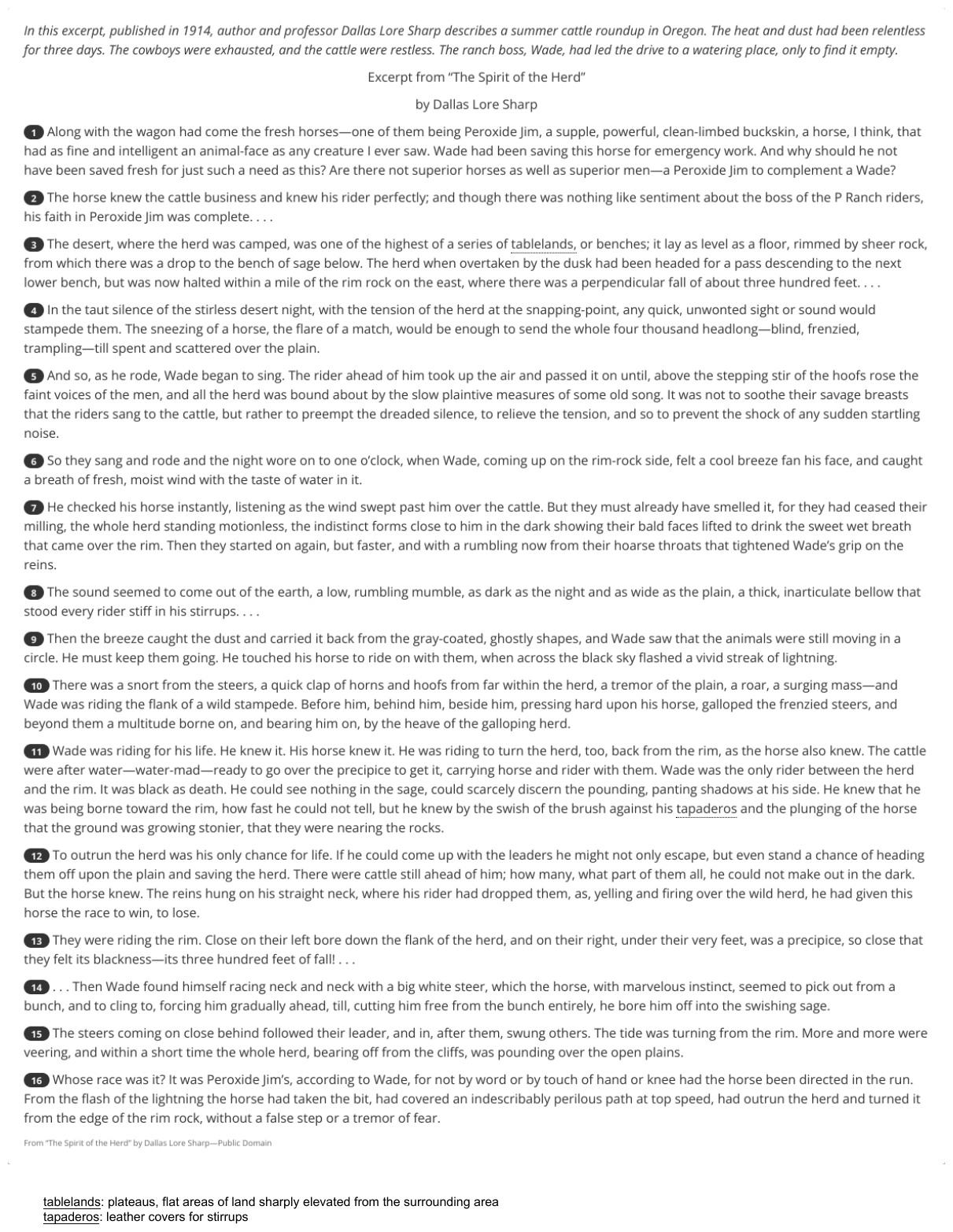
In this excerpt, published in 1914, author and professor Dallas Lore Sharp describes a summer cattle roundup in Oregon. The heat and dust had been relentless for three days. The cowboys were exhausted, and the cattle were restless. The ranch boss, Wade, had led the drive to a watering place, only to find it empty.
Along with the wagon had come the fresh horses—one of them being Peroxide Jim, a supple, powerful, clean-limbed buckskin, a horse, I think, that had as fine and intelligent an animal-face as any creature I ever saw. Wade had been saving this horse for emergency work. And why should he not have been saved fresh for just such a need as this? Are there not superior horses as well as superior men—a Peroxide Jim to complement a Wade?
The horse knew the cattle business and knew his rider perfectly; and though there was nothing like sentiment about the boss of the P Ranch riders, his faith in Peroxide Jim was complete. . . .
The desert, where the herd was camped, was one of the highest of a series of tablelands, or benches; it lay as level as a floor, rimmed by sheer rock, from which there was a drop to the bench of sage below. The herd when overtaken by the dusk had been headed for a pass descending to the next lower bench, but was now halted within a mile of the rim rock on the east, where there was a perpendicular fall of about three hundred feet. . . .
In the taut silence of the stirless desert night, with the tension of the herd at the snapping-point, any quick, unwonted sight or sound would stampede them. The sneezing of a horse, the flare of a match, would be enough to send the whole four thousand headlong—blind, frenzied, trampling—till spent and scattered over the plain.
And so, as he rode, Wade began to sing. The rider ahead of him took up the air and passed it on until, above the stepping stir of the hoofs rose the faint voices of the men, and all the herd was bound about by the slow plaintive measures of some old song. It was not to soothe their savage breasts that the riders sang to the cattle, but rather to preempt the dreaded silence, to relieve the tension, and so to prevent the shock of any sudden startling noise.
So they sang and rode and the night wore on to one o’clock, when Wade, coming up on the rim-rock side, felt a cool breeze fan his face, and caught a breath of fresh, moist wind with the taste of water in it.
He checked his horse instantly, listening as the wind swept past him over the cattle. But they must already have smelled it, for they had ceased their milling, the whole herd standing motionless, the indistinct forms close to him in the dark showing their bald faces lifted to drink the sweet wet breath that came over the rim. Then they started on again, but faster, and with a rumbling now from their hoarse throats that tightened Wade’s grip on the reins.
The sound seemed to come out of the earth, a low, rumbling mumble, as dark as the night and as wide as the plain, a thick, inarticulate bellow that stood every rider stiff in his stirrups. . . .
Then the breeze caught the dust and carried it back from the gray-coated, ghostly shapes, and Wade saw that the animals were still moving in a circle. He must keep them going. He touched his horse to ride on with them, when across the black sky flashed a vivid streak of lightning.
There was a snort from the steers, a quick clap of horns and hoofs from far within the herd, a tremor of the plain, a roar, a surging mass—and Wade was riding the flank of a wild stampede. Before him, behind him, beside him, pressing hard upon his horse, galloped the frenzied steers, and beyond them a multitude borne on, and bearing him on, by the heave of the galloping herd.
Wade was riding for his life. He knew it. His horse knew it. He was riding to turn the herd, too, back from the rim, as the horse also knew. The cattle were after water—water-mad—ready to go over the precipice to get it, carrying horse and rider with them. Wade was the only rider between the herd and the rim. It was black as death. He could see nothing in the sage, could scarcely discern the pounding, panting shadows at his side. He knew that he was being borne toward the rim, how fast he could not tell, but he knew by the swish of the brush against his tapaderos and the plunging of the horse that the ground was growing stonier, that they were nearing the rocks.
To outrun the herd was his only chance for life. If he could come up with the leaders he might not only escape, but even stand a chance of heading them off upon the plain and saving the herd. There were cattle still ahead of him; how many, what part of them all, he could not make out in the dark. But the horse knew. The reins hung on his straight neck, where his rider had dropped them, as, yelling and firing over the wild herd, he had given this horse the race to win, to lose.
They were riding the rim. Close on their left bore down the flank of the herd, and on their right, under their very feet, was a precipice, so close that they felt its blackness—its three hundred feet of fall! . . .
. . . Then Wade found himself racing neck and neck with a big white steer, which the horse, with marvelous instinct, seemed to pick out from a bunch, and to cling to, forcing him gradually ahead, till, cutting him free from the bunch entirely, he bore him off into the swishing sage.
The steers coming on close behind followed their leader, and in, after them, swung others. The tide was turning from the rim. More and more were veering, and within a short time the whole herd, bearing off from the cliffs, was pounding over the open plains.
Whose race was it? It was Peroxide Jim’s, according to Wade, for not by word or by touch of hand or knee had the horse been directed in the run. From the flash of the lightning the horse had taken the bit, had covered an indescribably perilous path at top speed, had outrun the herd and turned it from the edge of the rim rock, without a false step or a tremor of fear.
From “The Spirit of the Herd” by Dallas Lore Sharp—Public Domain
tablelands: plateaus, flat areas of land sharply elevated from the surrounding area
tapaderos: leather covers for stirrups
Question
Paragraphs 1–2 contribute to the development of the central idea of the excerpt by
- Arevealing the respect Wade had for his horse.
- Bemphasizing Wade’s high expectations of his horse and himself.
- Cindicating that Wade and his horse understood the cattle business.
- Ddemonstrating Wade’s ability to gauge a horse’s competence.
Show the answer
Correct answer: A
The question asks how paragraphs 1–2 contribute to the development of the central idea of the excerpt.
A. CORRECT. The description of Peroxide Jim in paragraph 1 indicates that the horse was a fine animal (“Along with the wagon had come the fresh horses—one of them being Peroxide Jim, a supple, powerful, clean-limbed buckskin, a horse, I think, that had as fine and intelligent an animal-face as any creature I ever saw” [paragraph 1]). The statement in paragraph 2 that Wade’s “faith in Peroxide Jim was complete” supports the central idea of the excerpt that Wade believed in Peroxide Jim’s abilities even before the horse turned the herd and saved the cattle.
B. Incorrect. Paragraphs 1–2 do not emphasize Wade’s high expectations for himself, nor are these expectations a central idea of the excerpt. The narrator expresses a high opinion of Wade’s abilities in his comparison of Peroxide Jim and Wade, referring to the horse as a “complement” (paragraph 1) for Wade; however, Wade showed complete trust in the horse’s ability to save the herd without his help, as evidenced by Wade dropping the reins to allow the horse to control the situation (paragraph 12).
C. Incorrect. The paragraphs refer to Peroxide Jim’s ability to handle cattle; in fact, paragraph 2 says that “the horse knew the cattle business.” It can be inferred that Wade had this knowledge as well, but this idea is not the focus of paragraphs 1–2 and is not the central idea of the excerpt.
D. Incorrect. Wade’s ability to judge a horse’s competence is not a central idea of the excerpt. The event described in the text is proof that Wade knew how to judge a horse’s ability: Wade trusted Peroxide Jim, and Peroxide Jim did not let him down. The option puts the focus on Wade and one of his strengths, when the central idea and focus of the excerpt is Peroxide Jim’s abilities and strengths, not Wade’s.
Question analysis
This central-idea question asks how the first two paragraphs of “The Spirit of the Herd,” which introduce the buckskin horse Peroxide Jim and the ranch boss Wade, contribute to the excerpt’s central idea. Students connect these opening details to the story of the stampede that follows. The narrator’s old-fashioned rhetorical questions can make the paragraphs’ point hard to pin down.
- Grade level
- Grade 8 reading and task
- Compared with grade 7
- At grade 7 Explaining how opening paragraphs build a central idea is typical grade 7 work. The two paragraphs are short, but the narrator’s rhetorical questions and old-fashioned phrasing must be decoded, and the central idea must come from the rest of the excerpt.
- Estimated difficulty
- Moderate: several steps, or a close reading with one strong distractor.
- Thinking it demands
- Depth of knowledge 2, skills and concepts · mainly analyze
- What makes it hard
- Reading between the lines moderate
- How, not what moderate
- Complex sentences minor
- Evidence
- Answered from several paragraphs or stanzas
- Reading level
- Passage: about grade 8, 1160 words; question and choices: about grade 9, 48 words.
- Students, last 30 days
- Not enough answers yet to show (it takes 10).
Why it is hard, traps and wrong answers (shows the answer)
Why it is hard
The opening paragraphs talk about both Wade and his horse, so every choice can find a foothold in them. The question turns on the excerpt as a whole, which ends by giving the race to Peroxide Jim, and only Wade’s regard for the horse points toward that ending. Students lose the point by picking a skill of Wade’s own, which his trust only implies, or by repeating “knew the cattle business,” a line said of the horse alone.
Reading between the lines moderate Working it out
Respect is never named; it must be read from Wade “saving this horse for emergency work” and from his “faith in Peroxide Jim” being “complete” in paragraph 2. (Graesser, Singer & Trabasso, 1994; Kintsch, 1998)
How, not what moderate Working it out
The question asks how two opening paragraphs serve the excerpt’s central idea, so students must know where the story ends, with the race credited to the horse, before judging them. (Anderson & Krathwohl, 2001)
Complex sentences minor Understanding the question
Paragraph 1 makes its point through two old-fashioned rhetorical questions, beginning “And why should he not” and “Are there not superior horses,” whose answers students must supply. (Abedi & Lord, 2001; Freedle & Kostin, 1993; Messick, 1989)
Strategy: Restate paragraphs 1 and 2 in plain words, decide what the excerpt as a whole is mainly about, and pick the option that links the two.
Traps
- Half right: One half of a two-part choice is right and the other is not.
- Word match: Repeats striking words or phrases from the text, so it looks supported, but its meaning does not fit the question.
- Reads too much in: A reasonable-sounding conclusion that goes further than the text allows.
The wrong answers, classified
B Half right (King et al., 2004; Thissen, Steinberg & Fitzpatrick, 1989)
Takes “superior horses as well as superior men” as Wade’s demands on both, but the paragraphs show only his trust in the horse, never his expectations of himself.
C Word match (Freedle & Kostin, 1993)
Repeats “knew the cattle business,” which paragraph 2 says of the horse alone, and treats that background detail as the point the excerpt builds toward.
D Reads too much in (Graesser, Singer & Trabasso, 1994)
Credits Wade with a talent for judging horses, which his trust implies, but the paragraphs show faith in one horse, and the excerpt’s focus is that horse’s deeds.
Working it out, step by step
Figure out what the question asks
This asks how paragraphs 1 and 2 help build the central idea. The central idea is the most important idea of the whole excerpt. So first find the central idea. Then see how the opening leads to it.
Find the central idea
The excerpt ends in paragraph 16: “Whose race was it? It was Peroxide Jim’s, according to Wade.” The horse saved the herd on his own, and Wade gives him the credit. The central idea is that Peroxide Jim is a remarkable horse who earns Wade’s trust.
Read paragraphs 1 and 2
Paragraph 1 says “Wade had been saving this horse for emergency work.” Paragraph 2 says “though there was nothing like sentiment about the boss of the P Ranch riders, his faith in Peroxide Jim was complete.”
Work out what they show
Sentiment means soft, tender feelings. Wade was a tough boss, not a soft one. Faith means trust. Even so, he trusted this horse completely. Saving the horse for the hardest jobs shows the same respect. The rest of the excerpt proves that respect was deserved.
Check each choice
- A fits. The paragraphs show how much Wade respected his horse.
- B does not fit. They never say what Wade expects of himself.
- C does not fit. “The horse knew the cattle business” is said about the horse, and it is only background.
- D does not fit. His trust may hint that he judges horses well. But the paragraphs show faith in one horse, and the excerpt is about what that horse does.
Choose the answer
The opening shows Wade’s respect, and the ending shows the horse deserved it. So the answer is A.
Why this answer and not the closest wrong one
D is the closest wrong choice. Wade’s trust does hint that he knows good horses. But paragraphs 1 and 2 show his faith in one horse, not a skill at judging horses. The excerpt is about that horse. Wade’s respect points straight to the end, where he gives the race to Peroxide Jim. That is A.
More questions like this
The original DOE question
The passage “Excerpt from “The Spirit of the Herd”” as printed (page 41)
Question 6 of 120
2026 Practice Test A English, question 32Uses the passage above: “Excerpt from “The Spirit of the Herd””.
Question
Read this sentence from paragraph 13.
Close on their left bore down the flank of the herd, and on their right, under their very feet, was a precipice, so close that they felt its blackness—its three hundred feet of fall!
The phrase “bore down the flank of the herd” conveys that Wade
- Astruggled to see the front of the herd.
- Bhad to ride quickly to keep up with the herd.
- Cwas forced to ride between the edge of the cliff and the herd.
- Dknew that the drop of the cliff would frighten the herd.
Show the answer
Correct answer: C
The question asks what the phrase “bore down the flank of the herd” (paragraph 13) conveys about Wade.
A. Incorrect. While Wade struggled to see the front of the herd, the words “bore down the flank of the herd” (paragraph 13) are meant to convey the intensity of the situation Wade was in, not the way the herd is blocking his vision.
B. Incorrect. The sentence from paragraph 13 states that the herd was “close on their left” and includes the phrase “bore down.” Both of these phrases indicate that Wade was trapped between the stampeding herd and the steep cliff. Wade and Peroxide Jim were struggling to reach the very front of the herd to turn it away from the edge.
C. CORRECT. The phrase “bore down the flank of the herd” from paragraph 13 conveys the overwhelming strength of the herd. The herd was forcing Wade toward the cliff. The wording in the quotation emphasizes the immediate danger of the situation and conveys the idea that Wade and Peroxide Jim were almost forced over the edge of the precipice by the stampeding herd.
D. Incorrect. The phrase “bore down the flank of the herd” (paragraph 13) does not indicate anything about the fear felt by the herd. The phrase is about Wade’s position between the edge of the stampeding herd and the drop-off. Wade was aware of the danger the herd was in if he and Peroxide Jim could not turn the cattle from the edge.
Question analysis
This vocabulary-in-context question quotes a sentence from paragraph 13 of “The Spirit of the Herd,” at the height of the stampede, and asks what the phrase “bore down the flank of the herd” conveys about Wade. Students need the meaning of “bore down” and “flank” as they are used here. Some choices describe real moments of the stampede, so students must stick to what this phrase shows.
- Grade level
- Grade 7 reading and task
- Compared with grade 7
- At grade 7 Working out a phrase’s meaning from its sentence is routine grade 7 work. The words “bore down” and “flank” are less common, but the full sentence is quoted with the question, so the task stays within one sentence.
- Estimated difficulty
- Straightforward: two steps or one careful reading.
- Thinking it demands
- Depth of knowledge 2, skills and concepts · mainly understand
- What makes it hard
- Complex sentences moderate
- Hard words minor
- Evidence
- Answered from one sentence or line
- Reading level
- Passage: about grade 8, 1160 words; question and choices: about grade 3, 94 words.
- Students, last 30 days
- Not enough answers yet to show (it takes 10).
Why it is hard, traps and wrong answers (shows the answer)
Why it is hard
Once the sentence is untangled, the herd pressing in on the left and the cliff on the right, the answer is a picture of Wade squeezed between them. The trouble is the word order and the phrase itself: students who read “bore down” as speed think about keeping pace, and those who recall the darkness of the paragraph before pick a detail this sentence never mentions.
Complex sentences moderate Understanding the question
The sentence is inverted: “the flank of the herd” is the subject of “bore down,” placed after its verb, so a quick reader may think Wade bore down along the herd instead. (Abedi & Lord, 2001; Freedle & Kostin, 1993; Messick, 1989)
Hard words minor Understanding the question
Both “flank,” the side of the herd, and “bore down,” pressed in hard, are uncommon in this sense, and the stem asks about exactly those words. (Perfetti, 2007; Freedle & Kostin, 1993)
Strategy: Read the whole quoted sentence rather than the phrase alone, picture the scene it describes, and pick what this sentence itself shows about Wade.
Traps
- Dictionary meaning, not meaning here: A common meaning of the word that does not fit its use in this text.
- Wrong part of the text: A choice is true of another paragraph, stanza or speaker than the one asked about.
- Reads too much in: A reasonable-sounding conclusion that goes further than the text allows.
The wrong answers, classified
A Wrong part of the text (Kirsch & Mosenthal, 1990)
Recalls from paragraph 12 that Wade could not tell how many cattle were ahead of him, which is true there, but this sentence says nothing about what he could see.
B Dictionary meaning, not meaning here (Perfetti, 2007)
Takes “bore down” in its sense of rushing forward and gives the speed to Wade, when in this sentence it is the herd’s flank pressing in on his left.
D Reads too much in (Graesser, Singer & Trabasso, 1994)
Assumes the cliff would scare the cattle, but they are “water-mad” and ready to go over the edge, and the phrase describes Wade’s position, not their fear.
Working it out, step by step
Figure out what the question asks
This asks what the phrase “bore down the flank of the herd” shows about Wade. To answer, read the whole sentence, not just the phrase.
Learn the hard words
A flank is the side of an animal or of a group. To bear down, here “bore down,” means to press in hard on something. A precipice is a cliff, a very steep drop.
Untangle the sentence
The sentence puts its words in an unusual order. In everyday order it would say: The flank of the herd bore down close on their left. So the side of the herd pushed in on Wade and his horse from the left. On the right, “under their very feet, was a precipice.”
Picture where Wade is
Wade is squeezed. Thousands of running cattle press in on one side. A 300-foot drop sits on the other side. He has no room to move away from either one. He is forced to ride in the narrow space between the herd and the cliff edge.
Check each choice
- A does not fit. Paragraph 12 says he could not tell how many cattle were ahead, but this sentence is about the sides.
- B does not fit. Here the herd does the bearing down, not Wade.
- C fits. He rides between the herd and the cliff.
- D does not fit. The cattle were “water-mad,” ready to go over the edge. Nothing says the cliff scared them.
Choose the answer
The phrase shows the herd pushing Wade toward the edge. So the answer is C.
Why this answer and not the closest wrong one
B is the closest wrong choice, because “bore down” can mean rushing forward fast. But in this sentence the herd does the bearing down, not Wade. The herd presses in from the left while the cliff waits on the right. That squeeze is what C describes.
More questions like this
The original DOE question
Question 7 of 120
2026 Practice Test A English, question 33Uses the passage above: “Excerpt from “The Spirit of the Herd””.
Question
Read these sentences from the excerpt.
He was riding to turn the herd, too, back from the rim, as the horse also knew. (paragraph 11)
It was Peroxide Jim’s, according to Wade, for not by word or by touch of hand or knee had the horse been directed in the run. (paragraph 16)
How do these sentences develop a central idea in the excerpt?
- AThey suggest that Wade would have been unable to save the herd without Peroxide Jim.
- BThey imply that Wade spent many hours training Peroxide Jim to herd cattle.
- CThey show that Peroxide Jim was able to understand a situation and take action.
- DThey indicate that Peroxide Jim was unafraid of the dangers presented by the stampede and the cliff.
Show the answer
Correct answer: C
The question asks how the sentences from paragraph 11 and paragraph 16 develop a central idea in the excerpt.
A. Incorrect. While Peroxide Jim’s presence was critical to saving the herd, the details in paragraph 11 and paragraph 16 do not focus on this idea. The primary idea is that the horse was so intelligent and aware that he acted on his own.
B. Incorrect. The excerpt does not tell who trained Peroxide Jim. It can be inferred that Peroxide Jim had been well trained and was knowledgeable of working cattle; however, there is no indication that Wade was the person who trained Peroxide Jim, only that Wade knew of Peroxide Jim’s abilities, respected the skilled horse, and was “saving this horse for emergency work” (paragraph 1). Because the reader cannot infer from the excerpt that Wade was the trainer, this idea cannot be considered central to the excerpt.
C. CORRECT. Wade recognized that Peroxide Jim knew to turn the herd without any instruction from him. Throughout the excerpt, Wade exhibited confidence in his horse, Peroxide Jim. For example, the narrator says that Wade’s “faith in Peroxide Jim was complete” in paragraph 2. After Wade let go of the reins (paragraph 12), the horse took over, doing exactly what needed to be done to save Wade, the herd, and himself: “a big white steer, which the horse, with marvelous instinct, seemed to pick out from a bunch, and to cling to, forcing him gradually ahead, till, cutting him free from the bunch entirely, he bore him off into the swishing sage” (paragraph 14).
D. Incorrect. The sentence from paragraph 11 and the sentence from paragraph 16 show that Peroxide Jim acted skillfully and with the knowledge that the ride was dangerous (“Wade was riding for his life. He knew it. His horse knew it” [paragraph 11]). Neither sentence indicates whether Peroxide Jim was afraid. The excerpt does say, later in paragraph 16, that the horse turned the herd “without a false step or a tremor of fear,” but these two sentences focus on his awareness of the danger and his ability to act on his own, not on his lack of fear.
Question analysis
This question quotes two sentences from “The Spirit of the Herd,” one from the middle of the stampede and one from its end, and asks how together they develop a central idea of the excerpt. Students must see what the two sentences share and connect it to the story as a whole. Each choice sounds reasonable for this story, which makes the exact wording of the two sentences decisive.
- Grade level
- Grade 8 reading and task
- Compared with grade 7
- Above grade 7 Grade 7 central-idea questions usually ask about one paragraph or the whole text. Here students must find what two sentences five paragraphs apart have in common and link it to the excerpt’s central idea, among choices that all sound believable.
- Estimated difficulty
- Hard: combines ideas, needs a plan, and has more than one tempting wrong answer.
- Thinking it demands
- Depth of knowledge 3, strategic thinking · mainly analyze
- What makes it hard
- Reading between the lines moderate
- Complex sentences moderate
- Evidence in several places moderate
- Evidence
- Answered from several paragraphs or stanzas
- Reading level
- Passage: about grade 8, 1160 words; question and choices: about grade 6, 121 words.
- Corrected from the DOE handbook
- An inaccurate statement in the explanation was corrected.
- Students, last 30 days
- Not enough answers yet to show (it takes 10).
Why it is hard, traps and wrong answers (shows the answer)
Why it is hard
Each choice says something a reader could believe about this story, so the exact content of the two quoted sentences decides it. What they share is knowledge and independence: the horse knew the goal and ran the race undirected. Fearlessness is stated in the very next sentence of paragraph 16, which makes it easy to credit to these two, and the claim that Wade could not have managed alone sounds like a fair summary of the ending.
Reading between the lines moderate Working it out
Neither sentence says the horse understood; that has to be read from “as the horse also knew” and from the race being his because he was not directed “by word or by touch.” (Graesser, Singer & Trabasso, 1994; Kintsch, 1998)
Complex sentences moderate Understanding the question
The second sentence is an inverted negative passive, “not by word or by touch of hand or knee had the horse been directed,” and the first tucks its point into a trailing clause. (Abedi & Lord, 2001; Freedle & Kostin, 1993; Messick, 1989)
Evidence in several places moderate Working it out
The two sentences sit five paragraphs apart, and the detail that tempts students most, “without a false step or a tremor of fear,” follows the second one in paragraph 16. (Kirsch & Mosenthal, 1990; Gorin & Embretson, 2006)
Strategy: Note what the two quoted sentences have in common, then pick the option that states that shared point, making sure it comes from these sentences and not from elsewhere in the excerpt.
Traps
- Wrong part of the text: A choice is true of another paragraph, stanza or speaker than the one asked about.
- Reads too much in: A reasonable-sounding conclusion that goes further than the text allows.
- Outside knowledge: A choice is plausible in the real world but not supported by this text.
The wrong answers, classified
A Reads too much in (Graesser, Singer & Trabasso, 1994)
Goes a step past the sentences: the horse clearly mattered, but they stress what he knew and did on his own, not that Wade would have failed without him.
B Outside knowledge (King et al., 2004; Recht & Leslie, 1988)
Assumes a rider trains his own horse, a common idea, but the excerpt never says who trained Peroxide Jim, and these sentences stress what he did undirected.
D Wrong part of the text (Kirsch & Mosenthal, 1990)
Draws on “without a false step or a tremor of fear,” which comes after the quoted sentence in paragraph 16; the two sentences show his understanding, not his courage.
What was corrected from the DOE handbook, and why
- Explanation: The handbook’s explanation of Option D says “There is no indication that Peroxide Jim was not afraid; in fact, it is likely the awareness of the danger and the fear associated with that knowledge contributed to the horse’s motivation to turn the herd.” Paragraph 16 says the opposite: the horse turned the herd “without a false step or a tremor of fear” (the handbook’s explanation of question 29 cites these words as his mental toughness). The site now says that neither of the two quoted sentences indicates whether Peroxide Jim was afraid, which is still why Option D is wrong: they focus on his awareness of the danger and his ability to act on his own.
Working it out, step by step
Figure out what the question asks
This asks what two quoted sentences have in common and how they build a central idea, the main idea of the excerpt. Focus on what these two sentences say, not on other parts of the story.
Read the first sentence
Paragraph 11 says “He was riding to turn the herd, too, back from the rim, as the horse also knew.” To turn the herd is to make it change direction. The words “as the horse also knew” mean the horse understood the goal too.
Read the second sentence
Paragraph 16 says the race was the horse’s, “for not by word or by touch of hand or knee had the horse been directed in the run.” Directed means told where to go. Riders guide a horse with their voice, their hands on the reins and their knees. Wade did none of that. The horse ran the race on his own.
Put the two together
Both sentences show the same thing. The horse understood what was happening. Then he acted on his own, with no one telling him what to do. This builds the central idea that Peroxide Jim is a smart horse who saves the herd by himself.
Check each choice
- A does not fit. The sentences do not say whether Wade could have done it alone. They focus on what the horse knew and did.
- B does not fit. The excerpt never says who trained the horse.
- C fits. The horse understood the situation and took action.
- D does not fit. The horse was fearless, but neither quoted sentence says so.
Choose the answer
The two sentences show a horse that understood the danger and acted on his own. So the answer is C.
Why this answer and not the closest wrong one
D is the closest wrong choice, because the horse really was fearless. But that comes from a later sentence in paragraph 16: “without a false step or a tremor of fear.” The two quoted sentences say nothing about fear. They show that the horse knew the goal and acted with no one guiding him. That is C.
More questions like this
The original DOE question
Question 8 of 120
2026 Practice Test A English, question 34Uses the passage above: “Excerpt from “The Spirit of the Herd””.
Question
How do the details in paragraphs 14–16 help convey a central idea of the excerpt?
- AThey highlight Peroxide Jim’s natural ability to control the herd.
- BThey emphasize the danger of the situation from which Peroxide Jim rescued the herd.
- CThey show that Peroxide Jim’s physical strength allowed him to force the herd to turn.
- DThey indicate that Peroxide Jim anticipated the herd’s stampede before the men did.
Show the answer
Correct answer: A
The question asks how the details in paragraphs 14–16 help convey a central idea of the excerpt.
A. CORRECT. Paragraphs 14–16 describe how Peroxide Jim’s “marvelous instinct” headed off the herd and drove it away from the cliff. Wade acknowledged that without his instruction, Peroxide Jim knew to find the leader of the herd, cut him off from the rest of the herd, and then lead him to safety, confident that the remainder of the herd would follow. Paragraph 16 confirms this: “Whose race was it? It was Peroxide Jim’s, according to Wade, for not by word or by touch of hand or knee had the horse been directed in the run.” This reinforces a central idea of the excerpt regarding the horse’s amazing intellect and ability.
B. Incorrect. Although paragraphs 14–16 mention the “rim,” the “cliffs,” and the “indescribably perilous path,” these details are not the focus of the paragraphs. They are descriptions of the setting where Peroxide Jim’s able and effective actions saved the stampeding herd, and it is these actions that are the central idea being conveyed.
C. Incorrect. Although Peroxide Jim is called “powerful” in paragraph 1, his physical strength is neither a central idea of the excerpt nor the focus of paragraphs 14–16. His success at turning the herd was attributed to his intellect and instinct, not his physical strength.
D. Incorrect. The excerpt does not suggest that Peroxide Jim anticipated the herd’s stampede before the men did. In fact, the excerpt indicates that Wade led the men in singing to cover sudden noises that might cause the herd to stampede, indicating that Wade was alert to that possibility. Paragraph 7 also indicates that Wade anticipated the stampede, as he “checked his horse instantly” and “tightened [his] grip on the reins” as soon as he smelled water on the wind and heard the low rumbling of the herd that preceded the lightning strike. The narrator notes Wade’s actions well before the horse’s actions. Paragraphs 14–16 describe how Peroxide Jim acted after the stampede began.
Question analysis
This central-idea question asks how the details in the last three paragraphs of “The Spirit of the Herd,” where the stampede is finally turned away from the cliff, help convey a central idea. Students must decide what those details mainly show about Peroxide Jim. Several choices touch on something real in the story, so the paragraphs’ main emphasis decides it.
- Grade level
- Grade 7 reading and task
- Compared with grade 7
- At grade 7 Linking a passage’s final paragraphs to its central idea is a familiar grade 7 task. Paragraphs 14–16 are short and vivid, but several choices mention something those paragraphs touch on, so students must judge what the details mainly emphasize.
- Estimated difficulty
- Moderate: several steps, or a close reading with one strong distractor.
- Thinking it demands
- Depth of knowledge 2, skills and concepts · mainly analyze
- What makes it hard
- How, not what moderate
- The right answer is reworded minor
- Complex sentences minor
- Evidence
- Answered from several paragraphs or stanzas
- Reading level
- Passage: about grade 8, 1160 words; question and choices: about grade 8, 66 words.
- Corrected from the DOE handbook
- Details in the explanation that are not in the excerpt were corrected.
- Students, last 30 days
- Not enough answers yet to show (it takes 10).
Why it is hard, traps and wrong answers (shows the answer)
Why it is hard
The three paragraphs mix danger with skill, so a choice about danger can quote them and still miss what they emphasize. The detail that carries the central idea is that no word or touch directed the horse: he picked out the lead steer himself and the herd followed. Students who remember that Peroxide Jim was called “powerful” credit his strength, and a few reverse the order of events, putting his reaction before Wade’s.
How, not what moderate Working it out
The question asks what the details in paragraphs 14–16 do, so students must see that the rim and the “perilous path” are background and the horse’s choices are the point. (Anderson & Krathwohl, 2001)
The right answer is reworded minor Choosing the answer
The right choice calls the horse’s skill a “natural ability,” a plain paraphrase of “marvelous instinct,” while a wrong choice repeats the danger words the paragraphs use. (Freedle & Kostin, 1993; Kirsch & Mosenthal, 1990)
Complex sentences minor Understanding the question
Paragraph 14 tells how the horse turns the herd in one 50-word sentence full of commas, “which the horse, with marvelous instinct, seemed to pick out from a bunch, and to cling to.” (Abedi & Lord, 2001; Freedle & Kostin, 1993; Messick, 1989)
Strategy: Note what paragraphs 14–16 mostly focus on, then test each choice by asking whether it names that focus or only a detail mentioned along the way.
Traps
- True but not the answer: A choice says something accurate about the text that does not answer this question.
- Twists what the text says: Uses the text's topic and ideas but changes what it says: who did it, how much, when, or why.
- Reversed relationship: Cause and effect, or the order of events, turned around.
The wrong answers, classified
B True but not the answer (King et al., 2004; Embretson & Wetzel, 1987)
Notices the “rim,” the “cliffs” and the “indescribably perilous path,” but these details set the scene; the paragraphs dwell on how the horse turned the herd.
C Twists what the text says (King et al., 2004)
Gets right that the horse turned the herd, perhaps recalling “powerful” from paragraph 1, but the paragraphs credit his “marvelous instinct,” not his strength.
D Reversed relationship (King et al., 2004)
Puts the horse’s reaction before the men’s, but Wade sensed trouble in paragraph 7 when the wind changed, and the horse took the bit only at the lightning.
What was corrected from the DOE handbook, and why
- Explanation: The handbook’s explanation of Option D says Wade reacted “as soon as he smelled the rain and heard the low rumble of thunder that preceded the lightning strike.” The excerpt has no rain and no thunder. In paragraph 6 Wade catches “a breath of fresh, moist wind with the taste of water in it,” and in paragraph 7 the rumbling comes “from their hoarse throats,” the cattle’s; that rumbling is what “tightened Wade’s grip on the reins.” The site now says “as soon as he smelled water on the wind and heard the low rumbling of the herd that preceded the lightning strike.”
Working it out, step by step
Figure out what the question asks
This asks how the details in paragraphs 14 to 16 help show a central idea, a main idea of the excerpt. What do these last three paragraphs mostly focus on?
Read paragraphs 14 to 16
In paragraph 14, the horse, “with marvelous instinct, seemed to pick out from a bunch” a big white steer. Paragraph 15 says “The steers coming on close behind followed their leader.” Paragraph 16 says the race was the horse’s, “for not by word or by touch of hand or knee had the horse been directed in the run.”
Work out what the details show
An instinct is a natural sense of what to do, without being taught or told. A steer is one of the cattle. The horse picked out one big steer and pushed it off into the sage, away from the cliff. The rest followed it as their leader. No one guided the horse. So the horse controlled the whole herd using his own natural skill.
Check each choice
- A fits. The details show the horse’s natural ability to control the herd.
- B does not fit. The “rim” and the “cliffs” set the scene. The focus is how the horse turned the herd.
- C does not fit. The horse does not overpower the herd. He picks the leader, and the others follow.
- D does not fit. In paragraph 7, Wade sensed trouble first. The cattle’s rumbling “tightened Wade’s grip on the reins.” The horse took charge only “From the flash of the lightning.”
Choose the answer
The last three paragraphs show the horse’s natural skill at turning the herd. So the answer is A.
Why this answer and not the closest wrong one
B is the closest wrong choice, because the paragraphs do mention the rim and a “perilous,” or dangerous, path. But the danger is the background. The paragraphs mostly show what the horse did: he chose the lead steer and turned the herd with no one guiding him. That natural skill is A.
More questions like this
The original DOE question
Question 9 of 120
2026 Practice Test A English, question 36Passage Massachusetts: Lowell National Historical Park
Massachusetts: Lowell National Historical Park
During the first half of the 19th century, Lowell, Massachusetts, quickly transformed itself from a farm town to a bustling industrial city. In time, Lowell became a model of industry, gaining global recognition for its state-of-the-art technology, innovative canal and dam system, mill architecture, boardinghouses, churches, and ethnic neighborhoods. Young Yankee women, immigrant families, and European tourists all flocked to Lowell to find work at one of the many textile mills, or visit the industrious city that was becoming a popular tourist destination. As one Scottish traveler observed during his visit to America, “Niagara and Lowell are the two objects I will longest remember in my American journey, the one the glory of American scenery, the other of American industry.” Today, Lowell National Historical Park welcomes visitors to enjoy the sights of Lowell and learn about the history of one of America’s most significant industrial cities.
The Boston merchants who founded Lowell in 1821 and named it after Francis Cabot Lowell chose to locate the town along Massachusetts’s Merrimack River to take advantage of the kinetic energy offered by the Pawtucket waterfalls. Over six miles of canals powered the waterwheels of Lowell’s mills, whose massive five- and six-story brick buildings dominated the city’s landscape. . . . The most recognized of these buildings are the Lowell Manufacturing Company chartered in 1821, the Suffolk or Wannalancit Mill completed around the 1880s, the Boott Mill Company established in 1835, and the Boott Mill Boardinghouse that opened in 1838. By the 1850s, 40 textile mills employing over 10,000 workers stretched for about a mile along the river. . . .
The city’s female workforce was significant in the history of Lowell. From the early to mid-1800s, women left the constricted lifestyle of small rural towns and rural areas for independent industrial city life. Most were young single Yankee girls, who were tired of the limited opportunities offered by their domestic work. Women found that Lowell’s mills offered monthly wages for their services and provided them room and board. Although these women gained economic independence in Lowell, the mill boardinghouse keepers constantly supervised their social activities, for which they hardly had any time, considering their daily 12- to 14-hour work schedules. At the end of the day, the factory bell signaled the “mill girls” to return to their boardinghouses. They were expected to adhere to the strict code of conduct respecting curfew and attending church.
Yankee “mill girls” continued to dominate the Lowell workforce until the 1840s, when the city began to find it difficult to compete with the growing industrial development in other New England communities. As profits fell, the mill industry cut wages. These wage cuts, deteriorating working conditions, and long workdays led the “mill girls” to protest and organize strikes. When their demands went unheard, the women left Lowell, and immigrant groups replaced them in the workforce. Despite the low wages and unhealthy work conditions, immigrants were eager to find work.
The immigrants replacing the Yankee “mill girls” during the 1840s were predominantly Irish Catholics, who traveled to America during the Great Potato Famine. Although Lowell received an influx of Irish families during this time, the Irish were a part of the city’s history from its birth, and before the “mill girls” arrived, they built Lowell’s historic canals, mills, and boardinghouses. Initially, Lowell’s Protestant community was slow to welcome Irish immigrants, but the hostility between Yankee Protestants and Irish Catholics eventually disappeared. Irish immigrants dominated the industrial scene until the Civil War, when other immigrant groups began to work in the city mills.
Like the Irish, the French-Canadians, Greeks, Poles, Portuguese, Russian Jews, and Armenians who came to work in Lowell’s mills faced long work hours, low wages, and poor living conditions in the city’s crowded tenements. By the time Lowell’s industry declined, the city had become an ethnic melting pot, where each group claimed its own distinct neighborhood, like the Irish immigrants’ “New Dublin” or “Acre,” and the French-Canadians’ “Little Canada.” The city officially began to close down its mills in the 1920s and ’30s after Lowell’s outdated mills could no longer compete against the state-of-the-art cotton mills in other communities and working conditions continued to decline as Lowell’s companies stopped reinvesting in their mills. . . . Despite a brief resurgence during World War II, the city shut down its last surviving mill by the mid-1950s.
From “Massachusetts: Lowell National Historical Park”—Public Domain/National Park Service
Yankee: native to New England
Niagara: a town in northwestern New York State well known as the location of Niagara Falls, a series of waterfalls on the Canadian border
domestic work: household duties like cooking and cleaning
Question
Read this sentence from paragraph 1.
As one Scottish traveler observed during his visit to America, “Niagara and Lowell are the two objects I will longest remember in my American journey, the one the glory of American scenery, the other of American industry.”
The author most likely includes the quotation from the Scottish traveler in order to
- Asuggest that people around the world saw the direct contribution of nature and industry to the United States.
- Bcompare the natural and industrial attractions in the United States at that time.
- Cconvey the idea that the United States offered both natural and industrial attractions.
- Dimply that the natural resources in the United States contributed to the development of industry.
Show the answer
Correct answer: C
The question asks why the author most likely includes the quotation from the Scottish traveler in paragraph 1 of the passage.
A. Incorrect. While it is likely that people outside the United States recognized that both the natural landscape and the bustling industry were significant, the quotation from the Scottish traveler is meant to convey the variety of the types of attractions in the U.S., not to make a general statement about their contribution.
B. Incorrect. The Scottish traveler mentions both “American scenery” and “American industry” in the quotation, but the intent is to highlight that they are each points of interest. The quotation does not provide a comparison of the two attractions.
C. CORRECT. The quotation emphasizes the idea that the United States offers different attractions. The Scottish traveler highlights the two places in the United States that he will most remember: first, the beautiful natural formation of Niagara Falls (“ ‘the glory of American scenery’ ”) and second, the industrial city of Lowell (“ ‘the glory . . . of American industry’ ”).
D. Incorrect. The Scottish traveler mentions both “American scenery” and “American industry” in the quotation but does not imply that the natural resources contributed to the development of industry.
Question analysis
This reading question asks why the author of a National Park Service article about Lowell, Massachusetts, quotes a Scottish traveler who named Niagara and Lowell as the sights he would remember longest from his American journey. Students must work out the job a quotation does in an opening paragraph, and the traveler's compressed, old-fashioned wording has to be untangled first.
- NYS standards
- 7R5 structure and genre features
- Grade level
- Grade 7 reading and task
- Compared with grade 7
- At grade 7 Grade 7 readers regularly explain why an author includes a quotation. This one adds a sentence in older English built on a compressed “the one…, the other…” pattern, but it is a single sentence in a plainly organized opening paragraph, so the demand stays typical.
- Estimated difficulty
- Moderate: several steps, or a close reading with one strong distractor.
- Thinking it demands
- Depth of knowledge 2, skills and concepts · mainly analyze
- What makes it hard
- A very close wrong answer moderate
- How, not what moderate
- Complex sentences minor
- Evidence
- Answered from one sentence or line
- Reading level
- Passage: about grade 15, 764 words; question and choices: about grade 11, 115 words.
- Students, last 30 days
- Not enough answers yet to show (it takes 10).
Why it is hard, traps and wrong answers (shows the answer)
Why it is hard
Most of the work is translating the traveler's compressed remark into plain words: Niagara stands for American scenery, Lowell for American industry, and both are high points of his trip. Students who see the two placed side by side often take the pairing for a comparison, while others read more into it, a worldwide verdict or a link between waterfalls and mills. The question rewards stating only what the remark does in the paragraph, which is to set Lowell beside Niagara as a sight worth the journey.
A very close wrong answer moderate Choosing the answer
The comparison choice names the same pair as the key, Niagara's scenery and Lowell's industry; it differs only in the verb, “compare” instead of conveying that the country offered both kinds of attraction. (Embretson & Wetzel, 1987; Gorin & Embretson, 2006; Ascalon et al., 2007)
How, not what moderate Working it out
The stem asks why the author placed the traveler's remark in paragraph 1, so its job, backing the sentence before it about tourists visiting the industrious city, matters more than its content. (Anderson & Krathwohl, 2001)
Complex sentences minor Understanding the question
The 37-word sentence ends in the compressed, old-fashioned “the one the glory of American scenery, the other of American industry,” where the verb and the second “glory” are left out. (Abedi & Lord, 2001; Freedle & Kostin, 1993; Messick, 1989)
Strategy: Put the traveler's remark into plain modern words, reread the sentence before it about who came to Lowell, and pick the purpose that fits both without reading more into the remark than it says.
Traps
- Wrong purpose or structure: Names a purpose, structure or effect that the part does not serve, or describes what a part says when the question asks what it does.
- Reads too much in: A reasonable-sounding conclusion that goes further than the text allows.
- Too broad or too strong: A choice overstates, generalizes, or uses absolute words the text does not support.
The wrong answers, classified
A Too broad or too strong (King et al., 2004)
Stretches one Scottish visitor's memory into what “people around the world” saw, perhaps from the paragraph's “global recognition,” and adds a “direct contribution” that the remark never claims.
B Wrong purpose or structure (Anderson & Krathwohl, 2001)
Takes the remark's side-by-side pattern, “the one … the other,” for a comparison, though the traveler weighs neither against the other and simply names each as a highlight.
D Reads too much in (Graesser, Singer & Trabasso, 1994)
Connects Niagara's waterfalls to the Pawtucket falls that powered Lowell's mills in paragraph 2, a link between nature and industry that the traveler's remark never draws.
Working it out, step by step
Figure out what the question asks
This question asks about the author’s purpose. You need to say why the author put the Scottish traveler’s words into paragraph 1. Don’t just restate what he says. Ask what job his words do in the paragraph.
Find the quotation and its neighbor
The traveler’s words are in paragraph 1: “Niagara and Lowell are the two objects I will longest remember in my American journey.” He ends with “the one the glory of American scenery, the other of American industry.” Now look at the sentence just before it. It says European tourists came to “visit the industrious city that was becoming a popular tourist destination.”
Put his words in plain English
The old-fashioned ending leaves words out. “The one” means the first place he named, Niagara. “The other” means the second place, Lowell. Glory means the finest thing, the pride. Industry means factories and the work done in them. So he is saying: Niagara Falls is the best of America’s natural beauty, and Lowell is the best of its industry. Both are the sights he will remember longest.
Check each choice
- A is wrong. One visitor is not “people around the world.” He also never says nature or industry made a “direct contribution” to the country.
- B is wrong. He names the two places side by side, but he never weighs one against the other.
- C is right. He names a natural wonder and an industrial wonder as the two highlights of his trip. So America offered both kinds of attraction.
- D is wrong. He never says nature helped industry grow. The waterfalls that powered the mills come up in paragraph 2, not in his words.
Watch out: “The one” and “the other” set the two places side by side. That can feel like a comparison, which leads to B. But he praises both. He does not compare them.
Choose the answer
The author uses the quotation to show that America had two kinds of sights worth the trip: natural ones like Niagara and industrial ones like Lowell. So the answer is C.
Why this answer and not the closest wrong one
B is the closest wrong answer. It names the same pair, nature and industry. But to compare is to show how two things are alike or different. The traveler doesn’t do that. He simply names Niagara and Lowell as two highlights. C says just that: the country offered both kinds of attraction.
More questions like this
The original DOE question
The passage “Massachusetts: Lowell National Historical Park” as printed (page 50)
Question 10 of 120
2026 Practice Test A English, question 37Uses the passage above: “Massachusetts: Lowell National Historical Park”.
Question
A central idea that Lowell was “one of America’s most significant industrial cities” (paragraph 1) is conveyed in the passage primarily through a description of the
- Acanals, mills, and boardinghouses that were built by immigrants.
- Bmill girls and immigrants who comprised Lowell’s workforce.
- Cdevelopment of the mills and the workforce established to support them.
- Dcultural diversity of the people who lived in the area.
Show the answer
Correct answer: C
The question asks which description conveys the central idea that Lowell was “one of America’s most significant industrial cities” (paragraph 1).
A. Incorrect. While the passage does state that the city’s canals, mills, and boardinghouses were built by early immigrants from Ireland, these details do not contribute to the development of the overall idea that Lowell was a significant industrial city.
B. Incorrect. The details about the women and immigrants who worked in the mills are important to the passage, but these details alone do not show that Lowell was a significant industrial city.
C. CORRECT. The details throughout the passage about the development of the mills and the people who worked in them convey the significance of Lowell in early American industry. Paragraph 2 shares details about the businesses that started in the 1800s and contributed to the development of industry in the region (“The most recognized of these buildings are the Lowell Manufacturing Company chartered in 1821, the Suffolk or Wannalancit Mill completed around the 1880s, the Boott Mill Company established in 1835, and the Boott Mill Boardinghouse that opened in 1838”). Then paragraphs 3–6 provide specific details about the people who worked in the mills at different points in time.
D. Incorrect. Although the passage references Lowell’s culturally diverse community (“Young Yankee women, immigrant families, and European tourists all flocked to Lowell to find work at one of the many textile mills” [paragraph 1]), these groups alone are not what marked Lowell as a significant industrial city.
Question analysis
This central idea question asks which kind of description in an article about the Massachusetts mill city of Lowell does most to show that it was one of America's most significant industrial cities. Students need a map of all six paragraphs, because every choice names something the passage really describes, and the question turns on which description does the main work.
- Grade level
- Grade 8 reading and task
- Compared with grade 7
- Above grade 7 Grade 7 students trace how a central idea is developed, usually through a few supporting details. Here the strands to weigh run through six dense paragraphs of dates, mills and worker groups, and the stem is long and passive, so it asks more than typical.
- Estimated difficulty
- Hard: combines ideas, needs a plan, and has more than one tempting wrong answer.
- Thinking it demands
- Depth of knowledge 3, strategic thinking · mainly analyze
- What makes it hard
- A very close wrong answer major
- Evidence in several places moderate
- A lot to read minor
- Complex sentences minor
- Evidence
- Answered from the whole text
- Reading level
- Passage: about grade 15, 764 words; question and choices: about grade 10, 63 words.
- Corrected from the DOE handbook
- A grammatical error in the explanation was corrected.
- An inaccurate detail in the explanation was corrected.
- Students, last 30 days
- Not enough answers yet to show (it takes 10).
Why it is hard, traps and wrong answers (shows the answer)
Why it is hard
Every choice names something the passage really describes, so truth rules nothing out; the question turns on which description carries the claim that Lowell mattered as an industrial city. Because four of the six paragraphs follow the workers, the workforce alone looks like the passage's main thread, and students who forget paragraph 2's mills take the half for the whole. Diversity and the immigrant builders are real themes too, but neither says anything about Lowell's industrial standing.
A very close wrong answer major Choosing the answer
The workforce choice is the key with one half removed: both describe the people who worked the mills, but only the key also names the development of the mills, which paragraph 2 builds with dates and numbers. (Embretson & Wetzel, 1987; Gorin & Embretson, 2006; Ascalon et al., 2007)
Evidence in several places moderate Working it out
The industrial picture is built in two stages, the canals and mills of paragraph 2 and the successive workforces of paragraphs 3 to 6, so each choice must be measured against the whole passage. (Kirsch & Mosenthal, 1990; Gorin & Embretson, 2006)
A lot to read minor Understanding the question
Six paragraphs pack in mill names, dates from 1821 to the 1950s and a string of worker groups, from Yankee mill girls to Irish, French-Canadian and Greek immigrants. (Kintsch, 1998; Gorin & Embretson, 2006; Freedle & Kostin, 1993)
Complex sentences minor Understanding the question
The stem is a long passive sentence that quotes paragraph 1 inside it and holds the real question, “primarily through a description of the,” until its last words. (Abedi & Lord, 2001; Freedle & Kostin, 1993; Messick, 1989)
Strategy: Note in a phrase what each of the six paragraphs is about, then test each choice against the stem's claim: would that description make a reader see Lowell as a major industrial city?
Traps
- Too narrow: A single detail offered as the central idea or a summary, or a summary that keeps minor details and leaves out an essential part.
- True but not the answer: A choice says something accurate about the text that does not answer this question.
The wrong answers, classified
A Too narrow (King et al., 2004)
Seizes on paragraph 5's clause that Irish workers built the canals, mills and boardinghouses, one fact about construction rather than the account of mills and workers that shows Lowell's importance.
B Too narrow (King et al., 2004)
Sees that paragraphs 3 to 6 follow the mill girls and the immigrants who replaced them, but leaves out the mills themselves, the heart of paragraph 2's industrial picture.
D True but not the answer (King et al., 2004; Embretson & Wetzel, 1987)
Recalls paragraph 6's “ethnic melting pot” and paragraph 1's “ethnic neighborhoods,” which are real, but the city's diversity says nothing about its standing as an industrial city.
What was corrected from the DOE handbook, and why
- Explanation: The handbook’s explanation of Option B says “The details about the women and immigrants who worked in the mills is important to the passage.” The subject is “details,” so the site now says “are important.”
- Explanation: The handbook’s explanation of Option C says paragraph 2 describes “the businesses that started in the early 1800s,” but the sentence it then quotes includes “the Suffolk or Wannalancit Mill completed around the 1880s,” late in the century. The site now says “the businesses that started in the 1800s.”
Working it out, step by step
Figure out what the question asks
This is a central idea question. A central idea is a main point that the whole passage builds. The point here is that Lowell was “one of America’s most significant industrial cities.” Significant means important. You need the description that does the most to show this.
Map the six paragraphs
- Paragraph 1: Lowell grows from a farm town into a famous industrial city.
- Paragraph 2: The mills: canals, huge brick buildings, mills started across the 1800s, and by the 1850s, “40 textile mills employing over 10,000 workers.”
- Paragraphs 3 and 4: The Yankee “mill girls” who worked in the mills.
- Paragraphs 5 and 6: The Irish and other immigrants who took their place.
See how the picture is built
The passage shows Lowell’s importance in two parts. First it describes the mills: how they were built and how big they grew. Then it follows the workers who ran them, group after group. Together, the mills and the workforce show a major industrial city. Workforce means all the people who do the work. Either part alone tells only half the story.
Check each choice
- A is wrong. Paragraph 5 does say the Irish built the canals, mills and boardinghouses. But that is one fact in one sentence, not the main description.
- B is wrong. The mill girls and immigrants fill paragraphs 3 to 6. But this choice leaves out the mills themselves, the heart of paragraph 2.
- C is right. It covers both parts: how the mills grew and the workers who kept them running.
- D is wrong. Lowell did become an “ethnic melting pot.” But a mix of cultures doesn’t show that a city was an industrial leader.
Watch out: Four of the six paragraphs are about workers, so B looks like the main thread. It is only half of it.
Choose the answer
The central idea is carried by the growth of the mills plus the workforce gathered to run them. So the answer is C.
Why this answer and not the closest wrong one
B is the closest wrong answer. It matches the second half of C, the people who worked in the mills. But it drops the mills, with their six miles of canals and, by the 1850s, 40 mills. Workers alone don’t make a city an industrial giant. C keeps both halves, so it fits the whole passage.
More questions like this
The original DOE question
Question 11 of 120
2026 Practice Test A English, question 40Uses the passage above: “Massachusetts: Lowell National Historical Park”.
Question
Read this sentence from paragraph 5.
Although Lowell received an influx of Irish families during this time, the Irish were a part of the city’s history from its birth, and before the “mill girls” arrived, they built Lowell’s historic canals, mills, and boardinghouses.
How does this sentence contribute to the development of ideas in the passage?
- AIt implies that Lowell was founded by early Irish immigrants.
- BIt emphasizes the important role Irish immigrants played in Lowell’s history.
- CIt suggests that the new Irish immigrants were readily accepted into the community.
- DIt highlights the working relationship between the mill girls and the new Irish immigrants.
Show the answer
Correct answer: B
The question asks how the sentence in paragraph 5 contributes to the development of ideas in the passage.
A. Incorrect. The sentence from paragraph 5 does not imply that Lowell was founded by early Irish immigrants. The sentence explains how Irish immigrants had been settling in Lowell since the city was established and that they contributed to the construction of the city, which allowed it to become an industrial center several decades later.
B. CORRECT. The sentence from paragraph 5 shows that early Irish immigrants were critical to the success of Lowell as an industrial city. This information supports the development of the idea that the work of Irish immigrants and immigrants from other places is an important element in the historical significance of industry in Lowell.
C. Incorrect. The sentence from paragraph 5 does not suggest that new Irish immigrants were readily accepted into the community. Paragraph 5 states that “initially, Lowell’s Protestant community was slow to welcome Irish immigrants, but the hostility between Yankee Protestants and Irish Catholics eventually disappeared.”
D. Incorrect. The sentence from paragraph 5 does not highlight the relationship between the mill girls and the new Irish immigrants. Paragraph 4 explains how the mill girls left Lowell, and paragraph 5 states that the mill girls were replaced by “predominantly Irish Catholics, who traveled to America during the Great Potato Famine” but does not discuss a relationship between them.
Question analysis
This question quotes a sentence from paragraph 5 of the Lowell article about Irish families, who arrived in large numbers in the 1840s but had been part of the city since its birth. Students explain how the sentence contributes to the development of the passage's ideas, and because it packs several groups and periods into one line, they must keep straight who did what and when.
- Grade level
- Grade 7 reading and task
- Compared with grade 7
- At grade 7 Explaining how one sentence develops a passage's ideas is a core grade 7 skill. The sentence is long but its meaning is direct, and the text around it settles most of the choices, so the demand is typical.
- Estimated difficulty
- Straightforward: two steps or one careful reading.
- Thinking it demands
- Depth of knowledge 2, skills and concepts · mainly analyze
- What makes it hard
- Complex sentences minor
- Evidence in several places minor
- Evidence
- Answered from one paragraph or stanza
- Reading level
- Passage: about grade 15, 764 words; question and choices: about grade 10, 103 words.
- Students, last 30 days
- Not enough answers yet to show (it takes 10).
Why it is hard, traps and wrong answers (shows the answer)
Why it is hard
Once the long sentence is untangled, its point is plain: the Irish were in Lowell from the start and built its canals, mills and boardinghouses. The likeliest slip is reading “from its birth” as founding the city, which paragraph 2 credits to Boston merchants. The other wrong choices invent a welcome or a partnership that the surrounding sentences contradict or never mention, so a quick check of paragraph 5 settles them.
Complex sentences minor Understanding the question
The 37-word sentence moves through three times at once, the influx “during this time,” the city's birth and the years before the mill girls arrived, so who did what and when must be sorted out. (Abedi & Lord, 2001; Freedle & Kostin, 1993; Messick, 1989)
Evidence in several places minor Working it out
Ruling out the founding choice needs paragraph 2's “Boston merchants who founded Lowell,” and ruling out a warm welcome needs the next sentence's “slow to welcome Irish immigrants.” (Kirsch & Mosenthal, 1990; Gorin & Embretson, 2006)
Strategy: Put the quoted sentence into your own words, then check each choice against the sentences around it in paragraph 5 and against what earlier paragraphs say about the city's beginnings.
Traps
- Twists what the text says: Uses the text's topic and ideas but changes what it says: who did it, how much, when, or why.
- Reads too much in: A reasonable-sounding conclusion that goes further than the text allows.
The wrong answers, classified
A Twists what the text says (King et al., 2004)
Reads “part of the city's history from its birth” and building the canals as founding the city, though paragraph 2 says Boston merchants founded Lowell in 1821.
C Twists what the text says (King et al., 2004)
Remembers that the hostility toward Irish Catholics “eventually disappeared” and overlooks “Initially, … slow to welcome,” turning a gradual change into a ready acceptance.
D Reads too much in (Graesser, Singer & Trabasso, 1994)
Sees the Irish and the mill girls named in one sentence and assumes they worked side by side, a relationship the passage never describes; the Irish later replaced them.
Working it out, step by step
Figure out what the question asks
This structure question asks what one sentence adds to the passage’s ideas. First you need to understand the sentence. It is long and jumps between three times, so take it apart piece by piece.
Break the sentence into parts
The sentence is in paragraph 5. Here are its three parts:
- “Although Lowell received an influx of Irish families during this time”: an influx is a big wave of people arriving, and “this time” means the 1840s.
- “the Irish were a part of the city’s history from its birth”: its birth means the city’s very beginning.
- “they built Lowell’s historic canals, mills, and boardinghouses”: this happened before the mill girls came.
Say it in your own words
Put together, the sentence says: Many Irish families came in the 1840s, but the Irish had been in Lowell from the start. They built its canals, mills and boardinghouses. Without those canals and mills, there would be no industrial city. So the sentence shows how much the Irish mattered to Lowell’s story.
Check each choice
- A is wrong. Being there “from its birth” is not the same as founding the city. Paragraph 2 names the founders: “The Boston merchants who founded Lowell in 1821.”
- B is right. The Irish were there from the start and built the city’s mills and canals. That is an important role.
- C is wrong. The very next sentence says “Lowell’s Protestant community was slow to welcome Irish immigrants.” So they were not readily, or easily, accepted.
- D is wrong. The passage never says the Irish and the mill girls worked together. Later, the Irish replaced them.
Watch out: “From its birth” can sound like they started the city, which leads to A. Check paragraph 2 to see who founded Lowell.
Choose the answer
The sentence makes clear that the Irish helped build Lowell from its first days. So the answer is B.
Why this answer and not the closest wrong one
A is the closest wrong answer, because the sentence links the Irish to the city’s “birth.” But being part of a city from the start is different from founding it. Boston merchants founded Lowell. The Irish built its canals and mills. B fits, because it names that important role without stretching it.
More questions like this
The original DOE question
Question 12 of 120
2026 Practice Test A English, question 42Uses the passage above: “Massachusetts: Lowell National Historical Park”.
Question
The reason Lowell lost its status as an industrial leader is best illustrated through the
- Adescription of poor living and working conditions.
- Bexplanation for why some immigrant groups struggled to live together.
- Ccomparison with other mills that used modern methods.
- Dinformation about the mills opening temporarily during World War II.
Show the answer
Correct answer: C
The question asks for the reason that best illustrates why Lowell lost its status as an industrial leader.
A. Incorrect. While the passage discusses the “long work hours, low wages, and poor living conditions in the city’s crowded tenements” (paragraph 6) in Lowell, these details highlight the living and working conditions of immigrant groups. The author does not state that poor living and working conditions are the reason Lowell lost its status as a “model of industry.”
B. Incorrect. Paragraph 5 in the passage acknowledges that there was some tension between the different ethnic and religious groups in Lowell, but this idea is not what led to Lowell’s decline as a “model of industry.”
C. CORRECT. When Lowell was initially established, the mills in the city thrived because of their advanced manufacturing methods (“gaining global recognition for its state-of-the-art technology, innovative canal and dam system, [and] mill architecture” [paragraph 1]). However, manufacturing technology changed and improved over time, and many mill owners chose to close the mills rather than modernize them, resulting in Lowell’s loss of status as a “model of industry” (“The city officially began to close down its mills in the 1920s and ’30s after Lowell’s outdated mills could no longer compete against the state-of-the-art cotton mills in other communities” [paragraph 6]).
D. Incorrect. The details about the temporary revival of the mills during World War II do not show why Lowell is no longer considered a “model of industry.” The mills were used briefly during wartime because of an increased need for supplies, but this use of the mills was short-lived.
Question analysis
Why did Lowell lose its place as an industrial leader, a decline that ended with its last mill closing by the mid-1950s? This evidence question asks which part of the article best illustrates the reason, so students must find where the passage explains the cause and match it to a choice worded in general terms, while other late details compete for attention.
- Grade level
- Grade 7 reading and task
- Compared with grade 7
- At grade 7 Using a text to explain a cause is typical grade 7 work. The reason is stated directly near the end of the passage, but the choices name it in abstract terms, so a careful match is needed, as in ordinary grade 7 reading.
- Estimated difficulty
- Moderate: several steps, or a close reading with one strong distractor.
- Thinking it demands
- Depth of knowledge 2, skills and concepts · mainly evaluate
- What makes it hard
- The right answer is reworded moderate
- Complex sentences minor
- Evidence in several places minor
- Evidence
- Answered from one paragraph or stanza
- Reading level
- Passage: about grade 15, 764 words; question and choices: about grade 9, 50 words.
- Students, last 30 days
- Not enough answers yet to show (it takes 10).
Why it is hard, traps and wrong answers (shows the answer)
Why it is hard
The reason is stated, but in a sentence that pairs it with worsening working conditions, and conditions get far more space in the passage, from paragraph 4's wage cuts to paragraph 6's crowded tenements. Students who match the choices to familiar words land on the conditions, which the passage presents as a result of companies not reinvesting. The key has to be recognized in new wording, as a comparison with modern mills elsewhere.
The right answer is reworded moderate Choosing the answer
The key's “comparison with other mills that used modern methods” rewords “could no longer compete against the state-of-the-art cotton mills,” while wrong choices repeat the text's “poor living conditions,” “working conditions” and “World War II.” (Freedle & Kostin, 1993; Kirsch & Mosenthal, 1990)
Complex sentences minor Understanding the question
The 47-word sentence that gives the reason joins two clauses under one “after,” outdated mills that “could no longer compete” and working conditions that “continued to decline,” so both can look like causes. (Abedi & Lord, 2001; Freedle & Kostin, 1993; Messick, 1989)
Evidence in several places minor Working it out
The cause echoes earlier hints, paragraph 1's “state-of-the-art technology” and paragraph 4's trouble competing with “other New England communities,” which confirm that competition is the passage's explanation. (Kirsch & Mosenthal, 1990; Gorin & Embretson, 2006)
Strategy: Find the sentence that tells why Lowell's mills shut down, restate the cause in your own words, then choose the description that matches that cause rather than a detail that merely appears nearby.
Traps
- Supports only part of the claim: In a question about evidence: a line that backs one half of the claim but not the other, or a related point rather than the claim itself.
- True but not the answer: A choice says something accurate about the text that does not answer this question.
- Twists what the text says: Uses the text's topic and ideas but changes what it says: who did it, how much, when, or why.
The wrong answers, classified
A Supports only part of the claim (King et al., 2004; Thissen, Steinberg & Fitzpatrick, 1989)
Finds the sentence about the closings but takes its declining working conditions as the reason, though they follow from companies no longer reinvesting, the same neglect that left the mills outdated.
B Twists what the text says (King et al., 2004)
Recasts paragraph 5's hostility between Yankee Protestants and Irish Catholics, which “eventually disappeared,” as a struggle among immigrant groups, though the passage never ties it to the decline.
D True but not the answer (King et al., 2004; Embretson & Wetzel, 1987)
Picks the World War II detail because it belongs to the mills' last years, but a “brief resurgence” describes a short revival, not why Lowell fell behind.
Working it out, step by step
Figure out what the question asks
This evidence question asks why Lowell lost its place as an industrial leader. First find where the passage gives the reason. Then pick the choice that matches it, even if it uses different words.
Find the reason in paragraph 6
Look near the end of the passage, where the mills close. Paragraph 6 says the city began to close its mills “after Lowell’s outdated mills could no longer compete against the state-of-the-art cotton mills in other communities.” This is the reason the passage gives.
Put the reason in plain words
Outdated means old-fashioned. State-of-the-art means the newest and best. To compete is to keep up with rivals. So mills in other places had newer machines, and Lowell’s old mills couldn’t keep up. That is a comparison: Lowell’s mills next to more modern mills elsewhere. It is a big change, too. In paragraph 1, Lowell was famous for its own “state-of-the-art technology.”
Rule out the working conditions
Choice A is the hard one to rule out. The same sentence says working conditions got worse “as Lowell’s companies stopped reinvesting in their mills.” Reinvesting means putting money back in, for repairs and new machines. Mills that get no new money also fall out of date. So the worse conditions came along with the decline. Falling behind modern mills elsewhere is what cost Lowell its lead. The passage’s longer descriptions of poor conditions, in paragraphs 4 and 6, tell how hard life was for workers. They don’t explain why the mills closed.
Check the other choices
- B is wrong. The passage tells of tension between Yankee Protestants and Irish Catholics, which “eventually disappeared.” It never links this to the mills closing.
- C is right. It matches the reason: Lowell’s mills fell behind more modern mills.
- D is wrong. The World War II “brief resurgence” was a short comeback. It doesn’t explain why Lowell fell behind.
Watch out: A repeats words from the passage, so it feels safe. But matching the words is not the same as matching the reason.
Choose the answer
The passage says Lowell’s outdated mills could not keep up with modern mills in other places. Choice C names that comparison. So the answer is C.
Why this answer and not the closest wrong one
A is the closest wrong answer, because the closing sentence also says “working conditions continued to decline.” But the passage ties that to the companies no longer spending on their mills. A leader loses its place when others get ahead. C names that: other mills used modern methods, and Lowell’s did not.
More questions like this
The original DOE question
Question 13 of 120
2026 Practice Test B English, question 8Passage A Miracle Mile
A Miracle Mile
In the 1950s people compared running one mile in four minutes to scaling Mount Everest and nicknamed the feat a “dream mile.” Although such an accomplishment was considered humanly impossible, several elite runners aimed to break that supposedly impenetrable barrier. One of them was a twenty-five-year-old medical student named Roger Bannister.
Roger Bannister had tasted failure during the 1952 Olympics. There, he was favored to win the 1,500-meter competition, a distance slightly shorter than a mile, but he finished in a dismal fourth place instead. Bannister’s performance was a disappointment for him and his country, Great Britain. Determined to redeem himself, Bannister postponed his plans to retire from racing and focused on the ultimate prize—breaking the four-minute-mile barrier.
Bannister attacked the elusive milestone with a positive attitude and logical planning. The amateur athlete decided to use intensive interval training to develop endurance and speed. For these workouts, Bannister ran an interval of ten consecutive laps on a quarter-mile track, aiming for sixty seconds each lap. In between intervals, he let his body recover for two minutes.
By early 1954, Bannister had succeeded in lowering his quarter-mile pace to sixty-one seconds, but he had to shave off at least one more second in order to reach his target. Frustrated by the plateau he had reached, Bannister took a break from training and went mountain climbing for three days. The rest from running permitted his muscles to recuperate and left him feeling refreshed. When Bannister returned to the track, he completed ten quarter-mile-long intervals at fifty-nine seconds each. He finally felt prepared to attempt to break the world record.
As a member of the Amateur Athletic Association (AAA), Bannister joined the AAA team for a track meet against Oxford University. The event took place on a cinder track in Oxford on May 6, 1954. Bannister and his two AAA teammates, Chris Chataway and Chris Brasher, were close friends and frequent running partners. Chataway and Brasher agreed to help Bannister accomplish his goal by being his “rabbits.”
In track and field, rabbits are runners who enter the race solely to pace a teammate for a segment of the course. Typically, a runner settles in behind the rabbit and allows the rabbit to set an appropriate tempo. Additionally, by running behind the rabbit, the runner conserves about 15 percent of his or her effort. When the starting pistol fired, Brasher pounced into the lead, and Bannister followed behind his first rabbit.
Propelled by the excitement, Bannister lost his instinctive feel for his pace and shouted “Faster!” at Brasher. Brasher, however, remained composed and maintained his current steady but grueling pace, completing the first two laps in a desirable one minute and fifty-eight seconds. Then Chataway surged forward, leading Bannister at this same punishing rate for another lap and a half. At the beginning of the back straightaway of the track, Bannister bolted past Chataway. Bannister said, “I felt that the moment of a lifetime had come. There was no pain, only a great unity of movement and aim.” Bannister crossed the finish line in 3 minutes 59.4 seconds. The ecstatic crowd erupted the moment the timekeeper announced the word “three.”
Soon after Bannister’s achievement, four other athletes matched his performance. A new mindset had taken root among runners. Over the years, the record continued to fall. However, the current record, 3 minutes 43.13 seconds, has stood unbroken since 1999. Some question whether this record represents the limits of human ability. But perhaps there is another Bannister, an athlete who, with willpower and dedication, will accomplish the miraculous.
Question
The words “feat,” “humanly impossible,” and “impenetrable barrier” in paragraph 1 affect the tone of the paragraph because they
- Ahighlight the idea that only the most skilled runners would be able to run a four-minute mile.
- Bemphasize the idea that running a mile in less than four minutes was a seemingly unattainable goal.
- Cconvey the competitiveness among elite runners to consistently set and break speed records.
- Dshow the intensity of the training programs athletes endure in order to achieve their goals.
Show the answer
Correct answer: B
The question asks how the words “feat,” “humanly impossible,” and “impenetrable barrier” in paragraph 1 affect the tone of the paragraph.
A. Incorrect. Although paragraph 1 states that “several elite runners aimed to break that supposedly impenetrable barrier,” the words “feat,” “humanly impossible,” and “impenetrable barrier” suggest that the goal was unattainable even for the most skilled runners.
B. CORRECT. No one had ever been able to run a mile in less than four minutes, and the words “feat,” “humanly impossible,” and “impenetrable barrier” imply that the goal seemed unattainable. These words also reinforce the comparison of running a four-minute mile to “scaling Mount Everest” (paragraph 1).
C. Incorrect. The words “feat,” “humanly impossible,” and “impenetrable barrier” describe how challenging and almost impossible running a four-minute mile seemed, and while other elite runners “aimed to break that supposedly impenetrable barrier” (paragraph 1), the paragraph focuses on Roger Bannister, not the competition among elite runners seeking to break the record.
D. Incorrect. Bannister’s training program is described in paragraphs 3 and 4, and the words “feat,” “humanly impossible,” and “impenetrable barrier” are used in paragraph 1 to describe the magnitude of Bannister’s goal to run a four-minute mile. Though his training program was intense, these words relate to the intensity of the goal itself, not to the intensity of his training.
Question analysis
This tone question on “A Miracle Mile,” an article about Roger Bannister and the four-minute mile, asks how three word choices in the opening paragraph, “feat,” “humanly impossible” and “impenetrable barrier,” affect its tone. Students must read the connotations of strong words in context and decide what they stress, while choices that echo other parts of the passage compete for attention.
- Grade level
- Grade 6 reading and task
- Compared with grade 7
- Below grade 7 Grade 7 tone questions often ask students to find the telling words themselves. Here the three words are quoted and sit in one short opening paragraph, and their shared meaning is strong and plain, so one careful reading is enough.
- Estimated difficulty
- Straightforward: two steps or one careful reading.
- Thinking it demands
- Depth of knowledge 2, skills and concepts · mainly analyze
- What makes it hard
- A very close wrong answer minor
- Hard words minor
- Evidence
- Answered from one paragraph or stanza
- Reading level
- Passage: about grade 10, 587 words; question and choices: about grade 11, 80 words.
- Students, last 30 days
- Not enough answers yet to show (it takes 10).
Why it is hard, traps and wrong answers (shows the answer)
Why it is hard
The three quoted words all make the same point, and the opening comparison with “scaling Mount Everest” makes it again, so the effect is easy to sense. Points are lost on degree: the sentence holding two of the three words also names “several elite runners,” which makes a choice about only the best runners look supported. Students who hold on to “humanly impossible” rule it out, and the choices about rivalry and training fall away once they check that the words describe the goal, not the runners or their preparation.
A very close wrong answer minor Choosing the answer
The choice about only the most skilled runners and the right one both stress how hard the four-minute mile was; they differ on degree, possible for the best runners or thought impossible for anyone. (Embretson & Wetzel, 1987; Gorin & Embretson, 2006; Ascalon et al., 2007)
Hard words minor Understanding the question
“Impenetrable” and “feat” carry the tone, and a student who does not know that impenetrable means impossible to break through may miss how absolute the barrier sounded. (Perfetti, 2007; Freedle & Kostin, 1993)
Strategy: Decide what feeling the three quoted words share, then reread paragraph 1 to see what they describe, and keep only a choice that fits both the feeling and the thing described.
Traps
- Twists what the text says: Uses the text's topic and ideas but changes what it says: who did it, how much, when, or why.
- Word match: Repeats striking words or phrases from the text, so it looks supported, but its meaning does not fit the question.
- Wrong part of the text: A choice is true of another paragraph, stanza or speaker than the one asked about.
The wrong answers, classified
A Twists what the text says (King et al., 2004)
Sees that the words stress difficulty but scales it down to a feat for the best runners only, though “humanly impossible” says no runner at all was thought able to do it.
C Word match (Freedle & Kostin, 1993)
Picks up “elite runners aimed to break” from the same sentence and turns it into a rivalry over records, though the three words describe the barrier, not the runners.
D Wrong part of the text (Kirsch & Mosenthal, 1990)
Carries the intensive interval training of paragraphs 3 and 4 back to paragraph 1, where the words measure the size of the goal, not the effort of preparing for it.
Working it out, step by step
Figure out what the question asks
This is a tone question. Tone is the feeling or attitude that a writer’s words give a passage. The question names three word choices from paragraph 1. You need to decide what feeling they share and what they describe.
Find the words in paragraph 1
Paragraph 1 says people “compared running one mile in four minutes to scaling Mount Everest.” Scaling means climbing. Mount Everest is the tallest mountain on Earth. The paragraph calls running that fast a “feat.” The next sentence says “Although such an accomplishment was considered humanly impossible, several elite runners aimed to break that supposedly impenetrable barrier.”
Work out what the words mean
A feat is an amazing deed that is very hard to do. Humanly impossible means no person could ever do it. Impenetrable means impossible to break through, and a barrier is a wall. All three say the same thing. A mile under four minutes seemed like a goal no one could reach. A word for that is unattainable.
Check each choice
- A does not fit. It says the best runners could do it. But “humanly impossible” means no one could.
- B fits. The words make the four-minute mile sound out of reach.
- C does not fit. The words describe the barrier, not a contest between runners.
- D does not fit. Training comes later, in paragraphs 3 and 4. These words describe the goal itself.
Watch out: A is tempting because the same sentence mentions “several elite runners.” Elite means the very best. But even they were not expected to succeed.
Choose the answer
The three words make the goal sound almost impossible for anyone. So the answer is B, “emphasize the idea that running a mile in less than four minutes was a seemingly unattainable goal.”
Why this answer and not the closest wrong one
A is the closest wrong choice. It also says the four-minute mile was hard. But A says that only the most skilled runners could do it. The passage says it was “considered humanly impossible.” People thought no runner at all could do it. That is why B fits better.
More questions like this
The original DOE question
The passage “A Miracle Mile” as printed (page 13)
Question 14 of 120
2026 Practice Test B English, question 9Uses the passage above: “A Miracle Mile”.
Question
Read these sentences from paragraph 7.
Bannister said, “I felt that the moment of a lifetime had come. There was no pain, only a great unity of movement and aim.”
The sentences contribute to the development of ideas in the passage by showing that Bannister
- Aknew that he was about to achieve the goal he had worked toward.
- Bwas no longer experiencing personal disappointment from his past failure in the Olympics.
- Cfelt grateful to his teammates for helping him take the lead.
- Dwas satisfied that his training had helped him perfect his running technique.
Show the answer
Correct answer: A
The question asks how the sentences from paragraph 7 contribute to the development of ideas in the passage.
A. CORRECT. The sentences from paragraph 7 show that toward the end of the race, Bannister knew that the goal of breaking the four-minute-mile barrier was within his grasp and that he had the focus necessary to achieve it. The sentence following Bannister’s quotation states that he did indeed meet his goal, crossing “the finish line in 3 minutes 59.4 seconds” (paragraph 7).
B. Incorrect. The feelings Bannister expressed in the sentences from paragraph 7 did not erase those feelings related to his loss at the 1952 Olympics, which were what drove him to the achievement he was about to make.
C. Incorrect. While the quotation states that Bannister felt “unity,” this pertains to his running, not to his work with the team. The sentences from paragraph 7 capture Bannister’s focus on his chance to break the barrier and what he was feeling at that moment.
D. Incorrect. The sentences from paragraph 7 express Bannister’s realization that he was on the verge of reaching a goal. The sentences show that in the seconds before crossing the finish line, Bannister was fully focused on the end goal and was not thinking about his training or his running technique.
Question analysis
This question quotes Roger Bannister’s own words from his famous race, “I felt that the moment of a lifetime had come,” and asks how they contribute to the development of ideas in “A Miracle Mile.” Students interpret an athlete’s description of a feeling and decide what it shows about him. Each choice links the quotation to a different part of his story.
- Grade level
- Grade 7 reading and task
- Compared with grade 7
- At grade 7 Explaining what a quoted sentence adds to a passage is everyday grade 7 work, and these two sentences are short. Their abstract phrase “a great unity of movement and aim” takes some interpreting, which keeps the demand typical rather than light.
- Estimated difficulty
- Moderate: several steps, or a close reading with one strong distractor.
- Thinking it demands
- Depth of knowledge 2, skills and concepts · mainly analyze
- What makes it hard
- Reading between the lines moderate
- Figurative or literary language minor
- Evidence
- Answered from one paragraph or stanza
- Reading level
- Passage: about grade 10, 587 words; question and choices: about grade 7, 93 words.
- Students, last 30 days
- Not enough answers yet to show (it takes 10).
Why it is hard, traps and wrong answers (shows the answer)
Why it is hard
Bannister’s words describe a feeling, and each choice explains it by a different part of his story. The right reading comes from where the quotation sits: on the back straight, seconds from the finish, so “the moment of a lifetime” is the record within reach. Students who take “unity of movement” as polished form, or “no pain” as the end of his Olympic hurt, tie the quotation to his training or his past instead of to this race.
Reading between the lines moderate Working it out
The quotation never names the record; students must link “the moment of a lifetime had come” to the four-minute goal and to the finish in 3 minutes 59.4 seconds reported right after it. (Graesser, Singer & Trabasso, 1994; Kintsch, 1998)
Figurative or literary language minor Understanding the question
“A great unity of movement and aim” is abstract, and “There was no pain” can be heard as emotional relief, so the words invite readings about technique, teamwork or old disappointment. (Graesser, Singer & Trabasso, 1994; Kintsch, 1998)
Strategy: Read the quotation together with the sentences around it in paragraph 7, put Bannister’s state of mind into your own words, and test each choice against what the quotation itself says.
Traps
- Wrong part of the text: A choice is true of another paragraph, stanza or speaker than the one asked about.
- Reads too much in: A reasonable-sounding conclusion that goes further than the text allows.
- Dictionary meaning, not meaning here: A common meaning of the word that does not fit its use in this text.
The wrong answers, classified
B Reads too much in (Graesser, Singer & Trabasso, 1994)
Hears “There was no pain” as the end of the hurt from his 1952 fourth place, but the pain meant is the strain of the race, and the quotation never looks back.
C Dictionary meaning, not meaning here (Perfetti, 2007)
Takes “unity” in its everyday sense of people pulling together and credits his rabbits, though the unity is of his own “movement and aim,” just after he passed Chataway to run alone.
D Wrong part of the text (Kirsch & Mosenthal, 1990)
Brings in the training of paragraphs 3 and 4 and reads “unity of movement” as perfected technique, but the quotation records a feeling during the race, not a verdict on his preparation.
Working it out, step by step
Figure out what the question asks
This asks what Bannister’s words show about him at that moment in the race. To answer, you need to know where the quotation comes. So read the sentences just before it and just after it.
Find where the quotation comes
Paragraph 7 tells the story of the race. Just before the quotation, “Bannister bolted past Chataway.” Bolted means ran off suddenly and fast. Chataway was his second rabbit, a teammate who set the pace. Now Bannister was in front, near the end. Just after the quotation, “Bannister crossed the finish line in 3 minutes 59.4 seconds.” That is under four minutes.
Put his words in your own words
He says “I felt that the moment of a lifetime had come.” The moment of a lifetime is the most important moment a person ever has. For Bannister, that was breaking the four-minute mile. “A great unity of movement and aim” means his body and his goal were working as one. He could feel that he was about to do it.
Check each choice
- A fits. He senses that his big goal is about to happen.
- B does not fit. “There was no pain” means he felt no strain in the race. He is not thinking back to 1952.
- C does not fit. The unity is of his own “movement and aim,” not of his team. He had just passed Chataway to run alone.
- D does not fit. The words describe a feeling during the race. They say nothing about his training or his technique, which means his way of running.
Watch out: D is tempting because “unity of movement” sounds like perfect running form. But Bannister is not judging his training here. He is feeling the big moment arrive.
Choose the answer
The quotation shows Bannister sensing that his goal was near, and the next sentence shows he reached it. So the answer is A, “knew that he was about to achieve the goal he had worked toward.”
Why this answer and not the closest wrong one
D is the closest wrong choice. His training did help him, and he was running well. But the quotation is about a feeling: “the moment of a lifetime had come.” It looks ahead to the finish, not back at his practice. A matches that feeling of a goal about to be reached.
More questions like this
The original DOE question
Question 15 of 120
2026 Practice Test B English, question 10Uses the passage above: “A Miracle Mile”.
Question
Which sentence best supports the idea that Bannister needed an alternative to “logical planning” (paragraph 3) in order to accomplish his goal?
- A“Bannister’s performance was a disappointment for him and his country, Great Britain.” (paragraph 2)
- B“The amateur athlete decided to use intensive interval training to develop endurance and speed.” (paragraph 3)
- C“For these workouts, Bannister ran an interval of ten consecutive laps on a quarter-mile track, aiming for sixty seconds each lap.” (paragraph 3)
- D“Frustrated by the plateau he had reached, Bannister took a break from training and went mountain climbing for three days.” (paragraph 4)
Show the answer
Correct answer: D
The question asks which sentence best supports the idea that Bannister needed an alternative to “logical planning” (paragraph 3) in order to accomplish his goal.
A. Incorrect. The outcome of the 1952 Olympics, referenced in the sentence from paragraph 2, is what prompted Bannister to seek a new goal: “Determined to redeem himself, Bannister . . . focused on the ultimate prize—breaking the four-minute-mile barrier” (paragraph 2).
B. Incorrect. The sentence from paragraph 3 does not show an alternative to Bannister’s training plan to “develop endurance and speed” (paragraph 3) and his focus on using logical planning in order to accomplish his goal.
C. Incorrect. The sentence from paragraph 3 focuses on details of his training plan, explaining the “intensive interval training” (paragraph 3) that Bannister used to build his endurance and speed, not an alternative form of preparation.
D. CORRECT. The sentence from paragraph 4 explains that Bannister reached a point where he could not improve his time despite the strict training plan he had created. Taking a break from his training to spend time mountain climbing “permitted his muscles to recuperate and left him feeling refreshed” (paragraph 4).
Question analysis
This textual evidence question on “A Miracle Mile” asks which sentence best supports the idea that Roger Bannister needed an alternative to the “logical planning” described in paragraph 3. Students must understand what his plan was before they can recognize a departure from it. The four sentences come from paragraphs 2 to 4, which cover his Olympic loss and his training.
- Grade level
- Grade 7 reading and task
- Compared with grade 7
- At grade 7 Matching a sentence to an idea is standard grade 7 evidence work, and the four sentences come from three short, plain paragraphs. The idea itself is worded abstractly, so students must first decide what an alternative to “logical planning” would look like.
- Estimated difficulty
- Straightforward: two steps or one careful reading.
- Thinking it demands
- Depth of knowledge 2, skills and concepts · mainly evaluate
- What makes it hard
- Evidence
- Answered from several paragraphs or stanzas
- Reading level
- Passage: about grade 10, 587 words; question and choices: about grade 12, 92 words.
- Corrected from the DOE handbook
- A wrong paragraph number in the explanation was corrected.
- Students, last 30 days
- Not enough answers yet to show (it takes 10).
Why it is hard, traps and wrong answers (shows the answer)
Why it is hard
The question turns on one decision: the interval training is the logical plan, so a sentence describing it cannot show an alternative to it. Once that is settled, three days of mountain climbing stand out as the only break from the plan. Students lose the point when they read “alternative” loosely and pick the sentence that introduces the training, or when they treat the Olympic disappointment as the moment his methods had to change.
Reading between the lines minor Working it out
The stem never says what the “logical planning” was; students must see that it is the interval training of paragraph 3, so the alternative has to be a step away from that training. (Graesser, Singer & Trabasso, 1994; Kintsch, 1998)
Evidence in several places minor Working it out
The stem points to paragraph 3, where two of the four sentences sit, but the departure from the plan comes in paragraph 4, after Bannister stalls at sixty-one seconds a lap. (Kirsch & Mosenthal, 1990; Gorin & Embretson, 2006)
Strategy: First reread paragraph 3 to see what Bannister’s “logical planning” was, then ask of each sentence whether it shows that plan or something different from it.
Traps
- Supports only part of the claim: In a question about evidence: a line that backs one half of the claim but not the other, or a related point rather than the claim itself.
- True but not the answer: A choice says something accurate about the text that does not answer this question.
The wrong answers, classified
A True but not the answer (King et al., 2004; Embretson & Wetzel, 1987)
Picks the 1952 disappointment, an accurate sentence that explains why Bannister took up the goal, but it comes before the plan and shows no step away from it.
B Supports only part of the claim (King et al., 2004; Thissen, Steinberg & Fitzpatrick, 1989)
Takes the decision to use intensive interval training as the alternative, missing that this training is the logical plan itself, so the sentence shows the plan, not a departure from it.
C Supports only part of the claim (King et al., 2004; Thissen, Steinberg & Fitzpatrick, 1989)
Chooses the workout details, ten laps aimed at sixty seconds each, which spell out the plan’s routine rather than any change to it.
What was corrected from the DOE handbook, and why
- Explanation: The DOE’s explanation of Option C begins “The sentence from paragraph 4 focuses on details of his training plan.” Option C quotes a sentence from paragraph 3 (“For these workouts, Bannister ran an interval of ten consecutive laps on a quarter-mile track, aiming for sixty seconds each lap”) and labels it “(paragraph 3),” and the explanation goes on to describe the “intensive interval training” of paragraph 3. The site now says “The sentence from paragraph 3.” The DOE’s 2021–2022 guide, where this question first appeared, has the same slip.
Working it out, step by step
Figure out what the question asks
This asks for evidence: the sentence that best supports an idea. The idea is that Bannister needed an alternative to his “logical planning.” An alternative is a different way of doing something. So first find out what his plan was. Then look for a sentence where he steps away from it.
Find the logical plan in paragraph 3
Paragraph 3 says “Bannister attacked the elusive milestone with a positive attitude and logical planning.” The next sentence tells what the plan was: “The amateur athlete decided to use intensive interval training to develop endurance and speed.” Interval training means running hard for a set stretch, resting, then running hard again.
Find where the plan stopped working
Paragraph 4 says he got down to sixty-one seconds a lap, but he needed sixty. Then “Frustrated by the plateau he had reached, Bannister took a break from training and went mountain climbing for three days.” A plateau is a point where you stop getting better. Climbing was not part of his plan. Afterward, he ran each lap in fifty-nine seconds.
Check each choice
- A does not fit. It is from paragraph 2. It tells why he chose the goal, before he had any plan.
- B does not fit. Interval training is the logical plan, not an alternative to it.
- C does not fit. It is from paragraph 3. It gives details of the same plan: ten laps, sixty seconds each.
- D fits. He stops training, does something else, and it works.
Watch out: B is tempting because it describes a choice Bannister made. But that choice was the plan itself.
Choose the answer
Only D shows Bannister trying something outside his plan. So the answer is D, “Frustrated by the plateau he had reached, Bannister took a break from training and went mountain climbing for three days.”
Why this answer and not the closest wrong one
B is the closest wrong choice. It names a decision Bannister made. But that decision, interval training, was his logical plan. The question asks for a step away from the plan. Only D shows him leaving training behind. The rest “permitted his muscles to recuperate,” which means recover.
More questions like this
The original DOE question
Question 16 of 120
2026 Practice Test B English, question 11Uses the passage above: “A Miracle Mile”.
Question
Which sentence from the passage indicates that Bannister nearly made a mistake that would have cost him the world record?
- A“By early 1954, Bannister had succeeded in lowering his quarter-mile pace to sixty-one seconds, but he had to shave off at least one more second in order to reach his target.” (paragraph 4)
- B“When the starting pistol fired, Brasher pounced into the lead, and Bannister followed behind his first rabbit.” (paragraph 6)
- C“Propelled by the excitement, Bannister lost his instinctive feel for his pace and shouted ‘Faster!’ at Brasher.” (paragraph 7)
- D“At the beginning of the back straightaway of the track, Bannister bolted past Chataway.” (paragraph 7)
Show the answer
Correct answer: C
The question asks which sentence indicates that Bannister nearly made a mistake that would have cost him the world record.
A. Incorrect. The sentence from paragraph 4 describes a challenge Bannister faced during his training period, when he used “intensive interval training to develop endurance and speed” (paragraph 3). Bannister ran laps on a “quarter-mile track” (paragraph 3) and was able to control his pace at this time—unlike during the actual race to break the record.
B. Incorrect. The sentence from paragraph 6 describes the start of the race and Brasher’s role as “first rabbit” for Bannister. Bannister was behind Brasher, following their plan for breaking the record.
C. CORRECT. If Bannister had begun running faster than the “steady but grueling pace” (paragraph 7) set by his “rabbit,” he would likely not have had enough energy to finish the race. As paragraph 6 notes, “the runner conserves about 15 percent of his or her effort” by allowing the rabbit to set the pace. Bannister had “lost his instinctive feel for his pace” (paragraph 7) in the excitement of the race. If he had given in to his impulse to run faster and bypassed the rabbit at that point in the race, it would have cost him energy, and, in turn, the record.
D. Incorrect. The sentence from paragraph 7 describes how Bannister leaped ahead of Chataway, his second “rabbit,” at the appropriate time in the effort to break the record. Chataway had “surged forward, leading Bannister at this same punishing rate for another lap and a half” (paragraph 7) before Bannister moved past him.
Question analysis
This textual evidence question asks which sentence from “A Miracle Mile” shows that Roger Bannister nearly made a mistake that could have cost him the world record. The passage never says outright that he slipped, so students must use what it explains about running a race to judge which moment was a real danger. The four choices span both his training and the race itself.
- Grade level
- Grade 7 reading and task
- Compared with grade 7
- At grade 7 Grade 7 evidence questions usually match a sentence to an idea the text states. This mistake is never named as one, so students must infer which moment put the record at risk, a typical grade 7 inference within a short, clear passage.
- Estimated difficulty
- Moderate: several steps, or a close reading with one strong distractor.
- Thinking it demands
- Depth of knowledge 2, skills and concepts · mainly evaluate
- What makes it hard
- Reading between the lines moderate
- Evidence in several places minor
- Every choice must be checked minor
- Evidence
- Answered from several paragraphs or stanzas
- Reading level
- Passage: about grade 10, 587 words; question and choices: about grade 11, 102 words.
- Students, last 30 days
- Not enough answers yet to show (it takes 10).
Why it is hard, traps and wrong answers (shows the answer)
Why it is hard
The near mistake is easy to miss because it never happens: Brasher ignores the shout, and the race goes on at the planned pace. Students must see that losing his feel for the pace put the record at risk, using what paragraph 6 explains about rabbits. The sudden surge past Chataway sounds rash and the training plateau sounds like a near failure, so students who look for drama or for falling short land on the wrong moment.
Reading between the lines moderate Working it out
The passage never calls the shout of “Faster!” a mistake; students must infer it from “lost his instinctive feel for his pace” and from Brasher’s refusal to change his steady pace. (Graesser, Singer & Trabasso, 1994; Kintsch, 1998)
Evidence in several places minor Working it out
Why running faster would have cost the record is explained a paragraph earlier, in paragraph 6, where following a rabbit saves a runner about 15 percent of his or her effort. (Kirsch & Mosenthal, 1990; Gorin & Embretson, 2006)
Every choice must be checked minor Choosing the answer
Each sentence shows a setback or a bold move, from the training plateau to the final surge, so each has to be judged against the idea of a near mistake. (Embretson & Wetzel, 1987)
Strategy: For each quoted sentence, ask whether it shows Bannister doing something that could have hurt his chances, and use what the passage explains about racing to judge how serious it was.
Traps
- Reads too much in: A reasonable-sounding conclusion that goes further than the text allows.
- Supports only part of the claim: In a question about evidence: a line that backs one half of the claim but not the other, or a related point rather than the claim itself.
- Outside knowledge: A choice is plausible in the real world but not supported by this text.
The wrong answers, classified
A Supports only part of the claim (King et al., 2004; Thissen, Steinberg & Fitzpatrick, 1989)
Takes the 1954 plateau, one second short of the target pace, as the near miss, but it was a setback in training that rest overcame, not a mistake.
B Outside knowledge (King et al., 2004; Recht & Leslie, 1988)
Assumes that trailing at the start is a racing error, but paragraph 6 explains that a runner behind a rabbit saves about 15 percent of his or her effort.
D Reads too much in (Graesser, Singer & Trabasso, 1994)
Reads “bolted” as a reckless burst, but Bannister passed Chataway only after his rabbits had paced him for three and a half laps, and the move won him the record.
Working it out, step by step
Figure out what the question asks
This asks for a sentence that shows a near mistake. That is something that almost went wrong. It would have cost Bannister the record. So look for a moment when he did something that could have ruined the race.
Learn how a rabbit helps
Paragraph 6 explains rabbits. They are teammates who run in front to set the speed. It says “Typically, a runner settles in behind the rabbit and allows the rabbit to set an appropriate tempo.” Tempo means speed. Also, “by running behind the rabbit, the runner conserves about 15 percent of his or her effort.” Conserves means saves.
Find the moment that went wrong
Paragraph 7 begins “Propelled by the excitement, Bannister lost his instinctive feel for his pace and shouted” at Brasher to go faster. He lost his natural sense of how fast to run. If Brasher had sped up, Bannister could have used up his energy too soon. But Brasher “remained composed,” which means calm. He kept the steady pace, and that saved the race.
Check each choice
- A does not fit. The training plateau was a setback, not a mistake. A rest fixed it.
- B does not fit. Following a rabbit was the plan. Paragraph 6 shows that it saves effort.
- C fits. Bannister wanted to go faster too early, which could have worn him out.
- D does not fit. Passing Chataway near the end was the right move. It won him the record.
Watch out: D is tempting because “bolted” sounds wild. But he waited until his rabbits had paced him for three and a half laps.
Choose the answer
Only C shows Bannister almost doing something that could have cost him the record. So the answer is C, “Propelled by the excitement, Bannister lost his instinctive feel for his pace and shouted ‘Faster!’ at Brasher.”
Why this answer and not the closest wrong one
D is the closest wrong choice, since bolting past Chataway was a bold, sudden move. But it came at the right time, and it led to the record. In C, Bannister lost his sense of pace and wanted to speed up too early. Only his rabbit’s calm saved him. That is a near mistake.
More questions like this
The original DOE question
Question 17 of 120
2026 Practice Test B English, question 12Uses the passage above: “A Miracle Mile”.
Question
Bannister’s loss in the 1952 Olympics influenced his decision to pursue breaking the four-minute-mile barrier by
- Aallowing him to recognize his weaknesses and improve his running ability.
- Bprompting him to take a different approach to his regular training.
- Cmotivating him to prove to himself that he could set and achieve a goal.
- Dgiving him the opportunity to reach a goal no runner had ever accomplished.
Show the answer
Correct answer: C
The question asks how Bannister’s loss in the 1952 Olympics influenced his decision to pursue breaking the four-minute-mile barrier.
A. Incorrect. While Bannister recognized the weaknesses that led to his poor performance in the Olympics and worked “to develop endurance and speed” (paragraph 3), the loss made him “determined to redeem himself” (paragraph 2). The desire for redemption influenced Bannister to focus specifically on running a mile in under four minutes, rather than on winning other races or training for other distances.
B. Incorrect. Although Bannister developed an “intensive interval training” plan to improve his “endurance and speed” (paragraph 3), he applied a different approach only after his progress toward a four-minute mile reached a “plateau” (paragraph 4) in 1954. It was his desire to “shave off at least one more second in order to reach his target” (paragraph 4) that prompted him to take a break from interval training and go mountain climbing for three days.
C. CORRECT. Bannister sought to redeem himself after “he finished in a dismal fourth place” at the Olympics (paragraph 2). He thought that his performance “was a disappointment for him and his country, Great Britain,” and he responded by setting a goal to successfully conquer the four-minute mile, which was considered the “ultimate prize” (paragraph 2).
D. Incorrect. Bannister’s loss at the 1952 Olympics motivated him to change his training focus to reaching the “ultimate prize” (paragraph 2) of breaking the four-minute-mile barrier, which no other runner had accomplished. His loss at the Olympics did not present him with a specific opportunity to reach this goal.
Question analysis
This cause-and-effect question on “A Miracle Mile” asks how Roger Bannister’s disappointing finish at the 1952 Olympics shaped his decision to chase the four-minute mile. Students trace how one event led to a choice. The passage gives the reason in a single phrase, and the choices restate it alongside effects that sound believable for any athlete after a loss.
- Grade level
- Grade 7 reading and task
- Compared with grade 7
- At grade 7 Explaining how one event influenced a person’s decision is standard grade 7 work, and the cause is set out in one short paragraph. The choices put the passage’s ideas in new words, so students must match meaning rather than phrases.
- Estimated difficulty
- Moderate: several steps, or a close reading with one strong distractor.
- Thinking it demands
- Depth of knowledge 2, skills and concepts · mainly understand
- What makes it hard
- The right answer is reworded moderate
- Hard words minor
- Evidence
- Answered from one paragraph or stanza
- Reading level
- Passage: about grade 10, 587 words; question and choices: about grade 10, 64 words.
- Students, last 30 days
- Not enough answers yet to show (it takes 10).
Why it is hard, traps and wrong answers (shows the answer)
Why it is hard
The answer sits in a single phrase, but the choices compete with stories that fit any athlete after a loss, such as learning from weaknesses or changing a routine. Both sound right because Bannister did train hard afterward, yet the passage ties the loss only to his wish to redeem himself, and the change of routine comes later, from the 1954 plateau. Students who keep to the question’s focus, the decision to chase the record, find a motive rather than a method.
The right answer is reworded moderate Choosing the answer
Paragraph 2 says the loss left Bannister “determined to redeem himself”; the right choice recasts this as proving to himself he could set and reach a goal, while a wrong one reuses the passage’s word “training.” (Freedle & Kostin, 1993; Kirsch & Mosenthal, 1990)
Hard words minor Understanding the question
“Redeem himself,” to make up for a failure, is the key phrase, and a student unsure of it may not see that the loss gave him a reason rather than a lesson. (Perfetti, 2007; Freedle & Kostin, 1993)
Strategy: Find the sentence in paragraph 2 that tells how Bannister responded to the 1952 loss, restate it in your own words, and compare each choice with your restatement.
Traps
- Half right: One half of a two-part choice is right and the other is not.
- Outside knowledge: A choice is plausible in the real world but not supported by this text.
- Wrong part of the text: A choice is true of another paragraph, stanza or speaker than the one asked about.
The wrong answers, classified
A Outside knowledge (King et al., 2004; Recht & Leslie, 1988)
Supplies a familiar sports lesson, that a loss shows an athlete what to fix, but paragraph 2 makes the loss a reason to redeem himself and names no weaknesses.
B Wrong part of the text (Kirsch & Mosenthal, 1990)
Borrows the change of routine from paragraph 4, where the 1954 plateau, not the Olympic loss, sent Bannister off to climb mountains for three days.
D Half right (King et al., 2004; Thissen, Steinberg & Fitzpatrick, 1989)
Gets right that no runner had yet broken four minutes, but the loss opened no door for him; finishing fourth gave him a motive, not a chance.
Working it out, step by step
Figure out what the question asks
This asks about cause and effect. The cause is Bannister’s loss at the 1952 Olympics. The effect is his decision to chase the four-minute mile. You need to find how the first led to the second.
Read paragraph 2
Paragraph 2 says he “finished in a dismal fourth place instead.” Dismal means very disappointing. Then it says “Bannister’s performance was a disappointment for him and his country, Great Britain. Determined to redeem himself, Bannister postponed his plans to retire from racing and focused on the ultimate prize.” The prize was breaking the four-minute mile.
Understand what redeem himself means
To redeem yourself means to make up for a failure. You show that you are better than your worst moment. Bannister had let himself down. So he set a huge new goal to prove what he could do. The loss gave him a reason to try, which is a motive.
Check each choice
- A does not fit. Paragraph 2 never names any weaknesses he found.
- B does not fit. He changed his routine in paragraph 4, in 1954. That was because of a plateau, not the Olympic loss.
- C fits. He wanted to make up for the loss by reaching a big goal.
- D does not fit. Losing did not give him a chance at the record. It gave him a reason.
Watch out: A sounds like a common sports lesson: losing shows you what to fix. But the passage does not say that.
Choose the answer
The loss made Bannister “determined to redeem himself” with a new goal. So the answer is C, “motivating him to prove to himself that he could set and achieve a goal.”
Why this answer and not the closest wrong one
A is the closest wrong choice. Athletes often learn from a loss, so it sounds right. But paragraph 2 never says what Bannister was bad at. It says the loss made him “determined to redeem himself.” That is about motivation, so C fits better.
More questions like this
The original DOE question
Question 18 of 120
2026 Practice Test B English, question 15Passage Excerpt from In Search of the Unknown
Excerpt from In Search of the Unknown
by Robert W. Chambers
It was at that time the policy of the trustees and officers of the Zoological Gardens neither to employ collectors nor to send out expeditions in search of specimens. The society decided to depend upon voluntary contributions, and I was always busy, part of the day, in dictating answers to correspondents who wrote offering their services as hunters of big game, collectors of all sorts of fauna, trappers, snarers, and also to those who offered specimens for sale, usually at exorbitant rates.
To the proprietors of . . . mangy lynxes, moth-eaten coyotes, and dancing bears I returned courteous but uncompromising refusals—of course, first submitting all such letters, together with my replies, to Professor Farrago.
One day towards the end of May, however, just as I was leaving Bronx Park to return to town, Professor Lesard, of the reptilian department, called out to me that Professor Farrago wanted to see me a moment; so I . . . retraced my steps to the temporary, wooden building occupied by Professor Farrago, general superintendent of the Zoological Gardens. The professor, who was sitting at his desk before a pile of letters and replies submitted for approval by me, pushed his glasses down and looked over them at me with a whimsical smile that suggested amusement, impatience, annoyance, and perhaps a faint trace of apology.
“Now, here’s a letter,” he said, with a deliberate gesture towards a sheet of paper impaled on a file—“a letter that I suppose you remember.” He disengaged the sheet of paper and handed it to me.
“Oh yes,” I replied, with a shrug; “of course the man is mistaken—or—”
“Or what?” demanded Professor Farrago, tranquilly, wiping his glasses.
“—Or a liar,” I replied.
After a silence he leaned back in his chair and bade me read the letter to him again, and I did so with a contemptuous tolerance for the writer, who must have been either a very innocent victim or a very stupid swindler. I said as much to Professor Farrago, but, to my surprise, he appeared to waver.
“I suppose,” he said, with his near-sighted, embarrassed smile, “that nine hundred and ninety-nine men in a thousand would throw that letter aside and condemn the writer as a liar or a fool?”
“In my opinion,” said I, “he’s one or the other.”
“He isn’t—in mine,” said the professor, placidly.
“What!” I exclaimed. “Here is a man living all alone on a strip of rock and sand between the wilderness and the sea, who wants you to send somebody to take charge of a bird that doesn’t exist!”
“How do you know,” asked Professor Farrago, “that the bird in question does not exist?”
“It is generally accepted,” I replied, sarcastically, “that the great auk has been extinct for years. Therefore I may be pardoned for doubting that our correspondent possesses a pair of them alive.”
“Oh, you young fellows,” said the professor, smiling wearily, “you embark on a theory for destinations that don’t exist.”
He leaned back in his chair, his amused eyes searching space for the imagery that made him smile.
“Like swimming squirrels, you navigate with the help of Heaven and a stiff breeze, but you never land where you hope to—do you?”
Rather red in the face, I said: “Don’t you believe the great auk to be extinct?”
“Audubon saw the great auk.”
“Who has seen a single specimen since?”
“Nobody—except our correspondent here,” he replied, laughing.
I laughed, too, considering the interview at an end, but the professor went on, coolly:
“Whatever it is that our correspondent has—and I am daring to believe that it is the great auk itself—I want you to secure it for the society.”
When my astonishment subsided my first conscious sentiment was one of pity. Clearly, Professor Farrago was on the verge of dotage—ah, what a loss to the world!
I believe now that Professor Farrago perfectly interpreted my thoughts, but he betrayed neither resentment nor impatience. I drew a chair up beside his desk—there was nothing to do but to obey, and this fool’s errand was none of my conceiving.
Together we made out a list of articles necessary for me and itemized the expenses I might incur, and I set a date for my return, allowing no margin for a successful termination to the expedition.
“Never mind that,” said the professor. “What I want you to do is to get those birds here safely. Now, how many men will you take?”
“None,” I replied, bluntly; “it’s a useless expense, unless there is something to bring back. If there is I’ll wire you, you may be sure.”
“Very well,” said Professor Farrago, good-humoredly, “you shall have all the assistance you may require. Can you leave to-night?”
The old gentleman was certainly prompt. I nodded, half-sulkily, aware of his amusement.
“So,” I said, picking up my hat, “I am to start north to find a place called Black Harbor, where there is a man named Halyard who possesses, among other household utensils, two extinct great auks—”
We were both laughing by this time. I asked him why on earth he credited the assertion of a man he had never before heard of.
“I suppose,” he replied, with the same half-apologetic, half-humorous smile, “it is instinct. I feel, somehow, that this man Halyard has got an auk—perhaps two. I can’t get away from the idea that we are on the eve of acquiring the rarest of living creatures. It’s odd for a scientist to talk as I do; doubtless you’re shocked—admit it, now!”
But I was not shocked; on the contrary, I was conscious that the same strange hope that Professor Farrago cherished was beginning, in spite of me, to stir my pulses, too.
“If he has—” I began, then stopped.
The professor and I looked hard at each other in silence.
“Go on,” he said, encouragingly.
But I had nothing more to say, for the prospect of beholding with my own eyes a living specimen of the great auk produced a series of conflicting emotions within me which rendered speech profanely superfluous.
From IN SEARCH OF THE UNKNOWN by Robert W. Chambers—Public Domain
Audubon: John James Audubon, an ornithologist and artist who created scientific illustrations of birds
dotage: a loss of reasoning brought about by old age
Question
Read this sentence from paragraph 3.
The professor, who was sitting at his desk before a pile of letters and replies submitted for approval by me, pushed his glasses down and looked over them at me with a whimsical smile that suggested amusement, impatience, annoyance, and perhaps a faint trace of apology.
What does the phrase “a faint trace of apology” convey about the professor?
- AIt indicates that the professor feels bad that he has to call the narrator to his office after work.
- BIt shows that the professor is hesitant to share his opinions with the narrator.
- CIt implies that the professor is uncomfortable criticizing the narrator’s work.
- DIt suggests that the professor knows that the conversation will be frustrating for the narrator.
Show the answer
Correct answer: D
The question asks what the phrase “a faint trace of apology” in paragraph 3 conveys about the professor.
A. Incorrect. The fact that the narrator had intended to leave the office for the day is not the source of the professor’s faintly apologetic manner, which is instead caused by the professor’s understanding that their conversation about the letter and the expedition is likely to cause an argument (“with a whimsical smile that suggested amusement, impatience, annoyance” [paragraph 3]). In paragraph 29, the professor asks the narrator if he can leave on an expedition that same evening, which indicates that the professor does not feel bad about taking up the narrator’s time after work.
B. Incorrect. The paragraphs that follow the sentence from paragraph 3 show the professor sharing his opinions without pause, even when his opinion of the narrator is unflattering (“ ‘Like swimming squirrels, you navigate with the help of Heaven and a stiff breeze, but you never land where you hope to—do you?’ ” [paragraph 17]).
C. Incorrect. The professor knows that the narrator will push back regarding the letter, but the professor is not uncomfortable challenging the narrator. Professor Farrago seems perfectly at ease and comfortable as he begins the discussion with the narrator.
D. CORRECT. The professor is both amused and annoyed by the narrator’s dismissal of the possibility that great auks still exist, and the professor knows that the narrator is likely to react negatively to being sent on what the narrator considers a “fool’s errand” (paragraph 25).
Question analysis
This question focuses on a single phrase in the excerpt from Robert W. Chambers’s In Search of the Unknown: as the professor looks up from a pile of letters, his whimsical smile shows “a faint trace of apology.” Students must work out what that hint of apology says about him. The phrase is brief and old-fashioned, and several explanations for it seem natural.
- Grade level
- Grade 8 reading and task
- Compared with grade 7
- Above grade 7 Grade 7 students often infer a character’s feelings from a description. Here the phrase ends a 46-word sentence of early-1900s prose, follows three other moods, and has to be interpreted from the scene as a whole, beyond typical grade 7 work.
- Estimated difficulty
- Among the hardest on the SHSAT: a non-obvious approach, heavy reading, or a well-hidden trap.
- Thinking it demands
- Depth of knowledge 3, strategic thinking · mainly analyze
- What makes it hard
- Reading between the lines major
- A very close wrong answer moderate
- Evidence in several places moderate
- Complex sentences minor
- Evidence
- Answered from several paragraphs or stanzas
- Reading level
- Passage: about grade 9, 1066 words; question and choices: about grade 10, 123 words.
- Students, last 30 days
- Not enough answers yet to show (it takes 10).
Why it is hard, traps and wrong answers (shows the answer)
Why it is hard
The phrase comes before a word of the conversation is spoken, so the reason for the apology lies ahead in the text. Two natural guesses compete with it: the professor has called the narrator back just as he was leaving, and he is about to question one of the narrator’s replies. Only a reader who follows the scene to the narrator’s scorn for the letter and the errand sees that the professor, at ease throughout, is sorry for what he is about to put the narrator through.
Reading between the lines major Working it out
Nothing explains the apology; students must reason from the talk that follows, in which the professor sends the narrator after birds the narrator believes extinct, that the professor expects resistance. (Graesser, Singer & Trabasso, 1994; Kintsch, 1998)
A very close wrong answer moderate Choosing the answer
The choice about criticizing the narrator’s work and the right one both tie the apology to the coming talk about a letter; one places discomfort in the professor, the other frustration in the narrator. (Embretson & Wetzel, 1987; Gorin & Embretson, 2006; Ascalon et al., 2007)
Evidence in several places moderate Working it out
What the professor anticipates appears only later: the narrator’s scorn for the letter in paragraphs 5–14 and his view of the trip as a “fool’s errand” in paragraph 25. (Kirsch & Mosenthal, 1990; Gorin & Embretson, 2006)
Complex sentences minor Understanding the question
The phrase closes a 46-word sentence, after a clause about the pile of letters and a run of three other moods, “amusement, impatience, annoyance.” (Abedi & Lord, 2001; Freedle & Kostin, 1993; Messick, 1989)
Strategy: Read the full sentence and then the conversation it opens, and test each choice against how the professor actually speaks and acts in that conversation.
Traps
- Reads too much in: A reasonable-sounding conclusion that goes further than the text allows.
- Half right: One half of a two-part choice is right and the other is not.
- Twists what the text says: Uses the text's topic and ideas but changes what it says: who did it, how much, when, or why.
The wrong answers, classified
A Reads too much in (Graesser, Singer & Trabasso, 1994)
Ties the apology to the timing, since Professor Lesard stopped the narrator as he was leaving Bronx Park, but the professor later asks him to leave on the trip that same night.
B Twists what the text says (King et al., 2004)
Reads the apology, and the “embarrassed smile” of paragraph 9, as reluctance to speak, though the professor states his belief in the letter plainly and even teases the narrator.
C Half right (King et al., 2004; Thissen, Steinberg & Fitzpatrick, 1989)
Rightly senses that the professor is about to challenge the narrator’s reply to a letter, but he does it “placidly” and “coolly,” with no sign of discomfort.
Working it out, step by step
Figure out what the question asks
This asks what one phrase shows about the professor: “a faint trace of apology.” Faint means slight, and a trace is a small sign. So his smile looks a little bit sorry. Why would he feel sorry? You find out from the talk that follows.
Read the whole sentence
Paragraph 3 says the professor looked at the narrator “with a whimsical smile that suggested amusement, impatience, annoyance, and perhaps a faint trace of apology.” Whimsical means playful. He is amused by the narrator and a bit annoyed with him. Then he picks up a letter the narrator has already turned down.
See what the professor is about to do
The professor is about to defend that letter. Then he sends the narrator after the birds in it. The narrator thinks the birds are extinct, or all dead. In paragraph 25 he calls the trip “this fool’s errand,” a pointless job. The professor seems to know the narrator will hate this. That is why his smile looks a little sorry.
Check each choice
- A does not fit. He later asks, “Can you leave to-night?” (paragraph 29). He is not sorry about taking the narrator’s time.
- B does not fit. He shares his opinion plainly: “He isn’t—in mine” (paragraph 11).
- C does not fit. He does challenge the narrator, but calmly. He speaks “placidly” and “coolly,” with no sign of being uneasy.
- D fits. He knows the talk will annoy the narrator.
Watch out: C is tempting because the professor is about to disagree with the narrator. But nothing shows that he is uncomfortable about it.
Choose the answer
The slight apology shows that the professor expects the narrator to be frustrated. So the answer is D, “It suggests that the professor knows that the conversation will be frustrating for the narrator.”
Why this answer and not the closest wrong one
C is the closest wrong choice. Both C and D link the apology to the talk about the letter. But C puts the bad feeling in the professor, as if he were nervous. He is not. He speaks “placidly,” which means calmly. D puts the bad feeling in the narrator, and the narrator does get upset.
More questions like this
The original DOE question
The passage “Excerpt from In Search of the Unknown” as printed (page 21)
Question 19 of 120
2026 Practice Test B English, question 17Uses the passage above: “Excerpt from In Search of the Unknown”.
Question
The professor’s observations in paragraphs 15–17 create tension in the excerpt by causing the narrator to feel
- Aflustered by the professor’s criticism of his logic.
- Bannoyed by the professor’s sarcasm about his inexperience.
- Cconfused by the professor’s lack of respect for his opinion.
- Dfrustrated by the professor’s lack of interest in his theory.
Show the answer
Correct answer: A
The question asks how the professor’s observations in paragraphs 15–17 create tension in the excerpt.
A. CORRECT. The professor criticizes “ ‘you young fellows’ ” (paragraph 15), suggesting that the ideas of young scientists like the narrator are unsupported (“ ‘like swimming squirrels’ ” [paragraph 17]) and inaccurate (“ ‘but you never land where you hope to—do you?’ ” [paragraph 17] and “ ‘you embark on a theory for destinations that don’t exist’ ” [paragraph 15]). The narrator then becomes “red in the face” (paragraph 18), indicating that the narrator is upset by the professor’s criticism, and asks the professor about the great auk in an attempt to defend himself.
B. Incorrect. While the narrator does experience a negative reaction to the professor’s words, the professor is being genuine, not sarcastic. In fact, the sarcasm comes from the narrator in paragraph 14 (“ ‘It is generally accepted,’ I replied, sarcastically, ‘that the great auk has been extinct for years. Therefore I may be pardoned for doubting that our correspondent possesses a pair of them alive’ ”), not from the professor.
C. Incorrect. The professor’s observations cause the narrator to blush with embarrassment (“rather red in the face” [paragraph 18]), but the narrator understands the point that the professor is making about the narrator’s acceptance of the idea that great auks do not exist. The narrator recognizes that the professor is criticizing his youthful ideas, not his opinion.
D. Incorrect. The professor shows amusement with the narrator’s perspective. The narrator is embarrassed and upset by the professor’s words, but the narrator does not display frustration with the professor’s lack of interest in a commonly held view of the existence of a certain species of bird.
Question analysis
In this question on In Search of the Unknown, Professor Farrago makes remarks about “you young fellows,” comparing them to swimming squirrels that never land where they hope. Students must decide how these remarks in paragraphs 15–17 make the narrator feel and so create tension. The comparison is odd and old-fashioned, and the four choices name similar negative feelings with different causes.
- Grade level
- Grade 8 reading and task
- Compared with grade 7
- Above grade 7 Grade 7 students infer feelings from a character’s reactions, usually from plainly stated emotions. Here the cause is a puzzling figurative jab about “swimming squirrels,” the reaction is shown only through a physical sign, and the choices offer four close negative feelings.
- Estimated difficulty
- Hard: combines ideas, needs a plan, and has more than one tempting wrong answer.
- Thinking it demands
- Depth of knowledge 2, skills and concepts · mainly analyze
- What makes it hard
- Figurative or literary language major
- A very close wrong answer moderate
- Reading between the lines moderate
- Evidence
- Answered from several paragraphs or stanzas
- Reading level
- Passage: about grade 9, 1066 words; question and choices: about grade 9, 52 words.
- Students, last 30 days
- Not enough answers yet to show (it takes 10).
Why it is hard, traps and wrong answers (shows the answer)
Why it is hard
The professor’s two images are odd, and students must decode them as a comment on how the narrator reasons before they can say why he blushes. Every choice names an unpleasant feeling, so the decision rests on its cause. “You young fellows” makes sarcasm about inexperience the natural guess, but the sarcasm in this scene is the narrator’s own, and the professor smiles “wearily” and speaks in earnest. The narrator’s pointed reply shows he followed the criticism, not that it confused him.
Figurative or literary language major Understanding the question
The criticism comes in images: young men who “embark on a theory for destinations that don’t exist” and who, like swimming squirrels, “never land where you hope to,” a picture of reasoning that goes astray. (Graesser, Singer & Trabasso, 1994; Kintsch, 1998)
A very close wrong answer moderate Choosing the answer
The choice about annoyance at sarcasm and the right one both name a bad reaction to the professor’s remarks; they part on the cause, sincere criticism of his logic or mockery of his youth. (Embretson & Wetzel, 1987; Gorin & Embretson, 2006; Ascalon et al., 2007)
Reading between the lines moderate Working it out
The narrator never names his feeling; it shows only in “Rather red in the face” and in the defensive question that follows about whether the great auk is extinct. (Graesser, Singer & Trabasso, 1994; Kintsch, 1998)
Strategy: Paraphrase what the professor says about “you young fellows” in paragraphs 15–17, find how the narrator reacts in paragraph 18, and choose the feeling and the cause that both fit.
Traps
- Wrong tone or attitude: Misjudges the tone, attitude or point of view, such as reading admiration as criticism, or taking a character's or subject's feelings for the author's.
- Twists what the text says: Uses the text's topic and ideas but changes what it says: who did it, how much, when, or why.
- Word match: Repeats striking words or phrases from the text, so it looks supported, but its meaning does not fit the question.
The wrong answers, classified
B Wrong tone or attitude (Graesser, Singer & Trabasso, 1994)
Hears mockery in “Oh, you young fellows,” but the professor is sincere; the sarcasm belongs to the narrator, who “sarcastically” insists in paragraph 14 that the great auk is extinct.
C Twists what the text says (King et al., 2004)
Takes the blush in paragraph 18 as confusion, though the narrator answers at once with a pointed question, which shows he understood the professor’s point well enough to push back.
D Word match (Freedle & Kostin, 1993)
Is drawn by “theory” in paragraph 15 and calls the professor uninterested, though he engages the narrator’s view closely enough to answer it with two vivid images.
Working it out, step by step
Figure out what the question asks
This asks how the professor’s words in paragraphs 15–17 make the narrator feel. Tension is a feeling of strain between characters. Each choice names a feeling and a cause. Both parts must be right.
Read what the professor says
In paragraph 15 he says, “Oh, you young fellows,” and “you embark on a theory for destinations that don’t exist.” To embark means to set out on a trip. He means young men set out with an idea toward places that are not there. Their reasoning leads them to wrong answers. In paragraph 17 he adds, “Like swimming squirrels, you navigate with the help of Heaven and a stiff breeze, but you never land where you hope to—do you?”
Understand the picture
A swimming squirrel can’t really steer. It drifts with luck and the wind. The professor is saying the narrator’s thinking drifts the same way and misses the truth. That is a criticism of his logic, or reasoning. In paragraph 18, the narrator is “Rather red in the face.” He is flustered, which means embarrassed and upset.
Check each choice
- A fits. He turns red after the professor criticizes his reasoning.
- B does not fit. Sarcasm is saying the opposite of what you mean in order to mock. The professor means what he says. The sarcastic one is the narrator, in paragraph 14.
- C does not fit. He is not confused. He fires back a sharp question right away.
- D does not fit. The professor answers the narrator’s idea closely, so he is interested in it.
Watch out: B is tempting because “you young fellows” points to the narrator’s youth. But the professor is sincere, not sarcastic.
Choose the answer
The professor says the narrator’s reasoning goes astray, and the narrator turns red. So the answer is A, “flustered by the professor’s criticism of his logic.”
Why this answer and not the closest wrong one
B is the closest wrong choice. Both A and B say the narrator feels bad. But B blames sarcasm. Paragraph 14 says the narrator “replied, sarcastically,” so the sarcasm is his own. The professor means his words seriously. A names the real cause: criticism of the narrator’s thinking.
More questions like this
The original DOE question
Question 20 of 120
2026 Practice Test B English, question 18Uses the passage above: “Excerpt from In Search of the Unknown”.
Question
How does the interaction between the narrator and the professor in paragraphs 26–28 contribute to the development of the theme?
- AIt illustrates the professor’s patience as the narrator argues against making the expedition.
- BIt reveals the narrator’s frustration with his limited role in making decisions for the zoological society.
- CIt emphasizes the professor’s desire to acquire new specimens for the zoological society at any cost.
- DIt shows the narrator’s acceptance of his assignment despite his personal objections.
Show the answer
Correct answer: D
The question asks how the interaction between the narrator and the professor in paragraphs 26–28 contributes to the development of the theme.
A. Incorrect. Paragraphs 26–28 do not show the narrator arguing against making the expedition. He instead argues that it is unnecessary for the professor to pay to send extra men on the expedition. The narrator points out that he can ask for assistance if he does, in fact, find great auks (“ ‘None,’ I replied, bluntly; ‘it’s a useless expense, unless there is something to bring back. If there is I’ll wire you, you may be sure’ ” [paragraph 28]).
B. Incorrect. When the professor criticizes the narrator’s blind acceptance of the theory about the existence of the auks, the narrator is frustrated and embarrassed. This frustration does not stem from his inability to make decisions for the zoological society.
C. Incorrect. The professor states that “ ‘what I want you to do is to get those birds here safely’ ” (paragraph 27), which indicates that his main priority is the birds’ safety rather than acquiring specimens regardless of the consequences (i.e., at any cost).
D. CORRECT. Paragraph 26 describes the professor and the narrator making practical plans for the expedition (“we made out a list of articles necessary for me and itemized the expenses I might incur”), indicating the narrator’s acceptance of his assignment while also revealing that he does not anticipate a “successful termination to the expedition.” Paragraph 28 further describes the personal objections of the narrator, who believes that adding extra men to the expedition is pointless (“ ‘a useless expense’ ”), since he does not expect to find any great auks to bring back.
Question analysis
This theme question on In Search of the Unknown asks how paragraphs 26–28, in which the narrator and Professor Farrago talk over supplies, expenses and how many men to bring, contribute to the development of the theme. Students must decode formal, old-fashioned phrasing, then judge what the interaction shows. Every choice sounds like something the excerpt might say.
- Grade level
- Grade 8 reading and task
- Compared with grade 7
- Above grade 7 Grade 7 theme questions trace an idea through clear events. Paragraphs 26–28 are dense with formal phrasing such as “allowing no margin for a successful termination,” and each choice pairs a real detail with a claim, which pushes the task above grade 7.
- Estimated difficulty
- Hard: combines ideas, needs a plan, and has more than one tempting wrong answer.
- Thinking it demands
- Depth of knowledge 2, skills and concepts · mainly analyze
- What makes it hard
- Complex sentences moderate
- Reading between the lines moderate
- How, not what minor
- Evidence
- Answered from several paragraphs or stanzas
- Reading level
- Passage: about grade 9, 1066 words; question and choices: about grade 13, 76 words.
- Students, last 30 days
- Not enough answers yet to show (it takes 10).
Why it is hard, traps and wrong answers (shows the answer)
Why it is hard
Each choice pairs a real feature of the scene with a claim, and the claims must be checked against three short paragraphs of formal prose. The narrator does object, bluntly, so the choice that has him arguing against the trip draws strongly; what he rejects is the cost of extra men, while he plans the trip itself. Students who decode “allowing no margin for a successful termination” see the whole picture: he is going, and he expects to fail.
Complex sentences moderate Understanding the question
Paragraph 26 is a 36-word sentence that ends “allowing no margin for a successful termination to the expedition,” formal wording for planning as if the search will fail. (Abedi & Lord, 2001; Freedle & Kostin, 1993; Messick, 1989)
Reading between the lines moderate Working it out
The narrator never says he accepts the trip; his acceptance shows in the planning, and his objection in the blunt “None” and “a useless expense” of paragraph 28. (Graesser, Singer & Trabasso, 1994; Kintsch, 1998)
How, not what minor Working it out
The stem asks about the theme, yet every choice describes a character’s attitude, so students must judge which attitude these paragraphs show rather than look for a stated theme. (Anderson & Krathwohl, 2001)
Strategy: Translate each of paragraphs 26–28 into plain modern words, then check each choice’s claim about the narrator or the professor against exactly what those three paragraphs show.
Traps
- Half right: One half of a two-part choice is right and the other is not.
- Too broad or too strong: A choice overstates, generalizes, or uses absolute words the text does not support.
- Wrong part of the text: A choice is true of another paragraph, stanza or speaker than the one asked about.
The wrong answers, classified
A Half right (King et al., 2004; Thissen, Steinberg & Fitzpatrick, 1989)
Gets the professor’s patience right, since he answers “Never mind that,” but the narrator never argues against going; he refuses only to take men along.
B Wrong part of the text (Kirsch & Mosenthal, 1990)
Carries over the grudging obedience of paragraph 25, “nothing to do but to obey,” though in paragraphs 26–28 the narrator sets his own return date and decides how many men to take.
C Too broad or too strong (King et al., 2004)
Inflates the professor’s wish for the birds into a desire for specimens “at any cost,” though the two men itemize expenses and he asks for the birds to arrive safely.
Working it out, step by step
Figure out what the question asks
This asks how paragraphs 26–28 build the theme. A theme is a big message of a story. Read the three paragraphs. Decide what the narrator does and what he thinks.
Read paragraph 26
Paragraph 26 says “Together we made out a list of articles necessary for me and itemized the expenses I might incur.” Articles are supplies, and itemized means listed one by one. So the narrator is planning the trip. But he sets a return date “allowing no margin for a successful termination to the expedition.” A margin is extra room. He leaves no extra time in case he finds the birds. He plans as if he will find nothing.
Read paragraphs 27 and 28
The professor asks how many men he will take. The narrator answers bluntly, which means in a short, plain way. He takes none. Extra men would be “a useless expense, unless there is something to bring back.” He still thinks the birds are not real. Yet he does not refuse to go. He accepts the job while doubting it.
Check each choice
- A does not fit. The professor is patient, but the narrator never argues against going. He only refuses to take men.
- B does not fit. Here the narrator makes decisions himself, like his return date and how many men to take.
- C does not fit. They count the costs, and the professor wants the birds safe. That is not “at any cost.”
- D fits. He plans the trip but shows he thinks it is pointless.
Watch out: A is tempting because the professor does stay calm. But the narrator is planning the trip, not fighting it.
Choose the answer
The narrator does the job while making his doubts clear. So the answer is D, “It shows the narrator’s acceptance of his assignment despite his personal objections.”
Why this answer and not the closest wrong one
A is the closest wrong choice. The professor does answer calmly, “Never mind that.” But A says the narrator argues against making the trip. He does not. He helps plan it and only objects to taking men. D captures both parts: he goes, and he still doubts.
More questions like this
The original DOE question
Question 21 of 120
2026 Practice Test B English, question 22Uses the passage above: “Excerpt from In Search of the Unknown”.
Question
How does the author develop the contrast between the narrator’s point of view and the professor’s point of view?
- Aby providing both the narrator’s and professor’s thoughts on how age and experience influence each other’s reasoning
- Bby using the conversation between the narrator and the professor to emphasize their reactions to the letter
- Cby describing the professor’s persistent efforts to change the narrator’s mind about the letter
- Dby including dialogue that explains why the professor is the supervisor and the narrator is his subordinate
Show the answer
Correct answer: B
The question asks how the author develops the contrast between the narrator’s point of view and the professor’s point of view.
A. Incorrect. The excerpt does not describe the narrator’s thoughts about how age and experience influence the professor’s reasoning in enough detail to fully contrast them against the thoughts about the narrator that the professor expresses in paragraphs 15–17. The narrator’s idea that the professor might be “on the verge of dotage” (paragraph 24) is meant in a humorous way.
B. CORRECT. The primary conflict of the excerpt revolves around the narrator’s disagreement with the professor about whether the letter about the great auks could be true. As the two men converse, their contrasting attitudes toward the letter become clear: the narrator dismisses the possibility of great auks out of hand (“ ‘of course the man is mistaken’ ” [paragraph 5]; “ ‘here is a man . . . who wants you to send somebody to take charge of a bird that doesn’t exist!’ ” [paragraph 12]), while the professor calmly admits that although “ ‘nine hundred and ninety-nine men in a thousand would throw that letter aside and condemn the writer’ ” (paragraph 9), he himself believes that the writer could be telling the truth (“ ‘How do you know,’ asked Professor Farrago, ‘that the bird in question does not exist?’ ” [paragraph 13]).
C. Incorrect. The professor explains why he disagrees with the narrator (paragraphs 19–21), but he does not make persistent efforts to convince the narrator to change his mind about the letter. Instead he states that the narrator will go on an expedition to retrieve “ ‘whatever it is that our correspondent has’ ” (paragraph 23), thereby requiring the narrator to go collect the great auks whether the narrator believes in them or not.
D. Incorrect. The point of the dialogue is not to explain the subordinate-supervisor relationship between the narrator and the professor but rather to contrast what each character believes about the contents of the letter.
Question analysis
This point-of-view question asks how Robert W. Chambers develops the contrast between the narrator’s outlook and Professor Farrago’s in the excerpt from In Search of the Unknown. Students must step back from single lines and judge the author’s method across the whole excerpt. The choices describe techniques in general terms, and several connect to real moments in the story.
- Grade level
- Grade 8 reading and task
- Compared with grade 7
- Above grade 7 Analyzing how an author contrasts two characters’ points of view is the grade 7 standard itself, but here students must judge the main method across the whole excerpt, and each choice names an abstract method that touches something in the text.
- Estimated difficulty
- Hard: combines ideas, needs a plan, and has more than one tempting wrong answer.
- Thinking it demands
- Depth of knowledge 3, strategic thinking · mainly analyze
- What makes it hard
- How, not what major
- A very close wrong answer moderate
- Evidence in several places moderate
- Evidence
- Answered from the whole text
- Reading level
- Passage: about grade 9, 1066 words; question and choices: about grade 11, 84 words.
- Students, last 30 days
- Not enough answers yet to show (it takes 10).
Why it is hard, traps and wrong answers (shows the answer)
Why it is hard
The right choice is plain enough to seem too obvious, so students look for something more specific. The excerpt offers a candidate: the professor teases “you young fellows,” and the narrator decides the old man is near “dotage,” which makes age look like the method. Those remarks are passing jokes, while the men’s opposite reactions to Halyard’s letter run through the whole conversation. The question rewards judging what carries the contrast from start to end rather than what is most striking.
How, not what major Working it out
The question asks for the author’s method across the whole excerpt, and every choice names an abstract technique, so students must step back from single lines to see that the dialogue carries the contrast. (Anderson & Krathwohl, 2001)
A very close wrong answer moderate Choosing the answer
The choice about age and experience and the right one both describe the two men’s opposed views as they come out in the excerpt; they part on the subject, their ages or the letter. (Embretson & Wetzel, 1987; Gorin & Embretson, 2006; Ascalon et al., 2007)
Evidence in several places moderate Working it out
The contrast builds from the narrator’s “of course the man is mistaken” in paragraph 5 to the professor’s appeal to “instinct” in paragraph 33, so no single passage shows the method. (Kirsch & Mosenthal, 1990; Gorin & Embretson, 2006)
Strategy: For each choice, find where the excerpt does what the choice describes, and ask whether that method carries the contrast through the whole excerpt or appears only once or twice.
Traps
- Too narrow: A single detail offered as the central idea or a summary, or a summary that keeps minor details and leaves out an essential part.
- Twists what the text says: Uses the text's topic and ideas but changes what it says: who did it, how much, when, or why.
- Wrong purpose or structure: Names a purpose, structure or effect that the part does not serve, or describes what a part says when the question asks what it does.
The wrong answers, classified
A Too narrow (King et al., 2004)
Notices the jab at “you young fellows” and the narrator’s thought of “dotage,” but two passing remarks about age are not how the author builds the contrast across the excerpt.
C Twists what the text says (King et al., 2004)
Overstates the professor’s role, since he asks a few calm questions and then simply assigns the trip, never working to win the narrator over.
D Wrong purpose or structure (Anderson & Krathwohl, 2001)
Knows that the professor is the superior, but no line of dialogue explains how either man got his position; the talk is about the letter, not their ranks.
Working it out, step by step
Figure out what the question asks
This asks about the author’s method. How does the author show that the two men see things differently? Look at how the whole excerpt is built, not just one line.
Notice how the excerpt is told
Most of the excerpt is a conversation. The two men talk back and forth about the letter. Each answer shows how one man reacts to it. So their reactions to the letter are where the contrast shows up. A contrast is a clear difference between two things.
Find the two reactions
The narrator says “of course the man is mistaken” (paragraph 5). He laughs at the idea of “a bird that doesn’t exist!” (paragraph 12). The professor stays open. In paragraph 13 he asks how the narrator can be sure “that the bird in question does not exist.” In paragraph 23, he is “daring to believe” it is the great auk.
Check each choice
- A does not fit. Age comes up only twice: “you young fellows” and the narrator’s thought about “dotage.” Two short remarks do not build the contrast.
- B fits. The talk about the letter shows their opposite reactions.
- C does not fit. The professor asks a few calm questions and then simply sends the narrator. He does not keep trying to change his mind.
- D does not fit. No line explains how either man got his job.
Watch out: A is tempting because those remarks about age are real. But they are passing moments, not the author’s main method.
Choose the answer
The author builds the contrast through the two men’s talk about the letter. So the answer is B, “by using the conversation between the narrator and the professor to emphasize their reactions to the letter.”
Why this answer and not the closest wrong one
A is the closest wrong choice. The professor does tease “you young fellows,” and the narrator does think of “dotage.” But those are two quick remarks. From paragraph 5 to paragraph 33, the two men keep reacting to the letter in opposite ways. That steady back-and-forth builds the contrast, so B fits.
More questions like this
The original DOE question
Question 22 of 120
2026 Practice Test B English, question 23Passage Looking for the Smallest Spark of Everything
Looking for the Smallest Spark of Everything
Located underground near Geneva, Switzerland, the Large Hadron Collider (LHC) helps scientists study and understand how the smallest particles of matter interact with one another. The LHC propels atomic particle beams along a 17-mile-long ring.
There are the things the world is made of,
things we can see and feel, and then
there are the things even smaller, things that seem
to exist only when we are looking right at them.
So beneath the level of molecules are atoms,
and beneath the level of atoms, we find
protons, electrons, neutrons; and beneath that—
what, exactly? Because we are talking about
everything here: your fingernail,
the candy at the back of your mouth,
the coffee your teacher drank this morning,
your little sister, and the stuffed dog
she used to carry around with her everywhere.
And everywhere.
Everything and everywhere
are made up of the same stuff, whatever
it is. How do we find it? We can listen for it
in the wavelengths from deep space,
talking back to us from unimaginable
distances. Or we can build long,
deep circular tunnels beneath the surface
of this Earth and race particles
(like racing cars, only very tiny cars
flashing along at close to the speed of light)
until everything we think we know
bangs against everything else we know.
And there, in the explosion, in the darkness,
briefly incandescent, they appear:
the quarks, the leptons, and the bosons;
the baryons and the mesons. Their names
sound like dinosaurs or maybe bands
playing terrible music in someone’s garage.
The one thing we know for sure
is that they spin. This is how gravity
enters our world, how our world is held
both together and apart, what keeps
together the pencil in your hand right now
as well as separate from, say,
Jupiter. They spin, and it is only down there
in the darkness—in the vast garage
where physicists jot down
what they can, whatever seems most real—
that they let us perceive their wild dancing,
combusting to the music they make.
Question
Read lines 5–8 from the poem.
So beneath the level of molecules are atoms,
and beneath the level of atoms, we find
protons, electrons, neutrons; and beneath that—
what, exactly?
The lines help develop a central idea of the poem by revealing the speaker’s
- Ainterest in determining how the parts of matter work together.
- Bcuriosity about what makes up matter.
- Cdesire to prove that particles make up matter.
- Dquestions about what tools are needed to study matter.
Show the answer
Correct answer: B
The question asks what lines 5–8 reveal about the speaker to help develop a central idea of the poem.
A. Incorrect. In lines 5–8, the speaker is demonstrating knowledge about the structure of matter, not demonstrating interest in how matter’s parts work together; for example, “beneath the level of molecules are atoms, / and beneath the level of atoms, we find / protons, electrons, neutrons” (lines 5–7).
B. CORRECT. Lines 5–8 show the connection between the particles by using the words “beneath the level” repeatedly. The progression of particles of matter, from atoms to subatomic particles, “protons, electrons, neutrons” (line 7), ends with a question. By asking, “what, exactly?” (line 8), the speaker questions the mysteries that are still unsolved about the nature of matter, which is a central idea of the poem.
C. Incorrect. The speaker expresses curiosity in line 8 (“what, exactly?”) but does not use language in lines 5–8 that expresses a desire to prove a point. The poem does not show any conflict, either from within or from other scientists, about the concept that particles make up matter.
D. Incorrect. While the poem is about the Large Hadron Collider, which, according to the introductory text before the poem, is a tool that “helps scientists study and understand how the smallest particles of matter interact with one another,” lines 5–8 do not suggest the use of tools but rather question what comes after the “protons, electrons, neutrons” (line 7).
Question analysis
This question on the poem “Looking for the Smallest Spark of Everything,” about the Large Hadron Collider, quotes lines 5–8, which move from molecules down to atoms and smaller particles. Students decide what the lines reveal about the speaker and how that develops a central idea of the poem. The choices name related attitudes toward matter and science, so precise reading matters.
- Grade level
- Grade 6 reading and task
- Compared with grade 7
- Below grade 7 Below typical grade 7 demand: the four lines are quoted in the question and use everyday words, so a single step of interpretation links them to the speaker’s attitude and to the poem’s larger subject.
- Estimated difficulty
- Straightforward: two steps or one careful reading.
- Thinking it demands
- Depth of knowledge 2, skills and concepts · mainly analyze
- What makes it hard
- Evidence
- Answered from one paragraph or stanza
- Reading level
- Passage: 346 words (a poem; reading level not measured); question and choices: about grade 7, 76 words.
- Students, last 30 days
- Not enough answers yet to show (it takes 10).
Why it is hard, traps and wrong answers (shows the answer)
Why it is hard
The lines move down level by level, molecules, atoms, protons, and then stop at a question, so the speaker’s curiosity is close to the surface. The choice about how the parts work together comes nearest to the right one, helped by the head-note, which says the collider studies how particles “interact.” Students who notice that the lines list what lies beneath what, and never how things interact, settle on curiosity about what matter is made of.
Reading between the lines minor Working it out
The speaker never names a feeling; the curiosity shows in the dash and the question “what, exactly?” that cut off a confident list of layers. (Graesser, Singer & Trabasso, 1994; Kintsch, 1998)
A very close wrong answer minor Choosing the answer
The choice about how the parts of matter work together and the right one both give the speaker an interest in matter; they part on its object, how parts interact or what matter is made of. (Embretson & Wetzel, 1987; Gorin & Embretson, 2006; Ascalon et al., 2007)
Strategy: Read lines 5–8 as one sentence, describe in a word or two what the speaker is doing in them, and pick the choice that matches those exact lines.
Traps
- Twists what the text says: Uses the text's topic and ideas but changes what it says: who did it, how much, when, or why.
- Wrong part of the text: A choice is true of another paragraph, stanza or speaker than the one asked about.
- Reads too much in: A reasonable-sounding conclusion that goes further than the text allows.
The wrong answers, classified
A Twists what the text says (King et al., 2004)
Keeps the speaker’s interest in matter but shifts it from what lies beneath atoms to how parts interact, the subject the head-note gives the collider, not these lines.
C Reads too much in (Graesser, Singer & Trabasso, 1994)
Reads the confident list of layers as a case being argued, though the speaker treats them as known and ends on a question, seeking rather than proving.
D Wrong part of the text (Kirsch & Mosenthal, 1990)
Jumps ahead to stanza 3, where the speaker asks “How do we find it?” and describes tunnels, but lines 5–8 say nothing about tools or ways of studying matter.
Working it out, step by step
Figure out what the question asks
This asks what lines 5–8 show about the speaker, the voice talking in the poem. It also asks how that fits a central idea, a main point of the whole poem. Decide what the speaker is doing in these lines.
Read lines 5–8
The lines say “So beneath the level of molecules are atoms, / and beneath the level of atoms, we find / protons, electrons, neutrons; and beneath that— / what, exactly?” Matter is the stuff everything is made of. A molecule is a tiny group of atoms joined together. Protons, electrons and neutrons are the even tinier parts of an atom.
See what the speaker is doing
The speaker goes down layer by layer: molecules, then atoms, then the parts of atoms. Then the list stops with a dash and a question: “what, exactly?” The speaker does not know what lies beneath, and wants to know. That is curiosity. The whole poem keeps asking what everything is made of.
Check each choice
- A does not fit. The lines ask what is underneath, not how the parts work together.
- B fits. The speaker wonders what matter is made of at its smallest.
- C does not fit. The speaker is not trying to prove a point. The lines end with a question.
- D does not fit. Ways to search, like tunnels, come later, in lines 17–22. Lines 5–8 do not mention them.
Watch out: A is tempting because the note before the poem says scientists study how particles “interact,” or act on one another. But lines 5–8 are only about what lies beneath.
Choose the answer
The question “what, exactly?” shows a speaker who wants to know what matter is made of. So the answer is B, “curiosity about what makes up matter.”
Why this answer and not the closest wrong one
A is the closest wrong choice, since it also shows interest in matter. But A is about how the parts work together. Lines 5–8 never talk about that. They go down layer by layer and end with “what, exactly?” That question asks what matter is made of, so B fits.
More questions like this
The original DOE question
The passage “Looking for the Smallest Spark of Everything” as printed (pages 32–33)
Question 23 of 120
2026 Practice Test B English, question 24Uses the passage above: “Looking for the Smallest Spark of Everything”.
Question
The main purpose of the comparison in lines 23–24 of the poem is to show
- Athat the particles’ size makes them difficult to see.
- Bhow the particles move within the tunnel.
- Cthat the particles have a familiar shape.
- Dhow the particles can be seen only in darkness.
Show the answer
Correct answer: B
The question asks what the comparison in lines 23–24 of the poem is mainly meant to show.
A. Incorrect. While the particles are moving “close to the speed of light” (line 24), which would make them difficult to see, the comparison in lines 23–24 focuses on the movement of the particles, not how visible they are.
B. CORRECT. Lines 23–24 describe “tiny cars / flashing along at close to the speed of light,” which describes how the particles move.
C. Incorrect. Lines 23–24 do not describe the shape of the particles but rather their movement, which is “flashing along at close to the speed of light” (line 24).
D. Incorrect. The word “flashing” in line 24 does not refer to light in darkness but rather to speed, and the word “light” is used to reference a measurement of speed, not brightness in darkness.
Question analysis
This figurative language question asks for the main purpose of a comparison in lines 23–24 of the poem “Looking for the Smallest Spark of Everything,” where particles in an underground tunnel are likened to tiny racing cars. Students must work out what the image is mainly meant to show about the particles, judging the comparison as a whole rather than word by word.
- Grade level
- Grade 6 reading and task
- Compared with grade 7
- Below grade 7 Explaining what a simple comparison shows is grade 6 work, and this one likens particles to racing cars in two short lines of familiar words, so a single step of interpretation is enough.
- Estimated difficulty
- Routine: one familiar step, little to misread.
- Thinking it demands
- Depth of knowledge 2, skills and concepts · mainly understand
- What makes it hard
- Evidence
- Answered from one sentence or line
- Reading level
- Passage: 346 words (a poem; reading level not measured); question and choices: about grade 5, 46 words.
- Students, last 30 days
- Not enough answers yet to show (it takes 10).
Why it is hard, traps and wrong answers (shows the answer)
Why it is hard
The image is built from words about motion, racing cars “flashing along at close to the speed of light,” so most students see its purpose quickly. Each wrong choice seizes one piece of the picture, the cars’ tininess, their shape or the word “light,” and makes it the point. Students who ask what the whole comparison makes them picture, rather than what one word suggests, avoid all three.
Figurative or literary language minor Understanding the question
The comparison sits in parentheses, “like racing cars, only very tiny cars / flashing along at close to the speed of light,” and students must see that racing cars stand for speed. (Graesser, Singer & Trabasso, 1994; Kintsch, 1998)
Strategy: Name the two things being compared in lines 23–24 and ask what a reader is meant to picture, then choose the purpose that the comparison’s own words support.
Traps
- Taking figurative language literally: A choice reads a figure of speech or image at face value.
- Word match: Repeats striking words or phrases from the text, so it looks supported, but its meaning does not fit the question.
- Dictionary meaning, not meaning here: A common meaning of the word that does not fit its use in this text.
The wrong answers, classified
A Word match (Freedle & Kostin, 1993)
Fixes on “very tiny cars” and decides the point is that the particles are too small to see, though racing cars are chosen for their speed, not their size.
C Taking figurative language literally (Graesser, Singer & Trabasso, 1994)
Takes the comparison at face value, as if particles looked like little cars, when the speaker uses racing to picture how they move, not what shape they have.
D Dictionary meaning, not meaning here (Perfetti, 2007)
Reads “flashing” and “light” as a glow, like the one in the darkness of lines 27–28, but “the speed of light” measures how fast the particles travel.
Working it out, step by step
Figure out what the question asks
This asks why the poet makes a comparison in lines 23–24. A comparison shows how two different things are alike. First find the two things. Then ask what the reader is meant to picture.
Read the lines around it
Lines 20–22 describe building “deep circular tunnels beneath the surface / of this Earth” to race particles. Then lines 23–24 add “(like racing cars, only very tiny cars / flashing along at close to the speed of light)”. The speed of light is the fastest speed there is.
Work out the comparison
The particles are compared to racing cars. Racing cars zoom around a track, lap after lap, very fast. The particles zoom around the round tunnel the same way. “Flashing along” means moving so fast they are a blur. So the comparison helps you picture how the particles move.
Check each choice
- A does not fit. The cars are “very tiny,” but the point is racing, not being hard to see.
- B fits. Like racing cars, the particles speed around the tunnel.
- C does not fit. The particles do not look like cars. The comparison is about motion, not shape.
- D does not fit. “Light” here measures speed. It is not about glowing in the dark.
Watch out: A is tempting because of the word “tiny.” But a poet picks racing cars to show speed, not size.
Choose the answer
The racing cars help you picture particles speeding around the tunnel. So the answer is B, “how the particles move within the tunnel.”
Why this answer and not the closest wrong one
A is the closest wrong choice, since the poem does call them “very tiny cars.” But the comparison is to racing cars “flashing along at close to the speed of light.” Every word there is about speed and motion. So B, how the particles move, fits better.
More questions like this
The original DOE question
Question 24 of 120
2026 Practice Test B English, question 25Uses the passage above: “Looking for the Smallest Spark of Everything”.
Question
Read lines 27–28 from the poem.
And there, in the explosion, in the darkness,
briefly incandescent, they appear:
The imagery in the lines reveals that the speaker
- Aenvies the physicists who research colliding particles.
- Bhas personally observed colliding particles.
- Cadmires the powerful reactions that occur when particles collide.
- Dhas a simplistic understanding of how particles collide.
Show the answer
Correct answer: C
The question asks what the imagery in lines 27–28 reveals about the speaker.
A. Incorrect. The physicists mentioned in the fifth stanza (lines 33–44) are described as mere observers: they “jot down / what they can” (lines 41–42). In lines 27–28, the speaker is focused on the reaction between the colliding particles, not on the physicists who study them.
B. Incorrect. The speaker describes the particle collision in detail, but the text does not imply that the speaker has personally witnessed a collision. The speaker implies that his or her understanding of the collision is based on the experiences of the physicists observing the phenomenon (“They spin, and it is only down there / in the darkness—in the vast garage / where physicists jot down / what they can, whatever seems most real— / that they let us perceive their wild dancing” [lines 39–43]).
C. CORRECT. The word “explosion” and the phrase “briefly incandescent” create a picture of rapid changes and short bursts of bright light, revealing how powerful the new particles are. The language the speaker uses is positive, revealing that the speaker admires the power of the reaction and stands in awe of the new particles.
D. Incorrect. The poem reveals the speaker’s deep knowledge about subatomic particles. For example, the speaker is able to name the new particles discovered—“the quarks, the leptons, and the bosons; / the baryons and the mesons” (lines 29–30)—and is able to use imagery to create a powerful picture that reveals the complexity of a scientific process that humans have never been able to see.
Question analysis
This imagery question asks what lines 27–28 of “Looking for the Smallest Spark of Everything” reveal about the poem’s speaker, as particles appear “briefly incandescent” in an explosion inside a particle collider. Students must infer what a vivid image says about the person describing it. The word “incandescent” may be unfamiliar, and the choices are about very different things.
- Grade level
- Grade 8 reading and task
- Compared with grade 7
- Above grade 7 Grade 7 students infer a speaker’s attitude from imagery, but these two lines turn on the uncommon word “incandescent,” state nothing about the speaker outright, and the choices range over the speaker’s knowledge, experience and feelings, which is harder than typical grade 7 work.
- Estimated difficulty
- Hard: combines ideas, needs a plan, and has more than one tempting wrong answer.
- Thinking it demands
- Depth of knowledge 2, skills and concepts · mainly analyze
- What makes it hard
- Reading between the lines major
- Hard words moderate
- Figurative or literary language minor
- Evidence
- Answered from one paragraph or stanza
- Reading level
- Passage: 346 words (a poem; reading level not measured); question and choices: about grade 9, 55 words.
- Students, last 30 days
- Not enough answers yet to show (it takes 10).
Why it is hard, traps and wrong answers (shows the answer)
Why it is hard
Nothing in the two lines names a feeling, so students must judge the speaker’s attitude from the image alone, and its key word is uncommon. The vividness is itself a trap: a scene described this sharply can seem to be one the speaker watched, though the poem says the particles are perceived only through the physicists’ work. The choices range over envy, experience, admiration and understanding, so each must be tested against the lines rather than against an overall impression.
Reading between the lines major Working it out
The lines describe particles, not the speaker, and contain no word of feeling; admiration has to be inferred from the drama of “the explosion” and the glow of “briefly incandescent.” (Graesser, Singer & Trabasso, 1994; Kintsch, 1998)
Hard words moderate Understanding the question
“Incandescent,” glowing with heat and light, is the word that makes the image dazzling, and a student who does not know it sees only an explosion in the dark. (Perfetti, 2007; Freedle & Kostin, 1993)
Figurative or literary language minor Understanding the question
The two lines are pure imagery, a burst of light in darkness as the particles “appear,” and the question asks what that picture reveals about the person painting it. (Graesser, Singer & Trabasso, 1994; Kintsch, 1998)
Strategy: Picture the scene in lines 27–28, including what “incandescent” means, decide what the description suggests about the speaker, and test each choice against these two lines.
Traps
- Taking figurative language literally: A choice reads a figure of speech or image at face value.
- Reads too much in: A reasonable-sounding conclusion that goes further than the text allows.
The wrong answers, classified
A Reads too much in (Graesser, Singer & Trabasso, 1994)
Reasons that someone so drawn to the scene must envy the physicists who study it, though the physicists appear only in lines 39–44 and nothing in the poem hints at envy.
B Taking figurative language literally (Graesser, Singer & Trabasso, 1994)
Takes the vivid scene of particles that “appear” in a glow as something the speaker witnessed, though lines 39–43 place that sight “down there,” where physicists record what they can.
D Reads too much in (Graesser, Singer & Trabasso, 1994)
Treats the poem’s playful comparisons, racing cars and garage bands, as a sign of shallow knowledge, though the next lines have the speaker naming quarks, leptons, bosons, baryons and mesons.
Working it out, step by step
Figure out what the question asks
This asks what the imagery in lines 27–28 shows about the speaker. Imagery is language that helps you see, hear or feel a scene. The lines describe particles, not the speaker. So you must infer, or figure out from clues, how the speaker feels.
Read lines 27–28
The lines say “And there, in the explosion, in the darkness, / briefly incandescent, they appear:” Briefly means for a short time. Incandescent means glowing with heat and light. So picture a burst of bright light flashing in the dark. The particles have just crashed into each other, or collided. In that flash, the tiny particles appear.
Decide how the speaker feels
The words are bold and bright: “explosion,” “incandescent,” “appear.” The speaker makes the moment sound dramatic and amazing. People describe something this way when they are in awe of it. So the speaker admires, or looks up to, the power of the crash.
Check each choice
- A does not fit. Physicists come up only later, in line 41. Nothing shows envy, or wanting what they have.
- B does not fit. Nothing says the speaker was there. Lines 39–42 place the sight “down there,” where “physicists jot down / what they can.”
- C fits. The glowing burst in the dark shows the speaker’s wonder.
- D does not fit. Right after, the speaker names quarks, leptons, bosons, baryons and mesons. That is not a simple understanding.
Watch out: B is tempting because the scene is so vivid. But a writer can picture something without seeing it in person.
Choose the answer
The bright, explosive picture shows a speaker who is amazed by the crash. So the answer is C, “admires the powerful reactions that occur when particles collide.”
Why this answer and not the closest wrong one
B is the closest wrong choice, because the scene feels like an eyewitness report. But the lines never say the speaker was in the tunnel. What they do show is a feeling. Words like “explosion” and “briefly incandescent” make the moment thrilling. That is admiration, so C fits.
More questions like this
The original DOE question
Question 25 of 120
2026 Practice Test B English, question 26Uses the passage above: “Looking for the Smallest Spark of Everything”.
Question
Read lines 30–32 from the poem.
Their names
sound like dinosaurs or maybe bands
playing terrible music in someone’s garage.
The speaker refers to familiar objects and events in the lines most likely to
- Aexplain confusing information in simple terms to help the reader understand more about the topic.
- Bdemonstrate how scientific ideas can be explained by describing situations that many people are familiar with.
- Cemphasize that the process being used to research particles is still in the early stages of development.
- Dsuggest that the scientific language used to describe particles seems silly by making a humorous comparison.
Show the answer
Correct answer: D
The question asks why the speaker refers to familiar objects and events in lines 30–32.
A. Incorrect. In lines 30–32, the speaker only gives an opinion about what the names sound like and does not simplify confusing information about how these newly discovered particles function or exist.
B. Incorrect. In lines 30–32, the speaker is only describing what the names of the particles sound like: “dinosaurs or maybe bands” (line 31). These descriptions illustrate the speaker’s opinion but do not explain specific scientific ideas.
C. Incorrect. In lines 30–32, the mention of the names of the particles sounding like “dinosaurs or maybe bands” (line 31) reveals the speaker’s opinion about the names but does not explain the process of researching the particles.
D. CORRECT. The phrase “their names” (line 30) refers to the scientific names of the particles: “the quarks, the leptons, and the bosons; / the baryons and the mesons” (lines 29–30). In lines 30–32, the speaker expresses the opinion that these scientific terms sound nonsensical, much like the strange scientific names of dinosaurs or silly band names.
Question analysis
In “Looking for the Smallest Spark of Everything,” the speaker says the names of particles sound like dinosaurs or bands playing in someone’s garage. This question asks why the speaker refers to such familiar things in lines 30–32. Students must read the comparison’s tone and purpose, and the choices offer several reasons poets compare science with everyday life.
- Grade level
- Grade 7 reading and task
- Compared with grade 7
- At grade 7 Explaining why a speaker includes a comparison is typical grade 7 work on word choice and tone. The three lines are quoted and their images are everyday ones, but the choices state purposes that differ in subtle ways.
- Estimated difficulty
- Moderate: several steps, or a close reading with one strong distractor.
- Thinking it demands
- Depth of knowledge 2, skills and concepts · mainly analyze
- What makes it hard
- How, not what moderate
- Figurative or literary language moderate
- Reading between the lines minor
- Evidence
- Answered from one paragraph or stanza
- Reading level
- Passage: 346 words (a poem; reading level not measured); question and choices: about grade 10, 97 words.
- Students, last 30 days
- Not enough answers yet to show (it takes 10).
Why it is hard, traps and wrong answers (shows the answer)
Why it is hard
Two choices give the textbook reason for an everyday comparison, to make hard science easier, and they draw students who answer from what comparisons usually do. These lines explain nothing; they say how the particles’ names sound, and “terrible music in someone’s garage” is a joke at the expense of the jargon. Students who trace “Their names” back to the list before it and hear the teasing tone reach the right purpose.
How, not what moderate Working it out
The question asks why the speaker makes the comparison, and two choices offer the usual reason for likening science to everyday things, making it easier to grasp, which these lines do not do. (Anderson & Krathwohl, 2001)
Figurative or literary language moderate Understanding the question
The humor has to be heard: names that sound like dinosaurs or like bands “playing terrible music in someone’s garage” are being teased, which signals a joke, not an explanation. (Graesser, Singer & Trabasso, 1994; Kintsch, 1998)
Reading between the lines minor Working it out
“Their names” points back to the list in lines 29–30, quarks, leptons, bosons, baryons and mesons, and students must see that the lines judge those words, not the particles. (Graesser, Singer & Trabasso, 1994; Kintsch, 1998)
Strategy: Find what “Their names” refers to in the lines just before, then ask what the comparison says about those names and in what tone, and match the purpose to both.
Traps
- Wrong purpose or structure: Names a purpose, structure or effect that the part does not serve, or describes what a part says when the question asks what it does.
- Too broad or too strong: A choice overstates, generalizes, or uses absolute words the text does not support.
- Reads too much in: A reasonable-sounding conclusion that goes further than the text allows.
The wrong answers, classified
A Wrong purpose or structure (Anderson & Krathwohl, 2001)
Assumes that comparing science with familiar things is meant to simplify it, but these lines explain nothing about particles; they only say what the names sound like.
B Too broad or too strong (King et al., 2004)
Turns three lines into a general claim about teaching science through familiar situations, though no scientific idea is described here, only the sound of some names.
C Reads too much in (Graesser, Singer & Trabasso, 1994)
Hears “someone’s garage” as an amateur workshop and concludes that particle research is just beginning, a meaning the lines, which tease the names, never suggest.
Working it out, step by step
Figure out what the question asks
This asks why the speaker compares the particles’ names to familiar things. Familiar means well known from everyday life. First find what “Their names” points to. Then decide what the comparison says about those names, and in what tone.
Find what their names means
Lines 29–30 list the particles: “the quarks, the leptons, and the bosons; / the baryons and the mesons.” Then the speaker says “Their names / sound like dinosaurs or maybe bands / playing terrible music in someone’s garage.” So “their names” means these science words.
Hear the joke
Dinosaurs have long, strange names. A garage band is a group of beginners who practice in a garage. Their music is often loud and bad. The speaker is teasing the science words. They sound odd and a little silly. This is a humorous, or funny, comparison.
Check each choice
- A does not fit. The lines explain nothing about particles. They only say how the names sound.
- B does not fit. No science idea is explained here.
- C does not fit. “Garage” is part of the band joke. It does not say the research is new.
- D fits. The joke makes the science names sound silly.
Watch out: A is tempting because comparisons to everyday things often make science easier. But these lines make fun of names. They do not explain anything.
Choose the answer
The speaker compares the particle names to dinosaurs and bad garage bands to poke fun at them. So the answer is D, “suggest that the scientific language used to describe particles seems silly by making a humorous comparison.”
Why this answer and not the closest wrong one
A is the closest wrong choice. Writers often compare science to everyday things to make it simpler. But ask what these lines explain. Nothing about how particles work is made clearer. The lines only say the names sound like “bands / playing terrible music.” That is a joke about the words, so D fits.
More questions like this
The original DOE question
Question 26 of 120
2026 Practice Test B English, question 27Uses the passage above: “Looking for the Smallest Spark of Everything”.
Question
Read lines 36–39 from the poem.
both together and apart, what keeps
together the pencil in your hand right now
as well as separate from, say,
Jupiter.
The poet includes these lines most likely to emphasize that
- Ait is important for physicists to continue their research about particles.
- Bthese particles have a powerful effect on everything.
- Cthe discoveries about particles provide little information.
- Dthe study of particles and the study of objects in space are similar.
Show the answer
Correct answer: B
The question asks for the most likely reason the poet includes lines 36–39 in the poem.
A. Incorrect. While the poem implies that the research is important, lines 36–39 do not point to a need for more research. Instead, the lines explain the power of the particles in the universe.
B. CORRECT. The particles that are “Everything and everywhere” (line 15) make up the objects mentioned in lines 36–39: a “pencil in your hand” and the planet “Jupiter.” Even though these objects are different from each other and extremely far apart in the universe, they are made up of and affected by these particles. The “powerful effect” is that the particles keep the objects “both together and apart” (line 36).
C. Incorrect. While the physicists can only “jot down / what they can, whatever seems most real” (lines 41–42), the discoveries about particles are ongoing and informative. The speaker shares that the particles are “everything and everywhere” (line 15) and that they “spin” (line 34), and that “this is how gravity / enters our world” (lines 34–35).
D. Incorrect. The speaker states that particles keep together objects in space, such as Jupiter, as well as objects on Earth, such as “the pencil in your hand right now” (line 37). However, in lines 36–39, the speaker is not comparing the study of subatomic particles with the study of objects in space (astronomy); the speaker is implying that because particles are “everything and everywhere” (line 15), the study of particles affects our understanding of everything in the universe, regardless of location.
Question analysis
This question asks why the poet of “Looking for the Smallest Spark of Everything” includes lines 36–39, about what keeps a pencil in your hand together and separate from the planet Jupiter. The quoted lines begin partway through a sentence, so students must read the lines before them to see what the sentence is about before judging the poet’s purpose.
- Grade level
- Grade 7 reading and task
- Compared with grade 7
- At grade 7 Explaining why a poet includes certain lines is typical grade 7 work. The quoted lines start partway through a sentence, so students must read lines 33–35 to see what the sentence is about, an extra step but not an unusual one.
- Estimated difficulty
- Moderate: several steps, or a close reading with one strong distractor.
- Thinking it demands
- Depth of knowledge 2, skills and concepts · mainly analyze
- What makes it hard
- Complex sentences moderate
- Reading between the lines minor
- Evidence
- Answered from one paragraph or stanza
- Reading level
- Passage: 346 words (a poem; reading level not measured); question and choices: about grade 8, 75 words.
- Corrected from the DOE handbook
- The explanation of C reversed cause and effect in the poem; one word was changed.
- Students, last 30 days
- Not enough answers yet to show (it takes 10).
Why it is hard, traps and wrong answers (shows the answer)
Why it is hard
The quoted lines are the tail of a sentence, and without its start they read like a list of objects. Students who go back to lines 33–35 see that the spin of the particles is what holds things “together and apart,” and the pencil and Jupiter show how far that reaches. Those who read the fragment alone fasten on Jupiter and think of astronomy, while those who read on to the physicists who “jot down / what they can” may decide that little is known.
Complex sentences moderate Understanding the question
The quoted lines begin mid-sentence with “both together and apart, what keeps,” so students must read back to lines 33–35 to learn that the subject is the particles’ spin, “how gravity / enters our world.” (Abedi & Lord, 2001; Freedle & Kostin, 1993; Messick, 1989)
Reading between the lines minor Working it out
The lines never say “everything”; students must see that a pencil in your hand and a distant planet stand for things near and small and things far and huge, so the effect reaches all matter. (Graesser, Singer & Trabasso, 1994; Kintsch, 1998)
Strategy: Read lines 33–39 as one sentence, work out what the subject of “what keeps” is, and then ask what point the two examples in lines 37–39 are meant to make.
Traps
- Twists what the text says: Uses the text's topic and ideas but changes what it says: who did it, how much, when, or why.
- Wrong part of the text: A choice is true of another paragraph, stanza or speaker than the one asked about.
- Reads too much in: A reasonable-sounding conclusion that goes further than the text allows.
The wrong answers, classified
A Reads too much in (Graesser, Singer & Trabasso, 1994)
Assumes the lines push for more research, a common message in writing about science, but they state what the particles do, not what physicists should go on doing.
C Wrong part of the text (Kirsch & Mosenthal, 1990)
Draws on “The one thing we know for sure” in line 33 and the physicists who “jot down / what they can” in lines 41–42, but lines 36–39 state confidently what the particles do.
D Twists what the text says (King et al., 2004)
Sees a planet next to a pencil and builds a comparison between particle physics and astronomy, though the lines show one force acting on both objects, not two fields of study.
What was corrected from the DOE handbook, and why
- Explanation: Rejecting C, the handbook's explanation says the particles “spin” “because ‘this is how gravity / enters our world’”. The poem says it the other way round: “The one thing we know for sure / is that they spin. This is how gravity / enters our world”, so the spinning is how gravity enters. It now says the particles “spin”, and that “this is how gravity / enters our world”. The answer, B, is unchanged.
Working it out, step by step
Figure out what the question asks
This asks why the poet includes lines 36–39. The lines start in the middle of a sentence. So read the whole sentence, from line 33, to see what it is about.
Read lines 33–39 as one sentence
Lines 33–34 say “The one thing we know for sure / is that they spin.” “They” means the tiny particles. Then the poem goes on: “This is how gravity / enters our world, how our world is held / both together and apart, what keeps / together the pencil in your hand right now / as well as separate from, say, / Jupiter.”
Work out what it means
“This” points back to the spinning. The spinning is how gravity comes into our world. Gravity is the pull that draws things toward each other. So the particles’ spin holds a pencil together and keeps it apart from Jupiter. A pencil is small and close. Jupiter is a huge planet, far away. Together they stand for everything.
Check each choice
- A does not fit. The lines say what particles do. They do not say physicists must keep working.
- B fits. The particles affect everything, from a pencil to a planet.
- C does not fit. These lines state facts with confidence. The physicists who “jot down / what they can” come later, in lines 41–42.
- D does not fit. The pencil and Jupiter are things the particles affect. They are not two subjects of study being compared.
Watch out: D is tempting because Jupiter is in space. But the lines show one force acting on both objects, not two kinds of science.
Choose the answer
A small pencil and a giant planet show that the particles’ effect reaches everything. So the answer is B, “these particles have a powerful effect on everything.”
Why this answer and not the closest wrong one
D is the closest wrong choice, since it also notices Jupiter. But D is about studying particles and studying space. The lines are not about study. They say the spin is “what keeps / together the pencil in your hand” and keeps it apart from Jupiter. Small and near, huge and far: that means everything, so B fits.
More questions like this
The original DOE question
Question 27 of 120
2026 Practice Test B English, question 28Uses the passage above: “Looking for the Smallest Spark of Everything”.
Question
Read lines 39–44 from the poem.
They spin, and it is only down there
in the darkness—in the vast garage
where physicists jot down
what they can, whatever seems most real—
that they let us perceive their wild dancing,
combusting to the music they make.
The lines reveal the speaker’s
- Afrustration with the research facilities physicists use.
- Bbelief that physicists are frantically working toward a new discovery.
- Cinterest in physicists and their study of particles.
- Dcertainty that physicists are working in secrecy.
Show the answer
Correct answer: C
The question asks what lines 39–44 reveal about the speaker.
A. Incorrect. While the discoveries are made “in the darkness” (line 40), the imagery conveys the speaker’s positive tone through descriptions like “perceive their wild dancing” (line 43) and “combusting to the music they make” (line 44), not frustration.
B. Incorrect. In lines 39–44, the imagery of energetic movement (“They spin,” “their wild dancing,” and “combusting to the music they make”) is used to describe the particles, not the physicists.
C. CORRECT. The speaker uses the phrases “only down there” (line 39), “physicists jot down … whatever seems most real” (lines 41–42), and “they let us perceive” (line 43) to convey that the physicists have a rare role in studying the mysteries of the universe and that the speaker appreciates and is interested in their work.
D. Incorrect. While the description of the experiments occurring “in the darkness” (line 40) may create a sense of secrecy, the secrets that the darkness refers to are the mysteries of subatomic particles, not the work processes that the physicists use.
Question analysis
The final six lines of “Looking for the Smallest Spark of Everything” describe particles spinning in the darkness of a “vast garage” where physicists work. This question asks what those lines reveal about the speaker. The long sentence is broken by dashes and mixes images of the particles with images of the scientists, so students must sort out which words describe which.
- Grade level
- Grade 8 reading and task
- Compared with grade 7
- Above grade 7 Grade 7 students infer a speaker’s attitude, usually from a clear statement. These six lines form one sentence broken by dashes, students must keep track of who does what, and the attitude is never stated, so the task is above typical grade 7 work.
- Estimated difficulty
- Hard: combines ideas, needs a plan, and has more than one tempting wrong answer.
- Thinking it demands
- Depth of knowledge 2, skills and concepts · mainly analyze
- What makes it hard
- Complex sentences major
- Figurative or literary language moderate
- Reading between the lines moderate
- Evidence
- Answered from one paragraph or stanza
- Reading level
- Passage: 346 words (a poem; reading level not measured); question and choices: about grade 8, 82 words.
- Students, last 30 days
- Not enough answers yet to show (it takes 10).
Why it is hard, traps and wrong answers (shows the answer)
Why it is hard
The sentence is the hardest part: the physicists appear in a clause set off by dashes, and the two uses of “they” around them refer to different subjects. Students who attach “wild dancing” to the physicists see frantic work, and those who stop at “in the darkness” see secrecy. The right choice is mild and general, so it is easy to pass over, yet it fits because the speaker lingers on the scene with evident fascination and nothing in the lines expresses frustration or certainty.
Complex sentences major Understanding the question
Lines 39–44 are one sentence broken by a dash clause, and its two uses of “they” point different ways: “what they can” means the physicists, “they let us perceive” the spinning particles. (Abedi & Lord, 2001; Freedle & Kostin, 1993; Messick, 1989)
Figurative or literary language moderate Understanding the question
The particles’ “wild dancing,” “combusting to the music they make,” and the lab as “the vast garage” are images whose tone, delight rather than complaint, students must judge. (Graesser, Singer & Trabasso, 1994; Kintsch, 1998)
Reading between the lines moderate Working it out
No line states the speaker’s attitude; interest has to be read from how closely the speaker follows the work of physicists who “jot down / what they can, whatever seems most real.” (Graesser, Singer & Trabasso, 1994; Kintsch, 1998)
Strategy: Untangle the sentence in lines 39–44 by finding who spins, who jots things down and who lets us perceive, then decide what the description reveals about how the speaker regards the scene.
Traps
- Twists what the text says: Uses the text's topic and ideas but changes what it says: who did it, how much, when, or why.
- Wrong tone or attitude: Misjudges the tone, attitude or point of view, such as reading admiration as criticism, or taking a character's or subject's feelings for the author's.
- Reads too much in: A reasonable-sounding conclusion that goes further than the text allows.
The wrong answers, classified
A Wrong tone or attitude (Graesser, Singer & Trabasso, 1994)
Links “the vast garage” to the garage bands’ “terrible music” of line 32 and hears a complaint, though the lines end on the delighted image of “wild dancing.”
B Twists what the text says (King et al., 2004)
Gives the particles’ “wild dancing” and “combusting” to the physicists, misled by the pronouns around them, though the physicists only “jot down / what they can.”
D Reads too much in (Graesser, Singer & Trabasso, 1994)
Reads “only down there / in the darkness” as a sign of hidden work, though the darkness belongs to the underground tunnel, and nothing in the lines suggests secrecy.
Working it out, step by step
Figure out what the question asks
This asks what lines 39–44 show about the speaker. The lines are one long sentence. It uses the word “they” for two different groups. So first sort out who is doing what.
Sort out who does what
- “They spin” means the particles spin.
- “physicists jot down / what they can” means the physicists write down what they can. Here “they” is the physicists.
- “they let us perceive their wild dancing” means the particles let us see their dance. Perceive means notice or see. Here “they” is the particles again.
Put the sentence in plain words
The part between the dashes describes the place. It is the huge tunnel, “the vast garage,” where physicists take notes. Without that part, the sentence says this: only down there do the particles let us see their wild dance. Combusting means bursting into flame. It is a lively, joyful picture.
Decide what it shows about the speaker
The speaker brings the physicists into the scene and shows their careful work. They write down “whatever seems most real.” The speaker also shows that all of us see the particles only through this research. The speaker cares about the physicists and what they study. That is interest.
Check each choice
- A does not fit. “The vast garage” is playful, and the lines end in delight. There is no complaint.
- B does not fit. The wild motion belongs to the particles. The physicists only “jot down / what they can.”
- C fits. The speaker follows the physicists’ work and the particles they study.
- D does not fit. It is dark because the tunnel is underground. Nothing suggests the work is secret.
Watch out: B is tempting because the lines sound frantic, or wild and rushed. But “they let us perceive” means the particles, so the dancing is theirs, not the physicists’.
Choose the answer
The lines show the speaker paying close attention to physicists and the particles they study. So the answer is C, “interest in physicists and their study of particles.”
Why this answer and not the closest wrong one
B is the closest wrong choice. The words “wild dancing” and “combusting” do sound frantic. But they describe the particles. In “they let us perceive,” “they” means the particles. The physicists just “jot down / what they can.” So the lines do not show physicists rushing. They show the speaker’s interest, which is C.
More questions like this
The original DOE question
Question 28 of 120
2026 Practice Test B English, question 49Question
Read these sentences.
(1) Flyby missions near Jupiter have been happening since 1973.
(2) Flyby missions allow scientists to collect data about Jupiter and its moons.
What is the best way to combine the sentences to clarify the relationship between the ideas?
- AWhile flyby missions near Jupiter have been happening since 1973, scientists collect data about the planet and its moons.
- BAlthough there have been flyby missions near Jupiter since 1973, they have allowed scientists to collect data about the planet and its moons.
- CFlyby missions near Jupiter, which allow scientists to collect data about the planet and its moons, have been happening since 1973.
- DFlyby missions have been happening near Jupiter, but scientists have been collecting data about the planet and its moons since 1973.
Show the answer
Correct answer: C
The question asks for the best way to combine the sentences to clarify the relationship between the ideas.
A. Incorrect. Even though the two ideas from the original sentences are incorporated into the combined sentence, the use of the conjunction “while” in the first part of the sentence suggests that there is a simultaneous but unrelated relationship between the two ideas, which is incorrect.
B. Incorrect. The combined sentence incorporates the ideas from both sentences, but the conjunction “although” suggests that scientists were allowed to collect data even though there were flyby missions, which is an inaccurate way to express the relationship between the ideas.
C. CORRECT. This sentence is the best way to combine the sentences because it accurately reflects the relationship between the ideas by using the nonrestrictive clause “which allow scientists to collect data about the planet and its moons” to describe the purpose of the flyby missions. (Nonrestrictive clauses are adjective clauses that give additional information about a word or phrase. They sometimes begin with the relative pronoun “which” and are set off by commas.) The idea that the missions “have been happening since 1973” follows the nonrestrictive clause.
D. Incorrect. The combined sentence uses the conjunction “but” to connect the ideas in the two original sentences. This suggests a contrasting relationship between ideas, which is an inaccurate way to connect the ideas expressed in the original sentences.
Question analysis
This sentence-combining question gives two short sentences about flyby missions near Jupiter, one saying they have happened since 1973 and the other that they let scientists collect data about the planet and its moons. Students choose the combination that makes the relationship between the ideas clear, weighing what each connecting word or clause says about how the facts relate.
- NYS standards
- 7L1 grammar and usage conventions
- Grade level
- Grade 7 reading and task
- Compared with grade 7
- At grade 7 Combining two short sentences so their relationship is clear is regular grade 7 work. Both sentences here are brief and plainly related, and the versions differ mainly in their connecting words, so this is a typical, fairly quick task.
- Estimated difficulty
- Straightforward: two steps or one careful reading.
- Thinking it demands
- Depth of knowledge 2, skills and concepts · mainly evaluate
- What makes it hard
- How sentences fit together moderate
- Every choice must be checked minor
- Evidence
- Answered from one sentence or line
- Reading level
- Question and choices: about grade 9, 119 words.
- Corrected from the DOE handbook
- A wrong word in the explanation of D was corrected.
- Students, last 30 days
- Not enough answers yet to show (it takes 10).
Why it is hard, traps and wrong answers (shows the answer)
Why it is hard
The two sentences are short, and the work lies in naming how they relate before reading the versions. The most tempting one, beginning “While,” keeps both facts but drops the word “allow,” so the missions no longer explain the data. Students who test each connector against the relationship also catch the concession in “Although” and the contrast in “but,” which also moves the date onto the data collection.
How sentences fit together moderate Working it out
Students must first name the relationship, that the missions make the data possible, a link only the version with “which allow” keeps, since the others recast it as time, concession or contrast. (Halliday & Hasan, 1976)
Every choice must be checked minor Choosing the answer
All four versions keep both facts and read smoothly, so each joining word, “While,” “Although,” “which” and “but,” has to be tested for what it claims. (Embretson & Wetzel, 1987)
Strategy: Before reading the choices, decide in a few words how the two facts are connected, then reject any version whose joining word signals a different relationship or shifts what a detail describes.
Traps
- Wrong transition: A connecting word or phrase that signals the wrong relationship, such as contrast where the idea continues.
- Changes the meaning: A revision is correct English but no longer says what the writer meant.
The wrong answers, classified
A Wrong transition (Halliday & Hasan, 1976)
Keeps both facts and reads smoothly, but “While” presents the missions and the data collection as merely happening at the same time and drops “allow,” the link between them.
B Wrong transition (Halliday & Hasan, 1976)
Treats “Although” as a neutral joining word, but it makes the data collection happen in spite of the missions, when the missions are what make it possible.
D Changes the meaning (Connors & Lunsford, 1988)
Joins the facts with “but,” implying a contrast, and moves “since 1973” from the missions to the data collection, so the date now describes something else.
What was corrected from the DOE handbook, and why
- Explanation: Rejecting D, the handbook's explanation says “but” “suggests an adverse relationship between ideas”. “Adverse” means harmful; the point is that “but” signals a contrast, which the two sentences don't have. It now says “a contrasting relationship”. The answer, C, is unchanged.
Working it out, step by step
Figure out what the question asks
This question asks for the best way to join two sentences. The joined sentence must show how the ideas are related. So first decide how they connect. Then pick the version whose joining word shows that link.
Find the relationship
Sentence 1 says flyby missions near Jupiter “have been happening since 1973.” A flyby mission sends a spacecraft past a planet without landing. Sentence 2 says the missions “allow scientists to collect data about Jupiter and its moons.” Data means facts and measurements. So sentence 2 tells what the missions do for scientists. The ideas don’t contrast, or clash. They fit together.
Learn the tool: a which clause
A clause is a group of words with a subject and a verb. A which clause adds extra facts about a noun. Commas set it off. Example: My bike, which has red wheels, is new. The extra facts describe the bike. In C, “which allow scientists to collect data about the planet and its moons” describes the missions.
Check each choice
- A is wrong. “While” makes the two facts just happen at the same time. It drops “allow,” so the missions no longer explain the data.
- B is wrong. “Although” means in spite of the fact that. It suggests scientists got data even though there were missions. That is backward.
- C is right. The which clause tells what the missions do, and the date stays with the missions.
- D is wrong. “But” signals a contrast that isn’t there. It also moves “since 1973” onto the data collecting.
Watch out: A reads smoothly and keeps both facts. But “While” loses the link: the missions are what make the data possible.
Choose the answer
So the answer is C: “Flyby missions near Jupiter, which allow scientists to collect data about the planet and its moons, have been happening since 1973.”
Why this answer and not the closest wrong one
A is the closest wrong answer, because it keeps both facts and sounds fine. But “While” only says two things happen at once. It drops the word “allow,” which shows the missions make the data collection possible. C keeps that link with its which clause.
More questions like this
The original DOE question
Question 29 of 120
2026 Practice Test B English, question 51Question
How should the paragraph be revised?
(1) Danielle spent several hours preparing for an upcoming audition for a play at the community theater. (2) First she did vocal exercises to practice her diction and projection so that her words would carry clearly throughout the large auditorium. (3) Then she studies the text of the monologue to better understand the emotions, and motivations of the character she plans to portray. (4) Finally she recited her monologue in front of a mirror many times, making slight adjustments and improvements to her performance each time.
- ASentence 1: Change spent to had spent, AND insert a comma after play.
- BSentence 2: Change did to does, AND insert a comma after projection.
- CSentence 3: Change studies to studied, AND delete the comma after emotions.
- DSentence 4: Change recited to recites, AND delete the comma after times.
Show the answer
Correct answer: C
The question asks how the paragraph should be revised.
A. Incorrect. The revisions in this option introduce new errors. The word “spent” is correct in the simple past tense because it encompasses the actions described throughout the rest of the paragraph, all of which happened during those “several hours.” Additionally, adding a comma after the word “play” would be incorrect because it would unnecessarily separate the prepositional phrase “at the community theater” from the rest of the sentence.
B. Incorrect. The revisions in this option introduce new errors. The word “did” is correct as written in the past tense because the past tense is used throughout the paragraph. There is no comma needed after the word “projection” because “so” is functioning not as a conjunction but rather as part of the conjunction phrase “so that,” which does not take a comma.
C. CORRECT. Changing the word “studies” from the present tense to the past tense “studied” is necessary to match the past tense established in the paragraph (“spent,” “recited”). Additionally, the comma after the word “emotions” needs to be removed because the words “emotions and motivations” are part of a group (series) of two elements, and when there are only two elements in a series, a comma is not used.
D. Incorrect. The revisions in this option introduce new errors. The word “recited” is correct as written in the past tense because the past tense is used throughout the paragraph. Also, removing the comma after “times” is incorrect because the comma is needed in order to separate the modifying phrase “making slight adjustments and improvements to her performance each time” from the main clause.
Question analysis
This grammar and punctuation question gives a four-sentence paragraph about Danielle preparing for an audition at the community theater, with eight spots underlined. Each answer choice pairs a verb change with a comma change in a single sentence, so students must judge verb tense and comma use together and accept a choice only if both of its edits are needed.
- Grade level
- Grade 6 reading and task
- Compared with grade 7
- Below grade 7 Keeping verb tense consistent and using commas correctly are taught before grade 7, and this paragraph is short and plain. Each choice bundles two edits, so a student who spots one real error can confirm the answer with the other.
- Estimated difficulty
- Routine: one familiar step, little to misread.
- Thinking it demands
- Depth of knowledge 1, recall and reproduction · mainly apply
- What makes it hard
- Evidence
- Answered from one paragraph or stanza
- Reading level
- Question and choices: about grade 10, 133 words.
- Students, last 30 days
- Not enough answers yet to show (it takes 10).
Why it is hard, traps and wrong answers (shows the answer)
Why it is hard
The shift to “Then she studies” stands out in a story told in the past tense with “spent,” “did” and “recited,” and finding either half of the right option is enough to choose it. That makes this one of the easiest editing questions. Students who miss it usually trust a half-remembered comma rule, such as a comma before “so,” and stop checking the verb in the same option.
A rule that doesn't sound wrong minor Working it out
Only two nouns, “emotions” and “motivations,” follow “the,” so the comma between them has no job, yet a habit of putting commas before “and” in lists hides it. (Connors & Lunsford, 1988)
Every choice must be checked minor Choosing the answer
The four options each pair a tense change with a comma change, one option per sentence, and an option is right only when both of its edits repair real errors. (Embretson & Wetzel, 1987)
Strategy: Find the tense of the paragraph's first verb, check every underlined verb against it, and then confirm that the comma change in the same choice is needed too.
The wrong answers, classified
A Verb tense or form (Connors & Lunsford, 1988)
Thinks “had spent” is needed because the preparing came before the audition, and accepts a comma after “play” that would cut off “at the community theater.”
B Punctuation (Connors & Lunsford, 1988)
Applies the rule of a comma before “so” joining two clauses, missing that “so that” opens a purpose clause with no comma, and accepts the present-tense “does.”
D Verb tense or form (Connors & Lunsford, 1988)
Notices that the tenses clash but takes the present-tense “studies” as the standard, shifts “recited” to match, and drops the comma that sets off “making slight adjustments.”
Working it out, step by step
Figure out what the question asks
This question asks how to fix the paragraph. Each choice makes two changes in one sentence: a verb change and a comma change. A choice is right only if both changes fix real errors. So check both halves.
Rule 1: keep one tense
Tense is when an action happens: past, present or future. A story should stay in one tense. Example: I woke up and eat breakfast mixes tenses. It should be I woke up and ate breakfast. This paragraph is in the past: “spent,” “did,” “recited.” But sentence 3 says “Then she studies.” That is present tense. It should be “studied.”
Rule 2: no comma between two
When only two things are joined by and, don’t put a comma between them. Example: I like apples and pears. Sentence 3 says “the emotions, and motivations.” There are only two things, so the comma should go. Fixed: the emotions and motivations of the character.
Check each choice
- A is wrong. “Spent” is already correct past tense. A comma after “play” would cut off “at the community theater.”
- B is wrong. “Does” is present tense, so it would create an error. And no comma goes before “so that.”
- C is right. “Studied” fixes the tense, and dropping the comma fixes the pair.
- D is wrong. “Recites” would create an error. The comma after “times” is needed to set off “making slight adjustments and improvements to her performance each time.”
Watch out: B tempts students who remember a comma before “so.” But “so that” tells a purpose, why she practiced, and takes no comma.
Choose the answer
So the answer is C: “Sentence 3: Change studies to studied, AND delete the comma after emotions.”
Why this answer and not the closest wrong one
B is the closest wrong answer, because many students put a comma before “so.” But “so that” explains a purpose, and it takes no comma. Also, B’s change to “does” would break the past tense. Both of C’s changes fix real errors.
More questions like this
The original DOE question
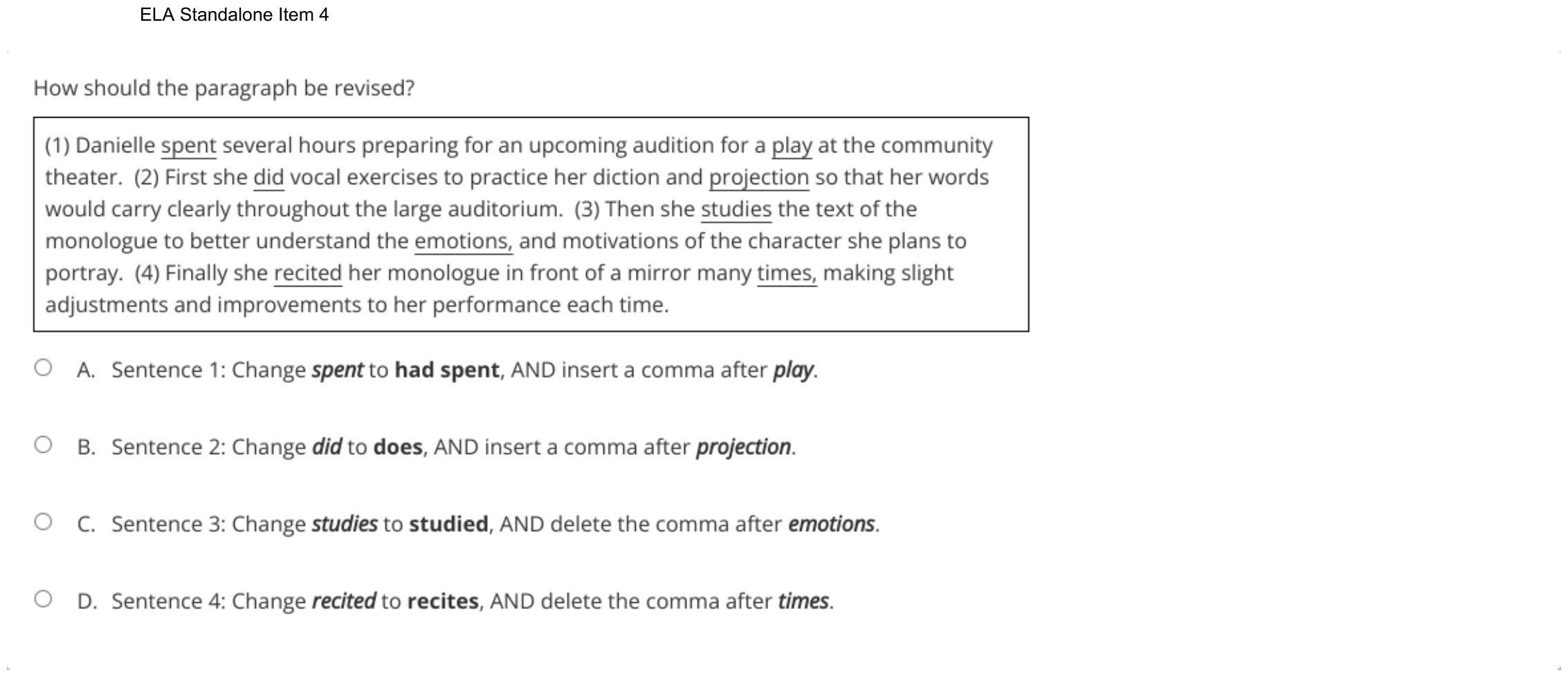
Question 30 of 120
2026 Practice Test C English, question 26Passage Serpent Mound
Serpent Mound
The Great Serpent Mound, located in Adams County, Ohio, is a human-made mound of earth that researchers believe was created between 300 B.C. and A.D. 1100 by an indigenous culture.
Ohio, 1846
Brush Creek stood low when the museum men came
with their measuring tapes and sketchbooks.
It was winter. Fringed with ice,
the creek doubled back on itself
as if it had forgotten something.
Pa was in Cincinnati, or else on his way home,
so Ma told me to lead the men
into the marshy low grounds. It being winter,
there was little underbrush to speak of—
in the summer there would have been
briars, poison ivy, biting flies. I listened
for the swish of a beaver’s heavy tail,
the chitter of a chickadee, or the cry of a hawk,
but the winter silence of the creek pressed
down on all of us like a weight.
The humps in the ground were all but
invisible until you were right up on them. The figure
was even less obvious: the sinuous body,
the tail coiled three times around,
and at the other end, the mouth wide open.
In the summer the creek bottom was crowded
with so much life that you could trip over
the ridges of earth before you saw
anything at all. In winter you could climb
a tree and get some idea of the whole thing:
the serpent’s body undulating, slithering
silently across the ancient
earth. At the mouth end, there was an oval mound
as if the snake were about to swallow an egg—
as snakes sometimes did in our rickety
henhouse—my Pa always said, or
as if swallowing the sun, one of the museum
men suggested, taking notes with his quill pen,
an old-style inkhorn slung at his side.
I liked that: swallowing the sun,
just the sort of thing a snake might do,
might want to do. When, later, I told my sister Ruth,
she disagreed. It is singing to the sun,
she insisted. That is why its mouth
is wide open. She said, “Sometimes I think
I hear it on summer nights. Not swallowing, singing.”
Question
How does the poem’s form contribute to the poem’s meaning?
- AThe use of one continuous stanza and the pattern of the lines mimic the long and winding shape of the mound.
- BThe uneven line lengths emphasize the variety of ways people interpret the meaning of the mound.
- CThe dashes throughout the poem highlight the speaker’s changing thoughts about the significance of the mound.
- DThe lack of a regular rhyme scheme and meter convey that the speaker struggles to comprehend the vastness of the mound.
Show the answer
Correct answer: A
The question asks how the poem’s form contributes to the poem’s meaning.
A. CORRECT. The poem is structured as one long stanza. The line lengths throughout the poem and the line indents (such as those in lines 7–10) create a visual effect so that the poem itself mimics the shape of the Serpent Mound.
B. Incorrect. The uneven line lengths in the poem do not indicate the different interpretations of the mound; separate stanzas or other stopping points would more effectively point to contrasting ideas.
C. Incorrect. The dashes in the poem lead to further explanation of a thought, not a change of thought.
D. Incorrect. The lack of regular rhyme and meter is intended to create a conversational tone rather than show the speaker’s struggle to grasp how large the mound is.
Question analysis
This question about poetic form asks how the form of “Serpent Mound,” a poem set in 1846 at the ancient earthwork in Adams County, Ohio, contributes to its meaning. Students must consider features such as the single stanza, the uneven lines, the dashes and the lack of rhyme, and decide which feature the poem actually puts to work, and how.
- NYS standards
- 7R5 structure and genre features
- Grade level
- Grade 7 reading and task
- Compared with grade 7
- At grade 7 Asking how a poem’s form adds to its meaning is a grade 7 standard. Each choice names a feature that is easy to check on the page and pairs it with a meaning that must also be tested, a typical demand.
- Estimated difficulty
- Hard: combines ideas, needs a plan, and has more than one tempting wrong answer.
- Thinking it demands
- Depth of knowledge 3, strategic thinking · mainly analyze
- What makes it hard
- How, not what major
- A very close wrong answer moderate
- Something you must already know minor
- Evidence
- Answered from the whole text
- Reading level
- Passage: 354 words (a poem; reading level not measured); question and choices: about grade 8, 84 words.
- Students, last 30 days
- Not enough answers yet to show (it takes 10).
Why it is hard, traps and wrong answers (shows the answer)
Why it is hard
Every choice names something really on the page, so the work is in the meaning each attaches. The strongest pull pairs the uneven lines with the poem’s real ending, three readings of the oval mound, and the free-verse choice can lean on line 25’s “some idea of the whole thing.” Seeing the key takes a step back from the words to the poem’s outline, which on the test means scrolling through all 41 lines.
How, not what major Working it out
This is a form question: students must see that the single stanza and the indents stepping right and back, as in lines 6–12, draw a winding body on the page, an effect of layout, not of words. (Anderson & Krathwohl, 2001)
A very close wrong answer moderate Choosing the answer
The choice about uneven line lengths names nearly the same feature as the key, the shape of the lines, but gives it another meaning: the mound’s many interpretations instead of its long, winding form. (Embretson & Wetzel, 1987; Gorin & Embretson, 2006; Ascalon et al., 2007)
Something you must already know minor Working it out
The choices assume “stanza,” “rhyme scheme” and “meter,” and the idea that a poem’s outline can picture its subject, which the poem never explains. (Anderson & Krathwohl, 2001)
Strategy: Test each choice in two steps: confirm that the feature it names is really in the poem, then ask whether the poem supports the meaning the choice attaches to it.
Traps
- Wrong purpose or structure: Names a purpose, structure or effect that the part does not serve, or describes what a part says when the question asks what it does.
- Reads too much in: A reasonable-sounding conclusion that goes further than the text allows.
The wrong answers, classified
B Wrong purpose or structure (Anderson & Krathwohl, 2001)
Pairs two real things, the uneven lines and the different readings of the mound at the end, but nothing ties the line lengths to those readings, which come only in lines 29–41.
C Wrong purpose or structure (Anderson & Krathwohl, 2001)
Spots the dashes in lines 9, 29 and 31, but each one leads into more detail on the thought before it, not into a change in what the speaker thinks of the mound.
D Reads too much in (Graesser, Singer & Trabasso, 1994)
Links free verse to line 25, where a climbed tree gives only “some idea of the whole thing,” but that is about seeing the shape, and the speaker never seems overwhelmed by it.
Working it out, step by step
Figure out what the question asks
This asks about form. Form is how a poem is built and how it looks on the page. It includes stanzas, which are groups of lines set apart by blank lines. It also includes line lengths, indents, rhyme and rhythm. An indent is space at the start of a line that pushes it to the right. You need the choice that ties a real feature of form to the poem’s meaning.
Look at the shape on the page
Don’t read the words yet. Just look. The poem is one long block of 41 lines with no blank lines. So it is one continuous stanza. Its lines do not all start at the left edge. Some are pushed in one step, some two, and some three. The steps go in and come back out, again and again.
Follow the lines in and out
Take lines 6–12. Line 6 starts one step in. Lines 7 and 8 start two steps in. Lines 9 and 10 start three steps in. Line 11 comes back to two steps, and line 12 is back at the left edge. The same swing out and back happens again in lines 19–27 and in lines 33–41. Look down the whole poem. Its left edge curves out and back like a snake winding down the page.
Connect the shape to the mound
The poem is about a giant earth mound shaped like a snake. Line 18 calls it “the sinuous body.” Sinuous means full of curves. Line 26 shows “the serpent’s body undulating, slithering.” Undulating means moving in waves. The one long stanza is like the snake’s long body. The lines curving in and out are like its winding shape. The poem looks like what it describes.
Check each choice
- A fits. The single stanza and the winding lines copy the mound’s long, curving shape.
- B does not fit. The lines are uneven. But the different ideas about the mound come only at the end, in lines 29–41. The line lengths are not tied to them.
- C does not fit. The dashes in lines 9, 29 and 31 lead into more detail. They do not show the speaker’s thoughts changing.
- D does not fit. The poem has no rhyme scheme, or pattern of rhymes, and no meter, or steady beat. But the speaker never struggles to grasp how big the mound is.
Watch out: B is tempting because both of its parts are true. But nothing links the line lengths to the different ideas about the mound.
Choose the answer
The poem’s one long stanza and its in-and-out lines draw a winding snake on the page. So the answer is A, “The use of one continuous stanza and the pattern of the lines mimic the long and winding shape of the mound.”
Why this answer and not the closest wrong one
B is the closest wrong choice. It also points to how the lines look, and the poem does give different ideas about the mound. But the uneven lines run through the whole poem, while those ideas come only at the end. The in-and-out pattern draws a shape, not a set of opinions. That shape is the mound’s long, winding body.
More questions like this
The original DOE question
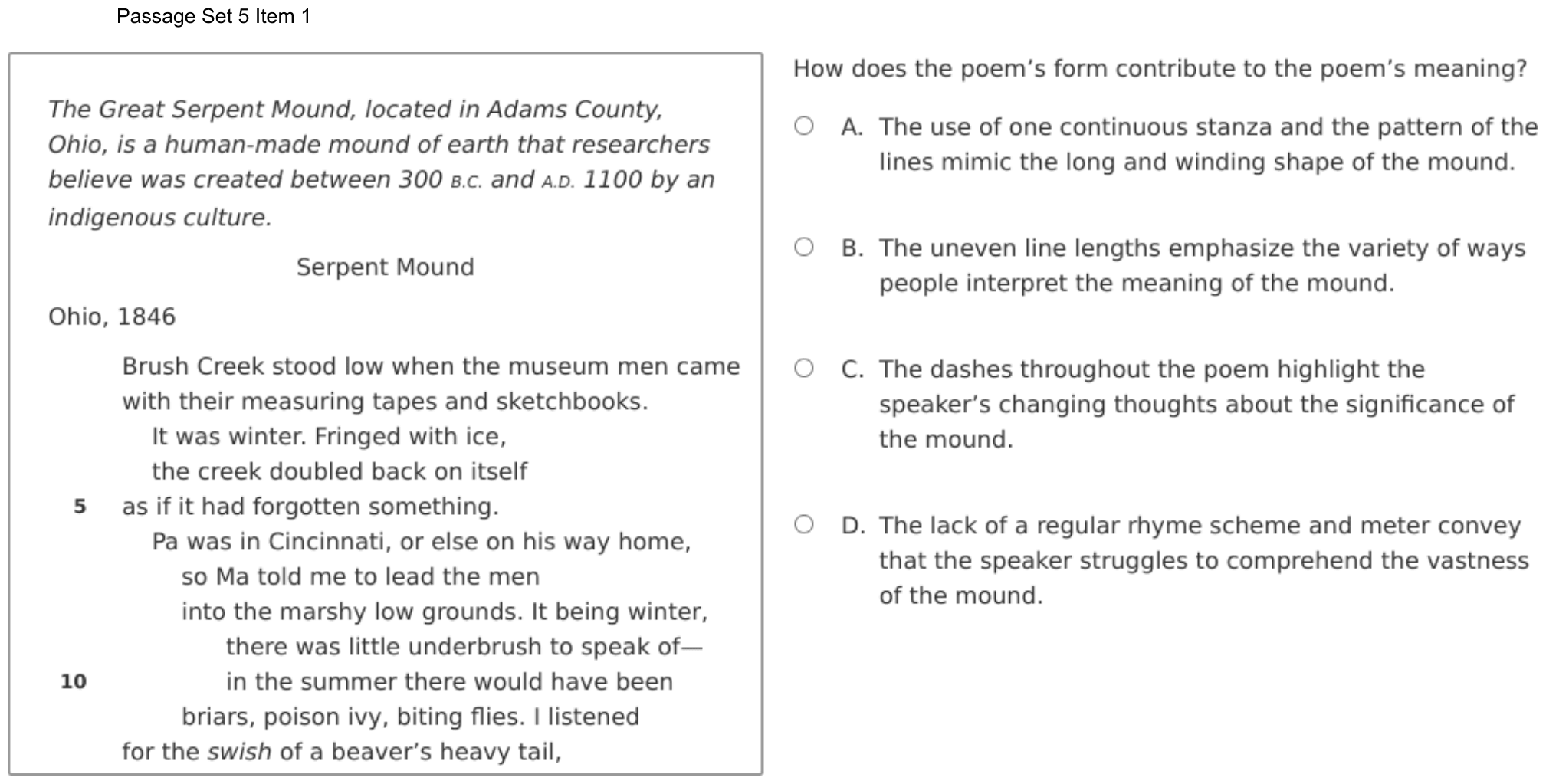
The passage “Serpent Mound” as printed (page 40)
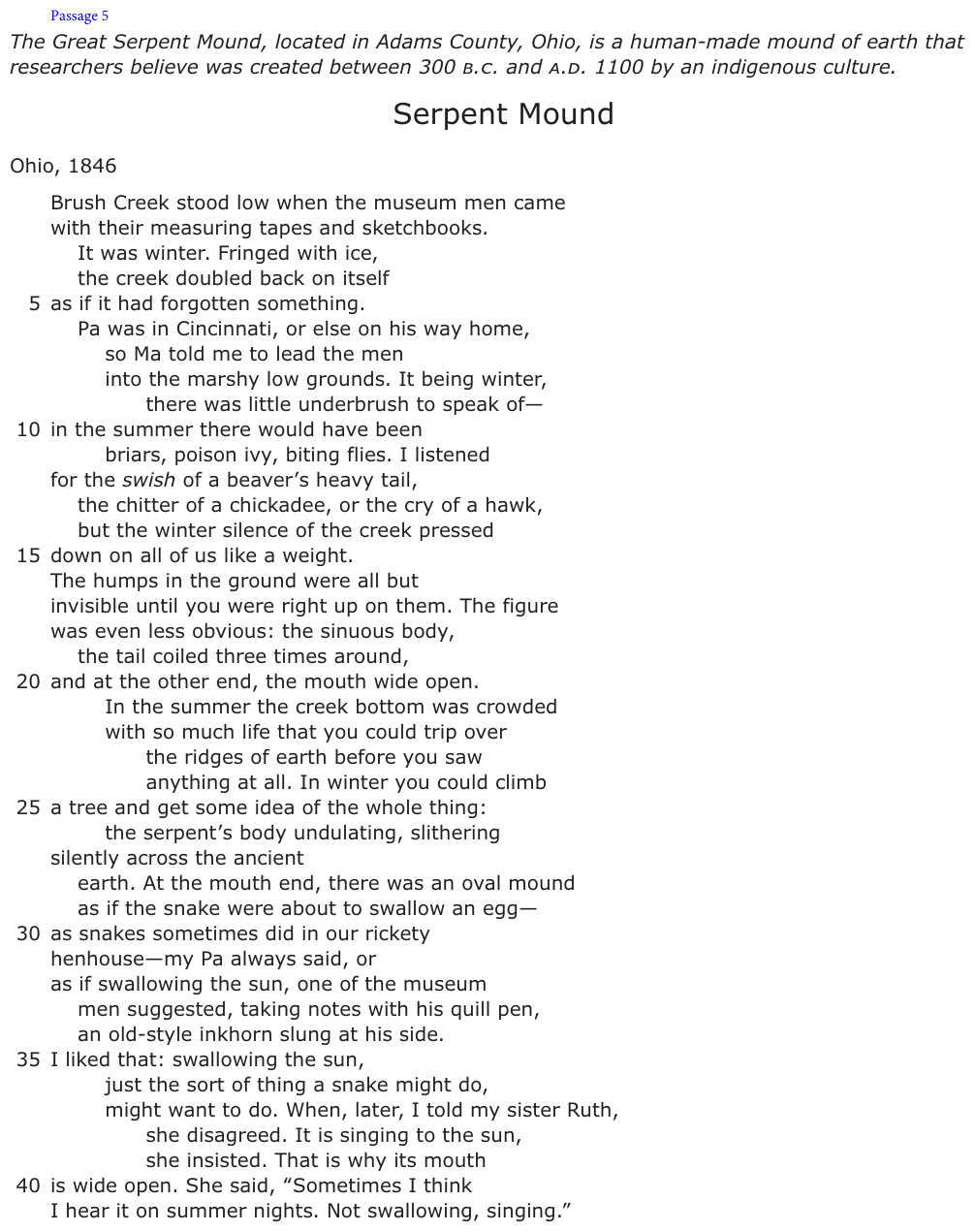
Question 31 of 120
2026 Practice Test C English, question 28Uses the passage above: “Serpent Mound”.
Question
Lines 1–2 contribute to the development of ideas in the poem by
- Asuggesting that the men are too busy with their work to talk to the speaker.
- Bhelping establish the reason for the men’s visit and purposeful behavior.
- Chinting that the men have hidden motives for studying the mound.
- Dindicating why the speaker is fascinated by the men and wants to help them.
Show the answer
Correct answer: B
The question asks how lines 1–2 contribute to the development of ideas in the poem.
A. Incorrect. The idea that the men are too busy with their work to talk to the speaker is not conveyed in the poem, and, in fact, one of the museum men discusses the oval mound with the speaker (“as if swallowing the sun, one of the museum / men suggested” [lines 32–33]).
B. CORRECT. The lines, with their mention of measuring tapes and sketchbooks, indicate that the reasons the museum men came were to measure the mound and to draw sketches of it.
C. Incorrect. There is little indication in the poem that the museum men have a hidden motive for studying the mound. Lines 1–2 present a straightforward description of the men and their equipment, which emphasizes the men’s academic interest in studying the mound.
D. Incorrect. While the speaker displays some curiosity about the work the museum men are doing (“one of the museum / men suggested, taking notes with his quill pen, / an old-style inkhorn slung at his side. / I liked that” [lines 32–35]), lines 1–2 focus on introducing the idea that the mound is a formation that is worth formal study and examination by experts.
Question analysis
This question asks how the opening lines of “Serpent Mound,” in which museum men arrive at a low winter creek with measuring tapes and sketchbooks, contribute to the development of ideas in the poem. The lines are short and plain, but the choices credit the men or the speaker with motives and feelings, and students must check each against the rest of the poem.
- Grade level
- Grade 6 reading and task
- Compared with grade 7
- Below grade 7 Below typical grade 7 demand: the two opening lines are short and concrete, and checking the choices takes one reading of the poem, much like grade 6 questions on how a single sentence fits into a text.
- Estimated difficulty
- Straightforward: two steps or one careful reading.
- Thinking it demands
- Depth of knowledge 2, skills and concepts · mainly analyze
- What makes it hard
- How, not what minor
- Evidence in several places minor
- Evidence
- Answered from one sentence or line
- Reading level
- Passage: 354 words (a poem; reading level not measured); question and choices: about grade 7, 62 words.
- Students, last 30 days
- Not enough answers yet to show (it takes 10).
Why it is hard, traps and wrong answers (shows the answer)
Why it is hard
The opening lines are short and concrete, and their tools, measuring tapes and sketchbooks, plainly say why the men came. The wrong choices each add something: men too busy to talk, a hidden motive, or a fascinated speaker, and the last borrows the speaker’s later delight in “swallowing the sun.” Checking each against the rest of the poem, rather than against first impressions of strangers arriving, is what the question rewards.
How, not what minor Working it out
The stem asks what lines 1–2 do in the poem, so students must see the measuring tapes and sketchbooks as setting up the visit’s purpose, not only as a description of the men. (Anderson & Krathwohl, 2001)
Evidence in several places minor Working it out
Ruling out two wrong choices takes later lines: a museum man offers the speaker an idea in lines 32–33, and the speaker leads the men in line 7 because Ma says to. (Kirsch & Mosenthal, 1990; Gorin & Embretson, 2006)
Strategy: Say in your own words what lines 1–2 tell you about the men, then reject any choice that depends on something the poem never shows.
Traps
- Reads too much in: A reasonable-sounding conclusion that goes further than the text allows.
- Wrong part of the text: A choice is true of another paragraph, stanza or speaker than the one asked about.
The wrong answers, classified
A Reads too much in (Graesser, Singer & Trabasso, 1994)
Pictures men absorbed in measuring who ignore the child, though nothing says so and one of them later suggests the mound looks “as if swallowing the sun.”
C Reads too much in (Graesser, Singer & Trabasso, 1994)
Reads a secret aim into the visit, but lines 1–2 show the men carrying measuring tools in the open, and the poem never hints at any other purpose.
D Wrong part of the text (Kirsch & Mosenthal, 1990)
Jumps to line 35, where the speaker likes a museum man’s phrase; in lines 1–2 the men have only arrived, and the speaker guides them because Ma says to.
Working it out, step by step
Figure out what the question asks
This asks what lines 1–2 do for the poem’s ideas. They are the poem’s first lines, so they set things up. You need to decide what they tell you about the museum men, and why that matters.
Read lines 1–2
Lines 1–2 say “Brush Creek stood low when the museum men came / with their measuring tapes and sketchbooks.” A measuring tape is for measuring lengths. A sketchbook is for drawing. So the men came to measure the mound and draw it. They have a job to do. Purposeful means acting with a clear goal. Their tools show that goal from the very start.
Check each choice
- A does not fit. Nothing says the men were too busy to talk. Later, one of them shares an idea: “as if swallowing the sun.”
- B fits. The tools show why the men came and that they came to work.
- C does not fit. The men carry their tools in plain view. The poem never hints at a hidden motive, or secret reason.
- D does not fit. The speaker leads the men because “Ma told me to lead the men.” The speaker’s liking for a man’s idea comes much later, in line 35.
Watch out: D borrows a feeling from later in the poem, “I liked that.” In lines 1–2, the men have only just arrived.
Choose the answer
Lines 1–2 use the men’s tools to show why they came and what they plan to do. So the answer is B, “helping establish the reason for the men’s visit and purposeful behavior.”
Why this answer and not the closest wrong one
D is the closest wrong choice. The speaker does later like a museum man’s phrase, “swallowing the sun.” But that comes in line 35. Lines 1–2 say nothing about the speaker’s feelings. They name only the men’s tools. Tapes and sketchbooks tell you why the men came: to measure and draw the mound.
More questions like this
The original DOE question
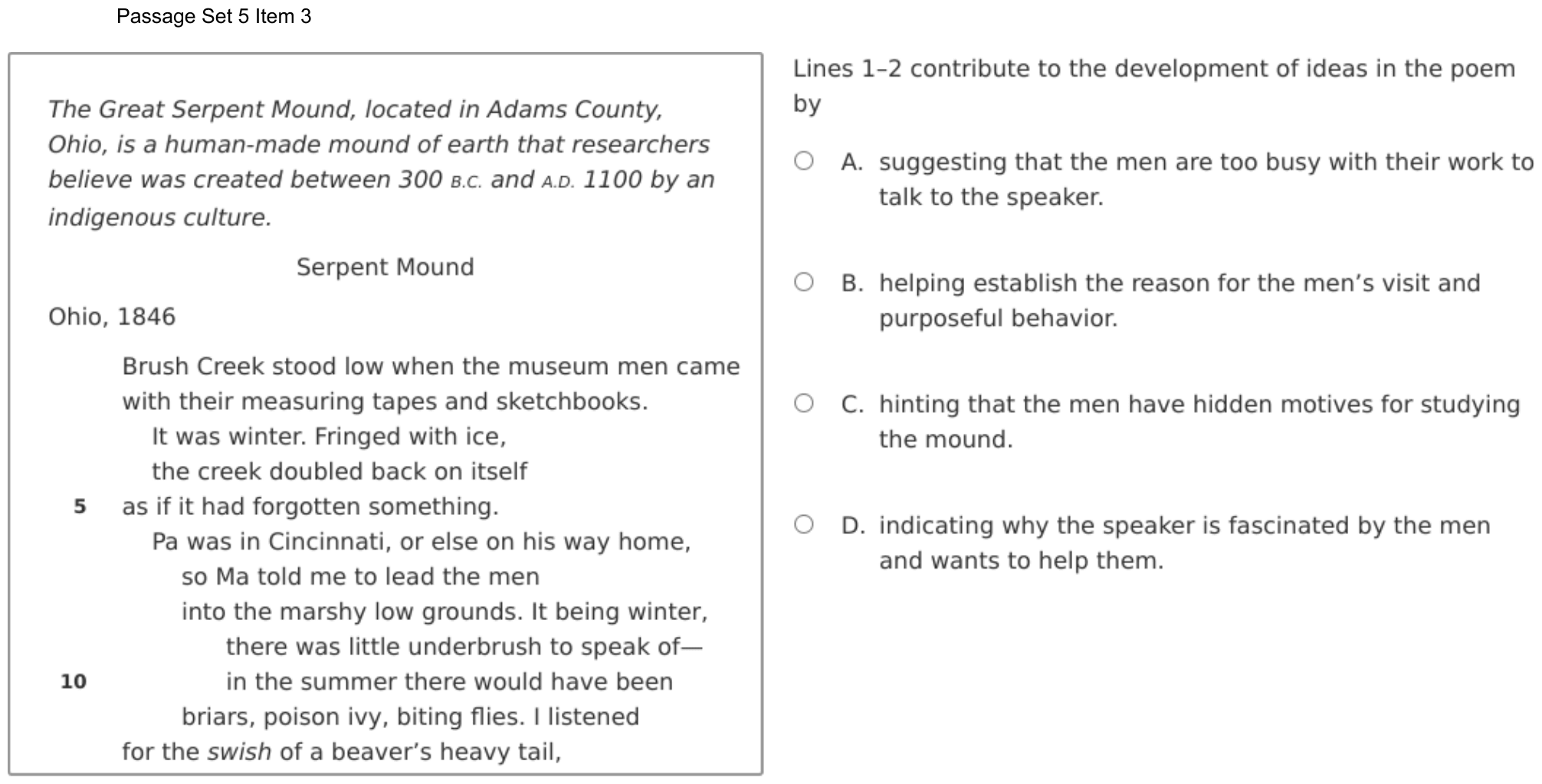
Question 32 of 120
2026 Practice Test C English, question 29Uses the passage above: “Serpent Mound”.
Question
Read line 28 from the poem.
At the mouth end, there was an oval mound
How does the line contribute to the development of ideas in the poem?
- AIt describes a feature of the mound that the men from the museum need to document.
- BIt introduces a comparison of the body of the mound with the head of the mound.
- CIt introduces a feature of the mound that has a different meaning to different people.
- DIt describes a part of the mound that is difficult to see from far away.
Show the answer
Correct answer: C
The question asks how line 28 contributes to the development of ideas in the poem.
A. Incorrect. Although the museum men are documenting the shape of the mound in line 33, lines 29–32 and 35–41 focus on what the oval mound represents as interpreted by the museum men, the speaker, and the speaker’s sister.
B. Incorrect. While the lines preceding line 28 describe the body of the snake in detail (“you could climb / a tree and get some idea of the whole thing: / the serpent’s body undulating, slithering / silently across the ancient / earth” [lines 24–28]), the purpose of line 28 is to begin the development of the ideas about the oval shape at the end of the mound: the serpent’s mouth.
C. CORRECT. Line 28 introduces the presence of the oval mound at the mouth of the snake. The meaning of this oval is of great interest to the museum men and the speaker. Line 28 leads to the idea that there is speculation about the oval mound (“as if the snake were about to swallow an egg” [line 29], “as if swallowing the sun” [line 32], and “It is singing to the sun” [line 38]).
D. Incorrect. The speaker does not say that the oval shape near the end of the mound is difficult to see. Earlier, the speaker says that the ridges of earth are difficult to see unless you are near them, but the speaker does not say this about the oval shape.
Question analysis
Students explain how line 28 of “Serpent Mound,” which introduces an oval mound at the serpent’s mouth end, contributes to the development of ideas in the poem. The line is a plain piece of description in a poem about museum men surveying the mound, so students must work out what part it plays in the poem as a whole.
- Grade level
- Grade 7 reading and task
- Compared with grade 7
- At grade 7 Explaining how one line contributes to a poem is standard grade 7 structure work. The line is a plain description, but its role depends on how it connects to the lines around it.
- Estimated difficulty
- Moderate: several steps, or a close reading with one strong distractor.
- Thinking it demands
- Depth of knowledge 2, skills and concepts · mainly analyze
- What makes it hard
- A very close wrong answer moderate
- How, not what moderate
- Evidence in several places minor
- Evidence
- Answered from one paragraph or stanza
- Reading level
- Passage: 354 words (a poem; reading level not measured); question and choices: about grade 5, 89 words.
- Students, last 30 days
- Not enough answers yet to show (it takes 10).
Why it is hard, traps and wrong answers (shows the answer)
Why it is hard
Because the museum men came to measure and sketch, a line naming a new feature looks like a note for their records, and that reading is the strong pull. Others see a comparison with the serpent’s body described just before, or carry over the earlier point about humps that are hard to see. The line’s job shows in what follows it: the oval is where Pa, a museum man and Ruth each see something different.
A very close wrong answer moderate Choosing the answer
The documenting choice and the key both say line 28 presents a feature of the mound; they differ in what follows, the men’s records or the egg, sun and singing readings in lines 29–41. (Embretson & Wetzel, 1987; Gorin & Embretson, 2006; Ascalon et al., 2007)
How, not what moderate Working it out
The line is plain description, so its role shows only in what it sets up: the oval becomes the egg, the swallowed sun and the open singing mouth that the rest of the poem weighs. (Anderson & Krathwohl, 2001)
Evidence in several places minor Working it out
The readings are spread over thirteen lines and three people, Pa in lines 29–31, a museum man in lines 32–33 and Ruth in lines 37–41, so students must gather them. (Kirsch & Mosenthal, 1990; Gorin & Embretson, 2006)
Strategy: Read line 28 together with the lines on either side of it, then test each choice against what those lines actually show.
Traps
- True but not the answer: A choice says something accurate about the text that does not answer this question.
- Wrong part of the text: A choice is true of another paragraph, stanza or speaker than the one asked about.
- Wrong purpose or structure: Names a purpose, structure or effect that the part does not serve, or describes what a part says when the question asks what it does.
The wrong answers, classified
A True but not the answer (King et al., 2004; Embretson & Wetzel, 1987)
Knows the men came “with their measuring tapes and sketchbooks,” so any new feature seems one to record, but the lines after 28 dwell on what the oval means, not on recording it.
B Wrong purpose or structure (Anderson & Krathwohl, 2001)
Notices that lines 24–28 describe the serpent’s body just before the oval appears, but line 28 moves on to the mouth end and never sets head and body side by side.
D Wrong part of the text (Kirsch & Mosenthal, 1990)
Carries over lines 16–17, where the humps are “all but / invisible” until you are close, to the oval mound, which the poem never calls hard to see.
Working it out, step by step
Figure out what the question asks
This asks how one line helps build the poem’s ideas. Line 28 is a plain description: “At the mouth end, there was an oval mound.” Oval means egg-shaped. To see the line’s job, look at what comes right after it.
Read what follows line 28
The next lines give three ideas about the oval mound.
- Pa always said it was “as if the snake were about to swallow an egg,” as snakes did in the family’s henhouse (lines 29–31).
- A museum man says “as if swallowing the sun” (line 32).
- Ruth says “It is singing to the sun” (line 38).
Name the line’s job
Line 28 brings in the oval mound. Then each person sees something different in it: an egg, the sun being swallowed, or a song. Each idea comes from that person’s own life. Pa thinks of his henhouse. Ruth thinks of what she seems to hear on summer nights. So the line sets up a feature that means different things to different people.
Check each choice
- A does not fit. The men did come to measure and sketch. But the lines after 28 are about what the oval means, not about recording it.
- B does not fit. Line 28 moves on from the body to the mouth. It never compares the two.
- C fits. The oval gets three different meanings from three people.
- D does not fit. Lines 16–17 say the humps are hard to see. The poem never says that about the oval.
Watch out: A is tempting because the men came “with their measuring tapes and sketchbooks.” But the poem spends its last 13 lines on meanings, not measurements.
Choose the answer
Line 28 brings in the oval mound that Pa, a museum man and Ruth each see in their own way. So the answer is C, “It introduces a feature of the mound that has a different meaning to different people.”
Why this answer and not the closest wrong one
A is the closest wrong choice. The museum men are there to document, or record, the mound, and one is taking notes. But the lines after 28 are not about notes. They give an egg, a swallowed sun and a singing snake. That is a feature with a different meaning to different people, just as C says.
More questions like this
The original DOE question
Question 33 of 120
2026 Practice Test C English, question 30Uses the passage above: “Serpent Mound”.
Question
What impact do the phrases “all but / invisible” and “even less obvious” in lines 16–18 have on the meaning of the poem?
- AThey indicate that viewing the full size and shape of the mound is difficult.
- BThey suggest that the location of the mound is unknown to most people.
- CThey imply that the speaker wants the location of the mound to remain a secret.
- DThey reveal that the speaker is unfamiliar with the significance of the mound.
Show the answer
Correct answer: A
The question asks what impact the phrases “all but / invisible” and “even less obvious” in lines 16–18 have on the meaning of the poem.
A. CORRECT. The words “all but / invisible” indicate that a person must be close to see the humps in the ground, while the phrase “even less obvious” indicates that a person must be far away to see the overall snake shape of the mound.
B. Incorrect. While the speaker has to lead the museum men to the mound because they did not know the exact location, the words in lines 16–18 are related to the difficulty in viewing the mound from the immediate surrounding area.
C. Incorrect. The speaker is willing to take the museum men out to study the mound, so there is no indication in the poem that the speaker wants the location of the mound to remain a secret. The words in lines 16–18 convey the idea that the mound is difficult to see.
D. Incorrect. While the speaker contemplates the significance of certain elements of the mound, the phrases in lines 16–18 relate to a viewer’s ability to see the physical shape of the mound, not its deeper meaning.
Question analysis
This word-meaning question asks what impact the phrases “all but / invisible” and “even less obvious” in lines 16–18 of “Serpent Mound” have on the poem’s meaning. Students must understand the idiom “all but” and then judge which of four claims about the mound and the speaker the two phrases actually support.
- Grade level
- Grade 6 reading and task
- Compared with grade 7
- Below grade 7 Below typical grade 7 demand: both phrases are quoted with their line numbers, in plain modern language, and one careful reading settles the question. The one hurdle is the idiom “all but,” which some readers take literally.
- Estimated difficulty
- Straightforward: two steps or one careful reading.
- Thinking it demands
- Depth of knowledge 2, skills and concepts · mainly understand
- What makes it hard
- Hard words moderate
- Reading between the lines minor
- Evidence
- Answered from one paragraph or stanza
- Reading level
- Passage: 354 words (a poem; reading level not measured); question and choices: about grade 7, 76 words.
- Students, last 30 days
- Not enough answers yet to show (it takes 10).
Why it is hard, traps and wrong answers (shows the answer)
Why it is hard
Both phrases are quoted with their lines, and the sentence that holds them goes on to list the body, the coiled tail and the open mouth, so its subject is what can be seen. The wrong choices slide from seeing to knowing: who knows where the mound is, who wants it hidden, and what it means. “Less obvious” is the slippery phrase, since obvious can also mean easy to understand.
Hard words moderate Understanding the question
“All but” is an idiom meaning almost, so “all but / invisible” means nearly unseen; a student who takes it as the opposite, plainly visible, loses the sense that the humps are hard to see. (Perfetti, 2007; Freedle & Kostin, 1993)
Reading between the lines minor Working it out
Students must keep both phrases about sight and connect them to lines 24–25, where only climbing a tree gives “some idea of the whole thing.” (Graesser, Singer & Trabasso, 1994; Kintsch, 1998)
Strategy: Put both phrases into plain words, starting with the idiom “all but,” then test each choice against what lines 16–25 actually describe.
Traps
- Twists what the text says: Uses the text's topic and ideas but changes what it says: who did it, how much, when, or why.
- Reads too much in: A reasonable-sounding conclusion that goes further than the text allows.
- Dictionary meaning, not meaning here: A common meaning of the word that does not fit its use in this text.
The wrong answers, classified
B Twists what the text says (King et al., 2004)
Turns “invisible” into “unknown,” helped by Ma sending the speaker to guide the men, but the phrases say how hard the mound is to see, not who knows where it is.
C Reads too much in (Graesser, Singer & Trabasso, 1994)
Finds a wish for secrecy in the hidden humps, though the speaker leads the museum men straight to the mound and never tries to keep it from anyone.
D Dictionary meaning, not meaning here (Perfetti, 2007)
Takes “less obvious” in its sense of harder to understand, but the sentence goes straight on to list the body, the coiled tail and the open mouth, so the word is about sight.
Working it out, step by step
Figure out what the question asks
This asks what two phrases add to the poem’s meaning. They are “all but / invisible” and “even less obvious,” in lines 16–18. Put each phrase in plain words first. Then see what they tell you about the mound.
Read lines 16–18
Lines 16–18 say “The humps in the ground were all but / invisible until you were right up on them. The figure / was even less obvious.” “All but” means almost. So the humps were almost invisible until you got very close. The figure is the whole snake shape. It was even harder to see than the humps. Here, obvious means easy to see.
Connect the phrases to later lines
The same sentence goes on to list what you would see: “the sinuous body, / the tail coiled three times around, / and at the other end, the mouth wide open.” So the phrases are about seeing the shape. Later, lines 24–25 say “In winter you could climb / a tree and get some idea of the whole thing.” Only from up high could you begin to see it. The mound is huge, low and hard to take in all at once.
Check each choice
- A fits. Both phrases show that seeing the whole mound is hard.
- B does not fit. The phrases are about how hard the mound is to see, not about who knows where it is.
- C does not fit. The speaker leads the museum men right to the mound. There is no wish to keep it secret.
- D does not fit. Here “less obvious” is about sight, not about understanding what the mound means.
Watch out: Obvious can also mean easy to understand. That reading leads to D. But the sentence goes straight on to list parts of the snake you can see.
Choose the answer
The phrases show how hard it is to see the mound’s full size and shape. So the answer is A, “They indicate that viewing the full size and shape of the mound is difficult.”
Why this answer and not the closest wrong one
B is a close wrong choice, because “invisible” can make you think nobody knows the mound is there. But the phrases describe looking, not knowing. The speaker knows exactly where the mound is. The problem is seeing it. The humps vanish until “you were right up on them,” and the whole shape shows only from a tree.
More questions like this
The original DOE question
Question 34 of 120
2026 Practice Test C English, question 31Uses the passage above: “Serpent Mound”.
Question
What impact do the words “swish,” “chitter,” and “cry” in lines 12–13 have in the poem?
- AThey illustrate how lively the mound’s surroundings are during the summer.
- BThey show how the mound disrupts natural life in the marsh.
- CThey indicate the variety of wildlife found in the area around the mound.
- DThey suggest that the speaker prefers the mound’s appearance in winter.
Show the answer
Correct answer: A
The question asks what impact the words “swish,” “chitter,” and “cry” in lines 12–13 have in the poem.
A. CORRECT. The words highlight the sounds of the animals that visit the mound in the summer: the “swish of a beaver’s heavy tail” (line 12), the “chitter of a chickadee” (line 13), and the “cry of a hawk” (line 13). These words help contrast the quiet stillness of the setting around the mound in the winter.
B. Incorrect. While the words in lines 12–13 convey the sounds certain animals make in the summer, the sounds of the animals that live near the mound are a natural part of life in the area, not a disruption.
C. Incorrect. The speaker is contrasting the sounds of the animals around the mound during the rest of the year with the silence of the winter months, not merely indicating the variety of wildlife.
D. Incorrect. The speaker expresses the idea that the mound is more visible in the winter because of the lack of brush (“It being winter, / there was little underbrush to speak of” [lines 8–9]). Then lines 12–13 describe sounds, not the appearance of the mound in winter.
Question analysis
This question about word choice asks what impact the sound words “swish,” “chitter” and “cry” in lines 12–13 of “Serpent Mound” have in the poem. They belong to a beaver, a chickadee and a hawk near the creek, and more than one choice sounds like a fair account of them, so students must read the surrounding lines closely.
- Grade level
- Grade 8 reading and task
- Compared with grade 7
- Above grade 7 Grade 7 students often explain what sensory words add to a description. These three words sit inside a long sentence that runs across several lines, so their effect has to be worked out from the lines around them, beyond typical grade 7 work.
- Estimated difficulty
- Hard: combines ideas, needs a plan, and has more than one tempting wrong answer.
- Thinking it demands
- Depth of knowledge 2, skills and concepts · mainly analyze
- What makes it hard
- A very close wrong answer major
- Reading between the lines moderate
- Complex sentences minor
- Evidence
- Answered from one paragraph or stanza
- Reading level
- Passage: 354 words (a poem; reading level not measured); question and choices: about grade 6, 61 words.
- Students, last 30 days
- Not enough answers yet to show (it takes 10).
Why it is hard, traps and wrong answers (shows the answer)
Why it is hard
Three vivid animal sounds invite the easy reading that the poem is showing off the creek’s wildlife, and that choice is true as far as it goes. The words matter because they are missing: the speaker listens for them, and “the winter silence” answers. Students must also accept that the key’s “during the summer” comes from the poem’s later picture of a crowded summer creek, not from lines 12–13 themselves.
A very close wrong answer major Choosing the answer
The variety choice is literally true, since a beaver, a chickadee and a hawk are three kinds of animal; it differs from the key in missing why the sounds are named, as a contrast with winter. (Embretson & Wetzel, 1987; Gorin & Embretson, 2006; Ascalon et al., 2007)
Reading between the lines moderate Working it out
The speaker listens for these sounds and does not hear them, so students must infer that they stand for the creek’s life in warmer months, which lines 21–22 call “crowded / with so much life.” (Graesser, Singer & Trabasso, 1994; Kintsch, 1998)
Complex sentences minor Understanding the question
The three words sit in one sentence that runs from “I listened” in line 11 to “like a weight” in line 15 and turns on “but,” so their point arrives only at its end. (Abedi & Lord, 2001; Freedle & Kostin, 1993; Messick, 1989)
Strategy: Read the full sentence that holds these words, from “I listened” in line 11 to the end of line 15, then decide what the three sound words add to the scene.
Traps
- True but not the answer: A choice says something accurate about the text that does not answer this question.
- Wrong part of the text: A choice is true of another paragraph, stanza or speaker than the one asked about.
The wrong answers, classified
B Twists what the text says (King et al., 2004)
Notices that the beaver, chickadee and hawk go unheard but blames the mound for the hush, though line 14 calls it “the winter silence of the creek.”
C True but not the answer (King et al., 2004; Embretson & Wetzel, 1987)
Rightly counts three different animals in lines 12–13, but the speaker listens for them in vain, so the point is their absence in winter, not the range of species.
D Wrong part of the text (Kirsch & Mosenthal, 1990)
Remembers from lines 8–9 and 24–25 that winter makes the mound easier to see, but lines 12–13 are about sounds and state no preference for either season.
Working it out, step by step
Figure out what the question asks
This asks what three sound words do in the poem. They are “swish,” “chitter” and “cry,” in lines 12–13. Read the whole sentence they sit in. It starts at “I listened” in line 11 and ends with “like a weight” in line 15.
Read the full sentence
Lines 11–15 say “I listened / for the swish of a beaver’s heavy tail, / the chitter of a chickadee, or the cry of a hawk, / but the winter silence of the creek pressed / down on all of us like a weight.” A chickadee is a small bird, and a chitter is its quick, chirping sound. The speaker listens for these sounds. But the word “but” tells you they never come. Only silence answers.
Work out why the sounds are named
A beaver, a chickadee and a hawk are signs of a creek full of life. The speaker hears none of them in winter. Later lines tell you when the creek is lively. Lines 21–22 say “In the summer the creek bottom was crowded / with so much life.” So the missing sounds remind you how lively the place is in summer. They also make the winter silence feel even emptier.
Check each choice
- A fits. The sounds stand for the busy life around the mound in the warm months.
- B does not fit. The quiet comes from the season: “the winter silence of the creek.” The mound does not cause it.
- C does not fit. There are three kinds of animals, but the point is that their sounds are missing.
- D does not fit. These lines are about sounds. The speaker says nothing about liking how the mound looks in winter.
Watch out: C is true as far as it goes. But it misses why the speaker names the sounds at all: to set them against the silence.
Choose the answer
The sounds the speaker listens for, and doesn’t hear, show how lively the creek is in summer. So the answer is A, “They illustrate how lively the mound’s surroundings are during the summer.”
Why this answer and not the closest wrong one
C is the closest wrong choice, because a beaver, a chickadee and a hawk really are three kinds of wildlife. But the speaker listens for them and hears nothing. The word “but” turns the sentence to “the winter silence.” The sounds matter because they are missing. They show the creek in its lively season, which line 21 names as summer.
More questions like this
The original DOE question
Question 35 of 120
2026 Practice Test C English, question 32Uses the passage above: “Serpent Mound”.
Question
How does the speaker’s interaction with Ruth in lines 37–41 convey a central idea of the poem?
- AIt suggests that the most accurate interpretations of the mound come from knowing the purpose of the mound.
- BIt emphasizes that there are multiple interpretations of the mound based on feelings and experiences.
- CIt reveals the benefit of considering different interpretations of the mound’s significance.
- DIt implies that scientific study of the mound’s purpose will affect what the mound symbolizes to people.
Show the answer
Correct answer: B
The question asks how the interaction between the speaker and Ruth in lines 37–41 conveys a central idea of the poem.
A. Incorrect. While there are many different interpretations of the mound’s meaning, there is no way to determine which of the interpretations is most accurate, and there is no way to know the mound’s true purpose.
B. CORRECT. The interaction references Ruth’s interpretation of the open-mouth shape as a serpent singing to the sun. This interpretation creates a joyful mood. The speaker contrasts this perspective with the idea that the mound is swallowing the sun, which creates a more aggressive feeling. These various interpretations of a physical shape arise out of what the individuals feel when they look at the mound.
C. Incorrect. The speaker does not describe any benefit to considering what different people imagine when they see the mound. Instead, the speaker is simply describing different interpretations.
D. Incorrect. Ruth’s interpretation of the mound’s shape is fanciful and symbolic. It is unlikely that scientific study would change the minds of people such as Ruth about the meaning of the mound.
Question analysis
This central idea question asks how the speaker’s conversation with a sister, Ruth, in lines 37–41 of “Serpent Mound” conveys a central idea of the poem. Ruth explains the serpent’s open mouth in her own way, and students must connect this short exchange to the rest of the poem before choosing among four claims about what it shows.
- Grade level
- Grade 7 reading and task
- Compared with grade 7
- At grade 7 Linking a short exchange between two characters to a poem’s central idea is standard grade 7 work. The language is plain, though the choices differ in what they claim the exchange shows, so each must be checked closely.
- Estimated difficulty
- Moderate: several steps, or a close reading with one strong distractor.
- Thinking it demands
- Depth of knowledge 2, skills and concepts · mainly analyze
- What makes it hard
- A very close wrong answer moderate
- Reading between the lines moderate
- Evidence in several places minor
- Evidence
- Answered from one paragraph or stanza
- Reading level
- Passage: 354 words (a poem; reading level not measured); question and choices: about grade 10, 78 words.
- Students, last 30 days
- Not enough answers yet to show (it takes 10).
Why it is hard, traps and wrong answers (shows the answer)
Why it is hard
Ruth’s “Not swallowing, singing” makes the disagreement plain, so most students see that the mound is read in more than one way. The difficulty is in what the choices add to that: a lesson about the benefit of differing views, a ranking of readings by the mound’s purpose, or a role for science. The poem only sets the readings side by side, each rooted in what its speaker has lived or felt.
A very close wrong answer moderate Choosing the answer
The choice about the benefit of considering different interpretations shares the key’s subject, several readings of the mound, and differs only in adding a lesson, that weighing them is worthwhile. (Embretson & Wetzel, 1987; Gorin & Embretson, 2006; Ascalon et al., 2007)
Reading between the lines moderate Working it out
The exchange is a plain disagreement, swallowing against singing, and students must infer the central idea it serves, that people see the mound through their own feelings and experiences. (Graesser, Singer & Trabasso, 1994; Kintsch, 1998)
Evidence in several places minor Working it out
Ruth’s reading answers earlier ones, Pa’s egg from the henhouse in lines 29–31 and the museum man’s sun in line 32, so her lines must be read against them. (Kirsch & Mosenthal, 1990; Gorin & Embretson, 2006)
Strategy: Sum up what Ruth says and how the speaker reacts, compare it with the earlier ideas about the oval mound, and pick the claim the poem shows rather than one it might only suggest.
Traps
- Reads too much in: A reasonable-sounding conclusion that goes further than the text allows.
- Outside knowledge: A choice is plausible in the real world but not supported by this text.
The wrong answers, classified
A Outside knowledge (King et al., 2004; Recht & Leslie, 1988)
Applies the sensible idea that knowing why something was built settles what it means, but the poem never ranks the readings or says anyone knows the mound’s purpose.
C Reads too much in (Graesser, Singer & Trabasso, 1994)
Rightly sees several readings of the mound, then adds a moral, that weighing them is helpful, which the poem never states; Ruth and the speaker simply disagree.
D Reads too much in (Graesser, Singer & Trabasso, 1994)
Connects the museum men’s measuring with the family’s readings at the end, but nobody suggests that study will change what the mound means to Ruth or anyone else.
Working it out, step by step
Figure out what the question asks
This asks how the talk between the speaker and Ruth, in lines 37–41, shows a central idea. A central idea is a big point the whole poem makes. Compare Ruth’s idea about the mound with the speaker’s, and with the ideas that come before.
Read the talk with Ruth
The speaker liked a museum man’s idea that the snake was “swallowing the sun.” But when the speaker told Ruth, “she disagreed. It is singing to the sun, / she insisted.” Ruth explains, “That is why its mouth / is wide open.” Then she says, “Sometimes I think / I hear it on summer nights. Not swallowing, singing.”
See where each idea comes from
Each person sees the same oval mound in a different way. Pa always said it was like a snake about to swallow an egg, as snakes did in the family’s henhouse. A museum man saw it swallowing the sun. Ruth hears it singing on summer nights. Each idea grows out of that person’s own feelings and experiences, or what they have lived through. That is a central idea: people see the mound in many ways.
Check each choice
- A does not fit. No one in the poem knows the mound’s purpose, and no idea is called the most accurate.
- B fits. Ruth and the speaker see the mound differently, each from what they feel and have lived.
- C does not fit. The poem never says that thinking about other ideas helps anyone. Ruth and the speaker just disagree.
- D does not fit. Nobody says the men’s study will change what the mound means to people.
Watch out: C starts out right, since there are different ideas. But it adds a lesson, a “benefit,” that the poem never gives.
Choose the answer
The disagreement shows more than one way to see the mound, each rooted in a person’s own feelings and experiences. So the answer is B, “It emphasizes that there are multiple interpretations of the mound based on feelings and experiences.”
Why this answer and not the closest wrong one
C is the closest wrong choice. It also says there are different ideas about the mound. But it claims there is a benefit, or gain, in thinking them over. The poem shows no one gaining anything. Ruth keeps her own idea, and the poem never says who is right. It simply sets the ideas side by side, each from a person’s own life.
More questions like this
The original DOE question
Question 36 of 120
2026 Practice Test D English, question 1Passage A Memory Revolution
A Memory Revolution
A high school senior logs on to a computer at the library to double-check the application due date listed on a college admissions website. Nearby, a librarian helps a group of biology students use a database to search for recent studies about mammals. In the past few decades, the Internet has become an integral component of daily life for many people. The seemingly limitless power of search engines made the Internet search extremely common, and today people increasingly rely on the Internet’s vast accumulation of sources to access all types of information. Scientists are beginning to examine how this reliance is modifying the strategies people use to store and prioritize information in their mind.
A Dependable and Valuable Asset
Psychologist Benjamin Storm from the University of California, Santa Cruz, and researchers Sean Stone and Aaron Benjamin devised an experiment to study students’ tendency to depend on the Internet for facts. To begin, the scientists divided sixty participants into multiple groups, including an “Internet” group and a “memory” group, and placed them in front of computers. The Internet group was required to use the search engine Google to answer eight challenging trivia questions. In contrast, participants in the memory group were permitted to use only their personal knowledge to answer the questions. In the second round, the researchers administered notably easier questions. This time, they allowed each group the option of using Google as they answered. Their results showed that 83 percent of the Internet group continued to consult Google in the second round, while only 63 percent of the memory group chose to do so.
People’s growing inclination to rely on the Internet in order to retrieve information, particularly facts and figures, is called cognitive offloading. Canadian researcher Evan F. Risko and British researcher Sam Gilbert, who have written extensively about the topic, say a similar process has been taking place for centuries. In the past, people used resources like encyclopedias to assist their memories; however, today the Internet, serving as a vast extended memory, allows people to digitally access and retrieve much larger volumes of information. Consequently, people’s minds are free for other cognitive feats, such as connecting data, learning new information, or solving problems.
Filing Information Away
The use of the Internet also appears to be modifying the strategies people use to store information in their mind. Researchers Betsy Sparrow from Columbia University, Jenny Liu from the University of Wisconsin-Madison, and Daniel Wegner from Harvard University conducted several studies to discover how people efficiently manage their information intake.
To begin, the researchers examined how people evaluate which information deserves their effort to remember. For this experiment, participants read forty trivia facts, such as “An ostrich’s eye is bigger than its brain,” and typed the statements into a computer file. Half the participants had been previously told the file would be saved, while half believed it would be erased. Next, the participants wrote down every fact they could recall. Those who believed the information would be erased and no longer available could recall 40 percent more facts than those who thought the information would be saved.
In another experiment, the same researchers tested the ability of study participants to remember where to access information. For this trial, participants read and typed trivia statements, which they saved in folders with generic names such as “Facts” and “Items.” After spending ten minutes writing down all the facts they could recall from memory, participants were asked which folder contained a particular fact based on a keyword. For example, “Which folder has the fact about ostriches?” Overall, participants recalled the information’s location more often than the content itself, correctly identifying 49 percent of the folders for specific facts while remembering only 23 percent of the actual trivia. The researchers concluded that our memory is adapting to the Internet age by prioritizing where to locate information even when the specific details are forgotten. According to Sparrow, the Internet has become an important form of transactive memory, an external source of the recollections and associative networks that constitute memory.
As the Internet’s resources continue to expand our “external” memory, some question whether the process may cause people to depend too heavily on technology. However, Steven Pinker, a professor of psychology at Harvard University, says, “Knowledge is increasing exponentially; human brainpower and waking hours are not. Fortunately, the Internet and information technologies are helping us manage, search and retrieve our collective intellectual output at different scales, from Twitter and previews to e-books and online encyclopedias. Far from making us stupid, these technologies are the only things that will keep us smart.”
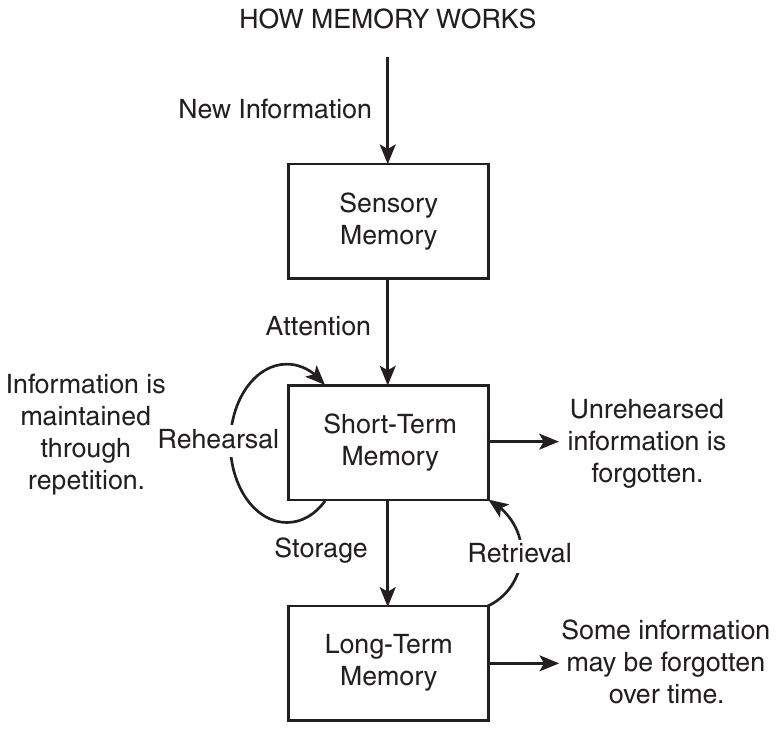
Question
The details in paragraph 3 about cognitive offloading convey a central idea of the passage by
- Asuggesting that reliance on the Internet for information is inevitable.
- Bdemonstrating how the methods used to store and find information have changed over time.
- Cexplaining how encyclopedias and the Internet are similar sources of information.
- Dimplying that more information can be understood now than ever before.
Show the answer
Correct answer: B
The question asks how the details in paragraph 3 about cognitive offloading convey a central idea of the passage.
A. Incorrect. Although paragraph 3 describes the Internet as “a vast extended memory,” it does not present reliance on the Internet for information as inevitable. The paragraph states that the Internet “allows people to digitally access and retrieve much larger volumes of information” and indicates that this benefit leaves people free to focus on “connecting data, learning new information, or solving problems.” However, these details about the benefits of the Internet do not express an opinion about the inevitability of Internet reliance.
B. CORRECT. A central idea of the passage is that the Internet is changing how people retain information. Paragraph 3 supports this idea by stating that “a similar process has been taking place for centuries” and that “in the past,” resources such as encyclopedias were used to store and find information. The details provided in paragraph 3 about encyclopedias and the Internet show that people have always used resources to remember information and that these resources change over time as people develop new ways to “assist their memories.”
C. Incorrect. While paragraph 3 does compare the use of encyclopedias to obtain information in the past with the use of today’s Internet, this comparison fails to convey the central idea of the passage that the Internet is changing how people remember information.
D. Incorrect. Although paragraph 3 states that “much larger volumes of information” are available on the Internet than what has been available in previous methods of information storage, such as encyclopedias, this fact does not relate to an increase in the ability to understand that information and is not a central idea of the passage.
Question analysis
This central-idea question on “A Memory Revolution,” an article about how relying on the Internet affects the way people remember, asks how the details about cognitive offloading in paragraph 3 convey a central idea of the passage. The paragraph mentions encyclopedias, the Internet and freed-up minds, and the choices each build on a different detail, so students must see what the paragraph adds to the article as a whole.
- Grade level
- Grade 8 reading and task
- Compared with grade 7
- At grade 7 Tying one paragraph’s details to a central idea is regular grade 7 work. Paragraph 3 is short, but terms such as “cognitive offloading” and “extended memory” are abstract, and students must settle on the article’s central idea before judging the paragraph.
- Estimated difficulty
- Moderate: several steps, or a close reading with one strong distractor.
- Thinking it demands
- Depth of knowledge 2, skills and concepts · mainly understand
- What makes it hard
- The right answer is reworded moderate
- A very close wrong answer minor
- Hard words minor
- Evidence
- Answered from one paragraph or stanza
- Reading level
- Passage: about grade 14, 763 words; question and choices: about grade 11, 61 words.
- Corrected from the DOE handbook
- An inaccurate statement about paragraph 3 in the explanation was corrected.
- Students, last 30 days
- Not enough answers yet to show (it takes 10).
Why it is hard, traps and wrong answers (shows the answer)
Why it is hard
Paragraph 3 is built on a then-and-now contrast: encyclopedias once helped people remember, and today the Internet does the same job on a far larger scale. Students who notice only the pairing take it for a likeness, while those who stop at the opening “growing inclination to rely on the Internet” are tempted to call the reliance unstoppable. The point goes to students who first name the article’s central idea, that the Internet is changing how people remember, and then read the paragraph as one stage in a long history.
The right answer is reworded moderate Choosing the answer
The key’s “methods used to store and find information have changed over time” appears nowhere in paragraph 3, while the wrong choices stay near its own wording: reliance on the Internet, encyclopedias beside the Internet, and more information. (Freedle & Kostin, 1993; Kirsch & Mosenthal, 1990)
A very close wrong answer minor Choosing the answer
The choice calling encyclopedias and the Internet similar sources sets up the same old-and-new pairing as the key; it parts only on likeness versus change, which the paragraph’s “however, today” decides. (Embretson & Wetzel, 1987; Gorin & Embretson, 2006; Ascalon et al., 2007)
Hard words minor Understanding the question
The paragraph explains its idea in abstract terms, “cognitive offloading,” “a vast extended memory” and “other cognitive feats,” which must be decoded before its then-and-now structure shows. (Perfetti, 2007; Freedle & Kostin, 1993)
Strategy: Put the article’s central idea about the Internet and memory into your own words first, then test each choice against what paragraph 3’s sentences actually say, not against a word it shares with them.
Traps
- True but not the answer: A choice says something accurate about the text that does not answer this question.
- Twists what the text says: Uses the text's topic and ideas but changes what it says: who did it, how much, when, or why.
- Too broad or too strong: A choice overstates, generalizes, or uses absolute words the text does not support.
The wrong answers, classified
A Too broad or too strong (King et al., 2004)
Builds on the “growing inclination to rely on the Internet” and a process “taking place for centuries,” then hardens them into “inevitable,” a claim the paragraph never makes.
C True but not the answer (King et al., 2004; Embretson & Wetzel, 1987)
Sees, accurately, that paragraph 3 sets encyclopedias beside the Internet as aids to memory, but stops at the likeness and misses the “however” that turns the comparison into a change.
D Twists what the text says (King et al., 2004)
Matches “much larger volumes of information” to more information and swaps the paragraph’s “access and retrieve” for “understood,” though reaching more facts is not grasping them better.
What was corrected from the DOE handbook, and why
- Explanation: The DOE’s explanation of Option A says that paragraph 3 “does not discuss reliance on the Internet for information.” It does: the paragraph opens “People’s growing inclination to rely on the Internet in order to retrieve information, particularly facts and figures, is called cognitive offloading.” What the paragraph does not do is present that reliance as inevitable, which is why Option A is wrong, as the explanation’s last sentence says. The site now reads “it does not present reliance on the Internet for information as inevitable.”
Working it out, step by step
Figure out what the question asks
This is a central idea question. A central idea is a main point the whole article makes. Here the main point is that the Internet is changing how people remember. The question asks how paragraph 3 adds to that point. Paragraph 3 is about “cognitive offloading,” so first work out what that term means.
Read paragraph 3 closely
Paragraph 3 begins: “People’s growing inclination to rely on the Internet in order to retrieve information, particularly facts and figures, is called cognitive offloading.” Then it says “a similar process has been taking place for centuries.” Next comes the key sentence: “In the past, people used resources like encyclopedias to assist their memories; however, today the Internet, serving as a vast extended memory, allows people to digitally access and retrieve much larger volumes of information.”
Put the paragraph in plain words
An inclination is a habit of leaning toward something. Cognitive means having to do with thinking. To offload is to hand a load to someone else. So cognitive offloading means letting an outside tool do some of your remembering. People have done this for a long time. Long ago they used encyclopedias, books full of facts. Today they use the Internet. The word “however” marks the change from then to now. So the paragraph shows the tools for storing and finding facts changing over time.
Check each choice
- A does not fit. The paragraph does talk about people relying on the Internet. But it never says that reliance is inevitable, which means it cannot be avoided.
- B fits. The paragraph moves from encyclopedias “in the past” to the Internet “today.” That is a change in how people store and find information.
- C does not fit. The paragraph does set the two side by side. But it uses them to show a change, not to say they are alike.
- D does not fit. People can “access and retrieve” more information. That means find it and pull it up, not understand it.
Watch out: C is tempting because encyclopedias and the Internet both help memory. Read past the likeness to the word “however.”
Choose the answer
Paragraph 3 shows people moving from encyclopedias to the Internet to help them remember. That supports the article’s point that the Internet is changing memory. So the answer is B, “demonstrating how the methods used to store and find information have changed over time.”
Why this answer and not the closest wrong one
C is the closest wrong choice. Paragraph 3 does compare encyclopedias and the Internet. But the comparison makes a point about change: the Internet now holds “much larger volumes of information.” B names that change. C stops at the likeness, so it misses what the paragraph adds to the article.
More questions like this
The original DOE question
The passage “A Memory Revolution” as printed (pages 3–4)
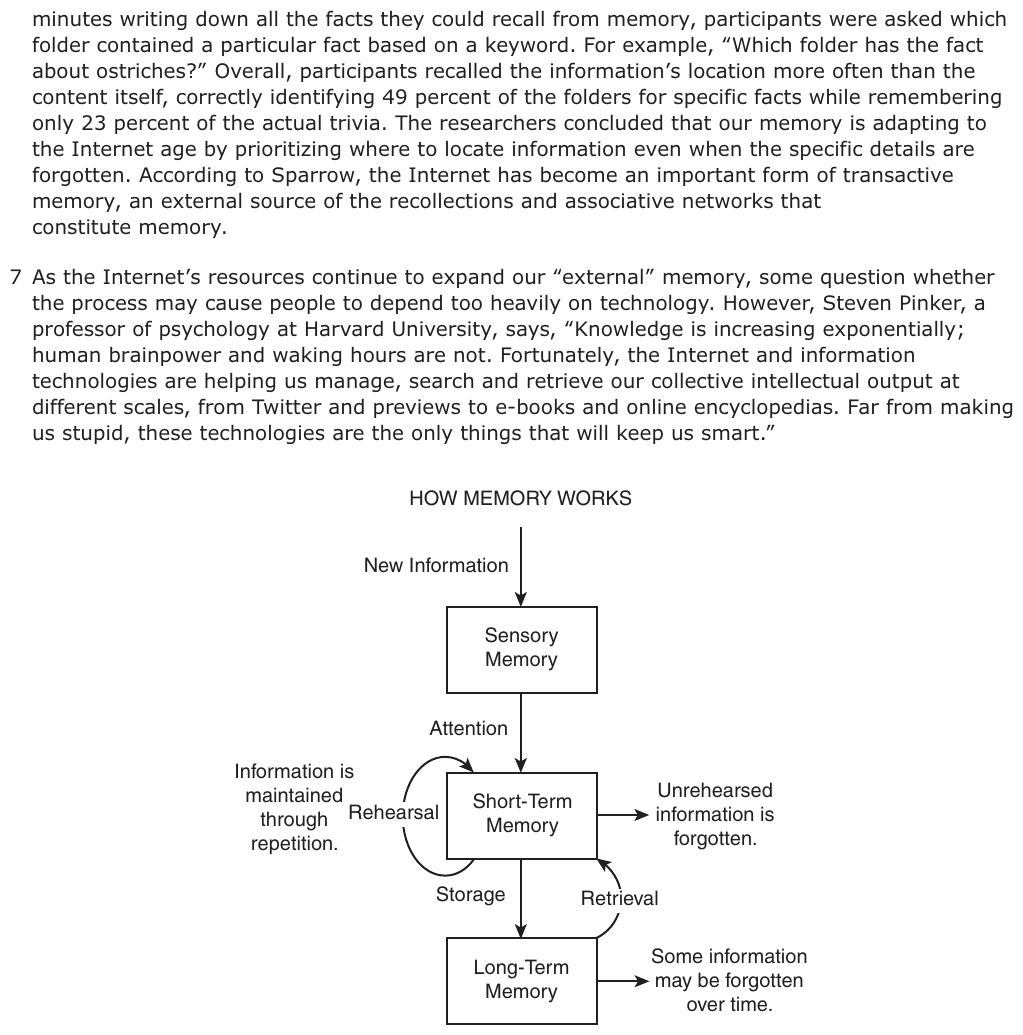
Question 37 of 120
2026 Practice Test D English, question 2Uses the passage above: “A Memory Revolution”.
Question
How do the details about the experiment described in paragraph 5 convey a central idea of the passage?
- AThey suggest that the act of repeating information by typing it on a keyboard may improve a person’s memory.
- BThey explain that a person will forget information faster if the information is considered unimportant.
- CThey indicate that a person may start to forget details when the amount of information becomes overwhelming.
- DThey suggest that memory is affected by whether a person expects to have access to the information in the future.
Show the answer
Correct answer: D
The question asks how the details of the experiment described in paragraph 5 convey a central idea of the passage.
A. Incorrect. Although paragraph 5 states that participants read the trivia facts and then “typed the statements into a computer file,” it does not explain the impact of repetition on memory, nor does this convey a central idea of the passage.
B. Incorrect. Paragraph 5 acknowledges that people evaluate which information is important enough to remember, but it does not describe the rate at which people forget unimportant information. According to the paragraph, information is considered less important to remember if a person believes that he or she will be able to retrieve that information easily in the future. This does not mean the information is unimportant but rather that it is readily available for future access.
C. Incorrect. Paragraph 5 specifies the number of trivia facts that study participants were given to read (forty), but it does not describe the amount of information as a factor in the participants’ memory performance. According to the paragraph, it was not the amount of information but rather the expectation of future availability that affected how much information participants were able to recall.
D. CORRECT. A central idea of the passage is that the way the human memory stores information is changing because of the Internet. The details of the experiment support this idea by indicating that study participants remembered different amounts of information based on whether they “thought the information would be saved” (paragraph 5). Those who “believed the information would be erased and no longer available” (paragraph 5) remembered 40 percent more than those who expected to be able to access the information again in a saved computer file. Therefore, paragraph 5 conveys the central idea that the expectation of future access to information is a key element in “how people evaluate which information deserves their effort to remember.”
Question analysis
Paragraph 5 of “A Memory Revolution” describes an experiment in which people typed forty trivia facts, such as one about an ostrich’s eye, into a computer file and then wrote down all they could recall. This central-idea question asks how the experiment’s details convey a central idea of the passage. Each choice offers a different lesson about memory, so the experiment’s actual result must decide.
- Grade level
- Grade 7 reading and task
- Compared with grade 7
- At grade 7 Explaining what an experiment’s results show is common grade 7 reading. The experiment in paragraph 5 is told in plain words and its result is a single comparison, so the main demand is restating that result as an idea.
- Estimated difficulty
- Straightforward: two steps or one careful reading.
- Thinking it demands
- Depth of knowledge 2, skills and concepts · mainly understand
- What makes it hard
- Evidence
- Answered from one paragraph or stanza
- Reading level
- Passage: about grade 14, 763 words; question and choices: about grade 12, 88 words.
- Students, last 30 days
- Not enough answers yet to show (it takes 10).
Why it is hard, traps and wrong answers (shows the answer)
Why it is hard
The experiment is short and its result fits in one sentence, so most students find the idea once they ask what differed between the two groups. The trap is the paragraph’s framing, “which information deserves their effort to remember,” which invites talk of important and unimportant facts and leads to the choice about forgetting. Others reach for what they know about studying, such as writing things down, instead of the one condition the researchers changed.
Reading between the lines minor Working it out
Paragraph 5 never names the cause; students must see that both groups read and typed the same forty facts, so only what they were told about the file can explain the 40 percent gap. (Graesser, Singer & Trabasso, 1994; Kintsch, 1998)
A very close wrong answer minor Choosing the answer
The choice about forgetting unimportant information shares the key’s idea that how people regard information affects memory; it differs in the reason, importance rather than expected access, and adds a speed nobody measured. (Embretson & Wetzel, 1987; Gorin & Embretson, 2006; Ascalon et al., 2007)
Strategy: Restate the experiment in paragraph 5 and its result in one sentence of your own, then reject any choice that rests on something the experiment did not set up or measure.
Traps
- Twists what the text says: Uses the text's topic and ideas but changes what it says: who did it, how much, when, or why.
- Outside knowledge: A choice is plausible in the real world but not supported by this text.
- Reads too much in: A reasonable-sounding conclusion that goes further than the text allows.
The wrong answers, classified
A Outside knowledge (King et al., 2004; Recht & Leslie, 1988)
Brings in the study tip that writing facts down helps memory, but both groups typed the same statements, so typing cannot explain why one group recalled 40 percent more.
B Twists what the text says (King et al., 2004)
Starts from “which information deserves their effort to remember” and calls the saved facts unimportant, though they were only expected to stay available, and no speed of forgetting was measured.
C Reads too much in (Graesser, Singer & Trabasso, 1994)
Takes forty trivia facts for an overload that made people forget, though both groups read the same forty, so the amount cannot explain the difference between them.
Working it out, step by step
Figure out what the question asks
This is a central idea question. It asks what the experiment in paragraph 5 shows. It also asks how that result supports a main point of the article. The article’s main point is that the Internet is changing how people remember.
Find the experiment in paragraph 5
In paragraph 5, participants, the people in the study, “read forty trivia facts” and “typed the statements into a computer file.” Then: “Half the participants had been previously told the file would be saved, while half believed it would be erased.” The result: “Those who believed the information would be erased and no longer available could recall 40 percent more facts than those who thought the information would be saved.”
Work out what the result means
Both groups read the same forty facts. Both typed them the same way. Only one thing was different: what each group expected to happen to the file. People who thought the facts would be gone remembered more. People who thought the facts would be saved remembered less. So your memory depends on whether you expect to look the facts up later. This fits the article’s point. When people know they can find facts again, they work less to remember them.
Check each choice
- A does not fit. Both groups typed the facts, so typing cannot explain why one group remembered more.
- B does not fit. Nobody called the saved facts unimportant. They were just expected to stay available. The study also never measured how fast people forget.
- C does not fit. Both groups read forty facts, so the amount was the same for everyone.
- D fits. What people expected about later access changed how much they remembered.
Watch out: B is tempting because the paragraph talks about “which information deserves their effort to remember.” But the saved facts were not judged unimportant. They were judged easy to find later.
Choose the answer
The only difference between the groups was whether they expected the file to be saved. So the answer is D, “They suggest that memory is affected by whether a person expects to have access to the information in the future.”
Why this answer and not the closest wrong one
B is the closest wrong choice. Like D, it says that how people see information affects memory. But B gives the wrong reason and adds a speed of forgetting. The study never tested importance or speed. The one thing it changed was whether people expected to see the facts again. That is exactly what D says.
More questions like this
The original DOE question
Question 38 of 120
2026 Practice Test D English, question 3Uses the passage above: “A Memory Revolution”.
Question
Read this sentence from paragraph 7.
As the Internet’s resources continue to expand our “external” memory, some question whether the process may cause people to depend too heavily on technology.
How does the sentence contribute to the structure and development of ideas in the passage?
- AIt presents a claim about the risks of relying on the Internet that prompted the research described in paragraphs 2 and 6.
- BIt contrasts a disadvantage of relying on the Internet with the benefits of Internet use that are described in paragraphs 2 and 6.
- CIt signals a shift from a neutral viewpoint in paragraphs 2 and 6 to a presentation of an argument and a counterargument.
- DIt introduces a counterargument and marks a transition from an optimistic tone in paragraphs 2 and 6 to a cautious tone as the counterargument is developed.
Show the answer
Correct answer: C
The question asks how the sentence from paragraph 7 contributes to the structure and development of ideas in the passage.
A. Incorrect. Although the studies showed, in part, that reliance on the Internet is increasing (“participants recalled the information’s location more often than the content itself” [paragraph 6]), the studies were not conducted in order to determine the risks of Internet use. The claim in the sentence did not prompt the research described in paragraphs 2 and 6.
B. Incorrect. While the sentence in paragraph 7 poses a question about the disadvantages of relying on the Internet, paragraphs 2 and 6 present the study data on Internet use and memory in a neutral tone (“correctly identifying 49 percent of the folders for specific facts while remembering only 23 percent of the actual trivia” [paragraph 6]). Neither study describes the availability of information on the Internet as an advantage or a disadvantage.
C. CORRECT. Paragraphs 2 and 6 describe the results of experiments related to the Internet’s effect on memory without commenting on the advantages or disadvantages of relying on that technology, and the sentence in paragraph 7 presents a questioning viewpoint that moves away from the neutral perspective of the broader passage. The opinion in the sentence is directly argued against in the three sentences that follow it, which present an extended quote from Steven Pinker, a psychology professor at Harvard University. Pinker refutes the idea expressed by the sentence, stating that “knowledge is increasing exponentially; human brainpower and waking hours are not.” He adds that technologies such as the Internet “are the only things that will keep us smart.”
D. Incorrect. Although the sentence in paragraph 7 expresses caution about the possible effects of the Internet on memory, the passage does not shift from an optimistic tone to a cautious tone. Actually, paragraph 6 provides the data on Internet use and memory in a neutral tone. The argument expressed by the sentence is also not elaborated on in the sentences that follow, but is immediately argued against by Steven Pinker, a professor of psychology. The last sentence of paragraph 7 in fact refutes the culled sentence: “ ‘Far from making us stupid, these technologies are the only things that will keep us smart.’ ”
Question analysis
This text-structure question quotes the sentence that opens the last paragraph of “A Memory Revolution,” where some people question whether the Internet may make us depend too heavily on technology. Students decide how it contributes to the structure and development of ideas in the article. Every choice also describes the experiments in paragraphs 2 and 6, so students must judge how the article presents them and what follows.
- Grade level
- Grade 8 reading and task
- Compared with grade 7
- Above grade 7 Grade 7 structure questions often ask what one sentence does in its paragraph. This one asks how a sentence turns the whole article, and every choice also characterizes paragraphs 2 and 6, closer to grade 8 work on opposing viewpoints.
- Estimated difficulty
- Hard: combines ideas, needs a plan, and has more than one tempting wrong answer.
- Thinking it demands
- Depth of knowledge 3, strategic thinking · mainly analyze
- What makes it hard
- How, not what moderate
- A very close wrong answer moderate
- Evidence in several places moderate
- Hard words minor
- Evidence
- Answered from several paragraphs or stanzas
- Reading level
- Passage: about grade 14, 763 words; question and choices: about grade 12, 129 words.
- Students, last 30 days
- Not enough answers yet to show (it takes 10).
Why it is hard, traps and wrong answers (shows the answer)
Why it is hard
The quoted sentence is the article’s only worried note, and the question asks what it does there. Students must judge two things at once: how the earlier studies sound, plain numbers such as 49 and 23 percent with no verdict, and what follows, Pinker’s “However” and a confident rebuttal. The near miss rightly calls the sentence an opposing view but hears the studies as cheerful and expects caution to follow, so only students who read on to the end of paragraph 7 can rule it out.
How, not what moderate Working it out
The stem asks what the sentence does in the article, and its job is a turn: from studies reported without judgment to a worry that Pinker’s quotation rebuts in the same paragraph. (Anderson & Krathwohl, 2001)
A very close wrong answer moderate Choosing the answer
The choice about a counterargument and a cautious tone shares the key’s frame, a shift away from paragraphs 2 and 6 toward opposing views; it differs in calling those paragraphs optimistic and the ending cautious. (Embretson & Wetzel, 1987; Gorin & Embretson, 2006; Ascalon et al., 2007)
Evidence in several places moderate Working it out
Every choice also characterizes paragraphs 2 and 6, so students must recall how the Google study and the folder study were reported, as percentages with no praise or blame, before judging the sentence. (Kirsch & Mosenthal, 1990; Gorin & Embretson, 2006)
Hard words minor Understanding the question
The choices judge structure in abstract words, “neutral viewpoint,” “counterargument,” “optimistic tone” and “cautious tone,” which students must match to how the article actually sounds. (Perfetti, 2007; Freedle & Kostin, 1993)
Strategy: Describe in a word or two how paragraphs 2 and 6 present their studies and what the rest of paragraph 7 does with the quoted sentence’s idea, then test both halves of every choice.
Traps
- Wrong tone or attitude: Misjudges the tone, attitude or point of view, such as reading admiration as criticism, or taking a character's or subject's feelings for the author's.
- Wrong part of the text: A choice is true of another paragraph, stanza or speaker than the one asked about.
- Reads too much in: A reasonable-sounding conclusion that goes further than the text allows.
The wrong answers, classified
A Reads too much in (Graesser, Singer & Trabasso, 1994)
Assumes the worry about depending on technology launched the research, though it appears only after the studies, and paragraph 2 says its experiment set out to study a “tendency to depend on the Internet.”
B Wrong part of the text (Kirsch & Mosenthal, 1990)
Credits paragraphs 2 and 6 with benefits found elsewhere, the freed-up minds of paragraph 3 under the heading “A Dependable and Valuable Asset,” though the two studies report results without calling them good.
D Wrong tone or attitude (Graesser, Singer & Trabasso, 1994)
Rightly sees an opposing view raised but hears the studies as optimistic and the ending as cautious, when Pinker’s quotation answers the worry at once and closes on “keep us smart.”
Working it out, step by step
Figure out what the question asks
This is a structure question. Structure is how the parts of an article fit together. The question asks what the sentence does at the start of paragraph 7. Each choice also describes paragraphs 2 and 6. So you must check two things: how those paragraphs sound, and what comes after the sentence.
Look at paragraphs 2 and 6
Paragraph 2 reports that “83 percent of the Internet group continued to consult Google in the second round, while only 63 percent of the memory group chose to do so.” Paragraph 6 reports “correctly identifying 49 percent of the folders for specific facts while remembering only 23 percent of the actual trivia.” These paragraphs give numbers. They do not say the results are good or bad. Writing that takes no side like this is called neutral.
Read the sentence and what follows
The sentence says “some question whether the process may cause people to depend too heavily on technology.” That is a worry, an argument against relying on the Internet. The very next word is “However.” Then Steven Pinker answers the worry. He ends, “Far from making us stupid, these technologies are the only things that will keep us smart.” An answer to an argument is called a counterargument. So the article moves from neutral reports to an argument and a counterargument.
Check each choice
- A does not fit. The worry comes after the studies. Nothing says it caused the research.
- B does not fit. Paragraphs 2 and 6 do not describe benefits. They only report numbers.
- C fits. The sentence shifts from neutral reports to an argument, and Pinker’s answer follows.
- D does not fit. Paragraphs 2 and 6 are not optimistic, or hopeful. And the end is not cautious. Pinker answers the worry with confidence.
Watch out: D is tempting because the sentence does raise an opposing view. But D gets both tones wrong.
Choose the answer
The sentence turns the article from plain reports to a debate. So the answer is C, “It signals a shift from a neutral viewpoint in paragraphs 2 and 6 to a presentation of an argument and a counterargument.”
Why this answer and not the closest wrong one
D is the closest wrong choice. Both C and D see the sentence bringing in an opposing view. But D calls paragraphs 2 and 6 optimistic, when they only give percentages. D also says a cautious tone follows. Instead, Pinker rejects the worry and ends with “keep us smart.” Only C describes both sides of the turn correctly.
More questions like this
The original DOE question
Question 39 of 120
2026 Practice Test D English, question 4Uses the passage above: “A Memory Revolution”.
Question
The study described in paragraph 6 influenced researchers’ ideas about memory in the digital age by
- Ahighlighting instances when organizing detailed information made it easier to remember.
- Bconfirming that keywords can be remembered more easily than large amounts of information.
- Cidentifying a shift in focus from remembering specific information to knowing where to find it.
- Demphasizing that remembering a basic idea is more important than storing detailed information.
Show the answer
Correct answer: C
The question asks how the study described in paragraph 6 influenced researchers’ ideas about memory in the digital age.
A. Incorrect. The study required participants to organize information into folders, but the results suggest that organizing the information did not make the information easier to remember; instead, participants remembered the folder in which to find the information but forgot the information itself.
B. Incorrect. Although the participants in the study were given a keyword, such as “ostrich,” when asked to remember “which folder contained a particular fact,” the study was significant for researchers because it demonstrated that “our memory is adapting to the Internet age by prioritizing where to locate information even when the specific details are forgotten” (paragraph 6). The study confirmed that participants were remembering where the information was stored, because they were able to provide the name of the folder where the information was stored.
C. CORRECT. The study in paragraph 6 demonstrated that participants were better able to recall where to find certain information than to recall the information itself. This influenced researchers’ ideas about memory in the digital age: “Overall, participants recalled the information’s location more often than the content itself, correctly identifying 49 percent of the folders for specific facts while remembering only 23 percent of the actual trivia” (paragraph 6).
D. Incorrect. The study did not examine the relative importance of remembering basic information or storing detailed information. It examined the effect of the Internet on the information that people remember and concluded that human memory “is adapting to the Internet age by prioritizing where to locate information” (paragraph 6).
Question analysis
This development-of-ideas question on “A Memory Revolution” asks how the folder experiment in paragraph 6, where participants saved trivia statements in folders named “Facts” and “Items” and were later quizzed, influenced researchers’ ideas about memory in the digital age. Students must understand what the experiment measured and what the researchers made of it, while the choices echo its keywords, folders and details.
- Grade level
- Grade 7 reading and task
- Compared with grade 7
- At grade 7 Explaining how a study shaped researchers’ thinking is typical grade 7 work with informational texts. The researchers state their conclusion in paragraph 6, which shortens the search, though the paragraph’s percentages and terms such as “transactive memory” need care.
- Estimated difficulty
- Straightforward: two steps or one careful reading.
- Thinking it demands
- Depth of knowledge 2, skills and concepts · mainly understand
- What makes it hard
- A very close wrong answer minor
- Much to keep track of minor
- Evidence
- Answered from one paragraph or stanza
- Reading level
- Passage: about grade 14, 763 words; question and choices: about grade 13, 67 words.
- Corrected from the DOE handbook
- A mislabeled term in the explanation was corrected.
- Students, last 30 days
- Not enough answers yet to show (it takes 10).
Why it is hard, traps and wrong answers (shows the answer)
Why it is hard
The researchers state their conclusion in paragraph 6, that memory is “prioritizing where to locate information even when the specific details are forgotten,” so the question mostly rewards recognizing it in new words. The risk lies in the experiment’s moving parts: a student who mixes up the folder, the fact and the keyword can believe that filing helped recall or that keywords were the finding. The closest wrong choice keeps the downgrading of detail and swaps a basic idea in for location.
A very close wrong answer minor Choosing the answer
The choice about a basic idea mirrors the key’s first half, detailed information losing out; it differs only in what wins, a basic idea instead of knowing where the information is kept. (Embretson & Wetzel, 1987; Gorin & Embretson, 2006; Ascalon et al., 2007)
Much to keep track of minor Working it out
Paragraph 6 juggles three things a participant might recall, the fact, its folder and the keyword cue, plus two percentages, so students must keep straight that 49 percent is folders and 23 percent is trivia. (Sweller, 1988; Carpenter, Just & Shell, 1990)
Strategy: Locate the researchers’ own conclusion in paragraph 6, restate it in plain words, and choose the option that matches it, not one that borrows a word from the description of the experiment.
Traps
- Reads too much in: A reasonable-sounding conclusion that goes further than the text allows.
- Word match: Repeats striking words or phrases from the text, so it looks supported, but its meaning does not fit the question.
- Twists what the text says: Uses the text's topic and ideas but changes what it says: who did it, how much, when, or why.
The wrong answers, classified
A Reads too much in (Graesser, Singer & Trabasso, 1994)
Assumes filing the facts in folders must have helped people remember them, though participants recalled only 23 percent of the trivia while naming the right folder 49 percent of the time.
B Word match (Freedle & Kostin, 1993)
Seizes on “keyword” in paragraph 6, but the keyword was only the cue in the question put to participants; what they remembered best was a folder with a generic name such as “Facts.”
D Twists what the text says (King et al., 2004)
Reads “prioritizing” as a ranking of what matters and turns knowing where a fact is kept into remembering a basic idea, though participants recalled locations, not the gist of the facts.
What was corrected from the DOE handbook, and why
- Explanation: The DOE’s explanation of Option B ends by saying that participants “were able to provide the name of the folder (keyword) where the information was stored.” In paragraph 6 the keyword is the cue the participants were given (the same explanation begins “the participants in the study were given a keyword, such as ‘ostrich’”); the folders had generic names such as “Facts” and “Items.” Calling the folder name a keyword makes the sentence seem to support Option B (“keywords can be remembered more easily”), the option it is rejecting. The site drops “(keyword).”
Working it out, step by step
Figure out what the question asks
This asks what the study in paragraph 6 taught the researchers about memory today. The researchers state their own conclusion in the paragraph. Find it, put it in plain words, and match it to a choice.
Follow the steps of the study
Participants typed trivia facts and saved them in folders. The folders had plain names, such as “Facts” and “Items.” Later each person got a keyword, a hint word, in a question like “Which folder has the fact about ostriches?” The result: “participants recalled the information’s location more often than the content itself, correctly identifying 49 percent of the folders for specific facts while remembering only 23 percent of the actual trivia.”
Read the researchers’ conclusion
Paragraph 6 says “our memory is adapting to the Internet age by prioritizing where to locate information even when the specific details are forgotten.” To prioritize is to put first. So people now put first knowing where a fact is kept. They may forget the fact itself. That is a shift in focus, a change in what memory pays attention to.
Check each choice
- A does not fit. Filing the facts in folders did not help people remember them. They recalled only 23 percent of the facts.
- B does not fit. The keyword, like “ostriches,” was only the hint in the question. What people remembered was the folder, such as “Facts.”
- C fits. Memory shifted from the facts themselves to where to find them.
- D does not fit. People remembered locations, not a basic idea of each fact.
Watch out: D is tempting because “prioritizing” sounds like deciding what matters most. But the study ranked nothing. It found that people recalled where facts were, not what they said.
Choose the answer
The study showed people remembering where facts were kept better than the facts. So the answer is C, “identifying a shift in focus from remembering specific information to knowing where to find it.”
Why this answer and not the closest wrong one
D is the closest wrong choice. Like C, it says detailed facts lose out. But it says a basic idea wins instead. In the study, what won was location: 49 percent of the folders against 23 percent of the facts. C names location, so C matches the researchers’ own conclusion.
More questions like this
The original DOE question
Question 40 of 120
2026 Practice Test D English, question 5Uses the passage above: “A Memory Revolution”.
Question
How does the diagram provide additional support for the topic presented in the passage?
- AIt reveals why human brains must adapt to obtaining information from the Internet as opposed to other sources.
- BIt indicates how people can use the Internet to help improve their long-term recollection of information.
- CIt shows how study participants’ brains distinguished between important and unimportant details.
- DIt depicts the idea that repetition and rehearsal are necessary to recall information when tools such as search engines are unavailable.
Show the answer
Correct answer: D
The question asks how the diagram provides additional support for the topic presented in the passage.
A. Incorrect. While the diagram indicates that the human brain has the ability to maintain different types of memory, the diagram does not show the need for the brain to adapt to obtaining information from the Internet rather than from other sources.
B. Incorrect. The diagram enhances the reader’s understanding of how long-term memories are formed, but it does not provide details about how the Internet can be used to improve long-term recollection of information.
C. Incorrect. The diagram provides an understanding of how details that are important to people can become stored because of an effort made to recall them. However, the diagram does not show how people decide which information is important and which is not.
D. CORRECT. The diagram depicts the connections that the human brain maintains between the different forms of memory. It also illustrates the idea that repetition and rehearsal are important steps in creating memories, as unrehearsed information will be forgotten. This supports the passage by highlighting the idea that access to search engines and other tools leads people to skip rehearsal and repetition steps that create memories, because people know that the information is readily accessible.
Question analysis
This question pairs “A Memory Revolution” with its flow diagram, “How Memory Works,” which follows new information from sensory memory through short-term and long-term memory, and asks how the diagram supports the topic of the passage. Students must read the diagram’s boxes, arrows and notes and relate them to an article about the Internet that never refers to the diagram, so the connection has to be worked out.
- Grade level
- Grade 8 reading and task
- Compared with grade 7
- Above grade 7 Grade 7 students regularly connect a diagram to a text. This flow diagram of memory never mentions the Internet, so students must build the bridge to the article’s studies themselves, and every choice claims something the diagram alone cannot show.
- Estimated difficulty
- Hard: combines ideas, needs a plan, and has more than one tempting wrong answer.
- Thinking it demands
- Depth of knowledge 3, strategic thinking · mainly analyze
- What makes it hard
- Combines ideas moderate
- Reading a figure, table or graph moderate
- Every choice must be checked minor
- Evidence
- Answered from the whole text
- Reading level
- Passage: about grade 14, 763 words; question and choices: about grade 12, 81 words.
- Students, last 30 days
- Not enough answers yet to show (it takes 10).
Why it is hard, traps and wrong answers (shows the answer)
Why it is hard
The diagram is a general model of memory, and every choice, even the right one, goes beyond it by bringing in the Internet, search engines or the study participants. The way through is to ask which choice rests on something the diagram really shows, and only one names its rehearsal loop and the forgetting of unrehearsed information. The strongest pull uses the diagram’s long-term memory and retrieval but claims the Internet improves recollection, the opposite of what paragraph 5’s experiment found.
Combines ideas moderate Working it out
The diagram never mentions the Internet and the article never mentions the diagram, so students must join its rehearsal loop to paragraph 5’s finding that people who expected the facts to be saved remembered fewer. (Embretson, 1998; Daniel & Embretson, 2010)
Reading a figure, table or graph moderate Understanding the question
Students must follow the arrows from “Attention” into short-term memory and find the “Rehearsal” loop beside “Information is maintained through repetition,” with “Unrehearsed information is forgotten” on the other side. (Lesh, Post & Behr, 1987; Kirsch & Mosenthal, 1990)
Every choice must be checked minor Choosing the answer
Three choices tie the diagram to the Internet, adaptation or the study participants, and even the key mentions search engines, so each claim must be held against the boxes and arrows actually drawn. (Embretson & Wetzel, 1987)
Strategy: Trace the diagram’s arrows from new information to long-term memory and say what each label shows, then ask which choice links that process to the studies without crediting the diagram with ideas it never shows.
Traps
- Reads too much in: A reasonable-sounding conclusion that goes further than the text allows.
- Wrong part of the text: A choice is true of another paragraph, stanza or speaker than the one asked about.
- Twists what the text says: Uses the text's topic and ideas but changes what it says: who did it, how much, when, or why.
The wrong answers, classified
A Reads too much in (Graesser, Singer & Trabasso, 1994)
Credits the diagram with the article’s claim that memory is “adapting to the Internet age” and adds a “must,” though its boxes and arrows show memory in general and never mention the Internet.
B Twists what the text says (King et al., 2004)
Joins the diagram’s long-term memory and retrieval arrow to the Internet as outside memory, though paragraph 5 found that people who expected the facts to be saved recalled fewer of them.
C Wrong part of the text (Kirsch & Mosenthal, 1990)
Reads the “Attention” arrow and the forgotten unrehearsed information as a picture of paragraph 5’s experiment, though the diagram shows no participants and nothing about judging what is important.
Working it out, step by step
Figure out what the question asks
This asks how the diagram supports the article. The diagram is the flow chart called “HOW MEMORY WORKS” at the end of the passage. It never mentions the Internet. So you must find what it shows, then link that to the article.
Follow the arrows in the diagram
Start at the top. An arrow labeled “New Information” goes into the box “Sensory Memory.” The “Attention” arrow leads to “Short-Term Memory.” From there, two things can happen. On the left, a loop labeled “Rehearsal” sits beside the note “Information is maintained through repetition.” On the right, a note says “Unrehearsed information is forgotten.” A “Storage” arrow leads down to “Long-Term Memory,” and a “Retrieval” arrow leads back up.
Explain what the diagram means
To rehearse information is to repeat it, the way you practice lines for a play. To maintain something is to keep it. So the diagram says that information you repeat stays with you. Information you don’t repeat is lost. Repeating takes effort.
Link the diagram to the passage
Paragraph 5 describes people who typed forty facts. Some thought the file would be saved. Others thought it would be erased. Those who thought it would be erased “could recall 40 percent more facts.” They knew they could not look the facts up later. So they made the effort to remember. The diagram shows that effort: rehearsal. When search engines are at hand, people may skip it.
Check each choice
- A does not fit. The diagram never mentions the Internet. It does not say brains must adapt.
- B does not fit. The diagram shows nothing about using the Internet. Paragraph 5 even found that people remembered less when they expected the facts to be saved.
- C does not fit. The diagram shows memory in general. It shows no study participants and no sorting of important facts.
- D fits. The “Rehearsal” loop shows that repeating information keeps it. Without a tool to look things up, that repeating is what lets you recall.
Watch out: B is tempting because the diagram has “Long-Term Memory” and “Retrieval,” and the article calls the Internet an outside memory. But the diagram is about the brain, not the Internet.
Choose the answer
The diagram shows rehearsal keeping information and unrehearsed information being forgotten. That explains why people who can’t look facts up must work to remember them. So the answer is D, “It depicts the idea that repetition and rehearsal are necessary to recall information when tools such as search engines are unavailable.”
Why this answer and not the closest wrong one
B is the closest wrong choice. It uses the diagram’s “Long-Term Memory” and “Retrieval” labels. But the diagram never shows the Internet improving recall. The passage says the opposite: expecting the facts to be saved made people remember fewer. D rests on what the diagram really shows, the “Rehearsal” loop and the note “Unrehearsed information is forgotten.”
More questions like this
The original DOE question
Question 41 of 120
2026 Practice Test D English, question 6Uses the passage above: “A Memory Revolution”.
Question
Which evidence from the passage is most relevant to the claim in paragraph 7 that “ ‘far from making us stupid, these technologies are the only things that will keep us smart’ ”?
- Athe revelation that most people opted to use the Internet to answer relatively easy trivia questions rather than relying on their own brainpower (paragraph 2)
- Bthe assertion that the storage of information on the Internet frees people to focus on higher-order tasks such as problem solving (paragraph 3)
- Cthe connection between how people organize information in their mind and their ability to recall that information (paragraph 5)
- Dthe description of transactive memory as an expansive external source that people can use to store information (paragraph 6)
Show the answer
Correct answer: B
The question asks for the evidence from the passage that is most relevant to the claim in paragraph 7 that “ ‘far from making us stupid, these technologies are the only things that will keep us smart.’ ”
A. Incorrect. Whether the participants decided to use the Internet to answer easy trivia questions varied based on the options that the participants were given during the first part of the experiment and, therefore, cannot be relevant to the claim in paragraph 7. Even when given the option of using the Internet, some participants chose to recall information from memory instead.
B. CORRECT. The assertion made in paragraph 3 that states that cognitive offloading allows for “people’s minds [to be] free for other cognitive feats, such as connecting data, learning new information, or solving problems” is relevant to the claim in paragraph 7 because it indicates that the ability to store large amounts of information within the brain does not necessarily make someone smart. It also suggests that if people did not have to use so much effort simply organizing and storing information, their brain would be free to conduct higher-order tasks: “the Internet, serving as a vast extended memory, allows people to digitally access and retrieve much larger volumes of information. Consequently, people’s minds are free for other cognitive feats, such as connecting data, learning new information, or solving problems” (paragraph 3).
C. Incorrect. The discussion in the passage connecting how people organize information in their mind and their ability to recall that information focuses on the process of organizing information within human memory rather than on how technology helps keep people’s minds available for complex thoughts.
D. Incorrect. Although the passage provides an accurate description of transactive memory, it provides no indication of how using such memory would advance a person’s ability to maintain or improve intelligent thought.
Question analysis
This evidence question on “A Memory Revolution” quotes the claim, made by Harvard psychologist Steven Pinker at the end of the article, that technologies such as the Internet are the only things that will keep us smart. Students choose the finding from earlier in the passage that is most relevant to it. Each choice summarizes a point about technology or memory, so relevance, not accuracy, decides.
- Grade level
- Grade 7 reading and task
- Compared with grade 7
- At grade 7 Judging which evidence is most relevant to a claim is standard grade 7 argument work. The claim is short and quoted in the question, and each choice names its paragraph, but students must recall what each paragraph actually showed.
- Estimated difficulty
- Moderate: several steps, or a close reading with one strong distractor.
- Thinking it demands
- Depth of knowledge 2, skills and concepts · mainly evaluate
- What makes it hard
- A very close wrong answer moderate
- Reading between the lines minor
- Evidence in several places minor
- Evidence
- Answered from several paragraphs or stanzas
- Reading level
- Passage: about grade 14, 763 words; question and choices: about grade 14, 112 words.
- Students, last 30 days
- Not enough answers yet to show (it takes 10).
Why it is hard, traps and wrong answers (shows the answer)
Why it is hard
Every choice reports something the article really says, so the question turns on relevance: which finding would persuade a reader that technology keeps us smart. The transactive-memory finding is the trap, because Pinker himself speaks of retrieving “our collective intellectual output,” and an outside store of facts sounds like his point. That finding shows only that technology holds information; paragraph 3 adds what people do with the freed space, and that step is the claim.
A very close wrong answer moderate Choosing the answer
The transactive-memory choice and the key both describe the Internet storing information for people; only the key adds the result, minds free for “connecting data, learning new information, or solving problems,” which is what keeps us smart. (Embretson & Wetzel, 1987; Gorin & Embretson, 2006; Ascalon et al., 2007)
Reading between the lines minor Working it out
The key never says smart; students must see that freeing minds for “other cognitive feats” is exactly what Pinker means by technology that keeps us smart rather than stupid. (Graesser, Singer & Trabasso, 1994; Kintsch, 1998)
Evidence in several places minor Working it out
The four findings come from paragraphs 2, 3, 5 and 6, and each choice’s summary has to be matched back to what its paragraph actually showed before its relevance can be judged. (Kirsch & Mosenthal, 1990; Gorin & Embretson, 2006)
Strategy: Restate Pinker’s claim in your own words, then ask of each finding whether it would persuade a doubter of that claim itself or only of something related to it.
Traps
- Supports only part of the claim: In a question about evidence: a line that backs one half of the claim but not the other, or a related point rather than the claim itself.
- True but not the answer: A choice says something accurate about the text that does not answer this question.
The wrong answers, classified
A True but not the answer (King et al., 2004; Embretson & Wetzel, 1987)
Pairs paragraph 2’s Google users with the “brainpower” in Pinker’s quotation, but people choosing a search engine for easy questions fits the worry he answers, not his claim that technology keeps us smart.
C True but not the answer (King et al., 2004; Embretson & Wetzel, 1987)
Hears smartness in organizing and recalling information, but paragraph 5 found people recalled fewer facts when a computer would save them, which hardly shows technology keeping anyone smart.
D Supports only part of the claim (King et al., 2004; Thissen, Steinberg & Fitzpatrick, 1989)
Matches transactive memory to paragraph 7’s “external” memory and Pinker’s “retrieve,” but an outside store shows only that technology holds facts, not that it frees minds for harder thinking.
Working it out, step by step
Figure out what the question asks
This asks for evidence: the detail that best supports a claim. The claim comes from Steven Pinker in paragraph 7: “Far from making us stupid, these technologies are the only things that will keep us smart.” Put it in your own words first. Pinker says the Internet does not make us dumb. It helps us think better.
Ask what would prove the claim
To support this claim, a detail must show technology helping people think. A detail that only shows people using the Internet is not enough. Neither is one that only shows the Internet storing facts. Look for a result: something people can do better because of the Internet.
Find that result in paragraph 3
Paragraph 3 says the Internet, “serving as a vast extended memory, allows people to digitally access and retrieve much larger volumes of information.” The next sentence gives the result: “Consequently, people’s minds are free for other cognitive feats, such as connecting data, learning new information, or solving problems.” Consequently means “as a result.” Cognitive feats are hard thinking tasks. Since the Internet holds the facts, your mind has room for harder work.
Check each choice
- A does not fit. People choosing Google for easy questions sounds more like the worry Pinker answers. It does not show anyone getting smarter.
- B fits. Higher-order tasks are harder kinds of thinking. Freeing minds for them is how technology could keep us smart.
- C does not fit. It is about how well people recall facts. In paragraph 5, people even recalled fewer facts when a computer would save them.
- D does not fit. It shows only that the Internet can store information. It does not say what people gain from that.
Watch out: D is tempting because transactive memory sounds like the “external” memory in paragraph 7. But storing facts outside your head is only half the idea. B adds the payoff: room for harder thinking.
Choose the answer
Only paragraph 3 shows the Internet freeing people for harder thinking. So the answer is B, “the assertion that the storage of information on the Internet frees people to focus on higher-order tasks such as problem solving” (paragraph 3).
Why this answer and not the closest wrong one
D is the closest wrong choice. It is true that the Internet works as an outside store of facts. But that alone does not show anyone getting smarter. B goes one step further. Because the Internet holds the facts, minds are free for “connecting data, learning new information, or solving problems.” That step is what Pinker’s claim needs.
More questions like this
The original DOE question
Question 42 of 120
2026 Practice Test D English, question 8Passage Excerpt from “How We Made the First Flight”
Excerpt from “How We Made the First Flight”
by Orville Wright
In 1903 brothers Wilbur and Orville Wright conducted experiments related to flying machines. These experiments would eventually lead to air travel becoming a reliable form of transportation.
During the night of December 16, 1903, a strong cold wind blew from the north. When we arose on the morning of the 17th, the puddles of water, which had been standing about camp since the recent rains, were covered with ice. The wind had a velocity of 10 to 12 meters per second (22 to 27 miles an hour). We thought it would die down before long, and so remained indoors the early part of the morning. But when ten o’clock arrived, and the wind was as brisk as ever, we decided that we had better get the machine out and attempt a flight. We hung out the signal for the men of the Life Saving Station.1 We thought that by facing the flyer into a strong wind, there ought to be no trouble in launching it from the level ground about camp. We realized the difficulties of flying in so high a wind, but estimated that the added dangers in flight would be partly compensated for by the slower speed in landing.
Final Preparations
We laid the track on a smooth stretch of ground about one hundred feet north of the new building. The biting cold wind made work difficult, and we had to warm up frequently in our living room, where we had a good fire in an improvised stove made of a large carbide2 can. By the time all was ready, J. T. Daniels, W. S. Dough and A. D. Etheridge, members of the Kill Devil3 Life Saving Station; W. C. Brinkley of Manteo, and Johnny Moore, a boy from Nags Head,4 had arrived.
We had a “Richard” hand anemometer with which we measured the velocity of the wind. Measurements made just before starting the first flight showed velocities of 11 to 12 meters per second, or 24 to 27 miles per hour. . . .
Audacity—and Calculation
Wilbur having used his turn in the unsuccessful attempt on the 14th, the right to the first trial now belonged to me. After running the motor a few minutes to heat it up, I released the wire that held the machine to the track, and the machine started forward in the wind. Wilbur ran at the side of the machine, holding the wing to balance it on the track. Unlike the start on the 14th, made in a calm, the machine, facing a 27-mile wind, started very slowly. Wilbur was able to stay with it till it lifted from the track after a forty-foot run. One of the Life Saving men snapped the camera for us, taking a picture just as the machine had reached the end of the track and had risen to a height of about two feet. The slow forward speed of the machine over the ground is clearly shown in the picture by Wilbur’s attitude. He stayed along beside the machine without any effort.
Flight
The course of the flight up and down was exceedingly erratic, partly due to the irregularity of the air, and partly to lack of experience in handling this machine. The control of the front rudder was difficult on account of its being balanced too near the center. This gave it a tendency to turn itself when started; so that it turned too far on one side and then too far on the other. As a result the machine would rise suddenly to about ten feet, and then as suddenly dart for the ground. A sudden dart when a little over a hundred feet from the end of the track, or a little over 120 feet from the point at which it rose into the air, ended the flight. As the velocity of the wind was over 35 feet per second and the speed of the machine over the ground against this wind ten feet per second, the speed of the machine relative to the air was over 45 feet per second, and the length of the flight was equivalent to a flight of 540 feet made in calm air. This flight lasted only 12 seconds, but it was nevertheless the first in the history of the world in which a machine carrying a man had raised itself by its own power into the air in full flight, had sailed forward without reduction of speed and had finally landed at a point as high as that from which it started.
From “How We Made the First Flight” by Orville Wright—Public Domain/Federal Aviation Administration
1Life Saving Station: one of the rescue stations along the Atlantic coastline that provided assistance to mariners in distress
2carbide: a very hard material composed of carbon and other heavy metals
3Kill Devil: the town of Kill Devil Hills in eastern North Carolina
4Nags Head: a town in eastern North Carolina
Question
How does paragraph 1 introduce the idea that the Wright brothers knew that their flight attempt was risky?
- Athrough the mention of a signal to notify lifesaving experts that the flight attempt was about to begin
- Bby providing specific details about the speed of the wind and the Wright brothers’ response to the windy conditions
- Cby suggesting that a slower landing would be necessary at the end of the flight in order to maintain safety
- Dthrough the indication that the Wright brothers waited indoors for most of the morning because of the poor weather
Show the answer
Correct answer: A
The question asks how paragraph 1 introduces the idea that the Wright brothers knew that their flight attempt was risky.
A. CORRECT. Paragraph 1 describes the Wright brothers hanging out “the signal” to notify the lifesaving crew to stand by as they attempted flight; the need for lifesaving experts to be available in case of an accident introduces the idea that the attempted flight might crash.
B. Incorrect. The specifics on the speed of the wind by themselves do not emphasize the danger of the flight. While the brothers admitted that the strong wind posed certain risks, they also noted that the windy conditions might make landing safer (“estimated that the added dangers in flight would be partly compensated for by the slower speed in landing” [paragraph 1]).
C. Incorrect. A slower landing was expected as a result of the windy conditions, but it was not part of a plan to increase the safety of the flight.
D. Incorrect. While the Wright brothers’ initial decision to wait to see whether the wind would die down does suggest they were concerned about the safety of the flight, the explanation of their decision to proceed with the flight shows that they expected one benefit from the poor weather: “the slower speed in landing” (paragraph 1).
Question analysis
This question on Orville Wright’s account “How We Made the First Flight” asks how the opening paragraph, which describes a cold, windy December morning at the brothers’ camp, introduces the idea that the Wright brothers knew their flight attempt was risky. Students must judge which of four details from the paragraph does that work, and the paragraph mentions both dangers and reasons for confidence.
- Grade level
- Grade 8 reading and task
- Compared with grade 7
- Above grade 7 Finding how a paragraph introduces an idea is grade 7 work, but this paragraph is long and old-fashioned, every choice points to something it mentions, and students must decide which detail most clearly signals that the brothers saw a risk.
- Estimated difficulty
- Hard: combines ideas, needs a plan, and has more than one tempting wrong answer.
- Thinking it demands
- Depth of knowledge 3, strategic thinking · mainly evaluate
- What makes it hard
- Reading between the lines moderate
- Every choice must be checked moderate
- Complex sentences minor
- Evidence
- Answered from one paragraph or stanza
- Reading level
- Passage: about grade 7, 816 words; question and choices: about grade 10, 93 words.
- Students, last 30 days
- Not enough answers yet to show (it takes 10).
Why it is hard, traps and wrong answers (shows the answer)
Why it is hard
Paragraph 1 states the danger outright only in its last sentence, and that sentence then weighs it against a gentler landing, so the choice built on the brothers’ response to the wind is the strongest pull. The key rests on a quieter detail whose meaning comes from a footnote: men from a rescue station were signaled before the attempt. Students must decide which detail shows the brothers preparing for trouble, not just noticing the weather, and that test is narrower than most expect.
Reading between the lines moderate Working it out
The key never says danger: students must connect “the signal for the men of the Life Saving Station” to footnote 1, rescue stations for “mariners in distress,” and see that summoning rescuers means expecting trouble. (Graesser, Singer & Trabasso, 1994; Kintsch, 1998)
Every choice must be checked moderate Choosing the answer
All four details come from paragraph 1, and its plainest admission of danger, “We realized the difficulties of flying in so high a wind,” sits inside a wrong choice, so each detail must be weighed for what it shows. (Embretson & Wetzel, 1987)
Complex sentences minor Understanding the question
The paragraph’s last sentence sets danger against benefit, “the added dangers in flight would be partly compensated for by the slower speed in landing,” and students must untangle it to see the brothers playing the risk down. (Abedi & Lord, 2001; Freedle & Kostin, 1993; Messick, 1989)
Strategy: Locate each of the four details in paragraph 1, reread the sentence it sits in, and ask what that detail on its own reveals about what the brothers feared could go wrong.
Traps
- Supports only part of the claim: In a question about evidence: a line that backs one half of the claim but not the other, or a related point rather than the claim itself.
- Twists what the text says: Uses the text's topic and ideas but changes what it says: who did it, how much, when, or why.
The wrong answers, classified
B Supports only part of the claim (King et al., 2004; Thissen, Steinberg & Fitzpatrick, 1989)
Seizes on the wind speeds and “We realized the difficulties of flying in so high a wind,” but the response the paragraph describes is a calculation that a slower landing would offset the danger.
C Twists what the text says (King et al., 2004)
Turns the slower landing, a side effect of facing a strong wind, into a safety step the brothers needed, when the paragraph counts it as a partial offset to the added danger.
D Reads too much in (Graesser, Singer & Trabasso, 1994)
Reads the wait for calmer air as fear and stretches “the early part of the morning” into most of it, though at ten o’clock they decided to fly in the same brisk wind.
Working it out, step by step
Figure out what the question asks
This asks how paragraph 1 first shows that the Wright brothers knew their flight was risky. Risky means it could end badly. All four choices name details from paragraph 1. Your job is to find the detail that shows them getting ready for trouble.
Find the signal in paragraph 1
Paragraph 1 says “We hung out the signal for the men of the Life Saving Station.” The small number 1 after “Station” points to footnote 1 at the end of the excerpt. Read it. A Life Saving Station was “one of the rescue stations along the Atlantic coastline that provided assistance to mariners in distress.” Mariners are sailors. Distress means danger or trouble.
Work out what the signal means
The brothers called rescue workers before they tried to fly. People call rescuers only when someone might get hurt. So the signal shows the brothers knew the flight could go wrong. They wanted help close by in case of a crash.
Check each choice
- A fits. Signaling rescuers shows the brothers planned for trouble.
- B does not fit. The wind speeds are only numbers. The brothers’ response was to fly anyway, thinking “there ought to be no trouble in launching.”
- C does not fit. The slower landing was a side effect of the wind. They counted it as a plus, not as a safety step they needed.
- D does not fit. They stayed inside only “the early part of the morning,” hoping the wind would die down. Then they went out in the same wind.
Watch out: B is tempting because the paragraph says “We realized the difficulties of flying in so high a wind.” But that same sentence weighs those dangers against a slower landing. It plays the risk down.
Choose the answer
The call to the rescue station is the detail that shows the brothers preparing for danger. So the answer is A, “through the mention of a signal to notify lifesaving experts that the flight attempt was about to begin.”
Why this answer and not the closest wrong one
B is the closest wrong choice. The paragraph does admit the wind made flying harder. But the brothers then argue the danger down: a slower landing would partly make up for it. A shows them acting on the risk. They called in rescuers before they flew. You only do that if you think something could go wrong.
More questions like this
The original DOE question
The passage “Excerpt from “How We Made the First Flight”” as printed (pages 13–14)
Question 43 of 120
2026 Practice Test D English, question 9Uses the passage above: “Excerpt from “How We Made the First Flight””.
Question
Read this sentence from paragraph 4.
Wilbur having used his turn in the unsuccessful attempt on the 14th, the right to the first trial now belonged to me.
The sentence contributes to the development of ideas in the excerpt by
- Ademonstrating the challenge of the extreme winter conditions during the flight.
- Brevealing how many tries it took for Wilbur Wright to finally get the machine to take flight.
- Cdemonstrating that both Orville and Wilbur Wright were eager to pilot what could potentially be the first flight.
- Dsuggesting a sense that both brothers felt confident they would soon succeed in completing the first flight.
Show the answer
Correct answer: C
The question asks how the sentence from paragraph 4 contributes to the development of ideas in the excerpt.
A. Incorrect. The sentence from paragraph 4 does not refer to the challenge of the winter conditions during the flight attempt.
B. Incorrect. While the sentence from paragraph 4 specifically references a previous flight several days earlier, it does not state how many attempts came before Wilbur’s attempt on December 14.
C. CORRECT. The sentence from paragraph 4 indicates that the Wright brothers had agreed to take turns attempting to achieve the first flight, which suggests their eagerness to each be the first to successfully fly the machine.
D. Incorrect. Orville’s trial came about simply because the brothers took turns, which would suggest that there was no greater likelihood of success or reason to be more confident at that moment than there had been for previous attempts.
Question analysis
This question quotes the sentence that opens the “Audacity—and Calculation” section of Orville Wright’s account, in which he explains that the first trial on December 17 was his because Wilbur had used his turn on the 14th. Students decide how the sentence contributes to the development of ideas in the excerpt. Several choices bring in other parts of the story, so students must stay with what this one sentence shows.
- Grade level
- Grade 8 reading and task
- Compared with grade 7
- At grade 7 Explaining what one quoted sentence adds is routine grade 7 work. This sentence is short but opens with an old-fashioned “Wilbur having used his turn” construction, and its point about the brothers is implied rather than stated.
- Estimated difficulty
- Moderate: several steps, or a close reading with one strong distractor.
- Thinking it demands
- Depth of knowledge 2, skills and concepts · mainly analyze
- What makes it hard
- A very close wrong answer moderate
- Reading between the lines moderate
- Complex sentences minor
- Evidence
- Answered from one sentence or line
- Reading level
- Passage: about grade 7, 816 words; question and choices: about grade 8, 102 words.
- Students, last 30 days
- Not enough answers yet to show (it takes 10).
Why it is hard, traps and wrong answers (shows the answer)
Why it is hard
The sentence is about whose turn it is, and the question asks what that arrangement says about the brothers. A quick reader may lose the subject in the opening phrase and think Wilbur is still trying, or may carry the cold of earlier paragraphs into a sentence that never mentions it. The harder call is between eagerness and confidence: the heading “Audacity—and Calculation” makes confidence sound right, but a failed attempt three days earlier gives no reason for it.
A very close wrong answer moderate Choosing the answer
The choice about confidence matches the key’s frame, both brothers feeling something about the first flight; it differs in one word, confident instead of eager, and only eagerness follows from taking turns. (Embretson & Wetzel, 1987; Gorin & Embretson, 2006; Ascalon et al., 2007)
Reading between the lines moderate Working it out
The sentence names no feeling; eagerness has to be read from the turn-taking itself, the brothers alternating for “the right to the first trial,” a chance each wanted to be his. (Graesser, Singer & Trabasso, 1994; Kintsch, 1998)
Complex sentences minor Understanding the question
The sentence opens with an absolute phrase, “Wilbur having used his turn in the unsuccessful attempt on the 14th,” whose subject is not the subject of the main clause, so a reader can lose track of who flies. (Abedi & Lord, 2001; Freedle & Kostin, 1993; Messick, 1989)
Strategy: Untangle the sentence first: say who used a turn, when, and who goes next. Then ask what the arrangement it describes suggests about the two brothers, and test each choice against that.
Traps
- Reads too much in: A reasonable-sounding conclusion that goes further than the text allows.
- Twists what the text says: Uses the text's topic and ideas but changes what it says: who did it, how much, when, or why.
- Wrong part of the text: A choice is true of another paragraph, stanza or speaker than the one asked about.
The wrong answers, classified
A Wrong part of the text (Kirsch & Mosenthal, 1990)
Carries the frozen puddles and “biting cold wind” of paragraphs 1 and 2 into this sentence, which says nothing about the weather and is only about whose turn it was.
B Twists what the text says (King et al., 2004)
Loses the subject of the opening phrase and has Wilbur keep trying until he flies, though the sentence mentions one failed attempt and gives this trial to Orville.
D Reads too much in (Graesser, Singer & Trabasso, 1994)
Reads “the right to the first trial” and the heading “Audacity—and Calculation” as confidence, but taking turns says nothing about their odds, and the attempt on the 14th had failed.
Working it out, step by step
Figure out what the question asks
This asks what one sentence adds to the excerpt. The sentence is short, but it starts in an old-fashioned way. First untangle who did what. Then ask what the sentence tells you about the two brothers.
Untangle the sentence
The sentence is “Wilbur having used his turn in the unsuccessful attempt on the 14th, the right to the first trial now belonged to me.” The first part gives a reason. In plain words: Wilbur already had his turn on the 14th. Unsuccessful means it failed. The second part says: so now it is my turn. The “me” is Orville, who wrote the excerpt. A trial here is a try.
Ask what taking turns shows
The brothers took turns trying to fly. Each one had a “right” to a turn. You take turns when both people want the same chance. Each brother wanted to be the pilot. This could be the first flight in history, so both were eager. Eager means they really wanted it.
Check each choice
- A does not fit. The sentence says nothing about the cold or the wind.
- B does not fit. It mentions only one failed try by Wilbur. And this trial was Orville’s, not Wilbur’s.
- C fits. Taking turns shows that each brother wanted to fly the machine.
- D does not fit. Nothing in the sentence shows confidence. The last try had failed, and it was simply Orville’s turn.
Watch out: D is tempting because the section heading is “Audacity—and Calculation.” Audacity means boldness. But taking turns shows eagerness, not a belief that they would succeed.
Choose the answer
The turn-taking shows that both brothers wanted to fly. So the answer is C, “demonstrating that both Orville and Wilbur Wright were eager to pilot what could potentially be the first flight.”
Why this answer and not the closest wrong one
D is the closest wrong choice. Both C and D describe how the brothers felt about the first flight. But the sentence gives no reason to feel sure of success. It even mentions “the unsuccessful attempt on the 14th.” What it does show is that each brother wanted his own turn. That is eagerness, so C fits better.
More questions like this
The original DOE question
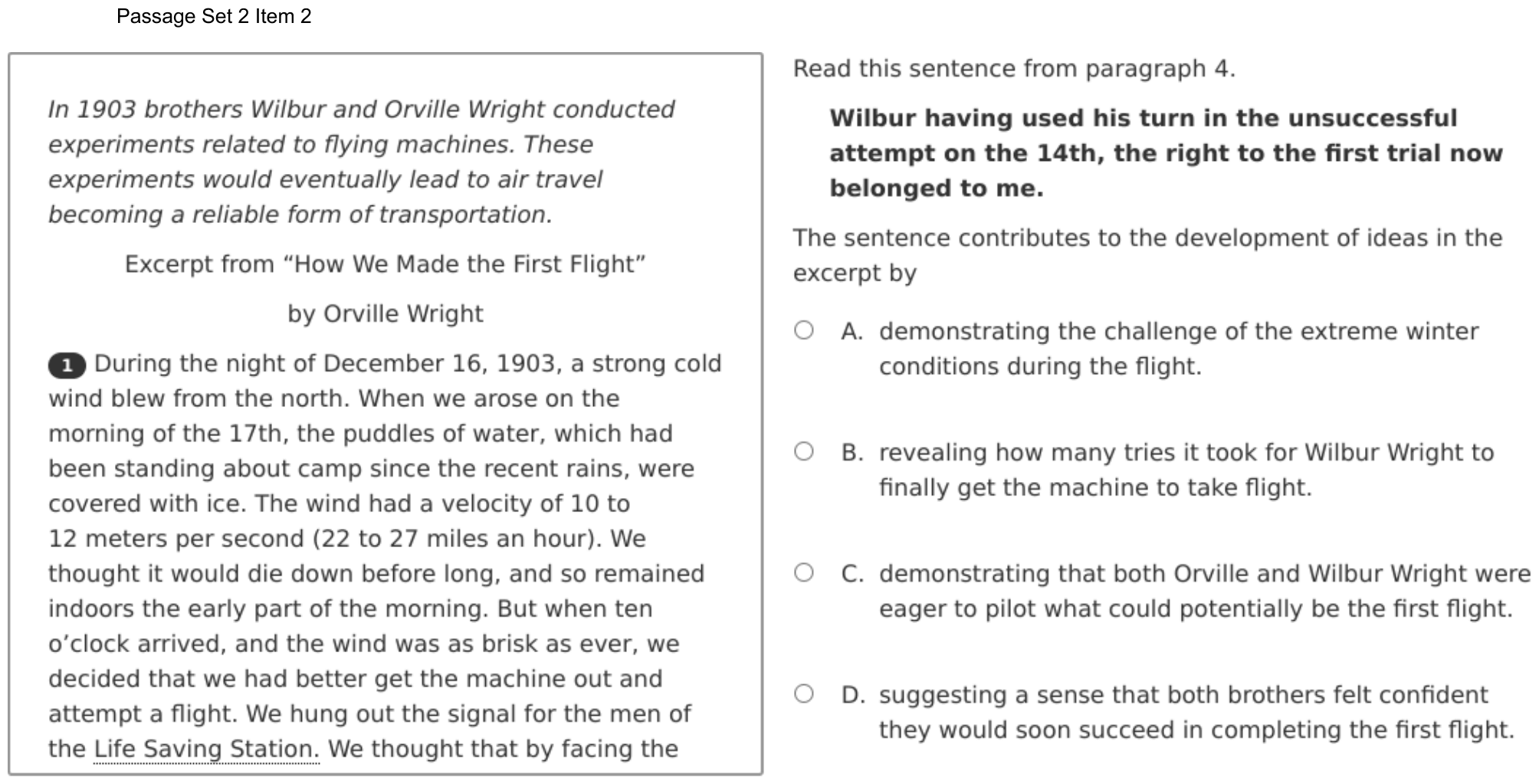
Question 44 of 120
2026 Practice Test D English, question 11Uses the passage above: “Excerpt from “How We Made the First Flight””.
Question
How do the details in paragraph 5 about the uneven nature of the flight convey a central idea of the excerpt?
- Aby explaining how the flawed design of the machine caused it to turn unpredictably in the air and brought the first flight by a person to an abrupt end
- Bby indicating that the difficulty in controlling the flight was caused by the rudimentary instruments of the machine and the inexperience of the pilot
- Cby explaining how the pilot and the plane overcame adverse conditions in order to complete the first piloted flight
- Dby indicating that the gradual change in wind velocity created an extreme environment in which to maneuver the plane and maintain its flight
Show the answer
Correct answer: C
The question asks how the details in paragraph 5 about the uneven nature of the flight convey a central idea of the excerpt.
A. Incorrect. Paragraph 5 explains that the rudder was unbalanced and the effect that this issue had on the flight, but the rudder was only part of the reason for the short flight. The length of the flight is not a central idea of the excerpt.
B. Incorrect. Although paragraph 5 does explain that the equipment contributed to the difficulty of controlling the plane’s flight, the lack of control over the flight is not a central idea of the excerpt, which focuses instead on the Wright brothers’ achievement of a successful flight despite the challenges involved.
C. CORRECT. The details in paragraph 5 describe the difficulties that the weather conditions and mechanical issues presented and how Orville’s flight was successful despite those problems. The Wright brothers’ ability to overcome difficult circumstances and complete the first flight is a central idea of the excerpt.
D. Incorrect. While paragraph 5 does emphasize the difficulty caused by the wind, it does not describe a “gradual change” in the wind, only that it was irregular.
Question analysis
This central-idea question asks how the details in paragraph 5 of Orville Wright’s “How We Made the First Flight,” which describe the machine darting up and down because of uneven air, a hard-to-control front rudder and the pilot’s inexperience, convey a central idea of the excerpt. The paragraph also includes speeds and distances, and students must decide what its details mean for the account as a whole.
- Grade level
- Grade 8 reading and task
- Compared with grade 7
- At grade 7 Linking a paragraph’s details to a central idea is regular grade 7 work. This paragraph is long and technical, with a rudder problem and a calculation of speeds, and most choices restate its problems accurately, so students must decide what the details add up to.
- Estimated difficulty
- Moderate: several steps, or a close reading with one strong distractor.
- Thinking it demands
- Depth of knowledge 2, skills and concepts · mainly understand
- What makes it hard
- The right answer is reworded moderate
- A lot to read minor
- Reading between the lines minor
- Evidence
- Answered from one paragraph or stanza
- Reading level
- Passage: about grade 7, 816 words; question and choices: about grade 12, 115 words.
- Students, last 30 days
- Not enough answers yet to show (it takes 10).
Why it is hard, traps and wrong answers (shows the answer)
Why it is hard
Most of paragraph 5 is about trouble, the uneven air, a rudder balanced too near the center, an inexperienced pilot and a dart that ended the flight, and two wrong choices describe that trouble accurately. What turns the details into a central idea is the paragraph’s last sentence, which calls the 12-second flight the first of its kind in history. Students who stop before it, or who take the problems as the point, miss that the excerpt is a story of success.
The right answer is reworded moderate Choosing the answer
The key’s “overcame adverse conditions” sums up the paragraph in new words, while the wrong choices repeat its own: the rudder’s “tendency to turn itself,” the dart that “ended the flight,” the “lack of experience” and “the velocity of the wind.” (Freedle & Kostin, 1993; Kirsch & Mosenthal, 1990)
A lot to read minor Understanding the question
Paragraph 5 runs about 250 words, and its problems and a 61-word speed calculation all come before the closing sentence, the only one that presents the flight as a success. (Kintsch, 1998; Gorin & Embretson, 2006; Freedle & Kostin, 1993)
Reading between the lines minor Working it out
The paragraph never says anyone overcame anything; students must set its problems beside its last sentence, a machine that “sailed forward” and landed “as high as that from which it started,” to see success despite them. (Graesser, Singer & Trabasso, 1994; Kintsch, 1998)
Strategy: Note what each part of paragraph 5 describes, from its first sentence to its last, then decide what the excerpt as a whole is about and choose the option that ties the two together.
Traps
- Too narrow: A single detail offered as the central idea or a summary, or a summary that keeps minor details and leaves out an essential part.
- True but not the answer: A choice says something accurate about the text that does not answer this question.
- Twists what the text says: Uses the text's topic and ideas but changes what it says: who did it, how much, when, or why.
The wrong answers, classified
A Too narrow (King et al., 2004)
Gets the rudder and the dart that ended the flight right but builds on that one failure, dropping the paragraph’s closing point that the short flight was still history’s first.
B True but not the answer (King et al., 2004; Embretson & Wetzel, 1987)
Restates the paragraph’s own explanation of the erratic course, inexperience and a hard-to-control rudder, which is accurate, but treats the lack of control as the point when the excerpt builds toward success.
D Twists what the text says (King et al., 2004)
Picks up “the velocity of the wind” and the hard flying but invents a “gradual change” in the wind, when the paragraph speaks only of “the irregularity of the air.”
Working it out, step by step
Figure out what the question asks
This is a central idea question. A central idea is a main point of the whole excerpt. Paragraph 5 describes an uneven, bumpy flight. The question asks how those details support a main point. So read the whole paragraph, including its last sentence.
Find the problems in paragraph 5
Paragraph 5 begins “The course of the flight up and down was exceedingly erratic, partly due to the irregularity of the air, and partly to lack of experience in handling this machine.” Erratic means jumpy and hard to predict. The front rudder, a part that steers, was hard to control. The machine “would rise suddenly to about ten feet, and then as suddenly dart for the ground.”
Read the last sentence
Then the paragraph turns. It says “This flight lasted only 12 seconds, but it was nevertheless the first in the history of the world in which a machine carrying a man had raised itself by its own power into the air in full flight.” Nevertheless means “even so.” The wind, the hard steering and the pilot’s inexperience all worked against him. Even so, the flight worked. Conditions that work against you are called adverse.
Check each choice
- A does not fit. The rudder problem and the sudden end are real. But A stops there and misses that the flight was a first.
- B does not fit. Paragraph 5 does blame the rudder and the pilot’s inexperience. But the excerpt is about success, not about the lack of control.
- C fits. The problems show what Orville overcame to make the first flight.
- D does not fit. The paragraph never says the wind changed gradually, or slowly. It speaks of “the irregularity of the air.”
Watch out: B is tempting because it repeats the paragraph’s own reasons for the bumpy flight. But true details are not the same as the main point.
Choose the answer
The problems in paragraph 5 make the success at the end more impressive. So the answer is C, “by explaining how the pilot and the plane overcame adverse conditions in order to complete the first piloted flight.”
Why this answer and not the closest wrong one
B is the closest wrong choice. It is true that the rudder and the pilot’s “lack of experience” made the flight hard to control. But that is only the first part of paragraph 5. The last sentence calls the flight the first of its kind. The problems show what had to be overcome. C ties the details to that success.
More questions like this
The original DOE question
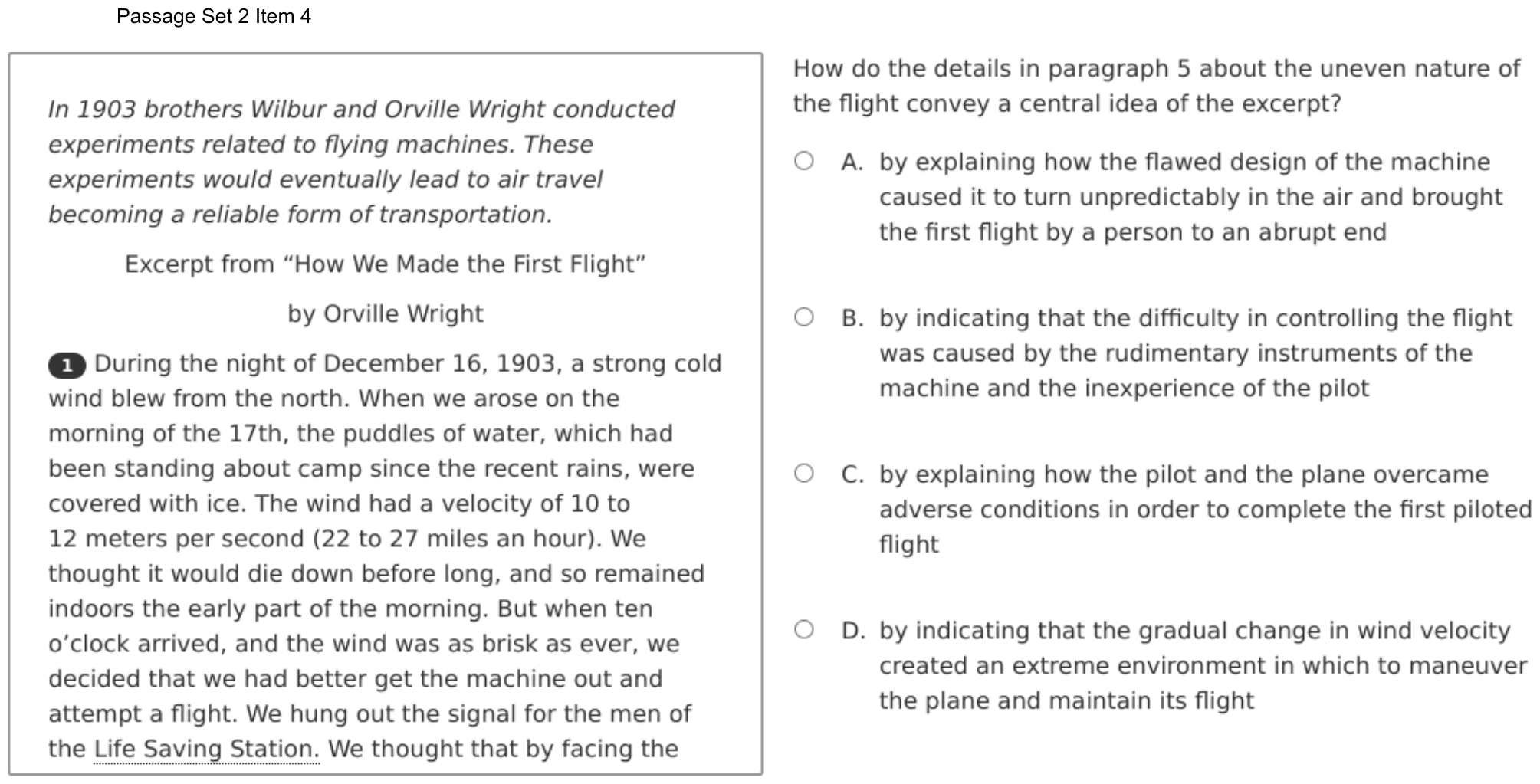
Question 45 of 120
2026 Practice Test D English, question 13Uses the passage above: “Excerpt from “How We Made the First Flight””.
Question
Which sentence from the excerpt best supports the idea that the Wright brothers had to adapt their plans for the flight in order to accommodate the weather conditions?
- A“When we arose on the morning of the 17th, the puddles of water, which had been standing about camp since the recent rains, were covered with ice.” (paragraph 1)
- B“We realized the difficulties of flying in so high a wind, but estimated that the added dangers in flight would be partly compensated for by the slower speed in landing.” (paragraph 1)
- C“After running the motor a few minutes to heat it up, I released the wire that held the machine to the track, and the machine started forward in the wind.” (paragraph 4)
- D“The course of the flight up and down was exceedingly erratic, partly due to the irregularity of the air, and partly to lack of experience in handling this machine.” (paragraph 5)
Show the answer
Correct answer: B
The question asks which sentence from the excerpt best supports the idea that the Wright brothers had to adapt their plans for the flight in order to accommodate weather conditions.
A. Incorrect. Although the sentence from paragraph 1 mentions the rainy weather and frozen puddles, it does not specifically explain how these weather conditions forced the brothers to adapt their plans for the flight.
B. CORRECT. The sentence from paragraph 1 reveals that the Wright brothers adapted by making a risk calculation, based on the wind speed, before the flight. The high speed of the wind could cause difficulties in flight while simultaneously allowing for a slower, more controlled landing.
C. Incorrect. The sentence from paragraph 4 does mention wind, but it describes what Orville was doing during the attempted flight, not the factors he considered before the flight in order to adapt the plan.
D. Incorrect. Although the sentence from paragraph 5 mentions the “irregularity of the air” during the flight, the sentence does not describe how the brothers adapted their plans for the flight based on the weather.
Question analysis
This evidence question on Orville Wright’s account of the first flight asks which sentence best supports the idea that the Wright brothers had to adapt their plans for the flight to the weather conditions. The four quotations come from paragraphs 1, 4 and 5 and all mention ice, wind or air, so students must look past the weather words to what each sentence shows the brothers doing.
- NYS standards
- 7R1 textual evidence and inferences
- Grade level
- Grade 7 reading and task
- Compared with grade 7
- At grade 7 Choosing the sentence that best supports an idea is core grade 7 evidence work. The four quotations are printed in full with their paragraph numbers, and the idea has two parts, weather and a change of plans, so the check is careful but typical.
- Estimated difficulty
- Straightforward: two steps or one careful reading.
- Thinking it demands
- Depth of knowledge 2, skills and concepts · mainly evaluate
- What makes it hard
- Evidence
- Answered from several paragraphs or stanzas
- Reading level
- Passage: about grade 7, 816 words; question and choices: about grade 13, 148 words.
- Students, last 30 days
- Not enough answers yet to show (it takes 10).
Why it is hard, traps and wrong answers (shows the answer)
Why it is hard
The idea has two parts, the weather and a change in the brothers’ plans, and every quotation carries the first. Students who look only for weather words can be drawn to the erratic flight or the launch into the wind. Only one sentence shows the brothers thinking about the wind before they flew and deciding how to proceed, and once the second half of the idea is in view the choice is quick.
Every choice must be checked minor Choosing the answer
All four quotations mention ice, wind or air, so the weather half of the idea rules nothing out; each must be checked for the other half, a decision the brothers made because of it. (Embretson & Wetzel, 1987)
Reading between the lines minor Working it out
The key never says plan or adapt; students must see that weighing “the added dangers in flight” against “the slower speed in landing” is the brothers fitting their decision to the wind. (Graesser, Singer & Trabasso, 1994; Kintsch, 1998)
Strategy: Split the idea into its two parts, the weather and a change in the brothers’ plans, and keep only a quotation that shows both, not one that shows the weather alone.
Traps
- Supports only part of the claim: In a question about evidence: a line that backs one half of the claim but not the other, or a related point rather than the claim itself.
- True but not the answer: A choice says something accurate about the text that does not answer this question.
The wrong answers, classified
A True but not the answer (King et al., 2004; Embretson & Wetzel, 1987)
Picks the frozen puddles as proof of harsh weather, which they are, but the sentence only sets the scene and shows nothing the brothers did or decided because of it.
C Supports only part of the claim (King et al., 2004; Thissen, Steinberg & Fitzpatrick, 1989)
Takes running the motor “to heat it up” and starting “in the wind” as adjustments to the cold, but the sentence narrates the launch and never says a plan changed.
D Supports only part of the claim (King et al., 2004; Thissen, Steinberg & Fitzpatrick, 1989)
Notices “the irregularity of the air” linking the weather to the flight, but this sentence explains why the course was erratic once the machine was up, not how the brothers prepared.
Working it out, step by step
Figure out what the question asks
This asks for the sentence that best supports an idea. The idea has two parts. First, there was bad weather. Second, the brothers had to adapt, or change, their plans because of it. All four choices mention ice, wind or air. So look for the one that also shows a decision.
Check each sentence for both parts
- A shows the weather: icy puddles. But no one decides anything.
- B shows the wind and the brothers’ thinking about it before the flight.
- C describes the launch. It tells what Orville did, not a change of plans.
- D explains why the flight was bumpy once it was in the air. It shows no plan.
Read the sentence that fits
Paragraph 1 says “We realized the difficulties of flying in so high a wind, but estimated that the added dangers in flight would be partly compensated for by the slower speed in landing.” To estimate is to make a careful guess. Compensated for means “made up for.” The brothers knew the strong wind made flying harder. They weighed that against a good effect: a slower landing. Then they decided to fly anyway.
Explain how this shows adapting
The brothers did not just notice the wind. They thought about how it would change the flight, the bad and the good. They also planned on “facing the flyer into a strong wind.” Making plans that fit the weather is what adapting means.
Watch out: D is tempting because it links “the irregularity of the air” to the flight. But it tells what happened during the flight, not how the brothers planned for it.
Choose the answer
Only one sentence shows the brothers fitting their decision to the wind before they flew. So the answer is B, “We realized the difficulties of flying in so high a wind, but estimated that the added dangers in flight would be partly compensated for by the slower speed in landing.”
Why this answer and not the closest wrong one
D is the closest wrong choice. It does connect the weather to the flight. But it describes what happened in the air, after the plans were made. The idea needs the brothers changing plans because of the weather. Only B shows them thinking through the wind’s dangers and benefits before they decided to fly.
More questions like this
The original DOE question
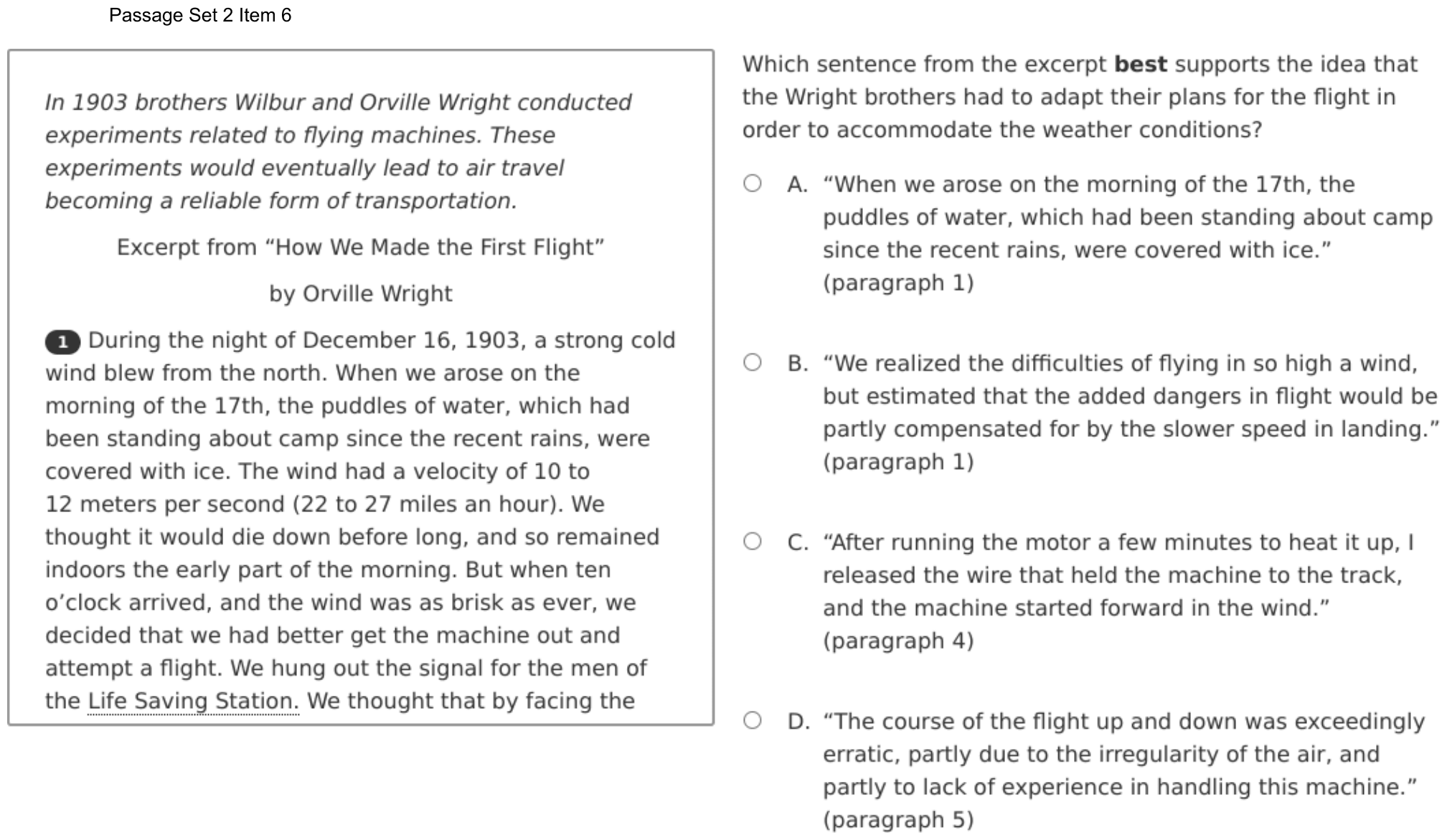
Question 46 of 120
2026 Practice Test D English, question 14Uses the passage above: “Excerpt from “How We Made the First Flight””.
Question
The use of chronological structure contributes to the development of ideas in the excerpt by
- Aoutlining the actions that the Wright brothers took to prepare for and successfully complete the first flight.
- Bidentifying the primary factors that allowed the Wright brothers to overcome obstacles and achieve the first flight.
- Cshowing how the Wright brothers applied lessons learned from their previous flight attempts to accomplish the first flight.
- Ddemonstrating how the Wright brothers analyzed the impact of wind velocity to identify the ideal conditions for the first flight.
Show the answer
Correct answer: A
The question asks how the use of chronological structure contributes to the development of ideas in the excerpt.
A. CORRECT. Through the chronological structure, Orville addresses all stages of the flight in a way that builds from flight concerns and preparations for takeoff to his experiences during the flight and his successful landing.
B. Incorrect. While obstacles are presented within the excerpt, the chronological structure emphasizes the events that ended in the successful achievement of flight on that day rather than how the Wright brothers overcame obstacles.
C. Incorrect. The chronological structure of the excerpt does not show that the Wright brothers applied lessons learned from their previous attempts at flight; instead, the structure describes Orville’s December 17 attempt.
D. Incorrect. While Orville’s narrative certainly shows a strong need to analyze wind speed, this idea is not conveyed through the chronological structure of the excerpt. Additionally, the description of the first flight on December 17 indicates that it did not take place in ideal conditions (“We realized the difficulties of flying in so high a wind” [paragraph 1] and “The course of the flight up and down was exceedingly erratic, partly due to the irregularity of the air” [paragraph 5]).
Question analysis
This text-structure question asks how the chronological structure of Orville Wright’s “How We Made the First Flight,” an account that begins on the night of December 16, 1903, contributes to the development of ideas in the excerpt. Students must see what telling events in time order does for the account. Each choice names a purpose that could suit a story of the first airplane flight.
- Grade level
- Grade 7 reading and task
- Compared with grade 7
- Below grade 7 Grade 7 structure questions often ask how a less obvious pattern, such as problem and solution, shapes ideas. This excerpt is plainly told in time order, with dates and section headings, so recognizing what that order does is a lighter task.
- Estimated difficulty
- Straightforward: two steps or one careful reading.
- Thinking it demands
- Depth of knowledge 2, skills and concepts · mainly analyze
- What makes it hard
- How, not what minor
- A very close wrong answer minor
- Evidence
- Answered from the whole text
- Reading level
- Passage: about grade 7, 816 words; question and choices: about grade 11, 87 words.
- Students, last 30 days
- Not enough answers yet to show (it takes 10).
Why it is hard, traps and wrong answers (shows the answer)
Why it is hard
The excerpt is plainly chronological, with a date in its first sentence and headings that move from “Final Preparations” to “Flight,” so the structure is easy to recognize. The difficulty is in saying what that order does. The strongest pull sounds like the excerpt’s central idea, success over obstacles, but ranking the causes of success is analysis, not sequence, and the other choices invent lessons from the failed attempt on the 14th or a search for ideal winds.
How, not what minor Working it out
The question asks what telling events in time order does, and the excerpt moves from the night of December 16 through laying the track and the launch to the flight, so the structure’s job is to trace those steps. (Anderson & Krathwohl, 2001)
A very close wrong answer minor Choosing the answer
The choice about the primary factors shares the key’s ending, achieving the first flight; it differs in its first half, an analysis of what made success possible, which a time order does not set out. (Embretson & Wetzel, 1987; Gorin & Embretson, 2006; Ascalon et al., 2007)
Strategy: Skim the section headings and the first sentence of each paragraph to see how the excerpt moves through time, then test each choice against what a time order can do.
Traps
- Wrong purpose or structure: Names a purpose, structure or effect that the part does not serve, or describes what a part says when the question asks what it does.
- Twists what the text says: Uses the text's topic and ideas but changes what it says: who did it, how much, when, or why.
- Reads too much in: A reasonable-sounding conclusion that goes further than the text allows.
The wrong answers, classified
B Wrong purpose or structure (Anderson & Krathwohl, 2001)
Expects the structure to explain why the flight succeeded, a fair summary of the excerpt’s message, but time order tells events as they happened and never ranks which factors mattered most.
C Reads too much in (Graesser, Singer & Trabasso, 1994)
Builds on the failed attempt of the 14th and assumes the brothers learned from it, though the excerpt only contrasts that calm start with this windy one.
D Twists what the text says (King et al., 2004)
Recalls the anemometer readings and the risk estimate and turns them into a search for ideal conditions, though the brothers flew in a wind whose difficulties and added dangers they admitted.
Working it out, step by step
Figure out what the question asks
This is a structure question. Chronological structure means telling events in time order, from first to last. The question asks what that order does for the excerpt. So first check how the excerpt moves through time.
Trace the order of events
Look at the section headings and the start of each paragraph.
- Paragraph 1 starts “During the night of December 16, 1903.” The brothers decide to fly.
- Under “Final Preparations,” they lay the track and measure the wind.
- Under “Audacity—and Calculation,” Orville takes off.
- Under “Flight,” the machine flies and lands.
Say what the time order does
The story moves step by step. It goes from getting ready, to taking off, to flying, to landing. Each step leads to the next. By the end, you have followed everything the brothers did to make the first flight happen. The last sentence says the machine “had finally landed at a point as high as that from which it started.”
Check each choice
- A fits. Time order lays out what the brothers did to prepare and then to fly.
- B does not fit. Primary factors are the main causes. Time order tells events as they happen. It does not rank which causes mattered most.
- C does not fit. The excerpt mentions the failed try on the 14th. But it never says what they learned from it.
- D does not fit. They did not wait for ideal, or perfect, conditions. They flew in a strong wind and knew its dangers.
Watch out: B is tempting because the excerpt does show success over problems. But naming the main causes of success is a different job from telling events in order.
Choose the answer
The time order walks you through the preparations, the takeoff and the flight. So the answer is A, “outlining the actions that the Wright brothers took to prepare for and successfully complete the first flight.”
Why this answer and not the closest wrong one
B is the closest wrong choice. The excerpt does show the brothers succeeding despite problems. But time order cannot explain which factors mattered most. It just tells events in the order they happened. That is what A says: the time order outlines the actions, from getting ready to completing the flight.
More questions like this
The original DOE question
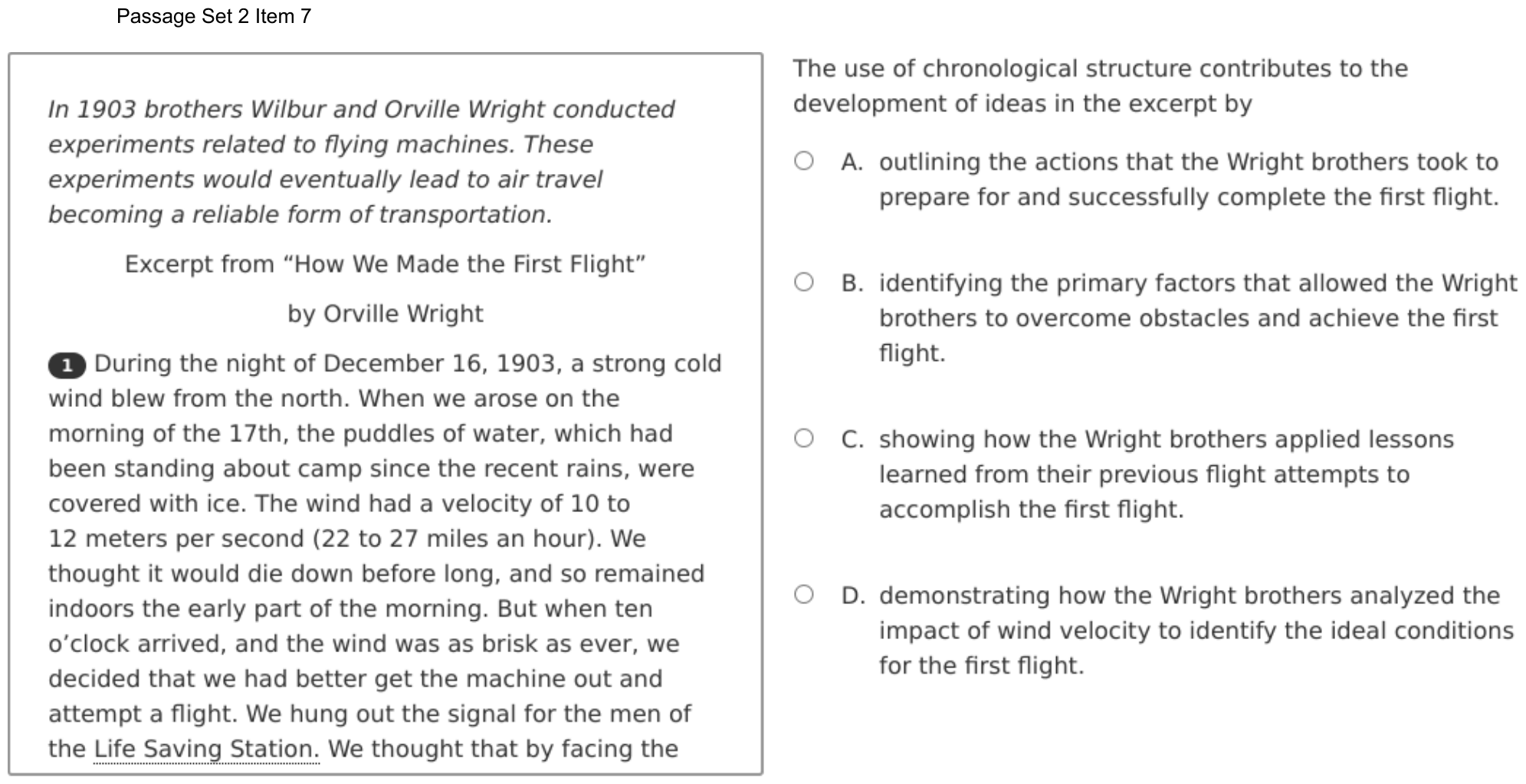
Question 47 of 120
2026 Practice Test D English, question 21Passage Ode to Fireworks
Ode to Fireworks
In autumn my mother drove us to the edge of the field
where the fair was set up year after year:
the carousel, the bumper cars, the long, low sheds
filled with prizewinning animals.
We—my sister, my cousin, and I—were ready for bed,
already in our pajamas. This was a treat we waited
all year for. We waited in the darkness
for the first low, dull thwumps, like someone
beating an old, filthy rug hung on a wash line.
Then we counted the seconds between the lightning
and thunder, as we also used to do, until the sky
lit up: red, blue, green, gold. In my mind’s eye
I can still see the straggly, ancient oak whose branches
reached up past the exhibition halls, silhouetted
against the spectrum of stars that cascaded behind it.
It was one thing to look up into the sky
and imagine yourself in it or to make out pictures
among the clouds, which my sister liked to do.
No, I would tell her, that cloud
does not look like an elephant, a hat, an umbrella.
But it was another thing to see
the sky at night written upon
with those jewels. (We lived in the country:
night was night.) All around us, crickets
stridulated in the stubble of what had been
somebody’s cornfield, their song rising and falling.
You could smell winter on the air’s edge.
Now, in the city, when the sky dips into shadow
at New Year’s or on the Fourth of July, I find myself
craning my neck upward at odd moments.
The city sky is always lit up. This is where we live now,
and it is how we live now, awash in light
of every hue. Everything is a constant celebration:
picking up washing at the cleaner’s or stopping by
the corner market for a loaf of heavy bread.
And the music around me is the music of people,
their voices rising and falling in a hundred languages.
But beneath the yellowish glow deep in the sky
of all our city lights pelting out into the universe,
I remember the feel of the pickup truck bumping
across the ridged field, as I kept waiting for those
childhood bursts, watching as they escorted us home.
Question
The comparison in lines 8–9 of the poem is used to convey
- Athe muffled pounding of explosions in the distance.
- Bthe way lightning streaks through the clouds.
- Cthe echoes of thunder on an autumn night.
- Dthe glow of sparks falling from the sky.
Show the answer
Correct answer: A
The question asks what the comparison in lines 8–9 of the poem is used to convey.
A. CORRECT. In lines 8–9 the speaker compares the deep thumping noises at the start of a fireworks show to the muffled thumping sound made when beating a rug to clean it. The imagery of “low, dull thwumps” (line 8) (onomatopoeia) describes a sound that is not clear or powerful. To the speaker, these low, distant explosions are the signal that the fireworks display is starting and that the loud, cracking sound of fireworks will be heard soon (“Then we counted the seconds between the lightning / and thunder” [lines 10–11]).
B. Incorrect. The comparison in lines 8–9 deals with the low sound of the first fireworks shooting off rather than the streaks of light they emit. To the speaker, the low thwumps (onomatopoeia) are the signal that fireworks are about to explode overhead, much like the way a streak of lightning during a storm indicates that a crash of thunder will follow in a few seconds.
C. Incorrect. The thwump (onomatopoeia) sounds are the start of the fireworks show, not thunder. As a comparison, the speaker says the initial thwumps of the fireworks signal anticipation for the full explosion that will come, much like the way the speaker would watch for lightning and count the seconds before an impending thunderclap (lines 10–11).
D. Incorrect. The muffled thwump (onomatopoeia) sounds occur before the dazzling explosion of lights and before sparks start to fall from the sky. The comparison focuses on the sounds of the experience, not the sight of the experience.
Question analysis
This figurative language question asks what the comparison in lines 8–9 of “Ode to Fireworks” conveys. In the poem an adult speaker remembers waiting with family, already in pajamas, for the fireworks at a country fair. Students must interpret an old-fashioned household image and decide what part of the show it describes, since the nearby lines mention sights as well as sounds.
- Grade level
- Grade 6 reading and task
- Compared with grade 7
- Below grade 7 Interpreting a simile is taught from grade 6, and this one takes up two lines of concrete words. The household chore it pictures may be unfamiliar, but the task is a single step, lighter than typical grade 7 poetry work.
- Estimated difficulty
- Straightforward: two steps or one careful reading.
- Thinking it demands
- Depth of knowledge 2, skills and concepts · mainly understand
- What makes it hard
- Evidence
- Answered from one sentence or line
- Reading level
- Passage: 379 words (a poem; reading level not measured); question and choices: about grade 3, 42 words.
- Students, last 30 days
- Not enough answers yet to show (it takes 10).
Why it is hard, traps and wrong answers (shows the answer)
Why it is hard
The comparison is about sound, and once students notice that, the sight-based choices about lightning and sparks fall away. The pull comes from the next lines, where the children count “the seconds between the lightning / and thunder,” a storm game that makes thunder seem like the thing being described. The question rewards staying inside lines 8–9, where “low, dull” and the beaten rug describe the first faint booms of the show.
Figurative or literary language moderate Understanding the question
Lines 8–9 pair the made-up sound word “thwumps” with a simile, someone beating an old rug on a wash line, so students must hear a dull, distant thud in an image about housework. (Graesser, Singer & Trabasso, 1994; Kintsch, 1998)
Something you must already know minor Working it out
The simile works only for readers who can imagine the flat whack of a rug being beaten clean on a line, a chore many students have never seen or heard. (Anderson & Krathwohl, 2001)
Strategy: Reread lines 8–9 slowly and ask which sense the comparison appeals to, sight, sound or touch, then pick the choice that describes that same experience.
Traps
- Taking figurative language literally: A choice reads a figure of speech or image at face value.
- Wrong part of the text: A choice is true of another paragraph, stanza or speaker than the one asked about.
The wrong answers, classified
B Wrong part of the text (Kirsch & Mosenthal, 1990)
Jumps to the “lightning” of line 10, but lines 8–9 come before the sky lights up and describe something heard in the darkness, not a streak of light.
C Taking figurative language literally (Graesser, Singer & Trabasso, 1994)
Takes the “lightning / and thunder” of lines 10–11 as a real storm and hears the thwumps as thunder, though the counting game only likens the fireworks to one.
D Wrong part of the text (Kirsch & Mosenthal, 1990)
Pictures the colors of lines 12–15, “red, blue, green, gold,” but the rug-beating image describes a dull sound heard before any sparks appear in the sky.
Working it out, step by step
Figure out what the question asks
This asks what a comparison helps you picture. Lines 8–9 compare one thing to another using “like.” That kind of comparison is called a simile. First ask which sense it describes: sight, sound or touch.
Find the comparison
The family waits in the dark. Lines 8–9 say they wait “for the first low, dull thwumps, like someone / beating an old, filthy rug hung on a wash line.” Thwumps is a made-up word that sounds like the noise it names. So the comparison is about a sound. It comes before the sky lights up.
Picture the rug
People used to hang a dusty rug on a line and hit it with a stick. Each hit makes a flat, soft thud, not a sharp bang. The words “low” and “dull” say the same thing. So the first fireworks sound like soft booms far away. Muffled means soft, as if wrapped in cloth.
Check each choice
- A is right. Dull thuds heard in the dark are the muffled pounding of explosions far off.
- B is wrong. Lightning is something you see. Lines 8–9 describe a sound heard before anything lights up.
- C is wrong. The thunder in lines 10–11 is part of a counting game. It compares the show to a storm. The rug image is about the fireworks.
- D is wrong. Sparks are something you see. The colors don’t come until line 12.
Watch out: Lines 10–11 mention “lightning” and “thunder.” That can make C look right. But the rug comparison comes first and is about the fireworks.
Choose the answer
The rug-beating simile makes the first fireworks sound like soft, faraway thuds. So the answer is A, “the muffled pounding of explosions in the distance.”
Why this answer and not the closest wrong one
C is the closest wrong answer, because thunder is a low boom too. But lines 10–11 only compare the show to a storm in a counting game. The rug image in lines 8–9 describes the fireworks themselves: dull, muffled thuds from far away. That is A.
More questions like this
The original DOE question
The passage “Ode to Fireworks” as printed (page 32)
Question 48 of 120
2026 Practice Test D English, question 22Uses the passage above: “Ode to Fireworks”.
Question
Read lines 22–23 from the poem.
the sky at night written upon
with those jewels.
What does the word choice in these lines convey about the speaker?
- AThe speaker values material possessions.
- BThe speaker imagines that the fireworks are magical.
- CThe speaker believes that the country setting is distinctive.
- DThe speaker cherishes the memory of seeing fireworks as a child.
Show the answer
Correct answer: D
The question asks what the word choice in lines 22–23 of the poem conveys about the speaker.
A. Incorrect. The word “jewels” is used figuratively to indicate the sentimental value that the experience of watching the fireworks holds for the speaker. There is no indication in the poem that the speaker values material possessions.
B. Incorrect. The use of the word “jewels” highlights the importance of the memory in the speaker’s mind. The imagery in the words “written upon” expresses the way the bright streaks of light curve and fly across the night sky, not that the speaker views the fireworks display as magical.
C. Incorrect. The speaker describes the elements of the fireworks display that stand out most clearly. The view of the bright, colorful fireworks streaking across the sky is distinct, but it is not unique to the country setting.
D. CORRECT. The word “jewels” creates a picture of watching shining and sparkling explosions in the night sky and suggests that this experience holds sentimental and emotional value for the speaker. The speaker cherishes the memory of the experience.
Question analysis
This question quotes lines 22–23 of “Ode to Fireworks,” in which the night sky is “written upon / with those jewels,” and asks what this word choice conveys about the speaker. Students must move from a striking metaphor for fireworks to what it reveals about the person describing them, and every choice names a different value or belief.
- Grade level
- Grade 7 reading and task
- Compared with grade 7
- At grade 7 Reading a speaker’s feelings through connotation is standard grade 7 work. The two lines are short and quoted, but the metaphor is compressed and the choices name abstract attitudes, so one careful inference is needed, as in typical grade 7 poetry.
- Estimated difficulty
- Moderate: several steps, or a close reading with one strong distractor.
- Thinking it demands
- Depth of knowledge 2, skills and concepts · mainly analyze
- What makes it hard
- Figurative or literary language moderate
- Reading between the lines moderate
- Evidence
- Answered from several paragraphs or stanzas
- Reading level
- Passage: 379 words (a poem; reading level not measured); question and choices: about grade 6, 59 words.
- Students, last 30 days
- Not enough answers yet to show (it takes 10).
Why it is hard, traps and wrong answers (shows the answer)
Why it is hard
The quoted lines are short, but the answer depends on what “jewels” suggests about the speaker, so students must move from an image to an attitude. The strongest pull comes from the words right after, where the speaker stresses that night in the country was truly dark, a real point but one about the setting, not about the jewel image. Students who take the gems literally or as magic stop at the surface of the metaphor instead of asking why someone would call a memory precious.
Figurative or literary language moderate Understanding the question
Lines 22–23 turn fireworks into “jewels” and the sky into a page “written upon,” a metaphor whose meaning lies in what jewels are worth to a person, not in what they are. (Graesser, Singer & Trabasso, 1994; Kintsch, 1998)
Reading between the lines moderate Working it out
The lines name no feeling; that the speaker cherishes the memory must be inferred from calling the fireworks “jewels” and from the speaker still craning upward for them years later in the city. (Graesser, Singer & Trabasso, 1994; Kintsch, 1998)
Strategy: Ask what “jewels” suggests beyond its literal meaning, picture the sky “written upon,” and then pick the attitude that fits both these lines and the poem as a whole.
Traps
- Wrong part of the text: A choice is true of another paragraph, stanza or speaker than the one asked about.
- Reads too much in: A reasonable-sounding conclusion that goes further than the text allows.
- Taking figurative language literally: A choice reads a figure of speech or image at face value.
The wrong answers, classified
A Taking figurative language literally (Graesser, Singer & Trabasso, 1994)
Takes “jewels” at face value, as valuable possessions, though the word describes fireworks in the sky and nothing in the poem is about owning things.
B Reads too much in (Graesser, Singer & Trabasso, 1994)
Sees the sky being “written upon” with gems as a fantasy and calls it magic, though the speaker describes real fireworks watched from a field with family.
C Wrong part of the text (Kirsch & Mosenthal, 1990)
Is drawn by the parenthesis that follows, “We lived in the country,” which does stress the setting, but the jewel image itself says nothing about the country.
Working it out, step by step
Figure out what the question asks
This asks what a word choice shows about the speaker. The speaker is the “I” who tells the poem. Look past what the words say. Ask what feeling they show.
Find the lines
In stanza 2, the speaker says “it was another thing to see / the sky at night written upon / with those jewels.” A stanza is a group of lines in a poem, like a paragraph. The jewels are the fireworks. The sky is like a page they write on.
Think about what jewels mean
Calling fireworks jewels is a metaphor: a comparison without “like” or “as.” Jewels are rare, bright and precious. People keep them safe and treasure them. So the word shows how much the sight meant to the speaker. Even now, in the city, the speaker says “I find myself / craning my neck upward at odd moments.” Craning means stretching your neck to look.
Check each choice
- A is wrong. The jewels are fireworks, not things the speaker owns.
- B is wrong. The speaker watched real fireworks from a field with family. Nothing calls them magic.
- C is wrong. The next words, “We lived in the country,” do stress the setting. But the jewel image itself is about how precious the sight was.
- D is right. To cherish is to treasure and hold dear. Jewels are treasures.
Watch out: C is tempting because the country comes up right after the jewels. Keep your eyes on lines 22–23 themselves.
Choose the answer
Calling the fireworks jewels shows a treasured childhood memory. So the answer is D, “The speaker cherishes the memory of seeing fireworks as a child.”
Why this answer and not the closest wrong one
C is the closest wrong answer. The poem does say they lived in the country, where night was truly dark. But that is the next thought, not the jewel image. Jewels are treasures. They show how much the speaker valued the sight. D says just that: the speaker treasures the memory.
More questions like this
The original DOE question
Question 49 of 120
2026 Practice Test D English, question 23Uses the passage above: “Ode to Fireworks”.
Question
The use of italics on the word “night” in line 24 is most likely intended to emphasize the
- Asense of mystery in the darkness.
- Bsense of absolute darkness.
- Cspeaker’s fear of night.
- Dspeaker’s certainty about that night.
Show the answer
Correct answer: B
The question asks what the use of italics on the word “night” in line 24 is most likely intended to emphasize.
A. Incorrect. The purpose of italicizing the word “night” is not to convey mystery. While the speaker refers to not knowing the exact location where the firework viewing took place (“in the stubble of what had been / somebody’s cornfield” [lines 25–26]), the emphasis on “night” is meant to highlight the darkness and contrast the bright light from the fireworks soaring across the sky.
B. CORRECT. The italics are intended to place emphasis on one key aspect of nighttime—total darkness. The speaker is making a point that night in the country was truly dark, unlike the night the speaker currently experiences in a city, where light emitted from buildings and vehicles prevents complete darkness.
C. Incorrect. The tone in the second stanza is positive, showing admiration for the beauty visible in true darkness rather than fear: “But it was another thing to see / the sky at night written upon / with those jewels” (lines 21–23).
D. Incorrect. The speaker is talking about the general experience of watching fireworks on several occasions, not focusing on the events of a specific night. The use of italics on the word “night” emphasizes the speaker’s memory of the persistent darkness.
Question analysis
In “Ode to Fireworks,” the word “night” is printed in italics in line 24, inside the speaker’s aside about living in the country. This craft question asks what the italics are most likely meant to emphasize, so students must think about what stressing one ordinary word does and choose among moods and meanings the word could carry.
- Grade level
- Grade 7 reading and task
- Compared with grade 7
- At grade 7 Grade 7 students explain how word choice shapes meaning; here the device is italics on one everyday word, which is studied less often. The surrounding lines are plain, so a single careful inference settles it, a typical grade 7 demand.
- Estimated difficulty
- Moderate: several steps, or a close reading with one strong distractor.
- Thinking it demands
- Depth of knowledge 2, skills and concepts · mainly analyze
- What makes it hard
- How, not what moderate
- A very close wrong answer moderate
- Evidence in several places minor
- Evidence
- Answered from one paragraph or stanza
- Reading level
- Passage: 379 words (a poem; reading level not measured); question and choices: about grade 5, 36 words.
- Students, last 30 days
- Not enough answers yet to show (it takes 10).
Why it is hard, traps and wrong answers (shows the answer)
Why it is hard
One plain word in a parenthesis carries the question, and its meaning comes from the stress, not the dictionary. Darkness is easy to see; the harder step is choosing what the italics add to it, and mystery is a familiar partner for darkness that the stanza never develops. Students who read on to the brightly lit city of the third stanza see that the speaker is insisting on how complete the country dark was.
How, not what moderate Working it out
The stem asks what italics do, not what a word means, so students must hear the stress in “night was night” as insisting that the country night was fully dark, as night should be. (Anderson & Krathwohl, 2001)
A very close wrong answer moderate Choosing the answer
The mystery choice and the key both tie the italics to darkness; they differ only in what the darkness carries, a sense of mystery or its sheer completeness. (Embretson & Wetzel, 1987; Gorin & Embretson, 2006; Ascalon et al., 2007)
Evidence in several places minor Working it out
The point of the stress becomes clear from the third stanza, where “The city sky is always lit up” and the speaker now lives “awash in light / of every hue.” (Kirsch & Mosenthal, 1990; Gorin & Embretson, 2006)
Strategy: Read line 24 aloud, stressing “night” as the italics do, and ask what the speaker insists on about nights in the country; then check whether the rest of the poem backs that reading.
Traps
- Reads too much in: A reasonable-sounding conclusion that goes further than the text allows.
- Wrong tone or attitude: Misjudges the tone, attitude or point of view, such as reading admiration as criticism, or taking a character's or subject's feelings for the author's.
- Wrong purpose or structure: Names a purpose, structure or effect that the part does not serve, or describes what a part says when the question asks what it does.
The wrong answers, classified
A Reads too much in (Graesser, Singer & Trabasso, 1994)
Links darkness with mystery, a common pairing, but nothing in the stanza is hidden or puzzling; the stress falls on how dark the country night was.
C Wrong tone or attitude (Graesser, Singer & Trabasso, 1994)
Assumes a child out in the dark must be afraid, but the stanza is full of wonder, with “jewels” in the sky and crickets singing, and shows no fear.
D Wrong purpose or structure (Anderson & Krathwohl, 2001)
Knows italics can mark insistence but reads “night” as one particular evening, though the speaker means country nights in general, at a fair held “year after year.”
Working it out, step by step
Figure out what the question asks
This asks why one word is in italics. Italics are slanted letters. Writers use them to stress a word, the way you would say it louder. So ask what the speaker insists on.
Read the line aloud
Lines 23–24 say “(We lived in the country: / night was night.)” Read it aloud and lean on the second “night.” It means night was really night. It was as dark as night should be, with no city lights.
Use the rest of the poem
Stanza 3 shows the opposite. “The city sky is always lit up.” The speaker now lives “awash in light / of every hue.” Awash means flooded. A hue is a color. So the italics stress how completely dark the country night was. That darkness made the fireworks stand out.
Check each choice
- A is wrong. Darkness can feel mysterious. But nothing in the stanza is hidden or puzzling.
- B is right. Absolute means total. The italics stress that the dark was total.
- C is wrong. The speaker shows wonder, not fear. The sky is full of “jewels.”
- D is wrong. “That night” would mean one evening. The speaker means country nights in general, at a fair held “year after year.”
Watch out: A pairs darkness with mystery, which feels natural. But the speaker stresses how dark it was, not that it felt strange.
Choose the answer
The italics insist that country nights were fully dark. So the answer is B, “sense of absolute darkness.”
Why this answer and not the closest wrong one
A is the closest wrong answer, since both A and B link the italics to darkness. But the stanza never treats the night as strange or secret. The bright city sky in stanza 3 shows what the stress is for: country nights were completely dark. That is B.
More questions like this
The original DOE question
Question 50 of 120
2026 Practice Test D English, question 24Uses the passage above: “Ode to Fireworks”.
Question
What is the purpose of the repeated words “rising and falling” in lines 26 and 37?
- Ato create a distinction between solitude and meaningful interaction
- Bto demonstrate a connection between the speaker’s past and present
- Cto emphasize the speaker’s attention to the surrounding sounds
- Dto compare the fireworks to common sights and sounds
Show the answer
Correct answer: B
The question asks what the purpose is of the repeated words “rising and falling” in lines 26 and 37.
A. Incorrect. These lines do not provide insight into the speaker’s interactions or feelings of solitude. The speaker mentions the emptiness of the country and the crowds in the city, but these repeated words are meant to draw a connection between the locations rather than show differences between them.
B. CORRECT. The first mention of these words occurs during a recollection of the speaker’s past, and the second takes place during a description of the speaker’s present. The speaker looks to the connections between the country setting (“All around us, crickets / stridulated in the stubble of what had been / somebody’s cornfield, their song rising and falling” [lines 24–26]) and the city setting (“And the music around me is the music of people, / their voices rising and falling in a hundred languages” [lines 36–37]) as a source of comfort.
C. Incorrect. Even though the lines call out specific sounds, the purpose of the repetition of the words in the two parts of the poem is to show how the speaker connects the two settings. The “rising and falling” of the sounds is one detail the speaker highlights.
D. Incorrect. The repetition of the words “rising and falling” is used to compare the different locations in the speaker’s life, not to compare fireworks to the sounds of crickets in the country or to the sounds of people moving and talking in the city.
Question analysis
The phrase “rising and falling” appears twice in “Ode to Fireworks,” in line 26 for the crickets’ song and in line 37 for people’s voices. This question asks for the purpose of repeating it, so students must compare the two places where it appears and decide what the echo does for the poem as a whole.
- Grade level
- Grade 7 reading and task
- Compared with grade 7
- At grade 7 Grade 7 students analyze how a poem’s structure develops its meaning. The repeated words are easy to spot, but they sit eleven lines apart in different stanzas, and the four purposes offered each sound possible, a typical grade 7 structure task.
- Estimated difficulty
- Moderate: several steps, or a close reading with one strong distractor.
- Thinking it demands
- Depth of knowledge 2, skills and concepts · mainly analyze
- What makes it hard
- How, not what moderate
- Evidence in several places moderate
- Evidence
- Answered from several paragraphs or stanzas
- Reading level
- Passage: 379 words (a poem; reading level not measured); question and choices: about grade 8, 51 words.
- Corrected from the DOE handbook
- The DOE printed this question’s explanation after a different question; the site matches the question with its own explanation.
- Students, last 30 days
- Not enough answers yet to show (it takes 10).
Why it is hard, traps and wrong answers (shows the answer)
Why it is hard
The repeated words are easy to find; the work is seeing that they sit on either side of the poem’s turn from childhood memory to city life. The strongest pull is the accurate observation that both lines describe sounds, which tells what the lines say rather than why the poet repeats them. The country and city are contrasted elsewhere in the poem, so a choice built on a contrast also tempts, though repeating the same words joins the two scenes instead of separating them.
How, not what moderate Working it out
The stem asks for the purpose of a repetition, so it is not enough to see that both lines describe sounds; students must say what echoing “rising and falling” does for the poem. (Anderson & Krathwohl, 2001)
Evidence in several places moderate Working it out
The two uses sit eleven lines apart in different stanzas, the crickets’ song in the remembered country field and city voices “in a hundred languages” in the present, and must be read together. (Kirsch & Mosenthal, 1990; Gorin & Embretson, 2006)
Strategy: Reread the lines around each use of “rising and falling,” describe each scene in a phrase, and ask what echoing the same words in both scenes accomplishes for the poem.
Traps
- Wrong purpose or structure: Names a purpose, structure or effect that the part does not serve, or describes what a part says when the question asks what it does.
- Reads too much in: A reasonable-sounding conclusion that goes further than the text allows.
- Twists what the text says: Uses the text's topic and ideas but changes what it says: who did it, how much, when, or why.
The wrong answers, classified
A Reads too much in (Graesser, Singer & Trabasso, 1994)
Reads solitude into the country scene and company into the city, though the speaker watched with a mother, sister and cousin, and the repeated words link the scenes.
C Wrong purpose or structure (Anderson & Krathwohl, 2001)
Notices that both lines describe sounds, the crickets’ song and people’s voices, which is true, but that is what the lines say, not why the words are repeated.
D Twists what the text says (King et al., 2004)
Assumes the repetition must refer to the fireworks of the title, though “rising and falling” describes crickets and voices and compares neither one to fireworks.
What was corrected from the DOE handbook, and why
- Explanation: In the DOE’s explanations appendix, the explanation printed after this question belongs to question 25 (“how the memory in lines 41–42 affects the speaker”) and marks D correct, and this question’s explanation (“what the purpose is of the repeated words ‘rising and falling’ in lines 26 and 37”) is printed after question 25, marking B correct. Read page by page, the appendix gives this question the answer D. The site gives the question the explanation that restates it, and the answer follows that explanation: B, because the words join the crickets’ song of the speaker’s country childhood (line 26) to the voices of the city in the present (line 37).
Working it out, step by step
Figure out what the question asks
This asks about purpose: why the poet repeats the words “rising and falling.” Don’t just say what the lines describe. Ask what repeating the same words does for the poem.
Find both uses
The first is in line 26, in the country of the speaker’s childhood. Crickets “stridulated in the stubble of what had been / somebody’s cornfield, their song rising and falling.” To stridulate is to chirp by rubbing body parts together. The second is in line 37, in the city today: “their voices rising and falling in a hundred languages.”
See what the repeat does
The two uses sit on either side of the poem’s big turn. Stanza 2 is the past in the country. Stanza 3 is the present in the city. The crickets’ song then and people’s voices now rise and fall alike. Using the same words in both places links the two times. So the repeat ties the speaker’s past to the present.
Check each choice
- A is wrong. Solitude means being alone. But the speaker was with family in the country. And the repeat joins the scenes. It does not set them apart.
- B is right. The same words join a childhood scene to a scene from now.
- C is wrong. Both lines do describe sounds. But that is what the lines say, not why the words repeat.
- D is wrong. The words describe crickets and voices. Neither is compared to fireworks.
Watch out: C is true, which makes it tempting. But a purpose question asks why, not what.
Choose the answer
The repeated words link the country past to the city present. So the answer is B, “to demonstrate a connection between the speaker’s past and present.”
Why this answer and not the closest wrong one
C is the closest wrong answer. It is true that both lines describe sounds the speaker hears. But the question asks for the purpose. The crickets belong to the speaker’s past, and the voices to the present. Repeating “rising and falling” joins the two times. That connection is B.
More questions like this
The original DOE question
Question 51 of 120
2026 Practice Test D English, question 25Uses the passage above: “Ode to Fireworks”.
Question
Read lines 41–42 from the poem.
I kept waiting for those
childhood bursts, watching as they escorted us home.
How does this memory affect the speaker?
- AThe speaker believes it is impossible to ever return to a place in the past.
- BThe speaker is still amused by the impatience felt during fireworks displays.
- CThe speaker now regrets abandoning the rural way of life.
- DThe speaker feels a sense of comfort when reflecting on the past.
Show the answer
Correct answer: D
The question asks how the memory in lines 41–42 affects the speaker.
A. Incorrect. The speaker does not express concern in these lines about the impossibility of returning to childhood or the past. For the speaker, the past and the memories associated with it are a source of comfort and a way to remember simpler times (“I remember the feel of the pickup truck bumping / across the ridged field” [lines 40–41]).
B. Incorrect. While the speaker recalls anticipation before the start of a fireworks display, there is no hint that the speaker is impatient. Particularly in lines 41–42, the speaker is reminded of the expectation of hearing and seeing fireworks and the sense of simple contentment felt in the experience (“I find myself / craning my neck upward at odd moments” [lines 29–30]).
C. Incorrect. The speaker is reflecting on past experiences and pointing out the elements of the city that remind the speaker of these past experiences. The speaker acknowledges the differences between the country and city settings but does not convey regret for leaving the rural area (“This is where we live now, / and it is how we live now, awash in light / of every hue” [lines 31–33]).
D. CORRECT. The memory of watching the fireworks on the way home creates a sense of comfort that stays with the speaker (“escorted us home”). The speaker looks forward to moments when the youthful experience (“childhood bursts”) of being excited by something like a fireworks display can be a source of happiness.
Question analysis
This question quotes the last lines of “Ode to Fireworks,” where the adult speaker, now living in the city, recalls waiting for the “childhood bursts” that “escorted us home,” and asks how this memory affects the speaker. Students must read the feeling in a brief closing image and check each choice against the whole final stanza about city life.
- Grade level
- Grade 7 reading and task
- Compared with grade 7
- At grade 7 Inferring how an experience affects a speaker is regular grade 7 work. The two quoted lines are plain, but the feeling behind them is implied rather than named, and the choices offer four believable reactions to a memory.
- Estimated difficulty
- Moderate: several steps, or a close reading with one strong distractor.
- Thinking it demands
- Depth of knowledge 2, skills and concepts · mainly understand
- What makes it hard
- Reading between the lines moderate
- Evidence in several places minor
- Figurative or literary language minor
- Evidence
- Answered from one paragraph or stanza
- Reading level
- Passage: 379 words (a poem; reading level not measured); question and choices: about grade 6, 74 words.
- Corrected from the DOE handbook
- The DOE printed this question’s explanation after a different question; the site matches the question with its own explanation.
- Students, last 30 days
- Not enough answers yet to show (it takes 10).
Why it is hard, traps and wrong answers (shows the answer)
Why it is hard
The memory is warm, but warm memories of a lost place are easy to read as sadness, and the choice about regretting the move to the city draws students who hear nostalgia as complaint. The other wrong choices turn the anticipation of “kept waiting” into impatience or make the past impossible to reach, both stronger than anything the lines say. Students who read the whole sentence from “But beneath the yellowish glow” see a speaker carried home by the memory, not mourning it.
Reading between the lines moderate Working it out
Lines 41–42 name no feeling, so the comfort must be read from fireworks that “escorted us home” and from the grown speaker still waiting for “those / childhood bursts” in the city. (Graesser, Singer & Trabasso, 1994; Kintsch, 1998)
Evidence in several places minor Working it out
Ruling out regret takes the rest of the third stanza, where city life is “a constant celebration” and “This is where we live now” is said without complaint. (Kirsch & Mosenthal, 1990; Gorin & Embretson, 2006)
Figurative or literary language minor Understanding the question
“Escorted us home” makes the fireworks companions guarding the family’s drive across the field, a personification that carries the sense of safety the question asks about. (Graesser, Singer & Trabasso, 1994; Kintsch, 1998)
Strategy: Read lines 38–42 as one sentence, starting from “But beneath the yellowish glow,” and ask how the speaker feels about the city and about the memory, using the whole third stanza, before choosing.
Traps
- Wrong tone or attitude: Misjudges the tone, attitude or point of view, such as reading admiration as criticism, or taking a character's or subject's feelings for the author's.
- Too broad or too strong: A choice overstates, generalizes, or uses absolute words the text does not support.
- Twists what the text says: Uses the text's topic and ideas but changes what it says: who did it, how much, when, or why.
The wrong answers, classified
A Too broad or too strong (King et al., 2004)
Turns a speaker who looks back into one mourning a place for good, with the absolute “impossible to ever return,” though the poem never says so and keeps the memory alive.
B Twists what the text says (King et al., 2004)
Turns the eager waiting of “kept waiting for those / childhood bursts” into impatience and adds amusement, though nothing in the lines is treated as funny.
C Wrong tone or attitude (Graesser, Singer & Trabasso, 1994)
Reads the speaker’s longing for the country as regret for leaving it, though the third stanza calls city life “a constant celebration” and never wishes the move undone.
What was corrected from the DOE handbook, and why
- Explanation: In the DOE’s explanations appendix, the explanation printed after this question belongs to question 24 (“what the purpose is of the repeated words ‘rising and falling’ in lines 26 and 37”) and marks B correct, and this question’s explanation (“how the memory in lines 41–42 affects the speaker”) is printed after question 24, marking D correct. Read page by page, the appendix gives this question the answer B. The site gives the question the explanation that restates it, and the answer follows that explanation: D, because the memory of the fireworks that “escorted us home” is a source of comfort to the speaker.
Working it out, step by step
Figure out what the question asks
This asks how a memory makes the speaker feel. The lines don’t name a feeling. So you have to infer it, which means figure it out from clues.
Read the whole sentence
The sentence starts in line 38: “But beneath the yellowish glow deep in the sky / of all our city lights pelting out into the universe, / I remember the feel of the pickup truck bumping / across the ridged field, as I kept waiting for those / childhood bursts, watching as they escorted us home.” The bursts are the fireworks.
Work out the feeling
To escort is to go along with someone to guide or protect them. So the speaker pictures the fireworks keeping the family company on the way home. That is a safe, warm picture. The memory comes back even under the bright city sky. It works like a favorite old song that still makes you feel good.
Check each choice
- A is wrong. The speaker never says it is “impossible to ever return.” The memory is still alive.
- B is wrong. The waiting was eager, not impatient. Nothing is treated as funny.
- C is wrong. Regret means wishing you had done something else. The speaker never wishes the move undone. The city is “a constant celebration.”
- D is right. The fireworks that “escorted us home” give the speaker a sense of comfort.
Watch out: Missing the past is not the same as regret. C reads a complaint into the poem that is not there.
Choose the answer
The memory of the fireworks bringing the family home warms the speaker. So the answer is D, “The speaker feels a sense of comfort when reflecting on the past.”
Why this answer and not the closest wrong one
C is the closest wrong answer, because the speaker clearly misses the country. But stanza 3 says “This is where we live now” with no complaint. It even calls city life “a constant celebration.” The memory warms the speaker. It does not make the speaker wish to undo the move. That is comfort, choice D.
More questions like this
The original DOE question
Question 52 of 120
2026 Practice Test D English, question 26Uses the passage above: “Ode to Fireworks”.
Question
The fireworks in the poem represent the speaker’s
- Awish to return to a simpler way of living.
- Bbittersweet feelings about leaving the past behind.
- Chigh expectations for everyday life.
- Dreflections on past interactions with relatives.
Show the answer
Correct answer: B
The question asks what the fireworks in the poem represent about the speaker.
A. Incorrect. While the speaker misses elements of the past, the speaker is also positive about the present, with comparisons to a “constant celebration” (line 33) and descriptions of “the music of people” (line 36). The speaker does not indicate a desire to return to a simpler way of living.
B. CORRECT. The speaker misses the experience of watching the fireworks display with family and friends but understands that time has progressed and that life is now different. The lines “This was a treat we waited / all year for” (lines 6–7) highlight the significance of the memory of waiting for and watching the fireworks. In the speaker’s present, the lines “I remember the feel of the pickup truck bumping / across the ridged field” (lines 40–41) emphasize the key details from the experience that stand out in the speaker’s mind when something in the current environment reminds the speaker of the past.
C. Incorrect. While the speaker does share details about the present and the tone is generally positive, the fireworks do not suggest that the speaker has high expectations for how everyday life should be. The third stanza (lines 28–42) describes the speaker’s daily life in the city, but the speaker does not form expectations from these everyday moments.
D. Incorrect. While the speaker does mention discussing cloud shapes with a family member in lines 19–20, the fireworks serve as a more general reminder of the speaker’s past life. Viewing the bright lights of the city makes the speaker recall memories of the speaker’s past and the feelings of anticipation before the fireworks show.
Question analysis
This question about symbolism asks what the fireworks represent in “Ode to Fireworks,” a 42-line poem in which an adult speaker remembers watching fireworks at a country fair as a child. Students must weigh all three stanzas to decide what the central image stands for, and the choices name abstract feelings and wishes that are close to one another.
- Grade level
- Grade 8 reading and task
- Compared with grade 7
- Above grade 7 Grade 7 students interpret symbols, usually where the text makes their meaning fairly clear. Here they must hold a 42-line poem in mind and choose among four abstract feelings, two of them very close, which goes beyond typical grade 7 work.
- Estimated difficulty
- Hard: combines ideas, needs a plan, and has more than one tempting wrong answer.
- Thinking it demands
- Depth of knowledge 3, strategic thinking · mainly analyze
- What makes it hard
- Figurative or literary language moderate
- A very close wrong answer moderate
- Evidence in several places moderate
- Evidence
- Answered from the whole text
- Reading level
- Passage: 379 words (a poem; reading level not measured); question and choices: about grade 8, 35 words.
- Corrected from the DOE handbook
- The explanation of C misdescribed the third stanza; one sentence was corrected.
- Students, last 30 days
- Not enough answers yet to show (it takes 10).
Why it is hard, traps and wrong answers (shows the answer)
Why it is hard
This symbol question asks students to hold the whole 42-line poem in mind and weigh two feelings at once: the speaker misses the fireworks of childhood but speaks warmly of city life. Readers who notice only the longing choose a wish to go back, and readers who fix on one detail choose the relatives or the city’s “constant celebration.” The key’s “bittersweet” is the one word that holds both halves, which is why it is easy to pass over for a choice that states only one.
Figurative or literary language moderate Understanding the question
The fireworks are never explained; they are “jewels” in stanza 2 and the “childhood bursts” that “escorted us home” in stanza 3, so their meaning as a symbol must be built from images. (Graesser, Singer & Trabasso, 1994; Kintsch, 1998)
A very close wrong answer moderate Choosing the answer
The wish-to-return choice and the key both read the fireworks as feelings about the past; they differ in whether the speaker wants that past back or has accepted leaving it. (Embretson & Wetzel, 1987; Gorin & Embretson, 2006; Ascalon et al., 2007)
Evidence in several places moderate Working it out
The answer needs all three stanzas: the treat “we waited / all year for,” the dark country night, and the city stanza’s “This is where we live now,” which shows acceptance beside longing. (Kirsch & Mosenthal, 1990; Gorin & Embretson, 2006)
Strategy: Note how the speaker describes the fireworks in each stanza and how the speaker feels about the present in the last one, then choose the feeling that fits all three stanzas, not only the first.
Traps
- Reads too much in: A reasonable-sounding conclusion that goes further than the text allows.
- Word match: Repeats striking words or phrases from the text, so it looks supported, but its meaning does not fit the question.
- Too narrow: A single detail offered as the central idea or a summary, or a summary that keeps minor details and leaves out an essential part.
The wrong answers, classified
A Reads too much in (Graesser, Singer & Trabasso, 1994)
Takes the poem’s fond memories of the country as a wish to go back, though the speaker accepts “where we live now” and never asks to return.
C Word match (Freedle & Kostin, 1993)
Links the fireworks to line 33’s “Everything is a constant celebration,” then turns that into high expectations for daily life, which the poem never mentions.
D Too narrow (King et al., 2004)
Fixes on the mother, sister and cousin of the first stanza, real details, but the fireworks stand for a whole period of the speaker’s life, not time with relatives.
What was corrected from the DOE handbook, and why
- Explanation: Rejecting C, the handbook's explanation calls the third stanza (lines 28–42) “the speaker’s imaginings” and “fantasies”. The stanza describes the speaker's real life in the city now: “This is where we live now”, picking up washing at the cleaner's, stopping by the corner market. It now says the stanza describes the speaker's daily life in the city. The answer, B, is unchanged.
Working it out, step by step
Figure out what the question asks
This asks what the fireworks represent, or stand for. A thing in a poem that stands for a bigger idea is called a symbol. Look at the fireworks in all three stanzas. Then see how the speaker feels about the past and the present.
Look at the past
Stanza 1 shows how special the fireworks were: “This was a treat we waited / all year for.” Stanza 2 calls them “jewels.” In stanza 3 the speaker still remembers them: “I remember the feel of the pickup truck bumping / across the ridged field.” So the speaker misses that time.
Look at the present
The speaker also accepts city life: “This is where we live now, / and it is how we live now.” The city is “a constant celebration,” full of “the music of people.” So the speaker is not unhappy now. The speaker misses the past but has moved on. That feeling is bittersweet: happy and sad at the same time.
Check each choice
- A is wrong. The speaker never says they want to go back to the country.
- B is right. The fireworks stand for a loved past the speaker has left behind. The feeling is both warm and sad.
- C is wrong. The “constant celebration” describes city life. Nothing shows high expectations.
- D is wrong. Relatives appear in stanza 1. But the fireworks stand for a whole time of life, not just time with family.
Watch out: A notices only the longing. It misses that the speaker accepts “where we live now.”
Choose the answer
The fireworks hold both the joy of the past and the sadness of leaving it. So the answer is B, “bittersweet feelings about leaving the past behind.”
Why this answer and not the closest wrong one
A is the closest wrong answer. Both A and B are about feelings for the past. But A says the speaker wants to return, and the poem never says that. The speaker calls the city “a constant celebration” and accepts “where we live now.” Missing the past while accepting the present is bittersweet. That is B.
More questions like this
The original DOE question
Question 53 of 120
2026 Practice Test D English, question 35Passage Martial Arts for the Mind and Body
Martial Arts for the Mind and Body
(1) The martial arts blend a series of physical movements with strategic mental discipline so that practitioners can defend themselves, physically defeat an opponent, or both. (2) Historians are unsure of exactly when and where martial arts were first used. (3) Martial arts have been practiced by several different societies for many centuries. (4) Martial arts such as karate, kung fu, tae kwon do, and judo are still taught and practiced as methods of self-defense, but they offer students more than that. (5) The study of martial arts can provide students with a way to enhance their mental discipline as well as their physical fitness.
(6) Discipline, focus, and respect are important qualities for everyone to have. (7) However, for most people these qualities are not innate; they must be learned and practiced. (8) The study of martial arts can provide an opportunity to develop these skills. (9) Students are rewarded for their dedication by passing tests and advancing to higher ranks or levels. (10) For example, in a typical tae kwon do class, students learn discipline by diligently practicing moves, improve focus by listening carefully, and demonstrate respect by bowing to the instructor and following directions.
(11) For teenagers, martial arts classes provide a safe and structured environment for gaining physical skills, building confidence, and enjoying a sense of community. (12) A lot of teens go through hard situations as they try to do well in school and in life. (13) A martial arts class can provide teens with a physical outlet for stress while also challenging them mentally. (14) Participating in a martial arts program also helps children and teens focus on self-improvement rather than on competition. (15) Progressing through levels of achievement involves mastering more physically demanding techniques. (16) It requires students to take responsibility and be accountable for achieving set goals. (17) Students gain confidence and experience companionship with other students who are progressing through the ranks.
(18) Adults who practice martial arts can experience many of the same benefits that younger people do, but perhaps the greatest of these is health and fitness. (19) Adult martial arts students often see changes in their body within weeks of beginning a program.
(20) For people interested in studying a martial art, there are many ways to learn and practice. (21) In addition to private studios, community recreation centers often offer low-cost or free martial arts classes. (22) There are even online videos that introduce students to the basic concepts. (23) People should study martial arts.
Question
What is the best way to combine sentences 2 and 3?
- AHistorians, who are unsure of exactly when and where martial arts were first used, know that martial arts have been practiced by several different societies for many centuries.
- BWhile historians are unsure of exactly when and where martial arts were first used, they do know that martial arts have been practiced by several different societies for many centuries.
- CBecause historians know that martial arts have been practiced by several different societies for many centuries, they are unsure of exactly when and where martial arts were first used.
- DMartial arts have been practiced by several different societies for many centuries, and historians are unsure of exactly when and where martial arts were first used.
Show the answer
Correct answer: B
The question asks for the best way to combine sentences 2 and 3.
A. Incorrect. This way of combining sentences 2 and 3 places unnecessary emphasis on characterizing historians, and it does not clearly show the contrasting relationship between the idea from sentence 2 that historians do not know the exact origins of martial arts and the idea in sentence 3 that historians know that martial arts have a long history.
B. CORRECT. This option is correct because the word “while” at the beginning of the sentence best indicates the contrast between the ideas in sentences 2 and 3. Sentence 2 states that historians do not know the exact origins of martial arts (“unsure of exactly when and where”). Sentence 3 describes what historians do know about these origins (“practiced by several different societies for many centuries”). This combination indicates that historians have a general understanding about the origins of martial arts even though they cannot confirm the exact details.
C. Incorrect. Starting this sentence with the word “because” indicates a cause-and-effect relationship that does not exist between the ideas in the original sentences. The idea from sentence 3, that historians know that martial arts have been practiced for many years, did not cause the idea in sentence 2, that historians do not know exact details about the origins of martial arts.
D. Incorrect. The conjunction (connecting word) “and” does not clearly show how the ideas in sentences 2 and 3 are related. While “and” can be used to combine related sentences, it does not demonstrate the contrast between the idea in sentence 2, that historians do not know the exact origins of martial arts, and the idea in sentence 3, that historians know that martial arts have a long history.
Question analysis
This sentence-combining question uses sentences 2 and 3 of a passage on the benefits of martial arts: historians are unsure when and where martial arts were first used, and the arts have been practiced by many societies for centuries. Students must choose the combination whose connecting word shows how the two facts relate, among four grammatical versions.
- Grade level
- Grade 7 reading and task
- Compared with grade 7
- At grade 7 Joining two sentences with a word that shows how their ideas relate is routine grade 7 work. Both sentences are short and plain, and the four versions differ mainly in one connecting word or structure, so the task is typical.
- Estimated difficulty
- Straightforward: two steps or one careful reading.
- Thinking it demands
- Depth of knowledge 2, skills and concepts · mainly evaluate
- What makes it hard
- How sentences fit together moderate
- Every choice must be checked minor
- Evidence
- Answered from one sentence or line
- Reading level
- Passage: about grade 11, 402 words; question and choices: about grade 13, 122 words.
- Students, last 30 days
- Not enough answers yet to show (it takes 10).
Why it is hard, traps and wrong answers (shows the answer)
Why it is hard
The two sentences are short and plain, and the only real decision is the relationship between them: uncertainty about origins set against knowledge of a long history. The relative-clause version tempts most because it sounds polished and keeps everything, yet it turns the uncertainty into a description of historians and drops the contrast. The versions with “Because” and “and” are easier to rule out once the contrast is named, since one invents a cause and the other only adds.
How sentences fit together moderate Working it out
Sentence 2 says what historians do not know and sentence 3 what they do, so the combined sentence needs a word that marks that contrast, which students should name before reading the choices. (Halliday & Hasan, 1976)
Every choice must be checked minor Choosing the answer
All four versions keep both facts and are grammatical, so each must be read through to see whether its opening word or structure shows contrast, addition, cause or mere description. (Embretson & Wetzel, 1987)
Strategy: Before reading the choices, decide how sentence 3 relates to sentence 2: an added fact, a cause, or a contrast. Then pick the version whose opening word or structure signals that relationship.
Traps
- Wrong transition: A connecting word or phrase that signals the wrong relationship, such as contrast where the idea continues.
- Changes the meaning: A revision is correct English but no longer says what the writer meant.
The wrong answers, classified
A Changes the meaning (Connors & Lunsford, 1988)
Keeps both facts in one polished sentence, but tucking sentence 2 into a “who” clause makes it a description of historians and hides the contrast between unknown and known.
C Wrong transition (Halliday & Hasan, 1976)
Opens with “Because,” making the long history the cause of historians’ uncertainty about origins, a cause-and-effect link the two facts do not have.
D Wrong transition (Halliday & Hasan, 1976)
Joins the sentences with “and,” which simply adds one fact to the other in reverse order, so nothing signals that what historians know contrasts with what they don’t.
Working it out, step by step
Figure out what the question asks
This asks how to join two sentences into one. The best way shows how the two ideas are related. So first figure out how they relate.
Read sentences 2 and 3
Sentence 2: “Historians are unsure of exactly when and where martial arts were first used.” Sentence 3: “Martial arts have been practiced by several different societies for many centuries.” A historian studies the past. Sentence 2 tells what historians don’t know. Sentence 3 tells what they do know. That is a contrast: two ideas that pull different ways.
Name the rule
When two ideas contrast, join them with a contrast word, such as while, although or but. Here “while” means although. For example: Sam forgot the exact date. He knew it was in May. Joined: While Sam forgot the exact date, he knew it was in May.
Check each choice
- A is wrong. The part that starts with “who” just describes the historians. The contrast between not knowing and knowing gets lost.
- B is right. “While” shows the contrast. The words “do know” make it even clearer.
- C is wrong. “Because” means one thing causes the other. A long history does not cause historians to be unsure.
- D is wrong. “And” just adds one fact to another. It does not show the contrast.
Watch out: A sounds smooth and keeps every fact, so it is tempting. But a good combined sentence must also show how the ideas relate.
Choose the answer
B joins the two facts and shows the contrast. So the answer is B, “While historians are unsure of exactly when and where martial arts were first used, they do know that martial arts have been practiced by several different societies for many centuries.”
Why this answer and not the closest wrong one
A is the closest wrong answer. It keeps both facts in one smooth sentence. But tucking sentence 2 into a “who” part turns it into a description of historians. Nothing marks the turn from what they don’t know to what they do. B’s “While” and “do know” make that contrast plain.
More questions like this
The original DOE question
The passage “Martial Arts for the Mind and Body” as printed (page 52)
Question 54 of 120
2026 Practice Test D English, question 36Uses the passage above: “Martial Arts for the Mind and Body”.
Question
Where should sentence 10 be moved to improve the organization of the second paragraph (sentences 6–10)?
- Ato the beginning of the paragraph (before sentence 6)
- Bbetween sentences 6 and 7
- Cbetween sentences 7 and 8
- Dbetween sentences 8 and 9
Show the answer
Correct answer: D
The question asks where sentence 10 should be moved to improve the organization of the second paragraph.
A. Incorrect. Starting this paragraph with sentence 10 would weaken the paragraph’s organization because it would place a supporting detail sentence (sentence 10) before the topic sentence (sentence 6). Sentence 6 belongs at the beginning of the paragraph because it introduces the topic—the qualities of discipline, focus, and respect. Sentence 10 supports the key idea of the paragraph, that these qualities can be developed through the study of martial arts. If sentence 10 preceded sentence 6, the transitional phrase “for example” would refer to an unspecified topic and idea.
B. Incorrect. Sentence 6 presents the idea that “discipline, focus, and respect are important qualities for everyone to have,” but the example in sentence 10 does not directly relate to this idea. Sentence 10 explains how martial arts develop these qualities, not why they are important qualities to have. Because sentence 10 is not directly related to the idea in sentence 6 (the qualities are important), it should not follow sentence 6.
C. Incorrect. Sentences 7 and 8 should not be separated, because the idea presented in sentence 8—that “the study of martial arts can provide an opportunity to develop these skills”—is directly related to the idea from sentence 7—that the skills of discipline, focus, and respect “are not innate; they must be learned and practiced.” Sentence 10 supports the idea from sentence 8 by describing an example from a typical martial arts class, so sentence 10 should not precede sentence 8.
D. CORRECT. This option is correct because sentence 10 logically follows and supports the idea in sentence 8 that “the study of martial arts can provide an opportunity to develop” the qualities of discipline, focus, and respect. Sentence 10 explains this idea with examples, describing three specific ways that students in a typical tae kwon do class develop discipline, focus, and respect—by “diligently practicing,” “listening carefully,” and “bowing to the instructor and following directions.”
Question analysis
This organization question asks where sentence 10, a “For example” sentence describing a typical tae kwon do class, should be moved within the second paragraph of the martial arts passage. Students must work out what idea the example illustrates and read the paragraph with the sentence in each position, since several spots sound acceptable.
- Grade level
- Grade 7 reading and task
- Compared with grade 7
- At grade 7 Placing a sentence where it supports the right idea is regular grade 7 revision work. The paragraph is five plain sentences and the opening “For example” is a strong clue, which keeps the demand typical of grade 7.
- Estimated difficulty
- Moderate: several steps, or a close reading with one strong distractor.
- Thinking it demands
- Depth of knowledge 2, skills and concepts · mainly analyze
- What makes it hard
- How sentences fit together moderate
- A very close wrong answer minor
- Much to keep track of minor
- Evidence
- Answered from one paragraph or stanza
- Reading level
- Passage: about grade 11, 402 words; question and choices: about grade 7, 31 words.
- Students, last 30 days
- Not enough answers yet to show (it takes 10).
Why it is hard, traps and wrong answers (shows the answer)
Why it is hard
The example sentence fits loosely almost anywhere in a paragraph about discipline, focus and respect, so students have to ask what exactly it is an example of. The slot just before sentence 8 is the trap: the class’s practicing seems to illustrate sentence 7’s claim that the qualities “must be learned and practiced,” but the paragraph has not yet brought in martial arts. Those who match the example to sentence 8’s claim about martial arts place it correctly.
How sentences fit together moderate Working it out
Sentence 10 opens with “For example,” so it must follow the claim it illustrates, sentence 8’s point that studying martial arts can “develop these skills,” before sentence 9 turns to rewards. (Halliday & Hasan, 1976)
A very close wrong answer minor Choosing the answer
The slots before and after sentence 8 are neighbors, and the tae kwon do class could seem to illustrate sentence 7 as well as sentence 8, so only rereading tells them apart. (Embretson & Wetzel, 1987; Gorin & Embretson, 2006; Ascalon et al., 2007)
Much to keep track of minor Working it out
Each of the four positions means rereading a five-sentence paragraph in a new order in your head while keeping track of what “these qualities” and “these skills” refer to. (Sweller, 1988; Carpenter, Just & Shell, 1990)
Strategy: Ask which sentence the tae kwon do class is an example of, then reread the paragraph with sentence 10 placed right after it and check that every sentence still follows the one before.
Traps
- Sentence in the wrong place: Puts a sentence where it breaks the order of ideas or separates it from what it refers to.
The wrong answers, classified
A Sentence in the wrong place (Halliday & Hasan, 1976)
Moves the example to the front, where “For example” would point back to nothing and the topic sentence would come after its own illustration.
B Sentence in the wrong place (Halliday & Hasan, 1976)
Places the example after sentence 6, but the class shows how the qualities are built, not why everyone needs them, and it would cut sentence 7’s “However” off from sentence 6.
C Sentence in the wrong place (Halliday & Hasan, 1976)
Hears sentence 7’s “learned and practiced” echoed in “learn” and “practicing,” but the example must come after sentence 8, which first connects the qualities to martial arts.
Working it out, step by step
Figure out what the question asks
This asks where to move sentence 10 so paragraph 2 reads in a better order. Sentence 10 starts with “For example.” So it must come right after the idea it is an example of.
Name the rule
An example goes right after the claim it shows. “For example” points back to the sentence before it. For instance: Reading builds your word power. For example, you meet new words in every book. If the example came first, it would point back to nothing.
Find what sentence 10 shows
Sentence 10 says students “learn discipline by diligently practicing moves, improve focus by listening carefully, and demonstrate respect by bowing to the instructor and following directions.” Diligently means with steady, careful effort. This shows how martial arts build those three qualities. Sentence 8 makes that claim: “The study of martial arts can provide an opportunity to develop these skills.” So sentence 10 belongs right after sentence 8.
Read the new order
Now the paragraph runs 6, 7, 8, 10, 9. Sentence 6 names the qualities. Sentence 7 says they “must be learned and practiced.” Sentence 8 says martial arts can build them. Sentence 10 gives the tae kwon do example. Then sentence 9 tells how students are rewarded. Each sentence leads to the next.
Check each choice
- A is wrong. “For example” would point back to nothing.
- B is wrong. Sentence 6 says why the qualities matter, but the class shows how they are built. It would also cut sentence 7’s “However” off from sentence 6.
- C is wrong. Sentence 7 never mentions martial arts. Sentence 8 is the first to link the qualities to martial arts.
- D is right. The example follows the claim it shows.
Watch out: Sentence 7 says “learned and practiced,” and sentence 10 uses “learn” and “practicing.” That echo pulls you toward C.
Choose the answer
Sentence 10 gives an example of sentence 8’s claim. It belongs right after it. So the answer is D, “between sentences 8 and 9.”
Why this answer and not the closest wrong one
C is the closest wrong answer, because sentence 7 talks about learning and practice too. But sentence 7 does not mention martial arts. Sentence 8 claims that martial arts can build these skills, and the tae kwon do class is an example of exactly that. So the example belongs right after sentence 8.
More questions like this
The original DOE question
Question 55 of 120
2026 Practice Test D English, question 37Uses the passage above: “Martial Arts for the Mind and Body”.
Question
Which revision of sentence 12 best maintains the formal style established in the passage?
- AA lot of teens have to put up with difficult things while trying to do well in school and in life.
- BMany teenagers deal with tough situations as they try to stay on top of their studies and do well in life.
- CMany teenagers encounter challenges as they work to succeed both academically and personally.
- DA lot of teens face problems as they work to keep up with their schoolwork and find personal success.
Show the answer
Correct answer: C
The question asks for the revision of sentence 12 that best maintains the formal style established in the passage.
A. Incorrect. The phrases “A lot,” “put up with,” “difficult things,” and “do well in school” are worded informally; therefore, this sentence does not consistently maintain the formal style established in the passage.
B. Incorrect. The phrases “deal with,” “tough situations,” “stay on top of,” and “do well in life” are worded informally; therefore, this sentence does not consistently maintain the formal style established in the passage.
C. CORRECT. This option is correct because it uses clear and scholarly wording throughout the whole sentence. The phrases “many teenagers,” “encounter challenges,” and “succeed both academically and personally” make the sentence’s style more consistently formal than the other options.
D. Incorrect. The phrases “A lot,” “face problems,” and “keep up with” are worded informally; therefore, this sentence does not consistently maintain the formal style established in the passage.
Question analysis
This style question asks which revision of sentence 12, “A lot of teens go through hard situations as they try to do well in school and in life,” best keeps the formal style of the martial arts passage. Students compare four rewrites phrase by phrase, listening for casual expressions in each one.
- Grade level
- Grade 6 reading and task
- Compared with grade 7
- Below grade 7 Keeping a formal style is practiced from grade 6, and here it is tested in one sentence with familiar casual phrases. Typical grade 7 style work asks for subtler choices of precise, content-specific words across a passage.
- Estimated difficulty
- Routine: one familiar step, little to misread.
- Thinking it demands
- Depth of knowledge 1, recall and reproduction · mainly evaluate
- What makes it hard
- Evidence
- Answered from one sentence or line
- Reading level
- Passage: about grade 11, 402 words; question and choices: about grade 8, 87 words.
- Students, last 30 days
- Not enough answers yet to show (it takes 10).
Why it is hard, traps and wrong answers (shows the answer)
Why it is hard
Most students hear the casual phrases at once, and only one version avoids all of them, so this is one of the easier revising questions. The risk is stopping at a formal start: one version opens with “Many teenagers” and then slides into “tough situations,” and another sounds serious with “face problems” but begins with “A lot of teens.” Checking every phrase, not the first few words, is all the question asks.
Every choice must be checked minor Choosing the answer
Each rewrite mixes formal and casual wording, “Many teenagers” beside “deal with” and “stay on top of,” so every phrase of every version has to be checked, not just the opening words. (Embretson & Wetzel, 1987)
Something you must already know minor Working it out
Students must recognize idioms such as “put up with” and “keep up with” as spoken English, a sense of register that the question expects them to bring. (Anderson & Krathwohl, 2001)
Strategy: Underline every casual phrase in each rewrite, such as everyday idioms or vague words, and keep only the version with none; one formal phrase is not enough.
Traps
- Wordy, vague or informal: A revision is grammatical but wordy, imprecise or too casual for the passage.
The wrong answers, classified
A Wordy, vague or informal (Connors & Lunsford, 1988)
Trades “go through hard situations” for “put up with difficult things” and keeps “A lot of teens,” swapping one set of casual phrases for another.
B Wordy, vague or informal (Connors & Lunsford, 1988)
Is reassured by the formal opening “Many teenagers,” but the rest, “deal with,” “tough situations” and “stay on top of,” is everyday speech.
D Wordy, vague or informal (Connors & Lunsford, 1988)
Likes the more serious “face problems” and “personal success,” but keeps the casual “A lot of teens” and “keep up with their schoolwork.”
Working it out, step by step
Figure out what the question asks
This asks which rewrite of sentence 12 matches the passage’s formal style. Formal style is the careful, serious way of writing you use in a school report. It skips the casual words you might use with friends.
Spot the casual words
Sentence 12 says, “A lot of teens go through hard situations as they try to do well in school and in life.” “A lot of,” “teens” and “go through” sound like talking with a friend. Compare sentence 11, which speaks of “a safe and structured environment.” The rest of the passage uses careful words like those.
Name the rule
Formal writing uses exact, serious words and skips everyday sayings. For example, Kids have a ton of homework is casual. Students have a large amount of homework is formal. Check every phrase in each choice, not just the first few words.
Check each choice
- A is wrong. “A lot of teens,” “put up with” and “difficult things” are casual.
- B is wrong. It starts well with “Many teenagers.” But “deal with,” “tough situations” and “stay on top of” are casual.
- C is right. Every phrase is formal. To encounter challenges is to meet hard problems. Academically means in school. Personally means in your own life.
- D is wrong. “Face problems” sounds serious. But “A lot of teens” and “keep up with” are casual.
Watch out: B and D each have a formal phrase or two. One formal phrase is not enough.
Choose the answer
Only C is formal from start to finish. So the answer is C, “Many teenagers encounter challenges as they work to succeed both academically and personally.”
Why this answer and not the closest wrong one
B is the closest wrong answer, because it opens with the formal “Many teenagers.” But it then slides into everyday phrases like “deal with” and “stay on top of.” C keeps the same meaning and stays formal from start to end. Words like “encounter challenges” and “academically” match the careful style of the passage.
More questions like this
The original DOE question
Question 56 of 120
2026 Practice Test D English, question 38Uses the passage above: “Martial Arts for the Mind and Body”.
Question
Which transitional phrase should be added to the beginning of sentence 17?
- AOver time,
- BIn fact,
- CEven so,
- DFor instance,
Show the answer
Correct answer: A
The question asks for the transitional phrase that should be added to the beginning of sentence 17.
A. CORRECT. This option is correct because it best shows the chronological progression between the ideas in sentence 16—progressing through levels of achievement “requires students to take responsibility and be accountable for achieving set goals”—and the ideas in sentence 17—“students gain confidence and experience companionship with other students who are progressing through the ranks.” The transitional phrase “over time” shows the gradual nature of the relationship between the cause in sentence 16 and the effect in sentence 17.
B. Incorrect. Though the ideas in sentences 16 and 17 are related, “in fact” does not show the correct relationship between the ideas. The transitional phrase “in fact” emphasizes an idea by giving a detail or example of greater intensity, but the ideas in sentence 16—progressing through levels “requires students to take responsibility and be accountable for achieving set goals”—and the ideas in sentence 17—“students gain confidence and experience companionship with other students who are progressing through the ranks”—are related by cause and effect rather than by (degree of) intensity.
C. Incorrect. The transitional phrase “even so” is used to connect opposing ideas, but the ideas in sentence 16—progressing through levels “requires students to take responsibility and be accountable for achieving set goals”—do not contrast with the ideas in sentence 17—“students gain confidence and experience companionship with other students who are progressing through the ranks.”
D. Incorrect. Although the transitional phrase “for instance” connects an idea with a related example, it does not show the cause-and-effect relationship between the ideas in sentence 16—progressing through levels “requires students to take responsibility and be accountable for achieving set goals”—and the ideas in sentence 17—“students gain confidence and experience companionship with other students who are progressing through the ranks.”
Question analysis
This transition question asks which phrase should begin sentence 17 of the martial arts passage, which says students gain confidence and companionship with others progressing through the ranks. Students must work out how it relates to sentences 15 and 16, on mastering harder techniques and meeting set goals, because all four phrases are common openers that sound natural.
- NYS standards
- 7W2d transitions in informative writing
- Grade level
- Grade 7 reading and task
- Compared with grade 7
- At grade 7 Choosing a transition that fits the link between sentences is routine grade 7 writing work. The sentences are short and plain, but more than one phrase sounds acceptable on a first reading, so careful but typical reasoning is needed.
- Estimated difficulty
- Moderate: several steps, or a close reading with one strong distractor.
- Thinking it demands
- Depth of knowledge 2, skills and concepts · mainly evaluate
- What makes it hard
- How sentences fit together moderate
- Reading between the lines minor
- Evidence
- Answered from one paragraph or stanza
- Reading level
- Passage: about grade 11, 402 words; question and choices: about grade 3, 19 words.
- Corrected from the DOE handbook
- A grammar slip in the explanation was corrected.
- Students, last 30 days
- Not enough answers yet to show (it takes 10).
Why it is hard, traps and wrong answers (shows the answer)
Why it is hard
All four phrases are common transitions, and “In fact” in particular sounds natural in front of almost any sentence that adds a point. The question rewards naming the link first: sentence 17 describes what students gain as they move up, a result that comes with time, not a stronger restatement, a contrast or an example. Students who read sentences 15 to 17 as one progression find the time phrase; those who test each phrase by sound tend to stop at the emphatic one.
How sentences fit together moderate Working it out
Sentence 16 says moving up the levels makes students responsible for “achieving set goals”; sentence 17 gives what they gain while “progressing through the ranks,” a result that builds up gradually. (Halliday & Hasan, 1976)
Reading between the lines minor Working it out
No word in either sentence says time passes or that one thing causes another, so students must infer that confidence and companionship come from the effort described in sentences 15 and 16. (Graesser, Singer & Trabasso, 1994; Kintsch, 1998)
Strategy: Restate sentences 16 and 17 in your own words and name the link between them, such as example, contrast, emphasis or time, before trying each phrase in front of sentence 17.
Traps
- Wrong transition: A connecting word or phrase that signals the wrong relationship, such as contrast where the idea continues.
The wrong answers, classified
B Wrong transition (Halliday & Hasan, 1976)
Hears “In fact” as a natural way to add a point, but sentence 17 does not restate sentence 16 more strongly; it names what follows from meeting goals.
C Wrong transition (Halliday & Hasan, 1976)
Sets the hard work of sentences 15 and 16 against the rewards of sentence 17 and calls it a contrast, though gaining confidence follows from that work rather than despite it.
D Wrong transition (Halliday & Hasan, 1976)
Takes sentence 17 as an example of sentence 16, but confidence and companionship are results of taking responsibility for goals, not instances of it.
What was corrected from the DOE handbook, and why
- Explanation: The DOE’s explanation of Option C says “the ideas in sentence 16 … does not contrast with the ideas in sentence 17.” The subject is “ideas,” so the site now says “do not contrast.”
Working it out, step by step
Figure out what the question asks
This asks for a transition to start sentence 17. A transition is a word or phrase that shows how two ideas connect. First figure out the link between sentences 16 and 17. Then pick the phrase that names it.
Read sentences 15 to 17
Sentence 15 says moving up “involves mastering more physically demanding techniques.” Sentence 16 says, “It requires students to take responsibility and be accountable for achieving set goals.” Being accountable means you must answer for your own results. Sentence 17 says, “Students gain confidence and experience companionship with other students who are progressing through the ranks.” Companionship means friendship.
Name the link
Confidence and friendship don’t come in one day. They grow as students keep working and moving up the ranks. So sentence 17 is a result that builds slowly. A time phrase fits. For example: I practiced piano every day. Over time, I could play the whole song.
Check each choice
- A is right. “Over time” shows the rewards grow as students keep working.
- B is wrong. “In fact” adds a stronger version of the same point. Sentence 17 makes a new point.
- C is wrong. “Even so” means in spite of that. Confidence comes because of hard work, not in spite of it.
- D is wrong. “For instance” starts an example. Confidence is a result of taking responsibility, not an example of it.
Watch out: “In fact” sounds natural in front of almost any sentence. Name the link before you test the phrases by sound.
Choose the answer
With the phrase added, sentence 17 begins Over time, students gain confidence. So the answer is A, “Over time,” added to the beginning of sentence 17.
Why this answer and not the closest wrong one
B is the closest wrong answer, since “In fact” is a common way to add a point. But “In fact” signals a stronger restatement. Sentence 17 doesn’t restate sentence 16. It tells what students gain as they keep moving up. That gain builds slowly, so “Over time” fits best.
More questions like this
The original DOE question
Question 57 of 120
2026 Practice Test D English, question 39Uses the passage above: “Martial Arts for the Mind and Body”.
Question
Which sentence would best follow and support sentence 18?
- AAdult students gain discipline, focus, self-control, and respect, which are qualities that help them advance in their careers.
- BMany adults initially train in a martial art simply to get exercise without realizing that the training also helps develop other skills.
- CThe exercise involved in training helps people strengthen their heart, boost endurance, improve balance, and develop muscle tone.
- DPeople who commit to training in the martial arts are usually concerned about improving their overall physical health.
Show the answer
Correct answer: C
The question asks for the sentence that would best follow and support sentence 18.
A. Incorrect. Though the idea of advancing one’s career is certainly appealing for adults, this benefit is not directly tied to “health and fitness” and, therefore, does not support sentence 18.
B. Incorrect. While the passage does discuss potential benefits related to discipline, focus, and confidence (sentences 6 and 11), sentence 18 is solely related to health and fitness benefits and should not be followed by a description of “other skills.”
C. CORRECT. This option is correct because sentence 18 conveys that the greatest benefit of practicing martial arts is “health and fitness,” and the sentence illustrates some specific ways that martial arts training helps improve physical fitness—“strengthen their heart, boost endurance, improve balance, and develop muscle tone.”
D. Incorrect. Some readers may choose this option because sentence 5, sentence 15, and sentence 18 discuss the physical aspects of practicing martial arts, but the idea that people who practice martial arts are concerned about their overall health does not provide further details about the connection between training and health.
Question analysis
This supporting-details question asks which sentence would best follow and support sentence 18 of the martial arts passage, which says adults gain many of the same benefits as younger students and names the greatest of them. Every choice is about adults or training, so students must match the exact point of sentence 18 rather than its general subject.
- NYS standards
- 7W2b developing a topic
- Grade level
- Grade 7 reading and task
- Compared with grade 7
- At grade 7 Adding a detail that supports a given sentence is a regular grade 7 writing task. Sentence 18 names its focus plainly and its paragraph is only two sentences long, so the demand is typical, though two choices stay close to the topic.
- Estimated difficulty
- Straightforward: two steps or one careful reading.
- Thinking it demands
- Depth of knowledge 2, skills and concepts · mainly evaluate
- What makes it hard
- How sentences fit together moderate
- A very close wrong answer minor
- Evidence
- Answered from one paragraph or stanza
- Reading level
- Passage: about grade 11, 402 words; question and choices: about grade 11, 84 words.
- Corrected from the DOE handbook
- The DOE printed this question’s explanation after a different question; the site matches the question with its own explanation.
- Students, last 30 days
- Not enough answers yet to show (it takes 10).
Why it is hard, traps and wrong answers (shows the answer)
Why it is hard
Sentence 18 states its focus plainly, so the question mostly tests whether students hold to it. Two choices drift back to the mental side of the passage, discipline, focus and other skills, which paragraphs 2 and 3 have already covered. The closest wrong answer stays on physical health but describes the people who train, so it adds nothing about how training improves fitness; the key is the only one to list effects on the body.
How sentences fit together moderate Working it out
Sentence 18 names one benefit, “perhaps the greatest of these is health and fitness,” so the next sentence must give details of that benefit, not of the mental ones the passage covered earlier. (Halliday & Hasan, 1976)
A very close wrong answer minor Choosing the answer
The choice about health-minded trainees and the key both concern training and physical health; the key says what the exercise does for the body, the other only what trainees care about. (Embretson & Wetzel, 1987; Gorin & Embretson, 2006; Ascalon et al., 2007)
Strategy: Reread sentence 18 and note which benefit it singles out, then ask of each choice whether it gives specific details about that benefit or shifts to another one.
Traps
- Off the point: Adds or keeps something that does not support the paragraph's or the passage's focus, or an introduction or conclusion that misses the main point.
The wrong answers, classified
A Off the point (Halliday & Hasan, 1976)
Lists discipline, focus, self-control and respect, qualities from paragraph 2, and adds careers, but sentence 18 singles out health and fitness for adults.
B Off the point (Halliday & Hasan, 1976)
Starts with adults training “to get exercise,” which sounds on topic, but its point is the other skills they gain without realizing it, a turn away from fitness.
D Off the point (Halliday & Hasan, 1976)
Stays on physical health but says what trainees care about, not what training does for them, so it gives no detail about the benefit sentence 18 names.
What was corrected from the DOE handbook, and why
- Explanation: In the DOE’s explanations appendix, the explanation printed after this question belongs to question 40 (“the concluding sentence that best replaces sentence 23 and supports the topic presented in the passage”) and marks B correct, and this question’s explanation (“the sentence that would best follow and support sentence 18”) is printed after question 40, marking C correct. Read page by page, the appendix gives this question the answer B. The site gives the question the explanation that restates it, and the answer follows that explanation: C, because sentence 18 names health and fitness as the greatest benefit for adults, and Option C gives specific ways that training improves fitness.
Working it out, step by step
Figure out what the question asks
This asks which sentence should come right after sentence 18 and support it. To support a sentence is to give details that back it up. So first find what sentence 18 is about.
Read sentence 18
Sentence 18 says adults “can experience many of the same benefits that younger people do, but perhaps the greatest of these is health and fitness.” A benefit is a good result. So the next sentence should give details about health and fitness. It should show how training helps the body.
Name the rule
A supporting sentence stays on the same point and adds details. For example: Dogs make good pets. They are loyal, playful and easy to train. The second sentence gives details about the first. A sentence about cats would drift off the point.
Check each choice
- A is wrong. Discipline, focus and respect are qualities of the mind. Careers are off the point too.
- B is wrong. It starts with exercise, then turns to “other skills.”
- C is right. It names four ways training helps the body. Endurance means being able to keep going for a long time. Muscle tone means firm, strong muscles.
- D is wrong. It tells what people who train care about, not what training does for them.
Watch out: D stays on physical health, so it looks on topic. But it gives no details about how training improves fitness.
Choose the answer
Only C gives details of the health and fitness benefit. So the answer is C, “The exercise involved in training helps people strengthen their heart, boost endurance, improve balance, and develop muscle tone.”
Why this answer and not the closest wrong one
D is the closest wrong answer, because it also talks about physical health. But it describes the people who train, not the benefit. Sentence 18 names health and fitness as the greatest benefit. C backs that up with real effects on the body: a stronger heart, endurance, balance and muscle tone.
More questions like this
The original DOE question
Question 58 of 120
2026 Practice Test D English, question 40Uses the passage above: “Martial Arts for the Mind and Body”.
Question
Which concluding sentence should replace sentence 23 to best support the topic presented in the passage?
- AWith so many ways to begin studying martial arts, people can easily discover how the skills needed to progress in rank may help them in life.
- BBy taking advantage of opportunities to practice martial arts, people can experience the satisfaction of achieving goals while also improving themselves.
- CBecause people are eager to reap the mental and physical benefits of studying martial arts, enrollment in martial arts courses has increased.
- DWhile taking martial arts classes can improve health for both young people and adults, the effects are clearly more immediate for adults.
Show the answer
Correct answer: B
The question asks for the concluding sentence that best replaces sentence 23 and supports the topic presented in the passage.
A. Incorrect. The phrase “the skills needed to progress in rank” is vague, and progressing in rank is not related to the overall topic of the passage, which is the benefits of studying martial arts. The topic of the passage is not the “many ways to begin studying martial arts” or how “people can easily discover” the benefits of martial arts.
B. CORRECT. This option is correct because it best supports the topic of the passage—the benefits of studying martial arts—by stating two reasons why people should study martial arts: to “experience the satisfaction of achieving goals while also improving themselves.”
C. Incorrect. Some readers may choose this option because it refers to the benefits of martial arts, but the word “because” and the detail that “enrollment in martial arts courses has increased” make this sentence unrelated to the overall topic of the passage, which is about the benefits of studying martial arts, not the number of people who participate.
D. Incorrect. Although the benefits of studying martial arts are described for both teens (in the third paragraph) and adults (in the fourth paragraph), the topic of the passage is the overall benefits of studying martial arts, which include mental discipline (discussed in the first, second, and third paragraphs) in addition to health benefits. Furthermore, the passage does not compare the health effects of studying martial arts across age groups.
Question analysis
This conclusion question asks which sentence should replace sentence 23, the bare closing line “People should study martial arts,” to best support the topic of the passage. Students must keep all five paragraphs in view, from mental discipline to fitness to ways of getting started, because every choice sounds like a reasonable final line when read on its own.
- NYS standards
- 7W2e concluding informative writing
- Grade level
- Grade 8 reading and task
- Compared with grade 7
- Above grade 7 Grade 7 writers choose conclusions that follow from a passage’s topic. This passage covers mental and physical benefits for different ages, and each long choice picks up a real thread, so judging the best fit takes more than typical grade 7 work.
- Estimated difficulty
- Hard: combines ideas, needs a plan, and has more than one tempting wrong answer.
- Thinking it demands
- Depth of knowledge 2, skills and concepts · mainly evaluate
- What makes it hard
- A very close wrong answer moderate
- Evidence in several places moderate
- A lot to read minor
- Evidence
- Answered from the whole text
- Reading level
- Passage: about grade 11, 402 words; question and choices: about grade 12, 106 words.
- Corrected from the DOE handbook
- The DOE printed this question’s explanation after a different question; the site matches the question with its own explanation.
- Students, last 30 days
- Not enough answers yet to show (it takes 10).
Why it is hard, traps and wrong answers (shows the answer)
Why it is hard
Every ending borrows something real from the passage: ways to begin, ranks, mental and physical benefits, or adults’ quick results. The work is deciding what the whole passage is about, the benefits of martial arts for mind and body, and then noticing which ending adds a new claim or shrinks the topic. The rank-based ending is hardest to reject because it is shaped like the key and promises help “in life,” but its focus is how easily people discover rank skills.
A very close wrong answer moderate Choosing the answer
The rank choice is built like the key, a phrase about ways or chances to train followed by what people gain; it differs in resting on the vague “skills needed to progress in rank.” (Embretson & Wetzel, 1987; Gorin & Embretson, 2006; Ascalon et al., 2007)
Evidence in several places moderate Working it out
The topic is pieced together from all five paragraphs, from the opening’s mind-and-body claim through teens, adults’ fitness and ways to learn, so a fitting ending must cover both kinds of benefit. (Kirsch & Mosenthal, 1990; Gorin & Embretson, 2006)
A lot to read minor Understanding the question
Each choice is a two-part sentence of 21 to 26 words, and each picks up a real thread of the passage, so all four must be held against the topic. (Kintsch, 1998; Gorin & Embretson, 2006; Freedle & Kostin, 1993)
Strategy: State the passage’s topic in a few words using all five paragraphs, then test each ending: does it sum up that topic, or does it narrow it or add a new claim?
Traps
- Off the point: Adds or keeps something that does not support the paragraph's or the passage's focus, or an introduction or conclusion that misses the main point.
- Too narrow: A single detail offered as the central idea or a summary, or a summary that keeps minor details and leaves out an essential part.
The wrong answers, classified
A Too narrow (King et al., 2004)
Follows on from the last paragraph’s many ways to start, but rests the ending on vague “skills needed to progress in rank,” one thread of paragraphs 2 and 3, not the benefits overall.
C Off the point (Halliday & Hasan, 1976)
Names the passage’s “mental and physical benefits,” which fits, but ends on rising enrollment, a claim about numbers of students that the passage never discusses.
D Half right (King et al., 2004; Thissen, Steinberg & Fitzpatrick, 1989)
Rightly says training can improve health for young people and adults, but adds that adults clearly benefit sooner, a comparison the passage never makes, and drops the mental benefits.
What was corrected from the DOE handbook, and why
- Explanation: In the DOE’s explanations appendix, the explanation printed after this question belongs to question 39 (“the sentence that would best follow and support sentence 18”) and marks C correct, and this question’s explanation (“the concluding sentence that best replaces sentence 23 and supports the topic presented in the passage”) is printed after question 39, marking B correct. Read page by page, the appendix gives this question the answer C. The site gives the question the explanation that restates it, and the answer follows that explanation: B, because it sums up the passage’s topic, the benefits of studying martial arts.
Working it out, step by step
Figure out what the question asks
This asks for a better last sentence. A good concluding sentence sums up the topic of the whole passage. Sentence 23, “People should study martial arts,” is short and plain. It doesn’t remind the reader why.
Find the passage’s topic
Sentence 5 states the topic. Martial arts can help students “enhance their mental discipline as well as their physical fitness.” Enhance means improve. Paragraph 2 covers discipline, focus and respect. Paragraph 3 covers teens and goals. Paragraph 4 covers adults and fitness. Paragraph 5 lists ways to start. So the topic is how martial arts help both mind and body.
Name the rule
A conclusion should sum up the main point. It should not shrink the point or add a brand-new claim. For example, after a report on why sleep matters, a good ending is Getting enough sleep helps both your body and your mind. A poor one is More people buy pillows now.
Check each choice
- A is wrong. It rests on vague “skills needed to progress in rank,” one small part of the passage.
- B is right. “Opportunities to practice” follows paragraph 5. “Achieving goals” and “improving themselves” sum up the benefits.
- C is wrong. Enrollment is the number of people who sign up. The passage never says it has gone up.
- D is wrong. The passage never says adults see results sooner than young people. D also leaves out the benefits to the mind.
Watch out: A is built like B and promises help “in life.” But it shrinks the topic to rank skills.
Choose the answer
B sums up what the whole passage says martial arts offer. So the answer is B, “By taking advantage of opportunities to practice martial arts, people can experience the satisfaction of achieving goals while also improving themselves.”
Why this answer and not the closest wrong one
A is the closest wrong answer. Like B, it starts with ways to begin and ends with what people gain. But its gain is vague “skills needed to progress in rank.” That is only one thread of the passage. B sums up the whole topic: reaching goals and improving yourself.
More questions like this
The original DOE question
Question 59 of 120
2025 Practice Test A English, question 55Question
Which revision corrects the error in sentence structure in the paragraph?
The land on Earth has not always been separated into the seven continents, at one time a massive supercontinent, known as Pangaea, covered one-third of Earth’s surface. Additionally, the supercontinent was surrounded by ocean waters called Panthalassa, much of which were in Earth’s Southern Hemisphere. Geologists believe that the supercontinent split apart over millions of years because of the movement of the tectonic plates that form Earth’s crust. In fact, experts predict that over the next 250 million years the movement of the plates will cause the seven continents to merge into a supercontinent again.
- Acontinents. At
- Bsurface; additionally,
- CPanthalassa. Much
- Dcrust, in fact,
Show the answer
Correct answer: A
The question asks for the revision that corrects the error in sentence structure in the paragraph.
A. CORRECT. The first sentence of the paragraph is a run-on because both clauses—“The land on Earth has not always been separated into the seven continents” and “at one time a massive supercontinent, known as Pangaea, covered one-third of Earth’s surface”—are independent clauses. Independent clauses are complete sentences, and two complete sentences should not be combined with just a comma. The revision is correct because it separates the two sentences by placing a period where it is needed after “continents” and by capitalizing the word “At.”
B. Incorrect. While adding a semicolon after “surface” can be considered a correct way to separate the independent clauses “at one time a massive supercontinent, known as Pangaea, covered one-third of Earth’s surface” and “Additionally, the supercontinent was surrounded by ocean waters called Panthalassa, much of which were in Earth’s Southern Hemisphere,” this change does not address the sentence structure error in the paragraph (the run-on sentence). The use of a period separating the independent clauses (complete sentences) is correct as is.
C. Incorrect. Adding a period after “Panthalassa” would separate the dependent clause “much of which were in Earth’s Southern Hemisphere” from its antecedent: “ocean waters called Panthalassa.” The dependent clause cannot stand on its own, because it shares elements with the main clause. A dependent clause is not a complete sentence and must be joined with an independent clause. The clause beginning with “much of which” is an adjective clause that modifies “ocean waters.” Changing the comma to a period creates a new error (a sentence fragment) and does not address the existing sentence structure error at the beginning of the paragraph (the run-on sentence).
D. Incorrect. Removing the period after “crust” would create a run-on sentence because the period is needed to separate two complete sentences—“Geologists believe that the supercontinent split apart over millions of years because of the movement of the tectonic plates that form Earth’s crust” and “In fact, experts predict that over the next 250 million years the movement of the plates will cause the seven continents to merge into a supercontinent again.” A comma after “crust” would combine these sentences into a run-on, creating a new error in the sentence without fixing the existing sentence structure error (the run-on sentence) at the beginning of the paragraph.
Question analysis
This editing question shows a short paragraph about Pangaea, the supercontinent that once covered a third of Earth’s surface, and the ocean around it, with four underlined spots, and asks which revision corrects the error in sentence structure. Each revision changes only punctuation and capitals at one spot, so the decision rests on how the clauses around each spot fit together.
- Grade level
- Grade 6 reading and task
- Compared with grade 7
- Below grade 7 Fixing run-ons and fragments is taught well before grade 7, and this item tests that basic skill in one short paragraph. The sentences are long, with an appositive and a clause beginning “much of which,” but the grammar involved stays simple.
- Estimated difficulty
- Straightforward: two steps or one careful reading.
- Thinking it demands
- Depth of knowledge 2, skills and concepts · mainly apply
- What makes it hard
- A rule that doesn't sound wrong moderate
- Every choice must be checked minor
- Complex sentences minor
- Evidence
- Answered from one paragraph or stanza
- Reading level
- Question and choices: about grade 9, 114 words.
- Corrected from the DOE handbook
- Two grammar terms in the explanation were corrected.
- Students, last 30 days
- Not enough answers yet to show (it takes 10).
Why it is hard, traps and wrong answers (shows the answer)
Why it is hard
The error is in the first sentence, but it hides behind a comma that sounds like an ordinary pause, while the later spots carry features that look riskier: a transition word, a clause beginning “much of which,” the phrase “in fact.” Students who test each spot for a complete sentence on both sides find the splice at once. Those who look for a revision that merely sounds polished are drawn to the semicolon, which is correct but fixes nothing.
A rule that doesn't sound wrong moderate Working it out
The comma after “continents” joins two complete sentences, and because “at one time” sounds like an introductory phrase continuing the thought, the splice reads as a natural pause. (Connors & Lunsford, 1988)
Every choice must be checked minor Choosing the answer
Each revision changes only punctuation at one underlined spot, and the semicolon one is correct English, so students must ask whether each spot was wrong to begin with, not only whether the change looks right. (Embretson & Wetzel, 1987)
Complex sentences minor Understanding the question
The paragraph’s sentences are long, with the appositive “known as Pangaea” and the clause “much of which were,” whose odd-sounding verb draws suspicion to a spot that is correctly punctuated. (Abedi & Lord, 2001; Freedle & Kostin, 1993; Messick, 1989)
Strategy: At each underlined spot, read the words on both sides and ask whether each side could stand as a sentence, then pick the revision that leaves every sentence correctly joined or separated.
Traps
- Fixes what isn't broken: Changes a part of the sentence that was already correct, while the real error stays; or, where the question asks which sentence has an error or should go, picks one that is correct and belongs.
- Fragment or run-on: Creates or keeps a sentence fragment, a run-on sentence or a comma splice.
The wrong answers, classified
B Fixes what isn't broken (Connors & Lunsford, 1988)
Knows a semicolon can join two clauses before “additionally” and picks that tidy-looking change, though the period it replaces was already correct and the comma splice up front remains.
C Fragment or run-on (Connors & Lunsford, 1988)
Treats the long second sentence as a run-on and splits it after “Panthalassa,” leaving “Much of which were in Earth’s Southern Hemisphere” as a fragment with no main clause.
D Fragment or run-on (Connors & Lunsford, 1988)
Thinks “in fact” belongs inside the sentence before it, set off by commas, which joins two complete sentences with only a comma and creates the error the paragraph already has.
What was corrected from the DOE handbook, and why
- Explanation: The DOE’s explanation of Option C says a period after “Panthalassa” would separate the dependent clause “much of which were in Earth’s Southern Hemisphere” “from its subject: ‘ocean waters called Panthalassa.’” The clause has a subject of its own, “much”; “ocean waters called Panthalassa” is its antecedent, the noun phrase that “which” refers to. The explanation also calls the clause “an adjective for ‘ocean waters’”; a clause is not an adjective but an adjective (relative) clause, which modifies the noun. The site now says “from its antecedent” and “an adjective clause that modifies ‘ocean waters.’” The reasoning and the answer, A, are unchanged.
Working it out, step by step
Learn the rule for joining sentences
An independent clause is a group of words with a subject and a verb that can stand alone as a sentence. Two of them can’t be joined with only a comma. That mistake is a run-on sentence, also called a comma splice. For example: I love soccer, my brother loves chess. Fix it with a period: I love soccer. My brother loves chess.
Test each underlined spot
At each spot, read the words on both sides. Ask: could each side stand alone as a sentence?
- After “continents”: both sides are complete. A comma joins them, so this is an error.
- After “surface”: a period already separates two sentences. That is correct.
- After “Panthalassa”: the words after the comma can’t stand alone. The comma is correct.
- After “crust”: a period already separates two sentences. That is correct.
Look closely at the first sentence
The first part says “The land on Earth has not always been separated into the seven continents.” That is a full sentence. The second part says “at one time a massive supercontinent, known as Pangaea, covered one-third of Earth’s surface.” Its subject is “supercontinent,” and its verb is “covered.” So it is a full sentence too. The words “At one time” start a new sentence.
Show the fix
Change the comma to a period, and capitalize the next word: The land on Earth has not always been separated into the seven continents. At one time a massive supercontinent, known as Pangaea, covered one-third of Earth’s surface. Now each sentence stands on its own. That is the revision continents. At.
Check each choice
- A is right. It splits the run-on into two sentences.
- B is wrong. A semicolon could join those two sentences, but the period there was already correct. It fixes nothing.
- C is wrong. “Much of which were in Earth’s Southern Hemisphere” is a dependent clause, a group of words with a verb that can’t be a sentence by itself. “Which” points back to “ocean waters called Panthalassa,” its antecedent. So the clause must stay attached.
- D is wrong. A comma after “crust” would join two full sentences. That makes a new run-on.
Choose the answer
Only the comma after “continents” joins two complete sentences. So the answer is A, continents. At.
Why this answer and not the closest wrong one
B is the closest wrong choice, because a semicolon can correctly join two sentences. But the spot after “surface” already had a period, which was correct. Changing it does not fix the real error. The comma splice after “continents” would still be there. Only A fixes it.
More questions like this
The original DOE question
Question 60 of 120
2024 Test A English, question 4Question
Which pair of revisions need to be made in this paragraph?
(1) Both Italian gelato and American ice cream are delightful treats to have on a hot summer day, but many people wonder: what is the difference between the two? (2) To start with, the butterfat content is much higher in ice cream than it is in gelato, making the Italian treat a wiser decision for people looking to make healthier choices. (3) Additionally, the mixing process, which adds less air to the frozen treat, makes gelato denser than ice cream. (4) Finally, gelato is served 10 to 15 degrees warmer than ice cream, which enhances the texture and flavor of the gelato, and allow it to melt more quickly.
- ASentence 1: Delete the colon after wonder AND change is to are.
- BSentence 2: Delete the comma after with AND change it is to they are.
- CSentence 3: Delete the comma after process AND change makes to make.
- DSentence 4: Delete the comma after gelato AND change allow to allows.
Show the answer
Correct answer: D
The question asks for the revisions that are needed to correct errors in the paragraph.
A. Incorrect. The revisions introduce new errors. The colon after “wonder” is needed to set off the question “what is the difference between the two?” from the rest of the sentence. In addition, changing the verb “is” to “are” would be incorrect with the use of the singular noun “difference,” which is the subject of the question.
B. Incorrect. The revisions introduce new errors. The comma following the introductory phrase “To start with” helps with clarity and is needed to separate the phrase from the rest of the sentence. Changing “it is” to “they are” would be incorrect with the use of the singular noun “butterfat content,” which is what the words “it is” refer to in the sentence.
C. Incorrect. The revisions introduce new errors. The comma following “process” is necessary to set off the nonrestrictive clause “which adds less air to the frozen treat” from the rest of the sentence. This clause is considered a nonrestrictive clause because it provides additional, but not essential, information about the mixing process. Changing the verb “makes” to “make” would be incorrect with the use of the singular noun “mixing process,” which is the subject of the sentence.
D. CORRECT. Deleting the comma after “gelato” would include the clause “and allow it to melt more quickly” with the first part of the clause “which enhances the texture and flavor of the gelato.” The word “and” between the two verb phrases (“enhances the texture and flavor of the gelato” and “allow it to melt more quickly”) indicates that the two verb phrases share a subject, “which” (referring to the act of serving gelato 10 to 15 degrees warmer than ice cream). The two ideas should not be separated by a comma within the clause. The entire clause “which enhances the texture and flavor of the gelato and allow it to melt more quickly” should be separated from the main clause only by the comma after “cream” because the entire clause is a nonrestrictive clause. This clause provides additional, but not essential, information about the purpose of serving gelato at a warmer temperature than ice cream. Changing the verb “allow” to “allows” is also necessary to match the use of the singular pronoun “which.”
Question analysis
This editing question gives a four-sentence paragraph comparing Italian gelato with American ice cream and asks which pair of revisions it needs. Students must check subject-verb agreement, what a pronoun refers to and whether each comma or colon belongs, and since every choice bundles two edits in one sentence, a single right-sounding change is not enough.
- Grade level
- Grade 7 reading and task
- Compared with grade 7
- At grade 7 Subject-verb agreement and commas around added clauses are grade 7 conventions. Eight marked spots across four long sentences make this a fuller check than a one-sentence item, but the demand is still typical of grade 7 editing.
- Estimated difficulty
- Moderate: several steps, or a close reading with one strong distractor.
- Thinking it demands
- Depth of knowledge 2, skills and concepts · mainly apply
- What makes it hard
- A rule that doesn't sound wrong moderate
- Every choice must be checked moderate
- Complex sentences minor
- Evidence
- Answered from one paragraph or stanza
- Reading level
- Question and choices: about grade 9, 160 words.
- Students, last 30 days
- Not enough answers yet to show (it takes 10).
Why it is hard, traps and wrong answers (shows the answer)
Why it is hard
The paragraph's only real errors sit at the end of its longest sentence, where a plural noun pair just before the faulty verb hides the mismatch. Students who do not hear “allow” as wrong start doubting correct marks instead, such as the colon before an embedded question or the comma after “To start with.” Every wrong pair also changes a verb or pronoun that already agrees, so reading each edit back into its sentence rules those pairs out.
A rule that doesn't sound wrong moderate Working it out
In sentence 4 the plural pair “texture and flavor” sits just before “and allow,” so the verb sounds right, but it belongs to “which,” the warmer serving, and must match “enhances.” (Connors & Lunsford, 1988)
Every choice must be checked moderate Choosing the answer
Each pair proposes two edits in one sentence, eight in all, and a pair is right only if both of its edits fix real errors, so every edit has to be tried in place. (Embretson & Wetzel, 1987)
Complex sentences minor Understanding the question
Sentence 4 hangs a which-clause with two verbs onto the main clause, and the comma before “and allow” splits that clause's compound predicate in a way few students hear as wrong. (Abedi & Lord, 2001; Freedle & Kostin, 1993; Messick, 1989)
Strategy: Before reading the choices, find each verb's true subject and test every marked comma yourself; then look for the choice whose two edits both fix errors you found.
Traps
- Fixes what isn't broken: Changes a part of the sentence that was already correct, while the real error stays; or, where the question asks which sentence has an error or should go, picks one that is correct and belongs.
- Agreement: A verb that does not agree with its subject, or a pronoun that does not agree with the word it stands for.
- Punctuation: A comma, semicolon, colon, dash or apostrophe used where it does not belong, or missing where it does.
The wrong answers, classified
A Agreement (Connors & Lunsford, 1988)
Hears “the two” as the subject and wants “are,” and distrusts a colon before a question, though “the difference” is singular and the colon is correct.
B Punctuation (Connors & Lunsford, 1988)
Believes a short opener like “To start with” needs no comma and accepts “they are,” though the pronoun stands for the singular “butterfat content.”
C Fixes what isn't broken (Connors & Lunsford, 1988)
Picks edits to a sentence that is already correct, unbalancing the commas around the which-clause and giving the singular “mixing process” a plural verb.
Working it out, step by step
Figure out what the question asks
Each choice offers two changes to one sentence. Both changes must fix real mistakes. If even one change breaks something that was right, the choice is wrong. So test every change in its own sentence.
Learn the rule for two verbs
A verb (an action word) must match its subject (who or what does the action). One thing takes allows. Two or more things take allow.
When one subject does two actions joined by “and,” no comma goes before “and.” Example: The sun warms the air and dries the grass. Both verbs end in s, because one sun does both.
Find the mistakes in sentence 4
Sentence 4 says gelato is served warmer than ice cream, “which enhances the texture and flavor of the gelato, and allow it to melt more quickly.”
“Which” stands for one thing: serving gelato warmer. That one thing does two actions. It “enhances” (improves) the texture and flavor. It also lets the gelato melt faster. So “allow” should be “allows,” to match “enhances.” And the comma before “and” must go.
Check each choice
- A is wrong. The colon (:) after “wonder” correctly leads into the question. And “is” matches “the difference,” which is one thing.
- B is wrong. The comma after “To start with” sets off an opening phrase. And “it is” stands for “the butterfat content,” which is one thing.
- C is wrong. The commas around “which adds less air to the frozen treat” come in a pair. And “makes” matches “the mixing process,” one thing.
- D is right. Both changes fix real mistakes.
Watch out: “The texture and flavor” comes right before “allow.” Those two things make “allow” sound right. But the subject is “which,” not “texture and flavor.”
Choose the answer
The fixed sentence ends: which enhances the texture and flavor of the gelato and allows it to melt more quickly. So the answer is D.
Why this answer and not the closest wrong one
A is the closest wrong answer. “The two” sits near “is,” so “are” can sound right. But the question asks what “the difference” is. A difference is one thing, so “is” is correct. A would add a mistake. In D, both changes fix mistakes that are really there.
More questions like this
The original DOE question
Question 61 of 120
2023 Test A Math, question 1Question
Ms. Li opened a retirement account with a deposit of $2,500. This account earns 4% simple interest annually. How many years will it take her to earn $500 on her $2,500 deposit?
Grid-in question: work out the answer and enter it as a number.
Show the answer
Correct answer: 5
Simple interest (y) is calculated by multiplying the initial deposit (p), the interest rate (r), and time (t):
Question analysis
Ms. Li deposits $2,500 in a retirement account that pays 4% simple interest each year, and this grid-in asks how many years it takes to earn $500 in interest. Students find one year's interest and work out how many years are needed. It turns the usual simple interest question around, asking for the time rather than the interest.
- Grade level
- Grade 7 content, by NYS standard
- Compared with grade 7
- At grade 7 Simple interest is a grade 7 percent application, usually asked as how much interest builds up over a given time. This one gives the interest and asks for the time, a short reverse step with friendly numbers.
- Estimated difficulty
- Straightforward: two steps or one careful reading.
- Thinking it demands
- Depth of knowledge 2, skills and concepts · mainly apply
- What makes it hard
- Solution
- 2 steps
- Reading level
- Question and choices: about grade 6, 28 words.
- Students, last 30 days
- Not enough answers yet to show (it takes 10).
Why it is hard, traps and wrong answers (shows the answer)
Why it is hard
Once one year's interest is known, $100, the rest is counting how many years make $500, so the arithmetic is light. The question turns the usual simple interest problem around, giving the interest and asking for the time, and that reversal is where students stall or grid a percent instead of a number of years. Writing 4% as 0.04, not 0.4, keeps the yearly interest from coming out ten times too big.
Something you must already know minor Working it out
The stem says 4% simple interest annually but never says that each year adds the same 4% of the $2,500 deposit, $100, so the yearly amount has to come from memory. (Anderson & Krathwohl, 2001)
Turning words into math minor Understanding the question
The question gives the interest, $500, and asks for the time, so the familiar formula runs backward: 2,500 × 0.04 × t = 500 has to be solved for t. (Hegarty, Mayer & Monk, 1995; Koedinger & Nathan, 2004)
An answer in an unexpected form minor Choosing the answer
As a grid-in it shows no choices, so 20, the interest as a percent of the deposit, can be gridded with nothing on the page to say it is not a number of years. (Enright, Morley & Sheehan, 2002)
Strategy: Work out one year's interest as 4% of $2,500, then find how many of those yearly amounts add up to the $500 of interest.
Traps
- Stops one step early: A choice is a number from partway through the solution.
- A formula you must know: Needs a formula the test does not give: area, circumference, volume, probability rules.
The wrong answers, classified
20 Stops one step early (King et al., 2004; Gierl et al., 2017)
Finds that the $500 of interest is 20% of the $2,500 deposit and grids 20, stopping before dividing by the 4% earned each year.
0.5 An arithmetic slip (Junker & Sijtsma, 2001)
Writes 4% as 0.4 instead of 0.04, so one year's interest looks like $1,000 and the $500 seems to take only half a year.
125 Numbers taken from the question (Hegarty, Mayer & Monk, 1995)
Divides the $500 of interest by the 4 in 4%, combining two numbers from the stem without first finding 4% of the deposit.
Worked solution, step by step
Formulas used
- Simple interest
- I is the interest, the extra money the account pays you. P is the deposit, the money you put in. r is the yearly rate as a decimal. t is the time in years. Simple means each year’s interest is figured on the deposit only, so every year adds the same amount.
- Percent to decimal
- p is the percent. Percent means out of 100. So divide by 100 to write it as a decimal. For example, 4% is 4 ÷ 100, which is 0.04.
Sort out the question
Ms. Li puts $2,500 into an account. This first amount is called the deposit. Each year the account pays 4% simple interest. Interest is extra money the bank pays you for keeping your money there. You need the number of years it takes to earn $500 of interest. The answer is a number of years, not dollars and not a percent.
Find one year’s interest
First write 4% as a decimal. 4% means 4 out of 100.
Now use the formula for 1 year, so t = 1.
The account earns $100 each year. Watch out: 4% is 0.04, not 0.4. Using 0.4 makes one year’s interest $1,000, and you would grid 0.5 years.
Find how many years make $500
Simple interest adds the same $100 every year. So the time t must make the interest $500.
It takes 5 years. Watch out: $500 is 20% of $2,500. But 20 is a percent, not a number of years. Don’t grid 20. So you would grid 5.
Check your answer
Count up one year at a time: $100, $200, $300, $400, $500. That is 5 years. Or put t = 5 back into the formula: . That matches the $500 in the question.
More questions like this
The original DOE question
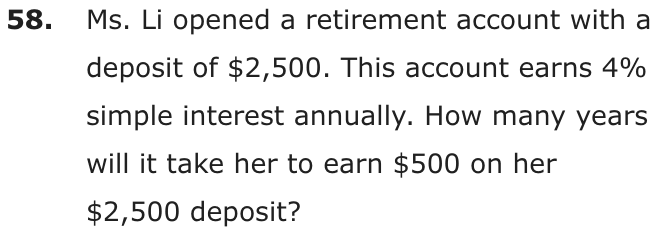
Question 62 of 120
2023 Test A Math, question 2Question
What is the value of the expression shown above?
Grid-in question: work out the answer and enter it as a number.
Show the answer
Correct answer: -9
| Calculate the exponent and convert the mixed number to an improper fraction. | |
| Next, calculate the absolute value. | |
| Perform the indicated multiplication and division. | |
| Perform the addition and subtraction. | |
Question analysis
This grid-in asks for the value of an arithmetic expression that mixes an absolute value, a negative number raised to the third power, a division and a mixed number. Students apply the order of operations with signed numbers. Cubing a negative base, and doing the division and multiplication before any adding, are where most slips happen.
- NYS standards
- Grade level
- Grade 7 content, by NYS standard
- Compared with grade 7
- At grade 7 Grade 7 students routinely evaluate expressions with negative numbers in the right order. This one combines an absolute value, a cubed negative and a mixed number in a single line, so it takes more steps than usual, each with a sign to watch.
- Estimated difficulty
- Moderate: several steps, or a close reading with one strong distractor.
- Thinking it demands
- Depth of knowledge 1, recall and reproduction · mainly apply
- What makes it hard
- Error-prone arithmetic moderate
- Many steps minor
- An answer in an unexpected form minor
- Solution
- 4 steps
- Reading level
- Question and choices: about grade 5, 10 words.
- Students, last 30 days
- Not enough answers yet to show (it takes 10).
Why it is hard, traps and wrong answers (shows the answer)
Why it is hard
The expression packs four kinds of notation into one line: a subtraction, a division by an absolute value, a negative base raised to the third power and a mixed number. None of the operations is hard alone, but each has a rule that is easy to break under time pressure, and the slips lead to very different totals. Rewriting the power and the mixed number first, then dividing and multiplying before any addition, avoids them.
Error-prone arithmetic moderate Working it out
(−2)³ must stay negative, −8, and the mixed number 1½ must become 3/2 before multiplying, so the last product is −12; a sign or fraction slip here moves the total far from −9. (Brown & Burton, 1978; Junker & Sijtsma, 2001)
Many steps minor Working it out
Six numbers and six operations, including a power and an absolute value, have to be worked in a planned order, and every addition waits until the division and multiplication are done. (Daniel & Embretson, 2010; Enright, Morley & Sheehan, 2002)
An answer in an unexpected form minor Choosing the answer
The value is negative and the grid-in offers no choices, so the minus sign has to be gridded and nothing on the page confirms that the total falls below zero. (Enright, Morley & Sheehan, 2002)
Strategy: Rewrite the absolute value and the power first, change the mixed number to an improper fraction, do the division and multiplication, and only then add and subtract from left to right.
Traps
- Order of operations: Working left to right, or distributing a minus sign wrongly, gives a choice.
- Negatives and direction: Arithmetic with negative numbers, the order of a subtraction, or direction on a number line. (Moving a term across the equals sign without changing its sign is a faulty procedure.)
- A faulty procedure: A systematic but wrong procedure: adding fractions straight across, applying an exponent to each term of a sum, dropping a sign when moving a term.
The wrong answers, classified
15 Negatives and direction (Brown & Burton, 1978)
Takes (−2)³ as positive 8, as if every power of a negative were positive, so the last product is +12 and 6 − 3 + 12 = 15.
-13.5 Order of operations (Brown & Burton, 1978)
Works strictly from left to right: 6 − 9 = −3, divided by 3 is −1, plus −8 is −9, and times 1½ gives −13.5.
-6 A faulty procedure (Brown & Burton, 1978; Tatsuoka, 1983)
Multiplies the base by the exponent, taking (−2)³ as −6, so the product with 3/2 is −9 and the total is 6 − 3 − 9 = −6.
Worked solution, step by step
Formulas used
- Order of operations
- This is the order for working out an expression. First work inside grouping symbols, such as parentheses and absolute value bars. Next do powers. Then multiply and divide from left to right. Last, add and subtract from left to right. Using one order means everyone gets the same answer.
- A power
- a is the base, the number being multiplied. The small 3 is the exponent. It says how many times the base is used as a factor, a number being multiplied. It does not mean a times 3.
- Absolute value
- The bars around a number mean absolute value. It is how far the number is from 0 on a number line. A distance is never negative, so the absolute value of −3 is 3.
- Mixed number to fraction
- a is the whole number part, and b over c is the fraction part. Each whole is c pieces, so a wholes are a × c pieces. Add the b extra pieces. The bottom number stays c.
Sort out the expression
You need the value of . It has many operations, so the order matters. It has absolute value bars, a power of a negative number and a mixed number. The answer may be negative, so keep track of every sign.
Do the absolute value and the power
Grouping symbols and powers come first.
Two negatives multiply to a positive, 4. One more negative makes it negative again. Watch out: (−2)³ is −8, not +8. Using +8 leads to 15. It is also not −2 × 3. That mistake leads to a total of −6.
Change the mixed number to a fraction
A fraction is easier to multiply than a mixed number.
Now the expression looks like this:
Multiply and divide next
Multiplying and dividing come before adding and subtracting.
A negative times a positive is negative. Watch out: don’t just work from left to right. Doing 6 − 9 first, then dividing by 3, leads to −13.5.
Add and subtract last
Now only adding and subtracting are left. Work from left to right.
Adding −12 is the same as taking away 12. So you would grid −9, with the minus sign in its own column.
Check your answer
Look at the size of each part. The part 6 − 3 is a small positive number, 3. The last part, −8 times 1½, is a bigger negative number, −12. A big negative plus a small positive is negative. So an answer below zero, −9, makes sense.
More questions like this
The original DOE question
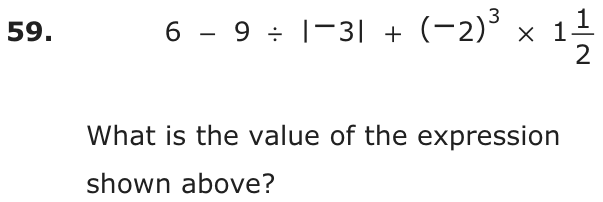
Question 63 of 120
2023 Test A Math, question 3Question
Solve for x:
Grid-in question: work out the answer and enter it as a number.
Show the answer
Correct answer: 4
| Apply the distributive property; multiply the −2 by and 1. | |
| Combine like terms. | |
| Apply the additive inverse property; subtract 1 from both sides of the equation. | |
| Apply the multiplicative inverse property; divide both sides of the equation by 3. | |
Question analysis
This grid-in gives the equation 7x + 3 − 2(2x + 1) = 13 and asks students to solve for x. It tests the distributive property with a negative factor, combining like terms and solving a two-step equation. The minus sign in front of the parentheses has to reach both terms inside, a step many students rush.
- Grade level
- Grade 7 content, by NYS standard
- Compared with grade 7
- At grade 7 Grade 7 students expand expressions with negative factors and solve equations such as p(x + q) = r. This equation needs both skills plus combining like terms, which is routine work with one negative sign that is easy to lose.
- Estimated difficulty
- Straightforward: two steps or one careful reading.
- Thinking it demands
- Depth of knowledge 1, recall and reproduction · mainly apply
- What makes it hard
- Error-prone arithmetic moderate
- An answer in an unexpected form minor
- Solution
- 4 steps
- Reading level
- Question and choices: about grade 3, 4 words.
- Students, last 30 days
- Not enough answers yet to show (it takes 10).
Why it is hard, traps and wrong answers (shows the answer)
Why it is hard
This is a standard multi-step linear equation, and the work is short once the parentheses are cleared. Everything rests on distributing −2 correctly; the later steps, combining 7x with −4x and 3 with −2, then undoing the + 1 and the × 3, are routine. Substituting 4 back into the left side, 28 + 3 − 18 = 13, is a fast check that catches a sign slip.
Error-prone arithmetic moderate Working it out
The −2 in front of (2x + 1) must reach both terms, giving −4x − 2; the second product, −2 × 1, is the one most often written as +2 or left as +1. (Brown & Burton, 1978; Junker & Sijtsma, 2001)
An answer in an unexpected form minor Choosing the answer
As a grid-in with no choices, a value such as 3 or 8/3 from a distributing slip looks just as finished as the right one; only substituting back exposes it. (Enright, Morley & Sheehan, 2002)
Strategy: Distribute −2 to both terms inside the parentheses, combine the x terms and the constants, then undo the addition and the multiplication in turn.
Traps
- A faulty procedure: A systematic but wrong procedure: adding fractions straight across, applying an exponent to each term of a sum, dropping a sign when moving a term.
- Order of operations: Working left to right, or distributing a minus sign wrongly, gives a choice.
The wrong answers, classified
3 A faulty procedure (Brown & Burton, 1978; Tatsuoka, 1983)
Multiplies only the 2x by −2 and leaves the + 1 untouched, so the equation becomes 3x + 4 = 13 and x = 3.
8/3 Order of operations (Brown & Burton, 1978)
Gives the minus sign to 4x but not to the 2, writing −4x + 2, so the equation becomes 3x + 5 = 13 and x = 8/3.
12 Stops one step early (King et al., 2004; Gierl et al., 2017)
Simplifies correctly to 3x + 1 = 13, subtracts 1 to reach 3x = 12, and grids 12 without dividing by 3.
Worked solution, step by step
Formulas used
- Distributive property
- a is the number outside the parentheses. b and c are the terms inside. A term is a number, a letter, or a number times a letter. Multiply each term inside by a. If a is negative, every product gets its sign too.
- Keeping an equation balanced
- a and b are the two equal sides. c is any number, but not 0 when you divide. Doing the same thing to both sides keeps them equal, like a balanced scale. Use it to get the unknown by itself.
Sort out the equation
You need the value of x that makes true. x is the unknown number. The tricky part is the −2 in front of the parentheses. It multiplies everything inside them.
Multiply out the parentheses
Use the distributive property with a = −2, b = 2x and c = 1.
So the equation becomes this:
Watch out: the −2 must multiply the 1 too. Leaving + 1 gives x = 3. Writing + 2 instead of − 2 gives .
Combine like terms
Like terms are terms of the same kind. Put the x terms together. Put the plain numbers together.
Get x by itself
Undo the + 1 first. Subtract 1 from both sides, so the equation stays balanced.
3x means 3 times x. So divide both sides by 3.
Watch out: don’t stop at 3x = 12. 12 is three times the answer. So you would grid 4.
Check your answer
Put x = 4 back into the first equation: . That matches the 13 on the right side, so x = 4 is right.
More questions like this
The original DOE question
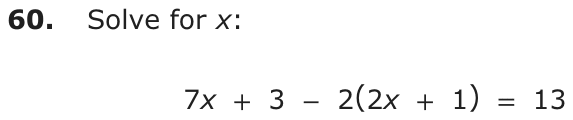
Question 64 of 120
2023 Test A Math, question 4Question
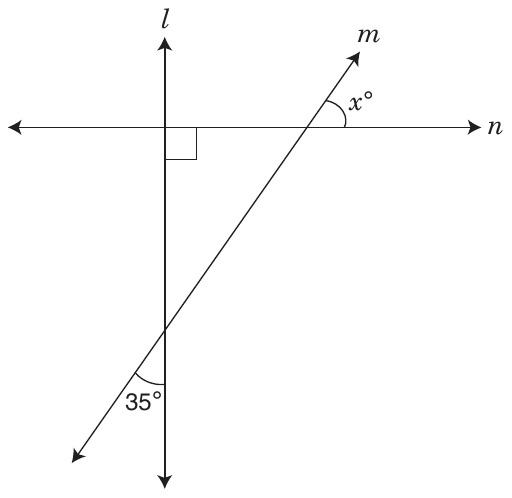
In the figure above, line l is perpendicular to line n. What is the value of x?
Grid-in question: work out the answer and enter it as a number.
Show the answer
Correct answer: 55
Since vertical angles are congruent, the right triangle in the figure has acute angles with measures of 35° and x°. The interior angles of a triangle sum to 180°, so set up an equation to solve for x:
Question analysis
Three lines cross in a figure: line l is perpendicular to line n, and a slanted line m meets them at a marked 35° angle and an unknown angle x. This geometry grid-in asks for the value of x. Students must see the right triangle the lines form and carry the marked angles into it using vertical angles.
- NYS standards
- Grade level
- Grade 8 content, by NYS standard
- Compared with grade 7
- Above grade 7 Grade 7 angle problems use vertical, supplementary and complementary angles. This one also needs the angle sum of a triangle, which New York places in grade 8, and the triangle is not drawn as a separate shape, so students must spot it.
- Estimated difficulty
- Moderate: several steps, or a close reading with one strong distractor.
- Thinking it demands
- Depth of knowledge 2, skills and concepts · mainly apply
- What makes it hard
- Reading a figure, table or graph moderate
- Something you must already know moderate
- An answer in an unexpected form minor
- Solution
- 3 steps
- Reading level
- Question and choices: about grade 4, 17 words.
- Students, last 30 days
- Not enough answers yet to show (it takes 10).
Why it is hard, traps and wrong answers (shows the answer)
Why it is hard
The figure hides a small right triangle between the three lines, and the question is easy once students see it. Its angles are the right angle, the vertical partner of the 35° angle and the vertical partner of x, so x is what the right angle and 35° leave of 180°. Students who never spot the triangle tend to guess a direct relationship between the two marked angles, which no angle fact supports.
Reading a figure, table or graph moderate Understanding the question
Neither marked angle is inside the right triangle that lines l, m and n form: the 35° opens below the point where m crosses l, and x opens above line n, so each must be carried in as a vertical angle. (Lesh, Post & Behr, 1987; Kirsch & Mosenthal, 1990)
Something you must already know moderate Working it out
The stem states only that l is perpendicular to n; students must supply that vertical angles are equal and that the three angles of a triangle add to 180°. (Anderson & Krathwohl, 2001)
An answer in an unexpected form minor Choosing the answer
As a grid-in it offers no choices, so 125, the right angle plus the 35° angle, can be gridded with nothing to signal the missing subtraction. (Enright, Morley & Sheehan, 2002)
Strategy: Find the triangle formed by the three lines, use vertical angles to move the 35° and x° angles inside it, and apply the triangle's angle sum with the right angle.
Traps
- Stops one step early: A choice is a number from partway through the solution.
- A formula you must know: Needs a formula the test does not give: area, circumference, volume, probability rules.
The wrong answers, classified
125 Stops one step early (King et al., 2004; Gierl et al., 2017)
Adds the right angle and the 35° angle, 90 + 35 = 125, and grids that sum without subtracting it from the triangle's 180°.
35 Misunderstands the concept (Smith, diSessa & Roschelle, 1993; De Bock et al., 1998; Ni & Zhou, 2005)
Assumes line m crosses l and n at equal angles, as it would cross two parallel lines, though l and n are perpendicular.
Worked solution, step by step
Formulas used
- Vertical angles
- When two lines cross, they make an X. The angles straight across from each other in the X are called vertical angles. a and b are one such pair. They are always equal, because each one plus the angle between them makes a straight line.
- Angles of a triangle
- A, B and C are the three angles inside any triangle, in degrees. They always add up to 180°. Use it when you know two of the angles and need the third.
Sort out the figure
Line l is perpendicular to line n. Perpendicular means they meet at a right angle, 90°. The small square in the figure marks it. Line m crosses both lines. The three lines make a triangle with a right angle. You need x, the angle marked x° where m crosses n.
Move the 35° angle into the triangle
The 35° angle is below the point where m crosses l. So it is outside the triangle. Lines l and m make an X there. The triangle’s angle is straight across from the 35° angle. They are vertical angles, so they are equal. The triangle’s angle at that corner is 35°.
Move the x° angle into the triangle
The x° angle is above line n, so it is outside the triangle too. Lines m and n make another X. The triangle’s angle at that crossing is straight across from x°. So the third angle of the triangle is also x°. Watch out: line m does not cross l and n at the same angle. Lines l and n are not parallel, so x is not 35.
Use the triangle’s angle sum
The triangle’s three angles are 90°, 35° and x°.
Watch out: 125 is only the two known angles added together. You still subtract it from 180. Gridding 125 is wrong. So you would grid 55.
Check your answer
In a right triangle, the two smaller angles add up to 90°. That is because the right angle uses 90° of the 180°. Check: . Also, in the figure the x° angle looks a bit bigger than the 35° angle, and 55 is.
More questions like this
The original DOE question
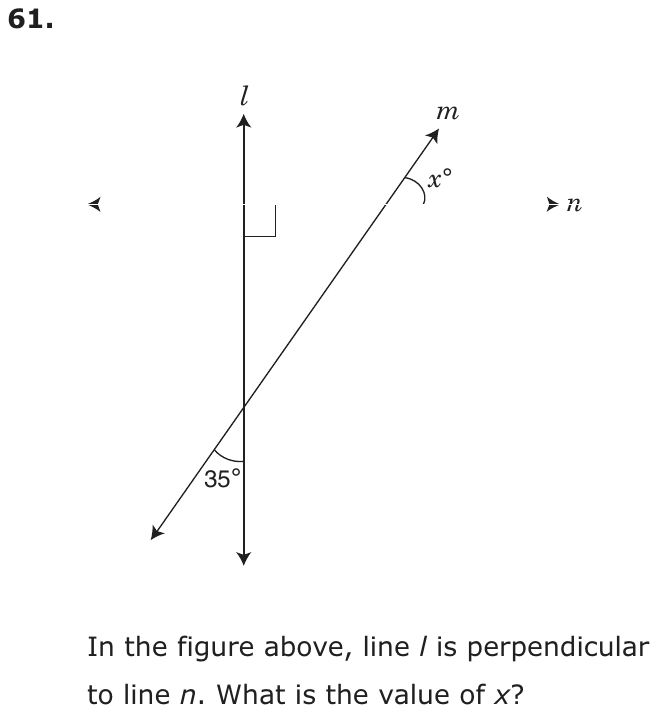
Question 65 of 120
2023 Test A Math, question 5Question
The mean value of 8 numbers is 17. Three of these numbers (9, 11, and 20) are discarded. What is the mean of the 5 remaining numbers?
Grid-in question: work out the answer and enter it as a number.
Show the answer
Correct answer: 19.2
First, find the sum of the original 8 numbers. Let x equal the sum of those numbers and use the mean formula to solve for x:
Next, subtract the 3 discarded numbers from the sum:
Finally, calculate the mean of the remaining 5 numbers by dividing the new sum, 96, by 5:
Question analysis
Eight numbers have a mean of 17, and three of them, 9, 11 and 20, are removed. This statistics grid-in asks for the mean of the five numbers that are left. Students have to rebuild the total from the mean before removing anything, and then divide by the new count rather than the old one.
- Grade level
- Grade 6 content, by NYS standard
- Compared with grade 7
- At grade 7 Finding a mean is grade 6 content, but working back from a mean to a total, removing values and averaging again is a typical grade 7 multistep task. As a grid-in, it offers no choices to check a wrong total against.
- Estimated difficulty
- Moderate: several steps, or a close reading with one strong distractor.
- Thinking it demands
- Depth of knowledge 2, skills and concepts · mainly apply
- What makes it hard
- Many steps moderate
- Much to keep track of minor
- An answer in an unexpected form minor
- Solution
- 3 steps
- Reading level
- Question and choices: about grade 3, 21 words.
- Students, last 30 days
- Not enough answers yet to show (it takes 10).
Why it is hard, traps and wrong answers (shows the answer)
Why it is hard
A mean cannot be adjusted directly when numbers are removed, so the question rewards switching from the mean to the total and back. The removed numbers, 9, 11 and 20, average less than 17, so the new mean must rise above 17; that quick check rules out an answer such as 12. Points are lost by dividing by the wrong count or by stopping at the new total.
Many steps moderate Working it out
Three operations come in a fixed order: multiply the mean by 8 to get 136, subtract 9, 11 and 20 to leave 96, then divide by the numbers that remain. (Daniel & Embretson, 2010; Enright, Morley & Sheehan, 2002)
Much to keep track of minor Working it out
The count changes partway through, from 8 numbers to 5, and the divisor at the end must be the new count, not the 8 from the first sentence. (Sweller, 1988; Carpenter, Just & Shell, 1990)
An answer in an unexpected form minor Choosing the answer
The answer, 19.2, is a decimal that must be gridded with its point, and with no choices a total of 96 or a mean over 8 numbers looks complete. (Enright, Morley & Sheehan, 2002)
Strategy: Turn the mean into a total by multiplying by 8, subtract the three discarded numbers, and divide what is left by the count of numbers that remain.
Traps
- Misreads the question: Misses or misreads a condition or a word in the question: "at least", "each", "remaining", "not".
- Stops one step early: A choice is a number from partway through the solution.
The wrong answers, classified
12 Misreads the question (Hegarty, Mayer & Monk, 1995)
Finds the remaining total, 136 − 40 = 96, correctly but divides it by the original 8 numbers instead of the 5 that are left.
96 Stops one step early (King et al., 2004; Gierl et al., 2017)
Subtracts the three discarded numbers from the total of 136 and grids the new sum, 96, without dividing by the 5 numbers left.
27.2 Misreads the question (Hegarty, Mayer & Monk, 1995)
Turns the mean into the total, 136, and divides it by 5 without first subtracting the three discarded numbers, 9, 11 and 20.
Worked solution, step by step
Formulas used
- Mean, or average
- The mean is the average. The sum is what you get when you add all the numbers. Divide it by how many numbers there are. The mean is the value each number would have if the total were shared out equally.
- Sum from a mean
- This is the mean formula turned around. If you know the mean and how many numbers there are, multiply them to get the sum. It works even when you don’t know the numbers themselves.
Sort out the question
There are 8 numbers. Their mean, or average, is 17. You don’t know what the 8 numbers are. Three of them, 9, 11 and 20, are discarded, or thrown away. That leaves 5 numbers. You need the mean of those 5 numbers.
Find the sum of all 8 numbers
You can’t add the 8 numbers, because you don’t know them. But the mean tells you their sum.
The 8 numbers add up to 136.
Take away the three discarded numbers
Subtract the three numbers that were thrown away.
The 5 numbers left add up to 96. Watch out: 96 is a sum, not a mean, so gridding 96 is wrong. Also, dividing 136 by 5 without subtracting first gives 27.2, which is wrong.
Divide by the 5 numbers left
Now use the mean formula for the numbers that are left.
Watch out: divide by 5, not by 8. Only 5 numbers are left. Dividing by 8 gives 12. So you would grid 19.2, with the decimal point in its own column.
Check your answer
The three numbers thrown away add to 40, so their mean is about 13. That is less than 17. Removing small numbers should make the mean go up, and 19.2 is more than 17. Also, , the sum of the 5 numbers left.
More questions like this
The original DOE question
Question 66 of 120
2023 Test A Math, question 6Question
- A40
- B370
- C2,482
- D10,000
Show the answer
Correct answer: C
Question analysis
This exponents question asks for the sum of 3 to the fourth power and 7 to the fourth power. Students evaluate each power separately and then add. The traps are treating an exponent as a multiplier and adding the bases before raising them to a power, and the larger power takes careful multiplication.
- NYS standards
- 6.EE.1 whole-number exponent expressions
- Grade level
- Grade 6 content, by NYS standard
- Compared with grade 7
- Below grade 7 Evaluating whole-number powers is grade 6 work, and this question asks only for two of them and a sum. The one demand beyond routine practice is computing a fourth power of 7 accurately without a calculator.
- Estimated difficulty
- Straightforward: two steps or one careful reading.
- Thinking it demands
- Depth of knowledge 1, recall and reproduction · mainly apply
- What makes it hard
- Error-prone arithmetic moderate
- Something you must already know minor
- Solution
- 3 steps
- Reading level
- Question and choices: about grade 16+, 1 words.
- Students, last 30 days
- Not enough answers yet to show (it takes 10).
Why it is hard, traps and wrong answers (shows the answer)
Why it is hard
The sum is short, but it tests exactly what an exponent means and when to apply it. The wrong choices come from three misreadings of the notation: treating the power as a multiplier, using one factor too few, and adding the bases before raising them. A size check settles it: 7⁴ alone is 49 × 49, a little under 2,500, so 40 and 370 are far too small and 10,000 far too large.
Error-prone arithmetic moderate Working it out
7⁴ means 7 × 7 × 7 × 7 = 2,401, a four-digit product built by hand, most easily as 49 × 49; 3⁴ = 81 is quick by comparison. (Brown & Burton, 1978; Junker & Sijtsma, 2001)
Something you must already know minor Working it out
An exponent counts repeated factors rather than acting as a multiplier, so 3⁴ is 3 × 3 × 3 × 3 = 81, not 3 × 4 = 12; the item assumes that meaning. (Anderson & Krathwohl, 2001)
Strategy: Compute each power on its own, squaring and then squaring again, and add the two results only at the end.
Traps
- A faulty procedure: A systematic but wrong procedure: adding fractions straight across, applying an exponent to each term of a sum, dropping a sign when moving a term.
- Order of operations: Working left to right, or distributing a minus sign wrongly, gives a choice.
The wrong answers, classified
A A faulty procedure (Brown & Burton, 1978; Tatsuoka, 1983)
Multiplies each base by its exponent, 3 × 4 + 7 × 4 = 12 + 28 = 40, instead of using each base as a factor four times.
B A faulty procedure (Brown & Burton, 1978; Tatsuoka, 1983)
Uses each base as a factor three times instead of four, 27 + 343 = 370, so both powers stop one factor short.
D Order of operations (Brown & Burton, 1978)
Adds the bases before applying the exponent, treating 3⁴ + 7⁴ as (3 + 7)⁴ = 10,000, though powers come before addition.
Worked solution, step by step
Formulas used
- A power
- a is the base, the number being multiplied. The small 4 is the exponent. It tells how many times the base is used as a factor, a number being multiplied. So the exponent counts factors. It does not mean multiply by 4.
- Powers come before adding
- a and b are any two positive numbers. The sign ≠ means is not equal to. Powers come before adding. So raise each number to its power first, then add. Adding the bases first gives a much bigger number.
Sort out the question
You need the value of . Each number has a small 4 above it. This 4 is an exponent. Work out each power on its own. Then add the two results.
Find 3 to the fourth power
3⁴ means four 3s multiplied together. Pair them up to make it easier.
Watch out: 3⁴ is not 3 × 4 = 12. Doing that to both powers gives 12 + 28 = 40, choice A.
Find 7 to the fourth power
7⁴ means four 7s multiplied together. Pair them up the same way.
To find 49 × 49, do 49 × 50 = 2,450. Then take away one 49. That gives 2,401. Watch out: count four 7s, not three. Three 7s make 343. Using three factors in both powers gives 370, choice B.
Add the two powers
Watch out: don’t add 3 and 7 first. That gives , choice D. Powers come before adding. So the answer is C, 2,482.
Check your answer
Estimate. 7⁴ is 49 × 49, a little less than 50 × 50 = 2,500. Adding 81 keeps it near 2,500. Only 2,482 is close. 40 and 370 are far too small, and 10,000 is far too big.
More questions like this
The original DOE question
Question 67 of 120
2023 Test A Math, question 7Question
In one week, inches of rain fell on Monday, inches fell on Tuesday, and inch fell on Wednesday. How many inches of rain fell during those three days?
- A
- B
- C
- D
Show the answer
Correct answer: A
To solve, add the three given fractions:
The common denominator is 24:
Question analysis
A rainfall word problem gives the inches of rain on Monday, Tuesday and Wednesday as two mixed numbers and a fraction, and asks for the total over the three days. Students add fractions with unlike denominators. Finding a common denominator for fourths, thirds and eighths, and regrouping the fractional part into wholes, is where errors come in.
- NYS standards
- Grade level
- Grade 7 content, by NYS standard
- Compared with grade 7
- Below grade 7 Adding fractions and mixed numbers with unlike denominators is taught before grade 7, and this is a direct word problem. It takes more care than a typical exercise only because three different denominators must be rewritten over a common one.
- Estimated difficulty
- Straightforward: two steps or one careful reading.
- Thinking it demands
- Depth of knowledge 2, skills and concepts · mainly apply
- What makes it hard
- Error-prone arithmetic moderate
- Many steps minor
- Solution
- 3 steps
- Reading level
- Question and choices: about grade 5, 35 words.
- Students, last 30 days
- Not enough answers yet to show (it takes 10).
Why it is hard, traps and wrong answers (shows the answer)
Why it is hard
The setup is plain addition, so the difficulty is all in the fractions. Students who know to rename over a common denominator rarely miss it, while those who add the fraction parts straight across, or put the numerators over 24 without scaling them, reach choices with a whole part of 3. Since 1 3/4 + 2 2/3 alone is more than 4, any total below 4 can be ruled out at a glance.
Error-prone arithmetic moderate Working it out
The fractional parts have denominators 4, 3 and 8, so they must be renamed as 18, 16 and 21 twenty-fourths, and their sum, 55/24, regrouped as 2 7/24 before the wholes are added. (Brown & Burton, 1978; Junker & Sijtsma, 2001)
Many steps minor Working it out
Renaming, adding the numerators, regrouping the improper fraction and adding the whole numbers are four separate moves, and losing the 2 carried from 55/24 drops the total by two inches. (Daniel & Embretson, 2010; Enright, Morley & Sheehan, 2002)
Strategy: Rewrite the three fractional parts over a common denominator of 24, add the whole numbers and the fractions separately, and regroup any extra twenty-fourths as a whole.
Traps
- A faulty procedure: A systematic but wrong procedure: adding fractions straight across, applying an exponent to each term of a sum, dropping a sign when moving a term.
The wrong answers, classified
B Little reason to choose it (Haladyna & Downing, 1993; Rodriguez, 2005)
No single renaming mistake gives 49 twenty-fourths; this choice sits exactly 1/4 below the right total, so it mostly catches guesses near it.
C A faulty procedure (Brown & Burton, 1978; Tatsuoka, 1983)
Adds the whole numbers to get 3, then adds the fractions straight across, (3 + 2 + 7)/(4 + 3 + 8) = 12/15 = 4/5.
D A faulty procedure (Brown & Burton, 1978; Tatsuoka, 1983)
Finds the common denominator 24 but adds the numerators without renaming them, (3 + 2 + 7)/24 = 1/2, and adds that to the wholes, 3.
Worked solution, step by step
Formulas used
- Equivalent fractions
- a over b is a fraction, and k is any whole number except 0. Multiplying the top and the bottom by the same number gives an equal fraction. You cut each piece into k smaller pieces. So you have k times as many pieces, each k times smaller.
- Adding fractions with the same bottom
- d is the denominator, the bottom number. It tells the size of the pieces. a, b and c are the numerators, the top numbers. They count the pieces. When the pieces are the same size, add the counts. The bottom stays the same.
- Fraction to mixed number
- a over b is a fraction whose top is bigger than its bottom. q is the quotient, how many whole times b fits into a. r is the remainder, what is left over. The leftover stays over the same bottom number.
Sort out the question
Rain fell on three days: inches, inches and inch. You need the total rain, in inches. So add the three amounts. Add the whole numbers and the fractions separately. The whole numbers are 1 and 2, so they add to 3 inches.
Find a common denominator
The fractions have denominators, or bottom numbers, 4, 3 and 8. You can only add pieces of the same size. So find the smallest number that 4, 3 and 8 all divide into. Count by 8s: 8, 16, 24. 24 works, since 24 = 4 × 6 and 24 = 3 × 8. So use 24ths.
Rename each fraction in 24ths
Multiply the top and the bottom by the same number.
Watch out: change the tops too. Keeping 3, 2 and 7 over 24 gives and a total of , choice D.
Add the fractions
Now the pieces are the same size, so add the tops.
That is more than 1 whole. 24 goes into 55 twice, with 7 left over.
Watch out: never add the bottoms. Adding straight across gives and a total of , choice C.
Put the parts together
Add the 3 whole inches from before.
So the answer is A, inches.
Check your answer
Use decimals. is 1.75, is about 2.67, and is 0.875. They add to about 5.29. And is about 0.29. So fits, and is too small.
More questions like this
The original DOE question
Question 68 of 120
2023 Test A Math, question 9Question
A revolving sign makes 1 complete revolution every 90 minutes. If the sign starts moving at 2:30 p.m., at what time will the sign complete 8 revolutions?
- A1:00 a.m.
- B2:30 a.m.
- C4:00 p.m.
- D12:00 midnight
Show the answer
Correct answer: B
First, use a proportion to find out how many minutes it will take the sign to complete 8 revolutions. Let x equal the total number of minutes:
Next, convert 720 minutes into hours and minutes:
Finally, 12 hours after 2:30 p.m. is 2:30 a.m.
Question analysis
A revolving sign turns once every 90 minutes and starts at 2:30 in the afternoon. Students find the clock time when it finishes 8 full revolutions. The question combines a rate with converting minutes to hours, and then adding the elapsed time to the starting time on a 12-hour clock.
- Grade level
- Grade 6 content, by NYS standard
- Compared with grade 7
- Below grade 7 A constant rate, a multiplication and a conversion from minutes to hours are grade 6 skills. The only step beyond routine work is adding the elapsed time to a starting clock time.
- Estimated difficulty
- Straightforward: two steps or one careful reading.
- Thinking it demands
- Depth of knowledge 2, skills and concepts · mainly apply
- What makes it hard
- Many steps minor
- Something you must already know minor
- Solution
- 3 steps
- Reading level
- Question and choices: about grade 4, 31 words.
- Students, last 30 days
- Not enough answers yet to show (it takes 10).
Why it is hard, traps and wrong answers (shows the answer)
Why it is hard
Each step is routine, so most points are lost in keeping elapsed time and clock time apart. The 12 hours is a duration, and the clock reading that ends it is 12 hours after 2:30 in the afternoon, not 12:00. A sense check helps: 12 hours after any time shows the same digits on the clock with a.m. and p.m. swapped.
Many steps minor Working it out
Three moves: 8 × 90 = 720 minutes, 720 ÷ 60 = 12 hours, then 12 hours counted on from the 2:30 start, which crosses midnight into the morning. (Daniel & Embretson, 2010; Enright, Morley & Sheehan, 2002)
Something you must already know minor Working it out
Counting hours past midnight means switching from p.m. to a.m. on a 12-hour clock, which the stem leaves to the student; the choices mix both halves of the day. (Anderson & Krathwohl, 2001)
Strategy: Multiply 90 minutes by 8 to get the total time, change it to hours, and then count that many hours forward from 2:30 p.m.
Traps
- Stops one step early: A choice is a number from partway through the solution.
- Counting the ends: Inclusive or exclusive ends, fence posts, consecutive numbers: an answer that is one too many or too few, or an endpoint drawn open where it belongs closed (or the reverse).
- Numbers taken from the question: Combines the numbers in the question without a model of the situation, or is simply a number that appears in the question.
The wrong answers, classified
A Counting the ends (Brown & Burton, 1978)
Counts only 7 revolutions, 630 minutes or 10½ hours, as if the first turn were already done at the start, and lands at 1:00 a.m.
C Numbers taken from the question (Hegarty, Mayer & Monk, 1995)
Adds a single revolution's 90 minutes to the 2:30 start, giving 4:00 in the afternoon, without multiplying by the 8 revolutions.
D Stops one step early (King et al., 2004; Gierl et al., 2017)
Finds that 8 revolutions take 12 hours and picks 12:00 midnight, reading the elapsed time as a clock time instead of counting on from 2:30.
Worked solution, step by step
Formulas used
- Total time
- Time for one is how long one revolution takes. How many is the number of revolutions. Each one takes the same time, so multiply to get the total time.
- Minutes to hours
- There are 60 minutes in 1 hour. So to change minutes to hours, divide by 60. Each group of 60 minutes makes 1 hour.
Sort out the question
The sign turns all the way around once every 90 minutes. One full turn is called a revolution. The sign starts at 2:30 p.m. You need the clock time when it finishes 8 revolutions.
Find the total time in minutes
Each revolution takes 90 minutes, and there are 8 of them.
The 8 revolutions take 720 minutes. Watch out: use all 8 revolutions. Counting only 7 gives 630 minutes and 1:00 a.m., choice A. Adding just one 90 minutes gives 4:00 p.m., choice C.
Change the minutes to hours
Clock times are easier to count in hours. There are 60 minutes in an hour.
The sign turns for 12 hours.
Count forward from 2:30 p.m.
Start at 2:30 p.m. and add 12 hours. When you pass midnight, p.m. changes to a.m. So 12 hours after 2:30 p.m. is 2:30 a.m. the next morning. Watch out: 12 hours is an amount of time, not a clock time. Reading it as 12:00 midnight gives choice D. So the answer is B, 2:30 a.m.
Check your answer
From 2:30 p.m. to 2:30 a.m. is one full trip around the clock, 12 hours. 12 hours is minutes. And , the number of revolutions in the question.
More questions like this
The original DOE question
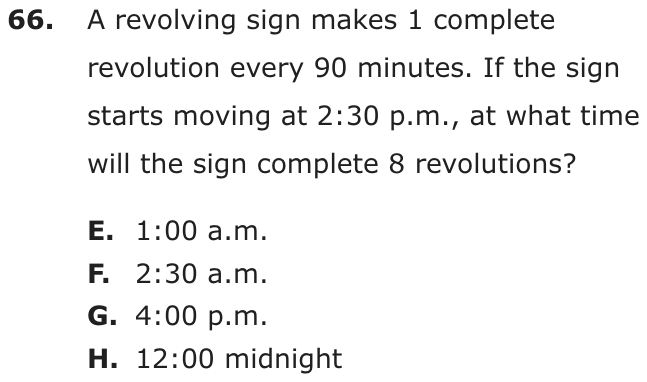
Question 69 of 120
2023 Test A Math, question 10Question

Points Y and Z are not shown on the number line above. If X is the midpoint of , and Y is the midpoint of , where on the number line would point Z be located?
- A2
- B4
- C6
- D8
Show the answer
Correct answer: D
First, find where Y is located on the number line. Point X is the midpoint of . Since there are 2 units between W and X, there must also be 2 units between X and Y. Thus, Y is located at 4 on the number line.
Point Y is the midpoint of . Use the same reasoning as above. Since there are 4 units between W and Y, there must be 4 units between Y and Z. So, Z is located at 8 on the number line.
Question analysis
A number line shows point W at 0 and point X at 2, and two more points, Y and Z, are described but not drawn. Students use two midpoint facts, one after the other, to find where Z lies. Each midpoint fact is about a different segment, so keeping track of which point is the middle one matters.
- Grade level
- Grade 7 content, by NYS standard
- Compared with grade 7
- Below grade 7 Midpoints on a number line rest on distance, which grade 7 students find as a difference. Here every point lies at a whole number of zero or more, so the work is two short steps with no negative numbers.
- Estimated difficulty
- Straightforward: two steps or one careful reading.
- Thinking it demands
- Depth of knowledge 2, skills and concepts · mainly apply
- What makes it hard
- Many steps minor
- Reading a figure, table or graph minor
- Solution
- 2 steps
- Reading level
- Question and choices: about grade 7, 36 words.
- Students, last 30 days
- Not enough answers yet to show (it takes 10).
Why it is hard, traps and wrong answers (shows the answer)
Why it is hard
Each midpoint statement doubles a distance from W, so the problem is two short doublings, 2 to 4 and then 4 to 8. The risk is stopping halfway, since Y's position is found first and appears among the choices, or reusing X as an endpoint in the second statement. Rereading which point the question asks about, and checking that Y is halfway between W and Z, catches both.
Many steps minor Working it out
The two midpoint statements must be used in order: the first places Y at 4, and only then can the second, about segment WZ, place Z. (Daniel & Embretson, 2010; Enright, Morley & Sheehan, 2002)
Reading a figure, table or graph minor Understanding the question
Only W at 0 and X at 2 are marked on the 0-to-10 line, and the overbars name WY and WZ as segments, so Y and Z have to be placed from the statements alone. (Lesh, Post & Behr, 1987; Kirsch & Mosenthal, 1990)
Strategy: Use the first midpoint to place Y as far beyond X as X is from W, then use the second midpoint the same way to place Z beyond Y.
Traps
- Answers a different question: A choice is right for another quantity: the other unknown, the rest instead of the part, the part instead of the whole.
- Misreads the question: Misses or misreads a condition or a word in the question: "at least", "each", "remaining", "not".
The wrong answers, classified
A Numbers taken from the question (Hegarty, Mayer & Monk, 1995)
Gives 2, the position of point X, the only labeled point besides W, without using either midpoint statement.
B Answers a different question (King et al., 2004; Hegarty, Mayer & Monk, 1995)
Uses the first statement to place Y at 4 and answers with Y's position instead of going on to locate Z, the point the question asks about.
C Misreads the question (Hegarty, Mayer & Monk, 1995)
Treats Y as the midpoint of XZ instead of WZ, so Z lands 2 units past Y, at 6, continuing the even steps from W to X to Y.
Worked solution, step by step
Formulas used
- Midpoint of a segment
- A and B are the ends of a segment, a straight piece of a line. M is its midpoint, the point exactly halfway. AM is the distance from A to M, and MB is the distance from M to B. A midpoint splits a segment into two equal parts, so these are equal.
Sort out the question
The number line shows W at 0 and X at 2. Points Y and Z are not shown. X is the midpoint of segment WY. Y is the midpoint of segment WZ. A midpoint is the point exactly halfway along a segment. You need the number where Z sits.
Place point Y
X is halfway from W to Y. So X to Y is as long as W to X.
So Y is 2 units past X.
Point Y is at 4. Watch out: this is Y, not Z. Stopping here gives 4, choice B.
Place point Z
Now Y is halfway from W to Z. W to Y is 4 units, so Y to Z is also 4 units.
Watch out: the second midpoint is for segment WZ, not XZ. Taking just 2 more units from Y puts Z at 6, choice C. So the answer is D, 8.
Check your answer
Check both midpoints. Halfway from 0 to 4 is , which is X. Halfway from 0 to 8 is , which is Y. Both facts in the question are true.
More questions like this
The original DOE question
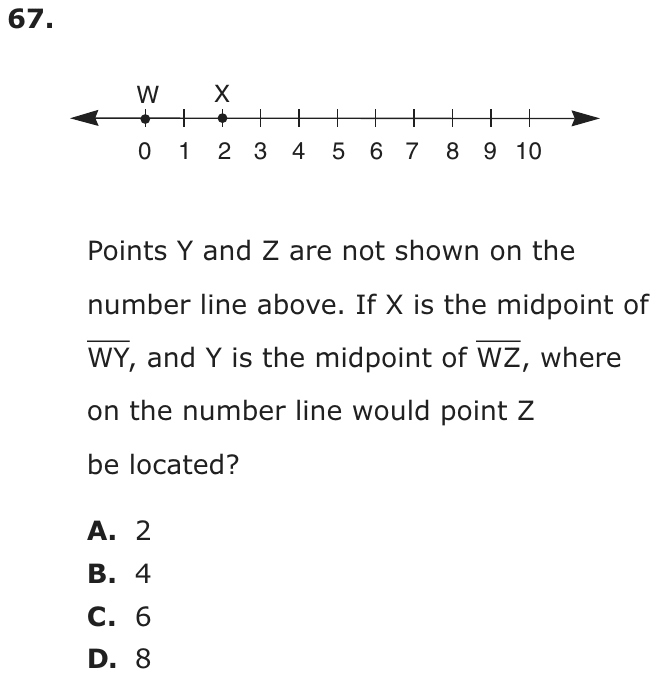
Question 70 of 120
2023 Test A Math, question 11Question
What value of n makes the equation above true?
- A1
- B
- C5
- D
Show the answer
Correct answer: B
| Cross multiply. | |
| Apply the multiplicative inverse property; divide both sides of the equation by 81. | |
| Then simplify the fraction. |
Question analysis
This question gives the proportion 81/10 = 9/n and asks for the value of n that makes it true. Students solve a proportion by cross-multiplying and dividing, then simplify the result. Reducing the resulting fraction and matching its form to the choices is where students slip.
- Grade level
- Grade 6 content, by NYS standard
- Compared with grade 7
- Below grade 7 Solving a proportion is familiar from grades 6 and 7, and this one needs only cross-multiplying and one division. Its one extra demand is simplifying the result and writing it in the form the choices use.
- Estimated difficulty
- Straightforward: two steps or one careful reading.
- Thinking it demands
- Depth of knowledge 1, recall and reproduction · mainly apply
- What makes it hard
- An answer in an unexpected form moderate
- A very close wrong answer minor
- Solution
- 3 steps
- Reading level
- Question and choices: about grade 7, 12 words.
- Students, last 30 days
- Not enough answers yet to show (it takes 10).
Why it is hard, traps and wrong answers (shows the answer)
Why it is hard
The proportion solves in one cross-multiplication, but the result is an improper fraction that must be simplified and rewritten to match. Students who notice that 81 is 9 × 9 can shortcut it: the numerator shrinks by a factor of 9 from left to right, so the denominator must shrink too, giving 10 ÷ 9. The mixed-number form is where answers drift, by dropping the leftover ninth or by writing 10 × 1/9 as 10 1/9.
An answer in an unexpected form moderate Choosing the answer
Cross-multiplying gives n = 90/81, which has to be reduced to 10/9 and rewritten as the mixed number 1 1/9 before it matches any choice. (Enright, Morley & Sheehan, 2002)
A very close wrong answer minor Choosing the answer
The choices 1 and 1 1/9 differ by one ninth, and estimating 90 ÷ 81 as about 1 cannot separate them; only keeping the remainder does. (Embretson & Wetzel, 1987; Gorin & Embretson, 2006; Ascalon et al., 2007)
Strategy: Cross-multiply to get 81n = 90, divide both sides by 81, and simplify the fraction before comparing it with the choices.
Traps
- A faulty procedure: A systematic but wrong procedure: adding fractions straight across, applying an exponent to each term of a sum, dropping a sign when moving a term.
- Answer in another form: The right answer is written differently from the way you worked it out.
The wrong answers, classified
A Rounds too early (King et al., 2004)
Finds n by dividing 10 by 9 but keeps only the whole-number part of the quotient, 1, dropping the remainder that the exact answer needs.
C Little reason to choose it (Haladyna & Downing, 1993; Rodriguez, 2005)
No cross-multiplication or scaling of 81/10 gives 5, which would make 9/n equal 1.8 instead of 8.1, so it mostly catches guesses.
D A faulty procedure (Brown & Burton, 1978; Tatsuoka, 1983)
Reaches n = 10 × 9/81 = 10 × 1/9 but writes the product as the mixed number 10 1/9, as if a whole number beside a fraction meant multiplication.
Worked solution, step by step
Formulas used
- Cross-multiplying
- a over b and c over d are two equal fractions, and b and d are not 0. Multiply each top by the other bottom. The two products are equal. It works because it is the same as multiplying both sides by b and by d.
- Simplifying a fraction
- a over b is a fraction, and k is a number that divides both the top and the bottom. Dividing the top and the bottom by the same number gives an equal fraction with smaller numbers.
- Fraction to mixed number
- a over b is a fraction whose top is bigger than its bottom. q is the quotient, how many whole times b fits into a. r is the remainder, what is left over. The leftover stays over the same bottom number.
Sort out the question
The equation says two fractions are equal: and . n is an unknown bottom number. You need the value of n that makes them equal. Some choices are mixed numbers, so n may not be a whole number.
Cross-multiply the two fractions
Multiply each top by the other fraction’s bottom. This gets n out of the bottom of the fraction.
Divide both sides by 81
81n means 81 times n. To undo multiplying by 81, divide both sides by 81.
Now simplify. 90 and 81 are both in the 9 times table, so divide the top and bottom by 9.
Write it as a mixed number
10 ÷ 9 is 1 with 1 left over. The leftover stays over 9.
Watch out: keep the leftover. Dropping it gives 1, choice A. Also, ten ninths is not 10 and one ninth. That mixed number, , is choice D, which is far too big. So the answer is B, .
Check your answer
Estimate. is about 8. For to be about 8, n must be a little more than 1. Check exactly: . It matches.
More questions like this
The original DOE question
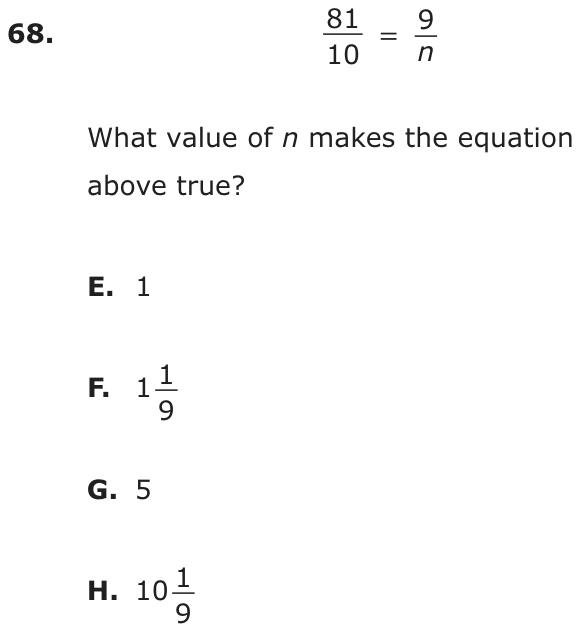
Question 71 of 120
2023 Test A Math, question 12Question
If n is an integer and is an even number, which expression must also represent an even number?
- A
- B
- C
- D
Show the answer
Correct answer: A
The expression is equal to , and it is given that this is an even number. The expression must also represent an even number, because 3 is an odd number: if were odd, would be the product of two odd numbers, which is an odd number. If is an even number, then n must be an odd number. Choose an odd number to substitute for n in the answer options to find which expression represents an even number:
Let .
Option A:
Option B:
Option C:
Option D:
Since 16 is the only even number, the correct answer is option A.
Question analysis
This number properties question says that 3n + 3 is even for an integer n and asks which of four expressions must also be even. Students reason about odd and even numbers written with a variable. The hidden step is deciding what the given fact says about n itself before testing the expressions.
- Grade level
- Grade 7 content, by NYS standard
- Compared with grade 7
- Above grade 7 Grade 7 students rewrite and evaluate expressions, but rarely reason about whether an expression is odd or even for every value of a variable. Here that reasoning comes in two layers: first about n, then about each choice.
- Estimated difficulty
- Moderate: several steps, or a close reading with one strong distractor.
- Thinking it demands
- Depth of knowledge 2, skills and concepts · mainly analyze
- What makes it hard
- Solution
- 3 steps
- Reading level
- Question and choices: about grade 9, 23 words.
- Corrected from the DOE handbook
- The explanation gave the wrong reason why n + 1 must be even; the reason was corrected.
- Students, last 30 days
- Not enough answers yet to show (it takes 10).
Why it is hard, traps and wrong answers (shows the answer)
Why it is hard
The question hides its key step: 3n + 3 = 3(n + 1), and since 3 is odd, n + 1 must be even, so n is odd. A student who skips that step and tests a convenient even value never checks the condition and lands on a wrong expression. Once n is known to be odd, any odd test value, such as 1, picks out 5n + 1 at once.
Variables instead of numbers moderate Understanding the question
No value of n is given; the only fact is that 3n + 3 is even, and it has to be turned into a fact about n itself, that n is odd, before any choice is judged. (Koedinger & Nathan, 2004; Enright, Morley & Sheehan, 2002)
Something you must already know minor Working it out
The parity rules are assumed, not stated: an odd number times an odd number is odd, and an even number plus an odd number is odd. (Anderson & Krathwohl, 2001)
Every choice must be checked minor Choosing the answer
Each expression has to be tested with an odd n or by parity rules; three of the four come out odd whenever n is odd, so none can be dismissed on sight. (Embretson & Wetzel, 1987)
Strategy: First work out what 3n + 3 being even says about n, by factoring out 3 or testing small integers, then check each expression with a value of n that fits.
Traps
- Misreads the question: Misses or misreads a condition or a word in the question: "at least", "each", "remaining", "not".
- Misunderstands the concept: A wrong belief about a concept: that percents can be added, that area grows like length, that averages can be averaged, that a bigger denominator means a bigger fraction.
The wrong answers, classified
B Misunderstands the concept (Smith, diSessa & Roschelle, 1993; De Bock et al., 1998; Ni & Zhou, 2005)
Sees the even term 4n and treats the whole expression as even, overlooking that adding the odd 5 makes 4n + 5 odd for every integer n.
C Misunderstands the concept (Smith, diSessa & Roschelle, 1993; De Bock et al., 1998; Ni & Zhou, 2005)
Assumes an expression that starts with 2n must be even, though 2n + 3 is an even number plus 3 and so is always odd.
D Misreads the question (Hegarty, Mayer & Monk, 1995)
Tests n = 2 without checking the condition, though 3(2) + 3 = 9 is odd; with n = 2, only n + 2 = 4 comes out even.
What was corrected from the DOE handbook, and why
- Explanation: The DOE’s explanation said that n + 1 must be even “because 3 is an odd number and the product of an odd number and an even number is an even number.” That fact does not show that n + 1 is even; the reason is that if n + 1 were odd, 3(n + 1) would be the product of two odd numbers, which is odd, and it is given as even. The site now gives that reason. The answer, A, is unchanged.
Worked solution, step by step
Formulas used
- Pulling out a common factor
- a is a factor, a number being multiplied, that both terms share. b and c are what is left. This is the distributive property run backward. It turns a sum into a product, which is easier to reason about.
- Multiplying odd numbers
- An even number splits into pairs, like 2, 4 or 6. An odd number has one left over, like 1, 3 or 5. An odd number of odd groups always leaves one extra. So the product is odd.
- Adding odd and even numbers
- Two odd numbers each have one left over. Together the two extras make a pair, so the sum is even. An even number plus an odd number still has one left over, so the sum is odd.
Sort out the question
n is an integer, a whole number that can be positive, negative or 0. You are told that is even. You need the expression that must be even too. Must means it is even every time. First find out what the fact tells you about n.
Pull out the 3
Both terms in have a factor of 3. Pull it out.
So 3 times is an even number.
Decide whether n is odd or even
3 is odd. If were odd, would be odd times odd. That is always odd. But we are told it is even. So must be even. One less than an even number is odd. So n is odd. Watch out: don’t test n = 2. Then , which is odd. With n = 2, only comes out even, choice D.
Test each choice with an odd n
Pick an odd number, n = 3. It fits, since is even.
- A: , even
- B: , odd
- C: , odd
- D: , odd
Only A is even.
Make sure A always works
Must means every odd n, not just 3. If n is odd, 5n is odd times odd, so it is odd. Odd plus 1 is even. So is always even. Watch out: 4n is even, but adding the odd 5 makes odd, choice B. In the same way, is always odd, choice C. So the answer is A, .
Check your answer
Try another odd number, n = 1. Then , which is even, so n = 1 fits. And is even too. The other three choices give 9, 5 and 3, all odd. Choice A wins again.
More questions like this
The original DOE question
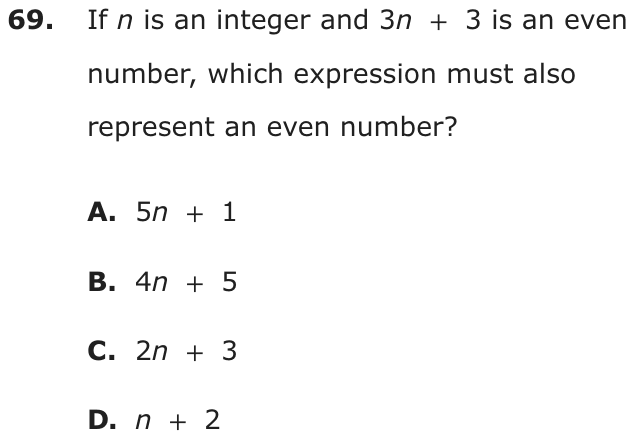
Question 72 of 120
2023 Test A Math, question 13Question
The product of two positive integers is 65. Which number could be the sum of the two integers?
- A5
- B18
- C24
- D52
Show the answer
Correct answer: B
First, find the pairs of positive integers that multiply to 65: and .
The sums of the pairs are 66 and 18. 18 is the option that is provided in the answer choices.
Question analysis
Two positive integers multiply to 65, and this question asks which number in the choices could be their sum. Students list the factor pairs of 65 and add each pair. The words could be signal that more than one pair exists, and only one of the sums appears among the choices.
- NYS standards
- 6.NS.4 common factors and multiples
- Grade level
- Grade 6 content, by NYS standard
- Compared with grade 7
- Below grade 7 Finding factor pairs of a two-digit number is review by grade 7. The question takes two quick steps, listing the pairs and adding each, with nothing to compute beyond small products and sums.
- Estimated difficulty
- Routine: one familiar step, little to misread.
- Thinking it demands
- Depth of knowledge 1, recall and reproduction · mainly apply
- What makes it hard
- Solution
- 2 steps
- Reading level
- Question and choices: about grade 5, 17 words.
- Students, last 30 days
- Not enough answers yet to show (it takes 10).
Why it is hard, traps and wrong answers (shows the answer)
Why it is hard
With only two factor pairs, 1 × 65 and 5 × 13, the work is a short list and two additions. The word could matters: the sum depends on which pair is chosen, and only one of the two sums appears among the choices. The main slip is answering with a factor rather than with the sum the question asks for.
Something you must already know minor Working it out
The pairs come from factoring 65 as 5 × 13, a fact the stem leaves to the student; the pair 1 and 65 also counts, but its sum, 66, is not offered. (Anderson & Krathwohl, 2001)
Strategy: List every pair of positive integers whose product is 65, starting from 1, and add the two numbers in each pair.
Traps
- Answers a different question: A choice is right for another quantity: the other unknown, the rest instead of the part, the part instead of the whole.
The wrong answers, classified
A Answers a different question (King et al., 2004; Hegarty, Mayer & Monk, 1995)
Finds the factor pair 5 and 13 and answers with the factor 5, one of the two integers, instead of their sum.
C Little reason to choose it (Haladyna & Downing, 1993; Rodriguez, 2005)
No pair of positive integers with product 65 adds to 24; reaching it needs a wrong pair such as 3 and 21, whose product is 63, so it mostly catches guesses.
D Little reason to choose it (Haladyna & Downing, 1993; Rodriguez, 2005)
No factor pair of 65 adds to 52, which is 65 − 13 or 4 × 13, and no common working combines them that way, so it mostly draws guesses.
Worked solution, step by step
Formulas used
- Factor pair
- a and b are positive whole numbers that multiply to make 65. Such a pair is called a factor pair of 65. To find them all, try 1, 2, 3 and so on. Stop when the factors start to repeat.
- Dividing by 5
- A whole number splits into groups of 5, with none left over, when its last digit is 0 or 5. So 65 divides by 5, but 64 does not.
Sort out the question
Two positive integers multiply to make 65. Positive integers are the counting numbers 1, 2, 3 and so on. The product is the answer to a multiplication. You need a number that could be their sum, the answer when you add them.
List the factor pairs of 65
Try each small number. See if it divides 65 with nothing left over.
- 1 works: .
- 2 and 4 don’t work, because 65 is odd. 3 doesn’t work either: , with 2 left over.
- 5 works, since 65 ends in 5: .
- 6 and 8 are even, so they don’t work. 7 doesn’t either: .
Since , any factor bigger than 8 pairs with one smaller than 8. You already tried those. So the pairs are 1 and 65, and 5 and 13.
Add each pair
The possible sums are 66 and 18. Only 18 is a choice. Watch out: the question asks for the sum, not one of the numbers. Picking the factor 5 is choice A. So the answer is B, 18.
Check your answer
Work back from 18. Look for two numbers that add to 18 and multiply to 65. and . Both match. For 24 or 52, no pair of whole numbers that multiplies to 65 adds up to them.
More questions like this
The original DOE question
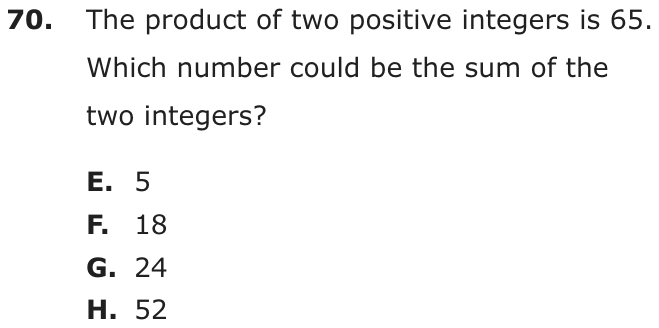
Question 73 of 120
2023 Test A Math, question 14Question
If n is an odd integer that is less than −3.25, what is the greatest possible value of n?
- A−1
- B−2
- C−3
- D−5
Show the answer
Correct answer: D
The two greatest integers less than −3.25 are −4 and −5. Since −4 is even, the answer is −5.
Question analysis
This question asks for the greatest odd integer that is less than −3.25. Students compare negative numbers on a number line and apply two conditions at once, odd and less than. With negatives, the greater number is the one closer to zero, which makes the two conditions easy to misapply.
- Grade level
- Grade 6 content, by NYS standard
- Compared with grade 7
- Below grade 7 Ordering negative numbers is grade 6 content, and the question adds only the condition that the integer be odd. It is lighter than typical grade 7 work, though the order of negatives still trips up students who compare their sizes.
- Estimated difficulty
- Straightforward: two steps or one careful reading.
- Thinking it demands
- Depth of knowledge 1, recall and reproduction · mainly apply
- What makes it hard
- Error-prone arithmetic minor
- Much to keep track of minor
- Solution
- 2 steps
- Reading level
- Question and choices: about grade 7, 18 words.
- Students, last 30 days
- Not enough answers yet to show (it takes 10).
Why it is hard, traps and wrong answers (shows the answer)
Why it is hard
The question is short, but it asks students to reason on the negative side of 0, where greater means closer to 0 and the size of the digits misleads. The integers just below −3.25 are −4 and then −5, and the first of those is even. Sketching a number line, or reading less than as to the left of, keeps the direction straight.
Error-prone arithmetic minor Working it out
On the negative side, less means farther from 0, so the integers below −3.25 run −4, −5, −6; −3, though its digit is closer to 3.25, lies to the right. (Brown & Burton, 1978; Junker & Sijtsma, 2001)
Much to keep track of minor Working it out
Three conditions apply at once, odd, less than −3.25 and the greatest such value, and checking only two of them leads to a listed choice. (Sweller, 1988; Carpenter, Just & Shell, 1990)
Strategy: Picture −3.25 on a number line, list the integers to its left starting with the closest, and take the first one that is odd.
Traps
- Negatives and direction: Arithmetic with negative numbers, the order of a subtraction, or direction on a number line. (Moving a term across the equals sign without changing its sign is a faulty procedure.)
- Misreads the question: Misses or misreads a condition or a word in the question: "at least", "each", "remaining", "not".
The wrong answers, classified
A Misreads the question (Hegarty, Mayer & Monk, 1995)
Picks the greatest odd number offered, −1, without checking the condition that n be less than −3.25; −1 lies to its right on the number line.
B Little reason to choose it (Haladyna & Downing, 1993; Rodriguez, 2005)
The choice −2 is even, so it breaks the condition that n be odd, and it is also greater than −3.25; it mostly catches guesses.
C Negatives and direction (Brown & Burton, 1978)
Looks for the odd integer just past −3.25 but steps toward 0, taking −3, though −3 is greater than −3.25, not less.
Worked solution, step by step
Formulas used
- Comparing negative numbers
- a and b are positive numbers, and a is bigger. On a number line, numbers get smaller as you move left. A negative number farther from 0 is farther left. So it is smaller, even though its digits look bigger.
Sort out the question
n has to pass three tests. It is an integer, a whole number with no decimal part. It is odd, so it is not a multiple of 2. And it is less than −3.25. Of all the numbers that pass, you need the greatest one. That is the one farthest to the right on a number line.
Picture −3.25 on a number line
−3.25 sits between −4 and −3. Less than −3.25 means to the left of it.
So −4 is less than −3.25, but −3 is greater. Watch out: −3 is not less than −3.25. It is to the right, closer to 0. For negative numbers, the one closer to 0 is greater. Picking −3 is choice C.
Find the odd integers to the left
The integers less than −3.25, starting with the closest, are −4, −5, −6 and so on. The greatest one is −4. But −4 is even, since 4 = 2 × 2. So skip it. The next one, −5, is odd. Watch out: −1 is odd, but it is greater than −3.25, so choice A breaks the rule. So the answer is D, −5.
Check your answer
Check all three tests for −5. It is an integer. It is odd. It is to the left of −3.25, so it is less. The only integer between −5 and −3.25 is −4, and it is even. So no greater number works.
More questions like this
The original DOE question
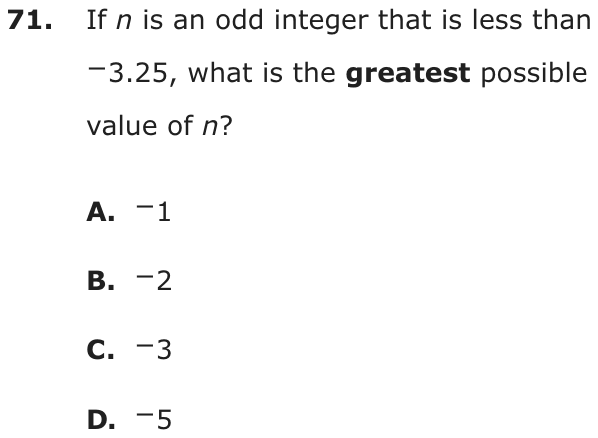
Question 74 of 120
2023 Test A Math, question 16Question
Between which two consecutive integers is the fraction ?
- A2 and 3
- B3 and 4
- C4 and 5
- D5 and 6
Show the answer
Correct answer: C
First, convert to a mixed number: . The two consecutive integers on either side of are 4 and 5.
Question analysis
This question asks between which two consecutive whole numbers the fraction 29/7 lies. Students divide to turn the improper fraction into a mixed number, or compare it with nearby multiples of 7. It is a quick check of number sense with fractions, where a remainder must be read correctly.
- Grade level
- Grade 6 content, by NYS standard
- Compared with grade 7
- Below grade 7 Changing an improper fraction to a mixed number and placing it between whole numbers is review well before grade 7. This takes one division with a small divisor and nothing more.
- Estimated difficulty
- Routine: one familiar step, little to misread.
- Thinking it demands
- Depth of knowledge 1, recall and reproduction · mainly apply
- What makes it hard
- Solution
- 2 steps
- Reading level
- Question and choices: about grade 5, 13 words.
- Students, last 30 days
- Not enough answers yet to show (it takes 10).
Why it is hard, traps and wrong answers (shows the answer)
Why it is hard
Dividing 29 by 7 gives 4 with a remainder of 1, so the fraction is 4 1/7 and lies just past 4. The one decision is which side of 4 the remainder puts it on, and a positive remainder always moves the value up. Writing the mixed number before looking at the choices makes the pair obvious.
A very close wrong answer minor Choosing the answer
The pairs 3 and 4 and 4 and 5 both contain 4, so knowing that 29/7 is about 4 is not enough; only the remainder, 29 − 28 = 1, puts it above 4. (Embretson & Wetzel, 1987; Gorin & Embretson, 2006; Ascalon et al., 2007)
Strategy: Find the largest multiple of 7 that is not more than 29, write the fraction as a mixed number, and read off the whole numbers on each side.
Traps
- Counting the ends: Inclusive or exclusive ends, fence posts, consecutive numbers: an answer that is one too many or too few, or an endpoint drawn open where it belongs closed (or the reverse).
The wrong answers, classified
A Little reason to choose it (Haladyna & Downing, 1993; Rodriguez, 2005)
No division of 29 by 7 lands below 3, since 7 × 3 = 21 is far short of 29; only misreading 29/7 as 2.9 gets there, so it mostly catches guesses.
B Counting the ends (Brown & Burton, 1978)
Finds the whole-number part, 4, but takes it as the upper end of the pair, as if 29/7 fell just short of 4 instead of just past it.
D Little reason to choose it (Haladyna & Downing, 1993; Rodriguez, 2005)
Nothing puts 29/7 above 5, since 7 × 5 = 35 is more than 29; even rounding 4 1/7 up gives 5 as the upper end, so it mostly catches guesses.
Worked solution, step by step
Formulas used
- Fraction to mixed number
- a over b is a fraction whose top is bigger than its bottom. q is the quotient, how many whole times b fits into a. r is the remainder, what is left over. The leftover stays over the same bottom number.
Sort out the question
Consecutive integers are whole numbers that come one right after the other, like 4 and 5. You need the two that falls between. So find the whole number just below it and the one just above it.
Divide 29 by 7
A fraction bar means divide. How many 7s fit in 29?
28 is the biggest multiple of 7 that is not more than 29. A multiple of 7 is 7 times a whole number. Then . So 29 ÷ 7 is 4 with 1 left over.
Write it as a mixed number
is a little more than 4 and less than 5. Watch out: it is just past 4, not just short of it. So 4 is the lower number of the pair. Picking 3 and 4 is choice B. So the answer is C, 4 and 5.
Check your answer
Multiply each end by 7. and . The top of the fraction, 29, is between 28 and 35. So is between 4 and 5. As a decimal it is about 4.14.
More questions like this
The original DOE question
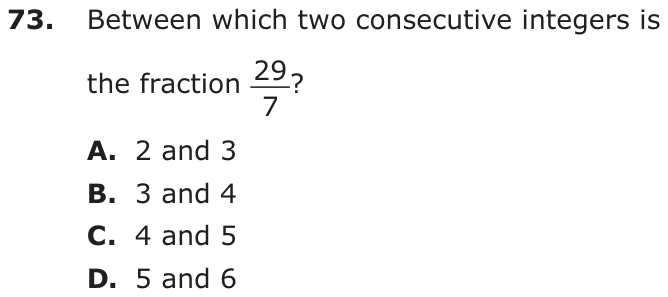
Question 75 of 120
2023 Test A Math, question 19Question
For what value of x is the proportion shown above true?
- A27
- B25
- C16
- D13
Show the answer
Correct answer: B
Write the ratios in fraction form and solve for x:
| Cross multiply. | |
| Apply the multiplicative inverse property; divide both sides by 28. | |
Question analysis
This question gives the proportion x:35 = 20:28 and asks for the value of x that makes it true. Students use equivalent ratios or cross-multiplication. The trap is reasoning by adding or subtracting the difference between terms rather than multiplying, which gives numbers that look reasonable but break the ratio.
- Grade level
- Grade 6 content, by NYS standard
- Compared with grade 7
- Below grade 7 Finding a missing term in a proportion is grade 6 ratio reasoning, and here the given ratio simplifies to small numbers. It is easier than typical grade 7 proportional reasoning, which usually involves fractions or a real context.
- Estimated difficulty
- Routine: one familiar step, little to misread.
- Thinking it demands
- Depth of knowledge 1, recall and reproduction · mainly apply
- What makes it hard
- Error-prone arithmetic minor
- A very close wrong answer minor
- Solution
- 2 steps
- Reading level
- Question and choices: about grade 5, 12 words.
- Students, last 30 days
- Not enough answers yet to show (it takes 10).
Why it is hard, traps and wrong answers (shows the answer)
Why it is hard
This is a single proportion with whole numbers, and the only real trap is reasoning by differences instead of by a common factor. Since 35 is 7 more than 28, adding or subtracting 7 to 20 is tempting, but equal ratios scale; they do not shift. Reducing 20:28 to 5:7 shows at once that the scale factor to 35 is 5.
Error-prone arithmetic minor Working it out
Cross-multiplying gives 28x = 700, and 700 ÷ 28 is not a table fact; simplifying 20:28 to 5:7 first turns it into 5 × 5. (Brown & Burton, 1978; Junker & Sijtsma, 2001)
A very close wrong answer minor Choosing the answer
27 is only 2 more than 25, so a rough sense that x is a little more than 20 fits both; only the exact scale factor, 35/28 = 5/4, separates them. (Embretson & Wetzel, 1987; Gorin & Embretson, 2006; Ascalon et al., 2007)
Strategy: Simplify 20:28 to lowest terms first, then scale it up so its second term becomes 35, or cross-multiply and divide by 28.
Traps
- Misunderstands the concept: A wrong belief about a concept: that percents can be added, that area grows like length, that averages can be averaged, that a bigger denominator means a bigger fraction.
- Wrong operation: Adds instead of multiplying, divides the wrong way round, turns a ratio or rate upside down, or undoes a step in the wrong direction (subtracts what should be added back).
The wrong answers, classified
A Misunderstands the concept (Smith, diSessa & Roschelle, 1993; De Bock et al., 1998; Ni & Zhou, 2005)
Reasons with differences: since 35 is 7 more than 28, adds 7 to 20, keeping the gap between the terms instead of their ratio.
C Wrong operation (Hegarty, Mayer & Monk, 1995; King et al., 2004)
Scales 20 by 28/35 instead of 35/28, so 20 × 28 ÷ 35 = 16, which turns the ratio of the second terms upside down.
D Misunderstands the concept (Smith, diSessa & Roschelle, 1993; De Bock et al., 1998; Ni & Zhou, 2005)
Reasons with differences and also goes the wrong way, subtracting 7 from 20, though x must exceed 20 because 35 exceeds 28.
Worked solution, step by step
Formulas used
- Ratio as a fraction
- a:b is a ratio, read a to b. It compares two amounts by division. You can write it as the fraction a over b. Two equal ratios make a proportion.
- Equivalent fractions
- a over b is a fraction, and k is any number except 0. Multiplying or dividing the top and the bottom by the same number gives an equal fraction.
Sort out the question
is a proportion. A proportion says two ratios are equal. A ratio compares two numbers, like 20 to 28. You need the value of x that makes the two ratios equal.
Write the ratios as fractions
Write each ratio as a fraction. The first number of the ratio goes on top. The second goes on the bottom.
Simplify the known fraction
20 and 28 both divide by 4. Smaller numbers are easier to work with.
So now .
Scale up so the bottom is 35
7 times 5 is 35. To keep the fraction equal, multiply the top by 5 too.
So x = 25. Watch out: a ratio is about multiplying, not adding. 35 is 7 more than 28, but adding 7 to 20 gives 27, choice A. Also, x must be more than 20, because 35 is more than 28. So 16 and 13 are too small. So the answer is B, 25.
Check your answer
Cross-multiply, as the test’s own explanation does. and . The two products are equal, so the ratios 25:35 and 20:28 are equal.
More questions like this
The original DOE question
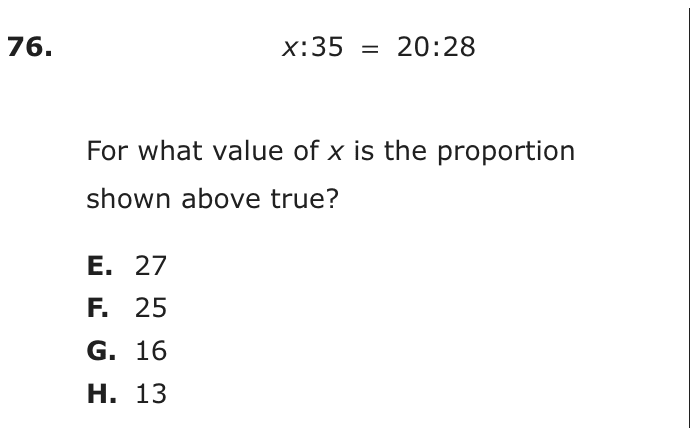
Question 76 of 120
2023 Test A Math, question 20Question
- A−60
- B
- C
- D68
Show the answer
Correct answer: C
Question analysis
This arithmetic question asks for the value of a fraction whose numerator is the sum of the squares of 3, −8 and 2, and whose denominator is the square of 3 − 8 + 2. Students apply the order of operations with negative numbers. Squaring a negative number and adding inside parentheses before squaring are the points to watch.
- NYS standards
- Grade level
- Grade 7 content, by NYS standard
- Compared with grade 7
- At grade 7 Squaring negative numbers and simplifying with the order of operations is standard grade 7 practice. Here the fraction bar groups a numerator and a denominator that each involve a negative sign, but the work stays short.
- Estimated difficulty
- Straightforward: two steps or one careful reading.
- Thinking it demands
- Depth of knowledge 1, recall and reproduction · mainly apply
- What makes it hard
- Error-prone arithmetic moderate
- Many steps minor
- Solution
- 3 steps
- Reading level
- Question and choices: about grade 16+, 3 words.
- Students, last 30 days
- Not enough answers yet to show (it takes 10).
Why it is hard, traps and wrong answers (shows the answer)
Why it is hard
The expression is built so that signs decide everything: the top's 3², (−8)² and 2² are all positive, and so is the square of the bottom's −3. Students who keep a negative after squaring, or who cancel the 9 on top against the 9 below, reach the other choices. The result, 77/9, does not reduce, which can make careful students doubt a correct answer.
Error-prone arithmetic moderate Working it out
Two negatives sit inside squares: (−8)² must be +64, and the denominator's 3 − 8 + 2 = −3 must be squared to +9, so every term ends up positive. (Brown & Burton, 1978; Junker & Sijtsma, 2001)
Many steps minor Working it out
The numerator needs three squares and a sum, the denominator a sum and then a square, and the fraction bar groups each side, so neither part can be split or cancelled. (Daniel & Embretson, 2010; Enright, Morley & Sheehan, 2002)
Strategy: Simplify the top and the bottom separately: square each number in the numerator, add inside the parentheses before squaring in the denominator, then write the fraction in lowest terms.
Traps
- Order of operations: Working left to right, or distributing a minus sign wrongly, gives a choice.
- A faulty procedure: A systematic but wrong procedure: adding fractions straight across, applying an exponent to each term of a sum, dropping a sign when moving a term.
The wrong answers, classified
A Order of operations (Brown & Burton, 1978)
Squares as if the minus sat outside the parentheses, (−8)² as −64, and also cancels the 9 on top against the 9 below, leaving −64 + 4 = −60.
B Order of operations (Brown & Burton, 1978)
Squares as if the minus sat outside the parentheses, taking (−8)² as −64, so the top is 9 − 64 + 4 = −51 and −51/9 = −17/3.
D A faulty procedure (Brown & Burton, 1978; Tatsuoka, 1983)
Cancels the 9 in the numerator, 9 + 64 + 4, against the denominator's 9, leaving 64 + 4 = 68, though only a factor of the whole top can cancel.
Worked solution, step by step
Formulas used
- Square of a negative
- a is any number. To square means to multiply a number by itself. A negative times a negative is positive. So the square of a negative number is always positive.
- The fraction bar groups
- A fraction bar means divide. It also groups: work out the whole top and the whole bottom first, then divide. You can only cancel a number that multiplies the whole top, not one part of a sum.
Sort out the expression
The top, the numerator, is three squares added together. The bottom, the denominator, is a sum in parentheses that is then squared. To square means to multiply a number by itself. Work out the top and the bottom on their own. Then divide.
Work out the top
Square each number first. Then add.
Watch out: (−8)² is +64, not −64. The minus sign is inside the parentheses, so it is squared too. Using −64 makes the top −51 and gives , choice B.
Work out the bottom
Work inside the parentheses first. Add and subtract before you square.
The bottom is 9.
Divide and simplify
77 is 7 × 11 and 9 is 3 × 3. They share no factor, so the fraction is in lowest terms. Watch out: don’t cancel the 9 on top with the 9 below. That 9 is only one part of a sum. Canceling it leaves 64 + 4 = 68, choice D. So the answer is C, .
Check your answer
Every square is positive or zero. So the top and the bottom are both positive, and the answer must be positive. That rules out −60 and . Also, is about 8.6, which is far from 68.
More questions like this
The original DOE question
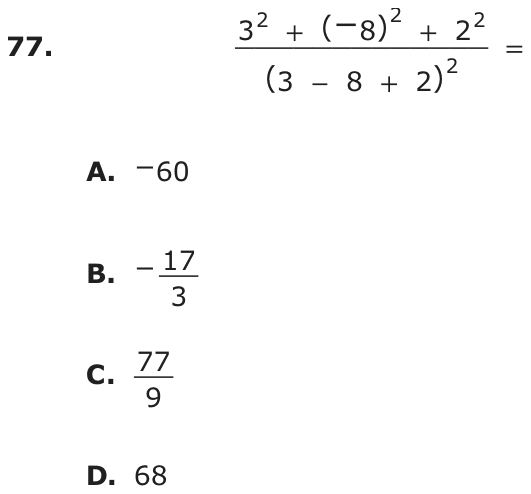
Question 77 of 120
2023 Test A Math, question 22Question
The numbers m, n, p, and q are different, and each is equal to one of the numbers 1, 2, 3, 6, or 12. If , what is the value of p?
- A2
- B3
- C6
- D12
Show the answer
Correct answer: C
Substitute each answer option for p to see which value will work:
Option A:
If , then , so . This cannot be the answer, because n cannot equal 4.
Option B:
If , then , so . This cannot be the answer, because q cannot equal 0.5.
Option C:
If , then , so ; , so ; and , so . This is the correct answer.
Option D:
If , then , so . This cannot be the answer, because n cannot equal 24.
Question analysis
Four letters, m, n, p and q, stand for different numbers from the list 1, 2, 3, 6 and 12, and the expressions 2m, 6q, half of n, and p are all equal. Students find the value of p. The puzzle-like setup has no single equation to solve, so testing values against every condition is the reliable route.
- Grade level
- Grade 6 content, by NYS standard
- Compared with grade 7
- Above grade 7 The equations involve only doubling, halving and multiplying by 6, all grade 6 skills. What goes beyond grade 7 practice is the chain of four equal expressions, with every letter limited to a short list of different numbers.
- Estimated difficulty
- Moderate: several steps, or a close reading with one strong distractor.
- Thinking it demands
- Depth of knowledge 2, skills and concepts · mainly analyze
- What makes it hard
- Variables instead of numbers moderate
- Every choice must be checked moderate
- Solution
- 3 steps
- Reading level
- Question and choices: about grade 5, 27 words.
- Students, last 30 days
- Not enough answers yet to show (it takes 10).
Why it is hard, traps and wrong answers (shows the answer)
Why it is hard
The chain looks forbidding, but it gives each letter as a simple multiple of p: m is half of p, q a sixth of it, and n twice it. Seen that way, q = p/6 forces p to be 6 or 12, and n = 2p rules out 12, so only one value fits. Students who check one or two of the letters, but not all three, can accept 2 or 12.
Variables instead of numbers moderate Understanding the question
Four letters are tied by one chain of equalities, 2m = 6q = ½n = p, and the only numbers are the five allowed values, so each letter has to be written in terms of p. (Koedinger & Nathan, 2004; Enright, Morley & Sheehan, 2002)
Every choice must be checked moderate Choosing the answer
Each choice for p must be tested against three letters, m = p/2, q = p/6 and n = 2p, and all of them must land on different numbers from 1, 2, 3, 6 and 12. (Embretson & Wetzel, 1987)
Strategy: Test each choice as p: find m, q and n from it, and keep the value for which all three are different numbers from the list 1, 2, 3, 6 and 12.
Traps
- Answers a different question: A choice is right for another quantity: the other unknown, the rest instead of the part, the part instead of the whole.
- Misreads the question: Misses or misreads a condition or a word in the question: "at least", "each", "remaining", "not".
The wrong answers, classified
A Misreads the question (Hegarty, Mayer & Monk, 1995)
Checks only m, finding that p = 2 gives m = 1 on the list, and misses that q would be 1/3 and n would be 4.
B Answers a different question (King et al., 2004; Hegarty, Mayer & Monk, 1995)
Finds the solution, m = 3, q = 1, n = 12 and p = 6, then answers with m's value, 3, instead of the value of p.
D Misreads the question (Hegarty, Mayer & Monk, 1995)
Tests p = 12 against 2m and 6q, getting m = 6 and q = 2, both on the list, and stops before seeing that ½n = 12 needs n = 24.
Worked solution, step by step
Formulas used
- Undoing a multiplication
- a is a number that multiplies m, and p is the result. Dividing by a undoes multiplying by a. Use it to write each letter using p.
Sort out the question
m, n, p and q are four different numbers. Each one is 1, 2, 3, 6 or 12. The chain says that four amounts are all equal to p. You need the value of p.
Write each letter using p
Each part of the chain equals p. Undo each multiplication.
Half of n is p, so n is twice p.
Test each choice for p
p m q n All on the list? 2 1 4 No 3 1.5 0.5 6 No 6 3 1 12 Yes 12 6 2 24 No Only p = 6 puts every letter on the list.
Check that the letters are different
With p = 6, you get m = 3, q = 1 and n = 12. All four numbers are on the list, and no two are the same. Watch out: p = 12 makes m = 6 and q = 2, which look fine. But n = 24 is not on the list, so choice D fails. Also, the question asks for p, not m. Picking 3 is choice B. So the answer is C, 6.
Check your answer
Put the values into the chain: , , , and p = 6. All four parts equal 6. The numbers 3, 1, 12 and 6 are all different and all on the list.
More questions like this
The original DOE question
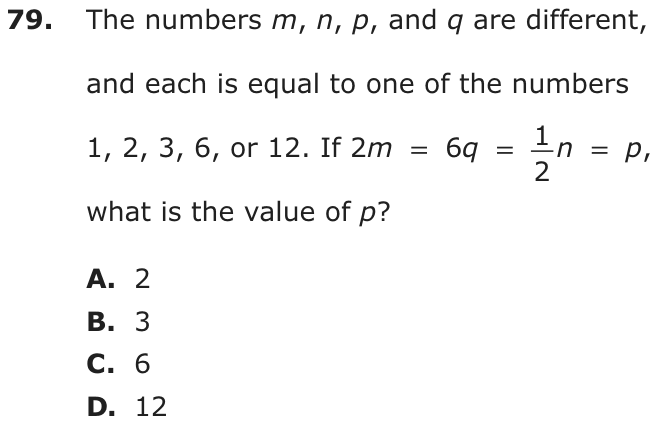
Question 78 of 120
2023 Test A Math, question 23Question
If a person chooses a number at random from the set above, what is the probability that the number is less than 0.005?
- A
- B
- C
- D
Show the answer
Correct answer: C
Three of the five numbers listed (0.001, 0.0001, and 0.00001) are less than 0.005. So, the probability of a person selecting a number less than 0.005 is .
Question analysis
A set holds five decimals, from one tenth down to one hundred-thousandth, and one number is chosen at random. Students find the probability that the number is less than 0.005. Comparing decimals with many zeros is the real task here, along with putting the count over the right total.
- Grade level
- Grade 6 content, by NYS standard
- Compared with grade 7
- Below grade 7 Probability with equally likely outcomes is grade 6 content in New York, and this needs one comparison per number and one fraction. The only real demand is comparing decimals with many zeros correctly.
- Estimated difficulty
- Straightforward: two steps or one careful reading.
- Thinking it demands
- Depth of knowledge 2, skills and concepts · mainly apply
- What makes it hard
- Error-prone arithmetic moderate
- Something you must already know minor
- Solution
- 2 steps
- Reading level
- Question and choices: about grade 6, 27 words.
- Students, last 30 days
- Not enough answers yet to show (it takes 10).
Why it is hard, traps and wrong answers (shows the answer)
Why it is hard
Each number in the set is a tenth of the one before, so only the three smallest fall below 0.005, which lies between 0.01 and 0.001. Students lose the point either by counting the numbers above 0.005 instead of below it or by writing the count over the wrong total. Lining the decimals up with the same number of places makes every comparison easy.
Error-prone arithmetic moderate Working it out
0.005 has to be compared with decimals from 0.1 down to 0.00001; written to five places, 0.00500 against 0.01000 and 0.00100, the order becomes a comparison of whole numbers. (Brown & Burton, 1978; Junker & Sijtsma, 2001)
Something you must already know minor Working it out
The probability is the count of numbers below 0.005 over all 5 numbers in the set; the stem leaves that part-to-whole rule to the student. (Anderson & Krathwohl, 2001)
Strategy: Write each number with five decimal places, compare it with 0.00500, count those that are smaller, and divide by the five numbers in the set.
Traps
- Answers a different question: A choice is right for another quantity: the other unknown, the rest instead of the part, the part instead of the whole.
- Misunderstands the concept: A wrong belief about a concept: that percents can be added, that area grows like length, that averages can be averaged, that a bigger denominator means a bigger fraction.
The wrong answers, classified
A Answers a different question (King et al., 2004; Hegarty, Mayer & Monk, 1995)
Gives 1/5, the chance of picking any one particular number from the set, without counting how many of the five are below 0.005.
B Answers a different question (King et al., 2004; Hegarty, Mayer & Monk, 1995)
Counts the 2 numbers greater than 0.005, 0.1 and 0.01, instead of those less than it, finding the chance of the opposite event.
D Misunderstands the concept (Smith, diSessa & Roschelle, 1993; De Bock et al., 1998; Ni & Zhou, 2005)
Writes a part-to-part ratio, the 2 numbers above 0.005 over the 3 below it, instead of dividing by all 5 numbers in the set.
Worked solution, step by step
Formulas used
- Probability
- P is the probability, the chance that something happens. Possible results are all the results that are equally likely. Wanted results are the ones you are looking for. The chance is the fraction of all the results that you want.
- Adding zeros to a decimal
- Zeros added to the right end of a decimal don’t change its value. One tenth is the same as ten hundredths. Giving every number the same number of decimal places lets you compare them like whole numbers.
Sort out the question
The set has five numbers. A person picks one at random, so each number has the same chance. You need the probability, or chance, that the number picked is less than 0.005.
Give every number five decimal places
Decimals are easier to compare with the same number of places. Add zeros to the end of each.
Number With five places 0.1 0.10000 0.01 0.01000 0.001 0.00100 0.0001 0.00010 0.00001 0.00001 0.005 0.00500 Count the numbers below 0.005
Compare each number with 0.00500 like whole numbers: 10000, 1000, 100, 10 and 1 against 500. Two numbers are bigger: 0.1 and 0.01. Three are smaller: 0.001, 0.0001 and 0.00001. Watch out: 0.01 has fewer digits than 0.005, but it is bigger. Counting the 2 bigger numbers gives , choice B.
Write the probability
Watch out: divide by all 5 numbers in the set. Comparing the 2 bigger numbers with the 3 smaller ones gives , choice D. So the answer is C, .
Check your answer
The numbers below 0.005 and the numbers above it make up the whole set: 3 + 2 = 5. So the two chances, and , add up to 1, as they should.
More questions like this
The original DOE question
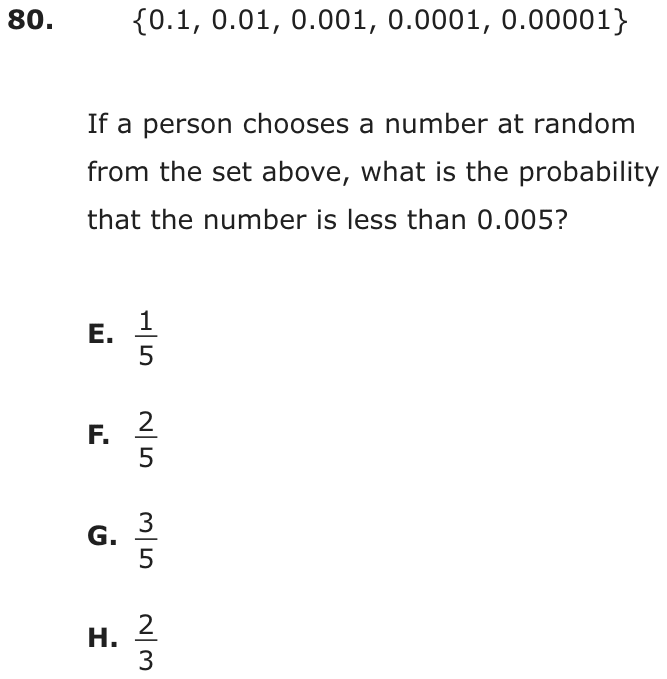
Question 79 of 120
2023 Test A Math, question 25Question
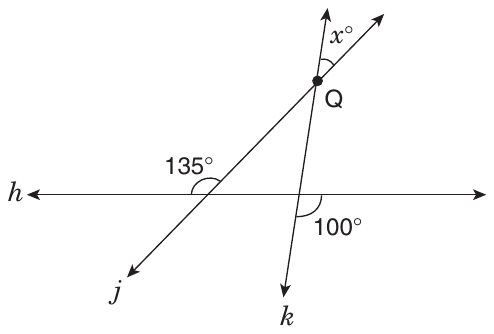
Lines j and k intersect at point Q, and h is a straight line. What is the value of x?
- A55
- B45
- C35
- D30
Show the answer
Correct answer: C
First, find the measures of the three angles inside the triangle. The lower left angle is supplementary to the one marked 135°, so the measure of that angle is . The angle on top is a vertical angle with the one marked x°, so the measure of that angle is also x°. The angle on the lower right is a vertical angle with the one marked 100°, so the measure of that angle is also 100°. Since the measures of the three interior angles of a triangle sum to 180°, set up an equation and solve for x:
Question analysis
Lines j and k cross at point Q above a straight line h, forming a triangle, with a 135° angle marked where j meets h and a 100° angle where k meets h. Students find the angle x at Q. Each marked angle lies outside the triangle, so it has to be turned into an inside angle before the triangle's angle sum can be used.
- NYS standards
- Grade level
- Grade 8 content, by NYS standard
- Compared with grade 7
- Above grade 7 Grade 7 students use supplementary and vertical angles to find unknown angles. This figure needs both, applied at three different vertices, plus the angle sum of a triangle, which New York teaches in grade 8.
- Estimated difficulty
- Hard: combines ideas, needs a plan, and has more than one tempting wrong answer.
- Thinking it demands
- Depth of knowledge 2, skills and concepts · mainly apply
- What makes it hard
- Reading a figure, table or graph major
- Combines ideas moderate
- Something you must already know minor
- Solution
- 4 steps
- Reading level
- Question and choices: about grade 2, 20 words.
- Students, last 30 days
- Not enough answers yet to show (it takes 10).
Why it is hard, traps and wrong answers (shows the answer)
Why it is hard
Every angle the solution needs has to be carried into the triangle from outside, and the two marked angles need different treatment. The 135° is supplementary to the triangle's angle, but the 100° is vertical to it, so subtracting both from 180° out of habit builds the wrong triangle. Checking which side of each line a marked angle sits on, not just how near the triangle it is, separates the two cases.
Reading a figure, table or graph major Understanding the question
None of the three marked angles is inside the triangle formed by h, j and k: the 135° is outside on the left, the 100° is below line h, and x is above Q. (Lesh, Post & Behr, 1987; Kirsch & Mosenthal, 1990)
Combines ideas moderate Working it out
Two different angle facts are needed: the 135° gives a supplementary interior angle of 45°, while the 100° and x carry into the triangle unchanged as vertical angles. (Embretson, 1998; Daniel & Embretson, 2010)
Something you must already know minor Working it out
Supplementary angles, vertical angles and the triangle's 180° sum are all assumed, and the question names none of them. (Anderson & Krathwohl, 2001)
Strategy: Mark the three angles of the triangle formed by lines h, j and k: one is supplementary to 135°, one is vertical to 100°, and the one at Q is vertical to x°.
Traps
- Misreads the figure: Reads a value, label or tick spacing in a figure, table or graph wrongly.
- Stops one step early: A choice is a number from partway through the solution.
The wrong answers, classified
A Misreads the figure (Lesh, Post & Behr, 1987; Kirsch & Mosenthal, 1990)
Takes the triangle's angle at line k as 180 − 100 = 80, the supplement of the marked angle instead of its vertical angle, so x = 180 − 45 − 80 = 55.
B Stops one step early (King et al., 2004; Gierl et al., 2017)
Finds the triangle's angle where line j meets h, 180 − 135 = 45, and gives it instead of going on to the angle at Q.
D Little reason to choose it (Haladyna & Downing, 1993; Rodriguez, 2005)
No angle fact in the figure gives 30, and the angle at Q is drawn close to its true size, so this choice mostly catches guesses.
Worked solution, step by step
Formulas used
- Angles on a straight line
- a and b are two angles side by side on a straight line. Together they make a half turn, a straight angle. So they add up to 180°. Angles like this are called supplementary.
- Vertical angles
- When two lines cross, they make an X. The angles straight across from each other in the X are called vertical angles. a and b are one such pair. They are always equal, because each one plus the angle between them makes a straight line.
- Angles of a triangle
- A, B and C are the three angles inside any triangle, in degrees. They always add up to 180°. Use it when you know two of the angles and need the third.
Sort out the figure
Lines h, j and k make a triangle. Its corners are where j crosses h, where k crosses h, and point Q. The figure marks two angles outside the triangle, 135° and 100°. You need x, the angle marked above Q.
Find the angle where j crosses h
The 135° angle is above h and to the left of j. The triangle’s angle is right next to it, on the other side of j. Together they make the straight line h. Call the triangle’s angle a.
So that corner of the triangle is 45°. Watch out: this is only one corner, not x. Stopping here gives 45, choice B.
Find the angle where k crosses h
The 100° angle is below h and to the right of k. The triangle’s angle is above h and to the left of k. Lines h and k make an X there, and these two angles are straight across from each other. They are vertical angles, so the triangle’s angle is 100°. Watch out: it is not 180 − 100 = 80. That angle is beside the 100°, not across from it. Using 80 gives 55, choice A.
Find the angle at Q
The x° angle is above Q, between the top parts of lines j and k. The triangle’s angle at Q is between the parts of j and k below Q. These two angles are straight across from each other. So they are vertical angles, and the triangle’s angle at Q is also x°.
Use the triangle’s angle sum
The three angles of the triangle must add up to 180°. Only x is unknown. So the answer is C, 35.
Check your answer
Add the triangle’s three angles: . Also, the angle at Q looks narrow in the figure, much less than a right angle of 90°. 35° fits that.
More questions like this
The original DOE question
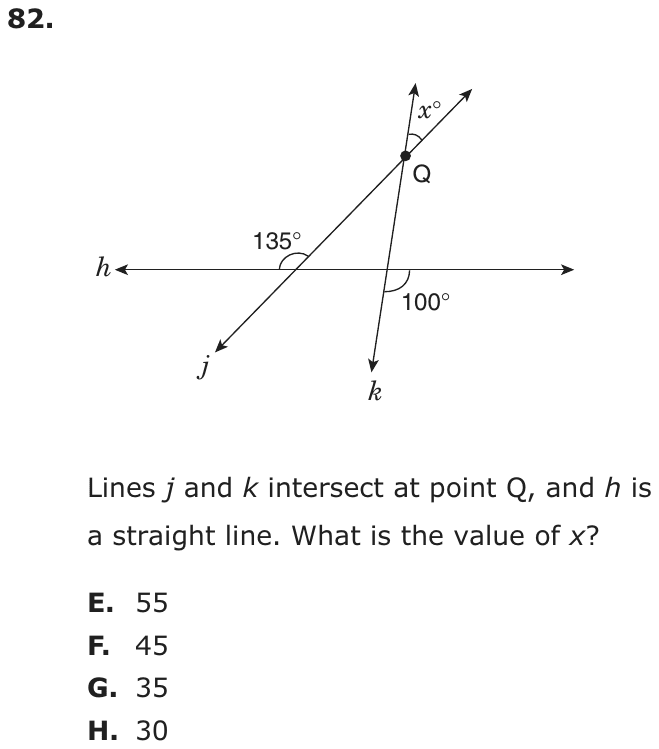
Question 80 of 120
2023 Test A Math, question 26Question
Which statement must be true if x is a whole number greater than or equal to 1?
- A
- B
- C
- D
Show the answer
Correct answer: A
Let , and substitute that value for x in each inequality to determine which one is correct:
Option A:
. This is true.
Option B:
. This is false.
Option C:
, or . This is false.
Option D:
, or . This is false.
Option A is the only true inequality.
Question analysis
This question asks which of four inequalities must be true when x is a whole number of at least 1. The inequalities compare fractions with denominators x + 1 and x + 2, or their difference. Students reason about how the size of a fraction changes as its denominator grows, and must be sure a statement holds for every allowed value.
- Grade level
- Grade 6 content, by NYS standard
- Compared with grade 7
- At grade 7 Comparing fractions is familiar, but these fractions have variable denominators and the question asks what must be true for every whole number from 1 up. That abstraction makes it as demanding as typical grade 7 work, though the arithmetic is light.
- Estimated difficulty
- Moderate: several steps, or a close reading with one strong distractor.
- Thinking it demands
- Depth of knowledge 2, skills and concepts · mainly analyze
- What makes it hard
- Variables instead of numbers moderate
- Every choice must be checked moderate
- Error-prone arithmetic minor
- Solution
- 2 steps
- Reading level
- Question and choices: about grade 6, 20 words.
- Students, last 30 days
- Not enough answers yet to show (it takes 10).
Why it is hard, traps and wrong answers (shows the answer)
Why it is hard
Choosing a small value, such as x = 1 or 2, and testing every statement settles this quickly, because three of the four fail for any value tried. The trap is the belief that a bigger denominator makes a bigger fraction, which turns the true comparison around. Students unsure of fraction subtraction lose time on the two difference statements, though both differences are tiny, never more than 1/6.
Variables instead of numbers moderate Understanding the question
All four statements are about the unknown x, and the bold must means each has to hold for every whole number from 1 up, not just for a single test value. (Koedinger & Nathan, 2004; Enright, Morley & Sheehan, 2002)
Every choice must be checked moderate Choosing the answer
The statements are four separate inequalities, two comparisons and two differences, so each has to be tested; one counterexample is enough to rule a statement out. (Embretson & Wetzel, 1987)
Error-prone arithmetic minor Working it out
Testing the differences means subtracting unlike fractions, such as 1/3 − 1/4 = 1/12 when x = 2, and comparing the result with 1 and with 1/x. (Brown & Burton, 1978; Junker & Sijtsma, 2001)
Strategy: Substitute a small whole number such as 1 or 2 for x in all four statements, rule out any that fail, and confirm the survivor by thinking about larger denominators.
Traps
- Misunderstands the concept: A wrong belief about a concept: that percents can be added, that area grows like length, that averages can be averaged, that a bigger denominator means a bigger fraction.
- A faulty procedure: A systematic but wrong procedure: adding fractions straight across, applying an exponent to each term of a sum, dropping a sign when moving a term.
The wrong answers, classified
B Misunderstands the concept (Smith, diSessa & Roschelle, 1993; De Bock et al., 1998; Ni & Zhou, 2005)
Believes a bigger denominator makes a bigger fraction, so 1/(x + 2) seems larger than 1/(x + 1), the comparison turned around.
C Little reason to choose it (Haladyna & Downing, 1993; Rodriguez, 2005)
Both fractions are at most 1/2, so their difference can never exceed 1, and no common working makes it do so; this choice mostly draws guesses.
D A faulty procedure (Brown & Burton, 1978; Tatsuoka, 1983)
Subtracts over a common denominator but keeps only the numerator, (x + 2) − (x + 1) = 1, so the difference looks like 1, larger than 1/x once x is 2.
Worked solution, step by step
Formulas used
- Comparing unit fractions
- a and b are positive numbers, and b is bigger. One over a means one whole cut into a equal pieces. Cutting the same whole into more pieces makes each piece smaller. So the fraction with the bigger bottom is smaller.
- Subtracting fractions
- a and b are the bottoms of the two fractions. Rewrite both fractions over the common bottom a × b. Then subtract the tops. The bottom stays a × b.
Sort out the question
x is a whole number that is 1 or more, so x can be 1, 2, 3 and so on. You need the statement that must be true. That means it is true for every such x. One x that makes a statement false rules it out.
Test x = 1 in each statement
With x = 1, x + 1 is 2 and x + 2 is 3.
- A: . True.
- B: . False.
- C: , which is not more than 1. False.
- D: is not more than . False.
Only A is true when x = 1. So B, C and D are out.
Make sure A is always true
Must means A has to work for every x, not just 1. In and , both tops are 1. The bottom x + 2 is always 1 more than x + 1. Cutting a whole into more pieces makes each piece smaller. So A is always true. Watch out: a bigger bottom makes a smaller fraction, not a bigger one. Thinking the other way gives choice B.
See why C and D always fail
Use the subtracting rule with a = x + 1 and b = x + 2.
The bottom is at least 2 × 3 = 6, so the difference is at most . That is less than 1. Its bottom is also bigger than x, so it is less than . Watch out: keep the bottom when you subtract. Keeping only the top, 1, leads to choice D. So the answer is A.
Check your answer
Try a bigger number, x = 9. A tenth of a pizza is more than an eleventh, so . The difference, , is tiny. It is less than 1 and less than . A still holds, and C and D still fail.
More questions like this
The original DOE question
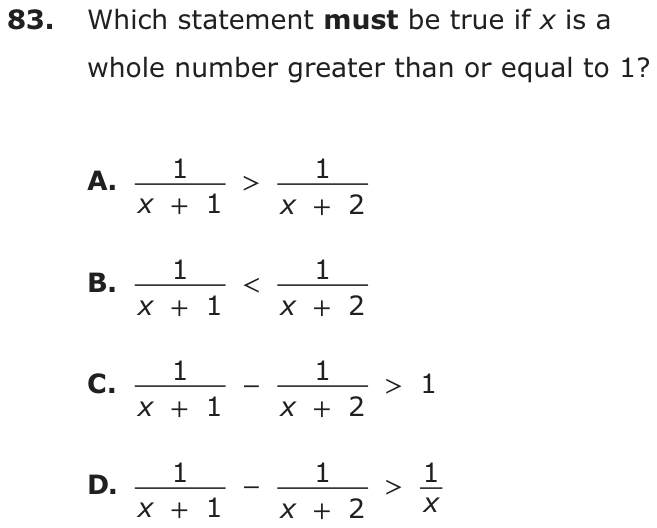
Question 81 of 120
2023 Test A Math, question 27Question
A basket contains red balls, green balls, and white balls. There are 12 red balls in the basket. The probability of randomly choosing a red ball is 1 in 3. If the probability of randomly choosing a green ball is 1 in 4, how many green balls are in the basket?
- A3
- B8
- C9
- D16
Show the answer
Correct answer: C
First, use the information about the red balls to calculate the total number of balls in the basket:
| Cross multiply. | |
There are a total of 36 balls in the basket. The probability of selecting a green ball is 1 in 4. Use that information to calculate how many green balls are in the basket:
| Cross multiply. | |
| Apply the multiplicative inverse property; divide both sides of the equation by 4. | |
There are 9 green balls in the basket.
Question analysis
A basket holds red, green and white balls, including 12 red ones, and the chances of drawing red and green are 1 in 3 and 1 in 4. Students find how many green balls are in the basket. Getting the total from the red count is the step students skip when they apply a probability to the wrong number.
- Grade level
- Grade 6 content, by NYS standard
- Compared with grade 7
- At grade 7 Simple probability is grade 6 content, but here it runs backward: a count and a probability give the total, which then gives another count. Two linked steps like this are typical of grade 7 work.
- Estimated difficulty
- Straightforward: two steps or one careful reading.
- Thinking it demands
- Depth of knowledge 2, skills and concepts · mainly apply
- What makes it hard
- Turning words into math minor
- Many steps minor
- Solution
- 2 steps
- Reading level
- Question and choices: about grade 6, 46 words.
- Students, last 30 days
- Not enough answers yet to show (it takes 10).
Why it is hard, traps and wrong answers (shows the answer)
Why it is hard
The basket's total is never stated, and that missing number is the whole problem: it has to be recovered from the red balls before the green probability means anything. Applying the green chance straight to the 12 red balls is the quick wrong move. Checking that 12 red and 9 green fit in 36 balls with 15 white left over confirms the setup.
Turning words into math minor Understanding the question
The sentence "The probability of randomly choosing a red ball is 1 in 3" has to become 12 = one third of the total, which makes the basket hold 36 balls. (Hegarty, Mayer & Monk, 1995; Koedinger & Nathan, 2004)
Many steps minor Working it out
Two linked steps: the red balls give the total, 12 × 3 = 36, and only then does the green probability give a count, 36 ÷ 4 = 9. (Daniel & Embretson, 2010; Enright, Morley & Sheehan, 2002)
Strategy: Use the red balls to find the total, since 12 is one third of it, then take one fourth of that total for the green balls.
Traps
- Numbers taken from the question: Combines the numbers in the question without a model of the situation, or is simply a number that appears in the question.
- Wrong operation: Adds instead of multiplying, divides the wrong way round, turns a ratio or rate upside down, or undoes a step in the wrong direction (subtracts what should be added back).
The wrong answers, classified
A Numbers taken from the question (Hegarty, Mayer & Monk, 1995)
Takes one fourth of the 12 red balls, 12 ÷ 4 = 3, applying the green probability to the only count the stem gives instead of to the total.
B Little reason to choose it (Haladyna & Downing, 1993; Rodriguez, 2005)
No use of the two probabilities gives 8, which is one third of the 24 balls that are not red, so it mostly catches guesses.
D Wrong operation (Hegarty, Mayer & Monk, 1995; King et al., 2004)
Scales the 12 red balls by 4/3 instead of 3/4, taking the 1-in-4 chance to mean more balls than the 1-in-3 chance: 12 × 4/3 = 16.
Worked solution, step by step
Formulas used
- Probability
- P is the probability, the chance of picking that color. Each ball is equally likely to be picked. So the chance is the fraction of all the balls that have that color. A chance of 1 in 3 means one third of the balls.
Sort out the question
The basket has red, green and white balls. There are 12 red balls. The chance of picking red is 1 in 3. The chance of picking green is 1 in 4. You need the number of green balls. You don’t know the total number of balls yet, so find it first.
Find the total number of balls
1 in 3 means one third of all the balls are red. So 12 is one third of the total. Call the total number of balls b.
There are 36 balls in all.
Find the number of green balls
1 in 4 means one fourth of all 36 balls are green. Call the number of green balls g.
Watch out: take one fourth of all 36 balls, not of the 12 red ones. gives choice A. Multiplying 12 by gives 16, choice D. So the answer is C, 9.
Check your answer
A 1 in 4 chance is smaller than a 1 in 3 chance. So there should be fewer green balls than red ones, and 9 is less than 12. Check: . The rest, , are white.
More questions like this
The original DOE question
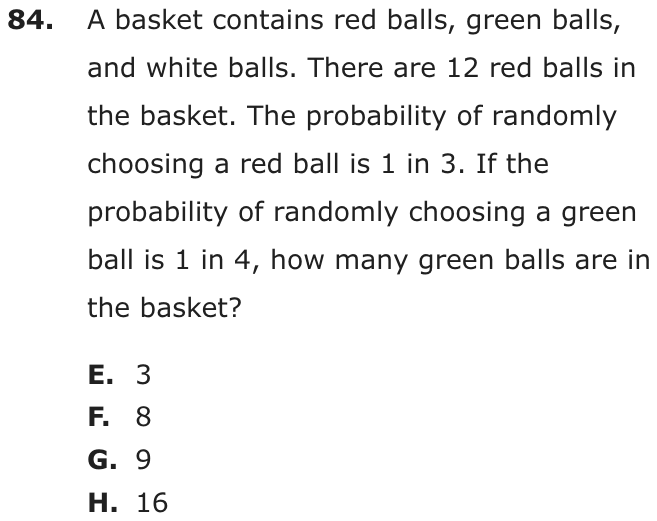
Question 82 of 120
2023 Test A Math, question 28Question
It took Lars 2 hours to ride his bicycle 48 kilometers. What was his average speed in miles per hour? (Use the approximation 1 mile = 1.6 kilometers.)
- A1.5
- B15.0
- C30.0
- D38.4
Show the answer
Correct answer: B
First, calculate Lars’s average speed in kilometers per hour:
Then, convert kilometers to miles:
| Cross multiply. | |
| Apply the multiplicative inverse property; divide both sides of the equation by 1.6. | |
Question analysis
Lars rides 48 kilometers in 2 hours, and this rate question asks for his average speed in miles per hour, using 1 mile = 1.6 kilometers. Students find a unit rate and convert it to other units. Deciding whether to multiply or divide by 1.6, and remembering the 2 hours, are where students go wrong.
- Grade level
- Grade 6 content, by NYS standard
- Compared with grade 7
- Below grade 7 Finding a speed and converting units with a given rate are grade 6 ratio skills. The question takes two short steps with friendly numbers, lighter than typical grade 7 rate problems with fractional quantities.
- Estimated difficulty
- Straightforward: two steps or one careful reading.
- Thinking it demands
- Depth of knowledge 2, skills and concepts · mainly apply
- What makes it hard
- Combines ideas minor
- Error-prone arithmetic minor
- Solution
- 2 steps
- Reading level
- Question and choices: about grade 7, 23 words.
- Students, last 30 days
- Not enough answers yet to show (it takes 10).
Why it is hard, traps and wrong answers (shows the answer)
Why it is hard
The question tests the direction of a conversion more than the arithmetic. A mile is longer than a kilometer, so a distance has fewer miles than kilometers, and multiplying by 1.6 runs the conversion backward. The other trap is converting the 48 kilometers to 30 miles and forgetting that the ride took 2 hours, which gives a distance instead of a speed.
Combines ideas minor Working it out
A rate and a unit conversion are combined: 48 ÷ 2 = 24 kilometers per hour, then 24 ÷ 1.6 = 15 miles per hour, and the two steps can come in either order. (Embretson, 1998; Daniel & Embretson, 2010)
Error-prone arithmetic minor Working it out
Dividing by 1.6 means dividing 240 by 16; a decimal point in the wrong place makes the speed ten times too small, and that value is offered. (Brown & Burton, 1978; Junker & Sijtsma, 2001)
Strategy: Find the speed in kilometers per hour first, then divide by 1.6, since a mile is longer than a kilometer and the number of miles must be smaller.
Traps
- Wrong operation: Adds instead of multiplying, divides the wrong way round, turns a ratio or rate upside down, or undoes a step in the wrong direction (subtracts what should be added back).
- Stops one step early: A choice is a number from partway through the solution.
- An arithmetic slip: The right method with a plausible arithmetic error: a digit, a place value or a times-table fact.
The wrong answers, classified
A An arithmetic slip (Junker & Sijtsma, 2001)
Divides 24 by 16 instead of 1.6, a decimal point in the wrong place that makes the speed ten times too small, 1.5.
C Stops one step early (King et al., 2004; Gierl et al., 2017)
Converts the 48 kilometers to 30 miles correctly and stops, forgetting to divide by the 2 hours, so it gives a distance rather than a speed.
D Wrong operation (Hegarty, Mayer & Monk, 1995; King et al., 2004)
Multiplies 24 kilometers per hour by 1.6 instead of dividing, converting in the wrong direction and getting more miles than kilometers.
Worked solution, step by step
Formulas used
- Average speed
- Distance is how far you go. Time is how long it takes. Speed is how far you go in each unit of time, such as each hour. Average speed shares the whole trip out evenly over the time.
- Kilometers to miles
- A kilometer is a unit of length used in most countries. 1 mile is about 1.6 kilometers, so a mile is longer. To find how many miles, find how many groups of 1.6 kilometers fit. So divide by 1.6.
Sort out the question
Lars rode 48 kilometers in 2 hours. You need his average speed in miles per hour. That means miles, not kilometers. Use the fact that 1 mile is about 1.6 kilometers.
Find the speed in kilometers per hour
Divide the distance by the time.
Lars went 24 kilometers each hour. This speed is still in kilometers, so you are not done yet.
Change kilometers to miles
Divide by 1.6. To make it easier, multiply both numbers by 10 first. Then you divide by the whole number 16.
Watch out: divide by 1.6, don’t multiply. A mile is longer, so there are fewer miles than kilometers. is choice D. Dividing 24 by 16 gives 1.5, choice A, with the decimal point in the wrong place.
Name the answer
Lars rode 15 miles each hour. Watch out: changing 48 kilometers to 30 miles is only part of the work. 30 is a distance, choice C. You still have to divide by the 2 hours. So the answer is B, 15.0 miles per hour.
Check your answer
Work backward. At 15 miles per hour for 2 hours, Lars rides 30 miles. And kilometers, the distance in the question. Also, 15 is smaller than 24, as it should be, since miles are longer than kilometers.
More questions like this
The original DOE question
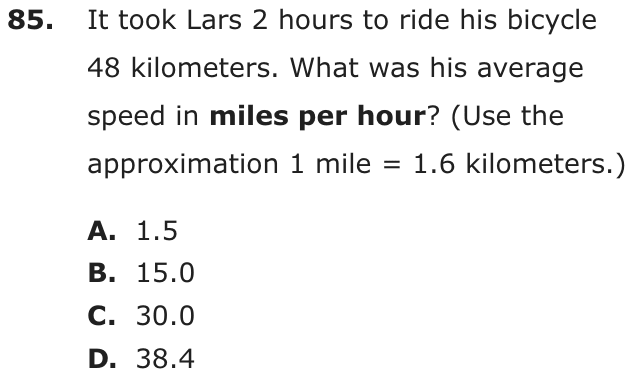
Question 83 of 120
2023 Test A Math, question 29Question
Integer x is evenly divisible by 3. Which expression below is also evenly divisible by 3?
- A
- B
- C
- D
Show the answer
Correct answer: D
Since integer x is evenly divisible by 3, substitute 3 for x in the answer options to determine which expression is also divisible by 3:
Let .
Option A:
Option B:
Option C:
Option D:
Option D is the only value that is divisible by 3.
Question analysis
This number properties question says an integer x is divisible by 3 and asks which of four linear expressions in x is also divisible by 3, whatever multiple of 3 the integer is. Students can test a multiple of 3 in each expression or think about remainders. Testing a value that is not a multiple of 3 can make a wrong expression look right.
- Grade level
- Grade 7 content, by NYS standard
- Compared with grade 7
- At grade 7 Grade 7 students rewrite and evaluate linear expressions, but they seldom ask whether one is divisible by 3 for every allowed value. One well-chosen substitution settles it, so the demand is about typical for grade 7.
- Estimated difficulty
- Straightforward: two steps or one careful reading.
- Thinking it demands
- Depth of knowledge 2, skills and concepts · mainly analyze
- What makes it hard
- Variables instead of numbers moderate
- Every choice must be checked minor
- Solution
- 2 steps
- Reading level
- Question and choices: about grade 13, 18 words.
- Students, last 30 days
- Not enough answers yet to show (it takes 10).
Why it is hard, traps and wrong answers (shows the answer)
Why it is hard
The algebra is light; the question turns on choosing a test value that obeys the condition. The habit of trying x = 1 backfires here, because 1 is not a multiple of 3 and it makes two wrong expressions come out divisible. Students who substitute 3, or who see that 4x and 6 are both multiples of 3 whenever x is, settle it quickly, and a second multiple such as 6 confirms it.
Variables instead of numbers moderate Understanding the question
Nothing pins x down except that it is a multiple of 3, so each expression must be judged for every such x, and any test value has to be a multiple of 3 itself, such as 3 or 6. (Koedinger & Nathan, 2004; Enright, Morley & Sheehan, 2002)
Every choice must be checked minor Choosing the answer
The four expressions differ only in their coefficients and constants, from 2x + 1 to 4x + 6, so none can be dismissed at a glance; each needs a test or a look at its terms. (Embretson & Wetzel, 1987)
Strategy: Substitute a multiple of 3, such as 3 or 6, for x in every expression and keep the one whose value divides evenly by 3; a second multiple confirms it.
Traps
- Misreads the question: Misses or misreads a condition or a word in the question: "at least", "each", "remaining", "not".
- Numbers taken from the question: Combines the numbers in the question without a model of the situation, or is simply a number that appears in the question.
The wrong answers, classified
A Misreads the question (Hegarty, Mayer & Monk, 1995)
Tests x = 1, which is not a multiple of 3, finds that 2(1) + 1 = 3 divides evenly, and stops at the first choice; with x = 3 it gives 7.
B Numbers taken from the question (Hegarty, Mayer & Monk, 1995)
Sees the 3 in 3x and takes the whole expression to be a multiple of 3, overlooking that subtracting 5 spoils it: with x = 3 it gives 4.
C Misreads the question (Hegarty, Mayer & Monk, 1995)
Tries a value that is not a multiple of 3, such as x = 4, where 4x − 1 = 15 divides evenly, though x = 3 gives 11.
Worked solution, step by step
Formulas used
- Adding multiples of 3
- a and b are whole numbers, so 3a and 3b are multiples of 3. A multiple of 3 is a number that 3 divides evenly, with nothing left over. Adding two multiples of 3 always gives another multiple of 3, because you can pull the 3 out of both parts.
Sort out the question
“Evenly divisible by 3” means 3 goes into the number with nothing left over. Such a number is called a multiple of 3, like 3, 6, 9 or 12.
You know that x is a multiple of 3. You need the expression that is a multiple of 3 every time, whatever multiple of 3 x is.
Test x = 3 in every choice
Pick a number for x that follows the rule. The easiest one is 3. Put it into each expression.
Choice Work Divisible by 3? A No B No C No D Yes Watch out: your test number must be a multiple of 3. With x = 1, choice A gives 3 and looks right. That leads to the wrong choice, A.
See why D always works
One test could be lucky, so see why D works for every x. Since x is a multiple of 3, 4x is one too. For example, 4 × 3 = 12 and 4 × 6 = 24. The number 6 is also a multiple of 3, since 6 = 3 × 2.
So 4x + 6 is a multiple of 3 plus a multiple of 3. That is always a multiple of 3.
Rule out the other choices
Watch out: choice B starts with 3x, but then it subtracts 5. The 5 is not a multiple of 3, so it spoils the result, and 3(3) − 5 = 4. Choices A and C also add or take away a number that is not a multiple of 3.
So the answer is D, .
Check your answer
Try two more multiples of 3. With x = 6, choice D gives , and 30 ÷ 3 = 10. With x = 9, it gives , and 42 ÷ 3 = 14. Both divide evenly, so D keeps working.
More questions like this
The original DOE question
Question 84 of 120
2023 Test A Math, question 30Question
Lamel has a jar containing 6 red chips, 10 blue chips, and 4 yellow chips. If he removes one chip at random, what is the probability that it will not be red?
- A
- B
- C
- D
Show the answer
Correct answer: B
There are currently 20 chips in the jar (). Of those chips, 14 are not red. So the probability of choosing a chip that is not red is .
Question analysis
In this probability word problem, Lamel's jar holds red, blue and yellow chips, and students find the chance that one chip drawn at random is not red. It tests counting the favorable outcomes against the total and writing the probability as a fraction. Missing the bold word not, or counting the wrong colors, leads to tempting wrong fractions.
- NYS standards
- 6.SP.8a uniform probability models
- Grade level
- Grade 6 content, by NYS standard
- Compared with grade 7
- Below grade 7 Probability of a single event with equally likely outcomes is grade 6 content in New York. Students add three counts and form one fraction, and the only extra care is the bold word not, so it sits below grade 7.
- Estimated difficulty
- Straightforward: two steps or one careful reading.
- Thinking it demands
- Depth of knowledge 2, skills and concepts · mainly apply
- What makes it hard
- Solution
- 2 steps
- Reading level
- Question and choices: about grade 5, 33 words.
- Students, last 30 days
- Not enough answers yet to show (it takes 10).
Why it is hard, traps and wrong answers (shows the answer)
Why it is hard
This is a one-event probability with small whole numbers, so the bold not carries the question. A student who skims past it computes the chance of red, a tidy fraction that is waiting among the choices. The other wrong fractions come from removing the wrong color or keeping only one of the two colors that are not red. Adding blue and yellow first, then dividing by all 20 chips, avoids each of them.
Turning words into math minor Understanding the question
The bold not turns the question around: the chips that count are the 10 blue and 4 yellow ones, 14 in all, or equivalently 1 minus the red share of 6/20. (Hegarty, Mayer & Monk, 1995; Koedinger & Nathan, 2004)
An answer in an unexpected form minor Choosing the answer
The count of 14 out of 20 matches no choice until it is reduced to 7/10, so a correct fraction left unsimplified can look missing from the list. (Enright, Morley & Sheehan, 2002)
Strategy: Add all the chips for the total, then count the chips that are blue or yellow, or subtract the chance of red from 1, and simplify the fraction.
Traps
- Misreads the question: Misses or misreads a condition or a word in the question: "at least", "each", "remaining", "not".
- Answers a different question: A choice is right for another quantity: the other unknown, the rest instead of the part, the part instead of the whole.
The wrong answers, classified
A Answers a different question (King et al., 2004; Hegarty, Mayer & Monk, 1995)
Leaves out the 4 yellow chips instead of the 6 red ones, finding the chance of not yellow, 16/20 = 4/5.
C Misreads the question (Hegarty, Mayer & Monk, 1995)
Overlooks the bold not and gives the chance that the chip is red, 6 out of 20, which reduces to 3/10.
D Answers a different question (King et al., 2004; Hegarty, Mayer & Monk, 1995)
Counts only the 4 yellow chips as not red and forgets the 10 blue ones, so it finds 4/20 = 1/5, the chance of yellow alone.
Worked solution, step by step
Formulas used
- Probability
- P is the probability, the chance that something happens. The top counts the outcomes you want. The bottom counts every outcome that could happen. It works when each outcome is equally likely, like pulling one chip without looking.
Sort out the question
Lamel’s jar holds 6 red chips, 10 blue chips and 4 yellow chips. He takes one chip without looking. You need the probability that it is not red. That means the chip is blue or yellow.
Count all the chips
There are 20 chips in all. That is the bottom of the fraction, because any of the 20 could come out.
Count the chips that are not red
The blue and yellow chips are the ones that are not red.
So 14 chips are not red. Watch out: the question asks for not red. Counting the 6 red chips gives , choice C. Counting only the 4 yellow chips gives , choice D.
Find and simplify the probability
Dividing the top and bottom by 2 puts the fraction in lowest terms. So the answer is B, .
Check your answer
A chip is either red or not red, so the two chances must add up to 1. The chance of red is . Then . It works.
More questions like this
The original DOE question
Question 85 of 120
2023 Test A Math, question 31Question
The arrow starts on Space P and moves clockwise around the circle. It moves through one space each minute. What space will the arrow point to in 100 minutes?
- AR
- BS
- CT
- DU
Show the answer
Correct answer: C
There are 6 spaces, so first divide 100 by 6: , remainder 4. So, the arrow goes around 16 full times and then 4 more spaces. Four spaces from Space P is Space T.
Question analysis
This patterns question shows a circle split into six lettered spaces, with an arrow that starts on P and moves one space clockwise each minute, and asks where it points after 100 minutes. Students use division with a remainder to skip the full trips around. Counting the leftover moves without including the starting space, and in the right direction, is the tricky part.
- NYS standards
- 6.NS.2 multi-digit division
- Grade level
- Grade 6 content, by NYS standard
- Compared with grade 7
- At grade 7 Division with a remainder is grade 6 arithmetic, but using that remainder to step around a six-part circle is a pattern task that grade 7 classes seldom practice. It needs careful counting rather than new content.
- Estimated difficulty
- Straightforward: two steps or one careful reading.
- Thinking it demands
- Depth of knowledge 2, skills and concepts · mainly apply
- What makes it hard
- Solution
- 2 steps
- Reading level
- Question and choices: about grade 1, 32 words.
- Students, last 30 days
- Not enough answers yet to show (it takes 10).
Why it is hard, traps and wrong answers (shows the answer)
Why it is hard
The division is short; the points are lost in turning the remainder into a space. The arrow starts on P, so the 4 leftover moves land on Q, R, S and T, and counting P itself as a move stops one space short. Going around the wrong way, or one move too far, gives the other two choices. Checking a small case first, such as 7 minutes landing on Q, fixes the rule before it is used.
No obvious method minor Working it out
The stem never mentions division; the step that unlocks it is seeing that every 6 minutes brings the arrow back to P, so only the remainder of 100 ÷ 6 matters. (Schoenfeld, 1985)
Reading a figure, table or graph minor Understanding the question
The six spaces and their clockwise order, P, Q, R, S, T, U, appear only in the circle diagram, so the cycle length and the direction of counting both come from the figure. (Lesh, Post & Behr, 1987; Kirsch & Mosenthal, 1990)
Strategy: Divide 100 by 6: every full trip around the circle brings the arrow back to P, so only the remainder matters; count that many moves clockwise, starting with the space after P.
Traps
- Counting the ends: Inclusive or exclusive ends, fence posts, consecutive numbers: an answer that is one too many or too few, or an endpoint drawn open where it belongs closed (or the reverse).
- Negatives and direction: Arithmetic with negative numbers, the order of a subtraction, or direction on a number line. (Moving a term across the equals sign without changing its sign is a faulty procedure.)
The wrong answers, classified
A Negatives and direction (Brown & Burton, 1978)
Counts the 4 leftover moves counterclockwise from P, through U, T and S to R, instead of clockwise as the stem says the arrow moves.
B Counting the ends (Brown & Burton, 1978)
Counts Space P itself as the first of the 4 leftover moves, P, Q, R, S, so the arrow stops one space short of where it really points.
D Counting the ends (Brown & Burton, 1978)
Makes 5 moves past P instead of the 4 left after 16 full turns, overshooting by one space, the fence-post slip in the other direction.
Worked solution, step by step
Formulas used
- Division with a remainder
- a is the number you divide, here the minutes. b is the number you divide by, here the spaces in one trip around. q is how many whole groups of b fit into a. r is the remainder, the amount left over. The remainder is always less than b.
Sort out the question
The circle has 6 spaces. Going clockwise, the way a clock’s hands turn, they are P, Q, R, S, T and U. The arrow starts on P and moves one space each minute. You need the space it points to after 100 minutes.
Notice that the pattern repeats
After 6 minutes, the arrow has gone all the way around and points to P again. After 12 minutes it is back on P again, and so on. So full trips of 6 minutes don’t change where it points. Only the leftover minutes matter.
Divide 100 by 6
The arrow makes 16 full trips. That takes minutes, and it is back on P. There are 4 minutes left over.
Count the last 4 moves
From P, move one space each minute: Q (minute 97), R (minute 98), S (minute 99), T (minute 100).
Watch out: don’t count P itself as the first move. That stops on S, choice B. Also count clockwise. Counting the other way lands on R, choice A.
So the answer is C, T.
Check your answer
Use a smaller number with the same remainder. 100 − 96 = 4, and 96 minutes is a whole number of trips. So after 100 minutes the arrow points where it does after 4 minutes. Four moves from P are Q, R, S, T. That is T again.
More questions like this
The original DOE question
Question 86 of 120
2023 Test A Math, question 32Question
Mei-Ling is one of 6 members of a committee. If 2 members of that committee are selected to go to a conference, how many of the possible pairs of members would include Mei-Ling?
- A5
- B6
- C10
- D12
Show the answer
Correct answer: A
Call the 6 members A, B, C, D, E, and M (for Mei-Ling). The possible combinations are AB, AC, AD, AE, AM, BC, BD, BE, BM, CD, CE, CM, DE, DM, and EM. Of those pairs, 5 include Mei-Ling.
Question analysis
This counting question describes a six-member committee sending two members to a conference and asks how many of the possible pairs include Mei-Ling. Students count combinations in which order does not matter. The traps are counting a pair twice, pairing Mei-Ling with herself, or multiplying the numbers in the question instead of listing the pairs.
- NYS standards
- 7.SP.8b sample spaces for compound events
- Grade level
- Grade 7 content, by NYS standard
- Compared with grade 7
- At grade 7 Grade 7 students count outcomes with organized lists and tree diagrams. Here the list of pairs is short and a single condition, that one named person belongs to the pair, filters it, which matches routine grade 7 counting work.
- Estimated difficulty
- Straightforward: two steps or one careful reading.
- Thinking it demands
- Depth of knowledge 2, skills and concepts · mainly apply
- What makes it hard
- Turning words into math minor
- Much to keep track of minor
- Solution
- 2 steps
- Reading level
- Question and choices: about grade 8, 31 words.
- Students, last 30 days
- Not enough answers yet to show (it takes 10).
Why it is hard, traps and wrong answers (shows the answer)
Why it is hard
The count is small enough to list, so the question rewards a clear picture of what a pair is: two different people, in no particular order. The tempting errors count Mei-Ling as her own partner, count each pair twice, or multiply the two numbers in the stem. Writing the five pairs out, M with each of A through E, takes seconds and rules out all three.
Turning words into math minor Understanding the question
Pairs that include Mei-Ling are simply Mei-Ling with each of the other 5 members, a count of her possible partners, though the phrase “possible pairs” invites counting all 15 pairs. (Hegarty, Mayer & Monk, 1995; Koedinger & Nathan, 2004)
Much to keep track of minor Working it out
Listing pairs by letter, as the explanation does with A to E and M, means tracking which pairs are already written, so that AM and MA are not both counted. (Sweller, 1988; Carpenter, Just & Shell, 1990)
Strategy: Label the members with letters and list every pair that contains Mei-Ling, remembering that a pair is two different people and that order does not matter.
Traps
- Counting the ends: Inclusive or exclusive ends, fence posts, consecutive numbers: an answer that is one too many or too few, or an endpoint drawn open where it belongs closed (or the reverse).
- Overlapping groups: Things in two groups at once are counted twice, or not subtracted.
- Numbers taken from the question: Combines the numbers in the question without a model of the situation, or is simply a number that appears in the question.
The wrong answers, classified
B Counting the ends (Brown & Burton, 1978)
Counts all 6 committee members as possible partners, forgetting that Mei-Ling cannot be paired with herself, one more than the real count.
C Overlapping groups (King et al., 2004)
Counts ordered pairs, Mei-Ling with a partner and that partner with Mei-Ling, as different, so each of the 5 pairs is counted twice.
D Numbers taken from the question (Hegarty, Mayer & Monk, 1995)
Multiplies the 6 members by the 2 people chosen, 6 × 2 = 12, a product of the stem's numbers that counts no actual pairs.
Worked solution, step by step
Formulas used
- Number of pairs in a group
- n is the number of people in the group. Each person can pair up with the n − 1 others. Multiplying counts every pair twice, once from each partner’s side. So you divide by 2.
Sort out the question
The committee has 6 members, and Mei-Ling is one of them. Two members go to the conference together. That makes a pair. You don’t need every possible pair. You only need the pairs that include Mei-Ling.
Find Mei-Ling’s possible partners
A pair with Mei-Ling is Mei-Ling plus one other member. Call Mei-Ling M, and call the other members A, B, C, D and E. Her pairs are M with A, M with B, M with C, M with D and M with E. That is 5 pairs.
Watch out: she can’t be paired with herself. Counting all 6 members as partners gives 6, choice B.
Don’t count a pair twice
Mei-Ling with A is the same pair as A with Mei-Ling. The same two people go either way. Watch out: counting both orders doubles the count to 10, choice C. Multiplying 6 × 2 = 12 gives choice D, but that does not count any pairs.
Check against all the pairs
Count every pair in the committee.
Each pair has 2 people, so the 15 pairs have 30 name spots. All 6 members get the same share: . So the answer is A, 5.
Check your answer
List all 15 pairs: AB, AC, AD, AE, AM, BC, BD, BE, BM, CD, CE, CM, DE, DM, EM. Now circle the ones with M in them: AM, BM, CM, DM, EM. There are exactly 5.
More questions like this
The original DOE question
Question 87 of 120
2023 Test A Math, question 33Question
If and , what is the value of ?
- A−9
- B−1
- C1
- D9
Show the answer
Correct answer: A
Question analysis
This algebra question gives m = 5 and t = −1 and asks for the value of a fraction whose numerator and denominator both contain parentheses. Students substitute the values and follow the order of operations. Subtracting a negative number and multiplying by a negative difference make sign mistakes likely, and the four choices differ only in sign and size.
- NYS standards
- Grade level
- Grade 7 content, by NYS standard
- Compared with grade 7
- At grade 7 Substituting values into expressions with negative numbers is everyday grade 7 work. This fraction has a numerator and a denominator to evaluate separately, with a minus sign before a negative and a negative difference, so it is a longer version of a standard exercise.
- Estimated difficulty
- Moderate: several steps, or a close reading with one strong distractor.
- Thinking it demands
- Depth of knowledge 1, recall and reproduction · mainly apply
- What makes it hard
- Error-prone arithmetic moderate
- Many steps minor
- A very close wrong answer minor
- Solution
- 4 steps
- Reading level
- Question and choices: about grade 8, 10 words.
- Students, last 30 days
- Not enough answers yet to show (it takes 10).
Why it is hard, traps and wrong answers (shows the answer)
Why it is hard
This is a plain evaluation with no story, and every point is lost on signs. Subtracting the negative t, then handling the two negative intermediate results, each invite a dropped minus, and the four choices are built so that each such slip lands on a listed value. Writing −1 in parentheses when substituting, and finishing the top and the bottom before dividing, keeps the signs in view.
Error-prone arithmetic moderate Working it out
The value t = −1 sits inside 2 − t, so the numerator needs 2 − (−1) = 3, and the work then passes through two negatives, 6 − 24 = −18 and 3 − 5 = −2. (Brown & Burton, 1978; Junker & Sijtsma, 2001)
Many steps minor Working it out
The numerator and the denominator each take a substitution, a parenthesis, a product and a sum, worked separately before one final division, so a slip in either half changes the result. (Daniel & Embretson, 2010; Enright, Morley & Sheehan, 2002)
A very close wrong answer minor Choosing the answer
The choices pair each size with each sign, −9 with 9 and −1 with 1, so getting 18 and 2 right still leaves the sign to decide between two choices. (Embretson & Wetzel, 1987; Gorin & Embretson, 2006; Ascalon et al., 2007)
Strategy: Substitute with parentheses around −1, simplify the numerator and the denominator separately, innermost parentheses first, and divide only at the end, checking each sign as you go.
Traps
- Negatives and direction: Arithmetic with negative numbers, the order of a subtraction, or direction on a number line. (Moving a term across the equals sign without changing its sign is a faulty procedure.)
The wrong answers, classified
B Negatives and direction (Brown & Burton, 1978)
Treats 2 − (−1) as 1 instead of 3, so the numerator becomes 6 − 8 = −2 and the fraction −2 over 2 equals −1.
C Negatives and direction (Brown & Burton, 1978)
Takes 6 − 24 as 18 and 3 − 5 as 2, subtracting the smaller number from the larger both times, so the fraction is 18 over 10 + 8 = 18, which is 1.
D Negatives and direction (Brown & Burton, 1978)
Gets every step right except 6 − 24, which it writes as 18 instead of −18, so the quotient 18 ÷ 2 comes out positive.
Worked solution, step by step
Formulas used
- Subtracting a negative number
- a and b are numbers. Taking away a negative number is the same as adding the positive number. Think of a debt of 1 dollar being taken away: you are 1 dollar better off.
- Dividing a negative by a positive
- a and b are positive numbers. A negative number divided by a positive number gives a negative answer. The answer is positive only when both signs are the same.
Sort out the question
You know m = 5 and t = −1. You need the value of the big fraction. Work out the top, called the numerator, and the bottom, called the denominator, one at a time. Then divide the top by the bottom.
Put in the numbers
Put each number in parentheses, so the minus signs stay clear. Work inside the parentheses first, then multiply, then add or subtract.
Work out the top
The top is −18. It is negative because 24 is more than 6. Watch out: 2 − (−1) is 3, not 1. Using 1 makes the top −2 and the answer −1, choice B.
Work out the bottom
Here 3 − 5 = −2, because 5 is more than 3. Then 4 times −2 is −8. The bottom is 2.
Divide the top by the bottom
Watch out: if you lost the minus sign in 6 − 24, you would get 9, choice D. So the answer is A, −9.
Check your answer
Check the sign first. The top, 6 − 24, is clearly negative. The bottom, 10 − 8, is positive. Negative over positive is negative, so only −1 or −9 can work. Without the signs, the top is 18 and the bottom is 2, and 18 ÷ 2 = 9. So −9 fits.
More questions like this
The original DOE question
Question 88 of 120
2023 Test A Math, question 34Question
In the parallelogram above, what is the value of ?
- A112
- B124
- C148
- D248
Show the answer
Correct answer: D
In a parallelogram, opposite angles are congruent, so the measure of the unmarked angle is 56°. The sum of the interior angles of a parallelogram is equal to 360°. Use that information to solve the problem:
Question analysis
This geometry question shows parallelogram PQRS with a 56° angle at P and unknown angles x and y at Q and S, and asks for the sum x + y. Students need angle facts about parallelograms: opposite angles match, and the four angles total 360°. Stopping after finding only one angle, or adding the wrong pair, are the common mistakes.
- NYS standards
- Grade level
- Grade 8 content, by NYS standard
- Compared with grade 7
- At grade 7 The parallelogram facts needed, equal opposite angles and a 360° angle sum, rest on grade 8 reasoning about parallel lines and triangles. Once they are known, the arithmetic is short, about the size of a typical grade 7 angle problem.
- Estimated difficulty
- Straightforward: two steps or one careful reading.
- Thinking it demands
- Depth of knowledge 2, skills and concepts · mainly apply
- What makes it hard
- Solution
- 2 steps
- Reading level
- Question and choices: about grade 10, 10 words.
- Students, last 30 days
- Not enough answers yet to show (it takes 10).
Why it is hard, traps and wrong answers (shows the answer)
Why it is hard
Two short angle facts finish the question, but the figure marks three of the four corners, and the unmarked one at R is easy to forget. Students who find one obtuse angle stop with half the total, and those who add the two 56° angles give the part already known. Checking that the four angles, 56, 124, 56 and 124, add to 360 confirms the sum.
Something you must already know moderate Working it out
The figure gives one angle and no rules: students must bring both that opposite angles of a parallelogram are equal and that a quadrilateral's angles total 360°, or that neighboring angles add to 180°. (Anderson & Krathwohl, 2001)
Reading a figure, table or graph minor Understanding the question
The labels x and y sit at Q and S, opposite corners, while the corner R across from the 56° angle at P carries no label at all. (Lesh, Post & Behr, 1987; Kirsch & Mosenthal, 1990)
Strategy: Mark the angle at R equal to the angle at P, since opposite angles of a parallelogram are equal, then take both away from the total of a quadrilateral's four angles.
Traps
- Stops one step early: A choice is a number from partway through the solution.
- Answers a different question: A choice is right for another quantity: the other unknown, the rest instead of the part, the part instead of the whole.
The wrong answers, classified
A Answers a different question (King et al., 2004; Hegarty, Mayer & Monk, 1995)
Adds the two 56° angles at P and R, 56 + 56 = 112, giving the part of the 360° already known instead of the two angles that remain.
B Stops one step early (King et al., 2004; Gierl et al., 2017)
Finds one unmarked angle, 180 − 56 = 124, and stops before adding the equal angle at the opposite corner.
C Little reason to choose it (Haladyna & Downing, 1993; Rodriguez, 2005)
No angle fact in the parallelogram gives 148, which is exactly 100 less than the right total, so it mostly catches guesses or a stray subtraction slip.
Worked solution, step by step
Formulas used
- Opposite angles of a parallelogram
- A parallelogram is a four-sided shape whose opposite sides are parallel. P and R are opposite corners: they don’t share a side. Opposite angles of a parallelogram are always equal.
- Angles of a four-sided shape
- P, Q, R and S are the four corners. Their angles always add up to 360 degrees. A line from one corner to the opposite corner cuts the shape into two triangles, and each triangle’s angles add up to 180 degrees.
- Neighboring angles of a parallelogram
- P and Q are corners next to each other, joined by one side. In a parallelogram, their angles add up to 180 degrees. The same is true of any two neighboring corners.
Sort out the figure
PQRS is a parallelogram. The angle at corner P is 56°. The angle at Q is x°, and the angle at S is y°. The angle at R has no label. You need x + y, the angles at Q and S added together.
Find the angle at R
R is across from P, so they are opposite corners.
So the angle at R is 56°, the same as at P.
Use the 360° total
Watch out: 112 is the two angles you already know, not x + y. Answering 112 is choice A.
Find x and y one at a time
Q is next to P, so use the neighbor rule.
S is also next to P, so y = 124 too. Then , the same total. Watch out: stopping at one angle, 124, gives choice B. The question asks for both added together.
So the answer is D, 248.
Check your answer
Add all four angles: . That is the right total for a four-sided shape. Also, the angles at Q and S look wider than a right angle in the figure, and 124° is wider than 90°.
More questions like this
The original DOE question
Question 89 of 120
2023 Test A Math, question 35Question

On the number line above, point L (not shown) is located on line segment JK so that . What is the position of point L?
- A−2
- B0
- C2
- D4
Show the answer
Correct answer: B
units. Let . Then . Substitute these expressions in the given equation:
Solve for x:
| Apply the multiplicative inverse property; multiply both sides of the equation by 3. | |
| Apply the distributive property; multiply the 2 by 10 and x. | |
| Apply the additive inverse property; add to both sides of the equation. | |
| Apply the multiplicative inverse property; divide both sides of the equation by 5. | |
So, point L is 4 units to the right of point J: . Point L is located at 0 on the number line.
Question analysis
This number line question puts J at −4 and K at 6 and asks for the position of a point L on segment JK where JL is two thirds of LK. Students find the segment's length, divide it in a 2-to-3 ratio, and turn a distance into a coordinate. Reading the ratio backwards, or giving a distance instead of a position, leads to wrong answers.
- Grade level
- Grade 7 content, by NYS standard
- Compared with grade 7
- At grade 7 Distances on a number line that crosses zero are grade 7 rational-number work, and splitting a length in a given ratio is grade 7 proportional reasoning. Turning a fraction of one part into a split, then into a position, makes a typical multistep task.
- Estimated difficulty
- Moderate: several steps, or a close reading with one strong distractor.
- Thinking it demands
- Depth of knowledge 2, skills and concepts · mainly apply
- What makes it hard
- Turning words into math moderate
- Reading a figure, table or graph minor
- Many steps minor
- Solution
- 3 steps
- Reading level
- Question and choices: about grade 5, 25 words.
- Students, last 30 days
- Not enough answers yet to show (it takes 10).
Why it is hard, traps and wrong answers (shows the answer)
Why it is hard
The ratio is stated between two unknown pieces, which is less familiar than a fraction of a whole, and the final step turns a length into a position. Students who stop at JL's length, read 2/3 the wrong way round, or use its 2 as a distance all reach listed points. Sketching five equal shares of 2 units from −4 to 6, two for JL and three for LK, makes the position plain.
Turning words into math moderate Understanding the question
JL = 2/3 LK compares the two pieces with each other, not a piece with the whole JK, so the 10 units must be split in the ratio 2 : 3, giving JL 4 and LK 6. (Hegarty, Mayer & Monk, 1995; Koedinger & Nathan, 2004)
Reading a figure, table or graph minor Understanding the question
J's position, −4, and K's, 6, are read from the number line, whose labeled ticks run every 2 units, and L itself is not drawn. (Lesh, Post & Behr, 1987; Kirsch & Mosenthal, 1990)
Many steps minor Working it out
Three steps follow in order: the length JK = 6 − (−4), the length JL from the ratio, and finally L's position counted from J rather than from 0. (Daniel & Embretson, 2010; Enright, Morley & Sheehan, 2002)
Strategy: Find the length of JK, split it into five equal shares with two for JL and three for LK, then count JL's length to the right from J.
Traps
- Stops one step early: A choice is a number from partway through the solution.
- Wrong operation: Adds instead of multiplying, divides the wrong way round, turns a ratio or rate upside down, or undoes a step in the wrong direction (subtracts what should be added back).
- Numbers taken from the question: Combines the numbers in the question without a model of the situation, or is simply a number that appears in the question.
The wrong answers, classified
A Numbers taken from the question (Hegarty, Mayer & Monk, 1995)
Takes the 2 in 2/3 as the length of JL and moves 2 units right from J at −4, without relating JL to LK or to JK.
C Wrong operation (Hegarty, Mayer & Monk, 1995; King et al., 2004)
Turns the ratio upside down, making LK two thirds of JL, so JL is 6 and L lands at 2, nearer K than J.
D Stops one step early (King et al., 2004; Gierl et al., 2017)
Finds JL = 4 correctly but gives that length as L's position, stopping before counting the 4 units from J at −4.
Worked solution, step by step
Formulas used
- Distance on a number line
- Subtract the position on the left from the position on the right. The answer is how many units apart the two points are. A distance is never negative.
- Splitting a length in a ratio
- A ratio a : b compares two pieces. If a length is split in the ratio a : b, think of it as a + b equal parts. The first piece gets a of them and the second gets b. Divide the whole length by a + b to find one part.
Sort out the question
Read the number line. Point J is at −4 and point K is at 6. Point L sits somewhere between them. JL is the length from J to L, and LK is the length from L to K. The rule says JL is of LK. You need the position of L.
Find the length of JK
K is on the right, so subtract J’s position from K’s.
Taking away −4 is the same as adding 4. J and K are 10 units apart.
Turn the rule into equal parts
JL is of LK. So for every 2 units in JL, LK has 3 units. That means JK is made of 2 + 3 = 5 equal parts. JL gets 2 parts and LK gets 3.
Each part is 2 units long.
Find the two lengths
Watch out: JL is of LK, not the other way round. Flipping the ratio makes JL 6 and puts L at 2, choice C.
Find the position of L
L is 4 units to the right of J. Start at J’s position, −4, and move 4 to the right.
Watch out: 4 is the length of JL, not where L sits. Answering 4 is choice D. So the answer is B, 0.
Check your answer
Put L at 0 and test the rule. JL = 0 − (−4) = 4, and LK = 6 − 0 = 6. Then , which is JL. Also 4 + 6 = 10, the whole length JK.
More questions like this
The original DOE question
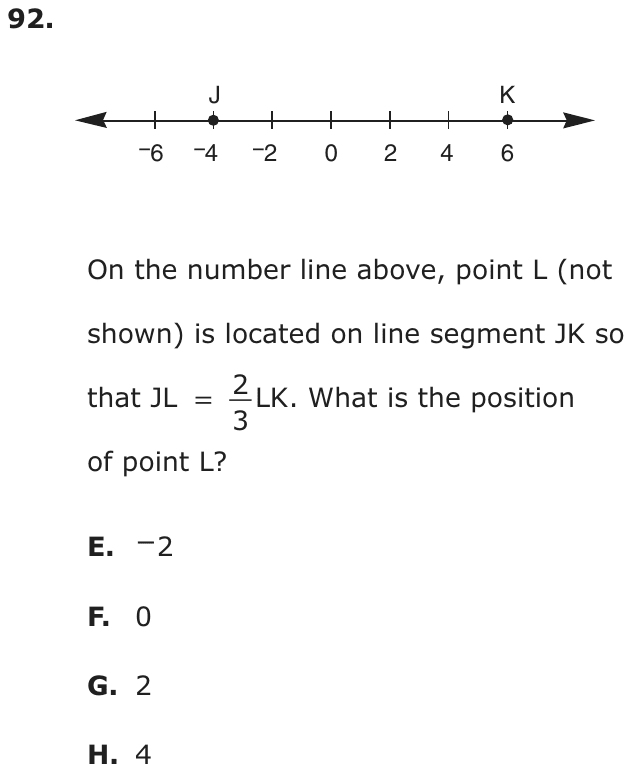
Question 90 of 120
2023 Test A Math, question 36Question
Josef and Mai divided some stamps between themselves. Josef got 60% of the stamps. If Josef received 500 more stamps than Mai, how many stamps did Josef receive?
- A300
- B800
- C1,500
- D2,500
Show the answer
Correct answer: C
Let j be the number of stamps Josef has. Then Mai has stamps. The total number of stamps is . Since Josef has 60% of the stamps, set up an equation to solve for j:
| Cross multiply. | |
| Apply the distributive property; multiply the 60 by and 500. | |
| Apply the additive inverse property; subtract from both sides of the equation. | |
| Apply the multiplicative inverse property; divide both sides of the equation by −20. | |
Question analysis
This percent word problem says Josef and Mai split some stamps, Josef got 60% of them, and he received 500 more than Mai; it asks how many stamps Josef received. Students must connect a difference in counts to a difference in percents. Stopping at the total, or taking a percent of 500, gives tempting wrong answers.
- Grade level
- Grade 7 content, by NYS standard
- Compared with grade 7
- Above grade 7 Grade 7 percent problems usually give the whole and ask for a part. Here neither share nor the total is known; students must link the 500-stamp gap to the gap between two percents before finding the total and then Josef's part.
- Estimated difficulty
- Hard: combines ideas, needs a plan, and has more than one tempting wrong answer.
- Thinking it demands
- Depth of knowledge 2, skills and concepts · mainly apply
- What makes it hard
- Turning words into math moderate
- No obvious method moderate
- Many steps minor
- Solution
- 3 steps
- Reading level
- Question and choices: about grade 4, 26 words.
- Students, last 30 days
- Not enough answers yet to show (it takes 10).
Why it is hard, traps and wrong answers (shows the answer)
Why it is hard
The arithmetic is easy once the 500 is seen as the gap between two percents of one total; seeing that is the hard part. The tempting move is to apply the 60% to the only number given, the 500, which treats a difference as a whole. Students who do find the total must still take Josef's share of it, since the total waits among the choices. Checking that 1,500 and 1,000 differ by 500 confirms the answer.
Turning words into math moderate Understanding the question
The stem describes one split in two ways, Josef's 60% of the total and his 500-stamp lead over Mai, and the link, that the lead is 60% − 40% = 20% of the total, is never stated. (Hegarty, Mayer & Monk, 1995; Koedinger & Nathan, 2004)
No obvious method moderate Working it out
No equation is suggested: the quick route treats the 500 as 20 percentage points and scales up to 100%, while the handbook's route, j over 2j − 500, needs cross-multiplying and a negative coefficient. (Schoenfeld, 1985)
Many steps minor Working it out
Even the short route takes three moves, the 20% gap, the 2,500 total and Josef's 60% of it, and the total is itself a listed choice. (Daniel & Embretson, 2010; Enright, Morley & Sheehan, 2002)
Strategy: If Josef has 60%, Mai has the other 40%, so the 500-stamp difference is a known percent of the total; use it to find the total, then take Josef's share.
Traps
- Stops one step early: A choice is a number from partway through the solution.
- Percent of the wrong amount: Finding the whole from a part, or a percent change measured from the wrong starting amount.
- Numbers taken from the question: Combines the numbers in the question without a model of the situation, or is simply a number that appears in the question.
The wrong answers, classified
A Percent of the wrong amount (Parker & Leinhardt, 1995)
Takes 60% of 500, applying the percent to the difference between the two shares as if the 500 stamps were the whole collection.
B Numbers taken from the question (Hegarty, Mayer & Monk, 1995)
Takes 60% of 500 to get 300 and then adds the 500 extra stamps, combining the stem's numbers without a model of the two shares.
D Stops one step early (King et al., 2004; Gierl et al., 2017)
Sees that the 500-stamp gap is 20% of the total, finds the total of 2,500, and stops before taking Josef's 60% of it.
Worked solution, step by step
Formulas used
- Percent of a number
- p is the percent. The whole is the total amount, and the part is the piece you want. Percent means “out of 100,” so 60% is 60 out of every 100. Use it to find a part, or work backward to find the whole.
Sort out the question
Josef and Mai split some stamps. Josef got 60% of them. He also got 500 more stamps than Mai. You need how many stamps Josef got. You don’t know the total yet, so find it first.
Find Mai’s percent
All the stamps make 100%. Josef has 60%, so Mai has the rest.
Mai has 40% of the stamps.
Find what the 500 stamps are
Josef’s extra 500 stamps are the gap between his share and Mai’s share.
So 500 stamps are 20% of all the stamps.
Find the total number of stamps
There are 2,500 stamps in all. Watch out: that is everyone’s stamps, choice D. Don’t stop here.
Find Josef’s share
Watch out: taking 60% of 500 gives 300, choice A. The 500 is the gap between them, not the total. So the answer is C, 1,500 stamps.
Check your answer
Mai gets 40% of 2,500, which is 1,000 stamps. Josef’s 1,500 minus Mai’s 1,000 is 500, just as the question says. And 1,500 + 1,000 = 2,500, the whole amount.
More questions like this
The original DOE question
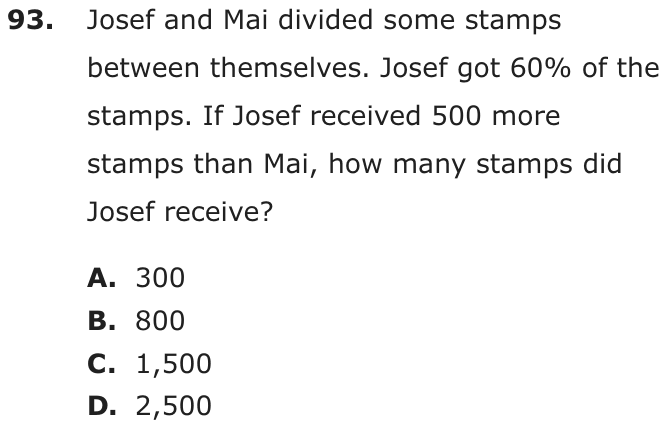
Question 91 of 120
2023 Test A Math, question 37Question
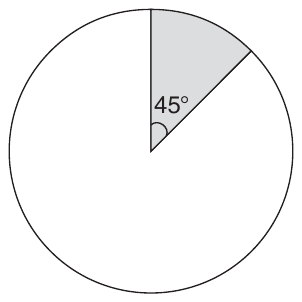
The shaded sector of the circle shown above has an area of square feet. What is the circumference of the circle?
- A ft
- B ft
- C ft
- D ft
Show the answer
Correct answer: B
The area of the entire circle is .
The fraction of the circle that is shaded is . So, the area of the sector is . Use that information to find r:
Use r to calculate the circumference of the circle:
The circumference is feet.
Question analysis
This circle question shows a shaded 45° sector with an area of 18π square feet and asks for the circumference of the whole circle. Students work backward: from the sector to the full area, from the area to the radius, and from the radius to the circumference. Mixing up area and circumference, or stopping partway, gives wrong choices.
- Grade level
- Grade 7 content, by NYS standard
- Compared with grade 7
- Above grade 7 Grade 7 circle problems usually give the radius and ask for area or circumference. This one runs backward from the area of a 45° sector, needing the sector's share of the circle, a square root and a switch to circumference: four linked steps.
- Estimated difficulty
- Hard: combines ideas, needs a plan, and has more than one tempting wrong answer.
- Thinking it demands
- Depth of knowledge 2, skills and concepts · mainly apply
- What makes it hard
- Combines ideas moderate
- Something you must already know moderate
- Reading a figure, table or graph minor
- Solution
- 4 steps
- Reading level
- Question and choices: about grade 5, 30 words.
- Students, last 30 days
- Not enough answers yet to show (it takes 10).
Why it is hard, traps and wrong answers (shows the answer)
Why it is hard
The question moves from a part of the circle's area to the whole circle's length, so area and circumference both appear and are easy to swap. Many students scale the sector up to 144π and stop, giving an area when a length was asked. Solving r² = 144 also needs a square root, after which 2πr is routine. Asking at the end whether the result is a length, measured in feet rather than square feet, catches the main trap.
Combines ideas moderate Working it out
Three ideas chain together: the 45° sector is 1/8 of the circle, so the whole area is 8 × 18π = 144π, then the radius comes from the area, and the circumference from the radius. (Embretson, 1998; Daniel & Embretson, 2010)
Something you must already know moderate Working it out
Neither πr² nor 2πr is given, nor that a full turn is 360°, so every link of the chain rests on formulas students must already know. (Anderson & Krathwohl, 2001)
Reading a figure, table or graph minor Understanding the question
The stem says only “shaded sector”; its 45° angle is marked at the center in the figure, the one place the fraction of the circle comes from. (Lesh, Post & Behr, 1987; Kirsch & Mosenthal, 1990)
Strategy: Work out what fraction of the circle a 45° sector is, scale its area up to the whole circle, solve for the radius, and only then use the circumference formula.
Traps
- Answers a different question: A choice is right for another quantity: the other unknown, the rest instead of the part, the part instead of the whole.
- A formula you must know: Needs a formula the test does not give: area, circumference, volume, probability rules.
- Numbers taken from the question: Combines the numbers in the question without a model of the situation, or is simply a number that appears in the question.
The wrong answers, classified
A Answers a different question (King et al., 2004; Hegarty, Mayer & Monk, 1995)
Scales the sector up to the whole circle, 8 × 18π = 144π, and gives that area, though the question asks for the circumference.
C Numbers taken from the question (Hegarty, Mayer & Monk, 1995)
Repeats the sector's area from the stem, 18π, as if the shaded part's area were the circle's circumference.
D Little reason to choose it (Haladyna & Downing, 1993; Rodriguez, 2005)
No step with the 45° angle or the circle formulas gives 9π, which is half the sector's area, so it mostly attracts guesses.
Worked solution, step by step
Formulas used
- Fraction of a circle in a sector
- A sector is a slice of a circle, like a slice of pizza. Its angle is the angle at the center, in degrees. A full turn around the center is 360 degrees. So the slice is that fraction of the whole circle.
- Area of a circle
- A is the area, the space inside the circle. r is the radius, the distance from the center to the edge. π, called pi, is a number a little more than 3. r² means r times r.
- Circumference of a circle
- C is the circumference, the distance around the circle. r is the radius and π is pi. Two radii make the diameter, the distance across, so this is the same as π times the diameter.
Sort out the question
The shaded slice has a 45° angle at the center. Its area is square feet. You need the circumference, the distance around the whole circle. For that you need the radius, so work back to it.
Find what fraction is shaded
The shaded slice is one eighth of the circle. Eight slices like it would fill the circle.
Find the area of the whole circle
The whole circle has an area of square feet. Watch out: this is an area, not the circumference. Stopping here gives choice A.
Find the radius
Divide both sides by π. Then ask what number times itself makes 144. It is 12, so the radius is 12 feet.
Find the circumference
Leave π as it is, because the choices are written with π. The circumference is feet. So the answer is B, ft.
Check your answer
Work forward. A radius of 12 feet gives an area of square feet. One eighth of that is square feet, the shaded area in the question.
More questions like this
The original DOE question
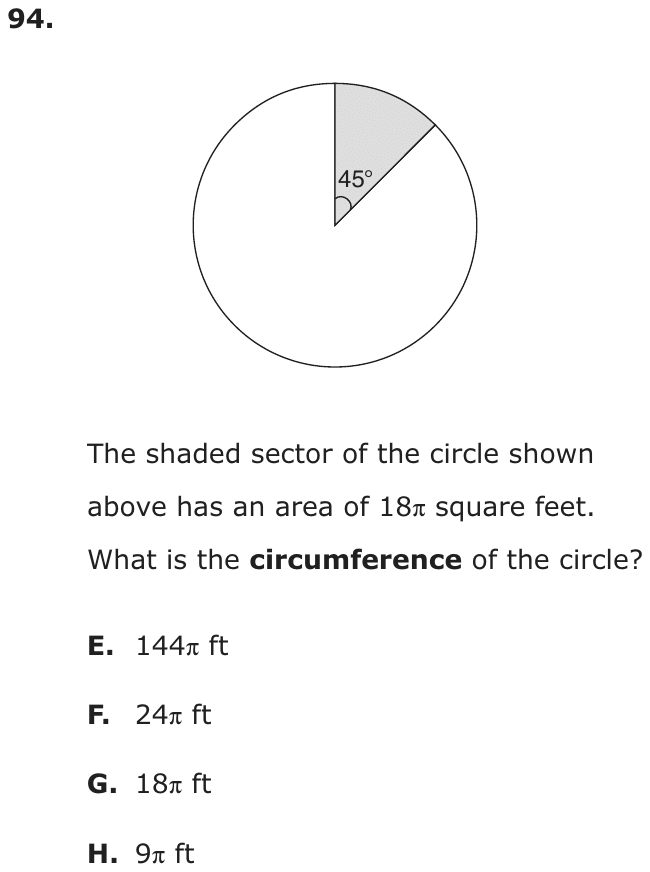
Question 92 of 120
2023 Test A Math, question 38Question
Which graph represents the solution to ?
- A

- B

- C

- D

Show the answer
Correct answer: A
| Apply the additive inverse property; add 7 to both sides of the inequality. | |
| Apply the multiplicative inverse property; divide both sides of the inequality by −3. Note: when dividing an inequality by a negative number, the inequality sign is reversed. | |
The solution is that x is less than −1, so choose the graph that starts at −1 and continues to the left.
Question analysis
This inequality question asks which number line graph shows the solution of −3x − 7 > −4. Students solve a two-step inequality whose x term has a negative coefficient, then match the boundary point and the direction of the shading. Handling the inequality symbol at the division step is where most mistakes happen, and each slip has a matching graph.
- Grade level
- Grade 7 content, by NYS standard
- Compared with grade 7
- At grade 7 Solving and graphing a two-step inequality is a core grade 7 standard. This one has a negative coefficient on x, the classic grade 7 inequality trap, and four similar graphs test whether the sign and the direction were both handled.
- Estimated difficulty
- Moderate: several steps, or a close reading with one strong distractor.
- Thinking it demands
- Depth of knowledge 1, recall and reproduction · mainly apply
- What makes it hard
- Something you must already know moderate
- A very close wrong answer moderate
- Reading a figure, table or graph minor
- Solution
- 3 steps
- Reading level
- Question and choices: about grade 9, 7 words.
- Corrected from the DOE handbook
- A wrong term in the explanation was corrected.
- Students, last 30 days
- Not enough answers yet to show (it takes 10).
Why it is hard, traps and wrong answers (shows the answer)
Why it is hard
The solving takes two moves, but the second carries the rule the question tests: dividing an inequality by a negative number flips its direction. The four graphs cross two features, boundary at −1 or 1 and shading left or right, so forgetting the flip, dropping a sign, or both each land on a graph. Testing a shaded value such as x = −2 in the original inequality, where 6 − 7 = −1 is greater than −4, confirms the choice.
Something you must already know moderate Working it out
The step that decides the question, reversing the symbol when dividing both sides by −3, is a rule students must bring themselves; −3x > 3 becomes x < −1, not x > −1. (Anderson & Krathwohl, 2001)
A very close wrong answer moderate Choosing the answer
The graph shaded to the right from an open circle at −1 matches the right graph's boundary exactly and differs only in direction, the result of skipping the reversal. (Embretson & Wetzel, 1987; Gorin & Embretson, 2006; Ascalon et al., 2007)
Reading a figure, table or graph minor Understanding the question
Each graph must be read for two things, where its open circle sits, at −1 or 1, and which way the arrow runs, so a boundary alone does not identify the answer. (Lesh, Post & Behr, 1987; Kirsch & Mosenthal, 1990)
Strategy: Add 7 to both sides, divide by −3 and reverse the inequality symbol, then match both the boundary point and the shading direction; test one shaded value in the original.
Traps
- Negatives and direction: Arithmetic with negative numbers, the order of a subtraction, or direction on a number line. (Moving a term across the equals sign without changing its sign is a faulty procedure.)
The wrong answers, classified
B Negatives and direction (Brown & Burton, 1978)
Reverses the symbol correctly but drops the negative in 3 ÷ (−3), so the boundary lands at 1 with the shading to its left.
C Negatives and direction (Brown & Burton, 1978)
Divides both sides by −3 without reversing the symbol, solving the inequality as if it were an equation, so x > −1 and the shading runs right.
D Negatives and direction (Brown & Burton, 1978)
Treats −3x as 3x, so it solves 3x > 3 to get x > 1 with no reversal, which puts both the boundary and the direction wrong.
What was corrected from the DOE handbook, and why
- Explanation: The handbook’s steps say “add 7 to both sides of the equation” and “divide both sides of the equation by −3” (p. 142, question 95). But −3x − 7 > −4 is an inequality, not an equation, and the step’s own note is the point of the question: dividing an inequality by a negative number reverses the sign. The site now says “both sides of the inequality” in both steps, as the DOE’s later guides word this step (“Subtract 4 from both sides of the inequality” in the 2024–2025 guide). The working and the answer are unchanged.
Worked solution, step by step
Formulas used
- Adding to both sides of an inequality
- a and b are the two sides, and c is any number. Adding the same amount to both sides keeps the comparison true, like adding the same weight to both pans of a scale.
- Dividing an inequality by a negative number
- a and b are the two sides, and c is a negative number. When you divide both sides by a negative number, the greater-than sign flips to less-than. That is because negatives reverse order: 2 is more than 1, but −2 is less than −1.
Sort out the question
An inequality compares two amounts. The sign > means is greater than. You need the graph of every x that makes true. The graphs differ in two ways: where the open circle sits, at −1 or 1, and which way the shading goes.
Add 7 to both sides
Adding 7 undoes the −7, so the x term is alone on the left.
Divide by −3 and flip the sign
So x is any number less than −1. Watch out: if you forget to flip the sign, you get x > −1, and that graph is choice C. Also, 3 ÷ (−3) is −1, not 1. Dropping that minus sign leads to B or D.
Match the solution to a graph
Less than −1 means to the left of −1 on the number line. The circle at −1 is open, or empty, because −1 itself does not work. The sign means greater than, not greater than or equal to.
Graph A has an open circle at −1 and is shaded to the left. So the answer is A, the graph shaded left from an open circle at −1.
Check your answer
Test a number on each side of −1. For x = −2: , and −1 is greater than −4, so −2 works. For x = 0: , and −7 is less than −4, so 0 does not work. The shading must go left.
More questions like this
The original DOE question
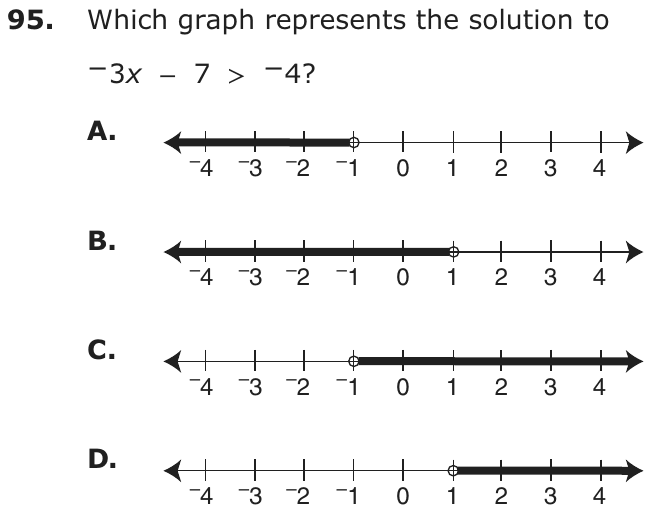
Question 93 of 120
2023 Test A Math, question 39Question
A scientist mixed three chemicals, R, S, and T, in a glass container. The amount of R is 3 times the amount of S, and the amount of T is the amount of S. What is the ratio of the amount of R to the amount of T?
- A1:18
- B2:1
- C3:1
- D18:1
Show the answer
Correct answer: D
First, set up the equations based on the information in the question.
So, the ratio of R:T is
Divide both sides by S to eliminate the variable. Then, multiply both sides by 6 to eliminate the fraction. The resulting ratio is 18:1.
Question analysis
This ratio question describes three chemicals mixed in a container: R is 3 times the amount of S, and T is one sixth of S. Students must combine the two relationships through S to find the ratio of R to T. Writing the ratio in the wrong order, or using only one of the relationships, produces the tempting wrong choices.
- Grade level
- Grade 7 content, by NYS standard
- Compared with grade 7
- At grade 7 Grade 7 ratio problems often link two quantities through a third. Here R and T are each described relative to S, one as a multiple and one as a fraction, and combining them into one ratio is typical grade 7 work with an order trap.
- Estimated difficulty
- Moderate: several steps, or a close reading with one strong distractor.
- Thinking it demands
- Depth of knowledge 2, skills and concepts · mainly apply
- What makes it hard
- Turning words into math moderate
- A very close wrong answer moderate
- Variables instead of numbers minor
- Solution
- 3 steps
- Reading level
- Question and choices: about grade 6, 48 words.
- Students, last 30 days
- Not enough answers yet to show (it takes 10).
Why it is hard, traps and wrong answers (shows the answer)
Why it is hard
The question chains two comparisons through S, and the 1/6 makes the chain awkward to do with letters. Choosing S = 6 turns it into whole numbers at once. The listed wrong ratios come from writing the right numbers in the wrong order, combining 3 and 6 by division, or stopping at the first comparison. Rereading which amount the question names first settles the order.
Turning words into math moderate Understanding the question
Both sentences compare a chemical with S, R as 3 times S and T as 1/6 of S, so S must serve as the link before R can be compared with T. (Hegarty, Mayer & Monk, 1995; Koedinger & Nathan, 2004)
A very close wrong answer moderate Choosing the answer
The ratios 1:18 and 18:1 use the same two numbers in opposite order, so only checking that R, the larger amount, comes first separates the right ratio from its reverse. (Embretson & Wetzel, 1987; Gorin & Embretson, 2006; Ascalon et al., 2007)
Variables instead of numbers minor Understanding the question
No amounts are given, only relationships, so students either reason with S as a letter or choose a number for it, such as 6, which makes R 18 and T 1. (Koedinger & Nathan, 2004; Enright, Morley & Sheehan, 2002)
Strategy: Pick a convenient amount for S, such as 6, so that both R and T come out as whole numbers, then write R to T in that order and simplify.
Traps
- Wrong operation: Adds instead of multiplying, divides the wrong way round, turns a ratio or rate upside down, or undoes a step in the wrong direction (subtracts what should be added back).
- Answers a different question: A choice is right for another quantity: the other unknown, the rest instead of the part, the part instead of the whole.
The wrong answers, classified
A Wrong operation (Hegarty, Mayer & Monk, 1995; King et al., 2004)
Works out the amounts correctly but writes the ratio upside down, T to R, putting the smaller amount first.
B Wrong operation (Hegarty, Mayer & Monk, 1995; King et al., 2004)
Divides the 6 by the 3 instead of multiplying them, combining the two comparisons with S the wrong way to get 2:1.
C Answers a different question (King et al., 2004; Hegarty, Mayer & Monk, 1995)
Uses only the first sentence, R is 3 times S, and gives the ratio of R to S instead of R to T.
Worked solution, step by step
Formulas used
- Equal ratios
- a and b are two amounts being compared, and n is any number except 0. Multiplying or dividing both parts of a ratio by the same number gives an equal ratio. For example, 2 : 1 is the same as 4 : 2.
Sort out the question
There are three chemicals, R, S and T. R is 3 times S. T is of S. You need the ratio of R to T, written R : T. Both facts compare a chemical with S, so S links R and T.
Pick an easy amount for S
No amounts are given, so you may choose one. Pick 6 units for S, because 6 divides evenly by 6.
So R is 18 units and T is 1 unit.
Write the ratio of R to T
R comes first because the question asks for R to T. Watch out: writing it the other way round gives 1:18, choice A. Using only the first fact gives R : S = 3 : 1, choice C.
Check with letters instead
Without picking a number, R = 3S and T is . Divide both parts by S, then multiply both parts by 6.
So the answer is D, 18:1.
Check your answer
R should be much bigger than T. R is 3 times S, while T is only a small piece of S. Try another amount, S = 12. Then R = 36 and T = 2, and 36 : 2 is also 18 : 1.
More questions like this
The original DOE question
Question 94 of 120
2023 Test A Math, question 40Question
Ken has k video games, and Jeff has j video games. If Ken gives 6 video games to Jeff, Ken will have twice as many video games as Jeff. Which equation shows the relationship between k and j?
- A
- B
- C
- D
Show the answer
Correct answer: A
If Ken gives 6 video games to Jeff, the number Ken has is , and the number Jeff has is . After the exchange, Ken has twice as many video games as Jeff. The equation is:
Question analysis
This algebra word problem says Ken has k video games and Jeff has j, and if Ken gives Jeff 6 games, Ken will have twice as many as Jeff. Students choose the equation that models the situation. Getting the comparison the right way round, and grouping each new total correctly, is where most errors happen.
- Grade level
- Grade 7 content, by NYS standard
- Compared with grade 7
- At grade 7 Grade 7 students write equations from word problems. This one tracks two people's counts after a transfer and states a times-as-many comparison, so both counts change and the factor of 2 must go on the right side: typical but error-prone.
- Estimated difficulty
- Moderate: several steps, or a close reading with one strong distractor.
- Thinking it demands
- Depth of knowledge 2, skills and concepts · mainly apply
- What makes it hard
- Turning words into math moderate
- A very close wrong answer moderate
- Variables instead of numbers minor
- Solution
- 2 steps
- Reading level
- Question and choices: about grade 4, 41 words.
- Students, last 30 days
- Not enough answers yet to show (it takes 10).
Why it is hard, traps and wrong answers (shows the answer)
Why it is hard
The question is all setup: no solving is needed, just an equation that says what the story says. The trade moves games out of one count and into the other, and the comparison has to be written with the 2 on the smaller side. The wrong equations reverse the comparison, forget Jeff's gain, or drop the parentheses, and all four look alike. Plugging in sample counts is the surest check.
Turning words into math moderate Understanding the question
After the gift both counts change, Ken's to k − 6 and Jeff's to j + 6, and “twice as many video games as Jeff” must double Jeff's whole new count, putting the 2 on his side. (Hegarty, Mayer & Monk, 1995; Koedinger & Nathan, 2004)
A very close wrong answer moderate Choosing the answer
All four equations share the pieces k − 6, j + 6 and a 2; the right one differs from 2(k − 6) = j + 6 only in where the 2 sits, and from k − 6 = 2j + 6 by parentheses. (Embretson & Wetzel, 1987; Gorin & Embretson, 2006; Ascalon et al., 2007)
Variables instead of numbers minor Understanding the question
There are no numbers to check against, only k and j, so testing an equation means inventing counts that fit the story, such as Jeff with 4 games and Ken with 26. (Koedinger & Nathan, 2004; Enright, Morley & Sheehan, 2002)
Strategy: Write each boy's number of games after the exchange as an expression, then translate "Ken will have twice as many as Jeff" into an equation and test it with sample numbers.
Traps
- Equation written backwards: Writes a comparison the wrong way round, word for word: "six times as many students as professors" as 6S = P. The bigger quantity gets the bigger number.
- Order of operations: Working left to right, or distributing a minus sign wrongly, gives a choice.
The wrong answers, classified
B Order of operations (Brown & Burton, 1978)
Leaves out the parentheses, doubling only Jeff's old count j and then adding 6, instead of doubling his whole new count j + 6.
C Equation written backwards (Clement, Lochhead & Monk, 1981)
Puts the 2 on Ken's side, writing the comparison backwards, and also forgets that Jeff gains the 6 games, two errors in one equation.
D Equation written backwards (Clement, Lochhead & Monk, 1981)
Writes the comparison backwards word for word, doubling Ken's new count, which would mean Jeff ends with twice as many games as Ken.
Worked solution, step by step
Formulas used
- Twice as many
- A and B are two amounts. “A has twice as many as B” means A equals 2 times B. The 2 goes with the smaller amount, because that is the one you double to match the bigger one.
- The distributive property
- a, b and c are numbers. Multiplying a by a sum means multiplying a by each part, then adding. For example, 2(4 + 6) = 8 + 12 = 20.
Sort out the question
Ken has k video games, and Jeff has j. Then Ken gives 6 of his games to Jeff. After that, Ken has twice as many games as Jeff. You need the equation that links k and j.
Write each new amount
Ken gives away 6 games, so he has k − 6 left. Jeff gets those 6 games, so he has j + 6. Both amounts change, so use both new amounts.
Write “twice as many”
After the gift, Ken has more games. So Jeff’s new amount is the one that gets doubled.
Watch out: putting the 2 on Ken’s side, as in , would mean Jeff has twice as many. That is choice D.
Keep the parentheses
Twice Jeff’s new amount is 2j + 12, not 2j + 6. Watch out: dropping the parentheses gives choice B. So the answer is A, .
Check your answer
Make up numbers that fit the story. Say Jeff has 4 games and Ken has 26. After the gift, Ken has 20 and Jeff has 10, and 20 is twice 10. Choice A gives , or 20 = 20. Choice B gives 20 = 14, which is false.
More questions like this
The original DOE question
Question 95 of 120
2023 Test A Math, question 41Question
Yesterday Sarah read 15% of her entire book. Today she read another 17% of the entire book. In lowest terms, what fraction of the book is left for her to read?
- A
- B
- C
- D
Show the answer
Correct answer: C
So far, Sarah has read of the entire book. That means she has left to read.
Question analysis
This percent word problem says Sarah read 15% of her book yesterday and 17% today, and asks what fraction of the book she still has to read, in lowest terms. Students combine percents of the same whole, find the part remaining, and convert a percent to a simplified fraction. Rounding, or giving the part already read, leads to wrong choices.
- Grade level
- Grade 7 content, by NYS standard
- Compared with grade 7
- Below grade 7 Grade 7 percent work often takes a percent of a percent or finds a percent change. Here both percents are of the same whole book, so they combine directly; the rest is a subtraction and simplifying a fraction, lighter than typical.
- Estimated difficulty
- Straightforward: two steps or one careful reading.
- Thinking it demands
- Depth of knowledge 2, skills and concepts · mainly apply
- What makes it hard
- Solution
- 3 steps
- Reading level
- Question and choices: about grade 5, 33 words.
- Corrected from the DOE handbook
- Missing percent signs in the explanation were restored.
- Students, last 30 days
- Not enough answers yet to show (it takes 10).
Why it is hard, traps and wrong answers (shows the answer)
Why it is hard
The percent work is a sum and a subtraction from 100, so the question mostly tests the last step, writing 68% as a fraction in lowest terms. Students who round to 30% read and 70% left to get a friendlier fraction land on a listed choice, as do those who give the part read. Dividing 68 and 100 by their common factor 4 keeps the answer exact.
Turning words into math minor Understanding the question
Both percents are “of the entire book,” so they simply add to 32%, and “left for her to read” asks for the rest, 100% − 32%, not the part already read. (Hegarty, Mayer & Monk, 1995; Koedinger & Nathan, 2004)
An answer in an unexpected form minor Choosing the answer
The result has to be written as a fraction in lowest terms, so 68/100 must be divided by 4 to reach a form that appears among the choices. (Enright, Morley & Sheehan, 2002)
Strategy: Add the two percents, since both are of the whole book, subtract the total from 100%, then write the result over 100 and simplify it fully.
Traps
- Rounds too early: Rounds a value partway through, or rounds the wrong way, so the final answer drifts from the exact one.
- Answers a different question: A choice is right for another quantity: the other unknown, the rest instead of the part, the part instead of the whole.
The wrong answers, classified
A Little reason to choose it (Haladyna & Downing, 1993; Rodriguez, 2005)
No sum or difference of 15% and 17% gives 28%, so 7/25 mostly draws students who match the right fraction's 25 without checking the numerator.
B Answers a different question (King et al., 2004; Hegarty, Mayer & Monk, 1995)
Gives the part already read rather than the part left, and rounds that 32% to 30% to write it as 3/10.
D Rounds too early (King et al., 2004)
Finds that 68% is left but rounds it to 70% to make an easier fraction, giving 7/10 instead of simplifying 68/100 exactly.
What was corrected from the DOE handbook, and why
- Explanation: The handbook writes “So far, Sarah has read 15 + 17 = 32 of the entire book. That means she has 100 − 32 = 68 left to read.” (p. 143, question 98), with no percent signs, so 32 and 68 read as amounts of the book (pages, say) that the question never gives. The question gives 15% and 17%, and the handbook’s next line begins “68% =”, so the site now reads 15% + 17% = 32% and 100% − 32% = 68%. The answer, 17/25, is unchanged.
Worked solution, step by step
Formulas used
- Percent as a fraction
- p is the percent. Percent means “out of 100,” so p percent is p hundredths. For example, 50% is 50 out of 100, which is one half.
- Simplifying a fraction
- a is the top number, b is the bottom, and n is a number that divides both evenly. Dividing the top and bottom by the same number keeps the value the same. A fraction is in lowest terms when no number bigger than 1 divides both.
Sort out the question
Sarah read 15% of her book yesterday and 17% today. Both are percents of the whole book. You need the part still left to read, as a fraction in lowest terms. That means a fraction that can’t be simplified any more.
Find how much she has read
Both percents are of the same whole book, so you can add them. She has read 32% of it.
Find how much is left
The whole book is 100%.
Watch out: 32% is the part she has read, not the part left. Rounding 32% to 30% gives , choice B.
Write 68% as a fraction
This fraction is not in lowest terms yet, because 68 and 100 are both even.
Write it in lowest terms
The number 4 divides both 68 and 100 evenly.
Watch out: don’t round 68% to 70%. That gives , choice D. So the answer is C, .
Check your answer
Turn the answer back into a percent: , which is 68%. Then 68% + 32% = 100%, the whole book. Also, 17 and 25 share no factor except 1, so the fraction is in lowest terms.
More questions like this
The original DOE question
Question 96 of 120
2023 Test A Math, question 42Question
How many members of the set shown above are multiples of 6 but not multiples of 9?
- A11
- B13
- C20
- D22
Show the answer
Correct answer: D
First, list the first several multiples of 6: 6, 12, 18, 24, 30, 36, 42, 48, 54 . . .
Every third multiple (i.e., 18, 36, 54, . . .) is also a multiple of 9. Thus, of the multiples of 6 are not multiples of 9.
Next, calculate how many multiples of 6 are in the given number range. The last multiple of 6 would be 198. So, there are a total of multiples of 6. Since of those are not multiples of 9, the answer is .
Question analysis
This number properties question shows the set of whole numbers from 1 to 200 and asks how many of them are multiples of 6 but not multiples of 9. Students count multiples in a range and remove the overlap, the numbers divisible by both. Finding the right common multiple, and removing only the overlap, is where it gets tricky.
- NYS standards
- 6.NS.4 common factors and multiples
- Grade level
- Grade 6 content, by NYS standard
- Compared with grade 7
- Above grade 7 Multiples and common multiples are grade 6 content, but counting the members of a set that meet one condition and fail another is rare in grade 7 work. The overlap between the two kinds of multiples must be found and removed exactly.
- Estimated difficulty
- Hard: combines ideas, needs a plan, and has more than one tempting wrong answer.
- Thinking it demands
- Depth of knowledge 2, skills and concepts · mainly apply
- What makes it hard
- No obvious method moderate
- Much to keep track of minor
- Turning words into math minor
- Solution
- 3 steps
- Reading level
- Question and choices: about grade 6, 16 words.
- Students, last 30 days
- Not enough answers yet to show (it takes 10).
Why it is hard, traps and wrong answers (shows the answer)
Why it is hard
Counting multiples of 6 is routine; the harder decision is how to remove the ones that are also multiples of 9. Those are the multiples of 18, the least common multiple, not of 54 or 15, and students who count them correctly must still subtract them rather than report them. Listing 6, 12, 18, 24, 30, 36 shows the pattern, two kept for every one removed, which also gives the answer as two thirds of 33.
No obvious method moderate Working it out
The stem never mentions a common multiple: students must see that the multiples of 6 that are also multiples of 9 are the multiples of 18, every third multiple of 6. (Schoenfeld, 1985)
Much to keep track of minor Working it out
Three counts are in play at once, 33 multiples of 6 up to 198, 11 multiples of 18 up to 198, and their difference, and two of them are listed choices. (Sweller, 1988; Carpenter, Just & Shell, 1990)
Turning words into math minor Understanding the question
The bold not in “multiples of 6 but not multiples of 9” asks for what is left after a removal, a set difference rather than a count of the numbers removed. (Hegarty, Mayer & Monk, 1995; Koedinger & Nathan, 2004)
Strategy: Count the multiples of 6 up to 200, find the smallest number that is a multiple of both 6 and 9, count its multiples in the set, and subtract.
Traps
- Answers a different question: A choice is right for another quantity: the other unknown, the rest instead of the part, the part instead of the whole.
- Misunderstands the concept: A wrong belief about a concept: that percents can be added, that area grows like length, that averages can be averaged, that a bigger denominator means a bigger fraction.
The wrong answers, classified
A Answers a different question (King et al., 2004; Hegarty, Mayer & Monk, 1995)
Counts the 11 multiples of 18, the numbers to be removed, and gives that count instead of the multiples of 6 that remain.
B Misunderstands the concept (Smith, diSessa & Roschelle, 1993; De Bock et al., 1998; Ni & Zhou, 2005)
Takes 6 + 9 = 15 as the step between numbers divisible by both, and gives its 13 multiples up to 195, the numbers it would remove.
C Misunderstands the concept (Smith, diSessa & Roschelle, 1993; De Bock et al., 1998; Ni & Zhou, 2005)
Uses 6 + 9 = 15 instead of 18 as the common multiple and removes its 13 multiples from the 33 multiples of 6, leaving 20.
Worked solution, step by step
Formulas used
- Counting multiples
- n is the number whose multiples you count, such as 6. The first multiple is n × 1, the second is n × 2, and so on. So if the largest multiple in the set is n × k, there are k multiples in all.
- Least common multiple
- The least common multiple, or LCM, is the smallest number that two numbers both divide evenly. A number is a multiple of both 6 and 9 exactly when it is a multiple of 18.
Sort out the question
The set holds the whole numbers from 1 to 200. A multiple of 6 is a number that 6 divides evenly, like 6, 12 or 18. You need the multiples of 6 that are not multiples of 9. So count all the multiples of 6. Then take away those that are also multiples of 9.
Count the multiples of 6
200 is not a multiple of 6, but 198 is. So 198 is the last multiple of 6 in the set.
There are 33 multiples of 6.
Find the numbers to take away
List the multiples of 6: 6, 12, 18, 24, 30, 36. The first one 9 also divides is 18, then 36. So every third multiple of 6 is also a multiple of 9.
Watch out: the shared multiples are multiples of 18, not of 6 + 9 = 15. Using 15 leads to 13 or 20, choices B and C.
Count the multiples of 18
The last multiple of 18 in the set is also 198.
There are 11 of them. Watch out: these are the numbers you take away, not the answer. Stopping here gives 11, choice A.
Take away the multiples of 18
There are 22 multiples of 6 left over. So the answer is D, 22.
Check your answer
Every third multiple of 6 is a multiple of 18, so two out of every three multiples of 6 stay. Two thirds of 33 is . That matches. Test one: 30 is a multiple of 6, and 30 ÷ 9 is not a whole number, so 30 counts.
More questions like this
The original DOE question
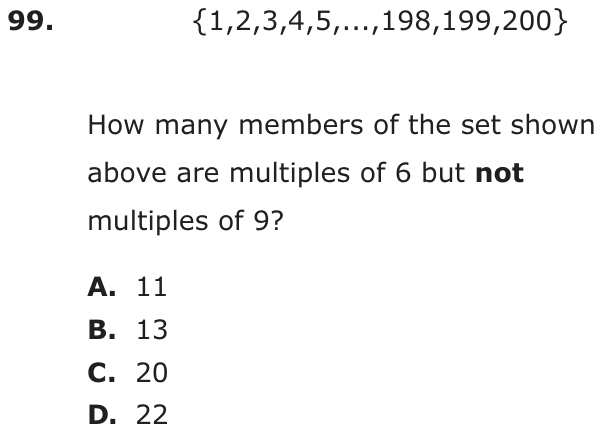
Question 97 of 120
2023 Test A Math, question 43Question
Kim jogs 8 kilometers in 1 hour 40 minutes. At that rate, how many meters does she jog per minute?
- A0.08
- B80
- C800
- D8,000
Show the answer
Correct answer: B
First, calculate Kim’s jogging time in minutes:
1 hour 40 minutes = 100 minutes
Then, convert kilometers to meters:
8 kilometers = 8,000 meters
Now simplify the ratio to find the answer:
Question analysis
This rate question says Kim jogs 8 kilometers in 1 hour 40 minutes and asks how many meters she jogs per minute. Students convert a mixed time to minutes and kilometers to meters before finding a unit rate. Skipping a conversion, or stopping before dividing, gives answers that are off by factors of ten or more.
- Grade level
- Grade 6 content, by NYS standard
- Compared with grade 7
- Below grade 7 Unit rates and metric conversions are grade 6 topics. This needs two conversions, hours and minutes to minutes and kilometers to meters, then one division with whole numbers, simpler than grade 7 rate problems built on fractions.
- Estimated difficulty
- Straightforward: two steps or one careful reading.
- Thinking it demands
- Depth of knowledge 2, skills and concepts · mainly apply
- What makes it hard
- Something you must already know minor
- Many steps minor
- Solution
- 3 steps
- Reading level
- Question and choices: about grade 4, 17 words.
- Students, last 30 days
- Not enough answers yet to show (it takes 10).
Why it is hard, traps and wrong answers (shows the answer)
Why it is hard
The rate itself is one division; what makes the question work is that the distance and the time both arrive in the wrong units. Converting only the time gives a speed in kilometers per minute, and converting only the distance and stopping gives the whole trip in meters. Writing the units beside every number, meters over minutes, shows when the answer is ready.
Something you must already know minor Working it out
The conversions are not given: 1 kilometer is 1,000 meters and 1 hour is 60 minutes, so 8 kilometers becomes 8,000 meters and 1 hour 40 minutes becomes 100 minutes. (Anderson & Krathwohl, 2001)
Many steps minor Working it out
Two conversions, one for distance and one for time, come before the single division, and skipping the distance conversion leaves an answer a thousand times too small. (Daniel & Embretson, 2010; Enright, Morley & Sheehan, 2002)
Strategy: Rewrite the time entirely in minutes and the distance entirely in meters, then divide distance by time; check that the answer's units are meters per minute.
Traps
- Units or scale: The answer is wanted in other units, or a rate or scale must be converted first.
- Stops one step early: A choice is a number from partway through the solution.
- An arithmetic slip: The right method with a plausible arithmetic error: a digit, a place value or a times-table fact.
The wrong answers, classified
A Units or scale (King et al., 2004)
Divides the 8 kilometers by the 100 minutes but never changes kilometers to meters, giving a speed of 0.08 kilometer per minute.
C An arithmetic slip (Junker & Sijtsma, 2001)
Converts both units correctly but cancels only one zero when dividing 8,000 by 100, getting a rate ten times too large.
D Stops one step early (King et al., 2004; Gierl et al., 2017)
Converts 8 kilometers to 8,000 meters and stops, giving the whole distance before dividing by the 100 minutes it took.
Worked solution, step by step
Formulas used
- Kilometers to meters
- Each kilometer is 1,000 meters, so multiply the number of kilometers by 1,000 to get meters. The word part kilo means a thousand.
- Rate
- The rate, or speed, is how far you go in one unit of time. Distance is how far, and time is how long. Dividing shares the distance equally among the minutes, so you get the distance for one minute.
Sort out the question
Kim jogs 8 kilometers in 1 hour 40 minutes. You need her speed in meters per minute: how many meters she jogs in one minute. The question gives kilometers and hours, so change both units first.
Change the time to minutes
One hour is 60 minutes. Add the extra 40 minutes.
Kim jogs for 100 minutes.
Change the distance to meters
Kim jogs 8,000 meters. Watch out: 8,000 is the whole distance, not meters per minute. Stopping here gives choice D.
Divide the distance by the time
She jogs 80 meters each minute. Watch out: if you skip the change to meters, you get 8 ÷ 100 = 0.08 kilometer per minute, choice A. So the answer is B, 80 meters per minute.
Check your answer
Work backward. At 80 meters a minute, 100 minutes gives meters. That is 8 kilometers, just as the question says.
More questions like this
The original DOE question
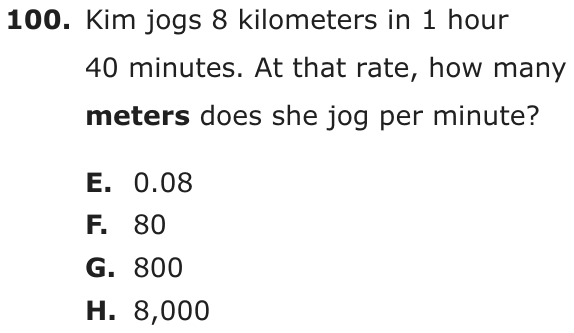
Question 98 of 120
2023 Test A Math, question 44Question
For what value of x is the equation true?
- A
- B
- C
- D
Show the answer
Correct answer: B
| Apply the distributive property; multiply the 3 by 4 and . | |
| Combine like terms. | |
| Apply the additive inverse property; add and 4 to both sides of the equation. | |
| Get a common denominator. | |
| Apply the multiplicative inverse property; multiply both sides of the equation by 5. | |
| Apply the multiplicative inverse property; divide both sides of the equation by 31. | |
Question analysis
This equation question asks for the value of x that makes x/5 − 4 = 3(4 − 2x) − 1 true. Students use the distributive property, collect variable terms on one side, and clear a fraction before solving. Each wrong choice matches a common slip with the parentheses or with the fraction, so careful bookkeeping matters more than speed.
- NYS standards
- Grade level
- Grade 8 content, by NYS standard
- Compared with grade 7
- Above grade 7 Grade 7 equations have the form px + q = r. This one has x on both sides, a fractional coefficient and a product to expand, which are grade 8 equation skills, and every wrong choice matches a plausible slip along the way.
- Estimated difficulty
- Hard: combines ideas, needs a plan, and has more than one tempting wrong answer.
- Thinking it demands
- Depth of knowledge 1, recall and reproduction · mainly apply
- What makes it hard
- Error-prone arithmetic moderate
- Many steps moderate
- A very close wrong answer minor
- Solution
- 5 steps
- Reading level
- Question and choices: about grade 8, 14 words.
- Students, last 30 days
- Not enough answers yet to show (it takes 10).
Why it is hard, traps and wrong answers (shows the answer)
Why it is hard
Every step is a routine move in solving a linear equation, but there are five of them and the fraction raises the cost of each. The listed wrong answers come from distributing the 3 to only one term, clearing the fraction from one term only, and stretching the parentheses over the −1. Substituting the result back is slow with a denominator of 31, so careful step-by-step work matters more than checking.
Error-prone arithmetic moderate Working it out
The term x/5 sits beside whole-number terms and a negative −6x, so clearing the fraction means multiplying every term by 5, and the answer is the unfriendly 75/31. (Brown & Burton, 1978; Junker & Sijtsma, 2001)
Many steps moderate Working it out
Five moves in a row, distributing the 3, combining 12 and −1, collecting the x terms, clearing the fifth and dividing by 31, each give a slip a place to enter. (Daniel & Embretson, 2010; Enright, Morley & Sheehan, 2002)
A very close wrong answer minor Choosing the answer
The fraction 75/11 shares its numerator with 75/31 and differs by one digit of the denominator, so only the coefficient of x, 6 1/5 rather than 2 1/5, separates them. (Embretson & Wetzel, 1987; Gorin & Embretson, 2006; Ascalon et al., 2007)
Strategy: Distribute the 3 to both terms in the parentheses, combine constants, collect the x terms on one side, then multiply every term by 5 to clear the fraction; check by substituting.
Traps
- A faulty procedure: A systematic but wrong procedure: adding fractions straight across, applying an exponent to each term of a sum, dropping a sign when moving a term.
- Order of operations: Working left to right, or distributing a minus sign wrongly, gives a choice.
The wrong answers, classified
A A faulty procedure (Brown & Burton, 1978; Tatsuoka, 1983)
Distributes the 3 only to the 4, writing 12 − 2x, so the equation becomes x/5 + 2x = 15 and then 11x = 75.
C A faulty procedure (Brown & Burton, 1978; Tatsuoka, 1983)
Multiplies only x/5 by 5 to clear the fraction, leaving 6x and 15 unchanged, so it solves x + 6x = 15 and gets 7x = 15.
D Order of operations (Brown & Burton, 1978)
Applies the 3 to the −1 as well, as if it sat inside the parentheses, so the right side becomes 9 − 6x and the constant 13 instead of 15.
Worked solution, step by step
Formulas used
- The distributive property
- a, b and c are numbers or terms. Multiplying a by a difference means multiplying a by each part. The number outside must reach every term inside the parentheses.
- Doing the same to both sides
- a and b are the two sides of an equation, and c is any number. An equation is like a balanced scale. Adding the same amount to both sides, or multiplying both sides by the same number, keeps it balanced.
Sort out the question
You need the value of x that makes both sides of the equation equal. The plan: clear the parentheses, gather the x terms on one side, and get rid of the fraction. Then divide.
Clear the parentheses
Watch out: the 3 multiplies both 4 and 2x. Writing 12 − 2x leads to , choice A. The −1 is outside the parentheses, so the 3 does not touch it.
Gather the x terms
Add 6x to both sides to move the x terms to the left. Add 4 to both sides to move the plain numbers to the right.
Clear the fraction
Multiply both sides by 5. Every term gets multiplied, not only the fraction.
Watch out: multiplying only the fraction by 5 gives x + 6x = 15. That leads to , choice C.
Divide by 31
75 and 31 share no factor except 1, so the fraction is already simplified. So the answer is B, .
Check your answer
Put back in. Then and . Write 4 as . The left side is . On the right, , and . Both sides match.
More questions like this
The original DOE question
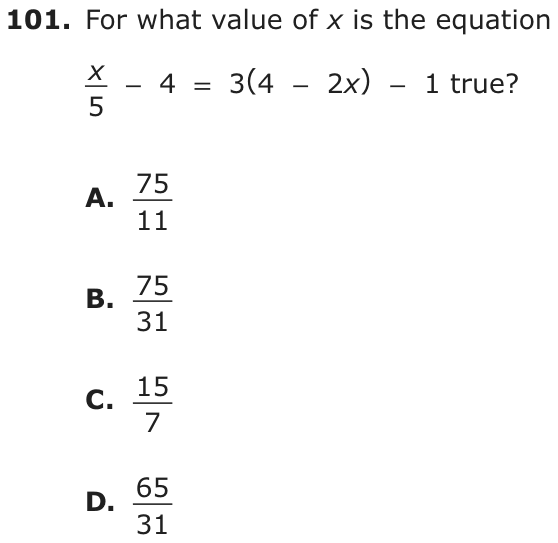
Question 99 of 120
2023 Test A Math, question 45Question
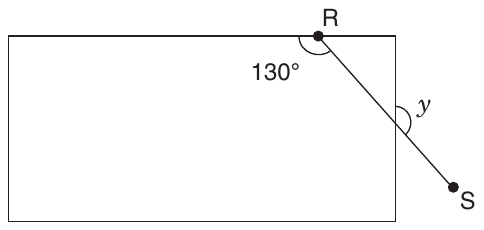
The diagram above shows line segment RS intersecting a rectangle. What is the measure of angle y?
- A140°
- B130°
- C50°
- D40°
Show the answer
Correct answer: A
First, find the measures of the interior angles of the triangle formed by the line segment and the rectangle. The top angle on the right is a vertex of the rectangle, so the measure of that angle is 90°. The top angle on the left is supplementary to the given angle of 130°. So, the measure of that angle is . The measure of the lower angle is 40°, since . Angle y is supplementary to the lower angle of 40°, so the measure of angle y is .
Question analysis
This geometry question shows line segment RS cutting across a corner of a rectangle, with a 130° angle marked where RS meets the top side, and asks for angle y where it crosses the right side. Students combine supplementary angles, the right angle of a rectangle and the angle sum of a triangle. Stopping at an angle inside the triangle is the main trap.
- NYS standards
- Grade level
- Grade 8 content, by NYS standard
- Compared with grade 7
- Above grade 7 Grade 7 angle problems use supplementary, vertical and adjacent angles. This one adds the angle sum of a triangle, which New York places in grade 8, and chains three facts around a small triangle that students must first spot in the figure.
- Estimated difficulty
- Moderate: several steps, or a close reading with one strong distractor.
- Thinking it demands
- Depth of knowledge 2, skills and concepts · mainly apply
- What makes it hard
- Reading a figure, table or graph moderate
- Many steps minor
- Something you must already know minor
- Solution
- 3 steps
- Reading level
- Question and choices: about grade 7, 17 words.
- Students, last 30 days
- Not enough answers yet to show (it takes 10).
Why it is hard, traps and wrong answers (shows the answer)
Why it is hard
The angle facts are basic, but the route runs through a triangle the figure does not point out, and the answer lies outside it. Students who stop inside the triangle give its 40° angle or its 50° angle, and those who assume y matches the marked 130° skip the work entirely. Checking that y and the triangle's angle beside it form a straight line, 140 + 40 = 180, confirms the result.
Reading a figure, table or graph moderate Understanding the question
The small triangle cut off at the rectangle's top right corner is never outlined or labeled, its 90° corner is unmarked, and y sits outside it, between RS and the rectangle's right side. (Lesh, Post & Behr, 1987; Kirsch & Mosenthal, 1990)
Many steps minor Working it out
Three steps follow in order, a straight angle at R, the triangle's angle sum, and a straight angle at the right side, and the first two results are both listed choices. (Daniel & Embretson, 2010; Enright, Morley & Sheehan, 2002)
Something you must already know minor Working it out
The rectangle's corner must be taken as 90° although no right-angle mark is drawn, and the 180° totals for a straight line and a triangle are assumed. (Anderson & Krathwohl, 2001)
Strategy: Look at the small triangle cut off at the rectangle's corner: get its angle at R from the straight top side, use the 90° corner and the triangle's angle sum, then use the straight right side.
Traps
- Stops one step early: A choice is a number from partway through the solution.
- Misunderstands the concept: A wrong belief about a concept: that percents can be added, that area grows like length, that averages can be averaged, that a bigger denominator means a bigger fraction.
The wrong answers, classified
B Misunderstands the concept (Smith, diSessa & Roschelle, 1993; De Bock et al., 1998; Ni & Zhou, 2005)
Takes y to equal the marked 130° angle, as if RS crossed two parallel sides, though the rectangle's top and right sides meet at a right angle.
C Stops one step early (King et al., 2004; Gierl et al., 2017)
Finds the triangle's angle at R, 180 − 130 = 50, and stops after the first of the three steps.
D Stops one step early (King et al., 2004; Gierl et al., 2017)
Finds the triangle's third angle, 180 − 90 − 50 = 40, but y lies outside the triangle, beside that angle on the straight right side.
Worked solution, step by step
Formulas used
- Angles on a straight line
- a and b are two angles side by side that together make a straight line. A straight line makes an angle of 180 degrees. So if you know one of them, subtract it from 180 to get the other.
- Angles in a triangle
- a, b and c are the three angles inside any triangle. They always add up to 180 degrees. If you know two of them, subtract both from 180 to find the third.
- Outside angle of a triangle
- An outside angle sits next to a triangle’s angle, along a straight line. a and b are the two inside angles at the other corners. The outside angle equals their sum.
Sort out the figure
Segment RS starts at R on the top side of the rectangle. It goes down to the right, crosses the right side, and ends at S. Call the rectangle’s top right corner P. Call the point where RS crosses the right side Q. Then R, P and Q make a small triangle. Angle y is at Q, outside the rectangle.
Find the triangle’s angle at R
The 130° angle and the triangle’s angle at R sit side by side along the top side, a straight line.
Watch out: 50° is only the first step. Stopping here gives choice C.
Find the triangle’s angle at Q
P is a corner of the rectangle, so its angle is 90°.
Watch out: y is outside the triangle, so this 40° angle, choice D, is not y.
Find angle y
Angle y and the triangle’s 40° angle at Q sit side by side along RS, a straight line.
So the answer is A, 140°.
Check your answer
Use the outside angle rule. Angle y is outside the triangle at Q. The two inside angles at the other corners are 50° and 90°, so . Also, y looks wider than a right angle in the figure, so it must be more than 90°.
More questions like this
The original DOE question
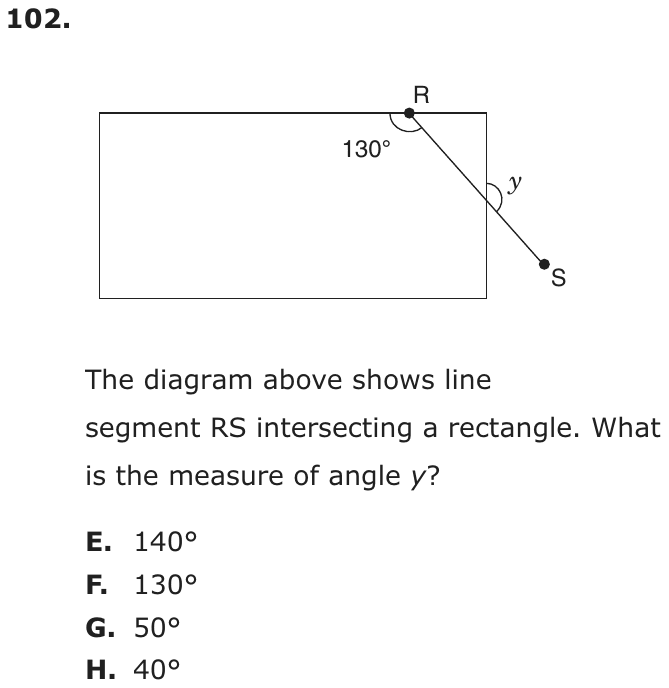
Question 100 of 120
2023 Test A Math, question 46Question
ESSAY LENGTH
| Number of Words | Number of Essays |
|---|---|
| <100 | 6 |
| 100–250 | 4 |
| 251–500 | 11 |
| >500 | 9 |
All 150 students in Grade 8 at a school are assigned to write an essay on the same topic. A teacher records the number of words in a random sample of the essays, as shown in the table above. Based on this sample, how many students in the entire grade would be expected to write essays with at least 100 words?
- A20
- B30
- C100
- D120
Show the answer
Correct answer: D
The number of students in the sample who wrote an essay with at least 100 words is 24 out of the 30 students. Write it as a fraction: . To predict the number of students in the entire grade who would write an essay with at least 100 words, find of 150, which is .
Question analysis
This statistics question gives a table of word counts for a random sample of Grade 8 essays and asks how many of all 150 students would be expected to write at least 100 words. Students find the sample size, the share meeting the condition, and scale it to the whole grade. Matching the words at least to the table's ranges is the tricky part.
- Grade level
- Grade 6 content, by NYS standard
- Compared with grade 7
- At grade 7 Using a random sample to predict a count for a whole population is typical grade 7 statistics and ratio work. Students total the sample from a table, read at least 100 against the table's ranges, and scale by a whole-number factor.
- Estimated difficulty
- Moderate: several steps, or a close reading with one strong distractor.
- Thinking it demands
- Depth of knowledge 2, skills and concepts · mainly apply
- What makes it hard
- Reading a figure, table or graph moderate
- Turning words into math minor
- Many steps minor
- Solution
- 3 steps
- Reading level
- Question and choices: about grade 6, 65 words.
- Students, last 30 days
- Not enough answers yet to show (it takes 10).
Why it is hard, traps and wrong answers (shows the answer)
Why it is hard
The proportion at the end is routine; the question is decided at the table. Students must turn “at least 100 words” into the right rows and also find the sample size, which is printed nowhere. Each listed wrong answer scales up a different group of rows, so a careless reading still produces a believable number. Noting that only 6 of 30 essays fall short, one fifth, gives a quick check.
Reading a figure, table or graph moderate Understanding the question
The table never prints the sample size; it has to be built by adding all four rows, 6 + 4 + 11 + 9 = 30, and the qualifying essays sit in three rows, not one. (Lesh, Post & Behr, 1987; Kirsch & Mosenthal, 1990)
Turning words into math minor Understanding the question
The bold “at least 100 words” must be matched to the rows 100–250, 251–500 and >500, keeping the row that begins at 100 and leaving out only the <100 row. (Hegarty, Mayer & Monk, 1995; Koedinger & Nathan, 2004)
Many steps minor Working it out
Four steps follow in order: the sample total, the qualifying count of 24, the fraction 24/30 = 4/5, and that fraction of all 150 students. (Daniel & Embretson, 2010; Enright, Morley & Sheehan, 2002)
Strategy: Add the table's counts to find the sample size, add the rows with 100 or more words, and scale that fraction of the sample up to all 150 students.
Traps
- Misreads the question: Misses or misreads a condition or a word in the question: "at least", "each", "remaining", "not".
- Answers a different question: A choice is right for another quantity: the other unknown, the rest instead of the part, the part instead of the whole.
The wrong answers, classified
A Misreads the question (Hegarty, Mayer & Monk, 1995)
Counts only the 100–250 row as at least 100 words, then scales its 4 essays up to the grade: 4/30 of 150 = 20.
B Answers a different question (King et al., 2004; Hegarty, Mayer & Monk, 1995)
Scales up the 6 essays with fewer than 100 words, 6/30 of 150 = 30, the very students the question leaves out.
C Misreads the question (Hegarty, Mayer & Monk, 1995)
Leaves out the 100–250 row, as if at least 100 meant more than 250, so it scales 11 + 9 = 20 essays up to 100.
Worked solution, step by step
Formulas used
- Predicting from a sample
- A sample is a smaller group picked at random from the whole group. The fraction of the sample with some feature is your best guess for the fraction of the whole group. So multiply that fraction by the size of the whole group.
Sort out the question
The table shows a random sample of the essays from a grade of 150 students. You need to predict how many of the 150 students wrote at least 100 words. At least 100 means 100 or more.
Find the sample size
The table doesn’t give the total, so add all four rows.
The sample has 30 essays.
Count the essays with enough words
Three rows count: 100–250, 251–500 and >500. Only the <100 row is left out.
Watch out: the 100–250 row counts, because 100 is at least 100. Leaving it out gives 100, choice C. Using the 6 short essays instead gives 30, choice B.
Scale up to the whole grade
About 4 out of every 5 students write at least 100 words. So the answer is D, 120 students.
Check your answer
The whole grade, 150, is 5 times the sample of 30. So multiply the sample count by 5: . The short essays scale to , and 120 + 30 = 150, the whole grade.
More questions like this
The original DOE question
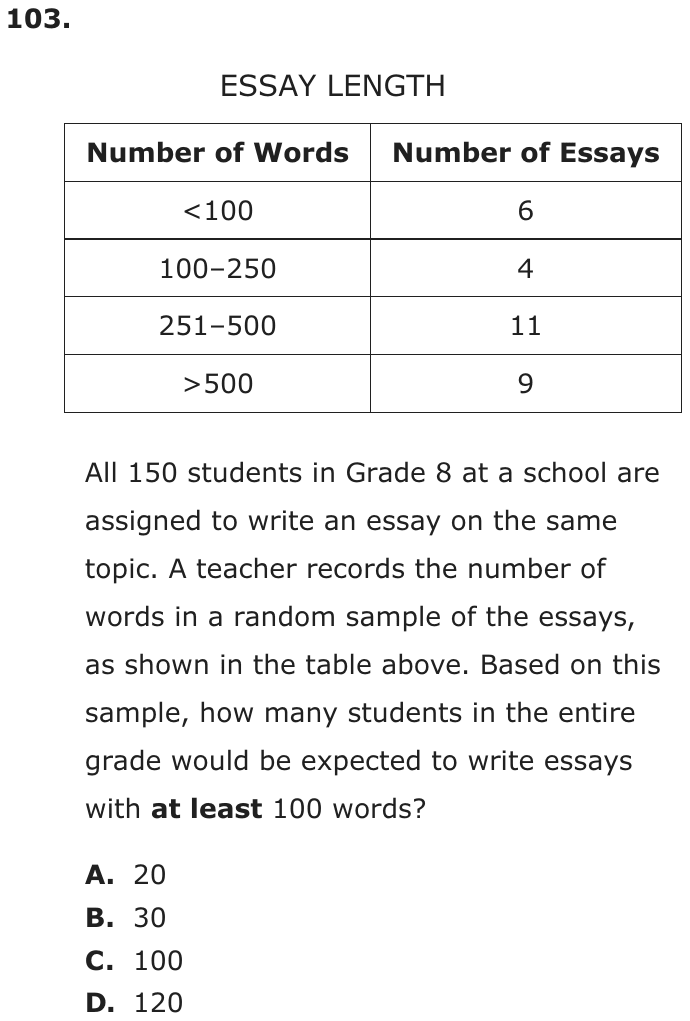
Question 101 of 120
2023 Test A Math, question 47Question
Which percentage is closest in value to 0.0099?
- A0%
- B0.1%
- C1%
- D100%
Show the answer
Correct answer: C
Since 0.0099 is equal to 0.99%, the answer option closest to that value is 1%.
Question analysis
This percent question asks which of four percentages is closest in value to the decimal 0.0099. Students convert a small decimal to a percent by multiplying by 100, then compare it with choices that differ by factors of ten. Moving the decimal point the wrong number of places, or reading the digits 99 as a percent, leads to wrong answers.
- NYS standards
- 6.RP.3c percent as a rate per 100
- Grade level
- Grade 6 content, by NYS standard
- Compared with grade 7
- Below grade 7 Converting a decimal to a percent is grade 6 work. This decimal has two zeros before its first digit, so the point must move carefully, but it is a single conversion followed by picking the nearest choice, below typical grade 7 demand.
- Estimated difficulty
- Straightforward: two steps or one careful reading.
- Thinking it demands
- Depth of knowledge 1, recall and reproduction · mainly apply
- What makes it hard
- Solution
- 2 steps
- Reading level
- Question and choices: about grade 6, 7 words.
- Students, last 30 days
- Not enough answers yet to show (it takes 10).
Why it is hard, traps and wrong answers (shows the answer)
Why it is hard
One conversion answers the question, and the choices are spaced by powers of ten, so the work is all in the decimal places. A decimal this small looks like nothing, and students who forget to multiply by 100 see it as nearly 0%. Others move the point the wrong number of places or read the digits 99 as a percent. Seeing that 0.01 is exactly 1% puts 0.0099 just below it.
Error-prone arithmetic minor Working it out
The decimal 0.0099 has two zeros before its digits, so moving the point two places gives 0.99, and miscounting the places lands on 0.1% or 99%. (Brown & Burton, 1978; Junker & Sijtsma, 2001)
Something you must already know minor Working it out
Students must know that a percent is a number of hundredths, so 0.0099 is multiplied by 100 to become 0.99%, a rule the question takes for granted. (Anderson & Krathwohl, 2001)
Strategy: Multiply the decimal by 100 to write it as a percent, moving the point two places to the right, then choose the percent nearest to that value.
Traps
- Misunderstands the concept: A wrong belief about a concept: that percents can be added, that area grows like length, that averages can be averaged, that a bigger denominator means a bigger fraction.
- An arithmetic slip: The right method with a plausible arithmetic error: a digit, a place value or a times-table fact.
- Numbers taken from the question: Combines the numbers in the question without a model of the situation, or is simply a number that appears in the question.
The wrong answers, classified
A Misunderstands the concept (Smith, diSessa & Roschelle, 1993; De Bock et al., 1998; Ni & Zhou, 2005)
Reads 0.0099 as if it were already a percent, 0.0099%, which is nearest 0%, never multiplying by 100 to change the decimal into a percent.
B An arithmetic slip (Junker & Sijtsma, 2001)
Moves the decimal point one place instead of two, turning 0.0099 into about 0.1, and writes that as 0.1%, ten times too small.
D Numbers taken from the question (Hegarty, Mayer & Monk, 1995)
Sees the digits 99, thinks of 99 percent, and picks the nearest choice, ignoring the zeros that make 0.0099 less than one hundredth.
Worked solution, step by step
Formulas used
- Decimal to percent
- A percent is a number of hundredths. To change a decimal into a percent, multiply by 100. That moves the decimal point two places to the right. For example, 0.25 × 100 = 25, so 0.25 is 25%.
Sort out the question
The number 0.0099 is a decimal, but the choices are percents. To compare them, change 0.0099 into a percent first. Then find the choice nearest to it.
Change the decimal to a percent
So 0.0099 is 0.99%. The decimal point moved two places to the right. Watch out: 0.0099 is not already a percent. Reading it as 0.0099% points to 0%, choice A.
Find the nearest choice
Find how far 0.99% is from each choice.
Choice Distance from 0.99% A, 0% 0.99 B, 0.1% 0.89 C, 1% 0.01 D, 100% 99.01 Watch out: moving the point only one place gives about 0.1, choice B. So the answer is C, 1%.
Check your answer
Work the other way. 1% is 1 out of 100, or 0.01. And 0.0099 is just a tiny bit less than 0.0100. So 0.0099 is very close to 1%, just a little less.
More questions like this
The original DOE question
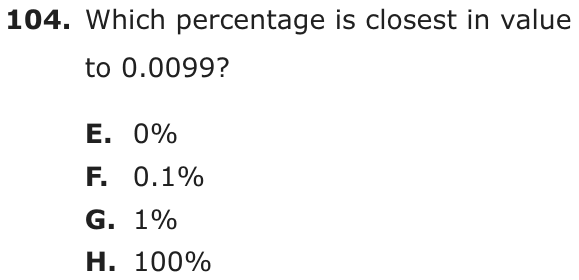
Question 102 of 120
2023 Test A Math, question 49Question
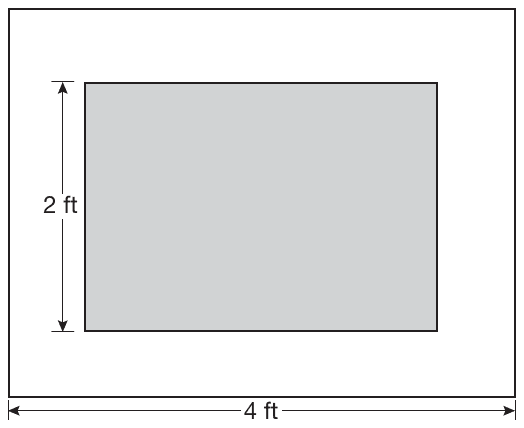
In the figure above, the shaded rectangle is similar to the outer rectangle. The length of the outer rectangle is 4 feet, and the perimeter of the outer rectangle is 14 feet. If the width of the shaded rectangle is 2 feet, what is the area of the shaded rectangle?
- A sq ft
- B6 sq ft
- C sq ft
- D12 sq ft
Show the answer
Correct answer: A
For the outer rectangle, the length is 4 feet and the perimeter is 14 feet. Write and solve an equation to find the width:
| Apply the additive inverse property; subtract 8 from both sides of the equation. | |
| Apply the multiplicative inverse property; divide both sides of the equation by 2. | |
Use that information in a proportion to find the length of the shaded rectangle:
| Cross multiply. | |
| Apply the multiplicative inverse property; divide both sides of the equation by 3. | |
Now find the area of the shaded rectangle:
Question analysis
This geometry question shows a shaded rectangle similar to an outer rectangle that is 4 feet long with a perimeter of 14 feet; the shaded rectangle is 2 feet wide. Students find the shaded area. They must find a missing side, match corresponding sides, and scale by a factor rather than a fixed amount, which makes it a multistep similar-figures problem.
- Grade level
- Grade 8 content, by NYS standard
- Compared with grade 7
- Above grade 7 Similar figures are grade 8 geometry, though grade 7 scale drawings use the same proportions. Students must first find a missing side from the perimeter, match corresponding sides, solve a proportion with a fractional result, and then find an area.
- Estimated difficulty
- Hard: combines ideas, needs a plan, and has more than one tempting wrong answer.
- Thinking it demands
- Depth of knowledge 2, skills and concepts · mainly apply
- What makes it hard
- Combines ideas moderate
- Reading a figure, table or graph minor
- Error-prone arithmetic minor
- Solution
- 4 steps
- Reading level
- Question and choices: about grade 5, 57 words.
- Students, last 30 days
- Not enough answers yet to show (it takes 10).
Why it is hard, traps and wrong answers (shows the answer)
Why it is hard
Each step is familiar, but the three together, perimeter to width, width to scale factor, and sides to area, demand a plan. The strongest pull is scaling by subtraction, shrinking each side by 1 foot because the width drops from 3 to 2, which gives a neat whole-number area. Others stop at the outer rectangle or add the sides instead of multiplying. Checking that 8/3 to 2 matches 4 to 3 confirms the shape is similar.
Combines ideas moderate Working it out
Perimeter, similarity and area are chained: 14 feet gives the outer width of 3 feet, the 2-foot side sets a scale factor of 2/3, and only then can the area be found. (Embretson, 1998; Daniel & Embretson, 2010)
Reading a figure, table or graph minor Understanding the question
The figure marks the shaded rectangle's 2-foot side running up and down and the outer 4-foot length along the bottom, so the 2 feet must be paired with the outer 3-foot side, which is not labeled. (Lesh, Post & Behr, 1987; Kirsch & Mosenthal, 1990)
Error-prone arithmetic minor Working it out
The scale factor 2/3 makes the shaded length 8/3 feet, and the area 2 × 8/3 = 16/3 has to be written as the mixed number 5 1/3. (Brown & Burton, 1978; Junker & Sijtsma, 2001)
Strategy: Use the perimeter to find the outer rectangle's width, match the shaded width of 2 feet to it, scale the 4-foot length by the same factor, then multiply length by width.
Traps
- Misunderstands the concept: A wrong belief about a concept: that percents can be added, that area grows like length, that averages can be averaged, that a bigger denominator means a bigger fraction.
- Wrong formula: Uses a related but wrong formula: perimeter for area, diameter for radius, area for volume, or a misremembered one.
- Answers a different question: A choice is right for another quantity: the other unknown, the rest instead of the part, the part instead of the whole.
The wrong answers, classified
B Misunderstands the concept (Smith, diSessa & Roschelle, 1993; De Bock et al., 1998; Ni & Zhou, 2005)
Shrinks each side by the same amount instead of the same factor: the width drops by 1 foot, from 3 to 2, so the length drops from 4 to 3, giving 6.
C Wrong formula (King et al., 2004)
Finds the shaded sides, 2 and 8/3 feet, correctly but computes the perimeter, 2 × (2 + 8/3) = 28/3 = 9 1/3, instead of the area.
D Answers a different question (King et al., 2004; Hegarty, Mayer & Monk, 1995)
Finds the outer width of 3 feet and gives the outer rectangle's area, 4 × 3 = 12, instead of the smaller shaded one.
Worked solution, step by step
Formulas used
- Perimeter of a rectangle
- P is the perimeter, the distance all the way around. l is the length and w is the width. A rectangle has two lengths and two widths, so you add each one twice.
- Scale factor of similar shapes
- Similar shapes have the same shape but different sizes. Each side of the small shape equals its matching side on the large shape times one number, the scale factor. So one pair of matching sides tells you the scale factor.
- Area of a rectangle
- A is the area, the space inside. l is the length and w is the width. You multiply because the rectangle is made of rows of unit squares: w rows with l squares in each.
Sort out the question
The outer rectangle is 4 feet long, and its perimeter is 14 feet. The shaded rectangle is similar to it, so it has the same shape. The shaded rectangle’s width, its left side, is 2 feet. You need the shaded area, so you also need the shaded length.
Find the outer rectangle’s width
The outer rectangle is 3 feet wide. That is its up-and-down side.
Find the scale factor
The shaded width, 2 feet, matches the outer width, 3 feet.
Every shaded side is of the matching outer side. Watch out: similar shapes shrink by the same factor, not by the same number of feet. Taking 1 foot off each side gives 2 by 3, an area of 6, choice B.
Find the shaded length
Multiply the outer length, 4 feet, by the scale factor.
The shaded rectangle is feet long.
Find the shaded area
Watch out: 4 × 3 = 12 is the outer area, choice D. So the answer is A, sq ft.
Check your answer
Check the shape. For the outer rectangle, length ÷ width is . For the shaded one, it is . They match, so the shapes are similar. Also, square feet is less than the outer 12, as it should be.
More questions like this
The original DOE question
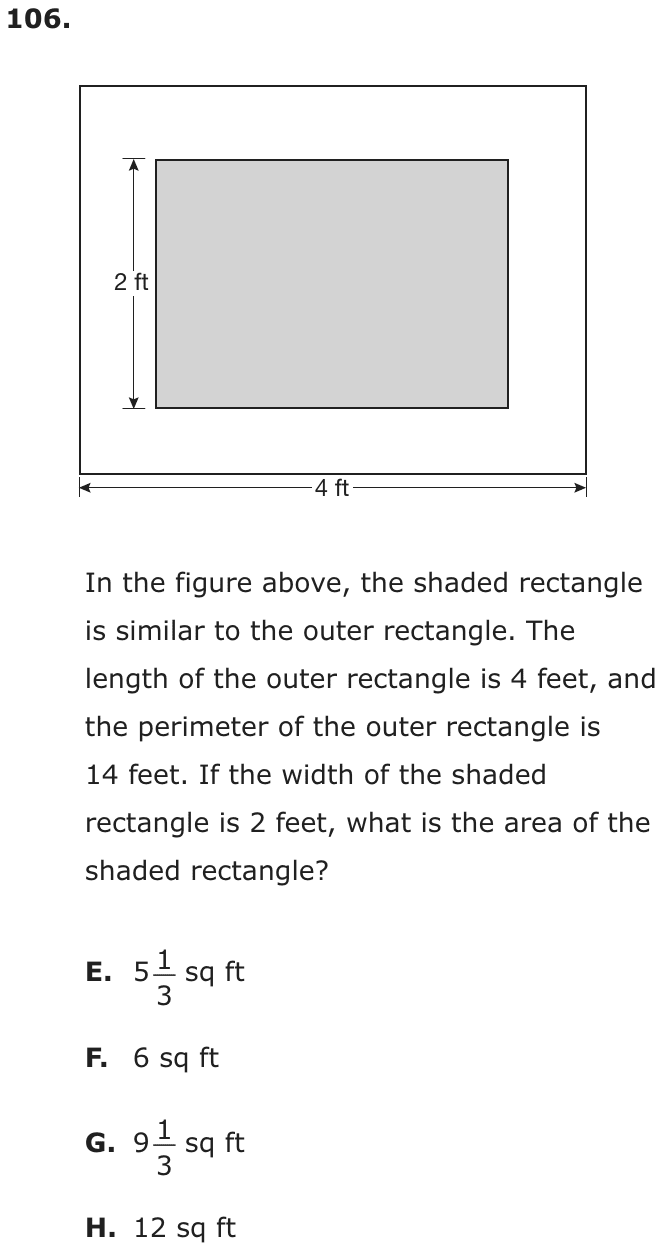
Question 103 of 120
2023 Test A Math, question 50Question
A rectangular concrete driveway is 30 feet long, 8 feet wide, and 6 inches thick. What is the volume of the concrete?
- A44 cu ft
- B48 cu ft
- C120 cu ft
- D240 cu ft
Show the answer
Correct answer: C
First convert 6 inches to 0.5 foot. Then, calculate the volume, in cubic feet:
Question analysis
This volume word problem describes a concrete driveway 30 feet long, 8 feet wide and 6 inches thick, and asks for the volume of the concrete in cubic feet. Students convert inches to feet and multiply three dimensions. Mixing units, or stopping at the area of the driveway's surface, is the main way to go wrong.
- Grade level
- Grade 6 content, by NYS standard
- Compared with grade 7
- Below grade 7 Volume of a rectangular prism with a fractional edge is grade 6 content. The only extra step is changing inches to feet before multiplying, so it is lighter than grade 7 volume work with composite or triangular prisms.
- Estimated difficulty
- Straightforward: two steps or one careful reading.
- Thinking it demands
- Depth of knowledge 2, skills and concepts · mainly apply
- What makes it hard
- Solution
- 2 steps
- Reading level
- Question and choices: about grade 2, 27 words.
- Students, last 30 days
- Not enough answers yet to show (it takes 10).
Why it is hard, traps and wrong answers (shows the answer)
Why it is hard
Volume of a box is familiar, so the question is decided by the mix of units: two dimensions in feet and one in inches. Multiplying the three numbers as printed gives 1,440, which is not a choice, and that should send students back to convert. The listed wrong answers instead come from leaving out the thickness or combining the numbers without the volume rule.
Something you must already know minor Working it out
The stem gives no formula and no conversion, so students must bring both the volume rule, length times width times height, and the 12 inches in a foot. (Anderson & Krathwohl, 2001)
Error-prone arithmetic minor Working it out
The thickness becomes the fraction 1/2 foot, so the product is 30 × 8 × 1/2, or, if the inches are kept, 1,440 divided by 12. (Brown & Burton, 1978; Junker & Sijtsma, 2001)
Strategy: Change 6 inches to a fraction of a foot first so that all three measurements share a unit, then multiply length, width and thickness.
Traps
- Stops one step early: A choice is a number from partway through the solution.
- Numbers taken from the question: Combines the numbers in the question without a model of the situation, or is simply a number that appears in the question.
The wrong answers, classified
A Numbers taken from the question (Hegarty, Mayer & Monk, 1995)
Adds the three numbers in the stem, 30 + 8 + 6 = 44, instead of multiplying the dimensions.
B Numbers taken from the question (Hegarty, Mayer & Monk, 1995)
Multiplies only the width and the thickness, 8 × 6 = 48, combining two of the stem's numbers and leaving out the 30-foot length.
D Stops one step early (King et al., 2004; Gierl et al., 2017)
Finds the area of the driveway's surface, 30 × 8 = 240, and stops before multiplying by the half-foot thickness.
Worked solution, step by step
Formulas used
- Inches to feet
- There are 12 inches in 1 foot. So to change inches into feet, divide the number of inches by 12.
- Volume of a rectangular box
- V is the volume, the space inside a box shape. l is the length, w is the width and h is the height, here the thickness. All three must use the same unit. The answer is in cubic units, such as cubic feet.
Sort out the question
The driveway is a flat box of concrete. It is 30 feet long, 8 feet wide and 6 inches thick. You need its volume, the space the concrete fills, in cubic feet. The thickness is in inches, so change it to feet first.
Change the thickness to feet
So 6 inches is half a foot. Now all three measures are in feet.
Multiply the three measures
The volume is 120 cubic feet. Watch out: 30 × 8 = 240 is only the area of the top surface, in square feet. Stopping there gives choice D. Adding 30 + 8 + 6 = 44 gives choice A.
So the answer is C, 120 cu ft.
Check your answer
Think of it another way. A slab 30 feet by 8 feet and a full foot thick would hold 240 cubic feet. This one is only half a foot thick, so it holds half as much, 120 cubic feet. Using 6 instead of one half would give 1,440, far too big.
More questions like this
The original DOE question
Question 104 of 120
2023 Test A Math, question 52Question
Vicente and Carla each ran 8 laps around a track. They started at the same time and place. If Vicente ran 1.5 times as fast as Carla, how many laps did Carla have left to finish when Vicente finished his 8th lap?
- A
- B
- C
- D
Show the answer
Correct answer: B
Vicente ran 1.5 times as fast as Carla, so that means for every lap Carla finished, Vicente finished 1.5 laps. Set up a proportion to calculate c, the number of laps Carla had completed when Vicente finished 8 laps:
| Cross multiply. | |
| Apply the multiplicative inverse property; divide both sides of the equation by 1.5. | |
So, the number of laps Carla still had to finish is .
Question analysis
This ratio word problem says Vicente and Carla each ran 8 laps, starting at the same time and place, and Vicente ran 1.5 times as fast. It asks how many laps Carla still had to run when Vicente finished. Students reason with a speed ratio and mixed numbers, and giving the laps run rather than the laps remaining is an easy slip.
- NYS standards
- Grade level
- Grade 7 content, by NYS standard
- Compared with grade 7
- Above grade 7 Grade 7 rate problems usually give a speed and a time. Here only the ratio of two speeds is given, so students must reason that distances run in the same time share that ratio, then work with a fractional number of laps.
- Estimated difficulty
- Hard: combines ideas, needs a plan, and has more than one tempting wrong answer.
- Thinking it demands
- Depth of knowledge 2, skills and concepts · mainly apply
- What makes it hard
- Turning words into math moderate
- Error-prone arithmetic moderate
- A very close wrong answer minor
- Solution
- 3 steps
- Reading level
- Question and choices: about grade 4, 44 words.
- Students, last 30 days
- Not enough answers yet to show (it takes 10).
Why it is hard, traps and wrong answers (shows the answer)
Why it is hard
No time is given, so students must reason that in equal time distance scales with speed, which turns the race into one division and one subtraction. Both steps hide a trap: the division by 1.5 leaves a remainder that is easy to misread, and subtracting a mixed number from 8 needs regrouping. The result of the first step, Carla's laps run, is itself a choice, so the question also rewards rereading what is asked.
Turning words into math moderate Understanding the question
The phrase “1.5 times as fast” has to become distances in the same time: while Vicente runs 8 laps, Carla runs 8 ÷ 1.5, not 8 − 1.5 or 8 × 1.5. (Hegarty, Mayer & Monk, 1995; Koedinger & Nathan, 2004)
Error-prone arithmetic moderate Working it out
Dividing 8 by 1.5 gives 16/3, or 5 1/3, a division by a decimal with a remainder, and 8 − 5 1/3 then needs a whole regrouped into thirds. (Brown & Burton, 1978; Junker & Sijtsma, 2001)
A very close wrong answer minor Choosing the answer
The choice 2 1/2 is only a sixth of a lap from 2 2/3, so a rough estimate of how far Carla trails cannot separate them; only the exact quotient does. (Embretson & Wetzel, 1987; Gorin & Embretson, 2006; Ascalon et al., 2007)
Strategy: In the same amount of time the faster runner covers 1.5 times the distance, so divide Vicente's laps by 1.5 to get Carla's, then subtract that from 8.
Traps
- Answers a different question: A choice is right for another quantity: the other unknown, the rest instead of the part, the part instead of the whole.
- A faulty procedure: A systematic but wrong procedure: adding fractions straight across, applying an exponent to each term of a sum, dropping a sign when moving a term.
The wrong answers, classified
A A faulty procedure (Brown & Burton, 1978; Tatsuoka, 1983)
Works 80 ÷ 15 as 5 remainder 5 and writes 5.5, turning the remainder into a decimal digit, so Carla seems to have run 5 1/2 laps and 2 1/2 remain.
C A faulty procedure (Brown & Burton, 1978; Tatsuoka, 1983)
Finds 5 1/3 correctly but subtracts it from 8 by taking 5 from 8 and keeping the 1/3, getting 3 1/3 instead of regrouping a whole.
D Answers a different question (King et al., 2004; Hegarty, Mayer & Monk, 1995)
Finds how many laps Carla had run when Vicente finished, 8 ÷ 1.5 = 5 1/3, and gives that instead of the laps she still had left.
Worked solution, step by step
Formulas used
- Distance, rate and time
- d is the distance, r is the rate or speed, and t is the time. When two runners run for the same time, the faster one goes farther by the same factor as the speed. So 1.5 times as fast means 1.5 times as far.
- Dividing by a fraction
- a is any number and m over n is a fraction. Dividing by a fraction is the same as multiplying by its reciprocal, the fraction flipped upside down.
Sort out the question
Vicente and Carla each run 8 laps, starting together. Vicente runs 1.5 times as fast as Carla. You need how many laps Carla still has to run when Vicente finishes. First find how far Carla has run at that moment.
Compare their distances
They have run for the same time. So Vicente’s distance is 1.5 times Carla’s. Let c be the laps Carla has run.
To find c, divide 8 by 1.5.
Divide 8 by 1.5
Write 1.5 as the fraction .
Carla has run laps. Watch out: that is how far she has run, not what is left. Stopping here gives choice D.
Find the laps she has left
Watch out: 8 − is not . You must break 1 whole into thirds first. Answering is choice C.
So the answer is B, laps.
Check your answer
Multiply back: . So when Carla has run laps, Vicente has run 8. And , her full race.
More questions like this
The original DOE question
Question 105 of 120
2023 Test A Math, question 53Question
At West College, students are randomly assigned to one of 20 dormitories and one of 6 dining rooms. Kharleen likes 6 of the dormitories and 2 of the dining rooms. What is the probability that she is assigned to both a dormitory and a dining room that she likes?
- A10%
- B12%
- C19%
- D38%
Show the answer
Correct answer: A
Kharleen likes of the dormitories. She likes of the dining rooms. Multiply those fractions together to calculate the probability of Kharleen being assigned to both a dormitory and a dining room that she likes: .
Question analysis
This probability word problem says students at West College are randomly assigned one of 20 dormitories and one of 6 dining rooms, and Kharleen likes 6 dormitories and 2 dining rooms. It asks for the chance that she gets both a dormitory and a dining room she likes. Students combine two independent events and write the result as a percent.
- Grade level
- Grade 7 content, by NYS standard
- Compared with grade 7
- At grade 7 Finding the chance that two independent events both happen is grade 7 compound probability. Each event's chance comes straight from the counts given, and joining them and writing the result as a percent is a typical grade 7 task.
- Estimated difficulty
- Moderate: several steps, or a close reading with one strong distractor.
- Thinking it demands
- Depth of knowledge 2, skills and concepts · mainly apply
- What makes it hard
- Something you must already know moderate
- Turning words into math minor
- A very close wrong answer minor
- Solution
- 3 steps
- Reading level
- Question and choices: about grade 8, 45 words.
- Students, last 30 days
- Not enough answers yet to show (it takes 10).
Why it is hard, traps and wrong answers (shows the answer)
Why it is hard
The question turns on one rule, multiplying the chances of two independent events. Students who know it reduce the fractions first and finish in seconds; students who don't tend to combine the counts, and 6 × 2 = 12 reads naturally as 12%. The other two choices match no common working, so the real contest is between the product of the counts and the product of the chances.
Something you must already know moderate Working it out
The rule that the chance of two independent events both happening is the product of their chances, 3/10 × 1/3, is assumed; nothing in the stem says to multiply. (Anderson & Krathwohl, 2001)
Turning words into math minor Understanding the question
The phrase “both a dormitory and a dining room that she likes” describes two separate random assignments that must both go her way, so the two chances are combined, not compared. (Hegarty, Mayer & Monk, 1995; Koedinger & Nathan, 2004)
A very close wrong answer minor Choosing the answer
The choice 12% sits only 2 points above 10%, so a rough sense that the answer is small cannot separate them; only computing 3/10 × 1/3 does. (Embretson & Wetzel, 1987; Gorin & Embretson, 2006; Ascalon et al., 2007)
Strategy: Write the chance of a liked dormitory and the chance of a liked dining room as fractions, multiply them because both must happen, and convert the product to a percent.
Traps
- Numbers taken from the question: Combines the numbers in the question without a model of the situation, or is simply a number that appears in the question.
- A formula you must know: Needs a formula the test does not give: area, circumference, volume, probability rules.
The wrong answers, classified
B Numbers taken from the question (Hegarty, Mayer & Monk, 1995)
Multiplies the numbers of liked options, 6 × 2 = 12, and reads that product as 12%, without dividing by the 20 × 6 possible assignments.
C Little reason to choose it (Haladyna & Downing, 1993; Rodriguez, 2005)
No combination of 6/20 and 2/6 gives 19%, a value between the right answer and either single chance, so it mostly draws estimates and guesses.
D Little reason to choose it (Haladyna & Downing, 1993; Rodriguez, 2005)
No common working gives 38%, which is larger than either single chance, 30% or about 33%, so it mostly catches guesses.
Worked solution, step by step
Formulas used
- Probability
- P is the probability, the chance that something happens. The top counts the outcomes you want. The bottom counts every outcome that could happen. Each outcome must be equally likely.
- Probability of two separate events
- A and B are two events that don’t affect each other, like two separate random picks. P(A) is the chance of A, and P(B) is the chance of B. The chance that both happen is the two chances multiplied.
Sort out the question
Kharleen gets one of 20 dorms, or dormitories, where students live. She also gets one of 6 dining rooms. Each is picked at random. She likes 6 dorms and 2 dining rooms. You need the chance that she gets a dorm she likes and a dining room she likes.
Find the chance of a liked dorm
She likes 6 of the 20 dorms. Divide the top and bottom by 2 to simplify.
Find the chance of a liked dining room
Use the same formula for the dining rooms.
She likes 2 of the 6 dining rooms. Divide the top and bottom by 2.
Multiply the two chances
The two picks are separate. One doesn’t change the other.
Both must happen, so the chance is smaller than either one alone.
Change to a percent
Watch out: multiplying 6 × 2 = 12 and calling it 12% skips dividing by all the possible assignments. That is choice B. So the answer is A, 10%.
Check your answer
Count every possible assignment. There are dorm and dining room pairs, all equally likely. She likes of them. Then , which is 10%, the same answer.
More questions like this
The original DOE question
Question 106 of 120
2023 Test A Math, question 54Question
A train travels 2,200 miles from Phoenix to New York City. The train covers the first 240 miles in 5 hours. If the train continues to travel at this rate, how many more hours will it take to reach New York City? Round your answer to the nearest whole hour.
- A46
- B45
- C43
- D41
Show the answer
Correct answer: D
First, find the speed of the train in miles per hour: .
The number of miles left to travel is .
To find the number of hours left, use the equation :
| Apply the multiplicative inverse property; divide both sides of the equation by 48. | |
That number rounded to the nearest whole hour is 41 hours.
Question analysis
This rate word problem describes a 2,200-mile train trip from Phoenix to New York City in which the first 240 miles take 5 hours, and asks how many more hours the rest will take, rounded to the nearest hour. Students find a unit rate and the remaining distance. The choices are close together, so the time for the whole trip is a tempting trap.
- Grade level
- Grade 6 content, by NYS standard
- Compared with grade 7
- At grade 7 Unit rates are grade 6 content, but this chains four steps: a speed, the distance left, a long division that does not come out even, and rounding. The word more must be read closely, which puts it at typical grade 7 demand.
- Estimated difficulty
- Moderate: several steps, or a close reading with one strong distractor.
- Thinking it demands
- Depth of knowledge 2, skills and concepts · mainly apply
- What makes it hard
- Many steps moderate
- Turning words into math minor
- Error-prone arithmetic minor
- Solution
- 4 steps
- Reading level
- Question and choices: about grade 4, 47 words.
- Students, last 30 days
- Not enough answers yet to show (it takes 10).
Why it is hard, traps and wrong answers (shows the answer)
Why it is hard
Each step is routine, but the question has a long chain and asks for only part of the trip. Dividing the whole 2,200 miles by the speed is the natural shortcut and gives a listed choice, and the rounding instruction adds a second place to go wrong. Checking that 41 hours at 48 miles per hour covers about 1,970 miles, close to the 1,960 left, confirms the answer.
Many steps moderate Working it out
Four steps follow in order, the speed 240 ÷ 5 = 48, the miles left 2,200 − 240 = 1,960, the time 1,960 ÷ 48, and the rounding, and an early slip carries through. (Daniel & Embretson, 2010; Enright, Morley & Sheehan, 2002)
Turning words into math minor Understanding the question
The bold more in “how many more hours” limits the question to the 1,960 miles still ahead, though 2,200, the whole trip, is the distance the stem names first. (Hegarty, Mayer & Monk, 1995; Koedinger & Nathan, 2004)
Error-prone arithmetic minor Working it out
Dividing 1,960 by 48 leaves 40 with a remainder of 40, so the time, 40 5/6 hours, must be rounded up to the nearest hour rather than cut short. (Brown & Burton, 1978; Junker & Sijtsma, 2001)
Strategy: Find the train's speed from the first 240 miles, subtract those miles from the total to get the distance left, divide by the speed, and round only at the end.
Traps
- Answers a different question: A choice is right for another quantity: the other unknown, the rest instead of the part, the part instead of the whole.
- An arithmetic slip: The right method with a plausible arithmetic error: a digit, a place value or a times-table fact.
- Rounds too early: Rounds a value partway through, or rounds the wrong way, so the final answer drifts from the exact one.
The wrong answers, classified
A Answers a different question (King et al., 2004; Hegarty, Mayer & Monk, 1995)
Divides the whole 2,200 miles by 48 miles per hour, about 45.8, or 46 hours, the time for the entire trip rather than the hours still to go.
B Rounds too early (King et al., 2004)
Divides the whole 2,200 miles by 48 and then cuts 45.8 down to 45 instead of rounding to the nearest hour, two errors at once.
C An arithmetic slip (Junker & Sijtsma, 2001)
Subtracts 240 from 2,200 without reducing the hundreds after borrowing, getting 2,060 instead of 1,960, and 2,060 ÷ 48 ≈ 42.9 rounds to 43.
Worked solution, step by step
Formulas used
- Distance, rate and time
- d is the distance, r is the rate or speed, and t is the time. If you know two of them, you can find the third. To find the speed, divide the distance by the time. To find the time, divide the distance by the speed.
Sort out the question
The whole trip is 2,200 miles. The train goes the first 240 miles in 5 hours, and it keeps that speed. You need how many more hours it takes, rounded to the nearest whole hour. “More” means the time after the first 240 miles.
Find the train’s speed
Divide the 240 miles by the 5 hours. The train goes 48 miles per hour.
Find the miles still to go
There are 1,960 miles left. Watch out: use the miles left, not the whole trip. Dividing 2,200 by 48 gives about 45.8 hours, which leads to 46 or 45, choices A and B.
Find the hours still to go
Here 48 × 40 = 1,920, and 40 miles are left over. That leftover is of an hour.
Round to the nearest hour
of an hour is more than half an hour, so round up to 41. Watch out: don’t just drop the fraction.
So the answer is D, 41 hours.
Check your answer
At 48 miles per hour, 41 hours covers miles. That is just a bit more than 1,960, as it should be after rounding up. In 40 hours, the train would cover only 1,920 miles, which is not enough.
More questions like this
The original DOE question
Question 107 of 120
2023 Test A Math, question 55Question
What is the least of four consecutive integers whose sum is 58?
- A1
- B2
- C12
- D13
Show the answer
Correct answer: D
Let n represent the least of the four integers. The other three integers are , , and . Write an equation to solve for n:
Question analysis
This number properties question asks for the least of four consecutive integers that add up to 58. Students write the integers in terms of one unknown and solve a two-step equation, or reason from the average of the four. Starting the list at n + 1 instead of n, which shifts every integer by one, is the main trap.
- Grade level
- Grade 7 content, by NYS standard
- Compared with grade 7
- At grade 7 Writing and solving an equation of the form px + q = r is core grade 7 work. Expressing four consecutive integers in terms of the least one is a familiar setup, so this is a routine three-step grade 7 problem.
- Estimated difficulty
- Straightforward: two steps or one careful reading.
- Thinking it demands
- Depth of knowledge 2, skills and concepts · mainly apply
- What makes it hard
- Turning words into math minor
- A very close wrong answer minor
- Solution
- 3 steps
- Reading level
- Question and choices: about grade 6, 11 words.
- Students, last 30 days
- Not enough answers yet to show (it takes 10).
Why it is hard, traps and wrong answers (shows the answer)
Why it is hard
One equation, 4n + 6 = 58, solves the question, and dividing 58 by 4 to find the middle of the four, 14.5, is quicker still. The only real risk is the count: writing the integers as n + 1 through n + 4 and reporting n gives a least integer one too small. The two smallest choices match no reasonable working, so they draw only guesses. Adding the four integers back up to 58 is a ten-second check.
Turning words into math minor Understanding the question
The phrase “four consecutive integers” has to become n, n + 1, n + 2 and n + 3, with n the least, so the sum is 4n + 6, not 4n + 10. (Hegarty, Mayer & Monk, 1995; Koedinger & Nathan, 2004)
A very close wrong answer minor Choosing the answer
The choices 12 and 13 differ by one, the size of a fence-post error, so only checking that 13 + 14 + 15 + 16 = 58 separates them. (Embretson & Wetzel, 1987; Gorin & Embretson, 2006; Ascalon et al., 2007)
Strategy: Call the least integer n, write the next three as n + 1, n + 2 and n + 3, add them and solve; or divide 58 by 4 to find the middle of the four.
Traps
- Counting the ends: Inclusive or exclusive ends, fence posts, consecutive numbers: an answer that is one too many or too few, or an endpoint drawn open where it belongs closed (or the reverse).
The wrong answers, classified
A Little reason to choose it (Haladyna & Downing, 1993; Rodriguez, 2005)
No equation for four consecutive integers gives 1; it may echo the step of 1 between them, but it mostly catches guesses.
B Little reason to choose it (Haladyna & Downing, 1993; Rodriguez, 2005)
No working with a sum of 58 leads to 2, which may echo the + 2 in n + 2, so it mostly draws guesses.
C Counting the ends (Brown & Burton, 1978)
Writes the four integers as n + 1 through n + 4, solves 4n + 10 = 58 to get n = 12, and reports n instead of the least integer, n + 1.
Worked solution, step by step
Formulas used
- Consecutive integers
- Integers are whole numbers and their negatives, like −2, 0 and 7. Consecutive integers come one right after another, like 4, 5, 6, 7. If n is the least one, each next one is 1 more than the one before.
Sort out the question
You need four consecutive integers, numbers in a row like 7, 8, 9, 10. Together they add up to 58. You need the least, or smallest, of the four.
Name the four numbers
Let n be the least number. Then the other three are 1, 2 and 3 more than n.
Write and simplify the equation
Add the four numbers and set the sum equal to 58.
To combine, count the n’s: there are four of them. The plain numbers make 1 + 2 + 3 = 6.
Solve for n
Subtract 6 from both sides. Then divide both sides by 4.
Watch out: if you call the numbers n + 1 to n + 4, you get n = 12. Then 12 is not one of the four numbers; the least one is 13. Answering 12 is choice C.
So the answer is D, 13.
Check your answer
Add them up: . It works. Another way: is their average. It falls halfway between the two middle numbers, 14 and 15. So the four numbers are 13, 14, 15 and 16.
More questions like this
The original DOE question
Question 108 of 120
2023 Test A Math, question 56Question

If all possible values of x are indicated by the shaded part of the number line above, which number line best shows all possible values of ?
- A

- B

- C

- D

Show the answer
Correct answer: D
The shaded region goes from to . So, the possible values of would be between the reciprocal of and the reciprocal of , which are 2 and , respectively. Find the number line in the answer options that has a shaded region that ranges from to 2, which is option D.
Question analysis
This number line question shades all possible values of x from one half to three halves and asks which number line shows all possible values of 1/x. Students find reciprocals of fractions and work out how a whole range of values changes. Keeping track of what happens to each end of the range, and placing fractions accurately on the line, makes it tricky.
- NYS standards
- Grade level
- Grade 6 content, by NYS standard
- Compared with grade 7
- Above grade 7 Reciprocals of single fractions are grade 6 work. Applying them to every value in a shaded range at once, and working out where the new range begins and ends, is reasoning about a whole set of numbers that grade 7 classes rarely practice.
- Estimated difficulty
- Hard: combines ideas, needs a plan, and has more than one tempting wrong answer.
- Thinking it demands
- Depth of knowledge 2, skills and concepts · mainly apply
- What makes it hard
- Reading a figure, table or graph moderate
- A very close wrong answer moderate
- Variables instead of numbers minor
- Solution
- 3 steps
- Reading level
- Question and choices: about grade 12, 27 words.
- Students, last 30 days
- Not enough answers yet to show (it takes 10).
Why it is hard, traps and wrong answers (shows the answer)
Why it is hard
Few students have flipped an interval before, so the question rewards testing its two ends and noticing that the order reverses. The harder part comes at the end: 2/3 falls between the tick marks, and a graph ending at the nearby 1/2 tick looks right at a glance. Students who believe a reciprocal is always at least 1, or who shift the interval instead of flipping it, reach the other graphs.
Reading a figure, table or graph moderate Understanding the question
The shaded segment's ends sit on unlabeled half-unit ticks, 1/2 and 3/2, and each choice must be read the same way, with 2/3 falling between ticks rather than on one. (Lesh, Post & Behr, 1987; Kirsch & Mosenthal, 1990)
A very close wrong answer moderate Choosing the answer
The graph from 1/2 to 2 matches the right graph's right end and differs at the left end by only a sixth of a unit, 1/2 against 2/3. (Embretson & Wetzel, 1987; Gorin & Embretson, 2006; Ascalon et al., 2007)
Variables instead of numbers minor Understanding the question
The question asks about 1/x for every x in a range, so a whole interval must be transformed, and its ends swap: the smallest x gives the largest 1/x. (Koedinger & Nathan, 2004; Enright, Morley & Sheehan, 2002)
Strategy: Take the reciprocal of each end of the shaded part, ask whether a bigger x gives a bigger or a smaller 1/x, and look for the graph whose endpoints are exactly those values.
Traps
- Misreads the figure: Reads a value, label or tick spacing in a figure, table or graph wrongly.
- Misunderstands the concept: A wrong belief about a concept: that percents can be added, that area grows like length, that averages can be averaged, that a bigger denominator means a bigger fraction.
- Wrong operation: Adds instead of multiplying, divides the wrong way round, turns a ratio or rate upside down, or undoes a step in the wrong direction (subtracts what should be added back).
The wrong answers, classified
A Wrong operation (Hegarty, Mayer & Monk, 1995; King et al., 2004)
Adds 1 to each endpoint instead of taking reciprocals, sliding the shaded part from 1/2–3/2 one unit right, to 3/2–5/2.
B Misunderstands the concept (Smith, diSessa & Roschelle, 1993; De Bock et al., 1998; Ni & Zhou, 2005)
Gets 2 from 1/2 but assumes a reciprocal cannot be less than 1, as flipping a proper fraction suggests, so it starts the shading at 1 instead of 2/3.
C Misreads the figure (Lesh, Post & Behr, 1987; Kirsch & Mosenthal, 1990)
Finds the reciprocals 2/3 and 2 but places 2/3 at the half-unit tick, 1/2, though 2/3 lies a third of the way from that tick toward 1.
Worked solution, step by step
Formulas used
- Reciprocal
- a and b are the top and bottom of a fraction. The reciprocal flips the fraction upside down. The number 1 over x is the reciprocal of x. A number times its reciprocal always makes 1.
Sort out the question
x can be any number in the shaded part of the first number line. You need the number line that shows every possible value of , the reciprocal of x. The reciprocal is the number flipped upside down, like for 2.
Read the shaded part
The ticks come every half unit. The shading starts at the tick halfway between 0 and 1, which is . It ends halfway between 1 and 2, which is , or . Both dots are filled in, so both ends count.
Find the reciprocals of the ends
Flip each end of the shaded part.
So the ends of the new shading are 2 and .
Notice that the ends swap
When x gets bigger, gets smaller. So the smallest x, , gives the biggest value, 2. The biggest x, , gives the smallest, . So runs from to 2, ends included.
Find the matching number line
lies between the half tick and 1, a third of the way from to 1. Line D starts there and ends at 2. Watch out: line C starts at the half tick, , not at . Line B starts at 1.
So the answer is D, the line shaded from to 2.
Check your answer
Test a value in the middle. x = 1 is shaded, and . On line D, 1 is shaded too. Test an end: , so really is the reciprocal of .
More questions like this
The original DOE question
Question 109 of 120
2023 Test A Math, question 57Question
Chanelle selects a marble from a container and then returns it to the container. When she does this 3 times, the probability of choosing a red marble all 3 times is . Based on this information, what is the probability of Chanelle choosing a red marble the first time she selects a marble?
- A
- B
- C
- D
Show the answer
Correct answer: D
Let be the probability of Chanelle selecting a red marble the first time. The probability of selecting a red marble three times is , which is given as . Since , the value of x is 6, and the probability of Chanelle selecting a red marble the first time is .
Question analysis
This probability question says Chanelle draws a marble and puts it back, three times, and the chance of red all three times is 1/216. It asks for the chance of red on her first draw. Students reverse the multiplication rule for repeated independent draws, which means finding a cube root, and dividing by 3 is the tempting shortcut.
- Grade level
- Grade 8 content, by NYS standard
- Compared with grade 7
- Above grade 7 Multiplying probabilities for repeated draws with replacement is grade 7 compound probability. Running it backward, from three draws to one, needs a cube root, a grade 8 idea, though the numbers are friendly and the work is short once set up.
- Estimated difficulty
- Moderate: several steps, or a close reading with one strong distractor.
- Thinking it demands
- Depth of knowledge 2, skills and concepts · mainly apply
- What makes it hard
- Something you must already know moderate
- No obvious method minor
- Solution
- 2 steps
- Reading level
- Question and choices: about grade 7, 55 words.
- Students, last 30 days
- Not enough answers yet to show (it takes 10).
Why it is hard, traps and wrong answers (shows the answer)
Why it is hard
Once the three draws are seen as one chance cubed, the question is a cube root, and 216 is a perfect cube many students know. The risk lies in undoing the cube the wrong way: dividing by 3 because there are three draws, or stopping at 36 after one division by 6. A quick check, 1/6 × 1/6 × 1/6 = 1/216, confirms the answer.
Something you must already know moderate Working it out
Students must know that three draws with the marble returned each time multiply, p × p × p, and must recognize 216 as 6 × 6 × 6; the stem states neither. (Anderson & Krathwohl, 2001)
No obvious method minor Working it out
The usual direction runs from one draw to three; here the three-draw chance is given and the bold first asks for one draw, so students work backward and undo a cube. (Schoenfeld, 1985)
Strategy: Call the chance of red on one draw p, so three draws with replacement give p × p × p; then find the number whose cube equals the given probability.
Traps
- Wrong operation: Adds instead of multiplying, divides the wrong way round, turns a ratio or rate upside down, or undoes a step in the wrong direction (subtracts what should be added back).
- Stops one step early: A choice is a number from partway through the solution.
The wrong answers, classified
A Wrong operation (Hegarty, Mayer & Monk, 1995; King et al., 2004)
Divides 216 by 3 because there are three draws, instead of finding the number that multiplied by itself three times makes 216.
B Stops one step early (King et al., 2004; Gierl et al., 2017)
Divides 216 by 6 to get 36 and stops one division short, keeping 1/36, which is the chance of two reds in a row, not one.
C Little reason to choose it (Haladyna & Downing, 1993; Rodriguez, 2005)
No working with 1/216 gives 1/8, the chance of three heads in three coin tosses, so it mostly attracts guesses at a familiar fraction.
Worked solution, step by step
Formulas used
- Probability of repeated picks
- p is the chance of red on one pick. Chanelle puts the marble back each time, so every pick has the same chance p, and one pick doesn’t change the next. The chance of red on all three picks is the three chances multiplied.
Sort out the question
Chanelle picks a marble and puts it back, 3 times. The chance of red all 3 times is . You need the chance of red on just the first pick. Call that chance p.
Write the three picks as a product
She puts each marble back, so the container is the same every time. Each pick has the same chance, p.
Find the number that fits
You need a fraction that, multiplied by itself three times, makes . Its top is 1, since 1 × 1 × 1 = 1. For the bottom, find a number that times itself three times makes 216.
So the bottom is 6, and p is .
Avoid the tempting shortcuts
Watch out: dividing 216 by 3 gives 72, choice A. Three picks means multiplying three times, not dividing by 3. Also, is the chance of red twice in a row, choice B.
So the answer is D, .
Check your answer
Multiply it out: . That matches the question. Choice A fails fast: is already far smaller than .
More questions like this
The original DOE question
Question 110 of 120
2023 Test B English, question 33Passage Excerpt from “How We Made the First Flight”
Excerpt from “How We Made the First Flight”
by Orville Wright
In 1903 brothers Wilbur and Orville Wright conducted experiments related to flying machines. These experiments would eventually lead to air travel becoming a reliable form of transportation.
During the night of December 16, 1903, a strong cold wind blew from the north. When we arose on the morning of the 17th, the puddles of water, which had been standing about camp since the recent rains, were covered with ice. The wind had a velocity of 10 to 12 meters per second (22 to 27 miles an hour). We thought it would die down before long, and so remained indoors the early part of the morning. But when ten o’clock arrived, and the wind was as brisk as ever, we decided that we had better get the machine out and attempt a flight. We hung out the signal for the men of the Life Saving Station.1 We thought that by facing the flyer into a strong wind, there ought to be no trouble in launching it from the level ground about camp. We realized the difficulties of flying in so high a wind, but estimated that the added dangers in flight would be partly compensated for by the slower speed in landing.
Final Preparations
We laid the track on a smooth stretch of ground about one hundred feet north of the new building. The biting cold wind made work difficult, and we had to warm up frequently in our living room, where we had a good fire in an improvised stove made of a large carbide2 can. By the time all was ready, J. T. Daniels, W. S. Dough and A. D. Etheridge, members of the Kill Devil3 Life Saving Station; W. C. Brinkley of Manteo, and Johnny Moore, a boy from Nags Head,4 had arrived.
We had a “Richard” hand anemometer with which we measured the velocity of the wind. Measurements made just before starting the first flight showed velocities of 11 to 12 meters per second, or 24 to 27 miles per hour. . . .
Audacity—and Calculation
Wilbur having used his turn in the unsuccessful attempt on the 14th, the right to the first trial now belonged to me. After running the motor a few minutes to heat it up, I released the wire that held the machine to the track, and the machine started forward in the wind. Wilbur ran at the side of the machine, holding the wing to balance it on the track. Unlike the start on the 14th, made in a calm, the machine, facing a 27-mile wind, started very slowly. Wilbur was able to stay with it till it lifted from the track after a forty-foot run. One of the Life Saving men snapped the camera for us, taking a picture just as the machine had reached the end of the track and had risen to a height of about two feet. The slow forward speed of the machine over the ground is clearly shown in the picture by Wilbur’s attitude. He stayed along beside the machine without any effort.
Flight
The course of the flight up and down was exceedingly erratic, partly due to the irregularity of the air, and partly to lack of experience in handling this machine. The control of the front rudder was difficult on account of its being balanced too near the center. This gave it a tendency to turn itself when started; so that it turned too far on one side and then too far on the other. As a result the machine would rise suddenly to about ten feet, and then as suddenly dart for the ground. A sudden dart when a little over a hundred feet from the end of the track, or a little over 120 feet from the point at which it rose into the air, ended the flight. As the velocity of the wind was over 35 feet per second and the speed of the machine over the ground against this wind ten feet per second, the speed of the machine relative to the air was over 45 feet per second, and the length of the flight was equivalent to a flight of 540 feet made in calm air. This flight lasted only 12 seconds, but it was nevertheless the first in the history of the world in which a machine carrying a man had raised itself by its own power into the air in full flight, had sailed forward without reduction of speed and had finally landed at a point as high as that from which it started.
From “How We Made the First Flight” by Orville Wright—Public Domain/Federal Aviation Administration
1Life Saving Station: one of the rescue stations along the Atlantic coastline that provided assistance to mariners in distress
2carbide: a very hard material composed of carbon and other heavy metals
3Kill Devil: the town of Kill Devil Hills in eastern North Carolina
4Nags Head: a town in eastern North Carolina
Question
Read this sentence from paragraph 5.
This flight lasted only 12 seconds, but it was nevertheless the first in the history of the world in which a machine carrying a man had raised itself by its own power into the air in full flight, had sailed forward without reduction of speed and had finally landed at a point as high as that from which it started.
The words “only,” “nevertheless,” and “finally” most clearly convey the idea that
- Aeven a flight of such minor duration had taken a long time to achieve.
- Bthe short flight gave the Wright brothers hope for longer ones in the future.
- Cthe flight proved that the machine was, at last, capable of becoming airborne.
- Dalthough it was brief, the flight was a remarkable accomplishment.
Show the answer
Correct answer: D
The question asks what idea is most clearly conveyed by the words “only,” “nevertheless,” and “finally” in the sentence from paragraph 5.
A. Incorrect. Although the duration of the flight was short and a successful flight had taken a long time to achieve, the words in the sentence from paragraph 5 are used to emphasize the remarkable nature of the flight, not the length of time it had taken the Wright brothers to be successful.
B. Incorrect. While it is easy to imagine that the Wright brothers had hope for longer flights, the words in the sentence from paragraph 5 do not relate directly to this sentiment; instead, they describe the groundbreaking success of their flight.
C. Incorrect. While the capabilities of the aircraft were demonstrated during the flight, the words in the sentence from paragraph 5 apply not only to the machine but also to the efforts of the people who designed it, built it, and actually made it fly.
D. CORRECT. The words in the sentence from paragraph 5 suggest that, though the first flight may not have lasted very long or taken the pilot very far, the Wright brothers accomplished something no one had been able to do before: successfully pilot an airplane in flight.
Question analysis
This word-choice question quotes the 60-word closing sentence of Orville Wright’s account of the first airplane flight, the sentence that begins by saying the flight lasted only 12 seconds. Students must decide what idea the words “only,” “nevertheless” and “finally,” spread across the sentence, most clearly convey, and the choices offer four readings of the flight’s significance.
- Grade level
- Grade 8 reading and task
- Compared with grade 7
- At grade 7 Explaining how word choice shapes meaning is grade 7 work, and these three words are familiar. The demand comes from the 60-word, old-fashioned sentence around them and from reading each word as it is used here, a typical grade 7 challenge.
- Estimated difficulty
- Moderate: several steps, or a close reading with one strong distractor.
- Thinking it demands
- Depth of knowledge 2, skills and concepts · mainly analyze
- What makes it hard
- A very close wrong answer moderate
- Reading between the lines minor
- Complex sentences minor
- Evidence
- Answered from one sentence or line
- Reading level
- Passage: about grade 7, 816 words; question and choices: about grade 8, 127 words.
- Students, last 30 days
- Not enough answers yet to show (it takes 10).
Why it is hard, traps and wrong answers (shows the answer)
Why it is hard
“Only” and “nevertheless” work as a pair, a concession followed by a claim of importance, and seeing that pair is most of the question. The trap is “finally,” which most students know as “at last,” a sense that suggests years of trying or a machine that at last left the ground. Here it simply means the flight ended with a level landing, so the choices built on the everyday meaning fall away for students who read it in its place.
A very close wrong answer moderate Choosing the answer
The “minor duration” choice and the right one both open by granting that the flight was brief; they part on the second half, a long road to success or a remarkable accomplishment. (Embretson & Wetzel, 1987; Gorin & Embretson, 2006; Ascalon et al., 2007)
Reading between the lines minor Working it out
“Finally” here marks the last stage of the flight, the landing “at a point as high as that from which it started,” and students must infer that from its place after “raised itself” and “sailed forward.” (Graesser, Singer & Trabasso, 1994; Kintsch, 1998)
Complex sentences minor Understanding the question
The 60-word sentence places “only” fourth, “nevertheless” tenth and “finally” 48th, inside a chain of three “had” clauses, so the three words must be gathered from across it before their combined idea appears. (Abedi & Lord, 2001; Freedle & Kostin, 1993; Messick, 1989)
Strategy: Read the sentence with each of the three words left out in turn and notice what changes; then choose the idea the three create together, not one that a single word suggests alone.
Traps
- Dictionary meaning, not meaning here: A common meaning of the word that does not fit its use in this text.
- Outside knowledge: A choice is plausible in the real world but not supported by this text.
The wrong answers, classified
A Dictionary meaning, not meaning here (Perfetti, 2007)
Reads “only” correctly as stressing the short flight but takes “finally” as “after a long wait,” so it concludes that even 12 seconds in the air took a long time to achieve.
B Outside knowledge (King et al., 2004; Recht & Leslie, 1988)
Supplies a natural next chapter, the brothers hoping for longer flights, which is easy to imagine, but none of the three words looks beyond this flight to future ones.
C Dictionary meaning, not meaning here (Perfetti, 2007)
Matches “finally” with “at last” and fixes on the machine leaving the ground, ignoring how “only” and “nevertheless” set the flight’s brevity against its importance.
Working it out, step by step
Figure out what the question asks
Here the question is about the author’s word choice. Three words, “only,” “nevertheless” and “finally,” are spread across one long sentence. You need the idea they create together. Look at what each word means right where it sits.
Look at only and nevertheless
The sentence begins, “This flight lasted only 12 seconds.” The word “only” stresses how short that is. Next comes “but it was nevertheless the first in the history of the world.” Nevertheless means even so, or in spite of that. Together these two words say: yes, it was short, but it still mattered greatly.
Look at finally
The sentence lists three things the machine did. It “had raised itself by its own power into the air,” then “had sailed forward without reduction of speed.” Last, it “had finally landed at a point as high as that from which it started.” Here, finally means as the last step. It does not mean after a long wait. It shows the flight was complete from start to finish.
Check each choice
- A is wrong. It reads “finally” as meaning after years of trying. The sentence says nothing about how long the brothers worked.
- B is wrong. None of the three words looks ahead to future flights.
- C is wrong. It leans on one word, “finally.” It skips how “only” and “nevertheless” work as a pair.
- D is right. Brief matches “only.” Remarkable, or amazing, matches “nevertheless the first in the history of the world.”
Watch out: A is tempting because most people know finally as “at last.” Always check what a word means in its own sentence.
Choose the answer
Together the three words say the flight was short but still a historic first. So the answer is D.
Why this answer and not the closest wrong one
A is the closest wrong answer. Like D, it starts by saying the flight was brief. But A then claims the flight took a long time to achieve, which needs “finally” to mean “at last.” Here it marks the landing, the last step. D keeps the real idea: short, yet a world first.
More questions like this
The original DOE question
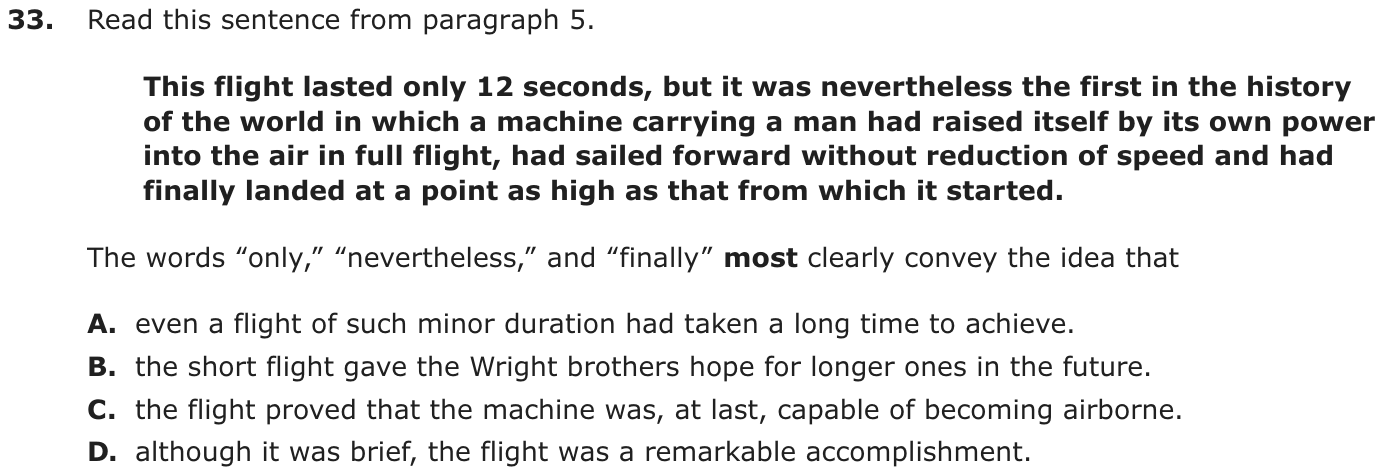
The passage “Excerpt from “How We Made the First Flight”” as printed (pages 13–14)
Question 111 of 120
2023 Test B Math, question 1Question
LAST YEAR’S TOTAL SALES
| Vehicles | Number |
|---|---|
| Four-door cars | 5,850 |
| Two-door cars | 2,250 |
| Trucks | 900 |
| Total | 9,000 |
The table above shows the number of each type of vehicle sold at a dealership last year. If 1,000 vehicles will be sold next month, what is the best estimate (based on last year’s sales) of the number of two-door cars that will be sold?
Grid-in question: work out the answer and enter it as a number.
Show the answer
Correct answer: 250
Let x represent the number of two-door cars that will be sold next month. Use the information in the table to set up a proportion:
Question analysis
A table shows last year's sales at a car dealership: four-door cars, two-door cars and trucks, 9,000 vehicles in all. This grid-in asks for the best estimate of how many two-door cars will be sold next month if 1,000 vehicles are sold. Students set up a proportion from the table; most of its rows are not needed.
- Grade level
- Grade 6 content, by NYS standard
- Compared with grade 7
- Below grade 7 Grade 7 proportion problems often take several steps or awkward numbers. This one scales a single share from a table to a new total, with numbers that divide cleanly, which is closer to grade 6 ratio work.
- Estimated difficulty
- Straightforward: two steps or one careful reading.
- Thinking it demands
- Depth of knowledge 2, skills and concepts · mainly apply
- What makes it hard
- Solution
- 2 steps
- Reading level
- Question and choices: about grade 4, 55 words.
- Students, last 30 days
- Not enough answers yet to show (it takes 10).
Why it is hard, traps and wrong answers (shows the answer)
Why it is hard
Once the share is seen as 2,250 out of 9,000, a quarter, the arithmetic is light, which makes this one of the easier grid-ins. Points are lost by entering the share itself as a percent, by reading the wrong row of the table, or by building a monthly average when the question supplies next month’s total. With no choices to compare, checking that the entry is a quarter of 1,000 is the only safeguard.
Turning words into math minor Understanding the question
The phrase “best estimate (based on last year’s sales)” has to become a proportion: two-door cars keep the same share of next month’s 1,000 vehicles as of last year’s 9,000. (Hegarty, Mayer & Monk, 1995; Koedinger & Nathan, 2004)
Reading a figure, table or graph minor Understanding the question
The table lists three vehicle types and a total; only the two-door row, 2,250, and the 9,000 total are needed, so the four-door and truck rows are distractions. (Lesh, Post & Behr, 1987; Kirsch & Mosenthal, 1990)
Strategy: Find what fraction of last year's 9,000 vehicles were two-door cars, simplify it, then take that fraction of the 1,000 vehicles expected next month.
Traps
- Stops one step early: A choice is a number from partway through the solution.
- Information you don't need: The question gives numbers or facts that play no part in the answer.
The wrong answers, classified
25 Stops one step early (King et al., 2004; Gierl et al., 2017)
Finds that 2,250 of 9,000 sales is 25 percent and enters that percent, stopping before taking a quarter of next month’s 1,000 vehicles.
650 Misreads the figure (Lesh, Post & Behr, 1987; Kirsch & Mosenthal, 1990)
Reads the four-door row instead of the two-door row and scales it correctly: 5,850 of 9,000 is 650 of 1,000.
187.5 Misreads the question (Hegarty, Mayer & Monk, 1995)
Divides last year’s 2,250 two-door sales by 12 months, a monthly average that ignores the stated 1,000 vehicles for next month.
Worked solution, step by step
Formulas used
- Proportion
- A proportion says two fractions are equal. Each fraction here is a part over its whole: two-door cars over all vehicles sold. Use it when a share stays the same while the total changes. Then you can find the missing part.
Sort out the question
The table shows last year’s sales. In all, 9,000 vehicles were sold, and 2,250 of them were two-door cars. Next month, 1,000 vehicles will be sold. You need about how many of them will be two-door cars.
“Based on last year’s sales” means two-door cars keep the same share of all sales. A share is a part out of a whole. The four-door and truck rows don’t matter here.
Find last year’s share of two-door cars
Last year, 2,250 out of 9,000 vehicles were two-door cars. Write that as a fraction and simplify it.
This works because . So 1 out of every 4 vehicles sold was a two-door car.
Set up the proportion and solve
Let x be the number of two-door cars next month. Next month’s share must match last year’s share.
To get x alone, multiply both sides by 1,000.
So about 250 two-door cars will be sold.
Give the answer
Watch out: one fourth is the same as 25%. Gridding 25 gives the percent, not the number of cars. Also be sure to use the two-door row. The four-door row would give 650. So you would grid 250.
Check your answer
Try it another way. Next month’s 1,000 vehicles are of last year’s 9,000. So take of the 2,250 two-door cars: . Both ways give 250 cars.
More questions like this
The original DOE question
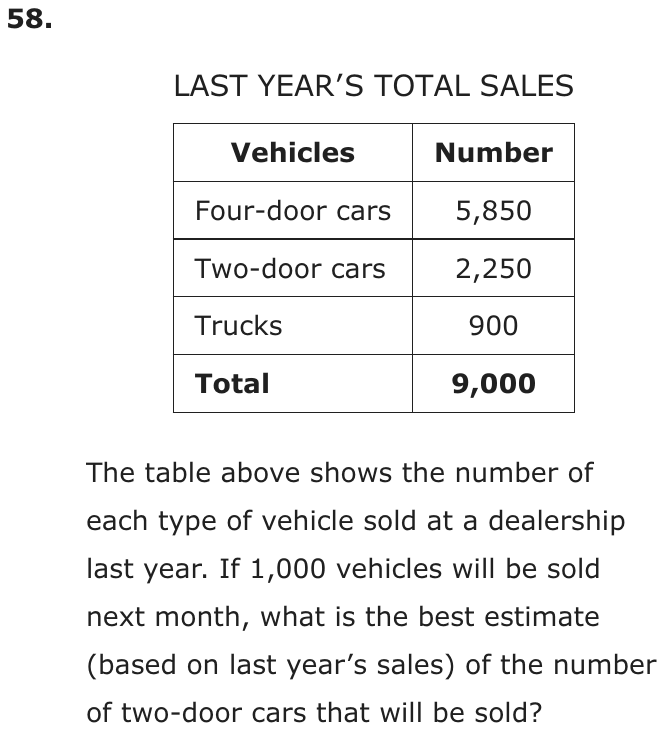
Question 112 of 120
2023 Test B Math, question 2Question
In a scale drawing of a rectangular garden, the length is 15 inches and the width is 9 inches. In the drawing, 2 inches represents 3 yards. What is the width of the actual garden, in yards?
Grid-in question: work out the answer and enter it as a number.
Show the answer
Correct answer: 13.5
Let w represent the width of the actual garden. Set up a proportion based on the information given:
Question analysis
In a scale drawing of a rectangular garden, 2 inches stands for 3 yards, and the drawing measures 15 inches by 9 inches. This grid-in asks for the real width of the garden in yards. Students apply the scale to one side only: the length is given but plays no part, and the scale has to be used the right way round.
- Grade level
- Grade 7 content, by NYS standard
- Compared with grade 7
- At grade 7 Scale drawings are grade 7 content, and this is a typical one: a single length converted with a stated scale. The only extra demand is using the width rather than the length and entering the result with no choices to check.
- Estimated difficulty
- Straightforward: two steps or one careful reading.
- Thinking it demands
- Depth of knowledge 2, skills and concepts · mainly apply
- What makes it hard
- Solution
- 2 steps
- Reading level
- Question and choices: about grade 4, 33 words.
- Students, last 30 days
- Not enough answers yet to show (it takes 10).
Why it is hard, traps and wrong answers (shows the answer)
Why it is hard
The drawing gives two lengths and only the width matters, so the first decision is which number to scale. The second is direction: the real garden must measure more in yards than the drawing’s 9 in inches, which a student can check before entering anything. Errors come from scaling the length, turning the scale over, or treating 2 to 3 as an increase of one.
Turning words into math minor Understanding the question
“2 inches represents 3 yards” must become 1.5 yards for every inch of drawing, so the 9-inch width is multiplied by 3/2, not by 2/3. (Hegarty, Mayer & Monk, 1995; Koedinger & Nathan, 2004)
An answer in an unexpected form minor Choosing the answer
The answer is a decimal entered with no choices to compare, so a result from the 15-inch length or from an upside-down scale looks just as finished. (Enright, Morley & Sheehan, 2002)
Strategy: Find how many yards one inch of the drawing stands for, then multiply the drawing's width, not its length, by that number.
Traps
- Answers a different question: A choice is right for another quantity: the other unknown, the rest instead of the part, the part instead of the whole.
- Wrong operation: Adds instead of multiplying, divides the wrong way round, turns a ratio or rate upside down, or undoes a step in the wrong direction (subtracts what should be added back).
- Information you don't need: The question gives numbers or facts that play no part in the answer.
The wrong answers, classified
22.5 Answers a different question (King et al., 2004; Hegarty, Mayer & Monk, 1995)
Applies the scale to the 15-inch length instead of the 9-inch width: 15 × 3 ÷ 2 = 22.5 yards.
6 Wrong operation (Hegarty, Mayer & Monk, 1995; King et al., 2004)
Turns the scale upside down, multiplying the 9 inches by 2/3 instead of 3/2, so the real garden comes out smaller than the drawing’s number.
10 Misunderstands the concept (Smith, diSessa & Roschelle, 1993; De Bock et al., 1998; Ni & Zhou, 2005)
Reads 2 inches to 3 yards as adding 1, keeping a constant difference instead of a constant ratio, so 9 inches becomes 9 + 1 = 10 yards.
Worked solution, step by step
Formulas used
- Scale proportion
- A scale drawing shrinks everything by the same amount. So real size over drawing size makes the same fraction for every part of the drawing. Keep the real sizes on top on both sides, and the drawing sizes on the bottom.
Sort out the question
The drawing shows a rectangle, a four-sided shape with square corners. On the drawing, the length is 15 inches and the width is 9 inches. The scale says 2 inches on the drawing stand for 3 yards in real life. You need the real width, in yards.
Only the width matters. The 15-inch length is extra.
Find what one inch stands for
If 2 inches stand for 3 yards, then 1 inch stands for half as much.
So each inch on the drawing is 1.5 yards in real life. That means the number of yards will be bigger than the number of inches.
Set up the proportion and solve
Let w be the real width, in yards. Put yards on top and inches on the bottom, on both sides.
To get w alone, multiply both sides by 9.
The real width is 13.5 yards.
Give the answer
Watch out: don’t flip the scale. Using gives 6, which is smaller than the drawing’s number. And don’t use the length: 15 inches would give 22.5 yards. So you would grid 13.5.
Check your answer
Count groups of 2 inches. The 9-inch width holds 4.5 groups of 2 inches. Each group stands for 3 yards, so the real width is yards. That matches.
More questions like this
The original DOE question
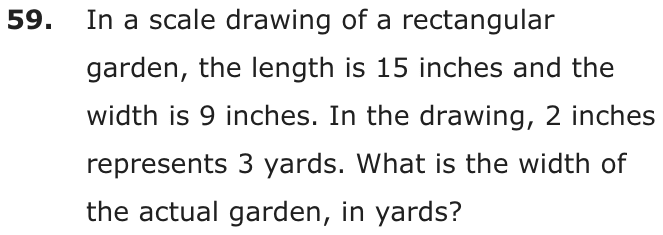
Question 113 of 120
2023 Test B Math, question 3Question
A kindergarten teacher has 72 crayons, 60 pencils, and 84 sheets of paper to distribute to the children in her class. If each child receives an equal number of each item and there are no items remaining, what is the greatest possible number of children in the class?
Grid-in question: work out the answer and enter it as a number.
Show the answer
Correct answer: 12
The greatest possible number of children in the class is the greatest common factor of 72, 60, and 84. Write the prime factorization of each number:
Then, find the factors that all three have in common, which is .
Question analysis
A kindergarten teacher shares 72 crayons, 60 pencils and 84 sheets of paper so that every child gets the same number of each item, with nothing left over. This grid-in asks for the greatest possible number of children in the class. Students must recognize a greatest common factor problem and not confuse it with a least common multiple.
- NYS standards
- 6.NS.4 common factors and multiples
- Grade level
- Grade 6 content, by NYS standard
- Compared with grade 7
- Below grade 7 Greatest common factors are grade 6 content, normally of two numbers. This one uses three numbers and a word setting that must be translated, but the factoring is short, so the demand stays below typical grade 7 work.
- Estimated difficulty
- Straightforward: two steps or one careful reading.
- Thinking it demands
- Depth of knowledge 2, skills and concepts · mainly apply
- What makes it hard
- Turning words into math moderate
- Something you must already know minor
- Solution
- 2 steps
- Reading level
- Question and choices: about grade 11, 45 words.
- Students, last 30 days
- Not enough answers yet to show (it takes 10).
Why it is hard, traps and wrong answers (shows the answer)
Why it is hard
The story has to be recognized as a sharing problem before any arithmetic starts, and the word greatest points to the largest divisor shared by all three counts. Students who spot a small shared factor can stop too soon, while those who think of a common multiple head the wrong way entirely. Checking that 72, 60 and 84 all divide by the entry, and that no larger number does, settles it.
Turning words into math moderate Understanding the question
Nothing names a greatest common factor; “each child receives an equal number of each item and there are no items remaining” means the class size must divide 72, 60 and 84 exactly. (Hegarty, Mayer & Monk, 1995; Koedinger & Nathan, 2004)
Something you must already know minor Working it out
Finding the greatest common factor of three numbers, by prime factorization or by listing factors, is a grade 6 method the question assumes rather than explains. (Anderson & Krathwohl, 2001)
Strategy: Write 72, 60 and 84 as products of primes, multiply the primes all three share, and check that each amount divides evenly by the result.
Traps
- Misunderstands the concept: A wrong belief about a concept: that percents can be added, that area grows like length, that averages can be averaged, that a bigger denominator means a bigger fraction.
- Stops one step early: A choice is a number from partway through the solution.
The wrong answers, classified
6 Stops one step early (King et al., 2004; Gierl et al., 2017)
Spots that 6 divides 72, 60 and 84 and stops there, a common factor not yet multiplied by the extra 2 that all three share.
2520 Misunderstands the concept (Smith, diSessa & Roschelle, 1993; De Bock et al., 1998; Ni & Zhou, 2005)
Finds the least common multiple of 72, 60 and 84, 2,520, confusing a number all three counts divide into with one that divides all three.
4 Stops one step early (King et al., 2004; Gierl et al., 2017)
Takes only the shared 2 × 2 from the prime factorizations and drops the factor 3 that 72, 60 and 84 also share.
Worked solution, step by step
Formulas used
- Greatest common factor
- A factor of a number divides it with nothing left over. The GCF is the greatest number that is a factor of every number in the group. A prime number has only 1 and itself as factors, like 2, 3, 5 and 7. Multiply the primes that all the numbers share, as many times as each number has them.
Sort out the question
The teacher has 72 crayons, 60 pencils and 84 sheets of paper. Every child gets the same number of each item, with none left over.
So the number of children must divide 72, 60 and 84 with no remainder. A number like that is a common factor. You need the greatest one.
Break each number into primes
Write each number as a product of primes. A product is the answer to a multiplication.
You can check each one by multiplying it back out.
Pick out the shared primes
Look for the primes that appear in all three lists. Each list has at least two 2s and one 3. Only 72 has a third 2 and a second 3. The 5 and the 7 appear in one list each.
Watch out: keep every shared prime. Using only one 2 gives 6. Leaving out the 3 gives 4.
Give the answer
Watch out: 2,520 is the smallest number that all three numbers divide into. That is the least common multiple, a different idea. The class can’t have 2,520 children when there are only 60 pencils. So you would grid 12.
Check your answer
Share the items among 12 children. Each child gets crayons, pencils and sheets. Nothing is left over. The numbers 6, 5 and 7 share no factor but 1, so no bigger class works.
More questions like this
The original DOE question
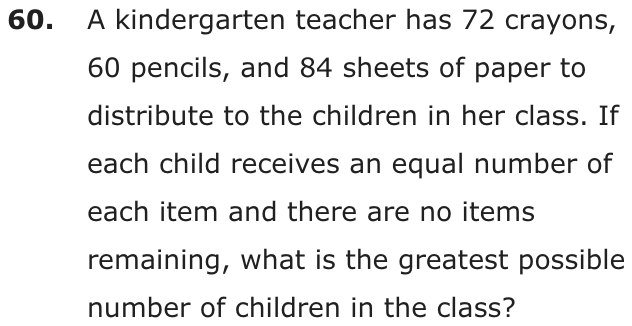
Question 114 of 120
2023 Test B Math, question 4Question
Mr. Smith opened a retirement account with a deposit of $900. This account earns 5% simple interest annually. How many years will it take for his $900 deposit to earn $360 interest?
Grid-in question: work out the answer and enter it as a number.
Show the answer
Correct answer: 8
Calculate simple interest (y) by multiplying the initial deposit (p) by the interest rate (r) by the number of years (t):
Question analysis
Mr. Smith deposits $900 in a retirement account that earns 5% simple interest each year. This grid-in asks how many years it takes for the deposit to earn $360 in interest. Students find one year's interest and then how many years add up to the total, and the percent must become the right decimal.
- Grade level
- Grade 7 content, by NYS standard
- Compared with grade 7
- At grade 7 Simple interest is grade 7 percent work, and a typical problem asks for the interest earned over a given time. This one runs the formula backward to find the time, one extra step, with friendly numbers.
- Estimated difficulty
- Straightforward: two steps or one careful reading.
- Thinking it demands
- Depth of knowledge 2, skills and concepts · mainly apply
- What makes it hard
- Solution
- 2 steps
- Reading level
- Question and choices: about grade 7, 28 words.
- Students, last 30 days
- Not enough answers yet to show (it takes 10).
Why it is hard, traps and wrong answers (shows the answer)
Why it is hard
The numbers are friendly once one year’s interest is found, so most of the difficulty is setting up the right relationship. Students who divide $360 by 5 treat the rate as a dollar amount, and students who compare $360 with $900 stop at a percent. Multiplying back, eight years of $45, confirms the $360.
Something you must already know minor Working it out
Simple interest is the deposit times the rate times the years; the stem does not give this rule, and it must be known to see that each year adds the same $45. (Anderson & Krathwohl, 2001)
Turning words into math minor Understanding the question
The question gives the total interest, $360, and asks for the time, so the usual interest calculation has to be run backward, as 45t = 360. (Hegarty, Mayer & Monk, 1995; Koedinger & Nathan, 2004)
Error-prone arithmetic minor Working it out
Writing 5% as 0.05, not 0.5 or 0.005, is the one place-value decision, and a slip there changes the yearly interest by a power of ten. (Brown & Burton, 1978; Junker & Sijtsma, 2001)
Strategy: Work out the interest for one year, 5 percent of $900, then divide the $360 target by that yearly amount.
Traps
- Stops one step early: A choice is a number from partway through the solution.
- Misunderstands the concept: A wrong belief about a concept: that percents can be added, that area grows like length, that averages can be averaged, that a bigger denominator means a bigger fraction.
- An arithmetic slip: The right method with a plausible arithmetic error: a digit, a place value or a times-table fact.
The wrong answers, classified
40 Stops one step early (King et al., 2004; Gierl et al., 2017)
Finds that $360 is 40 percent of the $900 deposit and enters 40, stopping before dividing by the 5 percent earned each year.
72 Misunderstands the concept (Smith, diSessa & Roschelle, 1993; De Bock et al., 1998; Ni & Zhou, 2005)
Reads 5% as $5 a year, a fixed amount instead of a share of the $900, and divides 360 by 5.
80 An arithmetic slip (Junker & Sijtsma, 2001)
Writes 5% as 0.005, so a year’s interest seems to be $4.50, and 360 ÷ 4.5 = 80 years.
Worked solution, step by step
Formulas used
- Simple interest
- I is the interest, the money the account earns. P is the deposit you start with. r is the yearly rate, written as a decimal. t is the number of years. With simple interest, every year earns the same amount, because it is always based on the first deposit.
Sort out the question
Mr. Smith puts $900 into an account. It earns 5% simple interest each year. Interest is extra money the bank pays you for keeping your money there. You need the number of years until the interest adds up to $360.
Write 5% as a decimal
Percent means “out of 100.” So 5% is 5 out of 100.
Watch out: 5% is not 0.5 or 0.005. Using 0.005 makes a year’s interest $4.50, and that leads to 80 years.
Find the interest for one year
Each year the account earns 5% of $900.
So it earns $45 every year. Watch out: 5% is not $5 a year. Dividing 360 by 5 gives 72, which is wrong.
Use the formula to find the years
Put the numbers into the formula. I is 360, P is 900 and r is 0.05.
To undo “times 45,” divide both sides by 45.
Give the answer
It takes 8 years. Watch out: $360 is 40% of $900. Gridding 40 stops too soon, because each year adds only 5%. So you would grid 8.
Check your answer
Add up the interest year by year. $45 a year for 8 years is dollars. Also, 8 years at 5% a year is 40%, and 40% of $900 is $360.
More questions like this
The original DOE question
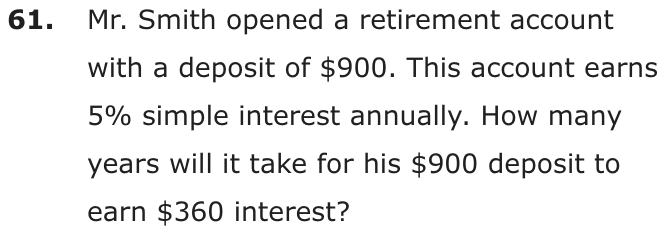
Question 115 of 120
2023 Test B Math, question 5Question
Solve the equation for x:
Grid-in question: work out the answer and enter it as a number.
Show the answer
Correct answer: 7
Question analysis
This equation puts x in a fraction with (21)(14) on top and (49)(48) below, set equal to the decimal 0.875. The grid-in asks for the value of x. Students do best to cancel common factors before multiplying anything out, and it helps to know the fraction that 0.875 equals.
- NYS standards
- Grade level
- Grade 7 content, by NYS standard
- Compared with grade 7
- At grade 7 Seventh graders solve equations like ax = b, usually with a simple coefficient. Here the coefficient is a product of four numbers that is best cancelled first, and a decimal has to be matched with a fraction.
- Estimated difficulty
- Moderate: several steps, or a close reading with one strong distractor.
- Thinking it demands
- Depth of knowledge 1, recall and reproduction · mainly apply
- What makes it hard
- Error-prone arithmetic moderate
- No obvious method minor
- An answer in an unexpected form minor
- Solution
- 3 steps
- Reading level
- Question and choices: about grade 5, 6 words.
- Students, last 30 days
- Not enough answers yet to show (it takes 10).
Why it is hard, traps and wrong answers (shows the answer)
Why it is hard
This is a one-unknown equation dressed in large numbers, and the work is in reducing them without slipping. Students who cancel early find that the whole coefficient is one eighth and that 0.875 is seven eighths, which makes the last step mental. Those who multiply out face a four-digit product and a decimal division, and with nothing to check against, an early slip goes unnoticed.
Error-prone arithmetic moderate Working it out
Multiplied out, the coefficient is 294 over 2,352 and the right side is the decimal 0.875; both invite slips unless 21/49 and 14/48 are cancelled first. (Brown & Burton, 1978; Junker & Sijtsma, 2001)
No obvious method minor Working it out
The quick route pairs 21 with 49 and 14 with 48 before multiplying, so that 3/7 × 7/24 collapses to 1/8; the layout of the fraction does not suggest that pairing. (Schoenfeld, 1985)
An answer in an unexpected form minor Choosing the answer
The result is entered with no choices, so a coefficient’s denominator or a quotient taken the wrong way looks as complete as the right value. (Enright, Morley & Sheehan, 2002)
Strategy: Cancel before multiplying: reduce 21 over 49 and 14 over 48, multiply the simplified fractions, then undo that coefficient, writing 0.875 as a fraction if it helps.
Traps
- Stops one step early: A choice is a number from partway through the solution.
- Wrong operation: Adds instead of multiplying, divides the wrong way round, turns a ratio or rate upside down, or undoes a step in the wrong direction (subtracts what should be added back).
- An arithmetic slip: The right method with a plausible arithmetic error: a digit, a place value or a times-table fact.
The wrong answers, classified
8 Stops one step early (King et al., 2004; Gierl et al., 2017)
Simplifies the coefficient correctly to 1/8 but enters the 8 from its denominator, never multiplying it by 0.875.
0.109375 Wrong operation (Hegarty, Mayer & Monk, 1995; King et al., 2004)
Divides 0.875 by 8 instead of multiplying, undoing the coefficient 1/8 the wrong way, so x comes out as 0.109375.
3.5 An arithmetic slip (Junker & Sijtsma, 2001)
Slips in reducing 14/48, taking it as 7/12 instead of 7/24, so the coefficient becomes 1/4 and x = 0.875 × 4 = 3.5.
Worked solution, step by step
Formulas used
- Multiplying fractions
- a and c are the tops, or numerators. b and d are the bottoms, or denominators. Multiply the tops together and the bottoms together. It also works backward: you can split one fraction into two smaller ones. That lets you simplify before the numbers get big.
Sort out the question
You need the value of x. On top, 21, 14 and x are multiplied. The bottom is 49 times 48. The right side is 0.875.
Multiplying 49 by 48 makes a big number. It is easier to simplify first.
Split the fraction into two
Use the rule for multiplying fractions backward. Pair 21 with 49, and 14 with 48.
Now the equation says these two fractions times x equal 0.875.
Simplify each fraction
To simplify, divide the top and bottom by the same number. Both 21 and 49 divide by 7. Both 14 and 48 divide by 2.
Watch out: 48 ÷ 2 is 24, not 12. Writing leads to 3.5.
Multiply the simple fractions
The 7 on top and the 7 on the bottom cancel, since 7 ÷ 7 = 1. Then divide 3 and 24 by 3 to get . So the equation becomes:
Solve for x
One eighth of x is 0.875. To undo dividing by 8, multiply both sides by 8.
Watch out: 8 is not the answer, and don’t divide 0.875 by 8. So you would grid 7.
Check your answer
0.875 is the same as . One eighth of 7 is , so x = 7 works. You can also multiply it all out: and . Then .
More questions like this
The original DOE question
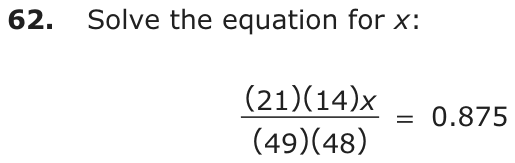
Question 116 of 120
2023 Test B Math, question 7Question
On Fran’s map, 2 centimeters represents 3 kilometers. The points on this map that represent Fran’s home and Bryant State Park are 4.5 centimeters apart. How many kilometers apart are Fran’s home and Bryant State Park, to the nearest kilometer?
- A3
- B5
- C7
- D9
Show the answer
Correct answer: C
Let x represent the distance, in kilometers, between Fran’s house and Bryant State Park. Set up a proportion to solve for x:
| Cross multiply. | |
| Apply the multiplicative inverse property; divide both sides of the equation by 2. | |
Question analysis
On Fran's map, 2 centimeters represent 3 kilometers, and her home and Bryant State Park are 4.5 centimeters apart on the map. Students find the real distance to the nearest kilometer. It is a map-scale proportion problem: the scale must be applied in the right direction, and the result rounded.
- Grade level
- Grade 7 content, by NYS standard
- Compared with grade 7
- At grade 7 Map scales are standard grade 7 proportional reasoning, and this problem is typical: one distance, one scale, then rounding. Nothing beyond a single proportion is needed.
- Estimated difficulty
- Straightforward: two steps or one careful reading.
- Thinking it demands
- Depth of knowledge 2, skills and concepts · mainly apply
- What makes it hard
- Turning words into math minor
- Error-prone arithmetic minor
- Solution
- 3 steps
- Reading level
- Question and choices: about grade 8, 37 words.
- Students, last 30 days
- Not enough answers yet to show (it takes 10).
Why it is hard, traps and wrong answers (shows the answer)
Why it is hard
This is a one-proportion map question, and the only judgments are the direction of the scale and when to round. The phrase to the nearest kilometer tempts some students to round the scale itself before multiplying, which lands on a listed answer two kilometers too far. Rounding only the final 6.75 keeps the result right.
Turning words into math minor Understanding the question
“2 centimeters represents 3 kilometers” gives 1.5 kilometers per centimeter; set up the other way round, the scale shrinks the 4.5 centimeters instead of enlarging them. (Hegarty, Mayer & Monk, 1995; Koedinger & Nathan, 2004)
Error-prone arithmetic minor Working it out
The map distance is a decimal, 4.5 × 3 ÷ 2 = 6.75, and the result must then be rounded to the nearest kilometer, two places where a quick estimate drifts. (Brown & Burton, 1978; Junker & Sijtsma, 2001)
Strategy: Work out how many kilometers 1 centimeter on the map stands for, multiply by 4.5, and round only at the very end.
Traps
- Wrong operation: Adds instead of multiplying, divides the wrong way round, turns a ratio or rate upside down, or undoes a step in the wrong direction (subtracts what should be added back).
- Rounds too early: Rounds a value partway through, or rounds the wrong way, so the final answer drifts from the exact one.
- Units or scale: The answer is wanted in other units, or a rate or scale must be converted first.
The wrong answers, classified
A Wrong operation (Hegarty, Mayer & Monk, 1995; King et al., 2004)
Turns the scale upside down, multiplying 4.5 by 2/3 instead of 3/2, so the real distance comes out smaller than the map distance.
B Units or scale (King et al., 2004)
Takes the 4.5 centimeters on the map as kilometers and rounds to 5, never applying the scale that turns each centimeter into 1.5 kilometers.
D Rounds too early (King et al., 2004)
Rounds the scale of 1.5 kilometers per centimeter up to 2 before multiplying, so 4.5 × 2 = 9 instead of 6.75.
Worked solution, step by step
Formulas used
- Scale proportion
- A map shrinks every distance by the same amount. So real distance over map distance makes the same fraction everywhere on the map. Put kilometers on top on both sides and centimeters on the bottom. Then solve for the missing number.
Sort out the question
On Fran’s map, 2 centimeters stand for 3 kilometers in real life. Her home and the park are 4.5 centimeters apart on the map. You need the real distance in kilometers, rounded to the nearest whole kilometer.
Set up the proportion
Let x be the real distance, in kilometers. Put kilometers on top and centimeters on the bottom, on both sides.
Solve for x
To get x alone, multiply both sides by 4.5.
So the real distance is 6.75 kilometers. Watch out: keep the scale exact until the end. Rounding 1.5 kilometers per centimeter up to 2 gives , choice D.
Round to the nearest kilometer
6.75 is between 6 and 7. Its decimal part, 0.75, is more than 0.5, so round up to 7.
Watch out: don’t flip the scale. Multiplying 4.5 by gives 3, choice A. So the answer is C, 7.
Check your answer
Each centimeter stands for kilometers. So 4 centimeters is 6 kilometers, and half a centimeter is 0.75 kilometer. That adds to 6.75, which rounds to 7. The real number should be bigger than 4.5, and it is.
More questions like this
The original DOE question
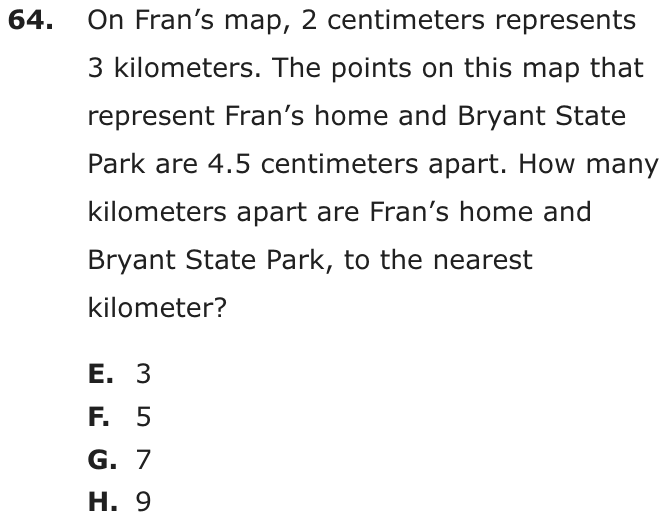
Question 117 of 120
2023 Test B Math, question 8Question
Solve for x in terms of y if .
- A
- B
- C
- D
Show the answer
Correct answer: A
| Apply the additive inverse property; subtract 4 from both sides of the equation. | |
| Apply the multiplicative inverse property; divide both sides of the equation by 2. | |
Question analysis
Given the equation 2x + 4 = y, students solve for x in terms of y. This literal-equation question offers four choices that mix multiplying and dividing by 2 with adding and subtracting 4. Undoing the two operations on x in the right order, with the right inverse each time, is what it tests.
- Grade level
- Grade 8 content, by NYS standard
- Compared with grade 7
- At grade 7 Grade 7 students solve two-step equations such as 2x + 4 = 10. Here the right side is the letter y, so the same two inverse steps leave an expression, a first taste of the grade 8 skill of rearranging.
- Estimated difficulty
- Straightforward: two steps or one careful reading.
- Thinking it demands
- Depth of knowledge 1, recall and reproduction · mainly apply
- What makes it hard
- A very close wrong answer moderate
- Variables instead of numbers minor
- Solution
- 2 steps
- Reading level
- Question and choices: about grade 6, 13 words.
- Students, last 30 days
- Not enough answers yet to show (it takes 10).
Why it is hard, traps and wrong answers (shows the answer)
Why it is hard
The two inverse steps are routine, subtract 4 and then divide by 2, but the letters hide whether they were done correctly. The main hazard is moving the 4 across the equals sign while keeping its plus sign, which produces an expression nearly identical to the right one. Substituting x = 1 and y = 6 tests every choice in seconds.
A very close wrong answer moderate Choosing the answer
(y − 4)/2 and (y + 4)/2 differ only in the sign before 4, and that sign depends on undoing the +4 by subtracting it from both sides. (Embretson & Wetzel, 1987; Gorin & Embretson, 2006; Ascalon et al., 2007)
Variables instead of numbers minor Understanding the question
With y on the right instead of a number, the answer is an expression, so there is no value to check unless the student substitutes a pair such as x = 1 and y = 6. (Koedinger & Nathan, 2004; Enright, Morley & Sheehan, 2002)
Strategy: Treat y as if it were a number and undo the operations on x in reverse order, using the inverse of each, then check by substituting a value.
Traps
- A faulty procedure: A systematic but wrong procedure: adding fractions straight across, applying an exponent to each term of a sum, dropping a sign when moving a term.
- Wrong operation: Adds instead of multiplying, divides the wrong way round, turns a ratio or rate upside down, or undoes a step in the wrong direction (subtracts what should be added back).
The wrong answers, classified
B Wrong operation (Hegarty, Mayer & Monk, 1995; King et al., 2004)
Multiplies by 2 instead of dividing and adds 4 instead of subtracting, applying the operations on x again rather than undoing them.
C A faulty procedure (Brown & Burton, 1978; Tatsuoka, 1983)
Moves the 4 across the equals sign without changing its sign, getting 2x = y + 4, then divides by 2 correctly.
D Little reason to choose it (Haladyna & Downing, 1993; Rodriguez, 2005)
Needs two unrelated errors at once, the subtraction written backward as 4 − y and a multiplication by 2 in place of division, so it mostly draws guesses.
Worked solution, step by step
Formulas used
- Keeping an equation balanced
- a and b are the two sides of an equation, and c is any number (not 0 when you divide). An equation is like a balanced scale. Doing the same thing to both sides keeps it balanced. Use this to undo, one at a time, each step that was done to x.
Sort out the question
The equation is . “Solve for x in terms of y” means get x alone on one side. The other side will have y in it. Treat y as if it were a number.
Undo the adding of 4
Right now, x is doubled and then 4 is added. Undo those steps in reverse order. First, subtract 4 from both sides.
Watch out: the 4 must be subtracted from y. Writing leads to choice C.
Undo the doubling
Next, divide both sides by 2. Divide the whole right side, not only the y.
Give the answer
Watch out: choices B and D multiply by 2. But x was multiplied by 2, so you undo that by dividing. So the answer is A, .
Check your answer
Pick a value, such as x = 1. Then . Put y = 6 into choice A: . That gives back x = 1. Choice C would give , which is wrong.
More questions like this
The original DOE question
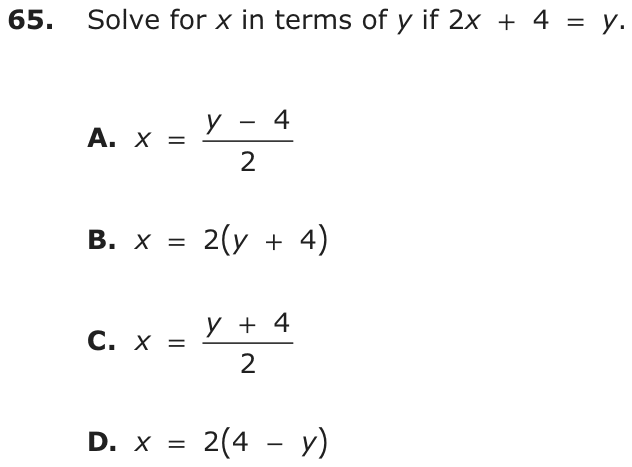
Question 118 of 120
2023 Test B Math, question 9Question
Bryan completed a 100-meter race in 11.74 seconds. Luis completed the same race in 11.69 seconds. What was the difference between their times, expressed as a fraction of a second?
- A
- B
- C
- D
Show the answer
Correct answer: A
First, subtract Luis’s time from Bryan’s time: .
Then, convert to a fraction:
.
Question analysis
Bryan ran a 100-meter race in 11.74 seconds and Luis ran the same race in 11.69 seconds. Students find the difference between their times and express it as a fraction of a second. It tests subtracting decimals and rewriting a decimal as a fraction in lowest terms.
- NYS standards
- 6.NS.3 multi-digit decimal operations
- Grade level
- Grade 6 content, by NYS standard
- Compared with grade 7
- Below grade 7 Subtracting decimals and writing a decimal as a fraction are skills from before grade 7. The two times are close, so the subtraction is quick, and the only care needed is with place value and simplifying.
- Estimated difficulty
- Routine: one familiar step, little to misread.
- Thinking it demands
- Depth of knowledge 2, skills and concepts · mainly apply
- What makes it hard
- Solution
- 2 steps
- Reading level
- Question and choices: about grade 5, 32 words.
- Students, last 30 days
- Not enough answers yet to show (it takes 10).
Why it is hard, traps and wrong answers (shows the answer)
Why it is hard
Two quick skills settle this question: lining up the decimals to subtract, and naming the result as a fraction in lowest terms. The two times differ only in their last two digits, so the subtraction is short, but it needs a borrow that some students skip. The fraction step is where a decimal’s digit gets mistaken for a denominator.
Error-prone arithmetic minor Working it out
Subtracting 11.69 from 11.74 needs a borrow in the hundredths, 14 − 9, after which the tenths cancel to 0, the step where place value goes wrong. (Brown & Burton, 1978; Junker & Sijtsma, 2001)
Something you must already know minor Working it out
The difference, 0.05, must be read as five hundredths and reduced as a fraction; the question gives no help with converting a decimal. (Anderson & Krathwohl, 2001)
Strategy: Line up the decimal points, subtract, write the difference as a number of hundredths over 100, and reduce the fraction.
Traps
- A faulty procedure: A systematic but wrong procedure: adding fractions straight across, applying an exponent to each term of a sum, dropping a sign when moving a term.
- Misunderstands the concept: A wrong belief about a concept: that percents can be added, that area grows like length, that averages can be averaged, that a bigger denominator means a bigger fraction.
The wrong answers, classified
B An arithmetic slip (Junker & Sijtsma, 2001)
Looks only at the tenths, 11.7 − 11.6 = 0.1, dropping the hundredths, a place-value slip that doubles the true gap.
C A faulty procedure (Brown & Burton, 1978; Tatsuoka, 1983)
Subtracts the smaller digit from the larger in each place, 9 − 4 = 5 and 7 − 6 = 1, getting 0.15, which is 3/20.
D Misunderstands the concept (Smith, diSessa & Roschelle, 1993; De Bock et al., 1998; Ni & Zhou, 2005)
Gets 0.05 but reads its digit 5 as a denominator, writing 1/5, instead of five hundredths, 5/100.
Worked solution, step by step
Formulas used
- Decimals as hundredths
- The second place after the decimal point is the hundredths place. So a decimal with two places counts hundredths, and you can write its digits over 100. For example, 0.37 is 37/100. Then simplify by dividing the top and bottom by the same number.
Sort out the question
Bryan ran the race in 11.74 seconds. Luis ran it in 11.69 seconds. The difference is how much longer one time is than the other. You need it as a fraction of a second.
Subtract the two times
Subtract the smaller time from the larger one. Line up the decimal points.
In the hundredths place, 4 is less than 9. So regroup: trade 1 tenth for 10 hundredths. Then 14 − 9 = 5 hundredths. The tenths are now 6 − 6 = 0.
Watch out: don’t just take the smaller digit from the larger one in each place. That gives 0.15, which is , choice C.
Write the difference as a fraction
The 5 is in the hundredths place, so 0.05 is 5 hundredths.
Now simplify. Divide the top and bottom by 5.
Give the answer
Watch out: 0.05 is not . One fifth is 0.2, which is four times as big. So the answer is A, .
Check your answer
Turn back into a decimal: . Then add it to Luis’s time: . That is Bryan’s time, so the difference is right.
More questions like this
The original DOE question
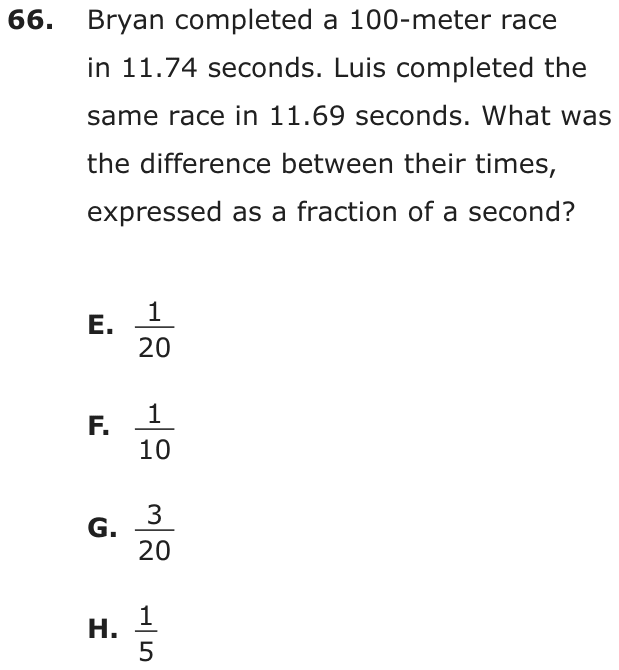
Question 119 of 120
2023 Test B Math, question 11Question
What is the value of n expressed as a fraction?
- A
- B
- C
- D
Show the answer
Correct answer: B
Question analysis
The number n equals 0.13 plus 207/100, and students must write n as a single fraction. This question mixes a decimal with a fraction in hundredths. Converting both to the same form, adding, and reducing to lowest terms are the steps, and the four fractions offered look quite different at first glance.
- NYS standards
- 6.NS.3 multi-digit decimal operations
- Grade level
- Grade 6 content, by NYS standard
- Compared with grade 7
- Below grade 7 Converting decimals to fractions and simplifying are skills taught before grade 7. Both numbers here are in hundredths, so the addition is immediate and only the final reduction takes thought.
- Estimated difficulty
- Routine: one familiar step, little to misread.
- Thinking it demands
- Depth of knowledge 1, recall and reproduction · mainly apply
- What makes it hard
- Solution
- 2 steps
- Reading level
- Question and choices: about grade 7, 15 words.
- Students, last 30 days
- Not enough answers yet to show (it takes 10).
Why it is hard, traps and wrong answers (shows the answer)
Why it is hard
Converting 0.13 to hundredths makes this a single addition, 13 + 207 = 220 hundredths, so the question tests little beyond reducing a fraction. Two of the wrong choices sit close to 2.2 but come from no common working, and the third only echoes the digits of 0.13. A student who checks each choice as a decimal finds only one equal to 2.2.
An answer in an unexpected form minor Choosing the answer
The sum comes out as 220/100 or 2.2, but the choices are in lowest terms, so it must be reduced, or each choice converted, before anything matches. (Enright, Morley & Sheehan, 2002)
Error-prone arithmetic minor Working it out
One term is a decimal and the other a fraction; writing 0.13 as 13/100 puts both in hundredths, and a misplaced digit there changes the sum. (Brown & Burton, 1978; Junker & Sijtsma, 2001)
Strategy: Write 0.13 as 13/100 so both terms are in hundredths, add the numerators, then divide the top and bottom by their greatest common factor.
Traps
- Answer in another form: The right answer is written differently from the way you worked it out.
- Numbers taken from the question: Combines the numbers in the question without a model of the situation, or is simply a number that appears in the question.
The wrong answers, classified
A Numbers taken from the question (Hegarty, Mayer & Monk, 1995)
Echoes the digits of 0.13, reading it as the fraction 1/3, and ignores the 207/100 altogether.
C Little reason to choose it (Haladyna & Downing, 1993; Rodriguez, 2005)
No common working gives 9/4, which is 2.25; adding 13 and 207 hundredths gives 2.2, so this mostly draws guesses near the sum.
D Little reason to choose it (Haladyna & Downing, 1993; Rodriguez, 2005)
Nothing leads to 23/10 except 13 + 207 coming out as 230, a slip with no reason behind it, so it mostly catches guesses.
Worked solution, step by step
Formulas used
- Decimals as hundredths
- The second place after the decimal point is the hundredths place. So a decimal with two places counts hundredths. Write its digits over 100. For example, 0.47 is 47/100.
- Adding fractions with the same bottom
- a and b are the tops. c is the shared bottom, the denominator. When the bottoms match, the pieces are the same size. So add the tops and keep the bottom.
Sort out the question
n equals 0.13 plus . One part is a decimal and one is a fraction. You need n as a fraction. The choices are in lowest terms, which means they can’t be simplified any more.
Write the decimal as a fraction
The 3 in 0.13 is in the hundredths place. So 0.13 is 13 hundredths.
Now both numbers are in hundredths. Watch out: 0.13 is not . That only copies the digits, choice A.
Add the hundredths
Use the rule for adding fractions. The bottoms match, so add the tops and keep the 100 on the bottom.
Simplify the fraction
is not a choice, so simplify it. Find the greatest number that divides both 220 and 100. That is 20.
So the answer is B, .
Check your answer
Change both to decimals. . And . They match. Choices C and D are close, but and .
More questions like this
The original DOE question
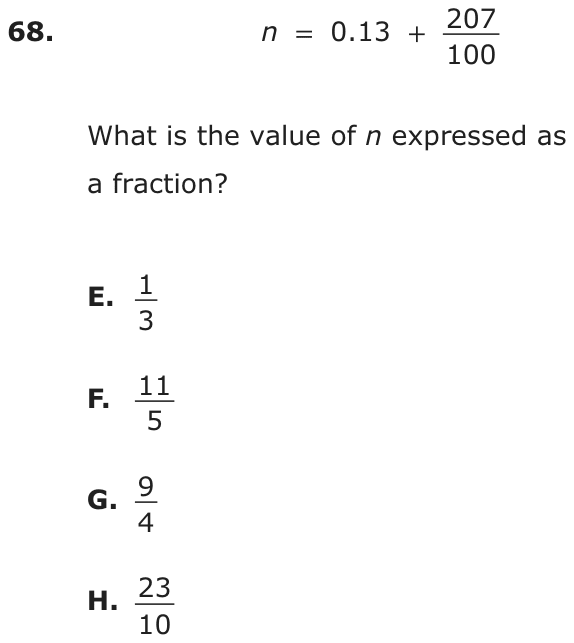
Question 120 of 120
2023 Test B Math, question 12Question
The perimeter of a 12-sided polygon is 100 centimeters. The length of one side is 25 centimeters. The length of another side is 35 centimeters. The remaining sides are equal in length to one another. What is the length of each of the remaining sides, in centimeters?
- A4
- B5
- C20
- D40
Show the answer
Correct answer: A
Let x represent the length of one of the 10 remaining sides:
Question analysis
A 12-sided polygon has a perimeter of 100 centimeters: one side is 25 cm long, another is 35 cm, and the rest are all equal to one another. Students find the length of each remaining side. This perimeter problem turns into a two-step equation, and the tricky part is counting the sides that are left.
- NYS standards
- 7.EE.4a two-step equations
- Grade level
- Grade 7 content, by NYS standard
- Compared with grade 7
- At grade 7 Writing and solving a two-step equation from a short description is standard grade 7 work. The perimeter setting is simple; the only extra care is counting the sides that remain after the two given ones.
- Estimated difficulty
- Straightforward: two steps or one careful reading.
- Thinking it demands
- Depth of knowledge 2, skills and concepts · mainly apply
- What makes it hard
- Turning words into math minor
- Many steps minor
- Solution
- 3 steps
- Reading level
- Question and choices: about grade 7, 44 words.
- Students, last 30 days
- Not enough answers yet to show (it takes 10).
Why it is hard, traps and wrong answers (shows the answer)
Why it is hard
The perimeter and the two named sides make the subtraction obvious, so the real decision comes after it: what to divide the leftover 40 centimeters by. Students who stop at the leftover length, or who lose track of how many sides remain, reach a listed choice. Writing 25 + 35 + 10x = 100 keeps the count of 10 in view.
Turning words into math minor Understanding the question
“The remaining sides are equal in length to one another” hides the count: 12 sides minus the two given ones leaves 10 equal sides to share the rest of the perimeter. (Hegarty, Mayer & Monk, 1995; Koedinger & Nathan, 2004)
Many steps minor Working it out
Subtracting 25 and 35 from 100, counting the sides left, and dividing are three steps, and the first result, 40, is itself a listed choice. (Daniel & Embretson, 2010; Enright, Morley & Sheehan, 2002)
Strategy: Subtract the two known sides from the perimeter, count how many sides are left, and share the remaining length equally among them.
Traps
- Stops one step early: A choice is a number from partway through the solution.
- Misreads the question: Misses or misreads a condition or a word in the question: "at least", "each", "remaining", "not".
The wrong answers, classified
B Little reason to choose it (Haladyna & Downing, 1993; Rodriguez, 2005)
No common working gives 5; sharing the 40 centimeters among 8 sides would, but nothing in the question suggests 8, so it mostly draws guesses.
C Misreads the question (Hegarty, Mayer & Monk, 1995)
Shares the leftover 40 centimeters between two sides, as if the figure were four-sided, overlooking that it has 12 sides.
D Stops one step early (King et al., 2004; Gierl et al., 2017)
Finds the total of the remaining sides, 100 − 25 − 35 = 40, and stops before sharing it among the 10 equal sides.
Worked solution, step by step
Formulas used
- Perimeter of a polygon
- P is the perimeter, the total distance around a shape. A polygon is a flat shape with straight sides. A sum is the answer to an addition. So add the lengths of every side to get P.
Sort out the question
The shape is a polygon with 12 sides. Its perimeter is 100 centimeters. One side is 25 centimeters, and another is 35 centimeters. The other sides all have the same length. You need that length.
Count the equal sides
Two of the 12 sides are already known. The rest are the equal sides.
So there are 10 equal sides. Call the length of each one x.
Write an equation for the perimeter
Use the perimeter formula. All 12 sides add up to 100. Ten sides of length x add up to 10x, which means 10 times x.
Solve for x
The 10 equal sides add up to 40 centimeters. Watch out: 40 is all ten sides together, not one side. Stopping here gives choice D. Now share the 40 among the 10 sides.
Give the answer
Each remaining side is 4 centimeters long. Watch out: sharing the 40 centimeters between only 2 sides gives 20, choice C. That treats the shape as if it had 4 sides, but it has 12. So the answer is A, 4.
Check your answer
Add all 12 sides: . That is the perimeter the question gives, so 4 centimeters is right.
More questions like this
The original DOE question