Passage Ode to Fireworks
Ode to Fireworks
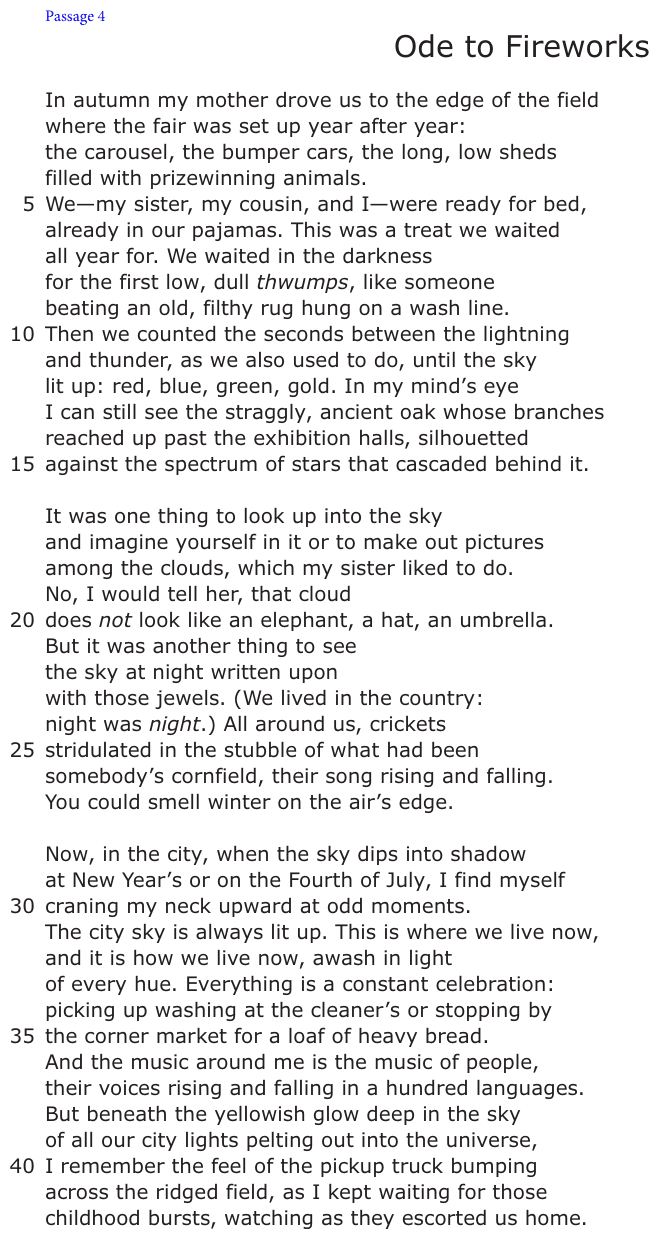
In autumn my mother drove us to the edge of the field
where the fair was set up year after year:
the carousel, the bumper cars, the long, low sheds
filled with prizewinning animals.
We—my sister, my cousin, and I—were ready for bed,
already in our pajamas. This was a treat we waited
all year for. We waited in the darkness
for the first low, dull thwumps, like someone
beating an old, filthy rug hung on a wash line.
Then we counted the seconds between the lightning
and thunder, as we also used to do, until the sky
lit up: red, blue, green, gold. In my mind’s eye
I can still see the straggly, ancient oak whose branches
reached up past the exhibition halls, silhouetted
against the spectrum of stars that cascaded behind it.
It was one thing to look up into the sky
and imagine yourself in it or to make out pictures
among the clouds, which my sister liked to do.
No, I would tell her, that cloud
does not look like an elephant, a hat, an umbrella.
But it was another thing to see
the sky at night written upon
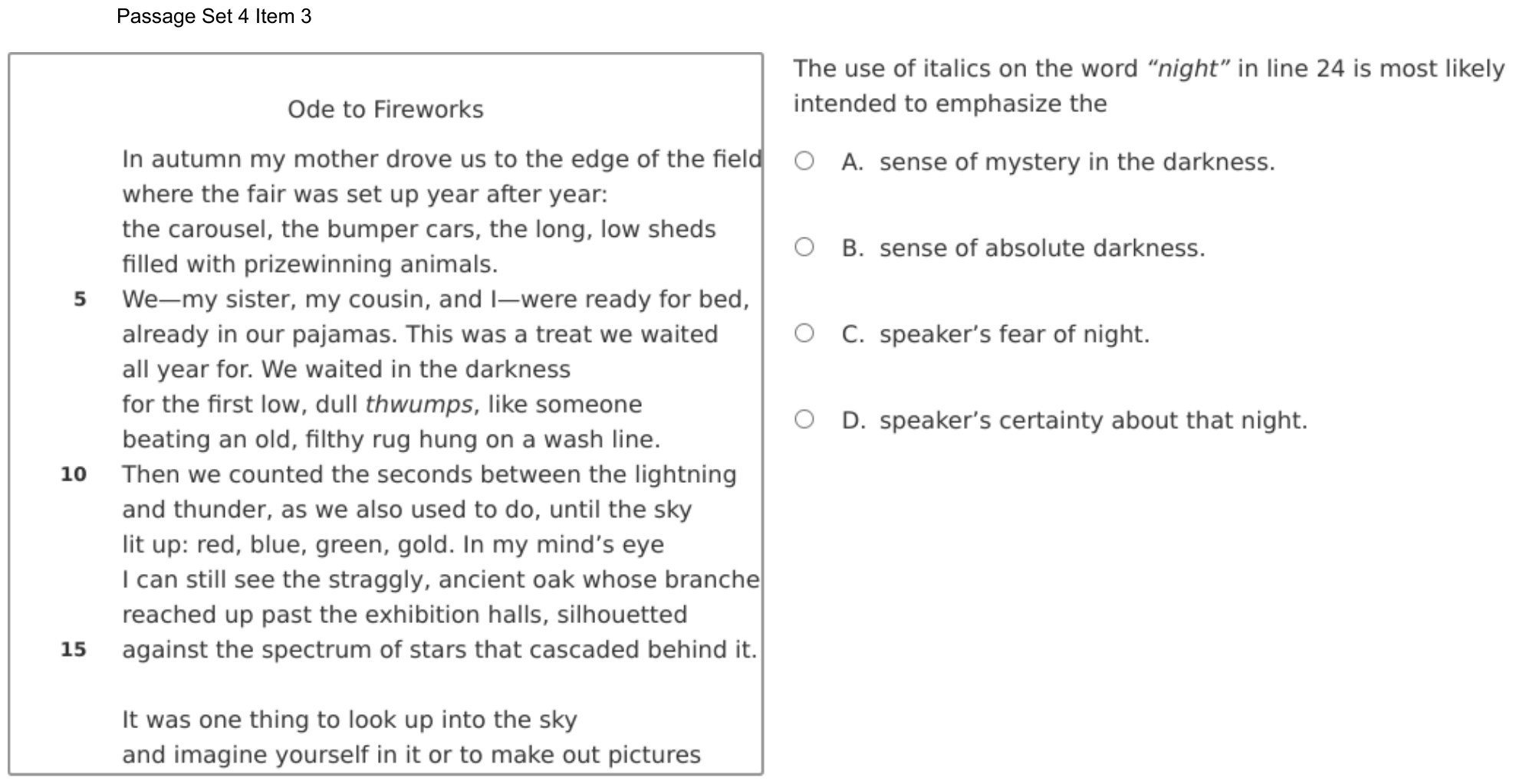
with those jewels. (We lived in the country:
night was night.) All around us, crickets
stridulated in the stubble of what had been
somebody’s cornfield, their song rising and falling.
You could smell winter on the air’s edge.
Now, in the city, when the sky dips into shadow
at New Year’s or on the Fourth of July, I find myself
craning my neck upward at odd moments.
The city sky is always lit up. This is where we live now,
and it is how we live now, awash in light
of every hue. Everything is a constant celebration:
picking up washing at the cleaner’s or stopping by
the corner market for a loaf of heavy bread.
And the music around me is the music of people,
their voices rising and falling in a hundred languages.
But beneath the yellowish glow deep in the sky
of all our city lights pelting out into the universe,
I remember the feel of the pickup truck bumping
across the ridged field, as I kept waiting for those
childhood bursts, watching as they escorted us home.
Question
The use of italics on the word “night” in line 24 is most likely intended to emphasize the
- Asense of mystery in the darkness.
- Bsense of absolute darkness.
- Cspeaker’s fear of night.
- Dspeaker’s certainty about that night.
Show the answer
Correct answer: B
The question asks what the use of italics on the word “night” in line 24 is most likely intended to emphasize.
A. Incorrect. The purpose of italicizing the word “night” is not to convey mystery. While the speaker refers to not knowing the exact location where the firework viewing took place (“in the stubble of what had been / somebody’s cornfield” [lines 25–26]), the emphasis on “night” is meant to highlight the darkness and contrast the bright light from the fireworks soaring across the sky.
B. CORRECT. The italics are intended to place emphasis on one key aspect of nighttime—total darkness. The speaker is making a point that night in the country was truly dark, unlike the night the speaker currently experiences in a city, where light emitted from buildings and vehicles prevents complete darkness.
C. Incorrect. The tone in the second stanza is positive, showing admiration for the beauty visible in true darkness rather than fear: “But it was another thing to see / the sky at night written upon / with those jewels” (lines 21–23).
D. Incorrect. The speaker is talking about the general experience of watching fireworks on several occasions, not focusing on the events of a specific night. The use of italics on the word “night” emphasizes the speaker’s memory of the persistent darkness.
Question analysis
In “Ode to Fireworks,” the word “night” is printed in italics in line 24, inside the speaker’s aside about living in the country. This craft question asks what the italics are most likely meant to emphasize, so students must think about what stressing one ordinary word does and choose among moods and meanings the word could carry.
- Grade level
- Grade 7 reading and task
- Compared with grade 7
- At grade 7 Grade 7 students explain how word choice shapes meaning; here the device is italics on one everyday word, which is studied less often. The surrounding lines are plain, so a single careful inference settles it, a typical grade 7 demand.
- Estimated difficulty
- Moderate: several steps, or a close reading with one strong distractor.
- Thinking it demands
- Depth of knowledge 2, skills and concepts · mainly analyze
- What makes it hard
- How, not what moderate
- A very close wrong answer moderate
- Evidence in several places minor
- Evidence
- Answered from one paragraph or stanza
- Reading level
- Passage: 379 words (a poem; reading level not measured); question and choices: about grade 5, 36 words.
- Students, last 30 days
- Not enough answers yet to show (it takes 10).
Why it is hard, traps and wrong answers (shows the answer)
Why it is hard
One plain word in a parenthesis carries the question, and its meaning comes from the stress, not the dictionary. Darkness is easy to see; the harder step is choosing what the italics add to it, and mystery is a familiar partner for darkness that the stanza never develops. Students who read on to the brightly lit city of the third stanza see that the speaker is insisting on how complete the country dark was.
How, not what moderate Working it out
The stem asks what italics do, not what a word means, so students must hear the stress in “night was night” as insisting that the country night was fully dark, as night should be. (Anderson & Krathwohl, 2001)
A very close wrong answer moderate Choosing the answer
The mystery choice and the key both tie the italics to darkness; they differ only in what the darkness carries, a sense of mystery or its sheer completeness. (Embretson & Wetzel, 1987; Gorin & Embretson, 2006; Ascalon et al., 2007)
Evidence in several places minor Working it out
The point of the stress becomes clear from the third stanza, where “The city sky is always lit up” and the speaker now lives “awash in light / of every hue.” (Kirsch & Mosenthal, 1990; Gorin & Embretson, 2006)
Strategy: Read line 24 aloud, stressing “night” as the italics do, and ask what the speaker insists on about nights in the country; then check whether the rest of the poem backs that reading.
Traps
- Reads too much in: A reasonable-sounding conclusion that goes further than the text allows.
- Wrong tone or attitude: Misjudges the tone, attitude or point of view, such as reading admiration as criticism, or taking a character's or subject's feelings for the author's.
- Wrong purpose or structure: Names a purpose, structure or effect that the part does not serve, or describes what a part says when the question asks what it does.
The wrong answers, classified
A Reads too much in (Graesser, Singer & Trabasso, 1994)
Links darkness with mystery, a common pairing, but nothing in the stanza is hidden or puzzling; the stress falls on how dark the country night was.
C Wrong tone or attitude (Graesser, Singer & Trabasso, 1994)
Assumes a child out in the dark must be afraid, but the stanza is full of wonder, with “jewels” in the sky and crickets singing, and shows no fear.
D Wrong purpose or structure (Anderson & Krathwohl, 2001)
Knows italics can mark insistence but reads “night” as one particular evening, though the speaker means country nights in general, at a fair held “year after year.”
Working it out, step by step
Figure out what the question asks
This asks why one word is in italics. Italics are slanted letters. Writers use them to stress a word, the way you would say it louder. So ask what the speaker insists on.
Read the line aloud
Lines 23–24 say “(We lived in the country: / night was night.)” Read it aloud and lean on the second “night.” It means night was really night. It was as dark as night should be, with no city lights.
Use the rest of the poem
Stanza 3 shows the opposite. “The city sky is always lit up.” The speaker now lives “awash in light / of every hue.” Awash means flooded. A hue is a color. So the italics stress how completely dark the country night was. That darkness made the fireworks stand out.
Check each choice
- A is wrong. Darkness can feel mysterious. But nothing in the stanza is hidden or puzzling.
- B is right. Absolute means total. The italics stress that the dark was total.
- C is wrong. The speaker shows wonder, not fear. The sky is full of “jewels.”
- D is wrong. “That night” would mean one evening. The speaker means country nights in general, at a fair held “year after year.”
Watch out: A pairs darkness with mystery, which feels natural. But the speaker stresses how dark it was, not that it felt strange.
Choose the answer
The italics insist that country nights were fully dark. So the answer is B, “sense of absolute darkness.”
Why this answer and not the closest wrong one
A is the closest wrong answer, since both A and B link the italics to darkness. But the stanza never treats the night as strange or secret. The bright city sky in stanza 3 shows what the stress is for: country nights were completely dark. That is B.
More questions like this
The original DOE question
The passage “Ode to Fireworks” as printed (page 32)