Passage Ode to Fireworks
Ode to Fireworks
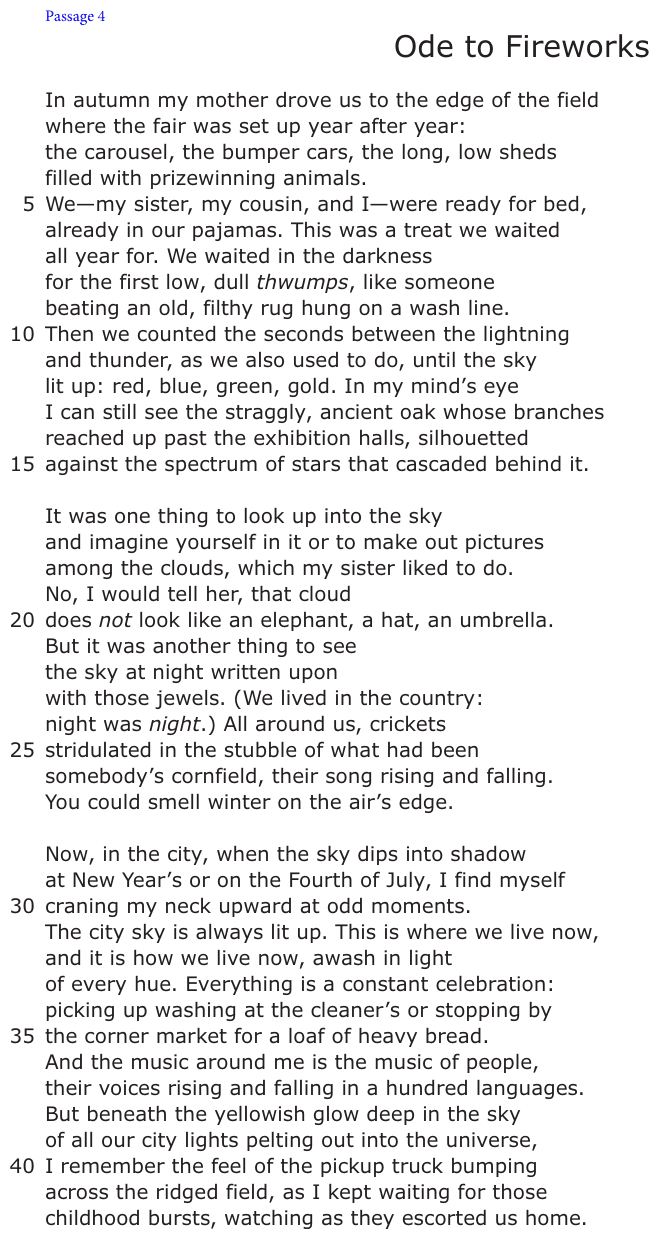
In autumn my mother drove us to the edge of the field
where the fair was set up year after year:
the carousel, the bumper cars, the long, low sheds
filled with prizewinning animals.
We—my sister, my cousin, and I—were ready for bed,
already in our pajamas. This was a treat we waited
all year for. We waited in the darkness
for the first low, dull thwumps, like someone
beating an old, filthy rug hung on a wash line.
Then we counted the seconds between the lightning
and thunder, as we also used to do, until the sky
lit up: red, blue, green, gold. In my mind’s eye
I can still see the straggly, ancient oak whose branches
reached up past the exhibition halls, silhouetted
against the spectrum of stars that cascaded behind it.
It was one thing to look up into the sky
and imagine yourself in it or to make out pictures
among the clouds, which my sister liked to do.
No, I would tell her, that cloud
does not look like an elephant, a hat, an umbrella.
But it was another thing to see
the sky at night written upon
with those jewels. (We lived in the country:
night was night.) All around us, crickets
stridulated in the stubble of what had been
somebody’s cornfield, their song rising and falling.
You could smell winter on the air’s edge.
Now, in the city, when the sky dips into shadow
at New Year’s or on the Fourth of July, I find myself
craning my neck upward at odd moments.
The city sky is always lit up. This is where we live now,
and it is how we live now, awash in light
of every hue. Everything is a constant celebration:
picking up washing at the cleaner’s or stopping by
the corner market for a loaf of heavy bread.
And the music around me is the music of people,
their voices rising and falling in a hundred languages.
But beneath the yellowish glow deep in the sky
of all our city lights pelting out into the universe,
I remember the feel of the pickup truck bumping
across the ridged field, as I kept waiting for those
childhood bursts, watching as they escorted us home.
Question
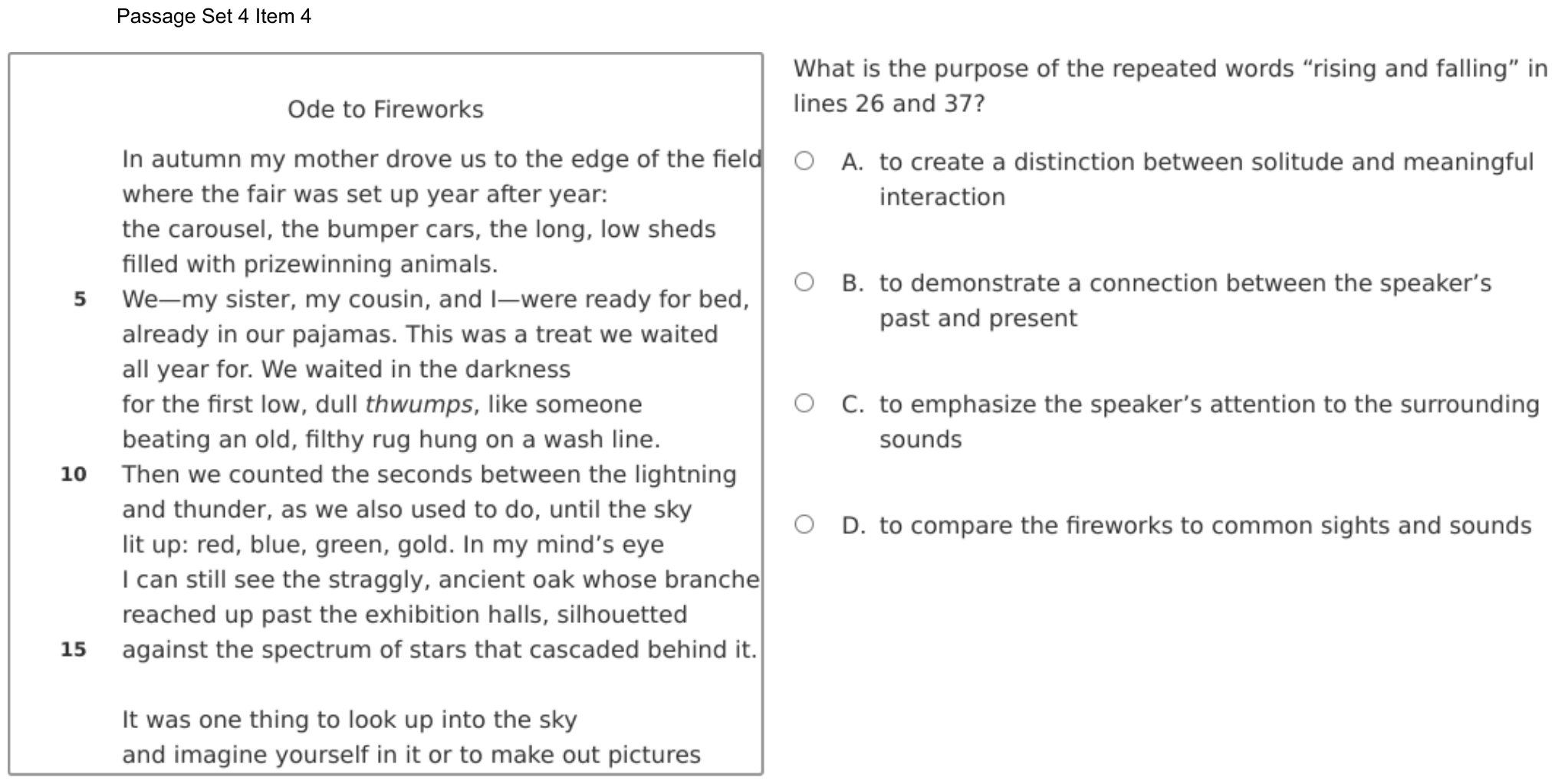
What is the purpose of the repeated words “rising and falling” in lines 26 and 37?
- Ato create a distinction between solitude and meaningful interaction
- Bto demonstrate a connection between the speaker’s past and present
- Cto emphasize the speaker’s attention to the surrounding sounds
- Dto compare the fireworks to common sights and sounds
Show the answer
Correct answer: B
The question asks what the purpose is of the repeated words “rising and falling” in lines 26 and 37.
A. Incorrect. These lines do not provide insight into the speaker’s interactions or feelings of solitude. The speaker mentions the emptiness of the country and the crowds in the city, but these repeated words are meant to draw a connection between the locations rather than show differences between them.
B. CORRECT. The first mention of these words occurs during a recollection of the speaker’s past, and the second takes place during a description of the speaker’s present. The speaker looks to the connections between the country setting (“All around us, crickets / stridulated in the stubble of what had been / somebody’s cornfield, their song rising and falling” [lines 24–26]) and the city setting (“And the music around me is the music of people, / their voices rising and falling in a hundred languages” [lines 36–37]) as a source of comfort.
C. Incorrect. Even though the lines call out specific sounds, the purpose of the repetition of the words in the two parts of the poem is to show how the speaker connects the two settings. The “rising and falling” of the sounds is one detail the speaker highlights.
D. Incorrect. The repetition of the words “rising and falling” is used to compare the different locations in the speaker’s life, not to compare fireworks to the sounds of crickets in the country or to the sounds of people moving and talking in the city.
Question analysis
The phrase “rising and falling” appears twice in “Ode to Fireworks,” in line 26 for the crickets’ song and in line 37 for people’s voices. This question asks for the purpose of repeating it, so students must compare the two places where it appears and decide what the echo does for the poem as a whole.
- Grade level
- Grade 7 reading and task
- Compared with grade 7
- At grade 7 Grade 7 students analyze how a poem’s structure develops its meaning. The repeated words are easy to spot, but they sit eleven lines apart in different stanzas, and the four purposes offered each sound possible, a typical grade 7 structure task.
- Estimated difficulty
- Moderate: several steps, or a close reading with one strong distractor.
- Thinking it demands
- Depth of knowledge 2, skills and concepts · mainly analyze
- What makes it hard
- How, not what moderate
- Evidence in several places moderate
- Evidence
- Answered from several paragraphs or stanzas
- Reading level
- Passage: 379 words (a poem; reading level not measured); question and choices: about grade 8, 51 words.
- Corrected from the DOE handbook
- The DOE printed this question’s explanation after a different question; the site matches the question with its own explanation.
- Students, last 30 days
- Not enough answers yet to show (it takes 10).
Why it is hard, traps and wrong answers (shows the answer)
Why it is hard
The repeated words are easy to find; the work is seeing that they sit on either side of the poem’s turn from childhood memory to city life. The strongest pull is the accurate observation that both lines describe sounds, which tells what the lines say rather than why the poet repeats them. The country and city are contrasted elsewhere in the poem, so a choice built on a contrast also tempts, though repeating the same words joins the two scenes instead of separating them.
How, not what moderate Working it out
The stem asks for the purpose of a repetition, so it is not enough to see that both lines describe sounds; students must say what echoing “rising and falling” does for the poem. (Anderson & Krathwohl, 2001)
Evidence in several places moderate Working it out
The two uses sit eleven lines apart in different stanzas, the crickets’ song in the remembered country field and city voices “in a hundred languages” in the present, and must be read together. (Kirsch & Mosenthal, 1990; Gorin & Embretson, 2006)
Strategy: Reread the lines around each use of “rising and falling,” describe each scene in a phrase, and ask what echoing the same words in both scenes accomplishes for the poem.
Traps
- Wrong purpose or structure: Names a purpose, structure or effect that the part does not serve, or describes what a part says when the question asks what it does.
- Reads too much in: A reasonable-sounding conclusion that goes further than the text allows.
- Twists what the text says: Uses the text's topic and ideas but changes what it says: who did it, how much, when, or why.
The wrong answers, classified
A Reads too much in (Graesser, Singer & Trabasso, 1994)
Reads solitude into the country scene and company into the city, though the speaker watched with a mother, sister and cousin, and the repeated words link the scenes.
C Wrong purpose or structure (Anderson & Krathwohl, 2001)
Notices that both lines describe sounds, the crickets’ song and people’s voices, which is true, but that is what the lines say, not why the words are repeated.
D Twists what the text says (King et al., 2004)
Assumes the repetition must refer to the fireworks of the title, though “rising and falling” describes crickets and voices and compares neither one to fireworks.
What was corrected from the DOE handbook, and why
- Explanation: In the DOE’s explanations appendix, the explanation printed after this question belongs to question 25 (“how the memory in lines 41–42 affects the speaker”) and marks D correct, and this question’s explanation (“what the purpose is of the repeated words ‘rising and falling’ in lines 26 and 37”) is printed after question 25, marking B correct. Read page by page, the appendix gives this question the answer D. The site gives the question the explanation that restates it, and the answer follows that explanation: B, because the words join the crickets’ song of the speaker’s country childhood (line 26) to the voices of the city in the present (line 37).
Working it out, step by step
Figure out what the question asks
This asks about purpose: why the poet repeats the words “rising and falling.” Don’t just say what the lines describe. Ask what repeating the same words does for the poem.
Find both uses
The first is in line 26, in the country of the speaker’s childhood. Crickets “stridulated in the stubble of what had been / somebody’s cornfield, their song rising and falling.” To stridulate is to chirp by rubbing body parts together. The second is in line 37, in the city today: “their voices rising and falling in a hundred languages.”
See what the repeat does
The two uses sit on either side of the poem’s big turn. Stanza 2 is the past in the country. Stanza 3 is the present in the city. The crickets’ song then and people’s voices now rise and fall alike. Using the same words in both places links the two times. So the repeat ties the speaker’s past to the present.
Check each choice
- A is wrong. Solitude means being alone. But the speaker was with family in the country. And the repeat joins the scenes. It does not set them apart.
- B is right. The same words join a childhood scene to a scene from now.
- C is wrong. Both lines do describe sounds. But that is what the lines say, not why the words repeat.
- D is wrong. The words describe crickets and voices. Neither is compared to fireworks.
Watch out: C is true, which makes it tempting. But a purpose question asks why, not what.
Choose the answer
The repeated words link the country past to the city present. So the answer is B, “to demonstrate a connection between the speaker’s past and present.”
Why this answer and not the closest wrong one
C is the closest wrong answer. It is true that both lines describe sounds the speaker hears. But the question asks for the purpose. The crickets belong to the speaker’s past, and the voices to the present. Repeating “rising and falling” joins the two times. That connection is B.
More questions like this
The original DOE question
The passage “Ode to Fireworks” as printed (page 32)