Question
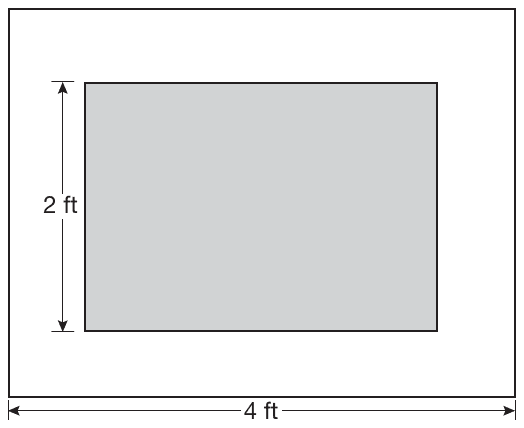
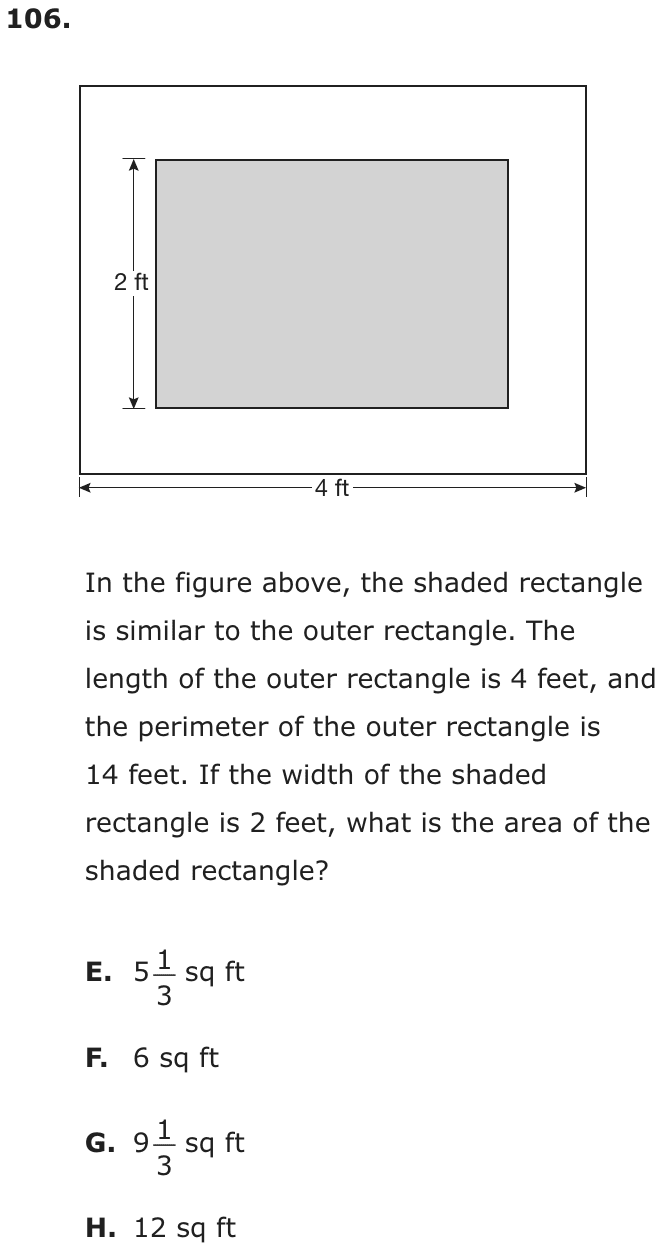
In the figure above, the shaded rectangle is similar to the outer rectangle. The length of the outer rectangle is 4 feet, and the perimeter of the outer rectangle is 14 feet. If the width of the shaded rectangle is 2 feet, what is the area of the shaded rectangle?
- A sq ft
- B6 sq ft
- C sq ft
- D12 sq ft
Show the answer
Correct answer: A
For the outer rectangle, the length is 4 feet and the perimeter is 14 feet. Write and solve an equation to find the width:
| Apply the additive inverse property; subtract 8 from both sides of the equation. | |
| Apply the multiplicative inverse property; divide both sides of the equation by 2. | |
Use that information in a proportion to find the length of the shaded rectangle:
| Cross multiply. | |
| Apply the multiplicative inverse property; divide both sides of the equation by 3. | |
Now find the area of the shaded rectangle:
Question analysis
This geometry question shows a shaded rectangle similar to an outer rectangle that is 4 feet long with a perimeter of 14 feet; the shaded rectangle is 2 feet wide. Students find the shaded area. They must find a missing side, match corresponding sides, and scale by a factor rather than a fixed amount, which makes it a multistep similar-figures problem.
- Grade level
- Grade 8 content, by NYS standard
- Compared with grade 7
- Above grade 7 Similar figures are grade 8 geometry, though grade 7 scale drawings use the same proportions. Students must first find a missing side from the perimeter, match corresponding sides, solve a proportion with a fractional result, and then find an area.
- Estimated difficulty
- Hard: combines ideas, needs a plan, and has more than one tempting wrong answer.
- Thinking it demands
- Depth of knowledge 2, skills and concepts · mainly apply
- What makes it hard
- Combines ideas moderate
- Reading a figure, table or graph minor
- Error-prone arithmetic minor
- Solution
- 4 steps
- Reading level
- Question and choices: about grade 5, 57 words.
- Students, last 30 days
- Not enough answers yet to show (it takes 10).
Why it is hard, traps and wrong answers (shows the answer)
Why it is hard
Each step is familiar, but the three together, perimeter to width, width to scale factor, and sides to area, demand a plan. The strongest pull is scaling by subtraction, shrinking each side by 1 foot because the width drops from 3 to 2, which gives a neat whole-number area. Others stop at the outer rectangle or add the sides instead of multiplying. Checking that 8/3 to 2 matches 4 to 3 confirms the shape is similar.
Combines ideas moderate Working it out
Perimeter, similarity and area are chained: 14 feet gives the outer width of 3 feet, the 2-foot side sets a scale factor of 2/3, and only then can the area be found. (Embretson, 1998; Daniel & Embretson, 2010)
Reading a figure, table or graph minor Understanding the question
The figure marks the shaded rectangle's 2-foot side running up and down and the outer 4-foot length along the bottom, so the 2 feet must be paired with the outer 3-foot side, which is not labeled. (Lesh, Post & Behr, 1987; Kirsch & Mosenthal, 1990)
Error-prone arithmetic minor Working it out
The scale factor 2/3 makes the shaded length 8/3 feet, and the area 2 × 8/3 = 16/3 has to be written as the mixed number 5 1/3. (Brown & Burton, 1978; Junker & Sijtsma, 2001)
Strategy: Use the perimeter to find the outer rectangle's width, match the shaded width of 2 feet to it, scale the 4-foot length by the same factor, then multiply length by width.
Traps
- Misunderstands the concept: A wrong belief about a concept: that percents can be added, that area grows like length, that averages can be averaged, that a bigger denominator means a bigger fraction.
- Wrong formula: Uses a related but wrong formula: perimeter for area, diameter for radius, area for volume, or a misremembered one.
- Answers a different question: A choice is right for another quantity: the other unknown, the rest instead of the part, the part instead of the whole.
The wrong answers, classified
B Misunderstands the concept (Smith, diSessa & Roschelle, 1993; De Bock et al., 1998; Ni & Zhou, 2005)
Shrinks each side by the same amount instead of the same factor: the width drops by 1 foot, from 3 to 2, so the length drops from 4 to 3, giving 6.
C Wrong formula (King et al., 2004)
Finds the shaded sides, 2 and 8/3 feet, correctly but computes the perimeter, 2 × (2 + 8/3) = 28/3 = 9 1/3, instead of the area.
D Answers a different question (King et al., 2004; Hegarty, Mayer & Monk, 1995)
Finds the outer width of 3 feet and gives the outer rectangle's area, 4 × 3 = 12, instead of the smaller shaded one.
Worked solution, step by step
Formulas used
- Perimeter of a rectangle
- P is the perimeter, the distance all the way around. l is the length and w is the width. A rectangle has two lengths and two widths, so you add each one twice.
- Scale factor of similar shapes
- Similar shapes have the same shape but different sizes. Each side of the small shape equals its matching side on the large shape times one number, the scale factor. So one pair of matching sides tells you the scale factor.
- Area of a rectangle
- A is the area, the space inside. l is the length and w is the width. You multiply because the rectangle is made of rows of unit squares: w rows with l squares in each.
Sort out the question
The outer rectangle is 4 feet long, and its perimeter is 14 feet. The shaded rectangle is similar to it, so it has the same shape. The shaded rectangle’s width, its left side, is 2 feet. You need the shaded area, so you also need the shaded length.
Find the outer rectangle’s width
The outer rectangle is 3 feet wide. That is its up-and-down side.
Find the scale factor
The shaded width, 2 feet, matches the outer width, 3 feet.
Every shaded side is of the matching outer side. Watch out: similar shapes shrink by the same factor, not by the same number of feet. Taking 1 foot off each side gives 2 by 3, an area of 6, choice B.
Find the shaded length
Multiply the outer length, 4 feet, by the scale factor.
The shaded rectangle is feet long.
Find the shaded area
Watch out: 4 × 3 = 12 is the outer area, choice D. So the answer is A, sq ft.
Check your answer
Check the shape. For the outer rectangle, length ÷ width is . For the shaded one, it is . They match, so the shapes are similar. Also, square feet is less than the outer 12, as it should be.
More questions like this
The original DOE question