Passage Serpent Mound
Serpent Mound
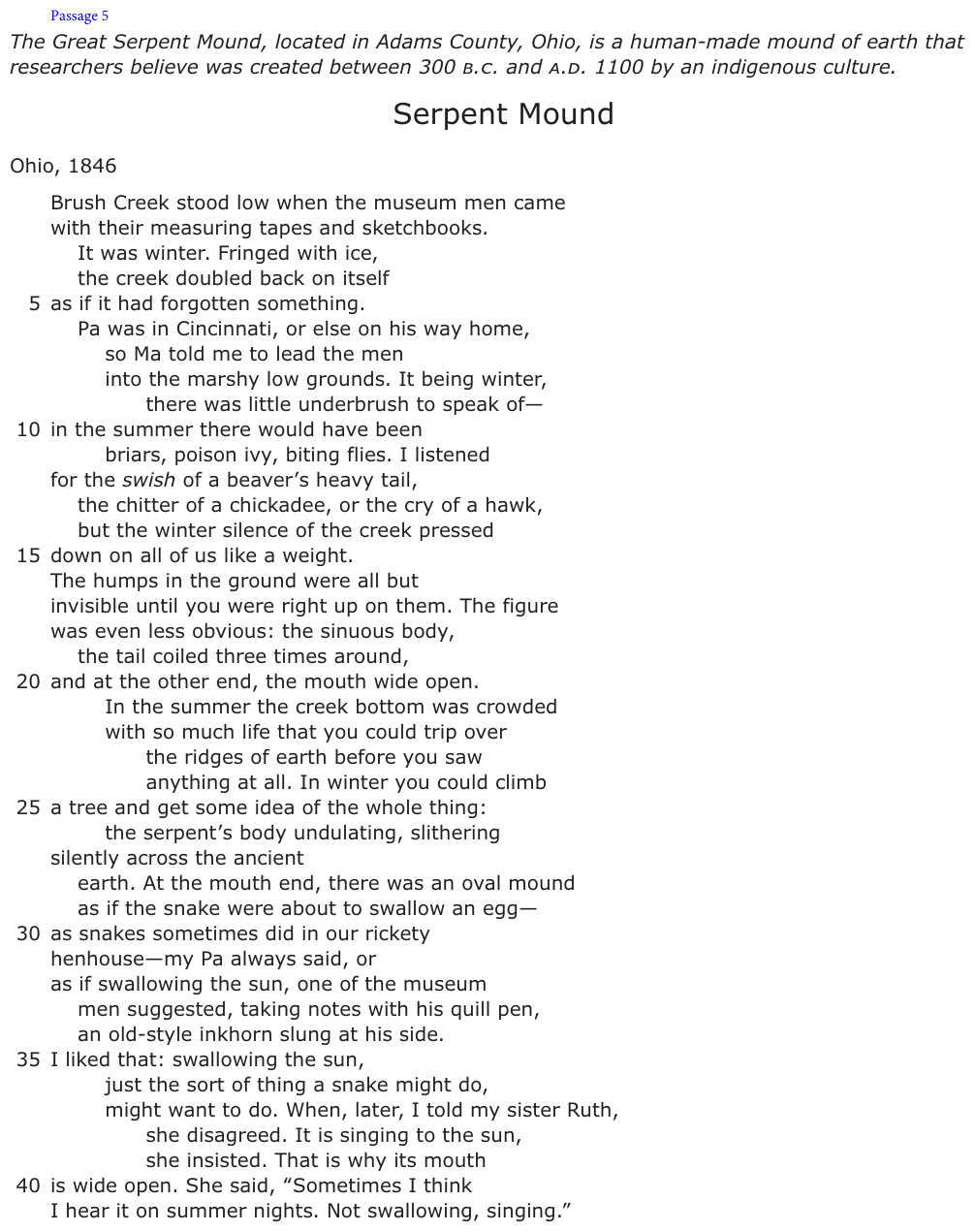
The Great Serpent Mound, located in Adams County, Ohio, is a human-made mound of earth that researchers believe was created between 300 B.C. and A.D. 1100 by an indigenous culture.
Ohio, 1846
Brush Creek stood low when the museum men came
with their measuring tapes and sketchbooks.
It was winter. Fringed with ice,
the creek doubled back on itself
as if it had forgotten something.
Pa was in Cincinnati, or else on his way home,
so Ma told me to lead the men
into the marshy low grounds. It being winter,
there was little underbrush to speak of—
in the summer there would have been
briars, poison ivy, biting flies. I listened
for the swish of a beaver’s heavy tail,
the chitter of a chickadee, or the cry of a hawk,
but the winter silence of the creek pressed
down on all of us like a weight.
The humps in the ground were all but
invisible until you were right up on them. The figure
was even less obvious: the sinuous body,
the tail coiled three times around,
and at the other end, the mouth wide open.
In the summer the creek bottom was crowded
with so much life that you could trip over
the ridges of earth before you saw
anything at all. In winter you could climb
a tree and get some idea of the whole thing:
the serpent’s body undulating, slithering
silently across the ancient
earth. At the mouth end, there was an oval mound
as if the snake were about to swallow an egg—
as snakes sometimes did in our rickety
henhouse—my Pa always said, or
as if swallowing the sun, one of the museum
men suggested, taking notes with his quill pen,
an old-style inkhorn slung at his side.
I liked that: swallowing the sun,
just the sort of thing a snake might do,
might want to do. When, later, I told my sister Ruth,
she disagreed. It is singing to the sun,
she insisted. That is why its mouth
is wide open. She said, “Sometimes I think
I hear it on summer nights. Not swallowing, singing.”
Question
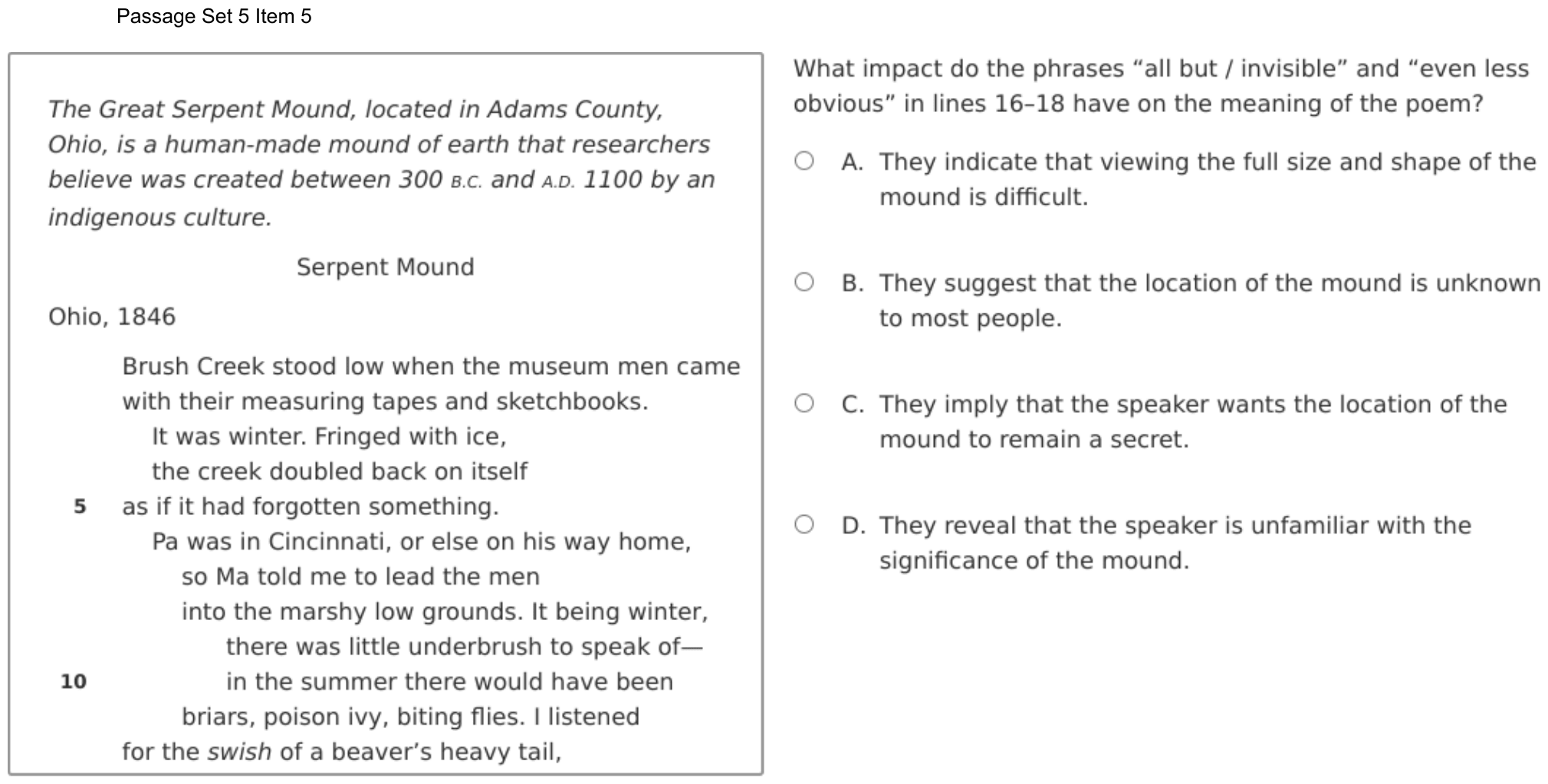
What impact do the phrases “all but / invisible” and “even less obvious” in lines 16–18 have on the meaning of the poem?
- AThey indicate that viewing the full size and shape of the mound is difficult.
- BThey suggest that the location of the mound is unknown to most people.
- CThey imply that the speaker wants the location of the mound to remain a secret.
- DThey reveal that the speaker is unfamiliar with the significance of the mound.
Show the answer
Correct answer: A
The question asks what impact the phrases “all but / invisible” and “even less obvious” in lines 16–18 have on the meaning of the poem.
A. CORRECT. The words “all but / invisible” indicate that a person must be close to see the humps in the ground, while the phrase “even less obvious” indicates that a person must be far away to see the overall snake shape of the mound.
B. Incorrect. While the speaker has to lead the museum men to the mound because they did not know the exact location, the words in lines 16–18 are related to the difficulty in viewing the mound from the immediate surrounding area.
C. Incorrect. The speaker is willing to take the museum men out to study the mound, so there is no indication in the poem that the speaker wants the location of the mound to remain a secret. The words in lines 16–18 convey the idea that the mound is difficult to see.
D. Incorrect. While the speaker contemplates the significance of certain elements of the mound, the phrases in lines 16–18 relate to a viewer’s ability to see the physical shape of the mound, not its deeper meaning.
Question analysis
This word-meaning question asks what impact the phrases “all but / invisible” and “even less obvious” in lines 16–18 of “Serpent Mound” have on the poem’s meaning. Students must understand the idiom “all but” and then judge which of four claims about the mound and the speaker the two phrases actually support.
- Grade level
- Grade 6 reading and task
- Compared with grade 7
- Below grade 7 Below typical grade 7 demand: both phrases are quoted with their line numbers, in plain modern language, and one careful reading settles the question. The one hurdle is the idiom “all but,” which some readers take literally.
- Estimated difficulty
- Straightforward: two steps or one careful reading.
- Thinking it demands
- Depth of knowledge 2, skills and concepts · mainly understand
- What makes it hard
- Hard words moderate
- Reading between the lines minor
- Evidence
- Answered from one paragraph or stanza
- Reading level
- Passage: 354 words (a poem; reading level not measured); question and choices: about grade 7, 76 words.
- Students, last 30 days
- Not enough answers yet to show (it takes 10).
Why it is hard, traps and wrong answers (shows the answer)
Why it is hard
Both phrases are quoted with their lines, and the sentence that holds them goes on to list the body, the coiled tail and the open mouth, so its subject is what can be seen. The wrong choices slide from seeing to knowing: who knows where the mound is, who wants it hidden, and what it means. “Less obvious” is the slippery phrase, since obvious can also mean easy to understand.
Hard words moderate Understanding the question
“All but” is an idiom meaning almost, so “all but / invisible” means nearly unseen; a student who takes it as the opposite, plainly visible, loses the sense that the humps are hard to see. (Perfetti, 2007; Freedle & Kostin, 1993)
Reading between the lines minor Working it out
Students must keep both phrases about sight and connect them to lines 24–25, where only climbing a tree gives “some idea of the whole thing.” (Graesser, Singer & Trabasso, 1994; Kintsch, 1998)
Strategy: Put both phrases into plain words, starting with the idiom “all but,” then test each choice against what lines 16–25 actually describe.
Traps
- Twists what the text says: Uses the text's topic and ideas but changes what it says: who did it, how much, when, or why.
- Reads too much in: A reasonable-sounding conclusion that goes further than the text allows.
- Dictionary meaning, not meaning here: A common meaning of the word that does not fit its use in this text.
The wrong answers, classified
B Twists what the text says (King et al., 2004)
Turns “invisible” into “unknown,” helped by Ma sending the speaker to guide the men, but the phrases say how hard the mound is to see, not who knows where it is.
C Reads too much in (Graesser, Singer & Trabasso, 1994)
Finds a wish for secrecy in the hidden humps, though the speaker leads the museum men straight to the mound and never tries to keep it from anyone.
D Dictionary meaning, not meaning here (Perfetti, 2007)
Takes “less obvious” in its sense of harder to understand, but the sentence goes straight on to list the body, the coiled tail and the open mouth, so the word is about sight.
Working it out, step by step
Figure out what the question asks
This asks what two phrases add to the poem’s meaning. They are “all but / invisible” and “even less obvious,” in lines 16–18. Put each phrase in plain words first. Then see what they tell you about the mound.
Read lines 16–18
Lines 16–18 say “The humps in the ground were all but / invisible until you were right up on them. The figure / was even less obvious.” “All but” means almost. So the humps were almost invisible until you got very close. The figure is the whole snake shape. It was even harder to see than the humps. Here, obvious means easy to see.
Connect the phrases to later lines
The same sentence goes on to list what you would see: “the sinuous body, / the tail coiled three times around, / and at the other end, the mouth wide open.” So the phrases are about seeing the shape. Later, lines 24–25 say “In winter you could climb / a tree and get some idea of the whole thing.” Only from up high could you begin to see it. The mound is huge, low and hard to take in all at once.
Check each choice
- A fits. Both phrases show that seeing the whole mound is hard.
- B does not fit. The phrases are about how hard the mound is to see, not about who knows where it is.
- C does not fit. The speaker leads the museum men right to the mound. There is no wish to keep it secret.
- D does not fit. Here “less obvious” is about sight, not about understanding what the mound means.
Watch out: Obvious can also mean easy to understand. That reading leads to D. But the sentence goes straight on to list parts of the snake you can see.
Choose the answer
The phrases show how hard it is to see the mound’s full size and shape. So the answer is A, “They indicate that viewing the full size and shape of the mound is difficult.”
Why this answer and not the closest wrong one
B is a close wrong choice, because “invisible” can make you think nobody knows the mound is there. But the phrases describe looking, not knowing. The speaker knows exactly where the mound is. The problem is seeing it. The humps vanish until “you were right up on them,” and the whole shape shows only from a tree.
More questions like this
The original DOE question
The passage “Serpent Mound” as printed (page 40)