Passage Excerpt from “How We Made the First Flight”
Excerpt from “How We Made the First Flight”
by Orville Wright
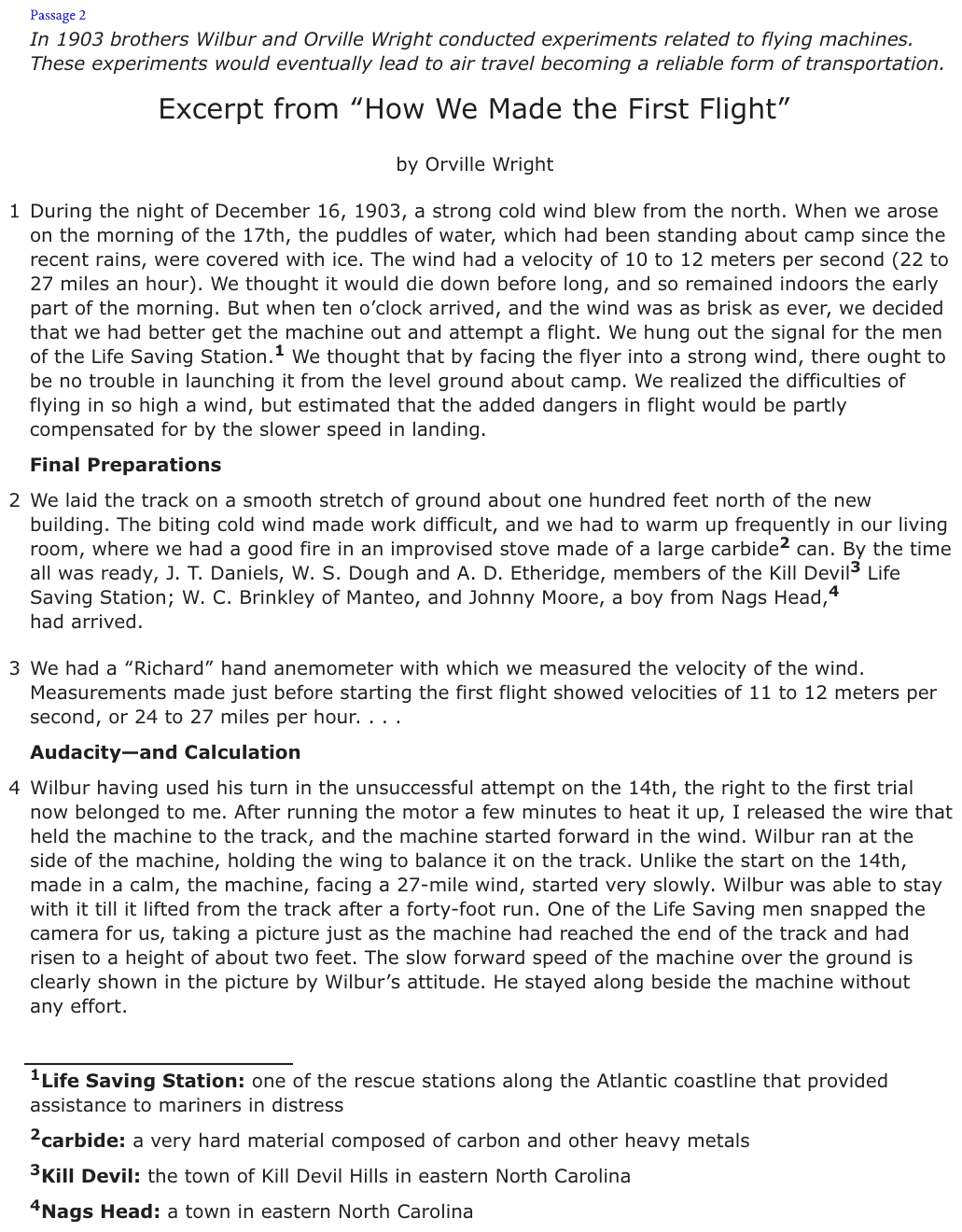
In 1903 brothers Wilbur and Orville Wright conducted experiments related to flying machines. These experiments would eventually lead to air travel becoming a reliable form of transportation.
During the night of December 16, 1903, a strong cold wind blew from the north. When we arose on the morning of the 17th, the puddles of water, which had been standing about camp since the recent rains, were covered with ice. The wind had a velocity of 10 to 12 meters per second (22 to 27 miles an hour). We thought it would die down before long, and so remained indoors the early part of the morning. But when ten o’clock arrived, and the wind was as brisk as ever, we decided that we had better get the machine out and attempt a flight. We hung out the signal for the men of the Life Saving Station.1 We thought that by facing the flyer into a strong wind, there ought to be no trouble in launching it from the level ground about camp. We realized the difficulties of flying in so high a wind, but estimated that the added dangers in flight would be partly compensated for by the slower speed in landing.
Final Preparations
We laid the track on a smooth stretch of ground about one hundred feet north of the new building. The biting cold wind made work difficult, and we had to warm up frequently in our living room, where we had a good fire in an improvised stove made of a large carbide2 can. By the time all was ready, J. T. Daniels, W. S. Dough and A. D. Etheridge, members of the Kill Devil3 Life Saving Station; W. C. Brinkley of Manteo, and Johnny Moore, a boy from Nags Head,4 had arrived.
We had a “Richard” hand anemometer with which we measured the velocity of the wind. Measurements made just before starting the first flight showed velocities of 11 to 12 meters per second, or 24 to 27 miles per hour. . . .
Audacity—and Calculation
Wilbur having used his turn in the unsuccessful attempt on the 14th, the right to the first trial now belonged to me. After running the motor a few minutes to heat it up, I released the wire that held the machine to the track, and the machine started forward in the wind. Wilbur ran at the side of the machine, holding the wing to balance it on the track. Unlike the start on the 14th, made in a calm, the machine, facing a 27-mile wind, started very slowly. Wilbur was able to stay with it till it lifted from the track after a forty-foot run. One of the Life Saving men snapped the camera for us, taking a picture just as the machine had reached the end of the track and had risen to a height of about two feet. The slow forward speed of the machine over the ground is clearly shown in the picture by Wilbur’s attitude. He stayed along beside the machine without any effort.
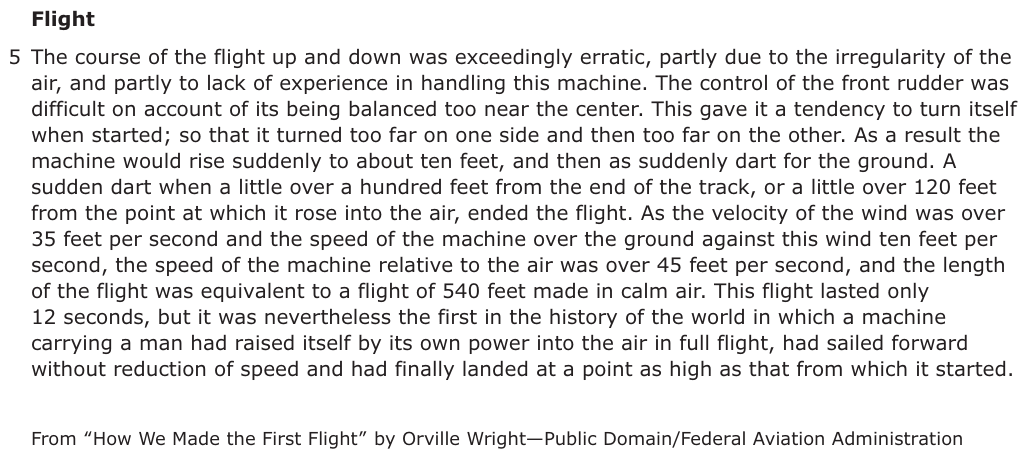
Flight
The course of the flight up and down was exceedingly erratic, partly due to the irregularity of the air, and partly to lack of experience in handling this machine. The control of the front rudder was difficult on account of its being balanced too near the center. This gave it a tendency to turn itself when started; so that it turned too far on one side and then too far on the other. As a result the machine would rise suddenly to about ten feet, and then as suddenly dart for the ground. A sudden dart when a little over a hundred feet from the end of the track, or a little over 120 feet from the point at which it rose into the air, ended the flight. As the velocity of the wind was over 35 feet per second and the speed of the machine over the ground against this wind ten feet per second, the speed of the machine relative to the air was over 45 feet per second, and the length of the flight was equivalent to a flight of 540 feet made in calm air. This flight lasted only 12 seconds, but it was nevertheless the first in the history of the world in which a machine carrying a man had raised itself by its own power into the air in full flight, had sailed forward without reduction of speed and had finally landed at a point as high as that from which it started.
From “How We Made the First Flight” by Orville Wright—Public Domain/Federal Aviation Administration
1Life Saving Station: one of the rescue stations along the Atlantic coastline that provided assistance to mariners in distress
2carbide: a very hard material composed of carbon and other heavy metals
3Kill Devil: the town of Kill Devil Hills in eastern North Carolina
4Nags Head: a town in eastern North Carolina
Question
The use of chronological structure contributes to the development of ideas in the excerpt by
- Aoutlining the actions that the Wright brothers took to prepare for and successfully complete the first flight.
- Bidentifying the primary factors that allowed the Wright brothers to overcome obstacles and achieve the first flight.
- Cshowing how the Wright brothers applied lessons learned from their previous flight attempts to accomplish the first flight.
- Ddemonstrating how the Wright brothers analyzed the impact of wind velocity to identify the ideal conditions for the first flight.
Show the answer
Correct answer: A
The question asks how the use of chronological structure contributes to the development of ideas in the excerpt.
A. CORRECT. Through the chronological structure, Orville addresses all stages of the flight in a way that builds from flight concerns and preparations for takeoff to his experiences during the flight and his successful landing.
B. Incorrect. While obstacles are presented within the excerpt, the chronological structure emphasizes the events that ended in the successful achievement of flight on that day rather than how the Wright brothers overcame obstacles.
C. Incorrect. The chronological structure of the excerpt does not show that the Wright brothers applied lessons learned from their previous attempts at flight; instead, the structure describes Orville’s December 17 attempt.
D. Incorrect. While Orville’s narrative certainly shows a strong need to analyze wind speed, this idea is not conveyed through the chronological structure of the excerpt. Additionally, the description of the first flight on December 17 indicates that it did not take place in ideal conditions (“We realized the difficulties of flying in so high a wind” [paragraph 1] and “The course of the flight up and down was exceedingly erratic, partly due to the irregularity of the air” [paragraph 5]).
Question analysis
This text-structure question asks how the chronological structure of Orville Wright’s “How We Made the First Flight,” an account that begins on the night of December 16, 1903, contributes to the development of ideas in the excerpt. Students must see what telling events in time order does for the account. Each choice names a purpose that could suit a story of the first airplane flight.
- Grade level
- Grade 7 reading and task
- Compared with grade 7
- Below grade 7 Grade 7 structure questions often ask how a less obvious pattern, such as problem and solution, shapes ideas. This excerpt is plainly told in time order, with dates and section headings, so recognizing what that order does is a lighter task.
- Estimated difficulty
- Straightforward: two steps or one careful reading.
- Thinking it demands
- Depth of knowledge 2, skills and concepts · mainly analyze
- What makes it hard
- How, not what minor
- A very close wrong answer minor
- Evidence
- Answered from the whole text
- Reading level
- Passage: about grade 7, 816 words; question and choices: about grade 11, 87 words.
- Students, last 30 days
- Not enough answers yet to show (it takes 10).
Why it is hard, traps and wrong answers (shows the answer)
Why it is hard
The excerpt is plainly chronological, with a date in its first sentence and headings that move from “Final Preparations” to “Flight,” so the structure is easy to recognize. The difficulty is in saying what that order does. The strongest pull sounds like the excerpt’s central idea, success over obstacles, but ranking the causes of success is analysis, not sequence, and the other choices invent lessons from the failed attempt on the 14th or a search for ideal winds.
How, not what minor Working it out
The question asks what telling events in time order does, and the excerpt moves from the night of December 16 through laying the track and the launch to the flight, so the structure’s job is to trace those steps. (Anderson & Krathwohl, 2001)
A very close wrong answer minor Choosing the answer
The choice about the primary factors shares the key’s ending, achieving the first flight; it differs in its first half, an analysis of what made success possible, which a time order does not set out. (Embretson & Wetzel, 1987; Gorin & Embretson, 2006; Ascalon et al., 2007)
Strategy: Skim the section headings and the first sentence of each paragraph to see how the excerpt moves through time, then test each choice against what a time order can do.
Traps
- Wrong purpose or structure: Names a purpose, structure or effect that the part does not serve, or describes what a part says when the question asks what it does.
- Twists what the text says: Uses the text's topic and ideas but changes what it says: who did it, how much, when, or why.
- Reads too much in: A reasonable-sounding conclusion that goes further than the text allows.
The wrong answers, classified
B Wrong purpose or structure (Anderson & Krathwohl, 2001)
Expects the structure to explain why the flight succeeded, a fair summary of the excerpt’s message, but time order tells events as they happened and never ranks which factors mattered most.
C Reads too much in (Graesser, Singer & Trabasso, 1994)
Builds on the failed attempt of the 14th and assumes the brothers learned from it, though the excerpt only contrasts that calm start with this windy one.
D Twists what the text says (King et al., 2004)
Recalls the anemometer readings and the risk estimate and turns them into a search for ideal conditions, though the brothers flew in a wind whose difficulties and added dangers they admitted.
Working it out, step by step
Figure out what the question asks
This is a structure question. Chronological structure means telling events in time order, from first to last. The question asks what that order does for the excerpt. So first check how the excerpt moves through time.
Trace the order of events
Look at the section headings and the start of each paragraph.
- Paragraph 1 starts “During the night of December 16, 1903.” The brothers decide to fly.
- Under “Final Preparations,” they lay the track and measure the wind.
- Under “Audacity—and Calculation,” Orville takes off.
- Under “Flight,” the machine flies and lands.
Say what the time order does
The story moves step by step. It goes from getting ready, to taking off, to flying, to landing. Each step leads to the next. By the end, you have followed everything the brothers did to make the first flight happen. The last sentence says the machine “had finally landed at a point as high as that from which it started.”
Check each choice
- A fits. Time order lays out what the brothers did to prepare and then to fly.
- B does not fit. Primary factors are the main causes. Time order tells events as they happen. It does not rank which causes mattered most.
- C does not fit. The excerpt mentions the failed try on the 14th. But it never says what they learned from it.
- D does not fit. They did not wait for ideal, or perfect, conditions. They flew in a strong wind and knew its dangers.
Watch out: B is tempting because the excerpt does show success over problems. But naming the main causes of success is a different job from telling events in order.
Choose the answer
The time order walks you through the preparations, the takeoff and the flight. So the answer is A, “outlining the actions that the Wright brothers took to prepare for and successfully complete the first flight.”
Why this answer and not the closest wrong one
B is the closest wrong choice. The excerpt does show the brothers succeeding despite problems. But time order cannot explain which factors mattered most. It just tells events in the order they happened. That is what A says: the time order outlines the actions, from getting ready to completing the flight.
More questions like this
The original DOE question
The passage “Excerpt from “How We Made the First Flight”” as printed (pages 13–14)