Passage Wolves of the Sea
Wolves of the Sea
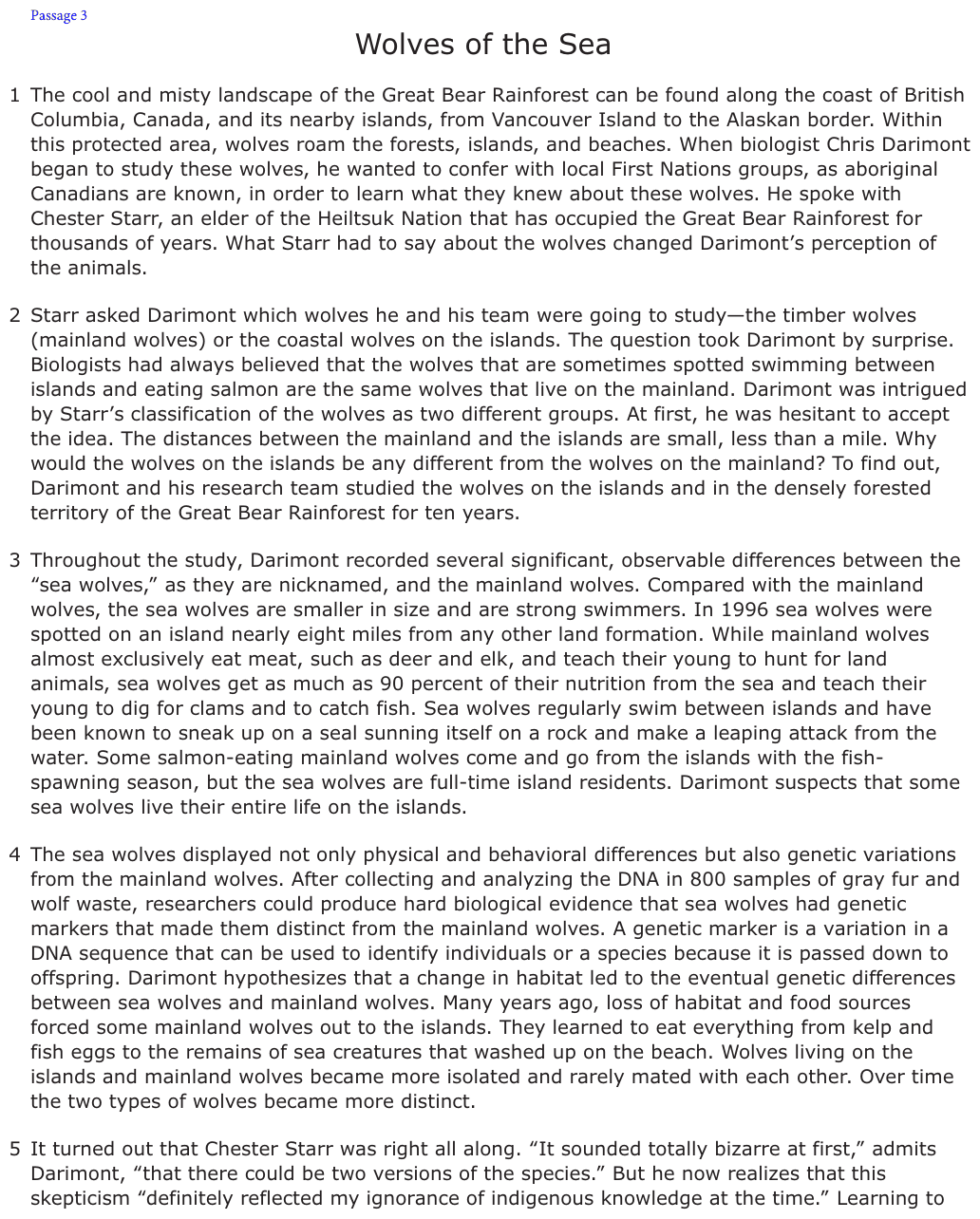
The cool and misty landscape of the Great Bear Rainforest can be found along the coast of British Columbia, Canada, and its nearby islands, from Vancouver Island to the Alaskan border. Within this protected area, wolves roam the forests, islands, and beaches. When biologist Chris Darimont began to study these wolves, he wanted to confer with local First Nations groups, as aboriginal Canadians are known, in order to learn what they knew about these wolves. He spoke with Chester Starr, an elder of the Heiltsuk Nation that has occupied the Great Bear Rainforest for thousands of years. What Starr had to say about the wolves changed Darimont’s perception of the animals.
Starr asked Darimont which wolves he and his team were going to study—the timber wolves (mainland wolves) or the coastal wolves on the islands. The question took Darimont by surprise. Biologists had always believed that the wolves that are sometimes spotted swimming between islands and eating salmon are the same wolves that live on the mainland. Darimont was intrigued by Starr’s classification of the wolves as two different groups. At first, he was hesitant to accept the idea. The distances between the mainland and the islands are small, less than a mile. Why would the wolves on the islands be any different from the wolves on the mainland? To find out, Darimont and his research team studied the wolves on the islands and in the densely forested territory of the Great Bear Rainforest for ten years.
Throughout the study, Darimont recorded several significant, observable differences between the “sea wolves,” as they are nicknamed, and the mainland wolves. Compared with the mainland wolves, the sea wolves are smaller in size and are strong swimmers. In 1996 sea wolves were spotted on an island nearly eight miles from any other land formation. While mainland wolves almost exclusively eat meat, such as deer and elk, and teach their young to hunt for land animals, sea wolves get as much as 90 percent of their nutrition from the sea and teach their young to dig for clams and to catch fish. Sea wolves regularly swim between islands and have been known to sneak up on a seal sunning itself on a rock and make a leaping attack from the water. Some salmon-eating mainland wolves come and go from the islands with the fish-spawning season, but the sea wolves are full-time island residents. Darimont suspects that some sea wolves live their entire life on the islands.
The sea wolves displayed not only physical and behavioral differences but also genetic variations from the mainland wolves. After collecting and analyzing the DNA in 800 samples of gray fur and wolf waste, researchers could produce hard biological evidence that sea wolves had genetic markers that made them distinct from the mainland wolves. A genetic marker is a variation in a DNA sequence that can be used to identify individuals or a species because it is passed down to offspring. Darimont hypothesizes that a change in habitat led to the eventual genetic differences between sea wolves and mainland wolves. Many years ago, loss of habitat and food sources forced some mainland wolves out to the islands. They learned to eat everything from kelp and fish eggs to the remains of sea creatures that washed up on the beach. Wolves living on the islands and mainland wolves became more isolated and rarely mated with each other. Over time the two types of wolves became more distinct.
It turned out that Chester Starr was right all along. “It sounded totally bizarre at first,” admits Darimont, “that there could be two versions of the species.” But he now realizes that this skepticism “definitely reflected my ignorance of indigenous knowledge at the time.” Learning to trust the wisdom of the Heiltsuk people opened Darimont up to knowledge accumulated over millennia and positioned him so that he could gather new scientific evidence about one of British Columbia’s most elusive species, the sea wolf.
Question
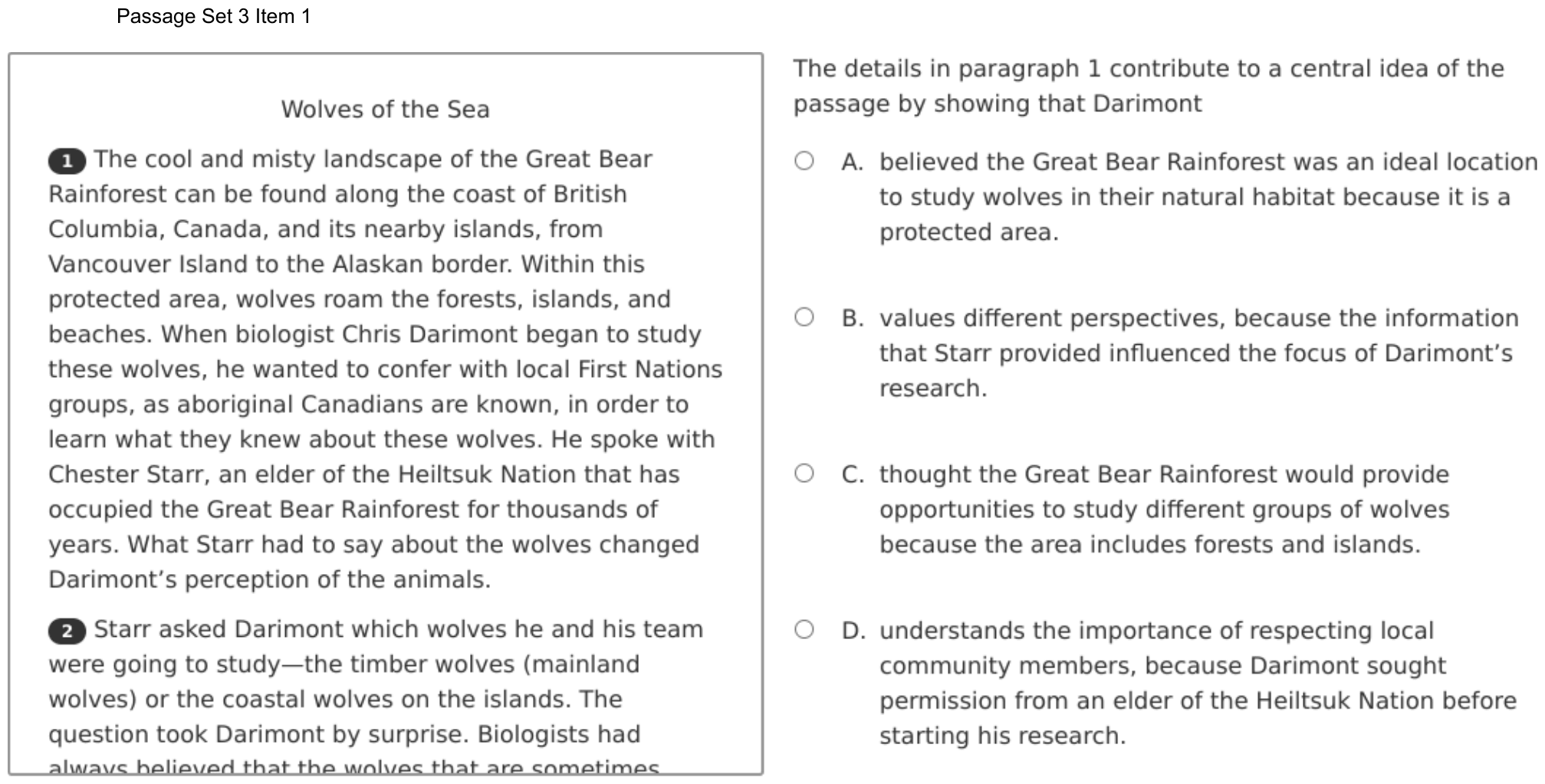
The details in paragraph 1 contribute to a central idea of the passage by showing that Darimont
- Abelieved the Great Bear Rainforest was an ideal location to study wolves in their natural habitat because it is a protected area.
- Bvalues different perspectives, because the information that Starr provided influenced the focus of Darimont’s research.
- Cthought the Great Bear Rainforest would provide opportunities to study different groups of wolves because the area includes forests and islands.
- Dunderstands the importance of respecting local community members, because Darimont sought permission from an elder of the Heiltsuk Nation before starting his research.
Show the answer
Correct answer: B
The question asks how the details about Darimont in paragraph 1 contribute to a central idea of the passage.
A. Incorrect. Although paragraph 1 includes the detail that the Great Bear Rainforest is a protected area, finding an ideal location to study wolves is not a central idea of the passage. Additionally, the paragraph does not describe Darimont’s beliefs about the Great Bear Rainforest.
B. CORRECT. Paragraph 1 explains why Darimont wanted to consult with Chester Starr, an elder of the Heiltsuk Nation: “When biologist Chris Darimont began to study these wolves, he wanted to confer with local First Nations groups, as aboriginal Canadians are known, in order to learn what they knew about these wolves.” The details in paragraph 1 show that Darimont valued Starr’s perspective (“What Starr had to say about the wolves changed Darimont’s perception of the animals”), even though it was different from Darimont’s own perspective at that time.
C. Incorrect. Paragraphs 1 and 2 show that Darimont did not initially believe that the mainland wolves and the coastal wolves were different groups. Therefore, the details in paragraph 1 do not provide evidence that Darimont chose the Great Bear Rainforest because of an expectation that there were separate groups of island wolves and timber wolves. Instead, he chose the Great Bear Rainforest for the opportunity to study what he had presumed to be one group of wolves.
D. Incorrect. Although Darimont sought out Chester Starr, an elder of the Heiltsuk Nation, before beginning his research, Darimont’s purpose in doing so was not to request Starr’s permission to study the wolves but to learn from Starr’s expert knowledge of the area and its wolves (“When biologist Chris Darimont began to study these wolves, he wanted to confer with local First Nations groups, as aboriginal Canadians are known, in order to learn what they knew about these wolves” [paragraph 1]).
Question analysis
This central idea question on “Wolves of the Sea,” an article about the coastal wolves of British Columbia’s Great Bear Rainforest, asks what the details in paragraph 1 show about the biologist Chris Darimont. Students must connect an introductory paragraph to the idea the whole passage develops, and each choice pairs a claim about Darimont with a reason that has to be checked.
- Grade level
- Grade 7 reading and task
- Compared with grade 7
- At grade 7 Linking an opening paragraph’s details to a central idea is standard grade 7 work. Paragraph 1 is plainly written, but each choice is a two-part claim about Darimont with a reason attached, so both halves must be checked against the text.
- Estimated difficulty
- Moderate: several steps, or a close reading with one strong distractor.
- Thinking it demands
- Depth of knowledge 2, skills and concepts · mainly analyze
- What makes it hard
- Reading between the lines moderate
- A very close wrong answer moderate
- Evidence in several places minor
- Evidence
- Answered from several paragraphs or stanzas
- Reading level
- Passage: about grade 10, 662 words; question and choices: about grade 13, 97 words.
- Corrected from the DOE handbook
- A missing word in the explanation was restored.
- Students, last 30 days
- Not enough answers yet to show (it takes 10).
Why it is hard, traps and wrong answers (shows the answer)
Why it is hard
Every choice pairs a claim about Darimont with a reason, so students who check only the first half can talk themselves into the respect choice, whose motive, asking permission, is a real-world custom the paragraph never mentions. The paragraph’s setting details, a protected area of forests and islands, invite readers to build beliefs about the study site that Darimont never states. The question rewards reading paragraph 1 as the opening of the passage’s larger story: a scientist learning from local knowledge.
Reading between the lines moderate Working it out
Paragraph 1 never says Darimont values other views; that has to be drawn from his wish “to learn what they knew” and from Starr changing “Darimont’s perception of the animals.” (Graesser, Singer & Trabasso, 1994; Kintsch, 1998)
A very close wrong answer moderate Choosing the answer
The respect choice shares the key’s picture of Darimont turning to the Heiltsuk and differs only in its reason: asking an elder’s permission instead of learning what the Heiltsuk knew about the wolves. (Embretson & Wetzel, 1987; Gorin & Embretson, 2006; Ascalon et al., 2007)
Evidence in several places minor Working it out
The central idea the paragraph serves is stated only in paragraph 5, where trusting “the wisdom of the Heiltsuk people” opens Darimont to knowledge “accumulated over millennia.” (Kirsch & Mosenthal, 1990; Gorin & Embretson, 2006)
Strategy: Sum up what paragraph 1 says Darimont did and why, recall what the passage as a whole is about, and test both parts of each choice, the claim and its reason, against the paragraph’s own words.
Traps
- Outside knowledge: A choice is plausible in the real world but not supported by this text.
- Twists what the text says: Uses the text's topic and ideas but changes what it says: who did it, how much, when, or why.
- Word match: Repeats striking words or phrases from the text, so it looks supported, but its meaning does not fit the question.
The wrong answers, classified
A Word match (Freedle & Kostin, 1993)
Picks up “protected area” from paragraph 1 and turns it into Darimont’s reason for choosing the site, though the paragraph never says what he thought of the rainforest.
C Twists what the text says (King et al., 2004)
Credits Darimont with expecting different groups of wolves, though it was Starr who drew that line; paragraph 2 says the question “took Darimont by surprise.”
D Outside knowledge (King et al., 2004; Recht & Leslie, 1988)
Supplies a familiar custom, asking an elder’s permission before research begins, though paragraph 1 says Darimont went to the First Nations “to learn what they knew about these wolves.”
What was corrected from the DOE handbook, and why
- Explanation: The DOE’s explanation of Option C says Darimont “chose Great Bear Rainforest.” The passage, and the next sentence of the same explanation, say “the Great Bear Rainforest,” so the site adds “the.”
Working it out, step by step
Figure out what the question asks
This is a central idea question. A central idea is a main point the whole passage builds. You need to see how paragraph 1 helps build that point. Each choice has two parts: something about Darimont, and a reason. Both parts must match the paragraph.
Find the passage’s central idea
The last paragraph spells it out. Starr “was right all along.” Then it says, “Learning to trust the wisdom of the Heiltsuk people opened Darimont up to knowledge accumulated over millennia.” Millennia means thousands of years. So a central idea is that a scientist learned from the long knowledge of the local people.
Read what paragraph 1 shows
Paragraph 1 says Darimont “wanted to confer with local First Nations groups, as aboriginal Canadians are known, in order to learn what they knew about these wolves.” To confer is to talk and share ideas. The paragraph ends, “What Starr had to say about the wolves changed Darimont’s perception of the animals.” His perception is the way he saw and understood them. So Darimont listened to a different point of view, and it changed how he saw the wolves.
Check each choice
- A is wrong. The paragraph calls the area protected. But it never says what Darimont thought of it as a place to study.
- B is right. A perspective is a point of view. Darimont wanted to hear what the First Nations knew. Starr’s words changed how he saw the wolves and what he set out to study.
- C is wrong. Darimont did not expect two groups of wolves. In paragraph 2, Starr’s question “took Darimont by surprise.”
- D is wrong. Darimont never asks for permission. He went “to learn what they knew about these wolves.”
Watch out: D sounds kind and respectful, so it pulls hard. But asking an elder’s permission is a custom you may know from real life. The paragraph never mentions it.
Choose the answer
Paragraph 1 shows Darimont seeking out what Starr knew and letting it change his view. That fits the passage’s central idea about trusting local knowledge. So the answer is B, “values different perspectives, because the information that Starr provided influenced the focus of Darimont’s research.”
Why this answer and not the closest wrong one
D is the closest wrong answer. Like B, it shows Darimont turning to a Heiltsuk elder. But its reason is wrong. Paragraph 1 says he wanted “to learn what they knew about these wolves,” not to get permission. B gives the reason the passage gives: what Starr knew changed Darimont’s view.
More questions like this
The original DOE question
The passage “Wolves of the Sea” as printed (pages 23–24)