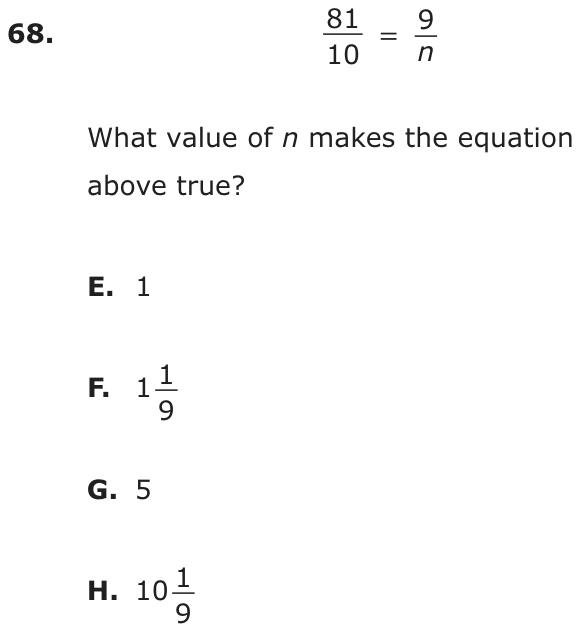
Question
What value of n makes the equation above true?
- A1
- B
- C5
- D
Show the answer
Correct answer: B
| Cross multiply. | |
| Apply the multiplicative inverse property; divide both sides of the equation by 81. | |
| Then simplify the fraction. |
Question analysis
This question gives the proportion 81/10 = 9/n and asks for the value of n that makes it true. Students solve a proportion by cross-multiplying and dividing, then simplify the result. Reducing the resulting fraction and matching its form to the choices is where students slip.
- Grade level
- Grade 6 content, by NYS standard
- Compared with grade 7
- Below grade 7 Solving a proportion is familiar from grades 6 and 7, and this one needs only cross-multiplying and one division. Its one extra demand is simplifying the result and writing it in the form the choices use.
- Estimated difficulty
- Straightforward: two steps or one careful reading.
- Thinking it demands
- Depth of knowledge 1, recall and reproduction · mainly apply
- What makes it hard
- An answer in an unexpected form moderate
- A very close wrong answer minor
- Solution
- 3 steps
- Reading level
- Question and choices: about grade 7, 12 words.
- Students, last 30 days
- Not enough answers yet to show (it takes 10).
Why it is hard, traps and wrong answers (shows the answer)
Why it is hard
The proportion solves in one cross-multiplication, but the result is an improper fraction that must be simplified and rewritten to match. Students who notice that 81 is 9 × 9 can shortcut it: the numerator shrinks by a factor of 9 from left to right, so the denominator must shrink too, giving 10 ÷ 9. The mixed-number form is where answers drift, by dropping the leftover ninth or by writing 10 × 1/9 as 10 1/9.
An answer in an unexpected form moderate Choosing the answer
Cross-multiplying gives n = 90/81, which has to be reduced to 10/9 and rewritten as the mixed number 1 1/9 before it matches any choice. (Enright, Morley & Sheehan, 2002)
A very close wrong answer minor Choosing the answer
The choices 1 and 1 1/9 differ by one ninth, and estimating 90 ÷ 81 as about 1 cannot separate them; only keeping the remainder does. (Embretson & Wetzel, 1987; Gorin & Embretson, 2006; Ascalon et al., 2007)
Strategy: Cross-multiply to get 81n = 90, divide both sides by 81, and simplify the fraction before comparing it with the choices.
Traps
- A faulty procedure: A systematic but wrong procedure: adding fractions straight across, applying an exponent to each term of a sum, dropping a sign when moving a term.
- Answer in another form: The right answer is written differently from the way you worked it out.
The wrong answers, classified
A Rounds too early (King et al., 2004)
Finds n by dividing 10 by 9 but keeps only the whole-number part of the quotient, 1, dropping the remainder that the exact answer needs.
C Little reason to choose it (Haladyna & Downing, 1993; Rodriguez, 2005)
No cross-multiplication or scaling of 81/10 gives 5, which would make 9/n equal 1.8 instead of 8.1, so it mostly catches guesses.
D A faulty procedure (Brown & Burton, 1978; Tatsuoka, 1983)
Reaches n = 10 × 9/81 = 10 × 1/9 but writes the product as the mixed number 10 1/9, as if a whole number beside a fraction meant multiplication.
Worked solution, step by step
Formulas used
- Cross-multiplying
- a over b and c over d are two equal fractions, and b and d are not 0. Multiply each top by the other bottom. The two products are equal. It works because it is the same as multiplying both sides by b and by d.
- Simplifying a fraction
- a over b is a fraction, and k is a number that divides both the top and the bottom. Dividing the top and the bottom by the same number gives an equal fraction with smaller numbers.
- Fraction to mixed number
- a over b is a fraction whose top is bigger than its bottom. q is the quotient, how many whole times b fits into a. r is the remainder, what is left over. The leftover stays over the same bottom number.
Sort out the question
The equation says two fractions are equal: and . n is an unknown bottom number. You need the value of n that makes them equal. Some choices are mixed numbers, so n may not be a whole number.
Cross-multiply the two fractions
Multiply each top by the other fraction’s bottom. This gets n out of the bottom of the fraction.
Divide both sides by 81
81n means 81 times n. To undo multiplying by 81, divide both sides by 81.
Now simplify. 90 and 81 are both in the 9 times table, so divide the top and bottom by 9.
Write it as a mixed number
10 ÷ 9 is 1 with 1 left over. The leftover stays over 9.
Watch out: keep the leftover. Dropping it gives 1, choice A. Also, ten ninths is not 10 and one ninth. That mixed number, , is choice D, which is far too big. So the answer is B, .
Check your answer
Estimate. is about 8. For to be about 8, n must be a little more than 1. Check exactly: . It matches.
More questions like this
The original DOE question