Question
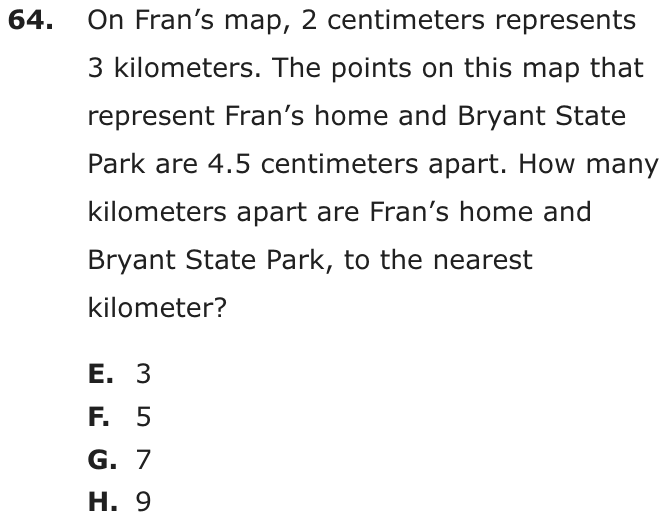
On Fran’s map, 2 centimeters represents 3 kilometers. The points on this map that represent Fran’s home and Bryant State Park are 4.5 centimeters apart. How many kilometers apart are Fran’s home and Bryant State Park, to the nearest kilometer?
- A3
- B5
- C7
- D9
Show the answer
Correct answer: C
Let x represent the distance, in kilometers, between Fran’s house and Bryant State Park. Set up a proportion to solve for x:
| Cross multiply. | |
| Apply the multiplicative inverse property; divide both sides of the equation by 2. | |
Question analysis
On Fran's map, 2 centimeters represent 3 kilometers, and her home and Bryant State Park are 4.5 centimeters apart on the map. Students find the real distance to the nearest kilometer. It is a map-scale proportion problem: the scale must be applied in the right direction, and the result rounded.
- Grade level
- Grade 7 content, by NYS standard
- Compared with grade 7
- At grade 7 Map scales are standard grade 7 proportional reasoning, and this problem is typical: one distance, one scale, then rounding. Nothing beyond a single proportion is needed.
- Estimated difficulty
- Straightforward: two steps or one careful reading.
- Thinking it demands
- Depth of knowledge 2, skills and concepts · mainly apply
- What makes it hard
- Turning words into math minor
- Error-prone arithmetic minor
- Solution
- 3 steps
- Reading level
- Question and choices: about grade 8, 37 words.
- Students, last 30 days
- Not enough answers yet to show (it takes 10).
Why it is hard, traps and wrong answers (shows the answer)
Why it is hard
This is a one-proportion map question, and the only judgments are the direction of the scale and when to round. The phrase to the nearest kilometer tempts some students to round the scale itself before multiplying, which lands on a listed answer two kilometers too far. Rounding only the final 6.75 keeps the result right.
Turning words into math minor Understanding the question
“2 centimeters represents 3 kilometers” gives 1.5 kilometers per centimeter; set up the other way round, the scale shrinks the 4.5 centimeters instead of enlarging them. (Hegarty, Mayer & Monk, 1995; Koedinger & Nathan, 2004)
Error-prone arithmetic minor Working it out
The map distance is a decimal, 4.5 × 3 ÷ 2 = 6.75, and the result must then be rounded to the nearest kilometer, two places where a quick estimate drifts. (Brown & Burton, 1978; Junker & Sijtsma, 2001)
Strategy: Work out how many kilometers 1 centimeter on the map stands for, multiply by 4.5, and round only at the very end.
Traps
- Wrong operation: Adds instead of multiplying, divides the wrong way round, turns a ratio or rate upside down, or undoes a step in the wrong direction (subtracts what should be added back).
- Rounds too early: Rounds a value partway through, or rounds the wrong way, so the final answer drifts from the exact one.
- Units or scale: The answer is wanted in other units, or a rate or scale must be converted first.
The wrong answers, classified
A Wrong operation (Hegarty, Mayer & Monk, 1995; King et al., 2004)
Turns the scale upside down, multiplying 4.5 by 2/3 instead of 3/2, so the real distance comes out smaller than the map distance.
B Units or scale (King et al., 2004)
Takes the 4.5 centimeters on the map as kilometers and rounds to 5, never applying the scale that turns each centimeter into 1.5 kilometers.
D Rounds too early (King et al., 2004)
Rounds the scale of 1.5 kilometers per centimeter up to 2 before multiplying, so 4.5 × 2 = 9 instead of 6.75.
Worked solution, step by step
Formulas used
- Scale proportion
- A map shrinks every distance by the same amount. So real distance over map distance makes the same fraction everywhere on the map. Put kilometers on top on both sides and centimeters on the bottom. Then solve for the missing number.
Sort out the question
On Fran’s map, 2 centimeters stand for 3 kilometers in real life. Her home and the park are 4.5 centimeters apart on the map. You need the real distance in kilometers, rounded to the nearest whole kilometer.
Set up the proportion
Let x be the real distance, in kilometers. Put kilometers on top and centimeters on the bottom, on both sides.
Solve for x
To get x alone, multiply both sides by 4.5.
So the real distance is 6.75 kilometers. Watch out: keep the scale exact until the end. Rounding 1.5 kilometers per centimeter up to 2 gives , choice D.
Round to the nearest kilometer
6.75 is between 6 and 7. Its decimal part, 0.75, is more than 0.5, so round up to 7.
Watch out: don’t flip the scale. Multiplying 4.5 by gives 3, choice A. So the answer is C, 7.
Check your answer
Each centimeter stands for kilometers. So 4 centimeters is 6 kilometers, and half a centimeter is 0.75 kilometer. That adds to 6.75, which rounds to 7. The real number should be bigger than 4.5, and it is.
More questions like this
The original DOE question