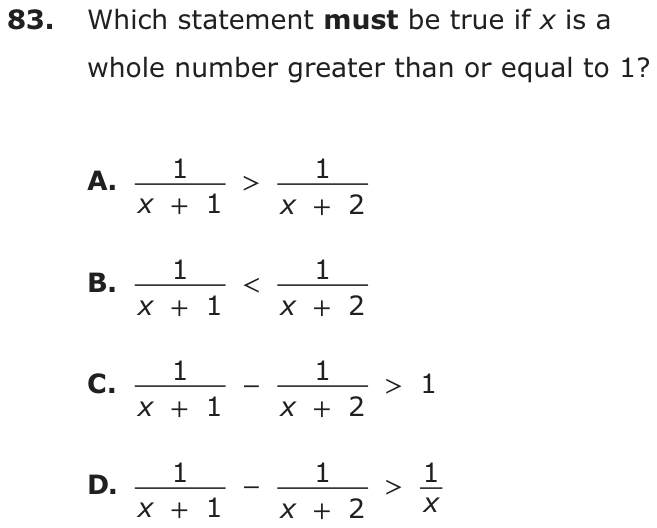
Question
Which statement must be true if x is a whole number greater than or equal to 1?
- A
- B
- C
- D
Show the answer
Correct answer: A
Let , and substitute that value for x in each inequality to determine which one is correct:
Option A:
. This is true.
Option B:
. This is false.
Option C:
, or . This is false.
Option D:
, or . This is false.
Option A is the only true inequality.
Question analysis
This question asks which of four inequalities must be true when x is a whole number of at least 1. The inequalities compare fractions with denominators x + 1 and x + 2, or their difference. Students reason about how the size of a fraction changes as its denominator grows, and must be sure a statement holds for every allowed value.
- Grade level
- Grade 6 content, by NYS standard
- Compared with grade 7
- At grade 7 Comparing fractions is familiar, but these fractions have variable denominators and the question asks what must be true for every whole number from 1 up. That abstraction makes it as demanding as typical grade 7 work, though the arithmetic is light.
- Estimated difficulty
- Moderate: several steps, or a close reading with one strong distractor.
- Thinking it demands
- Depth of knowledge 2, skills and concepts · mainly analyze
- What makes it hard
- Variables instead of numbers moderate
- Every choice must be checked moderate
- Error-prone arithmetic minor
- Solution
- 2 steps
- Reading level
- Question and choices: about grade 6, 20 words.
- Students, last 30 days
- Not enough answers yet to show (it takes 10).
Why it is hard, traps and wrong answers (shows the answer)
Why it is hard
Choosing a small value, such as x = 1 or 2, and testing every statement settles this quickly, because three of the four fail for any value tried. The trap is the belief that a bigger denominator makes a bigger fraction, which turns the true comparison around. Students unsure of fraction subtraction lose time on the two difference statements, though both differences are tiny, never more than 1/6.
Variables instead of numbers moderate Understanding the question
All four statements are about the unknown x, and the bold must means each has to hold for every whole number from 1 up, not just for a single test value. (Koedinger & Nathan, 2004; Enright, Morley & Sheehan, 2002)
Every choice must be checked moderate Choosing the answer
The statements are four separate inequalities, two comparisons and two differences, so each has to be tested; one counterexample is enough to rule a statement out. (Embretson & Wetzel, 1987)
Error-prone arithmetic minor Working it out
Testing the differences means subtracting unlike fractions, such as 1/3 − 1/4 = 1/12 when x = 2, and comparing the result with 1 and with 1/x. (Brown & Burton, 1978; Junker & Sijtsma, 2001)
Strategy: Substitute a small whole number such as 1 or 2 for x in all four statements, rule out any that fail, and confirm the survivor by thinking about larger denominators.
Traps
- Misunderstands the concept: A wrong belief about a concept: that percents can be added, that area grows like length, that averages can be averaged, that a bigger denominator means a bigger fraction.
- A faulty procedure: A systematic but wrong procedure: adding fractions straight across, applying an exponent to each term of a sum, dropping a sign when moving a term.
The wrong answers, classified
B Misunderstands the concept (Smith, diSessa & Roschelle, 1993; De Bock et al., 1998; Ni & Zhou, 2005)
Believes a bigger denominator makes a bigger fraction, so 1/(x + 2) seems larger than 1/(x + 1), the comparison turned around.
C Little reason to choose it (Haladyna & Downing, 1993; Rodriguez, 2005)
Both fractions are at most 1/2, so their difference can never exceed 1, and no common working makes it do so; this choice mostly draws guesses.
D A faulty procedure (Brown & Burton, 1978; Tatsuoka, 1983)
Subtracts over a common denominator but keeps only the numerator, (x + 2) − (x + 1) = 1, so the difference looks like 1, larger than 1/x once x is 2.
Worked solution, step by step
Formulas used
- Comparing unit fractions
- a and b are positive numbers, and b is bigger. One over a means one whole cut into a equal pieces. Cutting the same whole into more pieces makes each piece smaller. So the fraction with the bigger bottom is smaller.
- Subtracting fractions
- a and b are the bottoms of the two fractions. Rewrite both fractions over the common bottom a × b. Then subtract the tops. The bottom stays a × b.
Sort out the question
x is a whole number that is 1 or more, so x can be 1, 2, 3 and so on. You need the statement that must be true. That means it is true for every such x. One x that makes a statement false rules it out.
Test x = 1 in each statement
With x = 1, x + 1 is 2 and x + 2 is 3.
- A: . True.
- B: . False.
- C: , which is not more than 1. False.
- D: is not more than . False.
Only A is true when x = 1. So B, C and D are out.
Make sure A is always true
Must means A has to work for every x, not just 1. In and , both tops are 1. The bottom x + 2 is always 1 more than x + 1. Cutting a whole into more pieces makes each piece smaller. So A is always true. Watch out: a bigger bottom makes a smaller fraction, not a bigger one. Thinking the other way gives choice B.
See why C and D always fail
Use the subtracting rule with a = x + 1 and b = x + 2.
The bottom is at least 2 × 3 = 6, so the difference is at most . That is less than 1. Its bottom is also bigger than x, so it is less than . Watch out: keep the bottom when you subtract. Keeping only the top, 1, leads to choice D. So the answer is A.
Check your answer
Try a bigger number, x = 9. A tenth of a pizza is more than an eleventh, so . The difference, , is tiny. It is less than 1 and less than . A still holds, and C and D still fail.
More questions like this
The original DOE question